Safety net programs are designed to protect us when times get tough. But a recent wave of legislative and administrative attacks to those programs has threatened vital food and health assistance for millions of families across Alabama and the nation.
The stakes are high for people who struggle to make ends meet. Medicaid is a health care lifeline for one in four Alabamians. The Supplemental Nutrition Assistance Program (SNAP) helps one in six Alabamians keep food on the table. The Temporary Assistance for Needy Families (TANF) program provides meager but essential cash assistance for thousands of parents living in deep poverty.
All of these services improve lives. But numerous legislative plans could erect harmful barriers that keep struggling Alabamians from getting the help they need to survive.
We all know that people get down on their luck sometimes. They lose a job, have a sick child or need time to recover from an injury. And most Alabamians – understanding that “there, but for the grace of God, go I” – want to do what they can to help people going through a rough time.
The way that we, collectively, help our fellow Americans is through the safety net, a set of publicly funded services designed to help people meet basic needs when things get tough. Safety net programs include:
Food assistance through the Supplemental Nutritional Assistance Program (SNAP).
Health insurance through Medicaid or the Children’s Health Insurance Program (known as ALL Kids in Alabama).
Unemployment compensation.
Disability benefits.
Cash assistance through Temporary Assistance for Needy Families (TANF).
Attacks on the safety net in Alabama and other states
Some conservatives have been trying to cut the safety net at state and federal levels. During the 2018 Farm Bill reauthorization debate, the Foundation for Government Accountability (FGA) and other groups encouraged Congress to restrict hungry people’s ability to put food on the table. But these efforts failed, and SNAP emerged even stronger than before.
After this failure, opponents of the safety net turned their attention to the friendlier administrative rule process. They sought to force rules through the federal Departments of Agriculture, Housing and Homeland Security to cut food and housing assistance to marginalized people, including immigrant families.
Alabama Arise members and our state and national partners have submitted thousands of comments against these proposed changes. This advocacy has stopped or slowed some harmful plans, including the state’s proposed Medicaid work requirement. But the threats persist.
Another insidious attack on the safety net is happening in state legislatures across the country, including Alabama. While Medicaid and SNAP operate largely by federal rules, states have some discretion in how they design their programs. This discretion is called “state options” in SNAP.
Groups like the FGA have combed through the choices states have made in these state options. They have written “model” state legislation that would force states to select the most restrictive options allowed under federal law. Some of these bills are crafted to sound “reasonable” to legislators and to the general public. But together, they are designed to cut millions of struggling people off from the help they need.
Barriers to food and health care for struggling Alabamians
Since 2016, Arise has fought successfully against harmful barriers that would keep struggling Alabamians from getting the help they need. And we’re geared up to continue that fight for years to come. Here are a few of the damaging legislative proposals we expect to see again:
Stigmatize SNAP and TANF participants by requiring some of them to be tested for illegal drugs. States that implemented this approach have found it expensive and ineffective, with few participants testing positive. The plans would deny assistance to people who refuse a drug test or fail a drug test more than once. But they would not guarantee those participants get treatment for substance use disorders.
Prohibit Alabama from requesting a waiver of time limits for a small class of SNAP participants called able-bodied adults without dependents (ABAWDs). New federal rules already severely restrict these waivers, and the governor should have the authority to respond to an economic or environmental crisis by ensuring affected Alabamians can get the food they need during bad times.
Impose work requirements on SNAP participants who are not already working and who are not seniors or people with disabilities. This proposal would end Alabama’s very promising volunteer job training and employment assistance program for SNAP participants. Instead of getting the real job training they need, SNAP participants would be forced either to engage in less effective job search programs or to lose food assistance their families desperately need.
Require participants in “public benefits” to engage in community service at schools, nonprofits or other places. This could cut off assistance to hundreds of thousands of Alabamians who cannot jump through complex administrative hoops. It also would be time-consuming and expensive for participating agencies.
Other costly, harmful proposed administrative barriers
Require a photo ID to buy groceries using an Electronic Benefit Transfer (EBT) card for SNAP. This would be a tremendous barrier for seniors, people with disabilities and other Alabamians with transportation challenges. It would require store clerks to learn complex federal rules about who is allowed to use SNAP benefits. And it would slow down grocery store checkout lines for everyone.
Impose an asset test on applicants for SNAP food assistance. Alabama ended asset tests for SNAP because they were complex, time-consuming and expensive to administer, especially for seniors. They also rarely identified anyone too wealthy to be eligible for assistance.
Impose complex, duplicative and costly verification of income and assets for Medicaid, SNAP or TANF. This would slow down the processing of applications and deny or delay essential health and nutrition services for eligible people.
Require SNAP applicants to “comply” with child support orders or seek child support from the other parent before receiving food assistance. Cutting food assistance for families behind in child support does nothing but make children hungrier. And cutting assistance to a parent who has not demanded child support may force victims of domestic violence or child abuse to choose between their safety and their next meal.
The bottom line
All of these harmful ideas would make life harder for struggling Alabamians. Several proposals also would force agencies to pay millions of dollars to private firms that operate verification and client tracking functions now performed by state employees. Most importantly – and most troublingly – these proposals would increase the number of sick and hungry people in Alabama.
Alabamians deserve shared prosperity and inclusion, not increased human suffering and isolation. That is why we oppose cuts to Medicaid, SNAP, TANF and other programs that help people reach their full opportunity. Arise’s members rose to this challenge during the Farm Bill debate and in response to harmful federal rule changes. And we know you will continue to help protect the safety net that protects all Alabamians when times get tough.
The U.S. Court of Appeals for the 5th Circuit struck down the Affordable Care Act’s individual mandate on Wednesday. The court then returned the case to a district judge to consider whether other parts of the law can remain intact after the ruling. Alabama Arise policy director Jim Carnes issued the following statement Thursday in response:
“This appalling decision puts health coverage at risk for tens of millions of people. And it imperils important consumer protections for every single American. The ruling won’t affect the 2020 marketplace coverage that Alabamians have signed up for under the Affordable Care Act. But it poses a long-term threat to the health and well-being of our people and our communities.
“Let’s be clear about what’s at stake if the ACA disappears. Tens of millions of Americans who gained coverage through Medicaid expansion would lose their insurance. Young adults would lose the right to stay on their parents’ plans until age 26. Coverage guarantees for people with preexisting health conditions like cancer and diabetes would vanish. And insurers no longer would have to cover vital services like maternity care, mental health care or treatment for substance use disorders.
“We can’t afford to go back to those bad old days. This rehashed assault on health coverage flies in the face of settled law, public opinion and common sense. And this ruling should be a call to action for Alabama. Our families and our workforce deserve the same opportunity as all other Americans to stay healthy and productive. We urge our lawmakers to expand Medicaid and move toward a future where everyone can get the health care they need to survive and thrive.”
The ICN has completed a successful first year of operation with strong help from consumer voices at the policy table. The network seeks to increase the share of Medicaid long-term care patients who receive services in home and community settings rather than in nursing facilities.
In Year 1, the ICN reached its five-year benchmark for this quality measure four years early, thanks to a new approach to care coordination, data analysis and consumer education. Medicaid implemented an accelerated enrollment process Oct. 1, as consumer advisers recommended. That process should further increase the share of home- and community-based participants in Year 2.
More than 15,000 of Alabama’s Medicaid long-term care patients reside in nursing facilities. Another 8,000 receive care in other settings. Because federal Medicaid rules originally targeted long-term care services to nursing home patients only, states must request “waivers” suspending those rules to deliver home- and community-based services. The ICN includes two of Alabama’s waiver programs, both managed through the state’s 13 Area Agencies on Aging.
Alabama Arise has a seat on the ICN’s governing board, along with our partners at AARP Alabama, the Alabama Disabilities Advocacy Program and Disability Rights and Resources. We’re also represented on the network’s Consumer Advisory Committee (CAC).
The CAC has a productive relationship with Alabama Select Network, the Blue Cross Blue Shield subsidiary that administers the ICN. The committee is promoting consumer choice in care settings and working to lift practical barriers to home- and community-based care.
Alabama Medicaid is at a moment of transformation, opening up opportunities for a new focus on improving health outcomes. And Alabama Arise is working hard to ensure community needs and voices stay at the forefront.
Medicaid primary care is moving from a statewide fee-for-service model to a system of seven Alabama Coordinated Health Networks (ACHNs). The regional, nonprofit ACHNs began offering services Nov. 1, focusing on prevention, care coordination and health improvements. The inclusion of consumer representatives on regional governing boards and advisory committees also allows an unprecedented opportunity for Medicaid consumers to provide input directly to program officials.
Alabama Arise held a community asset mapping meeting on June 11, 2019, in Mobile. We met at the Bay Area Women Coalition and Trinity Gardens Community Civic Club offices. The meeting was the first held as part of a local project to help shape a Medicaid quality improvement project with the Alabama Coordinated Health Network for southwest Alabama.
In a pilot program designed to take advantage of these reforms, Arise has partnered with the Bay Area Women Coalition to enhance the local health system’s ability to promote greater food security in the Trinity Gardens neighborhood of Mobile. We’ve reached more than 100 people over six community meetings this year.
The community engagement effort is producing results. We’ve identified potential leaders and worked with residents to prioritize their ideas. We’re also discussing ways to strengthen community input as Medicaid implements and evaluates quality improvement projects.
Arise is grateful for our partnership with our Trinity Gardens neighbors. And we hope to build similar connections in communities across Alabama.
It’s no secret that Alabama’s prisons are overcrowded, violent and inhumane. Any meaningful solution to this crisis must address two major challenges. First, it must alleviate the abysmal conditions inside Alabama’s prisons. Second, it must help people who are at risk of incarceration or re-incarceration become productive members of their communities. (See the key policy recommendations from Alabamians for Fair Justice below.)
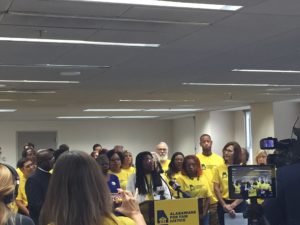
Dena Dickerson, executive director of the Offender Alumni Association, speaks during an Oct. 3 news conference at the State House in Montgomery. Dickerson was one of dozens of supporters of Alabamians for Fair Justice (AFJ) who assembled to show support for reforms to make Alabama’s corrections system more humane and restorative. Alabama Arise is a member of the AFJ coalition.
The missing voices who need to be heard
Alabama Arise has been following the study group’s learning curve on a broad array of criminal justice issues. In four public meetings since July, members have received a flood of statistics from prison administrators, sentencing specialists, law enforcement officers, prosecutors, judges, mental health officials and other experts. They also have toured multiple correctional facilities, becoming eyewitnesses to the shameful conditions they’re charged with improving.
Largely missing from this crash course: the voices of the people Alabama’s criminal justice system affects most. The panel should fill that gap by inviting testimony from inmates’ family members and formerly incarcerated individuals. Many of them have attended the public study group meetings, and the formal recommendations should reflect their lived experiences.
Policy solutions should ease reentry, reduce recidivism
Breaking the cycle of recidivism is a challenge that reaches beyond DOC, or even criminal justice policy. It also requires community partnerships to serve people with untreated mental health and addiction problems. These challenges can undermine successful reentry and often contribute to incarceration in the first place.
By targeting recidivism, the study group is highlighting our state’s overburdened community mental health and substance use services network. Medicaid expansion, at a 90% federal match, would allow Alabama to expand these services tenfold for the same state investment. The study group should urge our state to take this essential step forward.
The study group’s measured, highly visible approach to its complicated challenge is not one it can easily shrug off. The panel has set a high bar for meaningful recommendations, and Arise expects them to meet it. Arise and our partners in the Alabamians for Fair Justice alliance will keep up the pressure for comprehensive, lasting reform.
The path to a better corrections system
Alabama’s corrections system must become more humane and restorative. Alabama Arise and our allies in the Alabamians for Fair Justice coalition have proposed numerous changes to put our state on a path toward dignity, equity and justice for all. Here are a few of these recommendations:
Expand state investments in mental health care and treatment for substance use disorders.
Increase state support for mental health courts, pretrial diversion and reentry programs.
Reduce court costs and give people a reasonable amount of time to begin paying fines and restitution after returning from prison.
End automatic suspensions of driver’s licenses in cases unrelated to traffic safety.
Apply the state’s presumptive sentencing guidelines retroactively.
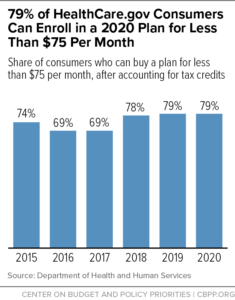
The deadline to #GetCovered is one month away! Open enrollment for 2020 Marketplace health coverage under the Affordable Care Act ends Sunday, Dec. 15, 2019. Don’t miss your chance to make sure you’re covered in case of accident or illness.
Visit healthcare.gov or call 800-318-2596 to explore your coverage options. And be sure to spread the word about this opportunity to your friends and family, too.
Even if you already have Marketplace coverage, we still recommend that you log in and double-check your options. Another plan may better meet your needs in the coming year.
Our state’s uninsured rate for children (3.5%) remained one of the best in the South in 2018. After years of improvement, though, Alabama’s number of uninsured children ticked up from 32,000 in 2016 to 41,000 in 2018.
That’s a warning sign that our policymakers should heed. Alabama must protect the coverage gains we’ve made through ALL Kids. And we should build on those gains by expanding Medicaid to cover adults with low incomes.
When parents have health insurance, their children are more likely to have coverage as well. Medicaid expansion would boost health security for struggling families across Alabama. That would be good for children, good for communities and good for our entire state.
Veterans Day gives Alabama a chance to shine. Our cities and towns hold parades and ceremonies each Nov. 11 to honor service members and to burnish the state’s reputation as a great place for veterans to retire.
This year, as we celebrate those who have risked and sacrificed to defend our country, let’s remember a group too often overlooked: veterans who have low incomes and no health insurance. And let’s commit to expanding Medicaid to help them meet their health needs.
It’s a common misconception that people who serve in the U.S. military automatically receive lifetime eligibility for health coverage and other benefits. In reality, though, veterans’ health benefits depend on their length of service, military classification, type of discharge and other factors. Treatment for service-connected conditions has no time-of-service requirement, but other health benefits do.
Active-duty service members and their families receive health coverage through the Department of Veterans Affairs (VA). Most also receive “bridge” health insurance coverage in the 180 days before and after their active-duty service.
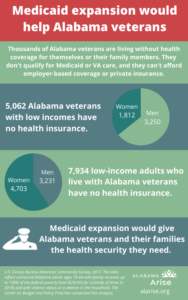
But many veterans — including many National Guard and Reserve members — return home without military health care for the long term. For the 13,000 Alabama veterans and adult family members who have no military health insurance and can’t afford private plans, the consequences can be dire.
A lasting commitment to Alabama’s uninsured veterans
Returning to civilian life can be challenging enough without the added burden of being uninsured. Injuries sustained from combat, environmental hazards or physical stress can cause chronic disability or loss of function. And the mental stress of combat and separation from family also puts some veterans at risk for mental health problems and substance use disorders. The rising rate of veteran suicides is stark evidence of this troubling toll.
There’s something Alabama can do to help. If we expanded Medicaid to adults earning up to 138% of the federal poverty level ($29,435 a year for a family of three), nearly 13,000 uninsured veterans and family members could get the health coverage they need. Medicaid expansion would be a meaningful and lasting commitment to make life better for veterans across Alabama.
The state’s uninsured rate for children (3.5%) remained one of the best in the South and was far below the national average (5.2%) in 2018. But after years of improvement, Alabama’s number of uninsured children ticked up from 32,000 in 2016 to 41,000 in 2018. (More Alabama-specific data is available at this link.)
The increase is a warning sign that Alabama could slip backward in children’s health care if policymakers do not protect and expand coverage, Alabama Arise policy director Jim Carnes said.
“Children’s health coverage has long been a point of pride for Alabama, and we can’t afford to backslide,” Carnes said. “ALL Kids and Medicaid have played huge roles in that success. And our state should build on those gains by expanding Medicaid to cover adults with low incomes as well. Medicaid expansion would boost financial security for struggling parents and increase the odds that their children get and stay insured. It would be good for children, good for families and good for Alabama.”
White House efforts to undermine the Affordable Care Act (ACA) also likely contributed to the coverage erosion, the report finds. Federal officials have shortened the open enrollment period for ACA Marketplace plans and have slashed outreach and advertising funding. Open enrollment for 2020 Marketplace coverage begins Nov. 1, 2019, and will continue until Dec. 15, 2019.