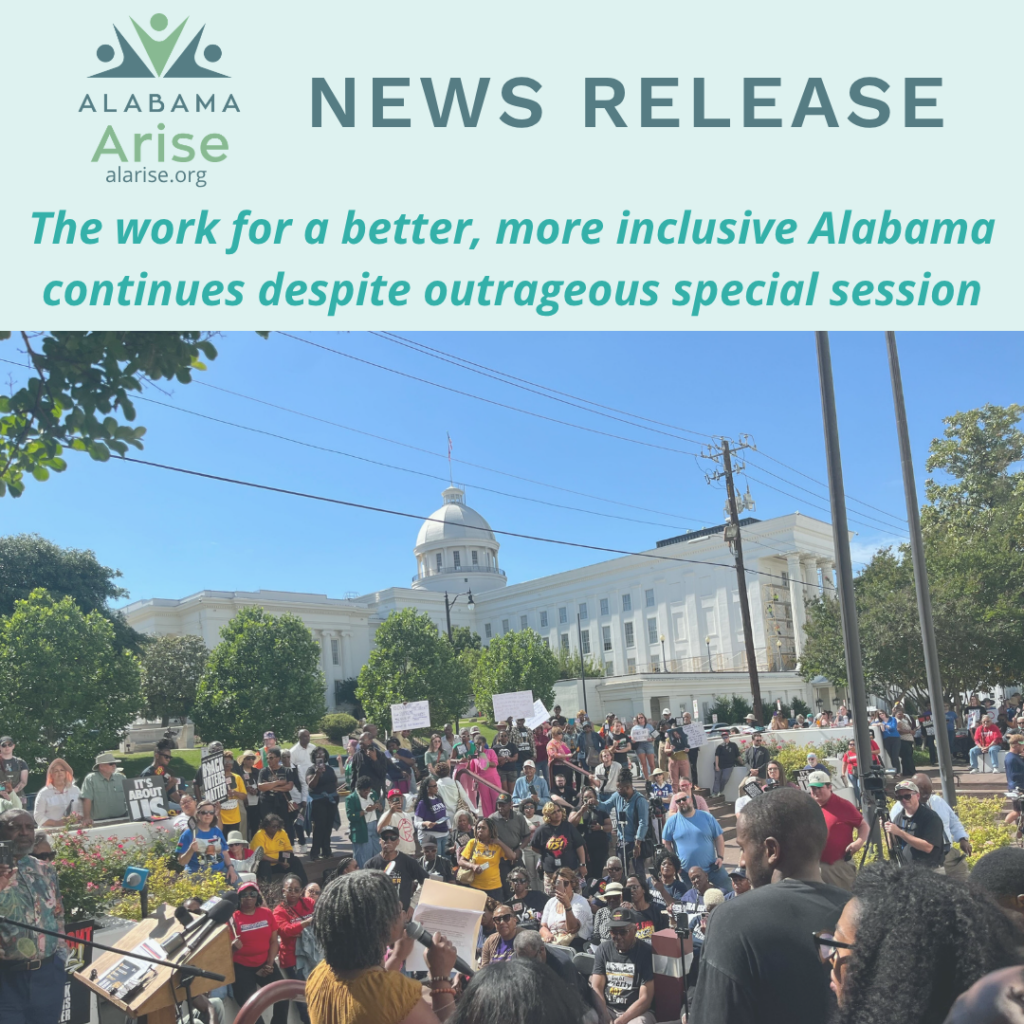
The work for a better, more inclusive Alabama continues despite an outrageous special session

Gov. Kay Ivey on Friday signed into law two bills that could set the stage for special primary elections in some of Alabama’s congressional and state Senate districts this year. Those special elections would occur if a federal court lifts an injunction blocking the state from using maps that it found to violate the Voting Rights Act. Ivey called legislators into a special session to pass the bills this week after a U.S. Supreme Court decision gutted key provisions of the Voting Rights Act last week.

Alabama Arise executive director Robyn Hyden released the following statement Friday in response:

“This special session was an affront to inclusive democracy and basic fairness, and it was a clear example of our policymakers’ misplaced priorities. Just days before Alabama’s primary election, our legislative leaders hurried to pass bills that would dilute Black Alabamians’ voting power. These new laws threaten to erode representation and engagement of all communities.

A large crowd rallies outside the Alabama State House in Montgomery, with the State Capitol in the background. Text: Alabama Arise news release: The work for a better, more inclusive Alabama continues despite outrageous special session.

“What lawmakers choose to prioritize shows what matters to them. Alabama legislators have declined for years to take action to close our state’s health coverage gap, or to expand access to public transportation and affordable housing. Instead of making needed investments to improve the quality of life for every Alabamian, our lawmakers rushed back to Montgomery for an outrageous 11th-hour redistricting effort that came after some voters already had cast absentee ballots in the upcoming primary. The estimated cost of these special elections, if they occur, is more than $5 million out of the General Fund.

“This special session and the U.S. Supreme Court ruling that prompted it both underscore the vital need for people across Alabama to show up and vote in the upcoming 2026 elections, including the May 19 primary. Alabama Arise will continue to work alongside advocates across our state to defend and expand voting rights, both this year and in the years to come.

“We will continue advocating for policies to reduce hunger and hardship. We will continue advocating to ensure people have the resources they need to secure a happy and healthy future. And we will continue advocating together to build a better, more inclusive Alabama for all.”

Alabamians must keep advocating to protect inclusive democracy

 Gov. Kay Ivey on Friday declared a special session starting Monday to redraw Alabama’s congressional and state Senate districts and provide for a special primary election this year using those new lines. The declaration comes after Wednesday’s U.S. Supreme Court decision that gutted key provisions of the Voting Rights Act.

Alabama Arise executive director Robyn Hyden released the following statement Friday in response:

“The U.S. Supreme Court struck a blow against inclusive democracy this week, gutting Voting Rights Act provisions that protect Black and Hispanic voters against efforts to dilute their voting power. Now, just weeks away from Alabama’s primary election, our lawmakers are seeking to redraw district lines and undermine Black Alabamians’ ability to elect candidates of their choice.

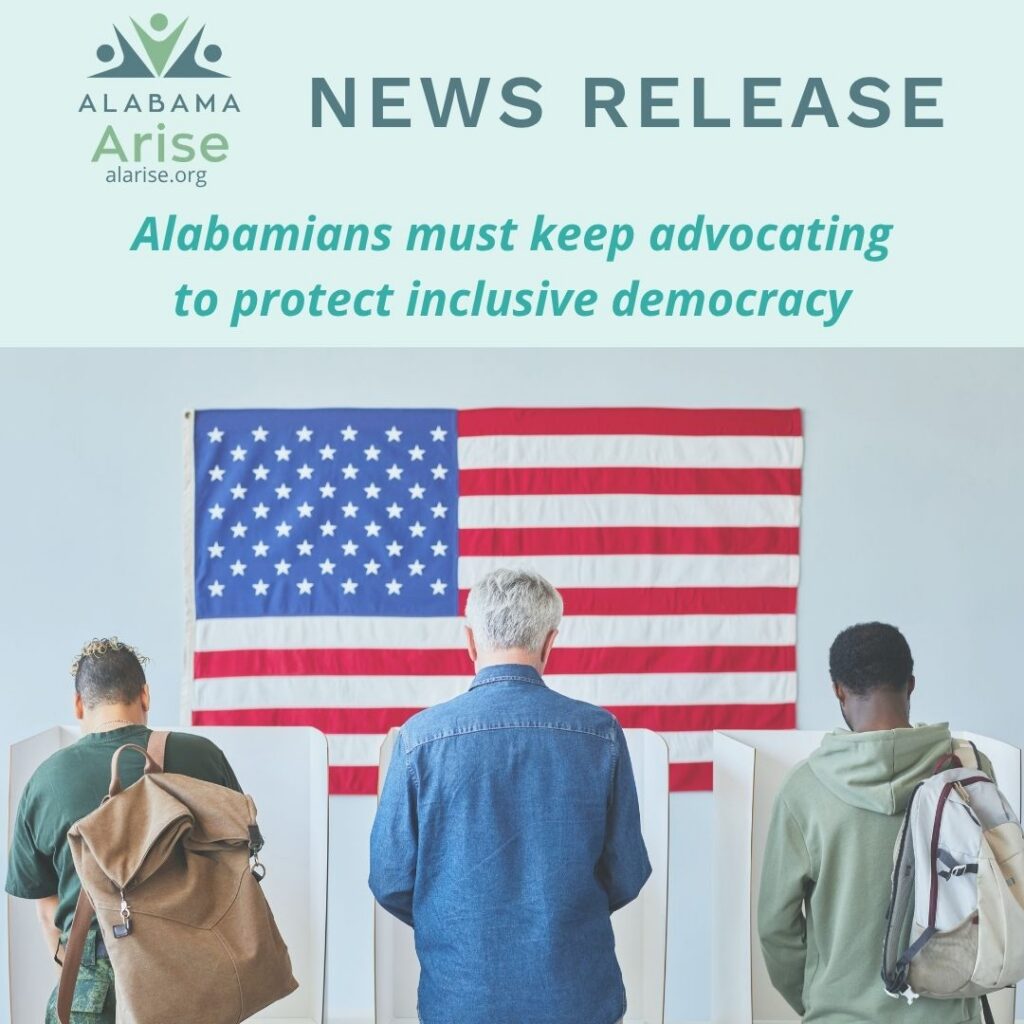
Three people stand in front of voting booths with an American flag on the wall in front of them. Text: Alabama Arise news release: Alabamians must keep advocating to protect inclusive democracy.

“The court’s ruling in Louisiana v. Callais is a travesty that further entrenches power in the hands of the few. It imperils the diversity of our elected bodies and representation of all communities. Many fair districts likely will vanish as legislatures gut representation for voters of color without checks from the courts.

“This ruling will have direct effects for Alabama. In an outrageous move, legislators are preparing to return Monday for a special session to redraw Alabama’s congressional and state Senate maps at the 11th hour, even though some voters already have cast their absentee ballots in the upcoming primary election.

“Alabama Arise will stand on the front lines with voting rights advocates across our state to fight any maps that remove fair representation. We encourage all Alabama voters to check their voter registration and polling place, and to make sure their friends and family are ready to vote. To build a better, more inclusive Alabama for all, we must ensure everyone’s voice is heard in our democratic process.”

El pueblo de Alabama debe seguir defendiendo la protección de la democracia inclusiva

Traducción de María Baker, CT

El viernes, la gobernadora Kay Ivey convocó a una sesión especial a partir del lunes para volver a delimitar los distritos electorales congresionales y del Senado estatal de Alabama y preparar una elección primaria especial este año usando estos nuevos límites. La declaración llega luego de la decisión de la Corte Suprema de Estados Unidos el pasado miércoles que dejó sin efecto provisiones clave de la Ley de Derecho al Voto.

Robyn Hyden, la directora ejecutiva de Alabama Arise, publicó la siguiente declaración este viernes, como respuesta:

“La Corte Suprema de Estados Unidos dio un golpe contra la democracia inclusiva esta semana, al desmantelar provisiones de la Ley de Derecho al Voto que protegen a los votantes negros e hispanos contra los esfuerzos para diluir el poder de su voto. Ahora, a unas pocas semanas de la elección primaria en Alabama, nuestros legisladores buscan trazar nuevos límites de distrito y debilitar la capacidad de la población negra de Alabama para elegir los candidatos que prefieren.

“El fallo de la corte en el caso Louisiana v. Callais es una farsa que concentra aún más el poder en las manos de unos pocos. Amenaza la diversidad de nuestros cuerpos de funcionarios electos y la representación de todas las comunidades. Es probable que muchos distritos justos se desvanezcan cuando la legislatura elimine la representación de los votantes de color sin control de los tribunales.

“Esta decisión tendrá efectos directos para Alabama. En una indignante medida, los legisladores se preparan para regresar el lunes para una sesión especial destinada a redibujar los mapas congresionales y del Senado estatal en Alabama a último momento, aunque algunos votantes ya enviaron sus boletas de voto en ausencia para las próximas elecciones primarias.

“Alabama Arise estará en la primera línea de defensa con activistas de derecho al voto de todo el estado para luchar contra cualquier mapa que elimine la representación justa. Animamos a todos los votantes de Alabama a verificar su inscripción para votar y su lugar de voto, y a asegurarse de que sus amigos y familiares estén listos para votar. Para construir un Alabama mejor y más inclusivo para todos, debemos asegurarnos de que todas las voces se escuchen en nuestro proceso democrático”.

Alabama Arise on state grocery tax holiday: ‘Two months is a good start toward forever’

A one-time, two-month holiday on Alabama’s state sales tax on groceries begins today. HB 527 by Rep. James Lomax, R-Huntsville, will reduce the state grocery tax from 2% to 0% starting today and continuing through June 30. The state grocery tax rate will return to 2% on July 1.

Alabama Arise executive director Robyn Hyden released the following statement Friday about the law’s implementation and what should happen next:

“Two months is a good start toward forever. Eliminating the state grocery tax – even temporarily – will make it easier for every Alabamian to make ends meet, especially in this time of persistently high food prices. People who are struggling to make ends meet will benefit the most of all.

“The grocery tax is a cruel tax on survival. It drives many families deeper into poverty, and Alabama Arise remains committed to the goal of eliminating it entirely. Arise members from every corner of our state have advocated tirelessly for decades for Alabama to untax groceries. And our work will continue until the state grocery tax is a thing of the past.

A smiling family stands around a table with a turkey and other foods atop it. Text: Alabama Arise news release. Alabama Arise on state grocery tax holiday: 'Two months is a good start toward forever.'

What should happen next

“The state grocery tax reductions in 2023 and 2025 were essential steps toward tax justice. But Alabama still remains one of nine states taxing groceries, and our legislators should commit to removing our state from that shameful list once and for all.

“As we work to untax groceries, we also must protect funding for our children’s education. Lawmakers should work together to end the state grocery tax sustainably and responsibly without harming Education Trust Fund revenues.

“Arise is open to numerous ideas for replacement revenue. We continue to support our longstanding proposal to replace grocery tax revenue by capping or ending the state income tax deduction for federal income tax payments. Alabama is the only state to allow this full deduction, which overwhelmingly benefits the wealthiest households. Closing this loophole would protect funding for public schools and ensure Alabama can afford to end the state sales tax on groceries forever.”

Labor groups announce Alabama Workers’ Week of Action

A coalition of Alabama labor groups and allies will partner next week to celebrate Alabama Workers’ Week of Action. The week will encompass Workers Memorial Day on April 28 and May Day, or International Workers’ Day, on May 1. Participating organizations include Alabama Arise, Jobs to Move America, the Alabama Coalition for Immigrant Justice and the United Campus Workers of Alabama.

“These two days, taken together, tell a powerful story,” said Adam Keller, Alabama Arise’s Worker Power Campaign director. “One reminds us of the human cost when workers are treated as disposable. The other reminds us of the strength workers have when we stand together and demand something better.”

Schedule of events

Throughout the week, numerous organizations will host virtual and in-person events. Here are some of the key events:

  • Monday, April 27, 6 p.m. – The Valley Labor Report will host a virtual kickoff call with speakers from Alabama Arise, Jobs to Move America, United Campus Workers and more. The call will be available for livestream at tvlr.fm/MayDay26.
  • Tuesday, April 28, 5:30 p.m. – Alabama Arise and League of Women Voters of Alabama will lead a workshop on Common Sense Economics for Alabama at Grace Presbyterian Church in Tuscaloosa.
  • Friday, May 1, 10 a.m. – 6 p.m. – 50501 Huntsville and the North Alabama Area Labor Council will be among the hosts of an all-day event at Butler Green at Campus 805 in Huntsville. The event will feature live music, including a performance from Lee Bains, plus workshops on labor history and community organizing.
  • Friday, May 1, noon – 8 p.m. – United Campus Workers at Jacksonville State University will host Labor Fest at the Public Square in Jacksonville. This family-friendly, community event will feature live music, games and a bounce house.
  • Friday, May 1, 2:30 p.m. – May Day Strong will host a screening of “Inequality for All” at the Crescent Theater in Mobile.
  • Friday, May 1, 5:30 p.m. – 50501 Dothan will hold a peaceful protest outside the Houston County Courthouse in Dothan.

“The labor movement is stronger than ever in Alabama,” said Luis Robledo, coalition manager for the Southern Program at Jobs to Move America. “This week we honor the memory of fallen workers and stand in solidarity with all Alabama workers organizing for better wages, better conditions, better benefits and more respect from Huntsville to Mobile.”

New Alabama Arise handbook explains how state taxes and budgets work – and how to improve them

Cover image of The Alabama Tax and Budget HandbookAlabama should reform its outdated, imbalanced tax system to help working people get ahead and to ensure adequate funding for vital services like education and health care, a new Alabama Arise handbook released Thursday concludes. Legislators also should implement several changes to make the state’s budgeting process more responsive and transparent, the handbook finds.

In The Alabama Tax and Budget Handbook, Arise uses graphs and illustrations to explain what state tax dollars pay for and where the state gets its money. The handbook highlights how key public services are funded and walks readers through how Alabama’s budgets become law annually.

Those explanations are especially timely as lawmakers work to finalize state budgets for fiscal year 2027. The handbook’s policy recommendations also could help legislators address future revenue declines, secure funding for unmet needs like Medicaid expansion and public transportation, and cover new state obligations for food assistance under the Supplemental Nutrition Assistance Program (SNAP).

The 84-page handbook also examines the state’s four major kinds of taxes – income, sales, property and business – to show how they measure up in terms of adequacy and equity for Alabamians and how they compare to taxes in other states.

“Our handbook is designed to help Alabamians better understand how state budgets and taxes affect their everyday lives,” said Carol Gundlach, Alabama Arise’s senior policy analyst and a handbook co-author. “We want to equip residents to advocate knowledgeably and effectively for policy changes that would improve life for their families and communities.”

The less you make, the more you pay: Alabama’s upside-down tax system

Alabama’s tax system is upside down and holds the state back from reaching its full potential, the handbook finds. On average, the lowest-paid fifth of Alabamians – those making less than $19,500 a year – pay nearly 12% of their incomes in state and local taxes. Meanwhile the wealthiest 1% – those making more than $484,300 annually – pay just 5.4%.
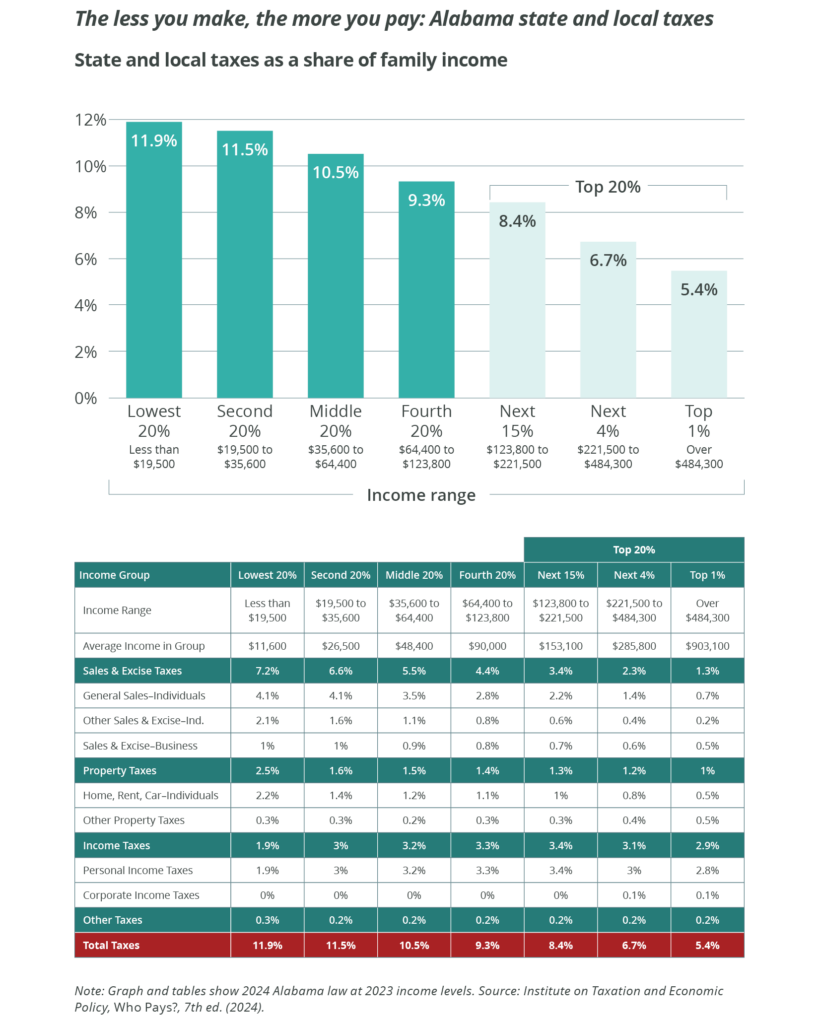
Bar graph of Alabama state and local taxes as a share of family income. Lowest 20% pays 11.9%. Second 20% pays 11.5%. Middle 20% pays 10.5%. Fourth 20% pays 9.3%. Next 15% pays 8.4%. Next 4% pays 6.7%. Top 1% pays 5.4%. Info reflects 2024 Alabama tax law at 2023 income levels. Source: Institute on Taxation and Economic Policy, Who Pays? (7th edition), 2024.

The biggest driver of this imbalance is Alabama’s overreliance on sales taxes, including on groceries and other necessities. Sales taxes hit families with low incomes the hardest because they must spend most of what they make on food, clothing and other items subject to sales tax just to get by. Lawmakers reduced Alabama’s state sales tax on groceries from 4% to 3% in 2023, and then to 2% in 2025. Even after those improvements, however, Alabama remains one of only nine states still taxing groceries.

Other aspects of the state’s tax system do little to offset the regressive effects of sales taxes, the handbook finds. The state’s income tax is relatively flat and taxes many families deeper into poverty. Alabama’s combined state and local property taxes are the nation’s lowest and provide large breaks to wealthy landowners. And skewed tax breaks like the state deduction for federal income taxes overwhelmingly benefit the wealthiest households at the expense of revenue for education and other services that benefit all Alabamians.

“Alabama’s upside-down tax structure makes it harder for families to make ends meet,” Gundlach said. “Our tax system forces people with low and middle incomes to subsidize enormous tax giveaways for wealthy households. And as the cost of living continues to rise, high sales taxes make food, clothing and other necessities even more expensive for struggling Alabamians.”

Opportunities to improve Alabama’s tax system

The handbook recommends numerous improvements to make Alabama’s taxes more equitable and allow stronger investments in public services. Here are a few key recommendations:

  • Modernize the sales tax on goods and services, including eliminating the grocery tax.
  • Make the income tax more progressive by increasing the standard deduction and establishing a state Earned Income Tax Credit.
  • Eliminate the federal income tax deduction for businesses and individuals.
  • Increase overall property tax rates while increasing the homestead exemption to protect homeowners with low incomes.
  • Adopt combined reporting, a practice that reduces tax avoidance by treating businesses and their subsidiaries as one taxpayer.
  • Limit tax incentives for luring companies to Alabama.

“Alabama’s tax system starves our state of the money we need to strengthen investments in education, health care, public transportation and other vital services that improve the quality of life for all of us,” Gundlach said. “Our lawmakers can and should take action to make our tax system more fair, more adequate and more sustainable.”

Opportunities to make state budgets more transparent and responsive

The budget process is more complicated in Alabama than in many other states. Most states have a single primary budget for public services, but Alabama has two. The Education Trust Fund supports services related to K-12 and higher education, and the General Fund supports all other services, including Medicaid and corrections.

Alabama also sets aside more than 90% of its revenues for a specific purpose, a process known as earmarking. Earmarks can help ensure stable funding for services, but they also can make it harder to understand state funding. In addition, earmarking can limit lawmakers’ ability to create a budget that adequately meets current needs, the handbook concludes.
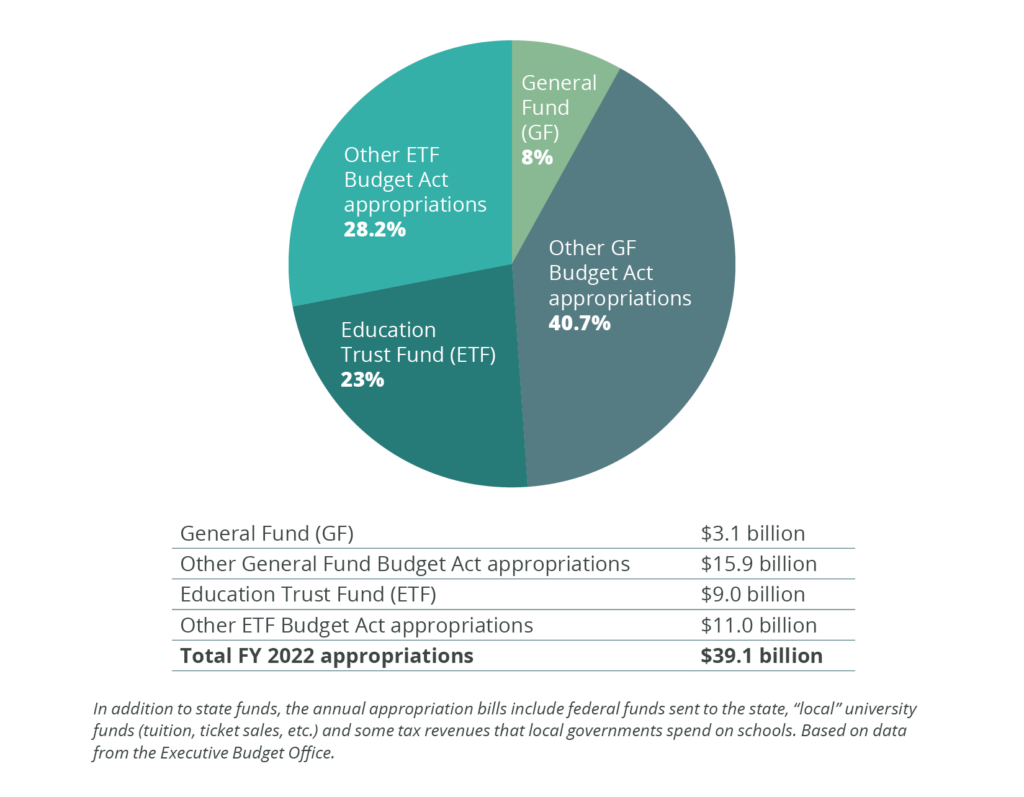
Pie graph showing shares of state spending: 8% General Fund (GF), other GF Budget Act approprations 40.7%, Education Trust Fund (ETF) 23%, other ETF Budget Act appropriations 28.2%. In addition to state funds, the annual appropriation bills include federal funds sent to the state, “local” university funds (tuition, ticket sales, etc.) and some tax revenues that local governments spend on schools. Based on data from the Executive Budget Office.

The handbook recommends new budgeting practices that would make Alabama’s budgets more transparent and adaptable. Here are a few key recommendations:

  • Forecast revenues for multiple years into the future.
  • Prepare fiscal notes with multiyear projections of bills’ revenue effects.
  • Get a stronger current-year baseline for the cost of public services.
  • Seek independent consensus revenue forecasts in addition to those from the Executive Budget Office and Legislative Services Agency.
  • Enhance fiscal flexibility through gradual earmarking reform.

“Alabamians deserve a government that gives everyone a voice and an economy that offers everyone a chance to get ahead,” Gundlach said. “By improving our state’s budget process and righting the wrongs of our upside-down tax system, we can build an Alabama that truly works for everyone.”

About the handbook

Alabama Arise published the first edition of The Alabama Tax and Budget Handbook in 2005 to help educate the public about how state taxes and budgets work and how they affect people’s everyday lives. Arise published a second edition in 2015 and now the new third edition in 2026.

Arise’s new handbook includes recent changes to state law and an expanded discussion of the budgeting process. The 2026 edition also explores how racism shaped the historical origins of many of Alabama’s tax and budget practices and examines the ongoing disparate racial impacts of those policies. The publication closes with a glossary defining terms commonly encountered in tax and budget debates.

Full handbook

The Alabama Tax and Budget Handbook is available to read online here. A downloadable PDF of the handbook is available here.

250+ advocates urge Alabama lawmakers to expand no-cost school breakfast

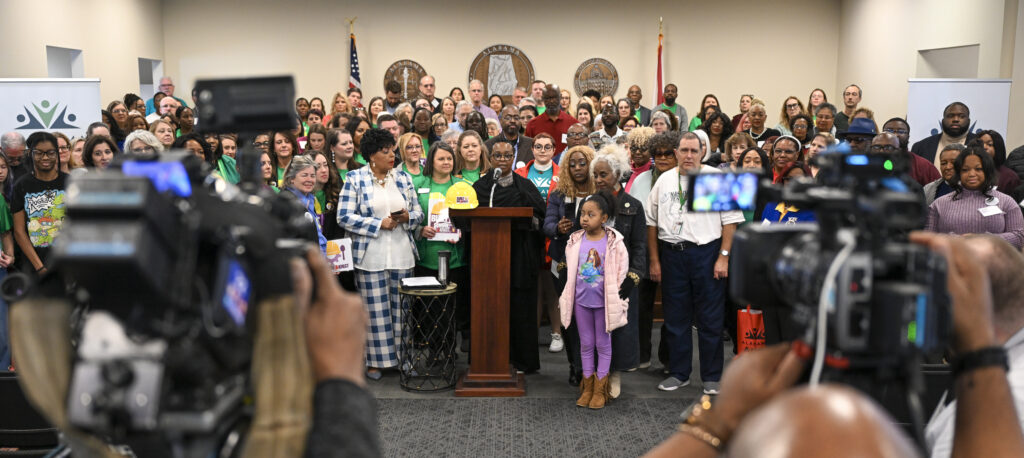
Dozens of people stand behind and to either side of a lectern in a committee room at the Alabama State House. Close-up shots of two videographers are in the foreground.
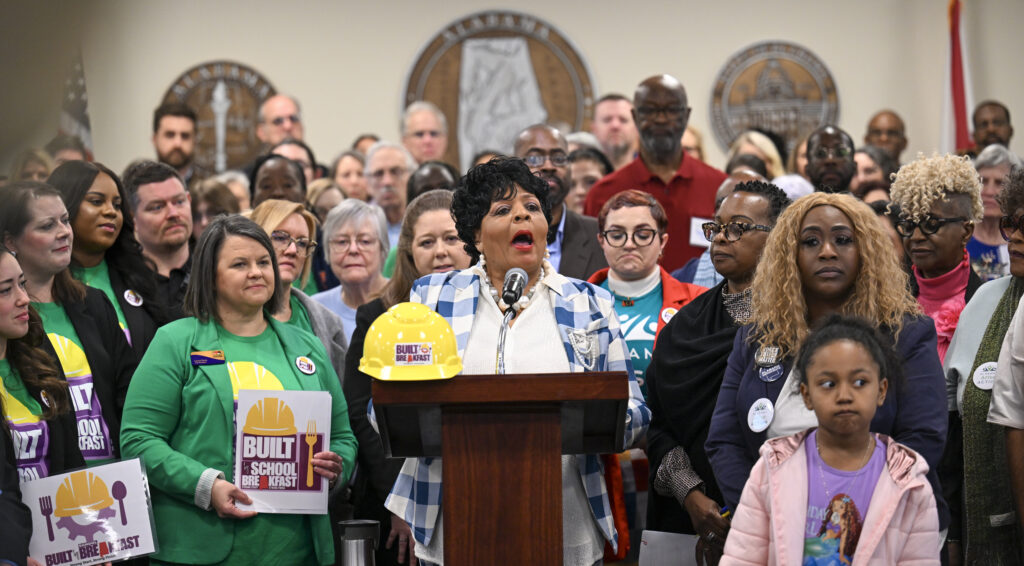
Dr. Shakita Brooks Jones, board president of Alabama Arise Action, speaks in support of no-cost school breakfast during Arise’s annual Legislative Day on Feb. 24, 2026, in Montgomery. (Photo by Julie Bennett)

Alabama should ensure access to no-cost breakfast for every child in the state’s public schools, Alabama Arise Action members told legislators Tuesday.

More than 210 Arise supporters gathered this week at the State House in Montgomery alongside dozens of members of the Alabama School Nutrition Association (ASNA) to show support for expanding no-cost school breakfast. The advocates urged legislators to provide $14 million next year to ensure no-cost breakfasts are available for every child in participating Alabama public schools.

The request would be less than 0.14% of Gov. Kay Ivey’s proposed $10.5 billion Education Trust Fund budget for fiscal year 2027. And that funding would provide long-term benefits for the people of Alabama, speakers at Arise’s news conference said Tuesday.

“Healthy school meals at no cost for all students are not an expense,” ASNA president Cacyce Davis said. “They are an investment in families. They are an investment in communities. And they are an investment in the future workforce of our state.”

ASNA members and Rep. Barbara Drummond, D-Mobile, joined Arise advocates at the news conference, which was part of Arise’s annual Legislative Day event.

Photos from the event are available here. Video from the news conference is available here.

Building on last year’s investment in child nutrition

Alabama lawmakers took an important step forward on child nutrition in 2025 by appropriating $7.3 million to expand access to no-cost school breakfasts for more public schools. More than 190,000 children have benefited from this investment in making school meals more readily available.

Arise advocates are asking lawmakers to provide $14 million in school breakfast funding next year so Alabama can maintain and build upon last year’s progress.

“That investment [in 2025] made a meaningful difference for districts across Alabama and for thousands of children who depend on school breakfast to start their day,” Davis said. “Because of that support, more students are walking in the classroom nourished and ready to learn.”

A woman speaks behind a lectern in a committee room at the Alabama State House. Dozens of people stand behind and beside her.
Rep. Barbara Drummond, D-Mobile, speaks in support of no-cost school breakfast during Arise’s annual Legislative Day on Feb. 24, 2026, in Montgomery. (Photo by Julie Bennett)

Access to no-cost school meals in Alabama has nearly doubled since 2019, and English and math scores have improved significantly during that time. Drummond, a longtime supporter of increased investment in food access, said the growth of no-cost school breakfast in recent years has helped improve academic achievement for many Alabama students.

“A healthy breakfast is the first lesson of the day,” Drummond said. “It fuels young minds before the bell even rings. When children eat in the morning, they learn better all day.”

Davis said she has seen the power of no-cost school breakfast in her roles as ASNA president and child nutrition director for Elmore County schools.

“When breakfast is offered at no charge to students, participation increases. Attendance improves,” Davis said. “Nurses report fewer morning stomachaches and headaches. Teachers see better focus and behavior in classrooms. Families experience meaningful financial relief. And academic outcomes improve.”

‘It’s about our children’

Dr. Shakita Brooks Jones, board president of Alabama Arise Action, said ensuring that children have the nutrition they need to learn and thrive is a moral issue.

“We believe in breaking down policy barriers that limit opportunity,” Jones said. “We believe public policy should make it easier, not harder, for struggling families to make ends meet. And we believe no one in our state should be hungry, especially not schoolchildren.”

Drummond said she agreed on the need to invest more in child nutrition. She encouraged people across Alabama to ask their lawmakers to support a $14 million state allocation for no-cost school breakfast.“I am energized,” Drummond said. “From Mobile all the way to the Wiregrass to Huntsville, we can make this happen. Because it’s not about us. It’s about our children.”

Alabama Arise unveils 2026 roadmap for change in Alabama

Expanding health care access and improving maternal and infant health will remain top goals on Alabama Arise’s 2026 legislative agenda. The organization also will continue advocating for state funds to help public schools provide free school meals to every student.

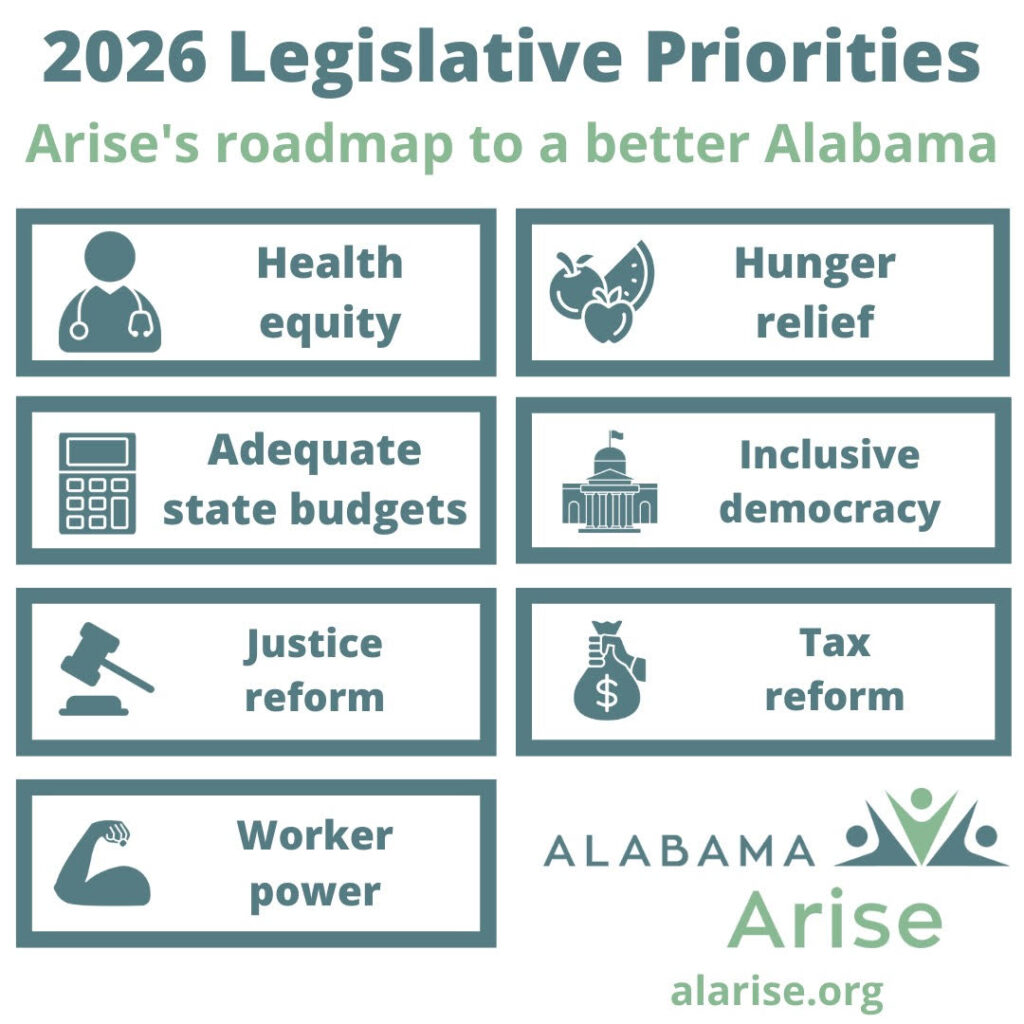
Nearly 600 members voted in the last week to affirm Arise’s legislative priorities. The seven priorities chosen were:

  • Health equity, including policies to close Alabama’s health coverage gap for adults with low incomes and to protect access to maternity care.
  • Hunger relief, including legislation to allow more public schools to provide no-cost breakfast and lunch for all of their students.
  • Adequate state budgets, including equitable public education funding for every student and state funding for affordable housing and public transportation.
  • Inclusive democracy, including no-excuse early voting and removal of barriers to voting rights restoration for disenfranchised Alabamians.
  • Justice reform, including legislation to apply Alabama’s ban on judicial override of jury sentencing decisions in death penalty cases retroactively, as well as improvements to the state’s sentencing and parole systems.
  • Tax reform to build a more just and sustainable revenue system, including eliminating the rest of Alabama’s state sales tax on groceries and replacing the revenue equitably.
  • Worker power to advance the health and safety of Alabama families, including legislation to remove tax incentives from companies that violate child labor laws, as well as efforts to extend paid parental leave protections to more workers.

“Alabama Arise believes in dignity, equity and justice for everyone,” Alabama Arise executive director Robyn Hyden said. “Our legislative priorities seek to empower Alabamians of every race, income and background to reach their full potential. And they reflect our members’ commitment to building a healthier, more just and more inclusive Alabama for all.”

Alabama Arise graphic text reads "2026 legislative priorities: Arise's roadmap to a better Alabama." Issues named are health equity, hunger relief, adequate state budgets, inclusive democracy, justice reform, tax reform and worker power.

The urgent need to close Alabama’s coverage gap and protect affordable Marketplace plans

Arise members believe Medicaid expansion is a path toward a healthier future where all Alabamians can afford the health care they need. Expanding Medicaid would reduce racial health disparities and remove financial barriers to health care for adults with low incomes. Expansion also would support thousands of new jobs across the state. And most importantly, it would save hundreds of lives every year.

Alabama is one of only 10 states yet to expand Medicaid. Medicaid expansion would ensure health coverage for nearly 200,000 Alabamians caught in a coverage gap. Most of these residents earn too much to qualify for the state’s bare-bones Medicaid program but too little to afford private plans.

The number of Alabamians in the coverage gap could soar in 2026 if Congress fails to renew enhanced Premium Tax Credits for Marketplace plans under the Affordable Care Act. If lawmakers allow the credits to expire, about 130,000 Alabamians would lose their health coverage, and premiums for many others would nearly double.

Those setbacks would add further strain to the health care infrastructure that serves all Alabamians. About two dozen rural hospitals in Alabama are at immediate risk of closure, and four labor and delivery units have shut down since 2023. These closures have reduced care options in a state that already has one of the nation’s worst maternal mortality rates.

“Everyone should be able to get the health care they need when they need it,” Hyden said. “Congress must act quickly to protect affordable Marketplace coverage for hundreds of thousands of Alabamians. And our state policymakers need to step up to close Alabama’s health coverage gap once and for all. This investment would pay off in the form of healthier families and stronger economic growth in communities across our state.”

No-cost school meals help Alabama children learn and thrive

Another key step toward a healthier Alabama is to ensure every public school can offer no-cost meals to every student. Hundreds of Alabama schools provide no-cost meals through the Community Eligibility Provision, but some schools cannot participate in the program.

Arise will advocate for additional state funding that local districts can use to match federal funds to offer no-cost meals. Legislators this year approved $17.3 million to expand school breakfast and continue Alabama’s participation in SUN Bucks, which provides $40 in food benefits per summer month for hundreds of thousands of Alabama children.

Stronger investment in school meals is more urgent amid threats to federal funding for the Special Supplemental Nutrition Program for Women, Infants and Children (WIC) and cuts to the Supplemental Nutrition Assistance Program (SNAP). Alabama and other states could run out of money for WIC in a few weeks if Congress does not renew its funding. And the federal budget law enacted in July will make fewer people eligible for SNAP while shifting more costs to states.

Children and communities across Alabama would enjoy immediate and long-term benefits from no-cost meals in public schools. No-cost meals would reduce child hunger in a state where nearly 1 in 4 children face food insecurity. Extending the reach of school meal programs would help reduce behavioral problems and improve attendance and test scores. Reducing food insecurity for children also can help improve their mental health and overall health as teenagers and adults.

“It’s hard for children to focus in school when they’re hungry,” Hyden said. “Lawmakers should ensure that WIC and SNAP continue to provide food assistance for families across our state. And our legislators should invest in no-cost school meals to reduce hunger and help every Alabama child succeed both in the classroom and throughout their lives.”

Alabama coalition to lawmakers: Keep TVA public, affordable and accountable

State and federal lawmakers should oppose any efforts to privatize the Tennessee Valley Authority (TVA), a broad coalition of 43 Alabama organizations wrote in a joint letter released Tuesday. The groups warned that privatization would raise energy costs, eliminate good jobs, weaken environmental protections and strip the public of its voice in decisions about the region’s energy future.

“TVA has been one of the most transformative public investments in our state’s history,” the letter reads. “Privatization would put that at risk, leading to higher energy bills, fewer protections for consumers, loss of good union jobs and more pressure to cut corners on safety and environmental stewardship.”

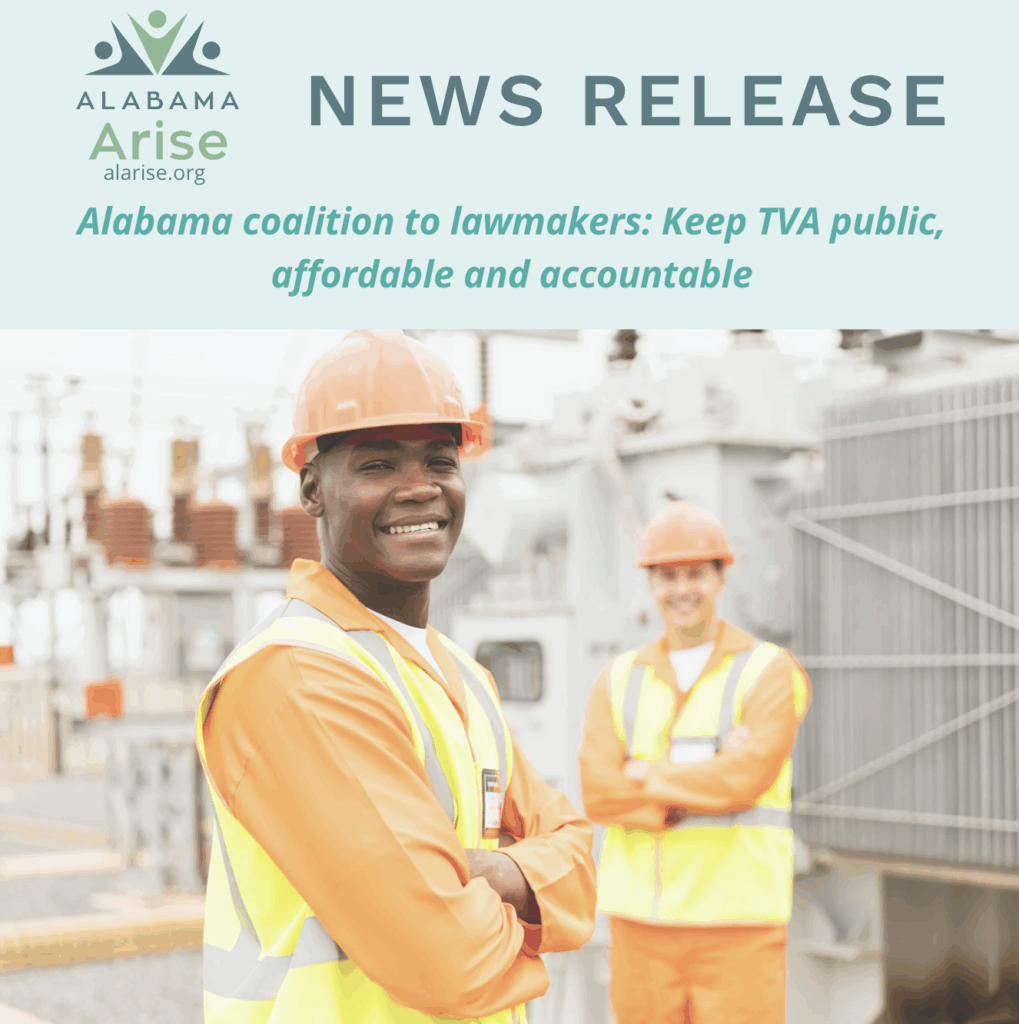
Two utility workers smile while wearing orange helmets and orange and yellow vests. Text above the photo: "Alabama Arise news release: Alabama coalition to lawmakers: Keep TVA public, affordable and accountable."

More than 40 organizations signed the letter, including labor unions, civic organizations, faith groups and nonprofits across Alabama. Read the full letter here.

“At Alabama Arise, we believe in public systems that are transparent, accountable and responsive to everyday people,” said Adam Keller, Alabama Arise’s Worker Power Campaign director. “Public power through TVA has kept energy reliable, affordable and accountable to Alabamians for generations, reducing poverty and expanding opportunity across the region. The public deserves a voice in decisions about our energy and environment, and we stand united in opposing any threats to this vital lifeline for our communities.”

Background

Created in 1933 as part of the New Deal, the Tennessee Valley Authority is the nation’s largest public power provider, serving nearly 10 million people across seven states. TVA’s mission extends beyond electricity: It also supports economic development, environmental stewardship and disaster response.

“TVA was originally created because the private sector failed rural America,” said Daniel Tait, executive director of Energy Alabama. “Turning TVA over to private, for-profit interests would mean higher electricity rates, destruction and loss of access to outdoor recreation areas, and other devastating consequences for families and businesses across the Tennessee Valley.”

TVA privatization proposals have surfaced repeatedly in Washington. Alabama stakeholders warn the costs would fall hardest on working families and vulnerable communities.

The broad array of groups opposing privatization “reflects the diverse voices of workers, community members, faith groups and environmental advocates across the state,” the joint letter reads. “While we come from different sectors and perspectives, we are united in calling for action to protect our communities.”

Next steps

The coalition is calling on Alabama’s congressional delegation and state elected leaders to issue clear, public statements opposing TVA privatization. The groups say they will continue organizing to ensure TVA remains publicly owned and accountable to the people of Alabama.

“TVA’s union workforce is the backbone of our energy system, providing safe, skilled jobs that support families and communities,” said Ray Dawson, business manager of Laborers’ International Union of North America (LiUNA) Local 366. “Privatization would wreck those jobs and the local economies they sustain.”

Read the groups’ full letter here.

Halfway there: Alabama Arise celebrates latest grocery tax reduction, urges lawmakers to finish the job

A new law reducing Alabama’s state sales tax on groceries from 3% to 2% will take effect on Monday after being enacted in May. HB 386 by Rep. Danny Garrett, R-Trussville, also will give cities and counties more flexibility to reduce local grocery taxes if they choose.

Alabama Arise executive director Robyn Hyden released the following statement Wednesday about the law’s implementation and what should happen next:

“This is great news for the people of Alabama. The latest grocery tax reduction – the second in three years – will make it easier for every Alabamian to make ends meet, especially in this time of persistently high food prices. Everyone in our state will benefit from this law, and people who are struggling to make ends meet will benefit the most of all.

“The state grocery tax reduction from 4% to 3% in 2023 was an essential first step toward tax justice in Alabama, and this year’s reduction to 2% continues that momentum. HB 386 is another important step toward righting the wrongs of our state’s upside-down tax system, which forces Alabamians with low and moderate incomes to pay a higher share of their incomes in state and local taxes than the wealthiest households.

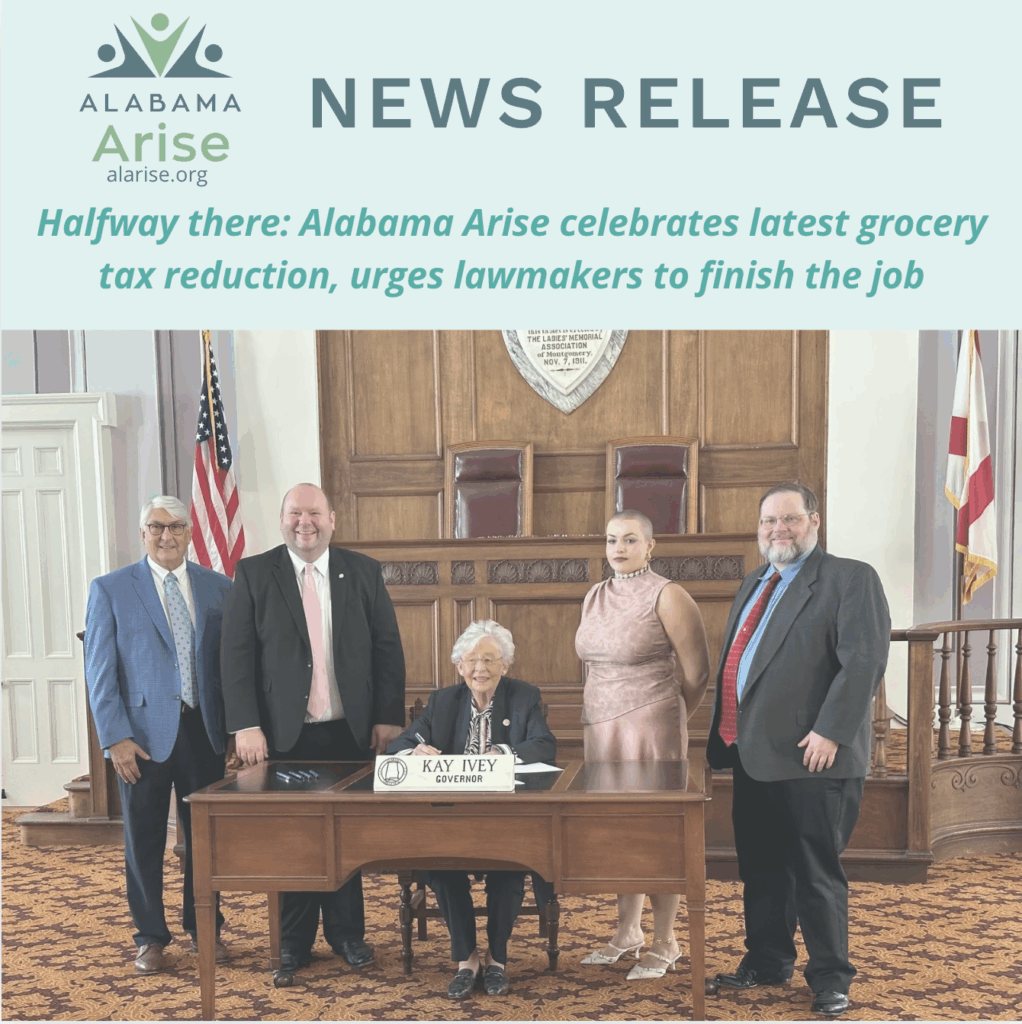
Alabama Arise staff members stand alongside Gov. Kay Ivey and Sen. Andrew Jones at a bill signing ceremony. Text above the image: "Alabama Arise news release: Halfway there: Alabama Arise celebrates latest grocery tax reduction, urges lawmakers to finish the job."

“Alabama Arise appreciates Rep. Danny Garrett and Sens. Andrew Jones and Arthur Orr for guiding HB 386 through the Legislature, and Gov. Kay Ivey for signing it into law. We’re thankful for the unanimous legislative support on this bill this year. And we’re grateful for former Rep. John Knight, former Sen. Hank Sanders, Reps. Laura Hall, Penni McClammy and Mary Moore, and so many other legislators whose determined work over so many years laid the groundwork for this continued progress.

What should happen next

“The grocery tax is a cruel tax on survival. It drives many families deeper into poverty, and Arise remains committed to the goal of eliminating it entirely. Arise members from every corner of our state have advocated relentlessly for decades for Alabama to untax groceries. And our work will continue until the state grocery tax is a thing of the past.

“Alabama is one of only 10 states still taxing groceries, and we must remove our state from that shameful list. We also must ensure grocery tax elimination doesn’t harm our children’s education in the long term. Education Trust Fund revenues are strong enough now to reduce the grocery tax without causing severe harm to school funding. But history tells us that times of strong revenues don’t last forever. Lawmakers must work together to agree to a solution to untax groceries sustainably and responsibly.

“Arise is open to numerous ideas for replacement revenue, and we will continue working with the state’s Joint Study Commission on Grocery Taxation to find a path forward. We continue to support our longstanding proposal to replace grocery tax revenue by capping or ending the state income tax deduction for federal income tax payments. Alabama is the only state to allow this full deduction, which overwhelmingly benefits the wealthiest households. Closing this skewed loophole would protect funding for public schools and ensure Alabama can afford to end the state sales tax on groceries forever.”

Alabama Arise celebrates grocery tax reduction at bill signing ceremony

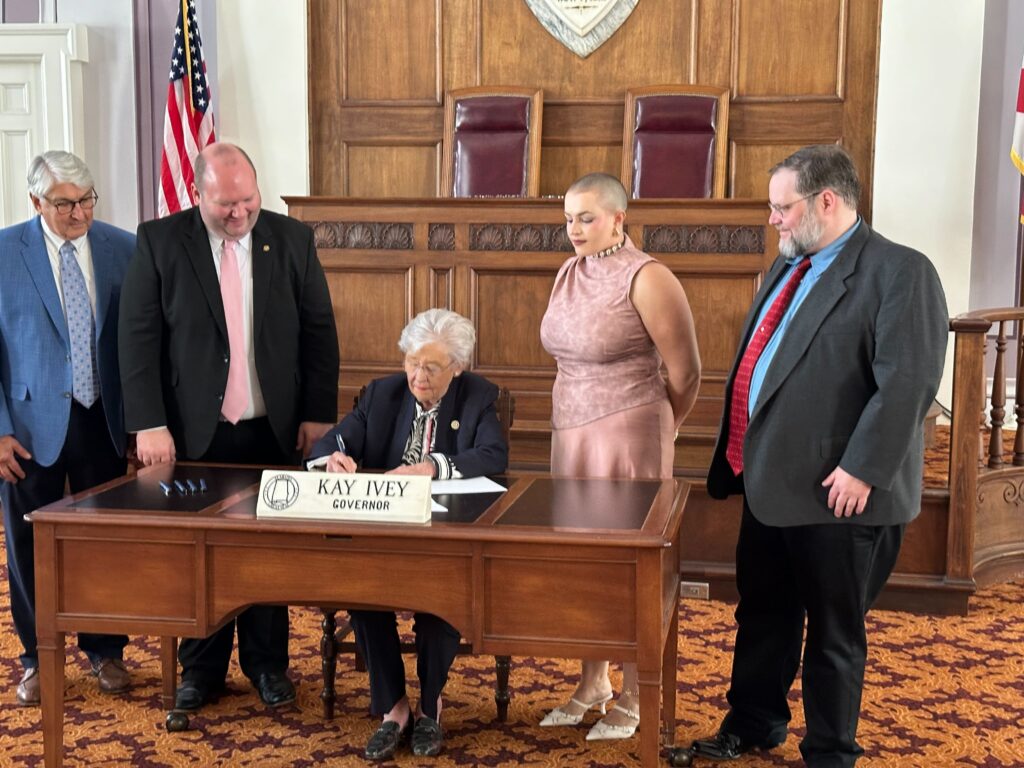
Three men wearing suits and ties and a woman wearing a pink dress stand to either side of Gov. Kay Ivey, who is wearing a black jacket and seated behind a wooden table.
Several Alabama Arise staff members participated in Gov. Kay Ivey’s bill signing ceremony for HB 386 on July 31, 2025, at the State Capitol in Montgomery. HB 386 will reduce the state sales tax on groceries from 3% to 2% starting Sept. 1, 2025. Left to right: Arise legislative director David Stout; Sen. Andrew Jones, R-Centre; Gov. Kay Ivey; Arise hunger policy advocate LaTrell Clifford Wood and Arise communications director Chris Sanders. (Photo by Matt Okarmus)

Alabama will reduce its state grocery tax once again next month thanks to bipartisan legislation enacted earlier this year. This reduction will make it easier for every family across Alabama to make ends meet.

Alabama Arise staff members were proud to participate in a ceremonial bill signing event that Gov. Kay Ivey held for the legislation at the State Capitol in Montgomery on Thursday. Ivey officially signed the bill into law in May.

Official event photos from the Governor’s Office are available here.

An important step forward for tax justice

HB 386, sponsored by Rep. Danny Garrett, R-Trussville, will reduce the state sales tax on groceries from 3% to 2% beginning on Sept. 1. The law also will give cities and counties more flexibility to reduce local grocery taxes if they choose. The grocery tax reduction will be Alabama’s second in three years, building on a 2023 law reducing the tax from 4% to 3%.

“Reducing the grocery tax is especially critical in this time of persistently high food prices,” Alabama Arise executive director Robyn Hyden said. “The grocery tax drives many families deeper into poverty, and Alabama Arise remains committed to the goal of eliminating it entirely.”

Untaxing groceries has been one of Arise members’ top advocacy priorities for decades. The grocery tax is a major driver of the state’s upside-down tax system, which forces Alabamians with low and moderate incomes to pay a higher share of their incomes in state and local taxes than the wealthiest households. Hyden said she was thankful for the years of work that current and former lawmakers put in to make the recent grocery tax reductions possible.

“Arise appreciates Rep. Danny Garrett and Sens. Andrew Jones and Arthur Orr for guiding HB 386 through the Legislature, and Gov. Kay Ivey for signing it,” she said. “We’re thankful for the unanimous legislative support on the bill this year. And we’re grateful for former Rep. John Knight, former Sen. Hank Sanders, Sen. Merika Coleman, Reps. Laura Hall, Penni McClammy and Mary Moore, and so many other legislators whose determined work over so many years laid the groundwork for this progress.”

Finish the job: Arise’s ongoing advocacy to untax groceries

Alabama is one of only 10 states still taxing groceries. Arise has worked with the state’s Joint Study Commission on Grocery Taxation in recent years to explore paths to eliminate the rest of the state sales tax on groceries in a sustainable and responsible way. Arise is open to many options to replace grocery tax revenue, Hyden said.

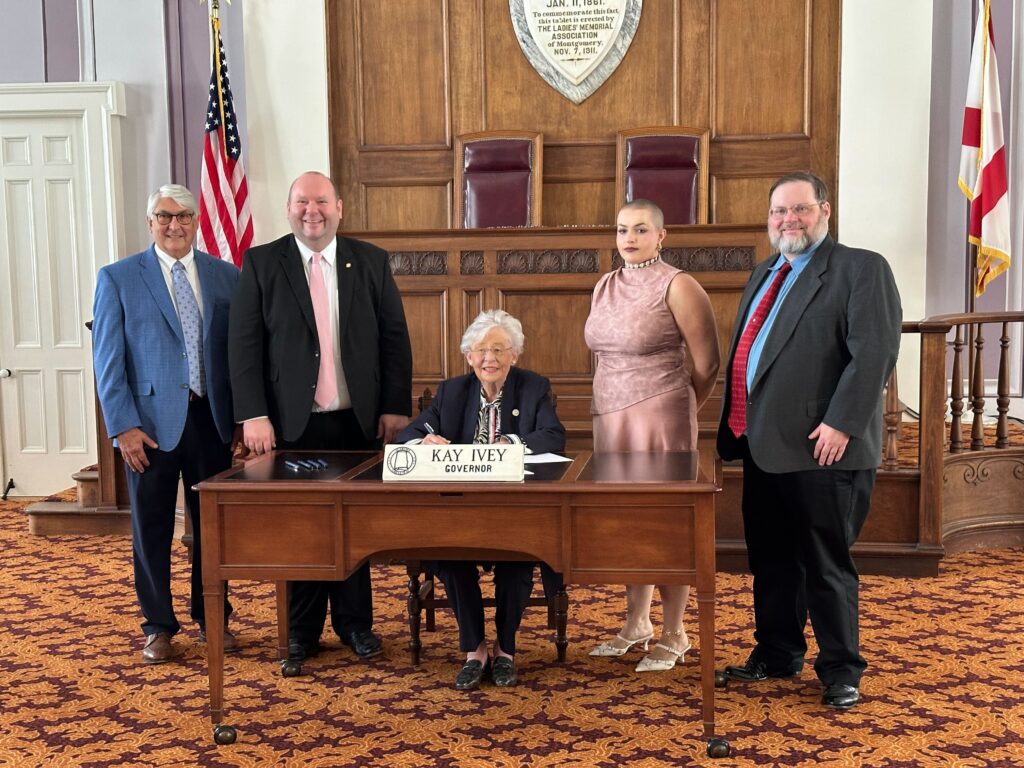
Three men wearing suits and ties and a woman wearing a pink dress stand to either side of Gov. Kay Ivey while she signs a bill. Ivey is wearing a black jacket and seated behind a wooden table.
Several Alabama Arise staff members participated in Gov. Kay Ivey’s bill signing ceremony for HB 386 on July 31, 2025, at the State Capitol in Montgomery. HB 386 will reduce the state sales tax on groceries from 3% to 2% starting Sept. 1, 2025. Left to right: Arise legislative director David Stout; Sen. Andrew Jones, R-Centre; Gov. Kay Ivey; Arise hunger policy advocate LaTrell Clifford Wood and Arise communications director Chris Sanders. (Photo by Matt Okarmus)

One plan that the organization strongly supports, she said, is a proposal to replace grocery tax revenue by capping or ending the state income tax deduction for federal income tax payments. Alabama is the only state to allow this full deduction, which overwhelmingly benefits the wealthiest households.

“It is important to ensure grocery tax elimination doesn’t harm our children’s education in the long term,” Hyden said. “Closing the skewed federal income tax deduction loophole would protect funding for public schools and ensure Alabama can afford to end the state sales tax on groceries forever.”