Changes are happening in Alabama Medicaid. Help us spread the word!

Starting Oct. 1, 2019, Medicaid begins a new care coordination program. The new plan will create Alabama Coordinated Health Networks (ACHNs) in seven regions of the state. (See the map below.) These ACHNs will coordinate primary care for people with Medicaid coverage. Your ACHN will have a phone line to call when a Medicaid participant (also known as a Medicaid member) has a health problem.

New services will help patients get the health care that’s right for their needs. To get these services, people who have Medicaid coverage (children, pregnant women, and people getting family planning services) will need to have a primary care doctor of their choice.

Their doctor will become their “medical home” – the first place to contact for ordinary health needs. And new services will be offered to improve patient health.

Medicaid members who already have a primary doctor can continue under their care. Coordinating patient care through a primary doctor helps avoid expensive emergency room visits for routine health care needs.

The Alabama Medicaid Agency will be sending out information about the ACHN program so you can know who to call to discuss care coordination services. In the meantime, you can help others be aware of the coming changes.

Alabama Arise has organizers available to talk to groups interested in learning more about the coming changes. So to set up a meeting in your area, email me or call me at 334-832-9060. Or reach out to the Arise organizer who serves your region. Let’s keep people informed and build a healthier Alabama!

PDF: Changes are happening in Alabama Medicaid!

En español: ¡Cambios están ocurriendo en el Medicaid de Alabama!

The 2019 session that was, and the one yet to come

Alabama legislators ended their 2019 regular session last week. But they’re not done yet.

Amid the threat of federal intervention, the Legislature likely will hold a special session this fall to address horrendous conditions in our state’s overcrowded prisons. This summer, Arise will continue making the case that meaningful prison reform must include Medicaid expansion. This move would cut state health care costs and help former inmates stay healthy and productive after release. And it would help people stay out of prison by strengthening treatment for mental illness and substance use disorders.

Arise will renew our call to fund these needed investments by fixing Alabama’s upside-down tax system. With high sales taxes and big tax breaks for rich people, this broken system is the worst of both worlds. It pushes struggling families deeper into poverty, and it doesn’t bring in enough money to provide adequate funding for corrections and other vital services. Untaxing groceries and ending the state’s deduction for federal income taxes would be two huge steps to undo that damage.

Breakthroughs on civil asset forfeiture, voting rights

Arise members’ advocacy led to progress on civil asset forfeiture and voting rights this year. Lawmakers voted unanimously for SB 191, sponsored by Sen. Arthur Orr, R-Decatur, which will increase transparency around forfeitures in Alabama. And they approved SB 301, sponsored by Sen. Rodger Smitherman, D-Birmingham, which will expand access to absentee ballots.

Our supporters were key in stopping numerous proposals to erect harmful new barriers to Medicaid and food assistance under the Supplemental Nutrition Assistance Program (SNAP). We also saw major breakthroughs on several recent Arise issue priorities and endorsements:

  • HB 225, sponsored by Rep. Adline Clarke, D-Mobile, will forbid pay discrimination based on race or sex.
  • SB 30, sponsored by Sen. Cam Ward, R-Alabaster, will ensure that inability to pay filing fees won’t block low-income Alabamians from pursuing their rights in court.
  • SB 228, sponsored by Orr, will increase jail food funding and prevent sheriffs from pocketing any leftover money.

Two other topics dominated the headlines at the State House this year. Legislators moved quickly to pass an abortion ban that is certain to face a lengthy, expensive court challenge. They also hustled to pass a 10-cent gas tax increase for infrastructure improvements during a special session in March.

The work that remains undone

But lawmakers showed much less urgency when it came to investments in human services. While Alabama’s funding for K-12 and higher education is increasing, it’s still well below 2008 levels. Similarly, General Fund (GF) revenues are rising. But it’s not nearly enough to reverse decades of underinvestment in Medicaid, mental health care, child care and other services.

The Legislature also waited until the session’s final week before finally deciding the GF, rather than the education budget, would pay for the state’s share of the Children’s Health Insurance Program. CHIP supports coverage for more than 170,000 Alabama kids.

Some climbs remain steeper than others. Reforms of payday lending and the death penalty struggled to gain traction this year. So did proposals for automatic voter registration and early voting. But Arise members – unafraid and undeterred – will keep working for those changes and others to promote opportunity, prosperity and justice for all Alabamians.

Alabama’s prison reform solution must include Medicaid expansion

Alabama’s prison crisis is about more than overcrowding and understaffing. It’s about the generational impacts of a criminal justice system warped by racism, chronic poverty, inadequate education and poor health.

The solution will require both new revenue and broad policy reform. And one essential step is to extend health coverage to uninsured Alabama adults with low incomes. Expanding Medicaid would address the prison crisis in four ways:

  • Untreated mental illnesses and substance use disorders are major contributors to Alabama’s over-incarceration problem, and Medicaid expansion would tackle these challenges head-on. Strengthening these services would help more people stay out of prison.
  • When a person leaves prison, it’s hard to get a job that offers health coverage. But to get and keep a job, you need to be healthy. Medicaid expansion would help former inmates become productive members of the workforce.
  • Federal funding would cover 90% of the cost of Medicaid expansion. That would slash state costs for hospitalizing prisoners.
  • A stronger education system creates economic opportunity that, in turn, reduces crime. As new federal dollars for Medicaid expansion flowed into the economy, they would generate major new state and local tax revenues for schools.

Bottom line

Alabama is one of only 14 states that have not yet accepted Medicaid expansion. The 36 states that have embraced it show how this single policy decision can strengthen the health care system, make the population healthier, reduce racial health disparities and shore up state budgets.

Alabama’s legacy of failure on all four counts is a major contributor to the prison crisis. And Medicaid expansion is an essential part of the solution.

Arise legislative recap: May 17, 2019

Legislators talked a lot about pregnancy and childbirth at the State House this week, but the spotlight has left some disturbing facts about the reality of health care in Alabama in the shadows. Arise’s Jim Carnes talks about why it’s so crucial for Alabama to expand Medicaid to strengthen the state’s health care system and promote healthy families.


CHIP funding uncertainty shows a core problem in Alabama’s budgets

The Alabama Legislature has yet to decide how to fund health coverage for more than 170,000 children next year. And that’s a symptom of a fundamental illness that has plagued our state’s budgets for decades.

The Children’s Health Insurance Program (CHIP) is one of Alabama’s most successful programs. Through Medicaid and ALL Kids, CHIP supports health coverage for 14% of Alabama’s children. Alabama’s 1997 adoption of CHIP and its later decision to expand eligibility to children in households that make up to 317% of the federal poverty level (nearly $68,000 for a family of three) has made our state a leader on children’s health coverage in the South.

Alabama’s investment in CHIP ensures that kids can get the health care they need to learn and thrive. And CHIP is a great deal for our state. For every $1 Alabama spends on CHIP, the federal government provides more than $3 in matching money. (CHIP parents pay an annual fee and copays that can’t total more than 5% of their annual income.)

Unfortunately, Alabama often struggles to provide its share of CHIP funding, even during a “good” budget year. Gov. Kay Ivey recommended that CHIP’s state match for 2020 be paid out of the Education Trust Fund (ETF), which receives most of the “growth tax” revenue from sales and income taxes. But the Senate balked at this idea and removed CHIP from the ETF budget it passed last week. Meanwhile, the General Fund budget that the House passed in April also includes no CHIP funding.

In the next couple of weeks, both chambers are expected to take up the budget that the other one passed. In the meantime, the parents of more than 170,000 Alabama children wait to learn whether their kids will still have health insurance this fall.

It’s time to stop lurching from one crisis to another

CHIP is one of Alabama’s most popular programs, and we fully expect the House and Senate to fund it. But the uncertainty illustrates the central problem of Alabama’s budgets: We don’t bring in enough money to meet basic needs. In past years, Medicaid has been the subject of funding crises. This year, the threat of a federal lawsuit over abominable conditions in state prisons may force a special session. And in 2021, CHIP may be at risk as a temporary boost to the federal matching rate ends.

Every year, Alabama seems to have at least one essential service that it struggles to fund adequately. And every year, the Legislature juggles too little money, robs Peter to pay Paul, or grasps at another source of one-time funding to squeak through another year. Barely maintaining the status quo is no way to promote shared prosperity. And it’s no way to make life better for everyday Alabamians.

Alabama Arise has a solution to break the cycle of uncertainty and invest in our state’s future. And it’s a solution that’s beginning to interest lawmakers as they consider how to pay for CHIP, Medicaid, corrections and other necessities.

Ending the FIT deduction would strengthen Alabama’s future

That solution is to end Alabama’s income tax deduction for federal income taxes (FIT). It’s a loophole that only two other states – Iowa and Louisiana – allow in full. (Three other states allow a partial deduction.) And it’s a skewed tax break that primarily benefits the richest households among us.

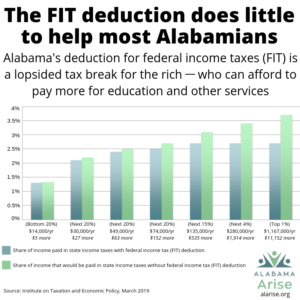
For those who earn $30,000 a year, the FIT deduction saves them about $27 on average. But for the top 1% of taxpayers, it’s worth an average of more than $11,000 a year. Closing this tax loophole would bring our state’s upside-down tax system closer to balance. It also would allow Alabama to end the state sales tax on groceries without cutting school funding.

Ending the FIT deduction would bring in an additional $719 million a year. That’s enough to pay for Medicaid expansion, secure long-term CHIP funding and invest in education, corrections and other pressing needs.

And this new revenue wouldn’t be just one-time money. It would be there every year to help Alabama meet the needs of the state and its people.

As one legislator told us recently: “This is the only plan that makes sense.” We think so, too, and we’re working hard to convince more lawmakers that they need to support this proposal, for the sake of our children’s health and for all of us.

Senate panel OKs costly new SNAP, Medicaid limits that would punish struggling Alabamians

There’s an old saying: If you like laws or sausage, you should never watch either one being made. Wednesday afternoon was a perfect example of how stomach-turning it can be to see how laws are often made in Alabama.

The Senate Fiscal Responsibility and Economic Development Committee approved a bill Wednesday to cut new holes in Alabama’s safety net. This plan would erect harmful, expensive new barriers to food assistance under the Supplemental Nutrition Assistance Program (SNAP), health coverage under Medicaid, and cash aid under the Temporary Assistance for Needy Families (TANF) program. And it would increase hunger and hardship for tens of thousands of struggling Alabamians in the process.

The bill – SB 294, sponsored by Sen. Arthur Orr, R-Decatur – is a version of the “HOPE Act” promulgated by the Foundation for Government Accountability (FGA), a nationwide conservative organization based in Florida. The bill now awaits consideration in the full Senate.

At a public hearing Wednesday, four Alabamians spoke against SB 294:

  • Carol Gundlach, policy analyst at Alabama Arise.
  • Jim Jones, director of Alabama Childhood Food Solutions.
  • Laura Lester, executive director of the Alabama Food Bank Association.
  • Ashley Lyerly, director of advocacy with the American Lung Association in Birmingham.

All of us agreed that this bill would make people in Alabama poorer, hungrier and sicker. The only speaker in support was an FGA staffer from Arkansas who repeatedly misstated many of the bill’s provisions. Compounding the problem, many committee members showed unfamiliarity with how safety net programs work in Alabama. The result was a frustrating discussion that consistently mixed up SNAP, TANF, Medicaid and even SSI eligibility requirements. In the end, few people left the room with a clear understanding of the bill.

How SB 294 would hurt struggling Alabamians

But it’s important to recognize the wide-ranging harm this plan would cause. SB 294 would take many steps to worsen life for Alabamians in poverty:

  • Reinstitute a SNAP asset test that could deny food assistance to some families with more than one automobile or to seniors with small savings accounts for medical or funeral costs.
  • Eliminate a slightly higher gross income limit for seniors, which helps make up for their higher medical costs.
  • Prohibit Gov. Kay Ivey from requesting a federal waiver of work requirements imposed on a small group of SNAP recipients, unless the unemployment rate is greater than 10%.
  • Require every non-disabled SNAP participant over age 16 to participate in an expensive workfare program, including parents with children over 6. This requirement would make it impossible for Alabama to continue operating an excellent job-training program that serves 36 counties.
  • Deny SNAP food assistance to people who fail to “comply” with child support services. But the word “comply” is not defined in SB 294. So we don’t know for sure what hoops people would need to jump through to get SNAP.
  • Reduce the maximum number of months that parents can receive TANF cash assistance to 36 months in a lifetime. This would cut even more adults off TANF, which is already a shadow of what was once the country’s most important anti-poverty program.
  • Require SNAP and Medicaid participants to recertify eligibility every six months. This complicated process inevitably would end assistance for otherwise eligible people who simply couldn’t navigate the red tape.

Many of SB 294’s would-be limits lack specificity. But proposed new data verification requirements are spelled out in minute detail. The bill also would allow Alabama to contract with a private company to comply with those requirements, a provision that raised several eyebrows.

The good news: SB 294 is a long way from becoming law

Now that it has won committee approval, SB 294 could appear on the Senate’s calendar at any time. But we expect the Senate to vote on the education budget next week, so SB 294 is unlikely to come up before May 7 at the earliest. And even if the Senate passed the bill, it still would have to clear the House as well. The closer we get to the end of the regular session, the less time SB 294 has to become law.

We’ll be keeping an eye on this harmful bill while we organize Arise supporters to make their opposition known. Watch this space for further updates!

Arise legislative recap: April 19, 2019

“The grocery tax is a tax on a basic necessity of life. It’s a tax on survival. And it’s time for Alabama to bring this tax to an end.”

Arise communications director Chris Sanders discusses a recent bill by Rep. Chris England that would be a major step forward on untaxing groceries. The video also details Arise’s plan for how Alabama could end the state grocery tax and expand Medicaid without cutting a dime from the education budget.

Removing the FIT deduction would allow Alabama to untax groceries, expand Medicaid

Alabama’s federal income tax (FIT) deduction provides a huge tax break for high-income individuals – but at what cost? $719 million to be exact.

The FIT deduction is one big reason Alabama’s tax system is upside down. For those who earn $30,000 a year, the deduction saves them about $27 on average. But for the top 1% of taxpayers, the FIT break is worth an average of more than $11,000. The higher the income, the more the FIT deduction is worth for those who can most afford to pay more to fund education, health care and other vital needs.

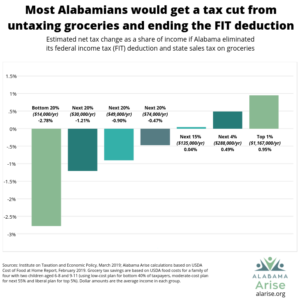
Only two other states offer a full FIT deduction like Alabama does. (Three other states offer a partial deduction.) Ending the FIT deduction would bring in an additional $719 million a year, the Institute on Taxation and Economic Policy estimates. That would be enough to allow Alabama to remove the state sales tax on groceries. For most people in our state, the net result would be a tax cut.

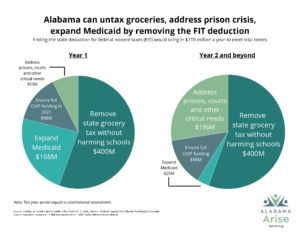
This proposal would make it easier for everyday Alabamians to make ends meet, but its benefits wouldn’t end there. Alabama also could use the new revenue to expand Medicaid, ensure full funding for the Children’s Health Insurance Program (CHIP) in 2021 and make critical investments in education and other areas. CHIP supports health coverage for more than 170,000 children through Medicaid and ALL Kids.

Alabama’s constitution dedicates income tax revenue to education, and the FIT deduction is written into the document as well. So this plan would require the Legislature and the public to approve a constitutional amendment. But ending the FIT deduction would be a good way for Alabama to begin prioritizing public investments that benefit everyone over tax breaks that primarily benefit a select few.

Alabama Medicaid reforms aim for better care, lower cost

Alabama is making some big changes in the way Medicaid members get their care. Alabama Arise believes the new plans, if carried out well, will be a significant improvement over the current Medicaid system. One way to improve the chances for success is to have a strong consumer voice at the policy table.

The changes are happening on two tracks:

  1. Primary care for children, pregnant mothers and family planning.
  2. Long-term care for people who need assistance with activities of daily living.

Alabama Coordinated Health Networks (ACHNs) for primary care, maternity care and family planning

Under the new plan, seven regional Alabama Coordinated Health Networks (ACHNs) will coordinate primary care for Medicaid children, pregnant mothers and people who receive family planning services. Primary care includes well-child visits; EPSDT (Early Periodic Screening, Diagnosis and Treatment); adult screening, diagnosis and treatment; and preventive care. Each member will choose a primary care doctor to be their “patient-centered medical home.”

(Note: A “medical home” is not a live-in care facility, like a nursing home. It’s more like a “home base” you stay in touch with for all your health care needs.)

Your ACHN will have a phone line to call when a Medicaid member has a health problem. The basic idea is that nurses, social workers and care coordinators working with the primary care doctor can help people get the right care for the right problem without going straight to the emergency room (ER) whenever they get sick.

ER services are important when there’s a real emergency (like a broken bone, chest pains or other critical need). But they’re also very expensive. So going to the ER for routine problems like a sore throat or upset stomach is a drain on the Medicaid budget. And it’s not the best way to get the right care for ordinary health needs. Getting checked first by your primary care doctor or nurse leads to better care at lower cost.

The ACHN can help patients identify health goals, create a care plan and connect with community resources that promote better health. Another feature aimed at improving care is bonus payments for doctors who reach quality benchmarks.

The new ACHN plan will begin Oct. 1, 2019. It will serve about 750,000 Medicaid members across seven regions. Each ACHN will have a consumer representative on its board, as well as a Consumer Advisory Committee (CAC). Arise is working to recruit Medicaid members, parents and caregivers to serve in these important roles. We also are urging Medicaid to add a second consumer representative to each regional ACHN board.

Integrated Care Network (ICN) for long-term care

On the long-term care side, Medicaid already has started a new plan called the Integrated Care Network (ICN). The ICN coordinates care for Medicaid members who live in nursing homes or receive certain home- and community-based waiver services. There are only about 25,000 of these members across Alabama, so one statewide ICN serves all of them. Right now, about 70% of people served by the ICN live in nursing facilities, and 30% are living at home. The program’s goal is to help more people get long-term care services in their home and community, if that’s what they want. The ICN works with 13 Area Agencies on Aging across Alabama to coordinate long-term care for Medicaid members who qualify.

The ICN has a strong consumer voice at the policy table. Four consumer advocates serve on the governing board. And the Consumer Advisory Committee includes eight consumer representatives, including Alabama Arise, along with a long-term care doctor.

What triggered reform?

Since it began in 1970, Alabama Medicaid has operated on a fee-for-service basis, with patients seeking care on their own from providers who then bill Medicaid for services rendered. For healthy patients, such a system can provide sufficient care at a reasonable cost. But many Alabama Medicaid patients have complicated health problems, involving one or more chronic conditions that are difficult and expensive to treat. Care providers often have difficulty monitoring patient care over time and educating patients on prevention and healthier lifestyles.

As Medicaid costs rose with enrollment growth during the Great Recession of 2008, state officials began to consider program changes that would both control budget growth and improve health outcomes.

In 2011, a few regional pilot projects began providing care coordination for people with chronic conditions, such as diabetes, cancer or substance use disorder. These successful experiments laid the groundwork for the regional care organizations (RCOs) that the Legislature authorized in 2013. Under the RCO plan, Alabama offered care coordination to people with chronic conditions statewide. Technical delays and other problems led Gov. Kay Ivey to cancel the RCO plan shortly after she took office in 2017, but the care coordination system remained in place. This time around, Medicaid will expand it even further – to serve not just patients with chronic illness but the majority of Medicaid members.

Long-term care reform took a different but parallel path. Alabama has long relied mainly on nursing homes to provide Medicaid long-term care services, even though home- and community-based services are far less expensive. The aging of the Baby Boom generation poses big challenges for the old system. A surge in nursing home patients would strain state budgets, and a movement for greater patient choice is changing the long-term care business. Alabama’s ICN has the potential to become a national model for expanding options in long-term care.

Bottom line for members

  • Regional ACHNs open Oct. 1, 2019. Through their primary care doctor, children, pregnant moms and family planning patients can get new services focused on prevention, care coordination and health improvement.
  • The primary care doctor is the patient’s “medical home” – the first place to contact for ordinary health needs. The goal: Reserve ERs for true emergencies.
  • A new focus on improving patient health gives doctors bonus payments for better outcomes. Special projects will target substance use disorders, infant mortality, and obesity and obesity prevention.
  • The ICN now gives long-term care patients more coordination of services and more choice in their care setting.
  • Consumer representatives give Medicaid members a new voice at the policy table.

Map of Medicaid ACHNs

Keywords in Medicaid reform

A basic understanding of these keywords will help Alabama Medicaid members navigate the changes that are underway and help advocates and others follow ongoing developments in the program:

ACHN (Alabama Coordinated Health Network) – beginning Oct. 1, 2019, any of seven regional organizations that administer Medicaid services for children, pregnant women and family planning patients in Alabama, with a special focus on care coordination to eliminate barriers to adequate health care.

Area Agency on Aging (AAA) – any of 13 regional offices that serve older Alabamians by coordinating state and federal services such as senior centers, Aging and Disability Resource Centers and the Alabama Cares caregiver support network. The AAAs provide case management for Medicaid long-term care in the home, community and nursing facilities through the new Integrated Care Network (ICN).

Care coordination – the practice of organizing patient care activities and sharing information among all parties concerned to achieve more effective and efficient care. Care coordination has a narrower focus than case management.

Case management – a collaborative process of assessment, planning, coordination and advocacy for options and services to meet a person’s health needs. Case management has a broader reach than care coordination, also addressing social determinants of health like housing, nutrition and transportation.

EPSDT (Early Periodic Screening, Diagnosis and Treatment) – comprehensive and preventive health services guaranteed for children under age 21 who are enrolled in Medicaid.

Home- and community-based services (HCBS) – Medicaid long-term care services for qualifying members who choose to live at home or in a community care setting. In Alabama, these services are delivered through seven waiver programs. Two of these – Elderly & Disabled (E&D) and Alabama Community Transition (ACT) – are part of the new Integrated Care Network.

ICN (Integrated Care Network) – Alabama Medicaid’s long-term care reform program promoting person-centered care in the least restrictive setting of the patient’s choice.

Long-term care – health care, personal care and social services provided to people with chronic illness or disability, either in institutional or home and community settings.

Medicaid – federal and state health insurance program for people with low incomes and few resources. Alabama Medicaid covers mainly children in families up to 146% of the federal poverty level (FPL), pregnant women up to 146% FPL, low-income people with disabilities, and low-income people in nursing homes. Parents are eligible in Alabama only if their income is 18% FPL or lower.

Medicaid member – any individual enrolled in a Medicaid program.

Patient-centered medical home – a health care setting that offers patients comprehensive, coordinated primary care; an ongoing relationship with a primary care doctor; and referrals for necessary additional care.

Preventive care – health care that emphasizes healthy behavior, regular testing and screening aimed at early detection and treatment.

Primary care – routine health care, including diagnostic, therapeutic and preventive services, as well as management of chronic conditions.

Waiver – permission granted by the federal government that allows the state to “waive” or change ordinary Medicaid rules to provide specific services to a targeted group, such as long-term care patients.

Arise legislative recap: March 29, 2019

Lawmakers may have been on spring break this week, but we still have plenty to discuss in our second video update of the 2019 legislative session.


Watch Arise organizing director Pres Harris discuss upcoming community forums on Medicaid expansion, as well as reminders on action you can take in anticipation of the Legislature reconvening on April 2.