COVID-19: 7 policy changes that would help protect Alabamians

The World Health Organization has labeled COVID-19 a global pandemic. And state officials announced the first confirmed case of the disease in Alabama on Friday. As the virus strains our health systems, schools and economy, we must ensure the most vulnerable Alabamians have the medical care, social supports and other protections they need to weather the crisis.

The Alabama Legislature will be on spring break for the next two weeks. We hope our state lawmakers and members of Congress will take time to examine the situation developing in their communities. And we hope they will act quickly and courageously to address these critical public health needs.

Here are seven actions that policymakers should take now to protect the well-being and security of all Alabamians:

1. Gov. Kay Ivey should expand Medicaid.

Medicaid expansion would extend health coverage to more than 223,000 uninsured Alabamians with low incomes. It also would ensure coverage for another 120,000 who struggle to afford the insurance they have.

Expansion would take several months to implement, but it would prepare us for the big challenges ahead. In the short term, Medicaid could take numerous other steps to protect families. Examples include streamlining enrollment, covering new mothers for one year after delivery and increasing our “bare-bones” income limit for parents.

Email Gov. Ivey to ask her to expand Medicaid and help address the coronavirus threat. Or if you’d prefer to reach out by phone, click here to call Gov. Ivey’s office.

2. Lawmakers should increase funding for public health to ensure adequate testing, preparation and prevention.

In addition, state and local agencies should take the lead on proactive policies and procedures to protect those who are most vulnerable to this virus. Read State Health Officer Scott Harris’ report to the Senate Health Committee.

3. Congress should authorize emergency food assistance increases.

Boosting the Supplemental Nutrition Assistance Program (SNAP) would help children get the food they need while they’re out of school. It also would promote food security for seniors, people who lose their jobs and other people at risk of hunger. Read additional recommendations to address critical food security issues from our partners at the Food Research and Action Center.

4. Policymakers should remove barriers to social support services.

Medicaid, SNAP, WIC and Temporary Assistance for Needy Families (TANF) save and improve lives. Red-tape barriers to these services make it harder for struggling families to get the help they need during a crisis. Read Arise’s fact sheet to learn why state lawmakers should abandon efforts to reduce access to safety net programs.

5. State lawmakers should remove the state sales tax on groceries while protecting education funding.

As many people prepare for social distancing by purchasing enough food to last for several weeks, the grocery tax imposes the highest tax burden on the people who can least afford it. It’s yet another illustration of why this cruel tax must end. Click here to urge state legislators to untax groceries and replace the revenue by supporting SB 144.

6. Policymakers should look at options to extend paid medical and family leave to every worker.

States including Washington and Massachusetts have created affordable buy-in plans so that even smaller employers can provide extended medical or family leave. Read how paid family and medical leave was made affordable and available to every worker in the state of Washington. Then read more about federal discussions to provide short-term relief for paid leave.

7. Alabama should expand unemployment protections to mitigate the effects of job losses for individuals and communities.

Closures and layoffs in the coming months will leave many workers without essential income. Public officials must act now to reduce the financial toll on people who struggle to make ends meet. Read recommendations from the National Employment Law Project (NELP) about potential improvements to unemployment insurance coverage.

Looking ahead

The conversation about the best policy and social responses will continue to evolve over the coming days and weeks. And additional needs and solutions are likely to emerge. Throughout this crisis and beyond, Arise will continue to speak out for dignity, equity and justice for all Alabamians.
Arise legislative recap: March 13, 2020

We’re excited to introduce you this week to Sherrel Wheeler Stewart, Arise’s new story collection coordinator. In this video, Sherrel talks about her new position and explains how you can help her tell the stories of uninsured and underinsured Alabamians who live in the Medicaid coverage gap.

If you’d like to share your story with Sherrel, email her at sherrel@alarise.org or use this brief online form.

Education, health care, nutrition and more: Why the Census matters to Alabama

The 2020 Census is nearly here. In mid-March, the Census Bureau will begin mailing out informational postcards to all U.S. residents. The postcards will provide instructions on how to complete the Census for your household.

Filling out the Census is important for a number of reasons. Alabama’s count impacts our state legislative districts and our representation in Congress. But it also influences the quality of life in our communities in a whole host of ways.

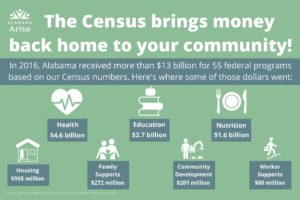
In 2016, Alabama received more than $13 billion for 55 federal programs based on data from the 2010 Census. Our Census count affected $4.6 billion that year in federal funding for health coverage through Medicaid and ALL Kids. It also shaped another $2.7 billion for education, including special education, student loans, and Title I grants to schools with high shares of students from households with low incomes.

The effects of Alabama’s Census numbers don’t stop there. The Census count guides more than $1.6 billion annually for the Supplemental Nutrition Assistance Program (SNAP), school meals and other nutrition services. And it affects funding for a range of other services, including affordable housing, child care, transportation and water treatment. The Census has important implications for virtually every aspect of our daily lives.

The Census brings money back home to your community! In 2016, Alabama received more than $13 billion for 55 federal programs based on our Census numbers. Here's where some of those dollars went. Health: $4.6 billion. Education: $2.7 billion. Nutrition: $1.6 billion. Housing: $965 million. Family supports: $272 million. Community development: $201 million. Worker supports: $80 million. Source: The George Washington University Institute of Public Policy, January 2019.

What you need to know to participate in the Census

Here are a few important things to know regarding the Census:

  • Postcards from the U.S. Census Bureau are scheduled to arrive between March 14 and April 1.
  • Officials encourage people to fill out the Census online if possible. But you also can complete the survey over the phone or request a paper copy in the mail.
  • The Census survey is just 10 questions, and it should only take you about 10 minutes to complete.
  • You will not need to provide a Social Security number to take the survey. Just your address will do.
  • Your responses are completely confidential. The Census Bureau uses them only for statistical purposes.
  • If you have any questions, visit census.gov or call 800-923-8282.

Alabama Arise is putting together informational toolkits for groups to share with folks all across the state. If you want information to share with your community, please email me at mike@alarise.org. Let’s make sure we each take 10 minutes to secure the funding we need for the next 10 years!

Arise legislative recap: March 6, 2020

Arise’s Jim Carnes discusses how the coronavirus outbreak and the closure of Pickens County Medical Center showcase Alabama’s need for Medicaid expansion. Also, in the wake of the recent execution of Nathaniel Woods, Jim talks about HB 359, which would forbid the death penalty in capital cases where the jury does not agree unanimously to impose it.

Alabama needs to expand Medicaid NOW!

Medicaid is a health lifeline for one in four Alabamians and an economic engine for communities across our state. Extending Medicaid coverage to adults with low incomes would make life better for Alabamians of all races, genders and incomes.

Medicaid expansion would ensure coverage for 340,000 Alabamians, including:

  • People who work low-wage jobs and can’t afford private coverage
  • Workers who are between jobs
  • Adults who are caring for children or older family members at home
  • People who have disabilities and are awaiting SSI determinations
  • Adult college students
  • Uninsured veterans

Medicaid expansion would help more Alabamians have:

  • Regular primary care and preventive checkups
  • Earlier detection and treatment of serious health problems
  • Regular OB/GYN visits without referral
  • Less dependence on costly emergency care
  • Better health and greater financial peace of mind

Medicaid expansion would bring our federal tax dollars home to support:

  • Healthier families, workers and communities
  • Stronger rural hospitals and clinics
  • Stronger community mental health and substance use disorder services
  • A needed boost in jobs and revenue for state and local economies

Bottom line

Medicaid expansion is the single biggest step we can take to move Alabama forward. It’s time to invest in a healthier future for our state and our people. It’s time to #CoverAlabama.

Why we’re spreading the word about the Census across Alabama

Filling out your Census form is quick and easy. It only takes about 10 minutes to answer 10 questions. You won’t have to do it again for 10 years. And your answers are completely confidential.

It may not seem like much, but the stakes are high. The accuracy of Alabama’s 2020 Census count will shape our state and local communities every day. Census results determine how many U.S. House members represent each state. They also guide the distribution of more than $700 billion in federal resources every year.

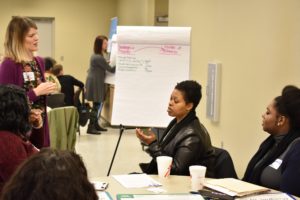
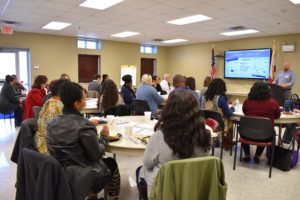
Alabama Arise organizer Mike Nicholson speaks to Madison County community representatives about the Census on Jan. 28 in Huntsville. Arise has partnered with VOICES for Alabama’s Children to conduct similar meetings across the state.

That money funds health coverage through Medicaid and the Children’s Health Insurance Program (CHIP), known as ALL Kids in Alabama. It also supports Head Start, the Supplemental Nutrition Assistance Program (SNAP) and many other services that help struggling families.

Census outreach across Alabama

Alabama Arise is part of a statewide effort to protect these programs by getting as many Alabamians counted as possible. We’ve teamed with VOICES for Alabama’s Children to travel to as many counties as we can to meet with folks and come up with a plan to make sure everyone is counted. We’re providing information and assistance to grassroots partners so they can help their communities understand how the Census affects Alabama.

Alabama Arise organizer Debbie Smith (left) speaks to Madison County community representatives about the Census on Jan. 28 in Huntsville.

Please help us spread the word. In the coming weeks, we’ll share more information about the Census’ importance and tips on persuading your community to participate. No one is a better messenger for your community than you, and Alabama’s future depends on it!

How Alabama can reform its criminal justice system to work for everyone

Alabamians deserve a justice system that sentences fairly, provides helpful rehabilitative services and keeps people safe during incarceration. But Alabama often falls catastrophically short of fulfilling those obligations.

Our state’s prisons are violent and poorly staffed. As a result, they often function as little more than warehouses to keep people locked up until their sentences end.

The crisis in Alabama’s prisons has cost many lives already and shows no sign of stopping. Gov. Kay Ivey’s Study Group on Criminal Justice Policy formed last year to propose steps to fix the problems. The study group published its recommendations last week. Unfortunately, they fall far short of advocating the system-wide changes Alabama needs to create an effective, humane corrections system.

Investments in mental health care, substance use disorder treatments would help thousands

Alabama needs to provide a pathway to full societal participation for people caught up in the criminal justice system. That pathway starts with treatment resources for mental health issues and substance use disorders that lead many people to incarceration. This is a public health problem, and our state can’t imprison its way out.

Medicaid is the largest provider of mental health services in the United States. Timely intervention would keep many people from ever reaching the point where they risk incarceration in a system that isn’t designed for or capable of meeting their needs.

The best option to increase funding for mental health and substance use disorder treatment services is Medicaid expansion. This move would reduce recidivism among people who were incarcerated. Even more, these investments would prevent many people from going to prison in the first place.

The study group’s recommendations fail to address Alabama’s urgent need for Medicaid expansion, but the governor should expand Medicaid anyway. Without that step, the path toward lasting, meaningful criminal justice reform becomes much more difficult.

Significant sentencing reform, fair parole hearings are necessary

Alabama’s sentencing practices need broad improvements beyond the limited relief valves endorsed in the study group’s report. The study group recommended the reintroduction of certain post-conviction motions for relief. It also proposed allowing people who are incarcerated to petition for sentence reduction when their sentence would be lower under current guidelines.

These moves would help, but they aren’t enough to fix a broken system. Alabama needs broader reforms like an end to the Habitual Felony Offender Act and sentence reductions for some nonviolent felonies. Many lawmakers may view such changes as politically risky, but that doesn’t make them any less necessary.

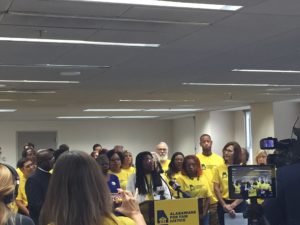
Dena Dickerson, executive director of the Offender Alumni Association, speaks during an Oct. 3, 2019, news conference at the State House in Montgomery. Dickerson was one of dozens of supporters of Alabamians for Fair Justice (AFJ) who assembled to show support for reforms to make Alabama’s corrections system more humane and restorative. Alabama Arise is a member of the AFJ coalition.

Alabama’s aging, overcrowded prisons won’t fix themselves. Just last week, the state closed large portions of Holman Correctional Facility in Escambia County, citing its dangerous structural dilapidation. The Department of Corrections is trying to find long-term placements for more than 600 people who were housed at Holman.

The study group also didn’t address the logjam that the Bureau of Pardons and Paroles has created with its near-total stoppage of paroles in recent months. Parole hearings aren’t appropriate places to retry cases against a person applying for parole. The focus must be on whether applicants pose a risk to the community, not whether their release would garner bad press.

Better preparation for release would reduce recidivism

The study group identified several good opportunities to reduce the odds that a person will end up back in prison. Educational incentive time and increased access to training would help provide people with reachable goals they can use to build a stable life outside of prison.

Pre-release supervision for all people leaving prison would provide them with needed guidance upon reentering society. Ensuring that people have driver’s licenses or other appropriate identification also would remove barriers to rebuilding a life. So would granting people more flexibility to report to their parole officers outside of their scheduled work hours.

Alabama should go even further in easing reentry and reducing recidivism. Drug courts and mental health courts are vital ways to reduce the toll of addiction and mental health crises. But Alabama’s alternative courts don’t operate under a standardized system. The study group didn’t recommend a uniform system for operating these courts or improving access to them. But the Legislature should address that need this year.

Modest improvements won’t cut it

The federal government already has taken notice of the moral atrocity that is Alabama’s prison system. The study group’s recommendations would seal up some cracks, help hundreds of people and remedy some prior oversights. But the suggestions don’t do enough to reduce the overcrowding that threatens to trigger federal takeover. And they aren’t enough to transform Alabama’s criminal justice system into one truly focused on rehabilitation first.

Instead of warehousing people until their sentences end, Alabama should ensure they can participate in society when they get out. The study group’s recommendations are all good steps that would improve our corrections system. But lawmakers will have to be significantly bolder if they want to build a more humane, more restorative criminal justice system that works for all Alabamians.

Arise 2020: Our vision for a better Alabama

Alabama Arise members have worked for more than three decades to build a brighter, more inclusive future for our state. And as the Legislature’s 2020 regular session starts Tuesday, we’re proud to renew that commitment.

Below, Arise executive director Robyn Hyden highlights some key goals for the session, including Medicaid expansion and untaxing groceries.

How you can make a difference

Together, we can turn our shared vision for a better Alabama into a reality. Here are three ways you can help:

(1) Become an Arise individual member. Numbers matter. The more members we have, the louder our voice for change is at the State House. If you’re not yet an Arise member, click here to become one today. If you’re already a member, please ask your friends and neighbors to join us as well!

(2) Talk to your legislators. Make sure your lawmakers know where you stand on our issues. Click here to sign up for our action alerts. And if you can, come meet your lawmakers in person at Arise’s annual Legislative Day on Feb. 25 in Montgomery. Click here to pre-register before Feb. 14.

(3) Spread the word about our issue priorities. The more people learn about our movement, the more support we gain. Read more about our 2020 issue priorities and share this information with your friends:

Together, we can make Alabama a place where everyone’s voice is heard and everyone has the opportunity to reach their full potential. Together, we can build a better Alabama!

Medicaid block grants are a dangerous path toward coverage cuts

The federal Medicaid changes announced Thursday won’t affect anyone now enrolled in Alabama Medicaid. But they could put coverage at risk in the years ahead for hundreds of thousands of Alabamians. This is a worrisome step down a road to increased human suffering and greater financial strain for struggling families.

Guidance from the Centers for Medicare and Medicaid Services (CMS) would allow states to ask for federal permission (known as a waiver) to receive a block grant – a capped amount of federal Medicaid money – to cover working-age adults without disabilities under Medicaid expansion. In exchange, states would receive new powers that can be used to loosen Medicaid’s guaranteed patient protections.

The results could be devastating for newly covered adults who already struggle to make ends meet. For example, states could ask for a waiver to deny Medicaid coverage for certain prescription drugs. They also could seek to take coverage away from people who cannot afford to pay premiums or meet a stringent work requirement.

The waiver plan also could jeopardize state budgets. Under Medicaid’s current structure, the federal government shares all costs with states. But a block grant would leave states solely responsible for covering any costs above the capped amount. This would make it harder for Alabama to respond to health emergencies, natural disasters, economic downturns and other events that increase the need for health care.

A block grant is not a viable alternative to Medicaid expansion

In the 36 states that have adopted Medicaid expansion, it has brought significant gains in public health, family economic security and rural hospital stability. (Alabama is one of just 14 states that have failed to expand Medicaid to cover adults with low incomes.)

The CMS plan threatens these advances in important ways. First, it would weaken eligibility and coverage protections for patients, making their coverage more expensive and less comprehensive. And second, it would limit the federal funding that states can get to support health services. That would reduce the positive impact that expansion has on state economies.

All Alabamians deserve an opportunity at better health for our families, our workforce and our communities. Our state should reject capped funding and harmful barriers to care that would put our bare-bones Medicaid at further risk. Instead, our elected officials should move Alabama forward by adopting Medicaid expansion.

Arise 2020: Expand Medicaid to save lives and make Alabama healthier

Happy anniversary – not! 2020 marks the 10th year of Medicaid expansion under the Affordable Care Act, but not in Alabama. We’re one of just 14 states that have rejected federal funding to extend affordable health coverage to adults with low incomes. And soon, Kansas may cut that number to 13.

The stakes have only gotten higher as time has passed. Over the last 10 years, Alabama has:

  • Seen 13 hospital closures, including seven rural ones.
  • Given up more than $1 billion a year in federal Medicaid funding.
  • Forfeited a similar amount in related economic activity.
  • Allowed thousands of preventable deaths.
  • Stranded more than 220,000 Alabamians in the coverage gap, unable to qualify for Medicaid or afford private coverage.
  • Left tens of thousands more struggling to pay for health insurance they can barely afford.

After a decade of missed opportunity, Alabama needs to invest in our people and our future. Uninsured working parents, caregivers, veterans, people awaiting disability determinations, adult students and other Alabamians with low wages are putting off needed health care. Nearly 90% of our rural hospitals are operating in the red. People and communities across our state are suffering unnecessarily, and it’s time to do something about it.

What will it take to move Alabama forward? 

This can and should be the year for Medicaid expansion in Alabama. It’s an overdue move that would bring our federal tax dollars home to stabilize our rural hospitals and clinics. It would provide critical investment in local economies. And it would increase economic security for struggling Alabamians.

Success would not require passing a bill. Gov. Kay Ivey could simply request a Medicaid rule change raising the eligibility limit for adults, including those without children. A legislative panel that reviews rule changes could allow Medicaid to seek permission from Washington. If that gets the OK, Medicaid would simply factor expansion costs into its next annual budget.

Arise members have identified Medicaid expansion as a top priority. It’s the single biggest step Alabama could take to make life better for people with low incomes. And we’re working hard to make it happen.

We need you with us as we work to make Medicaid expansion a reality in our state. Please join Alabama Arise or renew your membership today to add your voice to our chorus for change. Together, we can build a better Alabama!