
‘No one should have to go through what I did’

Diana Isom (right) smiles alongside her husband, Luke, and their son, Keenan. Diana, a resident of Athens, Ala., was uninsured during her pregnancy and struggled to find affordable options for the health care she needed. (Photo courtesy of Diana Isom)

When Diana Isom became pregnant with her first son, Keenan, back in 2021, it was what she’d always wanted.

“My husband and I had been trying for years. I was so happy, but immediately started thinking about timing,” Diana said.

Timing is always a big consideration for most first-time parents, but for Diana and her husband, Luke, things were a little more complicated. When Luke lost his job suddenly, he had to start training in a new technical field. This meant he lost the private health coverage they had previously.

Even though Diana was working full-time hours as a health care worker, she was paid hourly and offered no benefits. She faced a frightening new future: being pregnant with no health coverage.

“I knew I was fully on my own when the medicine I needed was $200 a month and I’m out here with no insurance. Zero options,” Diana said.

Diana, now 26 years old, was raised in Vestavia Hills. Her parents, native to Panama, moved to the United States more than two decades ago when she was 4 years old.

“When I was a child, my parents came to this country so I could have a better life and a better education. I was taught that America was freedom and happiness… and that hard work can get you whatever you want,” Diana said.

Building a life despite uncertainty

As she got older, Diana said she remained positive and worked hard so she could have opportunities her parents never did.

“When the DACA [Deferred Action for Childhood Arrivals] (policy) was passed in 2012, kids like me, who grew up here in America, qualified as ‘Dreamers.’ I was so excited to be able to get a work permit! I’ve been working ever since,” she said.

Under federal DACA provisions, Diana also could access her driver’s license, a Social Security card and other important documents. These documents could help her secure a job, a home or even just a doctor’s visit.

When Diana and Luke got married, she received a green card. But she decided she would begin the lengthy immigration process in 2017, to make everything “official.”

She grew up in Alabama and wanted to start her own family here. Even so, she had to spend five years – and thousands of dollars – to gain citizenship status.

“My life is here,” she said. “I don’t want to have to go back to Panama. My friends are here. My job and family are here.”

When she was growing up, Diana said, other kids bullied her about her status. Even though Alabama was all she had ever known, she still felt a gnawing sense of insecurity.

“In really bad times in my life, people would threaten to call immigration or ICE on my family,” Diana said. “So I jumped through all these hoops and saved up thousands of dollars to make sure that never happens again. Not for me, and not for my son.”

The stress of being uninsured during pregnancy

In 2021, the Isoms received the good news that Diana would finally receive her citizenship. There was only one hitch: It wouldn’t take effect until three months after her baby was due.

Most Alabama mothers with low incomes now are eligible for Medicaid coverage for up to one year after childbirth, thanks to the state’s postpartum coverage extension in 2022. Even though Diana now had her green card, she had to pay out of pocket for health care during and after pregnancy because of a five-year Medicaid eligibility waiting period.

So she faced it alone.

“I had horrible prenatal depression. No one talks about that. It’s awful,” Diana said. “All the stress of not having insurance and my husband working on a temp basis. He either gets hired on or he’s fired. Every time. That stress is crazy!”

Diana said finding the care she and her baby needed while pregnant became like a second job.

“It’s so mentally draining,” she said. “Ever since they rejected me from Medicaid, I’ve been crying and crying. I’m so numb with the whole process, but I couldn’t give up.”

When she realized the couple’s private insurance had lapsed and no other lifelines were in sight, she began researching resources. She went to a free primary care clinic serving mostly Hispanic patients. But she found it difficult to navigate materials provided in Spanish because her first language growing up was English. And the clinic couldn’t provide all the prenatal screenings she needed.

The experience left Diana lonely and struggling to bond with her child throughout her pregnancy.

“Most people get regular ultrasounds. Without insurance, the hospital I went to only offered me the bare minimum. I got to see my baby two times: at the beginning and at the end. That was it,” she said.

‘I shouldn’t have ever been left behind’

Diana’s local hospital was her only option. As she continued to be billed for more than $1,500 a visit, she said she spent many nights wondering how her new family could afford it all.

“You do what you have to do, and I made it all work for my child because that’s what my parents did for me,” she said. “I shouldn’t have ever been left behind, and now neither should my baby.”

After a 19-hour complicated labor and delivery, baby Keenan was born in early 2022. Three months later, Diana joined him in gaining full American citizenship.

Diana thought her citizenship ceremony would lift her spirits and give her family the celebration they needed after a stressful pregnancy, but the process proved a bit impersonal and underwhelming.

“We drove nearly four hours to the immigration office. When I sat down, there was just an officer calling in on Zoom. I was looking at an iPad screen when I ‘became an American,’” she said.

Diana said she is grateful for her new status, but her time as an uninsured mother was a stark reminder that the playing field is not equal for everyone who lives in Alabama.

“People like me who have been in this country for so long… we pay taxes,” she said. “You’re telling me I pay into it, but not benefit from it?”

Though most undocumented immigrants live in a family with a full-time worker, they have limited access to employer-sponsored coverage, a Kaiser Family Foundation report found. And while they pay the same taxes as citizens, they often are employed in low-wage jobs and industries that are less likely to offer employer-sponsored coverage, like Diana is.

Medicaid expansion is the path to a healthier future for Alabama parents

Diana was ineligible for Medicaid after her pregnancy, both because she was not yet a citizen and because Alabama had not yet extended postpartum coverage to one year.

She would now qualify for Medicaid coverage during and immediately after future pregnancies if she met the income eligibility standards. 

Alabama remains one of 10 states yet to expand Medicaid. That means tens of thousands of Alabama parents still have no affordable long-term path to the health care they need as they seek to provide for their families.

Hundreds of thousands of Alabamians stand to gain access to health coverage if our state expands Medicaid. In the Huntsville metro area where Diana and her family live, that includes more than 11,000 people in Madison County and nearly 3,000 people in Limestone County.

Diana said her difficult journey has turned her into a fierce advocate for Alabama mothers.

“Medicaid expansion is a given,” she said. “The stuff I had to deal with in my pregnancy; the days I had to cry myself to sleep. I was always thinking, ‘Today is gonna be the day that something bad happens to my baby.’”

The Isoms’ new son, Keenan, is now insured under Alabama’s Medicaid program. Diana recently returned to work, and her husband was hired on full time after completing workforce training. They soon will be covered by his health insurance. 

Diana said having coverage for both baby and mom has been such a relief to their family.

“I’ve been able to let go of so many things I was worried about before: being deported and away from my child, or how I was going to be able to go to the doctor, even just sleeping at night,” she said. “No one should have to go through what I did. No one.”

About Alabama Arise and Cover Alabama

Whit Sides is the Cover Alabama storyteller for Alabama Arise, a statewide, member-led organization advancing public policies to improve the lives of Alabamians who are marginalized by poverty. Arise’s membership includes faith-based, community, nonprofit and civic groups, grassroots leaders and individuals from across Alabama. Email: whit@alarise.org.

Arise is a founding member of the Cover Alabama coalition. Cover Alabama is a nonpartisan alliance of advocacy groups, businesses, community organizations, consumer groups, health care providers and religious congregations advocating for Alabama to provide quality, affordable health coverage to its residents and implement a sustainable health care system.
Medicaid ‘unwinding’ hits halfway mark in Alabama

In April, Medicaid ended a continuous coverage eligibility period brought on by the public health emergency during the COVID-19 pandemic. What followed was a return to traditional eligibility requirements. This return to normal rules is called “unwinding.” Coverage losses have begun, and tens of thousands of Alabamians likely will lose their Medicaid coverage by June 2024.

A little more than halfway through the unwinding process, Alabama Medicaid members have a renewal rate of 68%. Only 4% of Medicaid members have been determined to be ineligible, while 27% of members lost coverage for procedural reasons.

From this information, we know more than 70% of Medicaid members have responded to requests for eligibility information from Alabama Medicaid. This response rate can be credited to Alabama Medicaid having a clear and concise communication plan. It also is a testament to the strong support of health care advocates in communities across Alabama.

But this does leave many thousands of people who are disenrolled for procedural reasons. And these losses are especially harsh for those who still may be eligible for coverage. When coverage loss occurs for procedural reasons, enrollees may need to submit further information to keep or maintain coverage. To prevent unnecessary coverage loss, please return any application materials to Alabama Medicaid, even if you do not think you are eligible. Only Alabama Medicaid can determine eligibility status.

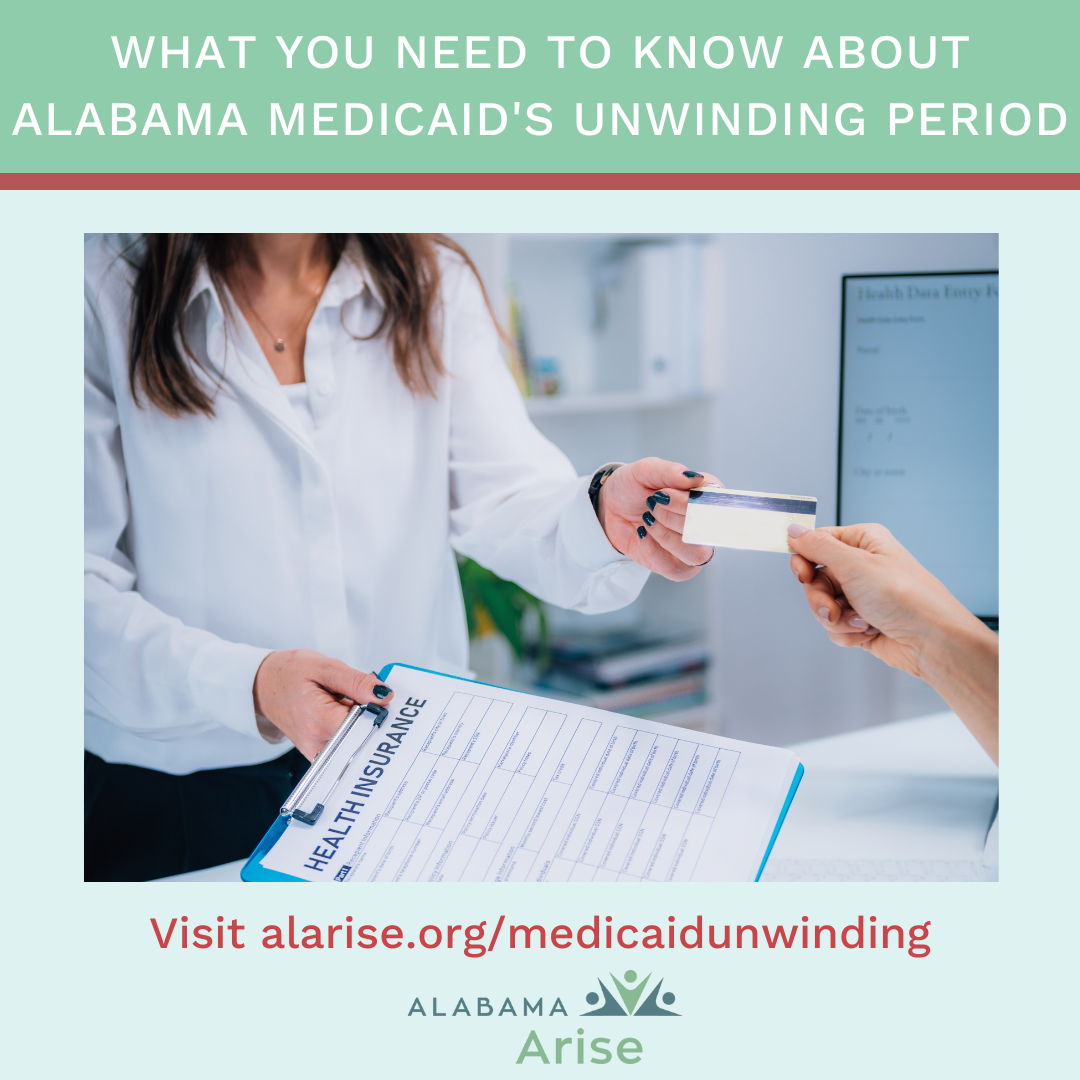
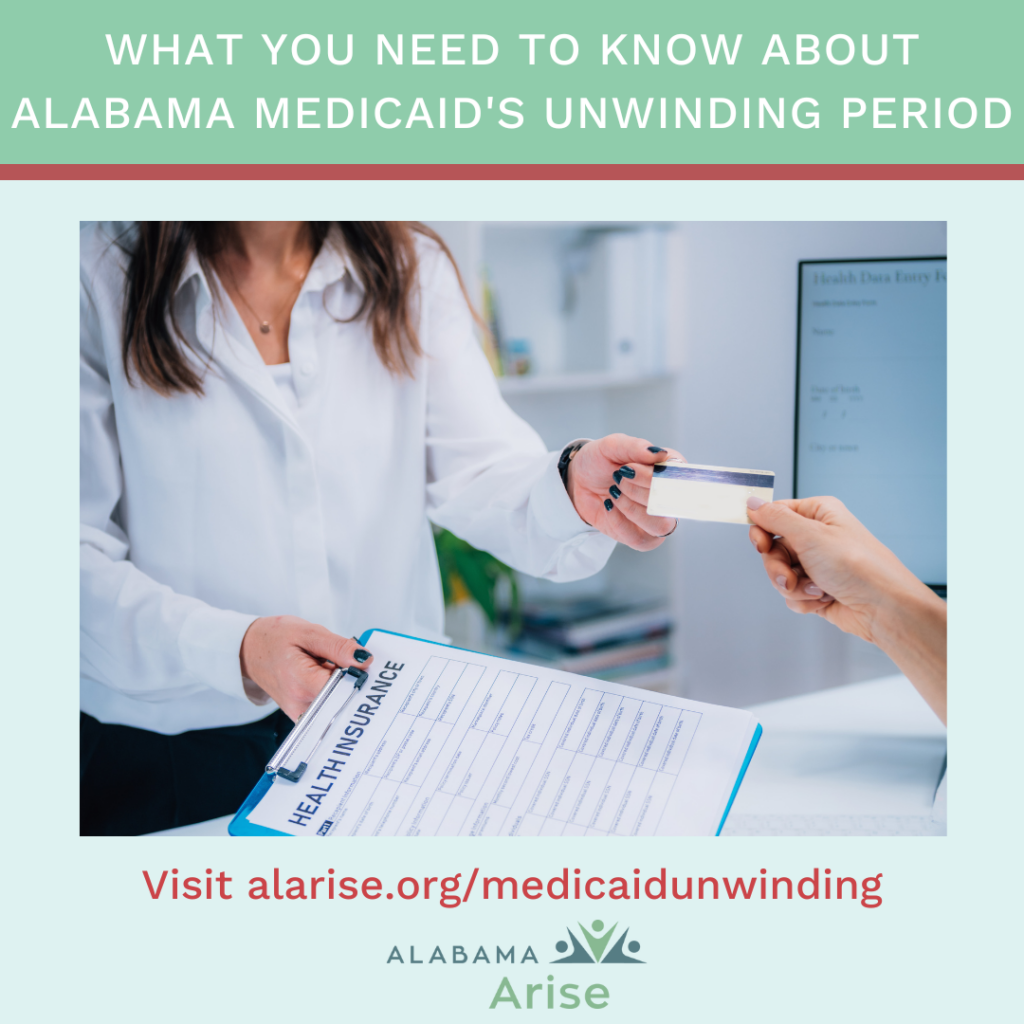
A graphic promoting an Alabama Arise toolkit. Headline: What you need to know about Alabama Medicaid's unwinding period. Text: Visit alarise.org/medicaidunwinding. Between the headline and text is a close-cropped photo of a woman reaching out to accept an insurance card while handing a clipboard to them. The clipboard includes a paper with "health insurance" as the headline. An Arise logo is at the bottom of the image.

If you have lost coverage, you may reapply with Alabama Medicaid. You also can contact Enroll Alabama for information on options for Marketplace insurance under the Affordable Care Act. If you feel that Medicaid terminated your coverage in error, you may appeal that decision. Call our partners at ADAP at 800-826-1675 for help.

For more information, please check out Alabama Arise’s Alabama Medicaid unwinding toolkit.

Maternal, infant health care debuts as an Alabama Arise priority

Alabama Arise reached a new milestone in October when more than 500 members voted to determine Arise’s 2024 legislative priorities after our Annual Meeting. Nearly 100 members attended the meeting in person at the Equal Justice Initiative’s Legacy Institute in Montgomery, while almost 250 attended virtually. Outgoing board president Kathy Vincent led the meeting, which featured presentations from Arise staff and member group representatives.

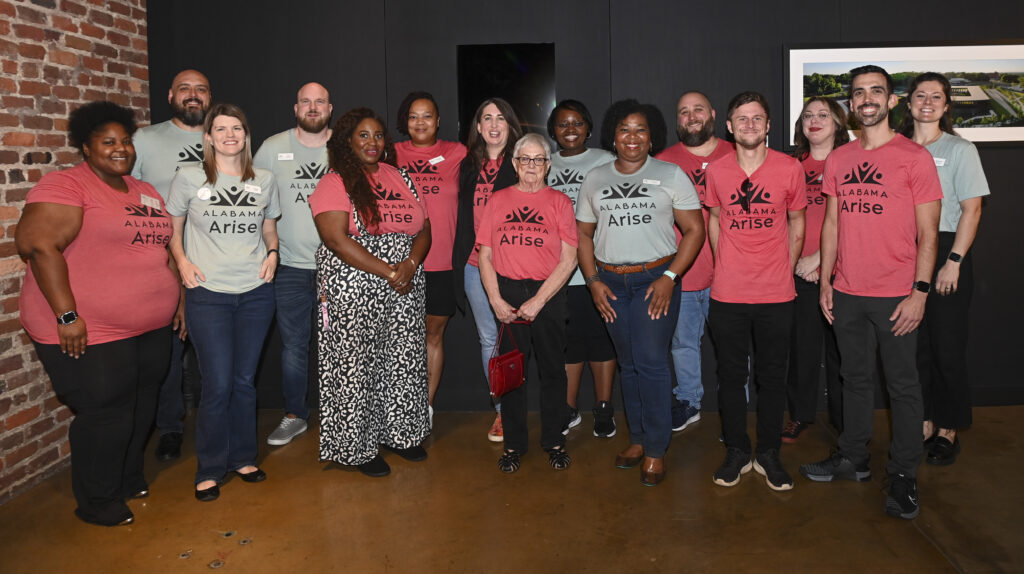
Fifteen Alabama Arise staff members, all wearing either red or green shirts with the Arise logo, stand and smile for a group photo. To their left is a red brick wall, and behind them is a black wall with two framed photographs.
Alabama Arise was excited to have a record number of members voting on our legislative priorities this year! Above: Arise staff members pose for a group photo after our Annual Meeting on Sept. 30, 2023, in Montgomery. (Photo by Julie Bennett)

Six of the seven priorities are returning from our 2023 agenda:

  • Fully untaxing groceries
  • Expanding Medicaid
  • Voting rights
  • Criminal justice reform
  • Comprehensive maternal and infant health care
  • Dedicated funding for public transportation
  • Death penalty reform

Read our news release for more information about each priority.

A safer and healthier Alabama for parents and children

A notable newcomer to our roster is a comprehensive approach to maternal and infant health care, which was proposed by ACLU of Alabama. This priority certainly aligns with our ongoing work to expand Medicaid and close Alabama’s health coverage gap. And our members decided it was critical for this to become a named priority in its own right. We are starting off strong by hiring a maternal health fellow to support our work to protect coverage during the Medicaid unwinding period.

Advocates have a long road ahead on this issue. Alabama has the highest maternal mortality rate in the nation. And according to the March of Dimes, more than one-third of Alabama’s counties are “maternal care deserts.”

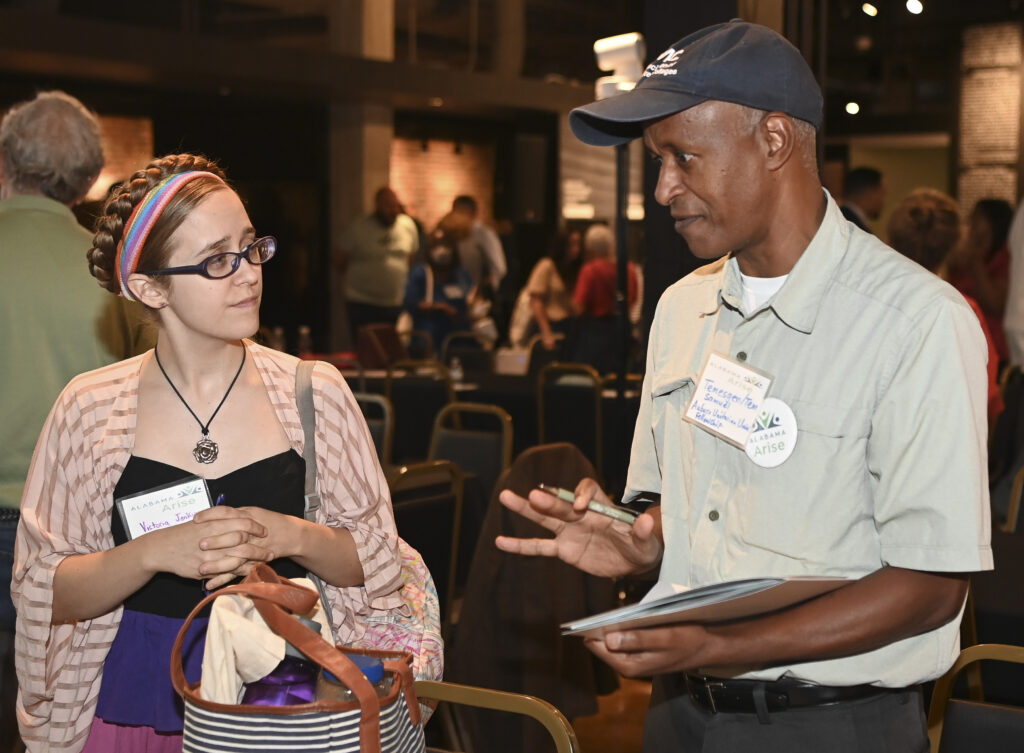
Two Alabama Arise members speak at our 2023 Annual Meeting. On the left is a white woman wearing glasses with a black blouse and a striped pink shirt over it. She has a purse over her shoulder and a bag in front of her. On the right is a Black man wearing a black hat and a cream-colored shirt with an Alabama Arise button. Both are wearing nametags.
Alabama Arise members Victoria Jenkins and Tem Samuel speak during the closing moments of our Annual Meeting on Sept. 30, 2023, in Montgomery. (Photo by Julie Bennett)

A safer Alabama for mothers will include access to high-quality maternal health care where patients live, removal of criminal penalties for doctors providing necessary care, and more freestanding maternal care centers across the state.

Alabama’s mothers and babies deserve so much better. Arise is committed to creating a safer and healthier state that will give parents, children and every Alabamian the chance to thrive and achieve their full potential.

Alabama Arise unveils 2024 roadmap for change in Alabama

Expanding Medicaid and ending the state sales tax on groceries will remain top goals on Alabama Arise’s 2024 legislative agenda. The group also will pursue a multifaceted approach to improving maternal and infant health in Alabama.

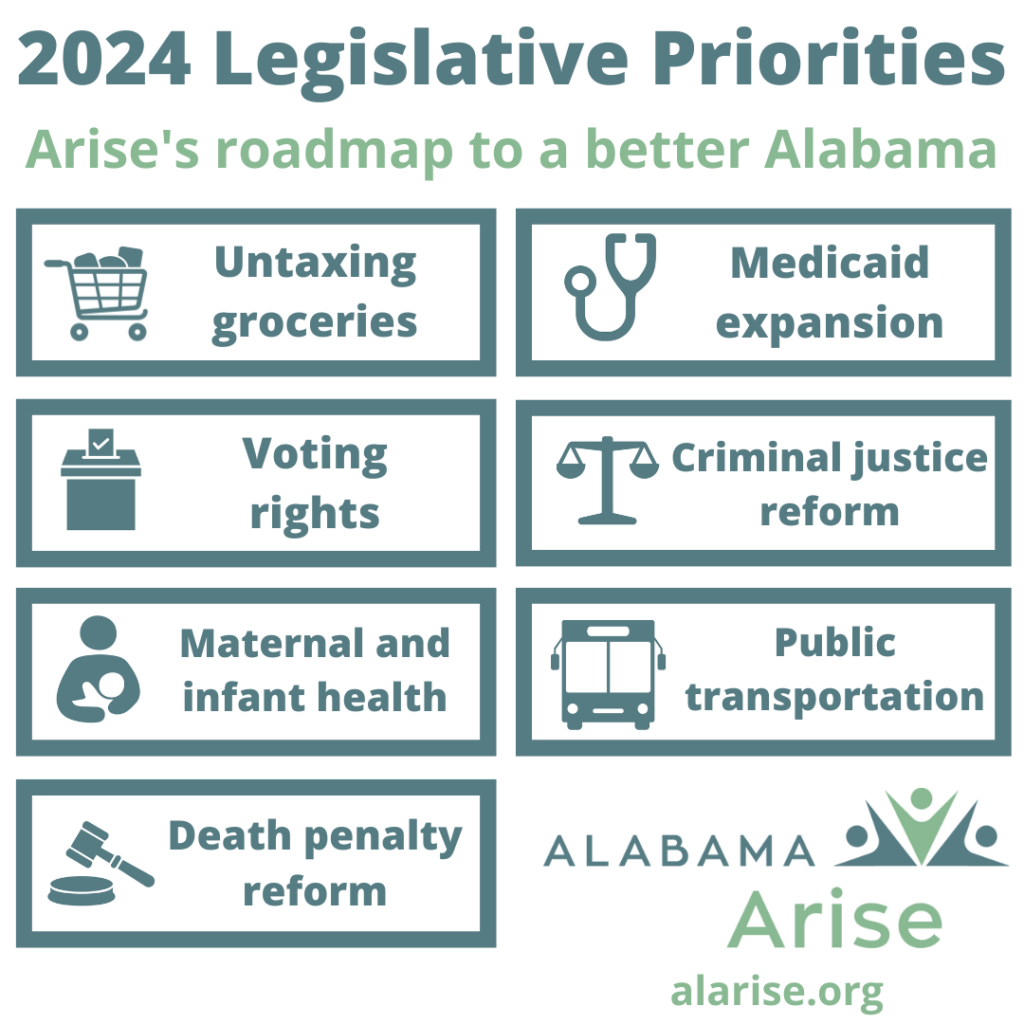
More than 500 members voted to determine Arise’s legislative priorities in recent days after the organization’s annual meeting Saturday. The seven priorities chosen were:

  • Adequate budgets for human services, including expanding Medicaid to make health coverage affordable for all Alabamians and protecting public education funding for all students.
  • Tax reform to build a more just and sustainable revenue system, including eliminating the rest of Alabama’s state sales tax on groceries and replacing the revenue equitably.
  • Voting rights, including no-excuse early voting, removal of barriers to voting rights restoration for disenfranchised Alabamians, and other policies to protect and expand multiracial democracy.
  • Criminal justice reform, including legislation to reform punitive sentencing laws and efforts to reduce overreliance on exorbitant fines and fees as a revenue source.
  • Comprehensive maternal and infant health care investments to ensure the health and safety of Alabama families.
  • Dedicated funding for public transportation to empower Alabamians with low incomes to stay connected to work, school, health care and their communities.
  • Death penalty reform, including a law to require juries to be unanimous in any decision to impose a death sentence.

“Arise believes in dignity, equity and justice for everyone,” Alabama Arise executive director Robyn Hyden said. “Our 2024 legislative priorities reflect our members’ embrace of those values, and they underscore the need to enact policies that empower Alabamians of every race, income and background to reach their full potential. Together, we’re working to build a healthier, more just and more inclusive Alabama for all.”

An infographic naming Alabama Arise's 2024 legislative priorities, Arise's roadmap to a better Alabama. The priorities are untaxing groceries, Medicaid expansion, voting rights, criminal justice reform, maternal and infant health, public transportation and death penalty reform.

The time is right to close Alabama’s health coverage gap

One essential step toward a healthier future for Alabama is to ensure everyone can afford the health care they need. Arise members believe Medicaid expansion is a policy path to that destination, and research provides strong support for that position.

Expanding Medicaid to cover adults with low incomes would reduce racial health disparities and remove financial barriers to health care for nearly 300,000 Alabamians. It would support thousands of new jobs across the state. And most importantly, it would save hundreds of lives every year.

“Medicaid expansion would boost our economy and improve the lives of hundreds of thousands of Alabamians,” Hyden said. “It’s time for Alabama’s policymakers to make this life-saving and job-creating investment in the people of our state. Ensuring Alabamians’ health and well-being now will help our state flourish for decades to come.”

Alabama became one of only 10 states yet to expand Medicaid after North Carolina enacted expansion in March. Medicaid expansion would ensure health coverage for nearly 300,000 Alabamians caught in the coverage gap. Most of these residents earn too much to qualify for the state’s bare-bones Medicaid program but too little to afford private plans.

How Medicaid expansion would improve maternal and infant health

Medicaid expansion also would bolster health care access for Alabamians before, during and after pregnancies. This would be a critical life-saving move in Alabama, which has the nation’s worst maternal mortality rate. Those rates are even higher for Black women, who are twice as likely to die during birth as white women. Adding to the problem, more than two-thirds of Alabama counties offer little or no maternity care or obstetrical services.

“Alabama took an important step to help families stay healthy by extending Medicaid postpartum coverage last year,” Hyden said. “However, that step alone was not enough to meet our state’s numerous health care needs. Policymakers should pursue numerous solutions to make Alabama a better place for parents and babies. At the top of that list should be expanding Medicaid to ensure Alabamians of all ages can stay healthy before, during and after conception.”

New to Arise’s agenda this year is a comprehensive policy approach to safeguarding and expanding access to maternal and infant health care in Alabama. In addition to Medicaid expansion, this approach would promote seamless continuity of care between home and clinical settings. It would include coverage for contraception and midwifery services. And it would eliminate the specter of criminal penalties for doctors who provide care to pregnant people who are experiencing life-threatening complications.

Finish the job: Alabama should remove the rest of the state grocery tax

Arise advocacy got results this year when legislators voted unanimously to reduce Alabama’s state sales tax on groceries by half. The new law reduced the state grocery tax from 4 cents to 3 cents on Sept. 1. Another 1-cent reduction will occur in 2024 or the first subsequent year when education revenues grow by at least 3.5%.

Arise’s members have advocated for decades to untax groceries, and they renewed their commitment to continue that work in 2024. Ending the state grocery tax remains a core Arise priority because the tax makes it harder for people with low incomes to make ends meet. The tax adds hundreds of dollars a year to the cost of a basic necessity for families. And most states have abandoned it: Alabama is one of only 12 states that still tax groceries.

The state grocery tax brought in roughly 7% of the Education Trust Fund’s revenue in the last budget year. But lawmakers have options to remove the other half of the state grocery tax while protecting funding for public schools. Arise will continue to support legislation to untax groceries and replace the revenue by capping or eliminating the state income tax deduction for federal income taxes. This deduction is a tax break that overwhelmingly benefits the richest households.

“Reducing the state grocery tax was an important step toward righting the wrongs of Alabama’s upside-down tax system,” Hyden said. “By untaxing groceries and reining in the federal income tax deduction, lawmakers can do even more to empower families to keep food on the table. Closing this skewed loophole is an opportunity to protect funding for our children’s public schools and ensure Alabama can afford to end the state grocery tax forever.”

Here’s what Alabama Arise heard from you in summer 2023!

Alabama Arise listens because we deeply value the input we get from members, partners and most importantly, those directly affected by the work we do together. We depend on what we hear to help guide our issue work and our strategies.

We held three statewide online events this summer: two Town Hall Tuesdays and one public transportation listening session. And we facilitated eight additional listening sessions around the state, engaging a total of about 375 people.

The town halls happened on July 18 and Aug. 8, and the public transit event was Aug. 9. Other meetings took place throughout the summer. This year we are sharing the direct notes and highlights from each of the meetings as recorded during the sessions.

Town Hall Tuesdays & Public Transportation Listening Session

  • Building on our vision: We had three breakout rooms during this session. We asked folks in each group to discuss their thoughts on current issues and to share other priorities they had. Here’s what we heard:

Group One: Participants generally thought Arise should continue working on the current issues. They noted that the issues are interconnected, and that makes it hard to prioritize. Concerns about criminal justice conviction practices were raised, along with the need for continued work on voting rights and Medicaid expansion. Other issues raised were the need for more affordable housing, paying a living wage versus a minimum wage, and the need to discuss the impact of the opioid epidemic on grandparents now raising children because their parents suffer with addiction. Participants also raised reapportionment as an important issue.

Group Two: Participants strongly believed all of the Arise priority issues are important and that we should continue to work on them. Some of the specific issues lifted up were transportation, voting rights, payday lending and Medicaid expansion. Some issues that are not current Arise priorities raised were housing, disability, mental health access and accountability and prison reform.

Group Three: Medicaid expansion received the most support for continued work. Several people voiced prisons and criminal justice as a concern, including the need for prison reform and bail reform. Voting rights and the concern about the many voter suppression bills was a high-priority topic. Participants discussed passionate concern about payday loans, and the group supported the present slate of issues.

  • Building on our hope: We had three breakout rooms during this session. We asked folks in each group to discuss what motivates them to act on issues and how Arise supports their actions. We also asked them to indicate their priority issues. Here’s what we heard:

Group One: 

  1. The discussion in the group was hot and heavy concerning voting rights and specifically the absentee ballot application. The group concluded that a no-excuse absentee ballot should be the norm and should be an Arise issue for 2024.
  2. The group felt strongly that the 2023 Arise slate of issues should all remain on the 2024 list of Arise priority issues. Medicaid is an issue we need to keep fighting for, they said.
  3. This group had a primary focus and lengthy discussion around voting rights.

Group Two: 

  1. All members of the group strongly believe all the Arise priority issues are important and that we should continue to work on them.
  2. Members also strongly believe affordable housing and public transportation should receive a strong voice like Medicaid expansion.
  3. Members said that to further our support of advocacy work, Arise can help unite nonprofits and grassroots organizations across the state to work together toward shared goals as opposed to working separately toward shared goals.
  4. Members lifted up our education and lobbying work as essential to connecting the people to those who represent them in the Legislature.

Group Three: Voting rights emerged as a strong theme from this group’s discussion. Participants stressed the importance of voter education and folks making the connection between voting and the policies elected officials make that impact their lives. Other voting themes included restoration of voting rights and engaging younger and BIPOC voters. Other issues raised were around public transportation and the need to fund mental health services. One participant expressed appreciation for the storytelling work Arise does related to Medicaid expansion and urged similar storytelling to help move elected officials around other Arise issues.

  • Public Transportation Listening Session: We had three breakout rooms during this session. We asked folks in each group to discuss what’s needed to improve public transit in Alabama, what strategies are needed to move the issue forward and how public transit impacts quality of life in their communities.

Group One: 

  1. Private companies like Uber and Lyft are not equipped to serve the disability community, group members said. This is very important when talking about transportation for the disability community wherever they may be, rural or urban. In other words, the private companies are not a viable resource, participants said.
  2. Rural linkage: Many rural counties have transportation-on-demand systems, but they only serve the county boundaries. Many health services reside in urban centers, and the rider needs to get from Blount County to UAB or Children’s Hospital in Birmingham. These riders are out of luck. Transfer hubs for rural to urban systems do not exist.
  3. A state transportation planning system is needed to coordinate all the existing public systems, rural and urban. Participants hoped Arise’s forthcoming transit study will shine some light on the need for a statewide public transportation planning entity.
  4. The group felt a need for massive public education around the benefits of public transportation. Somehow, Arise or a group of organizations should seek funding for an advertising budget, participants said.
  1. The real cost of owning a car versus using public transportation. This kind of information should be available to the public.
  2. The fact that public transportation is good for business development throughout the state should be targeted to legislators and local business councils and chambers of commerce.

Group Two: 

  1. This group believes public transportation is essential.
  2. There is a need for more hubs and covered stops for locations that already have public transportation in place.
  3. There is a need for more routes with more frequent buses each hour, as well as drivers who are paid livable wages.
  4. Specific strategies discussed included working with for-profits, chambers of commerce, small businesses and corporations to improve transportation for their employees. Participants also suggested surveying the need for transportation by including a question on applications to ask if transportation is needed.
  5. Public transportation impacts the quality of life across the board: health, food, employment, education, leisure, etc.
  6. People have a right to comfort, dignity, pride and independence that public transportation can provide.
  7. One member said reaching out to people who do not need or use public transportation is important to educate them that they can still benefit from it. It helps reduce traffic and road congestion, decreases likelihood of drinking and driving, and helps people out of desperate situations, which can help decrease poverty and crime.
  8. A member of the Alabama Institute for the Deaf and Blind shared how losing the ability to drive caused depression. But oppression is felt when there are no options for transportation other than relying on friends or family if you have them, or simply being unable to go to doctor’s appointments, shop for groceries or pick up medications when needed.
  9. Some members suggested a public Lyft/Uber service.

Group Three: 

  1. Needs: Money/state funding, alternative models, transit-oriented development at local levels, accessibility, buy-in from agencies like ALDOT, changed perception of public transit.
  2. Strategies/tactics: Collect public transit stories, share statistics on earning power with vs. without good public transit and other data relevant to workforce development, and highlight workforce development as a theme for legislative lobbying. Participants discussed a license plate fee, tire fee or special license plate (like public schools have, for example).
  3. Quality of life: A visually impaired participant described how a trip to the grocery store or polling place only a couple miles away is a $25 Uber ride one way. Another participant who works with clients described how their lack of access to public transit affects not just work but health appointments, visiting DHR to secure SNAP, applications for housing, etc. They also mentioned that even “low-cost” transit can be a barrier to low-income folks who may not have a dollar for a ride.

Additional listening sessions

Following are the brief notes/summaries from eight other sessions our organizers held during the summer. In general, all participants strongly affirmed Arise’s work on the current issue priorities. They also highlighted some other issues of concern.

  • Cullman, July 26 (Stan Johnson) – This was a well-informed group with a lot of comments and questions concerning criminal justice, public transportation, death penalty and new prison construction.
  • Opelika, July 26 (Formeeca Tripp) – This group discussed issues surrounding housing, transportation, food insecurity, health care and the legal system. Housing was a top issue.
  • Zoom, Aug. 3 (Formeeca) A death penalty group discussed issues related to recent executions in Alabama, as well as upcoming executions nationwide. Participants said more attention and connections are necessary to bring more awareness to death penalty reform.
  • Tuscaloosa, Aug. 7 (Stan) – The most passionate suggestion from this meeting was the need for legislative action to provide funding for mental health.
  • Opelika, Aug. 17 (Formeeca) – Arise conducted listening sessions in the form of a series of small group meetings.

Group 1: Predominantly parents, people of the community and law enforcement. They supported all current issues but wanted to focus on housing and transportation.

Group 2: Predominantly school staff, counselors, superintendents, principals, resource providers, etc. They wanted resources for non-English-speaking families, housing, transportation and effective mental health services.

Group 3: Predominantly youth, teenagers and support staff. They wanted to learn more about their representatives and how to lift up their own voices, as well as better wages and job opportunities.

  • Montgomery, Aug. 17 (Formeeca) – This group discussed their strategic plan to add to the existing public transportation priority issue. They want to add a $1 fee to license plates to fund the Public Transportation Trust Fund.
  • Birmingham, Sept. 10 (Stan) – This group showed special interest in fair housing and criminal justice reform. Voting rights also was a concern to the group, specifically absentee voting bills that may be reintroduced in the upcoming session.
  • Auburn, Sept. 21 (Formeeca) Students from an Auburn University class filled out a 2024 issue proposal survey form asking them to rank issues of priority. The top three issues that seemed to rank the highest were public transportation, voting rights and criminal justice reform.

Alabama Arise toolkit on the Medicaid ‘unwinding’ period

A promotional image for alarise.org/medicaidunwinding featuring a health insurance transaction between two adults.

Alabamians at every income level should be able to get the health care they need to survive and thrive. Medicaid plays a vital role toward meeting that goal, providing health coverage for more than 1 million Alabamians with low incomes. But tens of thousands of Alabamians may lose their Medicaid coverage by June 2024 in a process called “unwinding.”

Alabama Arise is working to minimize coverage losses during this period. As part of those efforts, we created this toolkit to explain the Medicaid unwinding and help connect people with other affordable coverage options for which they may be eligible.

Below is a table of contents for the resources in this Medicaid unwinding toolkit. Email info@alarise.org if you have any questions or recommendations for additional resources.

What is the Medicaid unwinding?
What Medicaid members should do next
How to appeal an eligibility determination
Where to look for new coverage
How has the Medicaid unwinding affected you?
Unwinding in the news
Additional resources

What is the Medicaid unwinding?

On April 1, 2023, Medicaid ended a continuous coverage eligibility period brought on by the public health emergency during the COVID-19 pandemic. What followed was a return to traditional eligibility requirements. This return to normal rules is called “unwinding.”

Alabama Medicaid has resumed its traditional process for verification of eligibility. More than 60,000 Alabamians may lose their coverage by June 2024 due to this change, researchers estimate. But Medicaid members who remain eligible can take steps to ensure they don’t lose coverage.

Current Medicaid members will receive mailings to their home addresses from Alabama Medicaid discussing these changes. Enrollees should ensure their most current and up-to-date information is on file by visiting the recipient portal here.

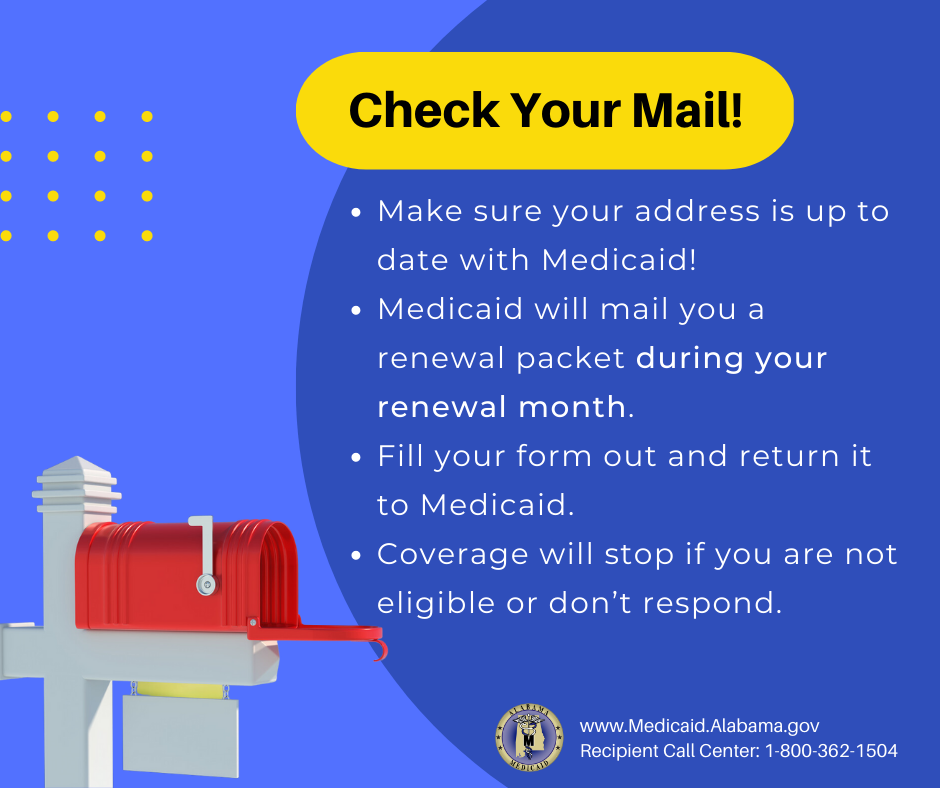
A notice from Alabama Medicaid to check your mail for important information beginning April 1.


Read Alabama Arise’s blog post about what Medicaid members need to know about the unwinding.

Read Arise’s blog post about how Alabama can protect health coverage during the unwinding.

What Medicaid members should do next

Click here to make sure Medicaid has your current contact information. Answers to some common questions about the unwinding period are below.

(1) How will I know it is time to renew my Medicaid application?

Medicaid enrollees will receive a recorded phone message, text message and/or email when it is time to renew – if you have provided that contact information to the Alabama Medicaid Agency. These automated messages will not ask for a response.

Please call Medicaid directly at 800-362-1504 if you have questions or need assistance.

(2) How will I get my renewal packet?

Medicaid enrollees will receive a renewal packet by mail prior to their renewal month. Click here to find out your renewal month.

(3) What do I do when I receive my renewal packet?

Please complete your form and follow instructions to return it to Alabama Medicaid. If you need assistance, call Medicaid at 800-362-1504 or go in person to a local Medicaid office.

(4) How will I know if I keep my Medicaid benefits?

Alabama Medicaid will make a determination on your eligibility. The agency also may ask for more information if needed. You will receive a decision on your eligibility directly from Alabama Medicaid.

(5) Do I need to fill out the renewal form if I know I don’t qualify for Medicaid anymore?

You should fill out the renewal form – even if you think you don’t qualify anymore. You can fill out the paper form or go online to submit the information. Or you can call the Medicaid office in your area to renew. Once you submit your information, you will be considered for any of the Medicaid programs for which you are eligible.

(6) Where can I find some helpful unwinding resources from Alabama Medicaid?

How to appeal an eligibility determination

Alabama Medicaid will make an eligibility determination and notify you of that decision. This notification will have a termination date if your benefits are ending.

(1) What if I received notice that I am no longer eligible for Medicaid?

You can appeal this decision, reapply for Medicaid benefits or contact Enroll Alabama to submit an application on the Health Insurance Marketplace portal.

(2) What if I want to stay on Medicaid but need to update my information? 

Click here to reapply to Medicaid with your updated information.

(3) What If I believe the termination notice from Medicaid is incorrect?  

The first step that you can take is to request a review of Medicaid’s decision or a conference to discuss your case. You or someone helping you must contact a Medicaid district office and request a review or conference. You may be asked to provide more information to Medicaid. A conference may be helpful when additional information is needed to support your eligibility claim.

(4) What do I do if Medicaid does not find me eligible after my review or conference?

The next step is to request a fair hearing. You must make your request in writing no later than 60 days from the date of your termination letter or 60 days from the decision of your review or conference. You must mail your request for a hearing to the following address:

Medicaid Agency – Central Office
Alabama Medicaid Agency
P.O. Box 5624
Montgomery, AL 36103-5624

Call Alabama Medicaid at 334-242-5741 for information on a fair hearing request.

Where to look for new coverage

Did you or someone you know lose health coverage due to the Medicaid unwinding? Other affordable coverage options may be available.

Contact Enroll Alabama for more information on enrolling in a plan through the Health Insurance Marketplace at healthcare.gov. Many Alabamians are eligible for Marketplace coverage at little or no cost thanks to subsidies under the Affordable Care Act.

How has the Medicaid unwinding affected you?

Alabama can protect families and make health coverage more affordable by expanding Medicaid to cover adults with low incomes. Your personal story can help influence legislators and inspire advocates to take action.

You’re not alone. Nearly 300,000 Alabamians who are uninsured or struggling to afford coverage would benefit from Medicaid expansion. When you share your story, you help make the issue real for people. And you help show what’s at stake if we don’t close Alabama’s health coverage gap.

Arise’s Cover Alabama storyteller Whit Sides is gathering and telling the stories of Alabamians living in the coverage gap. Click here to share your story.

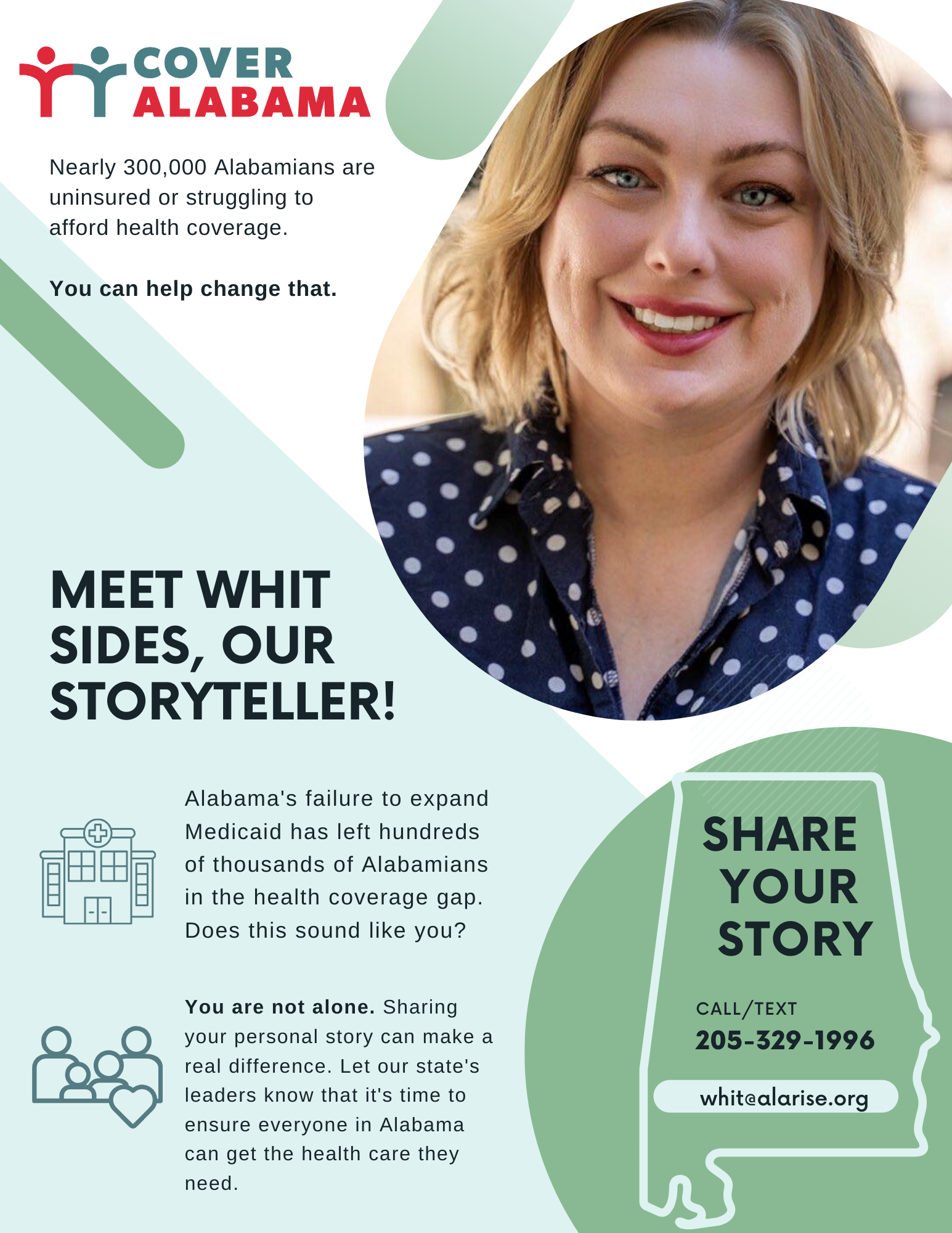
A flyer introducing Arise's Cover Alabama storyteller Whit Sides. A picture of Whit is at the top right. She is a smiling white woman with blonde hair, wearing a blue blouse with white polka dots. Reach Whit at 205-329-1996 or whit@alarise.org.

Unwinding in the news

  • AL.com: Status of 129,000 Alabama Medicaid enrollees uncertain after post-pandemic emergency
  • Alabama Daily News: Alabama starts removing people off Medicaid, but won’t yet say how many
  • Alabama Reflector: Post COVID-emergency, Alabama not reporting how many people lost Medicaid coverage
  • CNN: Medicaid eligibility: More than a million people have lost their Medicaid coverage already. It’s far from over
  • Managed Healthcare Executive: Understanding the long-term implications of Medicaid unwinding
  • NPR: Texas Medicaid dropped more than 500,000 enrollees in one month
  • PBS NewsHour: Why some cancer patients will fall off a Medicaid coverage cliff this summer
  • Washington Post: Paperwork mistakes should not end a child’s health coverage
  • WBRC Fox 6, Birmingham: What to know if you’re losing your Medicaid coverage in Alabama

Additional resources

See the Gap: How Medicaid expansion would benefit stylists – and every Alabamian

Over the last year, Alabama Arise has collected the stories of some of the nearly 10,000 personal care workers who would benefit from Medicaid expansion in our state. We spent months getting to know folks in one of our state’s most vibrant industries. And we want to be sure you see the last few stories in this series.

You can find all of our See the Gap stories in one place here.

We kicked off our series with a personal story about how beauty professionals make sacrifices to support us, but often have no safety net of their own. That’s especially true when it comes to having access to affordable health care for themselves or their families.

Now, as we close the series, we’re lifting up even more stories that speak to a vital question: “How would life be better for so many people if Alabama expanded Medicaid?”

Stories from Alabama’s coverage gap

Like Kayla, a young stylist who is at the pinnacle of her career. Even so, she has reservations about becoming pregnant and having a child while she has no health insurance. There are some possibilities that she just can’t afford.

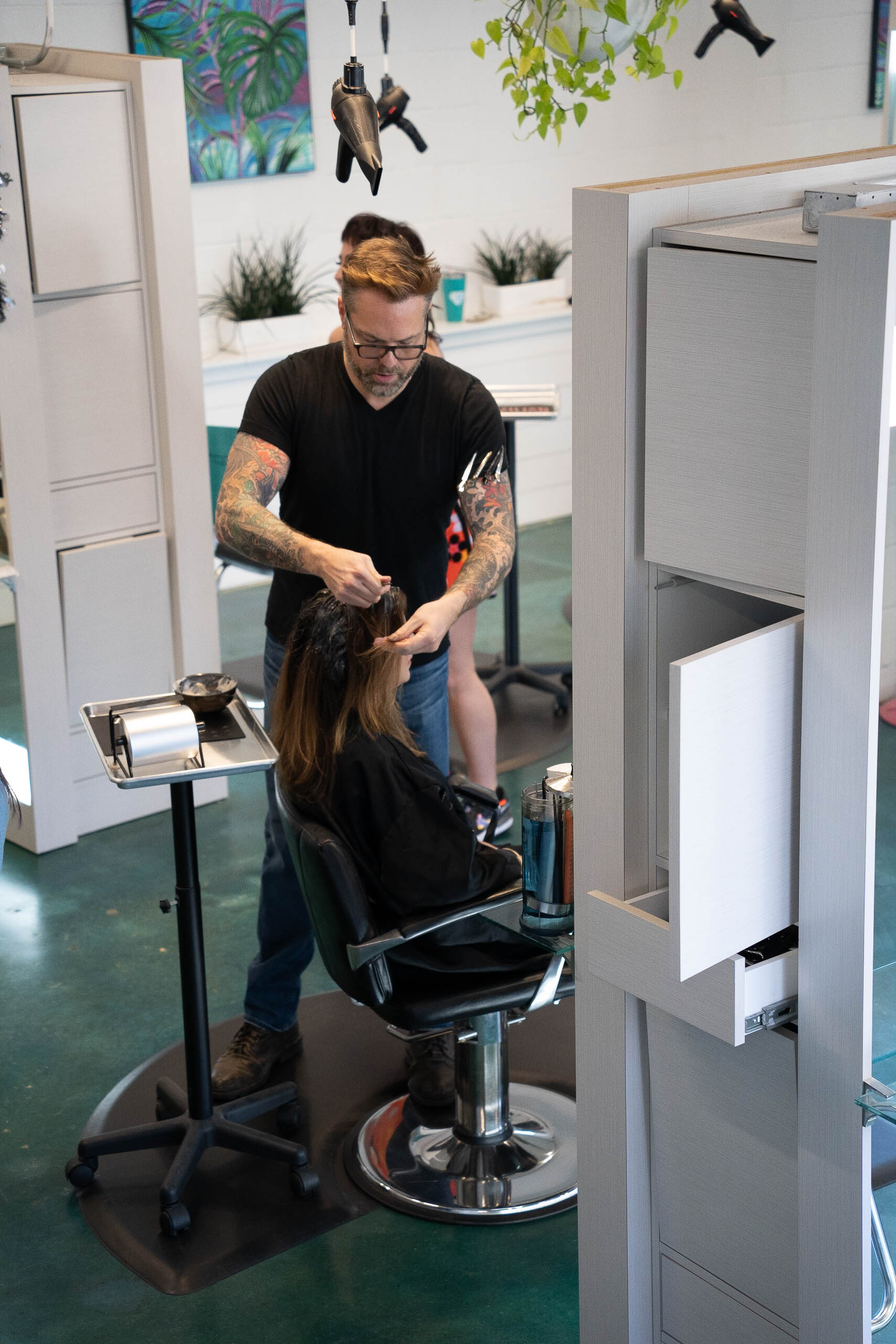
An image showing a hairstylist performing a color service on a client.
Kayla performs a color service on a client at her salon in downtown Birmingham. (Photo by Whit Sides)

Or Eryn Mullins, a new mom from Sumiton. She opened up to share her heart-wrenching story of navigating the mental health landscape in our state as a new stylist with no employer-provided health coverage. She needed help but couldn’t afford it.

The stories didn’t stop there. We highlighted the challenges facing many stylists seeking mental health care. We spoke to LGBTQ stylists about sacrifices they make both professionally and personally when it comes to finding care safely. And in our final piece in the See the Gap series, we talked to salon owners about what our state can and should do to improve lives and protect the health of those working in the beauty industry.

A path forward to close the coverage gap in Alabama

Hundreds of thousands of Alabamians are in the health coverage gap. Most of them are working at low-paid but essential jobs. They’re folks we see every day but may not realize are living without access to health care. Medicaid expansion would ensure they have the health coverage they need to survive and thrive.

With so many working folks in the gap, Medicaid expansion is an essential solution to save lives and make Alabama a healthier place. It would help real people across our state. And it would be an enormous financial boost for workers and businesses.

Expanding Medicaid would provide our state with more than $400 million a year to provide more than 280,000 people with health coverage. Click here to see the economic impact in our state, and click here to see it in your county.

Mert McNaughton smiles behind her desk in the Forecast Salon in Homewood. (Photo by Whit Sides)

Read the final story in our See the Gap series.

We encourage y’all to share these stories with state leaders in your district, as well as Gov. Kay Ivey. There’s never been a better time to, as Mert said herself, create more revenue for local businesses and put more money into workers’ pockets.

It’s been a privilege to collect these powerful stories and share them with the world. And we can’t wait to tell even more stories in the months to come. Thank you for your support of Arise and for being part of our work to make life better for all Alabamians.

See the Gap: ‘Medicaid expansion would end up creating more revenue for the business’

Just outside the Forecast Salon in Homewood is a gigantic mural painted along the wall. It features every color of the rainbow jumping out into the street. You’re up close with a 10-foot disco ball painted right beside a unicorn and two massive blue and purple manicured coifs.

Forecast’s owner Brittany McNaughton (friends call her Mert) chose the bright and welcoming mural as a manifestation of her personal philosophy.

“Big! Bold! Sunshine!” she says as we look at it. “The vibes are all there!”

The mural outside the Forecast Salon in Homewood, after its completion in February 2023. (Photo by Whit Sides)

Mert and Forecast’s co-owner, Mark Hyde, had a lot to look forward to in February 2020.

They had just reopened their salon in Homewood, just south of Birmingham, after an extensive expansion. Forecast had to shut its doors for three weeks. The renovations brought the space up to 16 chairs and almost doubled the original floorspace. The future looked bright.

Then the COVID-19 pandemic hit, and their world stopped.

“We’d been open for five years, but when 2020 happened, it felt like I had to go dark,” Mert said. “This massive adrenaline rush told me I had to stop expanding and keep my business afloat.”

Mert had just brought on some new stylists, and she said she probably could have hired even more. But soon she learned that the pandemic was shifting her focus from growth to her staff’s “mental capacity.”

Mert said that’s when she realized the shutdown would be longer than three weeks. And it wasn’t just about closing the physical doors to the shop.

“We went from managing everyone’s safety to all of a sudden seeing where our staff was just not doing so well,” she said.

More than just a paycheck

In a rare move in the salon industry, Forecast offers to pay for a portion of its stylists’ health insurance. After two years, they also contribute to employees’ 401(k) retirement accounts.

Another benefit that Mert said was useful during the pandemic was flexible scheduling. She said stylists are encouraged to take personal days off, especially for mental health.

“Whenever you have someone that’s not doing great personally or mentally outside of work, they bring that energy in with them into the workspace, and it can affect the people around you,” Mert said.

Mark Hyde serves a client at the Forecast Salon in Homewood. (Photo by Whit Sides)

Gov. Kay Ivey allowed barbershops and salons to reopen in May 2020 after the initial wave of pandemic shutdowns. It was a first step toward returning to business as usual. But for stylists, that meant getting up close and personal again – and many weren’t ready.

“We work in such an intimate space,” said Mark, Forecast’s co-owner. “We’re up close, touching our clients. It sometimes takes years for these young stylists to build up trust but also build up a shell that can protect them from negative energy or venting clients day in and day out.”

A focus on mental health

Mark and Mert decided to shore up the salon’s career development offerings beyond just continuing education on hair. They brought in local therapists, healers and self-help experts to discuss mental health. Their goal was to help teach stylists how not to take the stresses of personal care work home with them.

“Moving out of the pandemic, I saw a need to bring in programming focusing specifically on mental health and not just hair,” Mert said.

Mark and Mert agree that they can’t do it all. But they said they try their hardest to provide as much as they can for their staff.

“Nowhere is perfect,” Mert said. “I set standards for mental health here in the salon, but I’m not trained to treat anyone’s problems. I’m trained to do hair. That’s where therapists and doctors come in.”

More money in the pocket for both stylists and salon owners

Mert said she hopes that one day all salons will offer health insurance and other benefits. But she also said she knows that’s not a realistic option for all salons. And unfortunately, that means many stylists will have no affordable option for health coverage unless Alabama expands Medicaid.

Across Alabama, about 10,000 stylists and other personal care workers would benefit from Medicaid expansion. More than 220,000 Alabamians are caught in the coverage gap, unable to afford health insurance. Another 120,000 or more are stretching to pay for private or employer-based insurance.

Part of Forecast’s recent renovation was expanding to hire more younger stylists and apprentices into their already robust education program. Not everyone at Forecast would qualify for coverage under Medicaid expansion, but most newer stylists likely would, Mert said. 

Both owners agree that it would be nice to be able to pay stylists an extra $200 to $400 every month. That amount could help cover their groceries or a car payment.

“It’s expensive to provide insurance as a business. That’s why a lot of people don’t do it,” Mert said. “Medicaid expansion would end up creating more revenue for the business and put more money into that stylist’s pocket.”

Mert McNaughton smiles behind her desk in the Forecast Salon in Homewood. (Photo by Whit Sides)

The benefits for the local economy wouldn’t end there. Jefferson County could realize upwards of $298.6 million in additional economic impact in year one as a result of closing the health coverage gap. Medicaid expansion also would extend coverage to more than 22,500 county residents who didn’t have it before.

I asked Mert what Forecast Salon would do with the extra money when the day finally comes.

“As a business owner, I already know what I’m gonna do with that money,” she said. “Invest it right back into our people.”

ABOUT ALABAMA ARISE AND COVER ALABAMA

Whit Sides is the Cover Alabama storyteller for Alabama Arise, a statewide, member-led organization advancing public policies to improve the lives of Alabamians who are marginalized by poverty. Arise’s membership includes faith-based, community, nonprofit and civic groups, grassroots leaders and individuals from across Alabama. Email: whit@alarise.org.

Arise is a founding member of the Cover Alabama coalition. Cover Alabama is a nonpartisan alliance of advocacy groups, businesses, community organizations, consumer groups, health care providers and religious congregations advocating for Alabama to provide quality, affordable health coverage to its residents and implement a sustainable health care system.
See the Gap: ‘I needed help but couldn’t afford it’

A smiling husband and wife.
Eryn Mullins (left) smiles alongside her husband, Zach. Eryn is a hairstylist from Sumiton who struggled to afford mental health care after becoming uninsured at age 26. (Photo courtesy of Eryn Mullins)

Social media can be overwhelming. Like a lot of people, I’ve found myself stepping back from it lately. There is one thing I will never scroll past, though: baby pictures. (Well, that and jokes.)

And Eryn Mullins is good for both.

Eryn is a new mom and hairstylist from Sumiton, a small town in Walker County in northwest Alabama.

I spoke to her the week she returned to work after her maternity leave. Thanks to her husband’s insurance, she and her baby were well cared for during labor, delivery and the postpartum period.

The smiles in her family photos jump through the screen. It’s hard not to think she’s got it all together.

But Eryn will be the first to tell you that it wasn’t always this way. Things were much different for her just a few years ago.

‘A million things to worry about’

“Straight out of beauty school, there’s a million things to worry about,” Eryn said. “When I was 20, I suffered from extreme panic attacks, and I needed to be hospitalized. After that, it still took eight months and four or five different medications to get to a steady place.”

Eryn was diagnosed with a panic disorder that gave her “anxiety that you couldn’t just fix.” Her condition required regular doctor’s visits and consistent medication. Thanks to her dad’s insurance, she was able to keep everything under control.

Then Eryn turned 26. That’s the age when young adults are no longer eligible for their parents’ insurance under the Affordable Care Act. And things started to look very different.

“I was on my dad’s insurance, and then suddenly, I wasn’t. I was uninsured for three years after that,” Eryn said.

“I got a hospital bill for $2,500, and that’s when I decided I was going to try my hardest to not go to the doctor ever again.”

Cold turkey

One thing Eryn didn’t plan for was having to come off all her medications immediately. For her, “cold turkey” meant no prescription refills. It also meant no talk therapy and no visits with a psychiatrist to manage her mental health.

“I experienced so many adverse side effects that put me back in the hospital, suffering from withdrawal,” she said. “We all have brains; not all of them are healthy. Mine wasn’t.”

Any way Eryn looked at it, she was paying hundreds of dollars out of pocket every few months. Sometimes it was for a hospital stay. Once, she spent $400 for just one routine visit with a mental health provider.

“I worked in a high-stress environment my first year as a stylist,” she said. “It’s a vicious cycle. I needed mental help but couldn’t afford it.”

Being uninsured is expensive. And without consistent medical or mental health coverage, those expenses mount for many stylists. After facing a $2,500 medical bill while uninsured, Eryn told herself she would do whatever she could to avoid going to the doctor.

Unfortunately, Eryn is not alone in receiving eye-popping medical bills while uninsured. Most of her coworkers are uninsured, she said, and seeing them navigate that is heartbreaking. More than 22% of people in Walker County are facing medical debt along with her right now.

In all, 6,108 people in Walker County do not have health coverage. That number would drop by more than half if Alabama expanded Medicaid to cover adults with low incomes.

Across Alabama, about 10,000 stylists and other personal care workers would benefit from Medicaid expansion. More than 220,000 Alabamians are caught in the coverage gap, unable to afford health insurance. Another 120,000 or more are stretching to pay for private or employer-based insurance.

‘Hanging up the apron’

Hairstylists often can set their own schedule, but that means income fluctuates. And especially in the beginning, they are paying for all their own supplies and losing a lot of money.

“Starting off as a new stylist is the hardest part,” Eryn said. “There’s no method to the madness.”

Eryn said it is becoming more common to see coworkers “hang up their apron.” That’s code for leaving the hair business altogether, often to train in another industry.

“It’s exhausting,” she said. “I feel like everyone I know is always putting money back, for every little (and big) thing. And you have to be really lucky to even have any left over for medical bills.”

Eryn said she loves what she does and doesn’t plan on quitting anytime soon, though she jokes about it sometimes.

“There are days where I debate working at Big Lots or Walmart. It’s steady, and they probably get insurance at full time,” she said.

A path forward

After seeing so many friends walk away from behind the chair, Eryn said she didn’t know how she would make it as a mom and a stylist.

“We were expecting our first baby soon, and I had no idea how I would handle maternity leave,” she said. “I was able to make a deal on my booth rental, but that’s it. If I didn’t have the support of my husband, I don’t know if I could even afford a child.”

A husband and wife with their newborn child.
Eryn Mullins (right) enjoys a moment with her husband, Zach, and their newborn child in March 2023. (Photo courtesy of Eryn Mullins)

Through it all, Eryn said she still would choose to become a stylist all over again.

“I’m glad I stuck with it,” she said. “It was a rough few years, but now I get to coordinate my life and schedule the way I want, which is much better for my mental health. I think that’s probably true of any career.”

Eryn said she hopes discussing her experiences can help improve life for hairstylists and other Alabamians living without health coverage.

“I wanted to share my story because it’s worth it to me if even one person feels less alone,” she said.

ABOUT ALABAMA ARISE AND COVER ALABAMA

Whit Sides is the Cover Alabama storyteller for Alabama Arise, a statewide, member-led organization advancing public policies to improve the lives of Alabamians who are marginalized by poverty. Arise’s membership includes faith-based, community, nonprofit and civic groups, grassroots leaders and individuals from across Alabama. Email: whit@alarise.org.

Arise is a founding member of the Cover Alabama coalition. Cover Alabama is a nonpartisan alliance of advocacy groups, businesses, community organizations, consumer groups, health care providers and religious congregations advocating for Alabama to provide quality, affordable health coverage to its residents and implement a sustainable health care system.
New report: Medicaid expansion would improve maternal health in Alabama

Medicaid expansion would improve women’s health and expand access to maternal health care across Alabama, a new Georgetown University Center for Children and Families (CCF) report found. Expansion also would help reduce racial disparities, improve infants’ health and strengthen rural health care access, the report found.

Nearly one in six Alabama women (15.9%) of reproductive age (18-44) lack health insurance, CCF found. That rate is significantly higher than the national average (11.7%). And uninsured rates are sharply higher among Hispanic (41.5%) and Native American (46.7%) women in Alabama. Medicaid expansion would help by ensuring health coverage for tens of thousands of Alabama women who cannot afford it.

Alabama policymakers took an important step forward for women’s health last year by extending the Medicaid postpartum coverage period. That extension ensured coverage for a full year after childbirth, up from the previous cutoff of just 60 days afterward. But much work remains to protect women’s health in the state, Alabama Arise’s Cover Alabama campaign director Debbie Smith said.

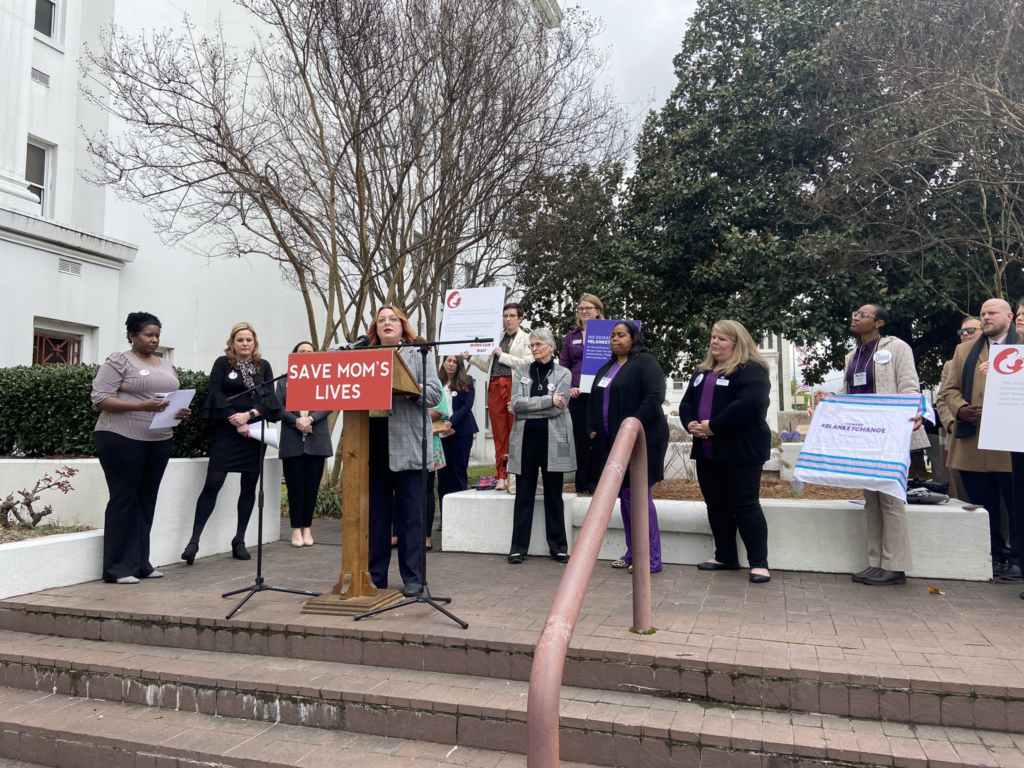
Alabama Arise story collection coordinator Whit Sides speaks at a March 9, 2022, rally in Montgomery to support extending postpartum Medicaid coverage. Arise joined the American Heart Association and other Cover Alabama partners at the event.

“State leaders showed they’re willing to address Alabama’s maternal health crisis when they extended Medicaid postpartum coverage last year,” Smith said. “However, these findings show that this step alone is not enough to help mothers and families stay healthy. Alabama should take the next logical step to protect women’s health and expand Medicaid coverage for adults with low incomes. We urge Gov. Kay Ivey and legislators to make Alabama a better place for parents and babies by expanding Medicaid.”

Medicaid expansion would save lives, protect rural health care access

The consequences of being unable to afford timely medical care can be deadly. Alabama had the nation’s third-worst maternal mortality rate between 2018 and 2020, the report found. The state’s rate (36.2 maternal deaths per 100,000 live births) was significantly higher than the national average (20.4 per 100,000) in those years.

Alabama’s infant mortality rate (7.2 infant deaths per 1,000 live births) also was much higher than the national average (5.4 per 1,000) in 2020. Black babies died at an even higher rate in Alabama that year (11.1 per 1,000 live births).

A decades-long decline in access to maternity and obstetric care in rural Alabama is compounding these terrible statistics. Twenty-nine of Alabama’s 54 rural counties lost hospital obstetric care providers between 1980 and 2019, CCF found. These closures required women in these counties to travel farther to providers elsewhere. That, in turn, can reduce the timeliness of care and increase barriers for women with limited transportation options.

Medicaid expansion is associated with lower maternal and infant mortality rates, with the greatest benefits for Black women and infants. Expansion also promotes health improvements throughout pregnancy and into children’s early years, CCF found. In addition, Medicaid expansion would decrease the costs of uncompensated care significantly, allowing more rural hospitals and providers to remain open to continue treating pregnant Alabamians.

“Research shows that stable health coverage for women before, during and after pregnancy can save moms and babies’ lives,” said Joan Alker, executive director of the Georgetown University Center for Children and Families. “Medicaid expansion is an essential investment in the health of Alabamians and builds a solid foundation for the state’s future.”

Read the full report here.