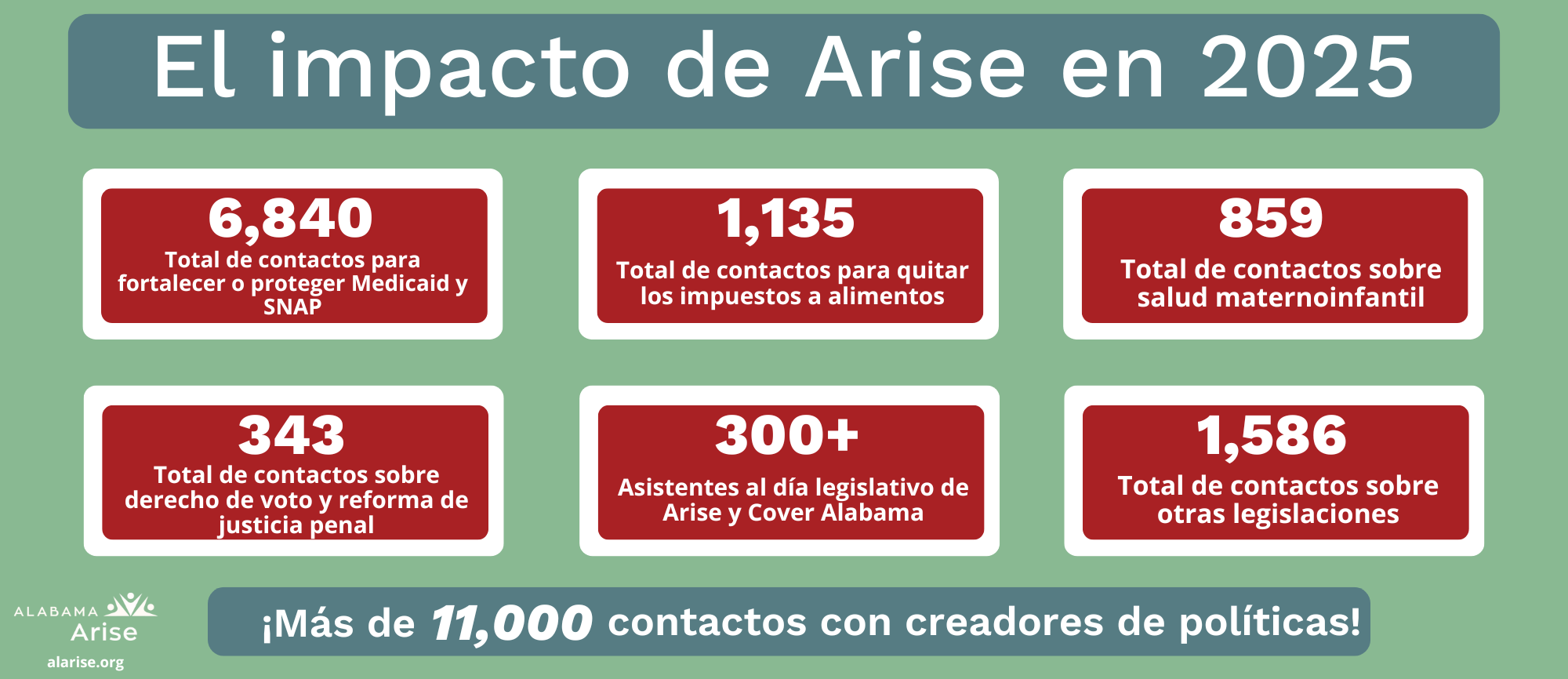
Las prioridades legislativas de Alabama Arise para 2026

Más de 150 grupos miembros de Alabama Arise y más de 1,500 miembros individuales eligen todos los años nuestras prioridades legislativas. Este proceso garantiza que los habitantes de Alabama más afectados por la pobreza participen de las decisiones. A continuación se enumeran las prioridades que nuestros miembros eligieron para 2025.

Para obtener una versión de este documento en PDF, haga clic aquí o en el botón de “Descargar” (Download) arriba.

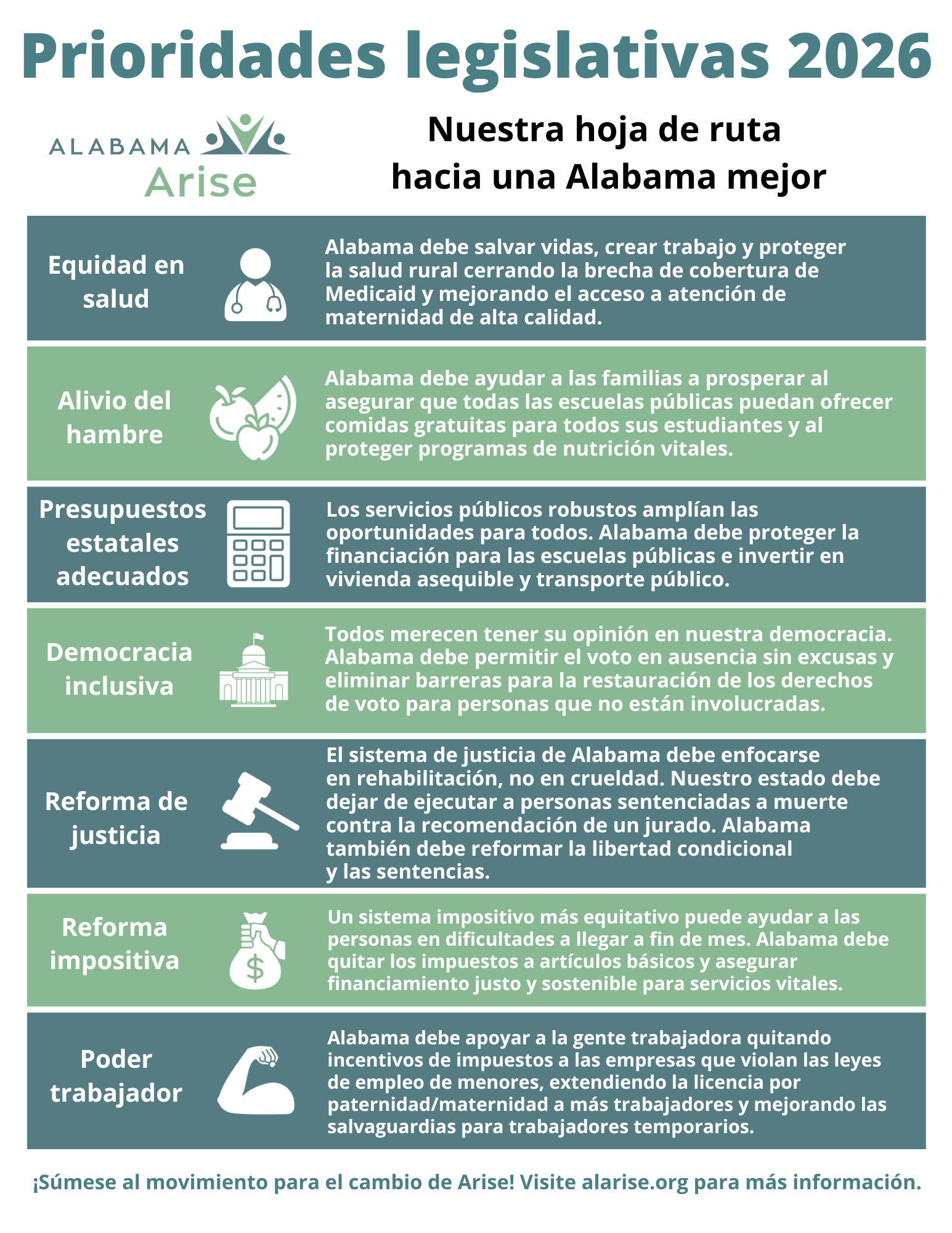
Equidad en saludAlabama debe salvar vidas, crear trabajo y proteger la salud rural cerrando la brecha de cobertura de Medicaid y mejorando el acceso a atención de maternidad de alta calidad.

Alivio del hambreAlabama debe ayudar a las familias a prosperar al asegurar que todas las escuelas públicas puedan ofrecer comidas gratuitas para todos sus estudiantes y al proteger programas de nutrición vitales.

Presupuestos estatales adecuadosLos servicios públicos robustos amplían las oportunidades para todos. Alabama debe proteger la financiación para las escuelas públicas e invertir en vivienda asequible y transporte público.

Democracia inclusivaTodos merecen tener su opinión en nuestra democracia. Alabama debe permitir el voto en ausencia sin excusas y eliminar barreras para la restauración de los derechos de voto para personas que no están involucradas.

Reforma de justiciaEl sistema de justicia de Alabama debe enfocarse en rehabilitación, no en crueldad. Nuestro estado debe dejar de ejecutar a personas sentenciadas a muerte contra la recomendación de un jurado. Alabama también debe reformar la libertad condicional y las sentencias.

Reforma impositivaUn sistema impositivo más equitativo puede ayudar a las personas en dificultades a llegar a fin de mes. Alabama debe quitar los impuestos a artículos básicos y asegurar financiamiento justo y sostenible para servicios vitales.

Poder trabajador Alabama debe apoyar a la gente trabajadora quitando incentivos de impuestos a las empresas que violan las leyes de empleo de menores, extendiendo la licencia por paternidad/maternidad a más trabajadores y mejorando las salvaguardias para trabajadores temporarios.

Alabama Arise 2026 legislative priorities

More than 150 Alabama Arise member groups and nearly 2,000 individual members choose our legislative priorities each year. This process ensures that Alabamians most impacted by poverty have a seat at the table. Below are the priorities that our members selected for 2026.

For a PDF version of this document, click here or click the “Download” button above.

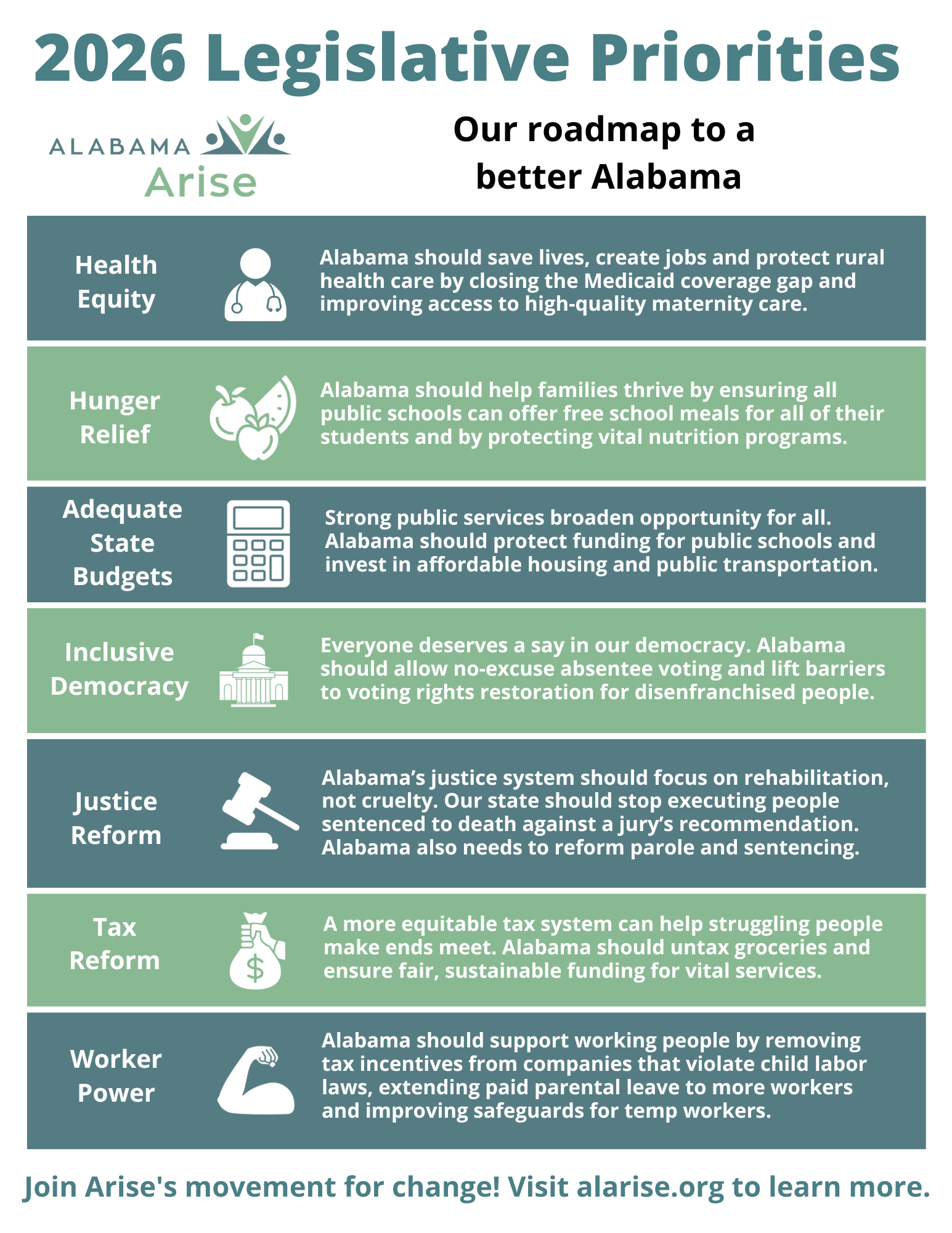
Health equityAlabama should save lives, create jobs and protect rural health care by closing the Medicaid coverage gap and improving access to high-quality maternity care.

Hunger reliefAlabama should help families thrive by ensuring all public schools can offer free school meals for all of their students and by protecting vital nutrition programs.

Adequate state budgetsStrong public services broaden opportunity for all. Alabama should protect funding for public schools and invest in affordable housing and public transportation.

Inclusive democracyEveryone deserves a say in our democracy. Alabama should allow no-excuse absentee voting and lift barriers to voting rights restoration for disenfranchised people.

Justice reformAlabama’s justice system should focus on rehabilitation, not cruelty. Our state should stop executing people sentenced to death against a jury’s recommendation. Alabama also needs to reform parole and sentencing.

Tax reformA more equitable tax system can help struggling people make ends meet. Alabama should untax groceries and ensure fair, sustainable funding for vital services.

Worker powerAlabama should support working people by removing tax incentives from companies that violate child labor laws, extending paid parental leave to more workers and improving safeguards for temp workers.

What Alabamians need to know about SNAP during the federal shutdown

People should not have to choose between food, health care and other basic needs. But the White House’s decision to delay issuing food assistance benefits means millions of struggling families are about to be forced to make exactly that choice as the holidays approach.

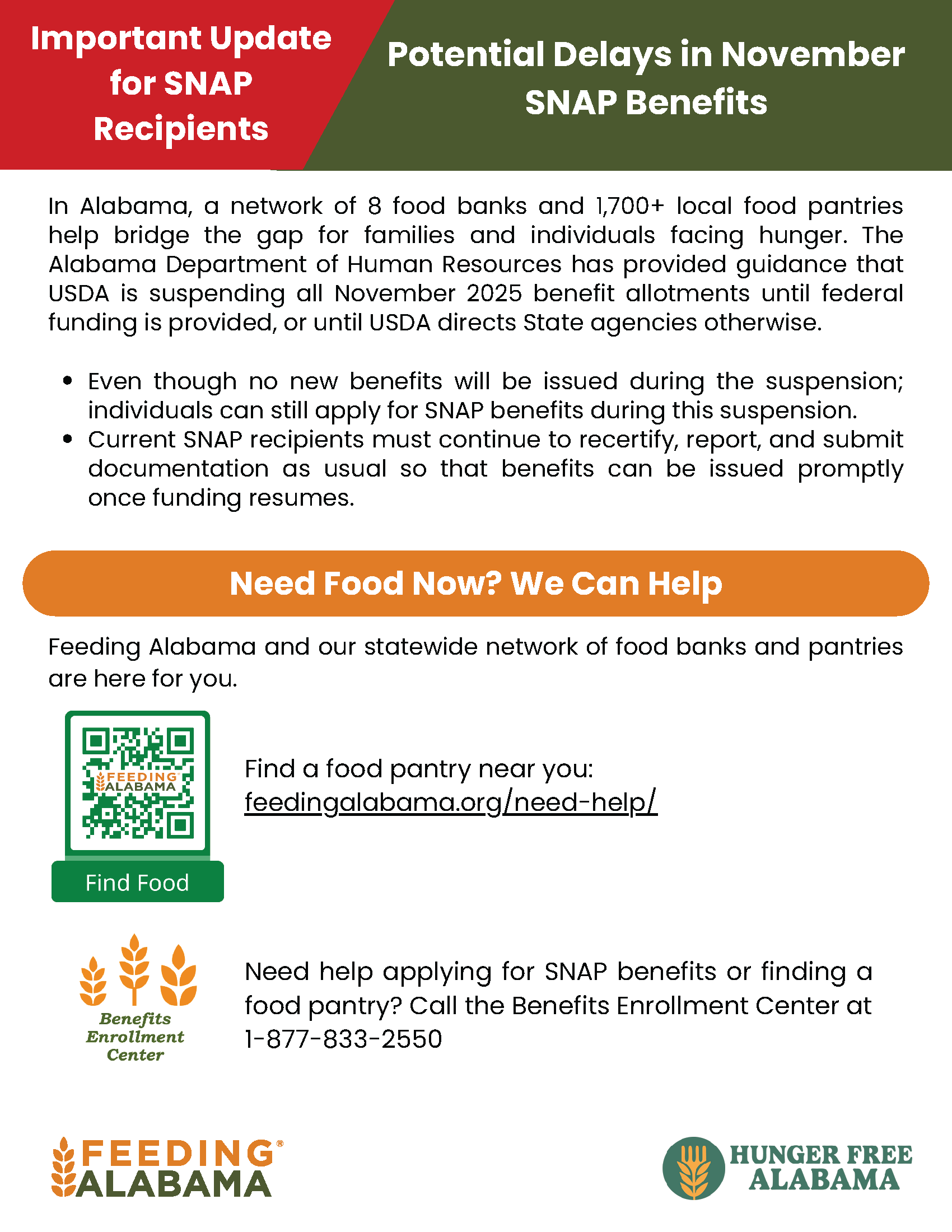
The U.S. Department of Agriculture (USDA) last week officially notified Alabama and other states that it would not issue food assistance benefits under the Supplemental Nutrition Assistance Program (SNAP) at the beginning of November. These benefits, which for now are 100% federally funded, are sometimes referred to as food stamps. The Department of Human Resources (DHR) confirmed Monday that SNAP participants in Alabama will see their benefits delayed.

More than 750,000 Alabamians – 1 in 7 people in our state – participate in SNAP. Nearly 40% of SNAP participants are children, according to the Food Research and Action Center. Alabama provided an average of $194 each in SNAP assistance to each participant in July. That means an average Alabama family of three participating in SNAP will lose nearly $600 next month.

Withholding these benefits will increase hunger and hardship across our state. It also could be financially devastating for grocery stores and other retailers, especially those serving large numbers of SNAP participants.

What SNAP participants should know

SNAP benefits still could be released later in November, either because the USDA changes its policy or because the budget standoff is resolved. If that happens, DHR will try to get November food assistance out as quickly as possible. But delays may occur, especially for people who get money added to their SNAP EBT cards early in the month.

If you are a SNAP participant, you still should be able to spend any money you already have on your EBT card after Nov. 1. But you will not see any additional money added to the card in November (or until this situation is resolved).

If you are scheduled to recertify your eligibility in November or to submit any paperwork to DHR, you should do that to avoid any further delays. And if you believe you are eligible for SNAP, you should go ahead and apply now. DHR is still processing applications, and eligible applicants will receive SNAP benefits retroactively to the date they applied once this situation is resolved.

To find emergency food from a food bank or food pantry, call 2-1-1 or visit Feeding Alabama’s food finder.

USDA can and should fund SNAP benefits for November

The USDA is using SNAP as a bargaining chip in the debate over the federal budget. The agency blames its decision to delay November SNAP benefits on the federal government shutdown. But the truth is that the USDA maintains a SNAP contingency fund with enough money in it to cover most of the November benefits for the entire country.

USDA officials already have spent some reserve money from that fund to help states cover their SNAP administrative costs. But the USDA now claims it cannot legally use this money to help struggling families. This claim is contrary to both the plain language of federal law and the White House’s own prior practice.

The USDA already has dipped into some of its reserve funds to help farmers during the shutdown. While we support our farmers, we also support helping hungry families, especially with Thanksgiving approaching. Some states are scrambling to find enough state money to cover SNAP benefits through November. But the USDA has announced that, unlike in previous shutdowns and unlike for other federal programs, it will not reimburse states for any money spent for food assistance.

How you can fight hunger and speak out for change

Donate to a food bank or food pantry. Hunger is about to soar due to the SNAP benefit delay. Please consider generously donating to your local food bank or food pantry. Unlike most shoppers, food banks buy food in bulk and at a discount, so financial gifts can feed far more people than direct gifts of food. But food banks and food pantries appreciate every donation and will use them to help our neighbors and communities.

Demand action from your federal officials. Food banks play an essential role in relieving hunger, but they cannot replace SNAP. The USDA’s decision to delay November SNAP benefits will increase hardship for families across our country. This policy also is a part of an effort to pressure Congress to discontinue enhanced premium tax credits that make Marketplace health coverage more affordable for millions of Americans, including nearly 500,000 Alabamians.

You can speak out now to help protect food assistance and health care access for people across Alabama:

People and families need both food and health care. No one should have to make a choice between seeing a doctor and keeping food on the table, and Congress should support both food assistance and affordable health insurance.

Alabama Arise unveils 2026 roadmap for change in Alabama

Expanding health care access and improving maternal and infant health will remain top goals on Alabama Arise’s 2026 legislative agenda. The organization also will continue advocating for state funds to help public schools provide free school meals to every student.

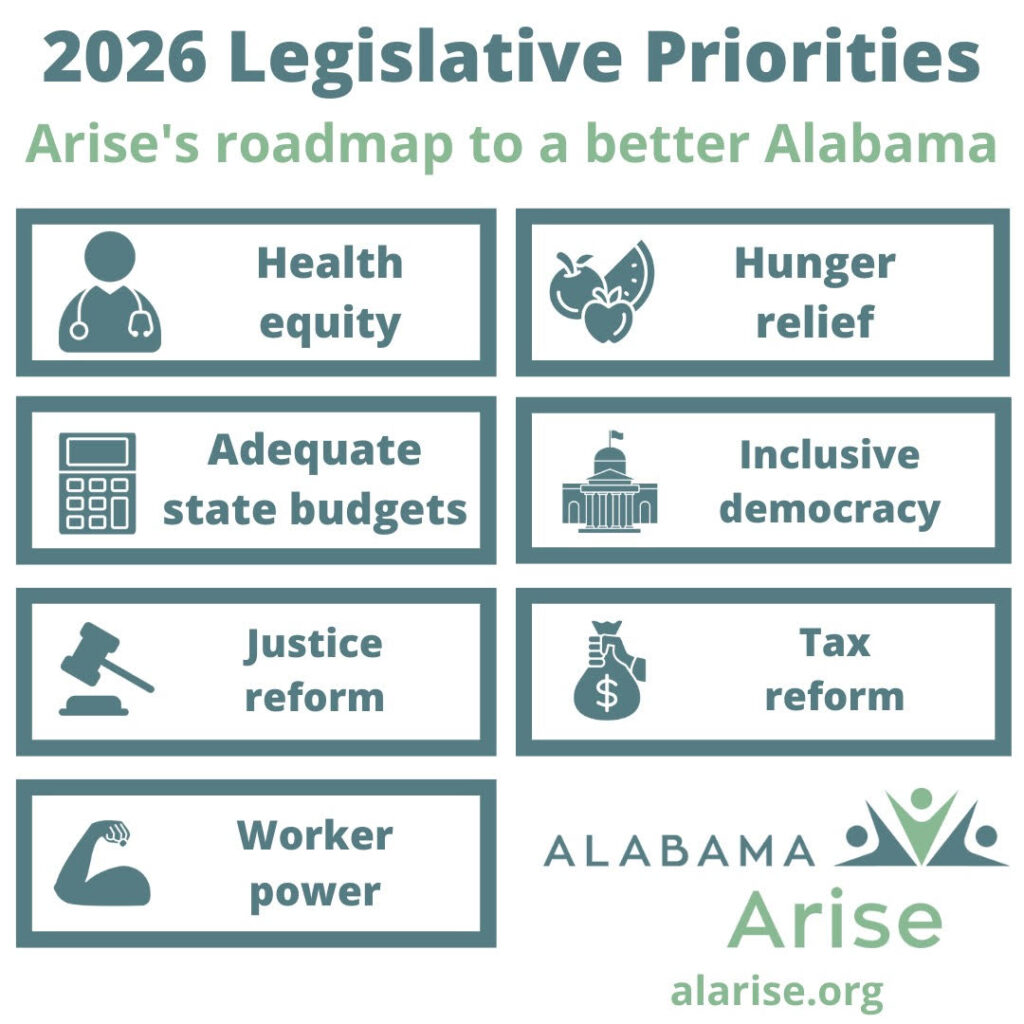
Nearly 600 members voted in the last week to affirm Arise’s legislative priorities. The seven priorities chosen were:

  • Health equity, including policies to close Alabama’s health coverage gap for adults with low incomes and to protect access to maternity care.
  • Hunger relief, including legislation to allow more public schools to provide no-cost breakfast and lunch for all of their students.
  • Adequate state budgets, including equitable public education funding for every student and state funding for affordable housing and public transportation.
  • Inclusive democracy, including no-excuse early voting and removal of barriers to voting rights restoration for disenfranchised Alabamians.
  • Justice reform, including legislation to apply Alabama’s ban on judicial override of jury sentencing decisions in death penalty cases retroactively, as well as improvements to the state’s sentencing and parole systems.
  • Tax reform to build a more just and sustainable revenue system, including eliminating the rest of Alabama’s state sales tax on groceries and replacing the revenue equitably.
  • Worker power to advance the health and safety of Alabama families, including legislation to remove tax incentives from companies that violate child labor laws, as well as efforts to extend paid parental leave protections to more workers.

“Alabama Arise believes in dignity, equity and justice for everyone,” Alabama Arise executive director Robyn Hyden said. “Our legislative priorities seek to empower Alabamians of every race, income and background to reach their full potential. And they reflect our members’ commitment to building a healthier, more just and more inclusive Alabama for all.”

Alabama Arise graphic text reads "2026 legislative priorities: Arise's roadmap to a better Alabama." Issues named are health equity, hunger relief, adequate state budgets, inclusive democracy, justice reform, tax reform and worker power.

The urgent need to close Alabama’s coverage gap and protect affordable Marketplace plans

Arise members believe Medicaid expansion is a path toward a healthier future where all Alabamians can afford the health care they need. Expanding Medicaid would reduce racial health disparities and remove financial barriers to health care for adults with low incomes. Expansion also would support thousands of new jobs across the state. And most importantly, it would save hundreds of lives every year.

Alabama is one of only 10 states yet to expand Medicaid. Medicaid expansion would ensure health coverage for nearly 200,000 Alabamians caught in a coverage gap. Most of these residents earn too much to qualify for the state’s bare-bones Medicaid program but too little to afford private plans.

The number of Alabamians in the coverage gap could soar in 2026 if Congress fails to renew enhanced Premium Tax Credits for Marketplace plans under the Affordable Care Act. If lawmakers allow the credits to expire, about 130,000 Alabamians would lose their health coverage, and premiums for many others would nearly double.

Those setbacks would add further strain to the health care infrastructure that serves all Alabamians. About two dozen rural hospitals in Alabama are at immediate risk of closure, and four labor and delivery units have shut down since 2023. These closures have reduced care options in a state that already has one of the nation’s worst maternal mortality rates.

“Everyone should be able to get the health care they need when they need it,” Hyden said. “Congress must act quickly to protect affordable Marketplace coverage for hundreds of thousands of Alabamians. And our state policymakers need to step up to close Alabama’s health coverage gap once and for all. This investment would pay off in the form of healthier families and stronger economic growth in communities across our state.”

No-cost school meals help Alabama children learn and thrive

Another key step toward a healthier Alabama is to ensure every public school can offer no-cost meals to every student. Hundreds of Alabama schools provide no-cost meals through the Community Eligibility Provision, but some schools cannot participate in the program.

Arise will advocate for additional state funding that local districts can use to match federal funds to offer no-cost meals. Legislators this year approved $17.3 million to expand school breakfast and continue Alabama’s participation in SUN Bucks, which provides $40 in food benefits per summer month for hundreds of thousands of Alabama children.

Stronger investment in school meals is more urgent amid threats to federal funding for the Special Supplemental Nutrition Program for Women, Infants and Children (WIC) and cuts to the Supplemental Nutrition Assistance Program (SNAP). Alabama and other states could run out of money for WIC in a few weeks if Congress does not renew its funding. And the federal budget law enacted in July will make fewer people eligible for SNAP while shifting more costs to states.

Children and communities across Alabama would enjoy immediate and long-term benefits from no-cost meals in public schools. No-cost meals would reduce child hunger in a state where nearly 1 in 4 children face food insecurity. Extending the reach of school meal programs would help reduce behavioral problems and improve attendance and test scores. Reducing food insecurity for children also can help improve their mental health and overall health as teenagers and adults.

“It’s hard for children to focus in school when they’re hungry,” Hyden said. “Lawmakers should ensure that WIC and SNAP continue to provide food assistance for families across our state. And our legislators should invest in no-cost school meals to reduce hunger and help every Alabama child succeed both in the classroom and throughout their lives.”

After a successful 2025 session, Alabama Arise looks toward the future

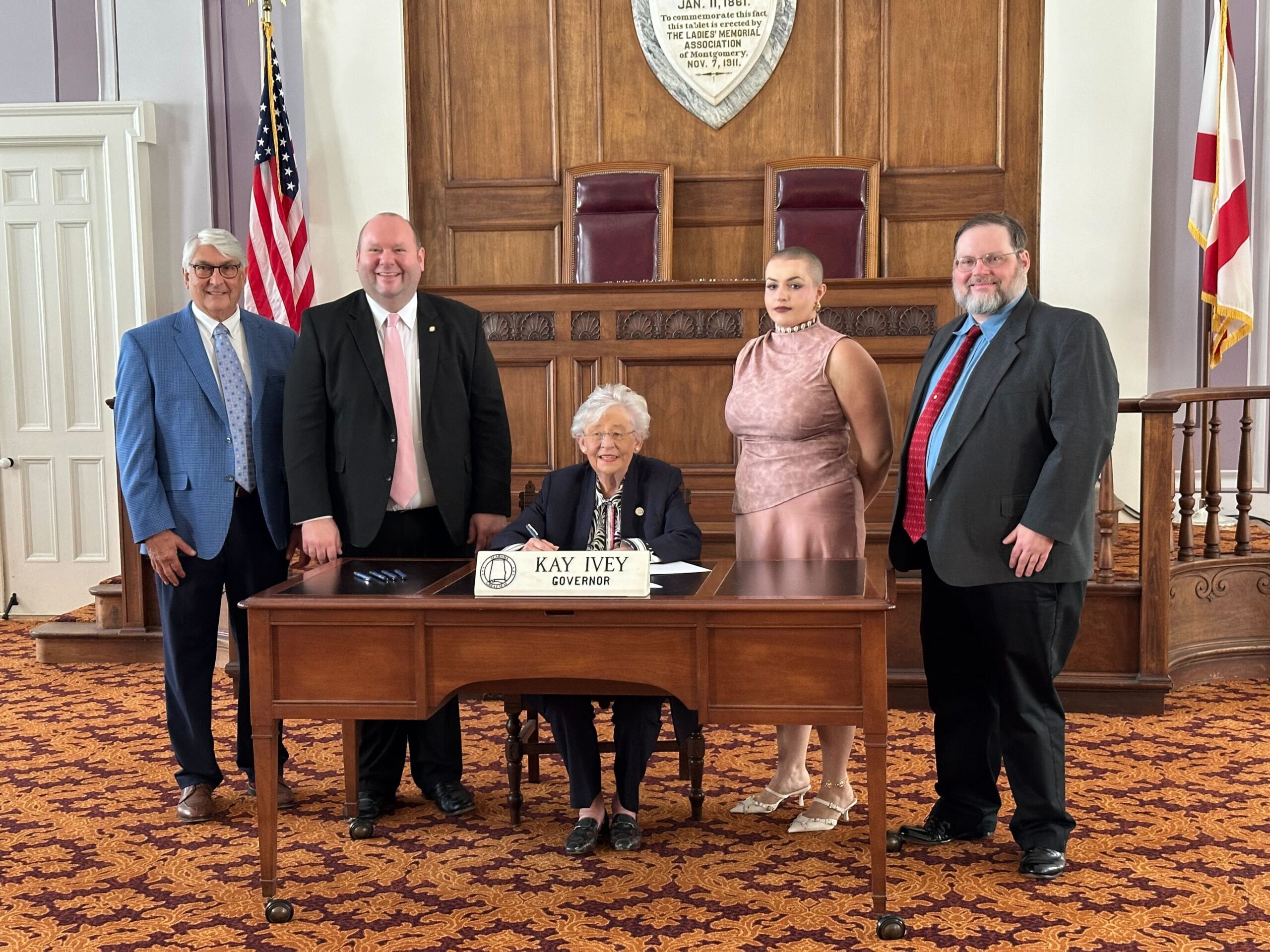
Three men wearing suits and ties and a woman wearing a pink dress stand to either side of Gov. Kay Ivey, who is wearing a black jacket and seated behind a wooden table.
Several Alabama Arise staff members participated in Gov. Kay Ivey’s bill signing ceremony for HB 386 on July 31, 2025, at the State Capitol in Montgomery. HB 386 will reduce the state sales tax on groceries from 3% to 2% starting Sept. 1, 2025. Left to right: Arise legislative director David Stout; Sen. Andrew Jones, R-Centre; Gov. Kay Ivey; Arise hunger policy advocate LaTrell Clifford Wood and Arise communications director Chris Sanders. (Photo by Matt Okarmus)

Building a better Alabama for all is not the work of a single year or decade or even lifetime. It’s work that spans generations. Each of us should do our best to build upon the foundation laid by those who came before us, and to equip those who will come after us to reach even greater heights.

As we continue on the path to a brighter future, it’s important to celebrate milestone achievements along the way. Three bill signing ceremonies with Gov. Kay Ivey this summer were opportunities for Alabama Arise to rejoice over several hard-won legislative victories in 2025.

Arise staff members participated in a ceremony on June 12 for the “pink tax” law, which removed the state sales tax from baby formula, diapers, maternity clothing and other items for infants and parents. We also participated in two more ceremonies on July 31: one for a law reducing the state grocery tax from 3% to 2%, and another for the RAISE Act, which made important reforms to Alabama’s education funding formula.

How we will build on this success

These breakthroughs were just a few of the many policy victories we enjoyed this year. All of them resulted from years of determined advocacy by Arise members and supporters.

With an eye toward the long term, Arise will ask members this month to approve a list of legislative priorities for 2026-29. Members then will vote on which issue areas are most important to them and have the option to rank legislative proposals under each issue.

This multiyear commitment will allow Arise to focus more deeply on the issues that our members have chosen consistently in recent years. And it will empower us to continue working effectively to advance dignity, equity and justice for every Alabamian.

What the new federal budget law means for SNAP, health care in Alabama

By Carol Gundlach, senior policy analyst, and Debbie Smith, Cover Alabama campaign director

While many Alabamians were celebrating July 4, Congress passed a sweeping budget reconciliation law that will hurt families across the country. To extend more than $1 trillion of tax cuts for the richest Americans, Congress slashed health care, food assistance and other vital services for ordinary people.

“It’s wrong to hurt people who are struggling to help people who are already far ahead,” Alabama Arise executive director Robyn Hyden said after the bill’s passage. “But Congress just passed legislation that will do exactly that. This budget bill is not only a moral failure. It’s bad policy, and it is a really bad deal for Alabama and our entire country.”

The biggest cuts nationally will be to Medicaid and to food assistance under the Supplemental Nutrition Assistance Program (SNAP). Alabama has not yet expanded Medicaid to cover adults with low incomes, but the harmful new budget law will make it harder for our state to improve and expand health care access. And the law’s SNAP cuts and barriers will increase hunger and hardship across Alabama.

SNAP cuts will make it harder to make ends meet

The SNAP cuts will threaten Alabama’s ability to fund essential state services. They also will impose red-tape barriers for SNAP participants and reduce the future buying power of SNAP.

Threats to state budgets: Beginning in 2026, the Alabama Legislature will have to appropriate an estimated $35 million a year in new funding for SNAP administration. Beginning in 2027, the Legislature also may have to appropriate an estimated $172 million annually in new funding to help cover SNAP benefits, which have been fully federally funded for decades. If Alabama lawmakers cannot or will not provide the required state share of funding, the state would have to reduce the number of SNAP participants or opt out of the program entirely. Eliminating SNAP would end food assistance for more than 750,000 Alabamians and send hunger rates soaring in a state where 1 in 4 children already struggle with food insecurity.

Changes that place time limits on more people who receive SNAP: Many older adults, families with teen children, veterans, people who are experiencing homelessness and young adults who were in foster care may face burdensome new work reporting requirements to receive food assistance. And beginning immediately, many people who are legally in the United States as refugees, asylum seekers or victims of domestic violence or sexual assault may no longer be eligible for SNAP.

Changes that likely will reduce the amount of SNAP assistance over time: The new law prohibits the federal government from making substantive changes to the USDA’s Thrifty Food Plan, on which the amount of SNAP benefits is based. This change will reduce the value of SNAP assistance over time.

Health care cuts will increase human suffering

Reconciliation cuts to Medicaid primarily targeted states that had expanded Medicaid, but the bill also will make it harder for Alabama to improve our Medicaid program. The law also failed to renew subsidies that make health coverage more affordable for hundreds of thousands of Alabamians.

The law eliminates key financial incentives that encouraged Alabama and other states to expand Medicaid. We no longer will be eligible for $619 million in additional federal funding on top of the 90% federal match, which would have helped pay for the startup costs of Medicaid expansion.

The law also includes restrictions on provider taxes — a key tool Alabama uses to help fund its share of Medicaid. This will make it more difficult for Alabama to expand coverage going forward and could put a long-term limit on how our state finances Medicaid as health care costs rise.

Congress also failed to renew enhanced tax credits that have made Marketplace plans under the Affordable Care Act (ACA) more affordable since 2021. These subsidies have helped hundreds of thousands of Alabamians lower their monthly premiums. Now, those enhanced subsidies are going away at the end of 2025.

The cuts to healthcare.gov tax credits mean that Alabamians’ monthly premiums will increase and fewer people will qualify for financial help. About 130,000 Alabamians are expected to lose coverage because of these changes.

Where we go from here

Arise is taking numerous steps in response to this law’s passage. These actions include:

  • Analyzing the law’s long-term impact on SNAP, Medicaid and ACA financing.
  • Creating resources for partners, community organizations and the public to explain the changes and what they mean. 
  • Meeting with state and local leaders to discuss options and ensure they understand the financial and human stakes of these changes. 

Even in the face of harmful federal policies, Arise’s commitment to the people of Alabama remains strong. We are working every day to protect access to food and health care and make sure families have the information and support they need.

2025 has been a roller coaster of a year for Alabama Arise

After years of advocacy, Alabama Arise and our partners secured several huge victories for low-income and working people at the State House this year! These legislative wins included:

  • An additional reduction of the state grocery tax.
  • A law removing the state sales tax on many women’s health products, maternity care items and baby care items. 
  • The first-ever state appropriation to expand no-cost school breakfast.
  • Continued funding for Summer EBT, known as SUN Bucks. 
  • Guaranteed paid parental leave for all state employees and teachers.
  • Improved health care access through the Alabama Maternal Health Act.
  • Reforms to the state’s funding formula for K-12 schools through the RAISE Act.

In most years, we would be celebrating the passage of just one of these bills, let alone seven. We also successfully opposed several bills targeting people participating in safety net programs like SNAP, Medicaid and unemployment insurance. And we successfully opposed some of the bills attacking our immigrant neighbors.

Our wins at the State House show that solidarity works. Multi-issue advocacy works. Long-term investment in power-building and community organizing, focused on engaging everyday people, is effective.

But even as we celebrate these victories, we see that our idea of an inclusive democracy is under threat. Bills attacking immigrants and diversity, equity and inclusion (DEI) have been passed and implemented. These measures use a time-tested “divide and conquer” approach to try to make working-class people turn against each other instead of uniting around their common interests.

The passage of a cruel federal budget law has challenged our collective hopes for our country. This legislation could throw a major wrench in our plans to expand health coverage and alleviate hunger. And it could undermine our efforts to build a more progressive tax system, a more responsive government and a more inclusive democracy.

Looking ahead to 2026 and beyond, we have a lot of work to do to defend and expand our democracy to be “responsive, inclusive and justice-serving,” as we say in Arise’s vision for an Alabama “where all people live with concern for the common good and respect for the humanity of every person.”

We need your support now more than ever. When the history of these times is written, Arise members will be those who were working on the side of dignity, equity and justice, for all of us. Thank you for standing with us.

¡Hemos mejorado vidas en toda Alabama!

La sesión legislativa de 2025 se terminó oficialmente, y fue atareada y productiva. El personal, los socios y los miembros de Arise trabajaron arduamente para mejorar la vida de gente que llega justo a fin de mes, mientras se protegían también los derechos de los alabamienses atacados por personas con agendas políticas retrógradas.

Hicimos un gran progreso hacia una Alabama mejor y más inclusiva. Y, aunque no ganamos todas las batallas, juntos nos mantuvimos firmes para quienes son más vulnerables. Militamos con éxito por leyes nuevas que mejorarán vidas. Estas políticas harán lo siguiente:

  • Hacer más asequibles los productos básicos para todos los alabamienses al reducir el impuesto estatal a los alimentos (¡otra vez!)
  • Aumentar el acceso a los alimentos en las escuelas al asegurar mayor financiación en nuestro presupuesto educativo para programas de desayuno gratuito en las escuelas públicas.
  • Facilitar que las personas embarazadas en Alabama obtengan pruebas prenatales al quitar obstáculos relacionados con la regla de “elegibilidad presunta” de Medicaid.
  • Asegurar que más padres y madres puedan atender a sus nuevas familias al asegurar una nueva política de licencia por maternidad/paternidad para maestros, trabajadores de programas universitarios de dos años y empleados estatales.
  • Disminuir el costo de vida para las familias al eliminar los impuestos de venta estatales para artículos esenciales como pañales, suministros para bebés, productos de higiene menstrual y ropa de maternidad.

La lucha no termina aquí. Debemos aprovechar esta energía a medida que nos dirigimos a la sesión de 2026. ¡Visite alarise.org para sumarse a la lucha y hacer oír su voz!

What we know about the SNAP changes in the new federal budget law

The federal One Big Beautiful Bill Act does not immediately cut or end food assistance benefits for people who now receive them. People who are now getting food assistance under the Supplemental Nutrition Assistance Program (SNAP) should continue receiving their monthly benefits normally for the foreseeable future, just as they have in the past. But the law likely will harm many participants and strain state budgets in coming years.

The act includes three major types of changes to SNAP. An overview of each category is below.

1. Changes that affect state budgets

Beginning in the 2026 regular session, the Alabama Legislature will have to appropriate an estimated $35 million in new funding for SNAP administration. This is because the act will require states to cover 75% of SNAP administrative costs, up from the current 50%.

Beginning in the 2027 regular session, the Alabama Legislature will have to appropriate an estimated $172 million in new funding for SNAP benefits. This amount could be smaller or larger each year based on annual changes in the state’s SNAP “error rate,” which includes both overpayments and underpayments of SNAP benefits. The error rate is not a measurement of fraud.

The act includes a sliding scale that requires states to pay for anywhere from 0% to 15% of SNAP benefits, depending on the state’s SNAP error rate. Based on Alabama’s most recent error rate, the state would have to cover 10% of the cost of SNAP benefits, or roughly $172 million.

If Alabama lawmakers could not or would not provide the required state share of funding, the state would have to reduce the number of SNAP participants or opt out of the program entirely. Eliminating SNAP would end food assistance for more than 750,000 Alabamians who participate in the program.

Deep SNAP cuts like those would send hunger rates soaring in a state where roughly 1 in 6 people – including nearly 1 in 4 children – already struggle with food insecurity, meaning they do not always have enough to eat or know where they are going to get their next meal.

Severe SNAP cuts also could be financially devastating for many grocery stores and other retailers. If those stores responded to the revenue loss by shutting down or reducing their hours of operation, that would decrease food access in communities across our state, particularly in rural areas.

2. Changes that place new requirements and limits on more people who participate in SNAP

Many veterans, people who are experiencing homelessness and young adults who were in foster care as children may have to comply with work reporting requirements.

Adults in a household with children aged 14 or older may have to comply with work reporting requirements. We don’t know exactly when this change will happen, but people who will be affected will get notice and an opportunity to ask for an exemption.

People who are between ages 55 and 64 may have to comply with work reporting requirements. We don’t know exactly when this change will happen, but people who will be affected will get notice and an opportunity to ask for an exemption.

Some people between 60 and 65 who have received special SNAP benefits for older adults under the Alabama Elderly Simplified Application Project (AESAP) may face additional barriers to participation.

Many people who are legally in the United States as refugees or asylum seekers may no longer be eligible for SNAP. We don’t know exactly when this change will happen, but people in these categories who are participating in SNAP now should continue to get their benefits until notified of a change.

3. Changes that likely will reduce the amount of SNAP assistance over time

The law will prohibit the federal government from changing the amount of SNAP assistance by updating the USDA’s “Thrifty Food Plan,” except to keep up with inflation. The Thrifty Food Plan is used as the basis for determining SNAP benefit amounts each year. This change will reduce SNAP assistance over time but won’t affect current benefit levels.

What we know about the health care changes in the new federal budget law

While many Alabamians were preparing for the July 4 holiday, Congress passed the One Big Beautiful Bill Act — a sweeping federal budget law with serious consequences for families across the country, including right here in Alabama.

The Center on Budget and Policy Priorities put it plainly:

“House and Senate Republicans have now passed a bill that will raise families’ food and health care costs, increase poverty and hunger, take health coverage away from millions of people, and drive up deficits — all to give costly tax cuts to the wealthy and corporations.”

This law is a cruel tradeoff — and it hits hardest in places like Alabama, where many families are already stretched thin and our health care system is fragile.

What you need to know about the Medicaid cuts

We want to be clear: We do not expect anyone in Alabama to be immediately kicked off their health coverage because of this law. However, the long-term consequences are serious and far-reaching. This law makes it more difficult for people to access coverage, and it limits Alabama’s ability to strengthen our health care system in the future.

Here’s what we know so far:

  • Work reporting requirements and six-month eligibility redeterminations target adults covered through Medicaid expansion. Since Alabama hasn’t expanded Medicaid, these provisions are unlikely to affect us directly at this time. 
  • The law eliminates key financial incentives created to encourage Alabama and other states to expand Medicaid. We no longer will be eligible for $619 million in additional funding to expand Medicaid in the future, which would have helped pay for the startup costs of Medicaid expansion. 
  • The law also includes restrictions on provider taxes — a key tool Alabama uses to help fund its share of Medicaid. We believe the most harmful restrictions would only apply if Alabama chooses to expand Medicaid in the future. This provision will make it more difficult for Alabama to consider expansion going forward, and the cap on provider taxes for Alabama will put a long-term limit on how our state finances Medicaid as health care costs rise.

What’s changing on Healthcare.gov

The law also failed to renew enhanced subsidies that have made Marketplace plans under the Affordable Care Act (ACA) more affordable since 2021. These subsidies have helped thousands of Alabamians lower their monthly premiums — and thanks in part to this support, the size of Alabama’s coverage gap shrank from about 340,000 to 200,000 people. Now, those enhanced subsidies are going away at the end of 2025.

Here’s what this means:

  • Monthly premiums will increase in 2026 for many people who buy insurance on Healthcare.gov. 
  • Fewer people will qualify for financial help, especially those with lower or fluctuating incomes. 
  • It will be harder to sign up and stay covered, with shorter enrollment periods and stricter paperwork rules.

These changes make health insurance less affordable and harder to access — especially in a state like Alabama, where many people already struggle to afford care.

What this means for providers and rural hospitals

The law includes a new Rural Health Transformation Program, which allocates $50 billion over five years for rural hospitals nationwide. But how that funding will be distributed is unclear, and the funding is unlikely to be enough to meet the growing financial needs of rural hospitals.

Meanwhile, the broader impact is clear:

  • More uninsured patients will increase uncompensated care costs for providers. 
  • Hospitals and clinics will face more financial pressure — especially in rural areas. 
  • Patients may face reduced access, longer wait times and fewer services as a result.

How Alabama Arise and Cover Alabama are taking action

Alabama Arise and the Cover Alabama team are taking numerous steps in response to the passage of this law. These actions include:

  • Analyzing the law’s long-term impact on Medicaid financing, ACA Marketplace access and Alabama’s health care infrastructure. 
  • Creating resources for partners, community organizations and the public to explain the changes and what they mean. 
  • Meeting with state and local leaders to discuss options and ensure they understand the financial and human stakes of these changes. 
  • Offering presentations and briefings across the state to help Alabamians prepare and respond.

Even in the face of harmful federal policy, our commitment to the people of Alabama is strong. We are working every day to protect access to care and make sure families have the information and support they need.
We will keep moving forward — and we’ll do it together.