
Arise’s Akiesha Anderson breaks down recent developments at the Alabama Legislature, including the committee approval of a troubling bill that could redirect a large amount of public school funding to private schools. She also discusses legislation we’re excited about, including the continuing progress of a bill that would greatly reduce the number of driver’s license suspensions due to unpaid fines or fees.
Issue: Budgets
Why Arise supports HB 479 / SB 257, a good plan to untax groceries in Alabama
SB 257 by Sen. Andrew Jones, R-Centre, and HB 479 by Rep. Danny Garrett, R-Trussville, are grocery tax reduction bills that would benefit every Alabamian. Below is a look at the principles that make a grocery tax reform bill good, what the bills do and what Alabamians need next.
What makes a grocery tax reform bill good for Alabamians
- Provides a tax cut for families with low incomes across Alabama (not just wealthy households).
- Protects education revenue to ensure our children’s classrooms are adequately funded in the years to come.
- Is broad enough to have a meaningful and long-lasting impact.
- Provides an immediate grocery tax reduction.
Provisions of the Jones/Garrett legislation
- Provides a tax cut for all Alabamians, cutting the current 4-cent tax in half over the span of four years.
- Limits detrimental impacts to the Education Trust Fund (ETF) by making this tax cut contingent on growth in the ETF.
- Is a broad, long-term tax cut on a wide range of foods, not just a limited subset.
- Provides an immediate grocery tax reduction beginning Sept. 1, 2023.
What we need next
- A complete elimination of the state grocery tax, rather than just part of it.
- An active replacement of grocery tax revenue in the Education Trust Fund budget, such as elimination of the state deduction for federal income taxes (FIT) and other reforms of Alabama’s upside-down tax system.
Why is HB 479 / SB 257 a good plan to untax groceries?
-
It would provide a tax cut on groceries for families with low incomes across Alabama (not just wealthy households).
- The sales tax on groceries is a cruel tax on survival, driving struggling Alabamians deeper into poverty. The state sales tax on groceries costs the average Alabama family approximately $600 a year.
- This bill would reduce Alabama’s 4-cent state sales tax on groceries to 2 cents over a multiyear period. The cut would be 1/2 cent per year and ultimately would give the average Alabama family an annual tax cut of about $300. This reduction would be an important step toward eliminating this regressive tax that makes it harder for families to make ends meet.
- What’s missing? An ideal grocery tax proposal would eliminate the state’s entire 4-cent grocery tax, rather than just a fraction of it. This is a cause for which we will continue to advocate.
-
It would protect education revenue to ensure our children’s classrooms are adequately funded in the years to come.
- Lawmakers should ensure proposals to untax groceries protect funding for public schools while making life better for struggling families across our state.
- The bill specifies that the tax cut would occur only if the growth in total net receipts to the ETF in the immediately preceding fiscal year was at least 2% more than the prior fiscal year.
- What’s missing? Alabama ultimately needs a concrete replacement for grocery tax revenues in the ETF budget to ensure we are good stewards of our children’s school funding.
- Phasing out the federal income tax (FIT) deduction, a tax loophole that overwhelmingly benefits the richest 10% of Alabamians, would allow the state to eliminate the entire state grocery tax sustainably. This policy solution also would protect hundreds of millions of dollars’ worth of education funding each year.
-
It would be broad enough to have a meaningful and long-lasting impact.
- This tax cut would apply broadly to eligible foods under the Supplemental Nutrition Assistance Program (SNAP), rather than only foods eligible under the Women, Infants and Children (WIC) program. The SNAP definition covers more food items and would make implementation clear. This is a long-term solution, not a one-time or temporary fix.
-
It would provide an immediate grocery tax reduction.
- Beginning Sept. 1, 2023, the state grocery tax would be reduced to 3.5 cents. Though the immediate reduction is small, this 0.5-cent reduction would provide the average Alabama family an immediate $75 annual tax cut.
- As prices continue to rise on many of the essentials that folks need to survive, every dollar helps families across Alabama who are struggling now to make ends meet.
Arise legislative update: May 8, 2023
Arise’s Robyn Hyden provides an update on recent action at the Alabama Legislature, including why we support the latest proposal to reduce the state grocery tax. She also discusses how lawmakers made positive changes to the Education Trust Fund budget and why we oppose bills that would limit voting rights and make life harder for unhoused Alabamians.
This is the moment: It’s time for Alabama to untax groceries
Sen. Andrew Jones, R-Centre, filed legislation Thursday to reduce Alabama’s state sales tax on groceries. Jones’ SB 257 is co-sponsored by all 35 state senators. Alabama Arise executive director Robyn Hyden released the following statement Friday in response:
“Alabama Arise is thrilled to see widespread, bipartisan support from every senator for reducing the state sales tax on groceries. We support Sen. Andrew Jones’ legislation and appreciate the leadership that he and Rep. Penni McClammy have shown on this issue. It’s time for lawmakers to seize this opportunity to untax groceries and improve life for every Alabamian.
“Reducing and ultimately eliminating the state grocery tax would make it easier for families to make ends meet. It would remove Alabama from the shameful list of three states with no tax break on groceries. It also would be an important step toward righting the wrongs of our state’s upside-down tax system.
“Alabamians with low and moderate incomes pay a higher share of their incomes in state and local taxes than the wealthiest households, and high sales taxes – particularly on food – are a major reason why. Quite simply, there are better ways for Alabama to raise revenue than taxing a necessity of life.
“It will be important, however, to ensure any grocery tax cut doesn’t harm our children’s education in the long term. The state grocery tax brings in more than $600 million a year for the Education Trust Fund. That’s about 7% of this year’s total ETF budget, making it a significant funding source for public schools.
“Revenues are likely strong enough for now to reduce the state grocery tax without causing severe harm to education funding. But history tells us that good economic times won’t last forever. Lawmakers should use the coming months to identify and agree to a lasting solution to replace the state grocery tax.
“Arise is open to numerous ideas for replacement revenue. We continue to support Sen. Merika Coleman’s proposal to untax groceries and end the state income tax deduction for federal income tax payments. Alabama is the only state to allow this full deduction, which overwhelmingly benefits wealthy households. Closing this skewed loophole would protect funding for public schools and ensure Alabama can afford to end the state sales tax on groceries forever.
“Alabama Arise members have advocated for decades to end the state grocery tax, and the people of Alabama strongly support this effort. The time for excuses and delays is over. It’s time for our lawmakers to untax groceries.”
Arise legislative update: April 24, 2023
Arise’s Carol Gundlach discusses what we’re watching for as the 2024 General Fund budget advances to the House floor. She also reviews the package of business tax breaks that the Alabama Legislature enacted last week.
Alabama lawmakers allocated the state’s final $1 billion of ARPA funds. What comes next?
As the Alabama Legislature begins to craft the 2024 General Fund budget, decisions made during last month’s special session should provide lawmakers with more flexibility to meet ongoing needs for our state. With additional near-term funding already in place for key priorities, legislators should seize the opportunity to improve the quality of life for every Alabamian. Investments that would further this goal include providing funds for public infrastructure like Medicaid expansion and public transportation.
On March 16, Gov. Kay Ivey signed HB 1 to end the special session she called to distribute the remaining federal funds that Alabama received under the American Rescue Plan Act (ARPA). This act provided states with federal funding to help cover losses and expenses incurred because of the COVID-19 pandemic. Lawmakers previously distributed the majority of the funds, leaving $1.06 billion to be allocated in this year’s special session.
Arise priorities eligible for funding
The Department of Finance received $55 million in ARPA funding for direct services for people likely to face economic hardship. These categories include older Alabamians and victims of domestic violence. Service providers will receive this money through departmental grants.
Further available categories for this funding include food banks, long-term housing security and mental health care. Summer education programs for schoolchildren and services to families involved in child welfare also are eligible for this funding.
Arise has advocated for using a portion of Alabama’s ARPA aid for affordable housing. While the ideal path would have been a specific allocation to housing, this funding pool provides a path for that important investment. Direct food assistance is likewise a vital public good. And increased mental health funding could help improve the well-being of Alabamians of all demographics.
Health care receives significant funding
Lawmakers allocated $339 million for direct health care expenses and related services. The largest portion will be used for hospital and nursing home reimbursements at $100 million each. Increased expenses for state employees’ health insurance will account for $80 million of the remaining $139 million.
The remaining $59 million will go toward several programs to expand health care availability and efficacy for Alabamians. These funds include:
- $9 million for telemedicine infrastructure expansion, particularly focused on specialist coverage for Alabamians in rural communities.
- $20 million for research into increasing access to personalized health care.
- $175,000 in cost reimbursement for COVID-19 vaccinations provided to college and university students.
Also notable is a $25 million line item for mental health care investment. This expenditure can help bring state programs up to the requisite standard of care. This amount is in addition to the permissible use of a portion of the Finance Department’s $55 million in funding.
Infrastructure improvements receive lion’s share of ARPA aid
Lawmakers allocated the largest share of this round of funds, $660 million, to infrastructure improvements in water and sewer systems. Of that amount, $260 million will go toward broadband internet access.
This decision is consistent with the state’s emphasis on increasing internet connectivity during recent legislative sessions. These funds are also available for use by state agencies to modernize and improve access to state computer infrastructure. This has been another recent priority for the Legislature.
The remaining $400 million in this category will go toward water and sewer infrastructure improvements. This includes $195 million for high-need water and sewer projects. A further $100 million will be available for water projects in growing communities. And an additional $100 million will be designated for grants that require 35% funding matches by local governments.
The Alabama Department of Public Health has designated $5 million to conduct wastewater system improvements in areas with high poverty rates, low populations and difficult soil conditions for septic systems. This expenditure aims to improve longstanding sewage disposal issues in the Black Belt.
In several Black Belt counties, recent major sewage problems due to inadequate investment in public sewage disposal have drawn international condemnation. This ARPA allocation will help mitigate the problems, though further investment will be necessary to fix them fully.
Final thoughts
Overall, state lawmakers used this final round of ARPA funds as generally intended: to improve Alabamians’ lives and mitigate shortfalls due to the COVID-19 pandemic. The relative flexibility of the appropriations bill still leaves open the possibility that some funds could be used in counterproductive ways. But the Legislature performed much better in allocating ARPA funds equitably this session than with the first round, when they devoted $400 million of relief funding to prison construction.
Thankfully, this special session created numerous pathways to help Alabamians by directly providing important public goods. The opportunity to make significant improvements in vital areas includes funding adequate housing and providing food for people who need it. It includes investments in mental health care and improvements in state agency reliability. And it includes mitigation of some harms resulting from decades of state disinvestment in Black Belt communities with mostly Black populations.
Make no mistake: Many urgent and vital needs remain unmet after the special session. But ARPA funding nonetheless will provide a generational opportunity to make substantial improvements to the lives of all Alabamians. Lawmakers should build on that momentum by expanding Medicaid, funding public transportation and making other investments in a brighter, more inclusive future for Alabama.
Alabama Arise Action Legislative Day 2023
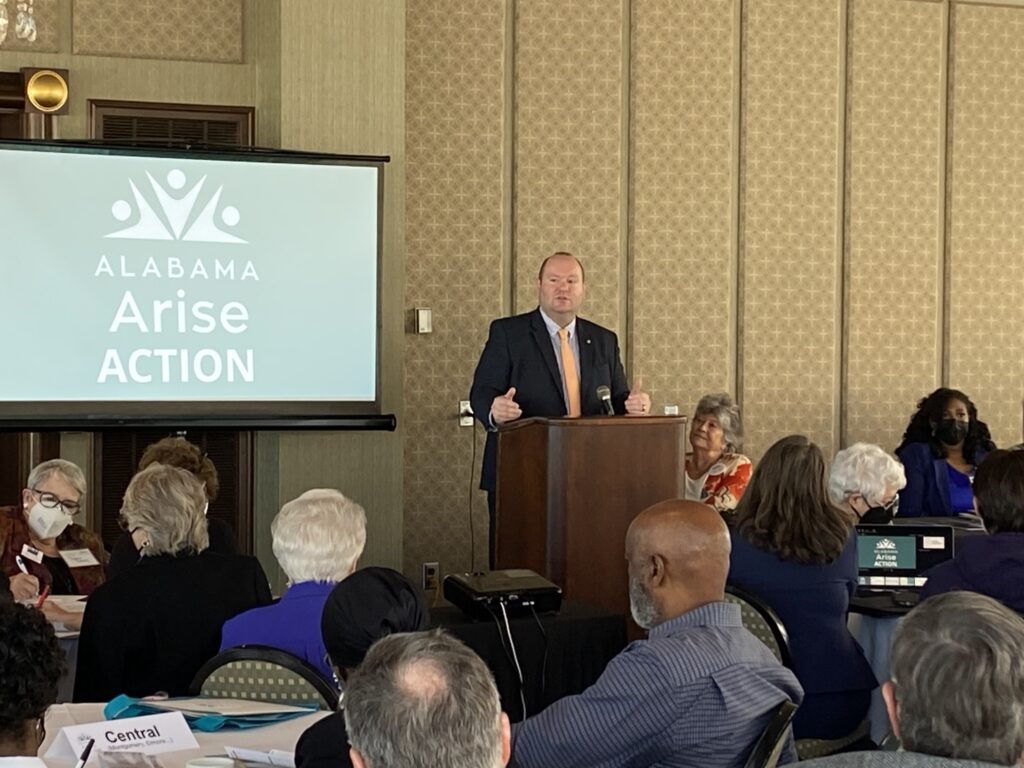
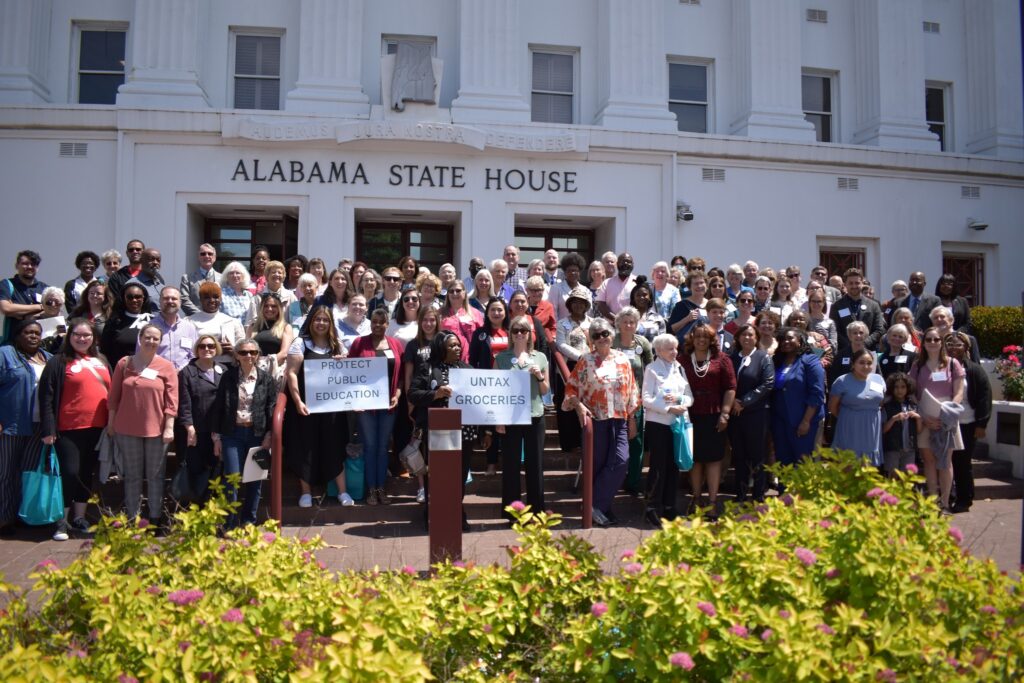
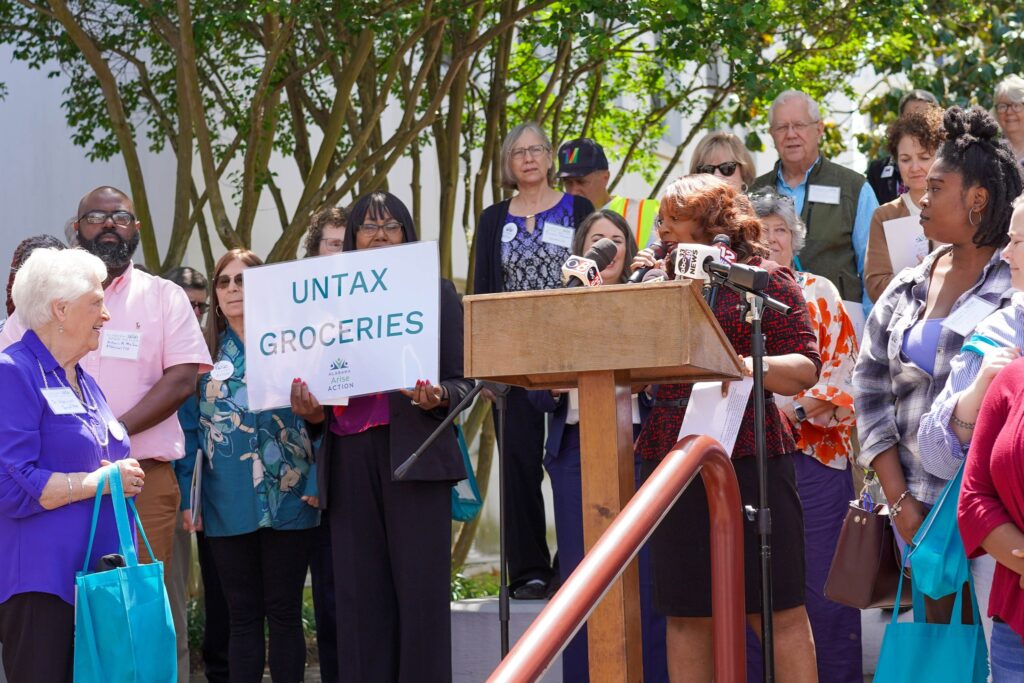
Arise held our 2023 Legislative Day on Tuesday, April 11. More than 100 supporters joined us in Montgomery to hear updates on our policy priorities and urge their lawmakers to untax groceries, expand Medicaid and end debt-based driver’s license suspensions. Thank you to everyone who spoke out for a better Alabama for all!
What would an ideal plan to untax groceries in Alabama look like?
Several tax bills (including grocery tax cut bills) will be discussed this year in the Alabama Legislature. What makes a tax reform bill good for Alabamians? Here are four important factors to keep in mind:
It provides a tax cut for families with low incomes (not just wealthy households).
Alabama’s state sales tax on groceries is a cruel tax on survival. It increases hunger rates, drives struggling families deeper into poverty and adds pressure to household budgets with every trip to the grocery store.
The average Alabama family spends approximately $600 a year on state grocery tax. By reducing or eliminating the state grocery tax, we are taking an important first step toward making it easier for working families to make ends meet.
It protects education revenue to ensure our children’s classrooms are adequately funded in the years to come.
Revenue from Alabama’s individual income tax and sales tax (including the grocery tax) goes to the Education Trust Fund, which supports public education throughout the state.
Lawmakers should ensure their proposals to untax groceries protect funding for public schools while making life better for families across our state. We can and should do both.
It is broad enough to have a meaningful and long-lasting impact.
It is important that any bill to reduce the grocery tax allows SNAP-eligible foods (rather than only WIC-eligible foods) to be untaxed.
If only WIC-eligible foods are untaxed, grocers would have a hard time implementing the bill. Families would be confused when grocery shopping, as relatively few items would be untaxed, while most would not be.
The reduction should be sustainable in the long term, rather than just being a temporary fix.
An ideal grocery tax proposal will do all the things on this list while eliminating the state’s entire 4-cent grocery tax, rather than just a fraction of it.
It provides an immediate grocery tax reduction.
As prices continue to rise on many of the essentials that folks need to survive, families across Alabama are struggling now.
We need to help Alabamians at a time when they need a grocery tax reduction the most, rather than putting it off until future years.
Arise legislative update: March 27, 2023
Arise’s Pres Harris invites you to our Legislative Day on April 11 in Montgomery. Legislative Day is an annual opportunity for Arise supporters to meet their lawmakers and make the case for policy changes to improve life for every Alabamian. We expect this year’s advocacy to focus on expanding Medicaid, untaxing groceries and funding public transportation.
Arise legislative update: March 6, 2023
Before the Alabama Legislature returns this week, Arise’s Akiesha Anderson welcomes everyone with an update on an upcoming special session on federal American Rescue Plan Act funds and an overview of Arise’s member-chosen policy priorities for 2023.