Check out Arise’s new Alabama Tax and Budget Handbook!

All Alabamians should have the resources they need to reach their potential and ensure a healthy, secure future. To realize that vision, we must make our state’s upside-down tax system more equitable. And we must secure adequate funding for unmet vital needs like Medicaid expansion and public transportation.

Alabama Arise’s new 2026 edition of The Alabama Tax and Budget Handbook explains how we can achieve those goals together. Packed with colorful graphs and illustrations, the handbook helps Alabamians better understand how budgets and taxes affect their everyday lives. It highlights how the state pays for key public services that benefit all of us, and it walks readers through how Alabama’s budgets become law each year.

Cover image of The Alabama Tax and Budget Handbook

The handbook also suggests dozens of policy changes to improve Alabama’s tax system and to ensure adequate funding for essential services like education and healthcare. Key recommendations include:

  • Update the sales tax on goods and services, including eliminating the grocery tax.
  • Make the income tax more progressive by increasing the standard deduction and establishing a state Earned Income Tax Credit.
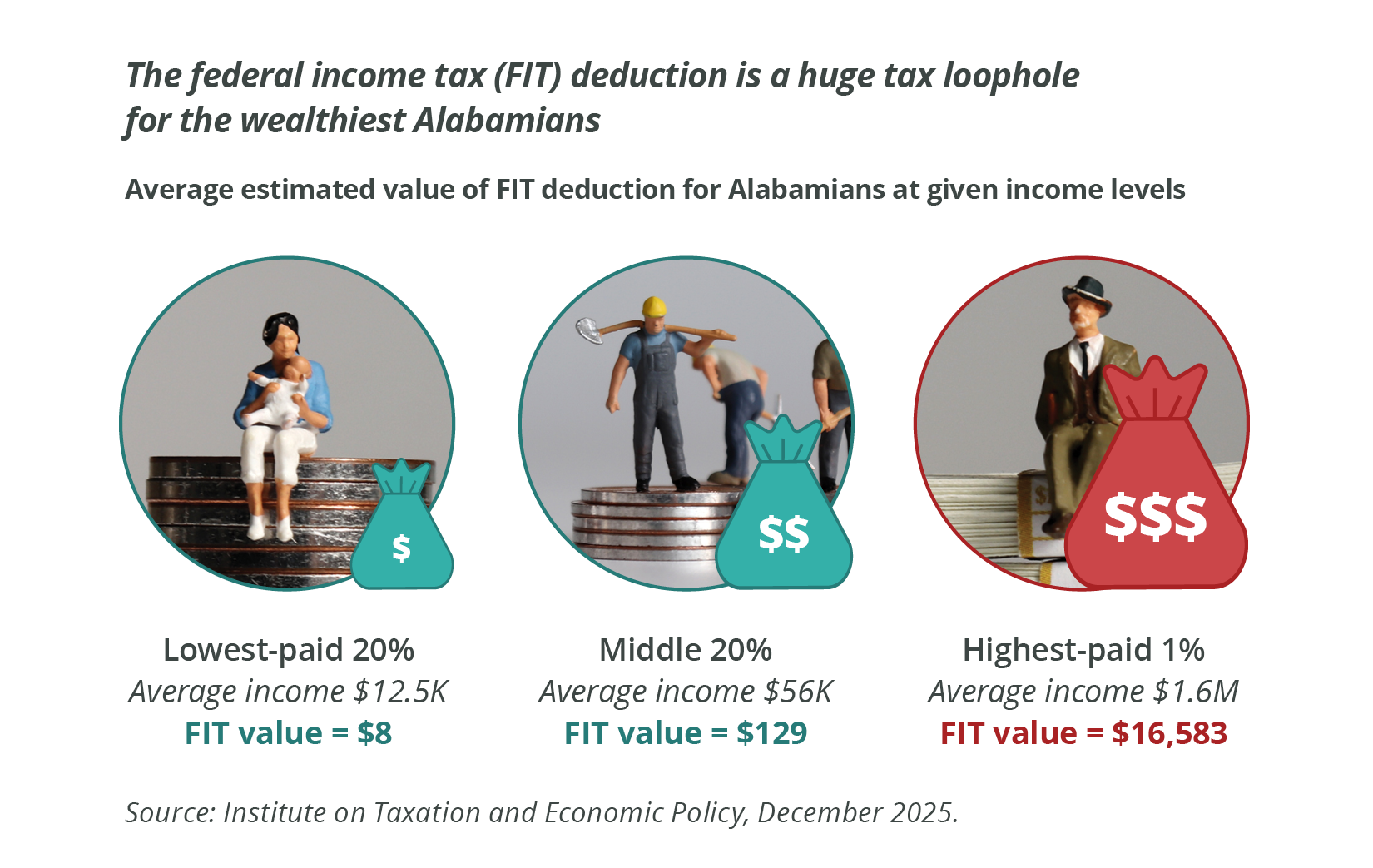
  • Eliminate the federal income tax deduction, a skewed tax break that overwhelmingly benefits the wealthiest households.
  • Increase overall property tax rates while increasing the homestead exemption to protect homeowners with low incomes.
  • Enhance budgetary flexibility through gradual earmarking reform.

Visit alarise.org/taxandbudgethandbook to read the handbook and request a print copy today.

‘Resilient communities begin with healthy people, period’

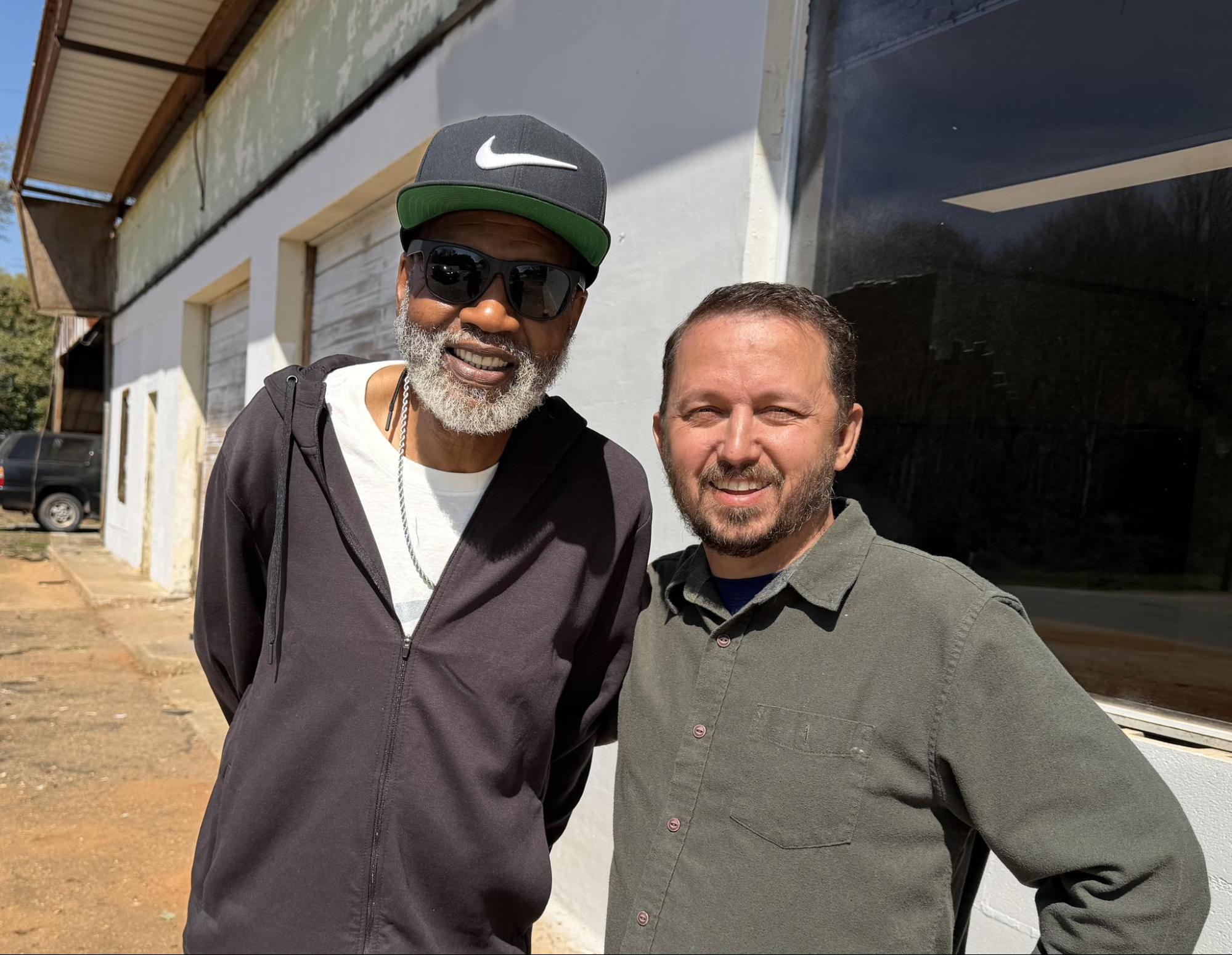
A smiling man in a black shirt and black hat.
Warren Tidwell works as a disaster rebuilding and recovery organizer in rural communities like Parrish in Walker County and Camp Hill in Tallapoosa County. (Photo courtesy of the Alabama Center for Rural Organizing and Systemic Solutions)

Warren Alan Tidwell has spent years doing work that depends on trust. He does the slow, often unseen work of bringing people together across differences after an emergency.

“There’s very few men like me who aren’t a part of marginalized communities that have the ability to work across working-class lines, between white folks and Black folks, trans folks, queer folks, whatever,” Tidwell said. “And it’s built on 25 years of experience working in places like Ghana and Haiti, but most importantly, right here in rural Alabama.”

Warren is originally from Walker County, just west of Birmingham. But in recent years, he has centered his organizing work on disaster relief and recovery in Camp Hill in Tallapoosa County.

The work became more challenging after a powerful hail storm and flooding hit the small east Alabama town in March 2023. Since then, Warren has tarped roofs, rebuilt everything you can imagine and gathered resources as the town continues to recover.

“It’s not my job to lead, but it’s my job to help draft leaders, you know, build them up and get the hell out of their way,” he said.

Chronic pain that keeps getting worse

Warren said his approach as executive director of the Alabama Center for Rural Organizing and Systemic Solutions (ACROSS) focuses on helping communities grow their own leaders and solve problems together. Step one is getting people what they need. That’s tough to do without a grocery store or doctor in town.

And lately, the work has become even harder to keep up for personal reasons. Warren’s health is getting worse, and he can’t afford healthcare. He’s facing several health issues, often on his own and with no treatment. One of those is a hernia he has had for two years.

“It’s umbilical,” he said. “If it was inguinal, I’d have had to figure something out by now.”

Without health insurance, Warren has put off surgery and is trying to manage the pain day by day. But that keeps getting harder.

“If I keep on this rotation of NSAIDs and Tylenol, man, it’s just going to ruin my stomach and my liver,” he said.

Warren also recently has been facing headaches caused by trigeminal neuralgia. The pain wears on him.

“Chronic pain is what I’ve always feared, because I know it’s something I struggle with tremendously,” he said.

For Warren, that means not being there for a town that counts on him.

“My wife’s a schoolteacher, but her employer doesn’t offer [spousal coverage],” he said.

Warren went onto healthcare.gov to find coverage in the Marketplace, but he found no affordable plans available for him. He said his monthly premiums would’ve cost him nearly $800 out of pocket.

“Then the federal cut in tax subsidies cut me out of being able to afford it,” he said. “And because our nonprofit needs better funding, I can’t even keep the folks working for me in health coverage, least of all myself.”

Lack of healthcare limits workforce development

Two men smile and embrace for a posed photo.
Warren Tidwell and Tommy “Pops” Sellers (left) worked together after a powerful 2023 hail storm in Tallapoosa County to set up a logistics network that still serves the people of Camp Hill. (Photo courtesy of Warren Tidwell)

Recent federal changes have made things even more difficult. Policies tied to the One Big Beautiful Bill Act have reduced access to affordable coverage for many people with low or middle incomes. That makes it even harder for people like Warren to get the care they need.

Warren spends every day investing in the people living in rural Alabama, and he said he wonders why the federal or state governments can’t do the same. He said lack of affordable health coverage isn’t just about being sick and skipping care for himself. It is also is limiting what organizations like his can do from a workforce development perspective.

“These are self-fulfilling prophecies,” he said. “If you can’t offer healthcare, people are going to have to sacrifice a lot just to be a part of that. Two people who work with me moved here from out of state to do this work. I don’t know if anyone would make that leap now.”

In rural places like Camp Hill, those struggles are easy to see — especially during disaster recovery. But as prices rise and wages stagnate for more Americans, Warren said rural Alabamians feel even more disenfranchised and alienated.

Lack of healthcare access affects entire communities. When people can’t get care, it weakens the systems meant to support everyone, Warren said.

“We have a number of seniors who are disabled on fixed incomes,” he said. “When prices go up, it affects every aspect of their life. They have no agency to take part in any kind of recovery.”

Investing in communities before it’s too late

Warren said he believes healthcare is the starting point for strong communities.

“Resilient communities begin with healthy people, period,” he said. “How can you help create opportunities and solve issues for other people when you’re trying to navigate the complexities of those issues yourself?”

For Warren and his organization, the stakes are rising. Without new funding to help cover costs (including health insurance for him and his staff), the work may not last much longer.

“If it gets worse with all of this health stuff, I mean, they’ll have to replace me,” he said. “If we’re not able to get the kind of funding we need by end of summer, we’re shutting down. I’ve got to take a job that I can get myself some insurance to take care of my health issues.”

What’s happening to Warren isn’t unusual. It’s the result of policy choices.

Alabama’s leaders often talk about investing in rural healthcare and economic development. But Warren’s situation shows a problem: Many of the people doing this work can’t afford to stay healthy enough to keep doing it.

Expanding Medicaid and renewing enhanced Premium Tax Credits for Marketplace coverage would be a good start. These investments in a healthier future would help Alabamians like Warren get the care they need. And they would make it easier for nonprofits like ACROSS to stay afloat.

In Camp Hill and rural communities across Alabama, the question is simple: Will policymakers invest in the people holding these communities together… before that work disappears?

About Alabama Arise and Cover Alabama

Whit Sides is the storyteller for Alabama Arise, a statewide, member-led organization advancing public policies to improve the lives of Alabamians who are marginalized by poverty. Arise’s membership includes faith-based, community, nonprofit and civic groups, grassroots leaders and individuals from across Alabama. Email: whit@alarise.org.

Arise is a founding member of the Cover Alabama coalition. Cover Alabama is a nonpartisan alliance of advocacy groups, businesses, community organizations, consumer groups, health care providers and religious congregations advocating for Alabama to provide quality, affordable health coverage to its residents and implement a sustainable health care system.

Alabama Arise among 44 groups urging U.S. senators to delay SNAP cost shift

Unless Congress acts, Alabama will have to provide a huge amount of additional state funding next year to maintain food assistance benefits under the Supplemental Nutrition Assistance Program (SNAP). HR 1, the so-called One Big Beautiful Bill Act, shifted significant SNAP costs from the federal government to states in an effort to finance large tax breaks for wealthy households and highly profitable corporations. The law will require most states to pay for a percentage of SNAP benefits – up to 15% for some states.

Alabama Arise joined 43 partner groups in a letter asking U.S. Sens. Katie Britt and Tommy Tuberville to support delaying the SNAP cost shift as part of the upcoming Farm Bill. The full text of the letter is below.

Letter text

Dear Senators Britt and Tuberville,

We, the undersigned 44 Alabama-based groups, write to ask for your timely action to protect our state budget from significant new costs under the Supplemental Nutrition Assistance Program (SNAP) and to support families in Alabama who are struggling to afford food. As you know, the federal budget bill enacted last summer creates a new requirement for our state to fund a portion of SNAP food benefits if our SNAP error rate isn’t low enough, shifting big costs to our state. Some states got a two-year delay to decrease their high error rates, but others, including Alabama, didn’t. Every state needs to get that same reasonable extra time to succeed in improving their SNAP program.

The stakes are very high. Based on the most recent error rate, Alabama could face about $175 million a year in new state SNAP costs. The error rate is determined by a metric comprising a sample of 1,000 eligible households per state for both underpayments and overpayments made to SNAP users by the Department of Human Resources (DHR). Importantly: The SNAP error rate is not a fraud rate.

States already have significant verification and integrity processes in place, and our Alabama DHR is working hard to continue to reduce errors and improve accuracy. These new federal requirements come on a short timeline, and states without the two-year delay only have six months to reduce their error rates to ease the financial burden of the new SNAP state match.

While HR 1 provided a few states with the highest SNAP errors with two extra years to give them more time to reduce their errors, Alabama is not one of the few to benefit from this extra time. It’s not fair for the worst-performing states to get a better deal than states like ours that have had lower error rates. Alabama is committed to running a strong, accurate SNAP program that protects both taxpayers and families. But we need more time to make needed improvements while also protecting eligible families who need food assistance to help make ends meet.

We ask you to work with your colleagues and Senate leadership to extend that practical delay in the SNAP cost shift to all states. This would give our state and others the chance to succeed in reducing its error rate – and thus its state match – while protecting participants. Extending the current two-year delay to all states would ensure every state has the same opportunity to strengthen their programs.

This proposal has the bipartisan support of National Governors Association, the National Conference of State Legislatures, the National Association of Counties and the American Public Health and Human Services Association (state SNAP directors).

We hope we can count on you to work to protect Alabama by ensuring any farm legislation that moves this year extends the current SNAP cost shift delay to all states so we all have the same opportunity to reduce error rates, maintain SNAP participation and help families across Alabama keep food on the table.

Thank you.

Signatories

Sincerely,

  1. Alabama Arise
  2. Alabama Institute for Social Justice
  3. Alabama Network of Family Resource Centers
  4. Alabama Poor People’s Campaign
  5. Alabama Sustainable Agriculture Network
  6. All Nations Church of God (Montgomery)
  7. Animal Kinship Ministry (Tuscaloosa)
  8. Bay Area Women Coalition, Incorporated (Mobile)
  9. Bread for the World, Alabama Chapter (Birmingham)
  10. Church and Society, First United Methodist Church (Anniston)
  11. Community Enabler Developer (Anniston)
  12. Community Food Bank of Central Alabama
  13. East Lake United Methodist Church (Birmingham)
  14. Feeding Alabama
  15. First Christian Church of Montgomery
  16. Five Horizons Health Services
  17. Grace Presbyterian Church (Tuscaloosa)
  18. Gratitude Foundation
  19. Greater Birmingham Ministries
  20. Hispanic and Immigrant Center of Alabama
  21. Hispanic Catholic Social Services – La Casita (Birmingham)
  22. Interfaith Mission Service (Huntsville)
  23. League of Women Voters of Alabama
  24. LunarLab (Birmingham)
  25. Mary’s House Catholic Worker (Birmingham)
  26. Mephibosheth LLC (Mobile)
  27. National Lawyers Guild – Alabama Chapter
  28. North Alabama Area Labor Council
  29. North Alabama Peace Network
  30. Progressive Women of Northeast Alabama
  31. Project Hope to Abolish the Death Penalty
  32. St. Paul United Methodist Church (Birmingham)
  33. Samford Community Outreach Group
  34. Sisters of St. Joseph (Mobile)
  35. Southern Rural Black Women’s Initiative
  36. Stand Up Mobile
  37. The Across Network (Camp Hill)
  38. The 6:52 Project Foundation, Inc. (Gadsden)
  39. The Yellowhammer Fund
  40. Unitarian Universalist Fellowship of Auburn
  41. Unitarian Universalist Church of Birmingham
  42. United for a Fair Economy
  43. United Way of West Alabama
  44. Voters Legal Justice Watch Group

cc: Office of the Honorable Kay Ivey, Governor of Alabama
cc: Bill Poole, Director, Alabama Department of Finance
cc: Members of the Alabama Senate Finance and Taxation – General Fund Committee
cc: Members of the Alabama House Ways and Means – General Fund Committee

New Alabama Arise handbook explains how state taxes and budgets work – and how to improve them

Cover image of The Alabama Tax and Budget HandbookAlabama should reform its outdated, imbalanced tax system to help working people get ahead and to ensure adequate funding for vital services like education and health care, a new Alabama Arise handbook released Thursday concludes. Legislators also should implement several changes to make the state’s budgeting process more responsive and transparent, the handbook finds.

In The Alabama Tax and Budget Handbook, Arise uses graphs and illustrations to explain what state tax dollars pay for and where the state gets its money. The handbook highlights how key public services are funded and walks readers through how Alabama’s budgets become law annually.

Those explanations are especially timely as lawmakers work to finalize state budgets for fiscal year 2027. The handbook’s policy recommendations also could help legislators address future revenue declines, secure funding for unmet needs like Medicaid expansion and public transportation, and cover new state obligations for food assistance under the Supplemental Nutrition Assistance Program (SNAP).

The 84-page handbook also examines the state’s four major kinds of taxes – income, sales, property and business – to show how they measure up in terms of adequacy and equity for Alabamians and how they compare to taxes in other states.

“Our handbook is designed to help Alabamians better understand how state budgets and taxes affect their everyday lives,” said Carol Gundlach, Alabama Arise’s senior policy analyst and a handbook co-author. “We want to equip residents to advocate knowledgeably and effectively for policy changes that would improve life for their families and communities.”

The less you make, the more you pay: Alabama’s upside-down tax system

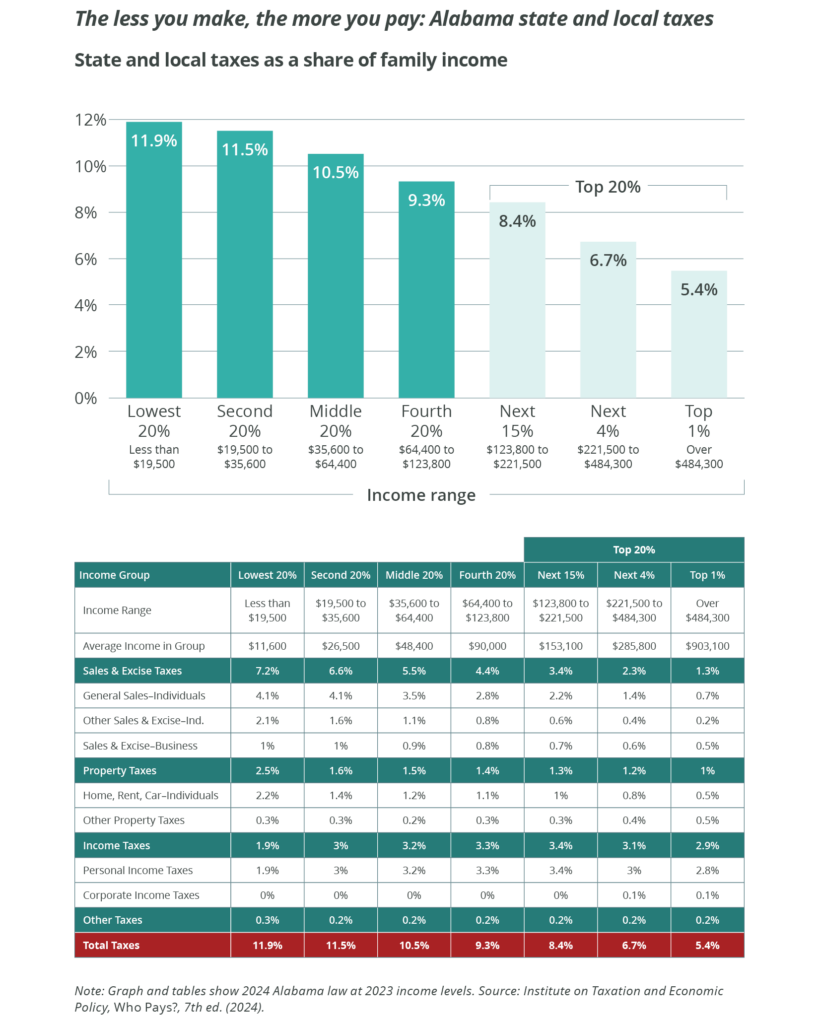
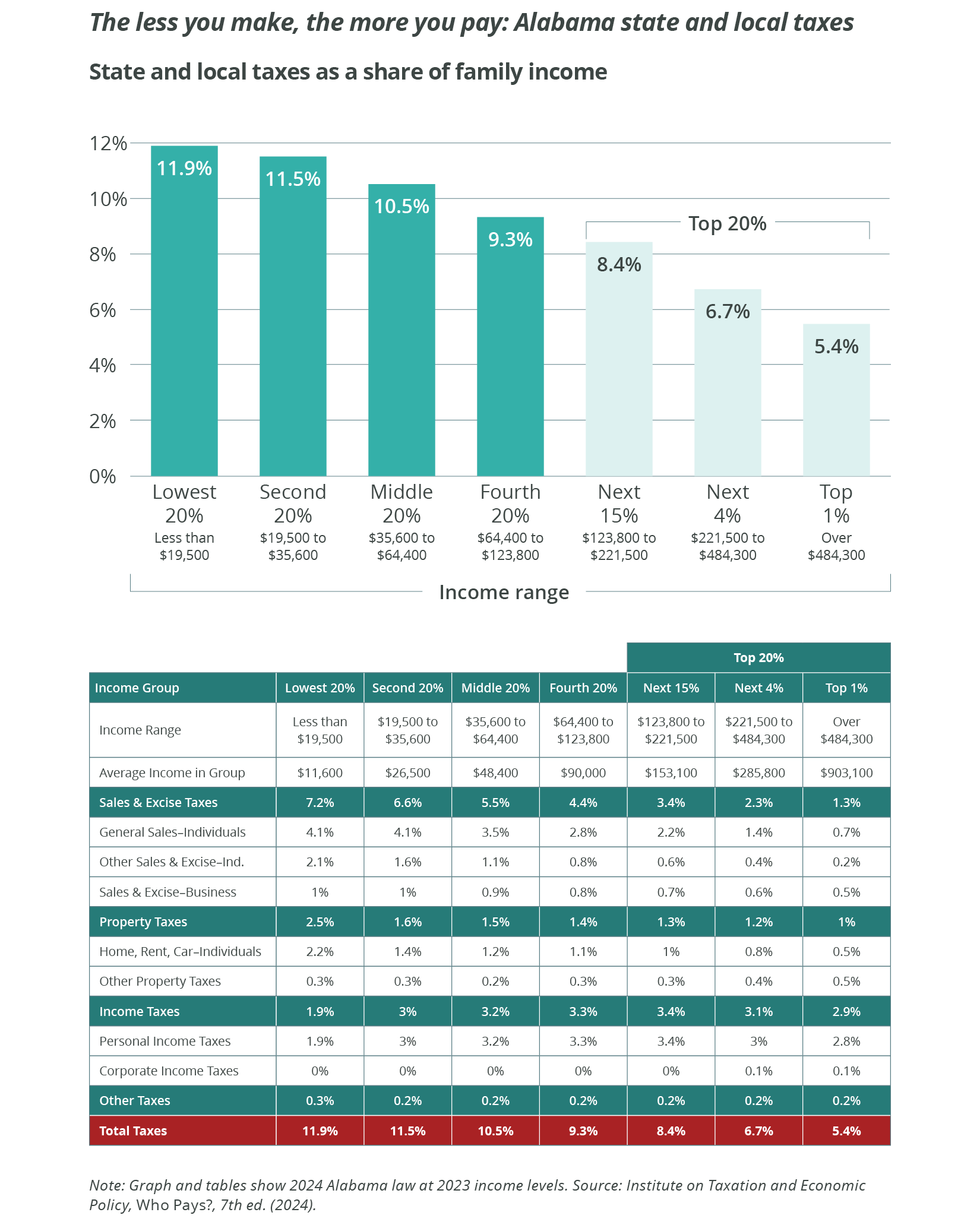
Alabama’s tax system is upside down and holds the state back from reaching its full potential, the handbook finds. On average, the lowest-paid fifth of Alabamians – those making less than $19,500 a year – pay nearly 12% of their incomes in state and local taxes. Meanwhile the wealthiest 1% – those making more than $484,300 annually – pay just 5.4%.

Bar graph of Alabama state and local taxes as a share of family income. Lowest 20% pays 11.9%. Second 20% pays 11.5%. Middle 20% pays 10.5%. Fourth 20% pays 9.3%. Next 15% pays 8.4%. Next 4% pays 6.7%. Top 1% pays 5.4%. Info reflects 2024 Alabama tax law at 2023 income levels. Source: Institute on Taxation and Economic Policy, Who Pays? (7th edition), 2024.

The biggest driver of this imbalance is Alabama’s overreliance on sales taxes, including on groceries and other necessities. Sales taxes hit families with low incomes the hardest because they must spend most of what they make on food, clothing and other items subject to sales tax just to get by. Lawmakers reduced Alabama’s state sales tax on groceries from 4% to 3% in 2023, and then to 2% in 2025. Even after those improvements, however, Alabama remains one of only nine states still taxing groceries.

Other aspects of the state’s tax system do little to offset the regressive effects of sales taxes, the handbook finds. The state’s income tax is relatively flat and taxes many families deeper into poverty. Alabama’s combined state and local property taxes are the nation’s lowest and provide large breaks to wealthy landowners. And skewed tax breaks like the state deduction for federal income taxes overwhelmingly benefit the wealthiest households at the expense of revenue for education and other services that benefit all Alabamians.

“Alabama’s upside-down tax structure makes it harder for families to make ends meet,” Gundlach said. “Our tax system forces people with low and middle incomes to subsidize enormous tax giveaways for wealthy households. And as the cost of living continues to rise, high sales taxes make food, clothing and other necessities even more expensive for struggling Alabamians.”

Opportunities to improve Alabama’s tax system

The handbook recommends numerous improvements to make Alabama’s taxes more equitable and allow stronger investments in public services. Here are a few key recommendations:

  • Modernize the sales tax on goods and services, including eliminating the grocery tax.
  • Make the income tax more progressive by increasing the standard deduction and establishing a state Earned Income Tax Credit.
  • Eliminate the federal income tax deduction for businesses and individuals.
  • Increase overall property tax rates while increasing the homestead exemption to protect homeowners with low incomes.
  • Adopt combined reporting, a practice that reduces tax avoidance by treating businesses and their subsidiaries as one taxpayer.
  • Limit tax incentives for luring companies to Alabama.

“Alabama’s tax system starves our state of the money we need to strengthen investments in education, health care, public transportation and other vital services that improve the quality of life for all of us,” Gundlach said. “Our lawmakers can and should take action to make our tax system more fair, more adequate and more sustainable.”

Opportunities to make state budgets more transparent and responsive

The budget process is more complicated in Alabama than in many other states. Most states have a single primary budget for public services, but Alabama has two. The Education Trust Fund supports services related to K-12 and higher education, and the General Fund supports all other services, including Medicaid and corrections.

Alabama also sets aside more than 90% of its revenues for a specific purpose, a process known as earmarking. Earmarks can help ensure stable funding for services, but they also can make it harder to understand state funding. In addition, earmarking can limit lawmakers’ ability to create a budget that adequately meets current needs, the handbook concludes.

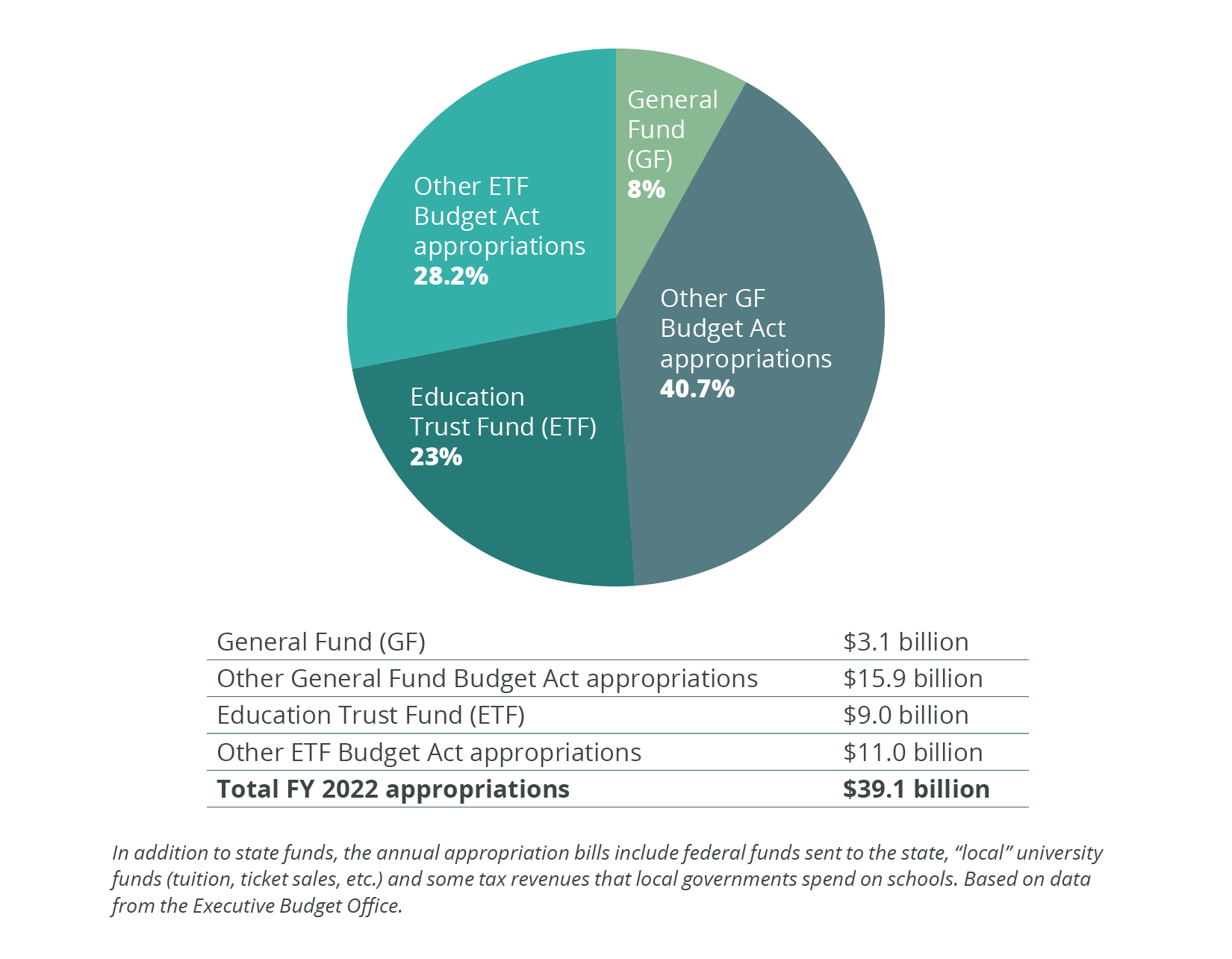
Pie graph showing shares of state spending: 8% General Fund (GF), other GF Budget Act approprations 40.7%, Education Trust Fund (ETF) 23%, other ETF Budget Act appropriations 28.2%. In addition to state funds, the annual appropriation bills include federal funds sent to the state, “local” university funds (tuition, ticket sales, etc.) and some tax revenues that local governments spend on schools. Based on data from the Executive Budget Office.

The handbook recommends new budgeting practices that would make Alabama’s budgets more transparent and adaptable. Here are a few key recommendations:

  • Forecast revenues for multiple years into the future.
  • Prepare fiscal notes with multiyear projections of bills’ revenue effects.
  • Get a stronger current-year baseline for the cost of public services.
  • Seek independent consensus revenue forecasts in addition to those from the Executive Budget Office and Legislative Services Agency.
  • Enhance fiscal flexibility through gradual earmarking reform.

“Alabamians deserve a government that gives everyone a voice and an economy that offers everyone a chance to get ahead,” Gundlach said. “By improving our state’s budget process and righting the wrongs of our upside-down tax system, we can build an Alabama that truly works for everyone.”

About the handbook

Alabama Arise published the first edition of The Alabama Tax and Budget Handbook in 2005 to help educate the public about how state taxes and budgets work and how they affect people’s everyday lives. Arise published a second edition in 2015 and now the new third edition in 2026.

Arise’s new handbook includes recent changes to state law and an expanded discussion of the budgeting process. The 2026 edition also explores how racism shaped the historical origins of many of Alabama’s tax and budget practices and examines the ongoing disparate racial impacts of those policies. The publication closes with a glossary defining terms commonly encountered in tax and budget debates.

Full handbook

The Alabama Tax and Budget Handbook is available to read online here. A downloadable PDF of the handbook is available here.

The Alabama Tax and Budget Handbook

Cover image of The Alabama Tax and Budget Handbook

We’re all in this together. All of us – people of every race, gender, age, income and background – benefit from a network of services from our local, state and national governments. From garbage collection to fire protection, from roads to schools, from public health to public safety, our tax dollars support the daily upkeep of our common good across Alabama.

The Alabama Tax and Budget Handbook is a guide to help make our state’s tax and budget processes more accessible and understandable. The handbook provides an overview of state finances and answers questions that affect every Alabamian: What do our tax dollars pay for? How does state spending work? Where does the state get its money?

The handbook looks at how those functions measure up – in relation to residents’ needs and abilities, in fairness and equity for all residents, and in comparison to the performance of other states. And the handbook offers ideas for making Alabama’s finances fairer, simpler, more adequate for meeting our needs and more easily communicated to the public.

By learning about these processes and advocating for positive change, Alabamians can require their policymakers to be responsive to the needs in our communities. Together, we can ensure a government that gives everyone a voice, an economy that offers everyone a chance to get ahead, and an Alabama that works for all of us.

Read the handbook

Use the links in the table of contents below to navigate through the full online version of The Alabama Tax and Budget Handbook. This navigation also will be available at the bottom of each section page.

For an overview of the handbook’s major themes and key recommendations, read our news release here.

To read the full handbook, download a PDF copy here. You also can access the PDF by clicking the “Download” button at the top of this page.

Order a print copy of the handbook

You can request print copies of the handbook, and we hope you do! Print copies are available free of charge, but we do ask you to consider a donation to help us cover printing and distribution costs.

• If you are able to donate for a print copy, you can make your request and donation in one place on this form.

• To request a print copy at no cost, please fill out this form.

About this handbook

Alabama Arise published the first edition of The Alabama Tax and Budget Handbook in 2005 to help educate the public about how our state’s taxes and budgets work and how they affect our everyday lives. Arise published a second edition in 2015 and now a third edition in 2026. This third edition includes changes that have occurred in the decade since the previous edition – and reflects our ongoing commitment to building a better Alabama for all.

This handbook concludes with a glossary of terms commonly encountered in tax and budget debates. Hyperlinked terms that appear in boldface type throughout the handbook are defined in the Alabama Tax and Budget Glossary.

To request a presentation about this handbook’s contents, email info@alarise.org or call the Alabama Arise office at 334-832-9060.

Table of contents

Section 2: Budget Overview

Section 3: Tax Overview

Section 4: Income Tax

Section 5: Sales Taxes

Section 6: Property Taxes

Section 7: Business Taxes

Section 8: Tax Policy Solutions for the Long Haul

Section 9: Alabama Tax and Budget Glossary

Acknowledgments

The Alabama Tax and Budget Handbook is an Alabama Arise publication made possible by generous support from Arise’s members. The findings and recommendations presented in this report are those of Alabama Arise and do not necessarily reflect the opinions of any other organization or person.

AUTHORS:

Carol Gundlach
Senior policy analyst
Alabama Arise

Chris Sanders
Communications director
Alabama Arise

Jilisa Milton
State policy fellow, 2021-22
Alabama Arise

Mike Nicholson
Senior policy analyst, 2023-25
Alabama Arise

Jim Carnes
Policy director, 2012-22
Alabama Arise

Kimble Forrister
Executive director, 1991-2018
Alabama Arise

EDITORS:

Chris Sanders
Communications director
Alabama Arise

Robyn Hyden
Executive director
Alabama Arise

Akiesha Anderson
Policy and advocacy director, 2022-24
Alabama Arise

Will Nevin, Ph.D.
Assistant professor and program coordinator for Communications Media
Alabama A&M University

RESEARCH SUPPORT:

Courtney Mathis
Summer legal fellow, 2023-24
Alabama Arise

WEB DESIGN:

Matt Okarmus
Senior communications associate
Alabama Arise

PHOTOGRAPHY:

Whit Sides
Storyteller
Alabama Arise

Julie Bennett
Auburn, Ala.

PRINT AND GRAPHIC DESIGN:

Tori LaConsay
Atlanta, Ga.

SPECIAL THANKS FOR ADVICE AND ASSISTANCE:

Alabama League of Municipalities
Montgomery, Ala.

Center on Budget and Policy Priorities
Washington, D.C.

Institute on Taxation and Economic Policy
Washington, D.C.

Conner Bailey, Ph.D.
Professor emeritus
Auburn University

Ryan Thomson, Ph.D.
Assistant professor
Auburn University

The Alabama Tax and Budget Handbook – Introduction

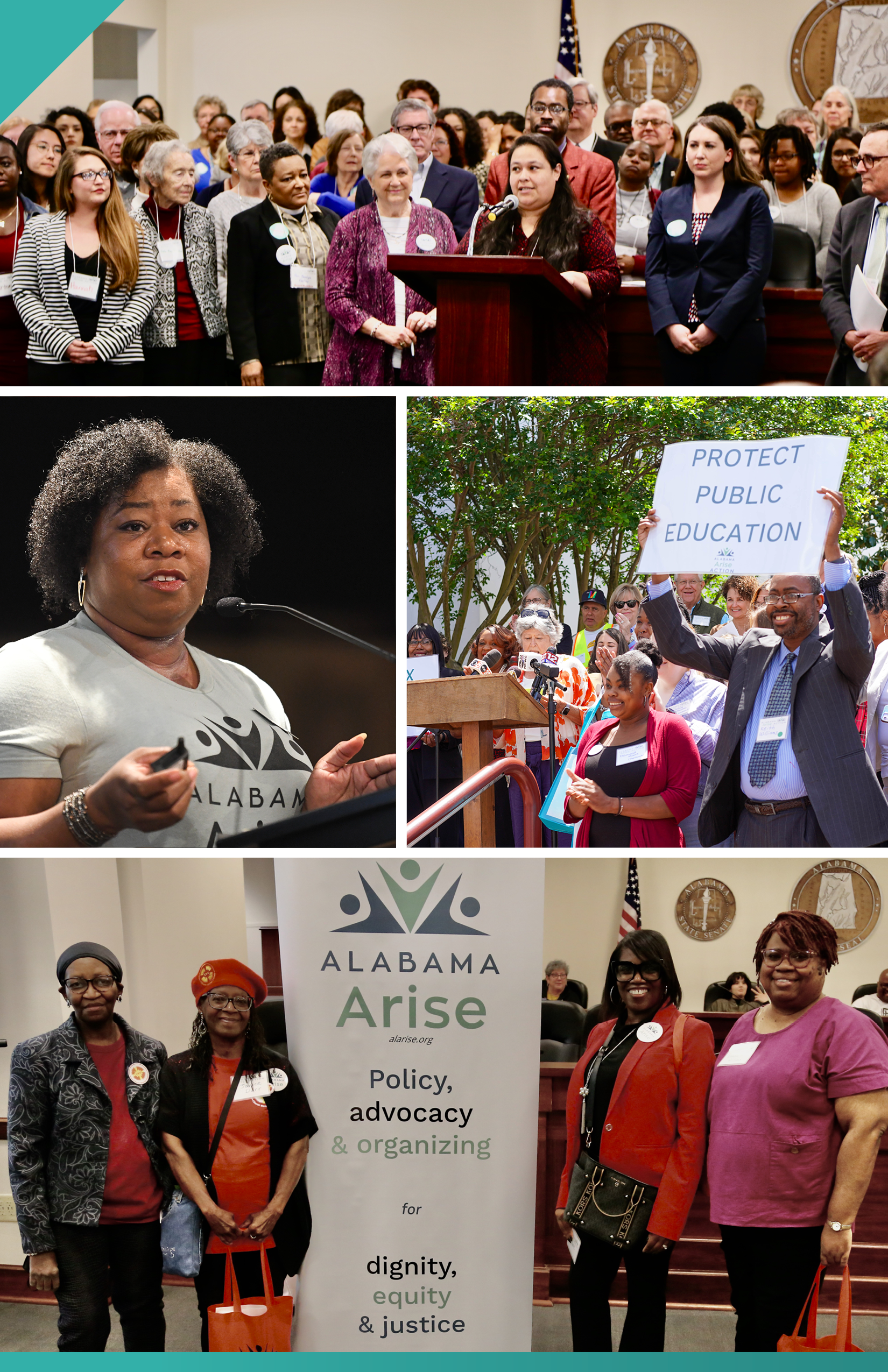
A collage of four photos from Arise events. Top: Dozens of advocates stand together during a news conference at the Alabama State House. Middle left: Arise staff member Jennifer Harris speaks to members. Middle right: An Arise member holds up a sign reading "Protect Public Education" during a news conference outside the State House. Bottom: Four women pose next to an Alabama Arise banner.

The common good

We’re all in this together. All of us – people of every race, gender, age, income and background – benefit from a network of services from our local, state and national governments. From garbage collection to fire protection, from roads to schools, from public health to public safety, our tax dollars support the daily upkeep of our common good.

The 50 state governments are vital links in this network. It’s a solemn trust: Each state is responsible for ensuring the safety, general well-being and education of its people. And each state government carries out this responsibility in its own way.

As Alabamians, many of us studied our state government in fourth grade and learned a little more about it in other classes. But until we’re out making a living, paying taxes and voting, these lessons may seem disconnected from our everyday lives. The Alabama Tax and Budget Handbook is designed to make that connection. The handbook breaks down state finances into basic functions that affect every taxpayer: What do our tax dollars pay for? How does state spending work? Where does the state get its money?

The handbook also looks at how those functions measure up – in relation to residents’ needs and abilities, in fairness and equity for all residents, and in comparison to the performance of other states. And the handbook offers ideas for making Alabama’s finances fairer, simpler, more adequate for meeting our needs and more easily communicated to the public.

This is the third edition of the handbook. Alabama Arise developed the first handbook in 2005 and updated it in 2015 to reflect changes in the 10 years since the original edition. This new edition incorporates recent changes to state law and expands our discussion of Alabama’s budgeting process. This edition also reflects Alabama Arise’s commitment to racial equity by delving into the racist history of our tax system and exploring the disparate impact of budget and tax decisions on Alabama’s residents of color.

What are the origins of Alabama’s tax structure?

Alabama’s deeply regressive and upside-down tax system is the legacy of the state’s history of slavery and segregation. It’s a history and a tax system that Alabama shares with many of our neighboring Southern states. And it’s a history and a tax system “linked to [S]outhern states’ continuing underinvestment in public services with a willful austerity that inhibits opportunities for the region’s residents to thrive,” according to the Institute on Taxation and Economic Policy (ITEP).

Immediately following the Civil War and the end of legalized slavery, Alabamians elected many Black citizens to the Legislature. These new lawmakers adopted a new state constitution that, according to historian Wayne Flynt, was “devoted to raising additional revenue, providing universal education [and] expanding state services[.]” During this period, these Black legislators and many white allies made significant investments in public services across Alabama, particularly education. These attempts to expand opportunities for everyday citizens led to tremendous racial and political tensions.

After the Reconstruction period ended, a newly empowered white-majority state government wrote a new constitution that segregated schools, slashed taxes, reduced public services and limited the political power of Black people. The 1901 constitution cemented these provisions, and more, in place. This constitution was designed explicitly to disenfranchise Black people, reinstitute the racist system of white supremacy and limit the state’s ability to tax a major source of white wealth: land.

Alabama’s 1901 constitutional convention intentionally excluded Black representatives. Instead, the Planters and Big Mules dominated the convention. The Planters were large landowners, mostly from the Black Belt. The Big Mules were industry leaders in the banking, railroad and industrial sectors. These two groups joined forces at the convention, where the main question was whether the new document would strip voting rights only from Black people or if it also would restrict the influence of poor white people.

Delegates chose the latter option and wrote a constitution that sought to perpetuate the system of white supremacy that had dominated Alabama prior to Reconstruction. The delegates did not try to hide their ultimate goal in drafting the 1901 constitution. As the convention president said during his opening address: “And what is it that we want to do? Why, it is, within the limits imposed by the [f]ederal Constitution, to establish white supremacy in this [s]tate.”

Many newspapers warned that the 1901 constitution, if ratified, would result in inadequate funding of Alabama’s public education system. Some delegates, however, intentionally sought to deny the right to a public education, believing that providing Black people with a quality education would threaten the system of white supremacy. Many delegates also believed Black people would gain the most from services like public schools. Therefore, the 1901 constitution’s drafters ensured that generations of policymakers would lack both the money and the power to invest adequately in services that might disproportionately benefit Black people. These racist impulses, combined with protections for the property interests of the Planters and Big Mules, resulted in a severe cap on property taxes. That cap limited available funding to support public schools and other services.

During the Civil Rights Movement, activists and lawyers were able to get many of the overtly racist sections of the 1901 constitution stricken. And in 2022, Alabama voters approved a recompilation of the constitution that removed many of these stricken sections entirely. But mounting successful challenges to the tax policies embedded in the document has proved much harder. For example, the 1901 constitution capped state property taxes at 6.5 mills, a limitation that is still in effect today. The constitution also limited the home rule of counties and cities, including their ability to increase their own local property taxes.

There is no question that the cumulative effect of these property tax limitations has been to restrict funding for public education, especially in rural counties in Alabama’s Black Belt, disproportionately harming Black children. To this day, the state constitution concentrates taxation power in the Legislature, then and now dominated by white representatives.

In 1939, the Legislature passed a law creating a 2% state sales tax, which has increased to 4% over time. The state constitution requires counties to get the Legislature’s approval to increase many categories of sales taxes, just like with property taxes. Cities, meanwhile, can increase sales taxes without having to ask for legislative permission. But the constitution makes it much harder for cities and counties to increase property taxes, requiring the Legislature’s approval and then approval in a voter referendum.

Because it’s easier for localities to adjust sales taxes than property taxes, cities and counties often rely heavily on sales taxes to fund local services like roads and fire protection. And because sales taxes are highly regressive, their impact lands disproportionately on Alabamians with the lowest incomes.

The tax that best offsets regressive taxes like sales taxes is the state income tax. In 1935, Alabama approved a graduated income tax that was quite progressive. That year, when the state began taxing incomes of $3,600 or more for a family of four, teachers earned around $500, and only about 7,000 people in Alabama earned enough to be subject to the new tax. But since then, income tax brackets haven’t kept up with inflation. What originally was enacted as a progressive tax has now become essentially a flat tax that no longer offsets the regressive effects of state and local sales taxes.

Alabama’s tax system continues to worsen racial and ethnic income disparities, ITEP found in a 2020 unpublished analysis. Black and Hispanic families in our state face higher effective tax rates than white families but have lower average incomes. ITEP found that Black families paid 7.8% of their incomes in state and local taxes, compared to a statewide average of 7.3%. The organization’s analysis concluded that Alabama was among the worst performing states in racial inequities embedded in the tax system.

Alabama’s current tax structure was created by the same 1901 constitution that sought to entrench our state’s long history of segregation and racial discrimination. To make our tax structure more adequate and fairer, we will have to confront and address the impulses that drove these decisions made more than a century ago.

The Alabama Tax and Budget Handbook – Budget Overview

How does state spending work?

One state, two separate budgets

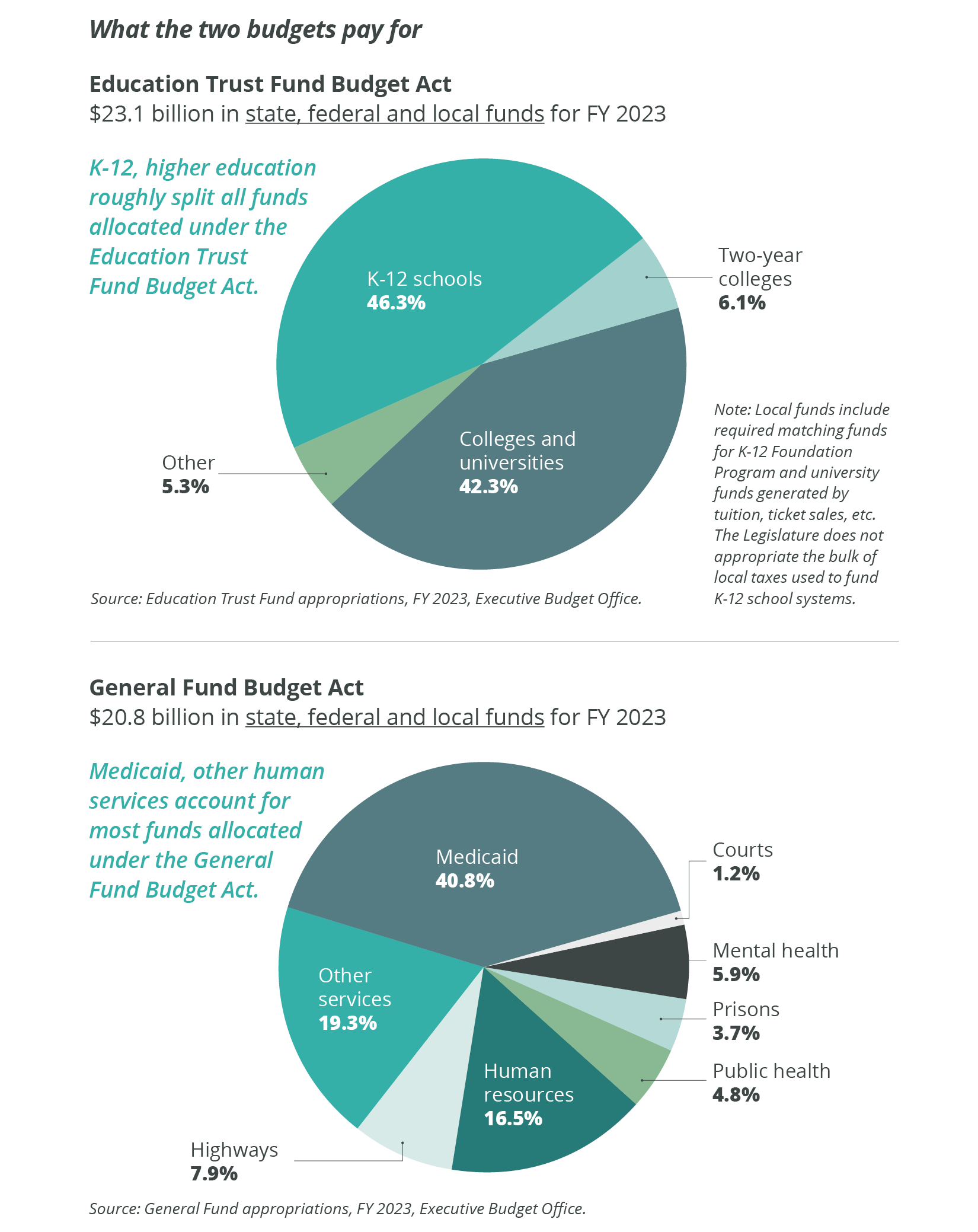
Of the Legislature’s $39.1 billion in total appropriations for fiscal year (FY) 2022, about $20 billion came under the Education Trust Fund (ETF) Budget Act for education-related services. Another $19 billion came under the General Fund (GF) Budget Act for all other services. Lawmakers also separately appropriated about $40 million in tobacco settlement money under the Children First Trust Fund to GF and ETF agencies (not shown on the chart). About 69% of total appropriations were earmarked, or set aside for a specific purpose, before lawmakers allocated them. Another 23% were designated for the ETF, though not earmarked for a particular purpose within it. Altogether, 92% of state revenue – everything outside the $3.1 billion General Fund – was restricted to some extent in how it could be spent.
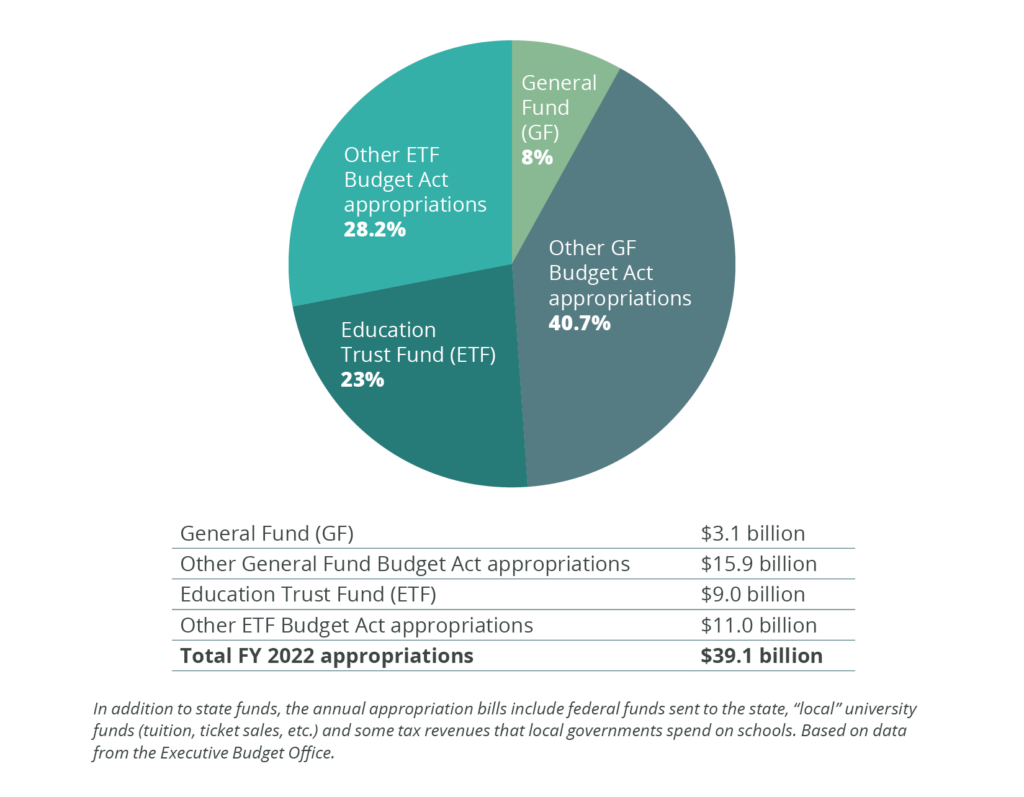
In addition to state funds, the annual appropriation bills include federal funds sent to the state, “local” university funds (tuition, ticket sales, etc.) and some tax revenues that local governments spend on schools. Based on data from the Executive Budget Office

It takes significant state and federal money to keep Alabama’s vital services running. Most of this money flows through the State Treasury. State agencies use the Treasury like a bank account. State and federal dollars appropriated by the Legislature are deposited there, and each agency draws out the money it’s been authorized to spend. Every penny the state spends goes through a formal budget process that involves the Legislature, the governor and state agencies.
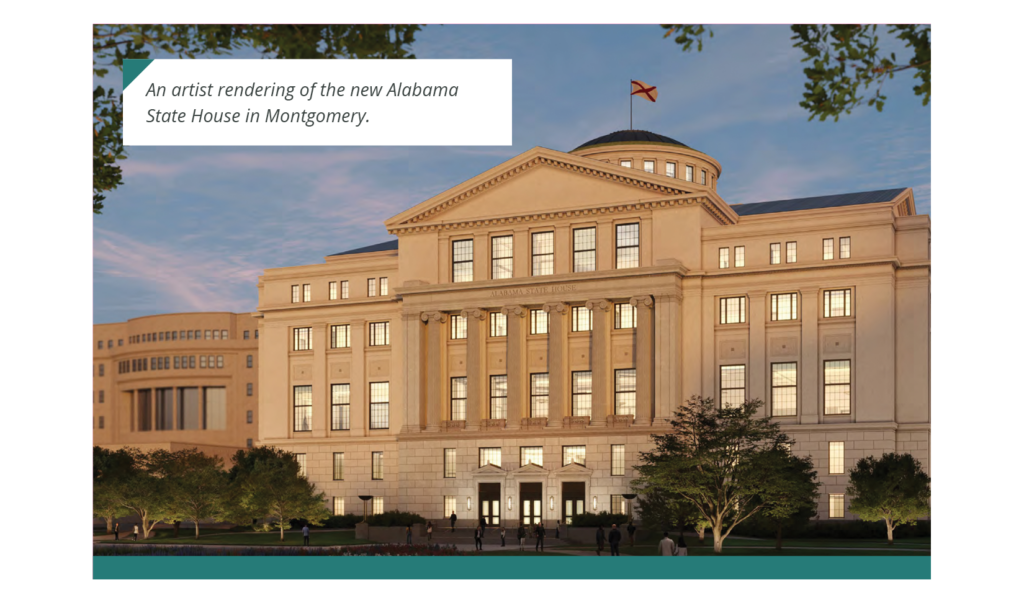
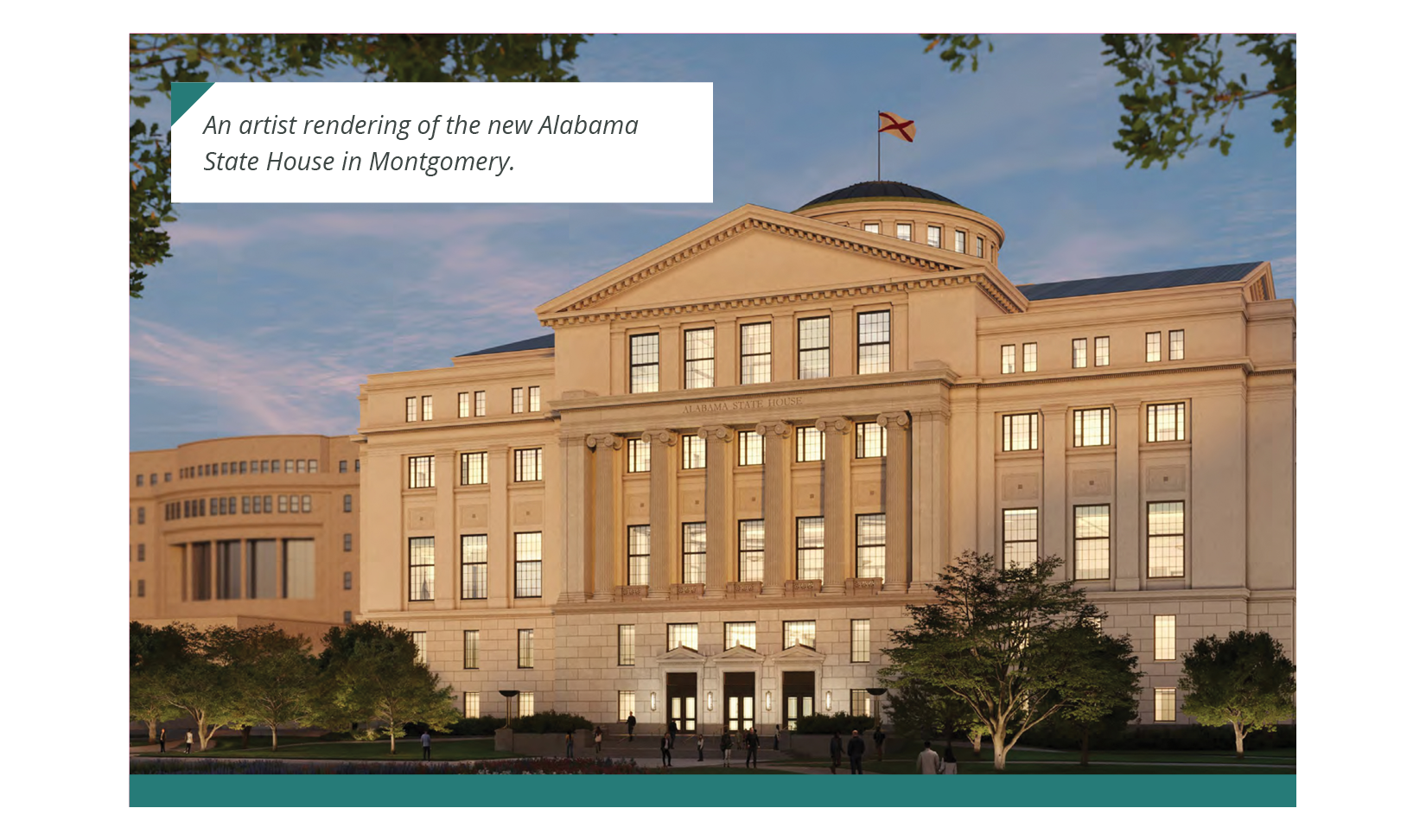
An artist rendering of the new Alabama State House in Montgomery.

Each year, the Legislature authorizes almost all state funding by passing two major pieces of legislation: the Education Trust Fund (ETF) Budget Act, which funds education-related services, and the General Fund (GF) Budget Act, which funds everything else the state does. (Lawmakers also pass several smaller budget bills annually.) Both major budgets include state tax revenues, as well as other state revenues like fines and fees and federal dollars. Each budget is divided into two parts: the smaller part controlled by the Legislature (discretionary funds) and the more significant part set aside by law for particular uses (earmarked funds). All federal funds are considered earmarked because the federal government, not the Legislature, decides where they can be spent. Because the Legislature must spend every dollar in the ETF on education-related programs, only the discretionary part of the General Fund budget is not earmarked.
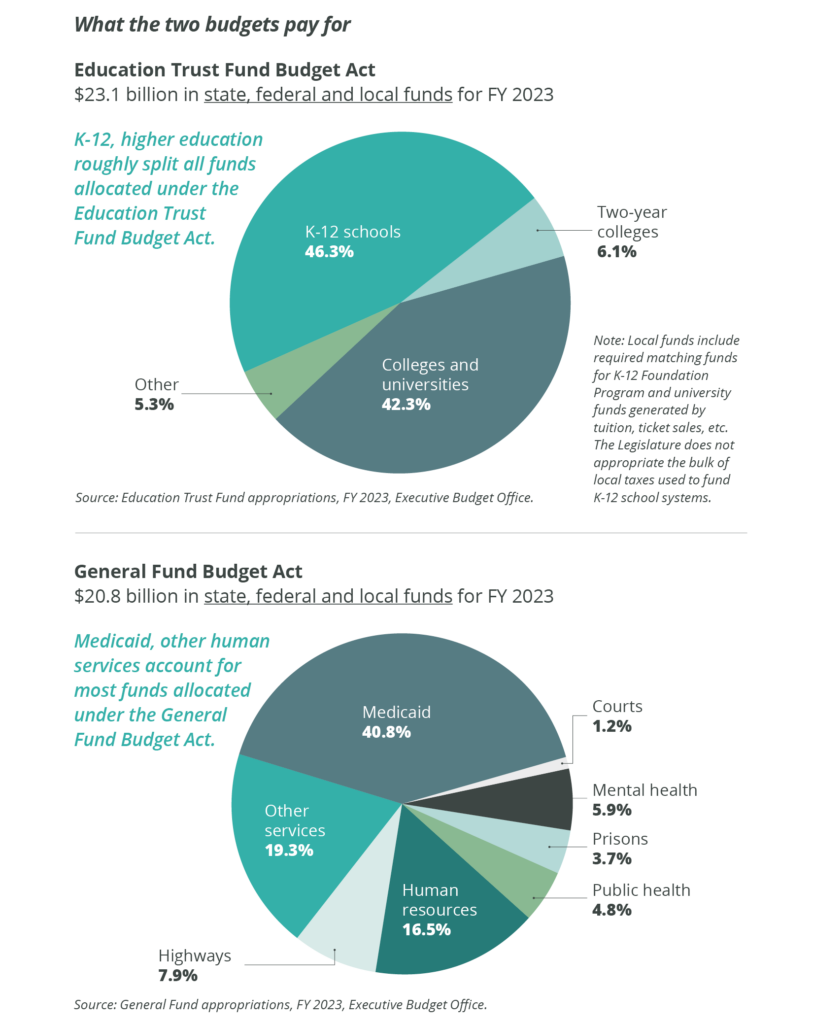
Two pie charts titled "What the two budgets pay for," detailing money used for the Education Trust Fund and the General Fund for FY 2023.
The first pie chart shows the Education Trust Fund Budget Act ($23.1 billion in state, federal and local funds). K-12 schools account for 46.3%. Colleges and universities account for 42.3%. Two-year colleges account for 6.1%. Other accounts for 5.3%. Note: Local funds include required matching funds for K-12 and university-generated funds, and the Legislature does not appropriate the bulk of local taxes used for K-12. Source: Education Trust Fund appropriations, FY 2023, Executive Budget Office.
The second pie chart shows the General Fund Budget Act ($20.8 billion in state, federal and local funds). Medicaid accounts for 40.8%. Other services account for 19.3%. Human resources account for 16.5%. Highways account for 7.9%. Mental health accounts for 5.9%. Public health accounts for 4.8%. Prisons account for 3.7%. Courts account for 1.2%. Source: General Fund appropriations, FY 2023, Executive Budget Office.

The annual Education Trust Fund Budget Act:

  • Provides financing for all state education spending.
  • Can be used only for education. Most funds are earmarked for particular education expenses, but lawmakers have some discretion over the areas of education on which the rest is spent.
  • Often is referred to as simply the Education Trust Fund (ETF).

The annual General Fund Budget Act:

  • Provides financing for all non-education programs.
  • Primarily appropriates earmarked federal and state funds, including state gasoline tax revenues, which have been set aside for roads, bridges and traffic enforcement since 1952 under Amendment 93 of the state constitution.
  • Includes the only state revenues that are not earmarked at all.
  • Often is referred to as simply the General Fund (GF).
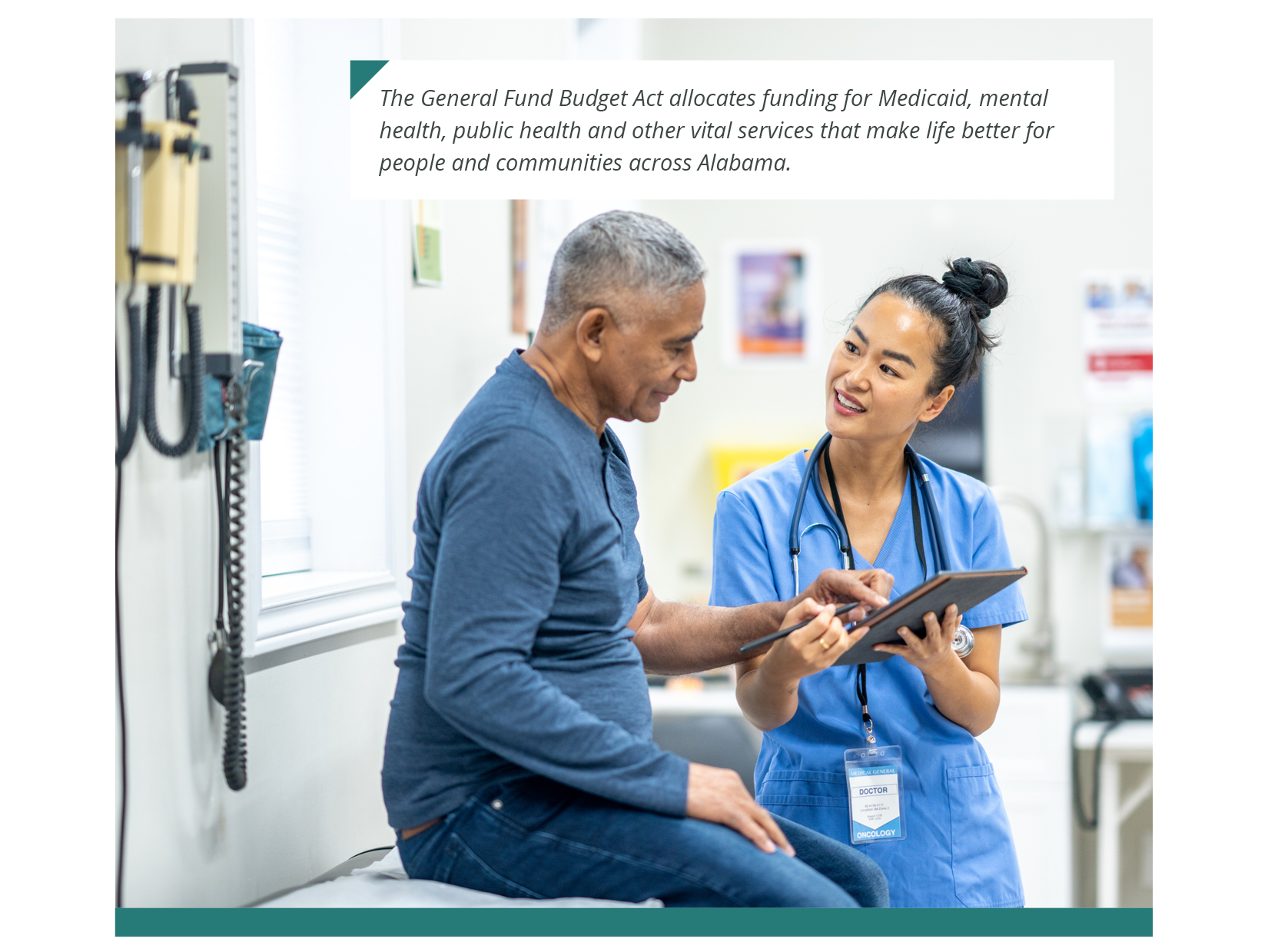
A seated man speaks with a nurse while she holds a tablet. Caption: The General Fund Budget Act allocates funding for Medicaid, mental health, public health and other vital services that make life better for people and communities across Alabama.

What state dollars pay for: Things that benefit all of us

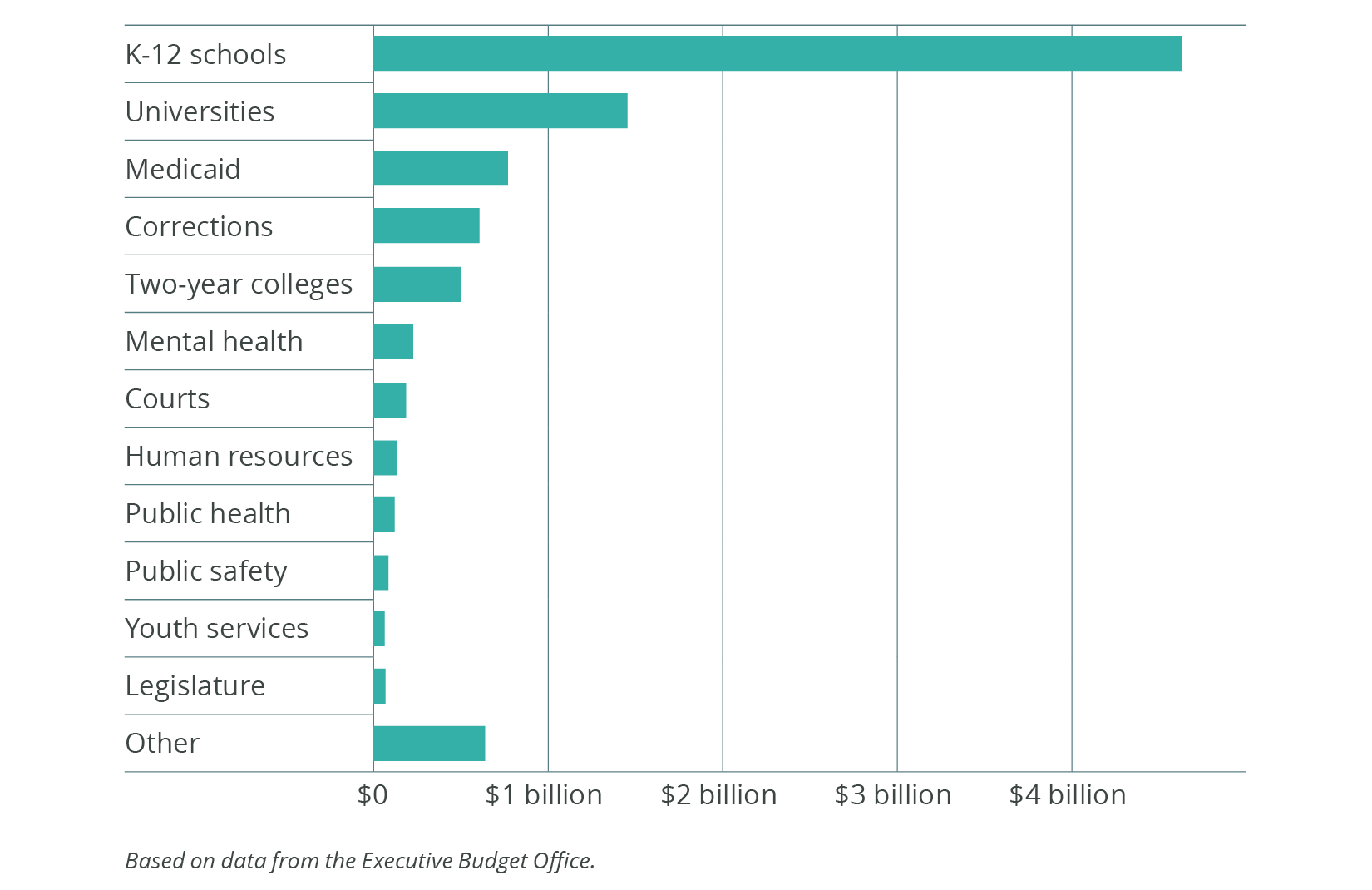
Education, health care, public safety and other vital services support economic growth and make our state a better place to live and work. Alabama spent $6.5 billion from the Education Trust Fund on K-12, colleges, universities and other education-related services in FY 2022. The same year, Alabama provided $2.2 billion in funding for Medicaid, mental health, courts and other non-education services from the General Fund. Of the total $8.8 billion, more than 75% of the funding went to K-12 schools and universities, easily exceeding the amount that went to Medicaid, corrections and other General Fund services. Here’s a look at what state dollars supported:
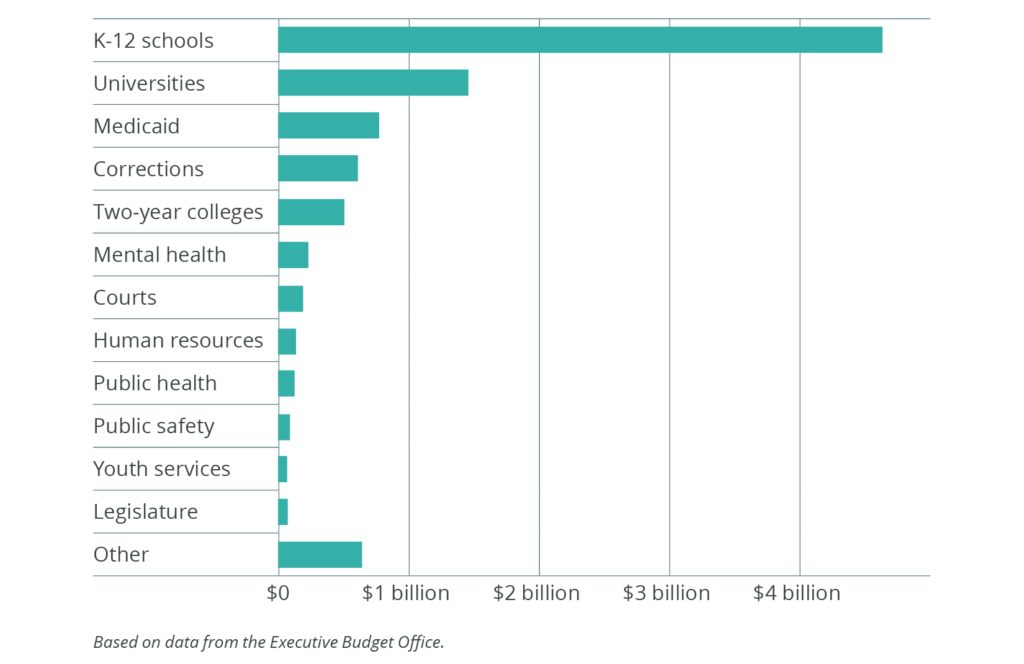
A horizontal bar graph showing state budget allocations across various categories. K-12 schools receive approximately $4.6 billion. Of the total $8.8 billion, more than 75% of the funding went to K-12 schools and universities, easily exceeding the amount that went to Medicaid, corrections and other General Fund services. Based on data from the Executive Budget Office.

In FY 2022, Alabama spent $6.5 billion from the Education Trust Fund, mostly on K-12 and higher education. This easily exceeded the amount that went to Medicaid, corrections and other vital services from the General Fund.

In passing the General Fund Budget Act each year, the Legislature is most concerned with the discretionary funds (dollars that are not earmarked) that make up what legislators call the General Fund (GF). Even though this money amounts to only a small portion of total GF Budget Act spending, it’s the portion that lawmakers are free to debate and divide up to help meet the state’s many competing needs. The Legislature seeks input from agency leaders and the general public in assessing these needs.

In most states, the Legislature has relatively wide latitude in deciding how to spend the money from state taxes. But Alabama lawmakers’ choices are much more limited. Over the years, Alabama voters have placed severe restrictions on how tax dollars are used by designating them (in constitutional amendments and statutes) for specific purposes. While this earmarking can help safeguard against misuse of state funds, it also can prevent legislators from creating a budget that adequately meets current needs for education, public health and other services that improve lives and build Alabama’s economy.

Tax expenditures reduce funding for essential needs

State tax incentives, tax credits and tax exemptions significantly affect state budgets by reducing the amount of money the Legislature can appropriate. These tax expenditures benefit specific companies, businesses or individuals and can total hundreds of millions of dollars annually. The Legislature routinely passes dozens of bills each year that exempt items such as farm supplies from sales taxes, direct tax credits to new and existing businesses, and create broad tax credits that reduce essential revenue.

One example of a tax credit with a significant budget impact is the CHOOSE Act, enacted in 2024. The law provides eligible parents with up to $7,000 per child each year for private schools and up to $2,000 per child each year for homeschooling. Those credits are available even for parents whose children never attended a public school. The CHOOSE Act will divert between $150 million and $200 million a year from public schools through 2027-28. That amount is enough to pay for up to 2,500 teachers every year. And the cost could grow in future years if lawmakers increase or remove the income cap for eligibility.

Earmarked vs. appropriated funds

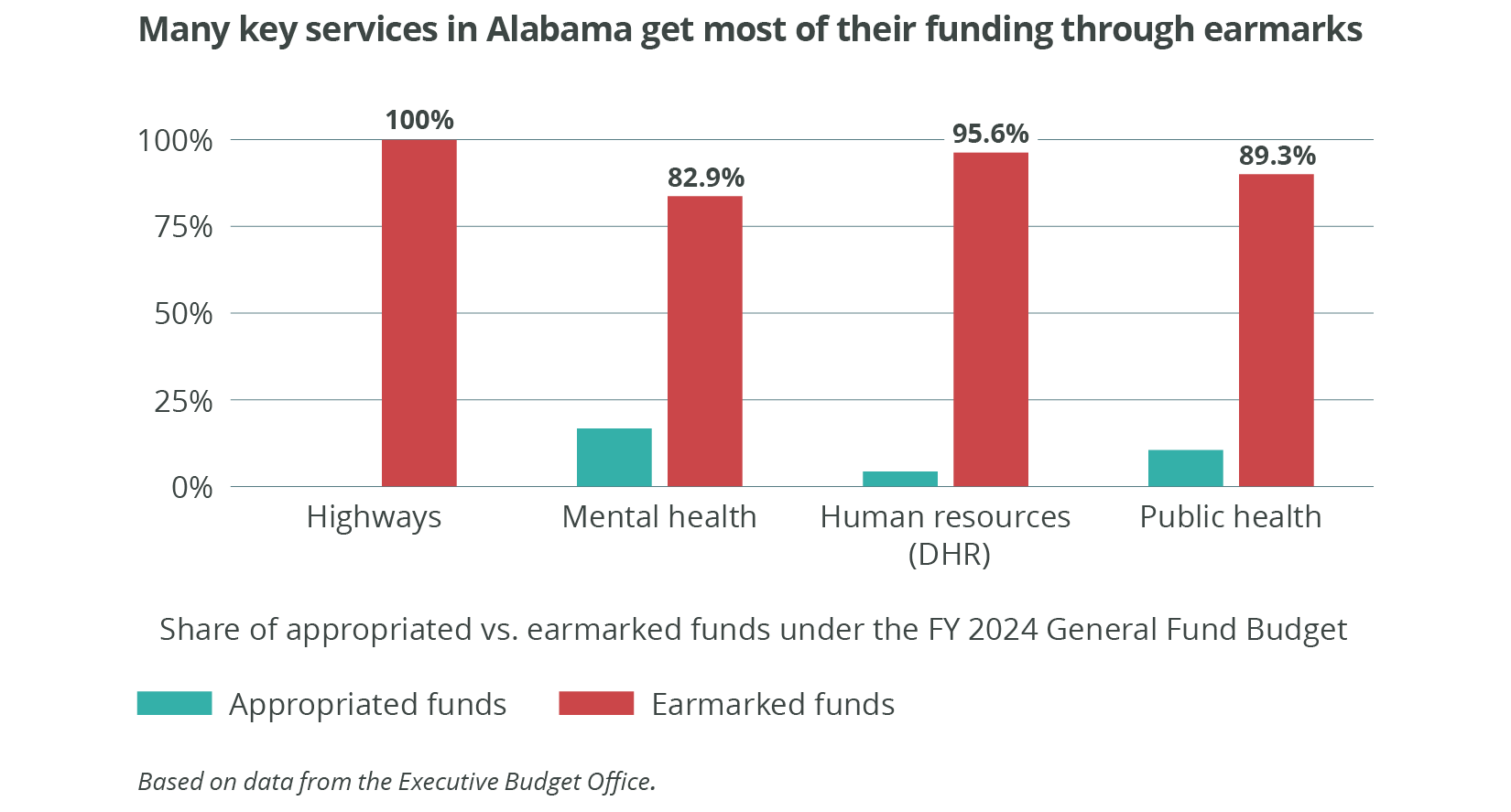
Some major agencies in Alabama depend significantly more on earmarked funds than on appropriations from the Legislature. This ensures stable funding for services, but it reduces the Legislature’s ability to create a budget meeting current needs.
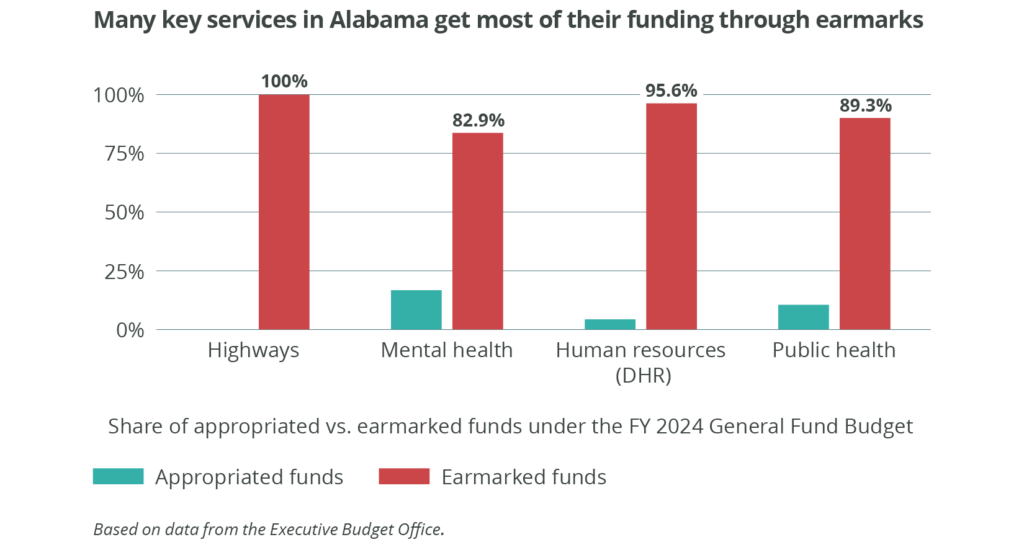
Bar graph titled "Many key services in Alabama get most of their funding through earmarks," showing the share of appropriated vs. earmarked funds under the FY 2024 General Fund Budget for four categories. For Highways, earmarked funds account for 100% and appropriated funds account for 0%. For Mental health, earmarked funds account for 82.9% and appropriated funds account for 17.1%. For Human resources (DHR), earmarked funds account for 95.6% and appropriated funds account for 4.4%. For Public health, earmarked funds account for 89.3% and appropriated funds account for 10.7%. Based on data from the Executive Budget Office.

When revenues fall below the amount needed to maintain services, the state must choose from a short list of options: Find one-time revenue sources, tap reserve funds, cut services or raise taxes. The state constitution prohibits Alabama from using money in any earmarked account to pay for other services. (Imagine not being able to use the money you budgeted for a birthday party to have a leaky roof repaired!) Alabama does have several “rainy day” reserve funds that have helped prevent proration, or mid-year service cuts, during the last decade. The most significant of these came in the Rolling Reserve Act, which was passed in 2011 and revised several times since. The law caps annual education spending and moves any remaining funds into reserve accounts and an account that can be used for non-recurring expenditures.

Most other states have much more flexibility in allocating spending for different programs. Reducing earmarking would make Alabama’s budgets more responsive to changing needs and priorities. But most earmarking changes would require amending the constitution or writing a new one. Constitutional amendments require voter approval, which may be difficult to get because many voters support earmarking as a check on legislative power.

Racial inequity at a glance

Photo of five children inside a classroom.

Alabama’s seven constitutions have recognized the importance of public education and, until 1955, encouraged education. Following the U.S. Supreme Court’s landmark Brown v. Board of Education decision, however, Alabama revised its constitution to say that “nothing in this Constitution shall be construed as creating or recognizing any right to education or training at public expense.” This was a direct act of defiance intended to maintain a racial hierarchy and the vestiges of white supremacy in Alabama. Though courts ruled school segregation unconstitutional, subsequent cases have failed to establish a clear right to equitable education funding throughout the state. Education funding in Alabama still varies widely based on the wealth, and racial makeup, of local communities – especially when it comes to revenues from local property taxes.
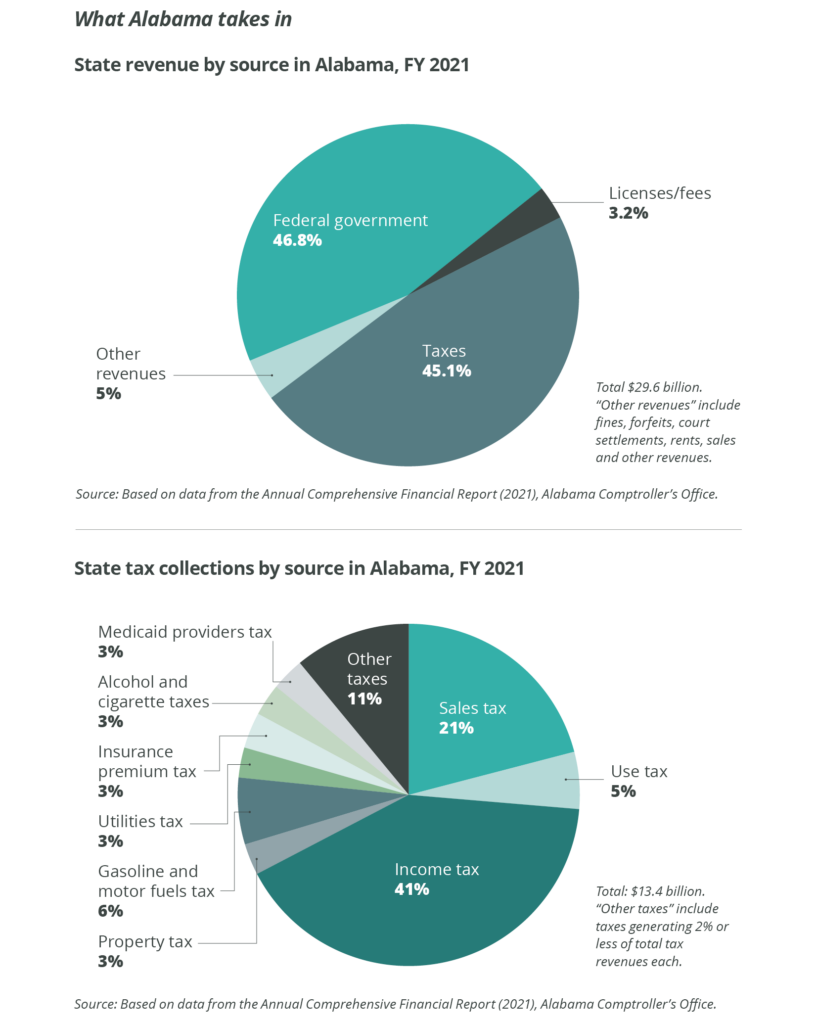
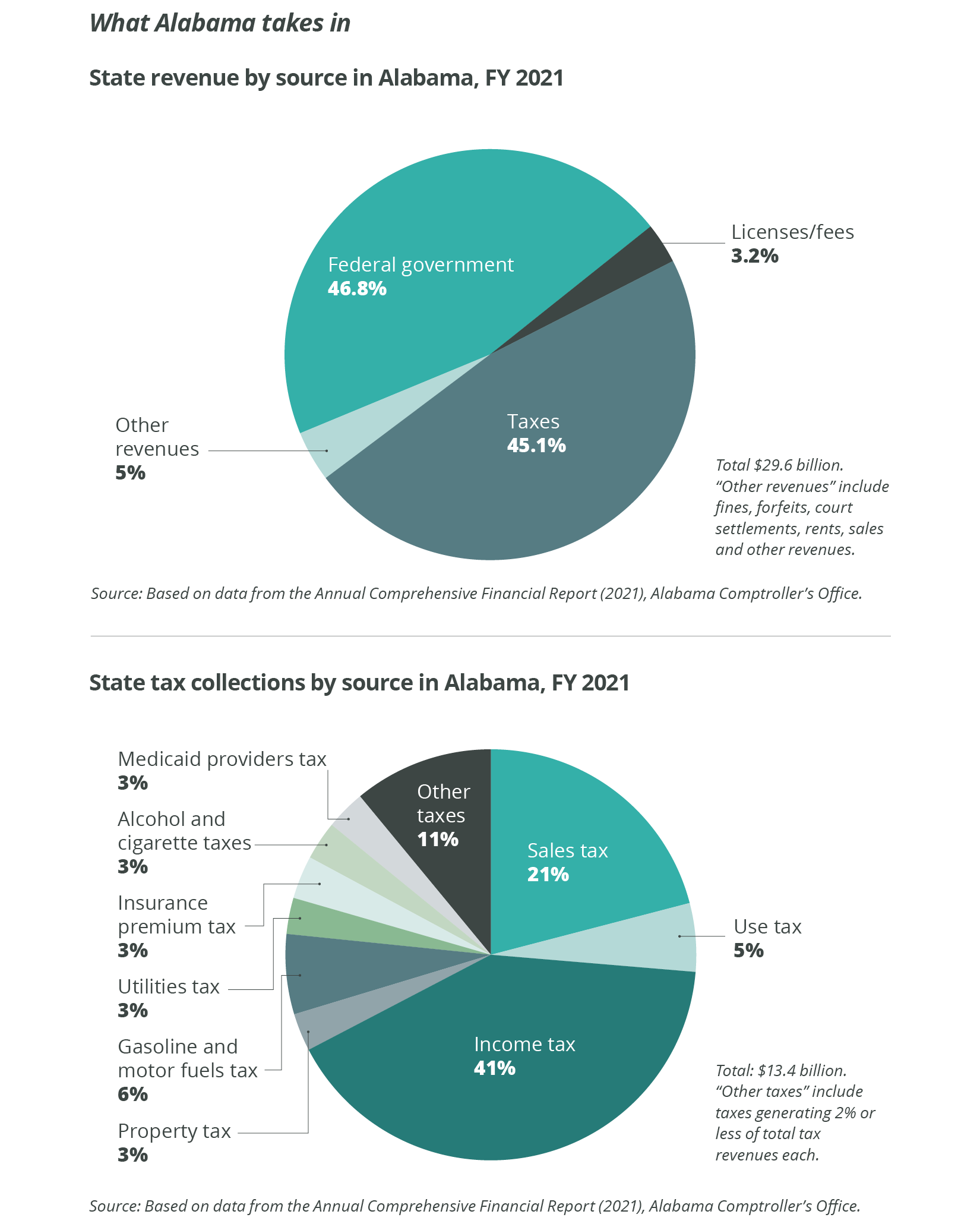
Two pie charts titled "What Alabama takes in," detailing state revenue and tax collections for FY 2021.
The first pie chart shows "State revenue by source in Alabama, FY 2021" (Total $29.6 billion). Federal government accounts for 46.8%. Taxes account for 45.1%. Other revenues account for 5%. Licenses/fees account for 3.2%. Note: "Other revenues" include fines, forfeits, court settlements, rents, and sales. Source: Based on data from the Annual Comprehensive Financial Report (2021), Alabama Comptroller's Office.
The second pie chart shows "State tax collections by source in Alabama, FY 2021" (Total $13.4 billion). Income tax accounts for 41%. Sales tax accounts for 21%. Other taxes account for 11%. Gasoline and motor fuels tax account for 6%. Use tax accounts for 5%. Medicaid providers tax, Alcohol and cigarette taxes, Insurance premium tax, Utilities tax, and Property tax each account for 3%. Note: "Other taxes" include those generating 2% or less of total tax revenues. Source: Based on data from the Annual Comprehensive Financial Report (2021), Alabama Comptroller's Office.

Where does the state get its money?

  1. From us – More than half of all the money Alabama takes in every year comes from taxes and fees that individuals and businesses pay. The lower graph on in the image above shows the share of this revenue that each state tax garners. (Note: The graph does not include local tax revenues, which in recent years have equaled a little less than half of the amount collected by the state. In Alabama, as in most other states, the property tax is mainly a local tax.) For a look at how state taxes work, see the image below.
  2. From the federal government – More than 45% of Alabama’s budget dollars ($2.25 of every $5 the state spends) comes from Washington, D.C. This is higher than in most other states. On average, states receive 35% of their budgets from the federal government. (Worth noting: During the COVID-19 pandemic, states witnessed an increase in federal financial support. Historically, only about one-fourth to one-third of states’ budgets have come from the federal government.) These are dollars that the federal government provides to help the state support basic services like education, health care and transportation. Most federal grants require a state contribution: When Alabama spends a certain amount on a particular area, the federal government will provide “matching” funds. The more the state spends, the bigger the federal match (up to a point).

Because Alabama’s state spending is so low, we often contribute little more than the minimum amount necessary to receive federal matching funds. In some areas, we forfeit the federal match altogether by failing to provide a state match. Most other states take better advantage of the match by contributing more state dollars to federally supported programs. A prime example: Alabama is one of only two states providing no state money for public transportation. That means our state forfeits tens of millions of federal dollars every year. It’s money that could support buses, trains, ride-sharing services and other efforts to help thousands of families stay connected. Even a modest state investment would help Alabama draw down tens of millions of federal dollars to help families get to work, the doctor’s office or wherever else they need to go.

Because Alabama’s state spending is so low, we often contribute little more than the minimum amount necessary to receive federal matching funds.
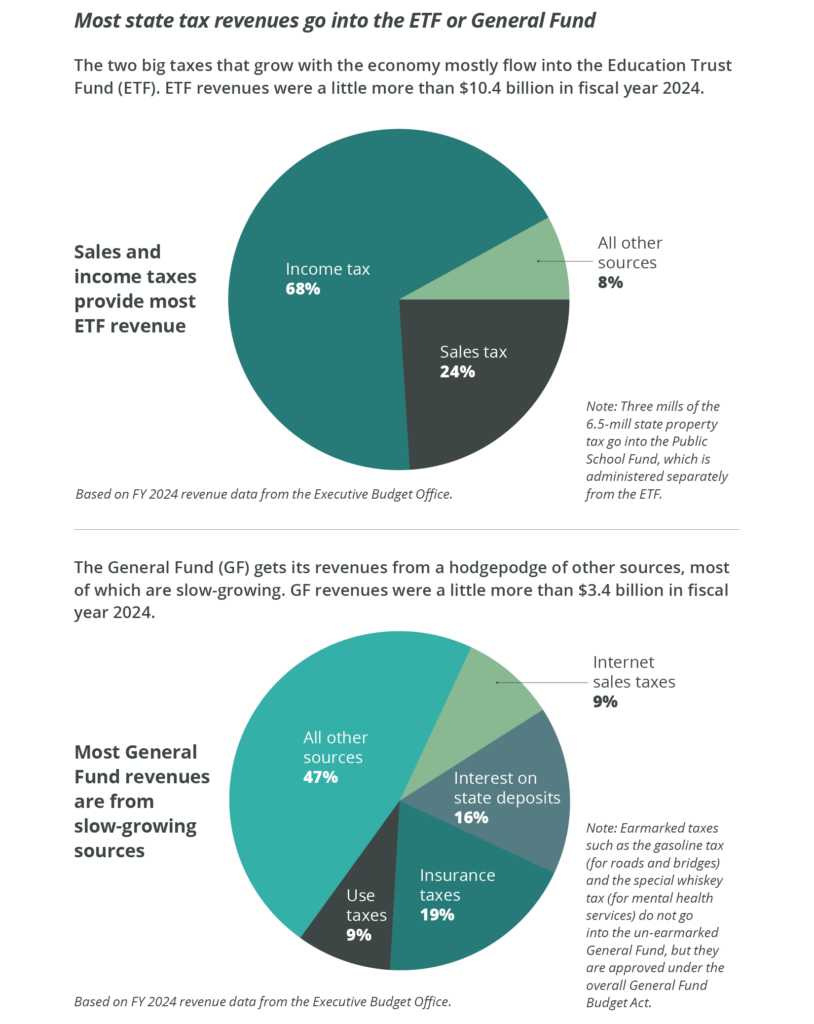
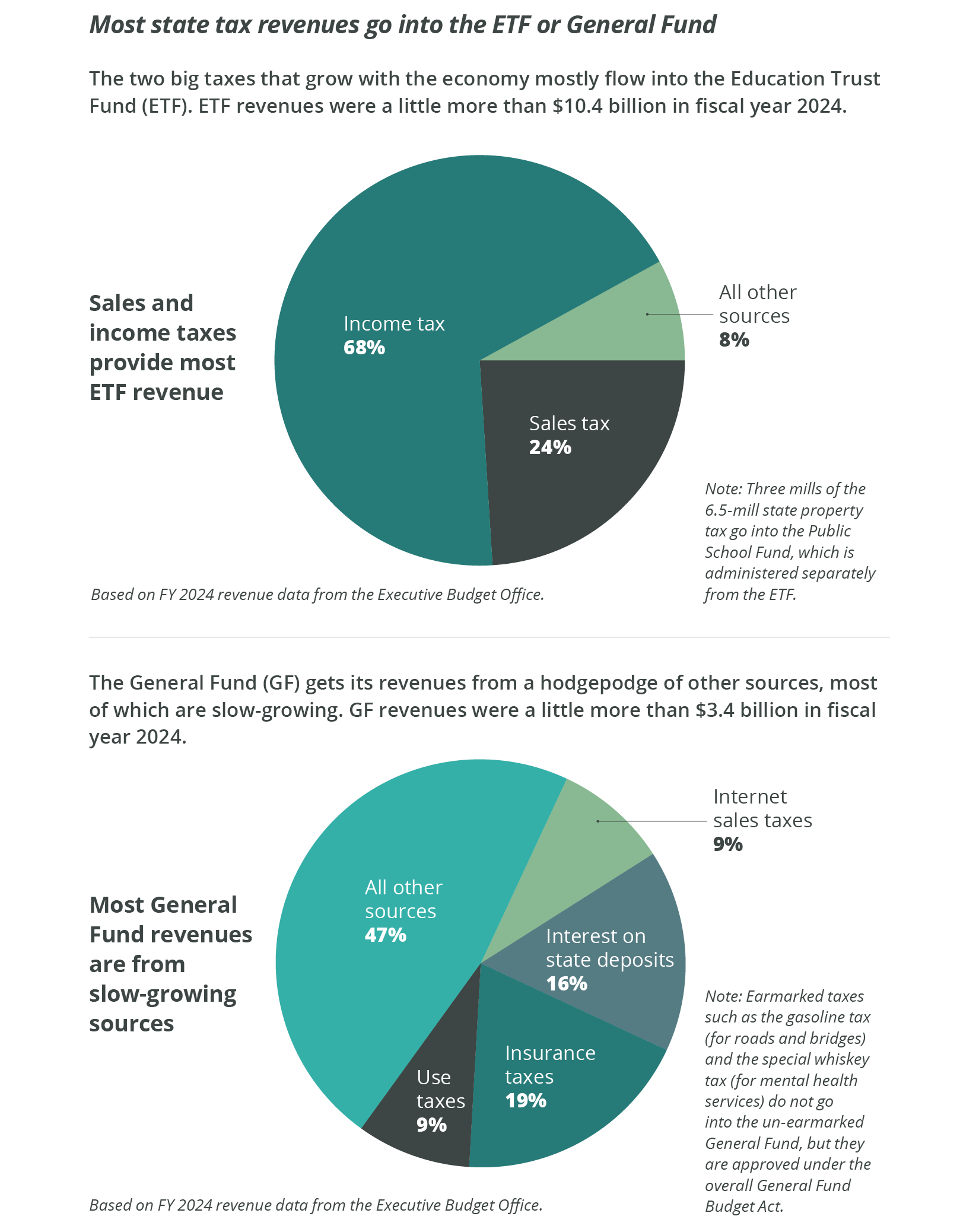
Two pie charts titled "Most state tax revenues go into the ETF or General Fund," detailing revenue sources for the Education Trust Fund (ETF) and the General Fund (GF) for fiscal year 2024.
The first pie chart shows revenue for the Education Trust Fund (ETF), which totaled a little more than $10.4 billion. Income tax accounts for 68%. Sales tax accounts for 24%. All other sources account for 8%. Note: Three mills of the 6.5-mill state property tax go into the Public School Fund, which is administered separately from the ETF. Based on FY 2024 revenue data from the Executive Budget Office.
The second pie chart shows revenue for the General Fund (GF), which totaled a little more than $3.4 billion. All other sources account for 47%. Insurance taxes account for 19%. Interest on state deposits accounts for 16%. Internet sales taxes account for 9%. Use taxes account for 9%. Note: Earmarked taxes, such as gasoline and special whiskey taxes, do not go into the un-earmarked General Fund but are approved under the overall General Fund Budget Act. Based on FY 2024 revenue data from the Executive Budget Office.

In Alabama, some state programs and services have more adequate funding than others, and some years have more adequate funding than others. Tax revenues that grow with the economy (major taxes on consumers and workers, such as sales taxes and income taxes) are largely earmarked for the ETF. This imbalance has improved in recent years because revenues from internet sales taxes (called the simplified sellers use tax) have increased, providing new “growth taxes” for the General Fund. In addition, post-pandemic revenue growth has allowed lawmakers to continue funding state services while enacting a one-time income tax rebate and a permanent reduction in the state sales tax on groceries. These revenue increases may not be sustainable in the long term, however, and income taxes and most state sales taxes remain earmarked for education.

Other state services under the GF continue to get the leftovers – an assortment of minor taxes, interest and fees, many on businesses, that often grow at a sluggish rate. The slow growth keeps services like Medicaid and corrections permanently shortchanged as costs continue to grow. There’s also a disadvantage to the ETF’s reliance on sales and income taxes: In bad years, they can shrink. Many states, including Alabama, set aside money in good years in a rainy day fund to help them in bad years.

Alabama has created rainy day funds by drawing from the Alabama Trust Fund – which gets revenue from offshore oil and gas drilling – and by using money that exceeds the ETF spending cap under the Rolling Reserve Act for school infrastructure and one-time expenses like buses and textbooks. Alabama also has established a Budget Stabilization Fund in the ETF where revenues in excess of the appropriation cap are transferred and a General Fund Budget Reserve Fund in which up to $100 million can be deposited to prevent proration. In 2023, the Legislature created a new education reserve fund called the Educational Opportunities Reserve Fund.

Despite these improvements, Alabama’s inadequate budgets for core services point to a deeper problem that can’t be fixed easily: The state doesn’t have enough money each year to support state services adequately or to expand services to meet a growing population or address new needs. This built-in shortfall is called a structural deficit. A more adequate tax system would bring in enough stable revenue to help prevent shortfalls and give legislators more leeway to respond when they occur.

The structural deficit shows how our state’s fiscal system has failed to keep up with changing times. In the budget crisis of 1933, the Legislature began dealing with revenue shortfalls by using proration, or cutting current spending (except for teacher and state employee salaries) across the board. By requiring the governor to use proration to avoid deficit spending, the law spares legislators from making tough decisions on which services should bear the brunt of cuts. For schools, though, the effect can be dramatic: Ordered in June to cut $10 million in spending for a budget year that ends Sept. 30, a system may be forced to choose between replacing worn-out roofs or replacing old math books. Alabama has used proration 18 times since 1975 but has not had to prorate the education budget since the Rolling Reserve Act was passed in 2011. However, the state had to borrow from the Alabama Trust Fund during recent difficult budget years and had to draw money from the ETF Budget Stabilization Fund during the pandemic recession.

Racial inequity at a glance

Alabama’s funding of our court system relies heavily on money collected from the users of the system. These fees include civil and criminal court costs charged against people – disproportionately Black – caught in the legal system. Some of these court costs are sent to the state General Fund (GF) and help fund local courts and related agencies. In 2022, Alabama’s state court cost collections were more than $60 million. While the exact appropriation of these fees is unclear, the $60 million collected equaled 28% of the GF appropriation to Alabama’s trial courts.

This heavy reliance on court costs to support the justice system negatively impacts the state. It encourages law enforcement and courts to focus on collecting revenue to support their operations. People of color and people with low incomes are disproportionately caught up in the justice system, in large part due to overpolicing in these communities (rather than either group committing crimes at rates higher than their counterparts). As a result, the weight of funding our courts falls heaviest on the people least able to pay. A 2018 study by Alabama Appleseed found that more than 80% of people surveyed gave up necessities like rent, food, medical bills and child support to meet their court debt.

The Alabama state budget process

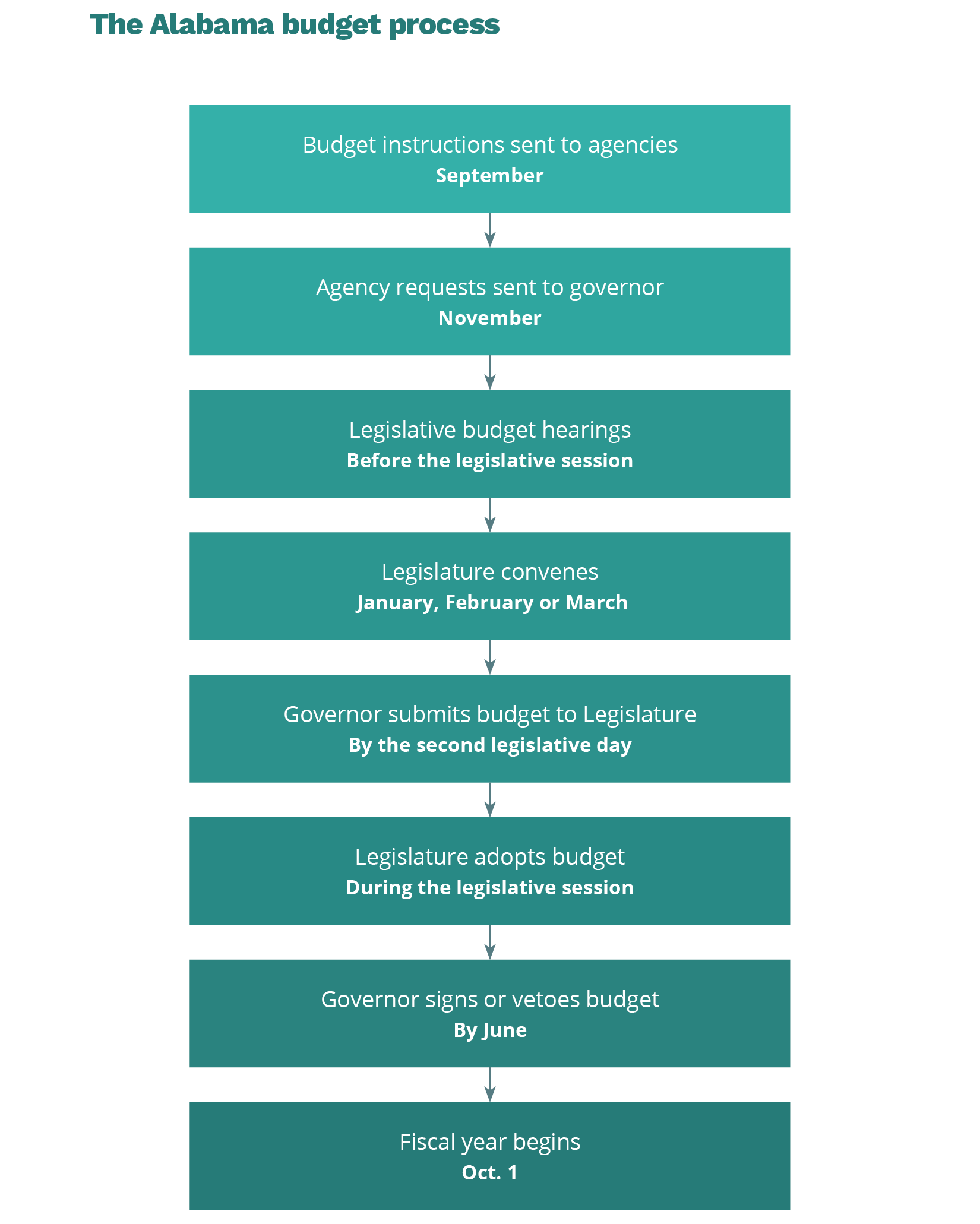
Each year, the governor prepares a financial plan and introduces two major budget bills: a General Fund (GF) bill and an Education Trust Fund (ETF) bill. In the plan, the governor outlines budget priorities, revenue projections and updates on the past fiscal year, which runs from Oct. 1 to Sept. 30. The governor drafts the plan after considering each state agency’s programmatic and financial objectives. The plan also includes recommended revenue measures to ensure a balanced budget. The governor must present a proposed budget to the Legislature on or before the second legislative day of each regular session of the Legislature.

After receiving the governor’s budget proposal, the Legislature:

  • Considers the governor’s recommended plan.
  • Adopts alternatives or revisions to the governor’s plan.
  • Passes legislation to authorize budgets for the next fiscal year.

After the introduction of the governor’s plan, the Legislature has until the end of a regular session to pass the budgets. This period of approximately three months – a comparatively short timeframe for consideration and passage of the state’s multi-billion-dollar GF and education budgets – is the critical period for public comment on the state’s spending priorities. During a regular session, the Legislature meets (usually on Tuesdays and Thursdays) for a maximum of 30 meeting days during a period of 105 calendar days. If lawmakers fail to pass one or both of the budgets during the regular session, the governor may call the Legislature back for a special session.

Both the House and Senate have separate budget committees that review and vote on the ETF and GF budgets. These budget committees often make significant changes to the governor’s proposed budget. State agencies, the governor’s Department of Finance and the Legislative Services Agency (LSA)’s Fiscal Division appear before these subcommittees with reports and recommendations. These committee hearings are the one of the best times for Alabamians to voice their opinions. The committees most often meet on Wednesdays.
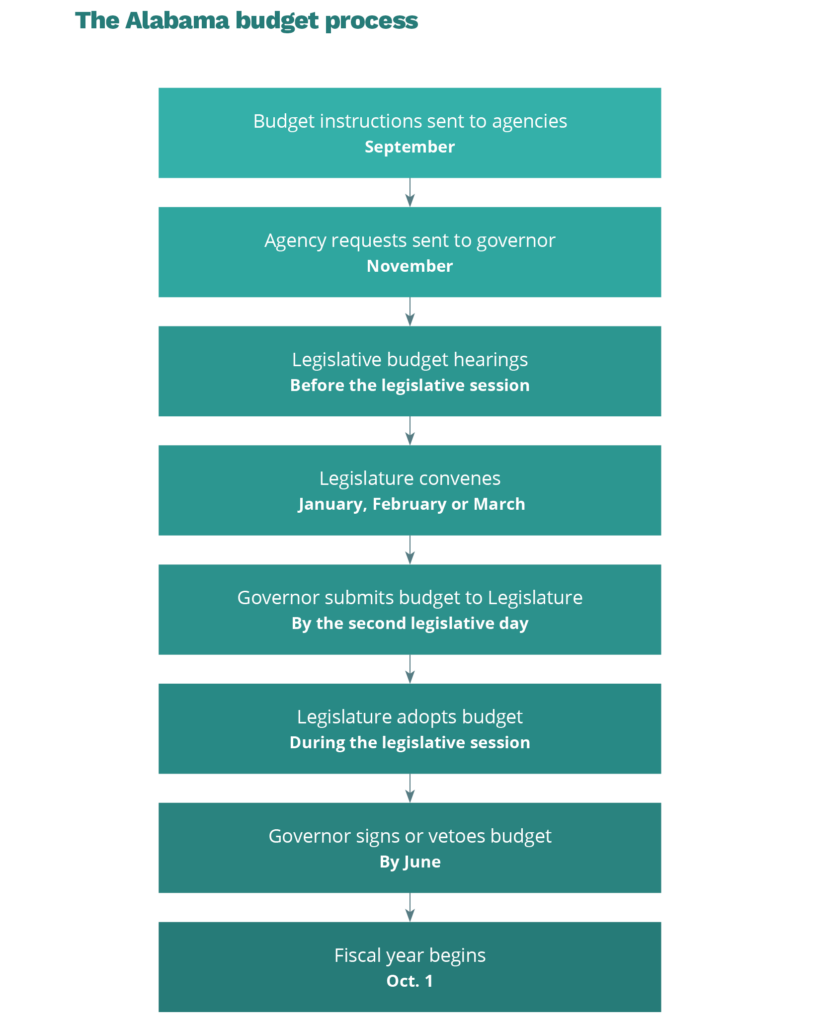
Flowchart titled "The Alabama budget process," outlining the timeline of the state's budgeting cycle. The timeline is as follows: Budget instructions sent to agencies: September. Agency requests sent to governor: November. Legislative budget hearings: Before the legislative session. Legislature convenes: January, February or March. Governor submits budget to Legislature: By the second legislative day. Legislature adopts budget: During the legislative session. Governor signs or vetoes budget: By June. Fiscal year begins: Oct. 1.

Alabamians can voice their opinions on the budgets by:

  • Calling their legislators’ district or Montgomery office number.
  • Writing a letter.
  • Meeting with their legislators or a member of their staff.
  • Sending an email.
  • Requesting a public hearing on a budget expenditure.
  • Testifying at a scheduled public hearing on a budget.

Each chamber discusses and votes on the budget bills separately. It is common practice for one major budget to “originate” in either the House or Senate and the other major budget to begin in the other chamber. The committees considering the budgets review the governor’s proposals and any changes approved by the other chamber. Then they make changes themselves and send revised budget bills (usually in the form of substitute bills) to the chamber floors for additional modification and votes. Usually there are differences between the budget bills passed by the House and by the Senate. In these cases, the bills often are referred to a joint committee (called a conference committee) where differences can be resolved. Each chamber then must approve the conference committee’s report before sending the final legislation to the governor for a signature, veto or executive amendment. If the governor signs the budget bill into law, or if the Legislature overrides the governor’s veto, the bill becomes an act.
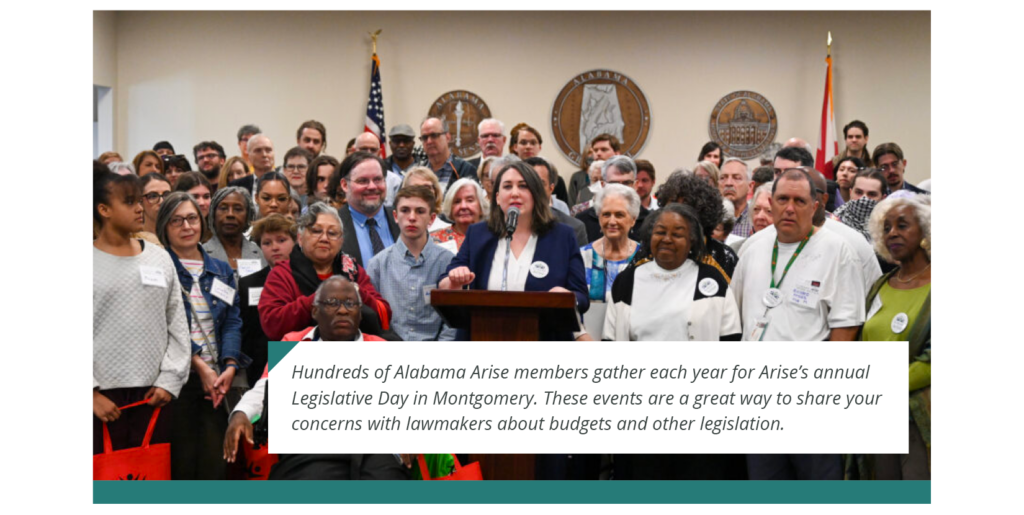
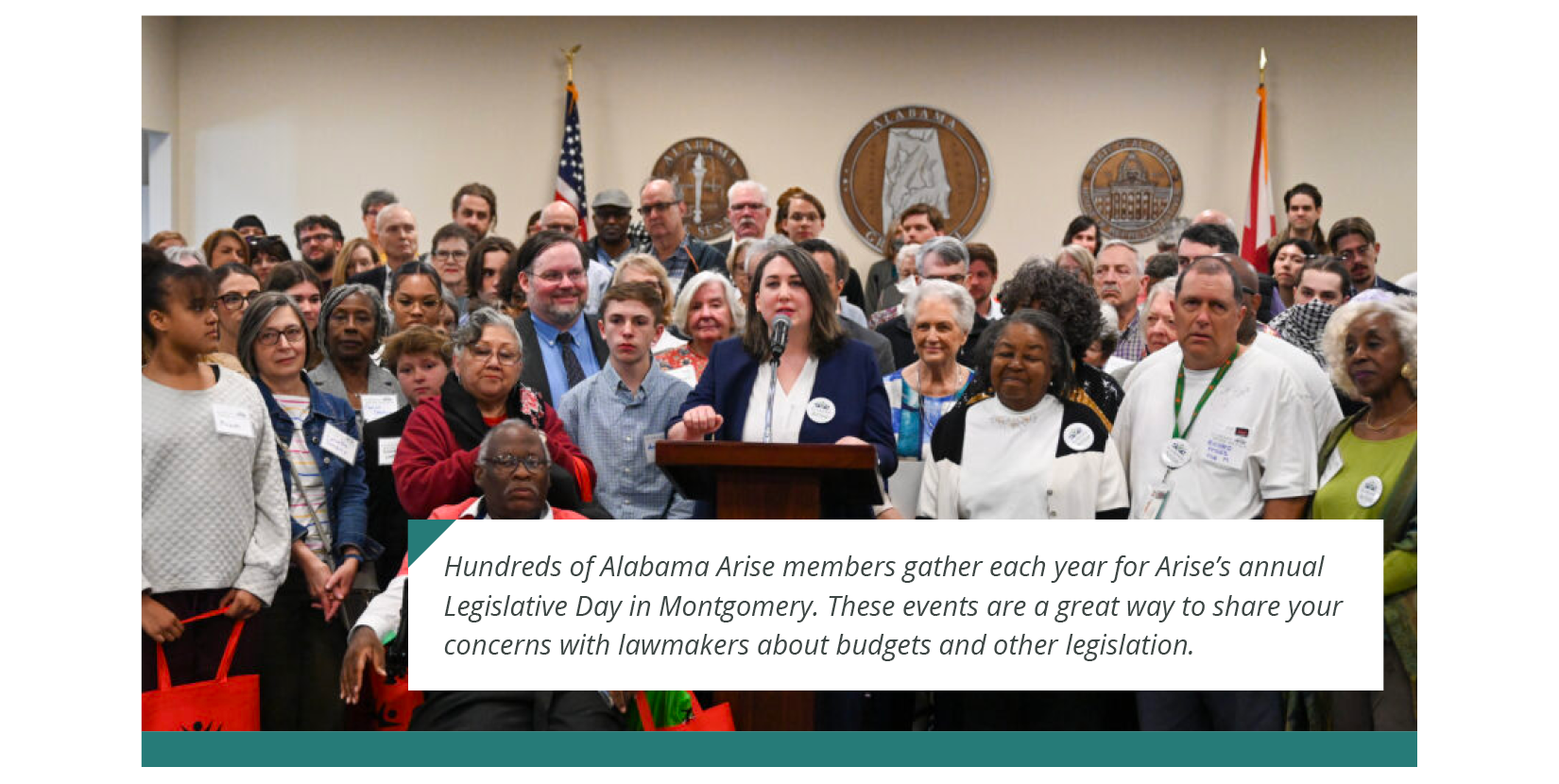
Alabama Arise advocates stand together during a news conference in the Alabama State House. Caption: Hundreds of Alabama Arise members gather each year for Arise's annual Legislative Day in Montgomery. These events are a great way to share your concerns with lawmakers about budgets and other legislation.

How could Alabama improve its budgeting process?

In 2014, the Center on Budget and Policy Priorities rated Alabama as “low” in using fiscal planning tools that could improve our budgeting process. While the analysis had some limits and the state has made some improvements since then, Alabama still fails to use many tools available in other states that could improve how we write our budgets. Some of the areas where Alabama could improve its budgeting process include:

  • Forecast revenues into the future. Alabama passes a future budget based, in large part, on revenues collected during the current budget year. State leaders often have a good idea of what economic conditions and revenues may look like in the next year but have no formal process to forecast revenues for several years. A more deliberate approach involving outside experts could help Alabama plan for future budgets and needed revenue.
  • Prepare fiscal notes with multiyear projections. Bills considered by the Legislature that will cost or save the state money must be accompanied by a fiscal note from the LSA describing the bill’s financial impact on the state. These fiscal notes, however, are often vague and limited in detail. More robust data would help lawmakers understand the financial implications of legislation they’re considering.
  • Get a stronger current-year baseline on services. Alabama’s budgets are based in part on requests prepared by state agencies and submitted to the governor each fall. These plans, however, are not readily available to the public and often lack detailed analysis of the cost of existing and anticipated services. Stronger and more specific estimates of the cost to extend current services into future years would help the governor and Legislature determine future revenue needs. In addition, greater transparency would allow Alabamians adequate time to weigh in, strengthening elected officials’ ability to ensure they are adequately responding to and funding the needs of the people.

In 2014, the Center on Budget and Policy Priorities rated Alabama as “low” in using fiscal planning tools that could improve our budgeting process.

  • Seek independent consensus revenue forecasts. The Executive Budget Office (EBO) prepares revenue forecasts for the governor, and the Legislative Services Agency’s Fiscal Division prepares them for the Legislature. In past years, these forecasts could diverge widely between the House and Senate. More recently, forecast differences between the LSA and EBO have been minor, and the two chambers generally agree on their revenue projections. But Alabama still should include outside, independent experts in their revenue estimates, such as experts from the state’s major universities. Including outside experts in the revenue forecasting process could make the process more objective and reduce politicization.
  • Enhance fiscal flexibility through gradual earmarking reform. Make Alabama’s budget process more agile and responsive to the state’s evolving needs and priorities by pursuing a measured approach to earmarking reform. Policymakers should seek to strike a balance between preserving the benefits of earmarking and providing the state’s budget with necessary adaptability. This approach could include doing the following:
    • Initiate a comprehensive review of Alabama’s existing earmarking practices. Identify programs and areas where earmarking can be gradually reduced or modified to allow for greater spending flexibility. This analysis should take into consideration both short-term budgetary requirements and long-term strategic goals.
    • Consider a phased approach to earmarking reform. Begin by identifying non-essential or outdated earmarks that can be modified without requiring constitutional amendments. This approach would allow for incremental changes that could lead to a more flexible budget over time.
    • Implement pilot projects to showcase the positive outcomes of earmarking reform in specific sectors. Highlighting the improved allocation efficiency, responsiveness to pressing issues and overall positive impact on the state’s well-being would be important steps toward broader reform.

The Alabama Tax and Budget Handbook

The Alabama Tax and Budget Handbook – Tax Overview

How do state taxes work?
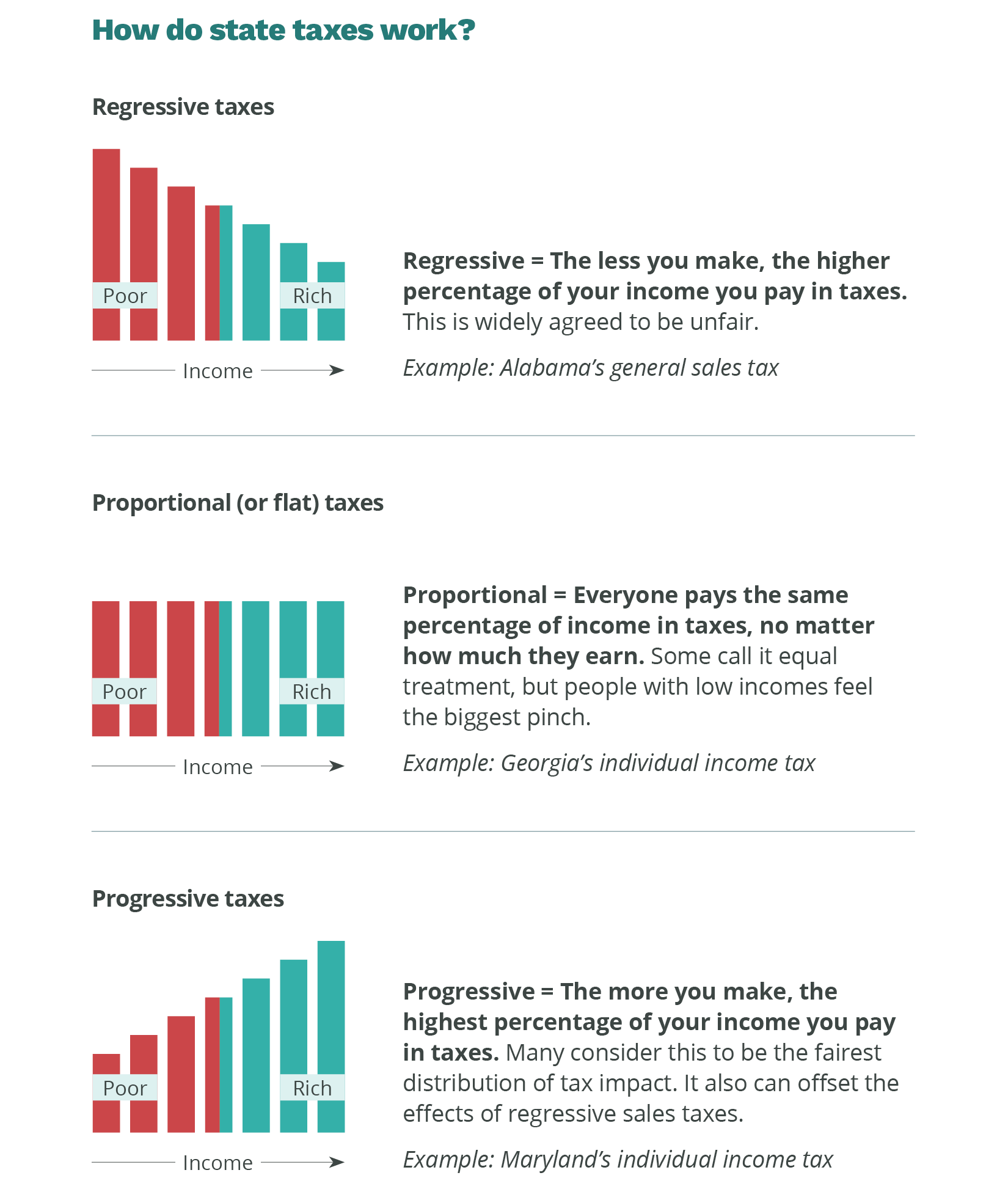
Graphics with sample bar graphs illustrating how three types of taxes work. Text for regressive taxes: Regressive = The less you make, the higher percentage of your income you pay in taxes. This is widely agreed to be unfair. An example is Alabama's general sales tax. Text for proportional (or flat) taxes: Proportional = Everyone pays the same percentage of income in taxes, no matter how much they earn. Some call it equal treatment, but people with low incomes feel the biggest pinch. An example is Georgia's individual income tax. Text for progressive taxes: Progressive = The more you make, the highest percentage of your income you pay in taxes. Many consider this to be the fairest distribution of tax impact. It also can offset the effects of regressive sales taxes. An example is Maryland's individual income tax.

Most people would consider a tax system to be unfair if those who earned less paid a higher percentage of their income in taxes than those who earned more. But that’s exactly how regressive taxes work.

As we’ve seen, Alabamians contribute to the funding of public services by paying taxes on their income, purchases, property and business operations. The next sections of this handbook will explain the basic principles of tax policy and examine the nuts and bolts of Alabama taxes.

Most people probably would agree that taxes should be “fair.” But what does tax fairness look like? From the vantage point of our own individual budgets, fairness may seem to be “lower taxes for me.” From the vantage point of the common good, however, economists have developed some basic tools for measuring tax fairness.

The charts on above illustrate three ways that any given tax can affect the total pool of taxpayers:

  • A regressive tax requires people who make less money to pay a bigger share of their income than people who make more.
  • A proportional tax (or flat tax) requires the same percentage of income from everyone, regardless of how much they earn.
  • A progressive tax requires people who make more money to pay a bigger share of their income than those who make less.

Most people would consider a tax system to be unfair if those who earned less paid a higher percentage of their income in taxes than those who earned more. But that’s exactly how regressive taxes work. They reduce the standard of living of families with low and middle incomes, while affluent families are not similarly affected. The sales tax is a regressive tax, because people with low incomes spend most of their income on goods that are taxed. Property taxes also are often regressive, especially in areas where home values are increasing more rapidly than incomes for the lowest-paid workers. Alabama’s regressive tax system taxes families with low incomes deeper into poverty, while demanding less of wealthy people, who have enjoyed the vast majority of the state’s income growth in recent decades.

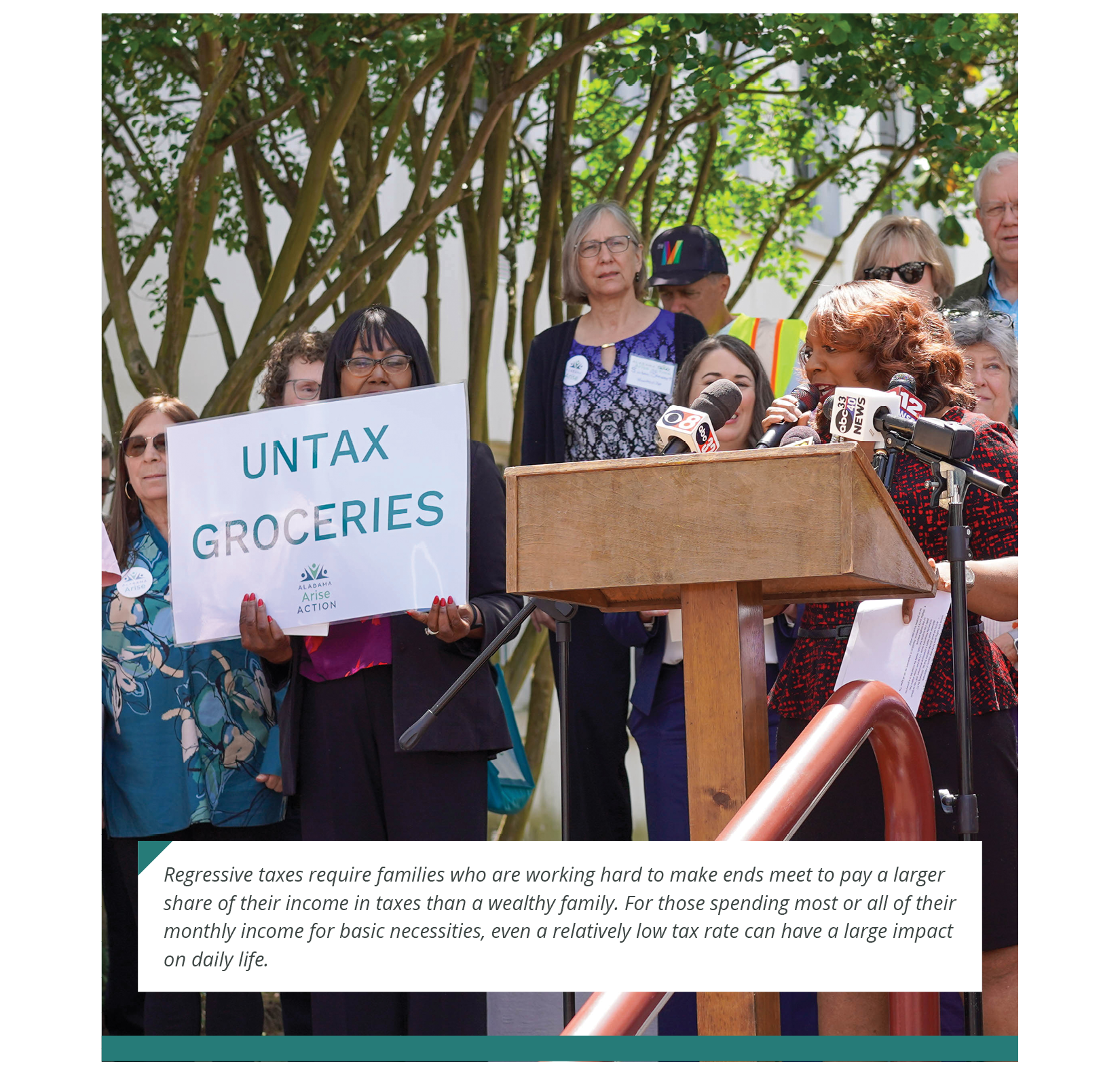
Photo of a woman holding an "Untax Groceries" sign during an Arise news conference outside the Alabama State House. Caption: Regressive taxes require families who are working hard to make ends meet to pay a larger share of their income in taxes than a wealthy family. For those spending most or all of their monthly income for basic necessities, even a relatively low tax rate can have a large impact on daily life.

Proportional taxes also are inequitable in practice. Requiring families who are working hard to make ends meet to pay the same share of their income in taxes as a wealthy family results in vastly different consequences for each. For those who must spend most or all of their monthly income for basic necessities, even a relatively low tax rate can have a large impact on daily life. For wealthier taxpayers with more discretionary income, however, a tax at the same percentage will not have the same impact. Alabama’s income tax is close to proportional.

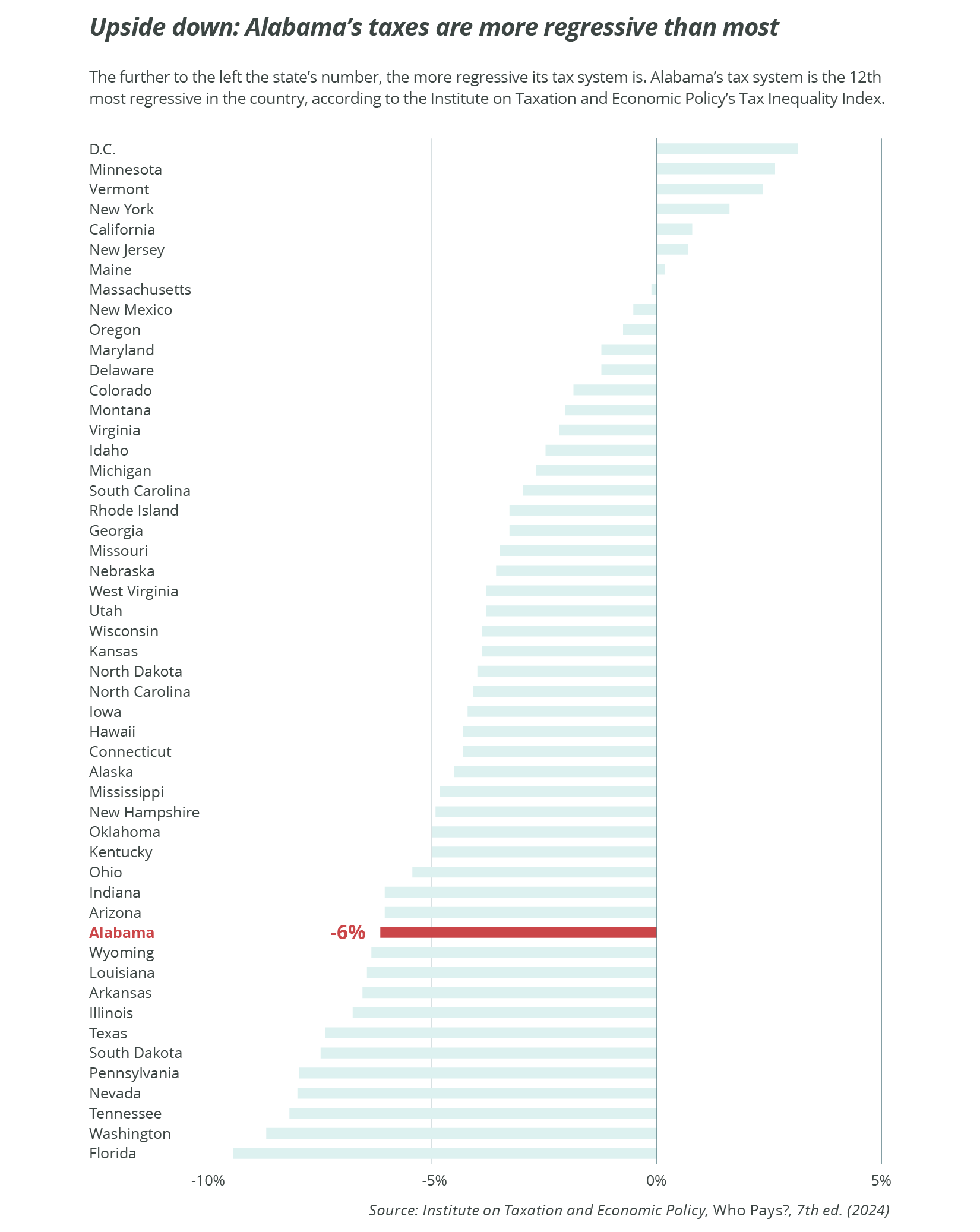
Horizontal bar graph titled "Upside down: Alabama’s taxes are more regressive than most," showing the Tax Inequality Index for various states and D.C. Alabama’s tax system is highlighted in red with a value of -6%, indicating it is the 12th most regressive in the country.


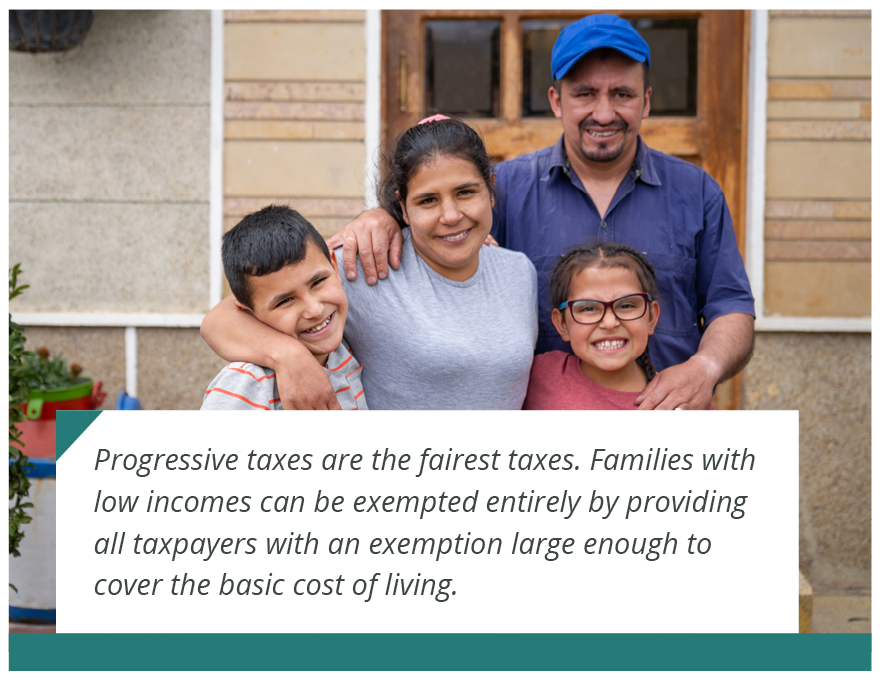
Progressive taxes are the fairest taxes. Families with low incomes can be exempted entirely by providing all taxpayers with an exemption large enough to cover the basic cost of living. Tax rates also can be graduated – meaning they rise along with income – so that families at middle and high incomes pay taxes fairly related to what they can afford. At both the state and federal levels, personal income taxes can be, and typically are, designed to be progressive taxes.

All state tax systems are different. But government leaders, economists and advocacy groups have identified several principles that mark a healthy tax system:

  • Fairness – Does the tax system require people to contribute to the cost of public services on the basis of their ability to pay?
  • Adequacy – Does the tax system raise enough money, in the short term and the long term, to finance needed public services? Does earmarking prevent revenues from being spent as needed?
  • Simplicity – Does the tax system have confusing tax loopholes? Is it easy to understand how our state’s taxes work and to file a basic income tax return?
  • Transparency – Is information about the tax system readily available to the public? Can taxpayers see that all businesses and individuals pay a fair share?

A smiling two-parent family of four stands outside their home. Caption: Progressive taxes are the fairest taxes. Families with low incomes can be exempted entirely by providing all taxpayers with an exemption large enough to cover the basic cost of living.

By these measures, what kind of health rating does Alabama’s tax system deserve? Read on to find out how our tax system compares to those of other states and how each tax affects the whole system. Spoiler alert: We have a lot of work to do.

How does Alabama’s tax system measure up?

Vertical bar graph and detailed data table titled "The less you make, the more you pay: Alabama state and local taxes," illustrating state and local taxes as a share of family income across different income ranges.
The bar graph shows the following total tax burdens:
* Lowest 20% (Less than $19,500): 11.9%
* Second 20% ($19,500 to $35,600): 11.5%
* Middle 20% ($35,600 to $64,400): 10.5%
* Fourth 20% ($64,400 to $123,800): 9.3%
* Next 15% ($123,800 to $221,500): 8.4%
* Next 4% ($221,500 to $484,300): 6.7%
* Top 1% (Over $484,300): 5.4%
The accompanying table breaks down these totals by tax type for each group:
* Sales & Excise Taxes: Ranges from 7.2% for the Lowest 20% down to 1.3% for the Top 1%.
* Property Taxes: Ranges from 2.5% for the Lowest 20% down to 1% for the Top 1%.
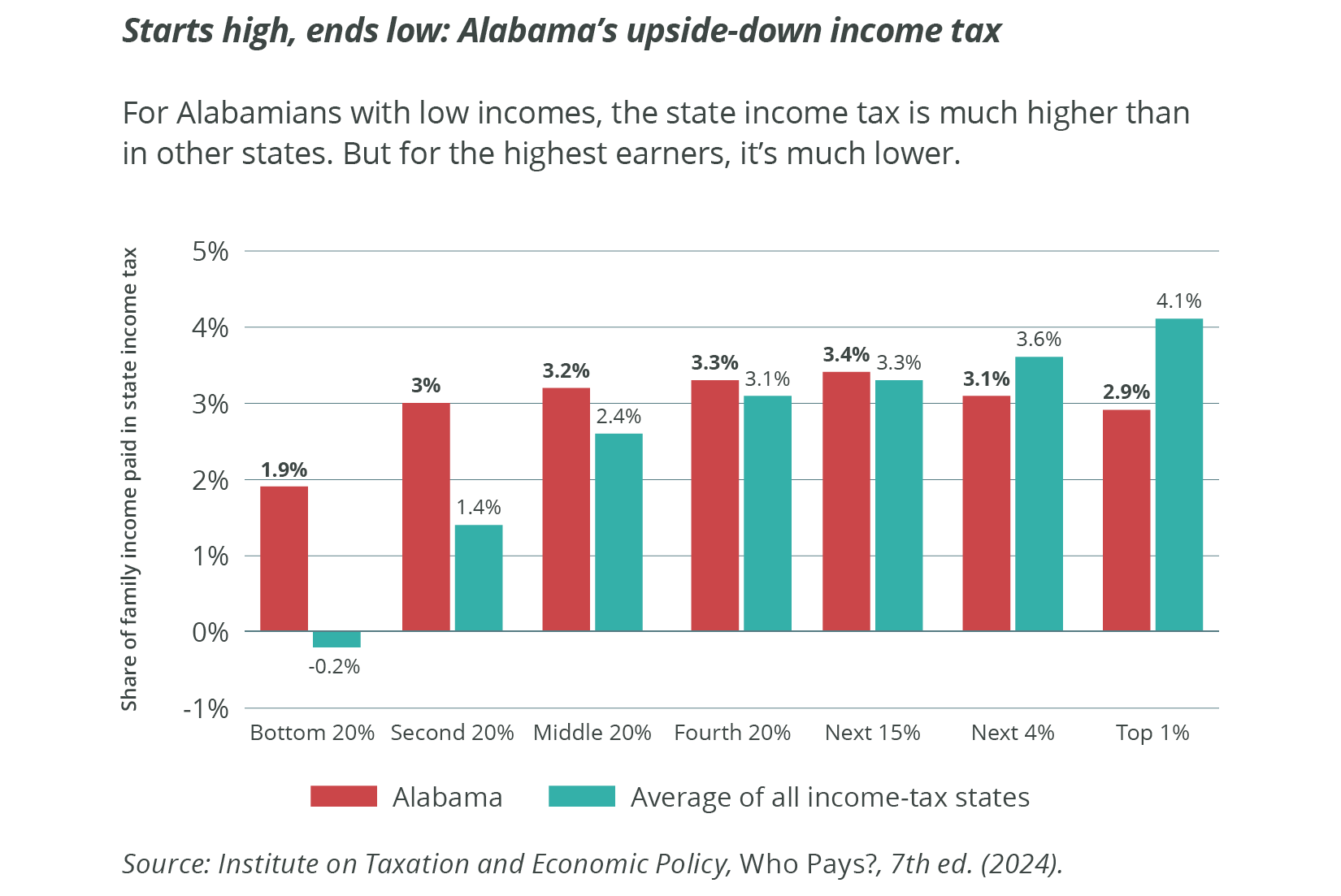
* Income Taxes: Ranges from 1.9% for the Lowest 20%, peaking at 3.4% for the Next 15%, and settling at 2.9% for the Top 1%.
* Other Taxes: Constant at approximately 0.2% to 0.3% for all groups.
Note: Graph and tables show 2024 Alabama law at 2023 income levels. Source: Institute on Taxation and Economic Policy, Who Pays?, 7th ed. (2024).

Alabama’s tax structure is among the nation’s most unfair, according to the 2024 edition of ITEP’s Who Pays? report, an analysis of the tax systems in all 50 states. (See whopays.org for the full report.) ITEP’s calculation includes both state and local taxes and excludes households where the primary tax filer or their spouse is aged 65 or older, because older adults often benefit from tax provisions unavailable to most other people. If you compare Alabama’s chart above with other states’ charts in Who Pays?, two things stand out:

  • We rely heavily on regressive sales taxes. Alabama has high state and local sales tax rates. We continue to tax groceries (though at a lower rate than other consumer goods), which account for a large share of spending for households with low incomes. And we tax relatively few services, which people with higher incomes tend to buy more often.
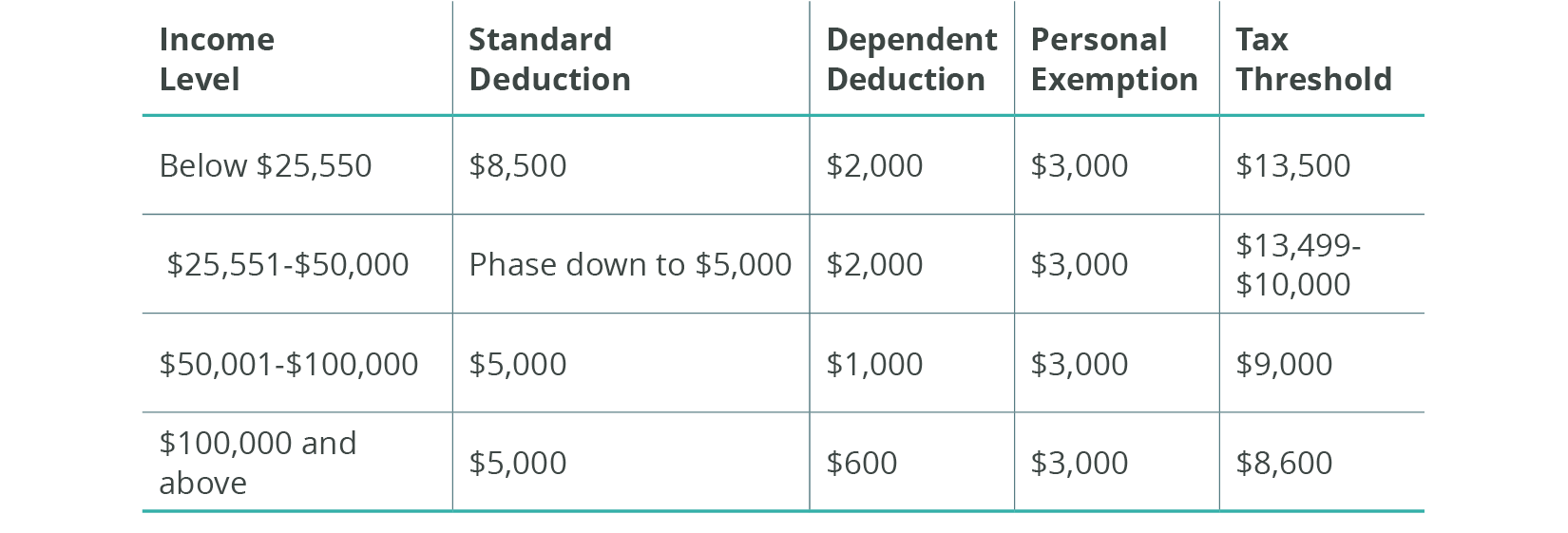
  • Our income tax is only moderately progressive compared to other states. Alabama’s income tax is almost flat for all but the lowest-paid 20% of families, so it doesn’t offset our steeply regressive sales tax. We’re better off on this measure than states without an income tax, like Florida and Tennessee, but not by much. And our income tax is even less fair than flat taxes used in some states, largely because of some generous tax breaks for the highest earners.

Cover image of the Who Pays? report by the Institute on Taxation and Economic PolicyThe result for Alabama is an upside-down tax system in which the less you make, the more you pay. The lowest-paid fifth of Alabamians pay nearly 12% of their incomes in state and local taxes, while the wealthiest 1% pay just 5.4%. Adding to the upside-down nature of this structure, Alabama is the only state to allow a full federal income tax (FIT) deduction on state individual income taxes. This tax break’s benefits flow disproportionately to wealthy households.

Alabama has an upside-down tax system in which the less you make, the more you pay.

All four legs of our state tax system need repair. Alabama made its income tax slightly less regressive in 2006 and 2022, but it remains mostly flat. While Alabama took historic steps to reduce the state grocery tax in 2023 and 2025, our sales taxes still remain high, taxing low-paid workers deeper into poverty. Our property taxes have changed little since the end of segregation and provide large tax breaks to wealthy owners of timber and agricultural land. And our corporate income taxes have numerous loopholes that allow many of the wealthiest corporations operating in Alabama to pay nothing.

Sections 4-7 look at each of these taxes – how they work, how they measure up and how we could improve them.

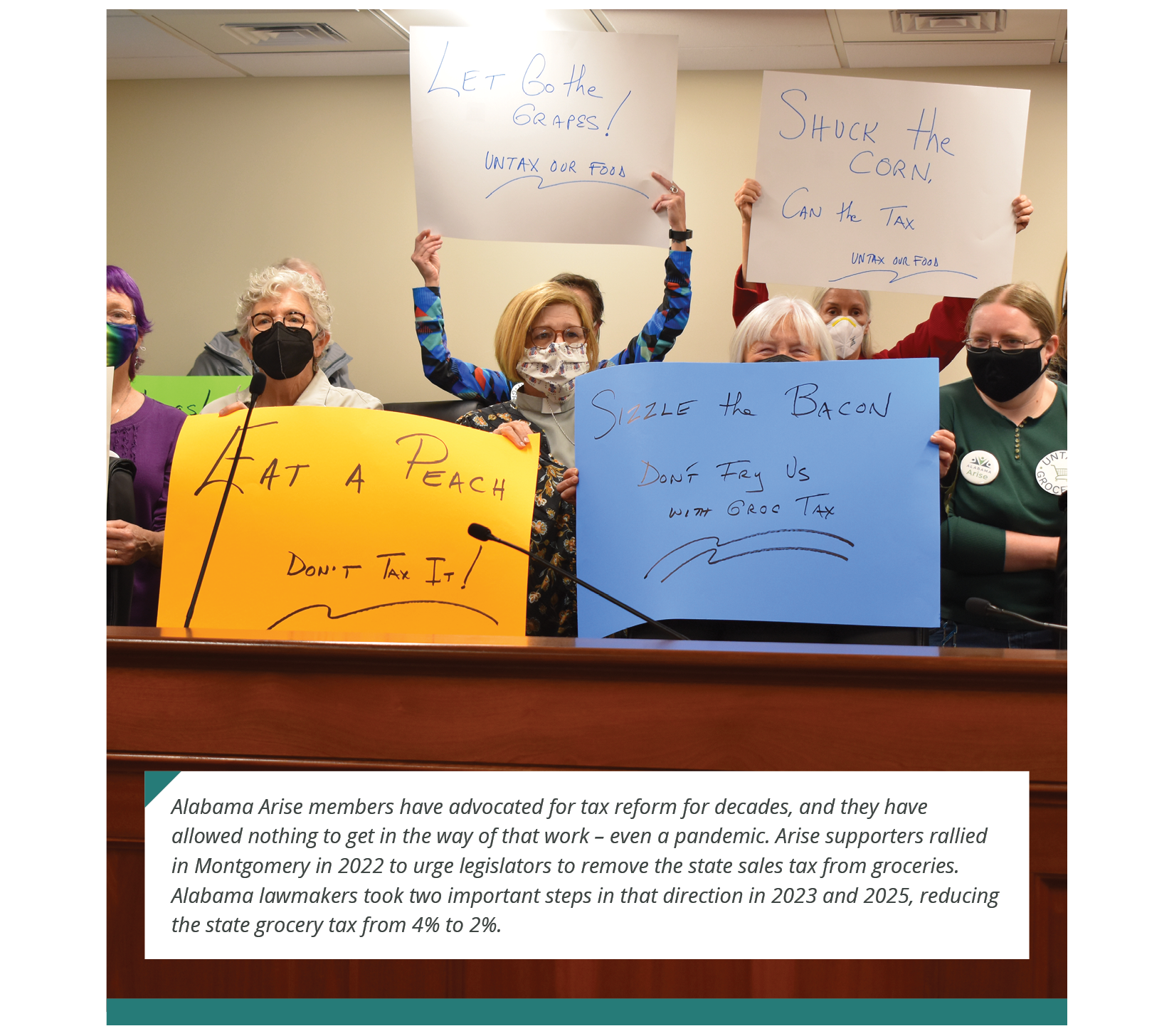
Advocates wearing masks hold up signs in support of ending the state grocery tax. Signs include "Eat a peach, don't tax it," "Sizzle the bacon, don't fry us with grocery tax," "Let go the grapes! Untax our food" and "Shuck the corn: Can the tax." Photo caption: Alabama Arise members have advocated for tax reform for decades, and they have allowed nothing to get in the way of that work -- even a pandemic. Arise supporters rallied in Montgomery in 2022 to urge legislators to remove the state sales tax from groceries. Alabama lawmakers took two important steps in that direction in 2023 and 2025, reducing the state grocery tax from 4% to 2%.


The Alabama Tax and Budget Handbook

The Alabama Tax and Budget Handbook – Income Tax
Feeling the pinch

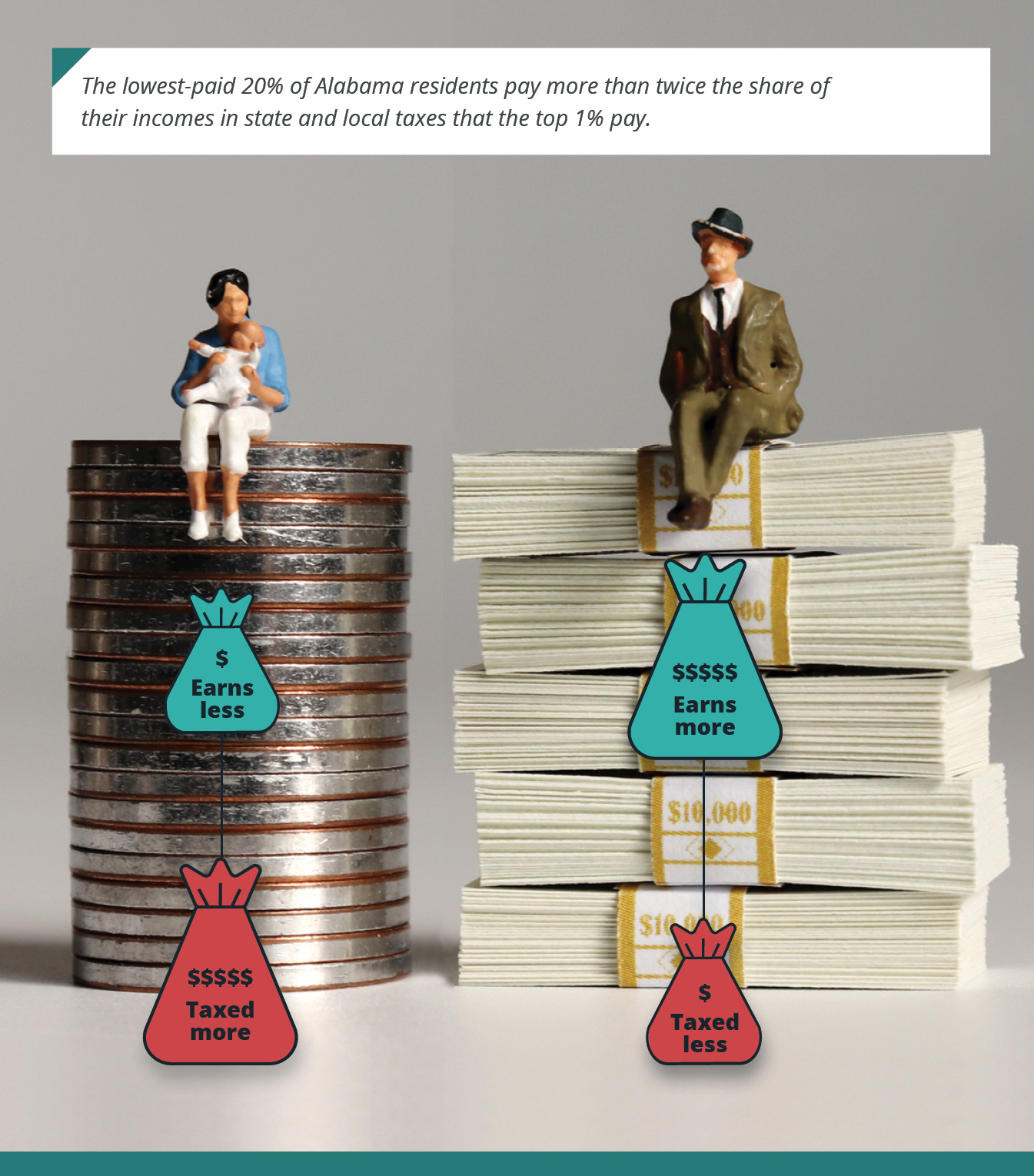
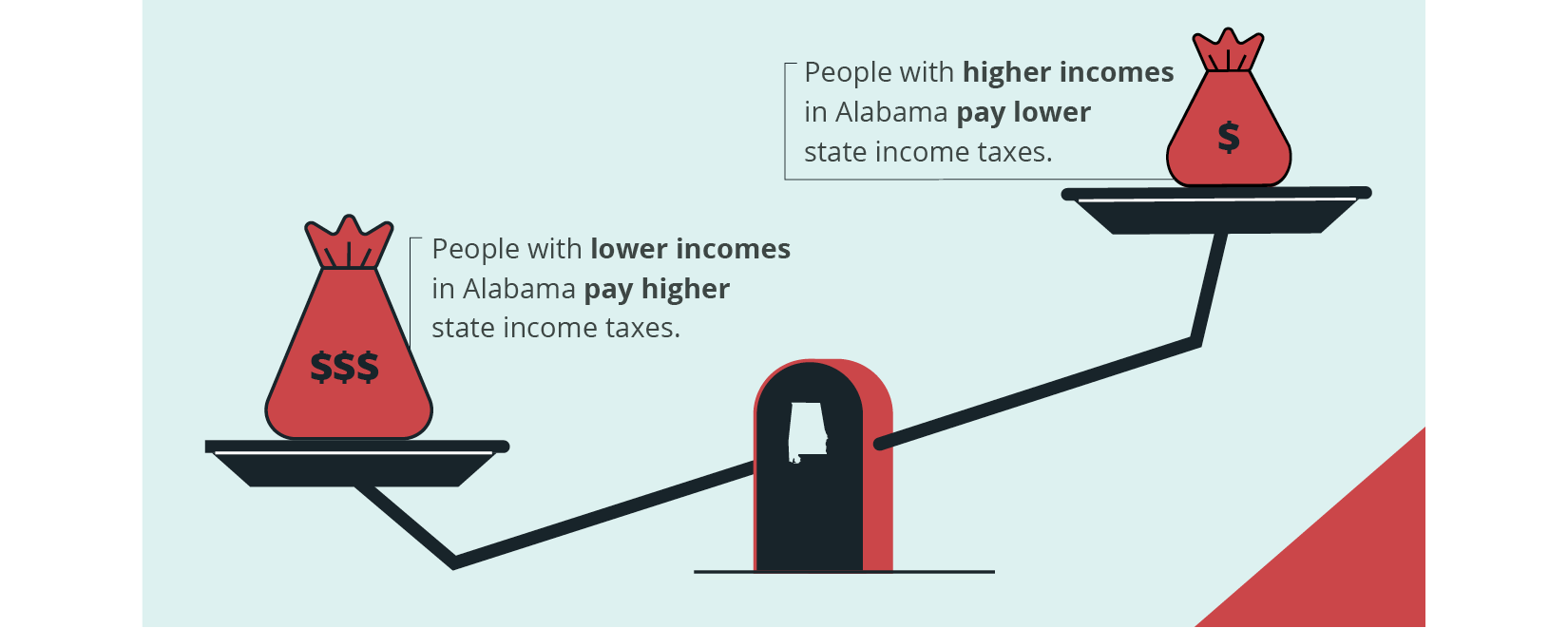
Alabama’s nearly flat income tax can’t offset our regressive sales taxes. As a result, the lowest-paid 20% of Alabama residents pay more than twice the share of their incomes in state and local taxes that the top 1% pay. It’s an upside-down tax system: It reduces the consumer spending that fuels economic growth and makes it harder for Alabamians with low and middle incomes to get ahead.

Photo illustration of a mother and child atop a tall stack of coins and a businessman in a suit sitting atop a stack of $100 bills. Below the mother and child are money bag graphics reading "Earns less, taxed more." Below the businessman are money bag graphics reading "Earns more, taxed less." Caption: The lowest-paid 20% of Alabama residents pay more than twice the share of their incomes in state and local taxes that the top 1% pay.

How does Alabama’s income tax work?

A 1933 amendment to the Alabama Constitution authorized the state to create a tax on personal income and set a limit of 5% for the tax rate. The Legislature enacted that tax in 1935, establishing three income tax rates for individuals that are still in place today:

  • Yearly taxable income of up to $500 is taxed at 2%.
  • Income from $501 to $3,000 is taxed at 4%.
  • Income of $3,001 and above is taxed at the top rate, 5%.

Most states define their income tax by statute, meaning their legislatures can change it. But major parts of Alabama’s income tax are written into our constitution, which is much harder to change.

Ideally, an income tax should be the most progressive tax, because it’s the easiest one to structure to help offset regressive taxes. When it began in 1935, Alabama’s graduated system of income tax rates was very progressive. That year, when the state began taxing incomes of $3,600 or more for a family of four, teachers earned around $500. Only about 7,000 people (less than a quarter of 1% of the population then) earned enough to be taxed. But since then, the system hasn’t kept pace with inflation.

Like most states, Alabama uses exemptions and deductions to exclude everyone’s most basic costs of living from taxation. This is especially important to low-income taxpayers, for whom this small amount is a large share of income. But our exemptions and deductions are lower than in many other states.

The 1935 law set personal exemptions of $1,500 for single adults and $3,000 for married couples. It also set a dependent deduction that lawmakers increased in 2006 and again in 2022. The standard deduction, for taxpayers who don’t claim itemized deductions, was added in 1951 and has increased three times, most recently in 2022 when the standard deduction increased to $3,000 for single adults and $8,500 for couples. Taxpayers can itemize if their deductions exceed the standard deduction. (See the chart on below for Alabama’s deductions by income level.)

Bar graph showing that for Alabamians with low incomes, the state income tax is much higher than in other states. But for the highest earners, it's much lower. For the Bottom 20%, the tax is 1.9% in Alabama and -0.2% for the average of all income-tax states. For the Second 20%, the tax is 3% in Alabama and 1.4% for the average. For the Middle 20%, the tax is 3.2% in Alabama and 2.4% for the average. For the Fourth 20%, the tax is 3.3% in Alabama and 3.1% for the average. For the Next 15%, the tax is 3.4% in Alabama and 3.3% for the average. For the Next 4%, the tax is 3.1% in Alabama and 3.6% for the average. For the Top 1%, the tax is 2.9% in Alabama and 4.1% for the average. Source: Institute on Taxation and Economic Policy, Who Pays?, 7th ed. (2024).

Better, but we still have work to do

In 2022, Alabama increased its income tax threshold – the income where one begins to pay income tax – from $12,500 to $13,500 for a family of four by expanding deductions. Even so, Alabama still taxes families with low incomes deeper into poverty.

Data table outlining the standard deduction, dependent deduction, personal exemption, and tax threshold by income level.

Below $25,550: Standard Deduction is $8,500, Dependent Deduction is $2,000, Personal Exemption is $3,000, and Tax Threshold is $13,500.

$25,551–$50,000: Standard Deduction phases down to $5,000, Dependent Deduction is $2,000, Personal Exemption is $3,000, and Tax Threshold is $13,499–$10,000.

$50,001–$100,000: Standard Deduction is $5,000, Dependent Deduction is $1,000, Personal Exemption is $3,000, and Tax Threshold is $9,000.

$100,000 and above: Standard Deduction is $5,000, Dependent Deduction is $600, Personal Exemption is $3,000, and Tax Threshold is $8,600.

Racial inequity at a glance

While Alabama’s income tax system appears essentially flat, Alabama doesn’t tax many sources of income received by wealthier (and disproportionately white) taxpayers. Many of these tax breaks are available to older adults no matter what their income or wealth.

Because of these tax breaks, many seniors with higher incomes pay less in income taxes than do younger, working families. The targeting of these special tax breaks also increases racial disparities because of demographics and historic inequities in wealth accumulation. As a result, white retirees have around seven times as much untaxed retirement wealth as do Black retirees.

Nearly all defined-benefit retirement income is exempt from Alabama income tax. This includes state retirement benefits for teachers and state employees, U.S. civil service retirement, judicial retirement, military retirement, federal government retirement, Social Security and some private retirement benefits. Alabama does not count inheritance as income and only counts the increased value of stocks and bonds when they are sold. These exemptions, along with the deduction for federal income taxes, allow many wealthy people in Alabama to pay much lower state income taxes than wage earners do. Because white people are much more likely to receive defined-benefit retirement benefits, own stocks and bonds, inherit wealth and pay higher federal income taxes, they are more likely to benefit from Alabama’s income tax structure than are Black people or people with lower incomes.

An illustration of a balance scale with an outline of the state of Alabama at the center. On the lower side, a large red money bag marked with three dollar signs represents "People with lower incomes in Alabama pay higher state income taxes." On the higher side, a smaller red money bag marked with one dollar sign represents "People with higher incomes in Alabama pay lower state income taxes."

How does Alabama’s income tax measure up?

Most states have made sure that people below the federal poverty line don’t have to pay income taxes. Alabama begins taxing a two-parent family of four at an income of $13,500. It’s an improvement from the pre-2006 level (just $4,500), but it’s still less than half of poverty-line wages (about $31,800 in 2024). Alabama’s income tax threshold is one of the nation’s lowest.

By contrast, Mississippi doesn’t start taxing such a family until they make $19,600 per year, and Georgia doesn’t start until they make $32,000.

In Alabama, families with low and high incomes pay income taxes at the same rate: 5% on taxable income above $3,000. Most Alabama taxpayers pay at the top rate. In 2023, most of Alabama’s taxpayers paid around 3% of their income in state income taxes. Even the Alabama families with the lowest incomes pay 1.9% of their income. Nationally, many families with the lowest incomes pay less than 0% in state income taxes (depending on the availability of refundable tax credits), while the top 1% pay 4.1%. But in Alabama, the top 1% pay an average of 2.9% of their income in state income taxes, barely more than the 1.9% paid by taxpayers with the lowest incomes.

Anatomy of a tax threshold

The tax threshold – the income where one begins to pay income tax – is a sum of tax deductions and exemptions. Here’s how it worked when applied to 2022 Alabama and federal taxes for a two-parent household of four.

(In 2017, Congress ended the federal personal exemption, significantly increased the standard deduction and replaced the dependent deduction with an increased Child Tax Credit.)

Stacked bar graph comparing Alabama and Federal tax deductions and exemptions in dollars. For Alabama, the total is approximately $14,000, consisting of a standard deduction of $8,500, a dependent deduction of $2,000, and a personal exemption of $3,000. For the Federal level, the total is $30,000, consisting of a standard deduction of $25,900 and a dependent deduction (CTC) of $4,100, with no personal exemption shown. The y-axis ranges from $0 to $30,000.

Few other states impose an income tax nearly as high as Alabama does on a two-parent family of four at the poverty line. Alabama’s income tax on such a family in 2024 was $838. That family pays no federal income tax, and in most states would pay no state income tax at all.

Alabama’s income tax system is unfair for three reasons:

First are our out-of-date deductions. Despite an increase in 2022, our standard and dependent deductions are still below those in many other states. Alabama’s standard deduction for individuals ($3,000) is less than a quarter of the federal one; the maximum for couples ($8,500) is less than half. Alabama’s standard deduction is not tied to inflation, which means its value will continue to decline over time.

Second is a big tax break we give the highest earners. Alabama is the only state that allows taxpayers to deduct all of their federal income taxes before calculating their state taxes. A 1965 constitutional amendment entrenched this federal income tax (FIT) deduction. The FIT deduction gives higher-income earners a special break, because they can deduct more from their Alabama taxes than those who earn a lower income and pay less federal tax. Alabama forgoes about $1.26 billion of its potential income tax revenue because of this lopsided deduction, and 86% of the tax break’s value goes to the highest-paid 20% of taxpayers.

Third, Alabama also allows Social Security contributions to be deducted. In theory, this should help people with low incomes, who pay a higher share of their income toward Social Security. The catch is that the deduction is available only to those who itemize deductions, which excludes most people with low or middle incomes.

Unlike the federal government and many states, Alabama doesn’t give targeted tax breaks to people with less income. This is in contrast to the 31 states and the District of Columbia that have followed the federal example and created state-level Earned Income Tax Credits (EITCs), which allow many taxpayers with low incomes to receive a credit against taxes owed or a tax refund if they do not owe taxes. Alabama has not created an EITC, a failure that makes it harder for families with low incomes to get ahead and makes our income tax more unfair.

How could we improve our income tax?

Because much of Alabama’s income tax structure is spelled out in the constitution, changing it would require changing the constitution. If Alabama’s income tax more closely followed the system of exemptions and deductions used at the federal level and in many other states, working families would have more money available to spend. That would boost the economy and improve their quality of life. The following proposals would help modernize our income tax and make it fairer:

  • Make income taxes less regressive and more progressive. Ensure people who make more money pay a larger share of their income in taxes than those who make less. Alabama’s state income tax rates top out at low income levels, making our income tax practically a flat tax. Transitioning to a more progressive system that requires households with higher incomes to pay a more equitable share of tax revenues would expand economic opportunity for families with lower and middle incomes. And it would make funding for vital public services more equitable and sustainable.
  • Reform out-of-date deductions. Update Alabama’s standard and dependent deductions to align with modern economic realities and periodically adjust them for inflation to prevent their gradual erosion over time. This should include increasing the personal exemption and standard and dependent deductions. The state also should conduct a comparative analysis with deductions in other states to determine appropriate adjustments or link these dollar amounts to federal levels. These changes would allow Alabama’s deductions and exemptions to keep pace with increases in the cost of living.
  • Eliminate the federal income tax (FIT) deduction. Repeal the provision that allows taxpayers to deduct federal income tax payments before calculating their state taxes. This lopsided deduction disproportionately benefits higher-income earners and results in a significant loss of revenue that could support public schools.

Graphic titled "The federal income tax (FIT) deduction is a huge tax loophole for the wealthiest Alabamians," showing the average estimated value of the FIT deduction for Alabamians at three income levels. The data is presented using miniature figures sitting on stacks of currency. Lowest-paid 20%: Average income of $12.5K with a FIT value of $8. Middle 20%: Average income of $56K with a FIT value of $129. Highest-paid 1%: Average income of $1.6M with a FIT value of $16,583.
Source: Institute on Taxation and Economic Policy, December 2025.

  • Review Social Security contribution deductions. Examine the eligibility criteria for deducting Social Security contributions. Expand access to this deduction beyond itemizers to ensure it benefits a broader range of people with low and middle incomes. These changes would help ensure the deduction benefits those who need it most.
  • Establish a state Earned Income Tax Credit (EITC). Introduce a state-level EITC program similar to the federal EITC and equal to at least 10% of the federal EITC amount. This credit would help low-paid working families make ends meet and help offset the regressive effects of Alabama’s high sales tax. This initiative also would provide a targeted reduction to lower-income taxpayers by allowing them to receive a credit against taxes owed or as a tax refund. Alabama can and should model this program after successful EITC programs in other Southern states like Louisiana, Oklahoma and Virginia.
  • Gradually increase standard deductions. Phase in a plan that gradually increases standard deductions for individuals and couples. This would help rebalance Alabama’s upside-down tax system to be more equitable toward people with lower and moderate incomes. Policymakers also should enact higher-rate tax brackets for millionaires.

The Alabama Tax and Budget Handbook
The Alabama Tax and Budget Handbook – Sales Taxes

Sales taxes: The key driver of Alabama’s upside-down tax system

Should wealthy people pay at a lower tax rate than everyone else? Most Alabamians would answer with a resounding “no.” Yet that’s exactly the result that our state’s tax system produces. Families with low incomes in Alabama pay more than twice the share of income in state and local taxes that the top 1% do.

By far the biggest cause is our state’s overreliance on sales taxes. They apply to a wide range of consumer goods, including necessities like food and clothing. And the tax on a $20 item is the same whether you make $20,000 or $20 million. (See below for more on Alabama’s grocery tax.) As a result, the sales tax takes the biggest bite out of the budgets of families with low incomes, who must spend most of what they make on items subject to sales tax just to get by.

Bar graph of the share of family income paid in sales taxes. Title: Upside down: Sales taxes are highest for Alabamians with the lowest incomes. The lowest 20% pays 7.2%. The second 20% pays 6.6%. The middle 20% pays 5.5%. The fourth 20% pays 4.4%. The next 15% pays 3.4%. The next 4% pays 2.3%. The top 1% pays 1.3%. Graph shows 2024 tax law in Alabama at 2023 income levels. Source: Institute on Taxation and Economic Policy, Who Pays?, 7th edition (2024).

Families with low incomes in Alabama pay more than twice the share of income in state and local taxes that the top 1% do.

How do Alabama’s sales taxes work?

The Legislature established the current state sales tax in 1939 at 2% on retail sales of tangible personal property like clothing, appliances, toys, food and over-the-counter drugs. The sales tax is defined by statute rather than the constitution. That means the Legislature can increase or decrease it without a vote of the people. Twenty years after introducing the tax, lawmakers increased it to 3% and expanded it to include entertainment. In 1963, legislators raised the sales tax to 4%. Lawmakers voted unanimously in 2023 to reduce the state sales tax on groceries to 3%. In 2025, lawmakers approved a second state grocery tax reduction, to 2%.

The state also levies some special sales taxes (in the form of excise taxes, privilege taxes and use taxes) on certain products, including gasoline. Special sales taxes on products that some people consider to be vices, such as tobacco and alcohol, often are called “sin taxes.” Over the years, the Legislature has found it easier to justify increasing this kind of tax than the general sales tax. By contrast, Alabama always has taxed cars at a lower rate (2%).

In 2015, Alabama adopted the simplified sellers use tax (SSUT) to collect sales tax on items purchased over the internet. Online sellers (such as Amazon and eBay) voluntarily collect the SSUT of 8%. Unlike the state sales tax on items purchased in a brick-and-mortar store, the SSUT is divided by formula between the state, counties and municipalities. As of early 2023, state and local governments had received $365 million in SSUT revenues.

Most Alabamians also pay municipal (or city) and county sales taxes to support services ranging from schools to parks to police. Local governments set the rate for these taxes but must follow state law in specifying what to tax. Combined municipal, county and state sales taxes range from 7% in the Kansas community (in Walker County) to 11.5% in Tuskegee and Shorter (in Macon County). The Legislature has granted municipal governments the authority to increase sales taxes without a vote or even a hearing. (Counties can act on their own to increase sales taxes used for schools, but not for other purposes.) In 2025, the Alabama Legislature also gave counties and municipalities the authority to decrease their local sales tax on groceries.

In theory, the sales tax applies to all retail transactions – that is, purchases by the final consumer. In Alabama, this means purchases of goods and entertainment, but not other services that account for an increasing share of consumer spending. Like almost all states, Alabama exempts some “essentials” like rent and prescription drugs. In 2023, the Legislature reduced the state sales tax on food to 3%, followed by another reduction to 2% in 2025. But Alabama still applies the full sales tax to many other essentials like shoes, clothing and over-the-counter medicines.

Racial inequity at a glance

The Alabama Constitution limits the ability of cities and counties to raise revenue needed to provide basic services for their residents. Services like fire protection, roads and streets, libraries, schools, parks, public safety and infrastructure like water and sewage service all require local funding. But Alabama has limited localities’ ability to make even the most basic decisions for themselves, including decisions on how to raise the revenue they need. While counties have some limited self-governance, local governments still cannot raise most taxes without permission from the Legislature. However, cities can set their own local sales tax rates without having to ask legislative permission, and counties can adjust local sales taxes for schools. These limitations force many cities and counties to rely on this regressive tax to provide basic services.

Like many other provisions of Alabama’s constitution, the denial of home rule to cities and counties has a racialized history. The Constitution of 1875, passed immediately after Reconstruction, placed most of the power in the state in the hands of the Planters and Big Mules who ran the state government. These restrictions remained in both the 1901 constitution and the 2022 recompilation. This restricted the ability of Black-majority communities to make decisions for themselves. In recent years, the “preemption” of local authority has denied Birmingham the right to increase its minimum wage, restricted the ability of localities to remove Confederate monuments and denied Montgomery the ability to apply an occupational tax on people who work in the city but live in predominantly white suburbs.

Taxing survival: Alabama is 1 of 9 states still taxing groceries

It’s an exclusive list, but Alabama shouldn’t be proud to be on it. Alabama is one of only nine states still collecting a state sales tax on groceries. Of the 45 states with a general sales tax, 36 exempt groceries entirely, and eight others (including Alabama as of 2023) either charge a reduced tax rate or offer a tax credit to help families with low incomes offset grocery tax payments.

By taxing groceries, Alabama adds to the cost of a basic necessity of life. That hurts the economy by leaving shoppers with less money to buy meat, vegetables and other products. It hurts working families by making it harder for them to get ahead. And it hurts Alabama by fueling an upside-down tax system that requires people with low and middle incomes to shoulder too much of the cost of education, health care and other public services that benefit all of us.

Map of states that still tax groceries. Full state grocery tax: South Dakota. Lower rate or credit for groceries: Alabama, Arkansas, Hawaii, Idaho, Mississippi, Missouri, Tennessee and Utah. No state sales tax: Alaska, Delaware, Montana, New Hampshire and Oregon. All other states exempt groceries from their sales tax. Sources: AARP and Mississippi Today.

How do Alabama’s sales taxes measure up?

We pay sales taxes in small bits throughout the year, unlike once-a-year property and income tax payments. This fact can mask the sales tax’s severe impact on Alabamians who are working hard to make ends meet. In fact, the sales tax is the most regressive of the three major taxes (income, property and sales), because it consumes a much greater portion of the household budget for families with low and middle incomes than for wealthy people.

Alabama’s state sales tax rate (4%) is lower than that of most states. However, when you add in local sales taxes, the combined sales tax rate (averaging 9%) is among the nation’s highest. Sales and excise taxes in Alabama provided 45% of all state and local revenue in 2023, the 12th highest share nationwide, according to the Institute on Taxation and Economic Policy.

Our sales tax continues to apply almost entirely to goods and entertainment, even as spending patterns shift more toward services. Families with low incomes pay a sales tax on laundry detergent, while wealthier families can get their clothes dry-cleaned tax-free. Luxury services like landscaping, house cleaning or interior design are not taxed either.

Alabama is one of a shrinking minority of states still taxing groceries. While the state grocery tax reductions that went into effect in 2023 and 2025 were a vital step forward on tax justice, Alabama is still one of only nine states with any state tax on groceries. Shoppers who buy $100 worth of food in Pensacola pay $100. But in Montgomery, that same food costs $108.

Alabama is still one of only nine states with any state tax on groceries. Shoppers who buy $100 worth of food in Pensacola pay $100. But in Montgomery, that same food costs $108.

Fortunately, sales taxes don’t apply to food bought with food assistance under the Supplemental Nutrition Assistance Program (SNAP), formerly known as food stamps. But SNAP benefits cover only a portion of grocery purchases for most families who receive them. Families with low incomes must pay for the rest of their food out of pocket. Alabama continues to tax those groceries, albeit at a reduced rate.

A collage of two photos. Top: A woman uses a washing machine at a laundromat. Bottom: A large mansion with a circular driveway and a palm tree in front of it. Caption: Families with low incomes pay a sales tax on laundry detergent, while wealthier families can get their clothes dry cleaned tax-free. Luxury services like landscaping, house cleaning or interior design are not taxed either.

How could we improve our sales taxes?

As the most regressive of the major taxes, the sales tax works best when balanced by a progressive income tax. That’s a problem in Alabama, because our nearly flat income tax does not come close to offsetting the regressive sales tax. The best way to reduce the sales tax’s impact on families with low and middle incomes would be to collect a larger share of the funding for public services from the income tax and local property taxes.

Alabama can modernize its sales tax system to make the tax less regressive and better reflect current spending patterns. Policy changes that would advance these goals include:

  • Modernize sales taxes on goods and services. Reduce or eliminate sales taxes on essential goods to avoid taxing people with low incomes into poverty. Policymakers should find a way to eliminate the sales tax on groceries while ensuring adequate funding for public education. Alabama also can generate additional revenue by broadening its tax base to include services primarily purchased by households (not businesses) and “digital goods” like video and music streaming services.
  • Expand the sales tax base to include more services. Broaden the sales tax base to include a wider range of personal and professional services, which would help the state preserve revenue lost by decreasing the tax on food and other necessities. The state should identify and assess services that can be included in the tax base without disproportionately increasing sales taxes on individuals with low incomes.
  • Adopt a progressive approach to taxing services. Implement a progressive approach to taxing services, considering the ability to pay and potential impact on households with low incomes. Graduated tax rates on luxury services used by the wealthiest households could help maintain fairness and reduce the sales tax’s regressive nature.

The best way to reduce the sales tax’s impact on families with low and middle incomes would be to collect a larger share of the funding for public services from the income tax and local property taxes.

A smiling family of a mother, father and two daughters hug each other while posing for a photo. Caption: Providing tax exemptions for services like health care, education and basic utilities could help ease potential negative impacts on Alabamians with low incomes.
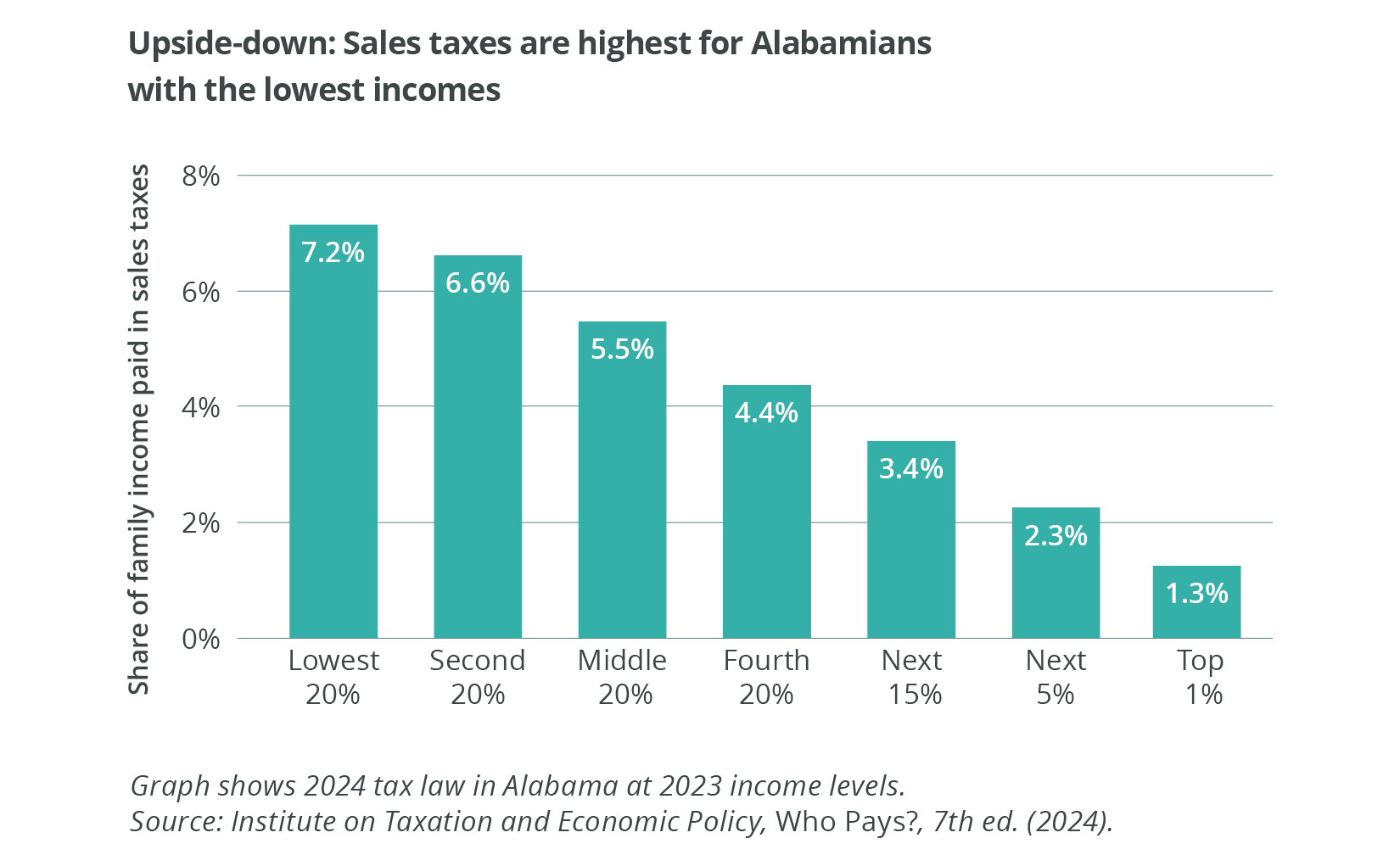
  • Target exemptions for essential services. While expanding the tax base, provide exemptions for essential services that directly impact families’ well-being. Exempting services like health care, education and basic utilities could help ease potential negative impacts on Alabamians with low incomes. Lawmakers also could offset existing sales taxes or future sales tax increases with refundable income tax credits that gradually phase out as income increases.
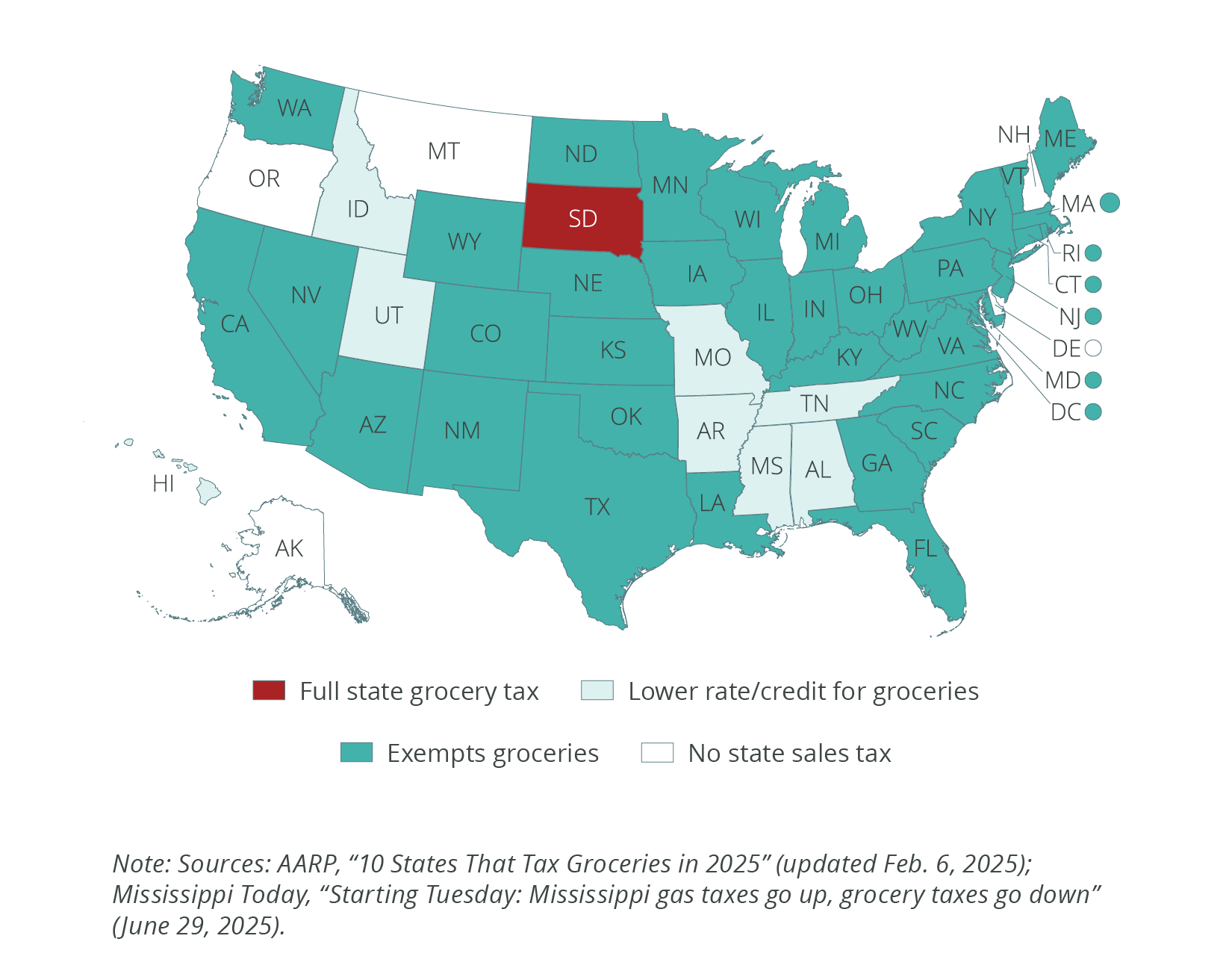
  • Regularly review and adjust sales tax rates. Establish a mechanism for regular review and adjustment of the sales tax system to accommodate changing consumption patterns and economic trends. This flexibility would help ensure Alabama’s tax system remains effective and responsive over time.
  • Conduct a cross-state comparison. Analyze sales tax structures in other states that already have expanded their tax base to include services. Policymakers can learn from those states’ experiences and tailor policy recommendations to suit Alabama’s economic and social environments.

The Alabama Tax and Budget Handbook