Alabama’s prison reform solution must include Medicaid expansion

Alabama’s prison crisis is about more than overcrowding and understaffing. It’s about the generational impacts of a criminal justice system warped by racism, chronic poverty, inadequate education and poor health.

The solution will require both new revenue and broad policy reform. And one essential step is to extend health coverage to uninsured Alabama adults with low incomes. Expanding Medicaid would address the prison crisis in four ways:

  • Untreated mental illnesses and substance use disorders are major contributors to Alabama’s over-incarceration problem, and Medicaid expansion would tackle these challenges head-on. Strengthening these services would help more people stay out of prison.
  • When a person leaves prison, it’s hard to get a job that offers health coverage. But to get and keep a job, you need to be healthy. Medicaid expansion would help former inmates become productive members of the workforce.
  • Federal funding would cover 90% of the cost of Medicaid expansion. That would slash state costs for hospitalizing prisoners.
  • A stronger education system creates economic opportunity that, in turn, reduces crime. As new federal dollars for Medicaid expansion flowed into the economy, they would generate major new state and local tax revenues for schools.

Bottom line

Alabama is one of only 14 states that have not yet accepted Medicaid expansion. The 36 states that have embraced it show how this single policy decision can strengthen the health care system, make the population healthier, reduce racial health disparities and shore up state budgets.

Alabama’s legacy of failure on all four counts is a major contributor to the prison crisis. And Medicaid expansion is an essential part of the solution.

Arise legislative recap: May 24, 2019

The uncertainty over 2020 CHIP funding showcases the fundamental problem with Alabama’s budgets: Our state doesn’t bring in enough money to fund basic needs adequately.

Arise’s Carol Gundlach explores that topic in this week’s legislative recap.


CHIP funding uncertainty shows a core problem in Alabama’s budgets

The Alabama Legislature has yet to decide how to fund health coverage for more than 170,000 children next year. And that’s a symptom of a fundamental illness that has plagued our state’s budgets for decades.

The Children’s Health Insurance Program (CHIP) is one of Alabama’s most successful programs. Through Medicaid and ALL Kids, CHIP supports health coverage for 14% of Alabama’s children. Alabama’s 1997 adoption of CHIP and its later decision to expand eligibility to children in households that make up to 317% of the federal poverty level (nearly $68,000 for a family of three) has made our state a leader on children’s health coverage in the South.

Alabama’s investment in CHIP ensures that kids can get the health care they need to learn and thrive. And CHIP is a great deal for our state. For every $1 Alabama spends on CHIP, the federal government provides more than $3 in matching money. (CHIP parents pay an annual fee and copays that can’t total more than 5% of their annual income.)

Unfortunately, Alabama often struggles to provide its share of CHIP funding, even during a “good” budget year. Gov. Kay Ivey recommended that CHIP’s state match for 2020 be paid out of the Education Trust Fund (ETF), which receives most of the “growth tax” revenue from sales and income taxes. But the Senate balked at this idea and removed CHIP from the ETF budget it passed last week. Meanwhile, the General Fund budget that the House passed in April also includes no CHIP funding.

In the next couple of weeks, both chambers are expected to take up the budget that the other one passed. In the meantime, the parents of more than 170,000 Alabama children wait to learn whether their kids will still have health insurance this fall.

It’s time to stop lurching from one crisis to another

CHIP is one of Alabama’s most popular programs, and we fully expect the House and Senate to fund it. But the uncertainty illustrates the central problem of Alabama’s budgets: We don’t bring in enough money to meet basic needs. In past years, Medicaid has been the subject of funding crises. This year, the threat of a federal lawsuit over abominable conditions in state prisons may force a special session. And in 2021, CHIP may be at risk as a temporary boost to the federal matching rate ends.

Every year, Alabama seems to have at least one essential service that it struggles to fund adequately. And every year, the Legislature juggles too little money, robs Peter to pay Paul, or grasps at another source of one-time funding to squeak through another year. Barely maintaining the status quo is no way to promote shared prosperity. And it’s no way to make life better for everyday Alabamians.

Alabama Arise has a solution to break the cycle of uncertainty and invest in our state’s future. And it’s a solution that’s beginning to interest lawmakers as they consider how to pay for CHIP, Medicaid, corrections and other necessities.

Ending the FIT deduction would strengthen Alabama’s future

That solution is to end Alabama’s income tax deduction for federal income taxes (FIT). It’s a loophole that only two other states – Iowa and Louisiana – allow in full. (Three other states allow a partial deduction.) And it’s a skewed tax break that primarily benefits the richest households among us.

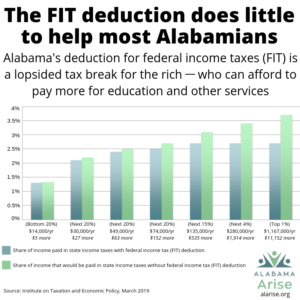
For those who earn $30,000 a year, the FIT deduction saves them about $27 on average. But for the top 1% of taxpayers, it’s worth an average of more than $11,000 a year. Closing this tax loophole would bring our state’s upside-down tax system closer to balance. It also would allow Alabama to end the state sales tax on groceries without cutting school funding.

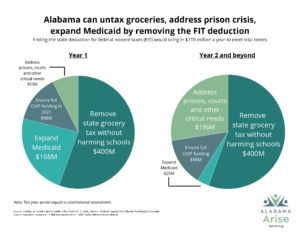
Ending the FIT deduction would bring in an additional $719 million a year. That’s enough to pay for Medicaid expansion, secure long-term CHIP funding and invest in education, corrections and other pressing needs.

And this new revenue wouldn’t be just one-time money. It would be there every year to help Alabama meet the needs of the state and its people.

As one legislator told us recently: “This is the only plan that makes sense.” We think so, too, and we’re working hard to convince more lawmakers that they need to support this proposal, for the sake of our children’s health and for all of us.

Not back yet: Alabama’s K-12, higher education funding still lower than 2008

Alabama children who entered first grade in 2008 will get their high school diplomas next year. And they’ll graduate from an education system that still gets less state support than it did when they were first learning how to add and subtract.

The $7.1 billion Education Trust Fund (ETF) budget that the Alabama Senate passed 28-2 Thursday contains substantial funding increases for K-12 schools, two-year colleges and four-year universities. (Read the excellent coverage from AL.com’s Trisha Powell Crain and the Montgomery Advertiser’s Brian Lyman for the full details.) The budget’s sponsor, Sen. Arthur Orr, R-Decatur, called it “the largest ETF budget in history.”

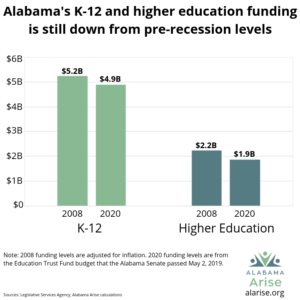
In terms of raw dollar amounts, that’s true. But it’s not the full story. To compare funding across the years on an apples-to-apples basis, you need to adjust for inflation. And adjusted for inflation, Alabama’s education funding is still much lower than it was in 2008, before the Great Recession hammered state revenues.

The math: ETF increases aren’t keeping up with inflation

Alabama allocated $6.7 billion to the ETF in 2008, which is equivalent to $7.8 billion in today’s dollars. That means the Senate’s $7.1 billion budget for next year still would be 8.6% below the ETF’s 2008 level.

The story is similar for both K-12 and higher education, both of which are on track to fall far short of their inflation-adjusted 2008 funding levels. Under the Senate budget, K-12 schools would get 6.9% less than they did in 2008, while higher education funding would be 17.2% below where it was that year.

Even so, the 2020 Senate budget would be a move in the right direction. This plan would provide $4.9 billion for K-12 schools and $1.9 billion for higher education. Those amounts would be 6.8% and 10% increases, respectively, over this year’s allocations. That is significant, praiseworthy progress toward returning to 2008 levels.

But it’s also important not to look at 2008 through rose-colored glasses. Though that budget was the ETF’s recent high-water mark, it still didn’t invest adequately in a range of important services. State officials at the time identified hundreds of millions of dollars of unmet needs in reading and math education, distance learning, need-based tuition assistance and other areas. As time has passed and inflation has continued to outpace state funding increases, Alabama’s unmet educational needs have only grown.

How Alabama can fund needed investments

Our state’s education funding isn’t an uncontrollable force of nature like the weather. Policy choices determine the amount of money that Alabama raises – or doesn’t raise – for education. And lawmakers have a range of choices to bring in more money for investments in our schools, colleges and universities.

One option would be to modernize Alabama’s income tax rates, which haven’t changed since 1935. The state’s 5% top rate kicks in starting at just $3,000 of taxable income. That means the marginal rate that multimillionaires pay is no higher than the one that applies to many families who struggle to make ends meet.

Another approach would be to close tax loopholes that disproportionately benefit large corporations and wealthy households. Alabama’s deduction for federal income taxes (FIT) is one example of that kind of skewed tax break. For those who earn $30,000 a year, the FIT deduction saves them about $27 on average. But for the top 1% of taxpayers, it’s worth an average of more than $11,000 a year.

Ending the FIT deduction would raise $719 million a year. That’s money Alabama could use to invest in education, end the state sales tax on groceries and take other steps to make life better for everyday folks.

Budget and tax decisions reflect what we value as a society. Alabama could continue to cling to a tax system that delivers lavish tax breaks to wealthy people while making it harder for struggling families to get ahead. Or our state could choose instead to prioritize stronger investments in education, health care and other services that benefit everyone.

Arise legislative recap: April 26, 2019

A state Senate committee approved a bill Wednesday to cut new holes in Alabama’s safety net.

Arise’s Carol Gundlach explains how these new limits on Medicaid, SNAP and TANF would increase hunger and hardship for tens of thousands of struggling Alabamians.

Arise legislative recap: April 19, 2019

“The grocery tax is a tax on a basic necessity of life. It’s a tax on survival. And it’s time for Alabama to bring this tax to an end.”

Arise communications director Chris Sanders discusses a recent bill by Rep. Chris England that would be a major step forward on untaxing groceries. The video also details Arise’s plan for how Alabama could end the state grocery tax and expand Medicaid without cutting a dime from the education budget.

Removing the FIT deduction would allow Alabama to untax groceries, expand Medicaid

Alabama’s federal income tax (FIT) deduction provides a huge tax break for high-income individuals – but at what cost? $719 million to be exact.

The FIT deduction is one big reason Alabama’s tax system is upside down. For those who earn $30,000 a year, the deduction saves them about $27 on average. But for the top 1% of taxpayers, the FIT break is worth an average of more than $11,000. The higher the income, the more the FIT deduction is worth for those who can most afford to pay more to fund education, health care and other vital needs.

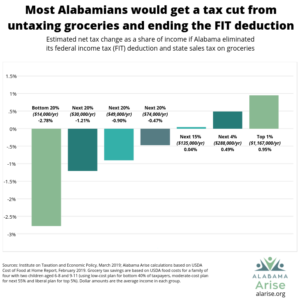
Only two other states offer a full FIT deduction like Alabama does. (Three other states offer a partial deduction.) Ending the FIT deduction would bring in an additional $719 million a year, the Institute on Taxation and Economic Policy estimates. That would be enough to allow Alabama to remove the state sales tax on groceries. For most people in our state, the net result would be a tax cut.

This proposal would make it easier for everyday Alabamians to make ends meet, but its benefits wouldn’t end there. Alabama also could use the new revenue to expand Medicaid, ensure full funding for the Children’s Health Insurance Program (CHIP) in 2021 and make critical investments in education and other areas. CHIP supports health coverage for more than 170,000 children through Medicaid and ALL Kids.

Alabama’s constitution dedicates income tax revenue to education, and the FIT deduction is written into the document as well. So this plan would require the Legislature and the public to approve a constitutional amendment. But ending the FIT deduction would be a good way for Alabama to begin prioritizing public investments that benefit everyone over tax breaks that primarily benefit a select few.

The real story of the House’s 2020 General Fund budget is what isn’t in it

Now that the gas tax is a reality, the Alabama Legislature appears to be in a hurry to finish up essential business – and maybe even adjourn a little early. The House on Tuesday passed a General Fund (GF) budget that differed little from Gov. Kay Ivey’s recommendations.

With Alabama finally out of the worst of the recession and revenues beginning to flow again, many legislators seem to be feeling a bit like Santa Claus. But the real story is what’s not under the GF’s tree.

The House’s GF budget, which awaits Senate action, would squeeze out increases for nearly every state agency, most of which have been living through tight times for the last decade. The state’s badly cash-strapped court system would receive nearly $40 million more, hopefully reducing its dependence on fines and fees. The Department of Corrections, facing court challenges over treatment for inmates with cognitive disabilities, would get an additional $41 million. That money would allow the department to hire an additional 500 prison guards.

Helping agencies would get increases, too. Mental health would receive an additional $9 million, as would the Department of Human Resources (DHR). The small but vital Department of Senior Services would get an additional $1 million.

Even state employees, who haven’t seen a pay increase in years, would get a 2% cost of living increase. And retired state employees would receive a one-time bonus based on the number of years served.

The head-scratcher budget request came from Medicaid. For years now, Medicaid’s funding needs have challenged previous bare-bones GF budgets. Now, during a good revenue year, Medicaid Commissioner Stephanie Azar actually requested $52 million less. Azar said the agency can carry over a considerable sum from this year to maintain current services in 2020.

The investments our state isn’t making

The 2020 GF budget does indeed look pretty good at first glance. But the House plan is conspicuous for what was not included.

Perhaps most notably, the budget doesn’t fund Medicaid expansion to cover more than 300,000 Alabama adults with low incomes. The net state cost would be $164 million in the first year and about $25 million a year thereafter. The $52 million reduction in Medicaid’s budget would have made a nice down payment on expansion.

While the Department of Corrections can hire another 500 prison guards, the real need is closer to 2,000 new guards, according to a federal court order. And the budget does not include money for the new prison construction that Ivey has urged.

Lawmakers transferred ALL Kids to the education budget for 2020 to help balance the GF budget. But House GF budget committee chairman Rep. Steve Clouse, R-Ozark, said ALL Kids will move back to the GF in 2021. That move would add to the strain that the underfunded GF budget regularly faces. To draw down available federal matching money, the Children’s Health Insurance Program (CHIP) will need $98 million more from the state in 2021 than it receives today. CHIP provides health coverage for more than 173,000 Alabama children through both ALL Kids and Medicaid.

A funding solution to help everyday Alabamians

Alabama is, quite simply, in need of new revenue. And Alabama Arise has a plan to raise that revenue while giving most residents an overall tax cut.

Alabama is one of only three states that allow taxpayers to deduct all of their federal income tax (FIT) payments from their state income taxes. This tax loophole makes little (if any) difference for families with low and moderate incomes. But it saves millionaires a whopping average of $11,327 a year in state income taxes. If Alabama ended its FIT deduction, the state would bring in an additional $719 million a year.

That new money would allow Alabama to expand Medicaid and end the state grocery tax (two long-time Arise priorities). It also would ensure full CHIP funding in 2021 and leave additional money to meet other critical needs. (Because the state constitution earmarks income tax revenue for education, some of those moves would require an amendment.)

The proposed 2020 GF budget is only flush when compared with years when the state was truly in dire straits. It’s time for our lawmakers to find the political courage to address Alabama’s needs and raise the revenue required to meet them. Ending the state’s FIT deduction would be a good first step.

Arise legislative recap: April 12, 2019

“While the General Fund budget looks really good for what it is, what it is is not enough.” Arise policy analyst Carol Gundlach breaks down what’s missing from the General Fund budget that the Alabama House passed April 9.


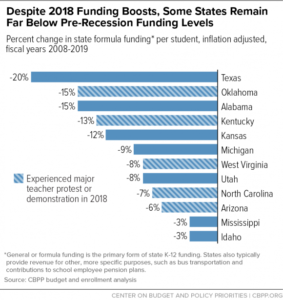
Alabama’s K-12 funding still far lower than a decade ago, despite recent gains

Alabama increased state education funding in 2018, but the legacy of years of extreme cuts remains, according to a new report from the Center on Budget and Policy Priorities (CBPP), a nonpartisan research organization based in Washington, D.C.

Alabama increased its K-12 formula funding by 1 percent per student last year. But that funding is still far below pre-recession levels: 15 percent less per student after adjusting for inflation.

“It’s good that state K-12 funding is moving in the right direction again, but Alabama must do much more to get our education system back on track,” Alabama Arise executive director Robyn Hyden said. “Otherwise, we risk falling even further behind states that invest more in their schools.”

Formula funding is the main state revenue source for K-12 schools nationally. It is especially important for schools in high-poverty areas, which educate a disproportionate share of black and Hispanic children. But state cuts have forced many cities and counties to cover more of the cost of education. Between 2008 and 2016, the national average for state funding declined by $167 per student. Average local funding grew by $161 during that time.

“The effects of state funding cuts are evident in teacher pay. Some 42 states cut the average teacher’s salary relative to inflation between 2010 and 2017,” said Michael Leachman, CBPP’s senior director of state fiscal research. “That is why teacher protests have emerged in many states recently.”

Adequate school funding can strengthen state economies. But steep funding cuts make it hard for states to reduce class sizes, extend learning time and enact other reforms to help students thrive.

“Alabama should close income tax loopholes that overwhelmingly benefit wealthy people and large corporations,” Hyden said. “That would allow our state to boost investments in K-12 education and offer pre-K to all families. And it would increase economic opportunities for low-income students and communities of color, who face the greatest barriers to education.”