
Arise policy analyst Dev Wakeley looks back at the Alabama Legislature’s second special session, which ended last week. Dev discusses lawmakers’ actions related to redistricting and COVID-19 vaccinations, as well as federal relief funding for hospitals and nursing homes.
Issue: Budgets
Recovering from Alabama’s costly mistake on COVID-19 recovery funds
This post originally appeared on the Economic Policy Institute’s blog.
When the Alabama Legislature gathered for a special session in September, it made a shortsighted and costly mistake. Lawmakers chose to allocate $400 million in American Rescue Plan Act (ARPA) money ‒ about 20% of Alabama’s federal COVID-19 relief funds ‒ to help finance a $1.3 billion prison construction plan.
Alabama prisons are decrepit, dangerous and massively overcrowded. The U.S. Department of Justice (DOJ) has sued the state over the unconstitutional conditions in the institutions. Moreso, raiding funds designed to help people and communities recover from pandemic-related economic distress will do nothing to make Alabama more humane and inclusive. That is particularly true when Black Alabamians are three times more likely to be incarcerated than white Alabamians due to discriminatory practices in policing and incarceration.
The state has a better path to build a more sensible criminal justice system and avert a looming federal takeover. New buildings to house the same old problems won’t get us there. Real change will require meaningful changes to sentencing and reentry policies.
Sentencing reform is vital to build a more humane criminal justice system in Alabama
Alabama’s sentencing scheme still relies on outdated ideas about punishment and limits availability of services shown to improve reentry. One example is the state’s Habitual Felony Offender Act (HFOA), which increases sentences for even minor offenses. Like other mandatory minimum laws, it is a relic of earlier racially motivated “tough on crime” practices and leads to higher rates of incarceration throughout the South.
The Legislature made minor improvements to the HFOA in 2015 but refused to make them retroactive. That failure has left hundreds of Alabamians still serving sentences for convictions that today would result in less time under current presumptive sentencing guidelines.
Alabama Arise supports full repeal of the broken HFOA. Until then, the state at minimum should ensure people aren’t serving wildly different sentences for the same conviction.
Those efforts have been an uphill battle for reform advocates. During September’s special session, lawmakers failed to pass a bill to allow some people to petition for resentencing under current standards. Legislators also have failed in recent years to expand medical release and releases for older people who have aged out of reasonable likelihood of recidivism. Efforts to expand and improve diversion programs have stalled as well.
All of these policies would save Alabama money in the long run. They also would demonstrate respect for the humanity of incarcerated people. But legislators have chosen not to act.
This persistent refusal to engage in meaningful reform may cost Alabama dearly. Failure to take even small steps to reduce overcrowding and improve atrocious conditions may spur the DOJ to conduct a wholesale takeover of the state’s prison system. If that happens, the Legislature will have only its own inaction to blame.
How federal aid should help Alabamians
The consequences of prioritizing bad spending go beyond federal intervention in the broken prison system. ARPA relief funds represent an opportunity to move Alabama forward in many areas that would increase opportunity and stability for people across the state.
Provide health care to hundreds of thousands of uninsured Alabamians
More than 220,000 Alabamians live in a Medicaid coverage gap. They make too much to qualify for Medicaid under the state’s bare-bones eligibility limits but too little to qualify for subsidized coverage through the Affordable Care Act. Another 120,000 Alabamians have stretched their finances seriously to pay for coverage they can’t truly afford.
Federal ARPA funds would allow Alabama to expand Medicaid. Alabama could use these dollars to meet other critical spending priorities. This would free up state funds to pay for the startup of an expanded Medicaid program to cover adults left out of coverage.
Update infrastructure and invest in equity
Alabama should use ARPA funds to update and expand infrastructure and support services. Economic fallout from the COVID-19 pandemic has placed a disproportionately heavy burden on women, Black Alabamians and communities with few resources upon which to fall back. Investments in child care, expanded early childhood education and long-term postpartum health coverage would deliver major improvements in quality of life for people hit hardest during the pandemic.
Federal relief should be used both to lessen the pandemic’s immediate harm and to break the pattern of long-term, intentional disinvestment in the Black Belt and other areas. Community-based organizations offer valuable connections and expertise to guide investment to where it is needed. The state should ensure these groups have the capacity and pathways to provide input on best uses for relief money.
Finish implementing solutions on housing and public transportation
ARPA funds also represent an opportunity to take steps forward where lack of political will has hindered full implementation of state solutions. Within the past decade, the Legislature created both the Public Transportation Trust Fund and the Affordable Housing Trust Fund (AHTF). It also has failed to provide a single dollar for either.
Transportation investment would improve quality of life for everyone. Robust public transit creates long-term, high-wage jobs and enables people to get to work reliably and inexpensively. It is a vital public good that helps older people and people with disabilities fully participate in public life.
Housing investment would help alleviate the state’s severe affordable housing shortage. State AHTF funding would increase community resilience by allowing struggling families to spend less of their incomes to keep a roof over their heads. It also could help speed up rental assistance and prevent evictions during future recessions.
Increase transparency and modernize technology
Alabama’s technological infrastructure has lagged behind contemporary standards. Early in the pandemic, this resulted in major delays of unemployment insurance payments. The patchwork of IT systems at all levels of state government has contributed to public confusion and delays. Technology investments would reduce duplication of effort and increase public access to the public’s information.
A new path forward
ARPA provides a generational opportunity to begin remedying policy shortcomings that have held back progress, perpetuated inequality and furthered Alabama’s history of racist policy choices. This chance is too valuable to waste by doubling down on past failures like foolish and overly punitive criminal justice policy.
The Legislature’s recent misuse of $400 million is inexcusable, but this bad decision has not blocked the path forward. The remaining ARPA funds are a chance to invest in adequate resources and transparent, responsive government. Our state must seize this opportunity to improve life significantly for every Alabamian.
Alabama Arise unveils members’ 2022 roadmap for change
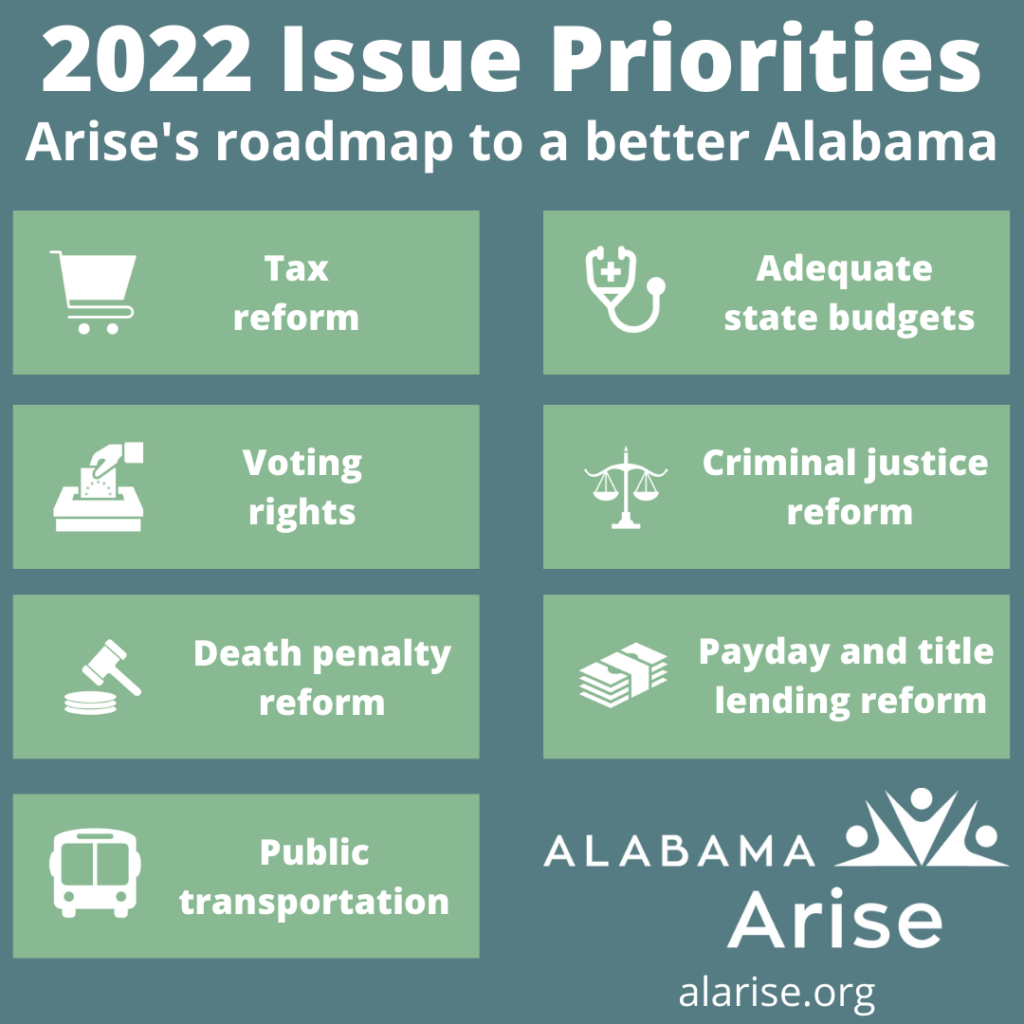
Sentencing reform and voting rights expansion are two key goals on Alabama Arise’s 2022 legislative agenda. Members voted for Arise’s issue priorities this week after nearly 300 people attended the organization’s online annual meeting Saturday. The seven issues chosen were:
- Tax reform, including untaxing groceries and ending the state’s upside-down deduction for federal income taxes, which overwhelmingly benefits rich households.
- Adequate budgets for human services like education, health care and child care, including Medicaid expansion to make health coverage affordable for all Alabamians.
- Voting rights, including automatic universal voter registration and removal of barriers to voting rights restoration for disenfranchised Alabamians.
- Criminal justice reform, including retroactive application of state sentencing guidelines and repeal of the Habitual Felony Offender Act.
- Death penalty reform, including a law to require juries to be unanimous in any decision to impose a death sentence.
- Payday and title lending reform to protect consumers from getting trapped in debt.
- Public transportation to help Alabamians with low incomes stay connected to work, school, health care and their communities.
“Arise believes in dignity, equity and justice for all Alabamians,” Alabama Arise executive director Robyn Hyden said. “Our 2022 issue priorities would break down many of the policy barriers that keep people in poverty. We must build a more inclusive future for our state. And together, we will.”
The urgent need for criminal justice reform
Alabama’s criminal justice system is broken, and its prisons are violent and dangerously overcrowded. Exorbitant court fines and fees impose heavy burdens on thousands of families every year, taking a disproportionate toll on communities of color and families who already struggle to make ends meet. And Alabama needs investments in mental health care, substance use disorder treatment, community corrections and diversion programs to help stem the tide of mass incarceration.
Lawmakers’ plan to spend hundreds of millions of dollars on new prisons is not an adequate solution to these problems. Alabama must enact meaningful sentencing and reentry reforms to make its corrections system more humane and effective. Legislators took a good first step during this week’s special session by passing a bill by Rep. Jim Hill, R-Moody, to provide supervised release for everyone leaving prison in Alabama.
Many other needed changes still remain on the Legislature’s plate, however. One important priority is Hill’s proposal to allow judges to apply Alabama’s new sentencing guidelines retroactively. The House declined to vote on that bill this week, but Hill has promised to file it again in 2022. Hundreds of people would be eligible to apply for a reduced sentence if the measure passes.
Arise also will continue to work toward repeal of the Habitual Felony Offender Act (HFOA), the state’s “three-strikes” law. The HFOA is a driver of sentencing disparities and prison overcrowding in Alabama. The law lengthens sentences for a felony conviction after a prior felony conviction, even when the prior offense was nonviolent. Hundreds of people in Alabama are serving life sentences for non-homicide crimes because of the HFOA. Thousands more have had their sentences increased as a result. Repealing the law would reduce prison overcrowding and end some of Alabama’s most abusive sentencing practices.
Protect and expand voting rights so every voice is heard
Arise members provided a resounding endorsement of efforts to protect and expand voting rights in Alabama. This includes support of federal legislation to prevent voter suppression and strengthen the Voting Rights Act. And it includes calls for numerous state-level improvements to promote greater civic engagement and increase access to voting.
One such improvement would be automatic voter registration (AVR) across Alabama. AVR would use information the state already has to register or update registrations electronically for hundreds of thousands of Alabamians. Another important step would be to ensure people who struggle to make ends meet are not denied the right to vote simply because they cannot afford court fines and fees.
“Our ability to progress as a state will be limited as long as any person or group is unable to exercise their constitutional right to vote,” Hyden said. “We urge Alabama lawmakers to protect and expand voting rights by instituting automatic voter registration and lifting barriers to voting rights restoration.”
Thousands in Alabama at risk of homelessness after Supreme Court overturns eviction moratorium
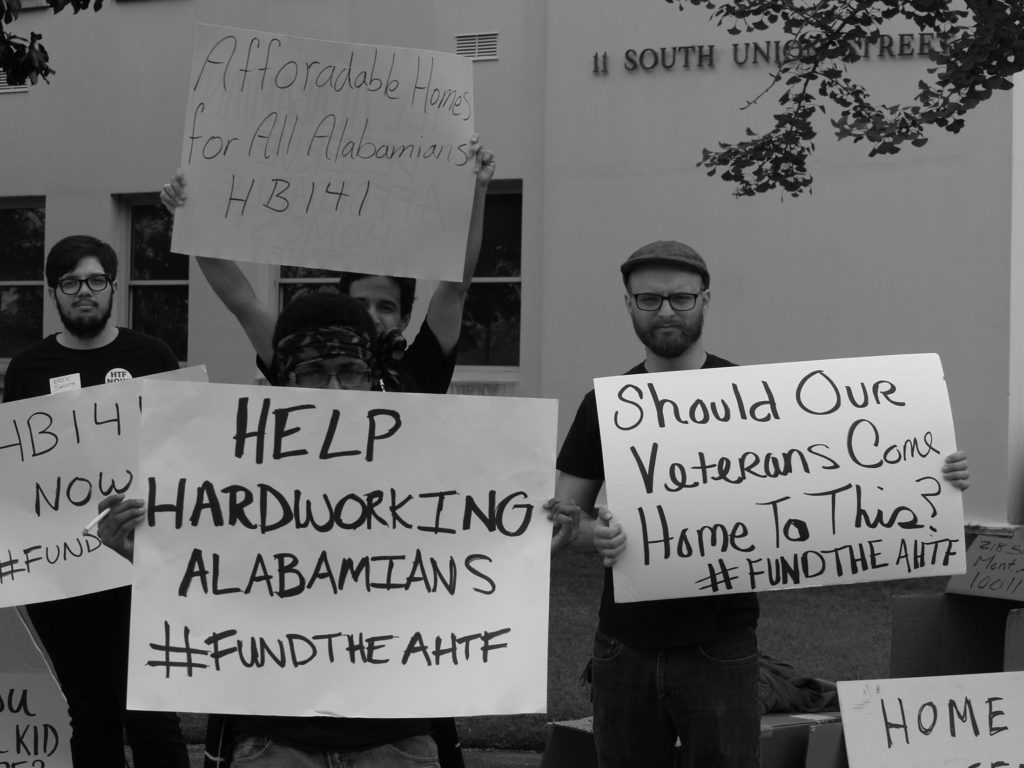
Tens of thousands of Alabamians are at risk of losing their homes after the U.S. Supreme Court overturned the new Centers for Disease Control and Prevention (CDC) eviction moratorium on Aug. 27. This moratorium — the latest in a series at the state and federal level — would have allowed renters harmed by the COVID-19 recession more time to apply for and receive federal rental assistance funds through local agencies.
The moratorium’s end has increased the urgency for Alabama to ramp up distribution of that money. The state had distributed less than 3% of its federal rental assistance funds as of Aug. 30, according to the National Low Income Housing Coalition (NLIHC).
In Baldwin County, a COVID-19 hot spot, 86% of vetted applicants have been determined eligible for assistance. But only 5.8% of total applicants have received money. More than 1,000 households in that county alone now face eviction if their funds do not arrive before the eviction cases are heard. Removing the moratorium will fuel a harmful, avoidable increase in evictions leading into winter. This decision will put thousands of Alabamians at risk of homelessness or force people into already-crowded shelters while the delta variant rages through the state.
The full resumption of the eviction crisis magnifies the need for Gov. Kay Ivey to renew state-level eviction protections like those she instituted in April 2020. Alabama Arise also has asked courts to direct renters and landlords to available rental assistance when a landlord files for eviction. These steps could prevent many evictions even if Congress and state authorities continue their failure to protect renters.
Resources for immediate assistance
To seek help paying rent, check Arise’s rental assistance resource guide or the NLIHC’s website at nlihc.org/rental-assistance to find the local agency serving your area. If your landlord serves you an eviction notice, call Legal Services Alabama at 866-456-4995. If you become homeless due to eviction or another reason, call 2-1-1 for shelter referral and rehousing assistance.
Alabama Arise’s administrative advocacy: Big wins in the policy margins
Unlike legislative advocacy, administrative advocacy is an aspect of Alabama Arise’s work we don’t talk about often. Yet that’s where some of our biggest policy wins happen.
State agencies and leaders can accomplish some important policy changes via rule changes. Sometimes legislators pass policies with good intentions, but administrative barriers and red tape stop them from being fully effective. Our members and constituents often help identify barriers to remove.
Given the nature of Alabama politics, it’s strategically important at times to keep some changes under the radar. But in recent years, administrative action has led to big steps forward on some top Arise priorities:
- Streamlining the process to access Medicaid, SNAP food assistance and TANF income assistance.
- Creating more openings for Medicaid home- and community-based long-term care services.
- Expanding the emergency flexibility of Medicaid and SNAP to respond to the COVID-19 pandemic via emergency waivers, and expanding the types of support available to TANF participants.
- Stopping onerous Medicaid work penalty proposals.
- Advocating for transparency and equitable distribution of federal COVID-19 relief funding.
As we see new opportunities to expand and shore up the social safety net this year, a portion of our policy advocacy work will continue to be this type of behind-the-scenes administrative analysis and advocacy.
One example we’re working on now: pushing the Alabama Housing Finance Authority to distribute federal rental assistance more quickly. We’re also working with local advocates to streamline how city and county aid gets out into communities.
If you see a way programs aren’t being implemented effectively in your community, let us know! We’re continuing to expand our ability to track and support this type of advocacy. And we’re looking for new ways to engage more directly impacted people in our feedback to state agencies and decision-makers.
Special session(s) ahead in Alabama? How Arise is preparing

Alabama Arise’s work for equity, justice and opportunity persisted after the Legislature’s regular session ended. We’ll renew our commitment to those principles when Arise members choose 2022 issue priorities after the Sept. 25 annual meeting. And we’ll keep up the drumbeat when lawmakers return later this year for one or more expected special sessions.
Alabama’s overcrowded and antiquated corrections system – a decades-long humanitarian crisis – may prompt a special session this fall. Gov. Kay Ivey and many legislators hope to build and renovate multiple prisons. Alabama may seek federal permission to use COVID-19 relief money for those purposes.
Arise believes meaningful sentencing reforms should accompany any plan for new prisons. Repeal of the outdated Habitual Felony Offender Act would be one long-term step to reduce overcrowding. Parole reform and stronger investments in community corrections and reentry supports would help as well. Arise will advocate for these policy changes and others during any prison-related special session.
Redistricting is another likely focus of a special session. Legislators will use new Census data to draw new districts for the Legislature, state school board and U.S. House. Arise urges members to participate in public hearings that the Joint Reapportionment Committee will hold across Alabama this month. Click here for more information and a full hearing schedule.
Arise will continue advocacy on federal funds, too. We’ll support efforts to make recent Child Tax Credit improvements permanent. We’ll urge legislators to use federal relief money for Medicaid expansion, public transportation and other long-term investments. And we’ll seek to build on an August federal rule change that permanently boosted Supplemental Nutrition Assistance Program (SNAP) benefits.
42 Alabama groups urge Ivey to drive transformative change with federal COVID-19 relief funds
Alabama should build a more equitable and inclusive future by using federal COVID-19 relief money for transformational investments in public health and economic opportunity, according to a letter that 42 churches and organizations across the state sent to Gov. Kay Ivey this week. Alabama Arise is among the groups that co-signed the letter.
The American Rescue Plan Act (ARPA) will provide Alabama $2.3 billion of federal assistance for education and other vital services. Local governments across the state will receive another $1.7 billion.
Affordable housing, education, nutrition and public transportation are a few key areas of need identified in the letter. The letter urges Alabama to use ARPA funds to expand Medicaid, increase broadband internet access in underserved areas and increase funding for child care, early childhood education and mental health care, among other investments.
“New funding at this scale can be transformative for our state, but only if we take a transformative approach to how we spend it,” the letter says. “For too long, Alabama’s leaders … have settled for poor outcomes in health, education, community development and other measures of shared prosperity, because they thought we couldn’t tackle such deep problems. The pandemic is challenging us to reclaim – and redefine – the common good. ARPA funding gives us a rare opportunity to meet the challenge, if we’re willing.”
The full letter, “To Strengthen the Common Good: Six Principles for Allocating Alabama’s ARPA Funding,” is available here.
Principles for effective, transparent use of ARPA money
COVID-19 and its associated recession exacerbated preexisting racial, gender and regional disparities that prevent Alabama from reaching its full potential. Enduring recovery will require breaking away from a mindset of scarce resources and limited opportunities, the letter says.
The letter encourages state leaders to allocate ARPA funds using these six principles as a framework:
- Engage local communities at every step.
- Aim for equity in outcomes.
- Maximize well-being by addressing health in all policies.
- Invest in existing assets and capacities to help funds work faster, go further and avoid duplication.
- Think big and create a 21st-century infrastructure for the common good.
- Build public trust and engagement by following the highest standards of documentation, transparency and accessibility of information about funding awards and expenditures.
Investments to increase equity, expand economic opportunity in Alabama
ARPA funds offer the state an opportunity to lift communities toward better health and broadly shared prosperity. They also can help Alabama address chronic challenges in education, health care, housing and other quality-of-life measures. Among the letter’s key recommendations for allocation of ARPA funds:
- Expand Medicaid to save lives and ensure health coverage for more than 340,000 Alabamians with low incomes.
- Invest in mobile mental health crisis services and expand mental health crisis centers and school-based mental health services.
- Increase funding for in-home early childhood education and in-home services for older adults and people with disabilities.
- Provide funding for the state’s Housing Trust Fund and Public Transportation Trust Fund.
- Promote equity in high-speed internet access by targeting earmarked broadband funding to help providers expand into underserved areas.
- Invest in workforce development by creating subsidized apprenticeships, two-year scholarship programs and subsidized certificate programs for workers with low incomes.
- Provide a grocery tax rebate and other cash assistance to households with low incomes.
“Recovery from COVID-19 will require Alabama to go beyond a return to an inadequate status quo,” Alabama Arise executive director Robyn Hyden said. “Our elected officials must make better policy choices now to build thriving communities in the future, and ARPA funds offer a powerful pathway to help make that vision a reality. We urge the governor to seize this opportunity to increase public trust and build a brighter, more equitable future for all Alabamians.”
To strengthen the common good: Six principles for allocating Alabama’s ARPA funding
Introduction
Dear Governor Ivey,
One of the darkest years in recent memory has put Alabama’s families, communities, health system, businesses – and our leaders at all levels – to the test. Thank you for all your efforts to keep Alabamians safe and secure during this unprecedented emergency. Now that a post-COVID world is dawning, the leadership test doesn’t end. Rather, it enters a critical new phase: Your vision and your actions will help determine what a post-COVID Alabama looks like, and history will record the results. Will the comfort of the familiar pull us back into “the way we’ve always done things”? Or will we count this ordeal as an awakening to bold new possibilities for our state?
For the organizations listed below, all signs point to the second option: The opportunity to address chronic problems that the pandemic has only worsened; a chance to inspire Alabamians with a recovery plan that lifts all communities toward a healthier, more prosperous future; and – most pragmatically – the power of $4 billion in new federal funding to turn vision into reality. We enclose for your consideration six principles that we believe can guide state and local leaders in the most productive, equitable and lasting use of these tax dollars.
The signers of this letter are advocates who work closely with the communities hit hardest by the COVID-19 health and economic crises. For these Alabamians, recovery from the pandemic must mean more than restoring the pre-COVID status quo. With courageous and creative leadership, community engagement across the state, and wise use of historic levels of funding, we have what we need to move Alabama forward and strengthen the common good.
We stand ready to answer any questions you may have about our recommendations.
Respectfully submitted,
The Undersigned Alabama Organizations
Signatories
The following organizations support a principled approach to American Rescue Plan Act funding that will strengthen Alabama’s common good:
ADAP
AIDS Alabama
Alabama Appleseed Center for Law and Justice
Alabama Arise
Alabama Coalition for Immigrant Justice
Alabama CURE
Alabama Possible
Alabama Solutions
Alabama State Conference of the NAACP
Bay Area Women Coalition, Inc.
Birmingham Society of Friends
BirthWell Partners Community Doula Project, Birmingham
Church & Society, Anniston First United Methodist Church
Community Enabler Developer, Inc.
Disabilities Leadership Coalition of Alabama
Disability Rights & Resources
The E.WE Foundation
Faith and Works Statewide Civic Engagement Collective
Grace Presbyterian Church (PCUSA), Tuscaloosa
Greater Birmingham Ministries
Hispanic Interest Coalition of Alabama
Hometown Action
Immanuel Presbyterian Church (PCUSA), Montgomery
Jobs to Move America
League of Women Voters of Alabama
Medical Advocacy & Outreach
The Nightingale Clinic, Birmingham
Nurse Practitioner Alliance of Alabama
Open Table United Church of Christ, Mobile
People First of Alabama
Project Hope to Abolish the Death Penalty
Restorative Strategies, LLC, Birmingham
Sisters of Mercy
Sisters of St. Joseph
The Sisters, Tuscaloosa
St. Luke’s Episcopal Church, Jacksonville
Unitarian Universalist Fellowship of Mobile
University of Montevallo Social Work Program
Volunteers of America Southeast
West Alabama Women’s Center
YMCA of Birmingham
YWCA of Central Alabama
Letter text
To Strengthen the Common Good: Six Principles for Allocating Alabama’s American Rescue Plan Act Funding
The COVID-19 crisis has created enormous new challenges for Alabama, while shining a harsh light on long-neglected ones. To strengthen and expedite recovery, the American Rescue Plan Act (ARPA), passed by Congress in March 2021, is pumping $4 billion into Alabama’s economy over the next three years. New funding at this scale can be transformative for our state, but only if we take a transformative approach to how we spend it.
The starting point is recognizing and breaking our old mindset of scarce resources, limited possibilities and patchwork policy solutions. For too long, Alabama’s leaders – and the voters who empower them – have settled for poor outcomes in health, education, community development and other measures of shared prosperity, because they thought we couldn’t tackle such deep problems. The pandemic is challenging us to reclaim – and redefine – the common good. ARPA funding gives us a rare opportunity to meet the challenge, if we’re willing. The undersigned organizations offer the following six principles as a framework for seizing this unprecedented opportunity to build a better Alabama for all.
-
Engage local communities at every step.
The COVID pandemic has hit people where they live, work, learn and play. The best use of ARPA funds will reflect the needs and goals identified by ordinary Alabamians through a process that solicits, accommodates and heeds public input.
Crucial question
How are local leaders, advocates and community members involved in identifying and prioritizing both needs and solutions?
Recommendations
- Identify or create effective, inclusive, results-oriented, nonpartisan, community-based councils in each county or region to develop recommendations for local ARPA funding priorities. Potential lead organizations may include United Way, community foundation or Community Action Agency advisory bodies; children’s policy councils; university extension services; or community round tables convened by local governments. Make it a priority to engage segments of the community underserved by the status quo, such as Alabamians of color, people who work for low wages or have lost jobs, and those who lack adequate basic services.
- Provide opportunities for broad public participation in developing and finalizing local, regional and state ARPA spending plans. State leaders should agree not to appropriate ARPA funds until the public engagement process is completed.
- Review existing community and state needs assessments to identify common local concerns, as well as gaps in information and perspective.
- Facilitate information-sharing and coordination among local, regional and state efforts to enhance efficiency, leverage capacity and avoid duplication.
- Designate a statewide source of technical assistance, best practices and other aids to local and regional decision-making.
-
Aim for equity in outcomes.
Some regions, counties, municipalities and populations have suffered deeper blows than others from the pandemic because of chronic gaps in resources, infrastructure, services and opportunities. Rural Alabamians, people of color, people with disabilities, and women have faced disproportionate impacts from both the health and economic crises. Simply restoring the prior status quo is not transformation. ARPA funding decisions should take into account the un-level playing field of COVID recovery, targeting investment toward improving the basic standards of living for areas and people long left behind. Assistance to those most deeply impacted by COVID-19 should come with as little “red tape” and administrative delay as possible. Direct cash assistance to people with low incomes should be a priority.
Crucial question
How do proposed funding allocations contribute to the removal of historic barriers to individual, family and community well-being?
Recommendations
- Within each jurisdiction (state, region, county, city), use socioeconomic indicators such as poverty, unemployment and workforce participation rates, and racial/ethnic health disparities to target strategic, expedited community investments.
- Provide grants to minority- or women-owned small businesses, especially those that did not receive earlier federal business loan assistance.
- Provide up to $13 per hour in bonus or “premium” pay – on top of their regular pay – to essential public and private workers, up to $25,000 per worker per year, as allowed under the Rescue Plan, for work performed during the public health emergency, awarding the largest bonuses to the lowest-paid workers.
- Provide cash assistance to SNAP food assistance recipients with incomes below 50% of the Federal Poverty Level.
- Provide a grocery tax rebate to households earning less than 200% of the federal poverty level.
- Fund and train organizations that already help people access SNAP, Medicaid, tax credits and other supports as navigators for the full range of ARPA assistance, including the expanded federal Child Tax Credit.
-
Maximize well-being by addressing health in all policies.
What began as the COVID-19 health emergency quickly became an economic and social crisis. In turn, the toll the virus has taken on communities of color, people with disabilities and the uninsured revealed how deeply socioeconomic conditions are connected to health risks and outcomes. Nutrition, housing, transportation, education and other factors are widely recognized as social determinants of health, but Alabama has been slow to broaden our approach to health policy and funding. ARPA offers us the chance to apply the lessons of COVID-19 and design a recovery plan that puts eliminating health disparities and improving health at the center of investments in every sector.
Crucial question
How does this funding proposal advance the goal of a healthier Alabama?
Recommendations
- Name it and claim it: There’s enough ARPA funding to achieve significant health improvement in Alabama if leaders set clear, ambitious goals and plan accordingly.
- Engage public health experts to incorporate health goals and strategies across the full span of ARPA allocation planning.
- Increase professional staffing at county health departments.
- Strengthen our workforce, families and communities by using the generous ARPA incentives (an estimated $720 million) to expand Medicaid and close the coverage gap for 340,000 Alabamians with low incomes.
- Invest in mobile mental health crisis services and expand mental health crisis centers.
- Expand school nurse programs and school-based mental health services.
- Fund Healthy Food Financing grants for fresh food markets, including mobile markets, as well as local worker-owned food cooperatives to boost local economies, provide jobs and expand availability of fresh foods in food apartheid areas (where healthy food access is hindered by racially discriminatory economic or political factors) and food swamp neighborhoods (where food and beverage sources like fast food outlets, convenience stores and liquor stores crowd out healthier food options).
-
Invest in existing assets and capacities to help funds work faster, go farther and avoid duplication.
Over recent decades, budget cuts to education, public health and other essential services – and our failure to expand Medicaid – have left Alabama unprepared for a prolonged emergency like COVID-19. Similarly, charitable nonprofit organizations across the state have faced unprecedented demand for their services during the pandemic and risen to the challenge. By directing ARPA funds to restoring critical services and supporting experienced, trusted charitable nonprofits, state and local governments can strengthen community resources, meet needs efficiently, avoid reinventing the wheel, and multiply the economic benefit.
Crucial question
What programs and organizations are already working to meet the goals of this ARPA funding proposal, and how can a partnership approach improve outcomes?
Recommendations
- Fund organizations that are well-positioned to reach people with significant barriers to accessing support, such as immigrants, people with disabilities and people of color with low incomes.
- Expand community schools in neighborhoods where the pandemic has taken a particularly heavy toll.
- Provide additional funding for existing in-home early childhood education services like HIPPY, Parents as Teachers and Nurse-Family Partnership programs.
- Increase support for school-based social and health services, particularly in high-poverty neighborhoods and districts.
- Help children catch up on unfinished learning by expanding the teacher workforce through pay increases and other supports for early childhood teachers, child care workers and special education teachers who work in at-risk communities and schools.
- Expand existing in-home and community-based services for the elderly and people with disabilities.
- Expand or develop local alternatives to incarceration such as specialized courts, community correction programs, re-entry programs and services for people at risk of offending.
- Invest in workforce development by creating subsidized apprenticeships, two-year scholarship programs, and subsidized certificate programs for low-income workers.
-
Think big and create a 21st-century infrastructure for the common good.
Alabamians have long recognized the human cost of inferior and outdated public works and services like sanitation, health care, transportation and information technology systems. But the monetary cost has kept our leaders from modernizing them. COVID has revealed the deadly consequences of that neglect, and ARPA includes massive funding aimed at moving states forward on all of these fronts, including a large share for education (not addressed in these recommendations because of specific earmarking). The opportunity calls for bold leadership and vision. Our spending plan must seek to coordinate local, regional and statewide investments for fundamental and long-lasting impact.
Crucial question
How will today’s investments benefit future generations of Alabamians?
Recommendations
- Modernize and align state agency computer systems to create a “no wrong door” approach to streamlined eligibility and enrollment across benefit programs.
- Modernize and improve state unemployment insurance (UI) technological infrastructure, application and payment systems.
- Upgrade water and sanitation systems, prioritizing communities with a history of unsafe water quality and waste-water disposal.
- Provide critical infrastructure and equipment (such as trucks, refrigeration, trainers, lift gates, etc.,) to local food banks and food pantries to expand emergency food distribution.
- Expand Alabama’s affordable housing capacity, stabilize families and communities and reduce homelessness by seeding the Affordable Housing Trust Fund with $25 million and providing grants for eligible new construction, renovation and maintenance.
- Recognizing that lack of reliable transportation is a major hindrance to health care, economic activity and workforce development in many areas of the state, seed the Public Transportation Trust Fund with $20 million and provide state match for increased federal public transportation funding.
- Promote equity in high-speed internet access by targeting earmarked broadband funding to help local service providers expand into underserved areas and by ensuring community oversight of access and quality standards.
- Provide state technical assistance to localities in consolidating, evaluating and negotiating broadband contracts to minimize the danger of approving projects with little public benefit.
-
Build public trust and engagement by following the highest standards of documentation, transparency and accessibility of information about funding awards and expenditures.
Spending taxpayer dollars is always a tremendous responsibility. When it comes to spending billions in a short time, the potential for slow uptake, poor decisions and misuse only increases. Alabama can ensure that the generous ARPA funds do their appointed job by establishing clear guidelines and full disclosure for the entire funding process, from eligibility of applicants to allocation decisions to project expenditures and results.
Crucial question
How will Alabamians be able to track the allocation, use and impact of their federal ARPA tax dollars in the state?
Recommendations
- Create and maintain a public database of state and local ARPA funding allocations and expenditures, easily searchable and sortable by project or partner name, policy topic, service area, grant amount, award date, expenditure date and other key factors.
- Adopt simple, accessible application and reporting requirements that allow grantees and recipients to establish their credibility and tell their story without jumping unnecessary bureaucratic hurdles.
- Use local ARPA planning groups as conduits for ongoing reporting and feedback about plan implementation, obstacles, impact and sustainability. Build a robust outreach operation to help people access available federal, state and local aid.
Federal relief funds could transform Alabama’s future
How often have we gotten to say that it’s raining money in Alabama? That’s the image that comes to mind as the American Rescue Plan Act (ARPA), passed in March, begins to direct more than $4 billion in new federal funds into the state over the next three years.
The funding could help Alabama make historic progress in public health, education, family well-being and community viability if spent wisely and equitably. It also offers generous incentives that would more than offset the state’s initial cost to expand Medicaid. This new COVID-19 relief comes on top of $1.9 billion Alabama got under the CARES Act last year.
The state government will receive more than $2 billion under ARPA. Counties will get nearly $1 billion. Alabama’s 21 largest cities will receive more than $400 million, and other municipalities will get nearly $400 million as well. Both the state and localities may use funds to offset the pandemic’s strains on families, small businesses, public health and infrastructure like water and sewer systems and high-speed broadband networks.
Portions of ARPA money are earmarked for direct payments to local school districts. Other funds are dedicated to provide rental assistance and make child care more affordable and accessible.
The act also temporarily boosts the Child Tax Credit and Earned Income Tax Credit and temporarily increases food aid under the Supplemental Nutrition Assistance Program and WIC. In addition to these supports, ARPA also provides one-time cash payments ($1,400 each for most Americans). And it provides direct assistance for health care, funeral expenses and other essential needs.
Arise will continue to follow these funding streams with the goal of ensuring equitable distribution and transparency. And we will advocate to make the temporary improvements permanent in the next round of federal relief.
Arise advances justice in a pandemic session
Advocacy barriers for Alabama Arise members were extraordinarily high during the Legislature’s 2021 regular session. The COVID-19 pandemic limited physical access to the State House and made a difficult policy landscape even rockier.
But Arise members were undeterred. They spoke out forcefully and repeatedly for justice and opportunity. And the result was real, meaningful progress on multiple issue priorities.
This year brought advances on criminal justice reform and internet access. It delivered stronger investment in early education and preserved funding for Medicaid and mental health care. And it saw efforts to chill free speech and erode the Department of Public Health’s effectiveness defeated.
Wins on expanding broadband, reforming civil asset forfeiture
Arise members made their presence known throughout the session. They gathered monthly for online Membership Monday events to stay engaged and connect with advocates across Alabama. On May 18, nearly 100 people attended a virtual recap event to debrief the session and prepare for next steps. And throughout the year, our supporters flooded email inboxes and rang phones off the hook, contacting legislators and Gov. Kay Ivey more than 14,000 times.
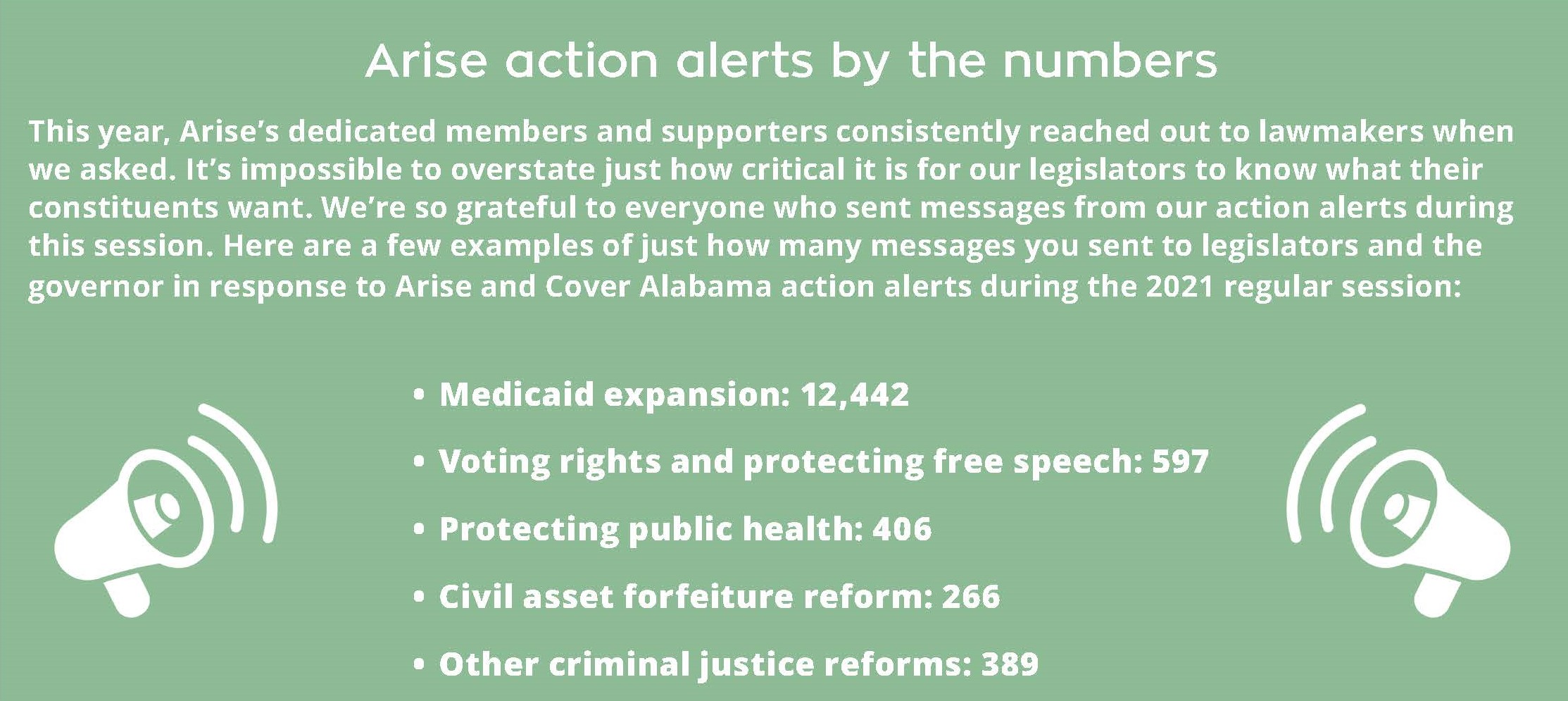
That advocacy worked. Lawmakers passed SB 215 by Sen. Del Marsh, R-Anniston, to promote broadband expansion to rural communities and other underserved areas. And legislators finally began to rein in civil asset forfeiture, a practice that allows law enforcement to seize property without a criminal conviction.
SB 210 by Sen. Arthur Orr, R-Decatur, doesn’t end civil asset forfeiture, but it makes some important initial improvements. Those changes include exempting some property from forfeiture and strengthening protections for innocent owners.
Successful defense against public health threats, anti-protest bill
Arise advocacy helped stop harmful proposals as well. Our members played a key role in blocking a plan to limit the governor and public health officials’ ability to respond to emergencies like the COVID-19 pandemic. After our members sounded the alarm, SB 97 by Sen. Tom Whatley, R-Auburn, lost a House procedural vote in the session’s final hours.
Arise members also helped halt a threat to free speech. HB 445 by Rep. Allen Treadaway, R-Morris, would have expanded law enforcement’s powers to arrest protesters for “rioting” and imposed harsh mandatory minimum sentences on people convicted under the law. The bill passed in the House but died in the Senate.
The Legislature likely isn’t done this year. Lawmakers expect one or more special sessions to address unfinished business like redistricting, prison overcrowding and allocating federal relief funds. Whenever the next session may be, Arise members will be ready, advocating as always for a better, more inclusive Alabama.