
Arise’s Carol Gundlach breaks down the busy final stretch of the Alabama Legislature’s 2021 regular session. Carol reviews where things stand on the General Fund budget and broadband access. And she flags two potential action alerts we want you to be ready for in the coming week.
Issue: Budgets
Alabama Arise Action 2021 annual meeting
The Arise policy and campaign teams gave updates on criminal justice reform, voting rights, Medicaid expansion and other issue priorities during Alabama Arise Action’s annual meeting last week. Sen. Kirk Hatcher, D-Montgomery, also called in to provide insight from the legislative side of the 2021 regular session.
(Note: The video captions were generated live during the meeting and include some typos. We apologize for any resulting confusion or inconvenience.)
Money matters: Budgets top priority for session; lawmakers also discussing Medicaid expansion, criminal justice reform, voting rights this year
As the Alabama Legislature approaches the 2021 regular session’s final days, both state budgets are halfway to passage. The Education Trust Fund (ETF) budget has passed in the Senate and is in the House’s education budget committee. The General Fund (GF) budget, which funds all non-education services, has cleared the House and awaits Senate committee approval. Despite the COVID-19 recession, both budgets eked out small increases – 3% in the GF and 6% in the ETF. This will allow pay raises for teachers and state employees. It also will fund one-time additional 2022 teacher units and a new salary matrix for certified math and science teachers.
While budgets progressed, the Senate divided over whether to pass a gambling bill that would increase revenue for one or both. After Sen. Del Marsh’s lottery and gaming bill failed March 9, Sens. Garlan Gudger, R-Cullman, and Jim McClendon, R-Springville, introduced lottery bills. Meanwhile, Marsh, R-Anniston, introduced both a new lottery and a new gaming bill.
The Senate may consider some combination of these measures later this session. If approved by legislators and voters, expansion of gambling could increase state revenues anywhere from $118 million to $550 million. (Arise takes no position for or against gambling legislation.)
Health care
 A big change on the health care front this year is the prominent role of Medicaid expansion in legislative discussions, both on and off the chamber floors. Gov. Kay Ivey can propose expansion through administrative steps, but lawmakers still control the purse strings. So legislative advocacy is essential!
As the pandemic highlights the need for rigorous health data, Alabama had been one of only two states lacking a statewide hospital discharge database. Now we’ll be shedding that dubious distinction with the enactment of HB 210 by Rep. Paul Lee, R-Dothan, a bill that Arise supported.
The Alabama Department of Public Health (ADPH) has been the target of several proposals to increase political control over the agency’s leadership and decision-making. McClendon’s SB 240, for example, would abolish the State Board of Health, the medical body that appoints the state health officer, and make ADPH’s director a gubernatorial appointment. Other bills would limit state and county health officials’ authority to declare health emergencies. One such measure, SB 97 by Sen. Tom Whatley, R-Auburn, passed the Senate in early April.
Criminal justice reform
 Several criminal justice improvements have moved forward this year. These include partial reform of sentencing under the Habitual Felony Offender Act (HFOA) and expanded alternatives to imprisonment. Bigger reforms like HFOA repeal and abolition of driver’s license suspension have been slowed due to opposition, though. That inaction has persisted even in the face of a U.S. Department of Justice lawsuit over unconstitutional prison conditions.
Voting rights
 Efforts to protect and expand voting rights continue to face an uphill battle. Bills prohibiting curbside voting have advanced, despite the practice’s success in Mississippi and other states. Meanwhile, a bill allowing no-cause absentee voting stalled, as did measures on early voting and same-day voter registration. Legislation improving voting rights restoration did advance, but only after removal of a provision that would have ended a de facto poll tax: the requirement for people with convictions to pay all fines and fees before regaining voting rights.
American Rescue Plan Act offers path to recovery
As vaccinations continue across Alabama, COVID-19’s viselike grip on our lives is loosening. The pandemic has caused immense physical, emotional and economic suffering, and those aftereffects will not fade quickly. But the American Rescue Plan Act – the federal relief package that President Joe Biden signed March 11 – includes many important policies to begin the healing.
Some of the most crucial investments come in health care. The law increases subsidies for marketplace health coverage under the Affordable Care Act. It also creates new incentives that would more than offset the cost of Medicaid expansion. The incentives would remove Alabama’s last financial barrier to extending coverage to more than 340,000 adults with low incomes.
If Gov. Kay Ivey agrees to expand Medicaid, Alabama would receive between $740 million and $940 million over two years. That would result from a 5-percentage-point federal funding increase for traditional Medicaid coverage.
“Medicaid expansion is the single biggest step Alabama can take to recover from the pandemic,” Alabama Arise campaign director Jane Adams said.
“Congress did their job. Now it’s time for the governor and state lawmakers to do theirs.”
The act also slashes poverty by boosting unemployment insurance and nutrition assistance benefits and expanding the Child Tax Credit and Earned Income Tax Credit. It funds rental and mortgage assistance to help prevent evictions and foreclosures. And it provides Alabama’s state and local governments with $4 billion of federal assistance to help avoid cuts to education and other vital services.
Persistent disparities – and how to end them
The relief package provides opportunities to begin dismantling longtime structural barriers in Alabama. Arise offers many such policy recommendations in our recent report, The State of Working Alabama 2021, which details how COVID-19 cost hundreds of thousands of Alabamians their jobs and fueled a rapid surge of hunger and hardship across our state.
COVID-19’s toll has been especially heavy for women and people of color, the report finds. The pandemic exacerbated Alabama’s preexisting racial, gender and regional disparities in health care, housing, nutrition and economic opportunity. These inequities – the legacy of bad policy decisions – prevent Alabama from reaching its full potential.
“Alabama’s economic, racial and gender inequities are preventable and reversible,” Arise policy director Jim Carnes said. “By making better policy choices now and in the future, we can chart a path toward a more equitable economy.”
New Medicaid expansion incentive clears the path to a healthier Alabama
The American Rescue Plan Act of 2021 answers a question Alabama policymakers have been asking for years: How can we pay for Medicaid expansion? It’s a solution that lawmakers should embrace immediately to build a better, healthier future for our state. And it’s a step you can urge the governor to take today.
An incentive in the new federal COVID-19 relief package means Medicaid expansion in Alabama effectively would pay for itself. Medicaid expansion would bring peace of mind to more than 340,000 adults with low incomes who are uninsured or struggling to afford health coverage. It also would save lives, create jobs and help protect rural hospitals across our state.
If Alabama agrees to expansion, the law will reduce the state’s costs to provide Medicaid coverage for the much larger non-expansion population for two years. This offer would add 5 percentage points of federal funding to the generous match Alabama already receives for Medicaid expenditures.
The enhanced federal match would create more than enough General Fund (GF) “breathing room” to cover the state’s 10% share of Medicaid expansion costs for the first two years, which are the most expensive. Since 2014, Alabama taxpayers have paid $4 billion in federal taxes to help support Medicaid expansion in other states. This new provision is an unprecedented opportunity to bring some of those tax dollars home to cover Alabamians.
How the new federal Medicaid incentives work
Alabama’s “regular” Medicaid match rate (known as the Federal Medical Assistance Percentage, or FMAP) adjusts slightly from year to year. It will be 72.37% for 2022. And the state already is receiving an additional 6.2-percentage-point boost until the COVID-19 public health emergency ends. That brings the overall federal share to 78.57%.
With the additional 5 percentage points, Alabama’s federal match to cover current Medicaid enrollees would increase to 83.57% until the emergency ends. (It would revert to 77.37% for the remainder of the two-year incentive period after the emergency.) An even higher federal match of 90% will apply permanently to coverage for people newly eligible under Medicaid expansion.
Estimates of the value of Alabama’s incentive over the two years range from $740 million (Kaiser Family Foundation) to $940 million (Center on Budget and Policy Priorities). Even at the lower end, the increase would free up far more than the state’s estimated net share of the first year of Medicaid expansion ($168 million).
Research findings from UAB – and other states’ experiences – suggest Alabama’s net costs will drop dramatically after Year 1. (A UAB study projects the state’s net cost for expansion will be around $25 million a year in Alabama.) That’s because the increased federal funding would produce new tax revenues and offset previous state spending on newly covered services.
Alabama is one of 14 states eligible for the new incentive. They include two states – Missouri and Oklahoma – that have passed expansion by referendum but haven’t implemented it yet. They also include the 11 other states, mostly in the South, that have not yet moved to expand Medicaid. Those states are Florida, Georgia, Kansas, Mississippi, North Carolina, South Carolina, South Dakota, Tennessee, Texas, Wisconsin and Wyoming.
Why the time for Alabama to expand Medicaid is right now
Timing is a critical factor. While the two-year incentive offer remains available for 10 years, current conditions are especially favorable for Medicaid expansion in Alabama. Medicaid will enter the 2022 budget year with a $252 million “carryforward” from this year.
That surplus likely will allow lawmakers to reduce Medicaid’s GF appropriation next year and keep some funds in reserve. The 2022 GF budget that legislators are considering also was written before the new 5-percentage-point boost became available. So the difference truly would be a windfall.
Alabama can’t use federal funds to match federal funds. But hundreds of millions of dollars of additional, unanticipated federal money would relieve pressure on state budgets. And that would free up enough state funds to pay for Alabama’s share of Medicaid expansion for many years.
The Medicaid expansion incentive is a part of federal COVID-19 relief funding for a reason. The pandemic has tested our health care system to its limits. Besides killing more Alabamians than all modern wars combined, the crisis has revealed deep gaps in care and coverage that leave hundreds of thousands of Alabamians extra vulnerable to the virus and unable to pay for the care they need. A “lost year” has left local communities, businesses and families reeling.
The single biggest step our leaders can take to bridge Alabama’s health care gap and accelerate our economic recovery is to expand Medicaid. The new federal incentive removes the last hurdle in our way. It’s time to expand Medicaid now.
You can speak up now for this investment in a healthier future for Alabama. Click here to email Gov. Kay Ivey and urge her to save lives and create jobs by expanding Medicaid.
Arise legislative recap: March 12, 2021
Arise’s Carol Gundlach breaks down the American Rescue Plan and what it means for Alabama families including expansions to the Child Tax Credit and EITC helping to reduce poverty across Alabama.
Now is the time! Medicaid expansion talking points in Alabama
Timing
On Thursday, March 11, 2021, President Biden signed the American Rescue Plan Act, which will bring back federal funding for states to newly expand Medicaid. Thanks to this law, if Alabama expanded Medicaid, the state would get an estimated $940 million boost in federal Medicaid funds over two years. This is enough money to fully fund Alabama’s share of the cost of Medicaid expansion for many years.
Messaging on cost
For years, Gov. Kay Ivey and legislative leaders have said the barrier to expanding Medicaid is the cost. Thanks to the enhanced federal funding, Alabama will have the money to cover the cost of expansion. Now more than ever before, we have the chance to ensure that no Alabamian has to choose between going to the doctor and putting food on the table.
Medicaid expansion is popular
A January 2021 poll from the Cygnal polling firm showed that nearly 70% of Alabamians support Medicaid expansion, including 64% of Republican voters. The poll also revealed that Alabamians support using a portion of funds from any gambling or medical marijuana legalization to expand Medicaid.
Medicaid is necessary for COVID-19 recovery
Recovering from the COVID-19 pandemic will require Alabama to reinvigorate our public health system. Medicaid is a health lifeline for one in four Alabamians and an economic engine for communities across our state. As we struggle with the COVID-19 pandemic, extending Medicaid coverage to adults with low incomes is the single biggest step Alabama can take to restore health, save our rural hospitals and boost economic recovery.
The vast majority who would gain coverage are working
More than 100,000 Alabamians in the coverage gap hold regular jobs that pay low wages. Thousands more are self-employed, serve as caregivers or attend school. Medicaid expansion has proved to incentivize work and create jobs.
Medicaid expansion would ensure coverage for 300,000 Alabamians, including:
- People who work low-wage jobs and can’t afford private coverage
- Workers who are between jobs
- Adults who are caring for children or older family members at home
- People who have disabilities and are awaiting SSI determinations
- Adult college students
- Uninsured veterans
Medicaid expansion would help more Alabamians have:
- Regular primary care and preventive checkups
- Earlier detection and treatment of serious health problems
- Regular OB/GYN visits without referral
- Less dependence on costly emergency care
- Better health and greater financial peace of mind
Medicaid expansion would promote racial equity by:
- Reducing racial disparities in coverage, which is more likely to leave out people of color with low incomes
- Lowering the high rate of African American infant deaths
- Lowering the high rate of African American maternal deaths
- Covering chronic health conditions that disproportionately affect African Americans, making them more vulnerable to COVID-19 complications
Medicaid expansion would bring our federal tax dollars home to support:
- Healthier families, workers and communities
- Stronger rural hospitals and clinics
- Stronger community mental health and substance use disorder services
- A needed boost in jobs and revenue for state and local economies
Bottom line
Medicaid expansion is the single biggest step we can take to weather the pandemic and move Alabama forward. It’s time to invest in a healthier future for our state and our people.
Federal relief package will reduce Alabamians’ unmet health needs, hunger, housing instability and other hardships
The American Rescue Plan Act of 2021 will reduce poverty while expanding health care, housing and nutrition protections across Alabama, according to analyses by Alabama Arise and other research organizations. President Joe Biden signed the new federal COVID-19 relief package into law Thursday.
The law will slash poverty by expanding tax credits to struggling households and boosting unemployment insurance (UI) benefits. It also will provide Alabama $2.3 billion of federal assistance to help avoid cuts to education and other vital services. Local governments in Alabama will receive another $1.7 billion in federal funding.
Some of the relief package’s most transformative investments will come in health care. The law will increase the affordability of health coverage through the marketplace created under the Affordable Care Act (ACA). And it will create new federal incentives that would more than offset the state’s cost to expand Medicaid, providing health coverage to hundreds of thousands of Alabama adults with low incomes.
“The American Rescue Plan Act throws Alabama’s struggling families a much needed lifeline,” Alabama Arise executive director Robyn Hyden said. “And it offers budgetary breathing room for policymakers to tackle chronic problems, address longstanding racial and gender inequities and build an economy that works for every Alabamian. Medicaid expansion should be at the very top of our legislators’ to-do list.”
A new pathway to Medicaid expansion in Alabama
The relief package could bring overdue peace of mind to some 300,000 Alabamians living in the health coverage gap. They earn too much to qualify for Medicaid under the state’s stringent income limit but too little to qualify for subsidized ACA marketplace plans.
Nearly seven in 10 Alabamians support expanding Medicaid to cover these adults, a statewide poll found last month. If Gov. Kay Ivey agrees to expansion, the law would give the state a 5-percentage-point increase in federal funding for its traditional Medicaid coverage for two years.
That would bring Alabama an additional $940 million over two years, the Center on Budget and Policy Priorities (CBPP) estimates. And it would remove any remaining financial barrier to Medicaid expansion, said Jane Adams, the Cover Alabama campaign director for Alabama Arise.
“This law is a much-needed step toward closing the health coverage gap in Alabama. We have no time to waste,” Adams said. “Tens of thousands of people have died in the South ‒ my home ‒ because they couldn’t afford to get the health care they needed.
“Medicaid expansion is the single biggest step Alabama can take to weather and recover from the COVID-19 pandemic and move our state forward. Congress did their job. Now it is time for Governor Ivey and our state lawmakers to do theirs and immediately expand Medicaid in Alabama.”
Enhancements to existing Medicaid, marketplace coverage
The relief package also makes multiple coverage improvements for tens of millions of Americans with Medicaid or ACA marketplace plans. Among other changes, the law:
- Reduces or eliminates marketplace premiums through 2022. Subsidies will increase across the board, and no one will pay more than 8.5% of income for their health plan.
- Eliminates COBRA premiums through September 2021.
- Protects against tax liability on premium assistance because of income fluctuation.
- Increases funding for COVID-19 testing and vaccine distribution.
- Gives Alabama the option to increase the income limit and coverage period for postpartum Medicaid coverage.
- Increases federal funding for home- and community-based Medicaid long-term care services.
- Increases federal funding for substance abuse prevention and treatment and a broad spectrum of mental health services.
Child Tax Credit, EITC expansions will reduce poverty across Alabama
Poverty rates will fall nationwide thanks to tax credits and stimulus payments in the American Rescue Plan Act, studies predict. One of the greatest gains will result from a Child Tax Credit (CTC) expansion that could cut the U.S. child poverty rate in half, a Columbia University analysis found.
The relief package makes the full CTC available to children living in families with low or no earnings. It increases the credit’s maximum amount to $3,000 per child and $3,600 for children under age 6. And it extends the credit to 17-year-olds. This CTC expansion will help four in five Alabama children (or nearly 1.1 million), as well as nearly 1 million adults, the Institute on Taxation and Economic Policy (ITEP) estimates.
Direct payments and expanded tax credits will help Alabamians make ends meet as well. Among other changes, the law:
- Provides a one-time payment of $1,400 per person for individuals making up to $75,000 and couples making up to $150,000. Individuals with incomes up to $80,000 and couples with incomes up to $160,000 are eligible for partial payments. These stimulus payments will benefit 91% of adults (3.1 million) and 92% of children in Alabama, ITEP estimates.
- Raises the maximum Earned Income Tax Credit (EITC) for working adults without children from roughly $530 to roughly $1,500. The law also increases the income limit for these adults to qualify from about $16,000 to at least $21,000.
- Expands the age range of EITC-eligible workers without children. Younger adults aged 19-24 who are not full-time students can qualify now, as can people 65 and over.
- Helps more than 280,000 Alabamians with the EITC improvements mentioned above, CBPP estimates. The vast majority of the Alabamians who will benefit (205,200) have annual incomes below $20,400, according to ITEP.
Boosts to SNAP, unemployment, housing assistance to help Alabamians make ends meet
The American Rescue Plan Act includes additional provisions to keep more households fed and housed. Most urgently, it extends until Sept. 6 the supplemental $300 federal UI benefits that were set to expire this weekend. This extension more than doubles Alabama’s maximum total weekly benefit to $575, or roughly 60% of median household income.
The law also provides $37 billion nationwide in rental and mortgage assistance to help prevent evictions and foreclosures. For Alabama, this would mean an increase of more than 1,400% from 2020 Emergency Solutions Grant funding if states receive funding proportionate to their populations.
In addition, the package continues a 15% boost to food assistance under the Supplemental Nutrition Assistance Program (SNAP) through September. This increase will help nearly 800,000 Alabamians and bring $64 million in additional SNAP benefits into Alabama, CBPP finds.
The plan takes many other steps to alleviate hardship. Among other changes, the law:
- Provides Alabama with $10 million in emergency pandemic Temporary Assistance for Needy Families (TANF) funding. This money is usable for one-time benefits like cash assistance, rental assistance or clothing allowances.
- Allows states to continue Pandemic EBT (P-EBT) benefits through early September. P-EBT replaces the value of meals that children miss when schools are closed.
- Increases the monthly allocation for fruits and vegetables in the Women, Infants and Children (WIC) program from $9 to $35 for four months.
- Makes the first $10,200 of UI benefits non-taxable for households with incomes below $150,000.
- Excludes discharged student loan amounts from taxable income calculation through 2026.
“Everyone should know the security of having food on the table and a roof overhead,” Hyden said. “The American Rescue Plan Act will help ease Alabamians’ suffering during the COVID-19 pandemic. And it will lay a foundation to build a stronger, more inclusive Alabama in its aftermath.”
Policies to advance racial, gender equity key to Alabama workforce’s COVID-19 recovery, new Alabama Arise report shows
Alabama should rebuild from the COVID-19 recession by lifting policy barriers to economic opportunity and charting a path toward a more equitable and inclusive future, according to The State of Working Alabama 2021, a new report that Alabama Arise released Monday.
Medicaid expansion and a state law guaranteeing paid sick leave both would help strengthen Alabama’s workforce, the report says. Other policy recommendations include higher funding for nutrition and housing assistance and improvements to the state’s unemployment insurance (UI) system.
The Alabama Legislature moved quickly to pass “pro-business” bills in the opening days of the 2021 regular session. These measures included a new law providing a broad range of civil immunity against claims related to coronavirus exposure. As lawmakers return to Montgomery after a weeklong break, their policymaking focus should shift toward addressing their constituents’ urgent needs during and beyond the COVID-19 pandemic, Alabama Arise executive director Robyn Hyden said.
“Legislators spent the first two weeks of this session protecting the interests of corporations,” Hyden said. “They should spend the rest of the session protecting the interests of the people of Alabama. And Arise’s State of Working Alabama report provides a blueprint for how to do just that.”
COVID-19’s toll has fallen heavily on women, Black and Hispanic/Latinx Alabamians
Arise’s seven-section report examines economic challenges – both old and new – that Alabamians have faced over the last year. Health coverage, housing, hunger, wages and working conditions for front-line workers are among the topics covered in The State of Working Alabama 2021. The report also highlights how the pandemic has exacerbated preexisting racial, gender and regional disparities in our state.
“When the COVID-19 pandemic hit Alabama in March 2020, it didn’t just cause massive human suffering and economic disruption,” the Arise report says. “It also revealed suffering and disruption that have long existed and that policymakers have long neglected – or even perpetuated.”
Past policy decisions left Alabama inadequately prepared to respond to the pandemic, the report finds. They also created and maintained racial and gender disparities that prevent our state from reaching its full potential. Among the report’s major findings:
- Alabama’s “essential workers,” hailed as pandemic heroes, often lack the basic protections of a living wage, health insurance, paid sick leave and family medical leave.
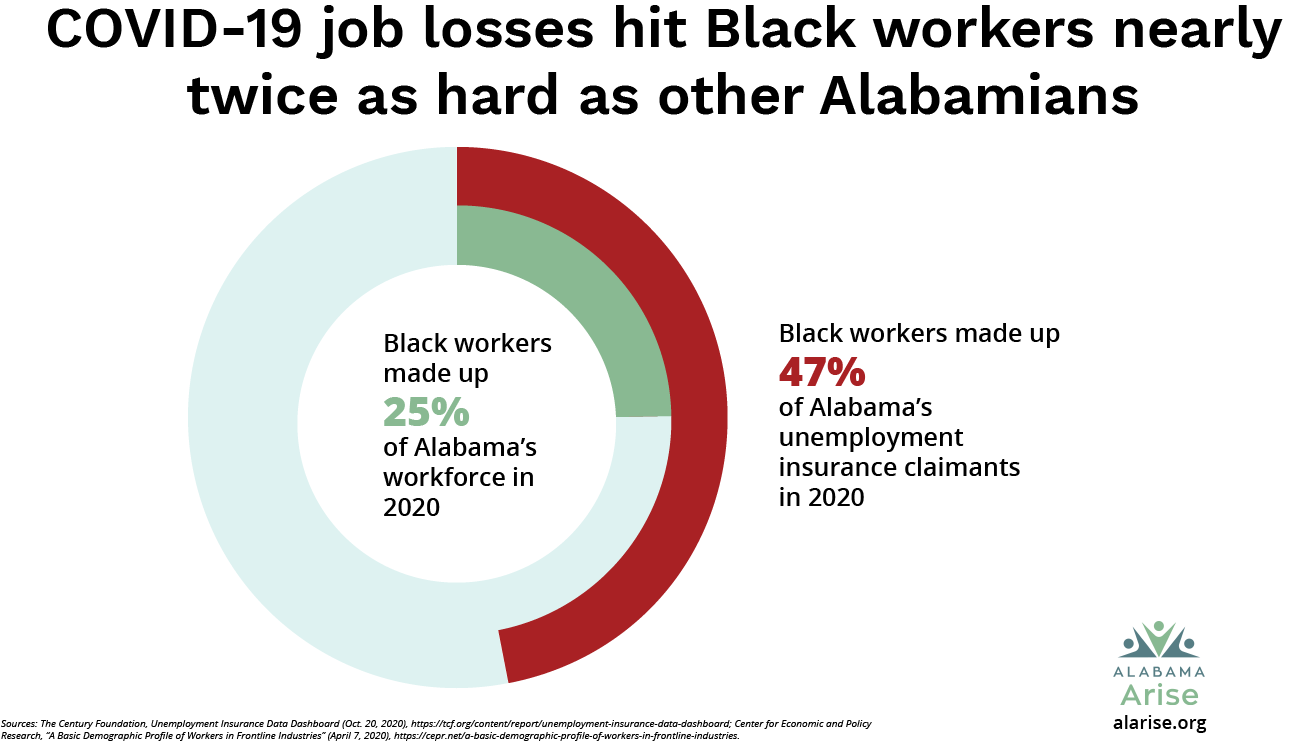
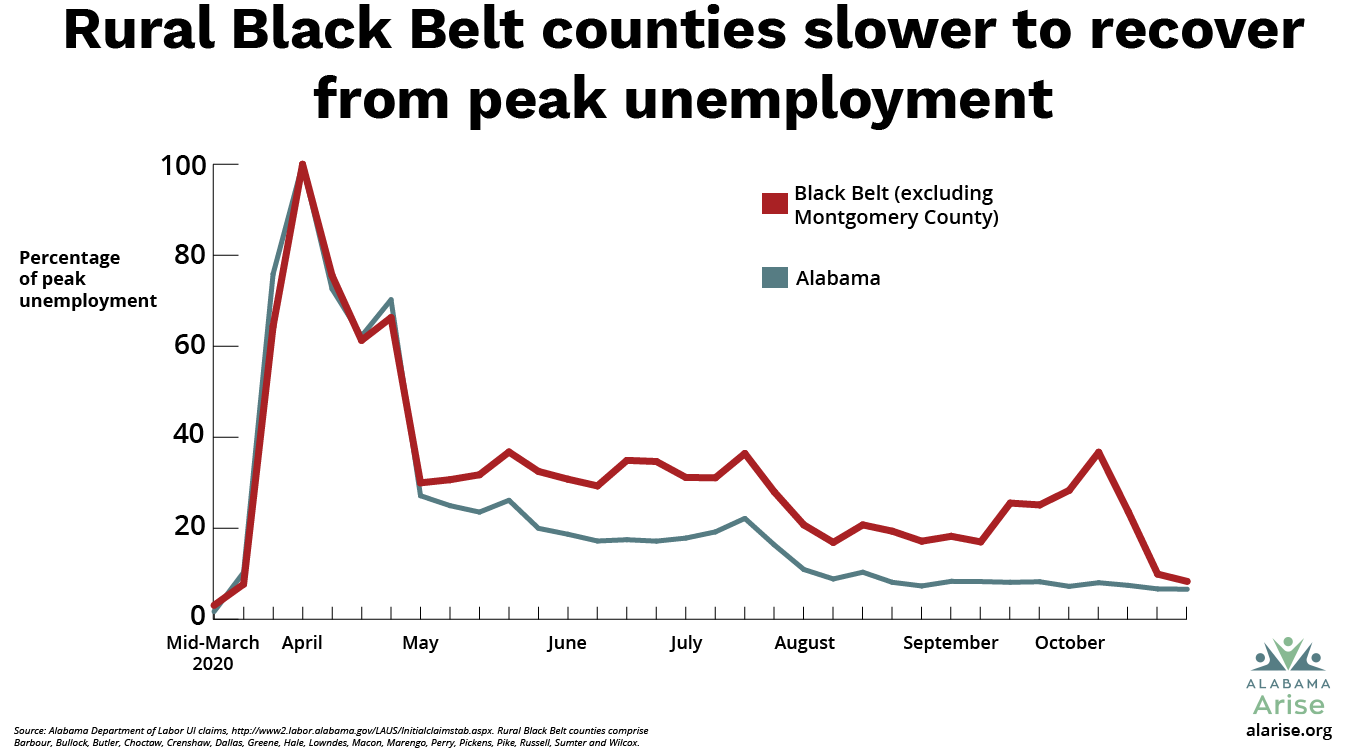
- COVID-19 has caused disproportionate unemployment for Black people and women in Alabama. Economically disadvantaged counties in the Black Belt and other parts of Alabama also have lagged behind in unemployment recovery.
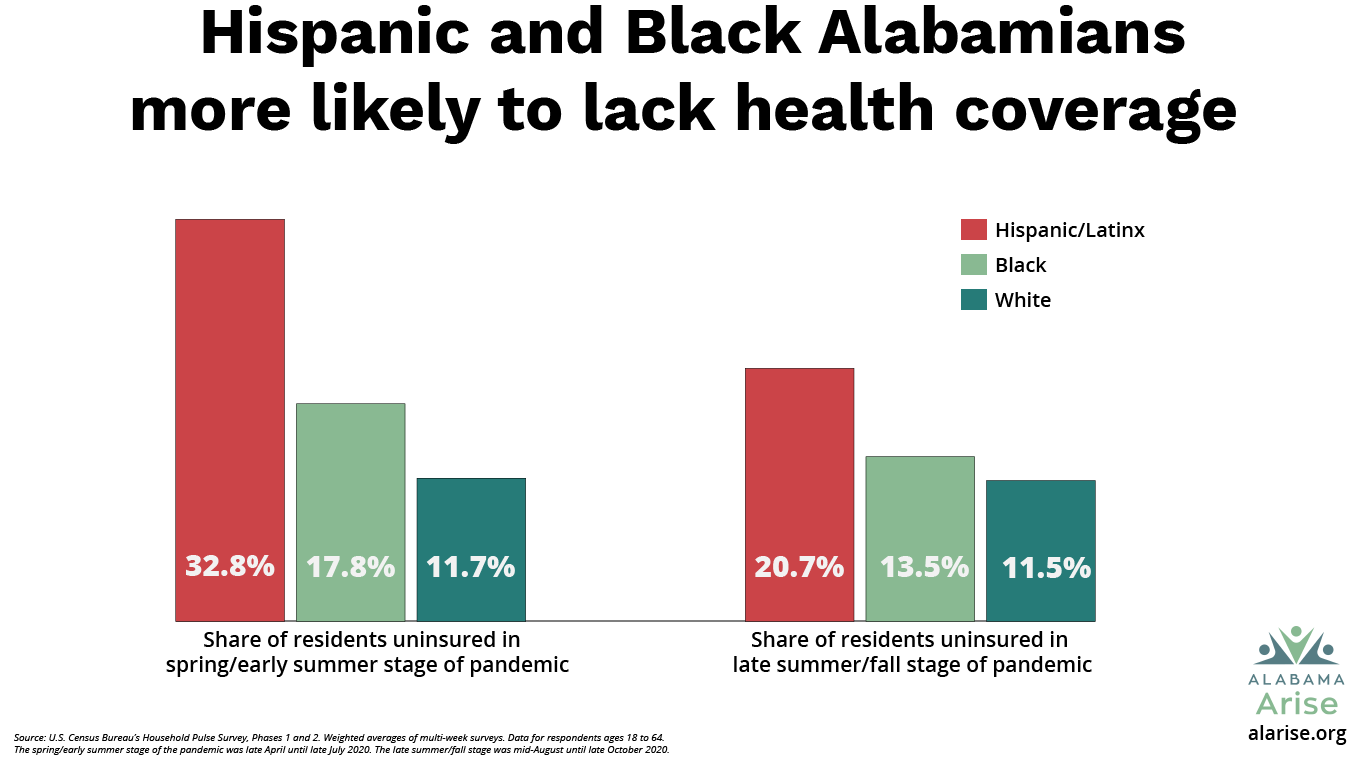
- Before the pandemic, 62.2% of Alabama’s white workers had health insurance through their jobs. The same was true for only 46.4% of Black workers and just 35.5% of Hispanic/Latinx workers. The pandemic has widened those racial/ethnic disparities in health coverage.
- Hunger has been widespread in Alabama’s communities of color during the COVID-19 recession. Early in the pandemic, nearly 21% of Black residents and 19% of Hispanic/Latinx residents said they didn’t have enough food.
- Black and Hispanic/Latinx Alabamians are at higher risk of eviction for inability to pay rent. Even basic apartments are out of financial reach for low-wage workers everywhere in Alabama.
Policies to increase equity, expand economic opportunity for working Alabamians
Alabama’s policy legacy has exacerbated the damage that COVID-19 has wreaked on working people across the state, the report finds. The State of Working Alabama 2021 outlines a policy agenda to repair that damage and promote broadly shared prosperity. Among the report’s key recommendations:
- Expand Medicaid to ensure more than 300,000 Alabamians with low incomes can afford treatment for COVID-19 and other health problems.
- Guarantee permanent paid sick leave for all working Alabamians, so that no one has to choose between earning a paycheck and going to work sick.
- Roll back the 2019 cuts to Alabama’s UI benefits and create a modernized claims system capable of handling future crises.
- Provide state support for the Alabama Housing Trust Fund and abandon efforts to impose harmful limits on safety net programs.
- Expand high-speed, affordable broadband technology, targeting rural and low-income communities and explicitly addressing racial equity in broadband access.
“The economic, racial and gender inequities in Alabama are preventable and reversible,” Alabama Arise policy director Jim Carnes said. “These disparities are the direct result of bad policy choices in the past. By making better choices now and in the future, we can chart a path toward a more equitable economy. The power to build a stronger, more inclusive Alabama is in the hands of our lawmakers – and all of us.”
About The State of Working Alabama 2021
Click here to read the executive summary of The State of Working Alabama 2021. Links to each of the report’s seven sections are available at the bottom of the page. You also can jump directly to a section using the links below.
- Introduction: The high cost of failing to protect the common good
- Unequal by design: COVID-19 and Alabama’s policy legacy
- Assessing the damage: COVID-19 and Alabama’s labor market
- Praised but underprotected: Front-line workers in the pandemic
- Why coverage matters: Health care in the time of COVID-19
- The ugly reality: Alabama’s hunger problem during the pandemic
- No place to call home: Housing insecurity amid COVID-19
The State of Working Alabama 2021
Introduction
When the COVID-19 pandemic hit Alabama in March 2020, it didn’t just cause massive human suffering and economic disruption. It also revealed suffering and disruption that have long existed and that policymakers have long neglected – or even perpetuated.
COVID-19 has laid bare deep racial inequities in Alabama’s economy and social system that have left our state unprepared to meet the needs of its people in this disaster. As the workers predominantly on the front lines, women and people of color bore the brunt of the economic meltdown. They also simultaneously have suffered greater exposure to the virus that caused it.
Alabama has a weak safety net for struggling families and an approach to economic growth that all too often leaves workers underprotected and underpaid. This ongoing policy legacy has exacerbated the damage that the virus has wreaked on the state’s working people.
In The State of Working Alabama 2021, Alabama Arise explores COVID-19’s significant and negative impacts on the state’s workforce. We also look ahead to outline a state and federal policy agenda for repairing the damage – not by repeating the policy mistakes of the past, but by charting a new path toward a more equitable economy marked by broadly shared prosperity.
Report navigation
You can read all seven sections of the report by clicking on the corresponding section’s icon at the bottom of this page. The executive summary of each section and of some of the report’s key policy recommendations is below, as are the report acknowledgments.
You can click any image in this report to enlarge it. To download a printable version of the executive summary, click here. To read our news release on the report, click here.
COVID-19 and Alabama’s policy legacy
COVID-19 struck Alabama’s families and communities hard, and the toll has been especially high for Alabamians of color. The virus and the shutdown exacerbated massive underlying disparities in health care, economic security and access to essential resources that policymakers have long ignored. And they revealed how our neglect of the common good – through low wages for average working people, low taxes for rich people and racially discriminatory policies for our entire state – has left many Alabamians unable to weather a crisis and hindered the entire state’s ability to rebound.
- The “essential workers” hailed as pandemic heroes often lack the basic protections of a living wage, health insurance, paid sick leave and family medical leave.
- Alabama’s fundamental state policies have been unequal by design, including its explicitly racist 1901 constitution. Right-to-work laws, preemption and other measures have blocked efforts to protect and support working families.
- Working Alabamians without health coverage are at even greater risk during the pandemic due to extension of broad liability protection to corporations and other entities for damages related to COVID-19.
Labor market
The COVID-19 recession hit vulnerable Alabama workers hard and fast, disproportionately affecting women and workers of color.
- Alabamians working in already low-wage industries suffered immediate and severe job losses, which fell hardest on women and people of color. By December 2020 – nine months into the pandemic – Alabama still had a net loss of 35,400 jobs, a 1.7% decline from pre-pandemic levels. The hardest hit industry was leisure and hospitality, including entertainment and food service establishments where workers were already struggling.
- Unemployment insurance (UI), designed for just such a moment, was inadequate and insufficient to meet working people’s needs because of Alabama’s policy choices. In 2019, the state cut compensable weeks of UI and tied benefit extensions to longer-term statewide unemployment rates. This framework is wholly unsuited to catastrophe response.
- COVID-19 has caused disproportionate unemployment for Black people and women. Economically disadvantaged counties in the Black Belt and other parts of Alabama also have lagged behind in unemployment recovery.
- Alabama’s lack of investment in updated claim processing systems has caused harmful lags in paying out UI claims. The state’s failure to modernize claim processing damages the well-being of people who drive the economy. Modernization would be quick, efficient and helpful to Alabamians.
- Alabama’s failure to invest in rural broadband made it even more difficult for people in large swaths of the state to work or attend school remotely. This “digital divide” is depriving many Alabamians of opportunities to learn and earn.
Recommendations
- Establish a state minimum wage significantly higher than the current federal minimum wage. The pandemic recession’s impacts have fallen hardest on people who were already struggling to make ends meet.
- Roll back the harmful 2019 cuts to UI benefits. Those changes reflected a shortsighted approach to UI and demonstrated counterproductive hostility to working people who have lost their jobs.
- Invest in support structures to allow communities that are at an economic disadvantage to participate fully in the workforce.
- Create a reliable, modernized claims system capable of handling a crisis with claims significantly exceeding peak UI claims resulting from the pandemic.
- Expand high-speed, affordable broadband technology, targeting rural and low-income communities and explicitly addressing racial equity in broadband access.
Front-line workers
Since the beginning of the COVID-19 pandemic, Alabamians have come to recognize a new category of “heroes.” Front-line workers in grocery stores, hospitals, pharmacies and other settings perform necessary tasks to keep our communities functioning during the public health emergency.
- Front-line workers, who face greater exposure to COVID-19 than the general population, are disproportionately women and people of color. Because of barriers to health care, Black and Hispanic/Latinx workers also are more likely to have underlying conditions that worsen COVID-19 outcomes. State and national policy failures on the pandemic response, especially inadequate supplies of personal protective equipment (PPE), are more likely to hit front-line workers the hardest.
- Thousands of working Alabamians were left out of paid sick days protections. Between half and three-quarters of all Alabamians were left out of the paid sick days protections in the federal Families First Coronavirus Response Act. This omission places entire workplaces at risk of exposure to the virus.
Recommendations
- Implement hazard pay for front-line workers during the pandemic.
- Guarantee permanent paid sick leave for all working Alabamians, regardless of employer size, so that no one has to choose between earning a paycheck and going to work sick.
- Expand Medicaid so front-line workers have affordable, timely access to treatment for health risks that worsen COVID-19 outcomes.
Health care
While the COVID-19 pandemic has slammed all segments of our economy and society in one way or another, health care is where most of these effects converge.
- Alabama had the 11th highest COVID-19 death rate among states in mid-February 2021. That means a higher share of Alabamians have died from the virus than in most other parts of the country. By mid-February, Alabama’s COVID-19 deaths in less than a year had surpassed 9,200, far more than the number of Alabamians who died in World War II and all subsequent wars (8,215).
- COVID-19 has exposed a shameful legacy of unequal access to health care. In the early days of the pandemic, Black Alabamians accounted for as many as 55.2% of Alabama’s daily COVID-19 deaths, more than double their 26.8% share of the population.
- The pandemic widened racial/ethnic disparities in health coverage. Before the pandemic, 62.2% of Alabama’s white workers had health insurance through their jobs. The same was true for only 46.4% of Black workers and just 35.5% of Hispanic/Latinx workers. Early in the COVID-19 shutdown, Hispanic/Latinx Alabamians reported lack of insurance at nearly three times the rate of white residents.
- COVID-19’s disparate impact on communities of color has opened a new conversation about health equity. A smart recovery will take a broader approach to building a healthy workforce by adopting policies that address food security, adequate housing and other social determinants of health.
Recommendations
- Expand Medicaid to cover more than 300,000 Alabama adults with low incomes. This health coverage expansion would facilitate COVID-19 testing, treatment and vaccination; allow working people to stay healthier and more productive; and strengthen Alabama’s health care system, especially rural hospitals. The Legislature’s eagerness to provide businesses with immunity against COVID-19 liability claims only makes the need for worker protections like health coverage more urgent.
- Make reducing health disparities a state priority. Alabama should adopt a rigorous program of data collection across state agencies to identify disparities in health outcomes related to race/ethnicity, income and geography. This effort should engage research universities and state health agencies in developing and implementing a strategic plan to reduce targeted health disparities and give all Alabamians a chance to thrive.
Hunger
Job and income losses during the pandemic have contributed to widespread hunger in Alabama.
- Too many people struggled to keep food on the table during the COVID-19 pandemic. During the spring/early summer stage of the pandemic (April through July 2020), 12% of all Alabama families and 13% of Alabama families with children either sometimes or often didn’t have enough food to eat.
- Hunger was much more widespread in communities of color. Nearly 21% of Black residents and 19% of Hispanic/Latinx residents said they didn’t have enough food.
- Proven safety net programs played a critical role in alleviating hunger. Food assistance through the Supplemental Nutrition Assistance Program (SNAP) was key to helping hundreds of thousands of Alabamians keep food on the table during this recession. And emergency food and child nutrition services eased hardship among Alabama’s children as schools closed or went virtual.
Recommendations
- Alabama lawmakers should abandon efforts to slash the state’s safety net. Past proposals to restrict SNAP and other safety net programs would have made the recent hunger and hardship in Alabama even more dire.
- Congress should move quickly to institutionalize recently increased UI, child nutrition and SNAP assistance. Hunger has grown during the pandemic, reaching crisis proportions. Boosts to UI, child nutrition and SNAP benefits have been essential tools to help struggling Alabamians meet their basic needs.
- Congress should provide additional cash assistance, similar to the earlier relief payments, targeted specifically to families with low incomes. Targeted relief should include a fully refundable Child Tax Credit and an expanded Earned Income Tax Credit (EITC). Relief payments were a significant source of cash for food and other basic needs during early stages of the recession. And federal assistance will remain important as struggling Alabamians rebuild in the aftermath of the COVID-19 recession.
Housing
Thousands of Alabamians face potential eviction and homelessness because of inadequate response to the COVID-19 pandemic and its associated recession.
- Alabamians can’t afford adequate housing. Many Alabamians in the workforce face housing insecurity because low wages burden renters heavily. Even basic apartments are out of reach for low-wage workers everywhere in the state.
- COVID-19 has caused increased housing insecurity. Alabamians face high risk of eviction during the COVID-19 pandemic, largely because of insufficient state-level protections.
- Housing insecurity is significantly racially disparate. Black and Hispanic/Latinx Alabamians face far higher risk of eviction for inability to pay rent. Long-standing inequities in the state’s economic structure have caused Black and Hispanic/Latinx communities to have fewer resources in reserve for weathering hard times.
Recommendations
- Fund the Alabama Housing Trust Fund (AHTF). Lawmakers in 2012 created the AHTF as a vehicle to promote safe, affordable homes for people with extremely low incomes. A small increase in the recording fee for mortgages could boost the AHTF and significantly increase housing availability. This would facilitate more construction of affordable homes in the Black Belt and other rural areas.
- Renew the state moratorium on evictions. Job losses amid the pandemic recession are causing evictions that otherwise would not have happened. The current limited federal moratorium fails to cover all Alabamians and requires administrative hurdles that leave holes in the system. By restricting evictions during the pandemic to reasons directly related to public safety, the governor could protect thousands of Alabamians from higher risk of COVID-19 transmission and from devastating long-term economic consequences.
Acknowledgments
This Alabama Arise report was made possible by a generous grant from EARN in the South. The findings and conclusions presented in this report are those of Arise and do not necessarily reflect the opinions of EARN in the South.
The report’s authors are Arise policy director Jim Carnes, policy analysts Carol Gundlach and Dev Wakeley, visiting fellow Allan Freyer and intern Resha Swanson. Arise communications director Chris Sanders was the report’s primary editor. Arise communications associate Matt Okarmus designed the charts and graphs and provided online design for the report. Bixler Creative designed the report logo and provided print design for the executive summary. Other report editors and contributors included Arise executive director Robyn Hyden and organizer Mike Nicholson.
Special thanks to Adelante Alabama Worker Center for producing a companion report to The State of Working Alabama 2021 and to Marie-Pier Frigon at New Mexico Voices for Children for providing guidance on chart and graph design.
The State of Working Alabama 2021