
Meet Rebecca Howard, Arise’s new policy and advocacy director! Rebecca introduces herself to our members before discussing the latest news on ARPA funding in Alabama and our thoughts on the recent federal court decision on the state’s congressional maps.
Issue: Budgets
Arise legislative recap: Jan. 25, 2022
The Alabama Legislature has stepped away briefly from its regular session for a special session on federal COVID-19 relief funds. Arise executive director Robyn Hyden provides an overview of how lawmakers plan to allocate the next portion of American Rescue Plan Act (ARPA) money this week. And she explains why affordable housing and public transportation should be among the top priorities for the next round of ARPA funding.
New poll: Alabamians strongly support use of ARPA funds to protect rural hospitals, increase mental health services
Alabama’s likely voters overwhelmingly support using federal COVID-19 relief funds to increase funding for mental health and rural hospitals, according to a new Alabama Arise poll released Monday.
More than four in five respondents (81.1%) supported using a portion of Alabama’s funding under the American Rescue Plan Act (ARPA) to invest in rural hospitals and increase rural Alabamians’ access to health care. And nearly three in four likely voters (73.6%) said lawmakers should boost mental health funding to increase access to services across Alabama. Among Republican voters, 80.1% supported investments in rural hospitals and 67.7% supported more mental health care funding.
“Alabamians are loud and clear that they want our lawmakers to use federal relief money to strengthen our state’s health care system,” Alabama Arise executive director Robyn Hyden said. “The COVID-19 pandemic has strained health care workers like nothing before in our lifetimes. And it has exposed and worsened our state’s persistent racial and geographic health disparities.
“ARPA offers an unprecedented chance to protect rural hospitals and increase access to mental health care and other services. We must seize this opportunity to build a healthier future for Alabama.”
Child care, housing, public transportation also enjoy strong public support
Sizable majorities also approved of other potential uses of ARPA money to improve living conditions for Alabama’s children and families. Those proposals include:
- Expanding access to subsidized child care for working families.
- Establishing a state child tax credit to lower costs for working families.
- Expanding access to affordable housing throughout the state.
- Investing in public transportation, particularly in rural areas.
Alabama will receive a total of more than $2 billion in ARPA funds. Lawmakers last year appropriated $400 million of that amount toward prison construction and $80 million to hospitals and nursing homes. This week, the Legislature will vote on a plan to spend another $772 million of ARPA funds. Most of that money would go toward broadband internet expansion, water and sewer improvements, and additional funding for hospitals, nursing homes and assisted living facilities.
The state expects to receive the remaining $1 billion in ARPA funds later this year. Arise’s poll shows the public wants legislators to use that money to ease economic stress on Alabama households, Hyden said.
“The pandemic has made it harder for people across our state to find child care, keep a roof overhead and get where they need to go,” Hyden said. “We should use ARPA funding to ease families’ suffering and provide the supports needed to help every Alabamian succeed. It’s time for our lawmakers to meet this moment and ensure Alabama’s post-pandemic future is a bright and inclusive one.”
About the survey
Alabama Arise commissioned the poll, which the Montgomery-based firm Cygnal conducted Jan. 13-14. The poll surveyed 631 likely voters across Alabama and has a margin of error of +/- 3.85%. Interviews of known registered voters occurred via live phone calls, online panel, texts and email invitation.
Click here for Arise’s poll results on ARPA funding priorities in Alabama.
Alabama Arise testimony on ARPA funding priorities in Alabama
Alabama Arise’s Robyn Hyden testified Wednesday before a joint meeting of the House and Senate’s General Fund budget committees. She discussed Arise’s top priorities for lawmakers’ allocation of federal relief funds under the American Rescue Plan Act. Here’s the full text of Hyden’s prepared remarks:
Good afternoon. My name is Robyn Hyden. I am the executive director of Alabama Arise, and I appreciate the opportunity to speak to you today.
The passage of the American Rescue Plan Act gives us an opportunity to create vital long-term improvements for Alabama – if we spend these funds wisely and well. We recognize that there are many serious needs in the state and that not all of them can be addressed with the funds that will be appropriated during this special session. Therefore, my comments are about the funds currently under consideration and those that will be received later this year.
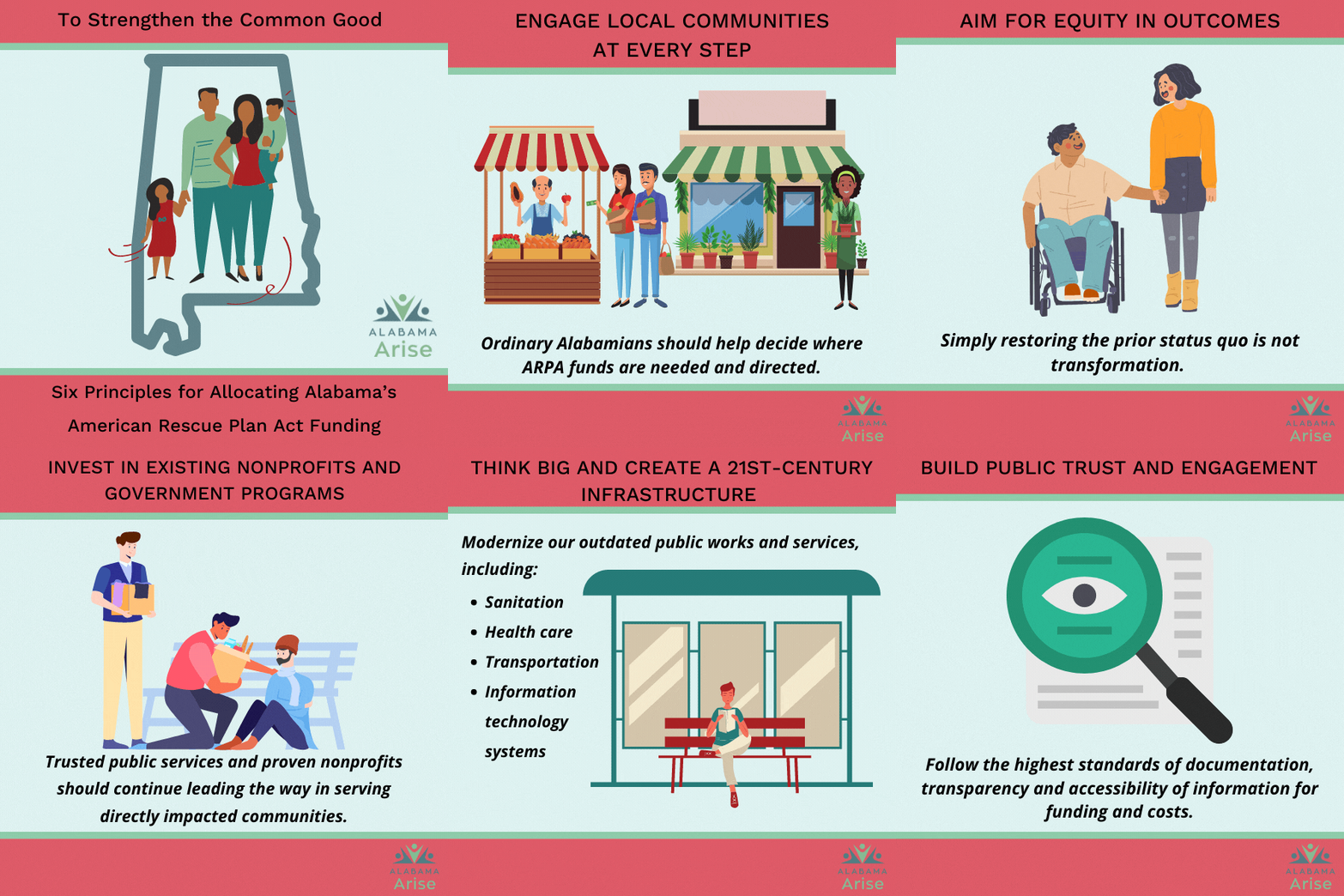
Last July, Alabama Arise and more than 40 other organizations wrote Governor Kay Ivey and other Alabama leaders outlining our principles for the use of ARPA funds. One of our first principles was that we should aim for equity in outcomes, providing assistance to those most deeply impacted by COVID-19.
We applaud the commitment in the draft bill to clean water and sewer infrastructure, particularly in Alabama’s Black Belt, where sewer infrastructure is a critical need. We urge you and the Department of Environmental Management to provide these funds with as few barriers and as little red tape as possible so that the communities most in need can benefit the most.
Prioritize health care, housing, public transportation
Just last week, Alabama Arise and Cygnal surveyed a random sample of likely 2022 voters and asked them how Alabama should spend ARPA dollars. Strong majorities supported spending these funds to expand access to medical care, including Medicaid and mental health services, and as an investment in rural hospitals and access to affordable care.
Strong majorities also supported using ARPA dollars to expand access to affordable housing and public transportation, particularly in rural areas.
Alabama Arise also has some additional recommendations for how ARPA funds can most benefit the state and its neediest citizens:
- We recommend that you invest $25 million in the existing Alabama Housing Trust Fund to expand affordable housing in the state.
- We recommend that you invest $20 million in the existing Alabama Public Transportation Trust Fund to improve public transportation, particularly in rural areas of the state.
- And we recommend that you invest in modernizing the state’s computer systems so that when the next crisis arises, Alabamians have a one-stop location to apply for state services, without the long waits and delays experienced by people applying for unemployment insurance and other benefits last year.
Thank you for your time and attention.
Arise legislative recap: Jan. 18, 2022
The Alabama Legislature is back in session, and Alabama Arise will keep a close eye on policy developments in the coming months. Arise’s Carol Gundlach previews the state budgets and discusses the rare opportunity our lawmakers have to create a more equitable Alabama using federal relief funds.
Six ways Alabama should use ARPA funds to build a better, more inclusive future
The Alabama Legislature’s 2022 regular session, which began Tuesday, will be unusual in one important way. For the first time in many years, Alabama has more than enough revenue to maintain its bare-bones public services. That means instead of scrambling to avoid cuts, the legislative focus can be on strengthening investments in our state’s future.
Both the Education Trust Fund (ETF) budget and the General Fund (GF) budget, which funds non-education programs, have seen tax revenues rise more than 10% in the last year. ETF revenues actually increased 16% in 2021. In addition, Alabama has about $1.6 billion of federal relief funds remaining under the American Rescue Plan Act (ARPA). President Joe Biden signed ARPA into law in March 2021.
Alabama lawmakers already allocated $480 million of the state’s ARPA money last year. Of that amount, $400 million went toward prison construction and $80 million went to hospitals and nursing homes.
Budget growth faces sustainability challenges
State budget officials have steadily cautioned lawmakers to consider the one-time nature of both relief money and the bump in tax revenues. Recent revenue growth almost certainly will not be sustained in future years, budget officials warn. And one-time ARPA funds are by definition only temporary.
Alabama’s budget officials have strongly recommended that both ARPA funds and increased state revenues be invested in programs and services that won’t require regular, recurring revenue but that still meet critical needs for the people of the state. Alabama Arise questions whether the new revenue is as unsustainable as budget officials predict. But Arise agrees that this money needs to fund big ideas that will benefit the state for years to come.
Areas for investment
If spent wisely, ARPA funds could create vital long-term improvements for Alabamians. Alabama Arise has numerous specific suggestions for what those big ideas, and investments, could be.
Serve underserved communities
 ARPA investments should focus on the most underserved areas and most underserved Alabamians. Communities of color and communities with low incomes, particularly in the Black Belt, have long-festering unmet infrastructure needs. The lack of wastewater treatment, accessible broadband internet, affordable housing and public transportation has held these communities back for decades.
In deciding where to spend new one-time dollars, the most historically neglected parts of Alabama should come first. An urgent public health need in many rural Black Belt counties is for sewer and other water treatment systems. These should be a top priority.
Modernize state technology
 A major lesson from the COVID-19 recession was that Alabama’s technology infrastructure is totally inadequate for remote access to services. Suddenly unemployed people desperately tried to apply for unemployment insurance (UI) benefits, food assistance, COVID-19 tests and other services on overwhelmed state computer and telephone systems. People who had never before applied for public assistance couldn’t find one-stop sources of information about services for which they might be eligible. And when new federal programs were created, they were hard to implement. That’s because Alabama’s computer systems didn’t talk to each other and couldn’t share information needed to help people get assistance.
Modernizing the state’s computer systems would be a great investment to increase efficiency and prepare us for the next crisis. This would allow for integrated eligibility and data sharing systems across state agencies. And it would be an opportunity to modernize and upgrade the state’s UI application and payment process.
Expand Medicaid and strengthen public health
 Alabama has failed for decades to invest adequately in our health care infrastructure, including Medicaid. The devastating toll of the COVID-19 pandemic has made the consequences of that failure apparent to everyone in the state. We need to invest now in a health care infrastructure that will improve the delivery of health services to underserved individuals and communities.
Medicaid expansion to cover adults with low incomes is an essential step to strengthen Alabama’s health care system. Other investments should include more funding for mobile health services and telehealth services. Alabama also should provide additional resources for our local and state public health departments.
Reduce hunger and promote healthier communities
 Hunger was already a large and perpetual problem across Alabama even before the pandemic. But the COVID-19 recession and its aftermath exacerbated this problem by fueling a rapid, major increase in food insecurity. Sudden income loss, rising prices and occasional shortages have made it much more difficult for many people to feed their children and families.
The Supplemental Nutrition Assistance Program (SNAP) and various child nutrition programs are essential standing resources to fight hunger in Alabama. But the state can and should do more to support our food infrastructure. Alabama should provide healthy food financing grants to expand community groceries, farmers markets and mobile markets. This would improve access to healthy foods in communities without ready access to fresh foods, especially fruits and vegetables.
Invest in affordable housing
 The COVID-19 recession has caused a wave of evictions and foreclosures across Alabama. This has occurred as the cost of housing has been driven up amid supply chain issues and fewer available workers.
Alabama could help address its housing shortage and resulting homelessness by providing $25 million for the state Housing Trust Fund. This investment would create and support jobs across the state. And it would reduce Alabama’s shortfall of more than 73,000 affordable homes for people with incomes below the federal poverty level.
Fund public transportation
 Alabama’s elected leaders, including Gov. Kay Ivey in her State of the State address, have celebrated the state’s low unemployment rate. But they also are bemoaning our state’s associated low rate of labor force participation. For more Alabamians to return to work during and after the pandemic, the state must ensure they have essential work supports. Not the least of these is transportation to and from a job or school.
Lawmakers can help people reenter the job market by investing $20 million in ARPA funds and $10 million in GF dollars in the state Public Transportation Trust Fund. These dollars would go a long way toward ensuring that people, especially those in rural areas, can get to a job and to job training. They also would help Alabama match other federal transportation dollars that can benefit the entire state.
Special sessions set stage for fast-paced 2022 regular session
The Alabama Legislature’s two special sessions this fall brought mixed results on Alabama Arise issue priorities. Lawmakers improved the state’s post-incarceration reentry policies in the first special session in September. And in the second session, which ended in November, they allocated $80 million of federal American Rescue Plan Act (ARPA) funds for costs related to COVID-19. Hospitals and nursing homes will split that amount.
But the first session ended with a misguided appropriation of $400 million – nearly a fifth of Alabama’s ARPA money – toward prison construction. And the second session saw a rush to pass bills that will slow COVID-19 vaccinations in a state with one of the nation’s lowest vaccination rates.
The second session’s primary purpose was to draw new districts for the Legislature, U.S. House and state school board. Lawmakers approved maps after little debate, in part because they understand litigation is nearly certain. Concerns about diluting Black voters’ power will be a major aspect of those suits.
Federal funds to be major topic in 2022 session
Next up is the 2022 regular session, beginning Jan. 11. One pressing issue the state faces is ensuring equitable, transformative use of federal funds. That includes remaining ARPA money, plus funds from the infrastructure package and potentially the Build Back Better (BBB) Act. The U.S. House passed BBB in November, and the Senate may vote on it later this month.
That money could advance several Arise issue priorities. Public transportation, Medicaid expansion and adequate emergency relief for people facing eviction are a few ways those funds could improve life for every Alabamian.
Alabama also faces a U.S. Department of Justice lawsuit over atrocious conditions in the state’s broken prison system. Arise will advocate for expanded safe releases for older and severely ill people, alongside sentencing and death penalty reforms. And we will continue beating back attacks on voting and democratic participation.
Legislators’ desire to hit the campaign trail means this session likely will be fast-paced. Advocates must act quickly to move policy decisions toward an Alabama that works for everyone.
Funding boosts bring opportunity to invest in Alabama’s future
Alabama’s broken tax system usually starves our state of money to fund basic responsibilities adequately. But 2022 may be different. Record tax revenues and a surge of federal recovery dollars could allow lawmakers to address longstanding state needs and inequities – if they have the political courage.
State revenues that pay for our schools, including income taxes earmarked for teacher salaries, went up 16% in 2021, according to the Legislative Services Agency. Internet sales taxes and other revenues for non-education programs grew more than 11% in 2021. Alabama also has received federal funds under the American Rescue Plan Act (ARPA) to aid recovery from the COVID-19 recession. Alabama has $580 million remaining in 2021 ARPA funds, plus another $1.06 billion coming in 2022.
Coming fast behind ARPA are federal infrastructure dollars for roads, bridges and public transportation. And if the U.S. Senate passes it, the Build Back Better Act will include new funds for child care, health care and senior services.
Transformative changes for a better Alabama
Legislators already have begun talking about how to spend this money. Alabama Arise believes wise use of these funds can make Alabama a better place for generations to come. Many of our recommendations are in our statement of principles for spending recovery dollars. A few key Arise recommendations include:
- Untax groceries. Tax cuts should help struggling Alabamians who already pay a disproportionate share of state taxes. Ending the state grocery tax is a good place to start.
- Expand Medicaid. Federal recovery dollars can help free up state money for Medicaid expansion. This would save hundreds of lives and ensure affordable health coverage for more than 340,000 Alabamians every year.
- Make the criminal justice system more just. Legislators just made a misguided decision to spend $400 million of ARPA money on new prison construction. They now should invest in meaningful policy changes like sentencing reform and other alternatives to incarceration.
Alabama lawmakers have a chance to make far-reaching and lasting changes in 2022. Arise and our members will work hard to ensure they seize this opportunity.
A year to strengthen our communities
We can’t even begin to summarize all the momentous federal policy advances realized in 2021 in one newsletter. This year brought passage of the American Rescue Plan Act (ARPA) and the infrastructure package. It brought expansion of the Child Tax Credit. And we hope it will bring the forthcoming passage of the Build Back Better (BBB) Act. That means 2022 will be a year of working diligently to advocate for fair, equitable implementation of these new investments in Alabama.
ARPA provided millions of new dollars in incentive funding to support Medicaid expansion. It also provided $2.1 billion for state COVID-19 relief and $1.9 billion for local governments. Check out our ARPA toolkit at alarise.org for resources to ensure ARPA funding goes to the priorities we all share to strengthen our communities.
If the Senate passes BBB this month, we anticipate more than 220,000 Alabamians gaining immediate access to no-cost health insurance via healthcare.gov for the next three years. Then the work of enrollment will begin! It’s not a permanent solution to our state’s health care coverage gap, but it would be a major step forward for Alabamians with low incomes. Stay tuned for alerts and ways you can support – and celebrate! – when the time comes.
Alabama Arise toolkit on the American Rescue Plan Act (ARPA)
To strengthen the common good: Six principles for allocating Alabama’s ARPA funding
The COVID-19 crisis has created enormous new challenges for Alabama, while shining a harsh light on long-neglected ones. To strengthen and expedite recovery, the American Rescue Plan Act (ARPA), passed by Congress in March 2021, is pumping $4 billion into Alabama’s economy through 2024. New funding at this scale can be transformative for our state, but only if we take a transformative approach to how we spend it.
2023 Update:
ARPA funding presents a powerful opportunity for Alabama. For the first time in many years, Alabama has more than enough revenue to maintain its bare-bones public services. That means instead of scrambling to avoid cuts, the legislative focus can be on strengthening investments in our state’s future.
Lawmakers entered a special session in March to allocate Alabama’s remaining $1 billion of ARPA funds. Alabama Arise will keep up the drumbeat for Alabama to use that money to fuel lasting change across our state.
Below is an update from the beginning of the legislative session on plans for the remaining ARPA funds.
On March 16, Gov. Kay Ivey signed HB 1 to end the special session she called to distribute the remaining federal funds that Alabama received under the American Rescue Plan Act (ARPA). This act provided states with federal funding to help cover losses and expenses incurred because of the COVID-19 pandemic. Lawmakers previously distributed the majority of the funds, leaving $1.06 billion to be allocated in this year’s special session.
Read more on our blog: Alabama lawmakers allocated the state’s final $1 billion of ARPA funds. What comes next?
2022 Update:
In a January 2022 blog post, we detailed six ways Alabama should use ARPA funds to build a better, more inclusive future. Read more here.
Later in January 2022, Arise executive director Robyn Hyden testified about our top ARPA priorities to members of the House and Senate’s General Fund budget committees. She recommended investments in public health, affordable housing, public transportation and technology improvements. Read her full testimony here.
2021-22 Special Sessions:
The Legislature allocated $480 million of ARPA funding to prison construction and health care during two special sessions in 2021. Lawmakers allocated another $772 million of ARPA money during another special session in January 2022. That money will fund a range of services, including hospitals, nursing homes, broadband expansion, and water and sewer improvements.
ARPA 101:
In a June 2022 blog post titled “ARPA 101: How the American Rescue Plan Act can build a more equitable Alabama,” Arise’s Rebecca Howard detailed what has happened so far with ARPA funds and how remaining funds can be used on initiatives such as affordable housing, public transportation and food security.
Groups urge Ivey to drive transformative change with COVID-19 relief funds
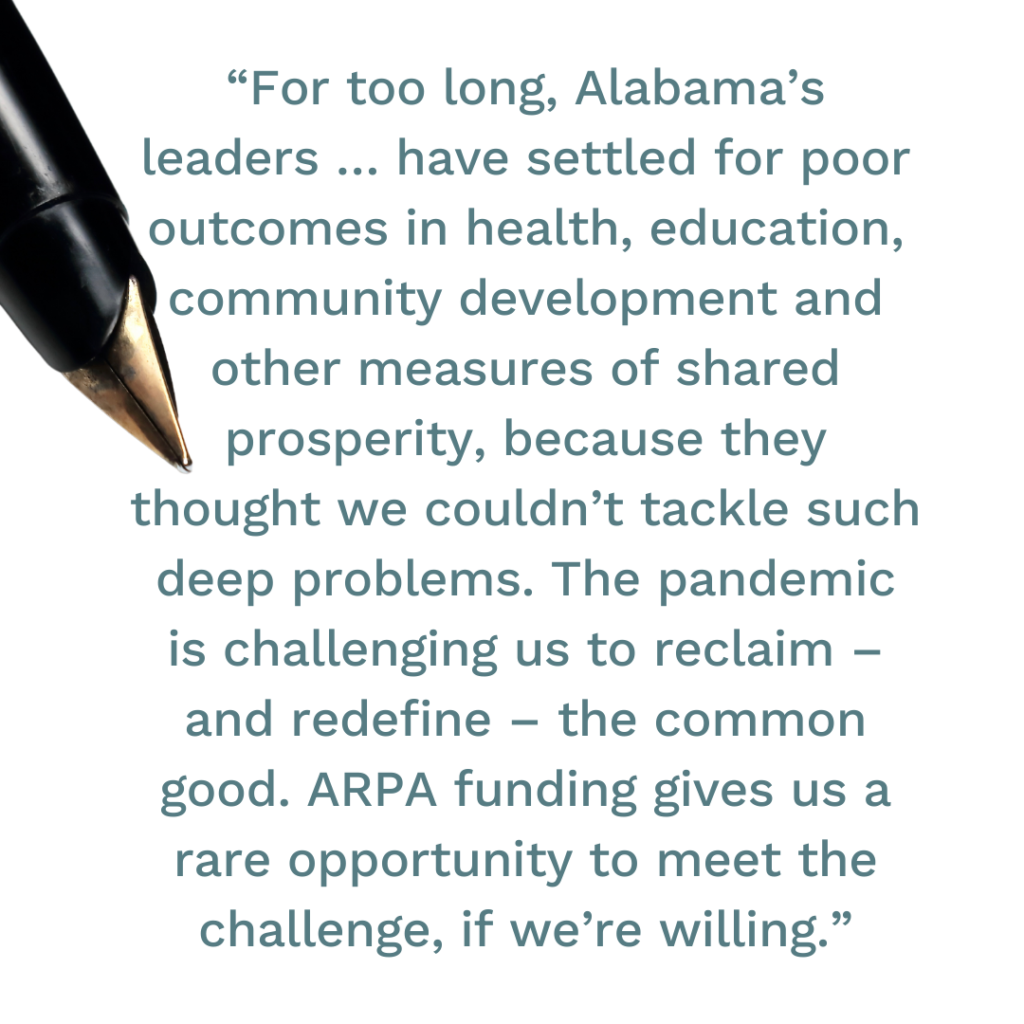
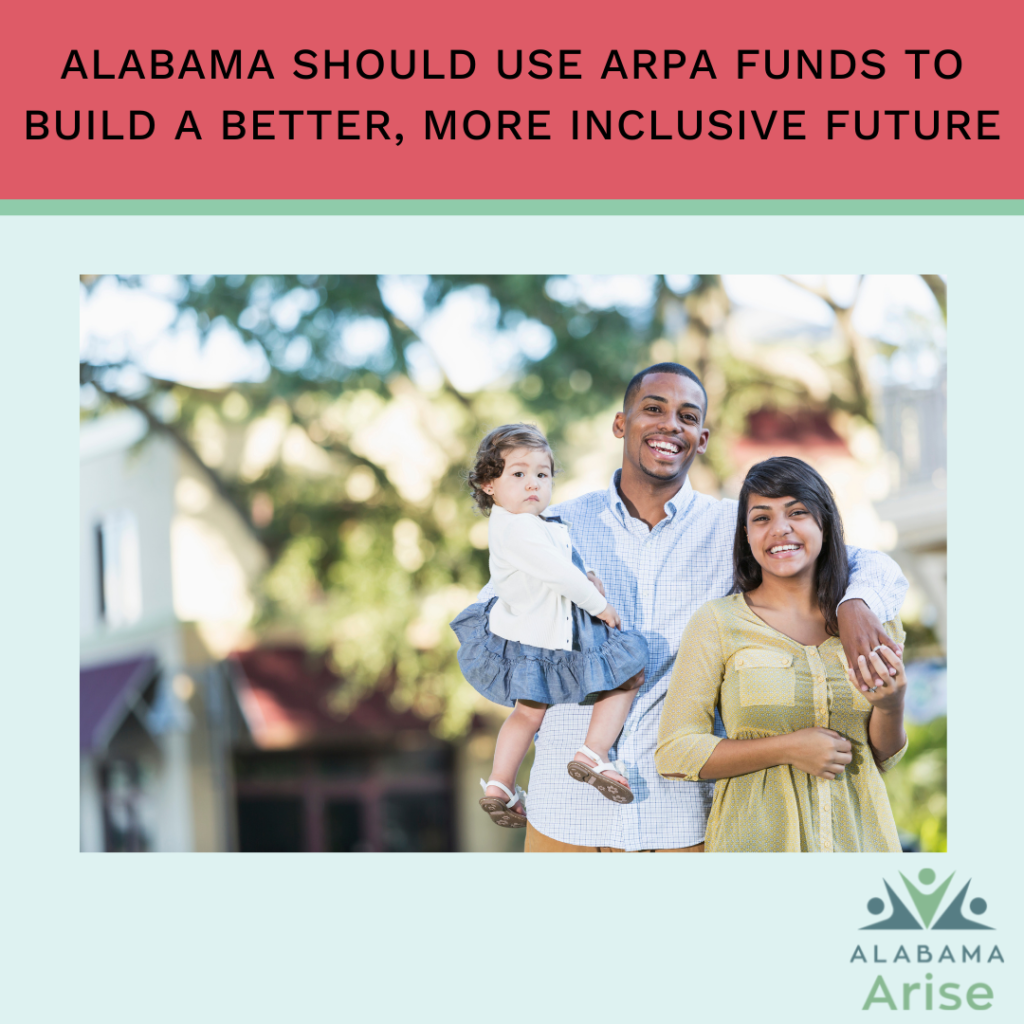
Alabama’s likely voters overwhelmingly support using federal COVID-19 relief funds to increase funding for mental health and rural hospitals, according to an Alabama Arise poll released in January 2022. Sizable majorities also approved of other potential uses of ARPA money to improve living conditions for children and families. Those proposals include expanding child care, establishing a state child tax credit and investing in affordable housing and public transportation. Read the full poll results here.
The State of Working Alabama
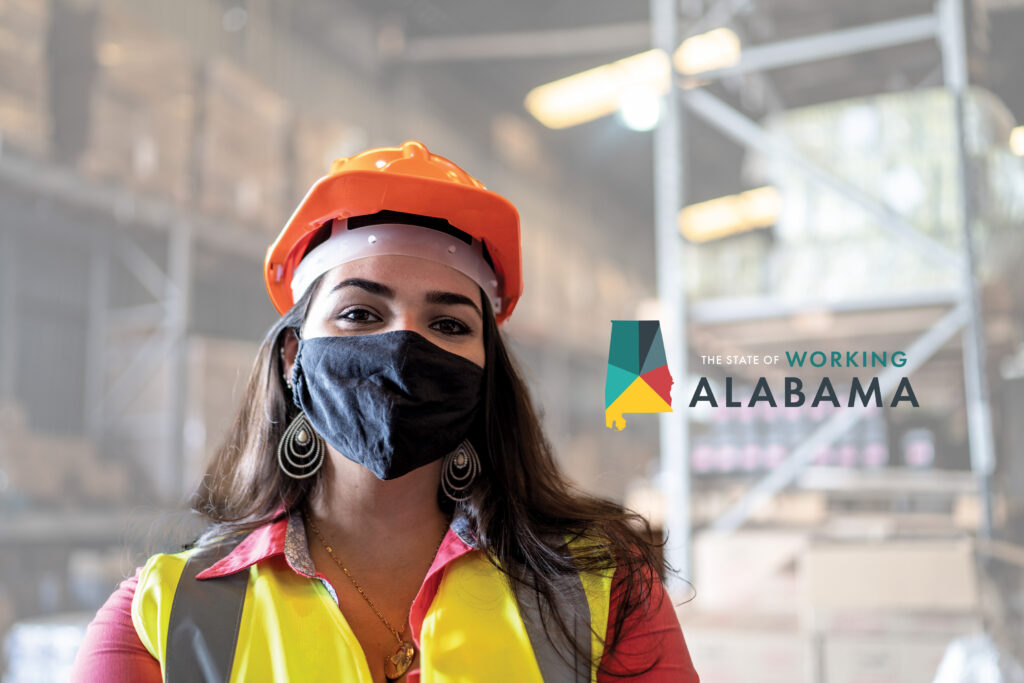
In The State of Working Alabama 2021, Alabama Arise explored COVID-19’s significant and negative impacts on the state’s workforce. We also looked ahead to outline a state and federal policy agenda for repairing the damage – not by repeating the policy mistakes of the past, but by charting a new path toward a more equitable economy marked by broadly shared prosperity.
Tell us about the priorities in your community!
Additional ARPA resources
- Alabama Legislative Services Agency: Federal funds update, Jan. 20, 2022 (opens as PDF)
- Alabama School Readiness Alliance: Webinar on utilizing American Rescue Plan funding to accelerate early learning
- Alabama State Board of Education: State Plan for the American Rescue Plan Elementary and Secondary School Emergency Relief Fund
- Center on Budget and Policy Priorities: American Rescue Plan Act will help millions and bolster the economy
- Pandemic Response Accountability Committee: Federal oversight of COVID-19 relief spending and programs
- Southern Economic Advancement Project: The ARP toolkit
- Southern Economic Advancement Project: ARPA Spending Tracker
- U.S. Department of Treasury: Guidance on Coronavirus State and Local Recovery Funds
- A+ Education Partnership: COVID School Spending Tracker