Voting rights reforms face uphill climb, anti-democratic political sentiments

All Alabamians should be able to exercise the right to vote without facing suppression, administrative hurdles, or manipulation by elected officials. But the infrastructure of democracy in Alabama falls short of that standard. Efforts to protect and expand voting rights for Alabamians in the past session took place amid a national atmosphere of outlandish conspiracy theories and outright lies about election security. Some states have used these lies to pass bills restricting voting rights.

For example, Georgia passed a broad voter suppression bill this year that shortens time frames for absentee ballot applications, allows state-level election officials to remove local officials, and criminalizes giving food or water to voters while they wait in line.

And like voters in neighboring states, Alabamians faced varied voter suppression attempts. For example, bills to restrict voter assistance in filling out ballots (HB 575, by Rep. Mike Holmes), prevent response by elected officials to emergency election concerns (HB 399, Rep. Wes Allen), and forbid payment to voter outreach organizations based on the number of voters who vote (HB 70, Rep. Jamie Kiel) were all introduced this session.

Alternative methods of voting attacked

Additionally, the Legislature delayed and killed multiple bills that would have increased access to voting for eligible Alabamians. Rep. Laura Hall’s HB 396 would have allowed voters to cast absentee ballots without providing an excuse from a list of state-approved reasons for absentee voting.

Early in the session, Hall had bipartisan support for this bill. Secretary of State John Merrill sent a staffer to the public hearing on HB 396 in the House Constitution, Campaigns and Elections (CC&E) Committee meeting to speak in favor of the bill. But partisan opposition arose in the committee during that hearing and soon after on talk radio. By the next week, Merrill had abandoned the bill and distanced himself from his longstanding if quiet support of no-cause absentee voting.

The right to vote received this same unabashed political consideration in other bills as well. Rep. Wes Allen introduced a bill to prohibit mail-in voting and prevent the secretary of state from responding to disasters by issuing emergency election rules. If that bill had been in effect during the 2020 election, Alabamians could not have voted an absentee ballot to avoid a crowded gathering during the COVID-19 pandemic.

But HB 399 wasn’t the only bill to pander to the false claim that the 2020 election was somehow insecure or flawed. Other bills also sought to restrict executive branch officials from responding to emergencies that affect elections, and those bills also failed to become law. Rep. Arnold Mooney’s HB 638 would have prevented local officials from extending voting hours in response to emergencies.

Both sides saw voting rights issues essentially reach a stalemate

While Arise advocates and our partners stopped many of the worst bills, positive reforms faced severe opposition across the board. Bills to allow early voting, same-day voter registration, and automatic voter registration through DMV record updates didn’t advance at all. In fact, most reform bills were never even placed on the calendar in the House CC&E Committee.

One reform bill did make significant headway, though. SB 118, by Sen. Linda Coleman-Madison, would have streamlined the process for people returning from prison to regain their right to vote. This bill also would have removed the requirement to pay fines and fees to regain the right to vote. That requirement is effectively a poll tax and prevents many Alabamians from full participation in civic life.

But in order to advance the bill through the Senate, the anti-poll tax provision was stripped out after it became clear that the bill would not pass without removing it. And even after the Senate passed SB 118, the House CC&E Committee failed to advance it further.

Through nearly the entire session, the voting rights issue remained fairly stalemated. Voting rights advocates found their bills slowed and killed by legislators hostile to expanding voter access, and voting rights opponents found their bills stalled because of ardent public opposition to new restrictions.

Legislature forces through anti-democratic, racist bill at end of session

Unfortunately, on the last night of the session, SB 235 / HB 285, sponsored by Sen. Dan Roberts and Rep. Wes Allen, respectively, passed the Senate, the final step it needed for legislative passage. This bill prohibits curbside voting, even though no jurisdictions offered curbside voting in the 2020 election cycle.

This bill directly furthers the false conspiracy theories surrounding the 2020 election. The 2020 Alabama general election saw no accusations of systemic problems for voters, no accusations of election fraud, and no curbside voting available for the public. And during the initial Senate debate on SB 235, even senators who ended up voting for it admitted it was unnecessary because curbside voting was unavailable, because the recent election was secure, and because the Secretary of State’s office prohibited the practice by rule already.

Further, SB 235’s passage will almost inevitably get the state sued, and the state should lose the lawsuit. In passing this bill, the Legislature has inscribed in the state code that Alabama refuses to grant accommodations to voters with disabilities, older voters, and pregnant voters.

While polling places are required to be accessible to voters with disabilities, too many Alabama polling places fail to meet that legal obligation. Allowing election officials to meet those voters at the curb is a way to meet the needs of voters who can’t access their designated polling place on election day. Sen. Bobby Singleton introduced SB 377 to remedy this looming legal problem, but this bill was voted down in committee 1-8 along straight party lines.

SB 235 faced a filibuster when it was placed on the calendar on the session’s last day. In the state’s long tradition of hostility to voting rights for all Alabamians, SB 235 fits the pattern of wealthy, influential areas oppressing voters with less power. SB 235’s purpose is to prevent local jurisdictions populated and run by Black Alabamians from making voting more accessible to their citizens. After Black senators opposing the bill repeatedly pointed out this bill is born from hostility to voting rights and furthers inequity, the Senate voted 25-6, again on a straight party line, to silence debate on the bill and force a vote.

The feds aren’t coming to save the state from itself, so where do we go from here?

At the federal level, the House passed HR 1, the For the People Act, an omnibus voting rights bill that contains many of the provisions Arise has supported at the state level. Among them, HR 1 would force states to implement automatic voter registration, no-cause absentee voting, and early voting for federal elections.

This bill would also return Section 5 of the Voting Rights Act, which required some states, including Alabama, to submit proposed changes to election procedures to the U.S. attorney general. Section 5’s preclearance provision was held unconstitutional in Shelby County v. Holder, and since that ruling, the Alabama Legislature has faced dozens of attempts to make voting more cumbersome, inconvenient, and difficult.

HR 1 has passed the House, but it faces stiff opposition in the Senate. The archaic, elitist rules of the U.S. Senate – combined with some Republican senators’ desire to fend off conservative challengers in next year’s primary and some conservative Democrats’ refusal to change filibuster rules – mean the For the People Act is unlikely to pass that chamber.

But federal dysfunction on top of political manipulation at the state level doesn’t mean progress is impossible. Alabama’s status outside the group of battleground states means that the policy arguments Arise has been making in favor of increasing democratic participation may be evaluated less on a political basis than how they improve access to democracy for all people. Automatic voter registration will still save the state money. No-cause absentee voting will still distribute the administrative workload for election officials more broadly, enabling efficiency increases.

Policies created to maintain Alabama’s longstanding racist social and economic structure can be overcome with sufficient public pressure. And in fact, that public pressure is what killed most of the bad bills facing the people of Alabama this year. The Legislature did not prevent the governor from responding to emergencies. Local election officials did not have their ability to extend hours curtailed when facing disasters.

These significant defensive victories happened because legislators heard from Alabamians who do not believe the right to vote should be a political football. The next major undertaking will be moving from defensive victories to bold steps forward that free Alabamians from the chains of the state government’s past hostility to equitable voting rights. The racially divided, partisan and nakedly political passage of SB 235/HB 285 shows we have a steep hill to climb. But transformational victories will come as advocates build power and push legislators toward a just Alabama that welcomes full democratic participation.

The dark road not taken in the 2021 regular session

Predicting actions and outcomes of a legislative session is never an easy bet. When the Alabama Legislature opened its 2021 regular session in February, our crystal ball was even cloudier than usual.

Strong currents of anxiety were sweeping the country amid fear and frustration over COVID-19 and precautionary measures, conflicting beliefs about racial justice and law enforcement, and the aftershocks of a bitter presidential election. In state after state, lawmakers proposed harsh reactions to each of these pressures, and Alabama appeared ready to follow suit.

On the pandemic front, governors and public health officials faced new limits on their emergency authority. Basic freedoms of assembly and speech came under threat by officials seeking to prevent protests like those that followed George Floyd’s murder by a Minneapolis police officer. Dissatisfaction with election results fueled efforts to narrow access to the electoral process, particularly for communities of color.

Harmful bills targeting all of these goals began surfacing when the Legislature convened. And limited public access to the State House only raised the stakes.

But Alabama bucked the trend. Thanks to strong, persistent advocacy from Arise members and our partners, legislation that would have tied the hands of public health officials, rolled back civil liberties and erected more barriers to voting mostly died. We also made some progress on several important Arise priorities this year.

In the Legislature as in life, mistakes avoided are often a big measure of success. Alabama’s refusal to follow the reactionary path of neighboring states is a victory to celebrate. Thank you to our members for helping make that happen.

Arise legislative recap: May 27, 2021

Arise’s Robyn Hyden recaps the Alabama Legislature’s 2021 regular session. She discusses several policy wins that Arise members should celebrate, including the defeat of legislation that would limit the right to protest and passage of a bill to promote equitable access to broadband.

Money matters: Budgets top priority for session; lawmakers also discussing Medicaid expansion, criminal justice reform, voting rights this year

As the Alabama Legislature approaches the 2021 regular session’s final days, both state budgets are halfway to passage. The Education Trust Fund (ETF) budget has passed in the Senate and is in the House’s education budget committee. The General Fund (GF) budget, which funds all non-education services, has cleared the House and awaits Senate committee approval. Despite the COVID-19 recession, both budgets eked out small increases – 3% in the GF and 6% in the ETF. This will allow pay raises for teachers and state employees. It also will fund one-time additional 2022 teacher units and a new salary matrix for certified math and science teachers.

While budgets progressed, the Senate divided over whether to pass a gambling bill that would increase revenue for one or both. After Sen. Del Marsh’s lottery and gaming bill failed March 9, Sens. Garlan Gudger, R-Cullman, and Jim McClendon, R-Springville, introduced lottery bills. Meanwhile, Marsh, R-Anniston, introduced both a new lottery and a new gaming bill.

The Senate may consider some combination of these measures later this session. If approved by legislators and voters, expansion of gambling could increase state revenues anywhere from $118 million to $550 million. (Arise takes no position for or against gambling legislation.)

Health care

A big change on the health care front this year is the prominent role of Medicaid expansion in legislative discussions, both on and off the chamber floors. Gov. Kay Ivey can propose expansion through administrative steps, but lawmakers still control the purse strings. So legislative advocacy is essential!

As the pandemic highlights the need for rigorous health data, Alabama had been one of only two states lacking a statewide hospital discharge database. Now we’ll be shedding that dubious distinction with the enactment of HB 210 by Rep. Paul Lee, R-Dothan, a bill that Arise supported.

The Alabama Department of Public Health (ADPH) has been the target of several proposals to increase political control over the agency’s leadership and decision-making. McClendon’s SB 240, for example, would abolish the State Board of Health, the medical body that appoints the state health officer, and make ADPH’s director a gubernatorial appointment. Other bills would limit state and county health officials’ authority to declare health emergencies. One such measure, SB 97 by Sen. Tom Whatley, R-Auburn, passed the Senate in early April.

Criminal justice reform

Several criminal justice improvements have moved forward this year. These include partial reform of sentencing under the Habitual Felony Offender Act (HFOA) and expanded alternatives to imprisonment. Bigger reforms like HFOA repeal and abolition of driver’s license suspension have been slowed due to opposition, though. That inaction has persisted even in the face of a U.S. Department of Justice lawsuit over unconstitutional prison conditions.

Voting rights

Efforts to protect and expand voting rights continue to face an uphill battle. Bills prohibiting curbside voting have advanced, despite the practice’s success in Mississippi and other states. Meanwhile, a bill allowing no-cause absentee voting stalled, as did measures on early voting and same-day voter registration. Legislation improving voting rights restoration did advance, but only after removal of a provision that would have ended a de facto poll tax: the requirement for people with convictions to pay all fines and fees before regaining voting rights.
Arise legislative recap: March 19, 2021

As the Alabama Legislature reaches the midpoint of this year’s regular session, Arise’s Celida Soto Garcia brings us up to date with the session so far. Lawmakers sadly have neglected many key needs while advancing numerous bills that would infringe on the civil rights of Alabamians. We need you to speak out for a better Alabama.

Two corrections reflected in the captions: The session will resume on Tuesday, March 30. And HB 285 is sponsored by Rep. Wes Allen.

Arise legislative recap: March 5, 2021

Arise’s Dev Wakeley provides an update on recent setbacks and successes on voting rights bills at the Alabama Legislature. He also discusses the U.S. House’s passage of the For the People Act, which would enact automatic voter registration and other changes to strengthen voters’ access to the ballot. Voting rights is one of Arise’s 2021 issue priorities, and you can learn more about our work at al-arise.org.

Alabama Arise condemns insurrection, demands protection and expansion of voting rights

Alabama Arise executive director Robyn Hyden released the following statement Friday on this week’s events in Washington, D.C.:

“The assault on the U.S. Capitol this week was a violent and racist attack on the very idea of democracy. It was an effort by white nationalists and other extremists to reject the results of a free and fair election and to tear the fabric of our shared freedoms. Alabama Arise condemns this disgraceful, reprehensible insurrection in the strongest possible terms.

“The peaceful transfer of power is essential to the continuation of our representative democracy. Everyone’s freedoms are jeopardized when lawmakers attempt to disregard the results of free and fair elections or when mobs attempt to overrule those elections by force.

“Arise denounces incitements to violence and insurrection by elected leaders and political extremists. We also denounce the white supremacist ideologies that fuel attempts to reject legitimate votes from people of color.

“Alabama has a painful history of overturning legitimate election results by disregarding the will of Black voters. Similar strategies were used to ratify our racist 1901 state constitution, which disenfranchised Black voters and explicitly aimed to establish white supremacy under the law.

“Our ability to progress as a state and a nation will be limited as long as any person or group is unable to exercise their constitutional right to vote. We call upon all of our elected officials to acknowledge and affirm the 2020 election results. And we demand that everyone involved in carrying out or inciting Wednesday’s insurrection be held accountable for their actions.

Steps toward a better, more inclusive future

“Arise applauds the grassroots organizers and elected leaders who have worked for years to expand access to free and fair elections. In recent months, we have witnessed amazing levels of mobilization and grassroots engagement to ensure that all eligible voters can participate in deciding their political future. The fact that nearly 160 million Americans voted despite a pandemic, a crushing recession and rampant voter suppression efforts is a testament to these organizers’ work.

“Ensuring that every eligible voter can access the ballot must be a top priority to protect our democratic republic. We call upon Congress to strengthen the Voting Rights Act of 1965 and provide protections from further attempts to suppress votes. And we urge Alabama lawmakers to protect and expand voting rights by instituting automatic voter registration and lifting barriers to voting rights restoration.”

How Alabama Arise is working to build a brighter future after the pandemic

After a year of darkness, the light at the end of the tunnel is finally in sight. Promising vaccine news offers hope that public health officials can rein in COVID-19 in the coming months. And as our state and nation seek policy solutions to rebuild from the pandemic’s health and economic devastation, Alabama Arise will seek to advance equity and shared prosperity for Alabamians who are marginalized and excluded.

That vital work won’t be fast or easy. In the meantime, the pandemic’s harrowing toll continues to grow. COVID-19 has killed more than 1.5 million people worldwide, including more than 3,900 Alabamians, and sickened tens of millions. It has fueled a deep recession, caused millions of layoffs and left more than 40% of U.S. children living in households struggling to make ends meet. It has stretched hospitals to the breaking point and disrupted education, commerce and social interactions in every community.

The Alabama Legislature will begin its 2021 regular session Feb. 2. As the health and economic tolls of the COVID-19 pandemic continue to mount, Alabama Arise will keep working hard to empower people who live in poverty and to lift up their voices in state policy debates.

COVID-19 has created suffering on a staggering scale. It also has highlighted long-standing economic and racial disparities and underscored the urgency of ending them. A new legislative session and a new presidency will offer new opportunities to right those wrongs in 2021 and beyond.

The federal and state work ahead

The most immediate needs will require federal action. Congress must extend state aid and additional unemployment insurance (UI) benefits before they expire this month. But those extensions should be just a down payment on a more comprehensive response.

Arise will urge further UI benefit increases and more federal relief to help states avoid layoffs and damaging cuts. We also will advocate for emergency rental and mortgage assistance and a 15% boost to food assistance under the Supplemental Nutrition Assistance Program (SNAP). And we’ll support regulatory efforts to lift harmful Medicaid and SNAP barriers created in recent years.

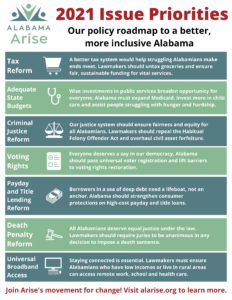
Flyer on Alabama Arise's 2021 issue priorities. For more information, visit https://alabama-arise.web-site-preview.com/news-releases/alabama-arise-unveils-members-2021-roadmap-for-change.

We’ll also keep working for better state policies when the Legislature returns in February. Our top focus will be Medicaid expansion, which we’ll pursue along with partners in the Cover Alabama Coalition. Expansion would cover more than 340,000 Alabamians with low incomes and ease the financial strain on rural hospitals. It also would attack structural health care disparities that led COVID-19 to take a disproportionate toll on Black Alabamians.

Arise’s work won’t stop there. We’ll support legislation to expand voting rights and ensure broadband internet access for all Alabamians. We’ll seek to increase consumer protections and overhaul the state’s criminal justice system. And we’ll fight to untax groceries once and for all.

Breakthroughs on many of these issues won’t be fast or easy. But together, we’ll emerge from dark times into the light of a brighter, more inclusive future for Alabama.

Join us at Alabama Arise’s 2021 action briefings!

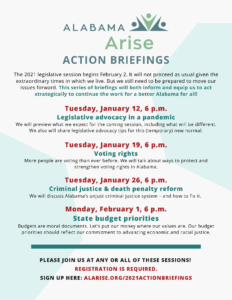
Alabama’s 2021 legislative session begins Feb. 2. It will not proceed as usual given the extraordinary times in which we live. But we still need to be prepared to move our issues forward. This series of briefings will both inform and equip us to act strategically to continue the work for a better Alabama for all.

Please join us at any or all of these sessions! Registration is required, so please register at the link under each description.

Tuesday, January 12, 6 p.m.Legislative advocacy in a pandemic

We will preview what we expect for the coming session, including what will be different. We also will share legislative advocacy tips for this (temporary) new normal. Click here to register for this session.

Tuesday, January 19, 6 p.m.Voting rights

More people are voting than ever before. We will talk about ways to protect and strengthen voting rights in Alabama. Click here to register for this session.

Tuesday, January 26, 6 p.m.Criminal justice and death penalty reform

We will discuss Alabama’s unjust criminal justice system – and how to fix it. Click here to register for this session.

Monday, February 1, 6 p.m.State budget priorities

Budgets are moral documents. Let’s put our money where our values are. Our budget priorities should reflect our commitment to advancing economic and racial justice. Click here to register for this session.

Alabama Arise action briefings flyer

It’s Election Day! Check out Alabama Arise’s 2020 voting resources

We made it! Today is Election Day across the United States. More than 300,000 Alabamians have voted already, shattering the state’s previous record for votes cast before Election Day. And we’re likely to continue to break records today.

The presidential and U.S. Senate races are drawing the biggest share of the attention in Alabama this year. But voters also will decide on their U.S. representatives, six statewide constitutional amendments and a host of state and local offices.

Have you made a plan to vote? Below, Alabama Arise has information about how to vote in person, what to do if you face barriers to voting, and why we urge Alabamians to vote YES on Amendment 4.

Vote!

Heres what you need to know for Election Day:

If you face any intimidation, threats or other barriers to voting, trained volunteers are ready to help:

  • English: 866-OUR-VOTE (866-687-8683)
  • Spanish: 888-VE-Y-VOTA (888-839-8682)
  • Asian languages: 888-API-VOTE (888-274-8683)
  • Arabic: 844-YALLA-US (844-925-5287)

Alabama Arise supports Amendment 4

Vote Yes on Amendment 4!

From our blog: “It’s past time for Alabama to tear down the policy legacies of slavery and segregation. And Alabamians can take an important step in that direction this fall by voting yes on Amendment 4. …

“Amendment 4 would allow the Legislature to remove racist language from the constitution. Examples of these provisions include references to separate schools for Black and white children and the prohibition of interracial marriages. This change would address one of the constitution’s original sins: its authors’ explicit intent to establish white supremacy in Alabama.”

Read more about Amendment 4 here.