The work for a better, more inclusive Alabama continues despite an outrageous special session

Gov. Kay Ivey on Friday signed into law two bills that could set the stage for special primary elections in some of Alabama’s congressional and state Senate districts this year. Those special elections would occur if a federal court lifts an injunction blocking the state from using maps that it found to violate the Voting Rights Act. Ivey called legislators into a special session to pass the bills this week after a U.S. Supreme Court decision gutted key provisions of the Voting Rights Act last week.

Alabama Arise executive director Robyn Hyden released the following statement Friday in response:

“This special session was an affront to inclusive democracy and basic fairness, and it was a clear example of our policymakers’ misplaced priorities. Just days before Alabama’s primary election, our legislative leaders hurried to pass bills that would dilute Black Alabamians’ voting power. These new laws threaten to erode representation and engagement of all communities.

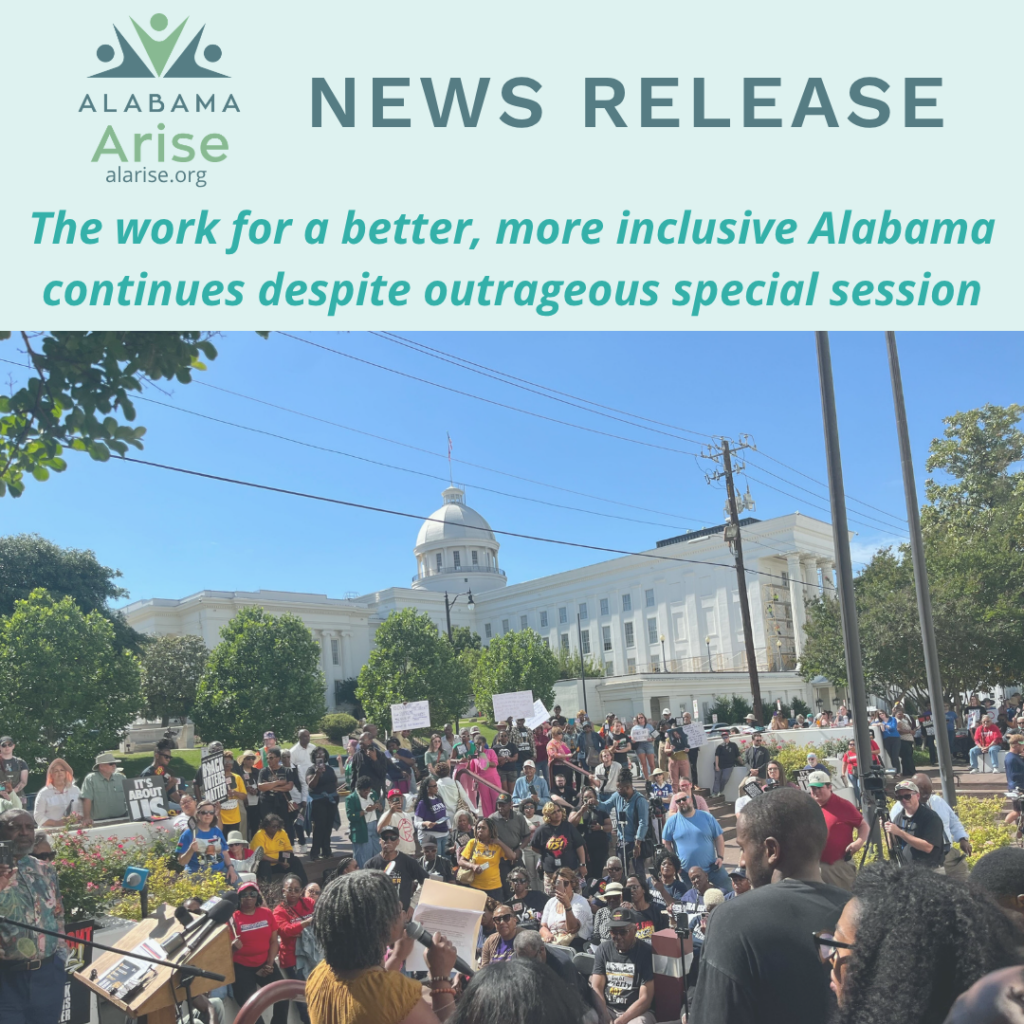
A large crowd rallies outside the Alabama State House in Montgomery, with the State Capitol in the background. Text: Alabama Arise news release: The work for a better, more inclusive Alabama continues despite outrageous special session.

“What lawmakers choose to prioritize shows what matters to them. Alabama legislators have declined for years to take action to close our state’s health coverage gap, or to expand access to public transportation and affordable housing. Instead of making needed investments to improve the quality of life for every Alabamian, our lawmakers rushed back to Montgomery for an outrageous 11th-hour redistricting effort that came after some voters already had cast absentee ballots in the upcoming primary. The estimated cost of these special elections, if they occur, is more than $5 million out of the General Fund.

“This special session and the U.S. Supreme Court ruling that prompted it both underscore the vital need for people across Alabama to show up and vote in the upcoming 2026 elections, including the May 19 primary. Alabama Arise will continue to work alongside advocates across our state to defend and expand voting rights, both this year and in the years to come.

“We will continue advocating for policies to reduce hunger and hardship. We will continue advocating to ensure people have the resources they need to secure a happy and healthy future. And we will continue advocating together to build a better, more inclusive Alabama for all.”

2026 Alabama election guide and candidate questions

2026 election questions

Where do candidates stand?

Meeting and talking with candidates as they campaign for your vote helps shape the conversation and let them know which issues are most important to their constituents. Below are some questions you can ask and info you can share when meeting candidates. Please let us know what you hear back!

Click here to download this resource as a PDF.

Funding public services

Alabama’s tax system is upside down. People with low incomes pay a higher share of their income in state and local taxes – double the amount paid by wealthier Alabamians. Alabama gives tax breaks and incentives to wealthy individuals and large corporations that are not accessible to low-income families and small businesses.

Alabama is the only state still providing the outdated federal income tax deduction, which costs our state $1.3 billion in lost revenue every year and overwhelmingly benefits the wealthiest households. At the same time, when Arise proposes policy solutions to help folks get ahead, we often hear lawmakers claim the state doesn’t have enough money.

Congress last year passed HR 1 (aka the One Big Beautiful Bill Act), which will cut $1.5 trillion from services like healthcare and food assistance to give more tax breaks to billionaires and highly profitable corporations. Because of this cut, Alabama may need to pay up to $261 million in additional state money to fund SNAP in 2027.

Questions for legislators or statewide candidates: Would you support getting rid of the outdated federal income tax deduction, which costs Alabama more than $1 billion a year and mostly helps wealthy households, while also ending the state grocery tax to help everyone? If not, what is your plan to untax groceries sustainably and responsibly?

Alabama is one of three states with no state dollars set aside for public transportation, and one of five with no funds directed toward affordable housing. Would you support providing dedicated state funding for affordable housing through the Alabama Housing Trust Fund, and for transportation through the Public Transportation Trust Fund?

Question for congressional candidates: Will you work to repeal the harmful spending cuts in HR 1, particularly Medicaid and SNAP cuts that will hurt Alabama for decades?

Health equity

Rural hospitals across Alabama face ongoing financial strain. More than 1 in 3 Alabama counties offer no maternity care services. Around 160,000 Alabamians fall into the health coverage gap, earning too much to qualify for Medicaid but too little to afford private insurance. The income limit for a single parent with two children to qualify for Medicaid is just $410 a month. That leaves many working families without affordable health coverage.

Questions for legislators or statewide candidates: Do you support Medicaid expansion to keep rural hospitals open, reduce maternal and infant mortality, help families afford healthcare and help low-wage workers stay healthy enough to work? If not, what is your specific plan to stabilize rural hospitals and improve healthcare?

Questions for congressional candidates: Will you pledge to repeal the $1 trillion in Medicaid cuts passed in HR 1, protect Medicare and make health insurance more affordable?

What will you do to hold healthcare corporations accountable for high costs?

Hunger relief

More than 750,000 Alabama families use SNAP to help put food on the table. In 2025, Congress enacted HR 1, aka the One Big Beautiful Bill Act, which will shift more SNAP costs onto states. Alabama may have to pay an additional $175 million next year just to ensure families continue to receive SNAP benefits.

About 1 in 6 Alabamians struggle with food insecurity, including more than 1 in 5 Alabama children. One positive step Alabama has taken in recent years is expanding no-cost school breakfast to more classrooms with increased state funding. We would like to expand this program to every school.

Questions for legislators or statewide candidates: Will you pledge to find new revenue to protect SNAP funding in next year’s state budget? Will you pledge to expand funding for no-cost school breakfast and lunch programs?

Questions for congressional candidates: Will you help families put food on the table by fighting to protect SNAP funding and roll back cuts to SNAP in HR 1? If not, what is your proposed solution to reduce hunger?

2026 election information

Key dates for the 2026 elections

Primary election: Tuesday, May 19, 2026

  • May 4 is the voter registration deadline for the primary election.
  • The election manager must receive absentee ballot applications by May 12 (by mail) or May 14 (in person).
  • Completed absentee ballots must arrive at the election manager’s office by May 18 (if hand-delivered) or by noon on May 19 (if returned by mail).

Runoff election (if necessary): Tuesday, June 16, 2026

  • May 29 is the deadline to hand-deliver a voter registration form for the runoff. June 1 is the deadline to register online or postmark registration forms delivered by mail.
  • The election manager must receive absentee ballot applications by June 9 (by mail) or June 11 (in person).
  • Completed absentee ballots must arrive at the election manager’s office by June 15 (if hand-delivered) or by noon on June 16 (if returned by mail).

General election: Tuesday, Nov. 3, 2026

  • Oct. 19 is the voter registration deadline for the general election.
  • The election manager must receive absentee ballot applications by Oct. 27 (by mail) or Oct. 29 (in person).
  • Completed absentee ballots must arrive at the election manager’s office by Nov. 2 (if hand-delivered) or by noon on Nov. 3 (if returned by mail).

What to know about voter registration and absentee voting

  • Alabama’s voter registration deadline for the 2026 primary election is May 4. For the runoff election, the deadline is May 29 (hand delivery) or June 1 (online or postmarked by mail). For the general election, the deadline is Oct. 19.
  • These deadlines are both for new voters to register and for current voters to update their information if they have moved to another location within Alabama.
  • People who have faced domestic violence, or guardians of people who have faced domestic violence, may submit a form to protect their residential and mailing addresses from appearing on the public list of registered voters.
  • Alabamians are not officially registered to vote until their county board of registrars reviews and approves their application.
  • Alabamians applying for an absentee ballot must certify that they cannot vote in person on Election Day for a reason allowed under state law. Those reasons include absence from the county on Election Day or an illness that prevents a trip to the polling place.
  • Visit alabamavotes.gov to learn more about voter registration and absentee voting.

What to know for the elections

  • Polls will be open from 7 a.m. to 7 p.m. on Election Day. If you’re a registered voter in line by 7 p.m., stay in line! You’ll be allowed to vote.
  • A valid photo ID is required to vote. Visit alabamavotes.gov to learn more.
  • Alabamians can vote in either the Democratic or Republican primary, but not both. Both ballots will include proposed constitutional amendments.
  • State law forbids “crossover voting” in runoff elections. If a runoff election is necessary in June, people who vote in the Democratic primary will be able to vote only in a Democratic runoff, and people who vote in the Republican primary will be able to vote only in a Republican runoff. Voters who participate in neither party’s primary can choose to vote in either party’s runoff.
  • The crossover voting rule does not apply to the general election in November. Voters may vote for whomever they wish in the general election, regardless of which primary (if any) they participated in earlier in the year.
  • Voters’ party choice for this year’s primary election does not bind their choice for future primaries.
  • Visit alabamavotes.gov to check your voter registration and polling place, find sample ballots by county and more.

Alabamians must keep advocating to protect inclusive democracy

 Gov. Kay Ivey on Friday declared a special session starting Monday to redraw Alabama’s congressional and state Senate districts and provide for a special primary election this year using those new lines. The declaration comes after Wednesday’s U.S. Supreme Court decision that gutted key provisions of the Voting Rights Act.

Alabama Arise executive director Robyn Hyden released the following statement Friday in response:

“The U.S. Supreme Court struck a blow against inclusive democracy this week, gutting Voting Rights Act provisions that protect Black and Hispanic voters against efforts to dilute their voting power. Now, just weeks away from Alabama’s primary election, our lawmakers are seeking to redraw district lines and undermine Black Alabamians’ ability to elect candidates of their choice.

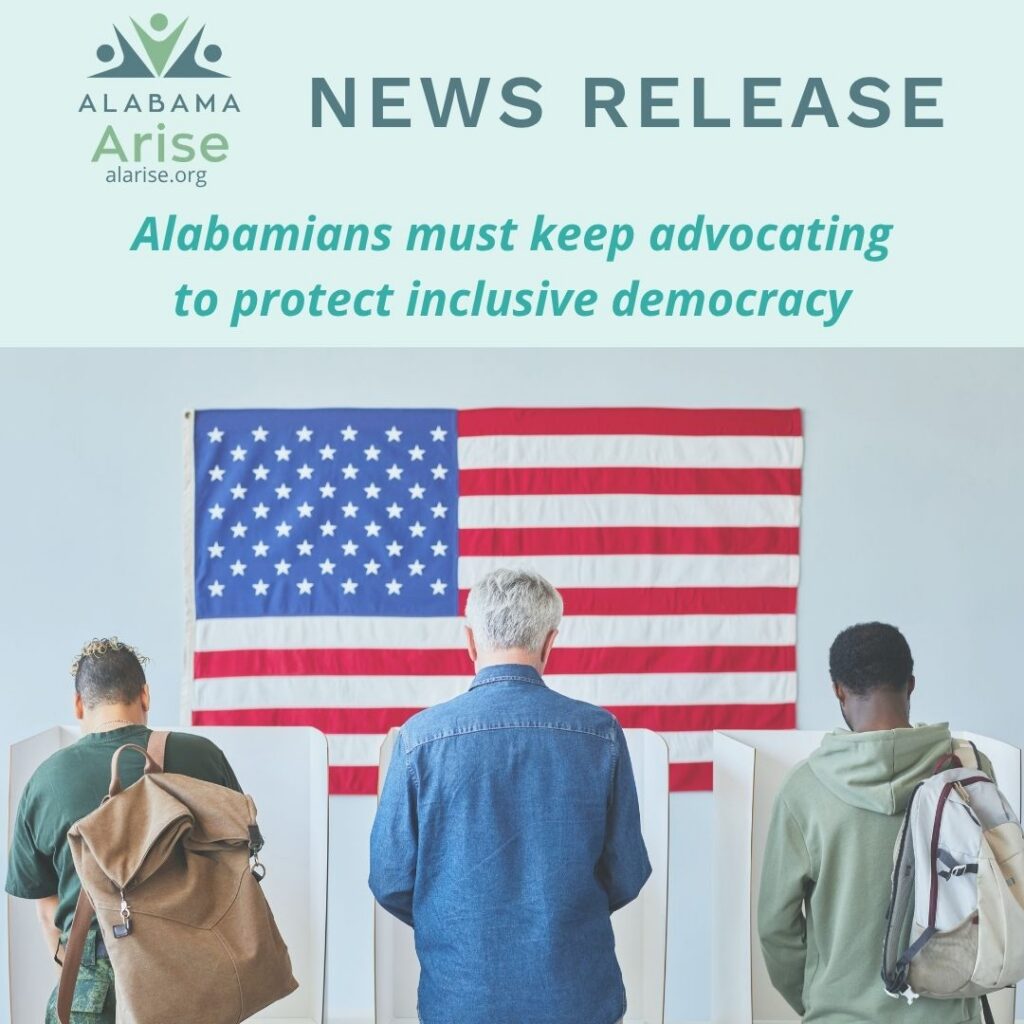
Three people stand in front of voting booths with an American flag on the wall in front of them. Text: Alabama Arise news release: Alabamians must keep advocating to protect inclusive democracy.

“The court’s ruling in Louisiana v. Callais is a travesty that further entrenches power in the hands of the few. It imperils the diversity of our elected bodies and representation of all communities. Many fair districts likely will vanish as legislatures gut representation for voters of color without checks from the courts.

“This ruling will have direct effects for Alabama. In an outrageous move, legislators are preparing to return Monday for a special session to redraw Alabama’s congressional and state Senate maps at the 11th hour, even though some voters already have cast their absentee ballots in the upcoming primary election.

“Alabama Arise will stand on the front lines with voting rights advocates across our state to fight any maps that remove fair representation. We encourage all Alabama voters to check their voter registration and polling place, and to make sure their friends and family are ready to vote. To build a better, more inclusive Alabama for all, we must ensure everyone’s voice is heard in our democratic process.”

El pueblo de Alabama debe seguir defendiendo la protección de la democracia inclusiva

Traducción de María Baker, CT

El viernes, la gobernadora Kay Ivey convocó a una sesión especial a partir del lunes para volver a delimitar los distritos electorales congresionales y del Senado estatal de Alabama y preparar una elección primaria especial este año usando estos nuevos límites. La declaración llega luego de la decisión de la Corte Suprema de Estados Unidos el pasado miércoles que dejó sin efecto provisiones clave de la Ley de Derecho al Voto.

Robyn Hyden, la directora ejecutiva de Alabama Arise, publicó la siguiente declaración este viernes, como respuesta:

“La Corte Suprema de Estados Unidos dio un golpe contra la democracia inclusiva esta semana, al desmantelar provisiones de la Ley de Derecho al Voto que protegen a los votantes negros e hispanos contra los esfuerzos para diluir el poder de su voto. Ahora, a unas pocas semanas de la elección primaria en Alabama, nuestros legisladores buscan trazar nuevos límites de distrito y debilitar la capacidad de la población negra de Alabama para elegir los candidatos que prefieren.

“El fallo de la corte en el caso Louisiana v. Callais es una farsa que concentra aún más el poder en las manos de unos pocos. Amenaza la diversidad de nuestros cuerpos de funcionarios electos y la representación de todas las comunidades. Es probable que muchos distritos justos se desvanezcan cuando la legislatura elimine la representación de los votantes de color sin control de los tribunales.

“Esta decisión tendrá efectos directos para Alabama. En una indignante medida, los legisladores se preparan para regresar el lunes para una sesión especial destinada a redibujar los mapas congresionales y del Senado estatal en Alabama a último momento, aunque algunos votantes ya enviaron sus boletas de voto en ausencia para las próximas elecciones primarias.

“Alabama Arise estará en la primera línea de defensa con activistas de derecho al voto de todo el estado para luchar contra cualquier mapa que elimine la representación justa. Animamos a todos los votantes de Alabama a verificar su inscripción para votar y su lugar de voto, y a asegurarse de que sus amigos y familiares estén listos para votar. Para construir un Alabama mejor y más inclusivo para todos, debemos asegurarnos de que todas las voces se escuchen en nuestro proceso democrático”.

Alabama Arise testimony against efforts to water down meaningful Public Service Commission reform

Arise’s Dev Wakeley testified Tuesday before the Senate Fiscal Responsibility and Economic Development Committee in support of the House-passed version of HB 475, and against proposed Senate changes through a substituted bill to weaken HB 475.

As originally passed in the House, HB 475 by Rep. Mack Butler, R-Rainbow City, would have required the Public Service Commission (PSC) to hold a formal rate hearing at least once every three years and would have limited utility companies from including certain lobbying and other costs in their rates. But the Senate committee amended the bill to weaken provisions regarding rate hearings and the PSC’s independence. Here is the full text of Wakeley’s remarks:

I’m Dev Wakeley with Alabama Arise. We are an anti-poverty organization, and accordingly, we supported HB 475 when it was introduced. We thought it was a good bill, and it was a bill that would have fostered accountability for the catastrophically high utility rates that the people in Alabama pay.

Our folks pay 20% more for electricity than people in Louisiana and Kentucky. Our folks pay more for electricity than all of our neighboring states. And that includes states where Southern Company owns the utility provider there. Georgians pay less for power than Alabamians do from the same parent company. It doesn’t make any sense.

Georgia and Alabama are the same climatically. People are dealing with the same amount of heat and the same amount of sunshine. The only thing that’s different is the regulatory structure or lack thereof. And we urged folks to support HB 475, and at the same time to oppose SB 360. Because SB 360 – the provisions of which have just been incorporated into HB 475 – is the exact opposite of an accountability bill.

That is a bill to put the thumb on the scale in favor of corporate interests at the expense of everyday Alabamians’ pocketbooks. And the people of Alabama are fully aware of this. They overwhelmingly turned out in opposition to the attempt to take away their right to vote for PSC commissioners. Now they face a similar effort to subordinate the elected PSC commission to an appointed position.

Please don’t do that. The people of Alabama have already made it perfectly clear they don’t want y’all to do that. They think it’s a way to shirk accountability for corporations.

People are squeezed every which way right now. The way to fix that is to lower electricity rates. This bill now doesn’t do that. It did before. It would have fostered the accountability that would have led to lower rates. And now there’s a thumb on the scale that’s going to prevent that in the long run.

I urge you to vote “no” on this bill as amended. Thank you.

Alabama Arise testimony in opposition to ending Public Service Commission elections

Alabama Arise’s Robyn Hyden testified Tuesday before the House Transportation, Utilities and Infrastructure Committee in opposition to HB 392 by Rep. Chip Brown, R-Hollinger’s Island, which would change the Public Service Commission from an elected board to an appointed one. Here is the full text of Hyden’s prepared remarks:

Good morning. I am Robyn Hyden, the executive director of Alabama Arise, a nonprofit coalition of faith-based, civic and community groups and individuals across our state working to alleviate poverty. I’m here today on behalf of our 155 member organizations, 2,000 individual members, and people across our state who have reached out and expressed alarm about this proposal. 

Alabama Arise was founded in the late 1980s by a group of citizens concerned about utility rates and the lack of oversight of public utilities with monopoly power in our state. Over the years, we have supported efforts for more transparency and accountability around utility rates. This year, our members asked us to revisit what can be done about Alabama’s highest power rates in the U.S. South.

This bill is a major step backward in our efforts toward greater transparency and accountability. We know just how unpopular this bill is with the general public, and I’m not just speculating here. We have a recent example of our legislature seeking to transition a government board from an elected to an appointed body, and just how unpopular that was.

In 2019, the Alabama Legislature voted to support a constitutional amendment that would make the Alabama Board of Education an appointed, not an elected, body. When this issue went to the ballot for a vote of the people, it was defeated overwhelmingly, with more than 75% of voters choosing to retain their right to vote and not to delegate that power.

We reject the notion that “people do not know who represents them” on the Public Service Commission. The purpose of public elections is that elected commissioners are accountable to the voting public every four years and must answer for regulatory issues, including the rate-setting process, during those elections.

We also reject the notion that this bill will reduce “outside influence.” The fact is, utility companies will have an outsized influence on the process through the ability to give large contributions to state lawmakers who will be appointing their regulators.

We urge you to protect the people’s right to vote and to hold this commission accountable. Please vote no on HB 392.

Arise 2026: How we’re working to build a better Alabama

Alabama Arise believes in dignity, equity and justice for all. We believe in an Alabama where everyone’s voice is heard and everyone has the opportunity to reach their full potential. And we believe better public policies are the key to building a brighter future for our state. 

Below, we’ll share some details of that vision as the Alabama Legislature’s regular session begins January 13. This blog focuses on the crucial legislative priorities on our 2026 roadmap to change.

If you’re not already a member of Alabama Arise, join us! Members will receive an exclusive version of our weekly Legislative Updates throughout the session. These emails include a weekly video update from Arise staff members on what’s happening at the State House, as well as details about upcoming legislation and links to additional resources.

Executive Director Robyn Hyden welcomes us to the 2026 session

Arise’s Robyn Hyden welcomes everyone to the Alabama Legislature’s 2026 regular session. Watch to see what to expect this year and to learn more about our advocacy on school breakfast, protecting funding for public schools and other member-selected legislative priorities. 

Strong investments in schools, housing and transit improve life for all Alabamians

Strong funding for public services like education and public health broadens opportunity for everyone, especially for Alabamians with low incomes. Arise members for decades have urged robust and secure state funding for these services. Our top adequate state budget priorities include protecting funding for public schools and securing state support for affordable housing and public transportation.

READ OUR FACT SHEET

Closing the health coverage gap: Alabama must enact policies to save lives

As Alabama enters the 2026 legislative session, Medicaid expansion and maternal health will be central to the state’s health equity conversations. Recent federal policy changes have made these conversations more urgent and more complex. Our top health equity priorities are Medicaid expansion and investments in comprehensive maternal health care.

READ OUR FACT SHEET

Federal SNAP cuts underscore Alabama’s need to protect and increase food access

Alabama’s food insecurity rates are among the worst in the country. More than 1 in 6 people in our state (17%) face food insecurity, according to the Alabama Department of Public Health. And that share is even larger for children: Nearly 1 in 4 Alabama children (23%) live in households with food insecurity. Our top hunger relief priorities are increasing the availability of no-cost school meals, protecting SNAP food assistance and continuing the successful SUN Bucks summer nutrition program.

READ OUR FACT SHEET

An inclusive democracy is vital to building a better Alabama for all

Alabama was central to the struggle for democracy and voting rights in the United States during the Civil Rights Movement in the 1950s and 1960s. And the need for our state to do more to build a more inclusive democracy continues today. That is especially true after recent U.S. Supreme Court decisions affecting the rights of people nationwide to have their say in who represents them at the local, state and federal levels. Our top inclusive democracy priorities include no-excuse absentee voting, early voting and removal of barriers to voting rights restoration.

READ OUR FACT SHEET

Alabama’s justice system should focus on rehabilitation, not cruelty

Alabama’s criminal justice system too often prioritizes punishment over evidence-based interventions. This cruel orientation has fueled heavy-handed sentencing policies and a broken parole system. And it has led to a death penalty system where state officials continue to kill prisoners against the recommendation of the juries that convicted them. Our justice reform priorities include reforms to Alabama’s sentencing and parole practices and legislation to make the state’s ban on judicial override in death penalty cases retroactive. 

READ OUR FACT SHEET

Alabama’s tax system is upside down and needs real reform

Alabama’s tax structure is among the nation’s most unfair and unjust. The state is heavily reliant on regressive sales taxes on consumer goods that account for a larger share of spending for households with low incomes. Our state continues to tax groceries, though at a lower rate than other goods after grocery tax reductions in 2023 and 2025. And Alabama does not tax numerous services that people with higher incomes more often purchase. Our tax reform priorities include untaxing groceries, reining in income tax breaks for wealthy households and opposing further diversion of public school funding to private schools and homeschooling.

READ OUR FACT SHEET

Empower workers to build an economy that works for all Alabamians

Alabama has a history of anti-worker policies that prioritize the interests of wealthy corporations over those of working people. This top-down structure has led to our state falling behind in measurable standards of well-being. Our worker power priorities include increased accountability for child labor law violators, expansion of paid leave and stronger protections for temp workers.

READ OUR FACT SHEET

An inclusive democracy is vital to building a better Alabama for all

Haga clic aquí para leer esto en español.

Alabama was central to the struggle for democracy and voting rights in the United States during the Civil Rights Movement in the 1950s and 1960s. And the need for our state to do more to build a more inclusive democracy continues today. That is especially true after recent U.S. Supreme Court decisions affecting the rights of people nationwide to have their say in who represents them at the local, state and federal levels.

The court’s Shelby County v. Holder ruling in 2012 weakened the Voting Rights Act significantly. After that decision, Alabama no longer was required to get federal permission (known as preclearance) before changing its voting rules. Since then, the state has acted repeatedly to make it harder for many people to vote.

Alabama Arise supports legislation to increase participation in our democracy by removing barriers to voting. In 2026, we will support legislative solutions including::

  • No-excuse absentee voting. This would remove the need for voters to specify a reason for absentee voting.
  • Early voting. This would give voters more time to participate in elections.
  • Greater accessibility for voters with disabilities. Lawmakers should remove recent legal barriers that could have a chilling effect on people and groups acting in good faith to help voters who request assistance with absentee voting.
  • Lift barriers to voting rights restoration. Legislators should require relevant state agencies to post information to assist disenfranchised Alabamians in navigating the process to restore their voting rights.

Bills requiring agencies to share info on voter rights restoration processes have advanced during previous sessions. This legislation would be an important next step toward increasing civic participation.

Alabama has a painful history of enacting policies that have made voting more inaccessible for older adults, people with disabilities, and Black and Hispanic people. Lawmakers should turn away from this harmful, divisive path and work instead to pass pro-democracy reforms to remove barriers to voting. These improvements would move our state away from its shameful past and toward a brighter future where every Alabamian can have a say in our democracy and stay engaged in the policymaking process.

Building on our momentum for the new year

As we close out 2025, Arise members and member organizations can reflect on a very successful year. Reducing the state sales tax on groceries from 3% to 2% and guaranteeing more students in public schools get a free breakfast with a $7.3 million budget appropriation were two of the biggest highlights worth celebrating. 

Improvements were also made in maternal health, including tax cuts passed for maternal and infant care products as well as those that fell under the “pink tax” such as diapers, baby formula and feminine hygiene products. Expecting mothers became eligible for Medicaid during the early days of their pregnancy, creating an increased opportunity for healthy pregnancies and babies. For the first time, a progressive model for parental leave for education employees and state workers became law. 

Arise aggressively fought to ensure SNAP benefits remained intact among federal changes. These successes come from the dedicated and engaged members who have remained steadfast in Arise’s mission to make Alabama more responsive to its citizens.

The 2026 legislative session, the last session of the quadrennium before lawmakers will face the public at the voting booth, is gearing up to be another busy time for Arise. Below is our roadmap for how we will prepare for the challenges ahead.

Health equity

Arise will continue our commitment to expand Medicaid and ensure health care for more Alabamians. With the growing lack of access to maternal health care, we will also continue the fight to protect and improve access for life-saving maternal care and contraception. In the realm of improving our current Medicaid coverage, Alabama is ranked 49th for dental care. We will work to expand access to adult dental benefits for Medicaid members.

Hunger relief

While 2025 saw a significant step forward in no-cost school meals, almost 30 percent of students still lack access to school breakfast or lunch. Arise will work to protect and expand funding for school meals as well as the Summer EBT program (now SUN Bucks) for low-income students. Arise will also be a voice of reason to block ill-intended limitations on the purchase of certain items under SNAP guidelines.

Adequate state budgets

With the constant waste of lucrative tax incentives going to big corporations, we must remain vigilant to protect our budgets from excessive giveaways, ill-conceived tax exemptions and tax credits. The biggest threat to the Education Trust Fund is the relatively new tax credit for private school students from the CHOOSE Act that allows up to $7,000 per student, a drain on public school resources. 

If income caps are removed, more than $500 million in school tax dollars could go to previously enrolled private school students. In 2026, Arise will continue to oppose any expansion of the CHOOSE Act.

Alabama does not currently provide any state funds for the Housing Trust Fund to support more affordable housing for low-income, elderly, and disabled citizens. Equally insufficient is the state’s failure  to fund the Public Transportation Trust Fund, which could secure up to an 80% percent match in federal funds. Arise will continue to fight to fund the Alabama Housing Trust Fund and the Public Transportation Trust Fund.

Inclusive democracy

The constant effort to suppress voting in Alabama demands we expand voting rights with comprehensive legislation, including allowing people to cast an absentee ballot without unnecessary, trivial restrictions. We will work to remove barriers for people who have been banned from voting because of a criminal conviction. We will also continue to oppose laws attacking the inclusion of immigrants, Black Alabamians and other racial and ethnic minorities in our society. 

Justice reform

In 2018, Arise worked to eliminate judicial override, a policy that allowed judges to impose a death sentence against the will of the jury. Unfortunately, the law was not retroactive. With nearly 30 people still on death row because of this outdated and now illegal policy, it’s time to make judicial override retroactive and seek justice for those condemned.

We must also work to reform Alabama’s three-strikes law, which disproportionately impacts low-income defendants. Under this law, a person could be serving a life sentence because of a series of minor infractions. Adding to the burden of prison overcrowding, Alabama’s parole system has been plagued by unworkable guidelines, driving our prison overcrowding crisis and making our system more punitive, not restorative. It’s time to make the parole system more fair, transparent and efficient.

Tax reform

Faced with tariffs and increasing food costs, there’s never been a better time to fully eliminate Alabama’s tax on groceries. A larger share of the burden falls on those with lower incomes, who spend more of their income on food than the wealthy. Arise supports a more progressive and fair income tax that recognizes the inequities in our tax rates.          

Worker power

The newest priority on our 2026 legislative agenda is supporting worker power legislation in partnership with organized labor. Our primary goal will be to remove tax incentives from companies that employ child labor and violate workers’ rights. We will also work to expand paid parental leave policies to cover more state employees, teachers and other workers. Often, the person most abused is the temporary worker, who has no rights. Arise will work to pass workplace protections in a Temp Workers’ Bill of Rights to improve on-the-job conditions, along with a pathway for full-time jobs.

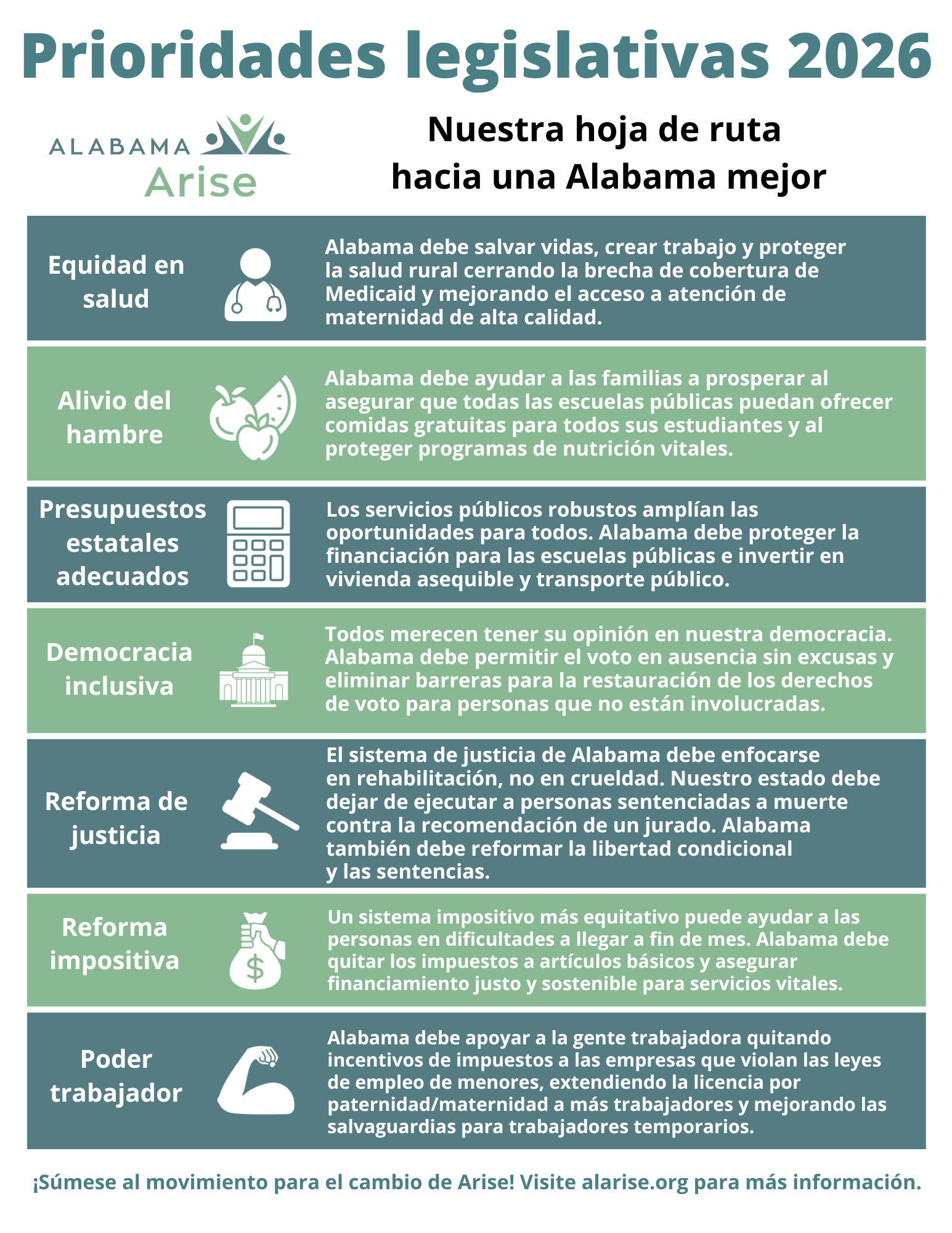
Las prioridades legislativas de Alabama Arise para 2026

Más de 150 grupos miembros de Alabama Arise y más de 1,500 miembros individuales eligen todos los años nuestras prioridades legislativas. Este proceso garantiza que los habitantes de Alabama más afectados por la pobreza participen de las decisiones. A continuación se enumeran las prioridades que nuestros miembros eligieron para 2025.

Para obtener una versión de este documento en PDF, haga clic aquí o en el botón de “Descargar” (Download) arriba.

Equidad en saludAlabama debe salvar vidas, crear trabajo y proteger la salud rural cerrando la brecha de cobertura de Medicaid y mejorando el acceso a atención de maternidad de alta calidad.

Alivio del hambreAlabama debe ayudar a las familias a prosperar al asegurar que todas las escuelas públicas puedan ofrecer comidas gratuitas para todos sus estudiantes y al proteger programas de nutrición vitales.

Presupuestos estatales adecuadosLos servicios públicos robustos amplían las oportunidades para todos. Alabama debe proteger la financiación para las escuelas públicas e invertir en vivienda asequible y transporte público.

Democracia inclusivaTodos merecen tener su opinión en nuestra democracia. Alabama debe permitir el voto en ausencia sin excusas y eliminar barreras para la restauración de los derechos de voto para personas que no están involucradas.

Reforma de justiciaEl sistema de justicia de Alabama debe enfocarse en rehabilitación, no en crueldad. Nuestro estado debe dejar de ejecutar a personas sentenciadas a muerte contra la recomendación de un jurado. Alabama también debe reformar la libertad condicional y las sentencias.

Reforma impositivaUn sistema impositivo más equitativo puede ayudar a las personas en dificultades a llegar a fin de mes. Alabama debe quitar los impuestos a artículos básicos y asegurar financiamiento justo y sostenible para servicios vitales.

Poder trabajador Alabama debe apoyar a la gente trabajadora quitando incentivos de impuestos a las empresas que violan las leyes de empleo de menores, extendiendo la licencia por paternidad/maternidad a más trabajadores y mejorando las salvaguardias para trabajadores temporarios.

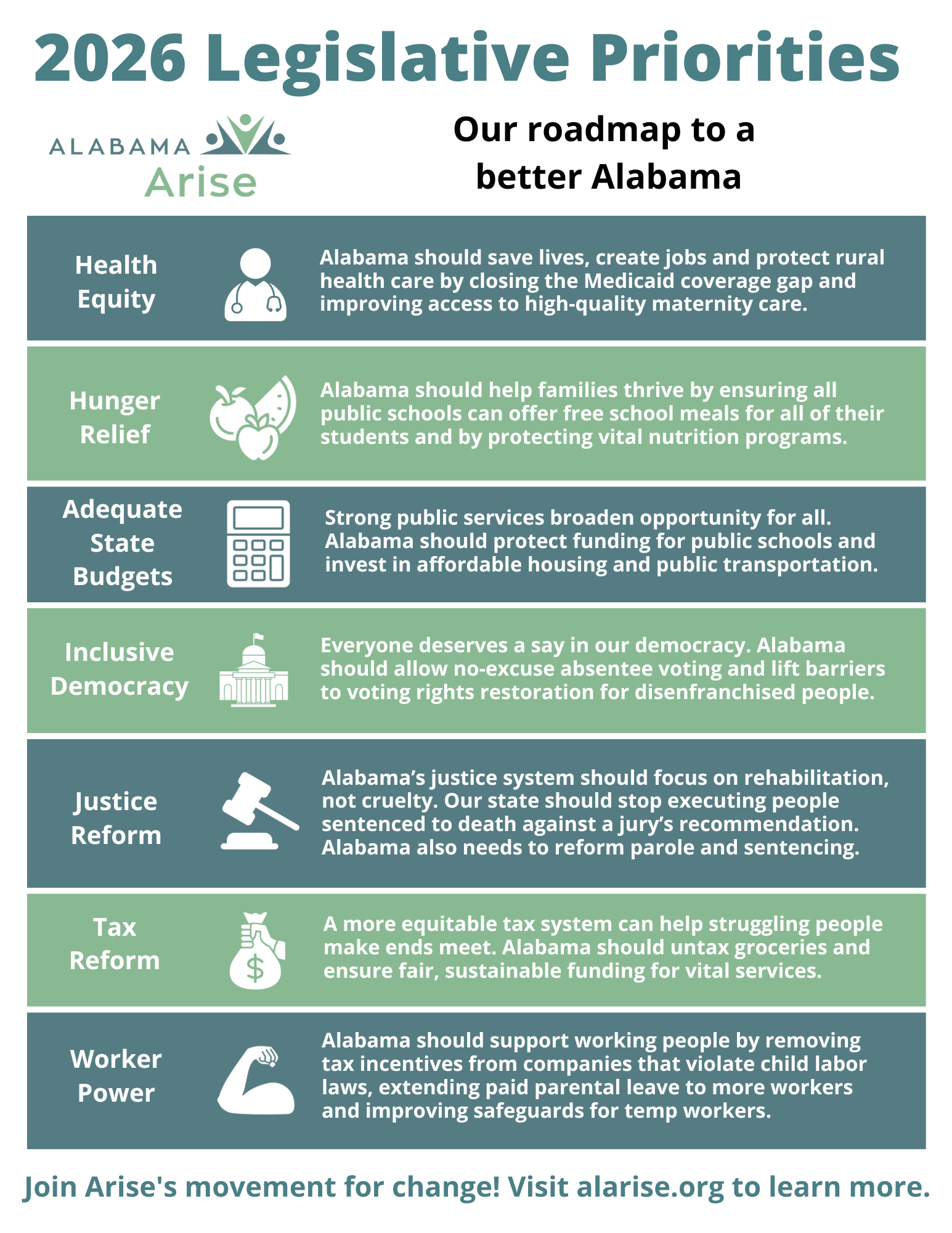
Alabama Arise 2026 legislative priorities

More than 150 Alabama Arise member groups and nearly 2,000 individual members choose our legislative priorities each year. This process ensures that Alabamians most impacted by poverty have a seat at the table. Below are the priorities that our members selected for 2026.

For a PDF version of this document, click here or click the “Download” button above.

Health equityAlabama should save lives, create jobs and protect rural health care by closing the Medicaid coverage gap and improving access to high-quality maternity care.

Hunger reliefAlabama should help families thrive by ensuring all public schools can offer free school meals for all of their students and by protecting vital nutrition programs.

Adequate state budgetsStrong public services broaden opportunity for all. Alabama should protect funding for public schools and invest in affordable housing and public transportation.

Inclusive democracyEveryone deserves a say in our democracy. Alabama should allow no-excuse absentee voting and lift barriers to voting rights restoration for disenfranchised people.

Justice reformAlabama’s justice system should focus on rehabilitation, not cruelty. Our state should stop executing people sentenced to death against a jury’s recommendation. Alabama also needs to reform parole and sentencing.

Tax reformA more equitable tax system can help struggling people make ends meet. Alabama should untax groceries and ensure fair, sustainable funding for vital services.

Worker powerAlabama should support working people by removing tax incentives from companies that violate child labor laws, extending paid parental leave to more workers and improving safeguards for temp workers.