Alabama Arise resources for the 2020 general election

Election Day is officially Nov. 3, but the 2020 general election is well underway. More than 206,000 Alabamians have voted already, shattering the state’s previous record for votes cast before Election Day.

The presidential and U.S. Senate races are drawing the biggest share of the attention in Alabama this year. But voters also will decide on their U.S. representatives, six statewide constitutional amendments and a host of state and local offices.

Have you made a plan to vote? Below, Alabama Arise has information about how to vote by mail or in person. And we explain why we urge Alabamians to vote YES on Amendment 4.

Vote!

It’s not too late for absentee voting!

  • The deadline to submit a standard absentee ballot application or to vote absentee in person this year is Thursday, Oct. 29.
  • The last day to postmark an absentee ballot is Monday, Nov. 2, the day before the election.
  • Due to potential mail delays, voters who are interested in voting absentee should consider safely doing so in person. Absentee ballots must arrive at the election manager’s office by no later than 5 p.m. on Monday, Nov. 2 (if hand-delivered) or by noon on Tuesday, Nov. 3 (if returned by mail).
  • Alabamians may vote absentee if they are worried about crowded polling places during the COVID-19 pandemic. On the application, they should check the box that says “I have a physical illness or infirmity which prevents my attendance at the polls.”
  • You can find much more information and resources on absentee voting on the Alabama Secretary of State’s website.

What you need to know for Election Day

Alabama Arise supports Amendment 4

Vote Yes on Amendment 4!

From our blog: “It’s past time for Alabama to tear down the policy legacies of slavery and segregation. And Alabamians can take an important step in that direction this fall by voting yes on Amendment 4. …

“Amendment 4 would allow the Legislature to remove racist language from the constitution. Examples of these provisions include references to separate schools for Black and white children and the prohibition of interracial marriages. This change would address one of the constitution’s original sins: its authors’ explicit intent to establish white supremacy in Alabama.”

Read more about Amendment 4 here.

Alabama Arise unveils members’ 2021 roadmap for change

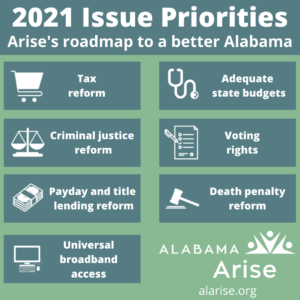
Sentencing reform and universal broadband access are two new goals on Alabama Arise’s 2021 legislative agenda. Members voted for Arise’s issue priorities this week after nearly 300 people attended the organization’s online annual meeting Saturday. The seven issues chosen were:

  • Tax reform, including untaxing groceries and ending the state’s upside-down deduction for federal income taxes, which overwhelmingly benefits rich households.
  • Adequate budgets for human services like education, health care and child care, including Medicaid expansion and extension of pre-K to serve all eligible Alabama children.
  • Criminal justice reform, including repeal of the Habitual Felony Offender Act and changes to civil asset forfeiture policies.
  • Voting rights, including automatic universal voter registration and removal of barriers to voting rights restoration for disenfranchised Alabamians.
  • Payday and title lending reform to protect consumers from getting trapped in debt.
  • Death penalty reform, including a law to require juries to be unanimous in any decision to impose a death sentence.
  • Universal broadband access to help Alabamians who have low incomes or live in rural areas stay connected to work, school and health care.

“Arise believes in dignity, equity and justice for all Alabamians,” Alabama Arise executive director Robyn Hyden said. “And our 2021 issue priorities would break down many of the policy barriers that keep people in poverty. We can and will build a more inclusive future for our state.”

Graphic naming Alabama Arise's 2021 issue priorities

The urgent need for criminal justice reform

Alabama’s criminal justice system is broken and in desperate need of repair. The state’s prisons are violent and dangerously overcrowded. Exorbitant court fines and fees impose heavy burdens on thousands of families every year, taking a disproportionate toll on communities of color and families who are already struggling to make ends meet. And Alabama’s civil asset forfeiture policies let law enforcement seize people’s property even if they aren’t charged with a crime.

Arise will continue to seek needed reforms in those areas in the coming year. The organization also will work for repeal of the Habitual Felony Offender Act (HFOA), the state’s “three-strikes” law. The HFOA is an unjust driver of sentencing disparities and prison overcrowding in Alabama. The law lengthens sentences for a felony conviction after a prior felony conviction, even when the prior offense was nonviolent. Hundreds of people in Alabama are serving life sentences for non-homicide crimes because of the HFOA. Thousands more have had their sentences increased as a result. Repealing the law would reduce prison overcrowding and end some of Alabama’s most abusive sentencing practices.

Universal broadband access would help struggling Alabamians stay connected

The COVID-19 pandemic has illustrated the essential role that the internet plays in modern life. Remote work, education, health care and shopping are a reality for millions in our state today. But far too many Alabamians, especially in rural areas, can’t access the high-speed broadband that these services require. These access challenges also reveal a racial disparity: About 10% each of Black and Latino households have no internet subscription, compared to 6% of white households.

Policy solutions can facilitate the investments needed to ensure all Alabamians can stay connected. Lawmakers can help by guaranteeing that all communities have the right to own, operate or deploy their own broadband services. The Legislature also can enact targeted and transparent tax credits to promote broadband for underserved populations.

Town Hall Tuesdays 2020: What we heard from Arise supporters

Listening is often an underdeveloped skill, yet it is critical for mutual understanding and working together for meaningful change. That’s why Arise is committed to listening to our members, to our allies and most importantly, to those directly affected by the work we do together. We depend on what we hear from you to guide our issue work and our strategies.

This year’s COVID-19 pandemic challenged us to be creative in finding ways to listen. Instead of our usual face-to-face meetings around the state, we hosted a series of six statewide online Town Hall Tuesdays. We held events every two weeks, starting in June and ending Sept. 1. We averaged 65 attendees at each session. Here’s some of what we heard from members and supporters:

  • Affirmation for Medicaid expansion, untaxing groceries and other current Arise issues as important for achieving shared prosperity.
  • Empathy for those who were already living in vulnerable circumstances further strained by the pandemic.
  • Concern about ongoing, intentional barriers to voting, especially during the pandemic.
  • Desire to see more resources to meet the needs of our immigrant neighbors.
  • Alarm about payday and title lending and its impact on people’s lives and our communities.
  • Passion and concern about many other issues, including housing; living wages and pay equity; prison and sentencing reform; gun safety; juvenile justice reform; defunding the police; the Census; environmental justice; quality and funding of public education; and food insecurity and nutrition.
  • Willingness to take informed actions to make a difference in the policies that impact people’s lives.
  • Hope that Alabama can be a better place for all our neighbors to live despite systemic issues and ongoing challenges.

Notes from each town hall

Overviews of the town halls are below. Click the title for a PDF of the notes from the breakout sessions at each town hall.

June 23 – Money talks
We examined how to strengthen education, health care, child care and other services that help Alabamians make ends meet. And we explored ways to fund those services more equitably.

July 7 – Justice for all
We discussed Alabama’s unjust criminal justice system and how to fix it.

July 21 – Getting civic
Discussion focused on protecting voting rights and boosting Census responses during a pandemic.

Aug. 4 – Shared prosperity
We looked at policy solutions to boost opportunity and protect families from economic exploitation.

Aug. 18 – Feeding our families
We explored ways to increase household food security during and after the recession.

Sept. 1 – Closing the coverage gap
Discussion focused on how everyone can help expand Medicaid to ensure coverage for hundreds of thousands of struggling Alabamians. We also heard about the expansion campaign strategies of the Cover Alabama Coalition, headed by Arise campaign director Jane Adams.

Get in touch and stay in touch with Arise

Remember, we didn’t stop listening because the town halls ended. We want to hear from you, and we encourage you to contact the Arise organizer in your area:

We hope to see you at Arise’s online annual meeting Oct. 3!

New Senate COVID-19 relief plan falls short of meeting Alabamians’ needs

U.S. Senate Republicans on Monday unveiled a new proposed COVID-19 relief plan. Alabama Arise executive director Robyn Hyden issued the following statement Tuesday in response:

“Millions of Alabamians are being pushed to the brink during the COVID-19 crisis. They’re struggling with difficult tradeoffs between protecting their own health, paying for basic necessities and caring for children and seniors. Nearly one in four renters in Alabama are behind on rent. And one in five adults with children in our state say their kids sometimes don’t have enough to eat because the household just can’t afford enough food.

“As families face these health and economic shocks, the Senate relief proposal fails to meet the demands of the moment. This plan would slash supplemental unemployment insurance benefits amid the highest unemployment since the Great Depression. It wouldn’t increase housing assistance to prevent families from being evicted and becoming homeless. It wouldn’t increase SNAP benefits to address the critical hunger concerns facing families of schoolchildren. And it wouldn’t provide Alabama and other states with the money needed to invest in child care, avoid teacher layoffs and prevent cuts to Medicaid and other vital services as budget shortfalls grow.

“This plan is inadequate by any measure. We urge our senators to reject it and look instead toward the approach taken in the House-passed HEROES Act. The House plan would boost Medicaid funding and offer more support for essential workers and people who lost their jobs. And it would provide federal assistance so states can avoid devastating service cuts that would hurt tens of millions of people.”

What a meaningful COVID-19 relief plan should look like

Alabama Arise urges Congress to negotiate a COVID-19 relief package that does the following:

  • Boosts Supplemental Nutrition Assistance Program (SNAP) benefits so struggling families can keep food on the table.
  • Increases housing assistance to help people pay their rent and mortgages and to avert a surge in homelessness.
  • Preserves the weekly $600 federal increase to unemployment insurance benefits.
  • Provides additional federal funding for states to avert harmful layoffs and invest in vital services like Medicaid and child care.
  • Removes administrative barriers to alternative school meal distribution procedures for districts that are holding classes online.
  • Allocates federal funding to help election officials process more absentee ballots and maintain proper social distancing at polling places.
  • Makes the Child Tax Credit temporarily available to children in families with the lowest incomes and expands the Earned Income Tax Credit (EITC) for low-paid workers who are not raising children in their homes.

You’re invited to Arise’s Town Hall Tuesdays!

Arise’s statewide online summer listening sessions are a chance to hear what’s happening on key state policy issues and share your vision for our 2021 policy agenda. Register now to help identify emerging issues and inform our work to build a better Alabama.

We’d love to see you at any or all of these sessions! Registration is required, so please register at the link under each description.

June 23rd, 6 p.m. Money talks

How can we strengthen education, health care, child care and other services that help Alabamians make ends meet? And how can we fund those services more equitably? Click here to register for this session.

July 7th, 6 p.m. Justice for all

We’ll discuss Alabama’s unjust criminal justice system – and how to fix it. Click here to register for this session.

July 21st, 6 p.m. Getting civic

How can we protect voting rights and boost Census responses during a pandemic? Click here to register for this session.

August 4th, 6 p.m. Shared prosperity

Policy solutions can boost opportunity and protect families from economic exploitation. Click here to register for this session.

August 18th, 6 p.m. Feeding our families

How can we increase household food security during and after the recession? Click here to register for this session.

September 1st, 6 p.m. Closing the coverage gap

Join the Cover Alabama Coalition to discuss how you can help expand Medicaid. Click here to register for this session.

Alabama must tear down the legacies of slavery and segregation

The monument stood in Birmingham for decades as a twisted tribute to Alabama’s original sins: slavery and white supremacy. It “honored” a violent rebellion that sought to protect the enslavement of human beings. During segregation and Jim Crow and civil rights protests and into the 21st century, it served as a daily 52-foot-tall reminder of the systemic oppression and persecution of Black Alabamians.

That monument is finally gone now. After protests, the city pulled it down June 1, on a state holiday named for the political leader of the rebellion it commemorated. Removing physical symbols of slavery and segregation is an important step toward healing and recovery, but it’s not enough. We also must tear down prejudices, disparities and injustices that trace their roots to these oppressive and racist practices. To do that, Alabama must enact public policies that undermine white supremacy and promote dignity, equity and justice for everyone.

The need for racial justice

For more than 30 years, Alabama Arise has worked to make life better for struggling Alabamians through better public policy. It’s impossible to do that work effectively without acknowledging and challenging our state’s historical and ongoing racial inequities. There can be no economic or social justice without racial justice. And as scholar Ibram X. Kendi said, policy cannot be merely non-racist; it must be anti-racist. That’s why we’re committed to placing racial equity and inclusion at the core of our work.

Black Alabamians have battled generation after generation of discriminatory barriers to education, jobs, housing and voting. Compounding those barriers is a criminal justice system that polices Black people more heavily, arrests them more often and condemns them to harsher sentences in dangerously overcrowded prisons and jails.

For centuries, Black people have suffered from police brutality and unequal treatment from law enforcement. This history has fueled protests across the country and around the world over the last week. Arise stands in solidarity with calls to stop killing Black people and start building a world that’s safe for everyone.

All of these systemic failures have added together to produce a series of terrible, ongoing disparities. Black people in our state face higher rates of poverty and hunger, lower life expectancies and lower rates of employment and health insurance coverage.

Policy changes to break down harmful barriers

These are institutional failures that require policy solutions. Here a few ways lawmakers can help break down barriers to opportunity and justice:

  • Expand Medicaid to cover adults with low incomes. Expansion would ensure health coverage for more than 340,000 Alabamians who are uninsured or barely paying for insurance they can’t really afford. It also would attack a fundamental injustice: People of color make up about 34% of our state’s population, but nearly half of all uninsured Alabamians with low incomes are people of color. Lack of affordable health coverage deprives Black people of timely care for cancer, diabetes, heart disease and other serious conditions. As the disproportionately high share of coronavirus deaths among Black Alabamians shows, health care access is literally a matter of life or death.
  • Invest more in public education. Alabama’s state funding for K-12 and higher education, adjusted for inflation, is lower today than it was in 2008. This chronic underfunding hits many schools that primarily serve Black students especially hard.
  • Equitably distribute funding for affordable housing and public transportation. Alabama has trust funds for both but hasn’t funded them yet. Lawmakers should fund public transportation to help everyone get to work, school and other places they need to go. Alabama should support the Housing Trust Fund to ensure people living in deep poverty have safe shelter. Our state also should commit to eliminating redlining, fighting housing discrimination and proactively reducing residential segregation.
  • Overhaul the criminal justice system and the death penalty. Areas with large Black populations often see a larger police presence. The weight of harsh sentences and criminal justice debt falls more heavily on these Alabamians as a result. Lawmakers should reform sentencing laws and ease the crushing burden of exorbitant fines and fees. They also need to end abuses of civil asset forfeiture and eliminate racial injustice in the state’s death penalty system.
  • Strengthen and expand voting rights. Voting barriers should find no home in the heart of the Civil Rights Movement. Automatic voter registration, no-excuse absentee voting and same-day registration are a few changes that would make voting more accessible. Alabama also should ease barriers to voting rights restoration.
  • Raise the minimum wage and restore home rule to localities. Alabama is one of only five states with no minimum wage law. Birmingham tried to raise its minimum wage in 2016, but state lawmakers blocked that effort. The Legislature has that power due to the 1901 state constitution, whose authors explicitly said the document aimed to “establish white supremacy in this state.” Alabama should lift constitutional barriers to home rule and allow local governments to make decisions in their own communities.

A better, more inclusive future for Alabama

Undoing the legacies of slavery and segregation in Alabama will require more than reassuring words and vague platitudes. It will require substantive policy changes to break down centuries-old barriers and ensure all Alabamians have a chance to reach their full potential.

Many of these changes – and others not mentioned above – won’t be easy. Some of them may not happen quickly. But we must keep advocating and working toward the day when they will. The road to dignity, equity and justice for all Alabamians remains a long one. But walking together and working together, we can and will reach that destination.

Arise 2020: Our vision for a better Alabama

Alabama Arise members have worked for more than three decades to build a brighter, more inclusive future for our state. And as the Legislature’s 2020 regular session starts Tuesday, we’re proud to renew that commitment.

Below, Arise executive director Robyn Hyden highlights some key goals for the session, including Medicaid expansion and untaxing groceries.

How you can make a difference

Together, we can turn our shared vision for a better Alabama into a reality. Here are three ways you can help:

(1) Become an Arise individual member. Numbers matter. The more members we have, the louder our voice for change is at the State House. If you’re not yet an Arise member, click here to become one today. If you’re already a member, please ask your friends and neighbors to join us as well!

(2) Talk to your legislators. Make sure your lawmakers know where you stand on our issues. Click here to sign up for our action alerts. And if you can, come meet your lawmakers in person at Arise’s annual Legislative Day on Feb. 25 in Montgomery. Click here to pre-register before Feb. 14.

(3) Spread the word about our issue priorities. The more people learn about our movement, the more support we gain. Read more about our 2020 issue priorities and share this information with your friends:

Together, we can make Alabama a place where everyone’s voice is heard and everyone has the opportunity to reach their full potential. Together, we can build a better Alabama!

Arise 2020: Break down barriers to voting rights in Alabama

Voting is an essential tool for people to speak out about the future they want. By breaking down barriers to voting, we promote greater civic engagement. And we make it easier for folks to make their voices heard about issues that matter in their communities.

Alabama’s sad history of racist voting restrictions means our state has an ongoing moral obligation to strengthen voting rights. And our elected officials have numerous policy options to remove harmful barriers to voting.

One important step would be to ensure that people who struggle to make ends meet aren’t denied the right to vote simply because they can’t afford to pay court fines and fees. Another would be to streamline Alabama’s voting system by enacting automatic voter registration (AVR), which would use information the state already has to register or update registrations electronically for hundreds of thousands of Alabamians.

These policy changes would strengthen our state’s democracy by extending voting access to hundreds of thousands more Alabamians. That would promote higher civic participation and stronger community involvement. And it would make our society more just and inclusive.

We need you with us as we work to protect and strengthen the right to vote in our state. Please join Alabama Arise or renew your membership today to add your voice to our chorus for change. Together, we can build a better Alabama!

The new poll tax: Court debt and voting rights in Alabama

Everyone should be able to have a voice in governmental decisions that affect their daily lives. Voting is the most straightforward way Alabamians have to shape those decisions. But our state has a long, sad legacy of voter suppression tactics. As a result, Alabama today has more disenfranchised citizens than California, a state with eight times the population.

More than 280,000 Alabamians – one of every 13 otherwise qualified citizens in the state – have had voting rights stripped away by the state’s anti-democratic voting limitations, according to a Sentencing Project survey. And Alabama’s history of wielding voting restrictions more heavily against Black people remains a problem, even decades after passage of the Voting Rights Act. Voting barriers still deny the franchise to one out of every seven Black citizens in Alabama today.

Felon disenfranchisement’s racist origins

The states with the most hostile policies on voting rights fit a predictable historical pattern. Seventeen states – none of which were in the Confederacy – restore voting rights automatically to all people upon release from prison. Two other states outside the South, Maine and Vermont, disenfranchise no otherwise qualified citizens, even if they are incarcerated. Meanwhile, states that fought to maintain slavery constitute more than half of the states that still impose permanent disenfranchisement for some people with a felony conviction.

This is no coincidence. Alabama’s voter disenfranchisement practices have their roots in post-Reconstruction politicians’ efforts to avoid the 15th Amendment’s ban on explicitly race-based voting rights restrictions. Instead of directly prohibiting Black people from voting, many Southern states erected barriers to voting for people convicted of crimes. Officials then set to work convicting large numbers of Black people – often at trials lacking due process – with the intent of taking away their voting rights.

A series of voting barriers

The president of Alabama’s 1901 state constitutional convention openly said delegates’ goal was to establish white supremacy to the extent that the U.S. Constitution would allow. With the 15th Amendment outlawing explicitly race-based restrictions, the convention sought other methods to bar Black people from voting.

For decades, Alabama officials required poll taxes and literacy tests for people registering to vote. To reduce the number of disenfranchised white voters, the convention exempted people whose ancestors were U.S. or Confederate military veterans. Black people largely had been barred from military service to that point in history.

For Black citizens able to get through these barriers, a catch-all provision allowed the state to bar people from voting due to a conviction for undefined “crimes of moral turpitude.” Officials stripped voting rights from people convicted of minor crimes, including vagrancy and writing bad checks.

These manufactured convictions further entrenched the Jim Crow system for decades. They denied voting rights to hundreds of thousands of Black Alabamians. And they forced many into convict leasing systems – effectively slavery by another name.

Modern voting restrictions yield similar results

Federal law has outlawed many but not all of these voting barriers in recent decades. The 24th Amendment prohibits poll taxes in federal elections, and the U.S. Supreme Court has barred them in state elections as well. In 1965, Congress stopped states from using literacy tests to attack voting rights. As a result of these changes, today the widespread use of criminal convictions and their associated costs to disenfranchise citizens is one of the largest remaining policy obstacles to voting rights.

These barriers still harm Black Americans at a far higher rate than the general population. Thirty-eight percent of disenfranchised Americans are Black, according to the Vera Institute for Justice, though only 13% of the population is Black. And the sentiment that voting is a privilege, not a right, still festers in too many places.

Even in states that have taken active steps to fix their anti-democratic voting laws, progress has met resistance. For example, Floridians overwhelmingly voted to restore voting rights to nearly all people with a felony conviction in 2018. But the Florida Legislature responded with a law requiring people with such a conviction to pay all outstanding fines and fees before their voting rights are restored. Advocates have scrambled to address this problem, and a federal lawsuit is still ongoing.

How Alabama can carve a new path on voting rights

Alabama has made progress on breaking down barriers to voting, but there’s plenty of work left to do. The Definition of Moral Turpitude Act, passed in 2017, codified the offenses considered to be “crimes of moral turpitude.” Before then, local election officials often differed on which felonies disqualified an otherwise eligible citizen from voting. That created a web of confusion, with eligibility determined not on the basis of the offense but of which county someone called home.

Ending this inconsistency was a good start toward strengthening voting rights in Alabama. A meaningful next step would be to remove the financial limits that disenfranchise struggling people across our state.

Inability to repay court fines and fees is a harsh barrier that denies voting rights to thousands of otherwise eligible Alabamians who already struggle to make ends meet. Citizens’ right to vote shouldn’t come with conditions, restrictions or asterisks. People shouldn’t have to jump through a series of bureaucratic hoops to regain voting rights. And the color of a citizen’s skin shouldn’t predict a lesser likelihood of that person’s ability to cast a vote.

Alabama’s maze of hurdles to exercising voting rights is needlessly cruel and divisive. Our state needs to move beyond its troubled past on voting rights and into a future where every Alabamian can participate in democracy without unnecessary barriers. One significant step toward voting rights for all would be to change state law to ensure that the right to vote is never conditioned on someone’s ability to pay money.


Alabama Arise members vow to renew ‘untax groceries’ push in 2020

Ending the state sales tax on groceries is one of the top goals on Alabama Arise’s 2020 legislative agenda. Nearly 200 Arise members picked the organization’s issue priorities at its annual meeting Saturday in Montgomery. The seven issues chosen were:

  • Tax reform, including untaxing groceries and ending the state’s upside-down deduction for federal income taxes, which overwhelmingly benefits rich households.
  • Adequate budgets for human services like education, health care and child care, including Medicaid expansion and investment in home visiting services for parents of young children.
  • Voting rights, including creation of automatic universal voter registration and removal of barriers to voting rights restoration for disenfranchised Alabamians.
  • Payday and title lending reform to protect consumers from getting trapped in deep debt.
  • Criminal justice debt reform, including changes related to cash bail and civil asset forfeiture.
  • Death penalty reform, including a moratorium on executions.
  • Public transportation, including state investment in the Public Transportation Trust Fund.

“We believe in dignity, equity and justice for all Alabamians,” Alabama Arise executive director Robyn Hyden said. “And we believe our 2020 issue priorities would break down policy barriers that keep people in poverty. We must build a more inclusive future where everyone can prosper.”

Why Alabama should untax groceries

The state grocery tax is particularly harmful for Alabamians who struggle to make ends meet. The tax adds hundreds of dollars a year to the cost of a basic necessity. And most states have abandoned it: Alabama is one of only three states with no sales tax break on groceries.

Alabama is also one of only three states with a full income tax deduction for federal income taxes (FIT). For those who earn $30,000 a year, the deduction saves them about $27 on average. But for the top 1% of taxpayers, the FIT break is worth an average of more than $11,000 a year. Ending the FIT deduction would allow Alabama to remove the sales tax on groceries and still have funding left over to address other critical needs.

The grocery tax and FIT deduction are two key factors behind Alabama’s upside-down tax system. On average, Alabamians with low and moderate incomes must pay twice as much of what they make in state and local taxes as the richest households do.

“By untaxing groceries and ending the FIT deduction, lawmakers can make Alabama’s tax system more equitable for everyone,” Hyden said. “They can strengthen state support for K-12 and higher education. And they can make it easier for struggling families to put food on the table. This is an opportunity to make life better for everyone in our state, and the Legislature should do it.”