
Learn more about Arise’s 2020 issue proposals

Grassroots democracy will be on display when Alabama Arise members choose our 2020 issue priorities at our annual meeting Sept. 7 in Montgomery.

The following proposals will be up for a vote for our 2020 legislative agenda.

Below, you’ll find member groups’ summaries of their new and modified proposals. And you’ll find our policy staff’s overviews of the current issue priorities and our two permanent priorities: tax reform and adequate state budgets. We hope to see you in September as we gather to renew our shared commitment to building a better Alabama for all!

New issue proposal

Housing Trust Fund revenue

Submitted by Gordon Sullivan, Low Income Housing Coalition of Alabama (LIHCA)

LIHCA thanks Alabama Arise and its members for supporting the Housing Trust Fund in 2018 and previous years. Our combined efforts resulted in social and political momentum to secure dedicated revenue for the Alabama Housing Trust Fund (AHTF)! We are here to ask for your continued support of the AHTF and help in securing dedicated revenue for the fund in 2020.

We believe safe, decent and affordable housing is a basic human right. Hard-working Alabamians should be able to pay rent and still be able to put food on the table. Unfortunately for many Alabamians, finding a safe and affordable home is only a dream. Alabama is in a housing crisis, with a lack of nearly 70,000 rental homes for folks surviving on minimum wage and fixed incomes.

Folks making minimum wage have to work 82 hours a week to afford a market-rate two-bedroom apartment. By doing so, they miss out on family suppers and Little League, because there simply aren’t enough hours in the day. Every child deserves a safe place to call home and a chance to have those who love them help with homework and read bedtime stories.

The AHTF created a fund to construct, rehabilitate and maintain homes for low-income households. Though the AHTF was created in 2012, it was enabling legislation and did not come with funding. That means we can’t create any new or rehabilitate any existing homes or address housing problems related to natural disasters. That is why LIHCA will seek dedicated revenue for the AHTF in 2020.

Proposed legislation to fund the AHTF

The bill, sponsored by Rep. Neil Rafferty, D-Birmingham, would increase the mortgage record tax from 15 cents to 20 cents for every $100 of a mortgage. This would put approximately $15 million per year in the AHTF. This type of revenue is a common funding source for housing trust funds across the country. In Alabama, this tax has not been increased since it was enacted in 1935.

We know that two-thirds of Alabamians (67%) see the lack of affordability as a problem in our state and that a strong majority (63%) of Alabamians are ready for state action to increase housing opportunities for households priced out of the market. Building on the momentum of previous years, we believe attaining bipartisan co-sponsors and endorsements from influential groups throughout the state is possible in 2020.

With the creation of new affordable homes in Alabama, families will begin to achieve economic stability. Communities will reduce blight. And the state will see an economic impact of nearly $1 billion over 10 years.

The dedicated revenue bill supports Arise’s values and its membership’s vision for addressing poverty in Alabama by investing in communities and helping low-income households access safe and affordable homes. The dedicated revenue bill will provide $15 million per year to create and rehabilitate homes for those in need. We have been successful in building momentum with Arise’s support in past years. Let’s work together to finish what we started!

Modified issue proposal

Voting rights

Submitted by Scott Douglas and Tari Williams, Greater Birmingham Ministries, and Ned Freeman, Birmingham Friends Meeting (Quakers)

Let’s build on Arise’s commitment to voting rights, continuing to prioritize automatic voter registration (AVR) and focusing on restoration of voting rights for Alabamians affected by felony disenfranchisement. Under AVR, Alabamians would be registered to vote by default, without having to register themselves, because the state already has the necessary information. And restoring voting rights for everyone would affirm basic ideals of democracy.

Historically, Alabama has been a leader among states with the most severely punitive disenfranchisement laws. These laws, with their blatantly racist history, have kept African Americans from the polls in enormous – and enormously disproportionate – numbers. Of the more than 280,000 disenfranchised felons in Alabama, nearly 150,000 are black, according to the Sentencing Project. That means that disenfranchised felons make up more than 15% of the state’s voting-age African American population.

Alabama’s felony disenfranchisement policies have disparate impact on individuals convicted of felonies who are poor, black or both. Therefore, we propose the introduction of legislation that will (a) remove the financial barrier of requiring payment of all fines, fees and/or restitution and (b) restore voting rights to individuals while on probation and parole. This legislation is not cost-prohibitive, may take one to three years to pass because of upcoming elections and is not potentially divisive for Arise members.

Alabama’s disenfranchisement laws have fostered an underclass of tens of thousands of people who are unable to vote because they do not have enough money. In 1964, the 24th Amendment abolished the poll tax, but to this day in Alabama, money keeps a disproportionate number of people away from the ballot box. People should not be barred from voting solely because they are unable to pay back their fines, fees and restitution.

Restoring voting rights to rebuild community ties

If we truly want people convicted of felonies to re-engage with society, become rehabilitated and feel a part of a broader community (thus creating incentives not to recidivate), then our state should do everything possible to reincorporate these individuals into mainstream society. In terms of being a just and even-handed society, it is not fair if thousands of people are unable to regain their voting rights because they are poor. People who are wealthy or have access to money are able to repay their financial debts. But poor people (the vast majority of people who have felony convictions) are not. This is an unjust system.

Individuals on probation and/or parole are actively working on retaining and/or rebuilding their ties to their families, employers and communities. Allowing them to reestablish ties as stakeholders in political life provides an analogous and important reintegrative purpose and promotes public safety.

Felony disenfranchisement provisions, especially in the South and particularly in Alabama, date back to the post-Reconstruction era. Their intent was always clear and explicit: to disenfranchise African Americans and preserve white domination.

Restoring voting rights and automatically registering voters is good policy. Arise prioritizing these policies also has the immediate benefit of putting a positive voting rights agenda in the public debate during an era when voting has been under attack.

Current Arise issue priorities

Criminal justice debt reform

Court fees and fines impose heavy burdens on many struggling families. Driver’s license suspensions over unpaid fines can cause Alabamians with low incomes to lose their jobs. Cash bail for minor offenses can imperil families’ economic security. And multiple fees can stack up, making it impossible to move on from a conviction because consequences never end. In Alabama, people are subject to 63 separate fees in the criminal justice system – including even a $1 fee for paying fee installments.

This year, Arise emphasized reforming civil asset forfeiture within the umbrella of criminal justice debt. This practice allows police to seize cash or other assets if they find probable cause to link the property to a crime. But the process doesn’t require a criminal conviction, or even a charge.

Originally intended to fight drug kingpins, civil asset forfeiture today sees heavy use against people accused of minor crimes. Underfunded law enforcement agencies have incentives to use forfeiture because they are often able to keep much of the seized property.

A philosophically diverse coalition is seeking to end forfeiture abuses in Alabama, and reform efforts already have borne fruit. In 2019, comprehensive reform efforts moved quickly at first but then slowed amid law enforcement opposition. Eventually, the Legislature passed incremental reform, mandating public reporting of property seizures. Public opinion strongly favors further change, and momentum continues to build.

Death penalty reform

Alabama’s capital punishment system is unreliable and racist. Our state hands down nearly double the national average of death sentences. We are the only state with no state-funded program providing legal aid to death row prisoners. And state laws give insufficient protection against executing people who were mentally incapable of understanding their actions.

Arise has worked for increased transparency on the lethal injection procedures and a three-year moratorium on executions. Bills were introduced but did not move in recent years. In 2017, the Legislature voted overwhelmingly to bar judges from imposing death sentences when a jury recommends life without parole. But the judicial override ban is not retroactive. About a fifth of the 175 people on Alabama’s death row received death sentences against the jury’s recommendation. We would like to enforce the override ban retroactively.

Alabama’s death penalty practices reflect deep racial inequities. Before the 2017 ban, judges imposed death against a jury’s determination more often when victims were white. The state argued as recently as 2016 that it should be allowed to kill a prisoner even when a judge explicitly cited race at the sentencing hearing. Much work remains to modernize Alabama’s justice system and prevent erroneous executions.

Payday and title lending reform

Every year, high-interest loans trap thousands of struggling Alabamians in a cycle of deep debt. Payday loans are short-term (usually two-week) loans charging high annual percentage rates (APRs), up to 456%. Auto title loans charge up to 300% APR and also carry the risk of repossession of the family vehicle.

These high-cost loans strip wealth from borrowers and hurt communities across Alabama. Payday lenders are on track to pull more than $1 billion in fees out of Alabama communities over the next decade, with most of that money flowing to out-of-state companies. Predatory lending practices disproportionately target people of color and exacerbate the economic challenges in struggling rural and urban communities.

Arise is part of a statewide coalition promoting interest rate caps on payday and title loans. In 2019, we supported legislation to give payday borrowers a 30-day repayment period – the same as other monthly bills – up from as few as 10 days now. But the bill didn’t move, despite the Senate Banking Committee chairman’s assurances that he would allow a vote.

The 30 Days to Pay bill’s sponsor – Sen. Arthur Orr, R-Decatur – is working to ensure it will receive consideration early in the 2020 regular session. Heavy citizen engagement will be needed to overcome the lending lobby.

Public transportation

Our state’s jumble of local transportation systems fails to meet the needs of many people in rural, suburban and urban areas. Alabama is one of just five states with no state public transportation funding. For many low-income workers, seniors and people with disabilities, the transit gap is a barrier to daily living. Many folks can’t get to work, school, the doctor’s office or other places they need to go in a reasonable amount of time.

Alabama took a good first step in 2018 by creating a state Public Transportation Trust Fund. But the law did not allocate any state money, even though it would be a high-return investment in our future. Each $1 million invested in public transportation creates 41 full-time jobs, research shows. Those jobs would fuel economic growth and improve quality of life in our communities.

Appropriations for the state trust fund would be eligible for a 4-to-1 federal match. So by not funding public transit, Alabama leaves millions of federal dollars on the table each year.

The General Fund remains a key potential source for state public transit funding. Greater Birmingham Ministries’ Economic Justice/Systems Change group also has urged Arise to support legislation in 2020 to allow Alabamians to dedicate part of their state income tax refund to public transit. The state already allows voluntary contributions for mental health care, foster care and other public services.

Compiled by Dev Wakeley, policy analyst

Permanent Arise issue priorities

Adequate state budgets

Our state’s upside-down tax system starves state budgets of money needed to invest in our shared future. Alabama provides almost no state money for child care. In-home services for parents of at-risk children receive a paltry $3 million a year, far less than other states. And young adults struggle to afford rising tuition and fees at universities and two-year colleges.

Alabama must address comprehensive sentencing and prison reform in 2020. The General Fund budget will need more revenue to pay for stronger investments in mental health care, substance use treatment, drug courts, community corrections and more corrections officers.

Arise’s health care advocacy has three main goals: defend, reform and expand Medicaid. Our defense work this year focused on Alabama’s pending plan to impose a catch-22 work penalty, which would strip Medicaid from thousands of parents with extremely low incomes. Looking ahead, we expect a new push to cut Medicaid by block-granting federal Medicaid funds to states.

We’ve seen progress on Medicaid reform. The statewide Integrated Care Network (ICN) for long-term care launched last October. And the long-delayed regional primary care reform takes effect this October. Arise has recruited consumer representatives for the ICN governing board and all seven Alabama Coordinated Health Network (ACHN) boards. Next year, we’ll push for the next step: Medicaid expansion, which would benefit more than 340,000 Alabama adults.

Tax reform

Alabama’s tax system is upside down. The rich get huge tax breaks, while the heaviest tax burden falls on people with low and moderate incomes. High, regressive sales taxes on groceries and other necessities drive this imbalance. So does the state’s deduction for federal income taxes (FIT), a skewed break that overwhelmingly benefits wealthy people.

Arise has fought to end the grocery tax for more than a decade. The central challenge is how to replace the $480 million it raises for education. In 2020, we’ll intensify our efforts to show legislators the powerful link between untaxing groceries and ending the FIT deduction.

Alabama is one of only three states where filers can deduct all federal income tax payments from state income taxes. This tax break disproportionately benefits wealthy people, who pay more in federal income taxes and are more likely to itemize. Ending the FIT deduction would bring in enough revenue to untax groceries, fund Medicaid expansion and meet other critical needs.

Compiled by Jim Carnes, policy director, and Carol Gundlach, policy analyst
The 2019 session that was, and the one yet to come

Alabama legislators ended their 2019 regular session last week. But they’re not done yet.

Amid the threat of federal intervention, the Legislature likely will hold a special session this fall to address horrendous conditions in our state’s overcrowded prisons. This summer, Arise will continue making the case that meaningful prison reform must include Medicaid expansion. This move would cut state health care costs and help former inmates stay healthy and productive after release. And it would help people stay out of prison by strengthening treatment for mental illness and substance use disorders.

Arise will renew our call to fund these needed investments by fixing Alabama’s upside-down tax system. With high sales taxes and big tax breaks for rich people, this broken system is the worst of both worlds. It pushes struggling families deeper into poverty, and it doesn’t bring in enough money to provide adequate funding for corrections and other vital services. Untaxing groceries and ending the state’s deduction for federal income taxes would be two huge steps to undo that damage.

Breakthroughs on civil asset forfeiture, voting rights

Arise members’ advocacy led to progress on civil asset forfeiture and voting rights this year. Lawmakers voted unanimously for SB 191, sponsored by Sen. Arthur Orr, R-Decatur, which will increase transparency around forfeitures in Alabama. And they approved SB 301, sponsored by Sen. Rodger Smitherman, D-Birmingham, which will expand access to absentee ballots.

Our supporters were key in stopping numerous proposals to erect harmful new barriers to Medicaid and food assistance under the Supplemental Nutrition Assistance Program (SNAP). We also saw major breakthroughs on several recent Arise issue priorities and endorsements:

  • HB 225, sponsored by Rep. Adline Clarke, D-Mobile, will forbid pay discrimination based on race or sex.
  • SB 30, sponsored by Sen. Cam Ward, R-Alabaster, will ensure that inability to pay filing fees won’t block low-income Alabamians from pursuing their rights in court.
  • SB 228, sponsored by Orr, will increase jail food funding and prevent sheriffs from pocketing any leftover money.

Two other topics dominated the headlines at the State House this year. Legislators moved quickly to pass an abortion ban that is certain to face a lengthy, expensive court challenge. They also hustled to pass a 10-cent gas tax increase for infrastructure improvements during a special session in March.

The work that remains undone

But lawmakers showed much less urgency when it came to investments in human services. While Alabama’s funding for K-12 and higher education is increasing, it’s still well below 2008 levels. Similarly, General Fund (GF) revenues are rising. But it’s not nearly enough to reverse decades of underinvestment in Medicaid, mental health care, child care and other services.

The Legislature also waited until the session’s final week before finally deciding the GF, rather than the education budget, would pay for the state’s share of the Children’s Health Insurance Program. CHIP supports coverage for more than 170,000 Alabama kids.

Some climbs remain steeper than others. Reforms of payday lending and the death penalty struggled to gain traction this year. So did proposals for automatic voter registration and early voting. But Arise members – unafraid and undeterred – will keep working for those changes and others to promote opportunity, prosperity and justice for all Alabamians.

Arise legislative recap: May 3, 2019

Protecting the right to vote is essential to ensure everyone’s voice is heard. Arise’s Dev Wakeley discusses several bills introduced this session that would strengthen voting rights for all Alabamians.


Voting rights bills would bring Alabama closer to full participation

Every eligible citizen should be able to vote, with no unnecessary barriers blocking the exercise of that fundamental right. But Alabama has an unusually troubled history of shameful voter suppression. And the Legislature has been reluctant to implement changes to help bring our state’s voting practices up to modern standards.

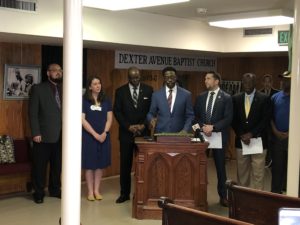
This year, Alabama has an opportunity to strengthen our voting practices and expand voting for tens of thousands of people. Three lawmakers – Reps. Prince Chestnut, D-Selma, Thomas Jackson, D-Thomasville, and Neil Rafferty, D-Birmingham – discussed several bills that would safeguard and expand voting rights in Alabama during a news conference Wednesday at Dexter Avenue King Memorial Baptist Church in Montgomery. Representatives from Alabama Arise and the Alabama State Conference of the NAACP also attended to show support for the legislation.

Alabama Arise policy analyst Dev Wakeley and executive director Robyn Hyden (at left) showed their support for legislation to protect and strengthen voting rights during a news conference May 1, 2019, at Dexter Avenue King Memorial Baptist Church in Montgomery.

Chestnut sponsors two of the bills: HB 501, which would establish automatic voter registration (AVR) in Alabama, and HB 502, which would allow Alabamians to vote absentee without having to give a reason. Jackson’s HB 256 would require each county to open at least one location for early voting. And Rafferty’s HB 486 would allow eligible Alabamians to register to vote on the same day as the election.

How automatic voter registration would strengthen democracy in Alabama

All four of these bills would improve government responsiveness to citizens’ wishes in a state with deep stains on its history of democracy. Arise particularly supports Chestnut’s efforts to establish automatic voter registration (AVR) in Alabama. Our fact sheet explains how AVR has saved money and boosted turnout in other states.

AVR would allow more than half a million unregistered and inactive voters in Alabama to be registered or updated automatically through transactions they already conduct with state agencies. Implementing AVR could save the state millions of dollars and significantly boost turnout.

The participation gains could be especially strong among people of color and younger voters. After Georgia put AVR in place in late 2016, turnout increased by nearly 30% between the 2014 and 2018 midterms. Turnout among nonwhite voters set new records, jumping by more than 36%. And turnout among young adults increased by nearly 45%.

Unfortunately, the Alabama House already has left the early voting bill languishing in a subcommittee for weeks. And amid rumors of an early end to the regular session, time is ticking for all four voting rights proposals.

Protecting the right to vote is essential, and it’s important not to allow these reforms to die quietly in committee. The people of Alabama deserve automatic voter registration and other changes to help ensure everyone’s voice is heard.

Automatic voter registration: Streamlining a basic right

Voting rights are a flashpoint in Alabama’s history. The long denial of those rights to African Americans led to Bloody Sunday in Selma, the march to Montgomery and eventually passage of the Voting Rights Act of 1965. In the half-century since, our state has taken a few steps that increase voting access for communities of color. But our system remains cumbersome and expensive. Automatic voter registration (AVR) would be a major step toward bringing our state’s system into the 21st century.

Before every major election in Alabama, a surge of activity focuses on voter rolls. For people seeking to exercise one of the most basic rights of democracy, getting registered and keeping that registration current can fall prey to busy schedules and confusing rules. Signing up eligible voters and ensuring lists are up-to-date are important responsibilities that cost Alabama advocates, civic groups and state officials a considerable amount of time and money.

There is a better way. Since 2015, sixteen states (including Georgia) and the District of Columbia have approved AVR, according to the Brennan Center for Justice. AVR registers eligible people when they apply for a driver’s license or share information with agencies in other routine ways. (People who do not want to register can opt out.) AVR saves money and removes barriers to civic participation.

A common-sense change

Voter registration in Alabama is outdated. In many places, the state uses the same pen-and-paper methods in operation for more than a century. Registering voters this way requires paying for printing, postage and staff to process the forms. If a person moves, the process is repeated, with those costs paid again. Some counties do conduct registration electronically. That requires less paper, but the kiosks are a considerable expense and still require staff.

Alabama could have saved about $2 million a year since 2015 by automatically registering all voters, according to estimates based on Oregon’s registration costs. Registering a new voter or updating records cost $7.67 per transaction in 2008, according to an Oregon study by the Pew Center on the States. But using data that agencies already have to register that voter automatically would have cost just 3 cents, Pew found. In Alabama, more than 1 million people have registered to vote since January 2015.

Building on previous gains

Alabama already offers voter registration services at several state agencies. The National Voter Registration Act of 1993 (aka “Motor Voter Act”) requires states to give people the chance to register to vote when they apply for a driver’s license. It also requires state agencies that provide public assistance, or that offer state-funded programs primarily engaged in providing services to people with disabilities, to offer voter registration services. Armed forces recruiting stations must provide registration services, and states must designate additional agencies of their choice to do so as well. Registering all eligible citizens automatically would increase the efficiency of a task the state already performs.

AVR would save time for citizens and public agencies across Alabama. Automatically registering people electronically would be less costly and time-consuming than processing paper forms. AVR also would build on Alabama’s recent improvements to streamline voter registration at Department of Motor Vehicles (DMV) offices. Those important changes have made it faster and easier for Alabamians to register to vote, but making registration automatic (with an opt-out choice for people who don’t want to register) would make it even faster and even easier. AVR would save people time at the courthouse. More importantly, it would encourage civic engagement by breaking down barriers to voting.

Civic boost, lower cost

Just 50 percent of people registered to vote in Alabama did so in the 2018 general election and even that turnout exceeded expectations. Low voter participation weakens democracy in our state. People who don’t vote are less likely to be engaged in their communities in other ways, and less likely to feel their voices are heard.

Other states have seen significantly higher voter participation after implementing AVR. Georgia, which put AVR in place before the 2016 election, saw voter turnout increase 11.4 percent from 2014 to 2018. By taking similar steps to remove paperwork barriers to democracy, Alabama can increase the number of people who participate in electing government officials.

Many states with AVR have seen large cost savings as well. For example, Oregon used AVR in 2016 to re-register 35,000 people with lapsed registrations and to register more than 220,000 people overall. Those moves saved an estimated $264,400 and $1.7 million, respectively, compared to doing so by hand.

AVR would be a cost-effective way to register, re-register or update voter registrations for hundreds of thousands of Alabamians. Alabama has nearly 300,000 voters on the inactive voter list, plus tens of thousands of people who are eligible but not yet registered. AVR would get those folks on the voter rolls at a much lower cost than traditional paper registration. It also offers a more efficient way to update records for people who have moved or changed their name. The money saved through AVR could be used to meet a range of other needs in Alabama. That could include expanding opportunities in underfunded schools, improving aging infrastructure or providing state funding for public transportation.

How to implement AVR

Alabama shouldn’t wait for federal action to boost civic participation. Three big policy choices could decide the scope of state-level AVR here:

— Legislative or administrative? Alabama can implement AVR through the Legislature or administrative rulemaking. States have used both options for automatic registration. Legislative implementation, used in most states, allows more input from elected officials in decision-making. Rulemaking can have a quick turnaround. Georgia, for example, conducted its rulemaking in 2016 and implemented AVR the same year.

— DMV-only or through all agencies? Every state with AVR, other than Alaska, uses its DMV to register voters, according to the Brennan Center. DMV implementation requires only one agency to modernize its procedures, and DMV users are a broad cross-section of society. But DMV-only implementation is likely to leave out many seniors, people with disabilities, and other people who are less likely to drive. Because DMV registration does not serve some people, some states offer automatic registration at other agencies as well.

— Pre-registration for citizens under age 18? Twenty-two states and the District of Columbia allow citizens to pre-register to vote before their 18th birthdays. Automating pre-registration would reduce paperwork and allow more young Alabamians to participate in democracy.

Bottom line: AVR by 2020

As our state enters its third century, Alabama should launch a new era of strengthened voting rights by implementing automatic voter registration in time for the 2020 general election. AVR would cut red tape, save taxpayers millions of dollars a year and, most importantly, increase participation in the democratic process. Ensuring everyone’s voice is heard is an essential step toward building a better Alabama for all.

Medicaid expansion, end to grocery tax highlight Alabama Arise’s 2019 priorities

Medicaid expansion and legislation to end the state sales tax on groceries are among the top goals on Alabama Arise’s 2019 legislative agenda. More than 200 Arise members picked the organization’s issue priorities at its annual meeting Saturday, Sept. 8, 2018, in Montgomery. The seven issues chosen were:

  • Tax reform, including untaxing groceries and closing corporate income tax loopholes.
  • Adequate funding for vital services like education, health care and child care, including approval of new tax revenue to protect and expand Medicaid.
  • State funding for the newly created Public Transportation Trust Fund.
  • Consumer protections to limit high-interest payday loans and auto title loans in Alabama.
  • Legislation to establish automatic universal voter registration in Alabama.
  • Reforms to Alabama’s criminal justice debt policies, including changes related to cash bail and civil asset forfeiture.
  • Reforms to Alabama’s death penalty system, including a moratorium on executions.

“Public policy barriers block the path to real opportunity and justice for far too many Alabamians,” Alabama Arise executive director Robyn Hyden said. “We’re excited to unveil our 2019 blueprint to build a more just, inclusive state and make it easier for all families to make ends meet.”

Alabama’s failure to expand Medicaid to cover adults with low wages has trapped about 300,000 people in a coverage gap, making too much to qualify for Medicaid but too little to receive subsidies for Marketplace coverage under the Affordable Care Act. Expanding Medicaid would save hundreds of lives, create thousands of jobs and pump hundreds of millions of dollars a year into Alabama’s economy. Expansion also would help keep rural hospitals and clinics open across the state.

The state grocery tax is another harmful policy choice that works against Alabamians’ efforts to get ahead. Alabama is one of only three states with no sales tax break on groceries. (Mississippi and South Dakota are the others.) The grocery tax essentially acts as a tax on survival, adding hundreds of dollars a year to the cost of a basic necessity of life. The tax also is a key driver of Alabama’s upside-down tax system, which on average forces families with low and moderate incomes to pay twice as much of what they make in state and local taxes as the richest Alabamians do.

Medicaid cuts loom, payday reform falls just short as Alabama Legislature ends 2016 regular session

The Alabama Legislature’s 2016 regular session, which ended Wednesday, was more notable in many ways for what didn’t happen than for what did.

Lawmakers did not agree on a revenue solution to prevent devastating Medicaid cuts that would reduce health care access for hundreds of thousands of children, seniors, and people with disabilities in Alabama. Despite enormous public support, payday lending reform didn’t cross the finish line in the House. State education funding still hasn’t returned to where it was in 2008. And proposals to expand affordable housing and reform Alabama’s death penalty system gained little traction at the State House.

Still, progress was real on several of Arise’s priority issues. With minutes left in the session, lawmakers passed a bill to expedite voting rights restoration for thousands of Alabamians. Payday lending reform made it further in the Legislature than it ever has before, with a reform bill sailing through the Senate 28-1. And the new #IamMedicaid campaign continues to remind lawmakers and the public of the real human faces behind Alabama’s Medicaid debate.

Here is a recap of what happened on each of Arise’s issue priorities this session – and the action that may yet lie ahead on them this year.

State budgets

Deep Medicaid cuts in Alabama moved much closer to reality Tuesday when a bill that would have averted most of them died in a Senate committee. HB 569 would have used BP oil spill settlement money to help free up $70 million to go toward Medicaid’s $85 million shortfall, but the bill died when the Senate’s General Fund (GF) budget committee adjourned without voting on it. Committee chairman Sen. Trip Pittman, R-Montrose, ended the meeting after his colleagues voted 9-6 to side with a proposed substitute by Sen. Arthur Orr, R-Decatur. Orr’s plan would have reduced the amount of road money in the bill and distributed those funds to all areas of Alabama instead of just coastal areas. The substitute also would have increased the share of settlement money used for debt repayment, fully repaying the Alabama Trust Fund (which receives state revenue from oil and gas drilling) for money that the state borrowed to avoid massive GF cuts in recent years.

The Legislature may return later this year for a special session to address the Medicaid shortfall, but Gov. Robert Bentley said “everybody’s got to rest a little bit” before he makes that decision. Even though the regular session is over, lawmakers are expected to continue a series of weekly hearings on Medicaid’s funding structure and importance to the state’s health care system. Meanwhile, Alabama moves ever closer to a future when deep Medicaid payment cuts could prompt many pediatricians to leave the state and could imperil many of the rural hospitals and doctor’s offices upon which Medicaid patients and privately insured Alabamians alike depend. The cuts could end Medicaid coverage for outpatient dialysis and adult prescriptions and eyeglasses as well. Also on the chopping block could be the Program of All-Inclusive Care for the Elderly (PACE) in Mobile, which saves the state money by allowing participating seniors to live independently in their own homes instead of being sent to a nursing home.

The Education Trust Fund (ETF) budget drew many fewer headlines than the GF this year, but state education funding is still about 15 percent below its pre-recession level of 2008, adjusted for inflation. (Even the 2008 funding level was insufficient to meet many of Alabama’s educational needs.) The 2017 ETF budget includes a 33 percent boost in pre-K funding and provides a 4 percent pay raise for most K-12 teachers. Universities and two-year colleges also received slight increases.

Payday lending reform

Alabama’s payday reform movement enjoyed an unprecedented breakthrough in the Legislature this year when a reform bill passed 28-1 in the Senate, but the plan came up just short of final passage. SB 91, sponsored by Orr, was on the House calendar Tuesday but never reached the floor for a vote after a long day of filibusters. Orr’s bill would have given Alabama payday borrowers a more realistic path out of debt by slashing interest rates, allowing installment payments and giving borrowers at least six months to repay. (Current state law allows payday loans to carry interest rates of up to 456 percent a year.) Arise will work with Alabama Appleseed and other advocates to build on this year’s momentum and growing public support as the reform movement continues into 2017.

Voting rights

Alabama will speed up the voting rights restoration process for thousands of people if Bentley signs a bill that the Legislature passed Wednesday. With just minutes left in the session, the House passed SB 186, sponsored by Sen. Linda Coleman-Madison, D-Birmingham, and sent it to the governor. The clock struck midnight just before the Senate could consider another voting rights bill – HB 268, sponsored by Rep. Mike Jones, R-Andalusia – which would have clarified what counts as a “crime of moral turpitude” that bars someone from voting in Alabama. Other proposals to expand voting access, including multi-day voting and same-day voter registration, died in committee.

Death penalty reform

A bill to establish a state Innocence Inquiry Commission for death penalty cases – SB 237, sponsored by Sen. Dick Brewbaker, R-Montgomery – cleared the Senate this year but died Tuesday when the House Judiciary Committee didn’t vote on it. Other proposed reforms to Alabama’s death penalty system, including a three-year moratorium on executions, went nowhere. The U.S. Supreme Court on Monday ordered further review of Alabama’s capital sentencing scheme, which allows judges to override a jury’s sentencing recommendation. A state circuit judge in March declared Alabama’s judicial override system unconstitutional, but the state has appealed that ruling.

Tax reform

Alabama’s tax system will remain upside down for another year, as the Legislature declined to consider measures to end the state grocery tax or close corporate tax loopholes. A bill to increase the state property tax won Senate committee approval but went no further. A proposed 75-cent cigarette tax increase won the endorsement of the Alabama Health Care Improvement Task Force but was never introduced in the Legislature. Lawmakers did, however, enact new tax breaks for small businesses and for increased use of state port facilities. The Legislature also passed a bill – SB 208, sponsored by Orr – to require annual reports on whether tax incentives are producing their intended economic effects.

“Ban the box” legislation

SB 327, sponsored by Sen. Quinton Ross, D-Montgomery, won Senate committee approval on April 7 but never reached the Senate floor. The bill would have removed the criminal history checkbox from state job and license applications, removing a potential barrier to employment for thousands of Alabamians looking to rebuild their lives and provide for their families after serving their time for a criminal offense.

Housing Trust Fund (HTF)

A bill to increase the state mortgage recording fee and distribute some of the revenue to the state HTF died in a House committee. HB 341, sponsored by Rep. Patricia Todd, D-Birmingham, would have created a dedicated state funding source for the HTF, which could create thousands of jobs while addressing Alabama’s need for more than 90,000 affordable homes for residents with extremely low incomes.

Quick overviews of Arise’s 2016 issue priorities

Your time is important, and your voice for a better Alabama is essential. That’s why we’ve prepared these quick overviews to keep you up-to-date on what’s happening at the Alabama Legislature on Arise’s 2016 issue priorities. We’ll update this post as needed.

“Ban the box” legislation: ‘Ban the box’ law would help rebuild lives in Alabama — The “criminal history checkbox” on many standardized job application forms often keeps otherwise qualified employees from making it to the next stage of the hiring process, where they could explain their past face-to-face. This creates discouraging barriers to employment for people who are looking to rebuild their lives after serving their time and paying their debt to society. A growing national “ban the box” movement to remove those checkboxes from job applications is helping former inmates become productive members of society and provide for their families. It could do the same for thousands in Alabama. (The Senate Judiciary Committee on April 7 approved SB 327, which would “ban the box” on state job and license applications, but the Senate never voted on it.)

Death penalty reform: Death is different: Reforming Alabama’s capital punishment system — People accused of capital crimes deserve every possible safeguard to ensure the integrity of a conviction. This overview examines several bills that could lower the risks of errors and injustice and could bring Alabama law into compliance with U.S. Supreme Court rulings.

Health care: Medicaid RCOs: Better care, better health, lower costs — Medicaid’s promising new regional care organization (RCO) reforms are designed to keep patients healthier while cutting health care costs. Investing in preventive care now should pay off in fewer costly emergency room visits later. (The Legislature on April 5 overrode the governor’s veto to pass a General Fund budget that would force deep Medicaid cuts. Lawmakers may return later this year for a special session to address Medicaid’s funding shortfall.)

Housing: Home at last: The Alabama Housing Trust Fund — Alabama has a shortage of almost 90,000 affordable and available homes for residents with extremely low incomes. State funding for the Alabama Housing Trust Fund (HTF), created in 2012, could reduce this shortfall and make dreams of home a reality for tens of thousands of families, seniors, veterans, and people with disabilities.

Payday lending reform: SB 91: A step in the right direction for Alabama borrowers — Payday loans in Alabama carry astonishingly high interest rates: up to 456 percent a year. A Senate proposal would give payday borrowers a less expensive path out of debt by reducing the maximum interest rate and allowing borrowers to pay off their loan in installments over time. (The Senate passed the bill 28-1 on April 5. A House committee approved a different version of SB 91 on April 27, but the regular session ended without a House vote on either version.)

State budgets: Alabama’s education budget begins to rebuild, but General Fund struggles put Medicaid at risk — The usual contrast between Alabama’s starving General Fund budget and its slightly healthier but still inadequate Education Trust Fund budget is exceptionally stark this year. As education finally climbs back toward its 2008 funding level after years of enormous cuts, the latest General Fund shortfall threatens devastating Medicaid cuts with effects that could ripple through the state’s entire health care system. (The Legislature on April 5 overrode the governor’s veto to pass a General Fund budget that would force deep Medicaid cuts. Lawmakers may return later this year for a special session to address Medicaid’s funding shortfall.)

Tax reform: Cigarette tax for Medicaid: A win-win to improve health and fill Alabama’s revenue gap — The future of Alabama Medicaid is on the line as lawmakers confront yet another threadbare General Fund budget. Without significant new long-term revenue, Medicaid will continue to be at risk of cuts to vital services and doctor payments that could place the entire program — and Alabama’s entire health care system — at risk. A cigarette tax of 75 cents per pack could provide long-term revenue needed to avoid those cuts, while also reducing health care costs and saving lives in Alabama.

Voting rights: A menu of options to improve voting rights in Alabama — Our entire democratic system depends on how elections are structured and who can participate. When barriers exclude people from voting, they often lose faith in a system that doesn’t seem to value their voice in our society’s decision-making process. This overview examines several bills that would protect and expand voting rights, including proposals related to early voting, streamlined voter registration and voting rights restoration. (SB 186, which would expedite the state’s voting rights restoration process, has gone to Gov. Robert Bentley after passing the Senate on April 19 and the House on May 4. Different versions of HB 268, a bill to clarify which crimes are “crimes of moral turpitude” that permanently disqualify offenders from voting in Alabama, passed the House on April 19 and the Senate on May 3, but the plan died May 4 when the regular session ended before the House could vote on a proposed conference committee version.)

Posted March 7, 2016. Last updated May 5, 2016.

Plan to help restore voting rights to thousands in Alabama wins Senate committee approval

Thousands of Alabamians could see their voting rights restored under a bill that won a state Senate committee’s approval Wednesday. SB 231, sponsored by Sen. Cam Ward, R-Alabaster, would clarify the types of crimes classified as “crimes of moral turpitude,” a longstanding murky category of crimes permanently disqualifying offenders from voting in Alabama.

Ward’s bill, which Arise supports, now moves to the Senate. It could reach the Senate floor for a vote as soon as Thursday.

The Senate Judiciary Committee quickly approved the bill after adopting two technical amendments that tweaked the bill’s wording without changing the substance of the proposed reforms. Lawmakers had no other debate about the issue Wednesday.

Secretary of State John Merrill has endorsed SB 231, which fits with the state’s Prison Reform Task Force recommendations regarding ex-felons’ ability to re-enter society successfully as participating and productive citizens. The bill is one of more than a dozen proposals this year to expand or protect voting rights in Alabama. Other legislation seeks to allow early voting and streamline voter registration.

By Stephen Stetson, policy analyst. Posted March 16, 2016.

A menu of options to improve voting rights in Alabama

Alabama is famous around the world for our historic fights over equal access to the polls. Our entire democratic system depends on how elections are structured and who can participate. When barriers exclude people from voting, they often lose faith in a system that doesn’t seem to value their voice in our society’s decision-making process.

What proposals are in play?

Civil rights anniversaries and national media attention have placed increasing focus on voting rights issues in Alabama. Several legislative proposals have been advanced to expand access to voting and strengthen our state’s electoral system.

Several bills seek to restore voting rights to people who lost them. HB 268, sponsored by Rep. Mike Jones, R-Andalusia, and SB 231, sponsored by Sen. Cam Ward, R-Alabaster, would clarify which crimes are considered “crimes of moral turpitude” that permanently disqualify people from voting – and which ones aren’t. Other bills that seek to streamline voting rights restoration include HB 222, sponsored by Rep. Chris England, D-Tuscaloosa; HB 245, sponsored by Rep. Thad McClammy, D-Montgomery; SB 186, sponsored by Sen. Linda Coleman-Madison, D-Birmingham; and SB 293, sponsored by Sen. Hank Sanders, D-Selma.

Several bills would ease voter registration. SB 156, sponsored by Sanders, would allow people to register on Election Day. Four other bills – HB 72, sponsored by Rep. Darrio Melton, D-Selma; HB 149, sponsored by Rep. Laura Hall, D-Huntsville; HB 259, sponsored by Rep. Mary Moore, D-Birmingham; and SB 71, sponsored by Coleman-Madison – would register people automatically when they apply for or renew a driver’s license or non-driver ID card.

Other bills would allow more voting time or seek to prevent mistakes. HB 163, sponsored by Rep. Richard Lindsey, D-Centre, and SB 302, sponsored by Sen. Rodger Smitherman, D-Birmingham, would require counties to offer in-person early voting options. HB 52, sponsored by Rep. Mike Ball, R-Madison, would require the state to notify absentee voters if a disqualifying mistake was made on their ballot so they can know not to repeat it. And HB 303, sponsored by Rep. Rod Scott, D-Fairfield, would require registrars to notify living voters who are being purged from the voter list.

What’s the bottom line?

All of the above bills would improve the health of Alabama’s elections and the responsiveness of those who serve in public office. In particular, establishing a clear and common-sense framework for people to regain voting rights after fulfilling the terms of their sentence would help ensure that everyone feels they have a chance to participate in our system of governance.