Voting rights are the foundation of our democracy. That’s why I wanted to share an opportunity for you to help protect those rights in Alabama by training and volunteering as a poll monitor. This opportunity comes through the nonpartisan Election Protection network, which works to ensure fair elections and make sure every eligible voter’s voice is heard.
Volunteers will observe polling stations for things like inaccessibility, improper signage, long lines and frustrated voters leaving the polling place. Volunteers also will be trained in the use of an Election Day hotline to report issues and support voters. This opportunity is in person, but Election Protection also offers remote participation options like voter outreach and social media monitoring.
As you surely are aware, our electoral process – the bedrock of our constitutional democracy – has been under threat from false narratives about the 2020 election and from legislative attacks in recent years. Alarmingly, Alabama lawmakers introduced many bills during the most recent legislative session that would have restricted voting rights. Now is the time to stand up strongly and boldly and defend our electoral process.
The volunteer training sessions for this November’s election will begin next week and continue until the election. If you can’t participate this year but would be interested in being a poll monitor in the future, don’t worry. Signing up at any time will start your process to be trained for future elections.
The 2022 runoff election is Tuesday, June 21. Alabamians will vote on Democratic and Republican nominees for a range of local, state and federal offices, including the Democratic nominee for governor and the Republican nominee for a U.S. Senate seat. Voters in some districts also will decide on nominees for the state Legislature.
Have you made a plan to vote? Alabama Arise has information below about how to vote in person Tuesday.
Alabamians can vote in either the Democratic or Republican primary, but not both.
State law forbids “crossover voting” in runoff elections. People who voted in the Democratic primary will be able to vote only in the Democratic runoff. People who voted in the Republican primary will be able to vote only in the Republican runoff. Voters who participated in neither party’s primary can choose to vote in either party’s runoff.
The crossover voting rule does not apply to the general election in November. Voters may vote for whomever they wish in the general election.
Voters’ party choice for this year’s primary or runoff election does not bind them for future years.
Listening is key to shaping and advancing public policies that matter most to those marginalized by bad policies. Alabama Arise depends on what we hear to help guide our work toward our vision of a better Alabama for all.
Our online Town Hall Tuesdays will return once again this year. These events are a chance to hear issue updates and share your vision for our 2023 priorities.
Please join us this summer to help identify emerging issues and inform our actions. Registration is required for any or all of the sessions. You can register at the link in each session below.
July 12th, 6 p.m. – Making the vision a reality: Food & health
Everyone should have access to food and the health care they need to live a long and healthy life. Join this session to discuss issue and advocacy opportunities in areas of access to food and health care. Click here to register for this session.
July 26th, 6 p.m. – Making the vision a reality: Democracy & justice
We envision a state where all government leaders are responsive, inclusive and justice-serving. Voting rights barriers and an unjust justice system have hindered our vision. But together, we can move forward. Join us to discuss how to improve voting access and advance criminal justice reforms. Click here to register for this session.
August 9th, 6 p.m. – Making the vision a reality: The path forward
Arise’s vision for Alabama can be realized because of our commitment and perseverance. We are committed to issues that matter to those marginalized by poverty, and we persevere in raising our voices together for change. Join this session to discuss issues already identified and to raise others. Click here to register for this session.
The Alabama Legislature’s 2022 regular session adjourned sine die late on Thursday, April 7. Lawmakers capped off the session’s last week with intense debates and late nights, with the final gavel dropping just before midnight.
Alabama Arise is grateful for the many positive outcomes that came out of the State House this year. We also were glad to play a role in stopping several misguided pieces of legislation from becoming law. These wins wouldn’t have been possible without the support of Arise’s determined members and various coalition partners.
We were not able to get every good bill across the finish line or stop every harmful legislative effort from happening. But Arise saw real progress on several important issue priorities this year. Keep reading below for recaps on some of the key bills we supported or opposed in 2022. Then visit our Bills of Interest page for updates on all of the legislation we tracked.
Adequate state budgets
Alabama’s fiscal year 2023 General Fund and Education Trust Fund budgets are both the largest in state history. The General Fund budget of $2.7 billion includes a provision to extend Medicaid postpartum coverage from 60 days to 12 months, which will help reduce maternal mortality and improve health outcomes for more than 30,000 women. Rep. Laura Hall, D-Huntsville, has been a longtime legislative champion for postpartum Medicaid extension.
The Education Trust Fund budget of $8.2 billion will provide a major boost in teacher pay. The increases will range from 4% all the way to 21% depending on seniority.
SB 140, sponsored by Sen. Del Marsh, R-Anniston, did not pass this session. The bill would have allowed the diversion of hundreds of millions of dollars from public schools to private schools. Arise opposed this effort.
SB 261, sponsored by Sen. Dan Roberts, R-Mountain Brook, passed out of both chambers. This bill will increase the income tax credit filers can claim for contributions to scholarship granting organizations for private schools. Arise opposed this effort.
Tax reform
HB 163 and SB 19, sponsored by Rep. Lynn Greer, R-Rogersville, and Sen. Arthur Orr, R-Decatur, passed out of both chambers. This legislation will increase the standard deduction and dependent exemption. That change will provide a small but significant income tax cut for low- and moderate-income Alabamians. Arise supported this effort.
SB 43, sponsored by Sen. Andrew Jones, R-Centre, did not pass this session. The bill would have repealed the state’s 4% grocery tax and capped the state deduction for federal income taxes. Despite strong bipartisan leadership from Jones and Rep. Penni McClammy, D-Montgomery, the bill did not come up for committee consideration. Arise supported this effort.
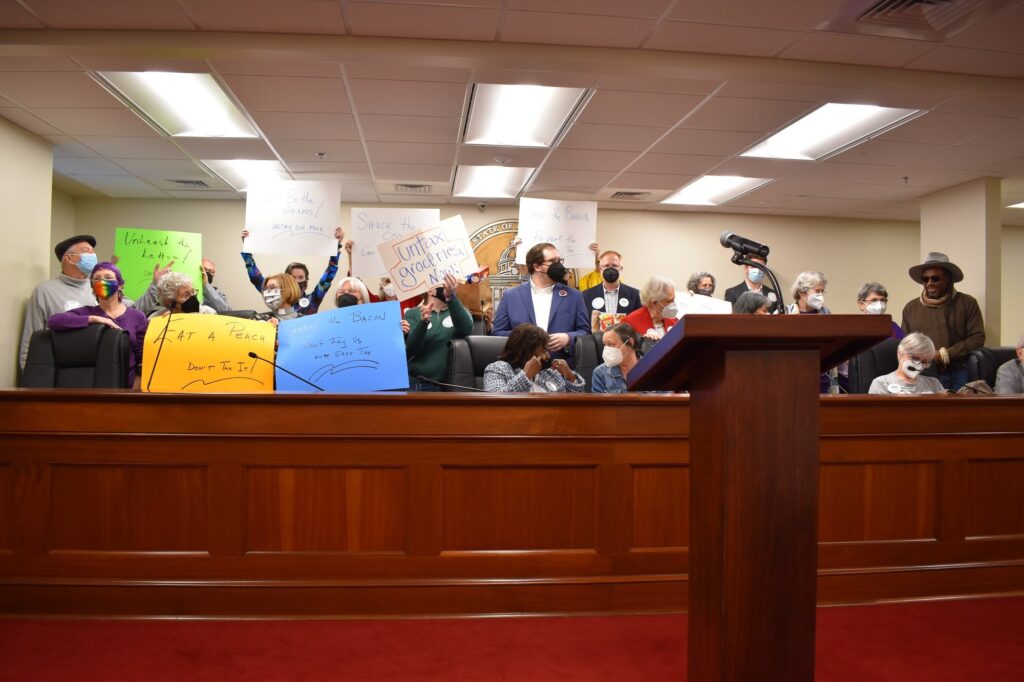
Alabama Arise members gathered for an Untax Groceries Rally at the State House in Montgomery on March 15, 2022. Bills to end the state grocery tax did not move in the Legislature this year, but the effort continues to enjoy growing bipartisan support.
Voting rights
HB 53 and SB 6, sponsored by Rep. Laura Hall, D-Huntsville, and Sen. Linda Coleman-Madison, D-Birmingham, passed the Senate but did not advance to the House floor. This bill would have eliminated application requirements for voting rights restoration. It also would have restored the right to vote for many indigent individuals. Arise supported this effort.
HB 63, sponsored by Rep. Debbie Wood, R-Valley, did not pass this session. The bill would have criminalized the prefilling of any voter application or absentee ballot application. Arise opposed this effort.
Hall’s HB 167 failed to pass this session. This legislation would allow inmate identification cards to be used as valid ID for voting. Arise supported this effort.
HB 194, introduced by Rep. Wes Allen, R-Troy, passed out of both chambers. The bill will prohibit state and local election officials from soliciting, accepting or using donations for election-related expenses. Arise opposed this effort.
Criminal justice reform
HB 52, sponsored by Rep. Jim Hill, R-Moody, passed out of both chambers. This bill will allow judges to use discretion in the length of someone’s sentence if their probation is revoked. Arise supported this effort.
HB 95, sponsored by Rep. Jeremy Gray, D-Opelika, passed out of both chambers. The bill will create a 180-day grace period for people to repay court-imposed fines and fees following release from incarceration. Arise supported this effort.
SB 203, sponsored by Sen. Arthur Orr, R-Decatur, passed out of both chambers. This bill will require the Administrative Office of Courts to establish a database of municipal fines and fees. Arise supported this effort.
HB 230, sponsored by Rep. Rolanda Hollis, D-Birmingham, passed out of both chambers. This bill will ban the routine shackling of incarcerated individuals during pregnancy, delivery and immediate postpartum time. Arise supported this effort.
HB 200 and SB 117, sponsored by Rep. Merika Coleman, D-Birmingham, and Sen. Will Barfoot, R-Montgomery, failed to pass this session. The bill would have ended driver’s license suspensions for failure to pay fines and fees. Arise supported this effort.
SB 220, sponsored by Sen. Linda Coleman-Madison, D-Birmingham, failed to pass this session. The bill would have required that time served awaiting a hearing for parole violation be applied retroactively. Arise supported this effort.
HB 2, sponsored by Rep. Allen Treadaway, R-Morris, did not pass this session. This anti-protest bill would have created minimum holding periods for people accused of the crimes of rioting or interfering with traffic. It also would have penalized certain local jurisdictions that reduce funding for law enforcement. Arise opposed this effort.
Hill’s HB 55 failed to pass this session. The bill would have required every judicial circuit to establish a community corrections program. Arise supported this effort.
Unemployment insurance benefits
SB 224, sponsored by Sen. Arthur Orr, R-Decatur, passed out of both chambers. This bill will impose additional job search requirements as a condition of eligibility for unemployment insurance benefits. Specifically, individuals will have to show a “reasonable and active effort” to find work by providing proof every week that they have contacted at least three prospective employers. Unless a new job notice has been posted, a job seeker cannot apply for or seek work at an employer where they already made contact. Arise opposed this effort.
Food security
SB 156, sponsored by Sen. Arthur Orr, R-Decatur, did not pass this session. The bill would have required both custodial and non-custodial parents to cooperate with child support enforcement to qualify for SNAP food assistance. Arise opposed this effort.
‘Divisive concepts’
HB 312 and SB 292, sponsored by Rep. Ed Oliver, R-Dadeville, and Sen. Will Barfoot, R-Montgomery, did not pass this session. The bill would have prohibited the teaching of “divisive concepts” related to race, religion and sex in public K-12 schools, colleges, universities and certain state training programs. Arise opposed this effort.
Meet Rebecca Howard, Arise’s new policy and advocacy director! Rebecca introduces herself to our members before discussing the latest news on ARPA funding in Alabama and our thoughts on the recent federal court decision on the state’s congressional maps.
Voting rights are a flashpoint in Alabama’s history. The long denial of those rights to Black residents led to Bloody Sunday in Selma, the march to Montgomery and eventually passage of the Voting Rights Act of 1965. In the decades since, our state has taken a few steps that increase voting access for communities of color. Still, Alabama’s voting systems remain unnecessarily cumbersome, expensive and exclusionary.
Alabamians seeking to exercise their fundamental right to vote often face numerous administrative hurdles and physical and procedural barriers. Recent legislative sessions have included repeated attempts to make voting more inconvenient for Alabamians and more burdensome for election officials.
Recent policy changes have made voting harder
Efforts to restrict voting have gained traction since the U.S. Supreme Court overturned parts of the Voting Rights Act in its 2010 Shelby County v. Holder ruling. And some of those more recent efforts in Alabama unfortunately have succeeded.
For instance, the 2021 regular session saw lawmakers ban curbside voting, a practice that Mississippi expanded in 2020. Curbside voting would have increased polling place access for older and pregnant Alabamians, as well as people with disabilities. Echoing the state’s long past of racist voting policy, the curbside voting ban finally passed after a procedural vote to cut off debate and silence a filibuster by Black senators.
Legislative attempts to make it harder for Alabamians to have their voices heard haven’t stopped there. Some lawmakers also have sought to remove election officials’ ability to provide extended hours or accommodations during declared emergencies. This measure would be particularly shortsighted in Alabama, where tornado outbreaks are routine during the primary election season in the spring and hurricanes remain a persistent threat during the general election season in the fall.
Pro-democracy policies would build a better Alabama
Ensuring that everyone’s voice is heard is an essential part of building a better, more inclusive Alabama. Lawmakers can and should make numerous policy improvements to boost civic engagement and strengthen democracy in Alabama:
Remove the racist modern poll tax that requires repayment of fines and fees for people with a criminal conviction to regain voting rights. This disenfranchisement has its roots in post-Reconstruction efforts to sidestep the U.S. Constitution’s ban on explicitly race-based voting restrictions. And this practice continues to harm Black people at a far higher rate than the overall population.
Allow extended early voting for voters who can’t make it to the polls on Election Day.
Create a same-day voter registration process so voters who show up to the polls aren’t excluded from casting ballots.
Enable curbside voting to increase accessibility for voters who have mobility or health concerns.
Eliminate the burdensome photo ID requirement for voters to cast ballots.
Allow absentee voting without requiring voters to provide an excuse from a state-approved list.
Bottom line
Our democracy is strongest when everyone can participate. But Alabama has made that harder by erecting barriers that limit voting for many seniors, people with low incomes, people with disabilities and people who were formerly incarcerated. By enacting policies to protect and expand voting rights, lawmakers can move Alabama away from a shameful past and toward a brighter future where all voices are valued and included.
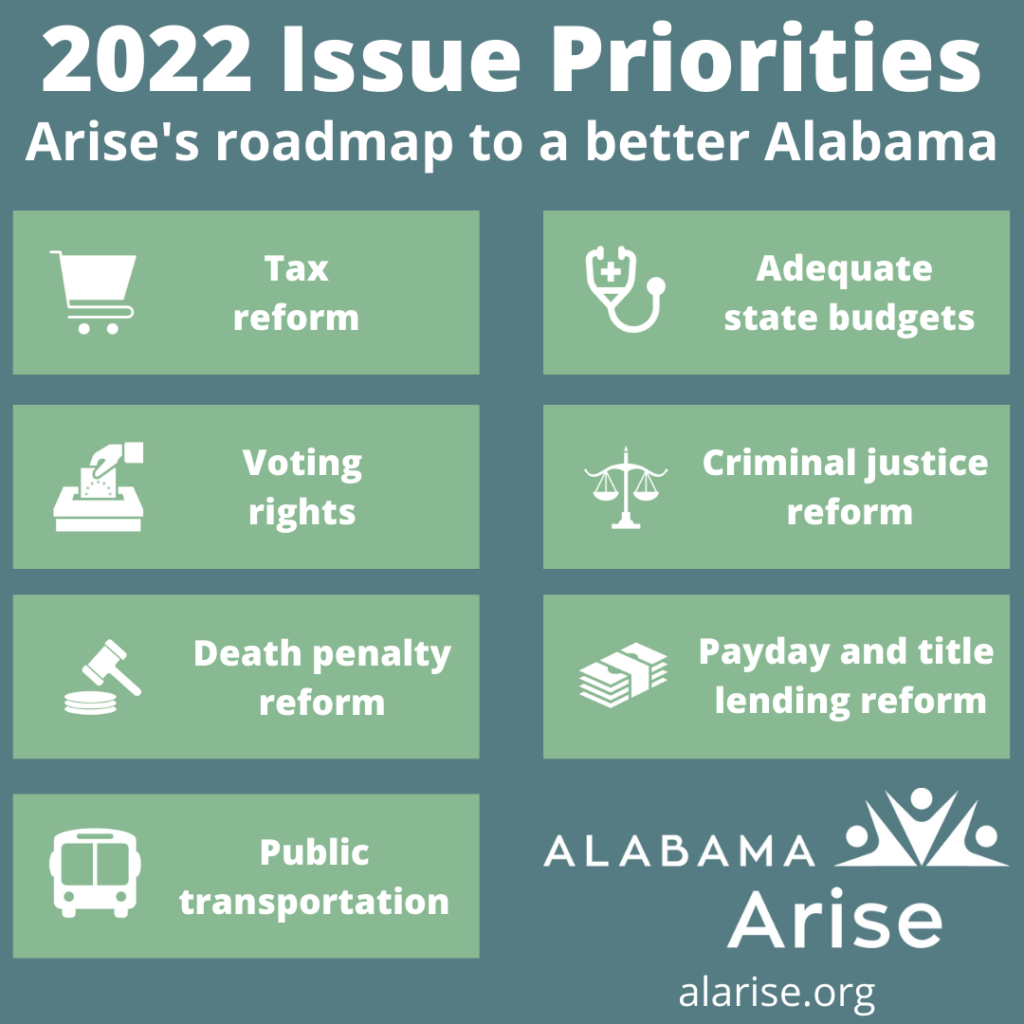
Sentencing reform and voting rights expansion are two key goals on Alabama Arise’s 2022 legislative agenda. Members voted for Arise’s issue priorities this week after nearly 300 people attended the organization’s online annual meeting Saturday. The seven issues chosen were:
Tax reform, including untaxing groceries and ending the state’s upside-down deduction for federal income taxes, which overwhelmingly benefits rich households.
Adequate budgets for human services like education, health care and child care, including Medicaid expansion to make health coverage affordable for all Alabamians.
Voting rights, including automatic universal voter registration and removal of barriers to voting rights restoration for disenfranchised Alabamians.
Criminal justice reform, including retroactive application of state sentencing guidelines and repeal of the Habitual Felony Offender Act.
Death penalty reform, including a law to require juries to be unanimous in any decision to impose a death sentence.
Public transportation to help Alabamians with low incomes stay connected to work, school, health care and their communities.
“Arise believes in dignity, equity and justice for all Alabamians,” Alabama Arise executive director Robyn Hyden said. “Our 2022 issue priorities would break down many of the policy barriers that keep people in poverty. We must build a more inclusive future for our state. And together, we will.”
The urgent need for criminal justice reform
Alabama’s criminal justice system is broken, and its prisons are violent and dangerously overcrowded. Exorbitant court fines and fees impose heavy burdens on thousands of families every year, taking a disproportionate toll on communities of color and families who already struggle to make ends meet. And Alabama needs investments in mental health care, substance use disorder treatment, community corrections and diversion programs to help stem the tide of mass incarceration.
Lawmakers’ plan to spend hundreds of millions of dollars on new prisons is not an adequate solution to these problems. Alabama must enact meaningful sentencing and reentry reforms to make its corrections system more humane and effective. Legislators took a good first step during this week’s special session by passing a bill by Rep. Jim Hill, R-Moody, to provide supervised release for everyone leaving prison in Alabama.
Many other needed changes still remain on the Legislature’s plate, however. One important priority is Hill’s proposal to allow judges to apply Alabama’s new sentencing guidelines retroactively. The House declined to vote on that bill this week, but Hill has promised to file it again in 2022. Hundreds of people would be eligible to apply for a reduced sentence if the measure passes.
Arise also will continue to work toward repeal of the Habitual Felony Offender Act (HFOA), the state’s “three-strikes” law. The HFOA is a driver of sentencing disparities and prison overcrowding in Alabama. The law lengthens sentences for a felony conviction after a prior felony conviction, even when the prior offense was nonviolent. Hundreds of people in Alabama are serving life sentences for non-homicide crimes because of the HFOA. Thousands more have had their sentences increased as a result. Repealing the law would reduce prison overcrowding and end some of Alabama’s most abusive sentencing practices.
Protect and expand voting rights so every voice is heard
Arise members provided a resounding endorsement of efforts to protect and expand voting rights in Alabama. This includes support of federal legislation to prevent voter suppression and strengthen the Voting Rights Act. And it includes calls for numerous state-level improvements to promote greater civic engagement and increase access to voting.
One such improvement would be automatic voter registration (AVR) across Alabama. AVR would use information the state already has to register or update registrations electronically for hundreds of thousands of Alabamians. Another important step would be to ensure people who struggle to make ends meet are not denied the right to vote simply because they cannot afford court fines and fees.
“Our ability to progress as a state will be limited as long as any person or group is unable to exercise their constitutional right to vote,” Hyden said. “We urge Alabama lawmakers to protect and expand voting rights by instituting automatic voter registration and lifting barriers to voting rights restoration.”
Listening is a core value of Alabama Arise. We deeply value the input we get from our members, our allies and most importantly, those directly affected by the work we do together. We depend on what we hear to help guide our issue work and our strategies.
The ongoing COVID-19 pandemic continued to challenge us to be creative in finding ways to listen. We did another series of three statewide online Town Hall Tuesdays. This year, we also held 12 individual group listening sessions for a total of 15 listening sessions in all.
What we heard this summer
The town halls happened every two weeks, starting June 15 and ending July 13. The individual meetings took place throughout the summer. Here is some of what we heard in those town halls and in the individual group sessions:
Health care, voting, criminal justice
In addition to strong support for Medicaid expansion, we heard several people express the need to address hospital costs, the lack of adequate equitable access to health services and significant concern for prescription drug prices (for seniors in particular). Many people highlighted the need for mental health reforms, and several pointed out the mental health connection to issues of homelessness.
We heard concerns about ongoing, intentional barriers to voting. Many raised the need to improve voter access by making it easier, not more difficult, for people to vote. They said we need reforms like automatic voter registration, no-excuse and simplified absentee voting, a better process for restoring voting rights of people who were formerly incarcerated, an Election Day holiday and curbside voting. Issues about term limits for legislators and rank choice voting also were raised. While related to voting, but distinct, redistricting was also a concern.
People voiced passionate support for many criminal justice reforms. Several highlighted a desire to abolish the Habitual Felony Offender Act and the death penalty. They also raised their voices for reforms around juvenile justice, gun violence, community sentencing options and programs to build social and job skills of people who were formerly incarcerated. There was much discussion about the need for prison reform beyond just building new prisons. Some participants also mentioned police reforms, specifically people advocating for public access to police body cam footage.
Housing, education, child care, transportation, language barriers
We heard much discussion about the need for quality affordable housing, living wages and adequate funding of public education, including early childhood education and child care. Many also emphasized the connections between most of the issues of concern. Deficits in one area lead to insufficiency in many others.
We also heard concern about the need to improve public transportation in the state. Many were interested in environmentally friendly public transportation solutions and securing a funding source for the Public Transportation Trust Fund created a few years ago.
Among our Spanish-speaking members, many noted concerns with access to health care. These included eligibility concerns and disparities with information shared regarding documents and verification needed to receive the COVID-19 vaccine. They also requested a statewide Spanish-language hotline for addressing day-to-day inquiries surrounding public service benefits.
June 15 ‒ A better Alabama for all: Participants discussed the question: If you could wave a magic wand and fix one issue that addresses poverty in Alabama, what would that issue be?
June 29 ‒ Health care for all: Participants discussed ways to close the health coverage gap by expanding Medicaid in Alabama.
July 13 ‒ Justice for all: Participants discussed their priorities for improving access to voting and reforming our criminal justice system.
Stay in touch with Arise
We didn’t stop listening because the town halls ended. We want to hear from you, and we encourage you to contact the Arise organizer in your area:
Presdelane Harris (pres@alarise.org): Southwest Alabama and Mobile.
Stan Johnson (stan@alarise.org): Northwest Alabama, Birmingham and Tuscaloosa.
Mike Nicholson (mike@alarise.org): Southeast Alabama, Auburn and the Wiregrass.
Alabama Arise’s work for equity, justice and opportunity persisted after the Legislature’s regular session ended. We’ll renew our commitment to those principles when Arise members choose 2022 issue priorities after the Sept. 25 annual meeting. And we’ll keep up the drumbeat when lawmakers return later this year for one or more expected special sessions.
Alabama’s overcrowded and antiquated corrections system – a decades-long humanitarian crisis – may prompt a special session this fall. Gov. Kay Ivey and many legislators hope to build and renovate multiple prisons. Alabama may seek federal permission to use COVID-19 relief money for those purposes.
Arise believes meaningful sentencing reforms should accompany any plan for new prisons. Repeal of the outdated Habitual Felony Offender Act would be one long-term step to reduce overcrowding. Parole reform and stronger investments in community corrections and reentry supports would help as well. Arise will advocate for these policy changes and others during any prison-related special session.
Redistricting is another likely focus of a special session. Legislators will use new Census data to draw new districts for the Legislature, state school board and U.S. House. Arise urges members to participate in public hearings that the Joint Reapportionment Committee will hold across Alabama this month. Click here for more information and a full hearing schedule.
Alabama legislators likely will return to Montgomery for a special session on redistricting later this year. Before then, the Joint Reapportionment Committee will hold a series of public hearings across the state beginning Sept. 1. These events are an opportunity for Alabamians to share their thoughts and concerns about the redistricting process.
Every decade, Alabama lawmakers draw new districts for the Legislature, state school board and U.S. House. This redistricting, based on the latest Census data, is designed to adjust for population changes in the previous 10 years.