Arise legislative update: Recap of Alabama redistricting hearing

The ongoing lawsuit over Alabama’s congressional map returned to federal court this week. Arise’s Mike Nicholson attended the U.S. District Court’s redistricting hearing in Birmingham on Aug. 14.

In this video update, Mike provides background on the case, which returned to district court after the U.S. Supreme Court’s decision in Allen v. Milligan. He also talks about the frustration that many people at the hearing seemed to feel in response to the state’s arguments. Judges questioned whether Alabama’s revised map complied with their order for lawmakers to draw two districts where Black voters have a realistic opportunity to elect a candidate of their preference.

This week’s hearing followed a July special session during which the Legislature drew a new congressional map in response to the Allen v. Milligan ruling. That decision found that Alabama’s congressional districts likely violated the Voting Rights Act by diluting the power of Black voters. Plaintiffs said lawmakers’ new map also violates the act and urged the court to appoint a special master to draw Alabama’s congressional districts.

Arise legislative update: Recap of 2023 redistricting special session

Arise’s Akiesha Anderson provides an update after the Alabama Legislature’s weeklong special session that focused on redistricting. The special session was in response to the U.S. Supreme Court’s ruling in Allen v. Milligan, which found that Alabama’s congressional districts likely violated the Voting Rights Act by diluting the power of Black voters. Akiesha also discusses what may happen next as the state’s new map faces a likely change in federal court next month.

Allen v. Milligan ruling is a shot in the arm for democracy

Alabamians received good news this month with the U.S. Supreme Court’s decision in Allen v. Milligan. This decision upholds key parts of the Voting Rights Act and requires Alabama to draw new congressional districts by July 21. The Legislature likely will hold a special session in July to approve two majority-Black (or close to majority-Black) districts. Alabama has had only one majority-Black district for decades, diluting the voting power of Black residents.

The ruling came a decade after Shelby County v. Holder, a decision that gutted the Voting Rights Act’s preclearance protections. As we commemorate this anniversary, we are reminded of why protecting Black voting power in Alabama is so critical to achieving our vision of a strong, participatory democracy.

Alabama Arise salutes our partners at Alabama Forward, Alabama NAACP, Greater Birmingham Ministries and ACLU of Alabama for their hard work and vision in the Milligan case. Arise will continue working to advance legislation to protect and strengthen voting rights. And we will keep fighting to ensure that every vote counts and elected officials are accountable to their constituents.

Alabama Arise was thrilled to join Shake the Field, Alabama Forward and other groups for the Democracy Now or Never Festival in Montgomery on June 3. The event sought to promote civic participation in advance of the Allen v. Milligan ruling.

2023 was a momentous session on Alabama Arise policy priorities

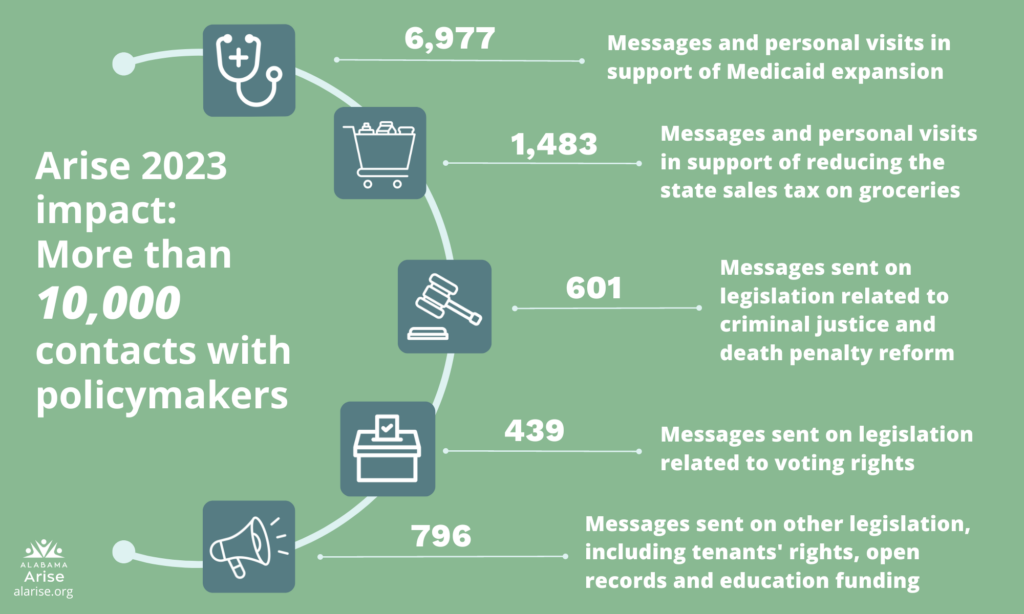
June 6 ended one of the most significant legislative sessions ever for Alabama Arise and our supporters. Through timely and persistent advocacy, Arise members helped build a better, more equitable Alabama.

While our work continues, we want to highlight the many important strides this year in our movement for a better Alabama for all – and celebrate Arise members’ role in advancing that goal. This article summarizes some of the key bills on Arise priorities during the Legislature’s 2023 regular session. For information on all bills we tracked this year, visit the Bills of Interest page on our website.
Tax reform

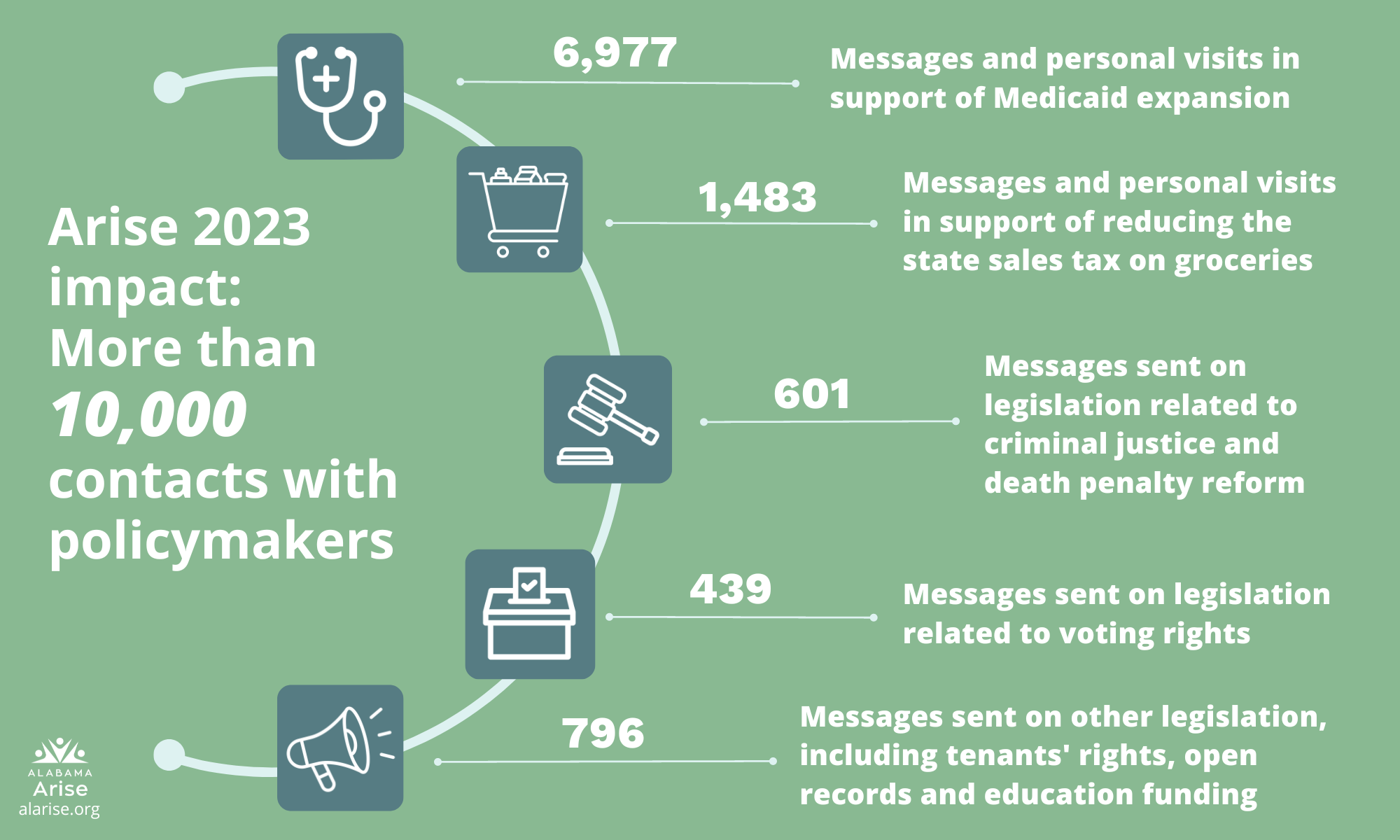
Lawmakers proposed many significant tax reform bills this session. But none will have more lasting significance to Alabamians than reducing the state sales tax on groceries, a longstanding Arise priority. Thanks to phenomenal member advocacy, our state is finally removing part of this regressive tax.

HB 479, sponsored by Rep. Danny Garrett, R-Trussville, became law this year. This legislation will cut the state grocery tax by half in the coming years. This huge victory for tax justice resulted from decades of hard work by Arise members. (See page 1.)

Adequate state budgets

Alabama’s 2024 General Fund (GF) and Education Trust Fund (ETF) budgets are both significantly larger than 2023. The GF budget is about $3 billion and includes a 2% pay raise for state employees. It also includes significant funding increases for Medicaid, mental health care and other state services. The 2024 ETF budget is nearly $8.8 billion, half a billion dollars more than the previous year’s ETF.

HB 295 and SB 202, known as the PRICE Act, were sponsored by Rep. Ernie Yarbrough, R-Trinity, and Sen. Larry Stutts, R-Tuscumbia. These bills would have allowed parents to take tax dollars that otherwise would support local public schools and use them to pay for private schools or home schooling. Arise and other advocates helped defeat this legislation, protecting nearly $600 million of public education funding.

Voting rights

HB 209, sponsored by Rep. Jamie Kiel, R-Russellville, did not pass this session. This bill would have criminalized many efforts to assist voters with absentee ballot applications or completed ballots. Arise and other groups successfully stopped this bill, which passed the House but never reached the Senate floor.

Criminal justice reform

SB 154, sponsored by Sen. Will Barfoot, R-Pike Road, became law this year. This legislation will make it harder for the state to suspend people’s driver’s licenses for failure to pay traffic tickets. Arise and our partners at Alabama Appleseed strongly supported this bill.

HB 24, sponsored by Rep. Reed Ingram, R-Pike Road, passed despite Arise’s opposition. This bill will criminalize asking for money on the side of roads, punishing many Alabamians facing housing insecurity. Federal courts have found similar laws unconstitutional in recent years.

HB 229, sponsored by Rep. Chris England, D-Tuscaloosa, would have allowed resentencing of certain incarcerated individuals sentenced to life imprisonment without parole under Alabama’s Habitual Felony Offender Act. This bill passed the House and gained Senate committee approval, but it never reached the Senate floor. Arise supported this bill and expects a similar one to be filed next session.

Death penalty reform 

England’s HB 14 would have required a unanimous jury sentence to impose the death penalty. The bill also would have made the state’s judicial override ban retroactive. This bill received a public hearing but did not leave the committee. Arise supported this bill and expects a similar one to be filed next session.

Other issues 

SB 196, sponsored by Sen. Arthur Orr, R-Decatur, would have increased government transparency by improving Alabama’s open records process. This bill passed the Senate and gained House committee approval but did not pass in the House. Arise supported this bill and expects a similar one to be filed next session.

SB 242, sponsored by Sen. Keith Kelley, R-Anniston, would have undermined tenant protections by removing the cap on the amount of the security deposit that landlords can charge to renters. Arise opposed this bill, and it died without reaching the Senate floor.

Vote ‘No’ on HB 209 – Rep. Kiel’s bill that would narrow voting rights in Alabama

Voting rights are an essential part of the democratic process, and we should be wary of any legislation that unnecessarily prevents people from voting. But HB 209, sponsored by Rep. Jamie Kiel, R-Russellville, would do just that. This bill would make it a felony to assist others in the absentee ballot application and submission process, except under very narrow exceptions. Here are three reasons to oppose this bill in the Alabama Legislature’s 2023 regular session:

Alabama’s absentee voting application process is already secure and safe. There’s no need to add confusing and frightening requirements to an already secure process.

  • This bill would prohibit any person from knowingly distributing, ordering, requesting, collecting, completing, obtaining or delivering an absentee ballot application or absentee ballot of another person.
  • Making it a crime to assist people in the absentee ballot application process is completely unnecessary. It would create a chilling effect on voters as they become more fearful of an already difficult process. 
  • This legislation reflects an untrue and dangerous narrative about voting rights and the voting process in our state. Former Secretary of State John Merrill repeatedly has gone on record to say the 2020 election was safe, and that few, if any, instances of voter fraud occurred.

This bill likely would have unintended consequences. Innocent people would become the victims of ideological warfare.

  • The stated intent of this legislation is to ensure that people don’t profit from, or take advantage of, the absentee ballot process. However, because the penalties are so severe, they almost certainly would scare people who are attempting to assist voters who legitimately need help.
  • This bill would make it a felony to drop off a neighbor’s or friend’s absentee ballot or ballot application, even if that person has a disability or no form of transportation.
  • The bill’s exception allowing immediate family members to drop off a ballot or ballot application for you is not enough to mitigate harm. This exception is too narrow (for example, it does not explicitly mention in-laws) and would lead to further confusion around the voting process.

We need to expand access to voting, not make it more difficult. 

  • Alabama has a shameful history when it comes to preventing groups from voting in our state. We have long been at the center of the battle for civil rights and far too often on the wrong side of history. 
  • Our 1901 state constitution was written explicitly to establish white supremacy and disenfranchise Black and poor white Alabamians. This shameful legacy unfortunately persists in many aspects of our state’s voting process today.
  • Our state has some of the strictest voting procedures in the country. Movements for an Election Day holiday, early voting periods, automatic voter registration and no-fault absentee voting all have met with intense opposition in the Legislature through the years.
  • This bill would be one more barrier in a long line of barriers going back more than 100 years that attempts to limit democratic participation in Alabama. We need to remove unnecessary voting barriers, not add more of them.

Vote ‘No’ on HB 209 – Rep. Kiel’s bill that would narrow voting rights in Alabama

  • Alabama’s absentee voting application process is already secure and safe. There’s no need to add provisions that could confuse or frighten people or discourage them from participating in our democracy.
  • This bill likely would have real and unintended consequences for people who are just trying to help their friends or family members vote.
  • Alabama already has some of the strictest voting laws in the nation. We should be making it easier, not harder, for people to be part of the democratic process.

Arise legislative update: April 17, 2023

Arise’s Akiesha Anderson provides an update on two bills we’re watching in the Alabama Legislature this week. We are urging the Senate to support a bill that would end many driver’s license suspensions for debt-based reasons. And we are urging a House committee to oppose a bill that would add harmful and confusing limits to Alabama’s absentee voting process.

Arise legislative update: April 10, 2023

Arise’s Mike Nicholson highlights three criminal justice reform bills that we’re watching and supporting during the Alabama Legislature’s 2023 regular session. This legislation would help modernize our state’s sentencing system, reduce the burdens of high fines and fees, and ease voting rights restoration for many Alabamians who were formerly incarcerated.

Alabama Arise resources for the 2022 general election

The 2022 general election will be held Tuesday, Nov. 8 – less than three weeks from today. Alabamians will vote on a range of local, state and federal offices, including the governor, state legislators, a U.S. Senate seat and U.S. House members. Voters also will decide on a proposed recompilation of the state constitution and 10 proposed statewide constitutional amendments.

Are you registered to vote? Have you made a plan to vote in this year’s general election? Alabama Arise has information below about how to register and how voters can cast a ballot. We share resources that could help if you face barriers to voting. And we explain why we urge Alabamians to vote YES on the recompiled state constitution.

A Black woman holds a voting button. Text: "You have the power. Use it. Vote!"

What you need to know about voter registration

  • Alabama’s voter registration deadline for the 2022 general election is Monday, Oct. 24. That is the deadline both for new voters to register and for current voters to update their voting information if they have moved to another location within Alabama.
  • Register to vote or update your information online here.
  • People who have faced domestic violence, or guardians of people who have faced domestic violence, may submit a form to protect their residential and mailing addresses from appearing on the public list of registered voters. Download that form here (opens as a PDF).
  • Alabamians are not officially registered to vote until their county board of registrars reviews and approves their application.
  • Check your voter registration status here.

What you need to know for the election

What to do if you face barriers to voting

If you face any intimidation, threats or other barriers to voting, trained volunteers are ready to help. You can call the nonpartisan Election Protection hotlines here:

  • English: 866-OUR-VOTE (866-687-8683)
  • Spanish: 888-VE-Y-VOTA (888-839-8682)
  • Asian languages: 888-API-VOTE (888-274-8683)
  • Arabic: 844-YALLA-US (844-925-5287)

Read our blog post to learn more about volunteering as a poll monitor with the nonpartisan Election Protection network.

Why Alabama Arise supports the recompiled constitution

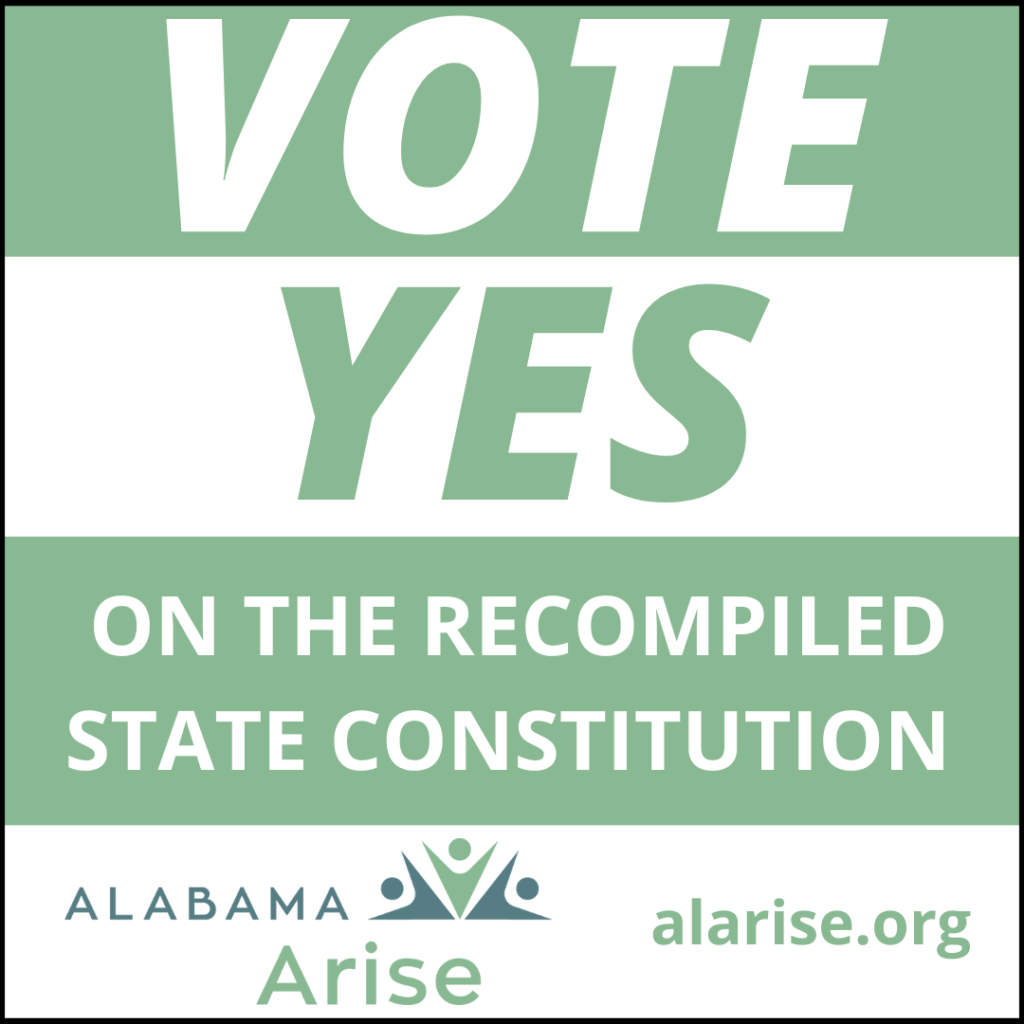
A graphic stating: Vote Yes on the recompiled state constitution

From our blog:

“Alabama Arise is committed to recognizing, teaching about and repairing the damage that state lawmakers perpetrated for generations through codifying racism and racist practices. Racist language and the harmful provisions flowing from it have no place in our state’s most important legal document. That is why we urge Alabamians to vote ‘Yes’ on the recompiled state constitution on Nov. 8, 2022.

“Examples of deleted racist language [in the recompilation] include references to separate schools for Black and white children and prohibition of interracial marriages. The recompilation also strengthens Alabama’s prohibition of slavery by removing language that allows involuntary servitude ‘for the punishment of crime.’

“Alabama voters will decide whether to authorize those changes by adopting the recompiled state constitution. Arise recommends voting ‘Yes’ on the recompilation, which will appear on the ballot as the Constitution of Alabama of 2022.”

Read more about the recompiled constitution here.

Alabama Arise unveils 2023 roadmap for change in Alabama

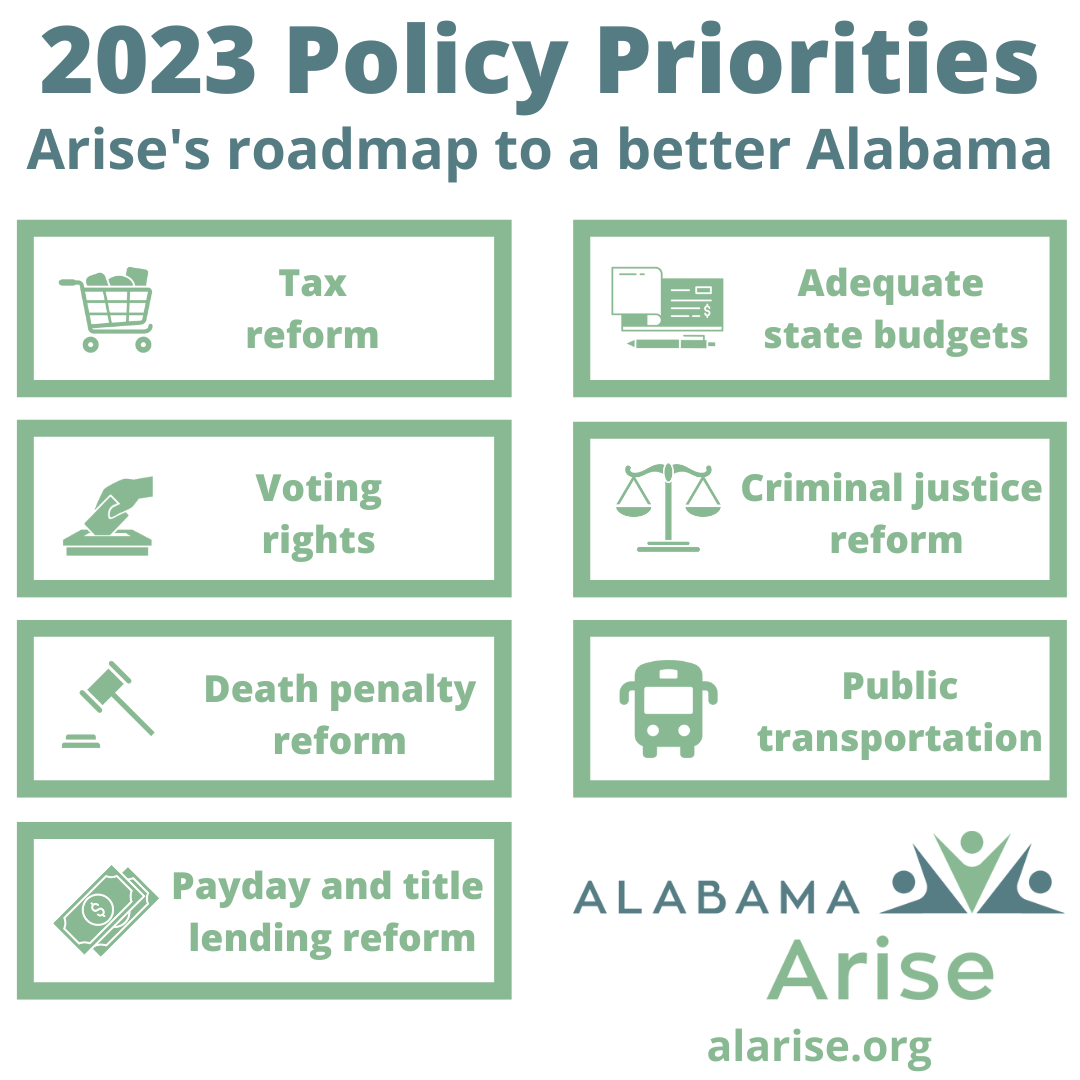
Expanding Medicaid and ending the state sales tax on groceries will remain top goals on Alabama Arise’s 2023 legislative agenda. More than 400 members voted on Arise’s issue priorities in recent days after the organization’s annual meeting Saturday. The seven issues chosen were:

  • Adequate budgets for human services like education, health care and child care, including Medicaid expansion to make health coverage affordable for all Alabamians.
  • Tax reform, including untaxing groceries and capping the state’s upside-down deduction for federal income taxes, which overwhelmingly benefits rich households.
  • Voting rights, including automatic universal voter registration, removal of barriers to voting rights restoration for disenfranchised Alabamians, and other policies to expand and protect multiracial democracy in the state.
  • Criminal justice reform, including retroactive application of state sentencing guidelines and repeal of the Habitual Felony Offender Act.
  • Death penalty reform, including a law to require juries to be unanimous in any decision to impose a death sentence.
  • Public transportation to empower Alabamians with low incomes to stay connected to work, school, health care and their communities.
  • Payday and title lending reform to protect consumers from getting trapped in debt.

“Arise believes in dignity, equity and justice for everyone,” Alabama Arise executive director Robyn Hyden said. “Our 2023 issue priorities reflect the need to work together to break down policy barriers that keep people in poverty, and that disproportionately harm Black and Hispanic Alabamians. We must build a healthier, more just and more inclusive future for our state.”

Displaying Arise's 2023 Policy Priorities: Tax reform, Adequate state budgets, Voting rights, Criminal justice reform, Death penalty reform, Public transportation, Payday and title lending reform

The time is right to expand Medicaid in Alabama

One essential step toward a healthier future for Alabama is to ensure everyone can afford the health care they need. Arise members believe Medicaid expansion is a policy path to that destination, and research provides strong support for that position.

Expanding Medicaid would reduce racial health disparities and remove financial barriers to health care for more than 340,000 Alabamians. It would support thousands of new jobs across the state. And most importantly, it would save hundreds of lives every year.

Medicaid expansion would ensure health coverage for more than 220,000 Alabamians caught in the coverage gap. These residents earn too much to qualify for the state’s bare-bones Medicaid program but too little to afford private plans. Expansion also would benefit another 120,000 Alabamians who are stretching to pay for coverage they cannot readily afford.

Alabama is one of only 12 states that have not yet expanded Medicaid to cover adults with low incomes. But an Alabama Arise poll earlier this year found that more than seven in 10 Alabamians (71.5%) support Medicaid expansion. That figure included 65.8% of Republican voters.

“Medicaid expansion would boost our economy and improve the lives of hundreds of thousands of Alabamians,” Hyden said. “It’s time for Gov. Kay Ivey and lawmakers to say yes to the generous federal incentives for Medicaid expansion. Making this crucial investment in Alabamians’ well-being now will make our state better for decades to come.”

Why and how Alabama should untax groceries

Alabama’s state grocery tax makes it harder for people with low incomes to make ends meet. The tax adds hundreds of dollars a year to the cost of a basic necessity for families. And most states have abandoned it: Alabama is one of only three states with no sales tax break on groceries.

The state sales tax on groceries brings in roughly 6% of the Education Trust Fund’s annual revenue. But lawmakers have a path available to end the state grocery tax while protecting funding for public schools. Arise will continue to support legislation to untax groceries and replace the revenue by capping the state income tax deduction for federal income taxes (FIT).

The FIT deduction is a skewed tax break that overwhelmingly benefits the richest households. It is also exceedingly rare: Alabama is one of only two states to allow this deduction in full. The FIT deduction and grocery tax are two policies that contribute heavily to Alabama’s upside-down tax system. On average, Alabamians with low and moderate incomes must pay twice as much of what they make in state and local taxes as the richest households do.

“By untaxing groceries and capping the FIT deduction, lawmakers can make Alabama’s tax system more just and equitable,” Hyden said. “This plan would empower more families to keep food on the table while also protecting funding for our public schools. The Legislature should seize this opportunity to make life better for every Alabamian.”

Here’s what Alabama Arise heard from you in summer 2022!

We deeply value the input we get from Alabama Arise members, our allies and most importantly, those directly affected by the work we do together. We depend on what we hear to help guide our issue work and our strategies.

Despite the ongoing challenges of connecting in person, we kept working at finding ways to listen. We did another series of three statewide online Town Hall Tuesdays. And we held seven additional listening sessions around the state, engaging about 200 people.

The town halls happened every two weeks, starting July 12 and ending Aug. 9. Other meetings took place throughout the summer. Below are summaries of what we heard in those meetings.

Town Hall Tuesdays

Food and health

Most participants deeply cared about Medicaid expansion. They discussed how it would help many people, including rural communities struggling with access to care. Many were frustrated that Gov. Kay Ivey has not yet expanded Medicaid in Alabama. Others discussed the connection between health and access to healthy food and nutrition. Some participants noted that other barriers like transportation also directly impact health, nutrition and employment.

Related issues raised were the needs to address the racial wealth gap and increase wages for front-line workers. Many people expressed appreciation for food banks and pantries but acknowledged that they cannot meet all food security needs. Participants encouraged Arise to remain vigilant about the threat to impose stringent work requirements for Medicaid and SNAP food assistance. Many participants also mentioned untaxing groceries as a way to improve food security.

Democracy and justice

Many participants expressed concerns about legislative attempts to suppress voting rights and said Election Day should be a state holiday. Others also expressed concerns about ballot access for people with disabilities, limited numbers of voting precincts and gerrymandering. Bottom line: We should make it easier to vote, as ballot access is key to a strong democracy.

Several participants expressed concerns about the need for more services for people leaving incarceration. We need to expand community corrections programs, enact real prison reform and get rid of unjust fines and fees.

Some participants identified language accessibility as a potential barrier to receiving many services and participating fully in our democracy. Others were concerned about allocation of American Rescue Plan Act funds and wanted more funding for the Housing Trust Fund.

The path forward

This town hall was an opportunity to talk about any issues of concern people wanted to highlight. Participants raised the following needs and concerns:

  • Expand Medicaid in Alabama now and address health disparities, including women’s health issues.
  • Untax groceries and improve our regressive tax system.
  • Improve voting access, including restoration of voting rights for people who were formerly incarcerated.
  • Address environmental issues, including working to improve air quality in schools.
  • Improve affordable housing access and language access, fully fund the child home visitation program and address gun violence.

Group and regional listening sessions

Session participants around the state strongly affirmed Arise’s work on the current 2022 issue priorities. They also emphasized the ongoing work to be done in those areas. Current issues highlighted were Medicaid expansion, criminal justice reform (particularly in the area of unjust fines and fees), more funding for child care and first class pre-K, public transportation and death penalty reform.

Session participants also discussed issues that aren’t on the Arise agenda but are of concern to them and their communities. Some of those issues include:

  • Affordable housing, with a focus on increased funding and availability. One example was discussion of whether to limit the number of vacation rental properties one person could own in an area, as this can contribute to the shortage of affordable housing. Many renters also discussed the soaring prices of rent.
  • Automatic organ donor registration linked to getting and renewing driver’s licenses.
  • Broadband internet extension to reach more rural households and Alabamians with low incomes.
  • Constitutional reform.
  • Government intrusion on private medical decisions. One example shared was concern over lawmakers interfering with rights of transgender teens to seek medical care. Another concern raised was doctors being able to provide medical care during pregnancy and decide the right time to intervene on a pregnancy that threatens the life of the mother.
  • Gun violence prevention.
  • Marijuana sentencing reform.