Federal Medicaid, SNAP threats imperil Alabamians

Lawmakers should not hurt people who are struggling to help people who are already doing well. But Congress is considering cuts to health coverage, food assistance and other human services that would do exactly that. These proposals would increase hunger and hardship for hundreds of thousands of Alabamians.

The U.S. House last month approved a budget resolution that could set the stage for more than $1 trillion of cuts to Medicaid and the Supplemental Nutrition Assistance Program (SNAP) over the next decade. Congressional leaders are weighing these cuts to offset the cost of renewing huge tax breaks for wealthy people. Among those breaks are higher estate tax exemptions and a cut to the top marginal income tax rate.

The contrast is stark. The amount of potential Medicaid and SNAP cuts in the House resolution would be roughly equal to the cost of extending tax breaks for just the wealthiest 1% of households, the Center on Budget and Policy Priorities (CBPP) found.

These funding cuts would increase suffering across Alabama. As many as 1 in 5 Alabamians enrolled in Medicaid could lose coverage due to cuts or work reporting requirements, CBPP estimated. Many other people could see SNAP assistance reduced or eliminated. Other potential targets include school meals, student loan assistance and tax credits for health coverage under the Affordable Care Act.

“Our lawmakers should reject harmful service cuts for working people and tax giveaways to wealthy households,” Alabama Arise executive director Robyn Hyden said. “They should focus instead on building an economy that works for everyone in Alabama and across our country.”

Arise is speaking out against harmful cuts

The proposed cuts are not a done deal. The House and Senate still must agree on an identical budget resolution. After that, lawmakers would have to identify specific cuts to meet the resolution’s numerical targets. Then the House and Senate would have to pass budget legislation to enact those cuts.

Arise and our partners have spoken out repeatedly against these harmful proposals. We joined 55 other groups in January to urge Alabama’s congressional delegation to reject additional tax breaks for wealthy households. The joint letter asked Congress to provide tax reductions for working families instead by expanding the Child Tax Credit and Earned Income Tax Credit. Arise also joined 111 groups in February in another letter urging Alabama’s delegation to reject cuts to Medicaid and SNAP.

Read the January letter here and the February letter here.

Arise and our members will continue opposing service cuts that would hurt families who struggle to make ends meet. As we wrote to Congress in January: “Americans want you to meet the moment and put the future and well-being of all of us ahead of tax cuts for the wealthy and well-connected.”

Arise legislative update: Week of March 3, 2025

Arise’s Debbie Smith highlights the wonderful turnout at Cover Alabama’s advocacy day on Medicaid expansion in Montgomery last week. She also discusses why Arise joined with more than 100 partner groups to oppose federal cuts to Medicaid and SNAP, and she explains how you can speak out against these harmful cuts as well. Finally, Debbie shares the good news that legislation to ensure paid parental leave for teachers and state employees is gaining momentum at the State House.

Full transcript:

Hi, everyone. This is Debbie Smith, Cover Alabama campaign director at Alabama Arise, sharing this week’s legislative update with news from both the state and federal levels.

Last week, Cover Alabama and the American Cancer Society Cancer Action Network partnered to bring together almost 100 people from across Alabama to push for Medicaid expansion and defend the program from harmful cuts. We heard powerful stories from people who lost their Medicaid coverage and fell into the coverage gap. Their experiences made it clear that expanding Medicaid isn’t just about covering more people—it’s about strengthening the program so no one is left without care.

At the federal level, there is a major threat. On Tuesday night, House Republicans passed a budget resolution that could lead to over a trillion dollars in cuts to Medicaid and SNAP benefits over the next decade, all while extending tax cuts passed during President Trump’s first term. Alabama Arise and over 100 partner organizations across the state sent a letter to lawmakers urging them to reject this budget resolution, warning that it would devastate health care and food assistance programs. Medicaid is the largest source of federal funding in Alabama’s budget, with more than 1 million Alabamians enrolled—over half of them children. Cutting Medicaid would put pregnant women, kids, and nursing home residents at risk while also threatening our rural hospitals.

And it’s not just health care at stake. SNAP, the program that helps people put food on the table, is also in danger. Nearly 400,000 households in Alabama rely on food assistance, including over 330,000 children. Alabama Arise and our partners have made it clear that slashing these programs will only increase hunger and hardship in a state where one in four children already experience food insecurity. But we’ve stopped harmful cuts to these life-saving programs before, and we can do it again. Let’s keep up the pressure—email Congress today and tell them no cuts to Medicaid by visiting coveralabama.org/savemedicaid.

There is some good news at the state level in Alabama. The Senate Finance and Taxation General Fund Committee just voted unanimously to advance SB 199, a bill that would provide paid parental leave to state employees, including K-12 public school teachers. This legislation, sponsored by state Sen. Vivian Davis Figures, ensures that state workers have the time they need to care for their families and children after childbirth, adoption, or miscarriage. Policies like this don’t just support workers—they strengthen families and communities.

Let’s continue advocating for policies that protect our health and our families. Together, we are making a difference.

110+ Alabama groups urge Congress to oppose cuts to Medicaid, SNAP

Congress should oppose efforts to cut funding or create additional enrollment barriers for Medicaid and the Supplemental Nutrition Assistance Program (SNAP), 112 organizations across Alabama wrote in a letter to Alabama’s congressional delegation this week.

“We write to request respectfully that, in your deliberations about federal budget and tax policy, you ensure that Congress protects the health and nutrition safety net that keeps so many Alabama children fed and healthy and that helps so many Alabamians make ends meet,” the groups wrote.

The organizations sent the letter before the U.S. House voted Tuesday night to pass a budget resolution that could set the stage for more than $1 trillion of cuts to health coverage and food assistance over the next decade. That vote was one step in a multi-part budget process. The House and Senate still must agree on an identical budget resolution, after which lawmakers would begin to specify funding cuts to meet its numerical targets.

Congressional leaders are considering cuts to health coverage, food assistance and other human services in a push to offset the cost of tax cuts for wealthy households. The amount of potential Medicaid and SNAP cuts in the House budget resolution would be roughly equal to the cost of extending tax breaks for the wealthiest 1% of households, according to the Center on Budget and Policy Priorities, a nonprofit research and policy institute in Washington, D.C.

Alabama Arise is among 112 organizations that signed the letter to the state’s two U.S. senators and seven U.S. representatives. Read the full letter here.

Medicaid cuts and new barriers would harm Alabama families and rural communities

Medicaid is at risk of deep federal funding cuts or caps during this process. The federal-state health insurance program for people with low incomes is essential to Alabama’s economy and health care infrastructure. Medicaid covers 1 in 5 Alabamians, almost all of whom are children, older adults, or people with disabilities. At $6.8 billion, Medicaid also is the largest source of federal funds in Alabama’s budget.

Federal Medicaid cuts would undermine health care access for children, pregnant women and nursing home residents, Arise and partners wrote. Cuts also would strain the state’s General Fund budget and further imperil rural hospitals and clinics, the letter said. In addition, Congress is considering new work reporting requirements that, along with potential funding cuts, could strip health coverage from as many as 1 in 5 Alabamians enrolled in Medicaid.

“Any cuts to federal Medicaid funding, restrictive policies aimed at encouraging disenrollment just to reduce costs, or caps that limit the ability of federal funding to keep pace with inflation would directly impact more than 1 million Alabama children and families,” the organizations wrote. “Such cuts would damage our communities, devastate our state budget and weaken Alabama’s economy.”

The letter highlighted some of Medicaid’s many benefits to Alabama:

  • Pediatric care for half of all Alabama children, including the majority of children with intensive health care needs.
  • Perinatal care for half of Alabama pregnant mothers and their babies.
  • Long-term services and supports for 3 in 4 nursing home residents, and for most children and adults who receive nursing care at home.
  • The leading source of health insurance in rural communities, and an essential source of funding for hard-pressed rural hospitals and clinics.
  • Direct grants to hospitals to sustain costly services, such as neonatal intensive care units, which serve their entire communities.

SNAP cuts would increase hunger and hardship across Alabama

SNAP is also at risk of harmful cuts as Congress continues the budget process. The program provides vital, federally funded nutrition assistance to about 1 in 7 Alabamians — more than 750,000 people. More than 2 in 3 households that participate in SNAP are families with children. Many other participants are older adults or people with disabilities.

The letter from Arise and partner organizations called SNAP “the most effective anti-hunger program in the United States.” SNAP’s role in reducing hunger is especially important in Alabama and other states with high poverty rates. Nearly 1 in 4 Alabama children face food insecurity, meaning they do not always have enough to eat or know where they will get their next meal. Funding cuts or other new barriers to SNAP enrollment would increase hunger and hurt local retailers, the groups’ letter said.

“In a time of persistently higher food prices, [SNAP] is more important than ever,” the organizations wrote. “Every dollar of federal SNAP funding not only affords families the necessary nutrition, but it also helps stimulate local economies.”

Potential Medicaid and SNAP cuts would help fund tax breaks for the wealthiest households

The Tax Cuts and Jobs Act, enacted in 2017, increased federal deficits by nearly $2 trillion while lavishing tax cuts on the country’s wealthiest households. Many of the law’s provisions are set to expire this year, including numerous tax breaks that disproportionately benefit wealthy people. These include higher estate tax exemptions and a cut to the top marginal income tax rate. Other provisions are permanent and not up for renewal, including a 40% reduction of the corporate income tax rate. This tax break overwhelmingly benefits large, highly profitable corporations.

Proposals to renew and expand these tax breaks would be similarly skewed in favor of the wealthiest Americans. The White House’s proposed tax plan would lead on average to “a tax cut for the richest 5% of Americans and a tax increase for the other 95% of Americans,” according to the Institute on Taxation and Economic Policy, a nonprofit tax policy research organization in Washington, D.C.

More resources

Read the full Feb. 25 letter from Alabama Arise and 111 partner organizations urging Alabama’s congressional delegation to oppose cuts to Medicaid and SNAP.

View a full breakdown of federal funds that Alabama received in FY 2024.

Read the Feb. 10 statement from Alabama Arise urging Congress to reject harmful cuts to health coverage, school meals and other human services.

Read the Jan. 29 letter from Alabama Arise and 55 partner organizations urging Alabama’s congressional delegation to oppose further tax cuts for wealthy people.

Alabama Arise, 111 partner groups urge Congress to oppose cuts to Medicaid, SNAP

Congressional leaders are considering cuts to health coverage, food assistance and other human services in a push to offset the cost of tax cuts for wealthy households. The amount of potential Medicaid and SNAP cuts in the House budget resolution would be roughly equal to the cost of extending tax breaks for the wealthiest 1% of households, according to the Center on Budget and Policy Priorities. Alabama Arise joined 111 partner groups in a letter asking Alabama’s congressional delegation to oppose cuts to Medicaid and SNAP. The full text of the letter is below.

Letter text

Dear Senators Tuberville and Britt and Representatives Aderholt, Rogers, Sewell, Palmer, Moore, Strong and Figures,

We write to request respectfully that, in your deliberations about federal budget and tax policy, you ensure that Congress protects the health and nutrition safety net that keeps so many Alabama children fed and healthy and that helps so many Alabama families make ends meet. 

As you know, federal Medicaid funds 72% of the cost of Alabama Medicaid. At a current level of $6.8 billion, Medicaid is the largest source of federal funds in our state’s budget. Medicaid provides health coverage and protection from medical bankruptcy for 1 in 5 Alabamians. Medicaid funding also supports the ALL Kids program, making Alabama a leader among our neighbors with the highest rate of children’s health insurance in the Deep South. 

It is impossible to overstate the extent to which federal Medicaid funding is integral to the strength and effectiveness of the health care infrastructure that benefits all Alabamians. Medicaid provides: 

  • Pediatric care for half of all Alabama children, including the majority of children with intensive health care needs.
  • Perinatal care for half of Alabama pregnant mothers and their babies.
  • Long-term services and supports for 3 in 4 nursing home residents, and for most children and adults who receive nursing care at home.
  • The leading source of health insurance in rural communities, and an essential source of funding for hard-pressed rural hospitals and clinics.
  • Direct grants to hospitals to sustain costly services, such as neonatal intensive care units, which serve their entire communities.

In short, any cuts to federal Medicaid funding, restrictive policies aimed at encouraging disenrollment just to reduce costs, or caps that limit the ability of federal funding to keep pace with inflation would directly impact more than 1 million Alabama children and families. Such cuts would damage our communities, devastate our state budget and weaken Alabama’s economy.

Similarly, the Supplemental Nutrition Assistance Program (SNAP) is the most effective anti-hunger program in the United States. And in a time of persistently higher food prices, it is more important than ever. Every dollar of federal SNAP funding not only affords families the necessary nutrition, but it also helps stimulate local economies. 

More than 2 in 3 SNAP households are families with children. SNAP provides vital help for working families, as well as for older Alabamians and people with disabilities. Cuts in federal SNAP funding would directly harm the 1 in 7 Alabamians – more than 750,000 people – who participate in the program and would have broader negative effects on communities across our state. 

For all of these reasons, we respectfully urge you to protect federal funding for Medicaid and SNAP, two vital programs that make life better across Alabama. If you have any questions or concerns regarding these matters, please do not hesitate to contact us. We thank you for your public service.

Signatories

Respectfully submitted, 

1. AIDS Alabama – Birmingham
2. AIDS Alabama South – Mobile
3. Alabama Appleseed Center for Law and Justice
4. Alabama Arise
5. Alabama Academy of Family Physicians
6. Alabama Association of Nonprofits
7. Alabama Black Women’s Roundtable
8. Alabama Chapter – American Academy of Pediatrics
9. Alabama Coalition for Immigrant Justice
10. Alabama Disabilities Advocacy Program
11. Alabama Election Protection Network
12. Alabama Forward
13. Alabama Institute for Social Justice
14. Alabama Interfaith Power & Light
15. Alabama Network of Family Resource Centers
16. Alabama Poor People’s Campaign
17. Alabama Possible
18. Alabama Rivers Alliance
19. Alabama Rural Ministry – Auburn
20. Alabama State Association of Cooperatives
21. Alabama State Conference of the NAACP
22. Alabama Sustainable Agriculture Network
23. All Nations Church – Montgomery
24. American Association of University Women the Shoals
25. American College of Nurse-Midwives Alabama Affiliate
26. American Lung Association
27. Auburn United Methodist Church
28. Baptist Church of the Covenant – Birmingham
29. Bay Area Women Coalition, Inc.
30. Beloved Community Church UCC – Birmingham
31. Birmingham Friends Meeting (Quaker)
32. BirthWell Partners
33. Black Belt Community Foundation
34. Center for Fair Housing – Mobile
35. Children First
36. Church & Society Committee, Anniston First United Methodist Church
37. Church Women United – Montgomery
38. Collaborative Solutions
39. Community Enabler Developer, Inc. – Anniston
40. Community Foundation of Greater Birmingham
41. Community Foundation of Northeast Alabama
42. Destiny Driven, Inc.
43. East Lake United Methodist Church – Birmingham
44. Educational Consulting and Training Group, LLC
45. Fairhope Unitarian Fellowship
46. Faith in Action Alabama
47. Feeding Alabama
48. Fernland Community Coalition Group
49. First Christian Church (Disciples of Christ) – Montgomery
50. First Congregational UCC – Birmingham
51. Five Horizons Health Services
52. Forest Lake United Methodist Church
53. Grace Presbyterian Church – Tuscaloosa
54. Gratitude Foundation
55. GASP – Birmingham
56. Greater Birmingham Ministries
57. Hispanic Catholic Social Services – La Casita
58. Hometown Organizing Project
59. Huntsville Bail Fund
60. Independent Living Center – Mobile
61. Interfaith Mission Service
62. Jackson District Women’s Home & Overseas Missionary Society A.M.E. Zion Church
63. Jobs to Move America
64. The Kelsey – Birmingham
65. Kennedy Strategic Communications
66. The Knights & Orchids Society
67. League of Women Voters of Alabama
68. Live2Serve
69. Low Income Housing Coalition of Alabama
70. LunarLab Benefit LLC – Birmingham
71. Macedonia Missionary Baptist Church
72. Mary’s House Catholic Worker – Birmingham
73. The Mothers of Gynecology – Montgomery
74. National Association of Social Workers – Alabama Chapter
75. National Lawyers Guild – Alabama Chapter
76. North Alabama Area Labor Council
77. North Alabama Conference, United Methodist Church – Advocacy for Social Justice Team
78. North Alabama Peace Network
79. One Roof – Birmingham
80. Open Table UCC – Mobile
81. The People’s Justice Council
82. The People’s Loan Program
83. Professional Association of Social Workers in HIV & AIDS (PASWHA)
84. Progressive Women of Northeast Alabama
85. PROJECT.HELP.USA
86. Project Hope to Abolish the Death Penalty
87. Saint Stephen’s Episcopal Church – Birmingham
88. Sapps Community Center, Inc.
89. Shoals Educational Enrichment Resources
90. St. Paul UMC – Birmingham
91. The Sisters
92. Sisters of St. Joseph – Selma
93. Sisters of Mercy in Alabama – Mobile
94. The 6:52 Project Foundation, Inc.
95. Southern Poverty Law Center
96. Southern Rural Black Women’s Initiative
97. Stand Up Mobile
98. Thrive Alabama
99. Together for Hope – Black Belt
100. Trinity Gardens Community Civic Club
101. Unitarian Universalist Fellowship of Auburn
102. Unitarian Universalist Church of Birmingham
103. Unitarian Universalist Church of Huntsville
104. Unitarian Universalist Fellowship of Montgomery
105. Unitarian Universalist Congregation of Tuscaloosa
106. United for a Fair Economy
107. United Way of West Alabama
108. United Women of Color – Huntsville
109. Valley Christian Church – Mountain Brook
110. VOICES for Alabama’s Children
111. WAWC Healthcare – Tuscaloosa
112. West End Community Church – Birmingham

Arise legislative update: Week of Feb. 24, 2025

Arise’s David Stout shares some good news from the Alabama State House this week. The Senate and House have passed SB 102 and HB 89, respectively, and sent them to the other chamber for consideration. These bills would ensure that women eligible for Medicaid could get health care earlier in their pregnancies. David also discusses the introduction of SB 191, which would improve Medicaid coverage for mothers facing postpartum depression.

David also reviews two concerning bills that would be bad for health coverage in Alabama. HB 177 is a confusing bill that could put Medicaid coverage at risk for tens of thousands of children. And SB 84 would authorize health plans that could deny coverage for essential treatments or for people with preexisting conditions.

Full transcript:

Hello, this is David Stout, Arise legislative director, with some good news about happenings in the legislative session. Two maternal health bills are moving: SB 102 by [Sen. Linda] Coleman-Madison and HB 89 by Rep. [Marilyn] Lands. These bills will provide insurance for Medicaid-eligible mothers earlier in their pregnancy. It’s an important bill that will mean healthier mothers and healthier children in the future in Alabama.

Sen. [Vivian] Figures has introduced SB 191, which would provide Medicaid coverage for mothers suffering from postpartum depression. This bill, if it passes, will allow for counseling and prescription drugs to treat postpartum depression.

A bad bill, we think, has been introduced by Rep. [Ben] Robbins from Sylacauga. It’s HB 177, and the intent of the bill seems to be to move children from Medicaid health coverage to the coverage offered by the mother or father’s place of employment. This is a confusing bill. We don’t know exactly what the intention is or the outcome. Arise’s own executive director, Robyn Hyden, testified against the bill.

SB 84 is scheduled to be up in committee in a couple of weeks. We think this is a bad bill. What it does is allow ALFA to have its own unregulated insurance plan. Even worse, it asks that it not be forced to provide coverage for preexisting conditions. We consider this a junk insurance plan, and it is bad for people who are looking for health care. We will oppose this bill and will continue to keep you updated on it.

Feb. 25 is Cover Alabama’s Advocacy Day for Medicaid expansion. It lasts from 9 a.m. to 3 p.m., and we will, along with many groups, be lobbying the Legislature to expand Medicaid and provide better insurance for the citizens of Alabama.

Arise legislative update: Week of Feb. 17, 2025

Arise’s David Stout brings you the latest after another busy week at the Alabama Legislature. David recaps some good news from last week: Bills increasing access to maternal health care (HB 89) and cracking down on companies that violate child labor laws (SB 22) passed in the House and Senate, respectively. He also shares worse news: The House passed HB 29, which would add more red-tape barriers to unemployment insurance for Alabamians facing joblessness.

David closes by discussing how proposed federal Medicaid and SNAP cuts would hurt Alabama, and by inviting our members to speak out at Cover Alabama Advocacy Day on Feb. 25. Stay engaged all year long by signing up for our action alerts and monitoring our bills of interest at alarise.org.

Full transcript

I’m David Stout, legislative director for Alabama Arise, with our weekly legislative report. Bills related to maternal health care moved in both houses this week. These bills would provide health care for mothers who did not have access to prenatal care. The House bill passed the House and awaits action in the Senate committee, while the Senate bill is out of committee and awaits action on the Senate floor.

Another bill we were interested in relates to clawbacks for industries that violate child labor laws. This bill, SB 22, easily moved out of committee and passed the Senate this week. It provides that if a company violates child labor laws, any incentives given to them by the state of Alabama could be clawed back.

A bill we opposed, related to unemployment compensation, passed the House. It made the standards more rigid and made it more difficult to receive unemployment insurance, requiring more applications to businesses to qualify for benefits. Despite our opposition, it did pass and is now awaiting action in the Senate. An amendment was added that would exempt counties with fewer than 20,000 people, where industry is scarce and transportation is often inadequate.

There are also concerns about potential cuts to many programs in Washington. If proposed cuts to Medicaid are made, they could impact around $8 billion in Alabama. SNAP benefits are also threatened, which would affect at least one in five children in Alabama who rely on the program for healthy food. These developments could have a tremendous negative impact on Alabama, and we need to stay vigilant.

We also want to invite you to Cover Alabama Advocacy Day, an event to promote Medicaid expansion. It will take place on Feb. 25 from 9 a.m. to 3 p.m. We encourage you to visit coveralabama.org and sign up. If you attend, we will make accommodations and provide lunch. It is crucial to raise our voices to both the public and the Legislature regarding Medicaid expansion. I hope to see you there. Thank you.

HB 89 and SB 102 would improve maternal health, save money and save lives in Alabama

Presumptive eligibility allows doctors and other providers to determine Medicaid eligibility for expectant mothers who are likely to be eligible. This allows women to begin receiving Medicaid coverage in the first trimester without having to wait for the agency’s official eligibility decision.

More than 50% of expectant mothers in Alabama are eligible for Medicaid coverage for prenatal medical care crucial for the health of both mother and child. Yet that care is regularly delayed because Alabama doesn’t have a timely procedure to allow many mothers to get prenatal care.

HB 89 by Rep. Marilyn Lands, D-Huntsville, and SB 102 by Sen. Linda Coleman-Madison, D-Birmingham, would allow expectant mothers to receive Medicaid coverage earlier in the pregnancy, when health care is essential for the mother and child. These bills would expand presumptive eligibility and reduce red-tape barriers to coverage.

Why do we need presumptive eligibility?

The wait for Medicaid’s official eligibility approval can prevent mothers from receiving care earlier in their pregnancy. Areas with a lack of maternal health care access compound this issue, increasing the cost of higher-risk pregnancies and deliveries.

Presumptive eligibility allows up to 60 days of Medicaid coverage for women who have not yet been formally approved for coverage but who submit proof of pregnancy and household income information to their maternity care provider. This would allow mothers to see a doctor, receive pregnancy verification and begin prenatal care while the Medicaid approval process is ongoing.

What are the benefits of presumptive eligibility? 

  • Alabama has some of the nation’s highest rates of infant mortality, maternal death and low birth weight. Maternal mortality is higher among patients with late or no prenatal care. 
  • More than 1 in 4 pregnant women (27%) do not receive prenatal care until the second trimester, according to the March of Dimes. This can lead to costlier care later in pregnancy or postpartum. 
  • Receiving prenatal care in the first trimester can improve outcomes and save millions of dollars by diagnosing and treating conditions that may worsen over time without medical attention, thereby reducing risk for maternal and infant death or severe complications. 
  • The state cost for presumptive eligibility – just $273,700, according to the fiscal note – is small compared to the potential savings, both in dollars and especially in lives.

What can the Legislature do to help?

Vote “yes” on HB 89 and SB 102 to improve maternal health, save money and save lives in Alabama.

Alabama at risk from threatened federal funding cuts

Congress this week likely will begin considering budget resolutions that could set the stage for severe cuts to Medicaid, food assistance and other human services. These funding cuts would finance efforts to renew or expand tax cuts for wealthy people and highly profitable corporations. Alabama Arise executive director Robyn Hyden issued the following statement Monday in response:

“It’s wrong to hurt people who are struggling to help people who are already doing well. But Congress is expected to vote soon on budget and tax legislation that would do exactly that.

“Congress must decide this year whether to renew the 2017 federal tax cut law, which provided tax breaks that overwhelmingly benefited wealthy households and highly profitable corporations. To offset the cost of these tax giveaways, Congress would have to slash funding in other areas. And many of those proposed service cuts would make life worse for Alabamians who struggle to make ends meet.

“The damage could be severe for hundreds of thousands of people across our state. As many as 1 in 5 Alabamians enrolled in Medicaid could lose their health coverage due to cuts and onerous work reporting requirements. Many more people could see food assistance reduced or eliminated. Other potential targets for cuts include school meals, the Child Tax Credit and tax credits for Affordable Care Act coverage.

“These cuts could cause more economic harm in our state than in most others, because Alabama receives far more federal dollars than we pay in taxes to the federal government. In 2022, Alabamians got a return of $2.01 for every dollar in federal taxes paid per capita. That ranked Alabama as the nation’s seventh-highest beneficiary of federal funds.

“As Alabama Arise and 55 partner organizations wrote last month to Alabama’s congressional delegation, Congress should put the future and well-being of all of us ahead of tax cuts for the wealthy and well-connected. Our lawmakers should reject harmful service cuts for working people and tax giveaways to wealthy households. And they should focus instead on building an economy that works for everyone in Alabama and across our country.”

How federal funding improves the quality of life in Alabama

Alabama receives a wide array of federal funding to support and maintain public infrastructure, programs and services. This funding is administered at the state, regional and local levels. Alabama benefited from more than $14.5 billion in federal funds in fiscal year (FY) 2024. Here are a few key examples:

  • $8.1 billion for health and human services, including Medicaid, the Children’s Health Insurance Program (known as ALL Kids in Alabama), Head Start, child care subsidies, child welfare and child protective services, HIV/AIDS prevention, opioid and substance use disorder treatment programs, and supportive services for older adults and people with disabilities.
  • $2.86 billion for nutrition and agriculture programs, including the Supplemental Nutrition Assistance Program (SNAP), the Special Supplemental Nutrition Program for Women, Infants and Children (WIC), school meal programs, emergency food assistance, cooperative extension services and agricultural research.
  • $1.4 billion for transportation, including funds for highways, railways, airports and bridges.
  • $1.35 billion for education, including Title I programs, Pell Grants, special education programs and 21st Century Community Learning Centers.
  • $318 million for housing and urban development programs, including homeownership programs, Community Development Block Grants and assistance for people facing homelessness.
  • $142.1 million for environmental protection, including grants to support clean water, clean air, pesticide management and enforcement of hazardous waste disposal.
  • $110 million for fish and wildlife programs and other programs supported by the Department of the Interior.
  • $92.4 million for the Tennessee Valley Authority.
  • $82 million for workforce development programs, including jobs programs for veterans, unemployment insurance and Workforce Innovation and Opportunity Act (WIOA) programs.
  • $23.8 million for Department of Justice programs, including sexual assault investigations, supports for crime victims and programs to prevent violence against women.
  • $12.6 million for homeland security.
  • $4.7 million for energy assistance and weatherization programs.
  • $2.1 million from the National Endowment for the Arts.
  • $1 million to support election administration.

More resources

View a full breakdown of federal funds that Alabama received in FY 2024.

Read the letter from Alabama Arise and 55 partner organizations urging Alabama’s congressional delegation to oppose further tax cuts for wealthy people.

Arise legislative update: Week of Feb. 3, 2025

Arise’s David Stout welcomes everyone to the Alabama Legislature’s 2025 regular session. Watch to see what to expect and learn about parental leave, school breakfast and other key issues where we hope to make progress this year.

Remember to sign up for our action alerts. And you can read more about our 2025 legislative priorities.

Full transcript below:

Hello, I’m David Stout, the legislative director for Alabama Arise, and I’m here to give you a brief look at the upcoming 2025 legislative session. The session begins Tuesday, Feb. 4, and the Constitution prescribes that the Legislature must meet over 105 days. There are actually 30 so-called working days where they meet, debate, and vote on bills in a session.

There are many issues that are very important to Arise members, and we need to be aware of them and be able to give our input as this session proceeds. During the first week, the budget presentations before the Legislature will occur on Feb. 5 and Feb. 6. These budget hearings, for the first time, are wrapped into the session and will include presentations by financial directors, state departments, education— a whole variety of departments in state government.

Especially important this year, and critical to making Alabama a better state, are three key issues that Arise will be working on. One is parental leave, which we hope will give parental leave for the first time in Alabama to state employees and educators. Secondly, we will be offering a plan to incentivize schools to provide breakfast for all students in public schools in Alabama. Lastly, we will continue our efforts to see that Alabama joins the majority of other states and expands Medicaid to give health coverage to over 200,000 Alabamians who do not have it.

Arise will also be working on a broad agenda in the Legislature, including criminal justice reform, seeking funds for public transportation, maternal and infant health care, voting rights, death penalty reform, and pushing to take more taxes off groceries.

We will keep you posted as we move through this session. It’s extremely important that you stay engaged, and the way to stay engaged is to be conscious of the Arise action alerts. We hope you participate, we hope you contact your legislators, and we think it’s important that you meet with your legislators personally. It’s going to be a difficult session, but Arise is working, we think, for the betterment of the people of Alabama.

Arise 2025: How we’re working to build a better Alabama

Alabama Arise believes in dignity, equity and justice for all. We believe in an Alabama where everyone’s voice is heard and everyone has the opportunity to reach their full potential. And we believe better public policies are the key to building a brighter future for our state.

Below, we’ll share some details of that vision with you before the Alabama Legislature’s regular session begins Feb. 4. We’ll focus on the crucial legislative priorities on our 2025 roadmap to change.
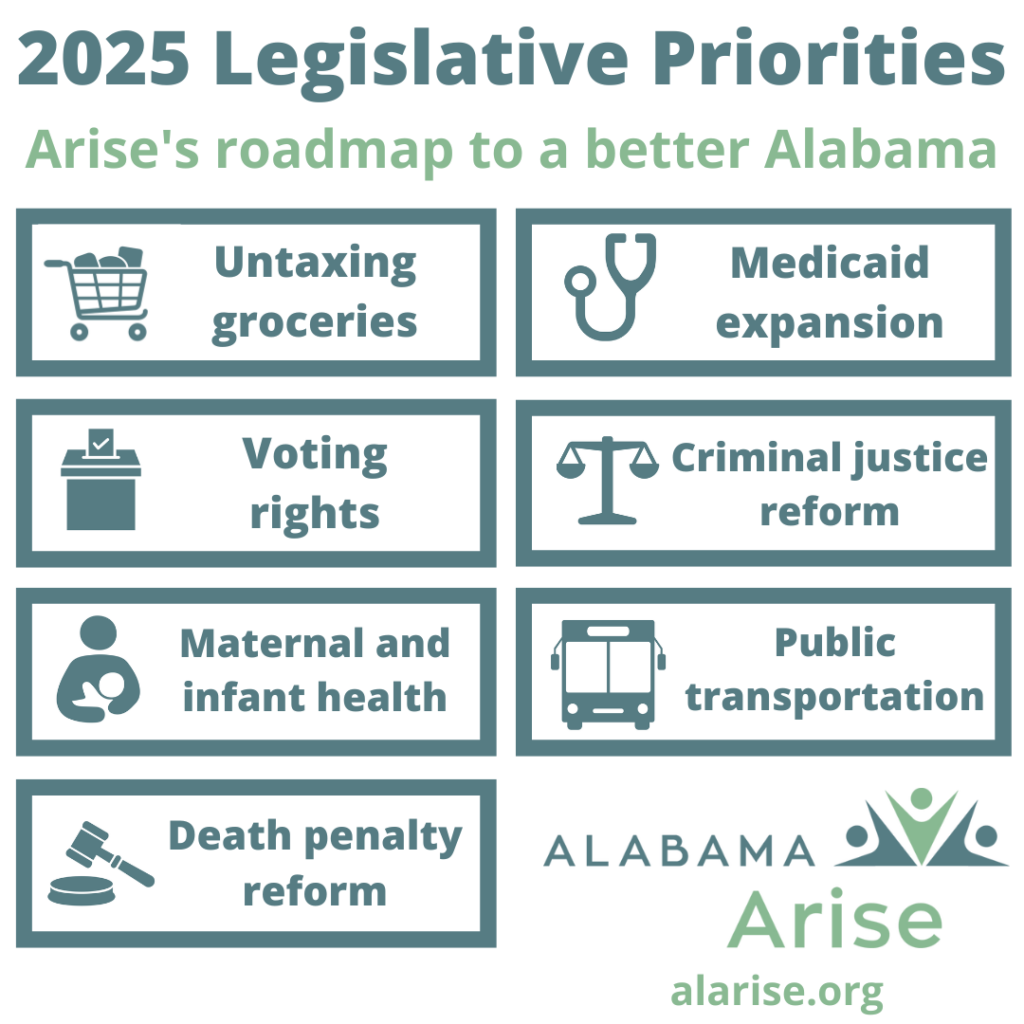
Graphic listing Alabama Arise's 2025 legislative priorities: Arise's roadmap to a better Alabama. The priorities are untaxing groceries, Medicaid expansion, voting rights, criminal justice reform, maternal and infant health, public transportation and death penalty reform.

It’s time to close Alabama’s health coverage gap

For more than a decade, Alabama has been outside looking in on a good deal. While hundreds of thousands of Alabamians continue to struggle without health insurance, state leaders have failed to expand Medicaid. A few loud voices have politicized an issue that never should have been political. And our state has paid the price in lost dollars, lost jobs and lost lives.

Alabama is one of 10 states that has yet to expand Medicaid. That inaction has left hundreds of thousands of Alabamians in a health coverage gap. We’re advocating to make this the year when our state closes that gap.

READ MORE – An Alabama solution: Closing the health coverage gap

Finish removing the state grocery tax

Alabama’s state sales tax on groceries is a cruel tax on survival, and Arise is committed to eliminating it. We were thrilled to see lawmakers pass legislation in 2023 to cut the state grocery tax in half after decades of persistent advocacy by our members. And we’ll continue advocating to remove the rest of the tax sustainably and responsibly. We’re grateful to serve on a state commission that is studying policy pathways to end the state grocery tax while protecting vital funding for public schools.

WATCH – The path forward in Alabama Arise’s work to untax groceries

Fund public transportation to improve life for all Alabamians

Alabama’s labor force participation rate is among the nation’s lowest. Only 58% of working-age adults reported they were actively working or looking for jobs as of November 2024. Our state also has nearly 100,000 more job openings than workers available to fill them. Yet 31% of Alabama job seekers cite transportation issues as the reason they are unemployed or underemployed, according to a study commissioned by the governor’s office.

Unfortunately, Alabama is one of only three states that has no state funding set aside to support public transportation. Alabama Arise will advocate for that to change during this legislative session.

READ MORE – Fund public transportation to improve life for all Alabamians

Expand voting rights to right past wrongs and safeguard democracy in Alabama

Voting rights are the foundation of our democracy, and we should do everything we can to protect them. However, since the U.S. Supreme Court stripped away federal preclearance of voting law changes in 2013, the Legislature has passed several harmful laws to create unnecessary barriers to voting rights in Alabama. This included 2024’s SB 1, which created a chilling effect for people trying in good faith to help Alabamians with absentee voting. Arise will advocate instead for positive steps to support voting rights, including passage of the Alabama Voting Rights Act, which would protect absentee voting and clarify voting procedures. Additionally, lawmakers will introduce bills to remove barriers to voting rights restoration for citizens released from incarceration.

READ MORE – Expand voting rights to right past wrongs and safeguard democracy in Alabama

It’s time for Alabama to prove we care about mothers and children

Healthy parents and healthy children mean a healthier future for Alabama. Comprehensive maternal and infant health care investments are crucial to ensure the health and safety of both infants and Alabamians of child-bearing age, especially postpartum mothers, pregnant women and future mothers. Lawmakers have numerous policy options to increase the number of health care providers and extend health coverage to more parents.

READ MORE – The Alabama Maternal Health Toolkit

School breakfast for all: What Alabama can do to help feed all of our kids

School breakfast for all would help reduce child hunger in Alabama, and it would go a long way toward the goal of guaranteeing a morning meal for every child in our state. School breakfast’s benefits are wide-ranging: It helps address chronic absenteeism, improves adolescent mental health, alleviates behavioral problems and improves test scores. Alabama Arise is pushing for a $16 million appropriation from the Education Trust Fund to ensure every district can pull down the maximum federal funding, and to give local schools the opportunity to offer no-cost breakfast for all Alabama children.

READ MORE – School breakfast for all: What Alabama can do to help feed all of our kids

Alabama’s death penalty practices remain unjust and unusually cruel

Americans increasingly oppose the death penalty. Gallup found that opposition to the death penalty more than doubled in the past 25 years. This may result from disturbingly high error rates in the system. For every 10 people executed since 1976, one innocent person on death row has been set free.

Alabama took an important step toward death penalty reform in 2017 by banning judicial overrides of juries’ sentencing decisions, and we will aim to work this session to make that ban retroactive. But the state’s death penalty scheme also remains broken in many other ways.

READ MORE – Alabama’s death penalty practices remain unjust and unusually cruel

Alabama’s parole system is still broken. How can we fix it?

The state’s parole system is a failure in both its design and in application of its own rules. We need to increase parole board oversight and eliminate racial disparities in parole. People also deserve to be able to attend their own parole hearings.

Arise’s suggested changes would be an important step in the direction of a more just Alabama, and they would mitigate some of the problems plaguing our state’s prison system overall.

READ MORE – Alabama’s parole system is still broken. How can we fix it?

Paid parental leave improves life for Alabama workers

Like any employer, our state should ensure its workers have jobs that support their ability to care for their families. The teachers, social workers and many other state employees who help look after our children and who build up Alabama for all the families in the state should be able to create and grow their own families without scrambling to pay the bills.

Paid parental leave is a common-sense policy that helps workers care for their families while maintaining their careers and financial well-being. State officials often have said Alabama is pro-family. Ensuring that teachers and state employees have paid parental leave is an important step to prove it.

READ MORE – Paid parental leave improves life for Alabama workers