2026 Alabama election guide and candidate questions

2026 election questions

Where do candidates stand?

Meeting and talking with candidates as they campaign for your vote helps shape the conversation and let them know which issues are most important to their constituents. Below are some questions you can ask and info you can share when meeting candidates. Please let us know what you hear back!

Click here to download this resource as a PDF.

Funding public services

Alabama’s tax system is upside down. People with low incomes pay a higher share of their income in state and local taxes – double the amount paid by wealthier Alabamians. Alabama gives tax breaks and incentives to wealthy individuals and large corporations that are not accessible to low-income families and small businesses.

Alabama is the only state still providing the outdated federal income tax deduction, which costs our state $1.3 billion in lost revenue every year and overwhelmingly benefits the wealthiest households. At the same time, when Arise proposes policy solutions to help folks get ahead, we often hear lawmakers claim the state doesn’t have enough money.

Congress last year passed HR 1 (aka the One Big Beautiful Bill Act), which will cut $1.5 trillion from services like healthcare and food assistance to give more tax breaks to billionaires and highly profitable corporations. Because of this cut, Alabama may need to pay up to $261 million in additional state money to fund SNAP in 2027.

Questions for legislators or statewide candidates: Would you support getting rid of the outdated federal income tax deduction, which costs Alabama more than $1 billion a year and mostly helps wealthy households, while also ending the state grocery tax to help everyone? If not, what is your plan to untax groceries sustainably and responsibly?

Alabama is one of three states with no state dollars set aside for public transportation, and one of five with no funds directed toward affordable housing. Would you support providing dedicated state funding for affordable housing through the Alabama Housing Trust Fund, and for transportation through the Public Transportation Trust Fund?

Question for congressional candidates: Will you work to repeal the harmful spending cuts in HR 1, particularly Medicaid and SNAP cuts that will hurt Alabama for decades?

Health equity

Rural hospitals across Alabama face ongoing financial strain. More than 1 in 3 Alabama counties offer no maternity care services. Around 160,000 Alabamians fall into the health coverage gap, earning too much to qualify for Medicaid but too little to afford private insurance. The income limit for a single parent with two children to qualify for Medicaid is just $410 a month. That leaves many working families without affordable health coverage.

Questions for legislators or statewide candidates: Do you support Medicaid expansion to keep rural hospitals open, reduce maternal and infant mortality, help families afford healthcare and help low-wage workers stay healthy enough to work? If not, what is your specific plan to stabilize rural hospitals and improve healthcare?

Questions for congressional candidates: Will you pledge to repeal the $1 trillion in Medicaid cuts passed in HR 1, protect Medicare and make health insurance more affordable?

What will you do to hold healthcare corporations accountable for high costs?

Hunger relief

More than 750,000 Alabama families use SNAP to help put food on the table. In 2025, Congress enacted HR 1, aka the One Big Beautiful Bill Act, which will shift more SNAP costs onto states. Alabama may have to pay an additional $175 million next year just to ensure families continue to receive SNAP benefits.

About 1 in 6 Alabamians struggle with food insecurity, including more than 1 in 5 Alabama children. One positive step Alabama has taken in recent years is expanding no-cost school breakfast to more classrooms with increased state funding. We would like to expand this program to every school.

Questions for legislators or statewide candidates: Will you pledge to find new revenue to protect SNAP funding in next year’s state budget? Will you pledge to expand funding for no-cost school breakfast and lunch programs?

Questions for congressional candidates: Will you help families put food on the table by fighting to protect SNAP funding and roll back cuts to SNAP in HR 1? If not, what is your proposed solution to reduce hunger?

2026 election information

Key dates for the 2026 elections

Primary election: Tuesday, May 19, 2026

  • May 4 is the voter registration deadline for the primary election.
  • The election manager must receive absentee ballot applications by May 12 (by mail) or May 14 (in person).
  • Completed absentee ballots must arrive at the election manager’s office by May 18 (if hand-delivered) or by noon on May 19 (if returned by mail).

Runoff election (if necessary): Tuesday, June 16, 2026

  • May 29 is the deadline to hand-deliver a voter registration form for the runoff. June 1 is the deadline to register online or postmark registration forms delivered by mail.
  • The election manager must receive absentee ballot applications by June 9 (by mail) or June 11 (in person).
  • Completed absentee ballots must arrive at the election manager’s office by June 15 (if hand-delivered) or by noon on June 16 (if returned by mail).

General election: Tuesday, Nov. 3, 2026

  • Oct. 19 is the voter registration deadline for the general election.
  • The election manager must receive absentee ballot applications by Oct. 27 (by mail) or Oct. 29 (in person).
  • Completed absentee ballots must arrive at the election manager’s office by Nov. 2 (if hand-delivered) or by noon on Nov. 3 (if returned by mail).

What to know about voter registration and absentee voting

  • Alabama’s voter registration deadline for the 2026 primary election is May 4. For the runoff election, the deadline is May 29 (hand delivery) or June 1 (online or postmarked by mail). For the general election, the deadline is Oct. 19.
  • These deadlines are both for new voters to register and for current voters to update their information if they have moved to another location within Alabama.
  • People who have faced domestic violence, or guardians of people who have faced domestic violence, may submit a form to protect their residential and mailing addresses from appearing on the public list of registered voters.
  • Alabamians are not officially registered to vote until their county board of registrars reviews and approves their application.
  • Alabamians applying for an absentee ballot must certify that they cannot vote in person on Election Day for a reason allowed under state law. Those reasons include absence from the county on Election Day or an illness that prevents a trip to the polling place.
  • Visit alabamavotes.gov to learn more about voter registration and absentee voting.

What to know for the elections

  • Polls will be open from 7 a.m. to 7 p.m. on Election Day. If you’re a registered voter in line by 7 p.m., stay in line! You’ll be allowed to vote.
  • A valid photo ID is required to vote. Visit alabamavotes.gov to learn more.
  • Alabamians can vote in either the Democratic or Republican primary, but not both. Both ballots will include proposed constitutional amendments.
  • State law forbids “crossover voting” in runoff elections. If a runoff election is necessary in June, people who vote in the Democratic primary will be able to vote only in a Democratic runoff, and people who vote in the Republican primary will be able to vote only in a Republican runoff. Voters who participate in neither party’s primary can choose to vote in either party’s runoff.
  • The crossover voting rule does not apply to the general election in November. Voters may vote for whomever they wish in the general election, regardless of which primary (if any) they participated in earlier in the year.
  • Voters’ party choice for this year’s primary election does not bind their choice for future primaries.
  • Visit alabamavotes.gov to check your voter registration and polling place, find sample ballots by county and more.
Alabama Arise among 44 groups urging U.S. senators to delay SNAP cost shift

Unless Congress acts, Alabama will have to provide a huge amount of additional state funding next year to maintain food assistance benefits under the Supplemental Nutrition Assistance Program (SNAP). HR 1, the so-called One Big Beautiful Bill Act, shifted significant SNAP costs from the federal government to states in an effort to finance large tax breaks for wealthy households and highly profitable corporations. The law will require most states to pay for a percentage of SNAP benefits – up to 15% for some states.

Alabama Arise joined 43 partner groups in a letter asking U.S. Sens. Katie Britt and Tommy Tuberville to support delaying the SNAP cost shift as part of the upcoming Farm Bill. The full text of the letter is below.

Letter text

Dear Senators Britt and Tuberville,

We, the undersigned 44 Alabama-based groups, write to ask for your timely action to protect our state budget from significant new costs under the Supplemental Nutrition Assistance Program (SNAP) and to support families in Alabama who are struggling to afford food. As you know, the federal budget bill enacted last summer creates a new requirement for our state to fund a portion of SNAP food benefits if our SNAP error rate isn’t low enough, shifting big costs to our state. Some states got a two-year delay to decrease their high error rates, but others, including Alabama, didn’t. Every state needs to get that same reasonable extra time to succeed in improving their SNAP program.

The stakes are very high. Based on the most recent error rate, Alabama could face about $175 million a year in new state SNAP costs. The error rate is determined by a metric comprising a sample of 1,000 eligible households per state for both underpayments and overpayments made to SNAP users by the Department of Human Resources (DHR). Importantly: The SNAP error rate is not a fraud rate.

States already have significant verification and integrity processes in place, and our Alabama DHR is working hard to continue to reduce errors and improve accuracy. These new federal requirements come on a short timeline, and states without the two-year delay only have six months to reduce their error rates to ease the financial burden of the new SNAP state match.

While HR 1 provided a few states with the highest SNAP errors with two extra years to give them more time to reduce their errors, Alabama is not one of the few to benefit from this extra time. It’s not fair for the worst-performing states to get a better deal than states like ours that have had lower error rates. Alabama is committed to running a strong, accurate SNAP program that protects both taxpayers and families. But we need more time to make needed improvements while also protecting eligible families who need food assistance to help make ends meet.

We ask you to work with your colleagues and Senate leadership to extend that practical delay in the SNAP cost shift to all states. This would give our state and others the chance to succeed in reducing its error rate – and thus its state match – while protecting participants. Extending the current two-year delay to all states would ensure every state has the same opportunity to strengthen their programs.

This proposal has the bipartisan support of National Governors Association, the National Conference of State Legislatures, the National Association of Counties and the American Public Health and Human Services Association (state SNAP directors).

We hope we can count on you to work to protect Alabama by ensuring any farm legislation that moves this year extends the current SNAP cost shift delay to all states so we all have the same opportunity to reduce error rates, maintain SNAP participation and help families across Alabama keep food on the table.

Thank you.

Signatories

Sincerely,

  1. Alabama Arise
  2. Alabama Institute for Social Justice
  3. Alabama Network of Family Resource Centers
  4. Alabama Poor People’s Campaign
  5. Alabama Sustainable Agriculture Network
  6. All Nations Church of God (Montgomery)
  7. Animal Kinship Ministry (Tuscaloosa)
  8. Bay Area Women Coalition, Incorporated (Mobile)
  9. Bread for the World, Alabama Chapter (Birmingham)
  10. Church and Society, First United Methodist Church (Anniston)
  11. Community Enabler Developer (Anniston)
  12. Community Food Bank of Central Alabama
  13. East Lake United Methodist Church (Birmingham)
  14. Feeding Alabama
  15. First Christian Church of Montgomery
  16. Five Horizons Health Services
  17. Grace Presbyterian Church (Tuscaloosa)
  18. Gratitude Foundation
  19. Greater Birmingham Ministries
  20. Hispanic and Immigrant Center of Alabama
  21. Hispanic Catholic Social Services – La Casita (Birmingham)
  22. Interfaith Mission Service (Huntsville)
  23. League of Women Voters of Alabama
  24. LunarLab (Birmingham)
  25. Mary’s House Catholic Worker (Birmingham)
  26. Mephibosheth LLC (Mobile)
  27. National Lawyers Guild – Alabama Chapter
  28. North Alabama Area Labor Council
  29. North Alabama Peace Network
  30. Progressive Women of Northeast Alabama
  31. Project Hope to Abolish the Death Penalty
  32. St. Paul United Methodist Church (Birmingham)
  33. Samford Community Outreach Group
  34. Sisters of St. Joseph (Mobile)
  35. Southern Rural Black Women’s Initiative
  36. Stand Up Mobile
  37. The Across Network (Camp Hill)
  38. The 6:52 Project Foundation, Inc. (Gadsden)
  39. The Yellowhammer Fund
  40. Unitarian Universalist Fellowship of Auburn
  41. Unitarian Universalist Church of Birmingham
  42. United for a Fair Economy
  43. United Way of West Alabama
  44. Voters Legal Justice Watch Group

cc: Office of the Honorable Kay Ivey, Governor of Alabama
cc: Bill Poole, Director, Alabama Department of Finance
cc: Members of the Alabama Senate Finance and Taxation – General Fund Committee
cc: Members of the Alabama House Ways and Means – General Fund Committee

Alabama should expand healthy food access. SB 57 isn’t the answer.

Alabama should not be in the business of telling people what to eat simply because they have low incomes. But SB 57 proposes to do just that. The bill would limit food choice for participants in the Supplemental Nutrition Assistance Program (SNAP), also known as food stamps, by forbidding the use of SNAP benefits to purchase candy or soft drinks.

SB 57 would stigmatize Alabamians with low incomes. It would do nothing to remove the structural barriers that limit access to healthy food for many families. And it would cost state agencies millions of dollars.

The bill would require Alabama to apply to the federal government for an exemption (or waiver) from the standard definition for SNAP-eligible foods under federal law. Twenty-two other states have received similar waivers. Now, five consumers are suing the U.S. Department of Agriculture (USDA), which administers SNAP, over the waivers it approved for five states. The plaintiffs argue that such waivers could narrow the definition of food without considering factors that can lead to infrastructural blockades to food access beyond the control of individuals. 

Alabama Arise members set our legislative agenda, and they voted overwhelmingly for us to oppose proposals, like SB 57, that limit the purchasing choices of Alabama families. We urge lawmakers to vote “no” on SB 57 and invest instead in no-cost school breakfast, Double Up SNAP Bucks and other policies that actually would advance health and nutrition for people across our state.

Read my testimony against SB 57 before a House committee for more on why Arise opposes this bill.

What this bill would do – and what we could do instead

SB 57 would penalize and patronize Alabamians with low incomes based on a false narrative about the factors that drive public health. It would limit food choice for hundreds of thousands of consumers, with no consideration for their individual circumstances. And it would force our state to pay millions of dollars to do so.

The Legislative Services Agency estimated that SB 57 would saddle taxpayers and state departments with a $10.6 million cost. In return, the state would increase complexity for retailers and leave many families at risk of seeing lower food access in their communities through no fault of their own.

As Rep. Laura Hall, D-Huntsville, asked during the House committee debate on the bill: “If we’re having a large amount of money to spend, wouldn’t it make sense that we would be providing an opportunity for eating healthier?” Here are three examples of things Alabama could do instead with that $10.6 million to improve healthy food access:

  • Use the same $10.6 million to help ensure that every Alabama public school student has access to a no-cost school breakfast. Alabama has shown more growth in fourth-grade math than any other state since 2019, according to the Public Affairs Research Council of Alabama (PARCA). We have seen access to no-cost school meals nearly double in the same period.
  • Increase the capacity of the Double Up Bucks program, which incentivizes fresh produce purchases for SNAP participants and supports our local farmers. State budgets for 2027 do not yet include funding for this program.
  • Restore funding for SNAP-Ed, a program that was cut by HR 1. SNAP-Ed provides free learning opportunities for SNAP participants about how to shop for and prepare healthy meals.

How SB 57 could harm the economy and send SNAP costs soaring

Instead of making important investments to improve food access, SB 57 would add red tape for retailers across our state. The bill includes a three-strike rule, which would allow retailers only three accidental acceptances per fiscal year before any “punishment,” as administered by the USDA Office of Retailer Operations and Compliance.

This provision could threaten revenue losses for 5,000 SNAP-authorized retailers across Alabama. It could even jeopardize the ability for many stores to accept SNAP or EBT altogether.

How SB 57 could increase SNAP costs and harm older adults in Alabama

In addition, SB 57 could increase the harm that Alabama faces as a result of HR 1, the so-called One Big Beautiful Bill Act – or what I call one hell of an ugly bill. Alabama will have to appropriate an estimated $174 million or more to address HR 1’s shift of SNAP benefit costs to states, based on error rates. If the state does not allocate those matching funds, SNAP benefits could be reduced or disappear entirely for more than 750,000 participants across Alabama.

Often mistaken as a measure of fraud, the error rate is determined using a USDA assessment of a sample of 1,000 SNAP-eligible households per state. USDA staff calculate the number of underpayments or overpayments made to SNAP users by the state agency managing SNAP. In Alabama, that agency is the Department of Human Resources (DHR). This bill would divert some of DHR’s attention away from efforts to reduce the error rate in the name of an experimental pilot program over which several other states are suing the USDA. The risks of this experiment would include increased SNAP costs and potential litigation costs.

We know that food-insecure seniors who participate in SNAP are 46% less likely to be hospitalized than non-participating seniors with low incomes. This bill puts that access at greater risk. We also know that SNAP participants eat a better diet, more frequently access preventative health care, adhere to medication, experience fewer hospitalizations and ER visits, and have lower health care costs for older adults.

Why would SB 57 not really address health? Access to healthy food is a structural issue 

On the surface, it might seem as though SB 57 would improve the health of Alabamians with low incomes. Some legislators referenced obesity as a sort of flat concept, solely correlated to soft drinks and candy. However, getting to the root of a public health issue is almost never that simple.

When you think of SB 57, I want you to imagine getting in a car and expecting to drive to France from Florence, Ala. Would you make it there? No. Why? Because the built world, or infrastructure around you, does not support the vehicle. The same is true for communities that have limited food access due to factors like affordability and transportation.

SB 57’s definitions draw many arbitrary lines. Most chewing gum, for example, is sweetened with Aspartame instead of sugar, so it still would be SNAP-eligible based on SB 57’s current text. And more to the point, making some foods more unaffordable does not make other food more affordable.

‘Do not legislate dignity away from Alabamians’

Some legislators, including Rep. Pebblin Warren, D-Tuskegee, said they found the bill patronizing in principle. “I see this really as a discrimination against SNAP recipients,” Warren said during a House committee discussion of the bill.

Rep. Napoleon Bracy, D-Mobile, emphasized the cost vs. the benefit of the bill in its current form. “I just don’t understand why we have to always legislate things all the way down to a person’s grocery basket as if it’s really going to fix a major overall obesity problem,” Bracy said.

Sen. Robert Stewart, D-Selma, said protecting food choice for SNAP participants is a matter of fundamental respect. “It’s important … that we do not legislate dignity away from Alabamians,” Stewart said.

Ultimately, members of the House Ways and Means General Fund Committee approved the bill on March 18. But the decision came only after an agreement not to schedule a House vote on it until many members’ concerns are resolved.

“[We are simply] not ready … to move forward on this,” said Rep. Rex Reynolds, R-Huntsville, who chairs the committee. “There’s just too many issues. We’re seeing lawsuits in other states. A lot of that’s got to do with the administrative ability to move this bill forward.”

Who might SB 57 impact?

  • Alabamians with low incomes
  • Retailers across Alabama, especially in small towns and rural areas
  • DHR and other state agencies
  • Potentially anyone who buys candy or soda

What should our legislators do instead?

To get to the root of the problem of healthy food access, we must start by asking the real questions:

  • Why do some Alabamians struggle to access healthy food?
  • Why do some Alabamians lack the resources to eat healthy?
  • What policy choices underlie poverty in Alabama?
  • Why are legislators not incentivized to improve the common good?

Many of our legislators unfortunately are not asking and working to answer these questions. But in the meantime, they still can do better.

Lawmakers should vote “no” on SB 57 and use any additional funds to support a full $14 million appropriation to provide a no-cost school breakfast for every child in Alabama’s public schools. We know that since 2019, access to no-cost meals has doubled in Alabama. In that time, reading and math scores across the state have improved for children across all household income levels.

Greater access to school meals helps improve student behavior and learning and reduces absenteeism, reducing the risk of incarceration. With streamlined funding for school breakfast local school districts have less paperwork and administrative costs. Moreover, continuing and increasing state investment in access to no-cost school breakfast supports local farmers and helps schools serve more local produce.

We must remove barriers to food access for Alabama communities

As an undergraduate student at Stillman College, I helped to co-found a sustainable healthy food initiative in west Tuscaloosa, because my campus was situated in what some social scientists call a food desert. Food Insecurity is not natural, but it is determined by your environment.

The intentional separation of people from resources is the result of a built world that does not support the presence of those resources. Before the 1960s, Stillman was a farm worked by students from the Black Belt, because no one would sell food to The Colored Institute.

As an Academic Scholar on a full-ride scholarship, it was my first time having access to breakfast, lunch and dinner in many years, so I work to repay that. Frankly, It is disrespectful to leverage the desperation that communities face as a result of our built world to pass harmful legislation like SB 57. Our lawmakers can and should do better for Alabama.

Alabama Arise testimony in opposition to SNAP food choice limits

Alabama Arise hunger policy advocate LaTrell Clifford Wood testified Wednesday before the House Ways and Means General Fund Committee in opposition to SB 57 by Sen. Arthur Orr, R-Decatur. SB 57 would restrict which foods can be bought in Alabama with food assistance benefits under the Supplemental Nutrition Assistance Program (SNAP). Here is the full text of Clifford Wood’s prepared remarks:

Mr. Chairman and esteemed committee members, my name is LaTrell Clifford Wood, and I am a hunger policy advocate with Alabama Arise. I am also an appointee to the Joint Study Commission on Grocery Taxation.

Alabama Arise is a member-based organization, and our members voted strongly for us to oppose SB 57. We support policies to improve the health of low-income people and to expand access to food and health care. However, those goals are not achieved by a bill that comes with sanctions for people experiencing poverty and unclear costs for our state.

It is government overreach for Alabama to be in the business of telling people who are living in poverty what to eat. This bill would not achieve its stated ends, nor was its introduction supported by any research about consumer behavior.

People on SNAP have similar purchasing habits to the average consumer. And while SNAP is the most effective program this nation has seen when it comes to addressing hunger, it is a modest program. SNAP benefits average $6 a day, meaning they only supplement grocery budgets. This bill would increase state costs, as well as increase the tax burden on low-income households, without making any investments to improve consumer access to healthy food.

Since it was introduced, SB 57’s estimated cost to taxpayers has increased to $10.4 million. It also threatens to undermine vital steps we have taken toward eliminating the state sales tax on food.

To put that cost in perspective, $10 million is 21 times the amount lawmakers annually allocate to increase access to fresh produce and support local farmers through SNAP incentives like Double Up Bucks. And it is more than enough to ensure every public school student in Alabama can access a no-cost school breakfast. Both of these policies are proven to improve the long-term health of Alabamians. 

I ask that you vote no on this bill. Do not resort to experimenting on our low-income communities. Let’s focus on stabilizing SNAP under the state cost shift. I am open to meeting with any of you all to discuss how we might improve access to healthy food, and I thank you for your time.

250+ advocates urge Alabama lawmakers to expand no-cost school breakfast

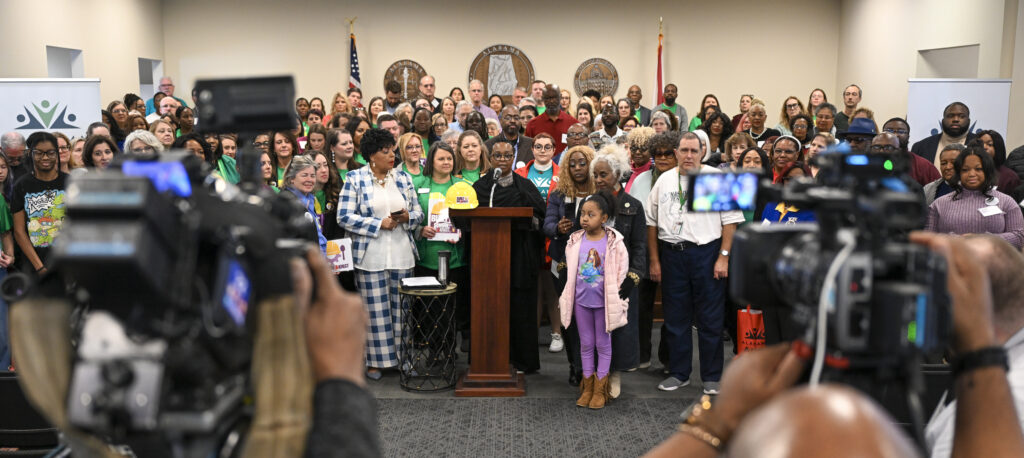
Dozens of people stand behind and to either side of a lectern in a committee room at the Alabama State House. Close-up shots of two videographers are in the foreground.
Dr. Shakita Brooks Jones, board president of Alabama Arise Action, speaks in support of no-cost school breakfast during Arise’s annual Legislative Day on Feb. 24, 2026, in Montgomery. (Photo by Julie Bennett)

Alabama should ensure access to no-cost breakfast for every child in the state’s public schools, Alabama Arise Action members told legislators Tuesday.

More than 210 Arise supporters gathered this week at the State House in Montgomery alongside dozens of members of the Alabama School Nutrition Association (ASNA) to show support for expanding no-cost school breakfast. The advocates urged legislators to provide $14 million next year to ensure no-cost breakfasts are available for every child in participating Alabama public schools.

The request would be less than 0.14% of Gov. Kay Ivey’s proposed $10.5 billion Education Trust Fund budget for fiscal year 2027. And that funding would provide long-term benefits for the people of Alabama, speakers at Arise’s news conference said Tuesday.

“Healthy school meals at no cost for all students are not an expense,” ASNA president Cacyce Davis said. “They are an investment in families. They are an investment in communities. And they are an investment in the future workforce of our state.”

ASNA members and Rep. Barbara Drummond, D-Mobile, joined Arise advocates at the news conference, which was part of Arise’s annual Legislative Day event.

Photos from the event are available here. Video from the news conference is available here.

Building on last year’s investment in child nutrition

Alabama lawmakers took an important step forward on child nutrition in 2025 by appropriating $7.3 million to expand access to no-cost school breakfasts for more public schools. More than 190,000 children have benefited from this investment in making school meals more readily available.

Arise advocates are asking lawmakers to provide $14 million in school breakfast funding next year so Alabama can maintain and build upon last year’s progress.

“That investment [in 2025] made a meaningful difference for districts across Alabama and for thousands of children who depend on school breakfast to start their day,” Davis said. “Because of that support, more students are walking in the classroom nourished and ready to learn.”

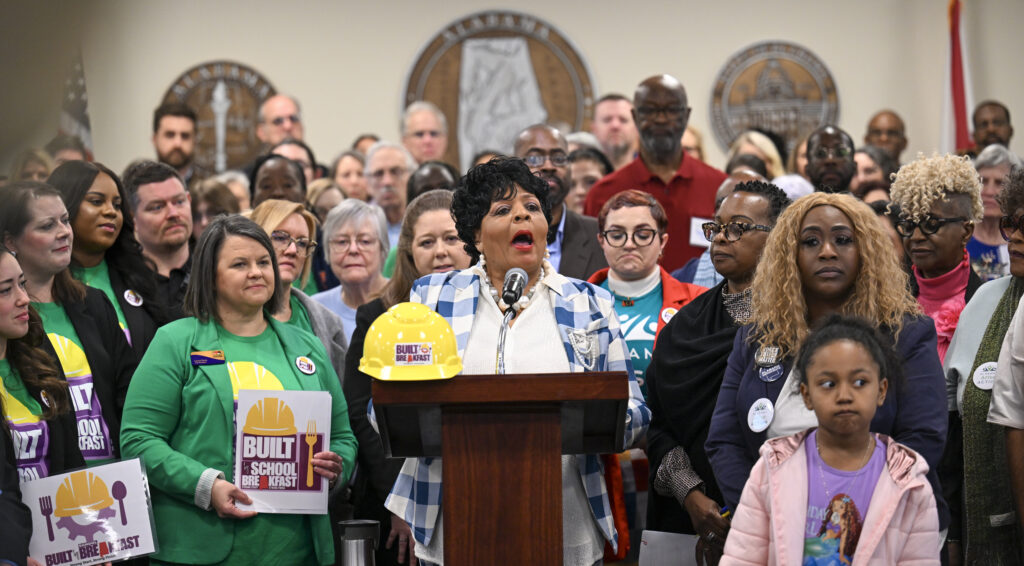
A woman speaks behind a lectern in a committee room at the Alabama State House. Dozens of people stand behind and beside her.
Rep. Barbara Drummond, D-Mobile, speaks in support of no-cost school breakfast during Arise’s annual Legislative Day on Feb. 24, 2026, in Montgomery. (Photo by Julie Bennett)

Access to no-cost school meals in Alabama has nearly doubled since 2019, and English and math scores have improved significantly during that time. Drummond, a longtime supporter of increased investment in food access, said the growth of no-cost school breakfast in recent years has helped improve academic achievement for many Alabama students.

“A healthy breakfast is the first lesson of the day,” Drummond said. “It fuels young minds before the bell even rings. When children eat in the morning, they learn better all day.”

Davis said she has seen the power of no-cost school breakfast in her roles as ASNA president and child nutrition director for Elmore County schools.

“When breakfast is offered at no charge to students, participation increases. Attendance improves,” Davis said. “Nurses report fewer morning stomachaches and headaches. Teachers see better focus and behavior in classrooms. Families experience meaningful financial relief. And academic outcomes improve.”

‘It’s about our children’

Dr. Shakita Brooks Jones, board president of Alabama Arise Action, said ensuring that children have the nutrition they need to learn and thrive is a moral issue.

“We believe in breaking down policy barriers that limit opportunity,” Jones said. “We believe public policy should make it easier, not harder, for struggling families to make ends meet. And we believe no one in our state should be hungry, especially not schoolchildren.”

Drummond said she agreed on the need to invest more in child nutrition. She encouraged people across Alabama to ask their lawmakers to support a $14 million state allocation for no-cost school breakfast.“I am energized,” Drummond said. “From Mobile all the way to the Wiregrass to Huntsville, we can make this happen. Because it’s not about us. It’s about our children.”

2026 Legislative Day – No-cost breakfast supports a strong start, strong finish for Alabama students

Every Alabama child deserves access to breakfast 

  • About 1 in 4 school-age children in Alabama struggle with food insecurity.
  • Access to no-cost school meals is not the standard for many children in working families and is often determined by where they live.
  • Many schools are struggling to break even with the current maximum federal reimbursement for school meals.

No-cost school breakfast helps families and communities thrive

  • Since 2019, access to no-cost meals has doubled in Alabama. In that time, reading and math scores across the state have improved for children across all household income levels.
  • No-cost school breakfast reduces the stigma associated with separating and sorting students by household income.
  • Greater access to school meals helps improve student behavior and learning and reduces absenteeism.
  • Streamlined funding for school breakfast reduces paperwork and administrative costs for local school districts.
  • Continuing and increasing state investment in access to no-cost school breakfast supports local farmers and helps schools serve more local produce.

Bottom line

Every student deserves the resources they need to thrive in the classroom. Breakfast is an essential school supply, and lawmakers should appropriate the total funding necessary to fund no-cost breakfast fully for all children in Alabama public schools. Let’s support a strong start and a strong finish with no-cost breakfast for Alabama schools!

Arise 2026: How we’re working to build a better Alabama

Alabama Arise believes in dignity, equity and justice for all. We believe in an Alabama where everyone’s voice is heard and everyone has the opportunity to reach their full potential. And we believe better public policies are the key to building a brighter future for our state. 

Below, we’ll share some details of that vision as the Alabama Legislature’s regular session begins January 13. This blog focuses on the crucial legislative priorities on our 2026 roadmap to change.

If you’re not already a member of Alabama Arise, join us! Members will receive an exclusive version of our weekly Legislative Updates throughout the session. These emails include a weekly video update from Arise staff members on what’s happening at the State House, as well as details about upcoming legislation and links to additional resources.

Executive Director Robyn Hyden welcomes us to the 2026 session

Arise’s Robyn Hyden welcomes everyone to the Alabama Legislature’s 2026 regular session. Watch to see what to expect this year and to learn more about our advocacy on school breakfast, protecting funding for public schools and other member-selected legislative priorities. 

Strong investments in schools, housing and transit improve life for all Alabamians

Strong funding for public services like education and public health broadens opportunity for everyone, especially for Alabamians with low incomes. Arise members for decades have urged robust and secure state funding for these services. Our top adequate state budget priorities include protecting funding for public schools and securing state support for affordable housing and public transportation.

READ OUR FACT SHEET

Closing the health coverage gap: Alabama must enact policies to save lives

As Alabama enters the 2026 legislative session, Medicaid expansion and maternal health will be central to the state’s health equity conversations. Recent federal policy changes have made these conversations more urgent and more complex. Our top health equity priorities are Medicaid expansion and investments in comprehensive maternal health care.

READ OUR FACT SHEET

Federal SNAP cuts underscore Alabama’s need to protect and increase food access

Alabama’s food insecurity rates are among the worst in the country. More than 1 in 6 people in our state (17%) face food insecurity, according to the Alabama Department of Public Health. And that share is even larger for children: Nearly 1 in 4 Alabama children (23%) live in households with food insecurity. Our top hunger relief priorities are increasing the availability of no-cost school meals, protecting SNAP food assistance and continuing the successful SUN Bucks summer nutrition program.

READ OUR FACT SHEET

An inclusive democracy is vital to building a better Alabama for all

Alabama was central to the struggle for democracy and voting rights in the United States during the Civil Rights Movement in the 1950s and 1960s. And the need for our state to do more to build a more inclusive democracy continues today. That is especially true after recent U.S. Supreme Court decisions affecting the rights of people nationwide to have their say in who represents them at the local, state and federal levels. Our top inclusive democracy priorities include no-excuse absentee voting, early voting and removal of barriers to voting rights restoration.

READ OUR FACT SHEET

Alabama’s justice system should focus on rehabilitation, not cruelty

Alabama’s criminal justice system too often prioritizes punishment over evidence-based interventions. This cruel orientation has fueled heavy-handed sentencing policies and a broken parole system. And it has led to a death penalty system where state officials continue to kill prisoners against the recommendation of the juries that convicted them. Our justice reform priorities include reforms to Alabama’s sentencing and parole practices and legislation to make the state’s ban on judicial override in death penalty cases retroactive. 

READ OUR FACT SHEET

Alabama’s tax system is upside down and needs real reform

Alabama’s tax structure is among the nation’s most unfair and unjust. The state is heavily reliant on regressive sales taxes on consumer goods that account for a larger share of spending for households with low incomes. Our state continues to tax groceries, though at a lower rate than other goods after grocery tax reductions in 2023 and 2025. And Alabama does not tax numerous services that people with higher incomes more often purchase. Our tax reform priorities include untaxing groceries, reining in income tax breaks for wealthy households and opposing further diversion of public school funding to private schools and homeschooling.

READ OUR FACT SHEET

Empower workers to build an economy that works for all Alabamians

Alabama has a history of anti-worker policies that prioritize the interests of wealthy corporations over those of working people. This top-down structure has led to our state falling behind in measurable standards of well-being. Our worker power priorities include increased accountability for child labor law violators, expansion of paid leave and stronger protections for temp workers.

READ OUR FACT SHEET

Federal SNAP cuts underscore Alabama’s need to protect and increase food access

Haga clic aquí para leer esto en español.

Alabama’s food insecurity rates are among the worst in the country. More than 1 in 6 people in our state (17%) face food insecurity, according to the Alabama Department of Public Health. And that share is even larger for children: Nearly 1 in 4 Alabama children (23%) live in households with food insecurity.

Food assistance programs like the Supplemental Nutrition Assistance Program (SNAP) are especially important to help struggling families make ends meet and keep food on the table across our state. And school meals provide vital nutrition for hundreds of thousands of children, helping them learn and grow.

In 2026, Alabama Arise will support stronger investments in child nutrition. This includes legislation to ensure continued funding for SUN Bucks and increased flexibility for schools to provide no-cost meals to all of their students. Arise also will advocate to protect SNAP and oppose additional red tape for participants.

SNAP threats grow, even as food prices continue to rise

SNAP benefits lapsed for the first time ever amid a federal government shutdown in November 2025. This lapse temporarily left more than 750,000 Alabamians without food assistance. In Alabama, more than 67% of SNAP participants are in families with children, while more than 39% of participants are in families with an older adult or a person with a disability.

HR 1, the so-called One Big Beautiful Bill Act, poses longer-term federal threats to SNAP. The law shifts costs to states while limiting or ending access for many families with children, older adults, veterans, and people with disabilities. In Alabama, lawmakers will have to appropriate $35 million a year to cover the larger share of administrative costs shifted to the state.

People seeking asylum (including those fleeing domestic violence) who are legally in the United States will no longer be eligible for SNAP, with few exemptions. Some people between ages 60 and 65 who have received special SNAP benefits may face more barriers to participation. And people who purchase groceries with SNAP will continue to receive an average of only $6 a day indefinitely, even as prices continue to increase.

Under HR 1, the following groups will no longer be exempt from burdensome work reporting requirements to receive SNAP benefits:

  • Veterans 
  • People with disabilities
  • People experiencing homelessness 
  • Young adults who age out of foster care
  • Adults in households with children as young as 14
  • People aged 55 to 64

Some state lawmakers are proposing even more SNAP limits. Rep. Reed Ingram, R-Montgomery, has prefiled HB 31, which would restrict the items that SNAP benefits can purchase.

We must continue to expand access to school meals

Arise members voted overwhelmingly to support increased access to no-cost school meals in 2026. School meals are an especially vital lifeline for families experiencing hunger. School meals also help ensure a stable learning environment for all Alabama children.

Since 2019, nearly 270,000 Alabama children have gained access to no-cost school meals, nearly doubling access. More than 2 in 3 Alabama students attend a school that offers no-cost school meals, according to the Food Research and Action Center

During the same time period:

  • Alabama has shown more growth in fourth-grade math than any other state since 2019, according to the Public Affairs Research Council of Alabama (PARCA).
  • Alabama is one of two states where public school fourth-graders are scoring higher in both reading and math than they did prior to the COVID-19 pandemic, PARCA found.
  • Among Alabama students in grades 3-8, both students who are experiencing poverty and those who are not saw improvements in both math and reading performance from 2019-24, according to the Education Recovery Scorecard compiled by researchers from Harvard University and Stanford University. 

Providing school breakfast at all public schools would be an important step to improve child nutrition and student success. School breakfast reduces chronic absenteeism, improves standardized testing and math scores and reduces behavioral problems.

The Legislature appropriated $7.3 million in 2025 to expand access to no-cost school breakfasts for more public schools. More than 190,000 children in schools across Alabama benefited last fall from this investment in making school meals more readily available.

Alabama schools served 2.8 million more school meals last year than in 2024. We must continue to improve upon these investments to ensure every Alabama child has an opportunity to learn and grow to their fullest potential.

SUN Bucks are a summer lifeline for Alabama children

Arise members sent thousands of messages to their legislators in 2024, advocating successfully for the state administrative funding needed to implement SUN Bucks (a.k.a. Summer EBT). Alabama administered the SUN Bucks program for the first time in summer 2025.

Children were automatically eligible to receive SUN Bucks if the child’s household received assistance under Medicaid, SNAP, Temporary Assistance for Needy Families (TANF) and/or the Food Distribution Program on Indian Reservations (FDPIR), or if the child was in foster care or experiencing homelessness.

The program was a resounding success in its first year. In 2025, 476,000 Alabama children received $120 to purchase groceries over the summer months. That money reduced hunger and boosted the economy. Both SNAP and SUN Bucks generate $1.50 to $1.80 in local economic activity for every dollar spent. In 2025 alone, SUN Bucks had a $85.5 million to $102.6 million impact on Alabama’s economy.

Bottom line

School meals, SNAP and SUN Bucks are good for families and good for the economy. Alabama must continue to invest in these vital nutrition programs in 2026 and beyond.

Long federal road ahead for SNAP, health care

By Carol Gundlach, senior policy analyst, and Debbie Smith, Cover Alabama campaign director

Alabama Arise believes that society should care for the most vulnerable in our nation—children, the elderly, those who are disabled and those who have fallen on temporary hard times. Since the Great Depression, Americans have been assured that, no matter how hard times get, our basic nutritional needs would be met by our government.

But 2025 has been a head-spinning and traumatic year for the 750,000 Alabama recipients of SNAP food assistance (commonly called Food Stamps), a stable pillar in America’s response to poverty and hunger. For 60 years, through multiple federal shutdowns, budget crises and wars, SNAP assistance has reliably fed hungry Americans. 2025 was different. 

Bill doesn’t help those who need it

HR1, the budget reconciliation bill (or “One Big Beautiful Bill”) passed by Congress in July, made it harder for people to receive food assistance and reduced the amount of assistance available, even as grocery costs rose. Existing time limits and burdensome paperwork requirements for some SNAP recipients were expanded to include unhoused people, veterans, children aging out of foster care and elderly recipients. 

Non-citizens and refugees legally in the U.S. were denied food assistance. And states, for the first time, will have to pay for some SNAP benefit costs. By mid-2027, Alabama will have to come up with approximately $175M to pay for our existing SNAP program.

Shutdown deepened impact

The October federal government shutdown only made the food crisis worse. The United States Department of Agriculture (USDA) refused to use its emergency funds and instead cut off food assistance to 42 million Americans, including all SNAP recipients in Alabama. 

Food banks and pantries, bolstered by small state grants, tried to fill the gap but many of our neighbors faced hunger as the holidays approached. The ending of the shutdown allowed the Department of Human Resources to get SNAP benefits out in record time, but legal immigrants face immediate termination of SNAP benefits. And many more people face new, draconian time limits that began in December. 

And many of the same people face huge increases in the cost of their health care.

Health costs will soar

As of this writing, Congress has not extended enhanced premium tax credits (ePTCs), which lower monthly premiums for nearly 500,000 Alabamians who get their coverage through the ACA Marketplace. As a result, 130,000 Alabamians are expected to lose coverage. This decision threatens to roll back the significant progress Alabama has made in reducing its uninsured rate.

The enhanced tax credits have played a central role in that progress. Lowering premiums opened Healthcare.gov plans to workers who had long been locked out of affordable coverage. Nearly half of Alabama’s Healthcare.gov enrollees fall into income ranges that would qualify them for Medicaid expansion if they lived in the 40 states that have expanded. Without the credits, many will face premiums they simply cannot pay, increasing the number of uninsured at a time when families are already navigating high costs of living.

This shift will place additional pressure on Alabama’s health care system, especially rural hospitals and clinics that already struggle with staffing shortages, rising uncompensated care, and service reductions. 

HR 1 complicates health care access

Federal changes under HR 1 create additional challenges. The law eliminates financial incentives meant to help states like Alabama adopt Medicaid expansion, including extra federal funding that would have supported expansion startup costs for the first two years. It also places new restrictions on increasing provider taxes, which Alabama uses to help fund its share of Medicaid. These limits would become more restrictive if Alabama chose to expand Medicaid in the future, and even now, they place a long-term cap on our state’s flexibility to finance Medicaid as health care costs continue to rise.

HR 1 also shifts new SNAP funding responsibilities to states. This will strain the state budget at a time when food insecurity is rising and families are struggling to meet basic needs.

Taken together, these issues ensure that health care and food access will be unavoidable priorities in the 2025 legislative session. The coming year will bring real challenges, but it also offers Alabama lawmakers an opportunity and a responsibility to strengthen the state’s health and nutrition safety nets at a moment when Alabamians need them most.

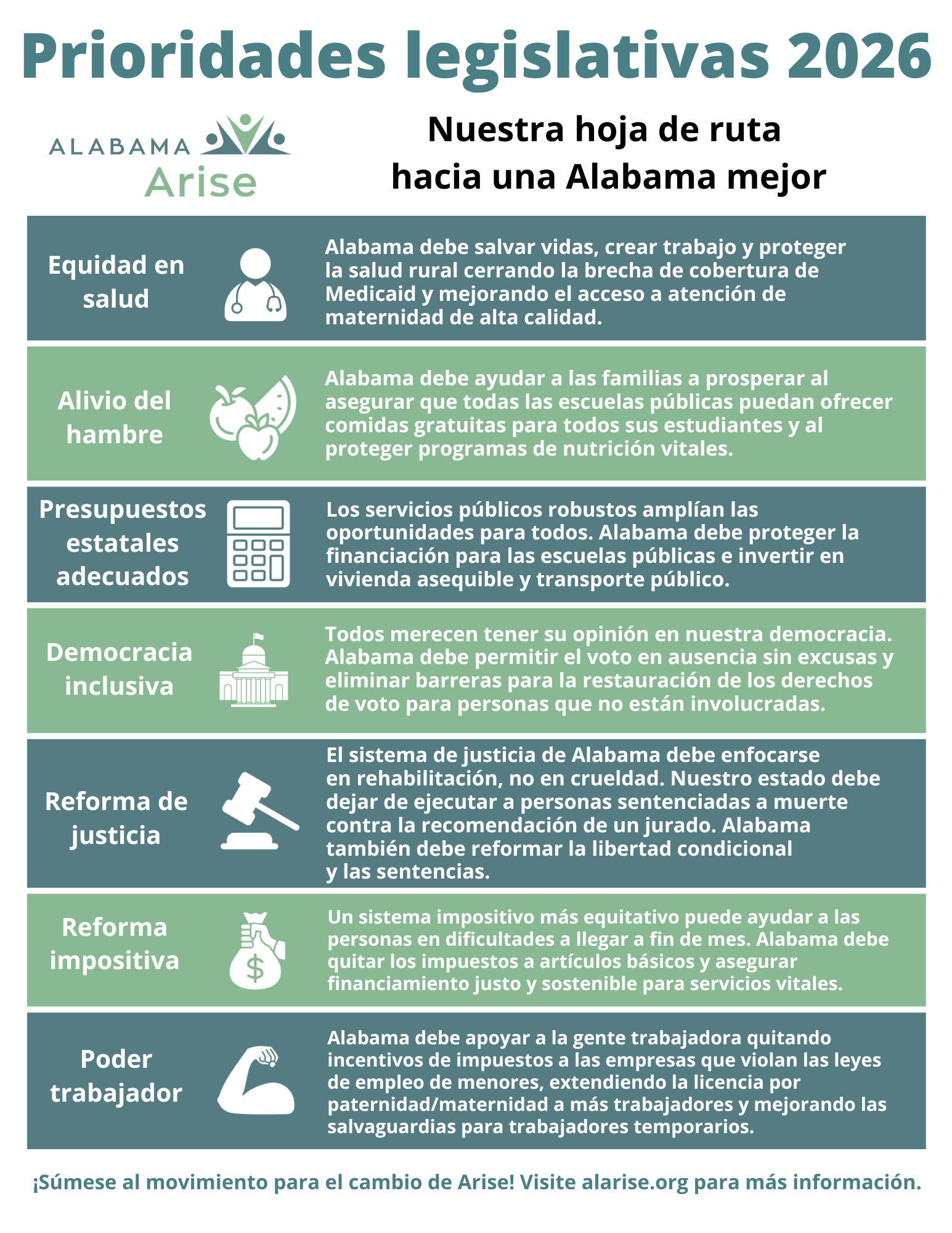
Las prioridades legislativas de Alabama Arise para 2026

Más de 150 grupos miembros de Alabama Arise y más de 1,500 miembros individuales eligen todos los años nuestras prioridades legislativas. Este proceso garantiza que los habitantes de Alabama más afectados por la pobreza participen de las decisiones. A continuación se enumeran las prioridades que nuestros miembros eligieron para 2025.

Para obtener una versión de este documento en PDF, haga clic aquí o en el botón de “Descargar” (Download) arriba.

Equidad en saludAlabama debe salvar vidas, crear trabajo y proteger la salud rural cerrando la brecha de cobertura de Medicaid y mejorando el acceso a atención de maternidad de alta calidad.

Alivio del hambreAlabama debe ayudar a las familias a prosperar al asegurar que todas las escuelas públicas puedan ofrecer comidas gratuitas para todos sus estudiantes y al proteger programas de nutrición vitales.

Presupuestos estatales adecuadosLos servicios públicos robustos amplían las oportunidades para todos. Alabama debe proteger la financiación para las escuelas públicas e invertir en vivienda asequible y transporte público.

Democracia inclusivaTodos merecen tener su opinión en nuestra democracia. Alabama debe permitir el voto en ausencia sin excusas y eliminar barreras para la restauración de los derechos de voto para personas que no están involucradas.

Reforma de justiciaEl sistema de justicia de Alabama debe enfocarse en rehabilitación, no en crueldad. Nuestro estado debe dejar de ejecutar a personas sentenciadas a muerte contra la recomendación de un jurado. Alabama también debe reformar la libertad condicional y las sentencias.

Reforma impositivaUn sistema impositivo más equitativo puede ayudar a las personas en dificultades a llegar a fin de mes. Alabama debe quitar los impuestos a artículos básicos y asegurar financiamiento justo y sostenible para servicios vitales.

Poder trabajador Alabama debe apoyar a la gente trabajadora quitando incentivos de impuestos a las empresas que violan las leyes de empleo de menores, extendiendo la licencia por paternidad/maternidad a más trabajadores y mejorando las salvaguardias para trabajadores temporarios.