Alabama voted. Now let’s organize for a better state

The State Capitol in Montgomery.

Alabama Arise and our members have worked for more than 35 years to push for state policies that improve the lives of people struggling to make ends meet. We advocate for policies to build an Alabama where everyone has the resources they need to reach their full potential. And we’ve always remained steadfast in this mission and our values, regardless of who holds public offices at any given time.

On Tuesday, Alabama voted. So today, we have a clearer vision of what we may face as we look toward the 2025 legislative session in February. The path to dignity, equity and justice for all has always been a long one in Alabama. None of us are strangers to this work, and we’re in it for the long haul.

To make positive change, we must work together. We all must lean into our relationships, communities and networks to find solidarity and grow our collective voice for change. As a member-based organization, we know power is built from the ground up. And Arise will continue our commitment to growing our people power to expand health care access, reduce hunger, reform Alabama’s upside-down tax structure and support working people across our state.

We’re glad you’re with us. Join or support our movement for a better Alabama for all today.

Alabama Arise 2025 legislative priorities

More than 150 Alabama Arise member groups and more than 1,500 individual members choose our legislative priorities each year. This process ensures that Alabamians most impacted by poverty have a seat at the table. Below are the priorities that our members selected for 2025.

For a PDF version of this document, click here or click the “Download” button above.

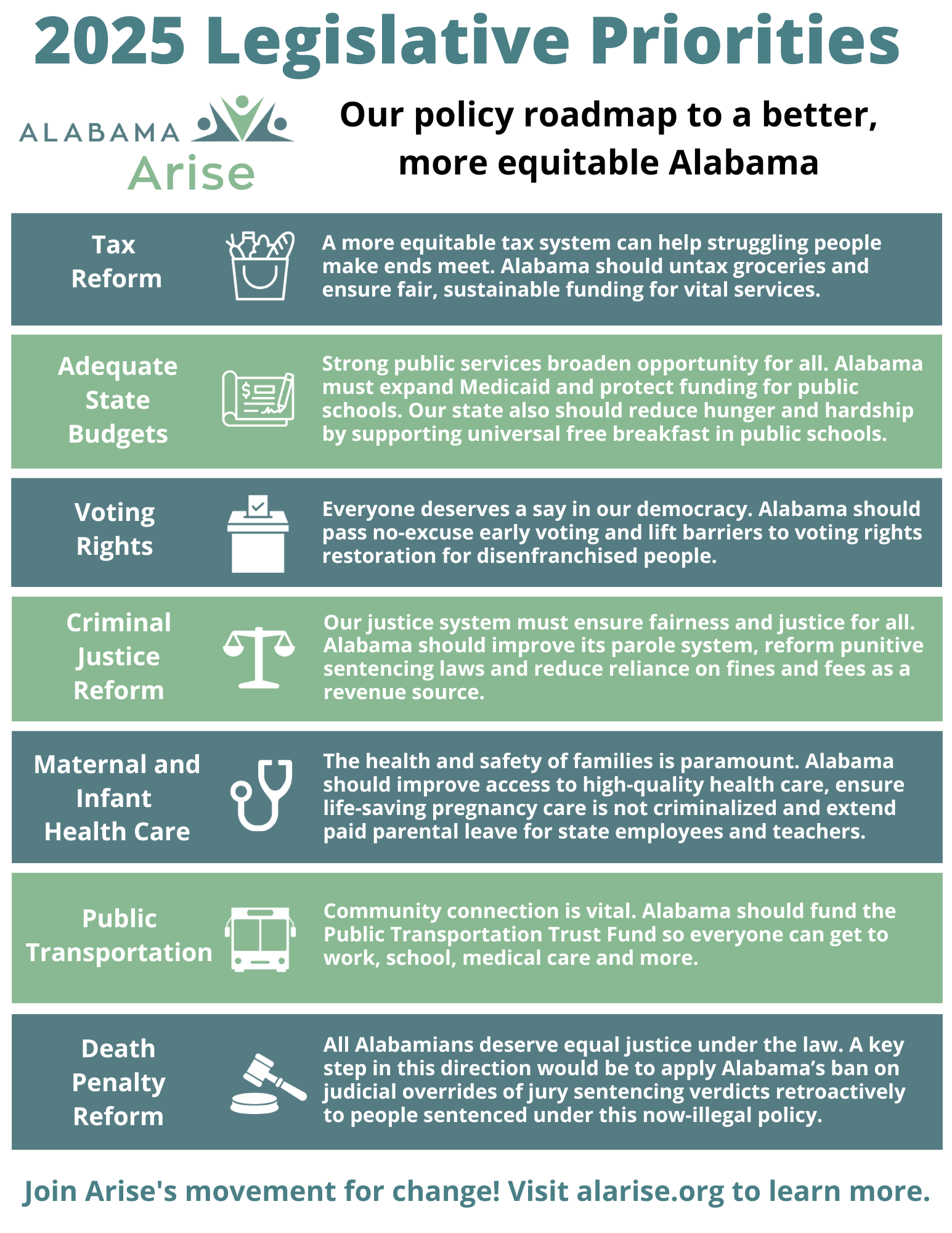
Image of a flyer listing Alabama Arise's 2025 legislative priorities: Our policy roadmap to a better, more equitable Alabama. The priorities are tax reform, adequate state budgets, voting rights, criminal justice reform, maternal and infant health care, public transportation and death penalty reform.

Tax reformA more equitable tax system can help struggling people make ends meet. Alabama should untax groceries and ensure fair, sustainable funding for vital services.

Adequate state budgetsStrong public services broaden opportunity for all. Alabama must expand Medicaid and protect funding for public schools. Our state also should reduce hunger and hardship by supporting universal free breakfast in public schools.

Voting rightsEveryone deserves a say in our democracy. Alabama should pass no-excuse early voting and lift barriers to voting rights restoration for disenfranchised people.

Criminal justice reformOur justice system must ensure fairness and justice for all. Alabama should improve its parole system, reform punitive sentencing laws and reduce reliance on fines and fees as a revenue source.

Maternal and infant healthThe health and safety of families is paramount. Alabama should improve access to high-quality health care, ensure life-saving pregnancy care is not criminalized and extend paid parental leave for state employees and teachers.

Public transportationCommunity connection is vital. Alabama should fund the Public Transportation Trust Fund so everyone can get to work, school, medical care and more.

Death penalty reformAll Alabamians deserve equal justice under the law. A key step in this direction would be to apply Alabama’s ban on judicial overrides of jury sentencing verdicts retroactively to people sentenced under this now-illegal policy.

Alabama Arise unveils 2025 roadmap for change in Alabama

Expanding Medicaid and ending the state sales tax on groceries will remain top goals on Alabama Arise’s 2025 legislative agenda. The organization also will advocate for state funds to help public schools provide free breakfast to every student.

More than 450 members voted in the last week to affirm Arise’s legislative priorities. The seven priorities chosen were:

  • Adequate budgets for human services, including expanding Medicaid to make health coverage affordable for all Alabamians, supporting universal free breakfast in public schools and ensuring equitable public education funding for all students.
  • Tax reform to build a more just and sustainable revenue system, including eliminating the rest of Alabama’s state sales tax on groceries and replacing the revenue equitably.
  • Voting rights, including no-excuse early voting, removal of barriers to voting rights restoration for disenfranchised Alabamians, and other policies to protect and expand multiracial democracy.
  • Criminal justice reform, including legislation to improve Alabama’s parole system and efforts to reduce overreliance on exorbitant fines and fees as a revenue source.
  • Maternal and infant health investments to advance the health and safety of Alabama families, including legislation to ensure paid parental leave for state employees and teachers.
  • Public transportation to empower Alabamians with low incomes to stay connected to work, school, health care and their communities.
  • Death penalty reform, including a law to apply Alabama’s ban on judicial overrides of jury sentencing verdicts retroactively to people sentenced to death row under this now-illegal policy.

“Alabama Arise believes in dignity, equity and justice for everyone,” Alabama Arise executive director Robyn Hyden said. “Our 2025 legislative priorities would empower Alabamians of every race, income and background to reach their full potential. And they reflect our members’ commitment to building a healthier, more just and more inclusive Alabama for all.”

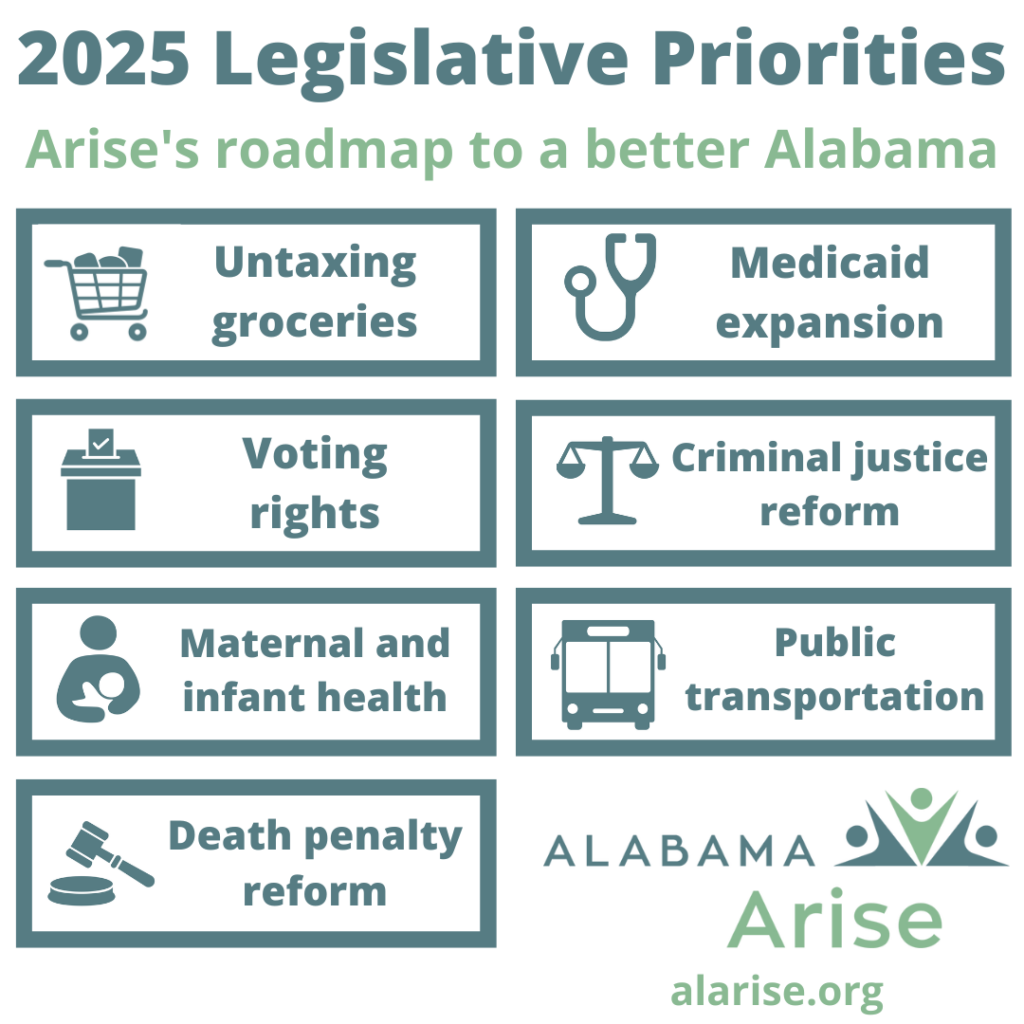
Graphic listing Alabama Arise's 2025 legislative priorities: Arise's roadmap to a better Alabama. The priorities are untaxing groceries, Medicaid expansion, voting rights, criminal justice reform, maternal and infant health, public transportation and death penalty reform.

Alabama urgently needs to close the health coverage gap

An essential step toward a healthier future for Alabama is to ensure everyone can afford the health care they need. Arise members believe Medicaid expansion is a policy path to that destination, and research provides strong support for that position.

Expanding Medicaid to cover adults with low incomes would reduce racial health disparities and remove financial barriers to health care for nearly 200,000 Alabamians. It would support thousands of new jobs across the state. And most importantly, it would save hundreds of lives every year.

The need to close Alabama’s coverage gap is growing by the day. Thomasville Regional Medical Center in Clarke County last month became the state’s most recent rural hospital to close. About two dozen other rural hospitals in Alabama are at immediate risk of closure, and four labor and delivery units have shut down in the last year. These closures have reduced care options in a state that already has one of the nation’s worst maternal mortality rates.

Alabama is one of only 10 states yet to expand Medicaid. Medicaid expansion would ensure health coverage for nearly 200,000 Alabamians caught in a coverage gap. Most of these residents earn too much to qualify for the state’s bare-bones Medicaid program but too little to afford private plans.

“Medicaid expansion would boost our economy, protect rural hospitals and improve life for people across Alabama,” Hyden said. “Closing the coverage gap also would improve access to mental health treatment and life-saving health care for mothers and babies. Our policymakers need to step up and to make this life-saving and job-creating investment in the people of our state.”

Universal school breakfast would help Alabama children learn and thrive

Another key step toward a healthier Alabama is to ensure every public school can offer free breakfast to every student. Hundreds of Alabama schools are providing free meals to all of their students through the Community Eligibility Provision, but some schools cannot participate in the program.

Arise will advocate for a state appropriation that local districts can use to match federal funds to offer free breakfasts. This funding would position Alabama to build on the success of Summer EBT, which will provide $40 in food benefits per summer month for more than 500,000 children starting in 2025. Legislators approved the necessary administrative funding for Summer EBT this year after determined advocacy by Arise members and partners.

Children and communities across Alabama would enjoy both immediate and long-term benefits from universal free breakfast in public schools. Universal school breakfast would reduce child hunger in a state where nearly 1 in 4 children face food insecurity. Extending the reach of school breakfast programs would help reduce behavioral problems and improve attendance and test scores. Reducing food insecurity for children also can help improve their mental health and overall health as teenagers and adults.

“It’s hard for children to focus in school when they’re hungry,” Hyden said. “Lawmakers can help ensure that every student across Alabama can start the day with a good meal and be ready to succeed both in the classroom and throughout their lives.”

Finish the job: Alabama needs to remove the rest of the state grocery tax

Arise members also renewed their decades-long commitment to another policy to reduce hunger: ending Alabama’s state grocery tax. That advocacy got results last year when legislators reduced the state sales tax on groceries by half. The law reduced the tax from 4 cents to 3 cents in 2023, but another 1-cent reduction did not happen this year because education revenues grew by less than 3.5%. That reduction will occur in the next year when revenues increase by that amount.

Ending the state grocery tax remains a core Arise priority because the tax makes it harder for people with low incomes to make ends meet. The tax adds hundreds of dollars a year to the cost of a basic necessity for families. And most states have abandoned it: Alabama is one of only 12 states that still tax groceries.

Lawmakers have options to remove the other half of the state grocery tax while protecting funding for public schools. Arise will continue to support legislation to untax groceries and replace the revenue by capping or eliminating the state income tax deduction for federal income taxes. This deduction is a tax break that overwhelmingly benefits the richest households. Arise also will support efforts to give local governments increased flexibility to decrease local grocery taxes if they determine it is feasible.

“Reducing the state grocery tax was an important step toward repairing Alabama’s upside-down tax system,” Hyden said. “By untaxing groceries and limiting the federal income tax deduction, legislators can help families keep food on the table while protecting funding for our children’s public schools. Alabama lawmakers should embrace this path to end the state grocery tax forever.”

How Alabama can build an economy that works for workers

Multi-colored logo of the state of Alabama with the text The State of Working Alabama


Labor Day is a holiday where we can reflect on the contributions that working people – and the unions that workers form to build power together – have made to the well-being of all people in the United States. These contributions include overtime pay, a five-day workweek, child labor protections and workplace safety standards.

These advances for working people didn’t come easily. Workers won them through strikes, pressure and solidarity. These advances came in the face of overwhelming opposition by bad employers that would have rather seen their workers die than to win workplace democracy.

And the fight continues. Many steps that the working people of Alabama have won toward better lives for their families are under attack today. In Alabama, workers fought this year against anti-union legislation and a measure to reduce existing child labor protections. And while passing these harmful bills and others, state officials have continued to give billions of dollars in tax incentives and subsidies to private companies. These giveaways persist even when those companies benefit from egregious child labor law violations.

These attacks on workers are continuations of longstanding economic strategies of worker abuse in the South. But at the same time officials choose to make life tougher for working people, officials are asking why people aren’t in the workforce.

The answer is straightforward: The Alabama economy doesn’t work for workers. And that’s by design. But we can move toward a better economy with better policy choices.

Job quality in Alabama is low

Alabamians labor in a state where numerous employment practices and policies prevent them from building a stable life and improving their overall well-being. More than 1 in 5 Alabama workers (22%) are paid less than $15 per hour. That is a poverty wage for a family of four and less than half of what that family needs to thrive. Alabama’s workers also make less, even after adjusting for the state’s lower cost of living, than workers in Rust Belt states like Illinois, Michigan, Ohio and Pennsylvania.

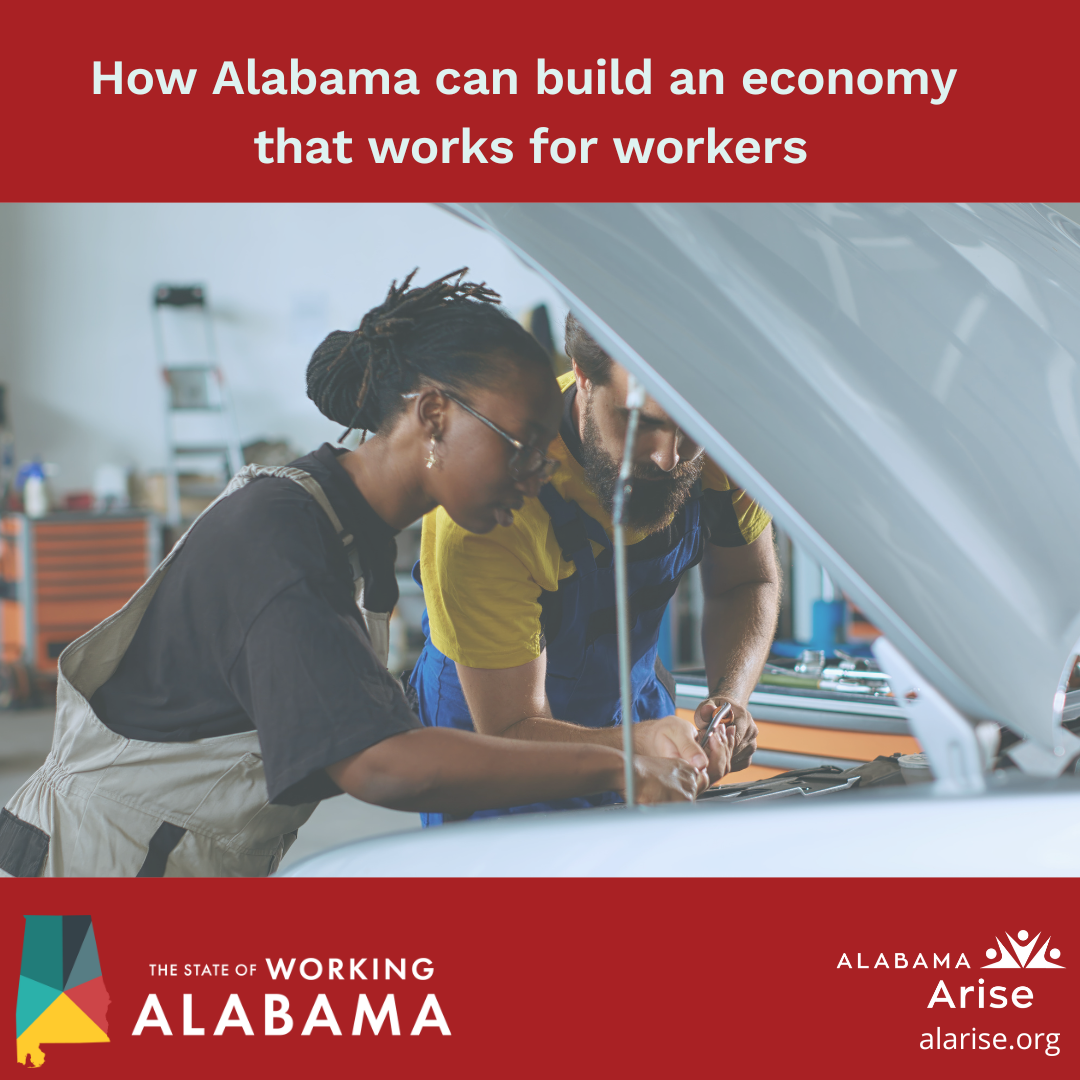
Two people working under the hood of a car with text on the top that reads How Alabama can build an economy 
that works for workers.The shortcomings of Alabama’s low-road economic development model reach far beyond employers’ failure to pay adequate wages. Southern workers broadly have less access to paid leave than other workers. Alabamians have no paid parental leave protections under state law, though momentum is building to fix that problem for some workers. Alabama workers also lack guaranteed paid sick leave, caregiving leave, domestic violence leave or bereavement leave. And the state has prevented local governments from giving workers a square deal by preempting any local legislation to improve conditions for workers, in an extension of policy barriers that limit Black Alabamians’ self-determination and participation in society.

State policymakers prop up employers’ anti-worker strategies by opposing workers’ efforts to build a better economy for themselves. The recent upswell of unionization in Alabama has met with vicious opposition from some officials, including a picketing ban, use of state troopers to support scabs against miners, and a slick, businesslike campaign of officials orchestrated to oppose workers organizing with the United Auto Workers (UAW) in Tuscaloosa County.

Officials also have attacked employers who freely and voluntarily recognize workers’ decision to unionize by forbidding those companies to receive economic development incentives. Hostility to workers, coupled with persistent underinvestment in work supports, has left Alabama’s workers significantly behind across the board.

Remove barriers by investing in child care, health care, public transportation

We know workers face specific barriers to workforce participation. The workers themselves and the businesses employing them have said so. These barriers include child care, transportation, housing and medical coverage.

But as our state’s economy has grown less than it would with broader opportunity, officials have made shortsighted anti-worker policy decisions that make life worse for working people and those who depend on them. Even the steps forward have been tentative, lacking in focus directly on the people who do the work to keep Alabama going.

Instead of just providing tax incentives to companies for child care and stopping there, workforce development should include direct investment in child care for workers. Our state’s hardheaded, hard-hearted refusal to expand Medicaid has cost lives and worsens our rural hospital crisis. Alabama remains one of just 10 states yet to close the health coverage gap.

Alabama also has yet to fund the Public Transportation Trust Fund that the Legislature created in 2018. Significant investment in public transportation would help all workers – particularly people working in manufacturing and caregiving, two areas of need where investment would provide rippling benefits for all Alabamians.

These persistent state policy failures bolster an overall economic structure that comes up short on providing jobs where people can thrive or even just get by. By not investing in essential work supports, lawmakers are limiting our state’s human potential and economic future.

Job quality for Alabamians is lower than in many other states. Many Alabamians make less than other states’ residents do for the same work, and that’s the wrong way to build an economy. 

A high road to a brighter future

Alabama’s economic development strategy of removing every guardrail for worker well-being while treating the people who do the work like they are disposable doesn’t make sense. It never has. The top-down model is why our state’s outcomes fall measurably short in important areas such as earnings, health care and educational attainment.

On this Labor Day, state decision-makers should move beyond the low-road strategies that have Alabama spinning its wheels on improving quality of life for the people who keep the state running. By investing in a high-road economic structure that uplifts workers, we can build an Alabama we’re all proud to call home.

What are the benefits of a universal school breakfast program in Alabama?

Alabama should do more to equip schoolchildren and teachers for success. Our state consistently ranks among the bottom five states for educational outcomes. And one essential school supply missing from several Alabama schools would immensely improve said outcomes: universal school breakfast. Below are a few of the positive effects that universal school breakfast would have for children across Alabama.

Reduce child hunger across our state. In Alabama, 23% of school-age children are food insecure, with a disparate impact among children of color. Universal school breakfast could guarantee a morning meal for all Alabama children during their required school day.

Address chronic absenteeism. In recent years, nearly 1 in 5 Alabama children have been chronically absent, with 53% of Alabama schools experiencing some form of high to chronic absenteeism. Decades of research has shown that students who participate in school breakfast see improved attendance and decreased tardiness, according to the Food Research and Action Center

Improve adolescent mental health. Young adults who reported experiencing food insecurity during childhood also reported greater psychological distress in adulthood, according to National Health and Nutrition Examination Survey data.

Improve standardized testing and math scores. Alabama ranks 46th in average math ACT scores. Student academic achievement increases, especially for math, when accessible breakfasts are made available to school-age children.

Reduce the long-term cost of closing the health coverage gap. Given the chronic health conditions associated with hunger, like diabetes and heart disease to name a few, a state subsidy for universal school breakfast is a form of preventative care that could have a long-term impact on the projected cost of closing the coverage gap in Alabama.

Alleviate behavioral problems. The behavioral effects of hunger include impulsivity, hyperactivity, irritability, aggression, anxiety and a greater propensity to using rewarding narcotics, according to a study by the National Institutes of Health. Reducing hunger would reduce these behaviors.

Aid Alabama’s teachers in regulating their classrooms. Attrition rates among teachers have surged nationwide and statewide in recent years. Teachers spend roughly $300 per year of their own money to feed hungry students in their classrooms.

Address educator attrition rates. Nearly 40% of teachers who left the profession said they had better material support in their current roles when compared to teaching, according to a survey conducted by the Institute of Education Sciences. Universal school breakfast is a simple but powerful way to provide material support for Alabama’s teachers and students.

For questions regarding the implementation, impact and general importance of universal school breakfast, please contact Alabama Arise’s LaTrell Clifford Wood at latrell@alarise.org or Carol Gundlach at carol@alarise.org.

Universal school breakfast helps Alabama children learn and thrive

School breakfast helps kids learn: Children who start the day with breakfast learn better. They have better classroom participation and are less likely to skip school than kids who don’t get breakfast. But tight family budgets and stressful mornings mean many children arrive at school hungry. School breakfast can help fill this gap.

School, bus and family schedules make it difficult to serve breakfast before the school day begins: School breakfast participation declined nearly 8% nationally after pandemic-era free breakfast ended. Only half of the children who get lunch at school also get breakfast.

The solution – universal free breakfast: School districts across the country have found that breakfast served after the first bell increases participation and helps kids learn.

Paperwork is a barrier for hungry children: Federal funding for traditional school breakfast relies on school’s assessing students’ eligibility for meal subsidies and reporting on how many free, reduced and paid meals are served. The Community Eligibility Provision (CEP) can reduce the paperwork for schools that serve a high share of children with low incomes. But many schools either can’t make CEP work financially or worry about its impact on other federal grants.

What the Legislature can do: The Legislature can help feed Alabama’s schoolchildren by appropriating Education Trust Fund (ETF) money to match federal reduced and paid breakfast funds. Schools that want to offer free breakfast can use these matching funds to provide breakfast for all of their students at the start of the school day.

How this would work: The Legislature would appropriate money to match federal school breakfast grants. The Alabama State Department of Education would allow local schools to apply and would distribute these matching dollars. Schools that receive funding would report to, and be monitored by, the Department of Education.

The decision to offer free breakfast is optional: Whether to apply for matching funds would be totally voluntary for schools or systems. Those that want to participate can apply for the matching funds. Those that don’t think it will work for them can choose not to apply.

How this would interact with CEP: The Community Eligibility Provision allows eligible schools to provide free meals for all their students. But some Alabama schools that are technically eligible for CEP can’t make the federal reimbursement rate work for them. And other Alabama schools would like to offer free breakfast but don’t want to adopt CEP fully. This proposal would allow schools to be made whole if they do adopt CEP or would allow schools to offer universal breakfast without having to adopt CEP fully.

Bottom line

An ETF appropriation of approximately $14 million in 2023 dollars would allow every school in Alabama to offer breakfast to all of their students.


Summer EBT for 2025

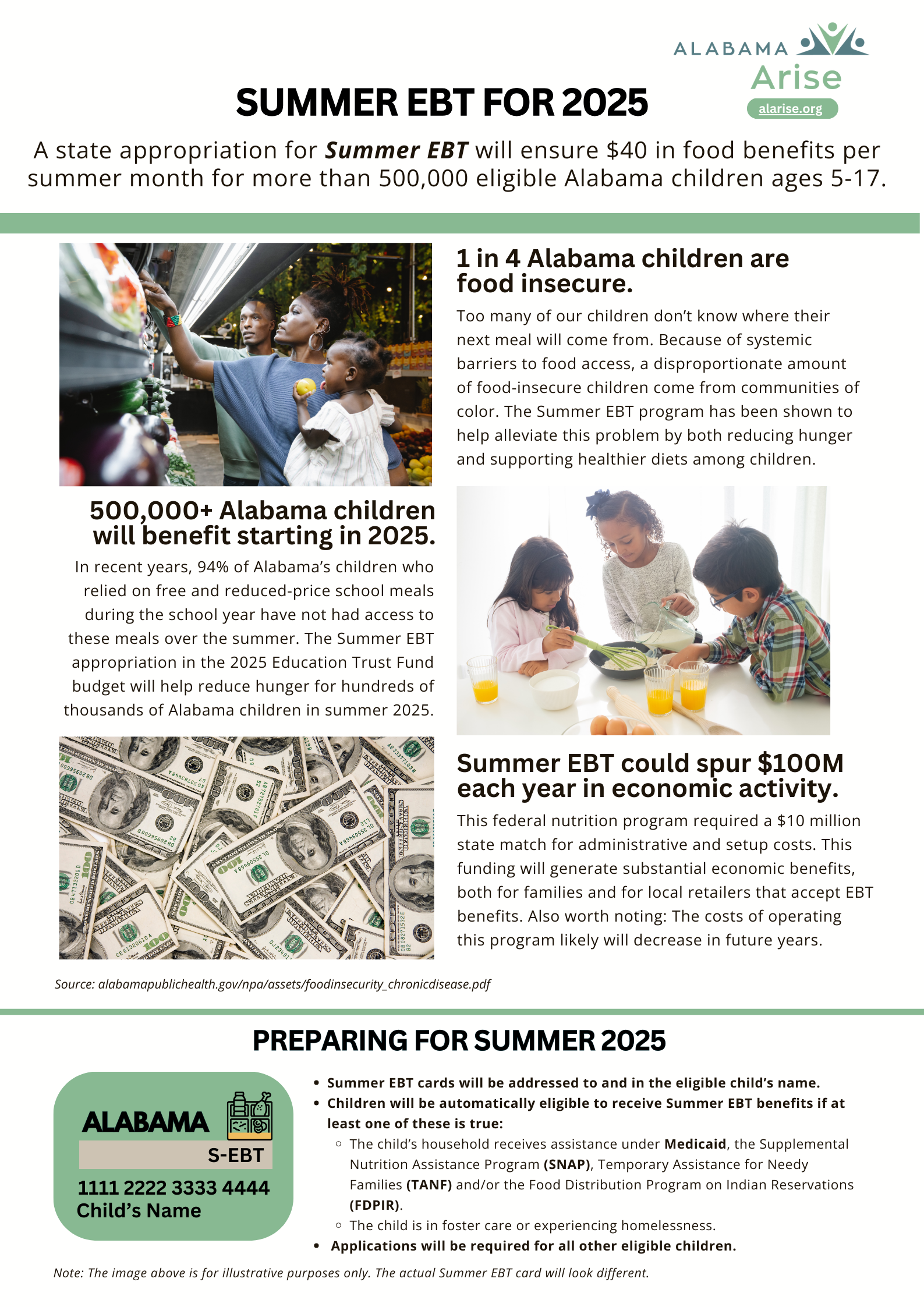
A state appropriation for Summer EBT will ensure $40 in food benefits per summer month for more than 500,000 eligible Alabama children ages 5-17.


An Alabama Arise flyer explaining the need for and benefits of Summer EBT starting in 2025.

1 in 4 Alabama children are food insecure.

Too many of our children don’t know where their next meal will come from. Because of systemic barriers to food access, a disproportionate amount of food-insecure children come from communities of color. The Summer EBT program has been shown to help alleviate this problem by both reducing hunger and supporting healthier diets among children.

500,000+ Alabama children will benefit starting in 2025.

In recent years, 94% of Alabama’s children who relied on free and reduced-price meals during the school year have not had access to these meals over the summer. The Summer EBT appropriation in the 2025 Education Trust Fund budget will help reduce hunger for hundreds of thousands of Alabama children in summer 2025.

Summer EBT could spur $100M each year in economic activity.

This federal nutrition program required a $10 million state match for administrative and setup costs. This funding will generate substantial economic benefits, both for families and for local retailers that accept EBT benefits. Also worth noting: The costs of operating this program likely will decrease in future years.

Preparing for Summer 2025

  • Summer EBT cards will be addressed to and in the eligible child’s name.
  • Children will be automatically eligible to receive Summer EBT benefits if at least one of these is true:
    • The child’s household receives assistance under Medicaid, the Supplemental Nutrition Assistance Program (SNAP), Temporary Assistance for Needy Families (TANF) and/or the Food Distribution Program on Indian Reservations (FDPIR).
    • The child is in foster care or experiencing homelessness.
  • Applications will be required for all other eligible children.


LaTrell Clifford Wood: Arise’s new star at the State House

The halls of the Alabama State House had a new face this legislative session.

LaTrell Clifford Wood started as Alabama Arise’s hunger policy advocate in November. Since then, the Stillman College graduate has worked tirelessly to ensure Alabama’s most marginalized residents have access to food. In her role, she advocates directly with lawmakers for legislation that supports getting food to the Alabamians who need it most. She also convenes the Hunger Free Alabama coalition of 88 organizations.

As the youngest member of the Arise staff, LaTrell offered up insights after her first legislative session.

“I think this session has really taught me to hold space for the world to grow, change and evolve, and find new room for hope,” she said. “You can have a resume that is really heavy with blue collar and service experience, and those experiences are meaningful. Those are ‘real jobs.’”

A photo headshot The intergenerational relationships with other Arise staff members proved to be helpful as she navigated an especially challenging session.

“I picked up gems of wisdom from people who have been doing this work a lot longer than me, and actualized the value that young people can bring to a space when they are treated as meaningful contributors,” LaTrell said.

Making use of opportunities

LaTrell grew up in Irondale, a city of about 13,000 near Birmingham, and is a proud HBCU grad. Her time at Stillman brought her into hunger advocacy work and a systemic framework for change.

“There are systems in place by which we lose wisdom with the people we love. So I said to myself, ‘Whatever I do, I have to take care of myself, and it has to be sustainable,’” LaTrell said. “Since I was a pandemic grad, I decided to take a break and explore more options, and that led me to Congressional Black Caucus Foundation [CBCF].”

Through the CBCF, LaTrell interned in U.S. Rep. Terri Sewell’s office in Washington, D.C. That is where she first learned of Alabama Arise.

“My team in Rep. Sewell’s office really advocated for me, and Akiesha [Anderson, Arise’s former policy and advocacy director] really opened the doors for me to Alabama politics, and made a safe space for me to come back home and grow and learn at Arise, and I am so grateful for her and the rest of Arise’s staff for welcoming me,” LaTrell said.

Telling her story

LaTrell’s advocacy this year helped secure $10 million in Summer EBT administrative funding for 2025. (See page 2.) She finds that telling her personal stories to lawmakers has helped her in this work.

“It was really healing and energizing to talk to Sen. [Rodger] Smitherman, whose district I grew up in, about my experiences with hunger and its impact, and see him really stand 10 toes down for children across the state,” she said. “Countless children will have some measure of relief from hunger over the summer months, for generations to come. It’s hard to wrap my head around in more ways than one.”

After an impactful first legislative session, LaTrell has even bigger goals for Arise’s hunger advocacy work. Universal school breakfast is her next advocacy priority.

“I think the first step in that is leaning into securing a state appropriation to subsidize universal school breakfast in the next year,” she said.

LaTrell also said she hopes to help bring even more young people like her into the Alabama Arise fold.

“I look forward to building more avenues to meet young Alabamians where they are,” she said.

An optimistic look at Alabama

As a young Alabamian who returned to the state after working elsewhere, LaTrell said she wants the rest of the world to see what Alabama is really like.

“When I go out of state, a lot of people say, ‘You’re from Alabama?’ And there’s always a tone,” she said. “So my favorite experience is being able to school people on all the misconceptions they have, and all the contributions Alabamians and Alabama have made to the U.S. and the world.”

LaTrell is incredibly proud of her Alabama roots and how they’ve shaped her family.

“My family has been domestic refugees of the state, run out by racial violence during the first wave of the Great Migration. But somehow, we find our way back, and every generation, we have been able to make a meaningful difference. And that is worth being proud of,” she said.

How to get involved

For those looking to get involved with the critical work of feeding Alabamians, LaTrell has some suggestions.

Arise supporters who live in or have connections in Limestone and Morgan counties, as well as Opelika, can support hunger advocacy by talking with parents, educators and superintendents in their communities about the Community Eligibility Provision (CEP). More than 50% of the schools in these areas could serve universal school meals through CEP but are not. The deadline for schools to opt in for the upcoming school year is June 30.

“I encourage members to keep an eye out for hunger-related action alerts, and follow us on Facebook at Hunger Free Alabama!” LaTrell said.


Summer EBT, Legislative Day energy highlight busy, tough 2024 session in Alabama

You made a difference! Alabama Arise members played a decisive role this year in securing summer food assistance for more than 500,000 children starting in summer 2025. Summer EBT funding brought an uplifting conclusion to the Alabama Legislature’s 2024 regular session, which ended May 9.

The Summer EBT victory showed the power of Arise’s policy analysis, organizing and advocacy. After the House passed an education budget without Summer EBT funding, Arise ramped up pressure on the Senate. Our policy team and lobbyists educated lawmakers about the program’s benefits. Our communications team generated dozens of media stories to build public support. And our organizers rallied Alabamians to speak out.

Ultimately, folks like you got Summer EBT funding across the finish line. Arise advocates flooded lawmakers with more than 2,700 emails, calls and personal visits urging support. And it worked: Senators added Summer EBT to the budget, and Gov. Kay Ivey signed it into law.

Our members also displayed their passion for change during Arise’s annual Legislative Day on April 2. More than 230 people packed the State House in support of our Cover Alabama campaign to close Alabama’s health coverage gap.

Lawmakers dealt setbacks to several Arise legislative priorities this year but made important progress on others. Through it all, our members kept speaking out for policies to improve the lives of Alabamians marginalized by poverty.

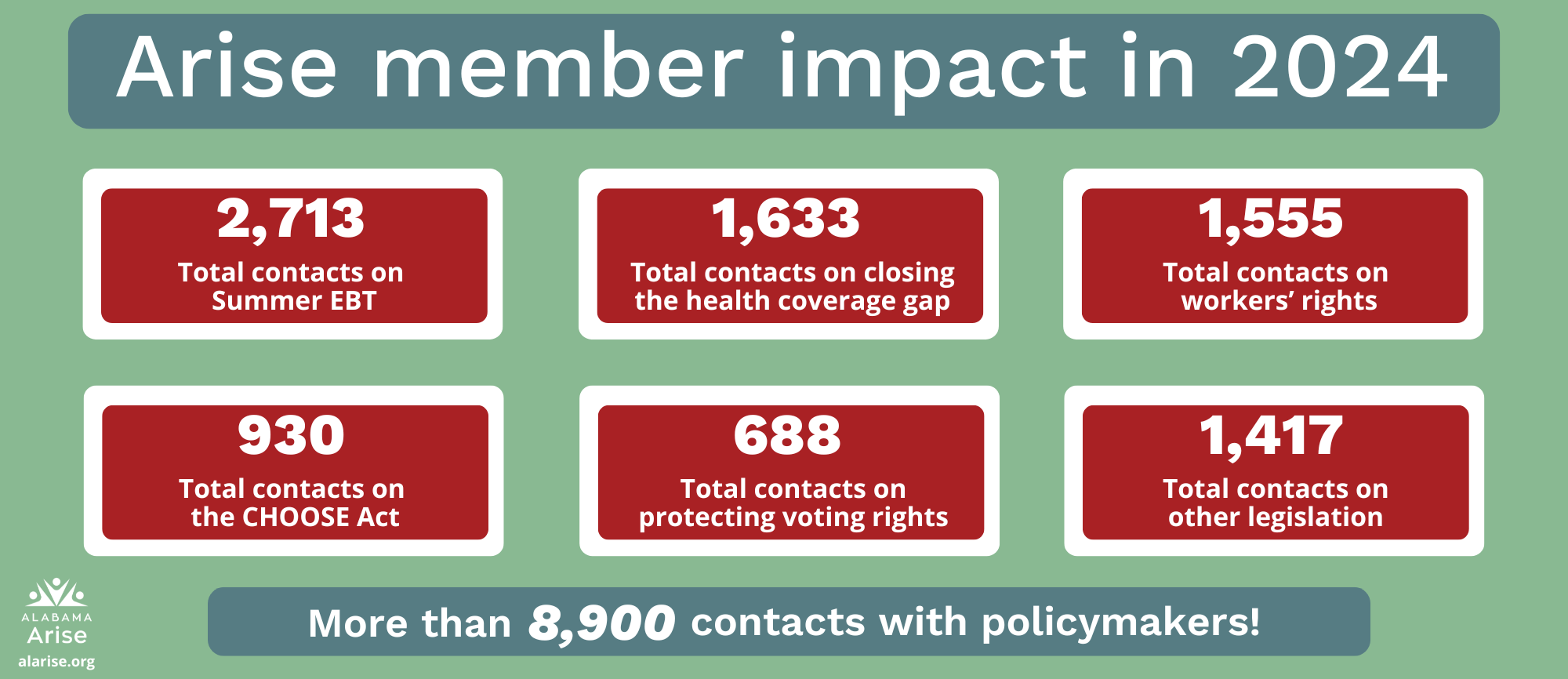
An infographic showing more than 8,900 Arise members took action this legislative session. 2,713 contacts on Summer EBT; 1,633 contacts on closing the health coverage gap; 1,555 contacts on workers' rights; 930 contacts on the CHOOSE Act; 688 contacts on protecting voting rights; and 1,417 contacts on other legislation.

Setbacks on school funding, voting rights, racial equity

Early in the session, legislators enacted three harmful new laws, all of which Arise opposed. One was the CHOOSE Act (HB 129 by Rep. Danny Garrett, R-Trussville). Over time, this law could divert hundreds of millions of dollars annually from public schools to private schools and homeschooling.

Another bad bill rushed into law was SB 1 by Sen. Garlan Gudger, R-Cullman, which criminalizes several forms of assistance with absentee ballot applications. Arise and other advocates fear this law could have a chilling effect on good-faith efforts to assist people who need help exercising their voting rights.

A third shortsighted new law is SB 129 by Sen. Will Barfoot, R-Pike Road. The act forbids state agencies and public schools and universities from sponsoring numerous diversity, equity and inclusion (DEI) programs. It also authorizes firings of employees found to violate the act knowingly. In late May, Jacksonville State University became the first university to close its DEI office in response to this law.

Later, legislators passed two new laws that undermine worker protections. SB 53 by Sen. Arthur Orr, R-Decatur, removes the requirement for an eligibility to work form for 14- and 15-year-olds. And Orr’s SB 231 makes companies ineligible for state or local tax incentives if they voluntarily recognize a union.

Good new laws on child care, housing, criminal justice reform

One positive workers’ rights law this year was SB 119 by Sen. Robert Stewart, D-Selma, which increases penalties for child labor violations. The Legislature also created tax credits designed to increase access to child care (HB 358 by Rep. Anthony Daniels, D-Huntsville) and workforce housing (HB 346 by Rep. Cynthia Almond, R-Tuscaloosa). And Orr’s SB 270 improved access to public records.

Lawmakers also enacted two good criminal justice and due process reforms. Almond’s HB 275 will increase pay for many lawyers representing indigent defendants. And HB 188 by Rep. Terri Collins, R-Decatur, requires a uniform hearing process and hearing rights for students suspended or expelled from public K-12 schools.

The work continues

Several other Arise-backed bills made major progress but came up just short of passage. HB 29 by Rep. Chris England, D-Tuscaloosa (allowing resentencing hearings for some defendants convicted under the Habitual Felony Offender Act) won House committee approval. Orr’s SB 62 (removing state sales tax from many infant and maternity products) passed the Senate but never reached the House floor. And HB 309 by Rep. Ginny Shaver, R-Leesburg (providing paid parental leave for state employees) passed the House but died on the Senate calendar.

With your support, Arise will keep advocating for important policy changes like these in 2025 and beyond. We will keep working to expand Medicaid and eliminate the state grocery tax. And we will keep strengthening our movement for a better, more inclusive Alabama.

Arise legislative update: May 13, 2024

Arise’s Akiesha Anderson gives a final update on the Alabama Legislature’s 2024 regular session, which ended last week. We closed the session with a big advocacy win: Lawmakers approved the funding needed to provide Summer EBT food assistance for more than 500,000 children starting next summer! For more information about what happened this year, please join Arise for our legislative session wrap-up on Tuesday, May 28, at 6 p.m. Register here.

Akiesha also shares the news that she will be leaving Arise later this month to accept a position with Represent Justice. We thank her for her work with Arise and wish her all the best in California!

Full transcript below:

Hi there. Akiesha Anderson here, policy and advocacy director for Alabama Arise, and I’m excited to be here to provide you with the final legislative update for the 2024 legislative regular session. Last week, we saw the Legislature wrap up the regular session after finally passing the Education Trust Fund budget. Alabama Arise and partners with the Hunger Free Alabama coalition worked tirelessly over the last few weeks to advocate for an appropriation of $10 million to $15 million to fund Summer EBT for 2025.

Thanks in large part to your help and the help of the thousands of Arise members that called and emailed legislators, we were able to end this legislative session with a huge win in the form of securing the $10 million needed to ensure that over half a million Alabama children who normally receive free or reduced lunch still receive meals that they elsewise might not might not have received due to school being out for the summer. I and the rest of the Arise staff are so tremendously grateful for your responsiveness to all the action alerts we sent out regarding this issue. It truly, truly, truly made a difference.

A few other notable happenings from last week include the passage of the General Fund budget, the passage of a child care tax credit bill, the passage of a workforce housing development bill and the passage of a bill that increases penalties for child labor violations. There was absolutely more. However, I hope that you will join me and the rest of the Arise team on Tuesday, May 28, at 6 p.m. for a much more thorough legislative wrap-up, where my team and I will talk in more depth about the highs and lows, wins and losses experienced this legislative session.

If you haven’t already received an email about how to register for that legislative wrap-up, simply email Pres Harris, our organizing director, at pres@alarise.org. That’s P-R-E-S at A-L-A-R-I-S-E dot O-R-G. You can email her for more registration information.

Lastly, it is with both deeper appreciation for you and the rest of the Arise family, along with a touch of sadness, that I share that this will unfortunately be my last legislative update video with Arise. At the end of this month, I will be transitioning to a new job with an Arise partner organization based in Los Angeles, California.

Some of you may know that my husband is from and located in Southern California and that during the legislative session, we are apart as I spend the session here in Montgomery. Well, as we prepare to try to grow our family, I have to make the bittersweet decision to transition to Southern California as well on a full-time basis.

Over the last two years, I cannot express how much each and every one of you have reminded me of how bright the future is here in my home state, where everyday people like us refuse to settle for the status quo, and where you all show up day in and day out to demand more. I hope that the fire that lights the fight within each and every one of you remains lit. We have certainly seen together — with the passage of both the grocery tax reduction, the $10 million Summer EBT allocation and so much more — what can happen when we refuse to let that fire be extinguished.

Again, I thank you for everything, and I hope to see you one final time at the legislative wrap-up taking place on May 28. Take care.