Summer EBT passage a hard-fought win for Alabama children

Alabama Arise members helped secure a policy change this year to reduce hunger for more than 500,000 children across the state. Beginning in summer 2025, eligible children ages 5-17 will receive $120 in Summer EBT benefits to continue to have school meals through the summer. The state must cover half of the administrative costs, but the benefits are 100% federally funded.

Children will be automatically eligible to receive Summer EBT benefits if their household receives assistance under Medicaid, the Supplemental Nutrition Assistance Program (SNAP), Temporary Assistance for Needy Families (TANF) and/or the Food Distribution Program on Indian Reservations (FDPIR). Foster children and children experiencing homelessness also will qualify automatically. Applications will be required for all other eligible children.

Arise advocacy builds momentum

Rep. Laura Hall, D-Huntsville, was the first legislator to inquire about Summer EBT this session during February’s budget hearings. Hall offered an amendment to the Education Trust Fund (ETF) budget to add Summer EBT administrative funding. But the House approved the budget without it.

Arise then kicked advocacy efforts into high gear. Hundreds of our supporters demanded that their senators support Summer EBT funding, and Arise generated dozens of media stories to increase public awareness and pressure. Reports from Senate secretaries and members foreshadowed Summer EBT’s success. Several said they were overwhelmed by the number of emails and calls they were receiving.

Legislative supporters kept up the push, too. Hall joined Rep. Barbara Drummond, D-Mobile, in efforts to build momentum for Summer EBT in the Senate. Sens. Vivian Figures, D-Mobile; Garlan Gudger, R-Cullman; and Rodger Smitherman, D-Birmingham, submitted requests to add an ETF line item for Summer EBT.

A victory to reduce hunger in Alabama

Arise and other Hunger Free Alabama coalition members made their case directly to the Senate’s ETF budget committee April 25, testifying in support of Summer EBT. Our advocacy worked. The following week, the committee added $10 million for the Department of Human Resources to administer Summer EBT in partnership with the state Department of Education.

The full Senate approved the budget 30-0 in early May. And after a brief jump-scare moment when lawmakers delayed the bill in a conference committee, the House and Senate both voted unanimously for the final budget – including the Summer EBT funding – on May 9, the session’s final day. Gov. Kay Ivey signed the budget into law on May 15.

Arise is relieved by the great news that Alabama children and families will be able to participate in this essential program in summer 2025. And we are inundated with gratitude for our members and partners who responded to our action alerts. Your advocacy made the difference!

Building momentum for closing the coverage gap

Alabama Arise and the Cover Alabama coalition have built powerful momentum to expand Medicaid and close the state’s health coverage gap in recent months.

Arise held a news conference with our partners at the March of Dimes and Alabama Rural Health Association during our annual Legislative Day in April. The event highlighted how Medicaid expansion could improve infant and mortality rates in our state and keep rural hospitals open. More than 230 individuals from across the state attended and spoke up in support of the nearly 300,000 Alabamians who need health coverage.

In another encouraging development, the House and Senate Health Committees held a joint meeting in late April to hear from other states about their efforts to close the health coverage gap. This hearing was a platform for legislators and experts to explore potential solutions, drawing insights from successful initiatives in Arkansas and North Carolina.

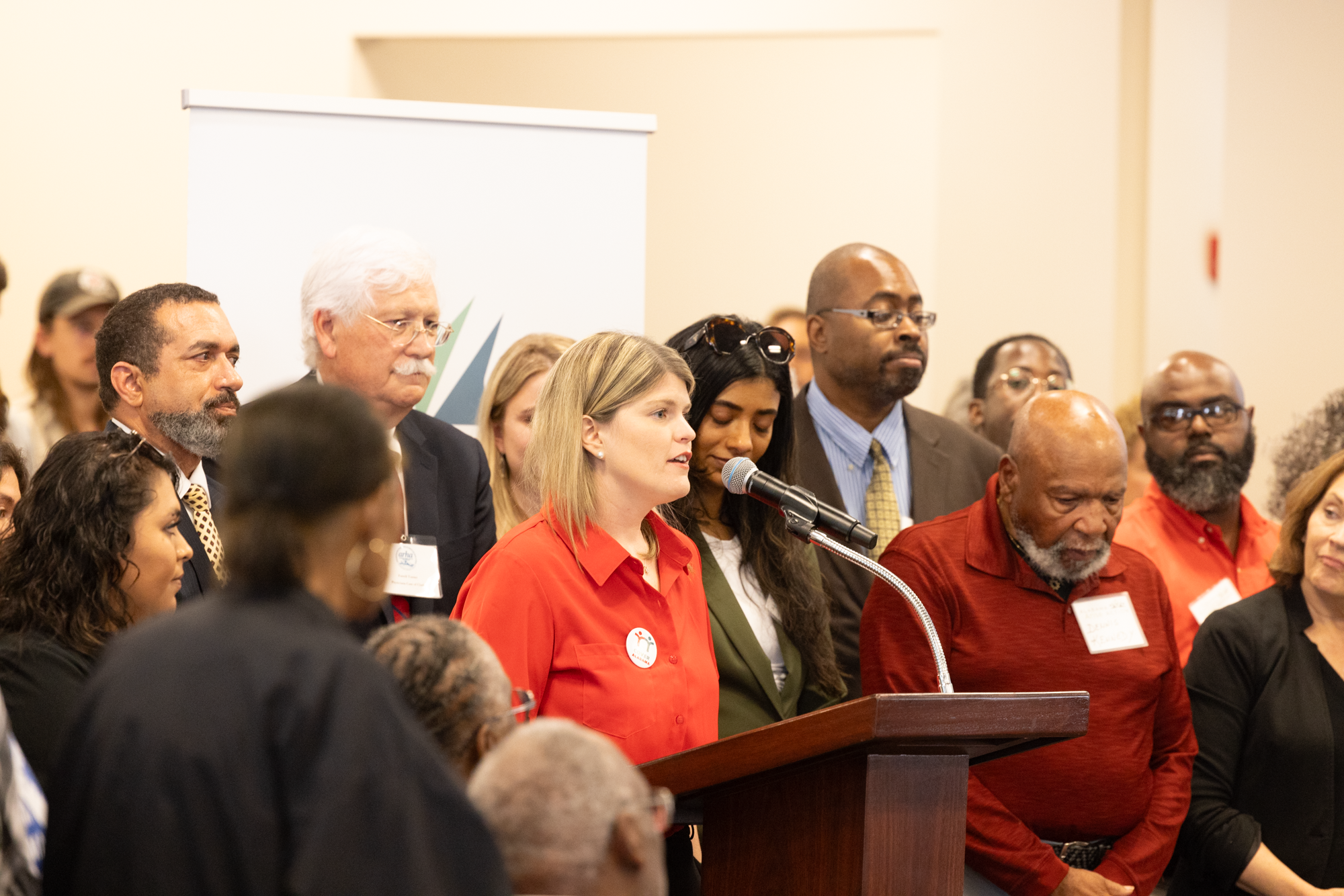
A woman speaks while standing at a podium with several people behind her.
Alabama Arise’s Cover Alabama campaign director Debbie Smith speaks during Arise Legislative Day on April 2, 2024, at the State House in Montgomery.

‘Their loved one is now getting help’

Key figures from North Carolina, such as state Sen. Jim Burgin, shared their state’s journey in closing the coverage gap. Burgin, a vocal opponent of Medicaid expansion in the past, highlighted the overwhelming gratitude from individuals receiving assistance.

“I live in a very rural and very conservative area,” Burgin said during the hearing. “I have not had one person that has come up to me and told me, ‘Jim, you shouldn’t have done that, and we’re against you for doing that.’ But I’ve had hundreds of people come up to me and thank me because their loved one is now getting help.”

The meeting seemed to drive a shift in attitudes among some conservative legislators. Many have expressed an openness to exploring avenues for closing the coverage gap.

Meanwhile, we also celebrated the progress that Mississippi made in its efforts to close the coverage gap. In February, the Mississippi House voted 99-20 to expand Medicaid. While that bill ultimately did not pass in the Senate, Mississippi made incredible progress by bringing conservative lawmakers on board and making Medicaid expansion a hot topic in the state. Alabama legislators took notice, and Mississippi’s progress will put pressure on our legislators to move forward as well.

Looking forward

In the coming months, Cover Alabama will continue to beat the drum in support of Medicaid expansion. We are so grateful for your continued support. Together, we are making significant strides toward Medicaid expansion in Alabama.

Let’s continue to raise our voices, engage with lawmakers and advocate for equitable health care access for every Alabamian.

Maternal health hits home

When Arise members convened at last year’s Annual Meeting to choose our 2024 legislative priorities, you voted to add maternal and infant health to our agenda. Most people didn’t know I was nearly eight weeks pregnant with my first child at the time!

As our team studied how we could improve maternal and infant health outcomes through our advocacy and organizing, we learned a lot from you, our partners and our new maternal health fellow.

A woman holding a baby.
Arise Executive Director Robyn Hyden holds her son, Hank.

Little did I know that what I was learning about maternal and infant health would soon affect me personally. At a routine 28-week checkup, I was diagnosed with severe preeclampsia, one of the leading causes of maternal death. Soon after, my son Hank was born three months early, causing him to spend more than 80 days in UAB’s Neonatal Intensive Care Unit (NICU).

While Hank and I are home now, happy and healthy, we were extremely lucky. Too many moms lack access to routine prenatal and postpartum care, transportation and paid family leave. I saw firsthand how many were struggling in our state’s only Level 4 NICU. I learned that around 10% of babies born in the United States will spend some time in the NICU. In a state that claims to care about babies, mothers and families still do not have the support they need. This causes us to have the third-worst rate of maternal mortality in the country. 

My family was lucky to have the support we needed. I wish the same for all those who wish to become parents. Together, Arise members envision a state where everyone has the support they need to have the family they choose. Thank you for pushing our leaders to make this a reality.

How Alabama can reduce Black maternal health disparities

As we reflect on the recent observance of Black Maternal Health Week, it is crucial to confront the staggering realities that Black women in Alabama face concerning maternal health care. A closer examination of data and statistics reveals the urgent need for targeted interventions and systemic reforms to address the unacceptable disparities in maternal health outcomes.

Disparities in maternal mortality

Multiple official definitions of maternal mortality exist. The World Health Organization defines maternal death as “the death of a woman while pregnant or within 42 days of termination of pregnancy, irrespective of the duration and the site of the pregnancy, from any cause related to or aggravated by the pregnancy or its management, but not from accidental or incidental causes.” Similarly, the Centers for Disease Control and Prevention (CDC) defines pregnancy-related death as “a death while pregnant or within 1 year of the end of pregnancy from any cause related to or aggravated by the pregnancy.”

In the United States, the overall maternal mortality rate was 32.9 deaths per 100,000 live births in 2021. Black women are three times more likely to die from pregnancy-related complications than white women. The maternal mortality rate for Black women is a staggering 69.9 deaths per 100,000 live births. In comparison, the maternal mortality rate for white women is 26.6 deaths per 100,000 live births. Even more tragic, data shows that more than 80% of pregnancy-related deaths are preventable.

Alabama’s maternal mortality rates

In Alabama, the maternal mortality rate is 36.4 per 100,000 live births, the third worst rate in the country. Other reports rank Alabama’s maternal mortality rate even higher. For Black women in Alabama, the maternal mortality rate is significantly higher than the national average.

The maternal mortality rate for Black women in Alabama is about 100 deaths per 100,000 live births, according to a recent Milken Institute report. The maternal health crisis does not have a singular cause. Instead, multiple factors contribute to its complexity.

Barriers to prenatal care access

Access to prenatal care is a critical factor in positive maternal health outcomes. However, many Black women in Alabama face barriers to accessing timely and comprehensive prenatal care.

One major barrier is lack of health care providers and limited access to medical facilities. According to the Alabama Department of Public Health, 55 of Alabama’s 67 counties are considered rural, with 62% of the total population living in Primary Care Health Professional Shortage Areas (HPSAs). Additionally, many Alabama counties also are considered maternity care deserts, meaning pregnant individuals there lack access to essential obstetric services close to home.

Impact of implicit bias

Implicit bias and racism within the health care system contribute to disparities in maternal health outcomes. Implicit bias can be defined as “unconscious attitudes or stereotypes that affect our understanding, actions and decisions.”

Black women are more likely to experience mistreatment (such as shouting and scolding), dismissive attitudes, and medical neglect during pregnancy and childbirth, research has shown. The American College of Obstetricians and Gynecologists (ACOG) emphasizes the importance of addressing implicit bias in the health care system to improve maternal health outcomes.

Socioeconomic factors

Socioeconomic factors, namely poverty, also play a significant role in shaping maternal health disparities in Alabama. Alabama has several rural counties in the Black Belt that are “majority-minority,” where a majority of the population is Black. In 2019, four of Alabama’s counties with the highest poverty rates were majority-minority. Poverty and its residual effects (such as housing insecurity, food insecurity, lack of transportation and more) lead to poorer health outcomes.

Another serious consequence of poverty is lack of health coverage. In 2021, one in seven women in Alabama were uninsured. Uninsured women are more likely to have poor outcomes during pregnancy and delivery than women with insurance, research shows.

Conclusion

This data and many other studies highlight the urgent need for targeted interventions and systemic reforms to address maternal health disparities among Black women in Alabama. By addressing barriers to prenatal care access, combating bias in health care and addressing socioeconomic factors, we can work toward achieving equitable maternal health outcomes for all women in Alabama.

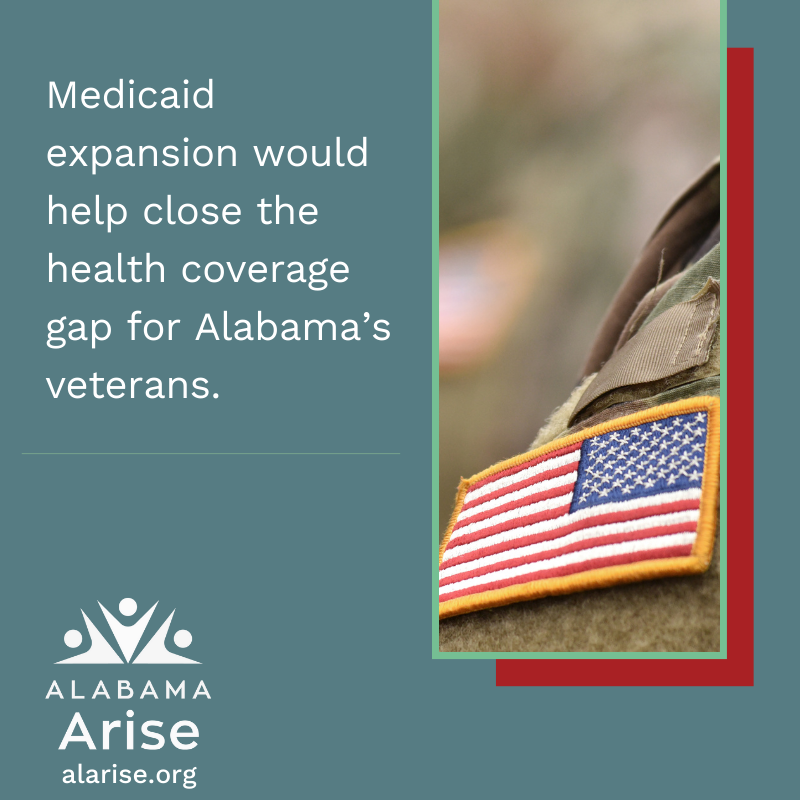
Close the health coverage gap for Alabama’s veterans

Many Alabama veterans face preventable barriers to obtaining health care. Closing our state’s health coverage gap through Medicaid expansion is an essential part of the solution.

Approximately 10,000 Alabama veterans are uninsured.

  • In 2022, half of Alabama veterans who were uninsured had an income below 138% of the federal poverty level (FPL), which is the income eligibility limit for coverage through Medicaid expansion.
  • In addition to uninsurance and other barriers to accessing health care that veterans face, VA health coverage is limited as well. This is due to eligibility based on service-connected disability, income status and other service-related factors. Distance to a VA facility also poses a significant barrier that can prevent enrollment in VA health care.
  • Lack of health coverage most greatly affects the veterans who need it most. Veterans with previously existing disabilities have a higher uninsured rate than veterans in general.

In 2022, 3,004 Alabamians on active duty for training in the National Guard or Reserves were uninsured and had an income under 138% FPL.

Expanding Medicaid would empower more of our brave service members and veterans with low incomes to access health care.

  • In states that expanded Medicaid at the time, 50% of the veterans who were uninsured in 2013 received health coverage by 2015. In Alabama, only a little more than 1 in 3 uninsured veterans obtained coverage in the same time period.
  • In 2021, half of all uninsured veterans were from the 14 states that had not expanded Medicaid at that time.
  • One veteran explained the stakes of Medicaid coverage in a KFF report: “If I didn’t have Medicaid, it would be all downhill because there are not a lot of places that can afford to supply the medications that I need. Hypertension killed both my parents, so I need to take care of myself and see the doctor regularly.”

Medicaid expansion would promote employment among veterans.

  • The employment rate for veterans will be higher in states that expand Medicaid than in states that do not, as indicated by Urban Institute projections for 2024.
  • About 1 in 7 veterans (14.2%) are employed in the service industry, while 13.7% work in construction and maintenance. These are among the professions where the most workers would benefit from Medicaid expansion. Closing Alabama’s coverage gap would allow more veterans to obtain and retain employment by improving their health and productivity.

Medicaid expansion would allow veterans to have more options to receive health care.

  • Expanding Medicaid would ensure veterans have more freedom to seek health care outside of the VA system. This would allow them to receive care more promptly while reducing wait times in VA facilities for other veterans.
  • The number of VA health system outpatient visits would decrease by 12% if all states expanded Medicaid.

Arise legislative update: May 13, 2024

Arise’s Akiesha Anderson gives a final update on the Alabama Legislature’s 2024 regular session, which ended last week. We closed the session with a big advocacy win: Lawmakers approved the funding needed to provide Summer EBT food assistance for more than 500,000 children starting next summer! For more information about what happened this year, please join Arise for our legislative session wrap-up on Tuesday, May 28, at 6 p.m. Register here.

Akiesha also shares the news that she will be leaving Arise later this month to accept a position with Represent Justice. We thank her for her work with Arise and wish her all the best in California!

Full transcript below:

Hi there. Akiesha Anderson here, policy and advocacy director for Alabama Arise, and I’m excited to be here to provide you with the final legislative update for the 2024 legislative regular session. Last week, we saw the Legislature wrap up the regular session after finally passing the Education Trust Fund budget. Alabama Arise and partners with the Hunger Free Alabama coalition worked tirelessly over the last few weeks to advocate for an appropriation of $10 million to $15 million to fund Summer EBT for 2025.

Thanks in large part to your help and the help of the thousands of Arise members that called and emailed legislators, we were able to end this legislative session with a huge win in the form of securing the $10 million needed to ensure that over half a million Alabama children who normally receive free or reduced lunch still receive meals that they elsewise might not might not have received due to school being out for the summer. I and the rest of the Arise staff are so tremendously grateful for your responsiveness to all the action alerts we sent out regarding this issue. It truly, truly, truly made a difference.

A few other notable happenings from last week include the passage of the General Fund budget, the passage of a child care tax credit bill, the passage of a workforce housing development bill and the passage of a bill that increases penalties for child labor violations. There was absolutely more. However, I hope that you will join me and the rest of the Arise team on Tuesday, May 28, at 6 p.m. for a much more thorough legislative wrap-up, where my team and I will talk in more depth about the highs and lows, wins and losses experienced this legislative session.

If you haven’t already received an email about how to register for that legislative wrap-up, simply email Pres Harris, our organizing director, at pres@alarise.org. That’s P-R-E-S at A-L-A-R-I-S-E dot O-R-G. You can email her for more registration information.

Lastly, it is with both deeper appreciation for you and the rest of the Arise family, along with a touch of sadness, that I share that this will unfortunately be my last legislative update video with Arise. At the end of this month, I will be transitioning to a new job with an Arise partner organization based in Los Angeles, California.

Some of you may know that my husband is from and located in Southern California and that during the legislative session, we are apart as I spend the session here in Montgomery. Well, as we prepare to try to grow our family, I have to make the bittersweet decision to transition to Southern California as well on a full-time basis.

Over the last two years, I cannot express how much each and every one of you have reminded me of how bright the future is here in my home state, where everyday people like us refuse to settle for the status quo, and where you all show up day in and day out to demand more. I hope that the fire that lights the fight within each and every one of you remains lit. We have certainly seen together — with the passage of both the grocery tax reduction, the $10 million Summer EBT allocation and so much more — what can happen when we refuse to let that fire be extinguished.

Again, I thank you for everything, and I hope to see you one final time at the legislative wrap-up taking place on May 28. Take care.

Arise legislative update: May 6, 2024

We welcome Arise’s LaTrell Clifford Wood to this week’s legislative recap to celebrate some good news: The Senate added $10 million to the Education Trust Fund budget for Summer EBT food assistance! Once the House agrees to this change with this modified budget and the governor signs off on it, the funding will start in 2025. This investment will reduce hunger for more than 500,000 Alabama schoolchildren during the summer months.

Full transcript below:

Hi everybody, my name is LaTrell Clifford Wood and I’m the Hunger Policy Advocate here at Alabama Arise. I’m excited to be here to talk to you today about two big legislative wins we’ve seen pertaining to hunger issues this session. That is Summer EBT and double up bucks.

Summer EBT will provide eligible school-age children with $40 per summer month for food in Summer 2025. While Double Up Bucks provides more fresh fruits and vegetables to SNAP recipients at select locations across the state.

Last week we saw appropriations made for Summer EBT in the Senate-passed version of the Education Trust Fund budget. This Tuesday we expect to see the budget return to the House floor where we anticipate it will move forward to Governor Ivey’s desk.

The inclusion of Summer EBT can be attributed, in part, to members like you, who’ve called, emailed and advocated for appropriation as it stands. It has amazed me to see the impact of your efforts firsthand. Summer EBT was by far our most sent action alert this session with over 2,400 emails sent to legislators. This is what collective advocacy can do.

I hope you all continue to be ready to keep the momentum as we continue to fight poverty and food apartheid across the state of Alabama. Thank you.

Summer EBT funding is a big win for Alabama’s children

The Alabama Senate Finance and Taxation Education Committee voted unanimously Tuesday to appropriate $10 million for Summer EBT administrative funding from the 2025 Education Trust Fund budget. Alabama Arise hunger policy advocate LaTrell Clifford Wood released the following statement Tuesday in response:

“Every child needs and deserves healthy meals throughout the year. That’s why Alabama Arise is excited that the Senate’s education budget committee voted to include Summer EBT funding in the 2025 education budget. We hope that every legislator will support this important investment in child nutrition, and that Gov. Kay Ivey will sign it into law.

“Summer EBT will help reduce food insecurity for more than 500,000 Alabama children. This program will provide every eligible school-age child in a low-income household with $120 in food assistance each summer starting in 2025. These benefits will help ensure that children can continue getting the nutritious food they need when school meals are unavailable. This ultimately will help kids stay healthier and be better prepared to learn.

“Summer EBT also will provide an important economic boost for communities across our state. After the state provides a few million dollars to help cover administrative costs, Alabama families will receive tens of millions of dollars’ worth of Summer EBT benefits, which are 100% federally funded. That will spur around $100 million of economic activity every year across Alabama.

“This investment will bring a meaningful improvement to the lives of Alabama’s children for generations to come. We appreciate Sens. Vivian Figures, Garlan Gudger and Rodger Smitherman for championing Summer EBT funding in the Senate, and Reps. Barbara Drummond and Laura Hall for their support in the House. We thank committee chairman Sen. Arthur Orr for adding this funding to the education budget. And most of all, we are grateful for Alabama Arise members and other advocates from every corner of our state who relentlessly called, emailed and spoke out in support of Summer EBT.”

Arise legislative update: April 29, 2024

Arise’s Akiesha Anderson provides an update on where things stand in the final days of the Alabama Legislature’s 2024 regular session. Unfortunately, we received unfavorable news last week on public transportation funding and legislation that would discourage employers from voluntarily recognizing a union. But we also have good news: Alabama lawmakers heard Medicaid expansion success stories from Arkansas and North Carolina officials last week, and your determined advocacy for funding Summer EBT is making a difference! Check out more by visiting alarise.org and clicking on “Take Action.”

Full transcript below:

Hi there. Akiesha Anderson here, policy and advocacy director for Alabama Arise. Per usual, I am here to provide you with another legislative update. With only five legislative days left this session, there is a lot left to get done before the clock runs out. Before we get into what’s left to do, however, let’s briefly discuss what happened at the State House last week.

Last week began with Alabama Arise calling a public hearing in the Senate Finance and Taxation [Education] Committee on HB 145. HB 145 is the Education Trust Fund budget. During the public hearing that took place last week, we spoke about the importance of the Legislature including funding for Summer EBT for 2025 in the Education Trust Fund budget. Currently there is no funding for Summer EBT for either this summer nor next. Thus, we are trying to do everything in our power to ensure that next summer, the half a million kids that rely on school meals don’t go hungry during their summer break. We were grateful to be joined by several of our Hunger Free Alabama partners, including VOICES for Alabama’s Children, who testified about the importance of Summer EBT last week. And we look forward to seeing what unfolds this week regarding this issue.

Last week, we also saw HB 376 by Rep. Yarbrough pass out of the House Public Safety and Homeland Security Committee. If passed into law, this bill would allow local law enforcement to serve as a proxy for ICE and potentially target and racially profile many of our immigrant neighbors while trying to enforce federal immigrant laws.

Last week, we also saw SB 91 by Sen. Linda Coleman-Madison, which would have added an additional license tax fee as a mechanism to fund the Alabama Public Transportation Fund. Unfortunately, this bill received a 6-7 vote and thus failed to pass out of committee, Thankfully, however, Sen. Coleman-Madison has expressed a commitment to come back next year in pursuit of funding for public transit.

Last week, we also saw SB 231 by Sen. Arthur Orr pass out of the House. This is the bill that would strip companies of tax incentives if they voluntarily recognize their workers’ decision to form a union. This bill is one like Rep. Yarbrough’s bill that we are opposed to, and it is now slated to be back in the Senate and to potentially have a conference committee to discuss some of the amendments that were placed on it in the House.

Lastly, last week the House and Senate held a Joint Health Committee meeting, which was designed to discuss solutions for closing the health coverage gap. During this hearing, lawmakers heard from both Arkansas and North Carolina legislators or lawmakers, who shared with our lawmakers details about their quasi-Medicaid expansion plans that have been rolled out in each of their respective states.

Last week was a lot. Again, we are racing against a clock, so let’s move forward to what’s going to be on the tap for this week.

This week is slated to be a budget-heavy week. In the Senate, the General Fund, a supplemental General Fund, a cost-of-living increase for state employees, the Education Trust Fund and a supplemental Education Trust Fund will all be deliberated in committee on Tuesday.

We are optimistic that Sen. Arthur Orr will prove to be a hero to the half a million kids that I referenced earlier by ensuring that there is funding for Summer EBT in the Education Trust Fund budget this week. Also in committee this week will be SB 312 by Sen. Barfoot. This is a bill that will be deliberated by the House Judiciary Committee on Wednesday, and if passed, it will give people in prison an opportunity to attend their parole hearings virtually.

Lastly, neither here nor there, the Legislative Council will be meeting this Wednesday afternoon to discuss the State House construction project which is currently underway.

My friends, there is quite a bit left this legislative session, quite a bit slated for this week. However, as the clock continues to tick down, I’ll be sure to be here to continue to provide you with weekly updates. In the meantime, take care.

Arise legislative update: April 22, 2024

Arise’s Akiesha Anderson brings you up to speed on all that happened last week at the State House plus gets you ready for the upcoming week. As the session is nearing an end, we still have action to take on securing public transportation funding and increasing penalties for child labor violations. We also are trying to curb anti-union and anti-immigration legislation. See more at alarise.org and clicking “Take Action.”


Full video transcript:

Hi there, Akiesha Anderson here, Policy and Advocacy Director for Alabama Arise here to give you yet another legislative update for the week of April 22.

Last week, quite a bit happened but I’m going to start with the Education Budget. So as you know, we are down to just a few legislative days left. Tomorrow when legislators go into the State House they will be on the 24th out of 30 legislative days. And it is essential that the legislature passes the Education Budget as well as the General Fund Budget. So last week we did see the Education Budget make it out of the House to be sent over to the Senate. One unfortunate reality about the Education Trust Fund budget is that unfortunately the $15 million needed for Summer EBT was not included in the House’s version of the budget. This is really unfortunate. We are still going to continue to push to see if we can get that money added to the budget in the Senate but I do want to make note that the House felt to allocate this money even despite the fact that there was a $15 million surplus or $15 million bucket of money that was set aside for Birmingham Southern back when the state intended on giving it a loan to bail it out of its financial trouble. There was $15 million that was previously allocated for Birmingham Southern that instead was allocated to a quasi slush fund for legislators basically to give out community grant money. And so Arise believes that this $15 million would be much better used ensuring that over half a million children have summer meals when school is out and so we are hopeful that we can make that argument in the Senate and we can ensure that children get fed over the summer.

Also related to budgets, last week HB 358, which is a bill sponsored by House Minority Leader Anthony Daniels. This piece of legislation was a childcare tax credit bill and it passed out of the House and so that is good news. It means that women and others that occasionally are forced out of the workplace to do caregiving for children might have some alternative ways to be in the workforce and ensure that they also have child care available. Some unfortunate yet also some good movement on several bills related to workers rights was seen last week. However, I will talk about that in more detail when I talk about what we’re watching this week at the State House.

But also last week we saw quite a bit of movement on some criminal justice related bills. So the judicial override bill sponsored by Rep. England as well as a bill requiring a unanimous jury before sentencing someone to the death penalty sponsored by Sen. Hatch, these both died in committee last week. So that was really unfortunate to see that the death penalty legislation that we were watching did not make it out of committee either in the senate or in the House Judiciary Committee last week. Despite that, however, there were some good parole bills that passed out of committee. This included HB 299 by Rep. England which essentially would create an appeal process for some people whose parole is denied. There also was movement on SB 312 by Sen. Barfoot. This piece of legislation also passed out committee and this would allow people to attend their parole hearings virtually. So that was really nice to see that there is some positive traction with regard to some parole bills. However, it remains to see be seen how much time is left in session whether or not these bills can make it over the finish line. Another piece of legislation that’s quasi criminal justice related a bit more education related, however, and that does have time to make it throughout the through the whole process for certain are some pieces of legislation introduced by Sen. Smitherman as well as Rep. Collins that would provide due process rights to students in K-12 Public Schools. So essentially if these pieces of legislation pass K-12 public school students will not be able to be suspended or expelled without certain due process criteria being met, essentially allowing them to tell their side of the story before they face those really harsh consequences that the school wants to impose.

Now, moving forward to this week. There are quite a few things that we are watching.

So first and foremost on Wednesday at 9 a.m. there is a Joint Health Committee meeting in which there will be a hearing on solutions for closing the health care coverage gap. And so we are super excited about that. This is only the second time in years that the legislature has spent time actually talking about the need for Medicaid expansion or addressing the health care coverage gap that we currently have in the state of Alabama so we’re looking forward to seeing what happens at that hearing. But we will definitely be in attendance and we hope that you are there as well if not able to make it in person definitely stream it online.

Also happening this week, SB 91 will be up in Finance and Taxation General Fund Committee in the Senate at 11:00 a.m. on Wednesday. This piece of legislation will be deliberated and for those of you who recall this is legislation that’s designed to create a source of funding for the Public Transportation Trust Fund. So we are super excited to see that this piece of legislation is getting a chance to be heard in committee this week.

A piece of legislation that we’re a bit concerned about this week is HB 376 which is introduced by Rep. Yarbough and this piece of legislation is an anti-immigration bill that essentially allows localities to enter into contracts with the federal government to become quasi agents of I.C.E. for a lack of better terms. And so proxies for I.C.E. and so this is a piece of legislation that we are fearful will cause a chilling effect on how included, how welcomed, how included yeah our neighbors feel here in the state of Alabama. And so we are hopeful that when that bill comes up in Public Safety and Homeland Security Committee at 9:00 a.m. on Wednesday that it will not make it out of committee.

The good thing about today’s update is that time is running out to pass harmful legislation and so even if that piece of legislation does make it out of committee we are hopeful that it will not make it throughout the process with there being only seven legislative days left in the process. Time is definitely running out. However, we are closely monitoring the final weeks of session and some bills that we do anticipate being deliberated on the full House floor this week include those workers rights bills that I referenced earlier.

So SB 231 for example, which is an anti-union bill that penalizes companies for voluntarily recognizing workers that decide to unionize, that piece of legislation is first on the special order calendar in the House tomorrow which means that when the House gets ready to deliberate legislation this will be the first piece of legislation that they deliberate. And this is a piece of legislation that we strongly oppose. Another piece of legislation related to workers rights that will be on the House floor tomorrow if the legislature makes it that far is SB 119 and this is a piece of legislation that would increase penalties for child labor violations. And so that is something that we are excited to see only has one more favorable vote needed before it will make its way to the governor’s desk. And so we are hopeful that that piece of legislation passes tomorrow and also hopeful that SB 231 fails.

And so that my friends is what is happening this week, that is what happened last week and we will be sure to keep you posted on things that continue to happen at the State House for as long as the legislature is in session. Take care.