How Alabama Arise is working to build a brighter future after the pandemic

After a year of darkness, the light at the end of the tunnel is finally in sight. Promising vaccine news offers hope that public health officials can rein in COVID-19 in the coming months. And as our state and nation seek policy solutions to rebuild from the pandemic’s health and economic devastation, Alabama Arise will seek to advance equity and shared prosperity for Alabamians who are marginalized and excluded.

That vital work won’t be fast or easy. In the meantime, the pandemic’s harrowing toll continues to grow. COVID-19 has killed more than 1.5 million people worldwide, including more than 3,900 Alabamians, and sickened tens of millions. It has fueled a deep recession, caused millions of layoffs and left more than 40% of U.S. children living in households struggling to make ends meet. It has stretched hospitals to the breaking point and disrupted education, commerce and social interactions in every community.

The Alabama Legislature will begin its 2021 regular session Feb. 2. As the health and economic tolls of the COVID-19 pandemic continue to mount, Alabama Arise will keep working hard to empower people who live in poverty and to lift up their voices in state policy debates.

COVID-19 has created suffering on a staggering scale. It also has highlighted long-standing economic and racial disparities and underscored the urgency of ending them. A new legislative session and a new presidency will offer new opportunities to right those wrongs in 2021 and beyond.

The federal and state work ahead

The most immediate needs will require federal action. Congress must extend state aid and additional unemployment insurance (UI) benefits before they expire this month. But those extensions should be just a down payment on a more comprehensive response.

Arise will urge further UI benefit increases and more federal relief to help states avoid layoffs and damaging cuts. We also will advocate for emergency rental and mortgage assistance and a 15% boost to food assistance under the Supplemental Nutrition Assistance Program (SNAP). And we’ll support regulatory efforts to lift harmful Medicaid and SNAP barriers created in recent years.

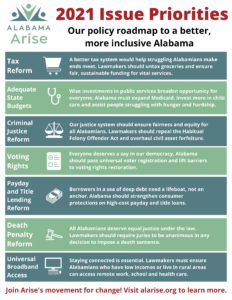
Flyer on Alabama Arise's 2021 issue priorities. For more information, visit https://alabama-arise.web-site-preview.com/news-releases/alabama-arise-unveils-members-2021-roadmap-for-change.

We’ll also keep working for better state policies when the Legislature returns in February. Our top focus will be Medicaid expansion, which we’ll pursue along with partners in the Cover Alabama Coalition. Expansion would cover more than 340,000 Alabamians with low incomes and ease the financial strain on rural hospitals. It also would attack structural health care disparities that led COVID-19 to take a disproportionate toll on Black Alabamians.

Arise’s work won’t stop there. We’ll support legislation to expand voting rights and ensure broadband internet access for all Alabamians. We’ll seek to increase consumer protections and overhaul the state’s criminal justice system. And we’ll fight to untax groceries once and for all.

Breakthroughs on many of these issues won’t be fast or easy. But together, we’ll emerge from dark times into the light of a brighter, more inclusive future for Alabama.

Get covered: 2021 ACA open enrollment ends Dec. 15, 2020

The deadline to #GetCovered is just weeks away! Open enrollment for 2021 Marketplace health coverage under the Affordable Care Act ends Tuesday, Dec. 15, 2020. Don’t miss your chance to make sure you’re covered in case of accident or illness.

Visit healthcare.gov or call 800-318-2596 to explore your coverage options. And be sure to spread the word about this opportunity to your friends and family, too.

Welcome! HealthCare.gov is open. Sign up for affordable health coverage from Nov. 1 to Dec. 15.

Our friends at the Center on Budget and Policy Priorities share why you should visit healthcare.gov during open enrollment. This resource discusses how to compare plans, seek financial help and ensure your insurance meets your needs.

Even if you already have Marketplace coverage, we still recommend that you log in and double-check your options. Another plan may better meet your needs in the coming year.

We also want to share resources from our partner organizations Enroll Alabama and the Cover Alabama Coalition around health care accessibility and advocacy.

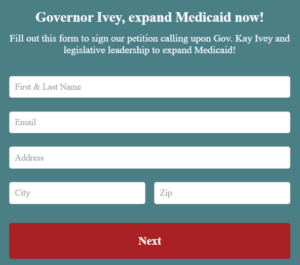
Screenshot of Cover Alabama petition

More than 220,000 Alabamians are caught in the state’s health coverage gap, earning too much to qualify for Medicaid and too little to afford private insurance. Right now, more than ever, affordable health care is a necessity. Please sign this petition to Gov. Kay Ivey on behalf of Cover Alabama.

Enroll Alabama logo

Enroll Alabama answers questions and offers services for open enrollment. For more information and free in-person assistance, call toll free at 844-248-7698 or email enrollalabama@gmail.com today.

Medicaid expansion would save Alabama mothers from preventable deaths, boost treatment resources for mental health and substance use disorders

Alabama Arise and Cover Alabama partner organization logos

Nearly 70% of Alabama’s pregnancy-related deaths in 2016 were preventable, according to a report this month from the state Department of Public Health and Maternal Mortality Review Committee. The committee recommended that Alabama improve maternal health by expanding Medicaid coverage and increasing resources and services for women with mental health and substance use disorders. The report also recommended improving Medicaid reimbursement for providers and encouraging broader education of mothers and families regarding the various health issues identified as maternal death risk factors and their warning signs.

Partner organizations in the Cover Alabama Coalition released the following statements Thursday in response:

Jane Adams, Campaign Director, Alabama Arise:

“Thirty-six Alabama mothers died in 2016 from causes linked to their pregnancies. Their children will go to bed tonight – and every night – without their birth mother there to tuck them in. And for 70% of these kids, their mother’s death was preventable. This report is a haunting reminder that poverty and access to health insurance are significant drivers of maternal mortality in Alabama. We encourage Gov. Kay Ivey, Commissioner Stephanie Azar and our legislators to save lives and protect families by expanding Medicaid to cover mothers before, during and after pregnancy.”

Jada Shaffer, Government Relations Regional Director, American Heart Association:

“We urge the Legislature and Governor Ivey to immediately implement the reforms the Maternal Mortality Review Committee recommends. In 2016, cardiovascular-related conditions were the leading underlying cause of pregnancy-related deaths in Alabama. When women lack health insurance, they are less likely to get treatment for preexisting conditions and are much more likely to die during or after pregnancy. Improving maternal health outcomes will require expanding Medicaid and equitably providing access to care for all Alabama families.”

Dr. John S. Meigs, President, Medical Association of the State of Alabama:

“The Medical Association of the State of Alabama commends the Maternal Mortality Review Committee (MMRC) for its diligence in researching the factors that impact maternal deaths, in hopes to mitigate and prevent future maternal deaths. It is very concerning for physicians throughout the state that 70% of the deaths reviewed by the MMRC were preventable and that women of color are disproportionately affected. Alabama mothers deserve the best medical care that we can offer. To that end, the Medical Association supports the MMRC’s recommendation of expanding Medicaid coverage for women postpartum beyond where it is today, as well as informing our communities that mental health and substance abuse issues can contribute to maternal mortality. Physicians have a responsibility to help mothers get the medical care that they need and deserve.”

Dr. Nadia Richardson, Executive Director, No More Martyrs:

“In Alabama, Black women are dying at three to four times the rate of white women from pregnancy-related complications. In 2016, thirty-six mothers died because they did not have consistent access to care. We fail mothers when they are forced to drive two counties over to see their OB-GYN for a check-up because they live in one of 29 Alabama counties that have lost obstetrical services.

“Now is not the time to turn a blind eye to health disparities rooted in injustice and indifference. Now is not a time to ignore the impact that this continued neglect has on the mental, physical and holistic wellness of Black women in our state. Now is not the time to pretend that these inequities are not remnants of a history that we have yet to come to terms with – a history of racism and sexism that remains embedded throughout our health care system. Now is the time to demand more. Alabama leaders must accelerate progress on ending maternal mortality by investing in access to quality and affordable health care.”

Britta E. Cedergren, MPH, MPA, Associate Director, Postpartum Care, March of Dimes:

“The health of a society is measured by the health of its moms and babies. In Alabama, we are not only facing the crisis of one in eight babies being born too sick, too soon, but mothers dying from potentially preventable causes. In the inaugural report by the Alabama Maternal Mortality Review Committee, we found that two-thirds of women die between 43 and 365 days postpartum. When moms have access to high-quality, equitable and uninterrupted care, outcomes can improve. Fully expanding, or even extending Medicaid for a full year postpartum, while only one step in combating the crisis of moms dying from pregnancy related causes, is a big step that can improve the health and well-being of all Alabamians.

Rev. Carolyn Foster, Faith in Community Coordinator, Greater Birmingham Ministries:

“It is our moral responsibility to care for one another. ‘Do unto others as you would have them do unto you’ is a mandate in many of our faith traditions. It is the most basic command in our religious tradition. We cannot stand by or look the other way or cross on the other side when people suffer. To do so is to turn one’s back on God because ‘when you do it to the least of these, you do it to me.’ Access to health care would be life-giving to many who are vulnerable. We are our sister’s and brother’s keepers. And we must bear one another’s burdens. Dr. Martin Luther King Jr. said, ‘Our lives begin to end the day we become silent about things that matter.’ We strongly urge the Legislature and Gov. Kay Ivey to increase access to quality affordable health insurance by expanding Medicaid.”

Holly Caraway McCorkle, Executive Director, Alabama Council for Behavioral Healthcare:

“The Alabama Council for Behavioral Healthcare urges policymakers to act quickly to increase access to coverage by expanding Medicaid in Alabama. Sadly, the Alabama Maternal Mortality Review Committee found that mental health and substance use disorders were identified as key contributors in almost half of pregnancy-associated and pregnancy-related deaths. These deaths are preventable, and Medicaid expansion will offer women who suffer from mental health and substance use disorders life-saving coverage and access to critically needed resources and services before, during and after pregnancies.”

Kim Cochran, Vice President, External Affairs, The Women’s Fund of Greater Birmingham:

“A recent report by Alabama’s Maternal Mortality Review Committee revealed that the maternal mortality rate is rising in the United States. Alabama’s rate is the second highest in the nation and disproportionately affects Black women. Even more alarming, 70% of the maternal deaths in Alabama were deemed preventable. As identified by the Maternal Mortality Review Committee, Medicaid expansion could reduce Alabama’s maternal deaths and change the narrative for women. A region, state or county’s ability to keep women and children alive during and after childbirth speaks volumes about our economic, social and political fabric. I urge our lawmakers to stand up for women and expand Medicaid to help reduce our state’s maternal mortality rate and provide health care coverage for an additional 152,000 women.”


ACA lawsuit could end health coverage for 122,000 Alabamians

At least 122,000 Alabamians would lose health coverage if the U.S. Supreme Court strikes down the Affordable Care Act (ACA), according to a new analysis from the nonpartisan Urban Institute. The state’s uninsured rate would increase by 25% as a result.

That number also doesn’t include hundreds of thousands of uninsured or underinsured adults with low incomes who would gain coverage if Alabama expands Medicaid. If the lawsuit succeeds, the ACA’s 9-to-1 federal funding match for Medicaid expansion would disappear.

“Repealing the ACA would throw our health care system into chaos in the middle of a pandemic and a deep recession,” Alabama Arise executive director Robyn Hyden said. “Tens of thousands of Alabamians would lose health coverage when they need it most. And hundreds of thousands would pay more for coverage or lose protections for their preexisting conditions.”

The White House and 18 states, including Alabama, are asking the Supreme Court to strike down the entire ACA. Oral arguments before the Supreme Court are scheduled for Nov. 10.

More than 21 million Americans would lose coverage in 2022 if the ACA falls, according to the Urban Institute. Coverage losses could be even larger next year, as the COVID-19 pandemic and recession likely still will be ongoing.

“The ACA has been a health lifeline for many Alabamians during the pandemic,” Hyden said. “It provides coverage options for people who have lost their jobs or seen sharp reductions in their income. And it ensures people aren’t denied insurance just because they got sick.”

Ending the ACA would undermine racial equity, harm people with preexisting conditions

The ACA made important progress in reducing racial disparities in health care that often stem from structural racism. But large coverage losses from ending the ACA would reverse many of those gains, the Urban Institute finds. Overturning the ACA would strip health coverage from nearly one in 10 Black and Latino Americans under age 65. More than one in 10 Native Americans nationwide would become uninsured.

Ending the ACA also would eliminate protections for people with preexisting conditions. This would allow insurers to charge higher rates to people with conditions like asthma, cancer, diabetes or COVID-19. Insurance companies also could refuse to offer them coverage at any price. One in three Alabamians under age 65 have a preexisting condition that would have been “declinable” before the ACA.

ACA repeal would harm people who have health insurance through their jobs, too. Their plans could reintroduce annual and lifetime coverage limits. Requirements for plans to cover essential benefits and provide free preventive services would disappear. So would the requirement for insurers to allow young adults to be covered through their parents’ plans.

Striking down the ACA would be a tax windfall for wealthy people, large corporations

Wealthy people and some large corporations would be among the few winners if the lawsuit succeeds. They would get billions of dollars in tax cuts, the nonpartisan Center on Budget and Policy Priorities finds:

  • The highest-income 0.1% of households would receive tax cuts averaging about $198,000 per year. This group has annual incomes of more than $3 million. A portion of these tax cuts would come at the expense of the Medicare Trust Fund, which would lose about $10 billion in revenue each year.
  • Pharmaceutical companies would pay $2.8 billion less in taxes each year. Meanwhile, millions of seniors could pay billions of dollars more for prescription drugs annually. That’s because eliminating the ACA could reopen the “donut hole” gap in Medicare’s prescription drug benefit.

“The ACA has left Alabama better equipped to fight COVID-19 and rebuild our economy after the recession,” Hyden said. “And those benefits would be even greater if Alabama would adopt Medicaid expansion.

“Striking down the ACA would harm the Alabamians who have suffered the most during the pandemic and the recession. It would deprive our state of the opportunity to save lives and strengthen our health care system by expanding Medicaid. And it would shower huge tax cuts on rich people while making life harder for everyone else. Alabama officials should stop seeking to undermine the ACA and start investing in a healthier future for our entire state.”

Alabama Arise unveils members’ 2021 roadmap for change

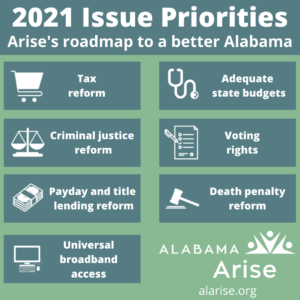
Sentencing reform and universal broadband access are two new goals on Alabama Arise’s 2021 legislative agenda. Members voted for Arise’s issue priorities this week after nearly 300 people attended the organization’s online annual meeting Saturday. The seven issues chosen were:

  • Tax reform, including untaxing groceries and ending the state’s upside-down deduction for federal income taxes, which overwhelmingly benefits rich households.
  • Adequate budgets for human services like education, health care and child care, including Medicaid expansion and extension of pre-K to serve all eligible Alabama children.
  • Criminal justice reform, including repeal of the Habitual Felony Offender Act and changes to civil asset forfeiture policies.
  • Voting rights, including automatic universal voter registration and removal of barriers to voting rights restoration for disenfranchised Alabamians.
  • Payday and title lending reform to protect consumers from getting trapped in debt.
  • Death penalty reform, including a law to require juries to be unanimous in any decision to impose a death sentence.
  • Universal broadband access to help Alabamians who have low incomes or live in rural areas stay connected to work, school and health care.

“Arise believes in dignity, equity and justice for all Alabamians,” Alabama Arise executive director Robyn Hyden said. “And our 2021 issue priorities would break down many of the policy barriers that keep people in poverty. We can and will build a more inclusive future for our state.”

Graphic naming Alabama Arise's 2021 issue priorities

The urgent need for criminal justice reform

Alabama’s criminal justice system is broken and in desperate need of repair. The state’s prisons are violent and dangerously overcrowded. Exorbitant court fines and fees impose heavy burdens on thousands of families every year, taking a disproportionate toll on communities of color and families who are already struggling to make ends meet. And Alabama’s civil asset forfeiture policies let law enforcement seize people’s property even if they aren’t charged with a crime.

Arise will continue to seek needed reforms in those areas in the coming year. The organization also will work for repeal of the Habitual Felony Offender Act (HFOA), the state’s “three-strikes” law. The HFOA is an unjust driver of sentencing disparities and prison overcrowding in Alabama. The law lengthens sentences for a felony conviction after a prior felony conviction, even when the prior offense was nonviolent. Hundreds of people in Alabama are serving life sentences for non-homicide crimes because of the HFOA. Thousands more have had their sentences increased as a result. Repealing the law would reduce prison overcrowding and end some of Alabama’s most abusive sentencing practices.

Universal broadband access would help struggling Alabamians stay connected

The COVID-19 pandemic has illustrated the essential role that the internet plays in modern life. Remote work, education, health care and shopping are a reality for millions in our state today. But far too many Alabamians, especially in rural areas, can’t access the high-speed broadband that these services require. These access challenges also reveal a racial disparity: About 10% each of Black and Latino households have no internet subscription, compared to 6% of white households.

Policy solutions can facilitate the investments needed to ensure all Alabamians can stay connected. Lawmakers can help by guaranteeing that all communities have the right to own, operate or deploy their own broadband services. The Legislature also can enact targeted and transparent tax credits to promote broadband for underserved populations.

Pandemic EBT renewal a good first step, but families still need comprehensive COVID-19 relief

The U.S. Senate this week approved a continuing resolution that extended Pandemic EBT (P-EBT) benefits through September 2021. The resolution was enacted Thursday. Alabama Arise policy analyst Carol Gundlach issued the following statement Friday in response:

“The extension of Pandemic EBT through September 2021 is welcome news for families struggling to make ends meet. P-EBT has been a powerful, flexible tool to fight child hunger during an era of remote learning. The program has helped feed more than 400,000 Alabama children while school buildings are fully or partially closed. Its renewal will help tens of millions of American families keep food on the table.

“P-EBT’s renewal was an important step to help struggling parents afford food during a deep recession and high unemployment. But families still need and deserve a comprehensive relief bill that truly meets the size and scope of suffering that the COVID-19 pandemic has inflicted across Alabama and across our country.

“An adequate relief package would provide enough federal relief to help states avoid cuts to vital services like education and Medicaid. It would renew the $600 weekly federal increase to unemployment insurance benefits. And it would boost nutrition and housing assistance to help millions who are at risk of hunger and homelessness. The House passed legislation that would do those things months ago, and the Senate should do the same.

“The pandemic won’t go away anytime soon. Struggling families need a relief bill that takes meaningful, long-term action to address this health crisis and ease financial suffering. Senators should pass such a bill quickly, and their constituents should accept nothing less.”

Town Hall Tuesdays 2020: What we heard from Arise supporters

Listening is often an underdeveloped skill, yet it is critical for mutual understanding and working together for meaningful change. That’s why Arise is committed to listening to our members, to our allies and most importantly, to those directly affected by the work we do together. We depend on what we hear from you to guide our issue work and our strategies.

This year’s COVID-19 pandemic challenged us to be creative in finding ways to listen. Instead of our usual face-to-face meetings around the state, we hosted a series of six statewide online Town Hall Tuesdays. We held events every two weeks, starting in June and ending Sept. 1. We averaged 65 attendees at each session. Here’s some of what we heard from members and supporters:

  • Affirmation for Medicaid expansion, untaxing groceries and other current Arise issues as important for achieving shared prosperity.
  • Empathy for those who were already living in vulnerable circumstances further strained by the pandemic.
  • Concern about ongoing, intentional barriers to voting, especially during the pandemic.
  • Desire to see more resources to meet the needs of our immigrant neighbors.
  • Alarm about payday and title lending and its impact on people’s lives and our communities.
  • Passion and concern about many other issues, including housing; living wages and pay equity; prison and sentencing reform; gun safety; juvenile justice reform; defunding the police; the Census; environmental justice; quality and funding of public education; and food insecurity and nutrition.
  • Willingness to take informed actions to make a difference in the policies that impact people’s lives.
  • Hope that Alabama can be a better place for all our neighbors to live despite systemic issues and ongoing challenges.

Notes from each town hall

Overviews of the town halls are below. Click the title for a PDF of the notes from the breakout sessions at each town hall.

June 23 – Money talks
We examined how to strengthen education, health care, child care and other services that help Alabamians make ends meet. And we explored ways to fund those services more equitably.

July 7 – Justice for all
We discussed Alabama’s unjust criminal justice system and how to fix it.

July 21 – Getting civic
Discussion focused on protecting voting rights and boosting Census responses during a pandemic.

Aug. 4 – Shared prosperity
We looked at policy solutions to boost opportunity and protect families from economic exploitation.

Aug. 18 – Feeding our families
We explored ways to increase household food security during and after the recession.

Sept. 1 – Closing the coverage gap
Discussion focused on how everyone can help expand Medicaid to ensure coverage for hundreds of thousands of struggling Alabamians. We also heard about the expansion campaign strategies of the Cover Alabama Coalition, headed by Arise campaign director Jane Adams.

Get in touch and stay in touch with Arise

Remember, we didn’t stop listening because the town halls ended. We want to hear from you, and we encourage you to contact the Arise organizer in your area:

We hope to see you at Arise’s online annual meeting Oct. 3!

U.S. Senate still needs to do its job and pass meaningful COVID-19 relief

The U.S. Senate on Thursday failed to advance an inadequate COVID-19 relief plan. Alabama Arise executive director Robyn Hyden issued the following statement Thursday in response:

“The bill that failed in the Senate this week was wholly inadequate to meet the size and scope of suffering that the COVID-19 pandemic has inflicted across Alabama and across our country. Lawmakers shouldn’t leave Washington without approving an adequate, long-term deal to help struggling Americans make ends meet.

“This plan offered nowhere near enough federal relief to help states avoid cuts to vital services like education and Medicaid. It would have cut the previous $600 weekly federal increase to unemployment insurance benefits in half, even though jobs remain hard to find. And it included no nutrition or housing assistance to help millions who are at risk of hunger and homelessness.

“Congress needs to step up and do its job by protecting people from harm. Last month’s executive actions were nothing more than a Band-Aid over a gaping economic wound. And any so-called relief bill that doesn’t help people keep food on the table and a roof over their heads is no relief bill at all.

“The pandemic isn’t going away anytime soon. Struggling families need a relief bill that takes meaningful, long-term action to address this health crisis and ease financial suffering. Senators should pass such a bill quickly, and their constituents should accept nothing less.”

Groups urge Dismukes’ resignation, ask Legislature to dismantle white supremacy through policy change

Alabama Arise logo     Alabama NAACP logo    Greater Birmingham Ministries logo

The following is a joint statement from Alabama Arise, the Alabama State Conference of the NAACP and Greater Birmingham Ministries:

Our elected officials and appointed leaders should respect the full dignity, worth and humanity of all people they represent. We urge all political parties and public officials to acknowledge the harm that white supremacy continues to inflict upon Alabama. And we call upon them to dismantle white supremacist structures through intentional policy changes.

The cause of white supremacy permeates our state’s fundamental governing document. When the president of the 1901 constitutional convention, John Knox, was asked why Alabama needed a new constitution, his answer was clear: “to establish white supremacy in this state.”

Any celebration of Nathan Bedford Forrest of the Ku Klux Klan – a white supremacist terrorist organization – is contrary to the values that Alabamians expect from our leaders, elected officials and neighbors. In celebrating Forrest, Rep. Will Dismukes revealed he is unable or unwilling to represent the best interests of his constituents and his state. We condemn his actions in the strongest possible terms. We also understand this is not the first time Dismukes has celebrated the Confederacy or Forrest in such a manner. Therefore, we join with many other individuals and organizations across Alabama in calling for Dismukes to resign immediately.

Racial equity requires action, not just words

Alabama’s need for racial justice and healing reaches far beyond any one individual. All elected officials must take a hard look at both their actions and the impacts of their policy decisions. Most lawmakers claim to support racial equality, but the results of their policy choices often do not match this claim.

Examples of this mismatch are unfortunately common in our state. The 2017 Memorial Preservation Act prevents localities from removing statues that “honor” the Confederacy without paying a steep fine or getting approval from a panel of legislators that to our knowledge has not approved a removal since the law was enacted. Lawmakers’ failure to expand Medicaid leaves a disproportionate share of African Americans without health insurance during a pandemic. And the absence of racial impact data prevents communities and legislators from evaluating the full effects of state policy choices.

The harsh reality of racial disparities in Alabama

While Dismukes dismisses the need for racial reconciliation in today’s society, we cannot remain ignorant of the truth. We all must reckon with these disparities created and maintained by structural policy barriers:

It’s time for more than talk. Denouncing and rejecting white supremacy is only the beginning. Lawmakers also must enact meaningful policy changes to break down institutional barriers to opportunity and justice for all Alabamians.

New Senate COVID-19 relief plan falls short of meeting Alabamians’ needs

U.S. Senate Republicans on Monday unveiled a new proposed COVID-19 relief plan. Alabama Arise executive director Robyn Hyden issued the following statement Tuesday in response:

“Millions of Alabamians are being pushed to the brink during the COVID-19 crisis. They’re struggling with difficult tradeoffs between protecting their own health, paying for basic necessities and caring for children and seniors. Nearly one in four renters in Alabama are behind on rent. And one in five adults with children in our state say their kids sometimes don’t have enough to eat because the household just can’t afford enough food.

“As families face these health and economic shocks, the Senate relief proposal fails to meet the demands of the moment. This plan would slash supplemental unemployment insurance benefits amid the highest unemployment since the Great Depression. It wouldn’t increase housing assistance to prevent families from being evicted and becoming homeless. It wouldn’t increase SNAP benefits to address the critical hunger concerns facing families of schoolchildren. And it wouldn’t provide Alabama and other states with the money needed to invest in child care, avoid teacher layoffs and prevent cuts to Medicaid and other vital services as budget shortfalls grow.

“This plan is inadequate by any measure. We urge our senators to reject it and look instead toward the approach taken in the House-passed HEROES Act. The House plan would boost Medicaid funding and offer more support for essential workers and people who lost their jobs. And it would provide federal assistance so states can avoid devastating service cuts that would hurt tens of millions of people.”

What a meaningful COVID-19 relief plan should look like

Alabama Arise urges Congress to negotiate a COVID-19 relief package that does the following:

  • Boosts Supplemental Nutrition Assistance Program (SNAP) benefits so struggling families can keep food on the table.
  • Increases housing assistance to help people pay their rent and mortgages and to avert a surge in homelessness.
  • Preserves the weekly $600 federal increase to unemployment insurance benefits.
  • Provides additional federal funding for states to avert harmful layoffs and invest in vital services like Medicaid and child care.
  • Removes administrative barriers to alternative school meal distribution procedures for districts that are holding classes online.
  • Allocates federal funding to help election officials process more absentee ballots and maintain proper social distancing at polling places.
  • Makes the Child Tax Credit temporarily available to children in families with the lowest incomes and expands the Earned Income Tax Credit (EITC) for low-paid workers who are not raising children in their homes.