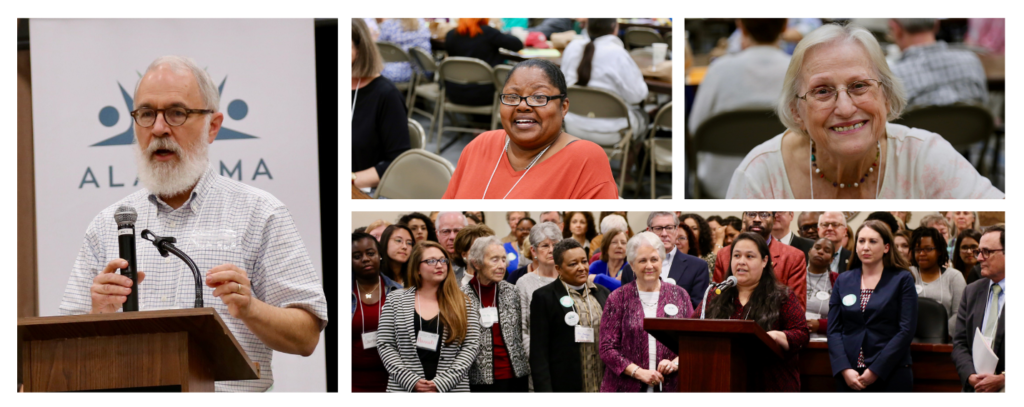
Medicaid expansion would increase access to life-saving health care while also advancing racial and gender equity in Alabama, according to a new report by the Georgetown University Center for Children and Families (CCF). Expansion also would ensure coverage for tens of thousands of essential workers in industries like health care, retail and construction.
“Everyone in Alabama has relied on these essential workers in some way during the COVID-19 pandemic,” Alabama Arise policy director Jim Carnes said. “Now it’s our turn to help them get reliable, affordable health insurance so they can continue to do their jobs and care for their families. It’s time for Alabama to accept generous federal funding to expand Medicaid to our state’s uninsured workers.”
Alabama is one of 12 states that have not yet expanded Medicaid to cover adults with low incomes. This inaction has denied hundreds of thousands of Alabamians access to quality, affordable health care.
Approximately 204,100 uninsured adults – 49% of Alabama’s uninsured adult population – would gain coverage if Alabama expands Medicaid, Georgetown CCF estimates. That estimate is in line with prior projections that Medicaid expansion would benefit more than 340,000 Alabamians who are uninsured or struggling to afford coverage.
These residents earn too much to qualify for Medicaid under the state’s stringent income limit but too little to qualify for subsidized marketplace plans under the Affordable Care Act. As a result, they are stranded in a health coverage gap.
Expanding Medicaid would save lives, advance racial and gender equity
Women and Black people account for a disproportionate share of low-wage uninsured working Alabamians, the Georgetown CCF report finds. Black people represent about 27% of Alabama’s overall population but 39% of the state’s low-wage uninsured workers. Women also are overrepresented in this category, making up 55% of low-wage uninsured Alabamians.
These uninsured residents work in vital but low-paid jobs. More than one-third of Alabamians working without health insurance (35.2%) are in the hospitality or retail industries, the report finds. Another one in five work in construction or in health care and social assistance.
Alabama’s uninsured rate for working people (12.1%) exceeds the national average. In 11 counties, more than 15% of working people are uninsured, Georgetown CCF finds. The highest rates are in DeKalb County (19.2%) and Dale County (18.2%).
The map below shows the range of uninsured rates for working adults across Alabama. Hover over the map to see the rate in your county.
Nearly seven in 10 Alabamians support expanding Medicaid to reduce these disparities, a statewide poll found in February. And the American Rescue Plan Act offers federal incentives that would more than offset Alabama’s initial cost to expand Medicaid.
If Gov. Kay Ivey agrees to expansion, the law would give the state a 5-percentage-point increase in federal funding for its traditional Medicaid coverage for two years. That would bring Alabama an additional $732 million over two years, based on an average of federal, state and independent estimates.

 A big change on the health care front this year is the prominent role of Medicaid expansion in legislative discussions, both on and off the chamber floors. Gov. Kay Ivey can propose expansion through administrative steps, but lawmakers still control the purse strings. So legislative advocacy is essential!
 Several criminal justice improvements have moved forward this year. These include partial reform of sentencing under the Habitual Felony Offender Act (HFOA) and expanded alternatives to imprisonment. Bigger reforms like HFOA repeal and abolition of driver’s license suspension have been slowed due to opposition, though. That inaction has persisted even in the face of a U.S. Department of Justice lawsuit over unconstitutional prison conditions.
 Efforts to protect and expand voting rights continue to face an uphill battle. Bills prohibiting curbside voting have advanced, despite the practice’s success in Mississippi and other states. Meanwhile, a bill allowing no-cause absentee voting stalled, as did measures on early voting and same-day voter registration. Legislation improving voting rights restoration did advance, but only after removal of a provision that would have ended a de facto poll tax: the requirement for people with convictions to pay all fines and fees before regaining voting rights.
 I am thrilled to report that Alabama is closer to expanding Medicaid today than we’ve ever been before! Thanks to your strong advocacy, our leaders are beginning to see