Alabama is on its way to reducing maternal mortality and improving health for families across the state ‒ but we can’t stop here.
Lawmakers and Gov. Kay Ivey last month enacted a budget that extends postpartum Medicaid coverage to a full year after childbirth. That is up from the previous cutoff of only 60 days after birth. Alabama Arise and other members of the Cover Alabama Coalition will continue to work with the governor’s administration and legislators to ensure this program is sustainable and permanent.
Alabama has the nation’s third-worst maternal death rate. Each year, nearly 40 new mothers in the state die within one year after delivery. The toll on Black mothers is nearly three times that of white moms.
Research shows that outcomes improve when moms have access to high-quality, equitable and uninterrupted care. Extending the Medicaid postpartum coverage period is a big step to save lives and improve the health and well-being of families, communities and the entire state.
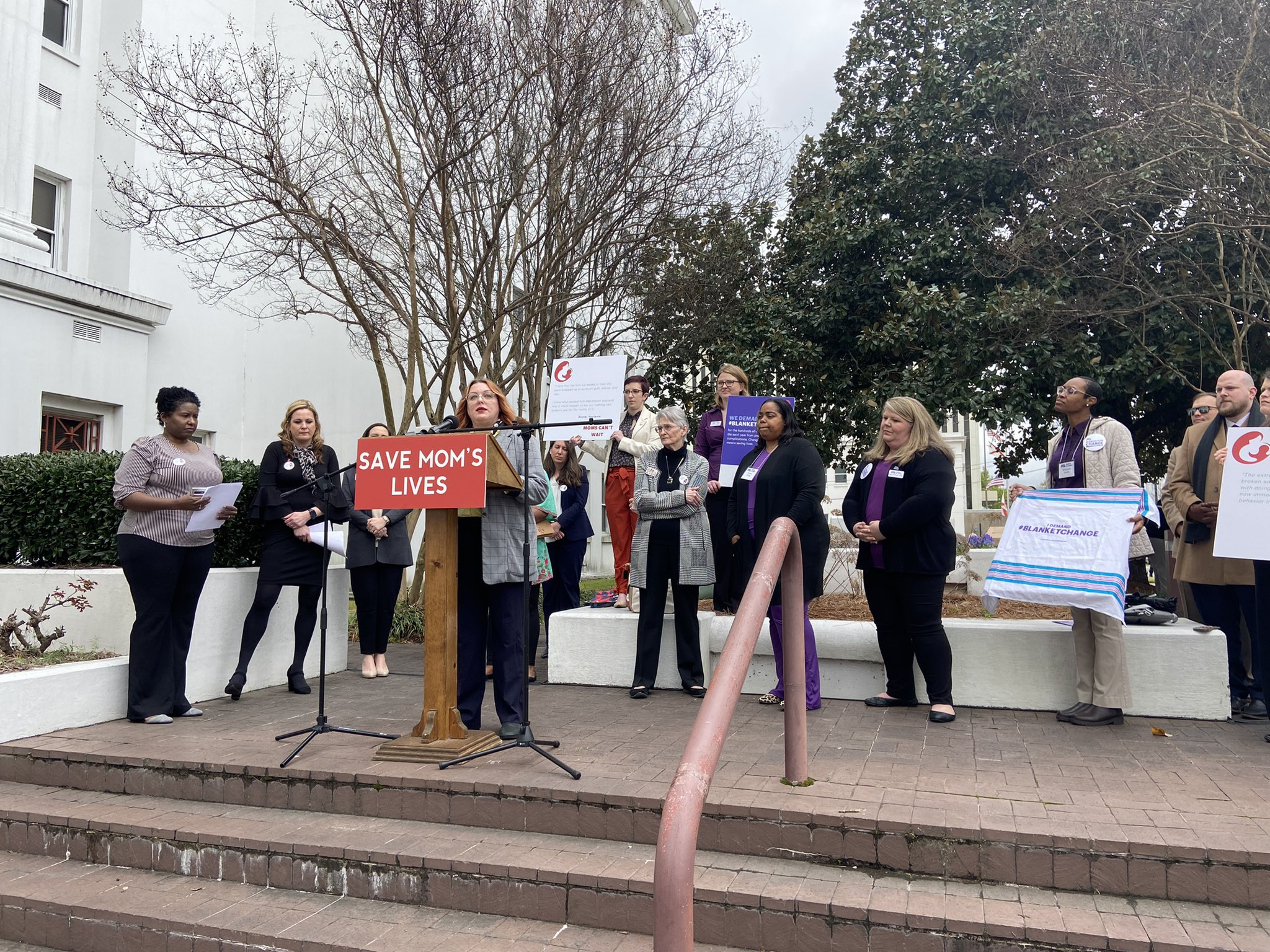
Arise story collection coordinator Whit Sides speaks at a March 9 rally in Montgomery to support extending postpartum Medicaid coverage. Arise joined the American Heart Association and other Cover Alabama partners at the event.
The work that remains
This is an exciting win, but we know that one year of coverage is, ultimately, not enough. And we know the solution: The most effective way to reduce maternal deaths is to make sure people giving birth have access to care before, during and after pregnancy. We need full Medicaid expansion, and we won’t stop until we get it.
Medicaid restrictions are not affecting only new parents. More than 220,000 Alabamians are caught in our health coverage gap, earning too much to qualify for Medicaid and too little to afford private insurance. And another 120,000 are stretching to pay for coverage they cannot afford. Expanding Medicaid would give these Alabamians the health care that they need to survive and deserve to thrive.
Postpartum Medicaid extension will be only the first of many wins toward creating a more equitable state health care system. It’s been a long fight, but I know we can do this.
On Mother’s Day in 2014, I found out I was pregnant. For me, the existential dread set in just as deeply as the morning sickness.
Motherhood and its crushing weight had been drilled into me my entire life. I told myself it was too hard, that I just wasn’t strong enough to handle parenthood and all its pressures. And I feared that my family’s legacy would repeat itself.
Maude Wakefield, pictured with her husband, William (Andy) Ingle of Nauvoo, Ala. Maude is holding one of their 72 grandchildren. (Photo courtesy of Whit Sides)
One summer day in 1932, while pregnant with her 14th child, my great-grandmother Maude Wakefield finally reached her breaking point. She set off behind her home in Winston County and climbed high into a tree on my family’s land. She had been pregnant regularly since 1906 and decided enough was enough.
So she offered an ultimatum: She would return to her infinite load of daily household duties only if my great-grandfather would promise that this was it – no more babies. Not long after what would become her infamous last stand, she passed away due to a stroke worsened by postpartum hypertension. My grandmother was left to live without her mother at age 12.
Nearly a century later, during a routine blood pressure check, I was deemed high risk for the same life-threatening condition that killed my great-grandmother.
I didn’t want that same lonely future for my daughter.
The life-saving power of health coverage
Fortunately, I had health insurance. My blood pressure continued to rise to dangerous levels as my pregnancy progressed. After reviewing my family history, my doctor decided it was best for both me and the baby to deliver early under supervision to prevent preeclampsia, a condition that can lead to maternal death during or after delivery.
Because I had access to care, I was easily treated, and it ended up saving my life. Now, when I take my blood pressure pill every morning, I can’t help but think how things could have been different for my great-grandmother.
Hope can be hard to come by in Alabama. Stories like mine remind us how far we’ve come. But when you’re left without coverage, it’s never as simple as a pill and a copay.
Medicaid covers about half of all births in Alabama. And for many new moms, health coverage expires shortly after the baby is born.
Medicaid postpartum coverage extension is a step in the right direction
Some good news could be coming as soon as this fall. On April 7, Gov. Kay Ivey signed a new General Fund budget into law. It includes an extension of postpartum Medicaid coverage from 60 days of coverage to 12 months. This life-saving change will provide thousands of families consistency in care during the critical time after childbirth.
In Alabama, children living in households with low or middle incomes are widely eligible for coverage through Medicaid or ALL Kids, Alabama’s Children’s Health Insurance Program (CHIP). For adults, it is much harder to qualify for Medicaid. Just 17% of Medicaid participants in Alabama are adults under age 65 who do not have a disability.
Our state has some of the most stringent income limitations for Medicaid. For example, a single parent of two without a disability is ineligible if they make more than $346 a month. These harsh Medicaid eligibility limits mean affordable health insurance is simply not an option for many people in our state.
Medicaid expansion would ensure coverage for more than 340,000 Alabamians, including those left uninsured by these tight limits. These folks do not qualify for Medicaid, but they are unable to afford a marketplace plan or other private coverage. However, the new postpartum coverage extension means there will now be a brief inclusive window during and after pregnancy.
A lifeline in a time of need
Moms like my friend Brittany Kendrick of Blountsville call this coverage a lifeline.
Brittany lost her fiance, Dylan, in a car accident two months before her daughter Khaleesi was born. They had everything planned out, but her health insurance expired after Dylan’s death. Brittany turned to Medicaid to cover the costs.
Blountsville resident Brittany Kendrick holds her daughter Khaleesi. Medicaid was a lifeline for Brittany after her fiance, Dylan, died shortly before Khaleesi’s birth. (Photo courtesy of Brittany Kendrick)
Then, in August 2021, she made the hour-long drive to Children’s Hospital in Birmingham, where she found out her newborn had contracted COVID-19. After getting emergency care, her baby made a recovery. But as soon as they got home, Brittany tested positive and started to feel worse.
Being able to see a doctor and seek treatment quickly was just the blessing they needed during what Brittany calls the hardest year of her life.
“Medicaid paid for all of our hospital and doctor bills,” Brittany said. “It gave me a chance to use the money I had in savings for a safer car and a new apartment for me and the baby.”
Brittany hopes she will be among those eligible for the new postpartum extension. Having consistent care has brought balance to her life in more ways than one. “I can take medicine for anxiety and depression now. I need that, to stay strong for her,” she said.
Khaleesi Rider in April 2022. (Photo courtesy of Brittany Kendrick)
‘Why not offer this to all mothers?’
Extending Medicaid coverage doesn’t just support new or single parents.
Sarita Edwards of Madison is a mother of five and founder of the E.WE Foundation, a health care advocacy organization. She began her foundation after receiving a rare prenatal diagnosis of Edwards’ Syndrome (trisomy 18) for her son Elijah. The high mortality rate associated with her son’s diagnosis meant her family racked up thousands in medical debt before baby Elijah was even born.
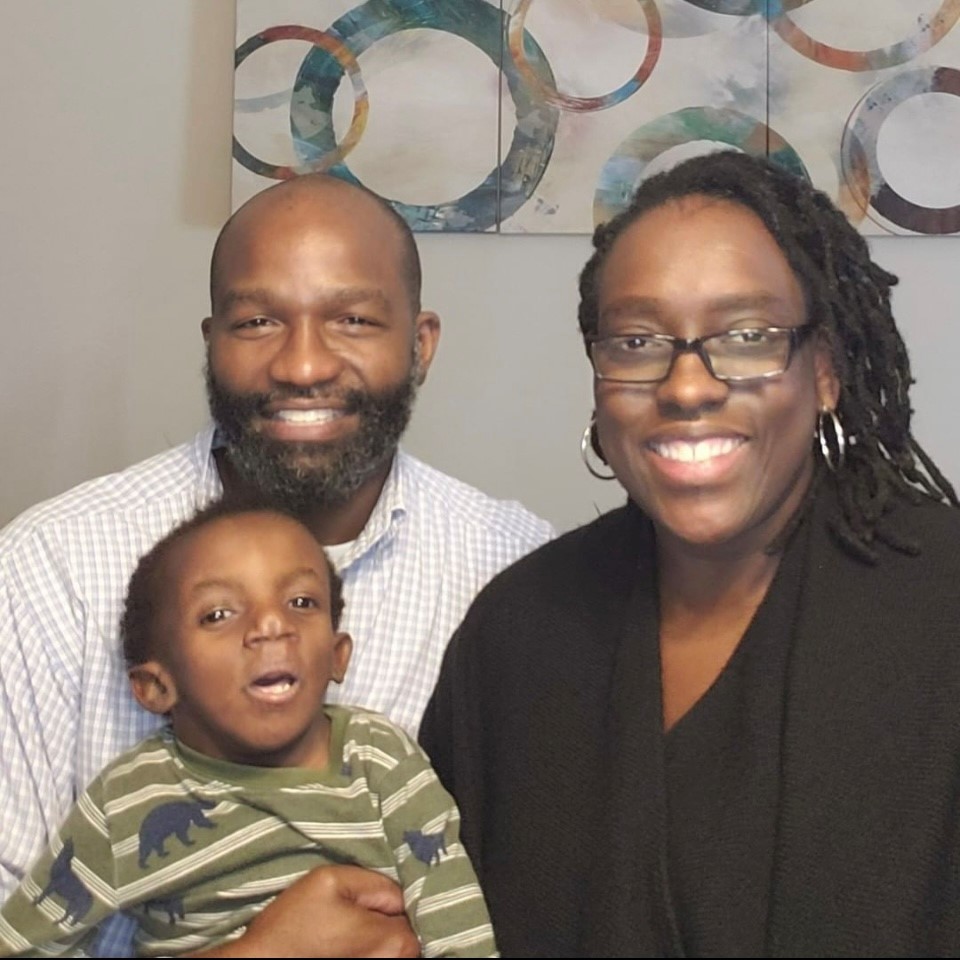
Madison residents Kareem and Sarita Edwards hold their son Elijah. Sarita founded the E.WE Foundation after her son received a rare prenatal diagnosis. (Photo courtesy of Sarita Edwards)
Sarita says every day with Elijah has been a juggling act. Elijah’s condition is terminal, and his care can be exhausting and expensive. She now spends her time advocating for more equitable treatment and access in health care. She knows our leaders can do more, because she’s seen it firsthand.
“I know what our state can do when offering care to mothers and children with rare diseases,” Sarita said. “Why not offer this to all mothers?”
Elijah Edwards, age 5. (Photos courtesy of Sarita Edwards)
The new General Fund budget includes more than $8 million to extend Medicaid coverage for 12 months after childbirth. But the funding is guaranteed only for one year – on a trial basis.
This year marked another Mother’s Day when Alabama mothers are still dying from pregnancy and childbirth at twice the national rate. Reliable health coverage – and the access to care that comes with it – can prevent many of those deaths. Sarita sees no reason to hold off on making Medicaid’s postpartum coverage extension permanent.
“Our babies are taken care of, but what about the mothers?” Sarita asked. “I don’t know why it takes Alabama so long to do the right thing sometimes.”
About Alabama Arise and Cover Alabama
Whit Sides is the story collection coordinator for Alabama Arise, a statewide, member-led organization advancing public policies to improve the lives of Alabamians who are marginalized by poverty. Arise’s membership includes faith-based, community, nonprofit and civic groups, grassroots leaders and individuals from across Alabama. Email: whit@alarise.org.
Arise is a founding member of the Cover Alabama Coalition. Cover Alabama is a nonpartisan alliance of more than 115 advocacy groups, businesses, community organizations, consumer groups, health care providers and religious congregations advocating for Alabama to provide quality, affordable health coverage to its residents and implement a sustainable health care system.
Arise’s Celida Soto Garcia explains how the Community Eligibility Provision (CEP) helps more than 450 high-poverty schools across Alabama offer breakfast and lunch to students at no charge. Now is the time to contact school superintendents and urge them to opt into CEP if their districts are eligible to participate.
A full transcript can be found below the video.
Hi. My name is Celida Soto Garcia, hunger policy advocate with Alabama Arise. Today I hope to share a few steps to make sure that children and families have ample food nutrition options this summer and during the upcoming school year.
I would also like to encourage parents and school administrators to join me in promoting the Community Eligibility Provision as dependable food and nutrition source during really uncertain times.
Community Eligibility Provision, or CEP for short, is a federal program that allows more than 450 high-poverty schools across Alabama to offer breakfast and lunch at no charge to all students. CEP reduces paperwork for schools so they can focus on providing healthy meals to help students learn and thrive.
CEP increases school meal participation by removing stigmas that are typically associated with having to pay for lunch and possibly not having the funds to do so that day. It maximizes federal reimbursement to schools with the highest rates of attending students living in low-income households.
CEP eliminates unpaid school meal fees and makes it easier to implement innovative service models such as breakfast in the classroom or some hearty snacks throughout the day.
Most notably, CEP saved the day in the early stages of the pandemic. When not participating, schools have to grapple with determining eligibility criteria before serving meals to families in need throughout the pandemic. Schools that had opted into CEP were best prepared to consistently meet food and nutrition needs. When so much more was uncertain for CEP schools, addressing hunger was a no-brainer, and school meals were made available to every child in need.
The pandemic taught us many lessons. Most notably, we learned that reliable sources of food and nutrition are vital to extending a sense of support and stability to communities. Temporary school meal waivers such as Seamless Summer Option, or SSO for short, and Summer Food Service Program, or SFP for short, strengthen the safety net during uncertain times. But these programs are ending soon. CEP offers a more dependable and enduring system for serving school meals to all children at no cost to families.
Also, students attending schools that opted into CEP were automatically eligible to receive Pandemic EBT. CEP facilitated feeding families during trying times, and it continues to be the most dependable support for ensuring all children receive the nutrition they need to survive and to thrive.
Now is the time to contact your local school superintendents and urge them to opt into the Community Eligibility Provision to secure a reliable source of food and nutrition for Alabama’s children.
Lastly, an urgent message to parents. Ending school meal waivers means that the parents and caregivers should ask your school administrator if your students school is adopting CEP in 2022-2023. If not, you will need to complete a school meal application for free or reduced-price meals as soon as possible. Thank you.
Feel free to submit any questions to info@HungerFreeAlabama.org or call 334-832-9060.
Listening is key to shaping and advancing public policies that matter most to those marginalized by bad policies. Alabama Arise depends on what we hear to help guide our work toward our vision of a better Alabama for all.
Our online Town Hall Tuesdays will return once again this year. These events are a chance to hear issue updates and share your vision for our 2023 priorities.
Please join us this summer to help identify emerging issues and inform our actions. Registration is required for any or all of the sessions. You can register at the link in each session below.
July 12th, 6 p.m. – Making the vision a reality: Food & health
Everyone should have access to food and the health care they need to live a long and healthy life. Join this session to discuss issue and advocacy opportunities in areas of access to food and health care. Click here to register for this session.
July 26th, 6 p.m. – Making the vision a reality: Democracy & justice
We envision a state where all government leaders are responsive, inclusive and justice-serving. Voting rights barriers and an unjust justice system have hindered our vision. But together, we can move forward. Join us to discuss how to improve voting access and advance criminal justice reforms. Click here to register for this session.
August 9th, 6 p.m. – Making the vision a reality: The path forward
Arise’s vision for Alabama can be realized because of our commitment and perseverance. We are committed to issues that matter to those marginalized by poverty, and we persevere in raising our voices together for change. Join this session to discuss issues already identified and to raise others. Click here to register for this session.
The Alabama Legislature’s 2022 regular session adjourned sine die late on Thursday, April 7. Lawmakers capped off the session’s last week with intense debates and late nights, with the final gavel dropping just before midnight.
Alabama Arise is grateful for the many positive outcomes that came out of the State House this year. We also were glad to play a role in stopping several misguided pieces of legislation from becoming law. These wins wouldn’t have been possible without the support of Arise’s determined members and various coalition partners.
We were not able to get every good bill across the finish line or stop every harmful legislative effort from happening. But Arise saw real progress on several important issue priorities this year. Keep reading below for recaps on some of the key bills we supported or opposed in 2022. Then visit our Bills of Interest page for updates on all of the legislation we tracked.
Adequate state budgets
Alabama’s fiscal year 2023 General Fund and Education Trust Fund budgets are both the largest in state history. The General Fund budget of $2.7 billion includes a provision to extend Medicaid postpartum coverage from 60 days to 12 months, which will help reduce maternal mortality and improve health outcomes for more than 30,000 women. Rep. Laura Hall, D-Huntsville, has been a longtime legislative champion for postpartum Medicaid extension.
The Education Trust Fund budget of $8.2 billion will provide a major boost in teacher pay. The increases will range from 4% all the way to 21% depending on seniority.
SB 140, sponsored by Sen. Del Marsh, R-Anniston, did not pass this session. The bill would have allowed the diversion of hundreds of millions of dollars from public schools to private schools. Arise opposed this effort.
SB 261, sponsored by Sen. Dan Roberts, R-Mountain Brook, passed out of both chambers. This bill will increase the income tax credit filers can claim for contributions to scholarship granting organizations for private schools. Arise opposed this effort.
Tax reform
HB 163 and SB 19, sponsored by Rep. Lynn Greer, R-Rogersville, and Sen. Arthur Orr, R-Decatur, passed out of both chambers. This legislation will increase the standard deduction and dependent exemption. That change will provide a small but significant income tax cut for low- and moderate-income Alabamians. Arise supported this effort.
SB 43, sponsored by Sen. Andrew Jones, R-Centre, did not pass this session. The bill would have repealed the state’s 4% grocery tax and capped the state deduction for federal income taxes. Despite strong bipartisan leadership from Jones and Rep. Penni McClammy, D-Montgomery, the bill did not come up for committee consideration. Arise supported this effort.
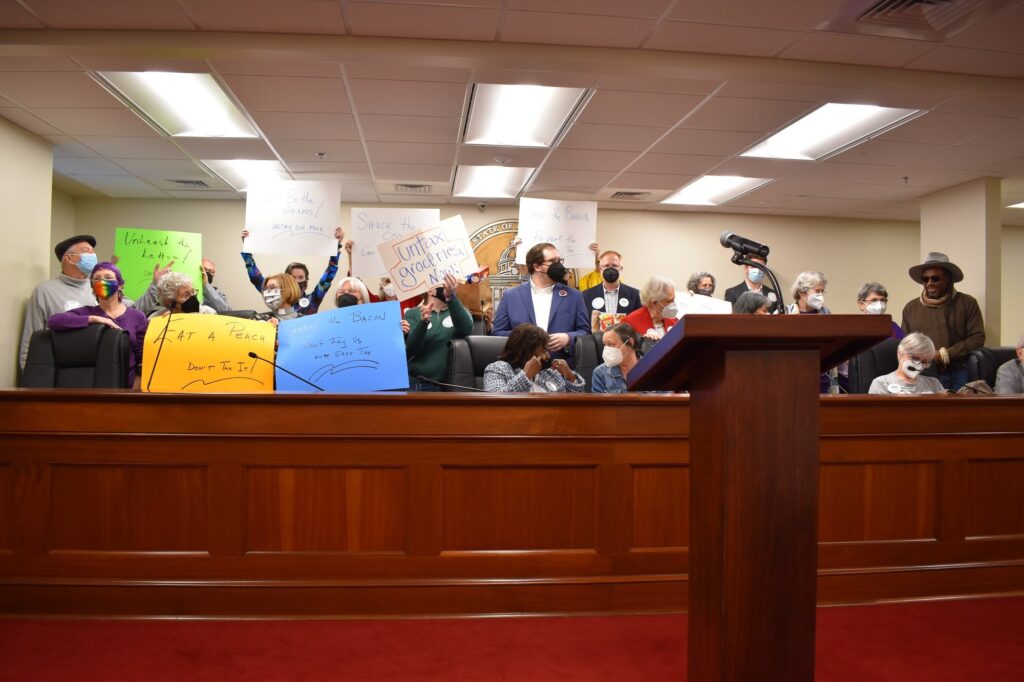
Alabama Arise members gathered for an Untax Groceries Rally at the State House in Montgomery on March 15, 2022. Bills to end the state grocery tax did not move in the Legislature this year, but the effort continues to enjoy growing bipartisan support.
Voting rights
HB 53 and SB 6, sponsored by Rep. Laura Hall, D-Huntsville, and Sen. Linda Coleman-Madison, D-Birmingham, passed the Senate but did not advance to the House floor. This bill would have eliminated application requirements for voting rights restoration. It also would have restored the right to vote for many indigent individuals. Arise supported this effort.
HB 63, sponsored by Rep. Debbie Wood, R-Valley, did not pass this session. The bill would have criminalized the prefilling of any voter application or absentee ballot application. Arise opposed this effort.
Hall’s HB 167 failed to pass this session. This legislation would allow inmate identification cards to be used as valid ID for voting. Arise supported this effort.
HB 194, introduced by Rep. Wes Allen, R-Troy, passed out of both chambers. The bill will prohibit state and local election officials from soliciting, accepting or using donations for election-related expenses. Arise opposed this effort.
Criminal justice reform
HB 52, sponsored by Rep. Jim Hill, R-Moody, passed out of both chambers. This bill will allow judges to use discretion in the length of someone’s sentence if their probation is revoked. Arise supported this effort.
HB 95, sponsored by Rep. Jeremy Gray, D-Opelika, passed out of both chambers. The bill will create a 180-day grace period for people to repay court-imposed fines and fees following release from incarceration. Arise supported this effort.
SB 203, sponsored by Sen. Arthur Orr, R-Decatur, passed out of both chambers. This bill will require the Administrative Office of Courts to establish a database of municipal fines and fees. Arise supported this effort.
HB 230, sponsored by Rep. Rolanda Hollis, D-Birmingham, passed out of both chambers. This bill will ban the routine shackling of incarcerated individuals during pregnancy, delivery and immediate postpartum time. Arise supported this effort.
HB 200 and SB 117, sponsored by Rep. Merika Coleman, D-Birmingham, and Sen. Will Barfoot, R-Montgomery, failed to pass this session. The bill would have ended driver’s license suspensions for failure to pay fines and fees. Arise supported this effort.
SB 220, sponsored by Sen. Linda Coleman-Madison, D-Birmingham, failed to pass this session. The bill would have required that time served awaiting a hearing for parole violation be applied retroactively. Arise supported this effort.
HB 2, sponsored by Rep. Allen Treadaway, R-Morris, did not pass this session. This anti-protest bill would have created minimum holding periods for people accused of the crimes of rioting or interfering with traffic. It also would have penalized certain local jurisdictions that reduce funding for law enforcement. Arise opposed this effort.
Hill’s HB 55 failed to pass this session. The bill would have required every judicial circuit to establish a community corrections program. Arise supported this effort.
Unemployment insurance benefits
SB 224, sponsored by Sen. Arthur Orr, R-Decatur, passed out of both chambers. This bill will impose additional job search requirements as a condition of eligibility for unemployment insurance benefits. Specifically, individuals will have to show a “reasonable and active effort” to find work by providing proof every week that they have contacted at least three prospective employers. Unless a new job notice has been posted, a job seeker cannot apply for or seek work at an employer where they already made contact. Arise opposed this effort.
Food security
SB 156, sponsored by Sen. Arthur Orr, R-Decatur, did not pass this session. The bill would have required both custodial and non-custodial parents to cooperate with child support enforcement to qualify for SNAP food assistance. Arise opposed this effort.
‘Divisive concepts’
HB 312 and SB 292, sponsored by Rep. Ed Oliver, R-Dadeville, and Sen. Will Barfoot, R-Montgomery, did not pass this session. The bill would have prohibited the teaching of “divisive concepts” related to race, religion and sex in public K-12 schools, colleges, universities and certain state training programs. Arise opposed this effort.
Arise’s Robyn Hyden breaks down successes and missed opportunities from the Alabama Legislature’s 2022 regular session, which ended Thursday night. She highlights breakthroughs on federal ARPA funds, postpartum Medicaid extension and criminal justice reform, among other issues.
Arise’s Jane Adams shares the good news that next year’s General Fund budget includes a provision that would extend Medicaid postpartum coverage to one year after childbirth, up from the current 60 days. The budget has passed both the Alabama House and Senate and has gone to the governor.
Untax groceries. Expand health coverage. Make the criminal justice system more just. Those are a few of Alabama Arise’s major priorities during the Legislature’s 2022 regular session. And we’re making real progress toward turning those goals into realities.
Untaxing groceries
Ending the state’s regressive sales tax on groceries has been a longtime Arise priority. It was the centerpiece of Alabama Arise Action’s online Legislative Day on Feb. 15, which attracted nearly 200 advocates from across the state. It also will be the focus of a March 15 rally in Montgomery.
McClammy said the grocery tax is a policy concern that transcends political lines. “It’s important that we stand together united as one and show the citizens that we all care about what’s going on in our homes,” she said.
Jones expressed optimism that lawmakers are nearing a breakthrough on the grocery tax. “This is not a partisan issue,” he said. “This is something that really meets the full criteria of being a bipartisan issue.”
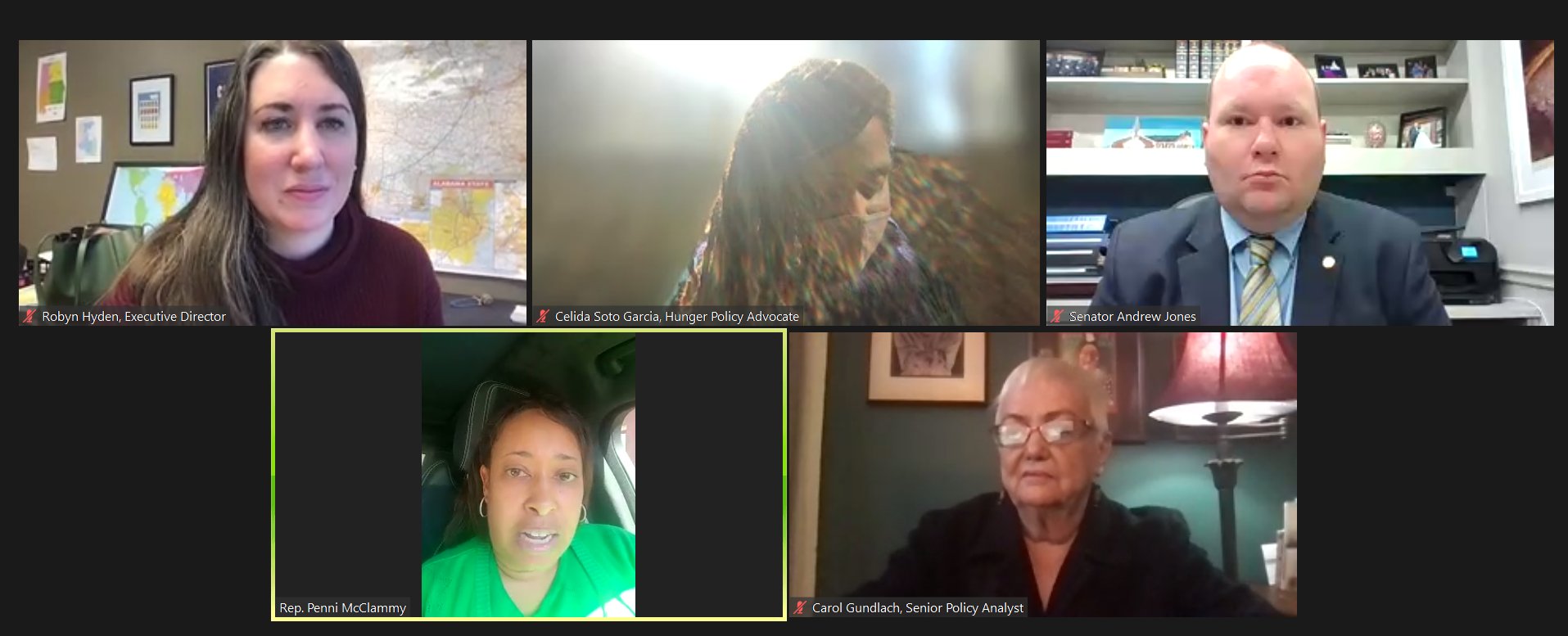
Nearly 200 advocates from across Alabama attended Arise’s virtual 2022 Legislative Day on Feb. 15. Supporters gathered to learn more about our issue priorities and get updates on where things stand legislatively on them. Sen. Andrew Jones, R-Centre (top right), and Rep. Penni McClammy, D-Montgomery (bottom left), joined us for a discussion of their bills to untax groceries.
Expanding health coverage
The COVID-19 pandemic has underscored a cruel fact: Hundreds of thousands of Alabamians can’t afford the health care they need. Gov. Kay Ivey can remove that financial barrier by expanding Medicaid to cover nearly 300,000 adults with low incomes. Arise and our Cover Alabama campaign are working hard to make that happen.
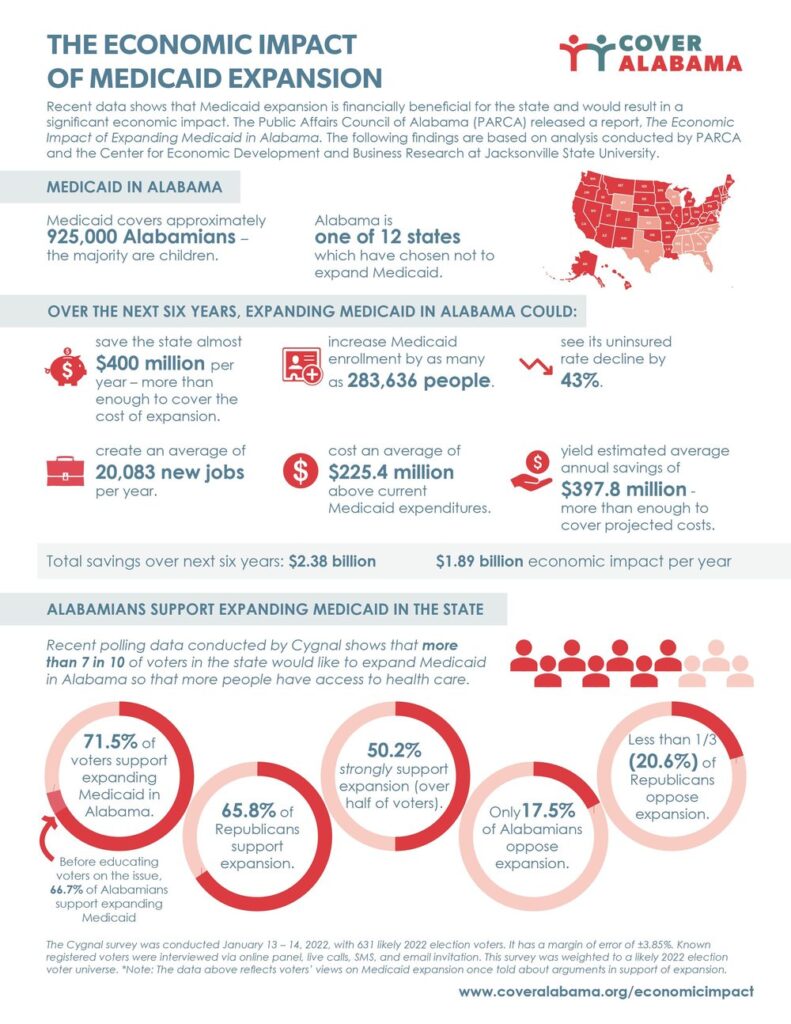
Public support for Medicaid expansion is strong and growing. More than seven in 10 Alabamians support expansion, according to a statewide Arise poll conducted in January. Expansion would create more than 20,000 jobs and save the state almost $400 million annually, a recent report estimated.
Extending Alabama Medicaid’s postpartum coverage to one year (up from the current 60 days) is another key goal this year. Nearly 70% of Alabama’s maternal deaths in 2016 were preventable, one study found. That’s why Arise is working hard to ensure legislators fund this life-saving coverage extension in the General Fund budget.
Advancing justice
Numerous reforms of Alabama’s criminal justice system are moving in the Legislature this year. Arise supports two bills – HB 200 by Rep. Merika Coleman, D-Birmingham, and SB 117 by Sen. Will Barfoot, R-Montgomery – to end driver’s license suspensions for failure to pay fines and fees. Arise also backs HB 57 by Rep. Chris England, D-Tuscaloosa, and SB 215 by Sen. Bobby Singleton, D-Greensboro, which would increase transparency in parole decisions.
More than seven in 10 Alabamians (71.5%), including 65.8% of Republican voters, support expanding Medicaid when told about arguments in support of the idea, according to a new poll commissioned by Alabama Arise. The poll also showed robust bipartisan support for using a portion of the state’s funding under the American Rescue Plan Act (ARPA) to support Medicaid expansion.
Participants responded strongly when informed that expanding Medicaid would create an average of 20,000 new jobs per year over the next six years and have an economic impact of $1.8 billion per year. Nearly 69% of respondents, including 61.8% of Republican voters, supported using a portion of the state’s $2 billion in ARPA funds to expand access to Medicaid in Alabama.
Jane Adams, Cover Alabama campaign director at Alabama Arise, said the poll results underscore Alabama’s urgent need for Medicaid expansion.
“Voters support Medicaid expansion because it is a tremendous opportunity to create jobs, protect rural hospitals and provide life-saving care,” Adams said. “This poll shows Medicaid expansion is no longer a partisan issue and that most Alabamians support expanding Medicaid coverage to adults with low incomes.”
Support for Medicaid expansion grows across Alabama
Alabama Arise commissioned the poll, which the Montgomery-based firm Cygnal conducted in January. The poll surveyed 631 likely voters across Alabama and has a margin of error of +/- 3.85%. Interviews of known registered voters occurred via live phone calls, online panel, texts and email invitation.
New report highlights economic benefits of Medicaid expansion
A recent report from the nonprofit Public Affairs Research Council of Alabama (PARCA) shows how Medicaid expansion would create jobs and boost local economies across the state. “Expanding Medicaid coverage in Alabama could save the state almost $400 million per year over the next six years – more than enough to cover the cost of expansion – and have an average positive economic impact of $1.89 billion per year over that same time frame,” the report found.
Medicaid expansion in Alabama would cost an average of $225.4 million per year, according to the PARCA report. But the report also found that expansion would lead to the federal government covering $379.9 million in annual expenses now paid by the state. “As a result, the state could expand coverage, and at the same time, reduce or reinvest the amount paid to support health care for low-income Alabamians by $172 million annually,” PARCA found.
Adams said ARPA funding and other federal incentives make Medicaid expansion an opportunity too good for Alabama to pass up.
“Governor Ivey and leaders in Montgomery have said the obstacle to expanding Medicaid in Alabama is the cost. But with the American Rescue Plan Act funding, Alabama can expand Medicaid and could reinvest more than $170 million in state funding to provide more access to care,” Adams said.
“Public support is strong, and the report and polling data show there is no financial barrier or obstacle to overcome. We urge Governor Ivey and leaders in Montgomery to put forward a Medicaid expansion plan that is tailored to the needs of Alabamians.”
Alabama’s likely voters overwhelmingly support using federal COVID-19 relief funds to increase funding for mental health and rural hospitals, according to a new Alabama Arise poll released Monday.
More than four in five respondents (81.1%) supported using a portion of Alabama’s funding under the American Rescue Plan Act (ARPA) to invest in rural hospitals and increase rural Alabamians’ access to health care. And nearly three in four likely voters (73.6%) said lawmakers should boost mental health funding to increase access to services across Alabama. Among Republican voters, 80.1% supported investments in rural hospitals and 67.7% supported more mental health care funding.
“Alabamians are loud and clear that they want our lawmakers to use federal relief money to strengthen our state’s health care system,” Alabama Arise executive director Robyn Hyden said. “The COVID-19 pandemic has strained health care workers like nothing before in our lifetimes. And it has exposed and worsened our state’s persistent racial and geographic health disparities.
“ARPA offers an unprecedented chance to protect rural hospitals and increase access to mental health care and other services. We must seize this opportunity to build a healthier future for Alabama.”
Child care, housing, public transportation also enjoy strong public support
Expanding access to subsidized child care for working families.
Establishing a state child tax credit to lower costs for working families.
Expanding access to affordable housing throughout the state.
Investing in public transportation, particularly in rural areas.
Alabama will receive a total of more than $2 billion in ARPA funds. Lawmakers last year appropriated $400 million of that amount toward prison construction and $80 million to hospitals and nursing homes. This week, the Legislature will vote on a plan to spend another $772 million of ARPA funds. Most of that money would go toward broadband internet expansion, water and sewer improvements, and additional funding for hospitals, nursing homes and assisted living facilities.
The state expects to receive the remaining $1 billion in ARPA funds later this year. Arise’s poll shows the public wants legislators to use that money to ease economic stress on Alabama households, Hyden said.
“The pandemic has made it harder for people across our state to find child care, keep a roof overhead and get where they need to go,” Hyden said. “We should use ARPA funding to ease families’ suffering and provide the supports needed to help every Alabamian succeed. It’s time for our lawmakers to meet this moment and ensure Alabama’s post-pandemic future is a bright and inclusive one.”
About the survey
Alabama Arise commissioned the poll, which the Montgomery-based firm Cygnal conducted Jan. 13-14. The poll surveyed 631 likely voters across Alabama and has a margin of error of +/- 3.85%. Interviews of known registered voters occurred via live phone calls, online panel, texts and email invitation.