
Alabama lawmakers allocated the state’s final $1 billion of ARPA funds. What comes next?

As the Alabama Legislature begins to craft the 2024 General Fund budget, decisions made during last month’s special session should provide lawmakers with more flexibility to meet ongoing needs for our state. With additional near-term funding already in place for key priorities, legislators should seize the opportunity to improve the quality of life for every Alabamian. Investments that would further this goal include providing funds for public infrastructure like Medicaid expansion and public transportation.

On March 16, Gov. Kay Ivey signed HB 1 to end the special session she called to distribute the remaining federal funds that Alabama received under the American Rescue Plan Act (ARPA). This act provided states with federal funding to help cover losses and expenses incurred because of the COVID-19 pandemic. Lawmakers previously distributed the majority of the funds, leaving $1.06 billion to be allocated in this year’s special session.

Arise priorities eligible for funding

The Department of Finance received $55 million in ARPA funding for direct services for people likely to face economic hardship. These categories include older Alabamians and victims of domestic violence. Service providers will receive this money through departmental grants.

Further available categories for this funding include food banks, long-term housing security and mental health care. Summer education programs for schoolchildren and services to families involved in child welfare also are eligible for this funding.

Arise has advocated for using a portion of Alabama’s ARPA aid for affordable housing. While the ideal path would have been a specific allocation to housing, this funding pool provides a path for that important investment. Direct food assistance is likewise a vital public good. And increased mental health funding could help improve the well-being of Alabamians of all demographics.

Health care receives significant funding

Lawmakers allocated $339 million for direct health care expenses and related services. The largest portion will be used for hospital and nursing home reimbursements at $100 million each. Increased expenses for state employees’ health insurance will account for $80 million of the remaining $139 million.

The remaining $59 million will go toward several programs to expand health care availability and efficacy for Alabamians. These funds include:

  • $9 million for telemedicine infrastructure expansion, particularly focused on specialist coverage for Alabamians in rural communities.
  • $20 million for research into increasing access to personalized health care.
  • $175,000 in cost reimbursement for COVID-19 vaccinations provided to college and university students.

Also notable is a $25 million line item for mental health care investment. This expenditure can help bring state programs up to the requisite standard of care. This amount is in addition to the permissible use of a portion of the Finance Department’s $55 million in funding.

Infrastructure improvements receive lion’s share of ARPA aid

Lawmakers allocated the largest share of this round of funds, $660 million, to infrastructure improvements in water and sewer systems. Of that amount, $260 million will go toward broadband internet access.

This decision is consistent with the state’s emphasis on increasing internet connectivity during recent legislative sessions. These funds are also available for use by state agencies to modernize and improve access to state computer infrastructure. This has been another recent priority for the Legislature.

The remaining $400 million in this category will go toward water and sewer infrastructure improvements. This includes $195 million for high-need water and sewer projects. A further $100 million will be available for water projects in growing communities. And an additional $100 million will be designated for grants that require 35% funding matches by local governments.

The Alabama Department of Public Health has designated $5 million to conduct wastewater system improvements in areas with high poverty rates, low populations and difficult soil conditions for septic systems. This expenditure aims to improve longstanding sewage disposal issues in the Black Belt.

In several Black Belt counties, recent major sewage problems due to inadequate investment in public sewage disposal have drawn international condemnation. This ARPA allocation will help mitigate the problems, though further investment will be necessary to fix them fully.

Final thoughts

Overall, state lawmakers used this final round of ARPA funds as generally intended: to improve Alabamians’ lives and mitigate shortfalls due to the COVID-19 pandemic. The relative flexibility of the appropriations bill still leaves open the possibility that some funds could be used in counterproductive ways. But the Legislature performed much better in allocating ARPA funds equitably this session than with the first round, when they devoted $400 million of relief funding to prison construction.

Thankfully, this special session created numerous pathways to help Alabamians by directly providing important public goods. The opportunity to make significant improvements in vital areas includes funding adequate housing and providing food for people who need it. It includes investments in mental health care and improvements in state agency reliability. And it includes mitigation of some harms resulting from decades of state disinvestment in Black Belt communities with mostly Black populations.

Make no mistake: Many urgent and vital needs remain unmet after the special session. But ARPA funding nonetheless will provide a generational opportunity to make substantial improvements to the lives of all Alabamians. Lawmakers should build on that momentum by expanding Medicaid, funding public transportation and making other investments in a brighter, more inclusive future for Alabama.
Walker County Medicaid town hall 2023

Alabama Arise and Cover Alabama co-hosted a Medicaid town hall in Jasper on April 10, 2023. Speakers discussed the importance of Medicaid expansion and how our state can afford it, as well as the cruelty of the Medicaid coverage gap. To learn more and join our movement to expand Medicaid in Alabama, visit coveralabama.org.

Alabama Arise Action Legislative Day 2023

Arise held our 2023 Legislative Day on Tuesday, April 11. More than 100 supporters joined us in Montgomery to hear updates on our policy priorities and urge their lawmakers to untax groceries, expand Medicaid and end debt-based driver’s license suspensions. Thank you to everyone who spoke out for a better Alabama for all!

It’s time to expand Medicaid and close Alabama’s coverage gap

Here are five reasons it’s time to expand Medicaid and close Alabama’s coverage gap:

  1. Nearly 300,000 Alabamians with low incomes would benefit from Medicaid expansion.

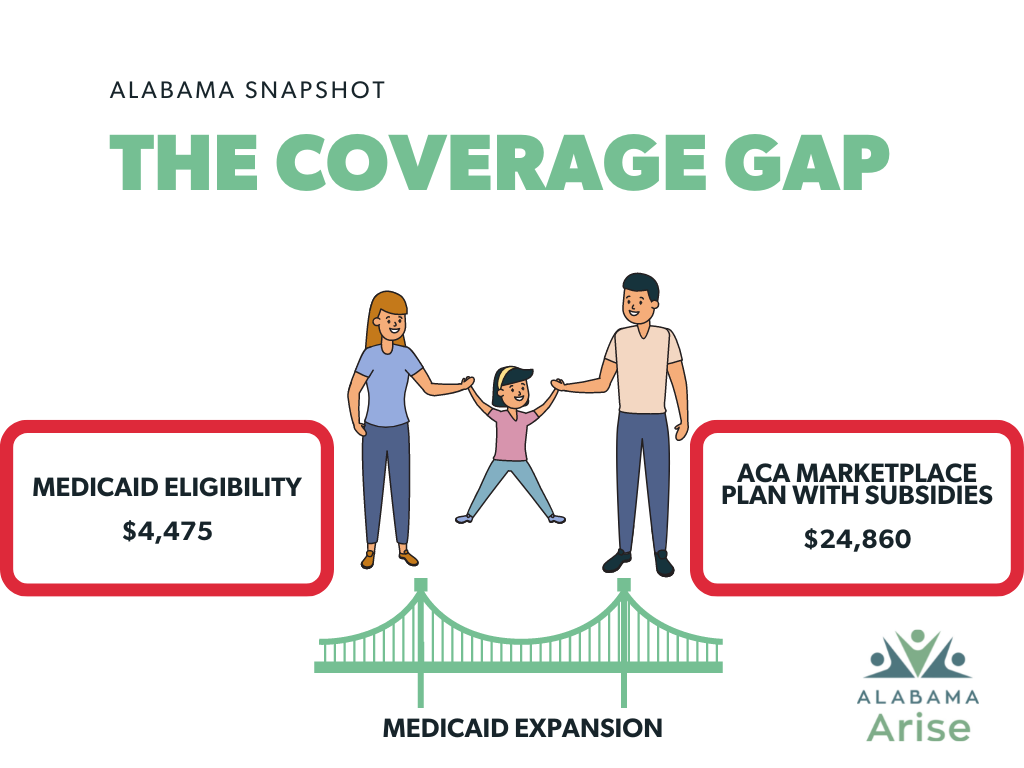
    • People in the coverage gap earn too much to qualify for Medicaid, but not enough for an affordable private health insurance plan on the Marketplace. This leaves them in the health coverage gap.
    • The vast majority of people who would gain coverage through Medicaid expansion are working. More than 100,000 Alabamians in the coverage gap hold jobs that are important but pay low wages. Thousands more are self-employed, serve as caregivers or attend school.
    • People who work low-wage jobs and can’t afford private coverage are among the Alabamians who would benefit from closing the coverage gap. So are workers who are between jobs, uninsured veterans, adults who are caring for children or older family members and people who are awaiting SSI determinations.
  2. We can afford it now. Medicaid expansion comes with a $619 million signing bonus.

    • States that close their coverage gap will receive a 5-percentage-point increase in the federal match rate for Medicaid for two years. This is thanks to an incentive in the American Rescue Plan Act.
    • An increased federal match rate would bring $619 million to Alabama over the next two years.
    • The state’s cost to close the gap in the first two years would be roughly $423 million. That means nearly $200 million in additional federal funding would come to our state above and beyond the cost to extend Medicaid coverage up to hard-working Alabamians. And that doesn’t even count other budgetary savings for the state and the revenue generated by thousands of new jobs across Alabama.
  3. Closing the coverage gap helps workers stay employed.

    • States that have closed the coverage gap have seen a greater increase in labor force participation among people with low incomes than in non-expansion states. One in three Alabama adults have a disability.
    • Injuries or manageable illnesses like diabetes can get so severe for those without health coverage that they prevent people from working or leading healthy lives. 
    • People with disabilities are more likely to be employed in states that have expanded Medicaid than in states that haven’t.
  4. Sixteen rural hospitals are at immediate risk of closing. Medicaid expansion can keep them operating.

    • Expanding Medicaid will help more rural residents afford health care services and reduce the financial losses experienced at hospitals from serving uninsured patients or providing uncompensated care.
    • Research shows that a rural hospital being located in a Medicaid expansion state decreases the likelihood it will close by an average of 62%.
    • Rural hospitals in states that have expanded Medicaid coverage have more sustainable median operating margins compared with rural hospitals in non-expansion states.
  5. Medicaid expansion can help strengthen mental health care services in Alabama.

    • We need more coverage and better care for Alabamians with mental health conditions. Medicaid expansion would allow more people with these conditions to access the vital care they need.
    • Alabama’s mental health care and substance use treatment providers deliver nearly $50 million worth of uncompensated services each year. Closing the coverage gap could drastically reduce this amount and allow more mental health services to be provided to people in need.

It’s time to expand Medicaid and close Alabama’s coverage gap

  • Nearly 300,000 Alabamians would benefit from Medicaid expansion.
  • We can afford it now. Medicaid expansion now comes with a $619 million signing bonus.
  • Closing the coverage gap helps workers stay employed.
  • Sixteen rural hospitals are at immediate risk of closing. Medicaid expansion can keep them operating.
  • Medicaid expansion can help strengthen mental health care services in Alabama.

Advocates visit Alabama lawmakers to urge support for Medicaid expansion

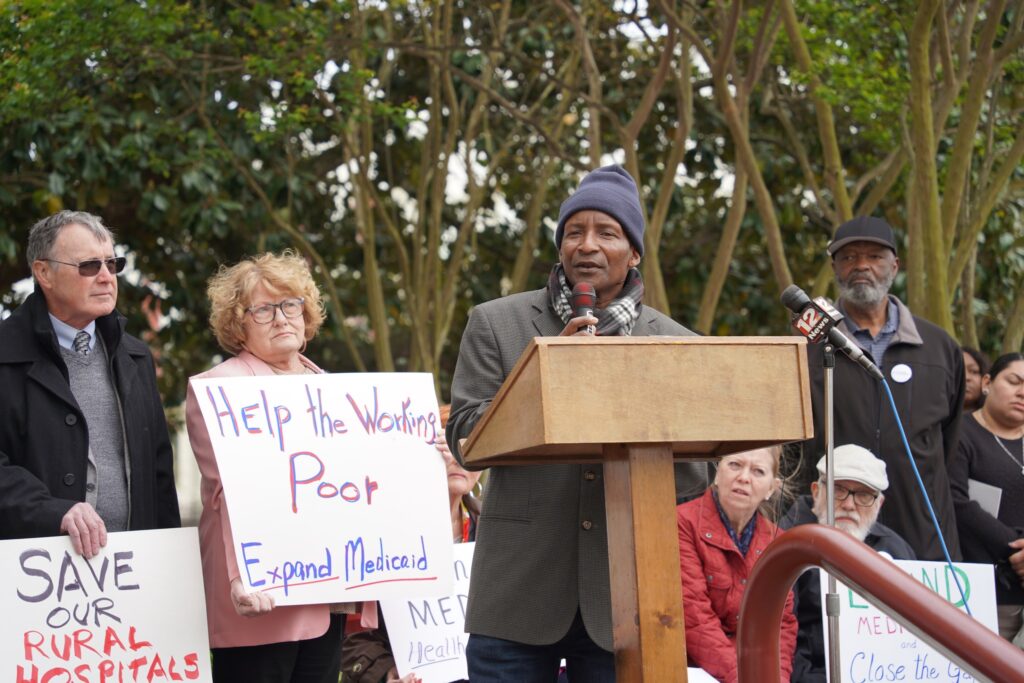
Kenneth King speaks from behind a lectern outside the Alabama State House in Montgomery. He is a Black man wearing a gray suit, a gray toboggan cap and a scarf that is white and black. Standing behind him are numerous supporters of Medicaid expansion, including a white man wearing a black jacket and glasses who holds a sign reading "Save Our Rural Hospitals," and a white woman with red hair and glasses who holds a sign reading "Help the Working Poor: Expand Medicaid."
Alabama Arise board member Kenneth King speaks at Cover Alabama’s advocacy event outside the State House in Montgomery on March 21, 2023. King shared his story of living in Alabama’s health coverage gap and urged lawmakers to support Medicaid expansion.

More than 80 Alabamians gathered outside the State House in Montgomery on Tuesday to urge state lawmakers to expand Medicaid to cover adults with low incomes. The Cover Alabama coalition sponsored the event as part of its advocacy day for Medicaid expansion. Alabama Arise is a founding member of Cover Alabama.

Some advocates shared stories of how Medicaid expansion would help their families and communities. Others highlighted how expansion would benefit Alabama’s economy and health care system. All sought to show the human faces of the state’s health coverage gap and the suffering it causes.

Video footage from the event is available here. Photos from the events are available here.

“I lost my job because of a chronic health condition. I’m the primary provider for my family, but I could not stay well enough to do my job,” said Jesse Odland, a Huntsville line cook. “Now, I worry my medical debt will affect how my family can thrive. The working class drives our economy, and we’re hit the hardest by the coverage gap.”

Closing the coverage gap would help nearly 300,000 Alabamians access potentially life-saving care. It also would create thousands of new jobs and invigorate the state’s economy, research shows. Medicaid expansion could create more than 20,000 new jobs and save the state almost $400 million each year for the next six years, according to a recent report by the Public Affairs Research Council of Alabama. And in rural areas, expansion would have the added benefit of reinforcing rural hospitals.

“Alabama’s rural hospitals are in trouble. More than a dozen are at immediate risk of closing this year,” said Dr. Marsha Raulerson, who has been a pediatrician in Brewton for more than 40 years. “When a rural hospital closes, that community loses not only their access to health care but also a primary economic engine and the jobs that come with that. Medicaid expansion is a win-win for patients and providers alike.”

Rev. Carolyn Foster, the faith in community coordinator at Greater Birmingham Ministries, argued that expanding Medicaid is just the right thing to do.

“No matter our creed, we can all agree that we are called to love our neighbors as ourselves,” Foster said. “So long as we allow our neighbors to fall into the health care coverage gap, we are failing to answer that calling. It is an affront to people of faith and people of good will.”

Thirty-nine states and the District of Columbia have expanded Medicaid, and North Carolina likely will join that list next week. Debbie Smith, Alabama Arise’s Cover Alabama campaign director, said advocates hope this is the year Alabama will expand, too.

“Research shows Medicaid expansion is favorable on both sides of the political aisle,” Smith said. “We are hopeful Alabama lawmakers will do the smart, compassionate and fiscally responsible thing and expand Medicaid now. How can our state not afford to save money?”

Click here for video from the event. And click here for photos from the event.

Cover Alabama Lobby Day 2023

The Cover Alabama coalition held its first Lobby Day on March 21 on the steps of the State House in Montgomery. Faith leaders, community advocates and people living in Alabama’s health coverage gap spoke about the importance of Medicaid expansion for their families and communities. Advocates then met with lawmakers to urge them to save lives and create jobs by expanding Medicaid.

PARCA presentation on Medicaid expansion in Brewton

Medicaid expansion would save lives, create jobs and strengthen the health care system across Alabama. Ryan Hankins, executive director of the Public Affairs Research Council of Alabama (PARCA), gave a presentation on Medicaid expansion’s benefits at a public event that Alabama Arise co-hosted on Feb. 27, 2023, at DW McMillan Memorial Hospital in Brewton.

Brewton community event on Medicaid expansion in Alabama

“Our rural hospital is the first line of care for the people in our community. If someone’s really sick, they need to be stabilized. They can be stabilized here quickly and efficiently. If our hospital closed … people will die.”
That was the blunt reality that Dr. Marsha Raulerson shared at a health care panel that Alabama Arise co-hosted Feb. 27 in Brewton. As we heard from her and many other people that night, Medicaid expansion is a crucial step to save lives and protect health care access in Escambia County and throughout Alabama.

Expand Medicaid and close Alabama’s health coverage gap

For years, Gov. Kay Ivey and legislators have said cost is the barrier to covering Alabamians with low incomes through Medicaid. However, thanks to new federal incentives for Medicaid expansion, any concerns about that barrier are gone. Now more than ever before, we have the opportunity to ensure no Alabamian has to choose between going to the doctor and putting food on the table.

More than 70% of Alabamians support Medicaid expansion, including 66% of Republican voters, according to a January 2022 poll, and opening up Medicaid coverage to adults with low incomes is the single biggest step Alabama can take to restore health, save our rural hospitals and boost our state’s economic recovery.

Who would gain coverage under Medicaid expansion?

Medicaid expansion would ensure coverage for nearly 300,000 Alabamians, including:

  • People who work low-wage jobs and can’t afford private coverage
  • Workers who are between jobs
  • Adults who are caring for children or older family members at home
  • People who have disabilities and are awaiting SSI determinations
  • Adult college students
  • Uninsured veterans

How would Medicaid expansion boost the economy?

Medicaid expansion would bring our federal tax dollars home to support:

  • Healthier families, workers and communities
  • Stronger rural hospitals and clinics
  • Stronger community mental health and substance use disorder services
  • A needed boost in jobs and revenue for state and local economies

How would Medicaid expansion keep people healthier?

Medicaid expansion would help Alabamians stay healthy by ensuring pathways to:

  • Regular primary care and preventive checkups
  • Earlier detection and treatment of serious health problems
  • Regular OB/GYN visits without referral
  • Less dependence on costly emergency care
  • Better health and greater financial peace of mind

How would Medicaid expansion reduce health disparities?

Medicaid expansion would promote health equity in Alabama by:

  • Reducing the racial/ethnic disparities in health coverage
  • Lowering the high rate of Black infant deaths
  • Lowering the high rate of Black maternal deaths
  • Covering chronic health conditions that disproportionately affect people of color and make them more vulnerable to COVID-19 complications

Bottom line

Medicaid expansion would save lives, create jobs and strengthen Alabama’s health care system. Closing the health coverage gap is one of the biggest policy changes available to move our state forward. The governor and the Legislature should embrace this opportunity to build a brighter, healthier future for Alabama.

Join our Cover Alabama campaign!

An end to Alabama’s coverage gap is within reach. Through our Cover Alabama campaign, Alabama Arise is working to ensure that every Alabamian can afford to get the health care they need when they need it. Visit coveralabama.org to learn more and add your name to our ever-growing list of supporters.

Arise legislative update: March 6, 2023

Before the Alabama Legislature returns this week, Arise’s Akiesha Anderson welcomes everyone with an update on an upcoming special session on federal American Rescue Plan Act funds and an overview of Arise’s member-chosen policy priorities for 2023.