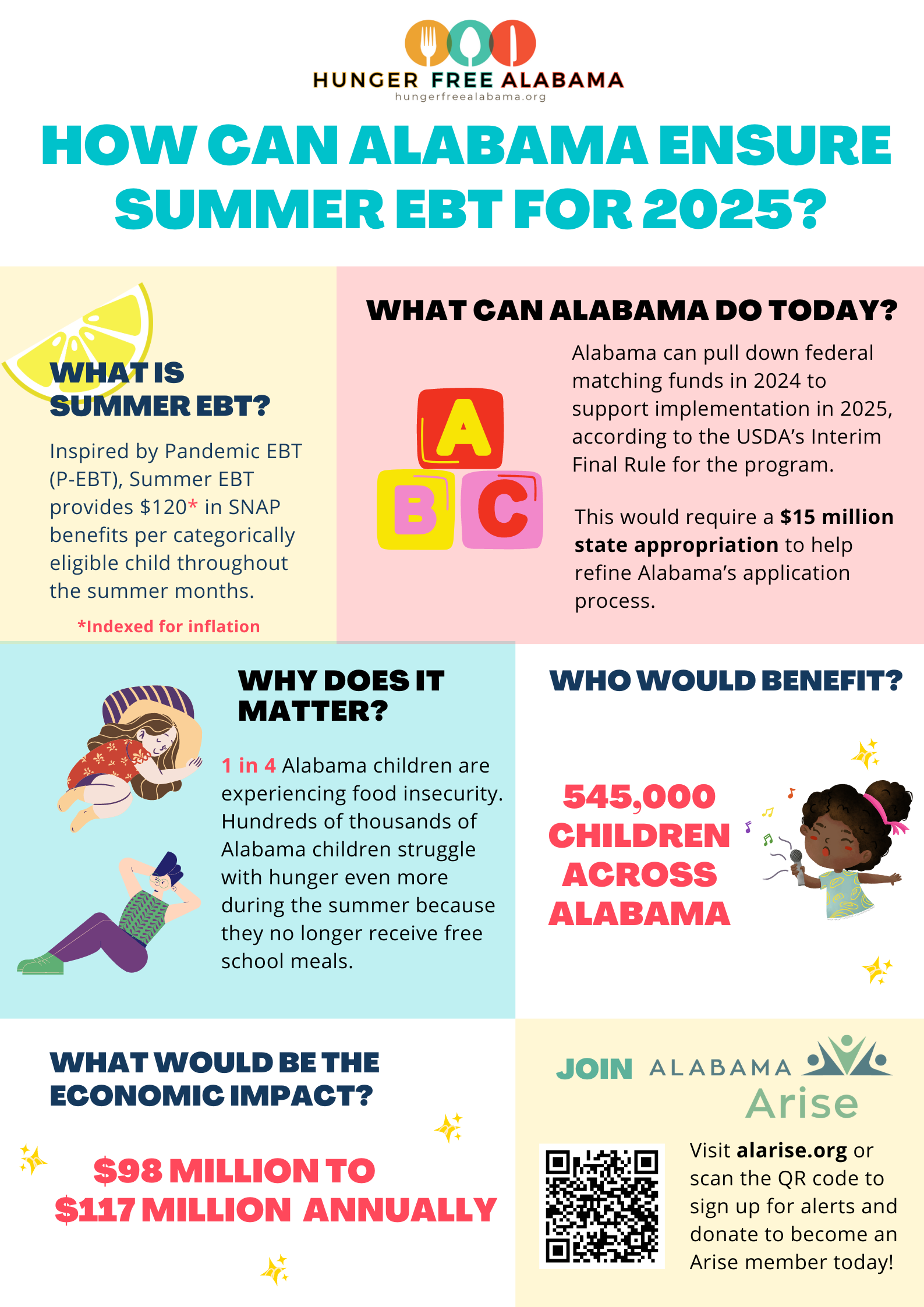
A $15 million appropriation for Summer EBT would reduce hunger by providing eligible Alabama children $40 per summer month for food.
1 in 4 Alabama children are food insecure.
Hundreds of thousands of Alabama children don’t know where their next meal will come from. And a disproportionate amount of food insecure children come from communities of color. The Summer EBT program has been shown to help alleviate this problem by reducing hunger and supporting healthier diets among children.
545,000 Alabama children will miss meals this summer.
Summer EBT could spur around $100 million in economic activity.
This program would require an initial appropriationof $15 million yet will deliver a substantially higher return on investment. This appropriation could come from either the Education Trust Fund or the General Fund. Also worth noting: The costs of operating this program would decrease in future years.
Call center* – $5 – 8 million
EBT cost* – $4 – 5 million
DHR expenses* – $500,000
Application administration** – $9.5 – 15.5 million (website design, interface, hearings, QC, notices)
Department of Education expenses* – $1 million
Total = maximum of $30 million State share = 50% | maximum of $15 million
* Cost estimates are based on Alabama’s experience with similar characteristics of Summer P-EBT cost from 2020-2024
** Cost estimates are based on new criteria in Summer EBT rules and similar vendor cost provided from other states participating in 2024
Summer EBT key points:
Summer EBT (Electronic Benefits Transfer) provides eligible children $40 per summer month ($120 total).
1 in 4 Alabama children are food insecure, with a disproportionate amount coming from households of color.
94% of Alabama children who receive free or reduced-price meals do not have access to them over the summer.
Summer EBT is a $15 million state investment in child nutrition, with a $1 for $1 federal match, that could spur around $100 million in economic activity annually across Alabama.
The Summer EBT program could reduce hunger and support healthier diets for more than half a million (545,000) Alabama children.
Inspired by Pandemic EBT (P-EBT), Summer EBT provides $120* in SNAP benefits per categorically eligible child throughout the summer months. (*Indexed for inflation).
What Can Alabama Do Today?
Alabama can pull down federal matching funds in 2024 to support implementation in 2025, according to the USDA’s Interim Final Rule for the program.
This would require a $15 million state appropriation to help refine Alabama’s application process.
Why Does it Matter?
1 in 4 Alabama children are experiencing food insecurity. Hundreds of thousands of Alabama children struggle with hunger even more during the summer because they no longer receive free school meals.
Who Would Benefit?
545,000 children across Alabama
What would be the Economic Impact?
$98 Million to $117 Million annually
Join Alabama Arise
Visit alarise.org to sign up for alerts and donate to become an Arise member today!
Arise’s Akiesha Anderson breaks down a flurry of legislation that kept us busy last week. She discusses bills filed in response to the Alabama Supreme Court’s decision on in vitro fertilization (IVF), updates us on anti-DEI legislation and examines the CHOOSE Act, a bill that would redirect public school funding to private schools and homeschooling. She also previews what’s ahead this week, including committee action on a harmful bill that would impose limits on absentee voting and a good bill that would increase help for those who can’t afford a lawyer when charged with a crime.
Full video transcript:
Hi there. My name is Akiesha Anderson, and as you know, I am the policy and advocacy director for Alabama Arise. I’m here once again to provide you with another weekly legislative update.
If you by any chance were following what happened at the State House last week, then you, like me, were probably somewhat exhausted if not depleted by the time the week was over. So before I delve into this week’s update, I do want to hold space for that reality and to thank you for all that you do to help to make this state better. Even in response to the tough political terrain that we often find ourselves in, it’s people like you that continue to show up and stay engaged with the political process that help to position us to create that Alabama that we hope to see.
Also, my apologies in advance — I know that these videos typically aren’t very long, but given all that happened last week and what’s slated to come up this week, I do think that I would be doing you a disservice by not talking about each of the things that I’m about to discuss.
Within the first three weeks of the legislative session, we have already seen a host of attacks targeting women’s health; diversity, equity and inclusion; public education funding; people’s rights to free speech and peaceful assembly; protecting our children from child labor and exploitation; and voting rights.
With regard to last week specifically, we started off with news about the Supreme Court ruling that embryos are human — something that has already had significant implications on women like me whose doctors have recommended IVF or other medical procedures in response to complications with conceiving naturally. In response to that decision, however, I am grateful that legislation like HB 225 designed to protect people’s ability to access IVF treatment without fear of prosecution has been filed by House Minority Leader Anthony Daniels.
Also less than ideal last week, we saw SB 129, the anti-diversity, equity and inclusion bill, be quickly introduced and placed on a committee agenda. Basically was heard the next day, within hours of being placed, or within hours of dropping in the Senate. This legislation unfortunately has already passed out of the Senate at an unprecedented speed. If passed into law, this bill would essentially ban diversity, equity and inclusion departments, programs and staff from existing on the campuses of our public institutions, namely colleges and universities. It would also rob many students of color of one of the few safe spaces that we often feel like we have while on the campuses of predominantly white institutions, or PWIs.
Also unfortunate last week, the CHOOSE Act, or HB 129, was voted out of the out of the House Ways and Means Education Committee. While I myself was someone who attended what would be considered a failing or an underperforming school while growing up here in Montgomery, Alabama, and while I definitely understand the desire of parents to have access to quality education, the truth is we cannot as a state ignore the fact that too many students are being failed by the public education system because of the fact that we have failed to properly fund the education system. Meaning our public schools need more, not less, resources in order to give our children the access to quality education that they deserve. Unfortunately, however, the CHOOSE Act, which would possibly help defund public education, is being backed by some powerful representatives and senators, Rep. Garrett in the House and Sen. Orr in the Senate, as well as being backed by Gov. Ivey. Thus it seems slated to be passed out of the House as early as this week.
Last week, we also saw a piece of legislation sponsored by Sen. Orr that would curb people’s ability to protest in residential areas. In particular, this bill would prohibit any protest near the residence of a public official that’s designed to “disturb” that official. Thus, this bill would have drastically undercut the right to protest public officials — and to be clear, all protests by nature are designed to disturb the peace of people in power. The right of Alabamians to make their voices heard is something that has been a bedrock to our democracy and has long been a tool utilized to transform both local and national policies. This right is also something that’s protected by both the First Amendment and the Alabama Constitution. Yet if passed, SB 57 would undermine both of those.
Looking ahead into this coming week, I am happy to report that things aren’t all bleak and grim. While many of the bills I just discussed may continue to move through the legislative process and advance this week, so too may other bills, including some that we are supportive of.
For example, HB 77 by Rep. Rigsby passed out of the House Health Committee last week, as well as the full House last week. Thus, it is positioned to be heard by the Senate at any point. If passed, this newborn screening bill would help advance some of our goals related to our new issue priority surrounding maternal and infant health.
Similarly, related to another new issue priority, HB 32 by Rep. England is slate to be heard in the House Judiciary Committee this Wednesday at 1:30 p.m. While a public hearing has been called on this bill and a vote won’t take place on it until next week, if passed, this bill could bring Alabama in line with the majority of states regarding the way that we apply the felony murder rule. As you may recall, working on this new issue under our criminal justice portfolio was proposed and approved by our Arise members last fall.
And for the sake of brevity, I’ll simply try to name a few other good bills to have on your radar, as they will be in committee this week as well.
SB 35 by Sen. Smitherman would require all history lessons to be fact-based. SB 83, also by Sen. Smitherman, would help more people in need of indigent defense by increasing the compensation that attorneys get for representing clients that need court-appointed counsel. Currently, many attorneys simply can’t justify taking on court-appointed cases given the low rate at which they’re currently compensated for such work. Also, HB 188 by Rep. Collins would create a uniform due process, procedure, standards and rights for schools to follow when taking certain disciplinary actions against students.
Also worth having on your radar, however, are going to be some bills of alarm that will also be in committee this week. Those include SB 1 by Sen. Gudger. If you recall, this is the bill that criminalizes certain forms of helping people with delivering their absentee ballot. This bill will have a public hearing in Room 418 at 9 a.m. on Wednesday, and if you are interested in testifying or being in that room to witness what happens, I definitely encourage you to show up early, because that is a very small room and the seats are limited.
Also, HB 102 by Rep. DuBose, which is a piece of legislation that mirrors Sen. Orr’s legislation that weakens protections against child labor in the state, will be deliberated in a House committee on Wednesday as well.
And honestly, y’all, I know that that is a lot, and it’s probably not as hopeful as we would like it to be. But those are this week’s updates on what happened during the third week of the legislative session and what we’re on the lookout for as we enter into the fourth week of session.
So hopefully the next time I come to you is with a more upbeat update, and just better news regarding what’s happening at the State House. In the meantime, take care, y’all.
Arise’s Akiesha Anderson provides updates on all the bills that moved last week and previews what’s to come this week in the Alabama Legislature. Topics include a harmful bill that would create barriers to absentee voting, efforts to preserve child labor protections, the future of the state sales tax on groceries and the CHOOSE Act, which would redirect funding for public schools to private schools and homeschooling.
Full video transcript:
Hi there. Akiesha Anderson here, policy and advocacy director for Alabama Arise, and I am excited to be here today to give you your weekly legislative update and glimpse into what’s been happening in Montgomery.
On Tuesday, Feb. 20, the Legislature will gather in for this third week of the legislative session. Yet, what an eventful first two weeks they have had.
The second week of the legislative session, which ended last Friday, began with Arise staff showing up to the State House to testify against the CHOOSE Act, also known as SB 61. This is a piece of legislation that would divert a minimum of $100 million away from our public education system into private or home schools.
Last week, Arise also attended a grocery taxation commission meeting. This is a commission which I serve on, and at this meeting, I had the pleasure of presenting on Arise’s concern about the Legislature not taking steps to cut to cut the additional 1 cent off of the state-level grocery tax this year. This is alarming to us, especially considering that cutting this additional 1 cent would cost less than $100 million — or less than what the Legislature is trying to divert from the ETF via the CHOOSE Act.
Last week, we also saw an alarming piece of legislation, SB 53, that would remove some existing child labor protections and safeguards. This piece of legislation passed out of a Senate committee along with another piece of legislation, SB 62, which we are actually supportive of. SB 62 would remove the state-level tax from certain women’s hygiene and baby products.
Similarly, last week we saw that the House passed some significant legislation, specifically gaming legislation passed both out of committee and out of the full chamber of the House last week. And so if the Senate follows suit and passes this legislation similarly to what the House did, then everyday voters like you will likely see this issue on the ballot this upcoming November. This will be the first time if this passes out of the Senate that gaming has been voted on by the Alabama public in over a decade.
That’s a lot, right? Well, now that you’re up to date on what happened last week, I’ll go ahead and discuss what’s on the tap for this third week of the legislative session.
So this week, there are several pieces of legislation that will be in committee that Arise will be monitoring. Of concern to us include SB 89, which is an anti-loitering bill, SB 57, which is a anti-picketing bill, and HB 29, which is the House’s companion to the CHOOSE Act.
And so luckily, it is not all bleak and grim. There are also some good pieces of legislation slated to be heard in committee this week. And we will be monitoring those pieces of legislation as well. So for example, HB 64, which is a piece of legislation that makes curing and absentee ballot easier, will be up in committee this week.
And so will HB 63, which will authorize split sentences in certain instances. And so that’s a criminal justice piece of legislation that has come up in several past legislative sessions, and we are excited to see what happens with it this year.
Stay tuned. We will be sure to keep you posted. Definitely tune back in next week for another legislative update. I hope this helps. Later, y’all.
Declining wages and pay gaps in Alabama’s auto manufacturing industry cost the state hundreds of millions of dollars in labor income and economic growth each year, an Alabama Arise report released Thursday found. Racial, gender and geographic pay disparities also persist even though Alabama automakers have received more than $1.6 billion in public incentives since 1993.
In The State of Working Alabama 2023, Arise assessed the results of the state’s 30-year drive to launch and grow its auto manufacturing industry. The industry has benefited Alabama in many ways, the report found, employing more than 44,000 people and paying average wages that are higher than those for other workers in the state. The report also explained how Alabama could build on those successes by centering workers in its economic development strategy. Among the key recommendations:
Policymakers should strengthen the wage, benefit and accountability standards for tax incentives and other state and local subsidies.
Alabama should boost investments in K-12 education, child care and workforce training.
Automakers should raise worker pay to at least the same amount workers earned 20 years ago, adjusted for inflation.
Automakers should eliminate pay disparities between men and women, between white people and people of color, and between workers in Alabama and other states.
Employers and policymakers should recognize organized labor as a key partner in improving wages, working conditions, operations and productivity.
“Alabama has bet big on the auto industry, and we must ensure that bet benefits our state to the greatest extent possible,” said Dev Wakeley, Alabama Arise’s worker policy advocate and a report co-author. “Policymakers, employers, workers, unions and community partners all have vital roles to play in strengthening our state’s auto industry and economy. By working together, we can build a more prosperous and inclusive economy that improves life for every Alabamian.”
The high costs of lower wages for Alabama autoworkers
One crucial step to advance shared prosperity in Alabama’s auto industry would be to increase workers’ wages, the report found. Inflation-adjusted average wages for Alabama autoworkers were 11% (or $7,770) lower in 2019 than in 2002, the report found. By contrast, average wages increased for other manufacturing workers and for workers overall in Alabama during that period. The cumulative ripple effects of just one year of these lower autoworker earnings cost Alabama 1,622 jobs, $418 million in additional labor income and $586 million in GDP, the report found.
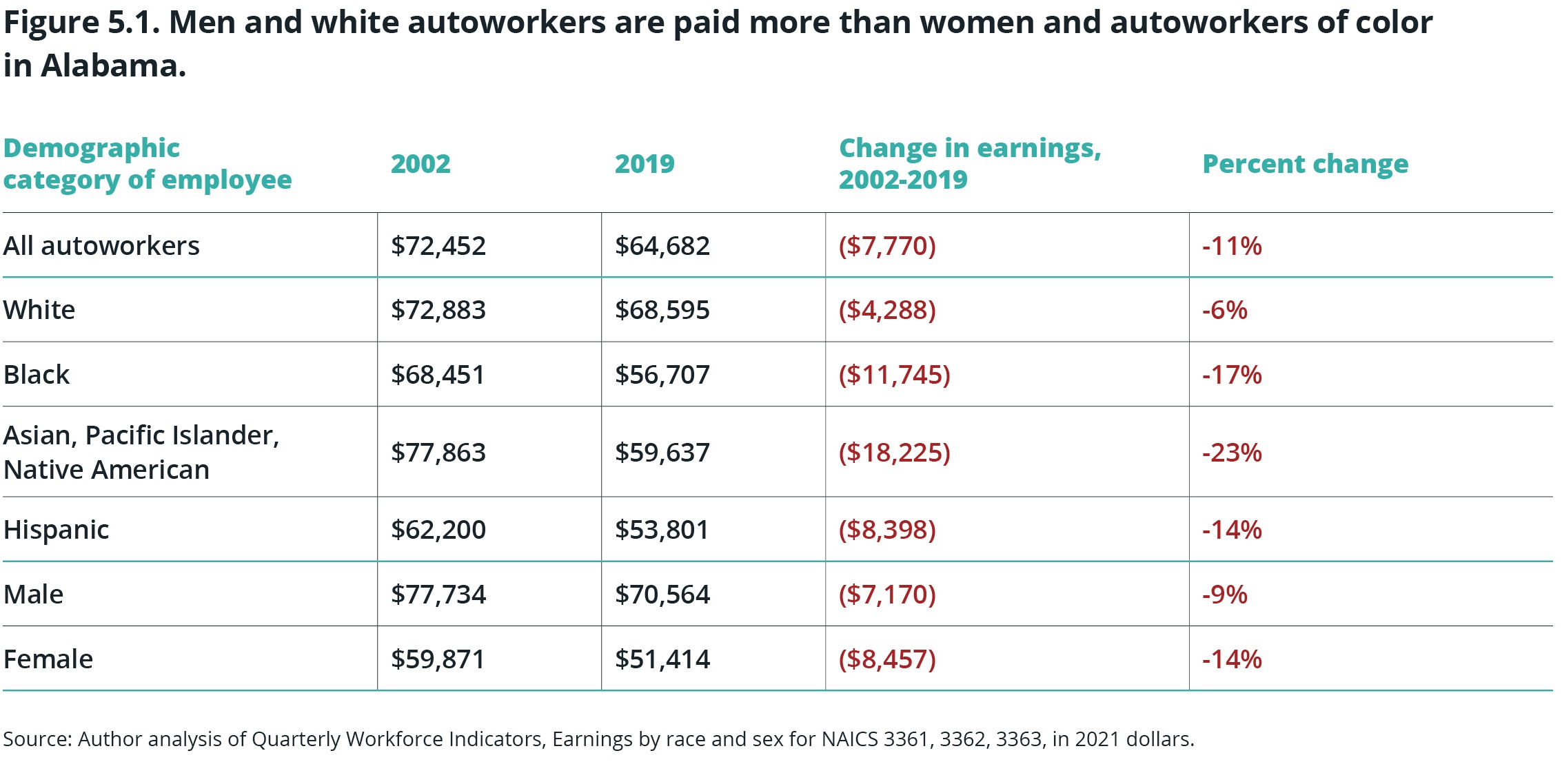
Eliminating pay disparities across racial, gender and geographic lines is another essential step to ensure equity in Alabama’s auto industry, the report found. Black autoworkers in Alabama on average received 83 cents for every dollar that a white autoworker received in 2019. For Hispanic autoworkers, that amount was 78 cents for every dollar that a white autoworker received. Women in Alabama’s auto industry earned just 73 cents for every dollar that men earned. And average pay for Alabama autoworkers has been consistently below the national average for decades.
“Many wage disparities in Alabama’s auto industry result from underrepresentation of women and people of color in high-wage occupations within the industry,” Wakeley said. “Employers should address these gaps through targeted hiring and training and with more consistent and advanced scheduling. And both employers and policymakers should do more to increase the availability and affordability of child care.”
Reforms to improve working conditions for Alabama autoworkers
Many auto employers in Alabama also should take action to improve working conditions at their facilities, the report found. Arise’s interviews with numerous autoworkers revealed serious employee concerns about promotion and disciplinary practices and changes in pay rates.
The report recommends that employers address these concerns by ending tiered wage systems and enacting industry-standard workplace protections to eliminate arbitrary or bad-faith discipline decisions. The report also urges employers to pursue community benefits agreements with local stakeholders to demonstrate their commitment to making a positive impact on the communities where they make their products and profits.
Full report
Alabama Arise’s new report, The State of Working Alabama 2023 – A Wheel in the Ditch: A Closer Look at Alabama’s Big Bet on the Auto Manufacturing Industry, is available here. A downloadable PDF of the report is available here.
Since the 1990s, Alabama has bet big on the auto industry. It has been a high-stakes effort to rebuild the state’s economy around high-wage manufacturing, raise the wages of Alabama’s workers and reduce the economic distress so prevalent across the state. A quarter-century after the first M-Class rolled off the Mercedes-Benz assembly line in Vance, now is the time to evaluate how that bet turned out – who benefited and by how much.
The 2023 edition of The State of Working Alabama assesses the results of the drive to bring the automotive manufacturing industry to Alabama. In A Wheel in the Ditch: A Closer Look at Alabama’s Big Bet on the Auto Manufacturing Industry, Alabama Arise analyzes the industry’s rapid growth over the past two decades, and the ways in which it has met or fallen short of its potential. Our report shows the heavy use of tax incentives in our state’s economic development strategy. It also reveals how a worker-focused development strategy would bring better results than the company-focused strategy that Alabama has prioritized.
Our report lays out shortcomings in pay for the same duties that workers perform in other states. It reveals instances of unfair worker treatment and a lack of workplace equity across racial and gender demographics. And it shows the massive economic benefits of creating a more equitable structure for our state’s auto industry.
This report recommends numerous policy changes, including many that autoworkers directly urged, to help fix these industry-wide shortcomings. These recommendations would bring compensation and job quality in Alabama’s auto manufacturing sector up to parity with national standards. They would position our state to reap even larger rewards from its big bet on the auto industry. And they would help build a more inclusive and prosperous future for every Alabamian.
News release and full report
Use the links in the table of contents below to navigate through the online report. Near the bottom of each section page, you will find icons that link to the other sections of the report.
The State of Working Alabama 2023 is an Alabama Arise report made possible by generous support from the Economic Policy Institute’s EARN Worker Power Project. The findings and conclusions presented in this report are those of Alabama Arise and do not necessarily reflect the opinions of any other organization or person.
AUTHORS:
Dev Wakeley, J.D. Worker policy advocate, Alabama Arise
Akiesha Anderson, J.D., MPA Policy and advocacy director, Alabama Arise
Allan M. Freyer, Ph.D. President, Peregrine Strategies, Inc. Durham, N.C.
STATISTICAL RESEARCH AND ANALYSIS:
Allan M. Freyer, Ph.D. President, Peregrine Strategies, Inc. Durham, N.C.
PRINT AND GRAPHIC DESIGN:
Tori LaConsay Atlanta, Ga.
EDITORS AND WEB DESIGN:
Robyn Hyden Executive director, Alabama Arise
Chris Sanders Communications director, Alabama Arise
Matt Okarmus Communications associate, Alabama Arise
FUNDING SUPPORT:
The Economic Policy Institute’s EARN Worker Power Project Washington, D.C.
In addition to the individuals and organizations listed above, Alabama Arise would like to thank our generous partners, donors, members and supporters for making this report possible.
Since the 1990s, Alabama has bet big on the auto industry. It has been a high-stakes effort to rebuild the state’s economy around high-wage manufacturing, raise the wages of Alabama’s workers and reduce the economic distress so prevalent across the state. A quarter–century after the first M-Class rolled off the Mercedes-Benz assembly line in Vance, subsidized by millions of dollars in taxpayer incentives, now is the time to evaluate how that bet turned out – who benefited and by how much.
A wheel in the ditch: Auto industry pay, conditions decline despite economic impact
Over the past decades, Alabama’s auto industry has grown rapidly and played a critical role as an engine in the state’s economic transformation. The industry employs thousands of workers and has generated glowing headlines about the ever-mounting number of cars built, sold and exported. The positive impacts on the state’s economy cannot be doubted.
Yet below the surface of rosy sales numbers and flattering media stories, Alabama’s auto industry is asleep at the wheel in one crucial arena: equitably compensating the workers employed in the state’s auto plants and suppliers. Despite record sales and profits, the state’s auto employers’ policies and practices are falling short regarding their workers – and Alabama more broadly – in the following ways:
Pay has declined across the board, despite significant profits in most years. Alabama’s autoworkers are earning significantly lower pay (when adjusted for inflation) than they did 20 years ago. Their pay is also below the current national average for autoworkers across the country. Meanwhile, the state’s auto plants are earning billions of dollars in profits that aren’t being adequately shared with workers every year.
Shocking gaps in pay persist across race and gender lines.Black and Hispanic workers are earning significantly less than white workers, and women are earning less than men. This is mostly due to women and workers of color being siloed into and working disproportionately in lower-wage occupations (also known as occupational segregation).
The ripple effects from these pay gaps and declining wages are costing Alabama’s overall economythousands of jobs and hundreds of millions of dollars in labor income and economic growth each year.
Working conditions on many shop floors are deteriorating.Interviews[1] with Alabamians employed at auto plants confirm recent media stories about unsafe working conditions and child labor. Interviewees also described arbitrary and unfair disciplinary practices and a tiered wage system that is holding down wages for many autoworkers.
Based on these results, it’s clear that Alabama’s big bet on auto manufacturing has only partly paid off. The industry has a wheel in the ditch as wages fall and working conditions worsen.
These problems come at a time when the auto industry’s stakes are higher than ever for Alabama’s workers, families and economy. Despite all the industry’s economic successes, Alabama’s residents continue to struggle with elevated poverty,[2]below-average household incomes[3][4][5] and sluggish (and often racially segregated) social mobility.[6] These shortcomings result in part from policy choices that often prioritize corporate profit and control of the workforce above workers’ well-being. Declining wages and racial and gender pay gaps starve Alabama’s autoworkers of the money they need to climb out of poverty, support local business growth and achieve upward mobility. This is doubly true for workers of color and their families, who historically have encountered barriers to participation in various societal institutions. These workersoften suffer from significantly lower household incomes, lower educational attainment and lower life expectancy than their white counterparts.Better wages for workers of color would make a large difference in erasing the troubling racial gaps in economic outcomes.
Alabama’s auto industry plays an outsized role in how global businesses, investors and policymakers perceive the state. In addition, the industry’s sheer economic strength – in terms of employees, suppliers, sales and especially wages – gives the industry a powerful capacity to help address these economic challenges and reshape Alabama’s overall economy so that prosperity is more widely shared with working people.
Given the massive amount of public subsidies that Alabama’s state and local governments have given these companies since Mercedes came to town in 1993, the auto industry also has an obligation to use its power – not just to increase its own profits, but also to benefit the state more broadly. This is especially true when doing so by raising wages and improving working conditions is directly within the industry’s control. In turn, policymakers have an obligation to constituents to ensure the state’s big bet pays off for the broadest possible number of Alabama families, taxpayers and workers.
This paper aims to provide both factual background and policy suggestions to empower manufacturers and officials to address the areas where they fall short, and to contribute more fully to the prosperity and economic well-being of the people who live in Alabama and work in auto plants.
What can be done
Together with Alabama’s policymakers and organized labor (often known as unions), auto employers can ensure the state’s corporate subsidies provide a return on investment in ways that chart a better course for their workers and the entire state. Specifically:
Employers must address three major areas where they are falling short: declining wages, pay gaps and working conditions. Employers should pay their workers at least the same as they did 20 years ago (when adjusted for inflation). They shouldeliminate pay disparities between men and women, as well as between white workers and workers of color. They should use targeted training and hiring programs to break down the occupational segregation that is driving many pay gaps. And they should improve safety and fairness on the shop floor.
Policymakers must fix Alabama’s low-road economic development model. The state’s prevalent economic development model has included massive corporate giveaways from tax revenue. These incentives often lack any accountability mechanism to claw back tax expenditures given to companies that fail to meet benchmarks. Moreover, data reporting and accountability mechanisms have been inadequate to monitor the companies’ claims of job quality and worker impact. In a positive move, the state recently has begun implementing data accessibility requirements on economic development incentives.[7]This trend should continue and include further clawback mechanisms for companies that fail to perform as they promised. These accountability mechanisms should include provisions rendering companies ineligible for incentives when they violate labor law, including but not limited to use of child labor. Further, the state should prohibit companies that use the current prison labor system, which operates much like “convict leasing” programs the state historically used to extract labor from incarcerated Alabamians, from eligibility for tax incentives. The state also should disallow the use of prison labor to benefit private companies.
Employers and policymakers must recognize organized labor as a key partner.Organized labor plays a central role in bargaining for better wages and working conditions for workers in the industry. That would be a critical step in addressing the industry’s glaring problems with declining pay and wage gaps. Perhaps most importantly, auto employers should voluntarily recognize the United Auto Workers in representing and collectively bargaining with their employees. Organized labor in 21st-century American auto plants adds massive value to employers in addition to workers and communities.Unions bring expertise to “discussions of quality, safety, predictive and preventative maintenance, workforce development, [and] team-based operations”[8] – all of which help improve the productivity and ultimately profit margins of America’s auto manufacturing companies. The auto industry receives huge subsidies, especially during the nascent large-scale transition to electric vehicle manufacturing. As recipients of massive public expenditures, manufacturers should operate in good faith with workers, in the form of their chosen unions, to hold up the companies’ end of the deal: creating good jobs with strong worker protections to benefit the people of Alabama.
How this paper is organized
This paper is organized as follows: Section 2 lays out the stakes and why it matters for Alabama’s economy that many of the state’s auto plants fall short when it comes to worker pay and working conditions. It also outlines the promise that the auto industry offered when Mercedes first came to town three decades ago.Section 3 shows the many ways the industry has lived up to the hopes of 1993 and benefited the entire state.
In the following four sections, we look at the ways the industry has fallen short: declining worker pay (Section 4), racial and gender pay gaps and occupational segregation (Section 5), the economic impacts of these pay gaps on Alabama’s GDP and labor income (Section 6), and working conditions on the shop floor (Section 7). Many of these failings can be laid at the doorstep of policymakers, as the state’s broken economic development model encourages weaker labor protections and lack of accountability from corporate employers (Section 8).
In Section 9, we explore the ways auto employers, policymakers and labor unions can partner to address these challenges around pay, working conditions and labor protections. For those interested in the technical aspects of the study, we provide an extensive description of our data sources, analytical approach and methodology in the Appendix. All earnings values in the report are presented in 2021 constant dollars.
Additional sections
Executive summary
The high stakes and big bet on Alabama’s auto industry
The ways the bet on auto benefited Alabama
A wheel in the ditch: Autoworkers see falling pay
A wheel in the ditch: Pay gaps and occupational segregation
A wheel in the ditch: Economic impact of falling wages and the pay gap
A wheel in the ditch: Working conditions worsen
The auto industry and Alabama’s low-road economic development approach
What we should do next
Research design and methodology
[1] In-person and phone interviews were conducted by report co-author Dev Wakeley.
[2] J. Wayne Flynt, ”Poverty in Alabama,” Encyclopedia of Alabama (last updated April 26, 2023), https://encyclopediaofalabama.org/article/poverty-in-alabama (stating that based on 2019 U.S. Census data, Alabama is the seventh poorest state in the nation and contains five of the nation’s 100 poorest counties).
[5] U.S. Census Bureau, QuickFacts: Alabama, https://www.census.gov/quickfacts/fact/table/AL/BZA210221. Among all 50 states, Alabama’s median family income has long remained below the national average. For example, in 2021, the national annual median household income was approximately $71,000. But in Alabama, it was just under $55,000.
[8] Joseph B. Atkins, Covering for the Bosses: Labor and the Southern Press, University Press of Mississippi: Oxford (2008), https://books.google.com/books?id=o6AfWT79t2MC&printsec=frontcover (stating that though the textile industry invested heavily in the South following World War II, globalization eventually led to many textile industries leaving the South and the country for cheaper labor elsewhere).
Since the early 1990s, Alabama has bet big on the auto industry, and the stakes have always been high. At the time the state succeeded in recruiting Mercedes in 1993, Alabama’s economy was headed in the wrong direction. Alabama was lagging because policymakers failed to modernize state laws by shifting away from centuries of persistently anti-worker policies. State residents faced poverty rates higher than the national average, median household incomes below the national average, and significant gaps in economic outcomes between white and Black residents.[9]
Unfortunately, Alabamians still face these problems today. Alabama has been one of the nation’s poorest states ever since the Civil War.[10] This is due in large part to the state’s history of racial discrimination and a long-term skepticism of using public power and tax revenues to support broadly shared prosperity.[11]
Alabama’s approach to economic development from the Civil War through to the 1980s practically guaranteed the persistence of poverty, economic distress and racial inequality. State leaders focused centrally on “desperate attempts to attract low-skill, low-wage industries … with tax exemptions coupled with government repression of unions that could have pushed for higher wages.”[12] To a large extent, these same flawed practices are still in use today. Researchers of Alabama’s economy have long found that this “low-road” approach contributes heavily to the state’s elevated poverty rate.[13] By the late 1980s, Alabama’s economic development model was noticeably failing, with steep declines in the state’s textile, coal, steel and paper industries due to globalization.[14]
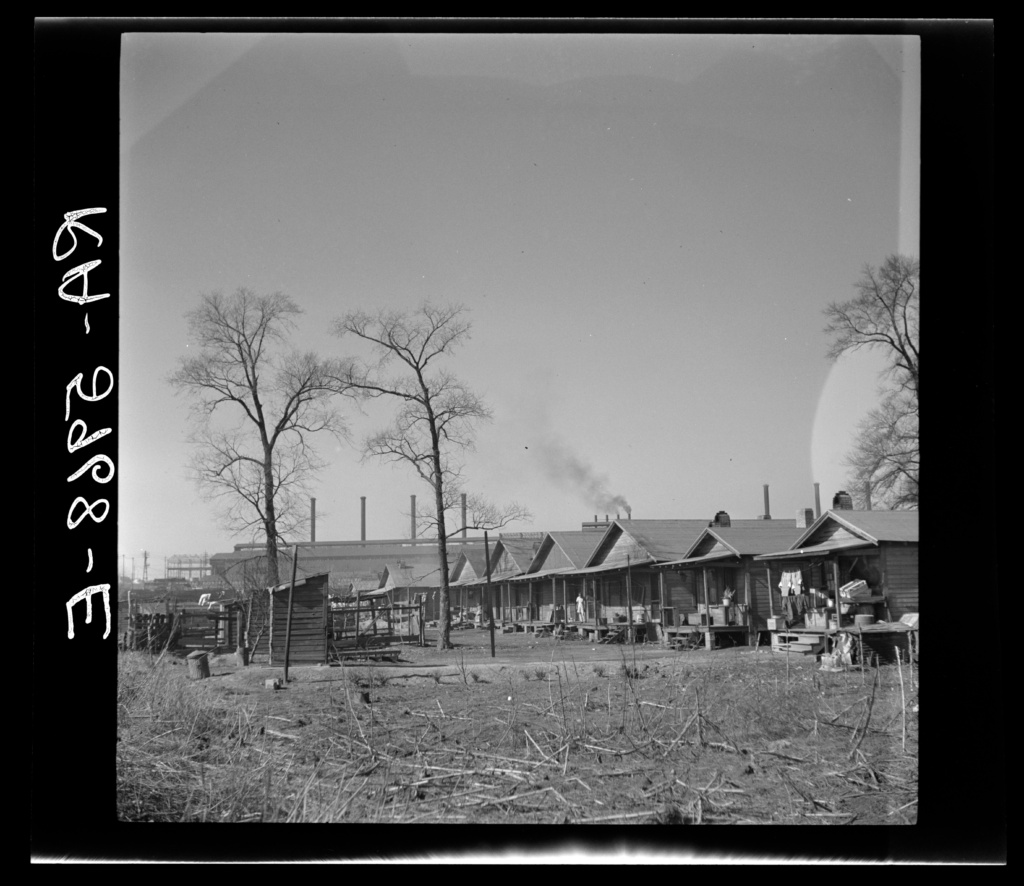
Housing conditions on the outskirts of a steel mill, Ensley, Alabama. Image via Library of Congress by Arthur Rothstein, 1937.
The promise of Alabama’s auto industry
Alabama’s development officials viewed the auto industry as an important way to replace the thousands of jobs lost in these declining industries with new good-paying jobs.[15] In fact, Americans have long perceived manufacturing jobs as being “good jobs.” As recently as 2014, “[n]ine out of ten Americans believe[d] that a strong manufacturing base is very important to our country’s standard of living.”[16] For decades, “[p]oliticians, economists, and other promoters [have] tout[ed] increased investment by manufacturers” when emphasis on “the benefits of direct and ‘value added’ industry cluster jobs flowing from manufacturing plants, and the overall economic boost that manufacturing jobs bring to local economies.”[17]
When the news broke that Mercedes was coming to Alabama in the early 1990s, “[t]he Vance plant [wa]s expected to create more than 10,000 jobs, most of which w[ould] come from support industries supplying parts, transportation, construction materials and services.”[18] In addition, in 1993, supporters touted Mercedes as having the potential over the next decade (by 2003) to increase jobs in the state by 15,000 to 17,000.[19] And the expectation was that by 2013, Alabama would witness “the creation of 4,375 jobs in manufacturing by Mercedes-Benz and its suppliers.”[20]
Within the manufacturing industry, motor vehicle and supply manufacturing historically has been the largest manufacturing sector, making up a significant portion of the nation’s economy.[21] In addition, the average salary of auto industry workers historically has “far outpaced other private-sector jobs.”[22] For example, during the mid-20th century, “the industry-wide average wage was roughly 30 percent higher than the average for the private-sector as a whole. It then rose relative to the private-sector average in the 1970s, peaking in the mid-1980s at more than 150 percent of the average private-sector wage.”[23]
Thus, when the opportunity arose for Alabama to go above and beyond other states in an attempt to woo auto manufacturers to the state in the 1990s, it is no surprise that “[e]xpectations [we]re high on the part of the state, local governments, and communities about employment, income, and revenue generation” that would follow if auto manufacturers came to our state.[24] In fact, in 1993, when Mercedes announced its decision to build a facility in Alabama, “[t]he average annual wage in the industry for hourly production workers [wa]s about $34,000.”[25] Put in context, the average annual pay in the United States in 1993 was only $26,361, and it was only $22,786 in Alabama.[26]
In August 1994, as thousands of Alabama residents began competing to fill available jobs at the Mercedes plant, “[u]p for grabs [we]re 1,500 jobs paying an estimated $12 to $18 an hour,”[27] or the equivalent of $24,960 to $37,440 annually. That same year, the average annual pay nationwide was $26,939, and in Alabama, it was only $23,616.[28] It is thus safe to assume that the people of Alabama expected that Mercedes jobs would be good-paying jobs that would help lift tens of thousands of Alabamians into the middle class.
Alabama bets big on the auto industry
To achieve these development goals and address the state’s broader economic challenges, Alabama’s policymakers – from Gov. Jim Folsom Jr. in 1993 to Gov. Kay Ivey today – have bet big on the auto industry with expensive economic development incentive packages and major expenditures of public funds.[29] For example, the state’s final bid to win Mercedes in 1993 included an estimated $253 million for total initial buildout, which also included “$8.7 million in waived sales and use tax revenues, a $600,000 fire station, $11 million worth of water and sewer improvements, $90 million in training costs and $50 million worth of highway work.”[30] This came to $293,000 for each projected job,[31] the largest package in Alabama history. A worker earning the state household median income would take more than five years to earn that amount. In 2000, the state offered Mercedes another round of incentives, worth $119 million, to support a $600 million expansion of the Vance plant.[32]
Beyond Mercedes, the state has invested a considerable amount in recruiting and expanding auto plants over the past 20 years.[33] Hyundai incentives for initial buildout were $90,000 per job in 2021 dollars.[34] Toyota’s initial incentives were $121,000 per job, and incentives for the 2021 plant totaled $700 million.[35][36] Honda’s initial incentives were $106,000 per job.[37]
As the major auto plants expanded, they received additional incentives.For example, in 2002, the Hyundai plant received $234.6 million in state and local incentives for the original plant location in Montgomery County.[38] And after the Montgomery plant was operational, the state granted an additional $59 million to Hyundai for a plant expansion.[39]
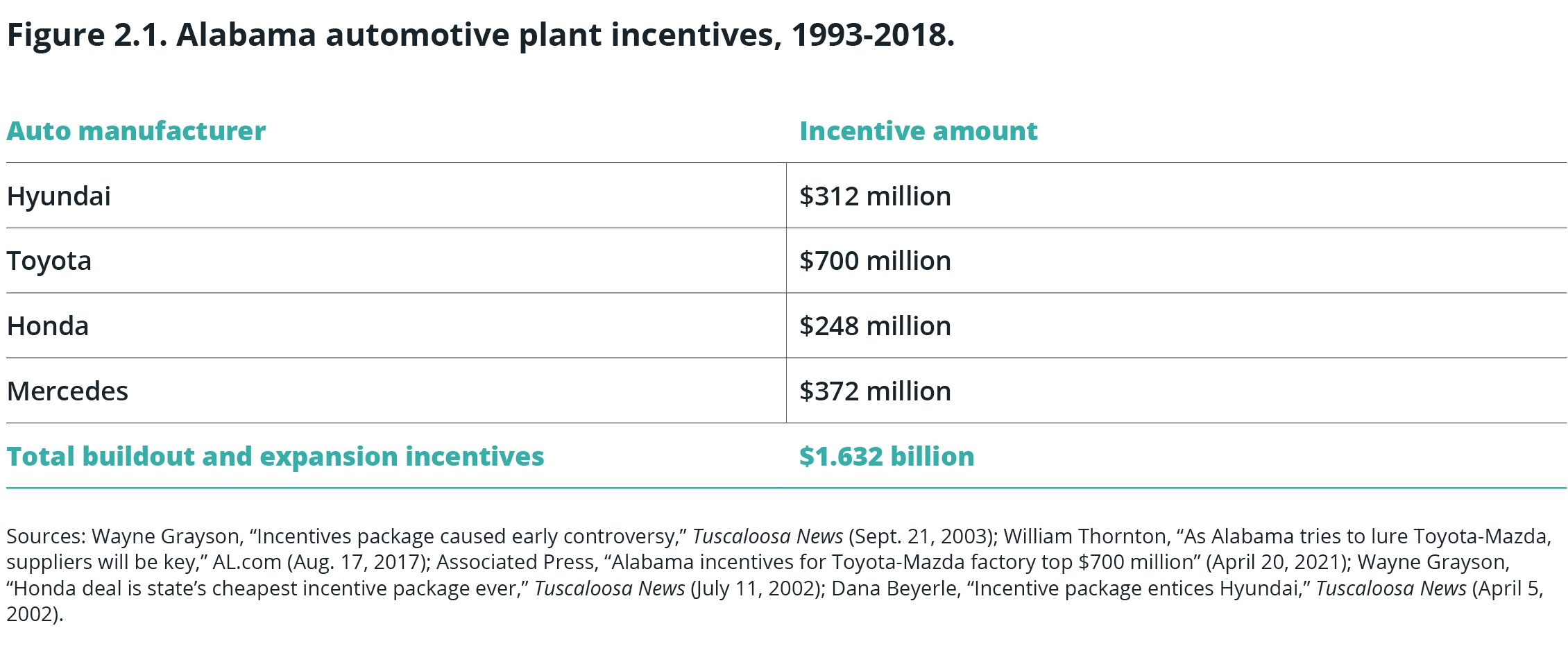
Over the years, the total incentive amounts for auto manufacturing plants have been well above $1.5 billion, as seen in Figure 2.1.
Figure 2.1. Alabama automotive plant incentives, 1993-2018. Sources: Wayne Grayson, “Incentives package caused early controversy,” Tuscaloosa News (Sept. 21, 2003); William Thornton, “As Alabama tries to lure Toyota-Mazda, suppliers will be key,” AL.com (Aug. 17, 2017); Associated Press, “Alabama incentives for Toyota-Mazda factory top $700 million” (April 20, 2021); Wayne Grayson, “Honda deal is state’s cheapest incentive package ever,” Tuscaloosa News (July 11, 2002); Dana Beyerle, “Incentive package entices Hyundai,” Tuscaloosa News (April 5, 2002).
The stakes remain high
Providing such large incentives was a big bet, and 30 years later, the stakes for Alabama are still high. Despite the influx of auto manufacturing jobs that have come to our state, Alabama remains a poor state.[40] Based on 2019 U.S. Census data, Alabama is the seventh poorest state in the nation and contains five of the nation’s 100 poorest counties.[41] The Alabama median family income also has long remained below the national average.[42] In 2021, the national annual median household income was approximately $71,000,[43] but in Alabama, it was just under $55,000.[44] More than 16% of Alabamians lived below the federal poverty line that year,[45] compared to 12% of the population nationwide.[46] Similarly, Alabama lags behind most other states in terms of overall health outcomes,[47] education quality and attainment,[48] child well-being[49] and overall equality.[50]
Given the stakes, how is the big bet on the auto industry paying off? Who in Alabama is benefiting most from the industry’s growth and strength? Workers? Or corporations?
Additional sections
Executive summary
Introduction
The ways the bet on auto benefited Alabama
A wheel in the ditch: Autoworkers see falling pay
A wheel in the ditch: Pay gaps and occupational segregation
A wheel in the ditch: Economic impact of falling wages and the pay gap
A wheel in the ditch: Working conditions worsen
The auto industry and Alabama’s low-road economic development approach
[24]Ellene Kebede & Mudiayi Sylvain Ngandu, “The Economic Impact of the Mercedes Benz Investment on the State of Alabama,”Journal of Agricultural and Applied Economics (Aug. 1999), https://ageconsearch.umn.edu/record/15385.
[27] David Rynecki, “Thousands vie for Mercedes jobs,”Birmingham Post-Herald (Aug. 16, 1994).
[28]U.S. Bureau of Labor Statistics, supra note 26.
[29] Peter Calcagno & Frank L. Hefner, “Economic Development Tax Incentives: A Review of the Perverse, Ineffective, and Unintended Consequences” (Jan. 3, 2018),https://ssrn.com/abstract=3173791. Excerpt from Adam J. Hoffer & Todd Nesbit, eds., For Your Own Good: Taxes, Paternalism, and Fiscal Discrimination in the Twenty-First Century (2018).
The auto industry plays a crucial role in Alabama’s economy.In many stakeholders’ views, the industry has benefited the state in the 30 years since Mercedes moved to town.State media outlets routinely report glowing headlines like:
“Alabama’s modern auto industry becomes state’s top export 25 years after its birth.”[51]
“Alabama’s auto industry looks to add more than 3,000 new jobs in wake of COVID.”[52]
Beyond the headlines, the auto industry’s enormous benefit to the state’s economy is clear. Today, Alabama is one of the top five states for auto manufacturing, producing 1.3 million cars and light trucks in 2022. That same year, Toyota, Honda and Hyundai combined to produce 1.5 million auto engines. As a result, auto vehicles are now Alabama’s top export, with sales to more than 70 nations totaling $9 billion to $10 billion.[54][55] In 2018 alone, Honda and its direct Tier 1 suppliers by themselvesgenerated more than $1 billion in earnings to Alabama households, accounted for $12 billion in annual economic impact and contributed 5.4% of Alabama’s entire GDP.[56]
Moreover, the industry continues to grow its footprint in Alabama. In 2021, the governor’s office reported 42 new auto industrial development projects, which promised to create 1,426 new jobs and $536,255,265 in new capital investment.[57] In addition, the Alabama Department of Commerce recently boasted thatthe state’s growing automotive supplier network, which now includes 150 major companies, created around 26,000 vehicles in 2021.[58][59]
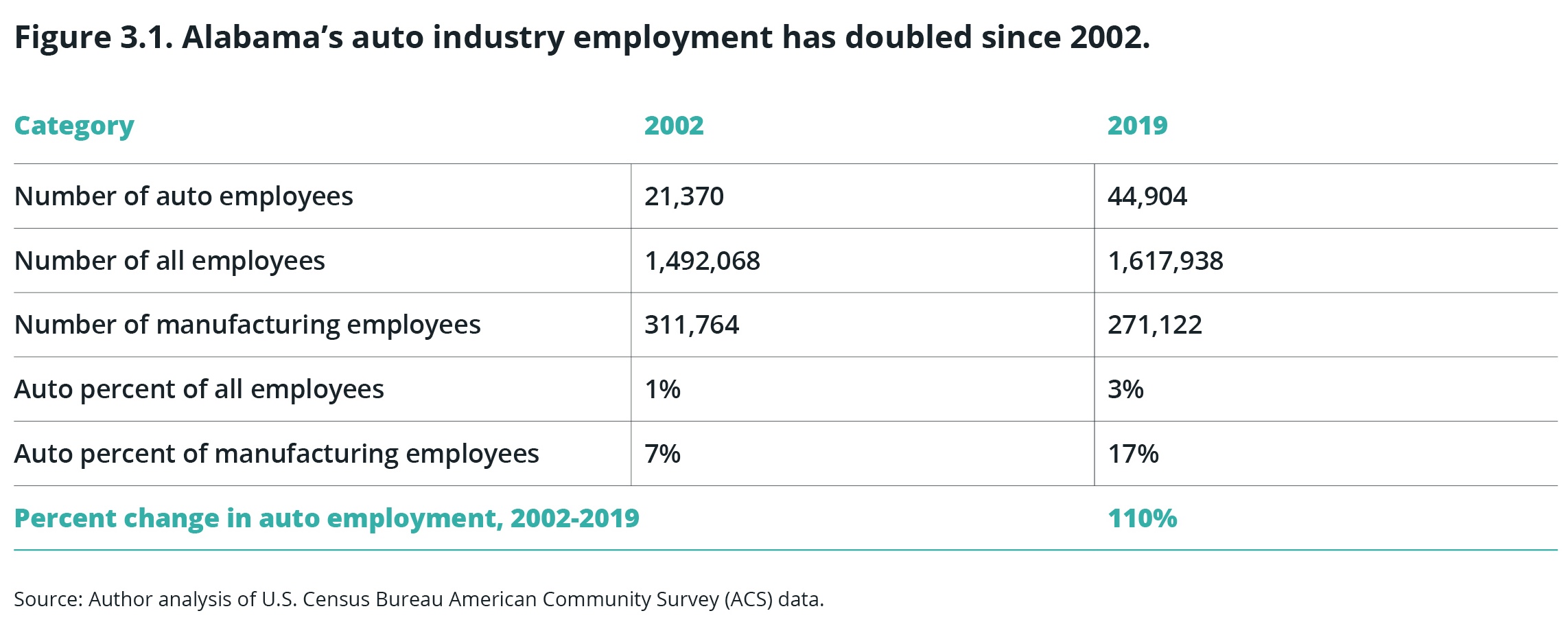
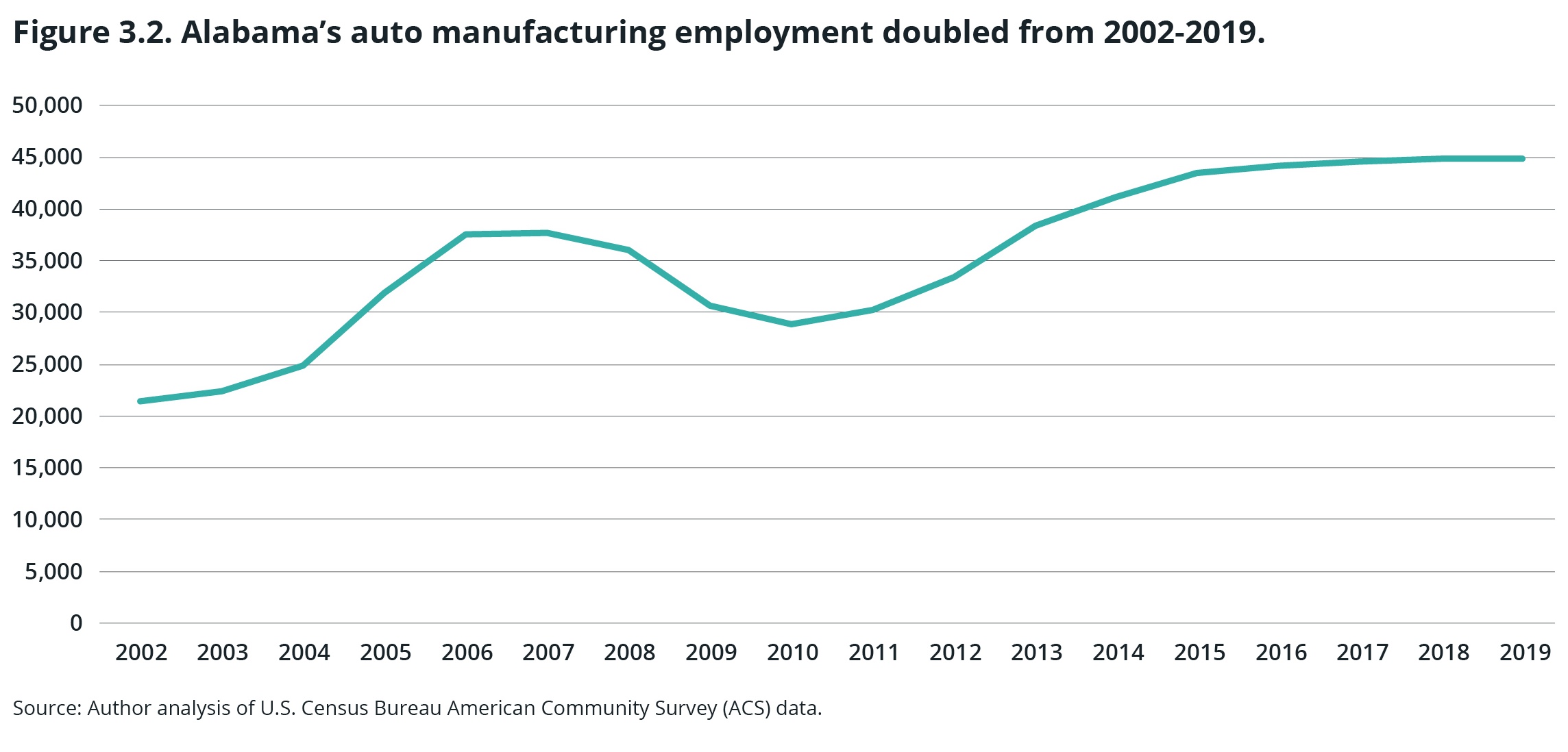
Alabama’s auto industry also has become a major employer. By the numbers, the auto industry is among Alabama’s five largest employers, with 44,904 workers on payroll in 2019.That means about one in every six Alabamians working in the manufacturing sector are employed in the auto industry. (See Figure 3.1.) Even more importantly, the auto industry has seen exceptional growth over the past 20 years, more than doubling the number of employees between 2002 and 2019. This occurred despite the economic damage wrought by the Great Recession, which significantly reduced demand for cars and trucks. (See Figure 3.2.) As Figure 3.1 shows, Mercedes locating in Alabama more than fulfilled the expectations of leaders and community members in 1993.The goal of reaching 15,000 to 17,000 jobs by 2003 was met early.
Figure 3.1. Alabama’s auto industry employment has doubled since 2002. Source: Author analysis of U.S. Census Bureau American Community Survey (ACS) data.
Figure 3.2. Alabama’s auto manufacturing employment doubled from 2002-2019. Source: Author analysis of U.S. Census Bureau American Community Survey (ACS) data.
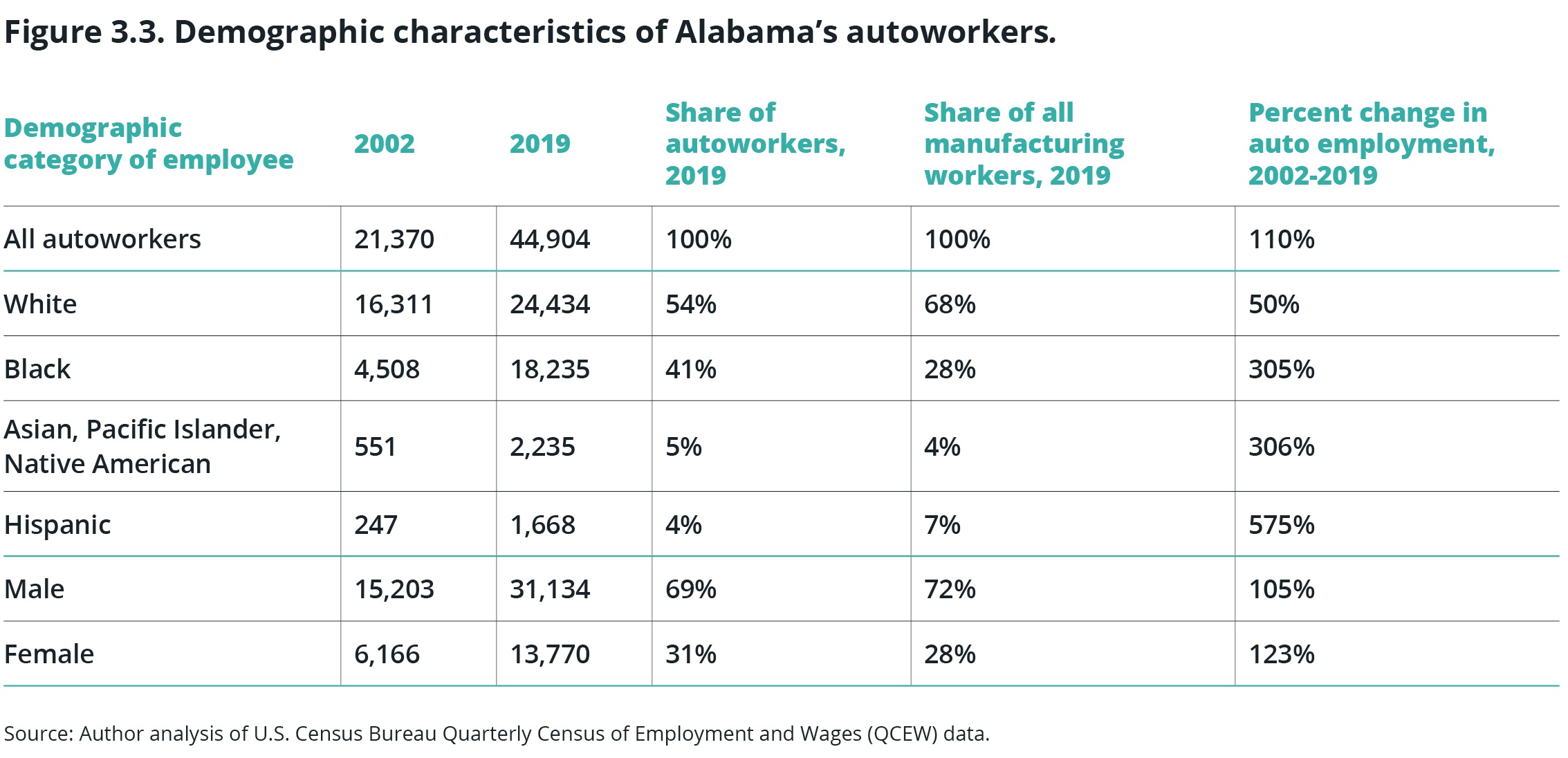
Alabama’s auto industry also has a more demographically diverse workforce than the state’s manufacturing sector as a whole. As seen in Figure 3.3, Black workers account for 41% of those employed in the auto industry, compared to a little more than a quarter of all manufacturing employees. In addition, women make up 31% of the auto industry workforce, compared to only 28% in the manufacturing sector overall.
Moreover, these trends are improving, thanks to targeted hiring and training efforts across Alabama’s auto industry. Examples include customized programs spearheaded by Alabama Industrial Development Training (AIDT), Alabama’s workforce training agency;[60] the creation of Apprenticeship Alabama (designed to provide classroom instruction and on-the-job training);[61][62] the creation of AlabamaWorks (a workforce development partner);[63][64] and the creation of the Alabama Robotics Technology Park (a facility that trains auto manufacturing and other industry workers).[65][66] In a sign of this improvement, Black employment in the auto industry has quadrupled in size since 2002. That is a 305% growth rate, compared to the 50% increase in white auto employment. Over the same period, Hispanic auto employment has grown by 575%, and the number of women in the auto workforce has grown by 123%. (See Figure 3.3.)
Figure 3.3. Demographic characteristics of Alabama’s autoworkers. Source: Author analysis of U.S. Census Bureau Quarterly Census of Employment and Wages (QCEW) data.
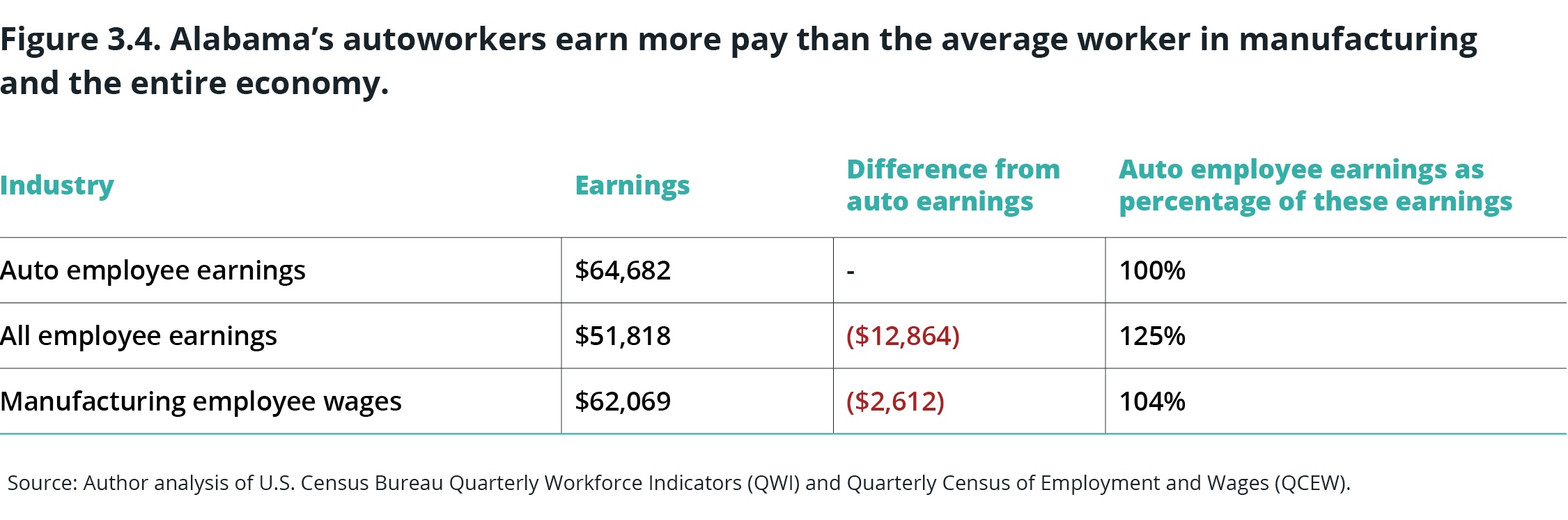
Not only does Alabama’s auto industry provide a large number of jobs for state residents, it also generally provides good-paying jobs (though this is becoming less true over time; see Section 4). As seen in Figure 3.4, Alabama’s auto industry pays more than jobs in both the broader state economy and in the state’s manufacturing sector. The average autoworker in Alabama earns 25% more than the state’s average worker and 4% more than the average manufacturing worker.
Bottom line:As anticipated when they were first recruited to locate in Alabama, the auto industry pays Alabama workers better wages than they could earn in other parts of the economy. These wages are a significant contributor to a rise in state manufacturing wages over the past 20 years.[67]
Figure 3.4. Alabama’s autoworkers earn more pay than the average worker in manufacturing and the entire economy. Source: Author analysis of U.S. Census Bureau Quarterly Workforce Indicators (QWI) and Quarterly Census of Employment and Wages (QCEW).
The auto industry anchored Alabama’s economic transformation
Aside from these direct benefits, the auto industry also has played a crucial role in galvanizing Alabama’s long-term economic transformation. In the 1970s and 1980s, Alabama’s core industrial sectors – mostly steel, textiles, coal mining and paper manufacturing – entered long-term decline, with several important regional employers shuttering their facilities and moving their jobs to lower-cost locations in developing nations.
This shift was particularly noticeable considering western Jefferson and eastern Tuscaloosa counties’ economic reliance on mining in multiple communities.[68] Throughout the 1980s and 1990s, the mining industry was drastically reducing manpower nationally. Mining companies reduced the industry’s workforce by more than 25% in the 1980s, with coal mining losing 46% of workers.[69] Communities throughout Alabama felt the pain of sector-wide economic contraction, and officials sought substitute industries that could soften the blow and prevent population decline and consequent community damage. Passage of the North American Free Trade Agreement (NAFTA) in 1994 accelerated these trends, especially for steel and textiles.
When Mercedes announced it was considering Alabama for its first North American auto facility in 1993, state economic development officials hoped to use the German car manufacturer as an anchor to transition Alabama’s economy toward more advanced manufacturing – and the higher-wage, higher-skilled jobs that come with it. They also hoped to revitalize struggling coal and textile communities in Jefferson and Tuscaloosa counties.
Thirty years after the first M-Class rolled off the assembly lines in Vance, it’s clear that these hopes have become reality. For years, Alabama has been able to refer to itself as the “center of the Southeast’s auto industry” and the “Detroit of the South.”[70] Just a few years after Mercedes opened its first plant in the state, Honda followed suit (2001), followed by Hyundai (2005), as well as many auto parts manufacturers, including Toyota.[71] As a result of the state’s industrial transformation, companies in the broader manufacturing sector have been able to count on availability of a trained and capable workforce in advanced manufacturing, including the aerospace sector. For example, certainty of the state’s workforce availability was a motivating factor in Airbus’ choice of Mobile for a major plant investment: “We never had a doubt we’d find the skilled workforce we need to produce our aircraft.”[72]
Additional sections
Executive summary
Introduction
The high stakes and big bet on Alabama’s auto industry
A wheel in the ditch: Autoworkers see falling pay
A wheel in the ditch: Pay gaps and occupational segregation
A wheel in the ditch: Economic impact of falling wages and the pay gap
A wheel in the ditch: Working conditions worsen
The auto industry and Alabama’s low-road economic development approach
Auto plants in Alabama have made a significant contribution to the state’s economy. But the big bet and significant investment in the form of corporate subsidies has only partly paid off. This is in part because the state’s weak worker protections have not mandated employment standards that would ensure better work conditions and equitable pay for workers despite gender or race. Below the surface of rosy sales and profit figures and flattering media profiles about the industry, Alabama’s autoworkers have lived through a long-term decline in wages and earnings, stunning gaps in pay across racial and gender lines, and deteriorating conditions on some shop floors. Taken together, the ways the auto industry has failed to live up fully to the hopes and promises of 1993 have cost Alabama’s workers and the overall state economy tangibly and measurably.
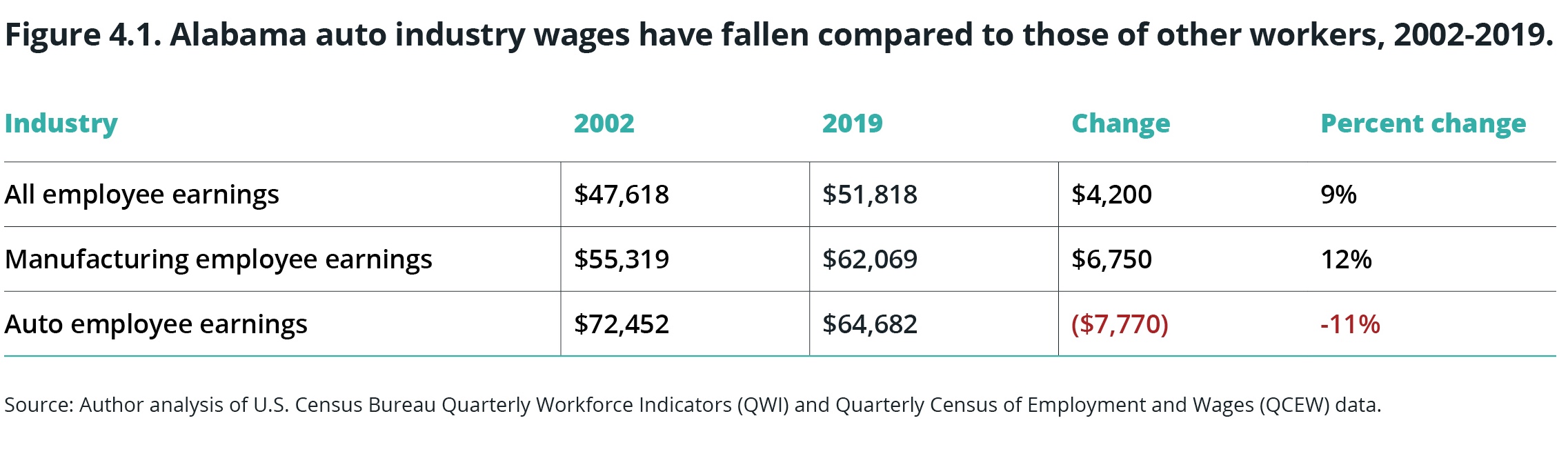
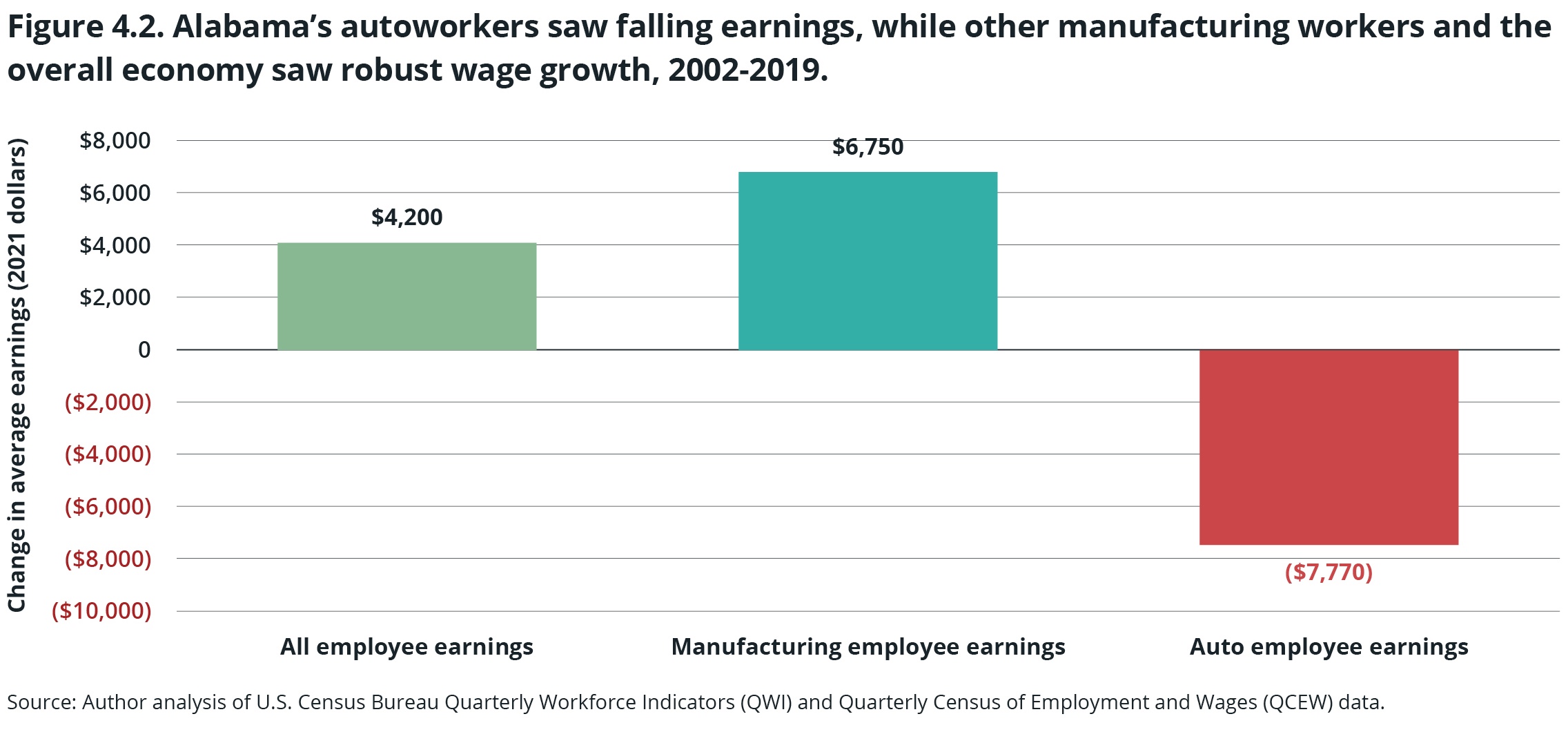
Most critically, Alabama’s autoworkers have lived through a significant and long-term decline in pay and earnings over the past 20 years. To be precise,autoworkers’ real wages (when adjusted for inflation) have fallen by $7,700 since 2002 – an 11% drop. (See Figures 4.1 and 4.2.) Despite rising profits for the auto companies and robust economic growth in the years following the Great Recession, Alabama’s autoworkers are earning less than they did a generation ago, while the cost of living and inflation have continued to rise.
Figure 4.1. Alabama auto industry wages have fallen compared to those of other workers, 2002-2019. Source: Author analysis of U.S. Census Bureau Quarterly Workforce Indicators (QWI) and Quarterly Census of Employment and Wages (QCEW) data.
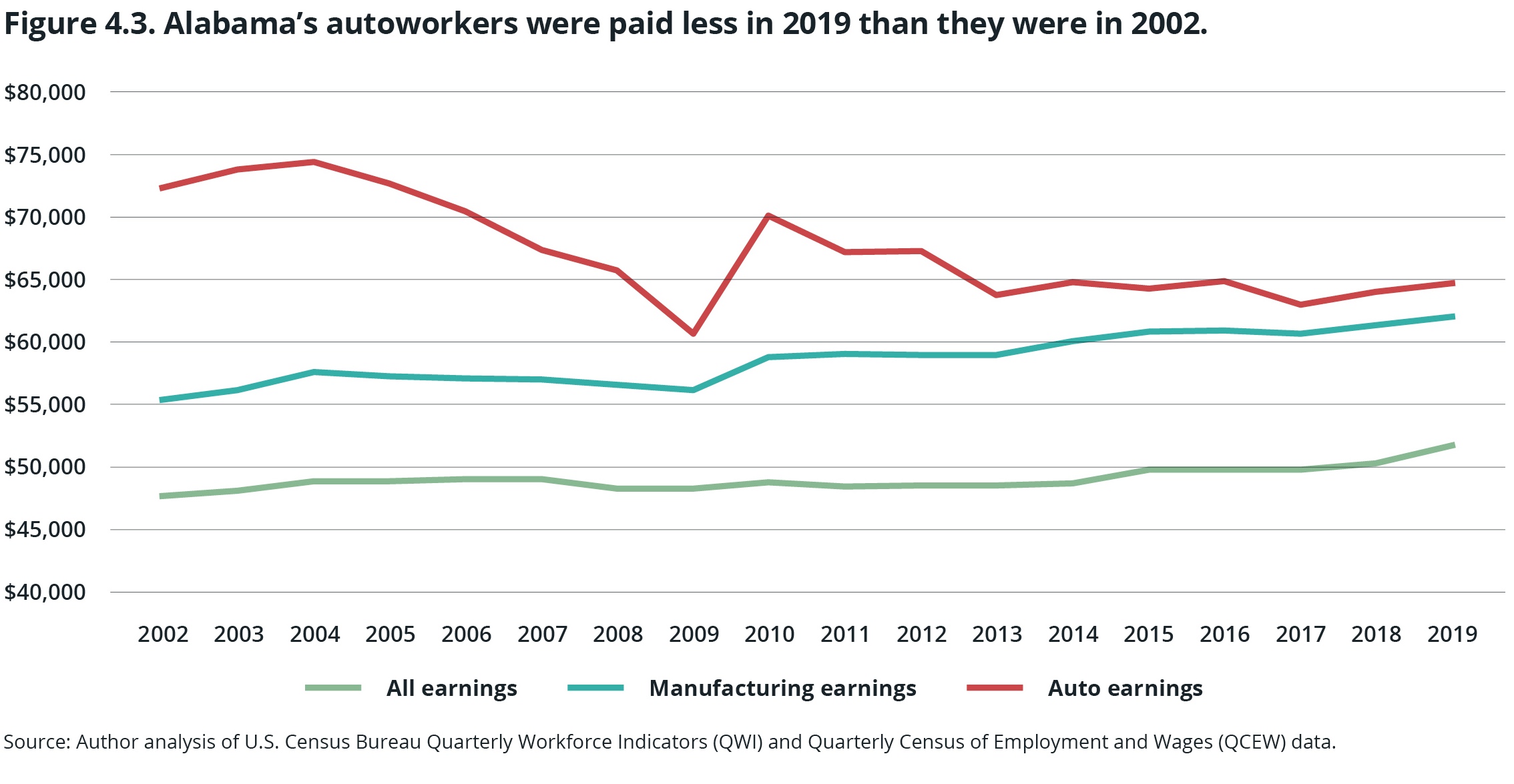
This precipitous drop in auto wages is especially stark compared to the wage growth seen by workers in the rest of Alabama’s economy. While the auto industry indeed still pays its workers a higher wage than they can earn in the rest of the economy, other industries – especially manufacturing – are catching up, thanks in large part to the drop in autoworker pay over the past 20 years. (See Figures 4.2 and 4.3.) At the same time as auto wages fell by $7,700, Alabama workers in the overall economy saw their wages rise by $4,200, and those employed in the broader manufacturing sector saw them rise by $6,750.
In the early years, the auto industry paid its workers a significant wage premium compared to the rest of the economy. For example, the average Alabama autoworker earned $72,452 in 2002 – about $25,000 more than what the average worker earned in the state economy that year ($47,618) and $17,000 more than what the average manufacturing worker earned ($55,319).
Yet by 2019, the autoworker wage premium shriveled, as the auto industry’s wages declined and other industries began to pay more. In 2019, Alabama’s autoworkers earned $64,682 – just $2,600 more than the average manufacturing worker in the state.
Figure 4.2. Alabama’s autoworkers saw falling earnings, while other manufacturing workers and the overall economy saw robust wage growth, 2002-2019. Source: Author analysis of U.S. Census Bureau Quarterly Workforce Indicators (QWI) and Quarterly Census of Employment and Wages (QCEW) data.Figure 4.3. Alabama’s autoworkers were paid less in 2019 than they were in 2002. Source: Author analysis of U.S. Census Bureau Quarterly Workforce Indicators (QWI) and Quarterly Census of Employment and Wages (QCEW) data.
Autoworkers get paid less in Alabama than in the nation as a whole
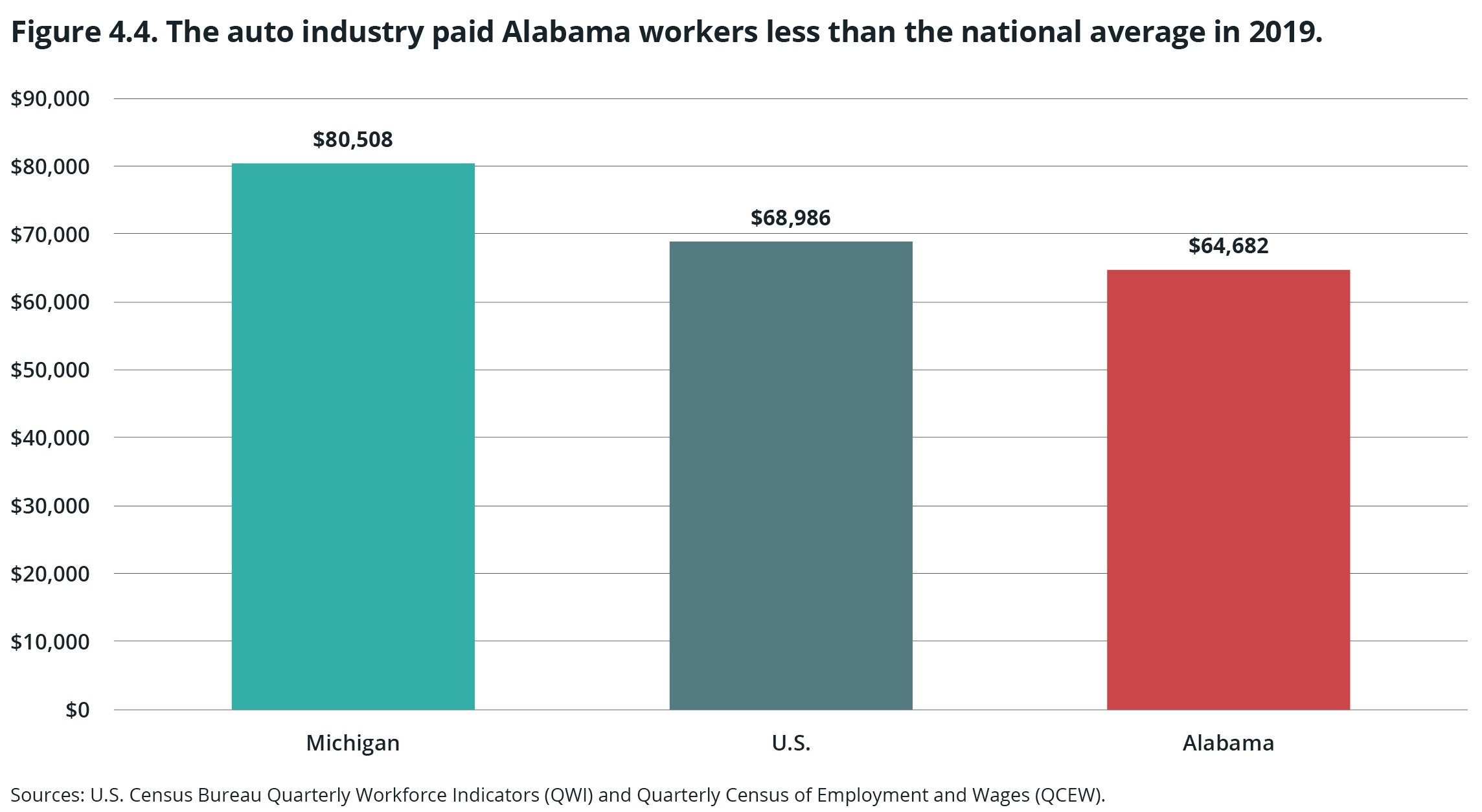
Not only are Alabama’s autoworkers getting paid less than they did 20 years ago, but they also continue to earn less than other autoworkers across the rest of the country. In 2019, Alabama’s auto plants paid their employees about $4,200 less in annual wages for the year than the national average of $68,896 – an earnings gap that’s remained largely consistent over the past 20 years. Compared to the traditional auto manufacturing heartland of Michigan, the pay gap looks even more glaring. Alabama’s autoworkers earned nearly $16,000 less in 2019 than those in Michigan. (See Figure 4.4.)
Figure 4.4. The auto industry paid Alabama workers less than the national average in 2019. Sources: U.S. Census Bureau Quarterly Workforce Indicators (QWI) and Quarterly Census of Employment and Wages (QCEW).
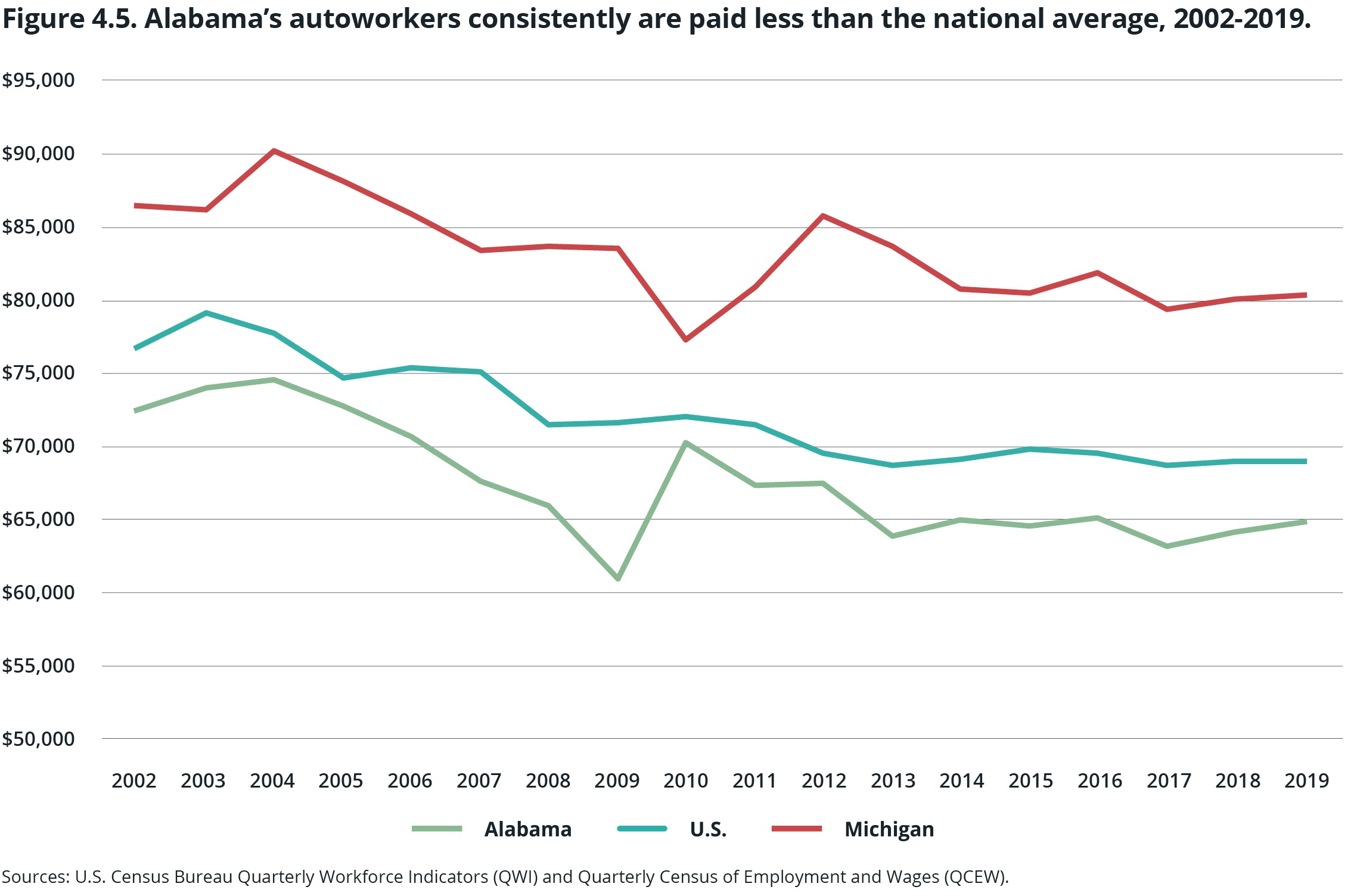
Taking a historical view, Alabama’s autoworkers have been living with these geographic pay gaps for 20 years. They’ve never earned the national average or close to heartland wages for their work in Alabama’s auto plants. (See Figure 4.5.) Magnifying the challenge, the auto industry has cut worker wages across the country as part of long-term disinvestment in labor over the past 20 years, trapping Alabama’s autoworkers in this national trend of labor disinvestment and declining pay. A range of factors have contributed to this industry-wide wage decline, including restructuring of the American auto industry after 2009, shifts in overall compensation packages (especially health insurance), and collective bargaining agreements that changed the entry-level wage for new auto employees.[73]
Figure 4.5. Alabama’s autoworkers consistently are paid less than the national average, 2002-2019. Sources: U.S. Census Bureau Quarterly Workforce Indicators (QWI) and Quarterly Census of Employment and Wages (QCEW).
But the bottom line for Alabama’s workers is clear: Their wages keep shrinking. And because Alabama’s auto employees started out earning lower wages ($72,452 in 2002) than their average national counterparts ($76,785) or heartland autoworkers ($86,711), these earnings losses have hit Alabamians harder, leaving them with less money to cover the rising costs of living.
Auto wages fall while corporate profits rise
Alabama’s autoworkers have seen 20 years of declining wages while, at the same time, auto companies are experiencing record profitability. In 2019, the average employee in an Alabama auto plant earned 11% ($7,700) less per year than in 2002. This disconnect between worker productivity and pay impacts every worker across Alabama’s auto industry.
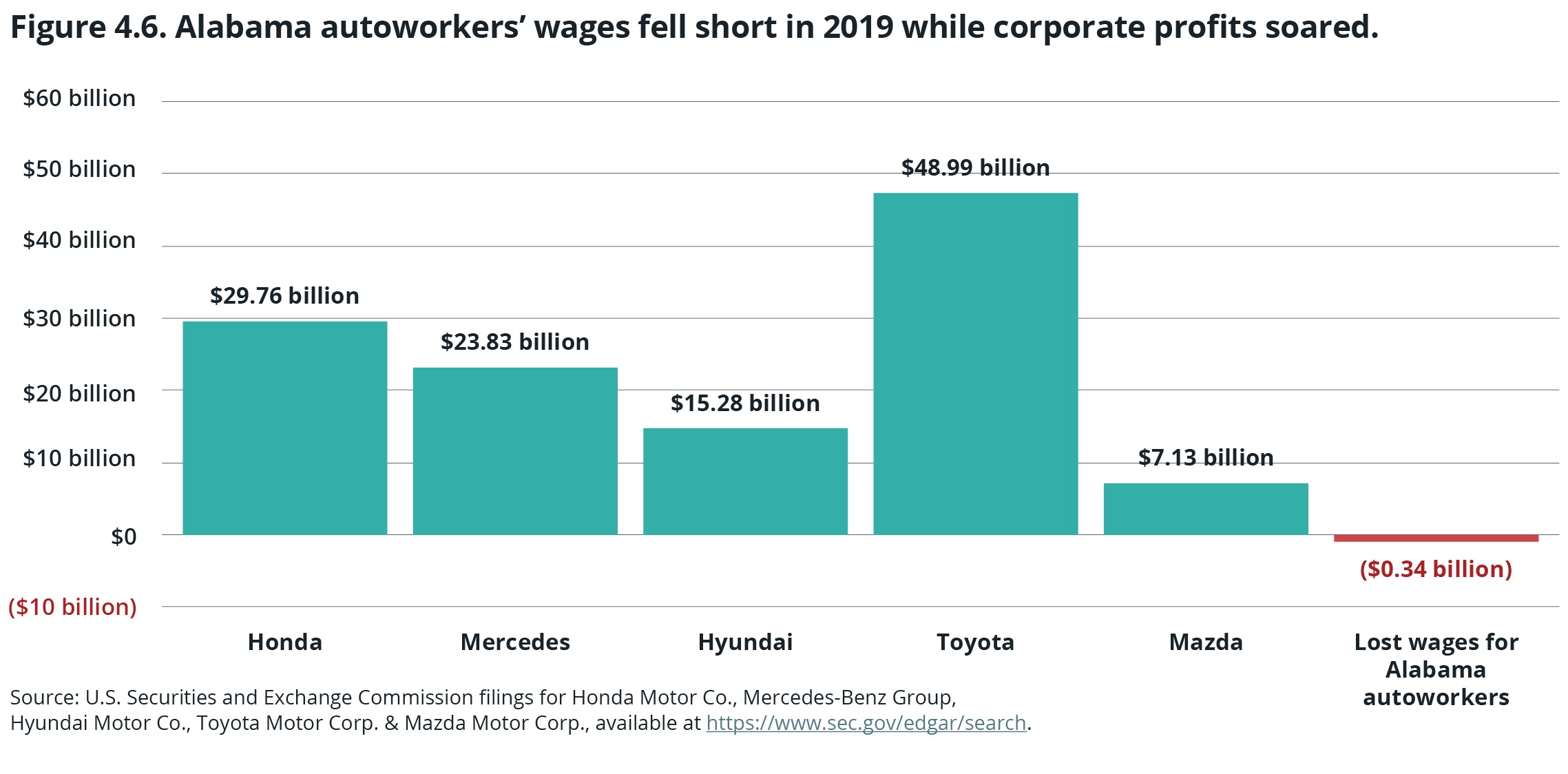
Adding together the average $7,700 in earnings lost by each of Alabama’s 44,904 auto employees translates into a total of $349 million in missing wages in 2019 alone. These are wages that could have gone into the pockets of Alabama autoworkers and their families but instead were extracted from the state’s economy.
Even more troubling, these missing wages came at a time when Alabama’s auto industry continued to experience record profitability. In 2019, Alabama’s five biggest auto manufacturers – Honda, Mercedes, Hyundai, Toyota and Mazda – together earned more than $127 billion in profits globally. Given profits of this magnitude, it seems reasonable to ask why automakers didn’t pay Alabama workers at least what they were making 20 years before. After all, $349 million in missing wages is a comparative drop in the bucket with profits like these. Paying Alabama’s autoworkers the same rate they made in 2002 would have equated to less than 0.3% of these companies’ profits.
Shortly before this report went to print, Honda, Hyundai and Toyota announced wage increases at their plants. This move came after the United Auto Workers negotiated substantial pay increases with Detroit automakers. These improvements are a good start and should serve as the foundation for further increases. These pay increases also show that wins for unionized workers help raise the standard for worker treatment across the sector.
Figure 4.6. Alabama autoworkers’ wages fell short in 2019 while corporate profits soared. Source: U.S. Securities and Exchange Commission filings for Honda Motor Co., Mercedes-Benz Group, Hyundai Motor Co., Toyota Motor Corp. & Mazda Motor Corp., available at https://www.sec.gov/edgar/search.
Additional sections
Executive summary
Introduction
The high stakes and big bet on Alabama’s auto industry
The ways the bet on auto benefited Alabama
A wheel in the ditch: Pay gaps and occupational segregation
A wheel in the ditch: Economic impact of falling wages and the pay gap
A wheel in the ditch: Working conditions worsen
The auto industry and Alabama’s low-road economic development approach