The State of Working Alabama 2023 – Section 5: A wheel in the ditch — Pay gaps and occupational segregation

State of Working - Section 5

Alongside the 20-year decline in earnings paid to workers, Alabama’s auto companies also are falling short by paying staggeringly unequal wages across race and gender lines. Men earn significantly more than women, and white workers earn significantly more than Black and Hispanic workers. These pay gaps are driven largely by occupational segregation: the fact that Black, Hispanic and female workers are disproportionately employed in lowerwage occupations within the auto industry than white workers and men, who tend to be over-concentrated in higher-wage occupations.

Men and white workers earn more than women and workers of color

Alabama has stunning gaps in pay between white autoworkers and autoworkers of other races, as seen in Figure 5.1. In 2019, white autoworkers earned an average $68,595, almost $12,000 more than Black autoworkers and $15,000 more than Hispanic autoworkers. As a result, a Black autoworker earns on average 83 cents for every dollar earned by a white autoworker. For Hispanic autoworkers, it’s 78 cents for every dollar earned by a white autoworker.
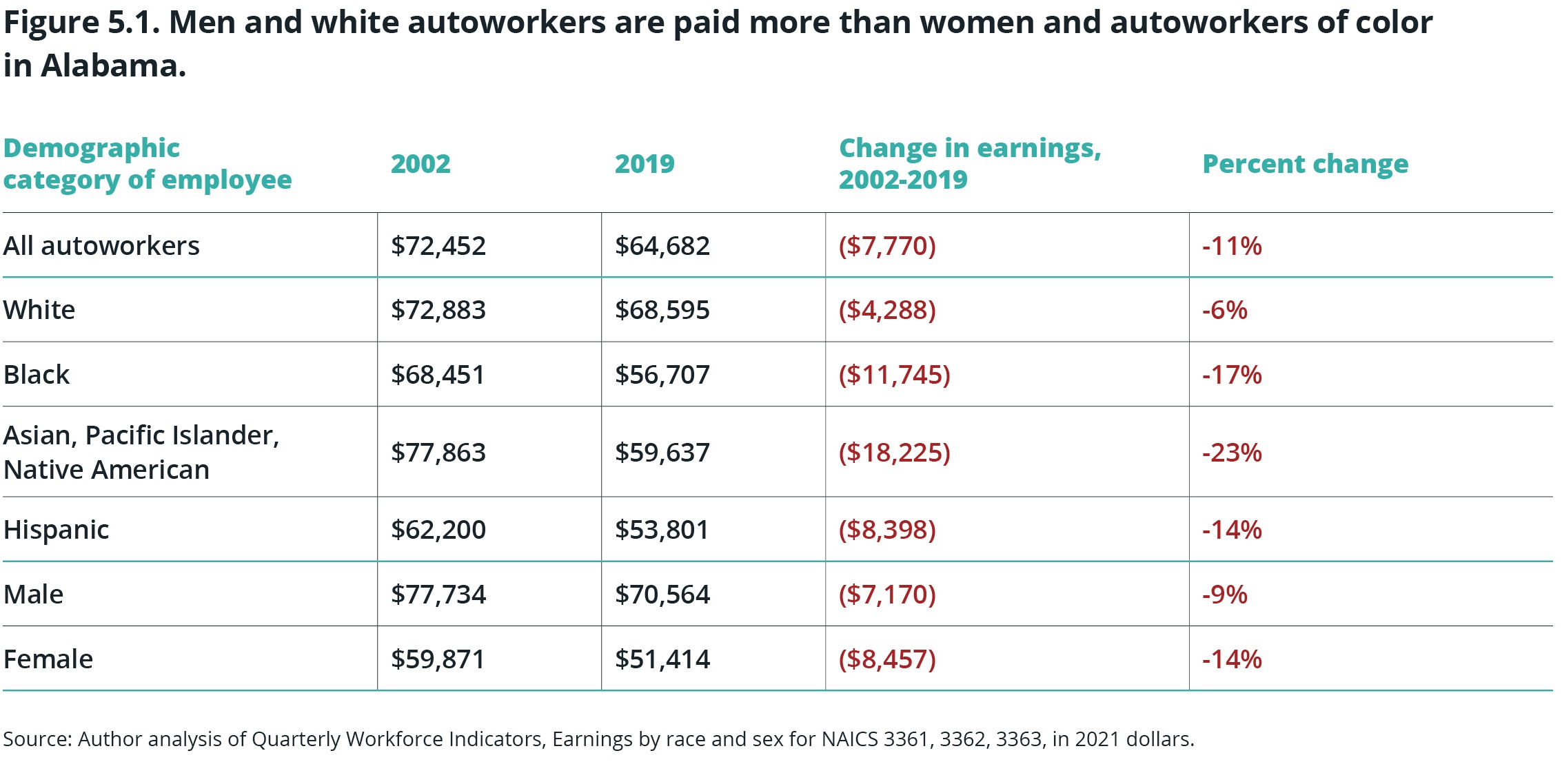
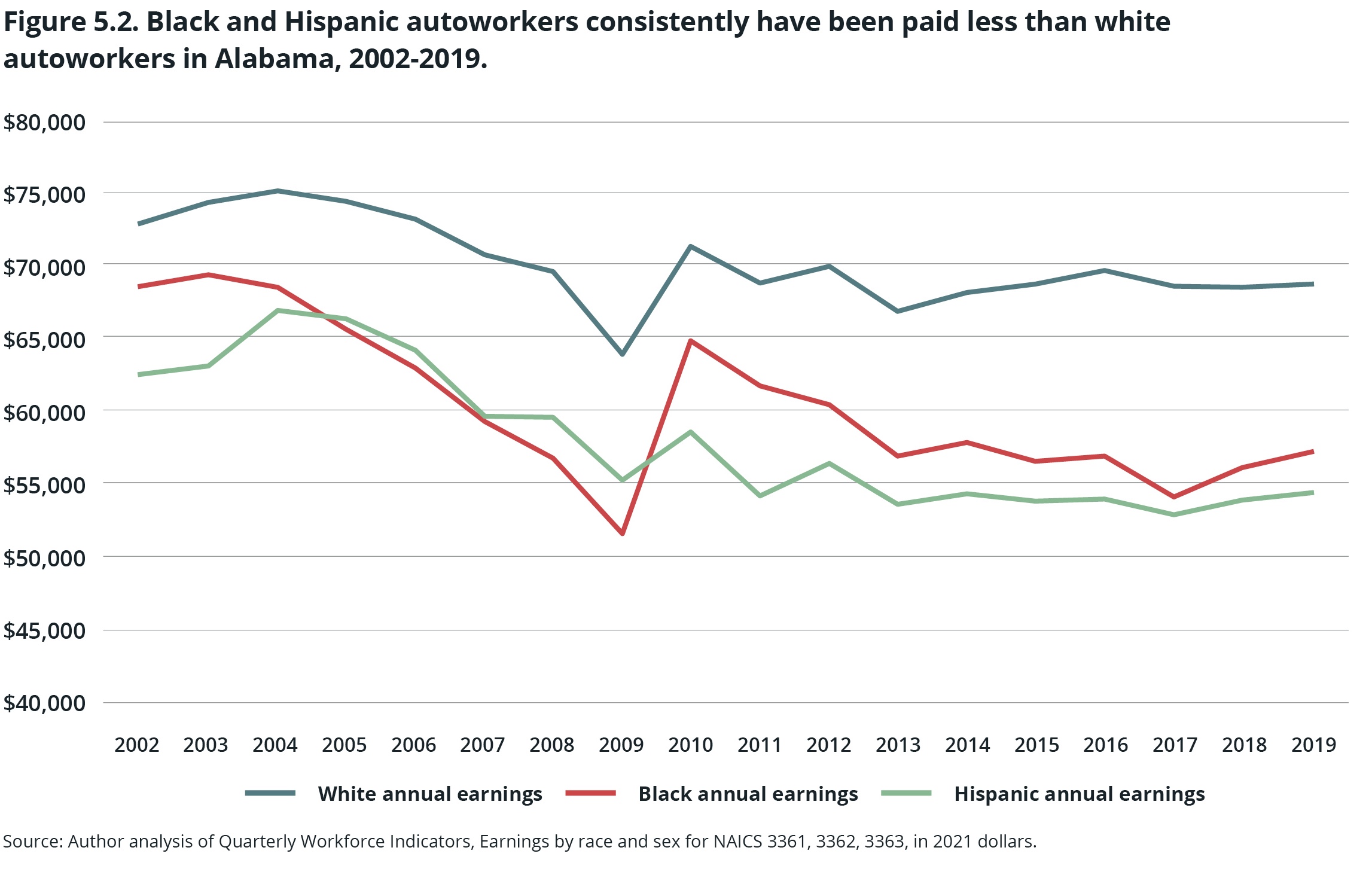
Figure 5.1. Men and white autoworkers are paid more than women and autoworkers of color in Alabama. Source: Author analysis of Quarterly Workforce Indicators, Earnings by race and sex for NAICS 3361, 3362, 3363, in 2021 dollars.
Figure 5.2. Black and Hispanic autoworkers consistently have been paid less than white autoworkers in Alabama, 2002-2019. Source: Author analysis of Quarterly Workforce Indicators, Earnings by race and sex for NAICS 3361, 3362, 3363, in 2021 dollars.

Even more troubling, wages for Black and Hispanic autoworkers have declined further and faster than wages for white autoworkers since 2002. While white workers earn $4,288 on average less today than they did 20 years ago (a 6% drop), Hispanic workers in the industry have seen their wages drop by an average of $8,398 (a 14% decline). Black autoworkers on average lost almost $12,000 in earnings since 2002 (a 17% decline). So not only do they earn less than white workers today, but these workers of color also have lost significantly more pay over the past 20 years than their white counterparts.[74]

The auto industry is paying men and women significantly different wages, too. In 2019, the state’s auto companies paid men an average annual wage of $70,564 – almost $20,000 more than the $51,414 average annual wage they paid women. As a result, women earned just 73 cents for every dollar earned by men. Unfortunately, women’s pay is also dropping faster than men’s. In 2019, women earned on average $8,457 less than they did in 2002 – a 14% drop. By contrast, men’s auto wages fell by 9% over the same period.

Occupational segregation drives racial and gender pay gaps in the auto industry

As in Alabama’s overall economy, the state’s auto industry is highly segregated by race and sexOccupational segregation occurs when workers in one racial or gender group are overrepresented or underrepresented in a particular occupation or job role compared to their share of the broader population of industry employees. When one group is persistently overrepresented in high-wage occupations, while another group is overrepresented in low-wage occupations and underrepresented in high-wage occupations, we can say there is a clear pattern of occupational segregation.

Unfortunately, Alabama’s auto industry displays a pattern of deep and pervasive occupational segregation. White workers and men are generally overrepresented in the highest-wage occupations, while Black workers and women are more heavily concentrated in the industry’s lowest-paying occupations. A stubborn legacy from the era of legalized discrimination and industrialization across the South, this pattern of occupational segregation among auto employees is likely still the driving force behind the pervasive unequal pay between white workers and Black workers and – to a lesser but still meaningful extent – between men and women in the industry.[75]

By the numbers, white workers dominate the highestwage occupations in the auto industryespecially first-line supervisors, who earn on average $91,805 every year. While they account for barely half of workers in the industry, white employees make up 63% of higher-paid supervisors and executives. The welding and soldering occupation (which pays an average of $65,128 every year) tells a similar story. White workers account for 54% of these jobs.

Black workers are significantly underrepresented in the better-paid supervisor occupation, making up 35% of those employees. In addition, as seen in Figure 5.3, they are also increasingly overrepresented in the lowest-paid occupations, which earn below the industry average ($64,682 a year). Black workers account for 41% of all autoworkers, but make up:

  • 58% of inspectors and weighers, who earn on average $60,450 a year.
  • 62% of miscellaneous assemblers and fabricators, who earn an average $53,401 a year.
  • 59% of general laborers, who earn on average $52,612 a year.
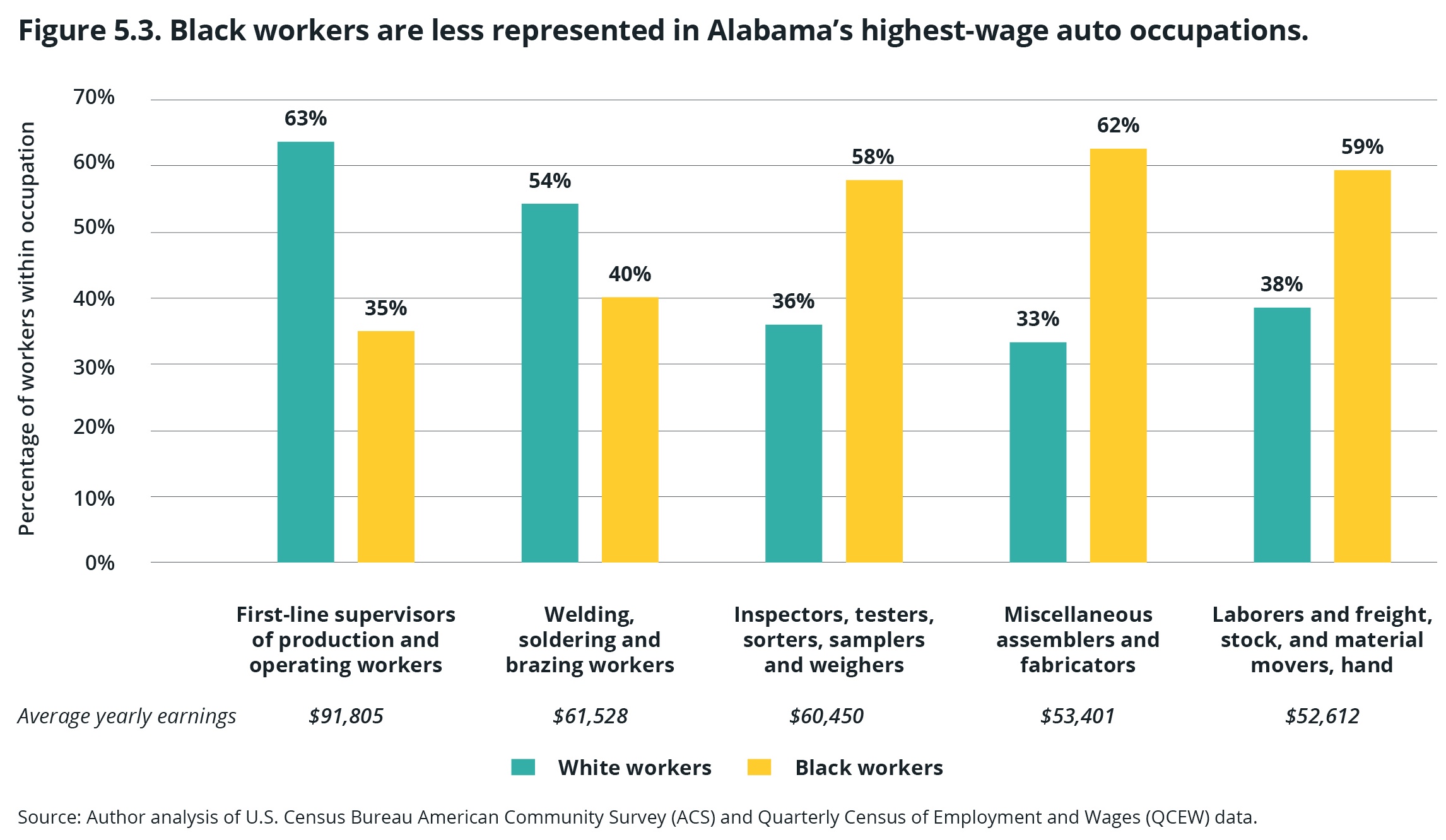
Figure 5.3. Black workers are less represented in Alabama’s highest-wage auto occupations. Source: Author analysis of U.S. Census Bureau American Community Survey (ACS) and Quarterly Census of Employment and Wages (QCEW) data.

Women in the auto industry face a broadly similar challenge with occupational segregation. As seen in Figure 5.4, roughly one out of every three autoworkers in Alabama is a woman, yet women account for almost half of all employees in two occupations that pay below-average wages – inspectors and weighers; and miscellaneous assemblers – and more than 35% of general laborers, stock and material movers, the lowestpaid occupation in the auto industry. Complicating the picture slightly, women are overrepresented in the highest-wage occupation, first-line supervisorswhich is a positive sign. But they are significantly underrepresented in the second highest-paying occupation, welding, where they account for just 18% of employees.

In short, women are clustered mostly in lowerwage occupations, but as the industry hires more women in the coming years, an opportunity exists to move them into higher-earning roles within each company. Certainly, the industry should view with concern the fact that female autoworkers earn just 73 cents for every dollar earned by a man in the industry.
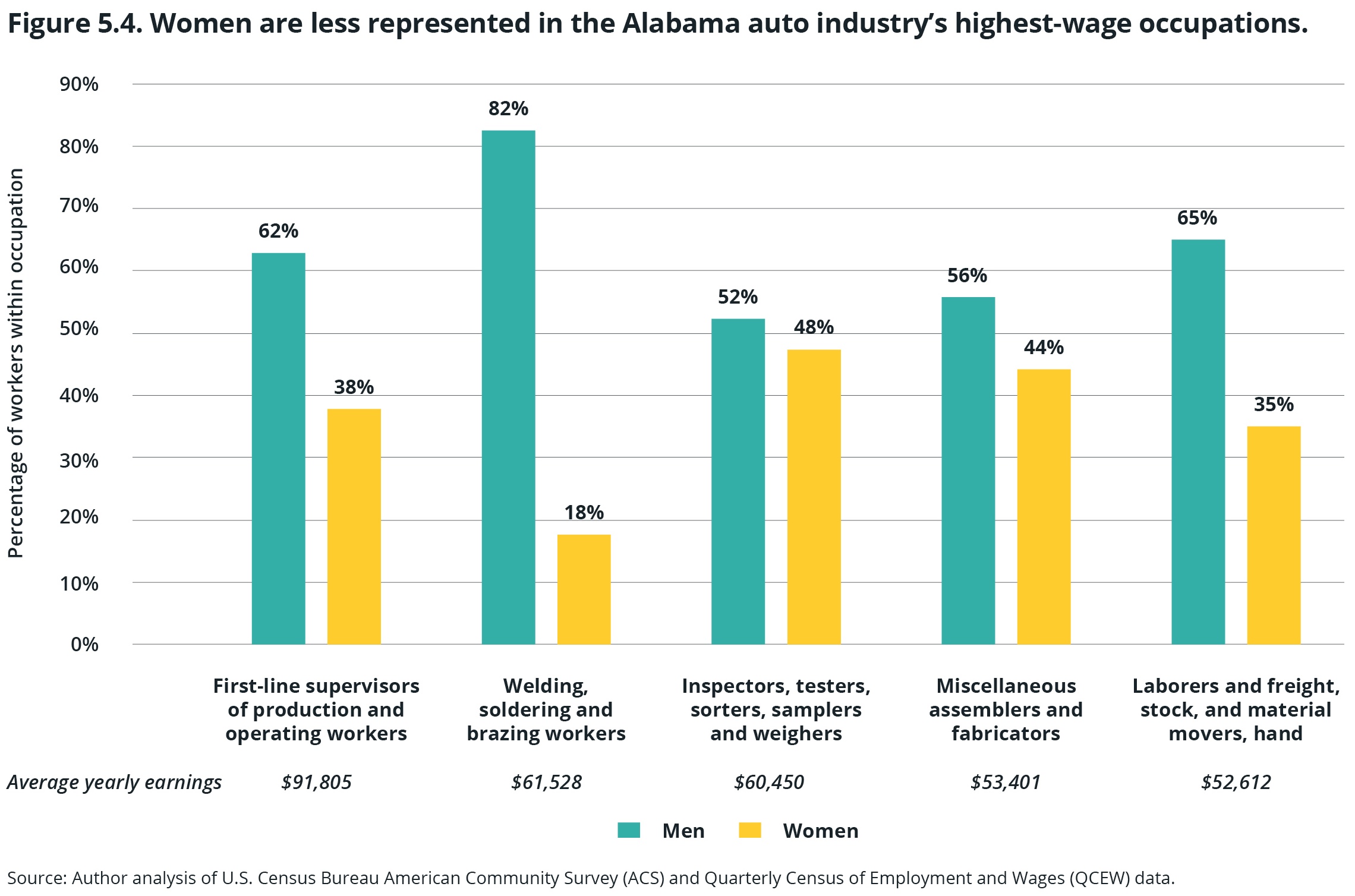
Figure 5.4. Women are less represented in the Alabama auto industry’s highest-wage occupations. Source: Author analysis of U.S. Census Bureau American Community Survey (ACS) and Quarterly Census of Employment and Wages (QCEW) data.

Historical origins of occupational segregation and the auto industry wage gap

Why are women and Black workers in Alabama’s auto industry today living with this kind of occupational segregation when the era of legalized racial and gender discrimination ended half a century ago? Historically, the brutal, dehumanizing system of state-sanctioned slavery forced African Americans to work without pay in occupations like agriculture, general labor and domestic service and deemed them to be the property of white enslavers.[76] When slavery ended and Jim Crow-era segregation began, Black people were no longer considered property by law, but they often were forced to work in the same occupations as they had in the slavery era, barred by legally sanctioned (and sometimes legally mandated) discrimination from majoritywhite professions and occupations that paid better wages.[77]

Even as late as the 1950s, Alabama’s economic development officials built their industrial recruitment efforts around the explicit goal of “creating jobs for white men” – good-paying jobs available for white workers coming off the farm as the mechanization of agriculture reduced the need for farm labor.[78] Though some African Americans succeeded in breaking into middleclass and professional occupations, legal and societal barriers forced most Black workers into sharecropping if they stayed on farms, or if they left, into the lowest-wage occupations on and off the factory floor.[79] In turn, this kept African Americans locked into lowwage jobs with little opportunity for advancement.[80]
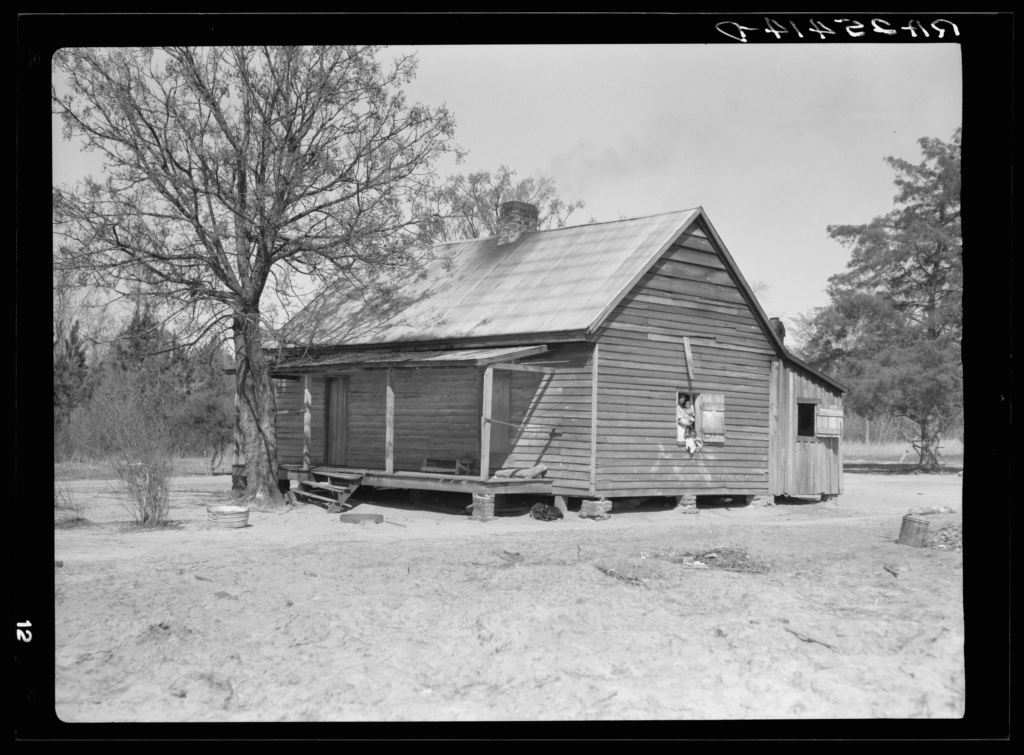
Sharecropper’s home, Macon County, Alabama. Image via Library of Congress by Arthur Rothstein.

Though the era of legalized discrimination ended in the 1960s, de facto occupational segregation – and the overrepresentation of Black workers in low-wage industries – did not simply end overnight because the laws changed. Black Alabamians continue to face a range of non-legal barriers to breaking into betterpaying occupations long dominated by white people,[81] including those in the auto industry. The most critical barriers include:

  • Historical disinvestment in Black educational attainment, occupational training and skill building by Alabama’s state government. Since the 1970s, jobs in goodpaying occupations mostly require broad educational attainment, and often specific technical skills development. Alabama historically has underfunded the public institutions that provide education and occupational training for all its residents. This in turn has disproportionately hurt African Americans, who often have fewer resources than white people do to attend college or obtain private education. All of these factors contribute to wage disparities.[82]
  • Cultural hiring practices that assume certain occupational workers are supposed to look a certain way. Research suggests hiring managers often have an implicit bias that sees as white men as more appropriate for higherskilled, higherwage jobs (supervisors or certain technical occupations like welders), while viewing Black women as more appropriate for lower-skilled, lowerwage jobs like clerical or general labor positions.[83] In addition, Alabama’s history of legalized occupational segregation means many Black workers have no family experience or social networks with other Black people in certain occupations, which can make it harder for African Americans to see those occupations as possible for them.[84]
  • Overt racial discrimination, where Black workers are paid less or given lowerpaying jobs explicitly because they are BlackThough overt discrimination is illegal, it still happens from time to time in businesses across Alabama. In the auto industry, Hyundai has faced multiple allegations of racial discrimination in worker lawsuits in recent years.[85] [86]  The company responded that it “provides a workplace free of discrimination” and does not comment on specifics of pending litigation.[87]

Though these kinds of challenges face Black workers across the economy, the broader history of the auto industry in the United States – especially in the Midwest – points to a better path, one not yet taken by Alabama’s auto industry. Between 1914 and 1947, Ford CEO and founder Henry Ford instituted a universal commitment to pay every worker the same wage: $5 a day for all workers in his plants, a promise of equal pay that lasted well into the 1950s.[88] Current Alabama auto plant workforces mirror the state’s longstanding economic inequities, with a higher-paid management structure made up heavily of white workers. These managers often are supervising line workers, who as a group are typically disproportionately Black workers.

In contrast to today’s Alabama auto industry, Black workers were overrepresented in Ford plants. They made 20% of Ford’s workforce in Michigan, compared to just 6% of the population.[89] Because they were overrepresented in an industry that paid equal wages, they slowly pushed up wages for all Black workers in the state, as other employers increased pay to compete with Ford. Recent research has suggested that Ford’s equal pay policy cut the overall wage gap between white and Black workers in half for Michigan workers outside the auto industry.[90] Alabama’s auto industry should make a similar commitment to equal pay, which should involve both proving equal pay for equal work within occupations and recruiting more Black workers into higherwage occupations.

At the same time, women face a similar but specialized set of barriers to entering male-dominated occupations, rooted partly in the state’s history and partly in the challenges of life today in Alabama’s economy. Historically, occupations dominated by women paid less because harmful cultural norms perceived them as “women’s work” and lower-status than jobs more associated with men.[91] [92] The pay gap between men and women in Alabama is one of the country’s largest and has structural and systemic origins, as a recent report by the Alabama Workforce and Wage Gap Task Force found.[93] Before various waves of industrialization took off in the 1880s, women and men in Alabama (as in the nation at large) often took on more similar roles, such as working together on the family farm.[94]

Yet as Alabama industrialized over the early and mid-20th century, more men began working for pay outside of the household, leaving women to continue the unpaid work of caring for the home and family.[95] This significant shift in gender roles slowly fueled unfounded cultural assumptions that men’s work was worthy of pay, while women’s work, because it often was inside the household, was not.[96] When women began entering the workforce and working outside the home in greater numbers in the 1960s, they often earned less because of these pervasive cultural views on the role of women.[97]

Today, women still face significant structural barriers to entering higher-wage occupations and earning equal wages. These barriers include continuing overt discrimination (which is illegal under state law following the 2019 passage of the Clarke-Figures Equal Pay Act),[98] a “motherhood” penalty – where women earn lower wages because employers assume women will take time away from paid work for childbirth and raising child – and the lack of affordable child care.[99] In addition, many women of color also are held back by the same challenges facing male workers of color, and often end up siloed into the lowest-wage and leastskilled occupations.

Additional sections
Summary Executive summary


Section 1 Introduction


Section 2 The high stakes and big bet on Alabama’s auto industry

 

Section 3 The ways the bet on auto benefited Alabama
 

Section 4 A wheel in the ditch: Autoworkers see falling pay
 

Section 6 A wheel in the ditch: Economic impact of falling wages and the pay gap
 

Section 7 A wheel in the ditch: Working conditions worsen
 

Section 8 The auto industry and Alabama’s low-road economic development approach
 

Section 9 What we should do next


Appendix Research design and methodology


[74] Wages for Asian autoworkers also have declined since 2002. This is likely because many executive and management positions in the early years of the industry’s presence in Alabama were held by managers from the companies’ countries of origin, such as Japan and South Korea. Over time, a larger share of those high-paying management jobs came to be held by U.S. residents of other races, particularly white managers, as the occupational siloing discussion later in this section explains.

[75] Washington Center for Equitable Growth, “Fact sheet: Occupational segregation in the United States” (Oct. 3, 2017), https://www.equitablegrowth.org/fact-sheet-occupational-segregation-in-the-united-states.

[76] Gavin Wright, Old South, New South: Revolutions in the Southern Economy since the Civil War, Louisiana State University Press: Baton Rouge (1986).

[77] C. Vann Woodward, Origins of the New South, 1877–1913: A History of the South, Louisiana State University Press: Baton Rouge (1981).

[78] James C. Cobb, The Selling of the South: The Southern Crusade for Industrial Development, 1935-1990University of Illinois Press: Urbana-Champaign (1993).

[79] Wright, supra note 76.

[80] Woodward, supra note 77.

[81] Danyelle Solomon, Connor Maxwell & Abril Castro, Systematic Inequality and Economic Opportunity,” Center for American Progress (Aug. 7, 2019)https://www.americanprogress.org/article/systematic-inequality-economic-opportunity.

[82] Ellen Gomory, “School choice in one of the most segregated, unequal systems in the country,” Alabama Political Reporter (April 5, 2023), https://www.alreporter.com/2023/04/05/school-choice-in-one-of-the-most-segregated-unequal-systems-in-the-country.

[83] Women’s Foundation of Alabama, Clearing the Path: Galvanizing the Economic Impact of Women (2022), https://wfalabama.org/assets/2022/05/WFA_CTP_2022_PRESSREADY_Webshare.pdf.

[84] Allan M. Freyer, Allison Forbes & Pamela Howze, Making Youth Apprenticeships Equitable and Effective: Lessons from North Carolina,” North Carolina Justice Center (June 28, 2019)https://www.ncjustice.org/publications/making-youth-apprenticeships-equitable-and-effective-lessons-from-north-carolina.

[85] William Thornton, “Black men suing Montgomery Hyundai plant for racial discrimination: White manager was called ‘master,’” AL.com (Nov. 17, 2022), https://www.al.com/business/2022/11/black-men-suing-montgomery-hyundai-plant-for-racial-discrimination-white-manager-was-called-master.html.

[86] Nathan Prewett, Montgomery Hyundai plant facing another discrimination lawsuit,” Selma Sun (Nov. 21, 2022), https://selmasun.com/news/montgomery-hyundai-plant-facing-another-discrimination-lawsuit/article_25e871ae-69ce-11ed-a9c5-bf7d9e354695.html.

[87] Thornton, supra note 85.

[88] The Henry Ford, “Fords Five-Dollar Day” (Jan. 3, 2014), https://www.thehenryford.org/explore/blog/fords-five-dollar-day.

[89] Jonathan Lanning, “How Ford Motor Company’s Equal Pay Policies Reduced Overall Labor Market Discrimination,” Federal Reserve Bank of Chicago (Aug. 2021), https://www.chicagofed.org/publications/profitwise-news-and-views/2021/ford-motor-equal-pay-policies.

[90] Ibid.

[91] Kathrin Leuze & Susanne Strauß, “Why do occupations dominated by women pay less? How ‘female-typical’ work tasks and working arrangements affect the gender wage gap among higher education graduates,” Work, Employment & Society, vol. 30, no. 5, 802-820 (Oct. 2016), https://d-nb.info/1119707552/34.

[92] Asaf Levanon, Paula England & Paul Allison, “Occupational Feminization and Pay: Assessing Causal Dynamics Using 1950-2000 U.S. Census Data,” Social Forces, vol. 88, no. 2, pp. 865-891 (Dec. 1, 2009), https://academic.oup.com/sf/article-abstract/88/2/865/2235342.

[93] Alabama Workforce and Wage Gap Task Force, “Key Findings and Recommendations of the Alabama Workforce and Wage Gap Task Force” (2023), https://wfalabama.org/assets/2023/02/Alabama-Workforce-and-Wage-Gap-Task-Force-Report-2023.pdf.

[94] Tsongas Industrial History Center, “The Role of Women in the Industrial Revolution,” University of Massachusetts Lowell, https://www.uml.edu/tsongas/barilla-taylor/women-industrial-revolution.aspx.

[95] American Association of University Women, “Systemic Racism and the Gender Pay Gap” (2021), https://www.aauw.org/app/uploads/2021/07/SimpleTruth_4.0-1.pdf.

[96] Ibid.

[97] Alabama Workforce and Wage Gap Task Force, supra note 93.

[98] Lloyd, Gray, Whitehead & Monroe, P.C., “Alabama Enacts New Equal Pay Act to Prevent Wage Disparity,”  https://www.lgwmlaw.com/news-media/ALABAMA-ENACTS-NEW-EQUAL-PAY-ACT-TO-PREVENT-WAGE-DISPARITY.

[99] Alabama Workforce and Wage Gap Task Force, supra note 93.
The State of Working Alabama 2023 – Section 6: A wheel in the ditch — Economic impact of falling wages and the pay gap

State of Working - Section 6 cover

Alabama’s autoworkers are living through a 20-year story of wage loss and unequal pay. This trend doesn’t harm only the individual auto employee who earned less this year than last. It also impacts employees across the entire industry and holds back Alabama’s overall economy.

Unequal pay and declining wages take money out of autoworkers’ pockets that they otherwise would spend buying groceries, paying for housing, putting gas in their cars and buying all kinds of other goods and services from locally owned businesses. Lower wages mean lower sales at local businesses, and lower sales mean less revenue that businesses can invest in job creation, wages, capital investment and purchasing from key suppliers, which in turn lose revenue and profitability. In short, auto companies’ unwillingness to pay Alabama workers as much as they did in 2002 – and failure to pay their workers the same across race and gender – has ripple effects across Alabama’s economy, ultimately holding back job creation, household income and economic growth. In turn, this holds down tax revenues that otherwise could have funded important investments in public infrastructure and shared prosperity like roads, education and health care.

Given Alabama’s ongoing struggles with elevated poverty rates, lower educational attainment and lower household incomes than the nation broadly, the state cannot afford to ignore the economic damage caused by the auto industry’s missing wages and unequal pay or to allow it to continue at the expense of Alabamians.

Specifically, unequal pay and declining wages in the auto industry have hurt Alabama’s economy in the following ways:[100]

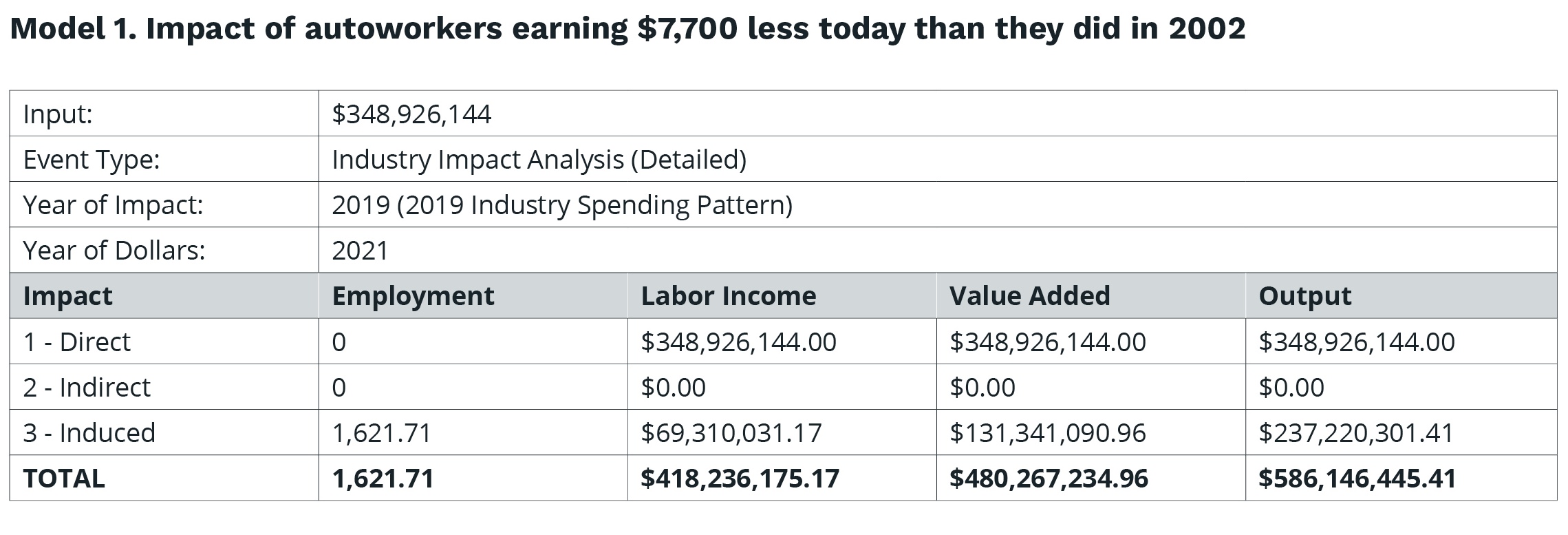
  • Twenty years of wage loss in the auto industry. Alabama’s autoworkers earned $7,770 less on average in 2019 than they did in 2002. Added across all 44,904 autoworkers in the state, this combined wage loss equaled $348,926,144 in total labor income that Alabama’s auto employees never saw and that never entered Alabama’s economy. In turn, the ripple effects of just one year of these lost earnings subtracted 1,622 jobs, $418 million in additional labor income and $586 million in GDP from Alabama’s overall economy.
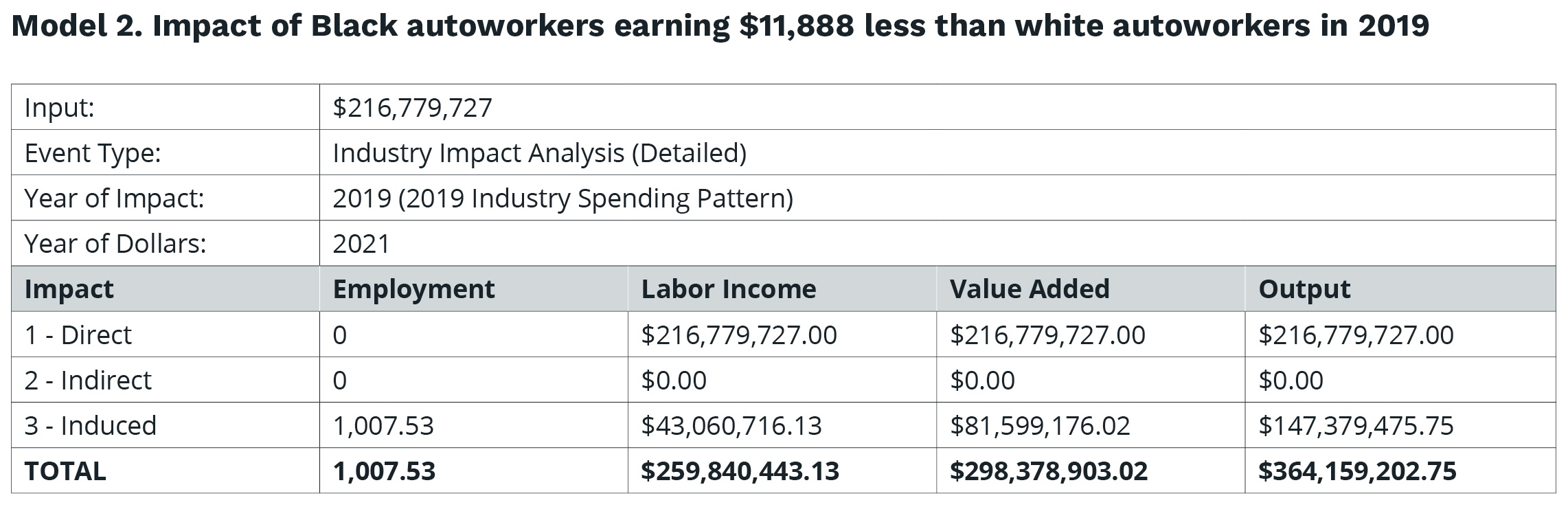
  • The pay gap between white and Black autoworkers. Alabama’s Black autoworkers were paid $11,888 less on average in 2019 than white workers in the industry. Added up across all 18,235 Black workers in the industry, unequal pay cost them a combined $216,779,727 in lost earnings in 2019 alone. In turn, the ripple effects of these lost earnings subtracted 1,008 jobs, $260 million in additional labor income and $298 million in GDP from Alabama’s overall economy.
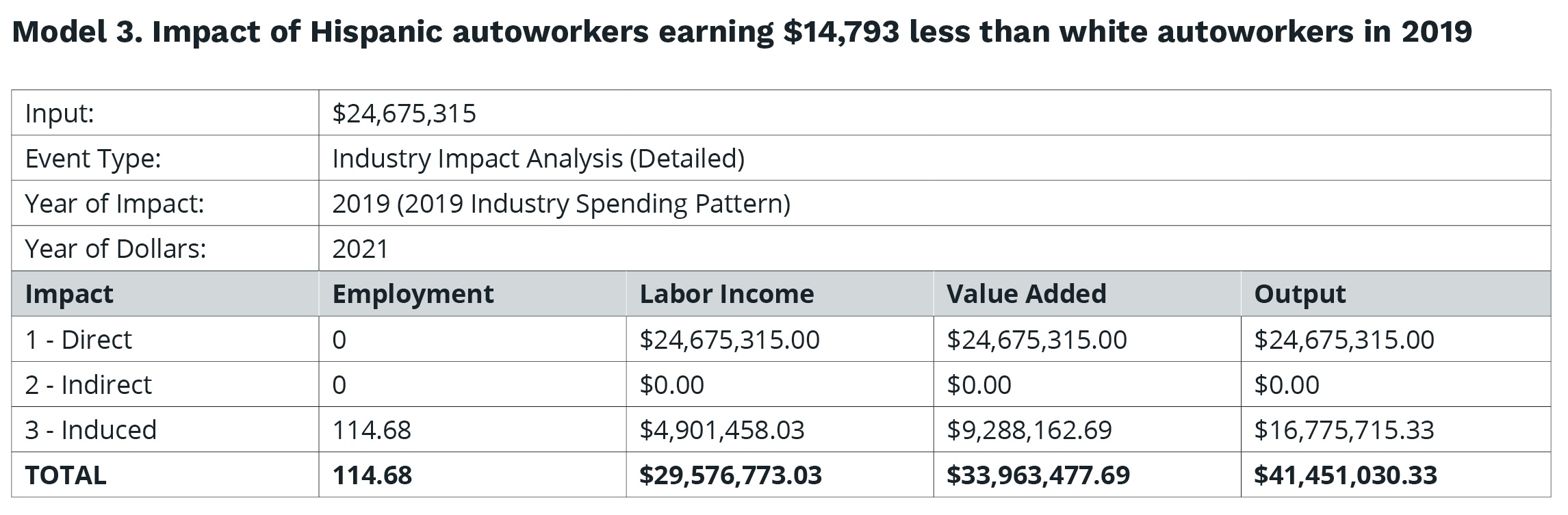
  • The pay gap between white and Hispanic autoworkers. Alabama’s Hispanic autoworkers were paid $14,793 less on average in 2019 than white autoworkers. Added up across all 1,668 Hispanic employees in the industry, unequal pay cost them a combined $24,675,315 in lost earnings in 2019 alone. In turn, the ripple effects of these lost earnings subtracted 115 jobs, $34 million in additional labor income and $41.5 million in GDP from Alabama’s overall economy.
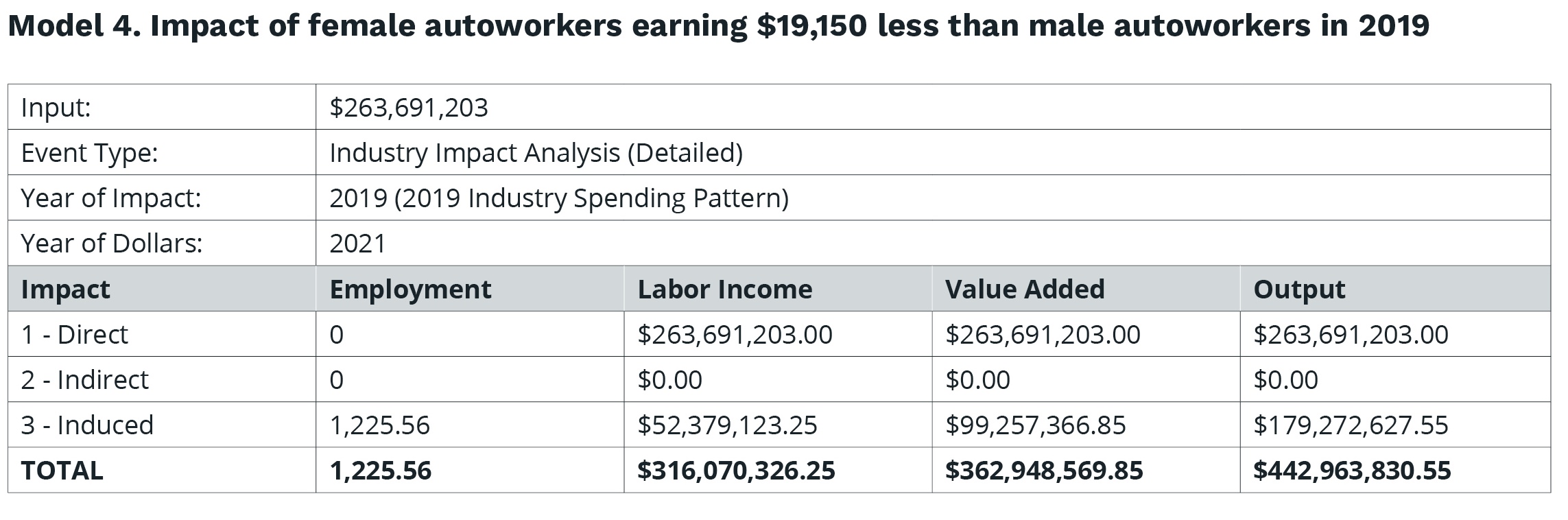
  • The pay gap between men and women in the auto industry. Women working in Alabama’s auto industry were paid $19,150 less on average in 2019 than men. Taken together across all 13,770 female autoworkers, unequal pay cost them a combined $263,691,203 in lost earnings. In turn, the ripple effects of these lost earnings subtracted 1,226 jobs, $316 million in additional labor income and $443 million in GDP from Alabama’s overall economy.

Until auto employers reverse course, pay their workers more and end these troubling racial and gender pay gaps, the people of Alabama will continue to suffer these kinds of negative impacts every year.

Additional sections

Summary Executive summary


Section 1 Introduction


Section 2 The high stakes and big bet on Alabama’s auto industry


Section 3 The ways the bet on auto benefited Alabama


Section 4 A wheel in the ditch: Autoworkers see falling pay


Section 5 A wheel in the ditch: Pay gaps and occupational segregation


Section 7 A wheel in the ditch: Working conditions worsen


Section 8 The auto industry and Alabama’s low-road economic development approach


Section 9 What we should do next


Appendix Research design and methodology

[100] See Appendix for the complete IMPLAN analysis.

The State of Working Alabama 2023 – Section 7: A wheel in the ditch — Working conditions worsen

State of Working - Section 7 cover

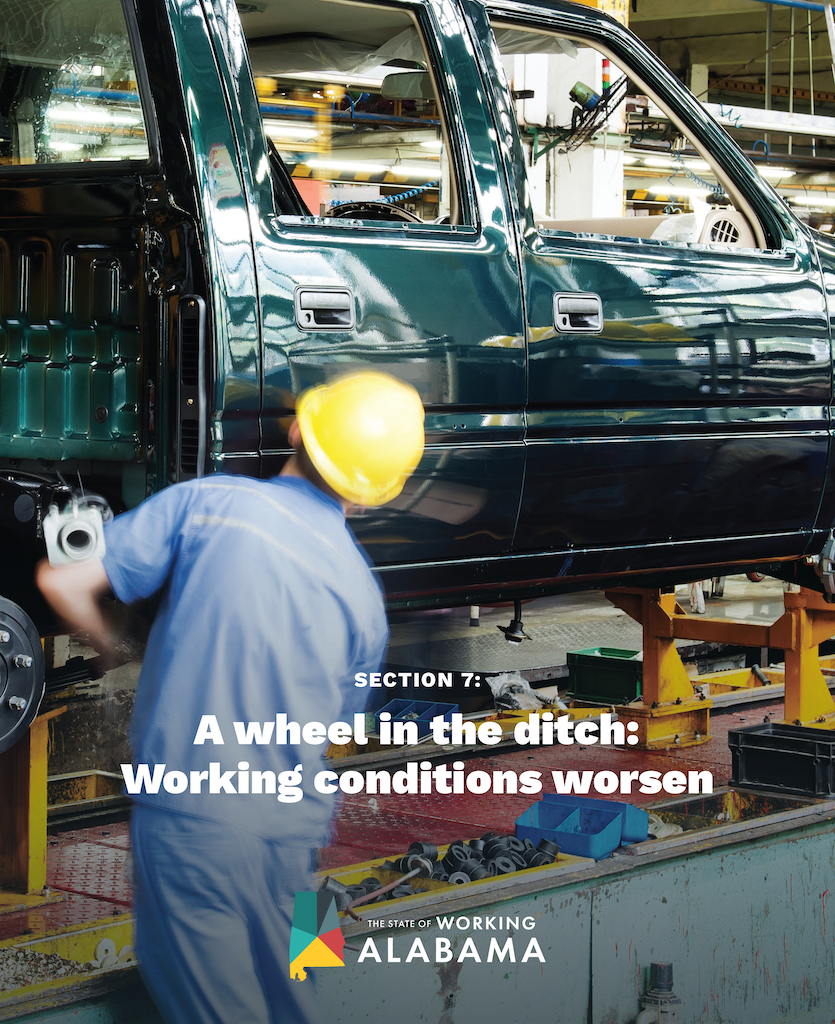
Aside from declining wages and occupational segregation, some of Alabama’s auto employers are falling short with conditions on the factory floor. Specifically, media coverage and interviews with autoworkers at numerous facilities revealed the following problems with working conditions in Alabama’s auto plants:

The tiered wage system. In an effort to reduce costs and increase profits, Alabama’s auto employers at Mercedes and other plants have instituted a tiered wage system, interviews found. Under such systems, workers who were hired more recently earn lower hourly pay and face higher health insurance costs than those who were hired more than 15 years earlier. Moreover, interviewees at Mercedes noted that autoworkers in the second tier face caps on their yearly wages. These caps are such that their maximum hourly pay rate is roughly 80% of the top rate earned by workers hired before the multitier system’s implementation. Even more troubling, temporary workers can earn less than half the hourly wage of a capped tier 1 worker, according to interviews. Because it ultimately holds down worker pay, the tiered wage system is likely a significant reason why auto industry pay has declined over the past 20 years.

Auto employers across the entire sector have cut wages significantly through the tiered system, including at plants in other states and plants staffed by workers who are represented by unions. United Auto Workers (UAW) contracts began including a multitiered wage and benefit system in 2007. Because companies’ motivations for cutting pay are so high, some autoworkers, including those at Mercedes, have been through multiple rounds of their employers offering five-figure payments to long-term workers to quit or retire, according to interviews. These moves have enabled employers to bring in lower-cost replacement workers and still save tens of thousands of dollars for each position replaced in the long run.

In addition, a tiered system divides the workforce and reduces worker organizing ability. It removes more experienced workers, who have greater familiarity with previous benefits and procedures, and replaces them with workers who lack the experience to evaluate the diminished wage and benefit structure against prior better compensation packages, according to interviews.

Child labor. In a recent series of abuses detailed by state and national media, SL Alabama, which at the time was a majorityowned subsidiary of Hyundai, contracted out labor in its Greenville auto parts plant and used children as young as 13 to manufacture car parts.[101] Victims of child labor trafficking are often immigrants, which places them at even further risk of workplace abuse, and this was generally the case with the Hyundai supplier’s victims.[102] [103] When these illegal activities came to light and resulted in international outrage, Hyundai divested its ownership interest in the subsidiary.[104] UAW’s organizing director Oten Wyatt notes that the multitiered system allows this type of abuse to continue, in part because temporary workers have fewer protections than permanent employees.

Unsafe working conditions and labor violations. A number of Alabama auto manufacturing plants also have habitually violated federal safety regulations. In 2017, a Bloomberg article highlighted some of the atrocious yet preventable deaths and injuries that had occurred within auto manufacturing facilities throughout the state, including suppliers for Honda and Mercedes facilities.[105] In 2010 alone, “workers in Alabama parts plants had a 50 percent higher rate of illness and injury than the U.S. auto parts industry as a whole.” [106] By 2015, “the chances of losing a finger or limb in an Alabama parts factory was double the amputation risk nationally for the industry, 65 percent higher than in Michigan and 33 percent above the rate in Ohio.” [107] And in 2017, “the incidence of traumatic injuries in Alabama’s auto parts plants remain[ed] 9 percent higher than in Michigan’s and 8 percent higher than in Ohio’s.” [108]

Sudden, unexpected and arbitrary changes in pay rates. Significant changes detrimental to employees recently have taken place at multiple Alabama auto manufacturing facilities. For example, workers at Mercedes reported having Saturday and Sunday pay rates, previously paid at double (Saturday) or triple (Sunday) the regular hourly rate, reduced to their straight hourly wage. Further, worker interviews noted that some facilities have instituted complete overtime bans within the past year, sometimes with less than a pay period’s notice to workers who would experience declines in earnings because of these policy changes. Worker estimates of the financial impact of these changes state that they could cost up to $1,500 per pay period.

Unfair discipline and capricious or discriminatory hiring and promotional decisions. Our interviews found that some workers have faced the use of much harsher discipline procedures, including potential dismissal for one-time, non-dangerous violations of uniform requirements. Workers also spoke about management punishing coworkers unfairly. In one instance, a highperforming assembler was written up to keep him from transferring to another team, with a higherpaying role, within the same facility to avoid a workflow slowdown on his then-current station. In other instances, interviewees said, supervisors gave conflicting or baseless rationales for promotional decisions that appeared to hold back Black workers and benefit specific white workers who were close to management and had less seniority, less training and more mistakes on the job.

Missing appeals process for disciplinary action. In some plants, discipline appeals processes have been eliminated for newer workers, our interviews found. Workers said the original appeals process included a panel review by other wage workers, rather than just salaried supervisors, but this process since has been eliminated. As a result, workers no longer have direct input into a process meant to prevent overly harsh or pretextual dismissals. These changes also have removed protections against targeted or otherwise unfair discipline for newer workers, interviewees said. This eliminates a key aspect of due process that can mean the difference between someone keeping or losing their job.

Additional sections

Summary Executive summary


Section 1 Introduction


Section 2 The high stakes and big bet on Alabama’s auto industry


Section 3 The ways the bet on auto benefited Alabama


Section 4 A wheel in the ditch: Autoworkers see falling pay


Section 5 A wheel in the ditch: Pay gaps and occupational segregation


Section 6 A wheel in the ditch: Economic impact of falling wages and the pay gap


Section 8 The auto industry and Alabama’s low-road economic development approach


Section 9 What we should do next


Appendix Research design and methodology

[101] Josh Moon, “As child labor scandal grows, Hyundai provides details of a crackdown on suppliers,” Alabama Political Reporter (Feb. 14, 2023), https://www.alreporter.com/2023/02/14/as-child-labor-scandal-grows-hyundai-provides-details-of-a-crackdown-on-suppliers.

[102] Mica Rosenberg, Joshua Schneyer & Kristina Cooke, “Special report: How A fake ID let Hyundai suppliers use child labor in Alabama,” Reuters (April 27, 2023), https://www.reuters.com/world/us/how-fake-id-repeatedly-enabled-hyundai-suppliers-employ-child-labor-alabama-2023-04-27.

[103] Tom Spiggle, Why Workplace Abuse Plagues Undocumented Workers,” Forbes (Dec. 10, 2021), https://www.forbes.com/sites/tomspiggle/2019/08/22/why-workplace-abuse-plagues-undocumented-workers.

[104] United Auto Workers, “UAW condemns Hyundai’s decision to sever ties with its Alabama suppliers (Oct. 21, 2022), https://uaw.org/uaw-condemns-hyundais-decision-sever-ties-alabama-suppliers.

[105] Peter Waldman, Inside Alabama’s Auto Jobs Boom: Cheap Wages, Little Training, Crushed Limbs, Bloomberg Businessweek (March 23, 2017), https://www.bloomberg.com/news/features/2017-03-23/inside-alabama-s-auto-jobs-boom-cheap-wages-little-training-crushed-limbs.

[106] Ibid.

[107] Ibid.

[108] Ibid.

The State of Working Alabama 2023 – Section 8: The auto industry and Alabama’s low-road economic development approach

State of Working - Section 8 cover

Alabama’s big bet on the auto industry has only partially paid off, as wages drop and working conditions deteriorate at some facilities. In contrast to the sunny stories told by auto industry boosters, the industry’s shortcomings reveal broader shortcomings in the state’s overall approach to economic development, which still often embodies the low-road mindset of a century ago.

Alabama’s economic development approach has five main shortcomings, all underscored by the mixed results of the state’s long-term bet on the auto industry:

  1. Over-reliance on the use of incentives to attract industry to the state.
  2. Lack of direct wage standards in incentive programs.
  3. Absence of labor protections under state law.
  4. The Alabama Jobs Act continues to fall short for Alabama workers.
  5. Organized labor is a missing piece and essential partner.

Over-reliance on the use of incentives to attract industry to the state

Alabama has long relied on corporate incentives to attract industrial development, with subsidy programs dating back to the 1970s.[109] But the Mercedes deal represented a new, deeper state commitment to the use of corporate subsidies to attract outside industry. Since 1993, the state has invested nearly $4.5 billion in corporate subsidies and incentives,[110] with the auto manufacturing industry receiving more than a third of those incentives.[111] In many instances, these incentives included tax abatements, land improvements, job training and provision of transportation and reliable sources of raw materials.[112]

The state’s development officials rightly can point to thousands of jobs and millions of dollars in investment created by economic development projects they facilitate each year. But it’s worth repeating that all this important work has yet to bring Alabama’s wages up to the national average.[113] It has yet to reduce statewide poverty or racial income gaps.[114] And it has yet to lift economic mobility for Black children up to par with that for white children.[115]

Similarly, while incentives certainly played an important role in attracting auto manufacturing plants to Alabama in the first place, two facts remain true. First, hundreds of millions of dollars in state subsidies have failed to keep auto pay from falling or working conditions from worsening. Second, Alabama’s experience with incentives and the auto industry may be an outlier that is not easily transferable to other industries. Decades of scholarly and policy research tell a consistent story that incentives are usually not decisive in influencing corporate location decisions.[116] 

If a business indeed decides to locate in Alabama, there is no guarantee it will stay, or even create the jobs it promises. Yet the state is always out the money that it spent or the tax revenue that it abated to create jobs that may never materialize. Though not an auto manufacturer, Shipt provided a recent illustration of this problem. Shipt, a Birmingham company acquired by Target in 2017 for $550 million, recently terminated its incentive agreement with the state after hiring hundreds fewer Alabamians than the 881 workers it had promised.[117] Local incentives also were curtailed.[118] But even with such a shortcoming, the company pocketed $2.8 million in incentives, and moreover, the decision to terminate the incentive agreement came from the company, not regulators,[119] illustrating the lack of external accountability safeguards.

In addition, Alabama’s billions of dollars of incentive packages largely have come at the expense of the state’s education budget.[120] This is the case despite the state historically underperforming many others on numerous education quality and attainment measures.[121] Paying for incentives in this way directly undermines the key factor that increasingly global and technologydependent companies care about most when considering where to locate a new plant or headquartersthe skill and educational attainment of the workforce.[122] Paying for corporate incentives by diminishing education revenues undermines the investments in people that empower them to obtain the technical skills that companies prioritize most highly.

Lack of direct wage standards in incentive programs

The fact that Alabama’s auto plants continued to receive incentives despite paying steadily lower wages highlights a glaring omission in the state’s economic development efforts: There are few direct efforts to increase earnings for the state’s workers. Specifically, Alabama has failed to include prevailing wage policies in its incentive packages. A prevailing wage is a minimum benefits and hourly wage standard that requires companies to offer compensation packages comparable to what workers employed in similar jobs throughout the industry receive.[123] Requiring auto manufacturers to base their wages on typical market salaries already received by workers in the industry would help prevent companies from shortchanging other workers and undermining standards that exist in other parts of the country. [124] The U.S. Congressional Black Caucus has noted that prevailing wage laws protect “workers against exploitation regardless of race, ethnicity, gender or union membership.” [125]

While Alabama development officials targeted the auto industry because it paid above-average wages in 1993 (and still does today), there were no efforts to ensure auto plants actually paid those wages in exchange for massive public subsidies. In effect, the state relied on targeting a high-wage sector to raise wages indirectly – an approach that officials also have pursued with aerospace and other advanced manufacturing industries in the years since – rather than directly raising pay by using the legal authority of an economic development contract or community benefits agreements as leverage to compel specific employers to pay better wages. Such wage standards are a frequent practice in other states,[126] which refuse to offer incentives to companies that do not pay a prevailing or industry average wage.

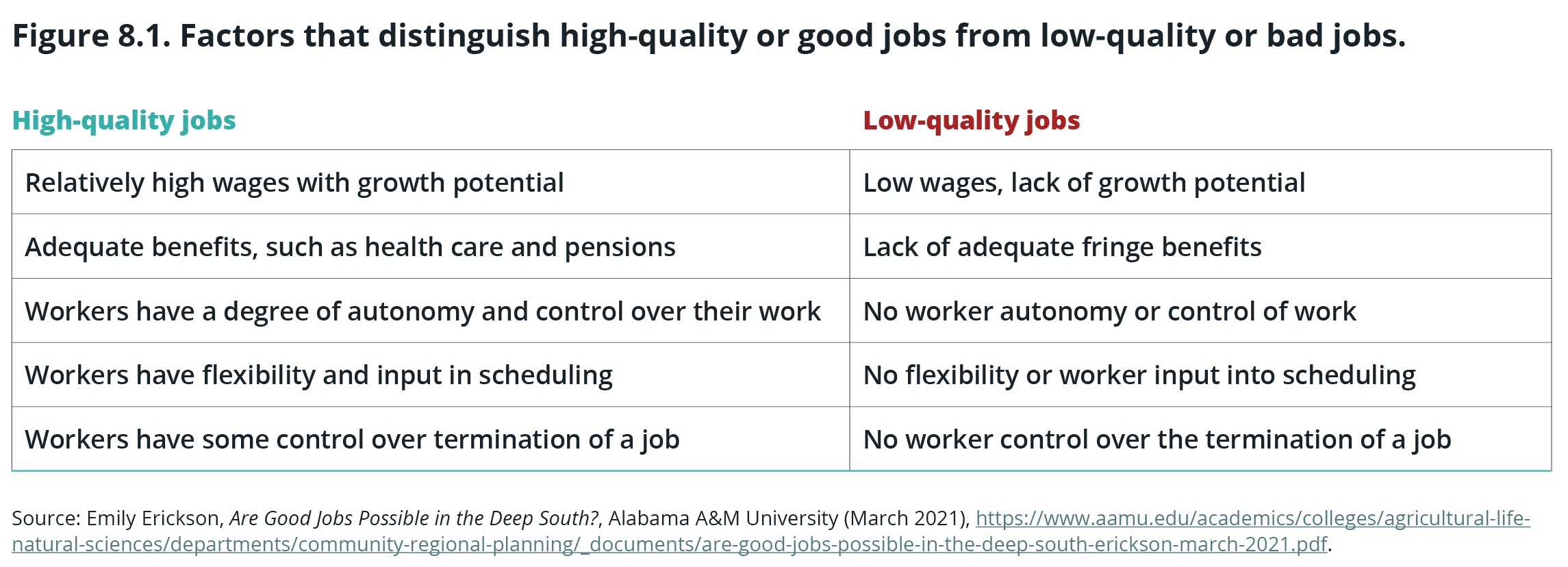
In many ways, this hearkens back to Alabama’s traditional low-road approach, which tended to pursue the quantity of jobs rather than worry about their quality. In recent years, it appears as if manufacturing employers in the state have consistently been “taking the low road and creating many bad jobs and a few good jobs.” [127] Figure 8.1 helps illustrate factors that distinguish highquality or good jobs from lowquality or bad jobs. Many of the characteristics of low-quality jobs align with concerns Alabama auto manufacturing workers expressed in the interviews discussed in Section 7, though average auto wages are higher than the state’s manufacturing average.

Figure 8.1. Factors that distinguish high-quality or good jobs from low-quality or bad jobs. Source: Emily Erickson, Are Good Jobs Possible in the Deep South?, Alabama A&M University (March 2021), https://www.aamu.edu/academics/colleges/agricultural-life-natural-sciences/departments/community-regional-planning/_documents/are-good-jobs-possible-in-the-deep-south-erickson-march-2021.pdf.

Absence of labor protections under state law

Wage disparities persist in part because of the anti-worker structure of state government and the anti-worker attitudes of some state officials.[128] [129] Alabama has longstanding practices of limiting worker protections. The regulatory structure at the state level is severely limited with regard to workers’ rights, instead focusing on protecting companies.[130] For example, Alabama does not have a statemandated minimum wage.[131] That means some of the most egregious wage- and hourrelated worker exploitations are remediable solely through federal protections.

The lengths to which the state went to attract the auto manufacturing industry have demonstrated a lack of regulatory appetite for significant corporate accountability, even Alabama spends millions of dollars in public funds annually to attract corporations.[132] [133]  Even with the massive existing incentive programs, many state officials argue for more public expenditures favoring private companies and the removal of limitations on corporate giveaways. Weakness of state regulators effectively has perpetuated near-total corporate control over some areas of state policy. This upside-down reality of regulatory capture has emboldened bad actors to abuse workers, even to the point of a supplier using middleschoolaged children in automotive manufacturing work.[134]

Failure to regulate is not merely an oversight. The state also has taken affirmative steps to undercut worker protections enacted by local governments. When Birmingham passed an ordinance setting the city minimum wage at $10.10 per hour in 2016, the Legislature responded by immediately blocking localities from implementing minimum wages in their own borders.[135] The preemption of local authority goes significantly beyond wages. It also includes preventing cities from implementing efforts to remain competitive by responding to recent shifts in national standards on issues such as paid family medical leave and work-sharing.[136] The Legislature even preempted localities from mandating fair scheduling notice, an improvement for workers that would cost employers nothing at all.[137]

The Alabama Jobs Act continues to fall short for workers

The Alabama Jobs Act, the state’s primary corporate subsidy program, doubles down on the incentive game but continues to fall short for workers. This program provides tax rebates between 3-5% of gross payroll for employers with Alabama workers. The Jobs Act provides different reimbursement percentages, capital investment requirements and full-time equivalent employment minimums ranging from creating any jobs to a minimum of 50 for varying industrial categories and county locations. But the overall incentive mechanism of a tax rebate for payroll expenses is the same statewide.

In 2023, the Legislature vastly increased the total amount of subsidies available under the Jobs Act over a five-year span. The total amount of public money given to private companies through tax credits will rise by $25 million annually, from $350 million in 2022 to $475 million in 2027.[138] But key problems with the Jobs Act call into question its effectiveness for Alabama’s workers and taxpayers.

The amended Jobs Act removed a provision restricting tax credits from being given to companies for projects that have long been underway. This is in contrast to the prior version, which restricted the availability of incentives to companies for projects that had substantially begun before 2015.[139] In addition, the Jobs Act does not include transparency or reporting requirements by project. This leaves taxpayers and lawmakers no way of measuring how individual projects are performing in terms of wages and jobs created, or of assessing the program’s overall effectiveness at meeting its goals.

Some efforts to increase transparency in the incentive process have gained ground, but even those improvement efforts are notable for the obvious care with which they avoid providing sufficient information to evaluate actual performance versus the claims used to drum up support for the incentive in the first place. A bill to require public posting of incentive amounts and recipient companies became law in 2023.[140] However, its transparency improvements, including identification of companies and amounts of incentives given, fail to include any follow-up evaluation.[141] Instead, the companies’ statements of job estimates are simply treated uncritically as truth and published on a state website.[142] [143] The failure to include evaluation of companies’ claims leaves these important increased transparency efforts susceptible to misuse and industry puffery instead of providing vital public accountability mechanisms.

Organized labor is a missing piece and essential partner

Anti-worker policies naturally have included hostility to organized labor, because unionization is a reliable way for workers to build power.[144] Alabama is a so-called “righttowork” state, [145] which means the state has banned agreements between employers and unions to employ solely union labor.[146] Laws prohibiting union-only shops serve to lower unionization rates,[147] enshrining structures thathistorically have impeded working Alabamians from building power to challenge the state’s traditional business ownership interests.

The lower organized labor rate and consequent reduced power base of workers are significant factors that reduce working Alabamians’ ability to hold state officials accountable for policy failures. Reduced unionization rates also often result in unsafe jobsite environments for Alabama’s workers.[148] Though unions historically have maintained their power via the threat of withholding labor, unions also have added functionality and operational capacity to plants in ways that management has been unable to do.[149] “This is evident in the expertise the union now brings to discussions of quality, safety, predictive and preventative maintenance, workforce development, team-based operations, and other such topics.”[150]

Because unions create safer, more productive employment environments for workers, low unionization rates are an indicator that Alabama’s manufacturing sector is performing less efficiently than it could be, both in terms of economic output and of the well-being of the people performing the work. Auto companies should embrace the opportunity to implement solutions informed by the experienced workers on the shop floor. This would aid in avoiding unnecessary disruption to workflow because of companies’ reluctance to cooperate with the people doing the work that makes their success possible.

Additional sections

Summary Executive summary


Section 1 Introduction


Section 2 The high stakes and big bet on Alabama’s auto industry


Section 3 The ways the bet on auto benefited Alabama


Section 4 A wheel in the ditch: Autoworkers see falling pay


Section 5 A wheel in the ditch: Pay gaps and occupational segregation


Section 6 A wheel in the ditch: Economic impact of falling wages and the pay gap


Section 7 A wheel in the ditch: Working conditions worsen


Section 9 What we should do next


Appendix Research design and methodology


[109] Kebede & Ngandu, supra note 24.

[110] Erickson, supra note 40.

[111] See Figure 2.1.

[112] Kebede & Ngandu, supra note 24.

[113] U.S. Census Bureau, Median Household Income by State: 1984 to 2018, https://www.census.gov/quickfacts/fact/table/US/SEX255222.

[114] Erickson, supra note 40.

[115] Ibid.

[116] Ann Markusen & Katherine Nesse, “Institutional and Political Determinants of Incentive Competition,” Reining in the Competition for Capital, W.E. Upjohn Institute for Employment Research (2007), https://doi.org/10.17848/9781429492065.ch1.

[117] Hannah Denham, “As Birmingham’s Shipt fails to meet hiring goals, Alabama withholds millions in incentives,” AL.com (Aug. 11, 2023)https://www.al.com/business/2023/08/as-birminghams-shipt-fails-to-meet-hiring-goals-alabama-withholds-millions-in-incentives.html.

[118] Ibid.

[119] Ibid.

[120] Stephanie Hoops, “Incentives package caused early controversy,” Tuscaloosa News (Sept. 21, 2003), https://www.tuscaloosanews.com/story/news/2003/09/21/incentives-package-caused-early-controversy/27848187007.

[121] World Population Review, supra note 48.

[122] Site Selection Magazine2022 Workforce Guide, https://siteselection.com/cc/workforce/2022 (“Workforce has been cited in Site Selection Magazine’s annual survey of corporate consultants as the No. 1 factor in site selection decisions for several years in a row.”).

[123] Aurelia Glass, David Madland & Karla Walter, “Prevailing Wages Can Build Good Jobs Into America’s Electric Vehicle Industry, Center for American Progress (July 6, 2022)https://www.americanprogress.org/article/prevailing-wages-can-build-good-jobs-into-americas-electric-vehicle-industry.

[124] Ibid.

[125] Ibid.

[126] Markie Wall, David Madland & Karla Walter, “Prevailing Wages: Frequently Asked Questions,” Center for American Progress (Dec. 22, 2020), https://www.americanprogress.org/article/prevailing-wages-frequently-asked-questions.

[127] Erickson, supra note 40.

[128] Alan Collins, Alabama miners object to state troopers providing escort duty,” WBRC Fox 6 News (Nov. 18, 2021), https://www.wbrc.com/2021/11/18/alabama-miners-object-state-troopers-providing-escort-duty.

[129] Economic Policy Institute, “Unions help reduce disparities and strengthen our democracy” (April 23, 2021), https://www.epi.org/publication/unions-help-reduce-disparities-and-strengthen-our-democracy.

[131] U.S. Department of Labor, “State Minimum Wage Laws” (updated Sept. 30, 2023), https://www.dol.gov/agencies/whd/minimum-wage/state.

[132] Patricia Todd, The Hidden Costs of Alabama’s Tax Incentives Secret Spending Amidst a Pandemic and Austerity, Jobs to Move America (2021), https://www.alreporter.com/wp-content/uploads/2021/08/Alabama-Report_PROOF.pdf.

[133] See Alabama Arise, Alabama Arise testimony in opposition to corporate COVID-19 immunity bill” (Feb. 3, 2021), https://alabama-arise.web-site-preview.com/resources/alabama-arise-testimony-in-opposition-to-corporate-covid-19-immunity-bill (noting swift passage of corporate immunity bills at the expense of workers’ remedies for negligence).

[134] Moonsupra note 101.

[135] Zachary Roth, “Birmingham raises minimum wage and Alabama takes iaway,” MSNBC (Feb. 26, 2016), https://www.msnbc.com/msnbc/birmingham-raises-minimum-wage-and-alabama-takes-it-away-msna803906.

[136] Hunter Blair, David Cooper, Julia Wolfe & Jaimie Worker, Preempting progress: State interference in local policymaking prevents people of color, women, and low-income workers from making ends meet in the South,” Economic Policy Institute (Sept. 30, 2020), https://www.epi.org/publication/preemption-in-the-south.

[139] HB 241.

[141] Ibid.

[144] Aurelia Glass & David Madland, How unions are crucial for building working-class economic power,” Center for American Progress (July 31, 2023), https://www.americanprogress.org/article/how-unions-are-crucial-for-building-working-class-economic-power.

[146] David Madland, Karla Walter & Ross EisenbreyRight to Work 101,” American Worker Project (2012), https://cdn.americanprogress.org/wp-content/uploads/issues/2012/02/pdf/right_to_work.pdf.

[147] AFL-CIO, “Right to Work,” https://aflcio.org/issues/right-work.

[148] Kenneth Quinnell, Service + Solidarity Spotlight: Study Shows Unions Make Workplaces Safer,” AFL-CIO (March 3, 2022), https://aflcio.org/2022/3/3/service-solidarity-spotlight-study-shows-unions-make-workplaces-safer.

[149] Cutcher-Gershenfeld, et al., supra note 73.

[150] Ibid.

The State of Working Alabama 2023 – Section 9: What we should do next

State of Working - Section 9 cover

Automakers, policymakers, community stakeholders, workers and unions all have critical roles to play in making sure the auto industry benefits its workers and the entire state to the greatest extent possible. Below are some recommendations that would strengthen Alabama’s auto industry and help the state build a more prosperous economy that makes life better for every Alabamian.

Recommendations for auto employers

Employers must address the areas they are falling short in: declining wages, pay gaps and working conditionsSpecifically, we recommend they do the following:

  • Reverse wage cuts and pay autoworkers at least as much as they earned in 2002. The long-term decline in pay is holding back Alabama’s economy and hurting workers’ ability to support their families in the face of the rising cost of living. Given healthy industry profits over the past decade, auto employers should have sufficient revenues to support wage increases to 2002 levels, even if they need to phase it in over multiple years. In addition, employers should commit to bringing Alabama’s autoworkers’ pay up to the national average.
  • Close racial and gender pay gaps. The gap in pay between male and female autoworkers – and between white workers and everyone else – is glaring, especially given Alabama’s historical legacy of discrimination. Whether these pay gaps are the result of discrimination or occupational segregation, the industry must make progress by raising the wages of women and Black workers and ensuring companies are paying their workers the same for similar work, regardless of race or gender. Taking these steps would demonstrate commitment to advancing equal pay and race relations in Alabama and to addressing the income inequality that afflicts women and workers of color and ultimately drags down Alabama’s economic growth.[151] Specifically, employers should focus on breaking down occupational segregation through targeted hiring and training programs such as apprenticeship programs that intentionally recruit underrepresented groups into high-wage, high-skill jobs.
  • End the tiered wage and benefit system for all auto employees. The tiered system divides workers into classes: those hired before the system went into effect, who earn better wages and pay less for health insurance, and those hired after, who earn lower wages and pay more for health insurance. Further division of workers occurs when companies hire temporary workers hired through subcontracting agencies. Temporary workers lack benefits and protections other workers have. As the industry grows, more workers will fall into the lower tiers, ultimately kneecapping their long-term earning potential and diminishing their ability to close the gender and racial wage gap. Ending the tiered system is broadly popular among the auto employees we interviewed.
  • Provide child care to autoworkers. Because child care is so expensive, lack of affordable day care acts as a major barrier for workers with children – especially women – to enter the labor force generally and seek employment in the auto industry in particular.[152] This barrier also increases the difficulty for workers already employed in the industry, especially given scheduling challenges discussed below. If auto employers increased child care availability, either through stipends or through provision of care on site, this likely would help narrow the earnings gap between men and women and improve shift scheduling for existing autoworkers. Mazda Toyota Manufacturing in north Alabama offers a heartening example of an auto manufacturing entity taking initial steps toward alleviating child care concerns for its workers.[153]
  • Provide consistent and advanced scheduling. Adequate notice for scheduling, including for training and mandatory meetings, would help workers plan their lives better. This change would cost employers nothing in wages. Aside from highly unusual genuine emergencies, training and meetings could be scheduled several weeks in advance at a minimum. This would be an improvement on the current norm, where lack of communication can mean workers too often receive notice of required on-site meetings outside their normal schedules with less than a week’s notice, according to our worker interviews. In addition, worker input on scheduling, through formalized feedback channels with anonymous options, would provide more information about workers needs and preferences.
  • End child labor immediately in all Alabama auto plants. The use of third-party subcontractors that hire temporary workers at plants has made abuses, including child labor violations and immigrant labor abuse, much more likely. The recent documented violations at Hyundai suppliers illustrate the dangers of allowing companies to shirk responsibility for implementing basic worker protections by contracting third parties to hire workers. A temp hiring model intentionally divides these workers from others performing the same work, diminishing the ability to ensure compliance with worker protection laws and hold companies accountable for violations. The short-term solution of punishing violations is vital, but it also should be accompanied by transitioning away from hiring practices that prevent transparency in the onboarding process. One long-term solution to this issue would be to shift away from the current hiring and training model and move to pre-apprenticeship and apprenticeship programs with input and oversight from labor advocates and the full body of plant workers. These programs can be implemented as part of community benefits agreements, as well as through collective bargaining agreements, providing multiple paths to create important worker oversight.
  • Enact industry-standard workplace protections to eliminate arbitrary and bad-faith discipline from supervisors. This would provide fairness, improve morale and prevent workers from being illegally targeted based on protected characteristics or activities. In some facilities, the lack of procedural safeguards puts workers on what is effectively a six-month probationary period with no protection or recourse from unfair disciplinary procedures. This is unfair for workers and creates instability and turnover on the shop floor, ultimately increasing costs for the employer.
  • Enter community benefits agreements (CBAs) with local community stakeholders in large-scale, transformative projects. Community benefits agreements are agreements between employers and community organizations to provide certain specified benefits for both workers and the broader community where a facility is located. CBAs can be a useful tool for ensuring that recipients of some of the state’s largest incentive packages commit to practices that benefit members of the community in which they are located. For example, CBAs can help ensure that auto manufacturers pay local living wages, fund educational services, hire local workers or benefit local communities in other ways negotiated by community labor representatives and industry. CBAs recently have been implemented in the South, including in vehicle manufacturing at the New Flyer electric bus plant in Anniston.[154] An employer benefits from signing a CBA because doing so shows willingness to meet enforceable, concrete standards of positive impact on the communities where they make their products and profits.
  • Respect workers’ right to organize their workplaces. Companies should refrain from interfering in organizing campaigns and maintain neutrality throughout unionization drives. Further, when a plant’s workforce chooses to unionize, the company should come to the bargaining table in good faith, without delaying tactics or needless obstacles to negotiations.

Recommendations for policymakers

Policymakers also have a role to play in getting the most out of the auto industry for Alabama’s workers and the state’s economy. Most importantly, they must fix Alabama’s broken, low-road and unaccountable economic development model, beginning by reforming the Alabama Jobs Act.[155] The auto industry has benefited heavily from the Jobs Act and other state subsidies, so ensuring the program delivers is essential to making sure the industry delivers for Alabama’s workers. Recent updates have improved the program’s fiscal responsibility, but lawmakers still need to take much bigger steps to ensure Jobs Act credits consistently deliver results for Alabama’s workers. These steps include:

  • Performance standards, including wage and benefit requirements. The Jobs Act already requires companies to state clearly the number of jobs they will create. But legislators should update the program to specify that these jobs must be full time, provide health insurance and pay prevailing wages. If companies are unwilling to meet these standards, they should not be eligible to receive Jobs Act incentives. This would ensure the state is using taxpayer dollars to subsidize the creation of quality jobs, rather than low-road jobs that promote poverty instead of broadly shared prosperity.
  • Prevailing wage standards. The prevailing wage is the average wage paid to workers performing similar work in a comparable geographical area. Laws incentivizing companies to pay workers the prevailing wage can help boost worker well-being and benefit the communities where facilities exist. In other states, “prevailing wage laws have been shown to support jobs offering good wages and benefits.” [156] For example, prevailing wage laws “have offered construction workers a route to the middle class and increased wages and enrollment in health insurance for service workers such as janitors. They have also been shown to close racial pay gaps in both the construction and service sectors, as employers must pay all workers the same minimum rate, regardless of race, leading to especially large compensation gains for workers of color.” [157] Adding prevailing wage provisions to the Alabama Jobs Act could help ensure that employers are neither taking advantage of nor shortchanging Alabama workers by offering non-competitive wages when compared to the industry overall. Such a provision also could help offset some of the wage disparities and occupational segregation trends identified in this report.
  • Accountability and clawback protections. Companies promise to create jobs all the time in exchange for public subsidies. But as we saw with Shipt (referenced in Section 8), the Jobs Act provides taxpayers and legislators with no real way to hold companies to their promises – or even count how many jobs a company has created at all with these public dollars. Legislators should update the Jobs Act to take back the money expended on tax incentives if companies do not meet their job creation promises. Widely used in state economic development programs across the country, these “clawback” provisions give lawmakers the legal tools necessary to hold companies accountable for their promises and are considered a best practice to protect workers and taxpayers.[158] Clawback provisions can include both ineligibility for future tax expenditures and return of amounts already disbursed to companies. Clawbacks should be used in cases where employers receiving incentives don’t create the jobs they promised, fail to pay the wages they promised or commit serious labor violations under federal or state rules.
  • Transparency and reporting requirements. Under the current Jobs Act, no one is obligated to see whether companies are living up to their promises. Neither the Alabama Department of Commerce nor any other state agency is required to investigate companies’ progress in job creation or investment. Monitoring and public transparency are key steps in holding these companies accountable for upholding their claims about what they are doing with public subsidies.

Beyond the Jobs Act, Alabama needs to shift its broader economic development approach away from its low-road past and toward a higher-road future that invests in workers and bolsters the state’s ability to compete with Georgia, Texas and other states for high-tech jobs. Specific recommendations include:

  • Greater state funding and investment in K-12 and workforce development. Global companies are increasingly looking for workers with the right technical skills, educational attainment and demonstrated ability to engage in innovative, adaptive work. Alabama cannot compete for these companies if it does not invest more in empowering workers to meet their full potential. This includes more investment in K-12 education, technical and vocational training, and occupation-specific training in key sectors. The greater the skill level of Alabama’s workforce, the more competitive the state will be in the global economy, and the higher wages the state’s workers can command.

Finally, Alabama’s policymakers should enact long-awaited statewide labor protections with a regulatory regime able to enforce them. These reforms should include:

  • Ending “righttowork” laws that disadvantage workers in disagreements with management.
  • Giving preference for state contracts to go to companies with unionized workforces and/or employee ownership.
  • Repealing the law preempting localities from setting worker protections that would make Alabama cities more competitive with similar cities in neighboring states.

Organized labor: a vital partner

State officials’ reaction to union activity has been largely hostile throughout Alabama’s history and often remains so in current practice. “[A]ntiunionism in the South is preserved and protected by measures that resemble the actions of antidemocratic governments in Asia and Latin America more than the ideal that America is the land of a free people.” [159] Recently, that reactionary hostility has included using state law enforcement to help break strikes[160] and state courts to prevent workers from picketing.[161]

But this hostility to unionized workers is a bad fit for modern industrial practices and is counterproductive within the automotive sector. Labor unions help ensure the safe and efficient operation of plants. Unions can provide both training pathways and quantifiable process improvements, as a result of their role as trusted worker advocates, by gathering input from line workers. For example, “[t]he United Automobile Workers union (UAW)—which represents autoworkers at the Big Three U.S. car manufacturers (Ford, General Motors, and Stellantis [formerly Chrysler])—[wa]s a constructive partner in the U.S. auto industry’s resurgence.”[162] Also, within the auto sector, at Ford plants alone, 2006 UAW-negotiated process improvements were responsible for generating estimated efficiency improvements of more than $500 million).[163] Stated differently, “[t]he expertise the union now brings to discussions of quality, safety, predictive and preventative maintenance, workforce development, team-based operations, and other such topics” are clear reasons for the auto sector management to cooperate with workers to implement process improvements instead of engaging in needless conflict.[164]

The auto manufacturing sector’s shortcomings in recent years, including overall wage declines and wildly unequal pay across demographics, can be made right with a participatory process that affords workers the input they deserve into the conditions under which they labor. And as a significant sector-wide shift toward electric vehicle (EV) manufacturing opens up new and large opportunities for innovation and manufacturing in Alabama, ensuring that the foundational aspects of worker-management relations are built on a sustainable, fair framework will set the correct course for the industry for decades to come.

Alabama policymakers should view workers and their unions as a vital partner in manufacturing, not as an enemy or source of wealth extraction. The ability to provide worker-focused insights that make factories safer and more efficient is an indispensable role uniquely suited to labor unions. The state should seek to expand that role, not limit it out of misguided, stubborn adherence to 19th-century economic views. Enacting policies to empower workers would position Alabama to reap even larger rewards from its big bet on the auto industry – and to build a more inclusive and prosperous future for every Alabamian.

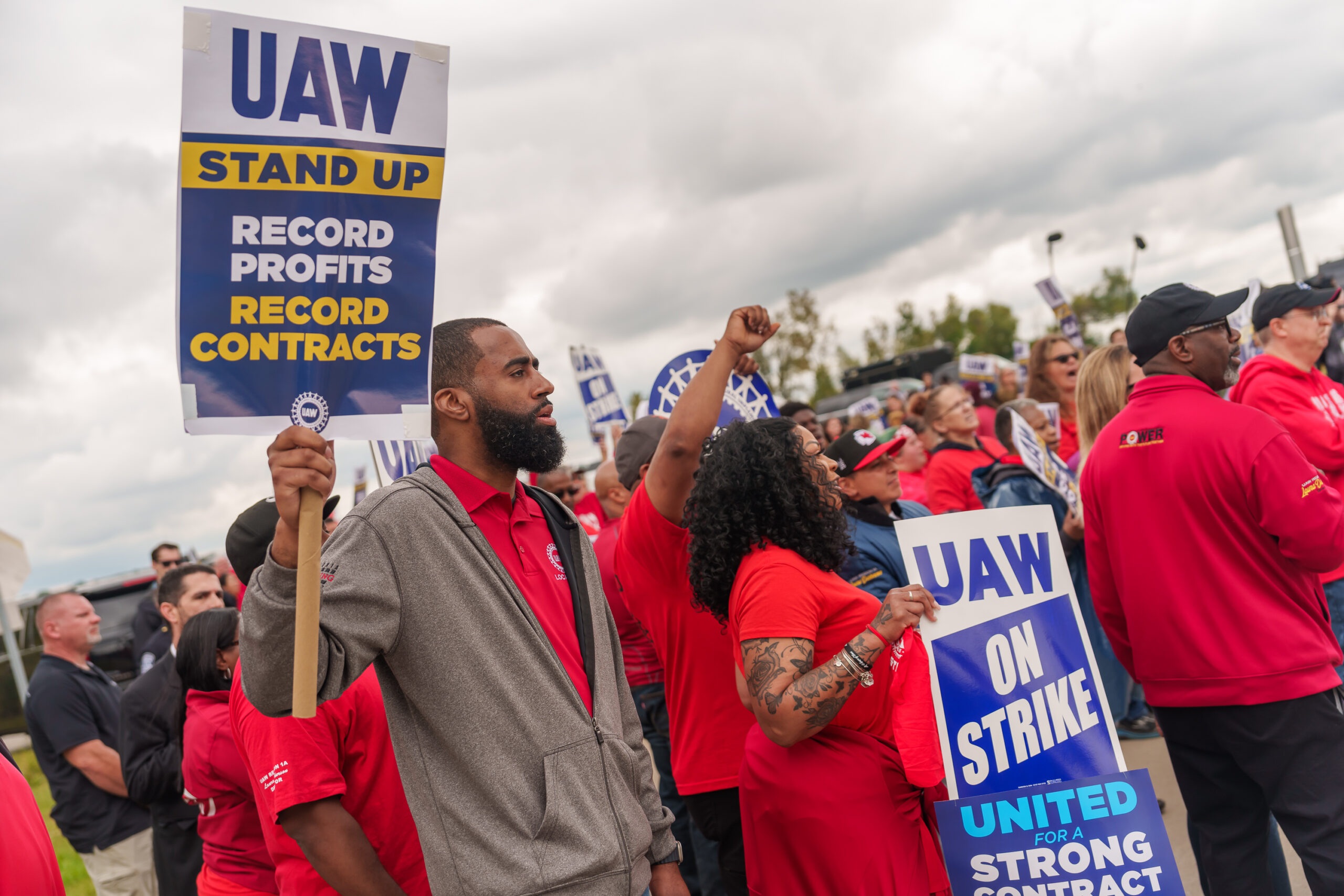
President Joe Biden walks along the UAW picket line and engages with union members at the GM Willow Run Distribution Center, Tuesday, Sept. 26, 2023, in Belleville, Michigan. (Official White House photo by Adam Schultz)


Additional sections

Summary Executive summary


Section 1 Introduction


Section 2 The high stakes and big bet on Alabama’s auto industry


Section 3 The ways the bet on auto benefited Alabama


Section 4 A wheel in the ditch: Autoworkers see falling pay


Section 5 A wheel in the ditch: Pay gaps and occupational segregation


Section 6 A wheel in the ditch: Economic impact of falling wages and the pay gap


Section 7 A wheel in the ditch: Working conditions worsen


Section 8 The auto industry and Alabama’s low-road economic development approach


Appendix Research design and methodology


[151] Economic Policy Institute, supra note 130.

[152] Alabama Workforce and Wage Gap Task Force, supra note 93.
[153] Kellie Miller, “Mazda Toyota employees begin enrolling in new child care assistance program,” WAFF 48 (April 3, 2022), https://www.waff.com/2022/04/03/mazda-toyota-partners-with-tootris-provides-child-care-assistance-employees.

[154] Paola Rodelas & Michael Troncoso, “Major electric vehicle manufacturer signs first multi-state agreement with community and civil rights group for equitable hiring and good jobs,” Jobs to Move America (May 26, 2022), https://jobstomoveamerica.org/press-release/major-electric-vehicle-manufacturer-signs-first-multi-state-agreement-with-community-and-civil-rights-group-for-equitable-hiring-and-good-jobs.

[156] Glass, et al., supra note 123.

[157] Ibid.

[158] Good Jobs First, Key Reforms: Clawbacks, https://goodjobsfirst.org/key-reforms-clawbacks.

[159] Atkins, supra note 8, at xii.

[160] Collins, supra note 129.

[161] Associated Press, “Judge orders striking coal miners to stop picketing” (Oct. 29, 2021), https://apnews.com/article/business-alabama-tuscaloosa-strikes-united-mine-workers-of-america-ae76d7d627cdbb90f8845c7a6ce29c9f.

[162] Cutcher-Gershenfeld, et al., supra note 73.

[163] Ibid.

[164] Ibid.

The State of Working Alabama 2023 – Appendix: Research design and methodology

State of Working - Appendix cover

How we define the ‘auto industry’

In this study, we confined our definition of the auto industry to the three industries that conduct auto manufacturing (as opposed to other auto-related activities):

  • NAICS 3361 – Motor Vehicle Manufacturing
  • NAICS 3362 – Motor Vehicle Body and Trailer Manufacturing
  • NAICS 3363 – Motor Vehicle Parts Manufacturing

Taken together, these three industries account for all aspects of vehicle and parts manufacturing, including core auto plants and their various suppliers (including everything from engines to seat covers). We do not include other related industries within the broader auto sector, including dealers, wholesalers, and maintenance and repair.

Data sources

We relied on two main sources of data for this analysis. First, our analyses of auto industry demographics, earnings and employment (Sections 4, 5 and 6) used Quarterly Workforce Indicators (QWI) from the Longitudinal Employer-Household Dynamics Survey, produced by the U.S. Census Bureau. We also cross-checked QWI earnings and employment with the Quarterly Census of Employment and Wages to ensure the values were broadly similar. Secondly, for our analysis of earnings and occupational segregation (Section 6), we relied on Economic Policy Institute sampling of five-year estimates of American Community Survey (ACS) microdata (2015-2019) to have sufficient sample size to conduct the analysis.

Study period

The study period for data analysis is 2002-2019. We chose 2002 as our starting point due to data limitations in QWI, which could not provide both employment and earnings data prior to that year. We chose 2019 as our end year because disruptions related to the COVID-19 pandemic disproportionately affected the auto industry. These disruptions artificially lowered employment and earnings in ways we felt were not representative of overall trends in the industry. Note that when we ran sensitivity analyses that included 2020 and 2021, these concerns proved valid. QWI data for 2022 and 2023 were not yet available at the time of the analysis in this report.

Earnings analysis

Using our QWI data, we estimated the average yearly earnings for the auto industry by taking a weighted average of the earnings across 3361, 3362 and 3663, weighting according to each industry’s share of combined auto employment. We then adjusted each year of average earnings for inflation. All earnings values in the report are presented in 2021 constant dollars.

Occupational segregation analysis

We examined five occupations within the auto industry that had sufficient sample size to incorporate into our analysis. These included by Census Occupational Code:

  • 7700 – First-Line Supervisors of Production and Operating Workers
  • 8140 – Welding, Soldering, and Brazing Workers
  • 8740 – Inspectors, Testers, Sorters, Samplers, and Weighers
  • 7750 – Miscellaneous Assemblers and Fabricators
  • 9620 – Laborers and Freight, Stock, and Material Movers

The QWI survey does not provide occupational earnings or employment by industry, race or sex, so we relied on the ACS microdata to provide us with the share each demographic group’s employment comprises of each occupation. We then applied these shares to the employment counts in QWI to determine how many employees of a demographic work within each occupation. To calculate the average earnings in each occupation, we took the percentage of each occupation’s earnings as a total of the average auto industry earnings (as presented in the ACS microdata) and applied that percentage to the QWI industry average earnings. This gave us estimated earnings levels for each occupation (and each demographic) consistent with and comparable to our overall earnings analysis using QWI data.

IMPLAN analysis

We used IMPLAN, a proprietary economic impact analysis software package, to estimate the economic impact of the key pay gaps discussed in Section 5.

IMPLAN is an input-output modeling program that permits researchers to estimate the projected effects of an exogenous change in demand – such as increase in overall labor income due to closing the pay gap between Black and white autoworkers – in a specified geographic region, such as Alabama. For our study, we used IMPLAN to model the implicit counterfactual of how much additional spending would have flowed into Alabama’s economy if auto employers had paid their workers the same average amount in 2019 as they did in 2002, and paid men the same as women, and Black and Hispanic workers the same as white workers.

The software is typically used by economic developers looking to assess the impacts of new plant locations or tax changes. But it also has been used to model the impacts of minimum wage changes in other states and increased labor income resulting from greater female labor force participation in Alabama, and so is well suited to assessing changes in earnings like those we examine.

Specifically, we used IMPLAN to estimate the following four pay gaps:

  • The difference between the inflation-adjusted average annual earnings by autoworkers in 2002 and in 2019 (in 2021 constant dollars).
  • The difference between the average annual earnings of Black autoworkers and white autoworkers in 2019 (in 2021 constant dollars).
  • The difference between the average annual earnings of Hispanic autoworkers and white autoworkers in 2019 (in 2021 constant dollars).
  • The difference between the average annual earnings of male autoworkers and female autoworkers in 2019 (in 2021 constant dollars).

We ran four separate models, one for each pay gap. In each of these models, we used the pay gap amount as the input and then modeled each of them as an Industry Impact Analysis (Detailed – labor income change) event for the auto industry, specifying the year of impact as 2019 (to match our QWI data), using 2021 dollars. To check our work, we also ran all four models as a standard labor income event (with 100% of our earnings change assigned to employee compensation), and as expected generated identical results to the original Industry Impact Analysis.

In terms of results, for labor income changes like these, the software only reports “induced effects,” which capture tail-end economic ripple effects of shifts in household spending resulting from the total change in earnings we’re modeling (e.g., resulting from closing the pay gaps). But we needed to estimate the total impact on Alabama’s economy, which includes the original amount of the new labor income that would flow to Alabama if these pay gaps were closed (e.g., $348,926,144 for the historical pay gap).

Though it is unusual to combine original and induced effects in this way for labor income changes in particular, staff economists at IMPLAN advised us it would be appropriate in this case. This is because the economic change is not associated with a separate Industry event (like a new plant facility opening), and we need to reflect the full range of an economic change that includes both new earnings (closing the pay gaps) and the induced effects (the ripple effects of the input) together.

Our results tables are reported here:


Additional sections

Summary Executive summary


Section 1 Introduction


Section 2 The high stakes and big bet on Alabama’s auto industry


Section 3 The ways the bet on auto benefited Alabama


Section 4 A wheel in the ditch: Autoworkers see falling pay


Section 5 A wheel in the ditch: Pay gaps and occupational segregation


Section 6 A wheel in the ditch: Economic impact of falling wages and the pay gap


Section 7 A wheel in the ditch: Working conditions worsen


Section 8 The auto industry and Alabama’s low-road economic development approach


Section 9 What we should do next

Alabama Arise, worker advocates celebrate progress

Alabama Arise is working on multiple fronts to improve life for working Alabamians. As part of our ongoing Worker Power Project, we held an Oct. 26 convening in Montgomery with around 20 worker advocacy groups and organized labor partners from across the state. Attendees met to discuss building and implementing a state agenda to build the policy power of working-class Alabamians.

Unions highlighted organizing campaigns at various stages, including the United Mine Workers of America strike and United Auto Workers actions nationwide and in Alabama. They also discussed efforts to empower workers through the recent community benefits agreement at New Flyer, an electric bus manufacturer in Anniston.

State of Working Alabama logo

Arise previewed this year’s forthcoming State of Working Alabama report, which will focus on job quality in the auto industry. Attendees also discussed ways to advance worker-centered policies and defend against anti-worker bills in 2024. And advocates planned how to build and strengthen long-term, strong interorganizational relationships and power for worker organizations throughout Alabama to support growing the collective power of organized labor.

Three strategies to boost Alabama’s workforce

State of Working Alabama logo

Alabama leaders and policymakers are stressing about one big issue going into the 2024 legislative session: labor force participation.

Alabama’s labor force participation rate is among the nation’s lowest. Only 57% of working-age adults reported they were actively working or looking for jobs as of September 2023. We also have a severe worker shortage, with nearly 100,000 more job openings than workers available to fill them.

This situation gives Alabama workers increased power to negotiate better wages, benefits and working conditions. It also leaves state leaders and employers scratching their heads. Aren’t we supposed to be among the most “business-friendly” states in the country? How can we attract and retain industry if businesses can’t hire workers? And why aren’t more people applying for openings as the cost of living continues to increase?

Consistent barriers to workforce participation

If you want to know why people are leaving the workforce, you need to ask them. Thankfully, we have data to understand what is happening.

Workers who are underemployed or dropped out of the workforce cited three major, consistent concerns, according to multiple recent surveys from the Governor’s Office of Education and Workforce Transformation:

  1. No transportation.
  2. Inadequate pay or work schedule. (Workers are looking for full-time work or higher pay.)
  3. Illness or disability prevented them from working. (Indeed, disability is one of the main driving forces in Alabama’s extremely low workforce participation rates.)

One would hope we would see more of this data informing the conversation about the workforce. But unfortunately, it appears many lawmakers still haven’t seen the data.

Alabama Arise worker policy advocate Dev Wakeley participated in a recent discussion with lawmakers about barriers to workforce entry. He shared Arise’s policy prescription to address this issue, based on clear and direct feedback we’ve heard from workers.

1. Fund the Public Transportation Trust Fund to help workers get to jobs.

Alabama is one of only three states that has no state funding set aside to support public transportation. The Bipartisan Infrastructure Law of 2021 made massive federal boosts in public transit money available across the country. But with no local or state resources to match, cities and counties across Alabama cannot harness those federal matching funds.

Multiple survey groups cited transit access as their top barrier. It’s time for Alabama to join the rest of our Southeastern neighbors by boosting public transportation investments.

2. Stop incentivizing employers who fail to deliver on promises to provide good-paying jobs.

Alabama lawmakers passed “The Game Plan” earlier this year to renew several key economic incentive packages for large employers. Legislators also strengthened some reporting requirements via the Enhancing Transparency Act. These enhancements were critical, as Alabama still ranks among the least transparent states when it comes to economic incentives and tax expenditures.

We applaud efforts to hold businesses accountable for the promises they make when applying for these major tax breaks. But lawmakers must do more to enforce accountability and ensure the investment is paying off. While our state defers millions of dollars in tax revenue for vague incentives with unclear deliverables, many workers are still struggling to access the promised jobs because we have failed to invest in the necessary state infrastructure. And too often, the jobs simply don’t measure up to the promised wages and hiring goals.

3. Expand Medicaid to keep working-age adults healthy and in the workforce.

Investing in Alabama’s health care infrastructure is not just an avenue to create more health care jobs. It’s also a way to keep workers healthy and in the workforce.

Nearly 300,000 working Alabamians fall into the health coverage gap. Many are employed in high-demand but low-paying industries including service, retail, personal care or construction jobs. Consistent health care for low-wage workers can help prevent or control chronic disabling conditions. It also can give workers a lifeline when they are struggling with addiction, substance use disorders or mental illness.

Workers ideally would find good-paying jobs that provide flexible and inclusive family benefits. But they also should retain access to health coverage if they have to take a break from work to handle caregiving duties, manage a health or family crisis, go back to school or start their own business.

Temporarily losing a job with health coverage should not spiral further into permanent, preventable disability or untreated illness. Medicaid expansion would ensure many Alabamians still can get the health care they need during difficult times.

A prescription for a stronger workforce

We applaud House Speaker Nathaniel Ledbetter and the House Commission on Labor Shortage for expressing an interest in looking more deeply into the data around labor force participation. We were also glad to hear multiple lawmakers cite issues including affordable housing, wages and child care. All of these are critical supports to empower people to obtain and maintain employment.

To us, the message is clear: Investing more in work supports like public transportation and health care while ensuring more transparency and accountability for workforce incentives is a key, data-supported strategy to keep more Alabamians working and thriving.

Here’s what Alabama Arise heard from you in summer 2023!

Alabama Arise listens because we deeply value the input we get from members, partners and most importantly, those directly affected by the work we do together. We depend on what we hear to help guide our issue work and our strategies.

We held three statewide online events this summer: two Town Hall Tuesdays and one public transportation listening session. And we facilitated eight additional listening sessions around the state, engaging a total of about 375 people.

The town halls happened on July 18 and Aug. 8, and the public transit event was Aug. 9. Other meetings took place throughout the summer. This year we are sharing the direct notes and highlights from each of the meetings as recorded during the sessions.

Town Hall Tuesdays & Public Transportation Listening Session

  • Building on our vision: We had three breakout rooms during this session. We asked folks in each group to discuss their thoughts on current issues and to share other priorities they had. Here’s what we heard:

Group One: Participants generally thought Arise should continue working on the current issues. They noted that the issues are interconnected, and that makes it hard to prioritize. Concerns about criminal justice conviction practices were raised, along with the need for continued work on voting rights and Medicaid expansion. Other issues raised were the need for more affordable housing, paying a living wage versus a minimum wage, and the need to discuss the impact of the opioid epidemic on grandparents now raising children because their parents suffer with addiction. Participants also raised reapportionment as an important issue.

Group Two: Participants strongly believed all of the Arise priority issues are important and that we should continue to work on them. Some of the specific issues lifted up were transportation, voting rights, payday lending and Medicaid expansion. Some issues that are not current Arise priorities raised were housing, disability, mental health access and accountability and prison reform.

Group Three: Medicaid expansion received the most support for continued work. Several people voiced prisons and criminal justice as a concern, including the need for prison reform and bail reform. Voting rights and the concern about the many voter suppression bills was a high-priority topic. Participants discussed passionate concern about payday loans, and the group supported the present slate of issues.

  • Building on our hope: We had three breakout rooms during this session. We asked folks in each group to discuss what motivates them to act on issues and how Arise supports their actions. We also asked them to indicate their priority issues. Here’s what we heard:

Group One: 

  1. The discussion in the group was hot and heavy concerning voting rights and specifically the absentee ballot application. The group concluded that a no-excuse absentee ballot should be the norm and should be an Arise issue for 2024.
  2. The group felt strongly that the 2023 Arise slate of issues should all remain on the 2024 list of Arise priority issues. Medicaid is an issue we need to keep fighting for, they said.
  3. This group had a primary focus and lengthy discussion around voting rights.

Group Two: 

  1. All members of the group strongly believe all the Arise priority issues are important and that we should continue to work on them.
  2. Members also strongly believe affordable housing and public transportation should receive a strong voice like Medicaid expansion.
  3. Members said that to further our support of advocacy work, Arise can help unite nonprofits and grassroots organizations across the state to work together toward shared goals as opposed to working separately toward shared goals.
  4. Members lifted up our education and lobbying work as essential to connecting the people to those who represent them in the Legislature.

Group Three: Voting rights emerged as a strong theme from this group’s discussion. Participants stressed the importance of voter education and folks making the connection between voting and the policies elected officials make that impact their lives. Other voting themes included restoration of voting rights and engaging younger and BIPOC voters. Other issues raised were around public transportation and the need to fund mental health services. One participant expressed appreciation for the storytelling work Arise does related to Medicaid expansion and urged similar storytelling to help move elected officials around other Arise issues.

  • Public Transportation Listening Session: We had three breakout rooms during this session. We asked folks in each group to discuss what’s needed to improve public transit in Alabama, what strategies are needed to move the issue forward and how public transit impacts quality of life in their communities.

Group One: 

  1. Private companies like Uber and Lyft are not equipped to serve the disability community, group members said. This is very important when talking about transportation for the disability community wherever they may be, rural or urban. In other words, the private companies are not a viable resource, participants said.
  2. Rural linkage: Many rural counties have transportation-on-demand systems, but they only serve the county boundaries. Many health services reside in urban centers, and the rider needs to get from Blount County to UAB or Children’s Hospital in Birmingham. These riders are out of luck. Transfer hubs for rural to urban systems do not exist.
  3. A state transportation planning system is needed to coordinate all the existing public systems, rural and urban. Participants hoped Arise’s forthcoming transit study will shine some light on the need for a statewide public transportation planning entity.
  4. The group felt a need for massive public education around the benefits of public transportation. Somehow, Arise or a group of organizations should seek funding for an advertising budget, participants said.
  1. The real cost of owning a car versus using public transportation. This kind of information should be available to the public.
  2. The fact that public transportation is good for business development throughout the state should be targeted to legislators and local business councils and chambers of commerce.

Group Two: 

  1. This group believes public transportation is essential.
  2. There is a need for more hubs and covered stops for locations that already have public transportation in place.
  3. There is a need for more routes with more frequent buses each hour, as well as drivers who are paid livable wages.
  4. Specific strategies discussed included working with for-profits, chambers of commerce, small businesses and corporations to improve transportation for their employees. Participants also suggested surveying the need for transportation by including a question on applications to ask if transportation is needed.
  5. Public transportation impacts the quality of life across the board: health, food, employment, education, leisure, etc.
  6. People have a right to comfort, dignity, pride and independence that public transportation can provide.
  7. One member said reaching out to people who do not need or use public transportation is important to educate them that they can still benefit from it. It helps reduce traffic and road congestion, decreases likelihood of drinking and driving, and helps people out of desperate situations, which can help decrease poverty and crime.
  8. A member of the Alabama Institute for the Deaf and Blind shared how losing the ability to drive caused depression. But oppression is felt when there are no options for transportation other than relying on friends or family if you have them, or simply being unable to go to doctor’s appointments, shop for groceries or pick up medications when needed.
  9. Some members suggested a public Lyft/Uber service.

Group Three: 

  1. Needs: Money/state funding, alternative models, transit-oriented development at local levels, accessibility, buy-in from agencies like ALDOT, changed perception of public transit.
  2. Strategies/tactics: Collect public transit stories, share statistics on earning power with vs. without good public transit and other data relevant to workforce development, and highlight workforce development as a theme for legislative lobbying. Participants discussed a license plate fee, tire fee or special license plate (like public schools have, for example).
  3. Quality of life: A visually impaired participant described how a trip to the grocery store or polling place only a couple miles away is a $25 Uber ride one way. Another participant who works with clients described how their lack of access to public transit affects not just work but health appointments, visiting DHR to secure SNAP, applications for housing, etc. They also mentioned that even “low-cost” transit can be a barrier to low-income folks who may not have a dollar for a ride.

Additional listening sessions

Following are the brief notes/summaries from eight other sessions our organizers held during the summer. In general, all participants strongly affirmed Arise’s work on the current issue priorities. They also highlighted some other issues of concern.

  • Cullman, July 26 (Stan Johnson) – This was a well-informed group with a lot of comments and questions concerning criminal justice, public transportation, death penalty and new prison construction.
  • Opelika, July 26 (Formeeca Tripp) – This group discussed issues surrounding housing, transportation, food insecurity, health care and the legal system. Housing was a top issue.
  • Zoom, Aug. 3 (Formeeca) A death penalty group discussed issues related to recent executions in Alabama, as well as upcoming executions nationwide. Participants said more attention and connections are necessary to bring more awareness to death penalty reform.
  • Tuscaloosa, Aug. 7 (Stan) – The most passionate suggestion from this meeting was the need for legislative action to provide funding for mental health.
  • Opelika, Aug. 17 (Formeeca) – Arise conducted listening sessions in the form of a series of small group meetings.

Group 1: Predominantly parents, people of the community and law enforcement. They supported all current issues but wanted to focus on housing and transportation.

Group 2: Predominantly school staff, counselors, superintendents, principals, resource providers, etc. They wanted resources for non-English-speaking families, housing, transportation and effective mental health services.

Group 3: Predominantly youth, teenagers and support staff. They wanted to learn more about their representatives and how to lift up their own voices, as well as better wages and job opportunities.

  • Montgomery, Aug. 17 (Formeeca) – This group discussed their strategic plan to add to the existing public transportation priority issue. They want to add a $1 fee to license plates to fund the Public Transportation Trust Fund.
  • Birmingham, Sept. 10 (Stan) – This group showed special interest in fair housing and criminal justice reform. Voting rights also was a concern to the group, specifically absentee voting bills that may be reintroduced in the upcoming session.
  • Auburn, Sept. 21 (Formeeca) Students from an Auburn University class filled out a 2024 issue proposal survey form asking them to rank issues of priority. The top three issues that seemed to rank the highest were public transportation, voting rights and criminal justice reform.

2023 was a momentous session on Alabama Arise policy priorities

June 6 ended one of the most significant legislative sessions ever for Alabama Arise and our supporters. Through timely and persistent advocacy, Arise members helped build a better, more equitable Alabama.

While our work continues, we want to highlight the many important strides this year in our movement for a better Alabama for all – and celebrate Arise members’ role in advancing that goal. This article summarizes some of the key bills on Arise priorities during the Legislature’s 2023 regular session. For information on all bills we tracked this year, visit the Bills of Interest page on our website.

Tax reform

Lawmakers proposed many significant tax reform bills this session. But none will have more lasting significance to Alabamians than reducing the state sales tax on groceries, a longstanding Arise priority. Thanks to phenomenal member advocacy, our state is finally removing part of this regressive tax.

HB 479, sponsored by Rep. Danny Garrett, R-Trussville, became law this year. This legislation will cut the state grocery tax by half in the coming years. This huge victory for tax justice resulted from decades of hard work by Arise members. (See page 1.)

Adequate state budgets

Alabama’s 2024 General Fund (GF) and Education Trust Fund (ETF) budgets are both significantly larger than 2023. The GF budget is about $3 billion and includes a 2% pay raise for state employees. It also includes significant funding increases for Medicaid, mental health care and other state services. The 2024 ETF budget is nearly $8.8 billion, half a billion dollars more than the previous year’s ETF.

HB 295 and SB 202, known as the PRICE Act, were sponsored by Rep. Ernie Yarbrough, R-Trinity, and Sen. Larry Stutts, R-Tuscumbia. These bills would have allowed parents to take tax dollars that otherwise would support local public schools and use them to pay for private schools or home schooling. Arise and other advocates helped defeat this legislation, protecting nearly $600 million of public education funding.

Voting rights

HB 209, sponsored by Rep. Jamie Kiel, R-Russellville, did not pass this session. This bill would have criminalized many efforts to assist voters with absentee ballot applications or completed ballots. Arise and other groups successfully stopped this bill, which passed the House but never reached the Senate floor.

Criminal justice reform

SB 154, sponsored by Sen. Will Barfoot, R-Pike Road, became law this year. This legislation will make it harder for the state to suspend people’s driver’s licenses for failure to pay traffic tickets. Arise and our partners at Alabama Appleseed strongly supported this bill.

HB 24, sponsored by Rep. Reed Ingram, R-Pike Road, passed despite Arise’s opposition. This bill will criminalize asking for money on the side of roads, punishing many Alabamians facing housing insecurity. Federal courts have found similar laws unconstitutional in recent years.

HB 229, sponsored by Rep. Chris England, D-Tuscaloosa, would have allowed resentencing of certain incarcerated individuals sentenced to life imprisonment without parole under Alabama’s Habitual Felony Offender Act. This bill passed the House and gained Senate committee approval, but it never reached the Senate floor. Arise supported this bill and expects a similar one to be filed next session.

Death penalty reform 

England’s HB 14 would have required a unanimous jury sentence to impose the death penalty. The bill also would have made the state’s judicial override ban retroactive. This bill received a public hearing but did not leave the committee. Arise supported this bill and expects a similar one to be filed next session.

Other issues 

SB 196, sponsored by Sen. Arthur Orr, R-Decatur, would have increased government transparency by improving Alabama’s open records process. This bill passed the Senate and gained House committee approval but did not pass in the House. Arise supported this bill and expects a similar one to be filed next session.

SB 242, sponsored by Sen. Keith Kelley, R-Anniston, would have undermined tenant protections by removing the cap on the amount of the security deposit that landlords can charge to renters. Arise opposed this bill, and it died without reaching the Senate floor.