The monument stood in Birmingham for decades as a twisted tribute to Alabama’s original sins: slavery and white supremacy. It “honored” a violent rebellion that sought to protect the enslavement of human beings. During segregation and Jim Crow and civil rights protests and into the 21st century, it served as a daily 52-foot-tall reminder of the systemic oppression and persecution of Black Alabamians.
That monument is finally gone now. After protests, the city pulled it down June 1, on a state holiday named for the political leader of the rebellion it commemorated. Removing physical symbols of slavery and segregation is an important step toward healing and recovery, but it’s not enough. We also must tear down prejudices, disparities and injustices that trace their roots to these oppressive and racist practices. To do that, Alabama must enact public policies that undermine white supremacy and promote dignity, equity and justice for everyone.
The need for racial justice
For more than 30 years, Alabama Arise has worked to make life better for struggling Alabamians through better public policy. It’s impossible to do that work effectively without acknowledging and challenging our state’s historical and ongoing racial inequities. There can be no economic or social justice without racial justice. And as scholar Ibram X. Kendi said, policy cannot be merely non-racist; it must be anti-racist. That’s why we’re committed to placing racial equity and inclusion at the core of our work.
Black Alabamians have battled generation after generation of discriminatory barriers to education, jobs, housing and voting. Compounding those barriers is a criminal justice system that polices Black people more heavily, arrests them more often and condemns them to harsher sentences in dangerously overcrowded prisons and jails.
For centuries, Black people have suffered from police brutality and unequal treatment from law enforcement. This history has fueled protests across the country and around the world over the last week. Arise stands in solidarity with calls to stop killing Black people and start building a world that’s safe for everyone.
All of these systemic failures have added together to produce a series of terrible, ongoing disparities. Black people in our state face higher rates of poverty and hunger, lower life expectancies and lower rates of employment and health insurance coverage.
Policy changes to break down harmful barriers
These are institutional failures that require policy solutions. Here a few ways lawmakers can help break down barriers to opportunity and justice:
Expand Medicaid to cover adults with low incomes. Expansion would ensure health coverage for more than 340,000 Alabamians who are uninsured or barely paying for insurance they can’t really afford. It also would attack a fundamental injustice: People of color make up about 34% of our state’s population, but nearly half of all uninsured Alabamians with low incomes are people of color. Lack of affordable health coverage deprives Black people of timely care for cancer, diabetes, heart disease and other serious conditions. As the disproportionately high share of coronavirus deaths among Black Alabamians shows, health care access is literally a matter of life or death.
Invest more in public education. Alabama’s state funding for K-12 and higher education, adjusted for inflation, is lower today than it was in 2008. This chronic underfunding hits many schools that primarily serve Black students especially hard.
Equitably distribute funding for affordable housing and public transportation. Alabama has trust funds for both but hasn’t funded them yet. Lawmakers should fund public transportation to help everyone get to work, school and other places they need to go. Alabama should support the Housing Trust Fund to ensure people living in deep poverty have safe shelter. Our state also should commit to eliminating redlining, fighting housing discrimination and proactively reducing residential segregation.
Overhaul the criminal justice system and the death penalty. Areas with large Black populations often see a larger police presence. The weight of harsh sentences and criminal justice debt falls more heavily on these Alabamians as a result. Lawmakers should reform sentencing laws and ease the crushing burden of exorbitant fines and fees. They also need to end abuses of civil asset forfeiture and eliminate racial injustice in the state’s death penalty system.
Strengthen and expand voting rights. Voting barriers should find no home in the heart of the Civil Rights Movement. Automatic voter registration, no-excuse absentee voting and same-day registration are a few changes that would make voting more accessible. Alabama also should ease barriers to voting rights restoration.
Raise the minimum wage and restore home rule to localities. Alabama is one of only five states with no minimum wage law. Birmingham tried to raise its minimum wage in 2016, but state lawmakers blocked that effort. The Legislature has that power due to the 1901 state constitution, whose authors explicitly said the document aimed to “establish white supremacy in this state.” Alabama should lift constitutional barriers to home rule and allow local governments to make decisions in their own communities.
A better, more inclusive future for Alabama
Undoing the legacies of slavery and segregation in Alabama will require more than reassuring words and vague platitudes. It will require substantive policy changes to break down centuries-old barriers and ensure all Alabamians have a chance to reach their full potential.
Many of these changes – and others not mentioned above – won’t be easy. Some of them may not happen quickly. But we must keep advocating and working toward the day when they will. The road to dignity, equity and justice for all Alabamians remains a long one. But walking together and working together, we can and will reach that destination.
Life is changing quickly for everyone during the coronavirus (COVID-19) public health emergency. Protecting yourself and your family from the virus is the first of many concerns. The pandemic also has left many Alabamians worried about food, health care, housing, job security and other basic needs.
Alabama has a safety net of public assistance programs that can help people through hard times. And Alabama Arise wants to help people connect with the help they need. Use this guide to find services that may fit your needs now, even if you weren’t eligible before.
Response efforts are changing rapidly, so check back for updates to this resource guide as new information becomes available. Email info@alarise.org if you have any questions or recommendations for additional resources.
Below is a table of contents covered in this guide. Click on each topic to go to its corresponding section.
Know the major symptoms of COVID-19: cough, fever, shortness of breath or difficulty breathing. Other symptoms may include aches, chills, diarrhea, headache, severe vomiting, sore throat, tiredness or new loss of smell or taste.
If you experience these symptoms, call your doctor first to get advice on testing and care. Free testing is available at state testing sites. Charges may apply at other testing sites.
If you do not have a doctor, call the Alabama COVID-19 Hotline 24/7 at 888-264-2256 for testing sites and hours of operation near you. Note: This hotline does not provide medical advice.
If you are uninsured, you may be able to get free treatment for conditions related to COVID-19. The federal Coronavirus Aid, Relief and Economic Security (CARES) Act includes a $100 billion emergency fund for health care providers. “As a condition of receiving funds under this program, providers will be forbidden from balance billing the uninsured for the cost of their care,” the Department of Health and Human Services (HHS) has announced. Check with your local hospital or clinic about this.
Prolonged in-home isolation can mask incidents of family abuse and violence, especially toward children, seniors or people with disabilities. People who report abuse or neglect are protected from legal action in response to their reporting.
Members of certain professions are mandatory reporters, meaning they must report suspected or known abuse or neglect. These professions include chiropractors, clergy members, coroners, day care workers or employees, dentists, doctors, law enforcement officials, medical examiners, mental health professionals, nurses, optometrists, osteopaths, pharmacists, podiatrists, social workers and teachers and school officials.
– If you are experiencing domestic violence (that is, if someone in your family or someone you’re in a relationship with is hurting or threatening you), call the Alabama domestic violence hotline at 800-650-6522. This hotline is answered 24/7, and you do not have to give your name to get help.
– To report suspected child abuse or neglect, including failure to seek medical treatment, call your county Department of Human Resources or local law enforcement. Do not email reports of suspected abuse or neglect, as they may not get prompt attention.
– To report elder abuse, call the Adult Abuse Hotline at 800-458-7214.
– To report abuse in an assisted living facility or nursing home, call 800-356-9596.
Other contact numbers to know
– If you need legal help anywhere in Alabama to protect your right to disability services, call the Alabama Disabilities Advocacy Program (ADAP) at 205-348-4928 or use the online intake form here.
– If you are a survivor of sexual assault, you can call the sexual assault hotline at 800-656-HOPE (4673). You will be connected with a trained sexual assault service provider in your area.
– If you are experiencing homelessness and need shelter, call 2-1-1 and ask for a list of shelters in your area.
– If you need legal help for a problem related to COVID-19, call Legal Services Alabama at 877-393-2333 or click here.
– To report COVID-19-related price gouging or scams, contact these hotlines:
The Alabama Attorney General’s Consumer Complaint Hotline: 800-392-5658 or 334-242-7335 (8 a.m. to 5 p.m., Monday through Friday).
The National Center for Disaster Fraud Hotline: 866-720-5721 or disaster@leo.gov.
Health care and insurance
The risk of COVID-19 exposure, complications and death varies widely by job, age and health condition. That’s why the new vaccines are being offered in phases, with those deemed at highest risk getting the first doses.
As of April 5, 2021, all Alabamians age 16 and older are eligible to receive the COVID-19 vaccine. Supply shortages have been a major obstacle in Alabama’s vaccination rollout, but new vaccine products and a manufacturing push are improving the outlook. For more information, visit alabamapublichealth.gov.
Important information about the COVID-19 vaccines
Here are some important things to know about the vaccines:
All approved vaccines have been through the full testing process for any U.S. vaccine. They’ve come out more quickly because testing and manufacturing were scaled up for the emergency.
The Johnson & Johnson vaccine comes in one dose. The Moderna and Pfizer vaccines come in two doses, several weeks apart. If you get either of those, you will need to get the second dose of the same vaccine you got the first time. The person who gives you your vaccine will explain how to get your follow-up shot.
Your health care provider is your best source of information about the vaccine and how to get it. If you don’t have a regular provider, contact your county health department or a local clinic about how and when to get the vaccine.
The vaccine will be free to everyone. Some providers may charge an administrative fee. If you cannot pay the fee, tell your provider. You can still get the vaccine.
Lots of false information is circulating about the vaccines. Be sure to confirm anything you hear or read with information from a reliable source, such as your health care provider, your county health department or a local clinic.
Vaccines are being distributed as soon as they are available. Because the supply is limited at this stage, it’s important to follow official guidance on which phase is the one for you. In the meantime, continue taking precautions and be patient. Everyone will have the opportunity to get the vaccine.
COVID-19 puts people without health insurance at special risk for delayed care and financial disaster. Federal and state governments are making changes to help people who are uninsured or at risk of losing coverage.
COVID-19 care
If you are uninsured, you may be able to get free treatment for conditions related to COVID-19. The federal Coronavirus Aid, Relief and Economic Security (CARES) Act includes a $100 billion emergency fund for health care providers. “As a condition of receiving funds under this program, providers will be forbidden from balance billing the uninsured for the cost of their care,” the Department of Health and Human Services (HHS) has announced. Check with your local hospital or clinic about this.
Medicaid
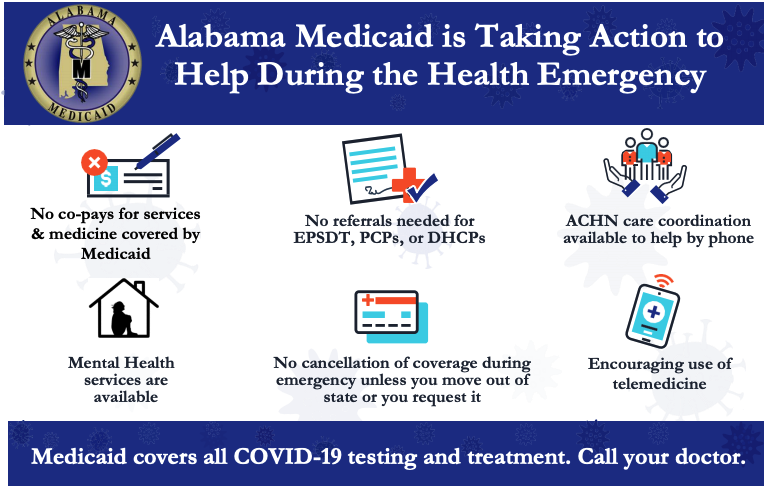
Courtesy of Alabama Medicaid Agency
If you had Medicaid coverage of any kind during March 2020, or if you become eligible later, your coverage will not be terminated for any reason before the crisis has ended, unless you cancel it yourself or move out of Alabama. This includes postpartum coverage for women who recently have given birth. If your case was open in March but has already closed, please be patient. Medicaid will reopen your case very soon.
To help keep your Medicaid from ending after the emergency:
Report any information changes.
Renew your Medicaid at the scheduled time.
If you have Medicaid coverage, you do not have to pay co-pays to the hospital, doctor’s office, pharmacy or for medical equipment and supplies during the coronavirus emergency.
If you are younger than 65 and have lost your job, regular pay or hours in the coronavirus emergency, you have a few options. The American Rescue Plan Act (ARPA) passed by Congress in March provides new assistance with health coverage:
Through Sept. 30, 2021, people eligible for COBRA continuation coverage after loss of employer-based coverage won’t have to pay any premiums. Note: If you become eligible for a new group plan or Medicare while on COBRA, you must notify your insurer. Failure to do so will result in a cash penalty.
Depending on income level, premiums for Marketplace plans are reduced or eliminated for 2021 and 2022 under ARPA.
Find out if you and your family can get health insurance through Medicaid, ALL Kids or the Marketplace.
To explore your Marketplace coverage options, visit healthcare.gov or call 800-318-2596.
For enrollment assistance, call Enroll Alabama at 844-248-7698 or email enrollalabama@gmail.com.
Alabama has 17 community health centers, with more than 165 locations across the state, that provide comprehensive primary care and preventive services on a sliding fee scale, regardless of patients’ insurance status. Services include:
COVID-19 vaccination
COVID-19 testing
General primary medical care
Diagnostic laboratory and radiology
Preventive screenings
Well check-ups
Dental services
Immunizations
OB-GYN care
Pharmaceutical services
Other services that vary by location (mental health care, optometry, substance use disorder treatment, etc.)
To find the nearest health center, visit Find My Health Center and enter your ZIP code. Or call the Alabama Primary Health Care Association at 888-322-7068 from 8 a.m. to 4:30 p.m., Monday through Friday. Some details of operation are changing because of COVID-19, so call your local center before visiting.
Financial assistance for COVID-related funeral expenses
Thousands of Alabama families have lost loved ones to COVID-19. One of the hidden burdens of the pandemic is the cost of funerals. FEMA, the Federal Emergency Management Agency, offers financial assistance for COVID-related funeral expenses incurred after Jan. 20, 2020.
Call this dedicated toll-free phone number to get a COVID-19 Funeral Assistance application completed with help from FEMA’s representatives. Multilingual services are available:
COVID-19 Funeral Assistance Line Number
844-684-6333 | TTY: 800-462-7585
Hours of Operation:
Monday – Friday
8 a.m. to 8 p.m. Central Time
Get answers to frequently asked questions about the application process on FEMA’s Funeral Assistance FAQ page
Living with disabilities and mental illness
If you or someone you know lives with a disability or mental illness and needs help during the COVID-19 crisis, use this guide from Disability Rights and Resources to find relevant resources by topic and location.
If you need legal help anywhere in Alabama to protect your right to disability services, call the Alabama Disabilities Advocacy Program (ADAP) at 205-348-4928 or use the online intake form here.
Alabama has a network of nonprofit food banks that collect, store and distribute groceries to food pantries, where families can get free food directly. To learn more about food assistance in your area and find a local food pantry, check out the Auburn Justice Center’s food pantry map. Or contact the food bank nearest you:
Alabama’s food banks also operate the Senior Box Program, which provides USDA-donated foods to eligible seniors through a monthly food package. Seniors must be 60 years of age or older and have a household income at or below 130% of the Federal Poverty Level. To apply to receive a Senior Box, a person should call the food bank that serves their area.
Supplemental Nutrition Assistance Program (SNAP)
Alabama provides federal food assistance through SNAP (formerly known as food stamps). Monthly SNAP benefits help eligible households with low incomes buy the food they need to maintain good health. Loss of income in the COVID-19 crisis has made many more families eligible for SNAP.
In response, Congress has increased SNAP benefits for eligible families in three important ways. First, families who would normally receive less than the maximum SNAP benefit because of their income had their benefits increased to the maximum benefit for their household size. Second, all SNAP recipients now receive an additional 15% in SNAP assistance. Third, households that did not receive increased benefits because they were already receiving the maximum for their household size became eligible for an additional emergency allocation beginning in April 2021.
Emergency benefits may be distributed on a different day than regular benefits for administrative reasons. Alabama must request emergency benefits on a monthly basis, but this is done routinely. During the pandemic emergency, the extra benefits are expected to continue without interruption.
Women, Infants and Children (WIC) is a supplemental nutrition program for pregnant or breastfeeding women; women who had a baby within the last six months; infants; and children under age 5. To receive WIC benefits in Alabama, an individual or family must meet all of these requirements:
Have a nutritional risk that healthier food could improve.
If you think you may qualify, call your county health department to make an appointment, or call 888-942-4673 for further information. The Alabama WIC Program offers free communication assistance at each clinic location. During the coronavirus emergency, the health department is conducting interviews and nutrition assessments by phone.
If you or your children are approved for WIC, you will be prescribed a specific package of food based on your nutritional assessment. You will receive a debit-like card called an EBT (electronic benefits transfer) card that you can use to purchase food from your personalized food package. Learn more about WIC food options here. Your options will be based on your age and need. Not everyone approved for WIC will be able to get every food item on the list. During the coronavirus emergency, the Department of Public Health is allowing some substitutions if not all the food in your package is available in the grocery store. Your grocer can help you figure out what you can substitute for a WIC food that is unavailable. Congress has also increased the WIC benefit for fruits and vegetables by up to $35 per month for each recipient.
School meals and extension of Summer Food Service Program
The 2020-21 school year began with many uncertainties for classrooms and school cafeterias. Despite detailed USDA guidelines for distributing school meals, child nutrition staff grappled with implementing practical methods to serve meals to incoming students. While some districts opted for on-site learning plans and specified food service procedures, most relied on virtual learning curriculums and grab-and-go meals for remote learners.
Parents and child nutrition staff received relief when Congress extended the Summer Food Service Program through the 2020-21 school year. Extending this program ensures that all school-age children receive school meals at no charge to parents. Elevated COVID-19 rates have forced some school districts to convert to remote or hybrid learning methods and accompanying grab-and-go meal options. Plans continue to vary from district to district and are likely to change in response to local conditions and experiences. To get updates on your school’s nutrition plan, contact your local board of education.
When schools were closed or went to hybrid schedules, millions of children lost access to school meals. In response, Congress created a special program called Pandemic EBT (P-EBT). P-EBT provides children normally eligible for free or reduced priced meals with the same benefits as the National School Lunch Program ($6.82 a day for each child not receiving meals at school, prorated for children attending school on a hybrid schedule). These benefits are delivered to each individual child on a debit-like card issued by the Food Assistance Division of the Alabama Department of Human Resources (DHR). Estimates are that more than half a million Alabama children will receive P-EBT for the 2020-21 school year.
No application is required to receive P-EBT benefits. The Alabama State Department of Education will provide eligible children’s information to the Alabama Department of Human Resources. Families who experience a decrease in income may apply for free or reduced-price meals at their child’s school to become eligible for P-EBT.
Each eligible school-aged child will receive a debit-like card on which their benefits will be loaded. Parents should maintain those cards so that they can receive a second round of assistance. P-EBT benefits will remain active and usable for 365 days from the date issued.
Details on P-EBT allotments
The first round of P-EBT will be sent to eligible children by mid-July 2021 and will be retroactive to August 2020. These P-EBT benefits will be issued in two allotments: one covering August to December 2020, and the second covering January to May 2021. The amount of each child’s benefit will be based on whether the child’s assigned school schedule is (1) mostly virtual, (2) mostly in-person or (3) hybrid.
Children attending a mostly virtual school will receive the equivalent of 18 days of benefits for each month that the school operated under a virtual learning plan 50% of the school year. Children attending a hybrid school will receive the equivalent of nine days of benefits for each month that the school operated under a hybrid learning plan. Those children attending a mostly in-person school are not eligible for P-EBT during any month when the school operated mostly in-person. Children whose parents elected to have them attend school virtually will be eligible for the full allotment.
P-EBT card distribution is scheduled to begin in mid-June, but because so many children are eligible to receive a card, it will take until mid-July before all cards are mailed and received by eligible families. DHR’s toll-free customer service hotline for P-EBT questions is 800-410-5827. Parents are encouraged to wait until mid-July to call the hotline about the status of their cards because many cards still will be in the mail before that date. The hotline is available from 7 a.m to 6 p.m. Monday through Friday. Parents who want to ensure their children’s cards are sent to the right address should check the address on file with their school(s). Parents can correct addresses by calling the hotline after July 15 when the first round of cards has been mailed out.
Further background on P-EBT eligibility
In October, Congress expanded P-EBT to include children under 6 living in a household receiving SNAP food assistance and in a county in which at least one school has operated virtually or in a hybrid model. If at least one school in the county was completely virtual, eligible young children in that county will receive the full P-EBT benefit. If no school in the county was virtual but at least one school in the county had a hybrid model, eligible young children will receive the prorated benefit.
P-EBT for eligible children under 6 will be retroactive to October 2020, when the law creating the benefit was passed, and will be received in two payments later in the summer of 2021. These benefits will be added to the household’s current SNAP EBT card.
Senior nutrition programs
Alabama provides prepared meals for eligible seniors through several programs, some of which have changed their operation during the emergency. Any Alabamian aged 60 or over, or married to someone in that age group, is eligible. People with disabilities who live with an eligible participant or in a living community where the senior nutrition program operates are also eligible.
Meals on Wheels continues to operate in all regions, though some programs have suspended hot meal delivery because of reduced volunteer capacity and other factors. Alabama has received emergency funding to enroll new participants in Meal on Wheels during the pandemic. Click here for a list of Senior Meals Distribution Centers near you.
Beginning April 19, 2021, Senior Centers are allowed to reopen, at their option, but not for on-site serving of congregate meals. Centers that do reopen can allow clients to pick up meals or receive meals through home delivery. Participants in on-site Senior Center activities may also be provided a take-out meal when they leave the Center.
To find out more about senior nutrition programs and Senior Centers near you, contact your regional Area Agency on Aging. (See the list and contact info below.) Office closures and other challenges may require you to leave a message.
The state has stopped penalizing employers for higher employee use of UI benefits. If you’re laid off, make sure your employer knows its UI costs won’t rise if you file a claim. This removes the incentive to dispute it.
Alabama provides 14 to 20 weeks of basic UI compensation. Five more weeks are available for people in job training programs, which face an uncertain status during the pandemic.
Compensation ranges from $45 to $275 weekly.
Payments equal 1/26 of the wages you earned in the two highest quarters, up to the weekly limit of $275.
The federal government provides a $300 weekly supplement to Alabama UI claims through the American Rescue Plan Act (ARPA). You do not need to file any additional paperwork beyond your UI claim to receive the federal supplement.
If you lose your job or hours and need to file or reopen a claim, follow the steps here or call 866-234-5382 (select option 2). Note: Filing a claim requires patience. The website is complicated, and current call volume is high.
Some people in the labor force do not qualify for traditional unemployment insurance (UI) compensation. But many will be covered under the Coronavirus Aid, Relief and Economic Security (CARES) Act’s provision for Pandemic Unemployment Assistance. You are federally eligible for PUA if you are ineligible for regular UI compensation and you are out of work or have lost working hours because of COVID-19.
This provision applies to:
Independent contractors who have not participated in the UI system.
Workers who have not earned enough wages to get UI benefits.
Workers who earned wages in too few quarters to qualify for UI benefits.
“Gig workers,” such as rideshare drivers, online sellers and pet-sitters.
The process for filing for PUA is the same as filing a UI claim. ARPA extended PUA eligibility through September 6, 2021.
Eligible people who missed a filing deadline or did not receive the full amount to which they were entitled still can receive the full amount of their relief payments. If this applies to you, claim the Recovery Rebate Credit when filing federal income taxes for the 2020 filing year. The deadline for 2020 returns is May 15, 2021.
If you’re eligible and have a bank account, your payment will be sent there. If you don’t have a bank account, the IRS will send a check or prepaid debit card. Direct deposits usually arrive within one to two weeks if there are no errors in the information provided. Checks and prepaid debit cards often take longer.
Stimulus payments for people who didn’t receive them automatically
The CARES Act created Economic Impact Payments of $1,200 for each eligible adult and $500 for each eligible child. A second round of relief payments of $600 per adult went out early in 2021. And the American Rescue Plan Act, passed in March 2021, will provide $1,400 payments for most Americans. Not everyone who is eligible for these relief payments have received them because they may not earn enough to owe federal taxes and, therefore, don’t file federal income tax returns. Others don’t receive Social Security, veterans’ benefits or other direct federal payments and therefore did not receive relief payments through those agencies.
To receive relief payments, the Child Tax Credit and the Earned Income Tax Credit described below, you must file a federal income tax return even if you don’t owe any federal taxes. Information on where you can get help filing income taxes is below.
You must have a Social Security number to receive the payments. But unlike with the first two rounds of relief payments, families with mixed immigration status are eligible for the third round. Anyone who has a Social Security number and is otherwise income-eligible can receive the payment. Children with Social Security numbers can get the payment even if both parents file their taxes with Individual Taxpayer Identification Numbers.
Eligible people who missed a filing deadline or did not receive the full amount to which they were entitled still can receive relief payments. If this applies to you, claim the Recovery Rebate Credit when filing federal income taxes for the 2020 filing year. Click here to find out how to make a claim if you have not received your first or second relief payment. If you’re eligible and have a bank account, your payment will go there. If you don’t have a bank account, the IRS will send a check or prepaid debit card.
Relief payments will not count toward eligibility for means-tested programs like Medicaid, the Supplemental Nutrition Assistance Program (SNAP) and public housing.
Important new changes to the Child Tax Credit
Prior to passage of the American Rescue Plan Act (ARPA), some parents received a reduced child tax credit because their earnings — and the taxes they owed on them — were too low. ARPA changes this for one year (2021) by making the child tax credit fully refundable and, therefore, available for families with low earnings or no earnings. It also increases the credit’s maximum amount to $3,600 for children under age 6 and $3,000 for children through age 17.
To receive the child tax credit, parents can file income taxes even if they have too little income to owe taxes orthey can complete the IRS’s Child Tax Credit Non-filer Sign-up Tool if they don’t owe federal taxes and don’t intend to file a tax return. If a person has not received the full amount of the first or second Economic Impact Payment (stimulus), the same form can be used to claim these payments from the IRS.
Important changes to the Earned Income Tax Credit (EITC)
The EITC helps low-income, working families with children but has been much less helpful for taxpayers who do not have children in the home. The American Rescue Act changed this by raising the maximum EITC for workers without children to approximately $1,500. It also raises the income cap for adults without children to at least $21,000 and cover working, non-student adults between 19 and 24 and above 65. The expansion of the EITC can provide extra income for working people without children, even if their incomes are too low for them to owe taxes.
Where to get help filing taxes
To receive your relief payment, the EITC and the Child Tax Credit, you will need to file your 2021 federal taxes even if you don’t have enough income to owe any taxes. The IRS Volunteer Income Tax Assistance (VITA) and the Tax Counseling for the Elderly Program (TCE) both offer free help filing your taxes and claiming the tax credits and payments for which you qualify. You can find a VITA site near you here. The AARP Foundation offers both in-person and remote tax filing assistance for anyone, but with a special focus on older and low-income taxpayers.
Help paying for internet and computers
During the pandemic emergency, access to reliable internet has become a necessity for work and for school. Families that are struggling to afford internet services can apply for the federal Emergency Broadband Benefit. This benefit provides a discount up to $50 per month for internet service and a one-time discount of up to $100 for the purchase of a computer or tablet from participating providers.
To be eligible, a family has to have an income below 135% of poverty or receive SNAP, Medicaid or other means-tested benefits or be approved to receive free or reduced-price school meals (including through Community Eligibility) or receive a Pell Grant or have experienced a substantial loss of income during the COVID-19 pandemic. To learn more, to see if your internet provider participates in the program and to apply, visit the FCC’s Emergency Broadband Benefit page.
Help for small and minority farmers
Black, Hispanic and Native American farmers have long suffered discrimination receiving USDA loans and grants. In an effort to begin reparations for this history, the American Rescue Plan included $4 billion in debt relief for Black, Indigenous and people of color farmers who have Farm Services Association loans. To learn more and find out how to apply for this funding, click here.
Help for small businesses
While the Paycheck Protection Program which provided forgivable loans for small businesses has ended, the American Rescue Plan includes several sources of new relief for small businesses, particularly restaurants and entertainment venues. To find out more about these new sources of business assistance click here.
Housing and utilities assistance
Federal and state governments have taken numerous steps to protect people from loss of housing and essential utilities during the COVID-19 emergency.
Eviction moratorium
On Aug. 26, 2021, the U.S. Supreme Court issued an unsigned opinion vacating the Centers for Disease Control and Prevention (CDC) placed a moratorium on evictions for most Americans. This leaves Alabamians without any protections against eviction for inability to pay rent because Gov. Kay Ivey lifted state-level eviction protections June 1, 2020.
Emergency rental assistance funds are being disbursed through several agencies in the state. Check the National Low Income Housing Coalition’s website to determine which agency you should contact to apply for rental assistance in your area. Landlords also can apply for assistance through this program. Having both landlords and tenants apply will help funds be distributed to applicants more quickly. While disbursements have been slow through most of the state, the pace of application processing has increased since July. Applying as soon as you have trouble making rent also will help your application to be processed sooner.
If you have received a notice to vacate, contact Legal Services Alabama immediately at 866-456-4995 (English) or 888-835-3505 (Español). You do not have a legal obligation to move out of your home because of that notice. If you become homeless due to eviction or any other reason, call 2-1-1 for shelter referral and rapid rehousing assistance.
Housing assistance
You also can call 2-1-1 or visit 211connectsalabama.org if you need help paying rental deposits, first month’s rent or a mortgage payment. Ask for a referral to an agency that receives Homeless Prevention and Rapid Rehousing funds. These funds can be used to prevent evictions, help cover the costs of a new rental or cover utility bills that may lead to loss of housing. The Alabama Department of Economic and Community Affairs (ADECA) has received $23 million for homelessness assistance and relief. Local nonprofit agencies have received these ADECA funds and can make rent and utility payments for people who are behind.
The Alabama Housing Financing Authority administers a separate fund of $263 million that can help with past due rent and utilities. To find out more and apply for assistance, call 833-620-2434 or click here.
Further, the American Rescue Plan Act (ARPA) added $25 billion nationally to prior amounts appropriated for housing assistance. You may be eligible for assistance for rent, back rent, utility costs and past due utility costs. This provision allows up to 18 months of assistance for households potentially facing homelessness.
If your income is very low and you need help paying rent, the Alabama Department of Human Resources (DHR) may be able to help with short-term assistance. You can find your local DHR office here.
If you are in an unstable housing situation, call the Low Income Housing Coalition of Alabama at 205-939-0411.
If your landlord changes locks or cuts off utilities to force you out, call Legal Services Alabama at 866-456-4995.
Keeping your electricity and water services active
No statewide process exists for utility assistance, but some utility payment assistance funds are available through the Low Income Home Energy Assistance Program (LIHEAP).
If you need utility bill payment assistance through LIHEAP, contact the Community Action Agency (CAA) serving the county where you live. Find your local CAA here.
The Alabama Housing Financing Authority administers a separate fund of $263 million that can help with past due rent and utilities. To find out more and apply for assistance, call 833-620-2434 or click here.
If you are unable to pay your utility bills, call your utility provider and ask for a deferment.
Additional information
To find other assistance in your area, call the statewide helpline at 2-1-1. This number will connect you to your area’s information and referral system. You also can click here to search for local help online. 2-1-1 is available 24/7 by phone and online to help you find assistance with clothing, employment, food, health care, housing, legal problems and other needs from government and non-government agencies.
For a print-friendly copy of this material: From a desktop computer, click the plus button below the Facebook and Twitter icons in the toolbar on the right side of your screen. Scroll to PrintFriendly and use that application to create a print-ready version. Email info@alarise.org if you have any questions or recommendations for additional resources.
State and federal leaders have taken action to help struggling Alabamians stay healthy and make ends meet amid the COVID-19 pandemic, but they must do more. Arise’s Robyn Hyden gives a video update on the coronavirus’ implications for Medicaid expansion, public health funding, food assistance, unemployment insurance, paid family and medical leave, prisons and jails, and other concerns.
Like all of you, we’re doing what we can to weather this crisis, and we have many concerns about the health and well-being of our families and communities. Arise executive director Robyn Hyden highlights some resources on our website that can help you navigate new SNAP and unemployment insurance benefits available for people who need immediate assistance.
The coronavirus pandemic has caused an unprecedented increase in unemployment insurance claims nationally. And the story is the same in Alabama, where 74,056 UI claims were filed in the week ending Saturday, March 28. That’s easily a record high since 1987, the earliest year for which weekly data is available for Alabama. The number of claims likely will continue to increase quickly in the coming weeks.
The pandemic has highlighted the need for Alabama to lift harmful UI cuts and barriers that lawmakers erected last year. In the meantime, three types of state and federal payments can help Alabamians who have lost their jobs or have working hours reduced because of the pandemic. They are traditional unemployment insurance (UI), Pandemic Unemployment Assistance and recovery rebates.
The Alabama Department of Labor (DOL) has taken some important steps to ease UI access during the pandemic. The DOL has waived its usual requirements for job searches and a one-week waiting period before benefits begin. Employers also will not be penalized with an increased UI tax rate based on high amounts of paid benefits for now. This removes a motivation for employers to dispute an employee’s claim for benefits.
Even Alabama’s maximum UI benefit amount is insufficient to secure the basic needs of many people. Fortunately, new federal legislation enacted Friday will help jobless workers fill that gap for the next few months. The Coronavirus Aid, Relief and Economic Security (CARES) Act will allow Alabama to provide an additional 13 weeks of federally funded UI benefits. The CARES Act also will supplement state benefits by providing a federally funded $600 weekly benefit increase through July 31.
People who haven’t been working long enough to qualify for UI
Contract workers and gig workers
People who have exhausted regular UI benefits
People whose workplaces closed because of COVID-19
Caretakers of people sick with COVID-19
PUA participants will receive half of the average weekly regular UI benefit in Alabama. They are also eligible for the federally funded $600 weekly benefit increase available to beneficiaries of regular UI. Federal and state agencies are still working to implement guidelines for the new program.
The full rebate amounts are $1,200 for single adults and married couples who file taxes separately, and $2,400 for married couples filing jointly.
Families also will receive an additional $500 per dependent child under age 17. The $500 payment is unavailable for older dependents like college students, seniors or adults with disabilities.
Rebates will be paid in full to individuals making up to $75,000 per year and couples making up to $150,000 per year. These rebates are available to individuals or households who filed a tax return in either 2018 or 2019. Millions of Americans with extremely low incomes likely will have to file a return to receive the rebate.
The rebate phases down gradually for individuals who reported more than $75,000 in annual income and for couples who reported more than $150,000 in annual income. Payments will be unavailable to individuals with annual incomes of more than $99,000 and couples with annual incomes of more than $198,000.
Payments will arrive via direct deposit for those who have given the IRS their deposit information. Others will receive a check.
State changes to unemployment insurance still needed
UI benefit increases and removal of barriers are good first steps toward ensuring state and federal governments mitigate the economic consequences of COVID-19 as much as possible. The Alabama DOL’s response to the CARES Act has been quick and thorough. But the state still needs to take bold action in other areas to blunt the damage the pandemic will do to the economic health of the people of Alabama.
State lawmakers should build on the federal UI improvements in the CARES Act by undoing recent harmful policy changes. Alabama’s UI system offers fewer weeks of coverage than most other states because of a 2019 law sponsored by Sen. Arthur Orr, R-Decatur.
Orr’s measure reduced the maximum number of weeks an Alabamian could claim UI benefits from 26 – the standard in most states – to somewhere between 14 and 20, depending on the unemployment rate. It conditioned five additional weeks of benefits on participation in job training programs, some of which are now shut down because of COVID-19.
The 2019 law tied the maximum number of benefit weeks to the unemployment rate. Because Alabama’s published unemployment rates were unusually low recently, the number of benefit weeks is set at the lowest level, 14 weeks. The COVID-19 pandemic shows that published unemployment rates lag behind the reality that tens of thousands of Alabamians experience during crises.
The coronavirus pandemic threatens to trigger economic suffering unlike anything most of us have seen in our lifetimes. Alabama should help jobless workers endure this downturn by boosting weekly UI benefits and removing harmful barriers to unemployment assistance. Repealing the 2019 UI limits and restoring the full 26 weeks of state-funded benefits would be a great start.
The World Health Organization has labeled COVID-19 a global pandemic. And state officials announced the first confirmed case of the disease in Alabama on Friday. As the virus strains our health systems, schools and economy, we must ensure the most vulnerable Alabamians have the medical care, social supports and other protections they need to weather the crisis.
The Alabama Legislature will be on spring break for the next two weeks. We hope our state lawmakers and members of Congress will take time to examine the situation developing in their communities. And we hope they will act quickly and courageously to address these critical public health needs.
Here are seven actions that policymakers should take now to protect the well-being and security of all Alabamians:
1. Gov. Kay Ivey should expand Medicaid.
Medicaid expansion would extend health coverage to more than 223,000 uninsured Alabamians with low incomes. It also would ensure coverage for another 120,000 who struggle to afford the insurance they have.
Expansion would take several months to implement, but it would prepare us for the big challenges ahead. In the short term, Medicaid could take numerous other steps to protect families. Examples include streamlining enrollment, covering new mothers for one year after delivery and increasing our “bare-bones” income limit for parents.
The conversation about the best policy and social responses will continue to evolve over the coming days and weeks. And additional needs and solutions are likely to emerge. Throughout this crisis and beyond, Arise will continue to speak out for dignity, equity and justice for all Alabamians.
Arise members showed up in force in Montgomery on Tuesday for our annual Legislative Day! Arise’s Chris Sanders gives a brief recap of the event and introduces a replay of our news conference on untaxing groceries. (Please note: The news conference footage was streamed from a cell phone and includes a few moments of adjustment.)
Today, Feb. 25, is our annual Legislative Day, and we’re excited to continue our efforts to untax groceries. Arise’s Carol Gundlach talks about steps you can take to contact your lawmakers on this issue if you can’t be there in person.
Shortchanging higher education is shortchanging Alabama’s future. It’s a harmful choice that’s limiting opportunity for people across our state. But better policy choices can create a more prosperous future and help all Alabamians reach their full potential.
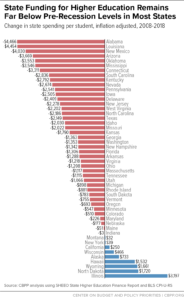
Alabama has slashed its per-student state higher education funding more than any other state over the last decade, according to the Center on Budget and Policy Priorities (CBPP). Since 2008, Alabama has cut higher ed funding by 36.2%, or $4,466 per student, CBPP found. Those cuts are the nation’s worst by dollar amount and third worst by percentage.
“We are dissuading folks from pursuing their dreams,” I told WBHM reporter Janae Pierre last week. “We’re reducing campus diversity, and we’re reducing opportunity for people to get ahead and build a better life for themselves and their families.”
With state funding down, tuition has soared. Between 2008 and 2018, the average tuition at public four-year institutions in Alabama jumped by 72.9%. These massive increases have erected barriers to opportunity for people across Alabama. And these barriers disproportionately block the paths of black and Latino students.
As I told WBHM: “We are asking an entire generation of folks to take on massive debt to begin their careers, to pursue their professional dreams. … Either people aren’t able to pursue the degree in the first place or they have to begin their career with five- or six-figure debt hanging over their head.”
Check out Alabama Arise’s news release for more information on the CBPP report. And check out my full interview with WBHM for more on how Alabama can help make college accessible and affordable for everyone, regardless of income.
Since 2008, Alabama has cut state higher education funding by 36.2%, or $4,466 per student, CBPP found. The state’s cuts are the nation’s worst by dollar amount and third worst by percentage. Nationally, the average cuts since 2008 are 13%, or $1,220 per student.
Alabama’s inadequate public investment in higher education over the last decade has contributed to soaring tuition costs. And that has forced many students either to start their careers in deep debt or abandon their college dreams entirely.
Between 2008 and 2018, the average tuition at public four-year institutions in Alabama jumped by $4,489, or 72.9%. That is nearly twice the national average growth of 37% – and almost exactly matches the size of state funding cuts. These soaring costs have erected barriers to opportunity for young people across Alabama, particularly for black and Latino students.
“This is another example of how short-sighted education cuts hurt people across Alabama,” Alabama Arise executive director Robyn Hyden said. “Pushing college students and their families into deep debt isn’t making our state stronger. We need to invest more in education at all levels to build an Alabama where everyone has the opportunity to succeed.”
Soaring tuition disproportionately harms black and Latino students
Alabama’s rising college costs have hit hardest among black and Latino students. In 2017, the average net price of attending a public four-year university accounted for:
35% of median household income for all families in Alabama.
45% of median household income for Latino families in Alabama.
54% of median household income for black families in Alabama.
Financial aid has not increased enough to cover higher college costs nationwide. The resulting higher prices can dissuade many students from enrolling or finishing their degrees. Tuition increases also can reduce campus diversity, especially among people of color and students from households with low wealth.
A large and growing share of future jobs will require college-educated workers. Greater public investment in higher education, particularly in need-based aid, would help Alabama develop the skilled and diverse workforce it needs to match the jobs of the future.
“All Alabamians, regardless of their income or hometown, deserve an opportunity to reach their full potential,” Hyden said. “Alabama should invest in making college more affordable for the students who need assistance the most. And ending skewed tax breaks for large corporations and wealthy households would be a good place to start.”