Paid parental leave improves life for Alabama workers

Overview

We all benefit when new parents are able to dedicate more time to bonding with their children. Paid parental leave is a crucial policy to promote stronger families, and it also helps more people remain in the workforce and continue to contribute to our economy. Alabama lawmakers should embrace the opportunity to ensure paid parental leave is available for all state employees and teachers.

Paid parental leave’s benefits for Alabama children and parents are clear and broad. Babies have better outcomes across the board when their parents can stay with them in the crucial weeks after birth. Fewer babies are born with dangerously low birth weights when mothers have paid leave to address medical issues throughout pregnancy. Paid leave also cuts the risk of rehospitalization in half for mothers and infants following birth.

From an economic perspective, paid leave also makes sense for employers because it reduces employee turnover. This policy can help employers save the equivalent of 50% to 200% of a worker’s salary on hiring and training a new worker to replace one who otherwise might have to quit to meet caregiving duties. Paid parental leave is a common-sense, pro-family policy that will result in a better, healthier future for all of us across Alabama.

Paid parental leave is growing across the South

Since 2020, Florida, Georgia and Tennessee have implemented paid parental leave for new groups of public-sector workers. After enactment, Georgia doubled its initial parental leave duration. Municipalities, too, are beginning to recognize the benefits of paid leave for workers. Birmingham implemented 12-week paid parental leave coverage for its city employees in 2023.

These steps forward contribute greatly to better quality of life for the workers covered by the new policies. Paid parental leave eases economic stresses for new parents and helps mothers in particular to remain in the workforce.

Beyond the benefits to workers, state agencies also benefit from providing paid parental leave. Workers who have more stable economic situations and feel valued as people are less likely to leave a job. And employee churn is expensive for agencies. The average cost of replacing a worker is between six and nine months’ salary. For technical employees, filling an open position can cost employers double the worker’s salary.

Great momentum for paid parental leave in Alabama

Alabama has an opportunity to take the same step forward as many of our neighboring states. Bills to provide parental leave for both state employees and teachers made significant progress in the 2024 legislative session. Rep. Ginny Shaver, R-Leesburg, sponsored a bill that passed the House and came one step from Senate passage last year. Shaver will file the bill again in 2025. As introduced, this bill would provide eight weeks of paid parental leave for state employees, covering childbirth and adoption.

Sen. Vivian Figures, D-Mobile, sponsored a bill to provide 12 weeks of paid leave for teachers in 2024. This bill won Senate committee approval, and it was combined with the state employees’ bill on the Senate floor before time ran out on the last day of the session to iron out details and secure passage. Covering teachers is important with regard to retention because better compensation policies can overcome some of the factors that contribute to teachers leaving the profession.

Best practices for paid parental leave in Alabama

Alabama has an opportunity to implement a paid leave policy that will lead the South. A first-class parental leave policy should meet these standards to ensure the highest benefit to both workers’ quality of life and agencies’ retention rates:

  • Sufficient duration. At least 12 weeks of parental leave at full replacement rate should be available to workers.
  • Broad coverage. Both parents should be covered to support bonding and recovery of both mothers and infants.
  • Flexibility. Workers should be able to use parental leave at a time they decide would best benefit their families in the first year of a child’s life.
  • Inclusivity. Workers should be able to use parental leave for adoptions, childbirth, long-term foster care and new family caregiving duties.
  • Availability after adverse outcomes. Leave should be available in case of a child’s death during the first year or of a miscarriage after the first trimester.

Bottom line

Like any employer, our state should ensure its workers have jobs that support their ability to care for their families. The teachers, social workers and many other state employees who help look after our children and who build up Alabama for all the families in the state should be able to create and grow their own families without scrambling to pay the bills.

Paid parental leave is a common-sense policy that helps workers care for their families while maintaining their careers and financial well-being. State officials often have said Alabama is pro-family. Ensuring that teachers and state employees have paid parental leave is an important step to prove it.

Alabama voted. Now let’s organize for a better state

The State Capitol in Montgomery.

Alabama Arise and our members have worked for more than 35 years to push for state policies that improve the lives of people struggling to make ends meet. We advocate for policies to build an Alabama where everyone has the resources they need to reach their full potential. And we’ve always remained steadfast in this mission and our values, regardless of who holds public offices at any given time.

On Tuesday, Alabama voted. So today, we have a clearer vision of what we may face as we look toward the 2025 legislative session in February. The path to dignity, equity and justice for all has always been a long one in Alabama. None of us are strangers to this work, and we’re in it for the long haul.

To make positive change, we must work together. We all must lean into our relationships, communities and networks to find solidarity and grow our collective voice for change. As a member-based organization, we know power is built from the ground up. And Arise will continue our commitment to growing our people power to expand health care access, reduce hunger, reform Alabama’s upside-down tax structure and support working people across our state.

We’re glad you’re with us. Join or support our movement for a better Alabama for all today.

Here’s what Alabama Arise heard in 2024!

Alabama Arise listens because we deeply value the input we get from members, partners and most importantly, those directly affected by the work we do together. We depend on what we hear to help guide our issue work and our strategies.

We held two virtual statewide Town Hall Tuesdays this summer, and each featured three to four listening session breakouts. Arise staff either facilitated or were part of 20 additional listening sessions, both online and in person around the state. We engaged more than 500 people in a total of 27 listening opportunities.

Following are direct notes from the town halls and highlights from the other sessions. These notes and highlights are listed under the names of the Arise organizers who heard them.

Town Hall Tuesdays

A better Alabama is possible, July 16

We had four breakout rooms during this session. We asked folks in each group to discuss their thoughts on current issues and to share other priorities they had. Here’s what our organizers heard from participants:

Pres Harris:

  • Death penalty reform. We need to consider the impact that potential new appointees to the U.S. Supreme Court might have on this issue at the state level.
  • Concern about new school choice laws that divert funding from public education. There is special concern in rural areas where there are either no or very limited options to public education for children. Many participants said this is a way to take more money from funding public education. Several participants agreed with the education concern.
  • A sight-impaired participant lifted up education, voting rights and public transportation as key issues impacting people living with disabilities. There is a disparity in education among low-vision students. The disabilities community has been advocating for electronic voting so that sight-impaired people can vote with privacy. And lack of public transportation is a barrier to voting and other quality-of-life activities.
  • Concern about the maternal health crisis and subsequent infant health care needs. We need to improve access to maternal care and health care overall. We need to expand Medicaid.
  • One participant raised the need for people to have legal representation in civil issues like family issues, bankruptcy, school issues, etc. Another participant said the Alabama State Bar might be an ally in advancing such an issue.
  • Public transportation was highlighted again as a need and a quality-of-life issue.
  • In the main session, a participant raised the need to address a variety of veterans’ issues, with emphasis on veteran housing availability.

Stan Johnson:

  • More funding for education programs for children ages 0-3. For a better Alabama, we need to focus on early education. Alabama has a home visitation program called First Teachers, designed to support families at risk for poor developmental outcomes. They use a variety of models, including Parents as Teachers and First Family Partnership. They go and visit families with children 0-3 years of age. Alabama is not putting additional money into 0-3 education. A participant noted that the state budget has included such funding in the past, and he wants to ensure it stays there. We have appropriated a couple million dollars, but Alabama receives more from the federal government than what the state puts in for this service. Minnesota puts 10 times as much money into their program as Alabama. Missouri has universal access to 0-3 education.
  • Kids need to master their social and emotional milestones, and the ability to have a two-way productive interpersonal relationship. They need the ability to modulate their emotions appropriately in a group setting, to have a sense of curiosity and to have a sense of who they are. If they do not get the basic scaffolding in the first three years of life, then all the remediation in the world will not help them get through high school. Efficacy-based programs exist and have proved effective. Alabama is not doing enough about it.
  • A participant said she is a retired teacher and could tell the difference between kids who were read to, loved and cuddled. The first three years make a world of difference. She said this does not need to be a named Arise priority, but it should be addressed.
  • We have picked up momentum with Medicaid, but not nearly enough. Many participants said this needs to continue to be the No. 1 issue. Adequate health care is important for a better Alabama.
  • Participants said they want to help with Medicaid expansion. They understand all it would take is for the governor to sign it and it would be a done deal. They do not understand why people would say they do not want money from the feds. For every dollar we send, we get back $2.17.
  • Participants opposed turning back federal infrastructure money and ARPA money. The argument has no logic.
  • Rural hospitals and departments closed this year, including in Thomasville, Monroe County and Union Springs. What are the governor’s plans to help those areas? Some voters in those areas do not realize that state policies have caused them to lose their health care. We have been saying for years that lack of Medicaid expansion would cause hospitals to close.
  • Some women are now having to drive as far as 90 minutes away to get to an OB-GYN. We can see the harm that elected officials are causing to their constituents.
  • Unfortunately, people do not realize when they vote that they sometimes are voting for representatives who do not seem to have their best interest in mind. We have already lost $7 billion in funding by not expanding Medicaid.
  • One participant said the new teacher certification test is an issue for young or new teachers. What are some alternate ways toward certificates?
  • A participant said Congress should have passed a Medicaid expansion bill, the Save Rural Hospitals Act. This would have helped rural areas to reopen hospitals. The state chose to enhance the port in Mobile instead of providing funding to rural hospitals. The hospitals would have provided jobs and training for RNs, LPNs, CANs and other hospital staff, as well as other jobs once the hospitals opened.
  • We have to educate our decision-makers about looking at cost holistically and not just as a one-time investment. We are losing people due to not investing and not expanding Medicaid.

Adam Keller:

  • It’s hard to begin, because all of the issues are so interrelated and important.
  • Public transportation is so important to access to food and work. Several participants weighed in on public transportation.
  • One participant said crime is out of control and expressed concern about gun safety. They are concerned about gun violence and how Gov. Kay Ivey and lawmakers have loosened restrictions. They emphasized the need for citizen participation.
  • There are false narratives around crime. We need more community-based public safety.
  • A participant brought up the lack of Medicaid expansion, closing of rural hospitals and lack of OB-GYNs. She had a medical incident and only survived because she had immediate attention.
  • A participant said the secretary of state’s salary should be tied to voter registration. They also brought up bicycles as a help for transportation, as well as university bike share programs and bike grants. They said the state needs to grant more paroles and shouldn’t require people to pay a bunch of fees before voting rights are restored.

Formeeca Tripp:

  • It’s important to know the history of Alabama so we can understand the past and where we are going.
  • A longtime Alabama Arise member is eager to keep learning more. He believes the issues proposed are good, and we need to keep focusing on them.
  • One big supporter of Medicaid expansion believes it needs to keep being addressed in the legislative sessions. He also supports the end to the state grocery tax but is lost on “what else can we do?” He also has concerns with gun violence, along with other participants.
  • Another longtime member is a big supporter of Medicaid expansion and believes we need to keep working on the current list of priorities for the next legislative session.
  • Another participant believes payday and predatory lending should be addressed and a priority issue. Transportation, specifically for disabled veterans, is important and needs to be addressed, not just grouped under the general transportation umbrella. She also would like to see gun violence reduction as a priority issue and has a movement called “SWAG – Safer Without A Gun,” to buy back real and toy guns as well as educate on gun safety, conflict resolution and problem-solving skills, especially in underserved communities.
  • Medicaid expansion, transportation and gun violence were the dominant topics in our breakout room.

Building toward a better Alabama, Aug. 6

We had three breakout rooms during this session. We asked folks in each group to discuss what motivates them to act on issues and how Arise supports their actions. And we asked them to indicate their priority issues. Here’s what our organizers heard from participants:

Pres Harris:

  • Participants shared consensus about the need to expand Medicaid to address several health care concerns. These included rural hospital closures, maternal mortality rates in Alabama and support for mental health care needs.
  • Concern for the survival of our democracy with attacks on voting rights was expressed. Public education, affordable housing and public transportation also were highlighted. Several said it is hard to prioritize the current Arise issues, as they are all critical.
  • Participants shared what motivates them to action: hearing the stories of those directly impacted, knowing they are coming together with others to advocate, and the feeling of confidence they get because Arise has helped equip them with information and tools to act.

Stan Johnson:

  • We heard consensus that all the issues are important, and it is difficult to pinpoint which is a priority over another.
  • Jobs to Move America supports everything Arise does and wants to see a clawback of incentives to companies that violate child labor laws (e.g., Hyundai’s supply chain). We want to raise that up for consideration. These kids come from impoverished backgrounds in Mexico/Central America, and they send money back to their families. Sen. Merika Coleman and Rep. Neil Rafferty had a bill last year, and it passed in the Senate and House committee unanimously; we just ran out of time. We need to send these car manufacturers a message. They are working on a strategic direction proposal to submit.
  • We need to continue to grow the communication network throughout the state.
  • Alabama Arise is the most respected organization in the State House.
  • We need to make serious reforms to the state budgets and appropriations so we can take care of the people of Alabama, instead of Mercedes, etc. We do not have money to fund social programs, but corporations are receiving gigantic tax breaks. These are billions of dollars that could have helped the citizens of Alabama.
  • One organization is working on criminal legal reform in Alabama, especially looking at the death penalty.
  • A participant was very upset that Alabama does not participate in programs, and then the same government comes and says we do not have any money.
  • Several participants said transportation needs to improve in Alabama, which also helps people have access to jobs. Transportation is a big topic for people with disabilities. One participant said some of her clients are not able to get to appointments at UAB because of a lack of public transportation. Some transportation directors, on the other hand, do not see the need and want to make further cuts because of low ridership on the buses. Her clients are losing their jobs because of unreliable transportation. Decatur has Ride on Demand, where you must call in to request a ride. It can be a two-hour wait time. There are bus stops on busy roads, so it is dangerous for individuals in wheelchairs as well as able-bodied individuals. These are some of the reasons people do not use Decatur’s transportation system.
  • Another participant from Mobile said she has been working on Medicaid expansion and is glad we were able to get an extension on the coverage for postpartum maternity care. She is pushing health care as the main issue, along with the social determinants associated with health.

Adam Keller:

  • We need more mental health services, which will help reduce prison overcrowding and crime.
  • Alabama needs prison reform, including addressing the prison labor situation.
  • We heard affirmation of our current agenda, including specifically voting rights and Medicaid expansion.
  • We heard discussion of burnout and the importance of persistence (with the grocery tax as an example).
  • Some members shared that they wouldn’t be involved if it wasn’t for our help and said Arise gives them more hope for the state.

Additional listening sessions

This section highlights participants’ input from the 19 additional sessions recorded by the Arise organizing team. In general, all participants strongly affirmed Arise’s work on current legislative priorities. Many thought that Arise should continue to build on momentum it has around some of the current issues. Many also said we need to see more change in the existing priorities. Members seemed to affirm these sentiments, as no new issues were proposed for 2025. These notes lift up the other issues of concern that participants highlighted as we listened.

Pres Harris – Baldwin, Elmore and Mobile counties

Participants in these meetings affirmed the current Arise priorities, acknowledging that our issues are long-haul issues.

Other issues raised:

  • The need to address gun violence.
  • The need for parole reform was proposed by a group of women from the Julia Tutwiler Prison for Women who are sponsored by Arise member group Greater Birmingham Ministries. GBM submitted the issue as a strategic approach under the existing criminal justice reform issue.

Stan Johnson – Birmingham/Jefferson County and Tuscaloosa/West Alabama

Most of the participants in these meetings focused on the existing legislative priorities and discussed ways to continue the work toward progress.

A member group planned to submit a proposal for a strategic approach to getting more funding for the 988 mental health crisis hotline that connects folks to needed resources. This is not a new issue, but it would be part of Arise’s permanent priority of adequate state budgets.

Other issues raised: More needs to be done about payday loans, energy/solar power incentives and veterans in crisis.

Whit Sides, Arise’s Cover Alabama storyteller, participated in a session with disability advocates that involved listening to and sharing stories related to intellectual disabilities and neurodivergence/autism. Participants were interested in developing their stories for advocacy with policy and lawmakers.

Adam Keller – Northeast/Madison and Morgan counties

Most of the participants in these meetings strongly affirmed the current Arise priorities.

During further discussion, participants highlighted issues related to public education, child nutrition, paid parental leave and parole/probation reform.

Several conversations centered on how the work of Arise connected with labor and worker power.

Formeeca Tripp – Houston, Lee, Montgomery and Tallapoosa counties

Many participants in these meetings expressed appreciation for Arise’s work around our current issues, especially voting rights, health care and other safety net issues.

Other issues raised:

  • The lack of affordable housing that contributes to issues of homelessness.
  • Legislation that impacted the Black population historically and current laws and policies that lawmakers have passed.
  • Issues that negatively impact racial equity and inclusion.
  • The need to address gun violence and have programs for youth.

How Alabama can build an economy that works for workers

Multi-colored logo of the state of Alabama with the text The State of Working Alabama


Labor Day is a holiday where we can reflect on the contributions that working people – and the unions that workers form to build power together – have made to the well-being of all people in the United States. These contributions include overtime pay, a five-day workweek, child labor protections and workplace safety standards.

These advances for working people didn’t come easily. Workers won them through strikes, pressure and solidarity. These advances came in the face of overwhelming opposition by bad employers that would have rather seen their workers die than to win workplace democracy.

And the fight continues. Many steps that the working people of Alabama have won toward better lives for their families are under attack today. In Alabama, workers fought this year against anti-union legislation and a measure to reduce existing child labor protections. And while passing these harmful bills and others, state officials have continued to give billions of dollars in tax incentives and subsidies to private companies. These giveaways persist even when those companies benefit from egregious child labor law violations.

These attacks on workers are continuations of longstanding economic strategies of worker abuse in the South. But at the same time officials choose to make life tougher for working people, officials are asking why people aren’t in the workforce.

The answer is straightforward: The Alabama economy doesn’t work for workers. And that’s by design. But we can move toward a better economy with better policy choices.

Job quality in Alabama is low

Alabamians labor in a state where numerous employment practices and policies prevent them from building a stable life and improving their overall well-being. More than 1 in 5 Alabama workers (22%) are paid less than $15 per hour. That is a poverty wage for a family of four and less than half of what that family needs to thrive. Alabama’s workers also make less, even after adjusting for the state’s lower cost of living, than workers in Rust Belt states like Illinois, Michigan, Ohio and Pennsylvania.

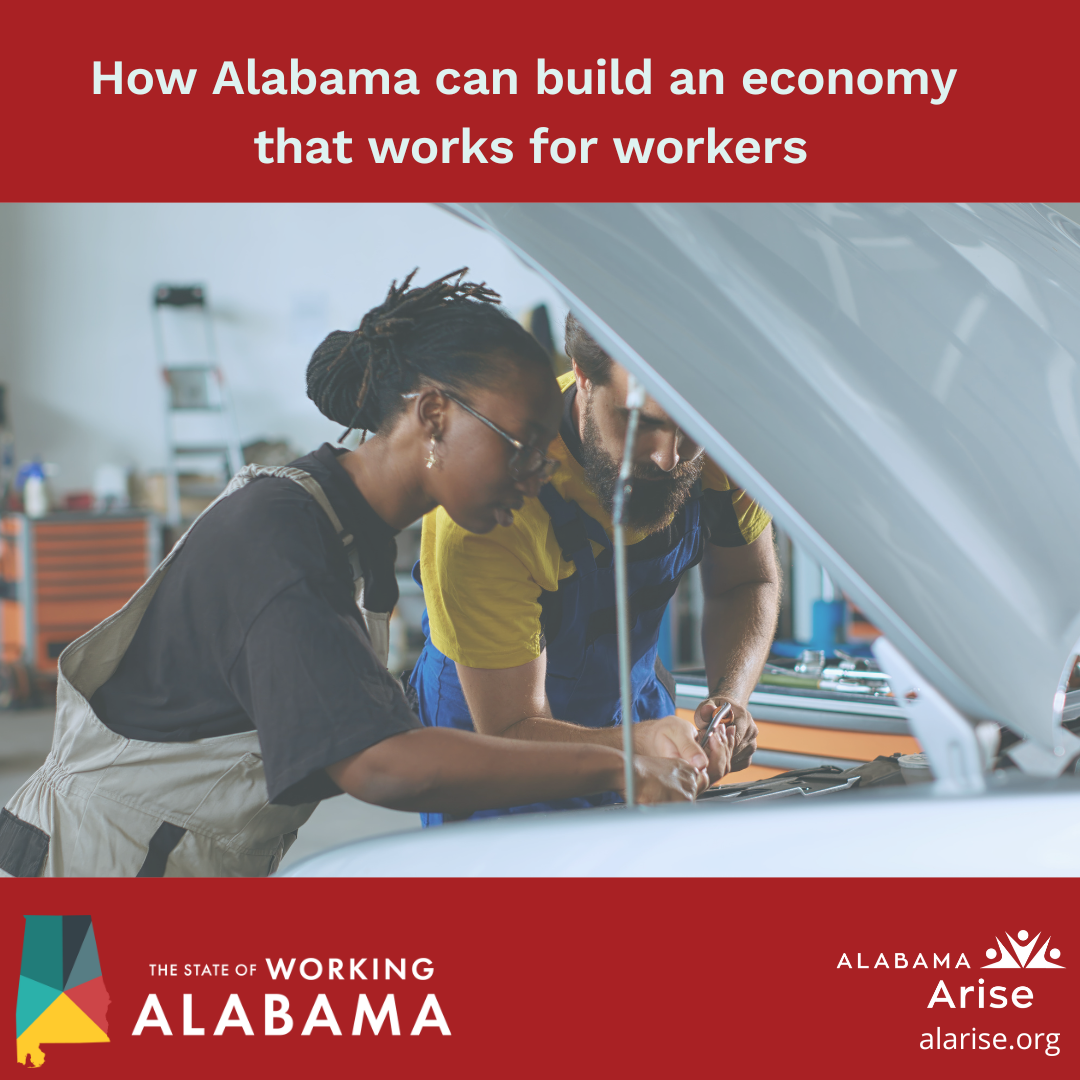
Two people working under the hood of a car with text on the top that reads How Alabama can build an economy 
that works for workers.The shortcomings of Alabama’s low-road economic development model reach far beyond employers’ failure to pay adequate wages. Southern workers broadly have less access to paid leave than other workers. Alabamians have no paid parental leave protections under state law, though momentum is building to fix that problem for some workers. Alabama workers also lack guaranteed paid sick leave, caregiving leave, domestic violence leave or bereavement leave. And the state has prevented local governments from giving workers a square deal by preempting any local legislation to improve conditions for workers, in an extension of policy barriers that limit Black Alabamians’ self-determination and participation in society.

State policymakers prop up employers’ anti-worker strategies by opposing workers’ efforts to build a better economy for themselves. The recent upswell of unionization in Alabama has met with vicious opposition from some officials, including a picketing ban, use of state troopers to support scabs against miners, and a slick, businesslike campaign of officials orchestrated to oppose workers organizing with the United Auto Workers (UAW) in Tuscaloosa County.

Officials also have attacked employers who freely and voluntarily recognize workers’ decision to unionize by forbidding those companies to receive economic development incentives. Hostility to workers, coupled with persistent underinvestment in work supports, has left Alabama’s workers significantly behind across the board.

Remove barriers by investing in child care, health care, public transportation

We know workers face specific barriers to workforce participation. The workers themselves and the businesses employing them have said so. These barriers include child care, transportation, housing and medical coverage.

But as our state’s economy has grown less than it would with broader opportunity, officials have made shortsighted anti-worker policy decisions that make life worse for working people and those who depend on them. Even the steps forward have been tentative, lacking in focus directly on the people who do the work to keep Alabama going.

Instead of just providing tax incentives to companies for child care and stopping there, workforce development should include direct investment in child care for workers. Our state’s hardheaded, hard-hearted refusal to expand Medicaid has cost lives and worsens our rural hospital crisis. Alabama remains one of just 10 states yet to close the health coverage gap.

Alabama also has yet to fund the Public Transportation Trust Fund that the Legislature created in 2018. Significant investment in public transportation would help all workers – particularly people working in manufacturing and caregiving, two areas of need where investment would provide rippling benefits for all Alabamians.

These persistent state policy failures bolster an overall economic structure that comes up short on providing jobs where people can thrive or even just get by. By not investing in essential work supports, lawmakers are limiting our state’s human potential and economic future.

Job quality for Alabamians is lower than in many other states. Many Alabamians make less than other states’ residents do for the same work, and that’s the wrong way to build an economy. 

A high road to a brighter future

Alabama’s economic development strategy of removing every guardrail for worker well-being while treating the people who do the work like they are disposable doesn’t make sense. It never has. The top-down model is why our state’s outcomes fall measurably short in important areas such as earnings, health care and educational attainment.

On this Labor Day, state decision-makers should move beyond the low-road strategies that have Alabama spinning its wheels on improving quality of life for the people who keep the state running. By investing in a high-road economic structure that uplifts workers, we can build an Alabama we’re all proud to call home.

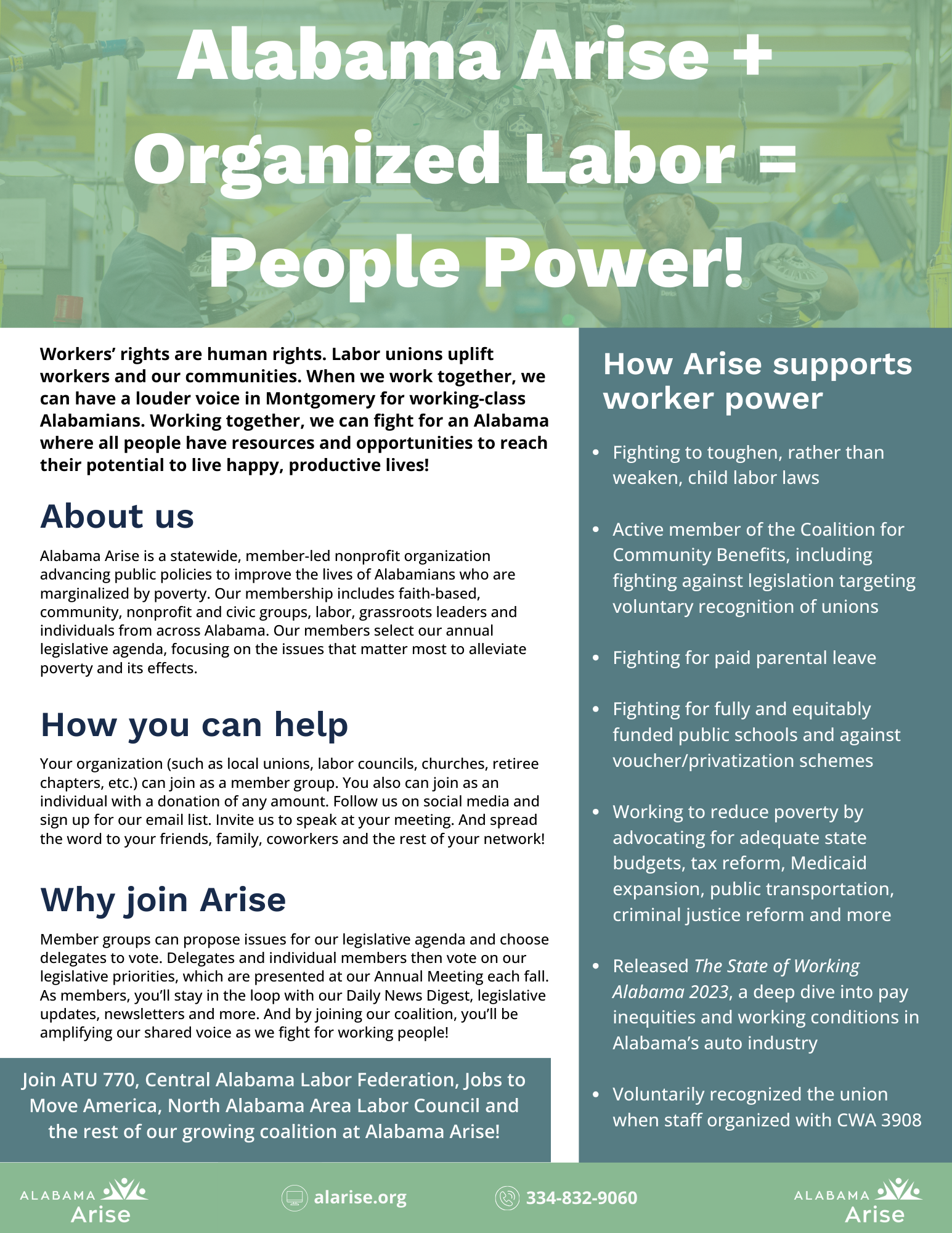
Alabama Arise + Organized Labor = People Power!

Workers’ rights are human rights. Labor unions uplift workers and our communities. When we work together, we can have a louder voice in Montgomery for working-class Alabamians. Working together, we can fight for an Alabama where all people have resources and opportunities to reach their potential to live happy, productive lives!

Click here to download a flyer with the information on this page.

Image of flyer. Headline: "Alabama Arise + Organized Labor = People Power!"

About us

Alabama Arise is a statewide, member-led nonprofit organization advancing public policies to improve the lives of Alabamians who are marginalized by poverty. Our membership includes faith-based, community, nonprofit and civic groups, labor, grassroots leaders and individuals from across Alabama. Our members select our annual legislative agenda, focusing on the issues that matter most to alleviate poverty and its effects.

How you can help

Your organization (such as local unions, labor councils, churches, retiree chapters, etc.) can join as a member group. You also can join as an individual with a donation of any amount. Follow us on social media and sign up for our email list. Invite us to speak at your meeting. And spread the word to your friends, family, coworkers and the rest of your network!

Why join Arise

Member groups can propose issues for our legislative agenda and choose delegates to vote. Delegates and individual members then vote on our legislative priorities, which are presented at our Annual Meeting each fall. As members, you’ll stay in the loop with our Daily News Digest, legislative updates, newsletters and more. And by joining our coalition, you’ll be amplifying our shared voice as we fight for working people!

How Arise supports worker power

  • Fighting to toughen, rather than weaken, child labor laws
  • Active member of the Coalition for Community Benefits, including fighting against legislation targeting voluntary recognition of unions
  • Fighting for paid parental leave
  • Fighting for fully and equitably funded public schools and against voucher/privatization schemes
  • Working to reduce poverty by advocating for adequate state budgets, tax reform, Medicaid expansion, public transportation, criminal justice reform and more
  • Released The State of Working Alabama 2023, a deep dive into pay inequities and working conditions in Alabama’s auto industry
  • Voluntarily recognized the union when staff organized with CWA 3908

Join ATU 770, Central Alabama Labor Federation, Jobs to Move America, North Alabama Area Labor Council and the rest of our growing coalition at Alabama Arise!

U.S. Labor Secretary calls Alabama Arise ‘truly incredible’ during visit to Birmingham

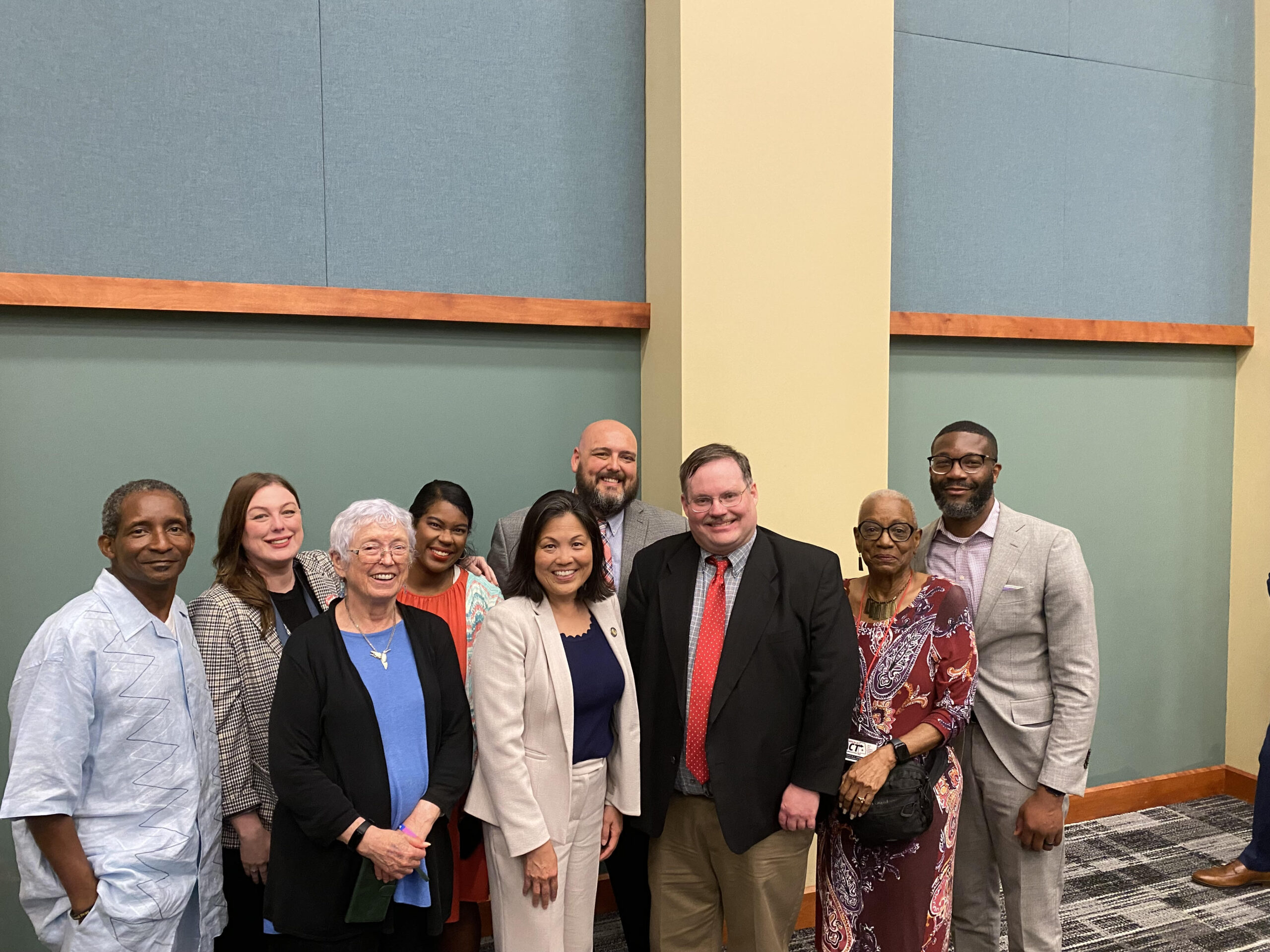
Nine people stand for a posed photo.
Alabama Arise staff and members participated in a listening session with the U.S. Department of Labor and the City of Birmingham on June 11, 2024. From left: Arise board member Kenneth Tyrone King, Arise’s Cover Alabama storyteller Whit Sides, former Arise board member Helen Rivas, health coverage gap storyteller Diana Isom, acting U.S. Labor Secretary Julie Su, Arise worker policy advocate Dev Wakeley, Arise communications director Chris Sanders, Arise member Marva Douglas and Birmingham Mayor Randall Woodfin. (Photo courtesy of Chris Sanders)

Alabamians need quality jobs that provide economic security and an opportunity to get ahead. That was the message Alabama Arise staff and members were excited to share with acting U.S. Secretary of Labor Julie Su during her visit to Birmingham last week.

Numerous Arise supporters participated in a worker listening session with the Department of Labor (DOL) on June 11. And worker policy advocate Dev Wakeley represented Arise at a June 12 roundtable meeting on good jobs.

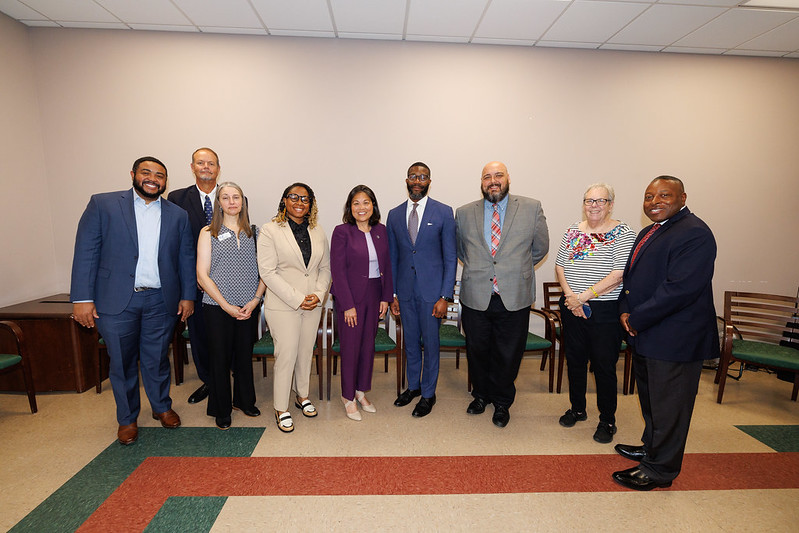
Nine people stand for a posed photo.
Alabama Arise worker policy advocate Dev Wakeley (third from right) participated in a June 12, 2024, roundtable on job quality with acting U.S. Labor Secretary Julie Su (center) and local business and civic leaders. (Photo by Shawn T. Moore, Department of Labor)

The DOL’s initiative to enhance job quality aligns well with Arise’s advocacy to improve life for Alabamians who are marginalized by poverty, Wakeley said. He also praised Su’s willingness to visit Alabama to hear workers’ concerns personally.

“We saw the closest thing you could imagine to unity of purpose,” Wakeley told AL.com after the visit. “When the Department of Labor comes in and talks about wanting to build good jobs that really allow for human beings to thrive and advance and to provide for their families, we are grateful for their presence, and we love to hear that.”

‘Alabama’s workers should not have to settle’

Su expressed her appreciation for Arise’s work as well. She praised both Arise and Jobs to Move America (an Arise member group and partner in the Alabama Coalition for Community Benefits) during a June 12 news conference at the North Birmingham Library.

“I did want to thank the union leaders for showing up here and every single day, to Jobs to Move America and Alabama Arise, who have helped make this trip so rich and meaningful for me,” Su said. “You are all truly incredible.”

Su came to Alabama on the second stop of the DOL’s Good Jobs Summer Tour. The tour aims to promote and build support for the department’s Good Jobs Principles, a shared framework for job quality for workers, businesses, unions, advocates and other interested parties. The principles include equitable pay and benefits, safe and healthy workplaces, and an organizational culture that values every worker’s contributions. Birmingham Mayor Randall Woodfin announced Birmingham’s commitment to the principles during the news conference.

Arise proudly supports and endorses the Good Jobs Principles. Learn more about them here.

Watch the video above to hear acting U.S. Labor Secretary Julie Su’s full remarks about good jobs during her June 12, 2024, news conference in Birmingham.
 

“We are being intentional about connecting all of Alabama’s residents and all of Birmingham’s workers to good jobs,” Su said. “Because Alabama’s workers should not have to settle. Because no one should have to work full time year-round and still live in poverty. No one should have to work two or three jobs and still barely be able to put together a life. That is not the American promise. That is not the American dream.”

Workers’ rights, public transportation uplifted during listening session

Su’s remarks reflected many of the concerns that Birmingham-area workers shared during a listening session with Su and Woodfin. More than 70 people attended the June 11 session, and many discussed their personal experiences with workplace challenges or lack of essential work supports.

Four people stand for a posed photo.
Alabama Arise organizer Adam Keller (right) attended a June 11, 2024, listening session with the U.S. Department of Labor and the City of Birmingham. Attending alongside him were (from left) Matt Holmes, Seth Cain and Wesley Verzwyvelt. All four men are members of the International Alliance of Theatrical Stage Employees (IATSE). (Photo by Whit Sides)

Several workers underscored the necessity of protecting employees’ right to form and join unions if they choose. Others highlighted the need for higher pay and more robust benefits like child care and health insurance. The final attendee to speak was longtime Arise member Marva Douglas, who emphasized the importance of securing state funding for public transportation so every Alabamian can get to work, school or anywhere else they need to go.

Two women are pictured speaking to each other.
Midfield resident Marva Douglas (left), a longtime Alabama Arise member, speaks with acting U.S. Labor Secretary Julie Su after a June 11, 2024, listening session in Birmingham. (Photo by Whit Sides)

An opportunity infrastructure

Su said the DOL stands with workers in advancing racial justice and breaking down other systemic barriers to job quality. Good jobs, she said, are about more than just making ends meet today. They are about the promise of a better tomorrow.

“A good job … means a job with security,” Su said. “A job where you know that you can not just get by, but get ahead. Where you have leave and benefits, so if you or your children need to go to a doctor, you can. Where you have a retirement plan so that you know that at the end of a career, you can retire with dignity.”

Making this vision of job quality a reality will require the creation of “opportunity infrastructure” in communities across the country, Su said. That means bringing workers, businesses, policymakers, advocates and educational institutions together to build an inclusive economy for everyone, she said.

“We have more bridges to build,” Su said. “The bridge from poverty to prosperity. The bridge from racial exclusion to real equity. So let’s roll up our sleeves, and let’s build together.”

Summer EBT, Legislative Day energy highlight busy, tough 2024 session in Alabama

You made a difference! Alabama Arise members played a decisive role this year in securing summer food assistance for more than 500,000 children starting in summer 2025. Summer EBT funding brought an uplifting conclusion to the Alabama Legislature’s 2024 regular session, which ended May 9.

The Summer EBT victory showed the power of Arise’s policy analysis, organizing and advocacy. After the House passed an education budget without Summer EBT funding, Arise ramped up pressure on the Senate. Our policy team and lobbyists educated lawmakers about the program’s benefits. Our communications team generated dozens of media stories to build public support. And our organizers rallied Alabamians to speak out.

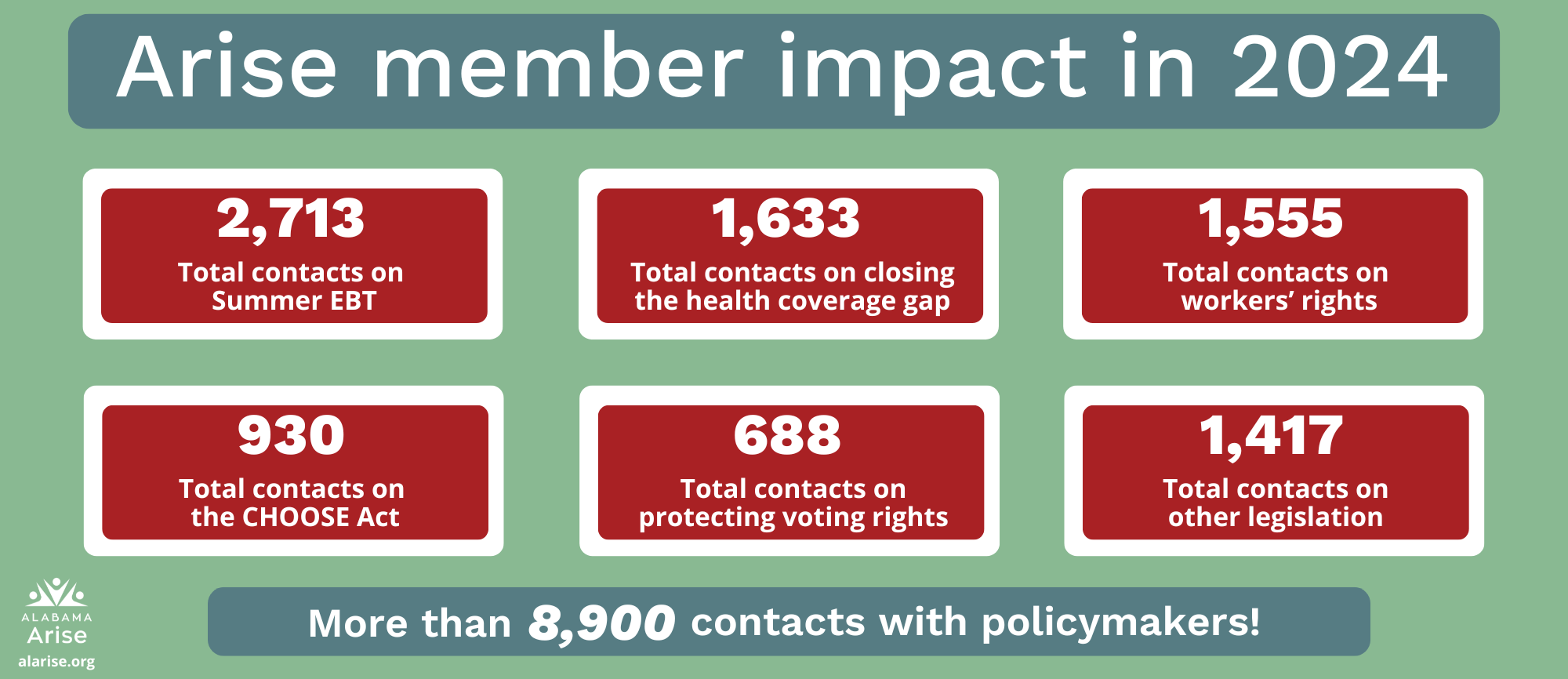
Ultimately, folks like you got Summer EBT funding across the finish line. Arise advocates flooded lawmakers with more than 2,700 emails, calls and personal visits urging support. And it worked: Senators added Summer EBT to the budget, and Gov. Kay Ivey signed it into law.

Our members also displayed their passion for change during Arise’s annual Legislative Day on April 2. More than 230 people packed the State House in support of our Cover Alabama campaign to close Alabama’s health coverage gap.

Lawmakers dealt setbacks to several Arise legislative priorities this year but made important progress on others. Through it all, our members kept speaking out for policies to improve the lives of Alabamians marginalized by poverty.

An infographic showing more than 8,900 Arise members took action this legislative session. 2,713 contacts on Summer EBT; 1,633 contacts on closing the health coverage gap; 1,555 contacts on workers' rights; 930 contacts on the CHOOSE Act; 688 contacts on protecting voting rights; and 1,417 contacts on other legislation.

Setbacks on school funding, voting rights, racial equity

Early in the session, legislators enacted three harmful new laws, all of which Arise opposed. One was the CHOOSE Act (HB 129 by Rep. Danny Garrett, R-Trussville). Over time, this law could divert hundreds of millions of dollars annually from public schools to private schools and homeschooling.

Another bad bill rushed into law was SB 1 by Sen. Garlan Gudger, R-Cullman, which criminalizes several forms of assistance with absentee ballot applications. Arise and other advocates fear this law could have a chilling effect on good-faith efforts to assist people who need help exercising their voting rights.

A third shortsighted new law is SB 129 by Sen. Will Barfoot, R-Pike Road. The act forbids state agencies and public schools and universities from sponsoring numerous diversity, equity and inclusion (DEI) programs. It also authorizes firings of employees found to violate the act knowingly. In late May, Jacksonville State University became the first university to close its DEI office in response to this law.

Later, legislators passed two new laws that undermine worker protections. SB 53 by Sen. Arthur Orr, R-Decatur, removes the requirement for an eligibility to work form for 14- and 15-year-olds. And Orr’s SB 231 makes companies ineligible for state or local tax incentives if they voluntarily recognize a union.

Good new laws on child care, housing, criminal justice reform

One positive workers’ rights law this year was SB 119 by Sen. Robert Stewart, D-Selma, which increases penalties for child labor violations. The Legislature also created tax credits designed to increase access to child care (HB 358 by Rep. Anthony Daniels, D-Huntsville) and workforce housing (HB 346 by Rep. Cynthia Almond, R-Tuscaloosa). And Orr’s SB 270 improved access to public records.

Lawmakers also enacted two good criminal justice and due process reforms. Almond’s HB 275 will increase pay for many lawyers representing indigent defendants. And HB 188 by Rep. Terri Collins, R-Decatur, requires a uniform hearing process and hearing rights for students suspended or expelled from public K-12 schools.

The work continues

Several other Arise-backed bills made major progress but came up just short of passage. HB 29 by Rep. Chris England, D-Tuscaloosa (allowing resentencing hearings for some defendants convicted under the Habitual Felony Offender Act) won House committee approval. Orr’s SB 62 (removing state sales tax from many infant and maternity products) passed the Senate but never reached the House floor. And HB 309 by Rep. Ginny Shaver, R-Leesburg (providing paid parental leave for state employees) passed the House but died on the Senate calendar.

With your support, Arise will keep advocating for important policy changes like these in 2025 and beyond. We will keep working to expand Medicaid and eliminate the state grocery tax. And we will keep strengthening our movement for a better, more inclusive Alabama.

Summer EBT funding is a big win for Alabama’s children

The Alabama Senate Finance and Taxation Education Committee voted unanimously Tuesday to appropriate $10 million for Summer EBT administrative funding from the 2025 Education Trust Fund budget. Alabama Arise hunger policy advocate LaTrell Clifford Wood released the following statement Tuesday in response:

“Every child needs and deserves healthy meals throughout the year. That’s why Alabama Arise is excited that the Senate’s education budget committee voted to include Summer EBT funding in the 2025 education budget. We hope that every legislator will support this important investment in child nutrition, and that Gov. Kay Ivey will sign it into law.

“Summer EBT will help reduce food insecurity for more than 500,000 Alabama children. This program will provide every eligible school-age child in a low-income household with $120 in food assistance each summer starting in 2025. These benefits will help ensure that children can continue getting the nutritious food they need when school meals are unavailable. This ultimately will help kids stay healthier and be better prepared to learn.

“Summer EBT also will provide an important economic boost for communities across our state. After the state provides a few million dollars to help cover administrative costs, Alabama families will receive tens of millions of dollars’ worth of Summer EBT benefits, which are 100% federally funded. That will spur around $100 million of economic activity every year across Alabama.

“This investment will bring a meaningful improvement to the lives of Alabama’s children for generations to come. We appreciate Sens. Vivian Figures, Garlan Gudger and Rodger Smitherman for championing Summer EBT funding in the Senate, and Reps. Barbara Drummond and Laura Hall for their support in the House. We thank committee chairman Sen. Arthur Orr for adding this funding to the education budget. And most of all, we are grateful for Alabama Arise members and other advocates from every corner of our state who relentlessly called, emailed and spoke out in support of Summer EBT.”

Arise legislative update: April 22, 2024

Arise’s Akiesha Anderson brings you up to speed on all that happened last week at the State House plus gets you ready for the upcoming week. As the session is nearing an end, we still have action to take on securing public transportation funding and increasing penalties for child labor violations. We also are trying to curb anti-union and anti-immigration legislation. See more at alarise.org and clicking “Take Action.”


Full video transcript:

Hi there, Akiesha Anderson here, Policy and Advocacy Director for Alabama Arise here to give you yet another legislative update for the week of April 22.

Last week, quite a bit happened but I’m going to start with the Education Budget. So as you know, we are down to just a few legislative days left. Tomorrow when legislators go into the State House they will be on the 24th out of 30 legislative days. And it is essential that the legislature passes the Education Budget as well as the General Fund Budget. So last week we did see the Education Budget make it out of the House to be sent over to the Senate. One unfortunate reality about the Education Trust Fund budget is that unfortunately the $15 million needed for Summer EBT was not included in the House’s version of the budget. This is really unfortunate. We are still going to continue to push to see if we can get that money added to the budget in the Senate but I do want to make note that the House felt to allocate this money even despite the fact that there was a $15 million surplus or $15 million bucket of money that was set aside for Birmingham Southern back when the state intended on giving it a loan to bail it out of its financial trouble. There was $15 million that was previously allocated for Birmingham Southern that instead was allocated to a quasi slush fund for legislators basically to give out community grant money. And so Arise believes that this $15 million would be much better used ensuring that over half a million children have summer meals when school is out and so we are hopeful that we can make that argument in the Senate and we can ensure that children get fed over the summer.

Also related to budgets, last week HB 358, which is a bill sponsored by House Minority Leader Anthony Daniels. This piece of legislation was a childcare tax credit bill and it passed out of the House and so that is good news. It means that women and others that occasionally are forced out of the workplace to do caregiving for children might have some alternative ways to be in the workforce and ensure that they also have child care available. Some unfortunate yet also some good movement on several bills related to workers rights was seen last week. However, I will talk about that in more detail when I talk about what we’re watching this week at the State House.

But also last week we saw quite a bit of movement on some criminal justice related bills. So the judicial override bill sponsored by Rep. England as well as a bill requiring a unanimous jury before sentencing someone to the death penalty sponsored by Sen. Hatch, these both died in committee last week. So that was really unfortunate to see that the death penalty legislation that we were watching did not make it out of committee either in the senate or in the House Judiciary Committee last week. Despite that, however, there were some good parole bills that passed out of committee. This included HB 299 by Rep. England which essentially would create an appeal process for some people whose parole is denied. There also was movement on SB 312 by Sen. Barfoot. This piece of legislation also passed out committee and this would allow people to attend their parole hearings virtually. So that was really nice to see that there is some positive traction with regard to some parole bills. However, it remains to see be seen how much time is left in session whether or not these bills can make it over the finish line. Another piece of legislation that’s quasi criminal justice related a bit more education related, however, and that does have time to make it throughout the through the whole process for certain are some pieces of legislation introduced by Sen. Smitherman as well as Rep. Collins that would provide due process rights to students in K-12 Public Schools. So essentially if these pieces of legislation pass K-12 public school students will not be able to be suspended or expelled without certain due process criteria being met, essentially allowing them to tell their side of the story before they face those really harsh consequences that the school wants to impose.

Now, moving forward to this week. There are quite a few things that we are watching.

So first and foremost on Wednesday at 9 a.m. there is a Joint Health Committee meeting in which there will be a hearing on solutions for closing the health care coverage gap. And so we are super excited about that. This is only the second time in years that the legislature has spent time actually talking about the need for Medicaid expansion or addressing the health care coverage gap that we currently have in the state of Alabama so we’re looking forward to seeing what happens at that hearing. But we will definitely be in attendance and we hope that you are there as well if not able to make it in person definitely stream it online.

Also happening this week, SB 91 will be up in Finance and Taxation General Fund Committee in the Senate at 11:00 a.m. on Wednesday. This piece of legislation will be deliberated and for those of you who recall this is legislation that’s designed to create a source of funding for the Public Transportation Trust Fund. So we are super excited to see that this piece of legislation is getting a chance to be heard in committee this week.

A piece of legislation that we’re a bit concerned about this week is HB 376 which is introduced by Rep. Yarbough and this piece of legislation is an anti-immigration bill that essentially allows localities to enter into contracts with the federal government to become quasi agents of I.C.E. for a lack of better terms. And so proxies for I.C.E. and so this is a piece of legislation that we are fearful will cause a chilling effect on how included, how welcomed, how included yeah our neighbors feel here in the state of Alabama. And so we are hopeful that when that bill comes up in Public Safety and Homeland Security Committee at 9:00 a.m. on Wednesday that it will not make it out of committee.

The good thing about today’s update is that time is running out to pass harmful legislation and so even if that piece of legislation does make it out of committee we are hopeful that it will not make it throughout the process with there being only seven legislative days left in the process. Time is definitely running out. However, we are closely monitoring the final weeks of session and some bills that we do anticipate being deliberated on the full House floor this week include those workers rights bills that I referenced earlier.

So SB 231 for example, which is an anti-union bill that penalizes companies for voluntarily recognizing workers that decide to unionize, that piece of legislation is first on the special order calendar in the House tomorrow which means that when the House gets ready to deliberate legislation this will be the first piece of legislation that they deliberate. And this is a piece of legislation that we strongly oppose. Another piece of legislation related to workers rights that will be on the House floor tomorrow if the legislature makes it that far is SB 119 and this is a piece of legislation that would increase penalties for child labor violations. And so that is something that we are excited to see only has one more favorable vote needed before it will make its way to the governor’s desk. And so we are hopeful that that piece of legislation passes tomorrow and also hopeful that SB 231 fails.

And so that my friends is what is happening this week, that is what happened last week and we will be sure to keep you posted on things that continue to happen at the State House for as long as the legislature is in session. Take care.

Arise legislative update: April 8, 2024

Arise’s Dev Wakeley provides this week’s legislative update with a look at bills related to workers’ rights, including one that would disincentivize companies from voluntarily recognizing unions. To speak out about these bills and others that we’re tracking in the Alabama Legislature, visit alarise.org and click “Take Action.”


Full video transcript below:


Hi, this is Dev Wakeley, here with this week’s Alabama Arise legislative update. Today we’ll be focusing on workers’ rights bills.

We have several bills up this week that touch on workers’ rights. Work and labor issues have significant interest right now in our state as a result of the recent growing push for better working conditions.

First, let’s talk about Sen. Arthur Orr’s SB 231. This is an anti-worker bill designed to undercut workers’ ability to form a union by prohibiting economic development incentives from going to companies that voluntarily recognize unions. This is an attack on the voluntary recognition process created by the federal National Labor Relations Act. This bill has moved out of its assigned Senate committee on a party-line vote and is likely to be on the Senate floor this week. To help us fight this bill, if you have not already, please take action using the action alert sent out regarding SB 231 this morning or by clicking on that action alert found in the legislative update email accompanying this video.

Next is Sen. Robert Stewart’s SB 19. This is a bill to update the penalties for companies that violate child labor laws. In light of recent child labor violation increases nationally and serious abuses in our state, this bill is especially important this week. Be on the lookout for an action alert asking you to send an email in support of SB 19 to the House Judiciary Committee, which will be deliberating on this bill this Wednesday.

The third bill to watch related to workers’ rights is SB 53, also by Sen. Arthur Orr. It’s on the agenda in the House Commerce and Small Business Committee Wednesday. This bill removes the work permit that ensures 14- and 15-year-old workers are doing well in school before taking on a job. Please also take action asking your legislator to oppose this bill by clicking on the SB 53 action alert found in the email accompanying this video.

Interestingly, workers’ issues have been a significant part of the session, a reflection of the changing statewide atmosphere over the past few years. Alabama Arise is ready to keep you up to date on developments and to let you know ways to engage with your lawmakers to move them toward policies that benefit workers and all Alabamians.

Thank you for being a member, and if you’re not already, make sure you’re following us on Twitter and on Facebook. Thanks for watching.