Grocery tax, paid leave, maternal health highlight triumphant 2025 session for Alabama Arise

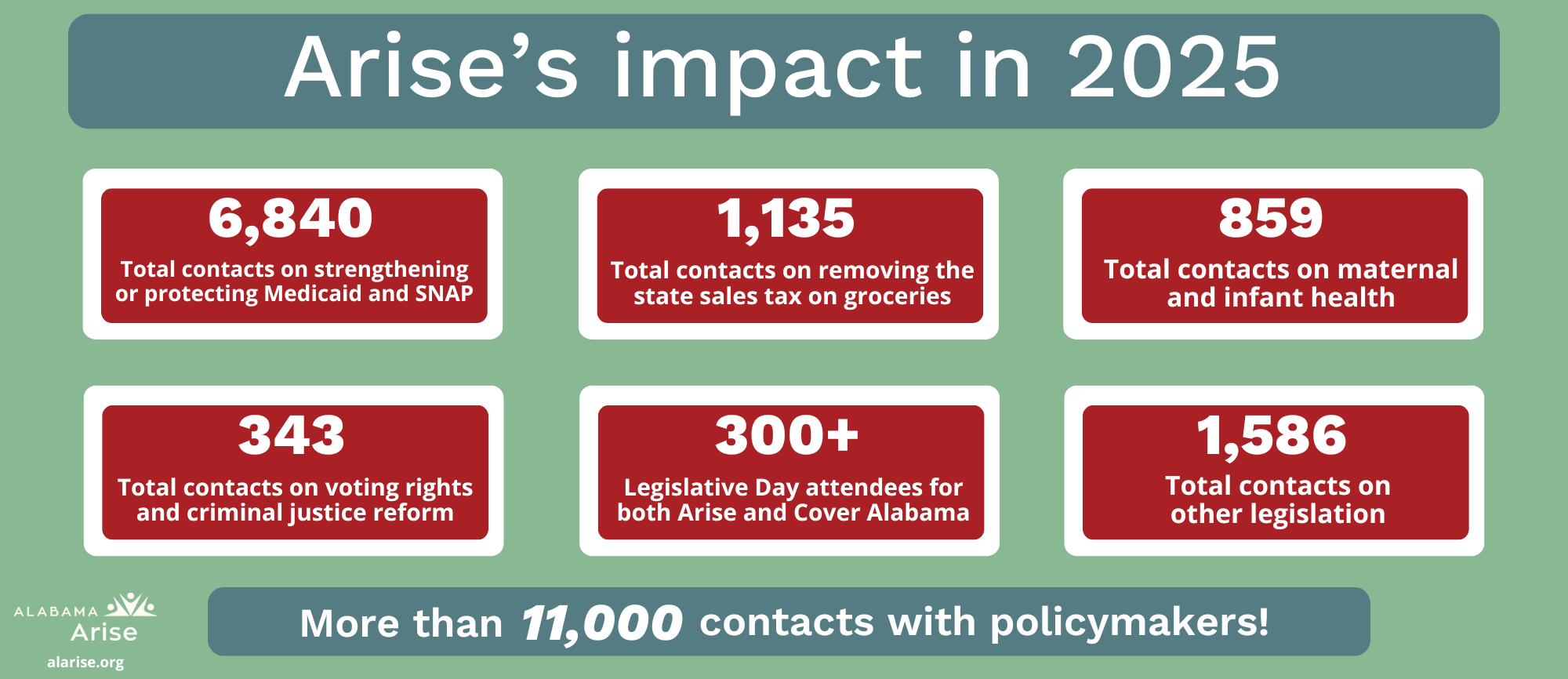
Alabama Arise just wrapped up one of the most successful legislative sessions in our history this year. Life will be better for people across the state as a result – and members like you made it all possible.

Arise members’ advocacy and support pushed legislators to enact numerous laws to reduce hunger and promote healthier families. By the time the Legislature’s 2025 regular session ended May 14, our members were celebrating many important, far-reaching victories:

Arise got results in a big way in 2025. Now the work continues. Congress is considering deep federal cuts and harsh barriers to food assistance and health coverage. State lawmakers also enacted some harmful bills this year and will seek to advance others in 2026. Through it all, Arise members will keep speaking out for policies to improve life for Alabamians marginalized by poverty.
Major victories for tax justice in Alabama

For the second time in three years, Alabama is reducing its state sales tax on groceries. HB 386 by Rep. Danny Garrett, R-Trussville, will reduce the tax from 3% to 2% starting Sept. 1. It also gives cities and counties more flexibility to reduce local grocery taxes.

The law built on the momentum of a 2023 grocery tax reduction, and it passed the House and Senate unanimously. Energy for this change was high all year: More than 200 people packed the State House in Montgomery to urge lawmakers to untax groceries during Arise’s annual Legislative Day on March 20.

HB 386 will help families keep food on the table and is an important step toward tax justice in Alabama. The grocery tax drives many Alabamians deeper into poverty and contributes heavily to our state tax system’s regressive, upside-down nature. Arise will keep advocating to end the grocery tax in a sustainable way that protects funding for public schools.

Another law to help new and growing families make ends meet is HB 152 by Rep. Neil Rafferty, D-Birmingham. This law will remove the state sales tax on numerous items for infants and parents, including baby formula, diapers, maternity clothing and menstrual hygiene products. The exemptions start Sept. 1 and will expire on Aug. 31, 2028, unless renewed.

New policies for healthier families and children

Arise also advocated successfully for other pro-family, pro-worker legislation. SB 199 by Sen. Vivian Figures, D-Mobile, will ensure paid parental leave for public school teachers, two-year college workers and state employees starting July 1. The law will provide eight weeks of paid leave to mothers after childbirth, adoption of a child aged 3 or younger, stillbirth or miscarriage. Fathers will receive two weeks of paid leave in those circumstances.

SB 102 by Sen. Linda Coleman-Madison, D-Birmingham, is another step forward for maternal health in Alabama. The law, effective Oct. 1, will expand presumptive eligibility, allowing doctors and other health care providers to determine Medicaid eligibility for expectant mothers who likely qualify. This will permit thousands of women to receive prenatal care earlier in their pregnancy.
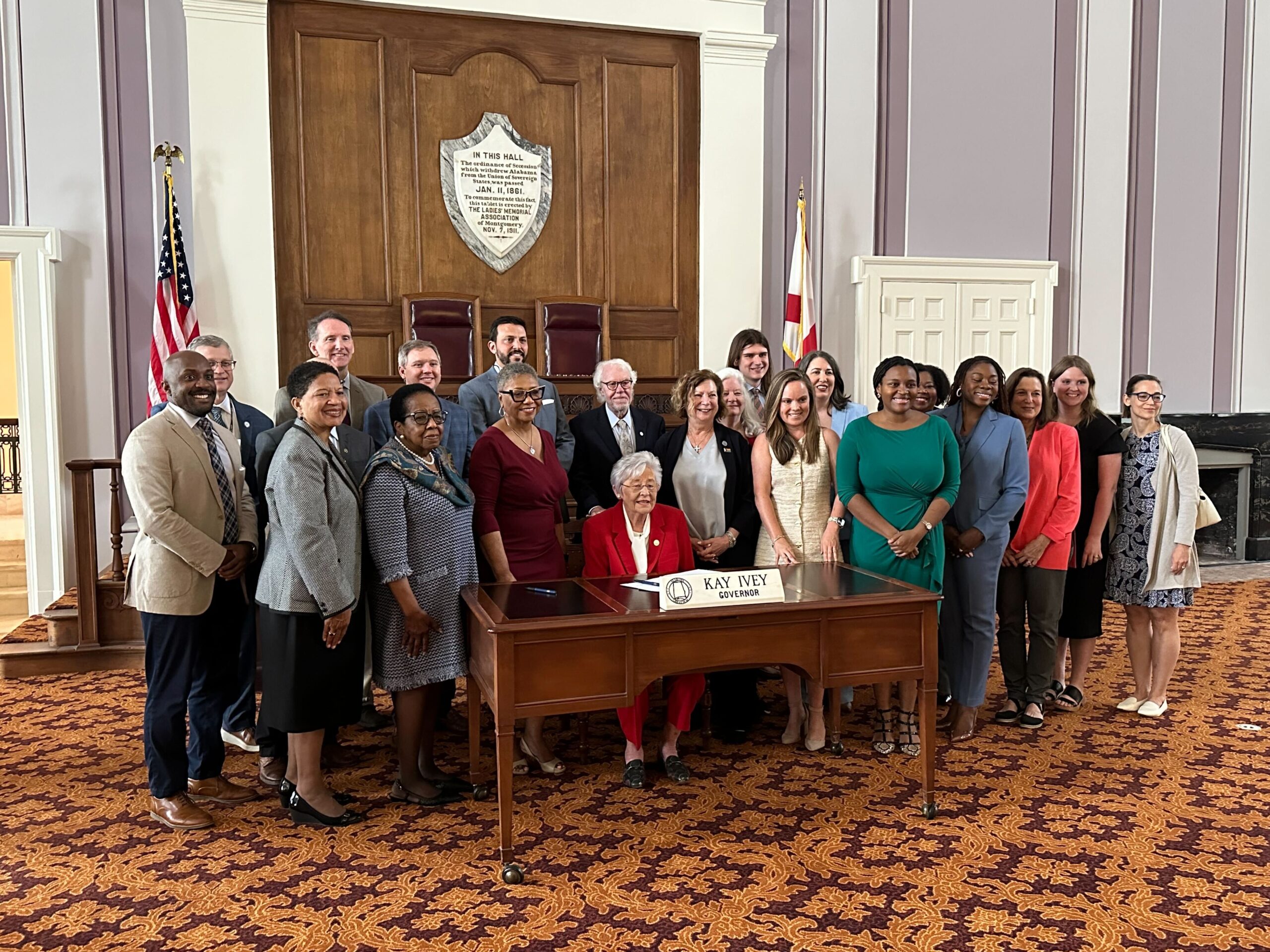
Gov. Kay Ivey sits behind a wooden desk with her nameplate on it and U.S. and Alabama flags in the background. Smiling people stand behind and to both sides of her. Behind her is wooden paneling and walls with a gray and white pattern. The patterned carpet is dark red and orange.
Alabama Arise senior health policy advocate Jennifer Harris (fifth from right) and executive director Robyn Hyden (seventh from right) participated in Gov. Kay Ivey’s bill signing ceremony for SB 102 on May 1, 2025, at the State Capitol in Montgomery. SB 102 will expand Medicaid presumptive eligibility and allow thousands of expectant mothers in Alabama to receive health care earlier in their pregnancy. (Photo by Matt Okarmus)

Arise advocacy also helped increase Alabama’s child nutrition investments. SB 112 and SB 113 by Sen. Arthur Orr, R-Decatur, allocated $17.3 million to expand school breakfast and continue Summer EBT. Arise members last year successfully pushed for Alabama to participate in Summer EBT starting in 2025. The program will help reduce food insecurity for more than 500,000 children statewide.

One setback this year was enactment of HB 477 by Rep. David Faulkner, R-Mountain Brook. This law authorizes unregulated health plans that could cap benefits for enrollees and charge higher premiums or deny coverage based on preexisting conditions. Arise sought amendments to help mitigate the law’s worst provisions.

The work continues

Several Arise-backed bills made major progress but fell just one step short of going to the governor. Garrett’s HB 389 would have reduced state income taxes for households with low and middle incomes. Coleman-Madison’s SB 153 would have improved Alabama’s voting rights restoration process. And SB 22 by Sen. Merika Coleman, D-Pleasant Grove, would have allowed the state to remove tax incentives for companies that violate child labor laws.

Arise also helped prevent numerous bad bills from passing. These included proposed new barriers to unemployment insurance benefits, food assistance and Medicaid coverage.

With your support, Arise will keep advocating for essential policy changes in 2026 and beyond. We will keep working to close the health coverage gap and untax groceries forever. And we will continue strengthening our movement for a better, more inclusive Alabama for all.
Federal funding cuts would increase hunger and hardship across Alabama

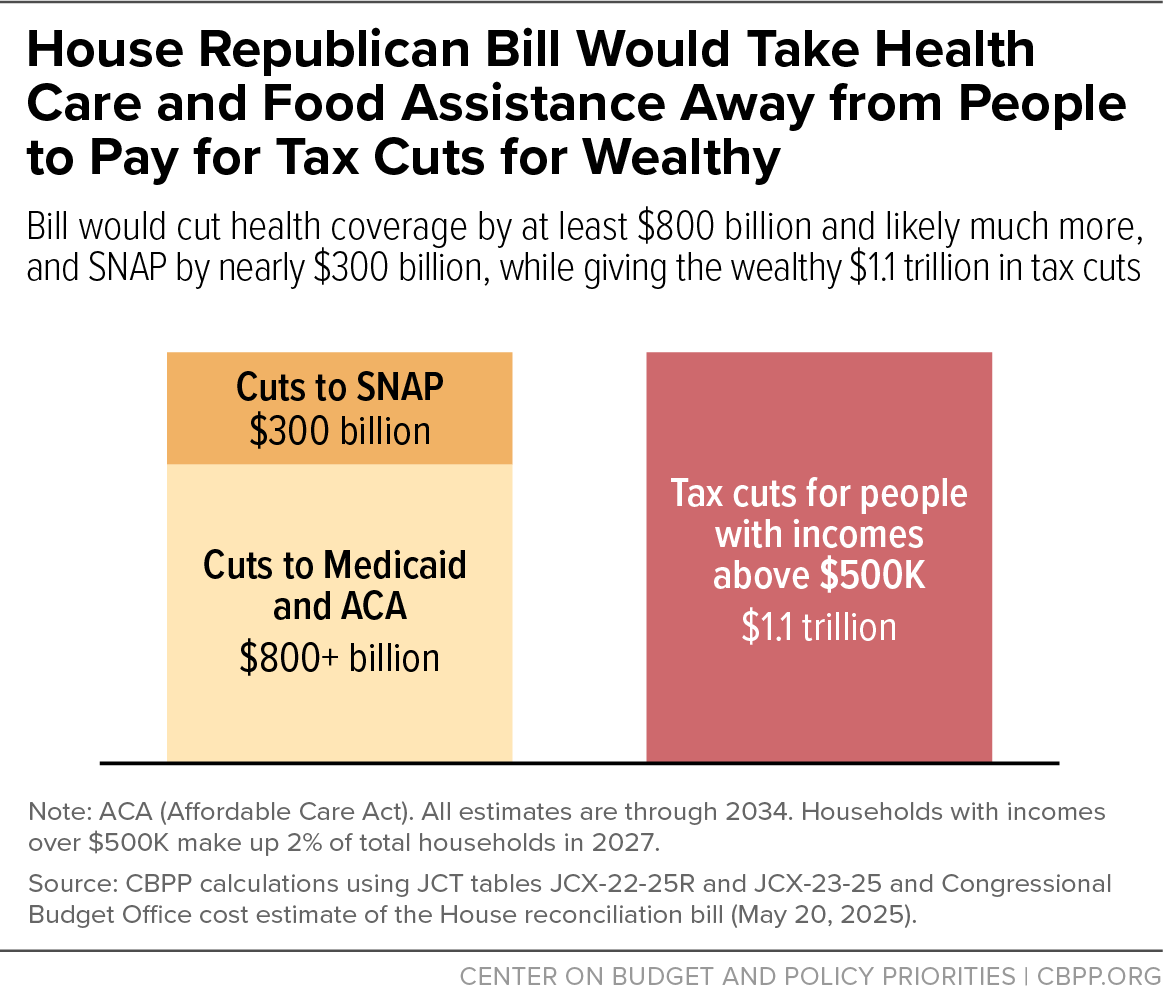
Congress is advancing a cruel proposal to take away food assistance, health coverage and other vital services from millions of Americans who struggle to afford basic needs.

Why? To give huge tax cuts to the wealthiest people in the country. The bill’s proposed $1.1 trillion of cuts to food assistance and health care over the next decade would be equal to the amount of tax cuts it would provide for the wealthiest 2% of households, according to the Center on Budget and Policy Priorities.

Congressional leaders are pushing the bill through budget reconciliation, a process that bypasses the Senate filibuster and allows legislation to pass with a simple majority vote. That process is ongoing and fluid. The U.S. House voted 215-214 for the bill in late May. By the time you read this, the Senate may have made many changes, some for the better and others for the worse.

The specifics may change, but the bill’s brutal core will remain the same. It will increase suffering for millions of Americans with low incomes to finance tax breaks for wealthy households and highly profitable corporations.

An existential threat to SNAP in Alabama

Alabama likely would feel the worst effects from proposed cuts to food assistance under the Supplemental Nutrition Assistance Program (SNAP). SNAP helps more than 42 million people nationwide and nearly 800,000 Alabamians put food on the table.

Now, Congress and the White House are threatening those families’ meals in an effort to reduce taxes for billionaires. Three major proposed SNAP changes would have devastating effects on Alabama.

(1) The bill likely would require Alabama to pay hundreds of millions of dollars more for SNAP benefits and administrative costs. The federal government has funded 100% of SNAP benefits for decades. Under the new cost shift, Alabama would become responsible for a projected $258 million or more in direct benefit costs annually, plus an additional $35 million a year in administrative costs.

The General Fund is already facing increasing costs and often stagnant revenues. There is real reason to be concerned that the Legislature can’t, or wouldn’t, commit this money. In that case, Alabama would be forced to cut SNAP benefits significantly – or even eliminate the program altogether.

(2) Congress also is considering expanding SNAP current time limits and work verification red tape for an additional 165,000 Alabamians, including parents with children over age 7. A change of this magnitude would create additional burdens for Alabama’s already stretched child care and child welfare systems. And it could leave thousands of Alabama children and families without food.

(3) Congress is considering limiting future growth in the value of SNAP benefits. Over time, this would reduce benefits for nearly 800,000 SNAP participants in Alabama, including more than 300,000 children, even as food costs continue to grow.

The economic devastation of SNAP cuts

SNAP cuts not only would hurt Alabama’s people. They also would damage Alabama’s economy. More than 5,000 Alabama stores are authorized to accept SNAP payments, and for many, it’s a large part of their business. This is particularly true in small towns and rural communities where retail is a major source of jobs and tax revenue.

Every $1 in SNAP benefits can generate $1.50 in economic activity in local communities, the USDA estimates. Deep SNAP cuts could force layoffs or closures at grocery stores and other retailers across our state. A reduction or loss of SNAP benefits is a threat to our economy and the local communities where we all live and shop.

Threats to Medicaid and ACA coverage

The bill also would make health care inaccessible or less affordable for tens of millions of Americans, including tens of thousands of Alabamians. It would allow enhanced Affordable Care Act (ACA) subsidies to expire, increasing premium costs for marketplace plans.

In addition, the bill would create new barriers that would limit Alabama’s ability to manage its own Medicaid program in the future. For example, the legislation would eliminate the federal incentives set aside to help states like Alabama cover the first two years of Medicaid expansion.

Alabama is one of 10 states yet to expand Medicaid to cover adults with low incomes. As a result, nearly 200,000 Alabamians are in the health coverage gap, earning too much to qualify for Medicaid but too little to afford private insurance.

The bill also would freeze provider taxes at current levels. This would ban Alabama from increasing fees on nursing homes, ambulance providers and others to fund Medicaid costs – even if legislators find that move necessary to sustain the program or expand coverage later.

Now is the time to speak out

It is not too late for us, as Alabamians and Alabama Arise members, to raise our voices against this dreadful bill. Congress is hearing the opposition from people back home, and that pressure continues to grow. The bill’s margin for passage is tight, and only a few votes can make a difference.

Please call on your U.S. representative and senators to say “no” to deep cuts to food assistance and health care. Ask them to focus instead on legislation that advances tax equity and meets essential health and nutrition needs in our communities.

U.S. House budget bill would hammer struggling Alabama families

The U.S. House voted 215-214 Thursday for a budget bill that would make basic needs like food and health care more expensive for millions of families through severe cuts to food assistance, Medicaid and other human services. These funding cuts would finance efforts to renew or expand tax cuts for wealthy people and highly profitable corporations.

Alabama Arise executive director Robyn Hyden issued the following statement Friday in response:

“It’s wrong to hurt people who are struggling to help people who are already doing well. But the U.S. House just voted for a budget bill that would do exactly that.

“This cruel budget plan would take away food assistance, health coverage and other vital services from hundreds of thousands of Alabamians who struggle to afford basic needs. And it would make those cuts in service of slashing taxes for billionaires and highly profitable corporations. The bill’s $1.1 trillion of cuts to food assistance and health care over the next decade would be equal to the amount of tax breaks it would provide for the wealthiest 2% of households.

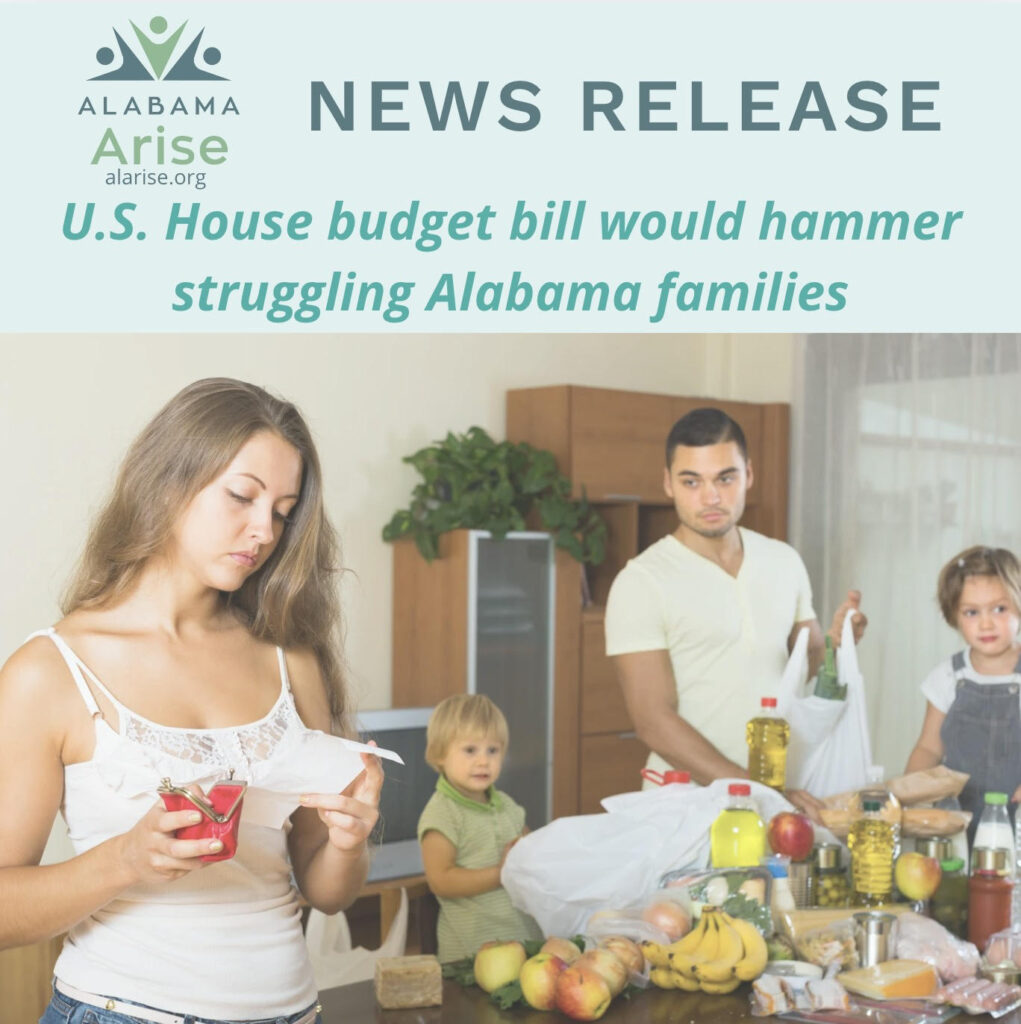
Text at the top: Alabama Arise news release: U.S. House budget bill would hammer struggling Alabama families. In the image below, a mother looks at a long receipt in the foreground. In the background, a father opens grocery bags on a kitchen table while their two young children stand to either side of him.

Threats to nutrition, health care

“Alabama likely would feel the worst effects from cuts to the Supplemental Nutrition Assistance Program. SNAP benefits have been fully federally funded for decades, but this bill would change that. As a result of this cost shift to states, Alabama would be on the hook to pay nearly $300 million a year in direct benefits and additional administrative costs.

“There is real reason to worry that the Legislature can’t or wouldn’t provide this additional funding. In that case, Alabama would be forced to cut SNAP benefits significantly – or even eliminate the program altogether for nearly 800,000 participants statewide. These cuts would send hunger soaring and devastate the economy in local communities across Alabama.

“The House bill also would make health care inaccessible or less affordable for hundreds of thousands of Alabamians. It would allow enhanced Affordable Care Act subsidies to expire, increasing premium costs for marketplace plans. It also would take away the additional federal incentives for the first two years of Medicaid expansion that Alabama left on the table, increasing the chances that hundreds of thousands of our neighbors will remain stuck in the health coverage gap with no options to afford life-saving care.

“The Senate should put the future and well-being of all of us ahead of tax cuts for the wealthy and well-connected. That means rejecting the House bill’s harmful service cuts for working people and tax giveaways to wealthy households. Our senators should focus instead on building an economy that works for everyone in Alabama and across our country.”

More resources

Read the February letter from Alabama Arise and 111 partner organizations urging Alabama’s congressional delegation to oppose harmful cuts to Medicaid and SNAP.

Read the January letter from Alabama Arise and 55 partner organizations urging Alabama’s congressional delegation to oppose further tax cuts for wealthy people.

Grocery tax bill’s passage will improve life for every Alabamian

The Alabama Senate voted 34-0 Tuesday for HB 386 by Rep. Danny Garrett, R-Trussville, a bill that will reduce the state sales tax on groceries from 3% to 2% beginning on Sept. 1 and give cities and counties more flexibility to reduce local grocery taxes if they choose. The Alabama House quickly concurred in the Senate’s changes, meaning the bill now will go to Gov. Kay Ivey.

Alabama Arise executive director Robyn Hyden released the following statement Tuesday in response.

“Reducing the grocery tax will make it easier for every Alabamian to make ends meet, especially in this time of persistently high food prices. Alabama Arise is thrilled to see the widespread, bipartisan support for reducing the state sales tax on groceries. And we urge Gov. Kay Ivey to sign this bill into law quickly.

“The state grocery tax reduction from 4% to 3% in 2023 was an essential first step toward tax justice in Alabama, and this year’s bill continues that momentum. The grocery tax drives many families deeper into poverty, and Arise remains committed to the goal of eliminating it entirely.

“Arise members from every corner of our state have advocated relentlessly for decades for Alabama to untax groceries. Our work will continue until the state grocery tax is in the dustbin of history where it belongs.

“Arise appreciates Rep. Danny Garrett and Sens. Arthur Orr and Andrew Jones for guiding HB 386 through the Legislature. We’re thankful for the unanimous legislative support on this bill this year. And we’re grateful for former Rep. John Knight, former Sen. Hank Sanders, Reps. Laura Hall, Penni McClammy and Mary Moore, and so many other legislators whose determined work over so many years laid the groundwork for this progress.

What should happen next

“Reducing the grocery tax benefits every Alabamian. And it is an important step toward righting the wrongs of our state’s upside-down tax system, which forces Alabamians with low and moderate incomes to pay a higher share of their incomes in state and local taxes than the wealthiest households.

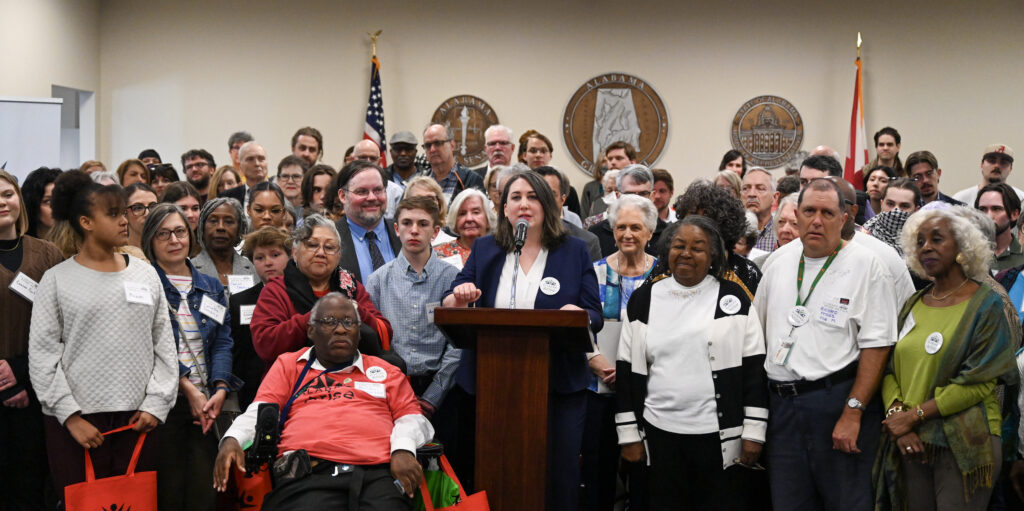
Alabama Arise executive director Robyn Hyden speaks in support of untaxing groceries during Arise’s annual Legislative Day on March 20, 2025, in Montgomery. (Photo by Julie Bennett)

“It is important to ensure grocery tax elimination doesn’t harm our children’s education in the long term. Education Trust Fund revenues are strong enough for now to reduce the grocery tax without causing severe harm to school funding. But history tells us that times of strong revenues don’t last forever. Lawmakers must work together to agree to a solution to untax groceries sustainably and responsibly.

“Arise is open to numerous ideas for replacement revenue, and we will continue working with the state’s Joint Study Commission on Grocery Taxation to find a path forward. We continue to support our longstanding proposal to replace grocery tax revenue by capping or ending the state income tax deduction for federal income tax payments. Alabama is the only state to allow this full deduction, which overwhelmingly benefits the wealthiest households. Closing this skewed loophole would protect funding for public schools and ensure Alabama can afford to end the state sales tax on groceries forever.”

200+ Alabama Arise supporters rally in favor of reducing state grocery tax

Alabama Arise executive director Robyn Hyden speaks in support of untaxing groceries during Arise’s annual Legislative Day on March 20, 2025, in Montgomery. (Photo by Julie Bennett)

Alabama should reduce the state sales tax on groceries again this year and work toward a sustainable solution to end the tax permanently, Alabama Arise members told legislators Thursday.

More than 200 Arise supporters gathered Thursday at the State House in Montgomery to show their support for untaxing groceries. The advocates urged state senators to support HB 386 by Rep. Danny Garrett, R-Trussville, which would reduce the state grocery tax from 3% to 2% beginning on Sept. 1. HB 386 passed the House 103-0 on Tuesday and now awaits Senate consideration.

“We’re here today to ask our lawmakers to continue what we started two years ago by reducing the state grocery tax again,” Alabama Arise board president Clyde Jones said at a news conference. “Reducing the grocery tax will make it easier for families across the state of Alabama to make ends meet. And it will be an important step toward our ultimate goal of untaxing groceries once and for all.”

The news conference was part of Arise’s annual Legislative Day event. Photos from the event are available here. A video of the news conference is available here. (Remarks start at the 3:50 mark.)

Building on a breakthrough in 2023

Alabama is one of only 10 states still taxing groceries. Three other states have ended their state tax but still allow local governments to tax food. The number of states reducing or eliminating their grocery tax has continued to grow in recent years. Most recently, Kansas ended its state grocery tax this year.

Arise members have advocated since the 1990s to eliminate Alabama’s grocery tax. That advocacy got results in 2023, when lawmakers voted unanimously to reduce the state grocery tax from 4% to 3%.

HB 386 presents an opportunity this year to continue the bipartisan progress toward untaxing groceries. Reducing the state grocery tax by 1 percentage point would save an average Alabama family of four around $150 per year, based on estimates using the moderate-cost food plan from the USDA’s cost of food at home reports.

“Our message today is simple: It is wrong to tax groceries,” Alabama Arise executive director Robyn Hyden said. “This is a highly regressive tax that drives many people deeper into poverty. Taxing food makes it harder for struggling families to put food on the table. It is a cruel tax on survival. This tax needs to end, and the sooner, the better.”

‘This is a moral issue’

Hyden expressed gratitude for Arise members’ persistent and determined advocacy to end the grocery tax. She also thanked Garrett and many other current and former legislative champions of untaxing groceries. Those lawmakers include Sens. Andrew Jones, R-Centre, and Merika Coleman, D-Pleasant Grove; Reps. Laura Hall, D-Huntsville, and Penni McClammy, D-Montgomery; and former Rep. John Knight, D-Montgomery.

“This is not a partisan issue. This is a moral issue,” Hyden said. “We’re going to continue to work together to get HB 386 across the finish line with the help of our senators, and to find a sustainable way to fund our state government without taxing people deeper into poverty.”

Vote ‘Yes’ on HB 386: Help Alabama families by reducing the state grocery tax

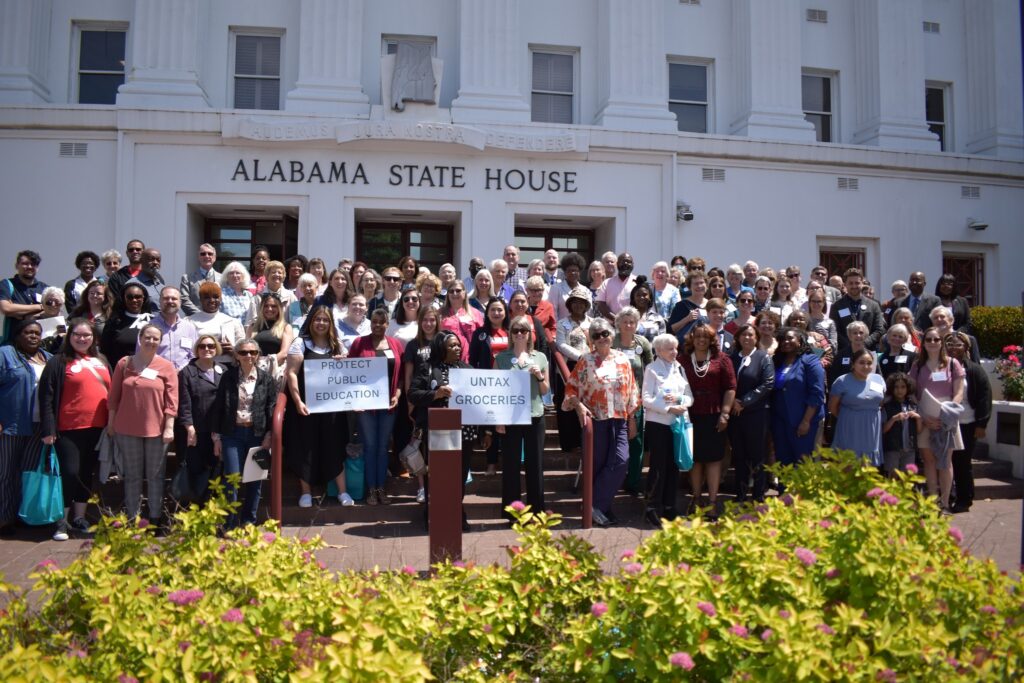
Alabama Arise supporters gather outside the State House in Montgomery during Arise’s Legislative Day on April 11, 2023. More than 100 Alabamians came to urge their legislators to end the state sales tax on groceries. Lawmakers reduced the state grocery tax from 4% to 3% in 2023 and now are considering another reduction in 2025.

Why Alabama needs to untax groceries

  • The grocery tax increases hunger rates and drives many struggling families deeper into poverty.
  • Alabama’s tax system is upside down. On average, people with low incomes pay a much higher share of their income in state and local taxes than the wealthiest households do.
  • The grocery tax is a major reason that Alabama’s tax system is so upside down. Grocery taxes take a much bigger bite out of household budgets for Alabamians with low and middle incomes than for wealthier people.
  • Most states have rejected the grocery tax. Alabama is one of only 10 states still taxing groceries.

How HB 386 would help people across Alabama

  • HB 386 by Rep. Danny Garrett, R-Trussville, would reduce the state sales tax on groceries from 3% to 2% starting on Sept. 1, 2025. This would build on the progress made in 2023, when the Legislature reduced the tax from 4% to 3%.
  • Reducing the state grocery tax by 1 percentage point would save an average Alabama family of four about $125 to $150 a year.

Bottom line

Alabama’s grocery tax is a cruel tax on survival. Lawmakers should pass HB 386 to continue the progress toward eliminating the state grocery tax once and for all. And they should work to identify more sustainable, less harmful options to fund public education and other vital services.

Another grocery tax reduction would be great news for every Alabamian

Rep. Danny Garrett, R-Trussville, on Wednesday introduced HB 386, a bill to reduce the state sales tax on groceries from 3% to 2% beginning on Sept. 1. The Alabama House Democrats also endorsed forthcoming legislation to end the state grocery tax during a news conference Wednesday. Alabama Arise executive director Robyn Hyden released the following statement Thursday in response:

“Alabama Arise is excited to see widespread, bipartisan support for reducing the state sales tax on groceries. The grocery tax reduction in 2023 was an essential first step toward tax justice in Alabama, and we look forward to working with lawmakers to continue the progress on this vital issue this year.

“Further reducing and ultimately eliminating the state sales tax on groceries would provide meaningful help for Alabamians who struggle to make ends meet. Reducing the grocery tax benefits every Alabamian. And it is an important step toward righting the wrongs of our state’s upside-down tax system, which forces Alabamians with low and moderate incomes to pay a higher share of their incomes in state and local taxes than the wealthiest households.

“The state grocery tax is a cruel tax on survival. It drives many families deeper into poverty. And Arise remains committed to the goal of eliminating it entirely. Arise members from every corner of our state have advocated relentlessly for decades for Alabama to untax groceries. Our work will continue until the state grocery tax is in the dustbin of history where it belongs.

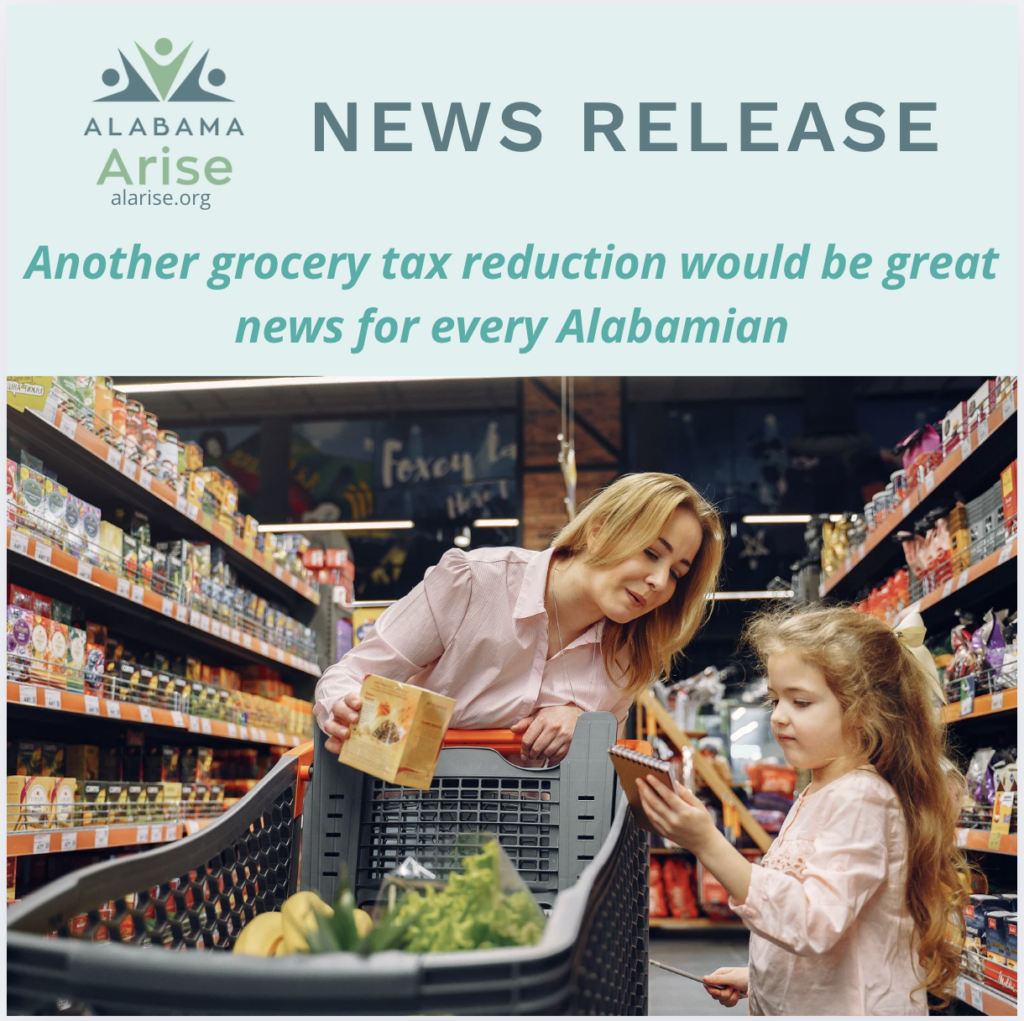
A woman pushes a grocery cart while her daughter stands next to her. Image text: "News release: Another grocery tax reduction would be great news for every Alabamian."

How to ensure the grocery tax reduction lasts

“It is important to ensure grocery tax elimination doesn’t harm our children’s education in the long term. Education Trust Fund revenues are strong enough for now to reduce the grocery tax without causing severe harm to school funding. But history tells us that good economic times don’t last forever. Lawmakers must work together to agree to a solution to untax groceries sustainably and responsibly.

“Arise is open to numerous ideas for replacement revenue, and we will continue working with the state’s Joint Study Commission on Grocery Taxation to find a path forward. We continue to support our longstanding proposal to replace grocery tax revenue by capping or ending the state income tax deduction for federal income tax payments. Alabama is the only state to allow this full deduction, which overwhelmingly benefits the wealthiest households. Closing this skewed loophole would protect funding for public schools and ensure Alabama can afford to end the state sales tax on groceries forever.”

Arise 2025: How we’re working to build a better Alabama

Alabama Arise believes in dignity, equity and justice for all. We believe in an Alabama where everyone’s voice is heard and everyone has the opportunity to reach their full potential. And we believe better public policies are the key to building a brighter future for our state.

Below, we’ll share some details of that vision with you before the Alabama Legislature’s regular session begins Feb. 4. We’ll focus on the crucial legislative priorities on our 2025 roadmap to change.

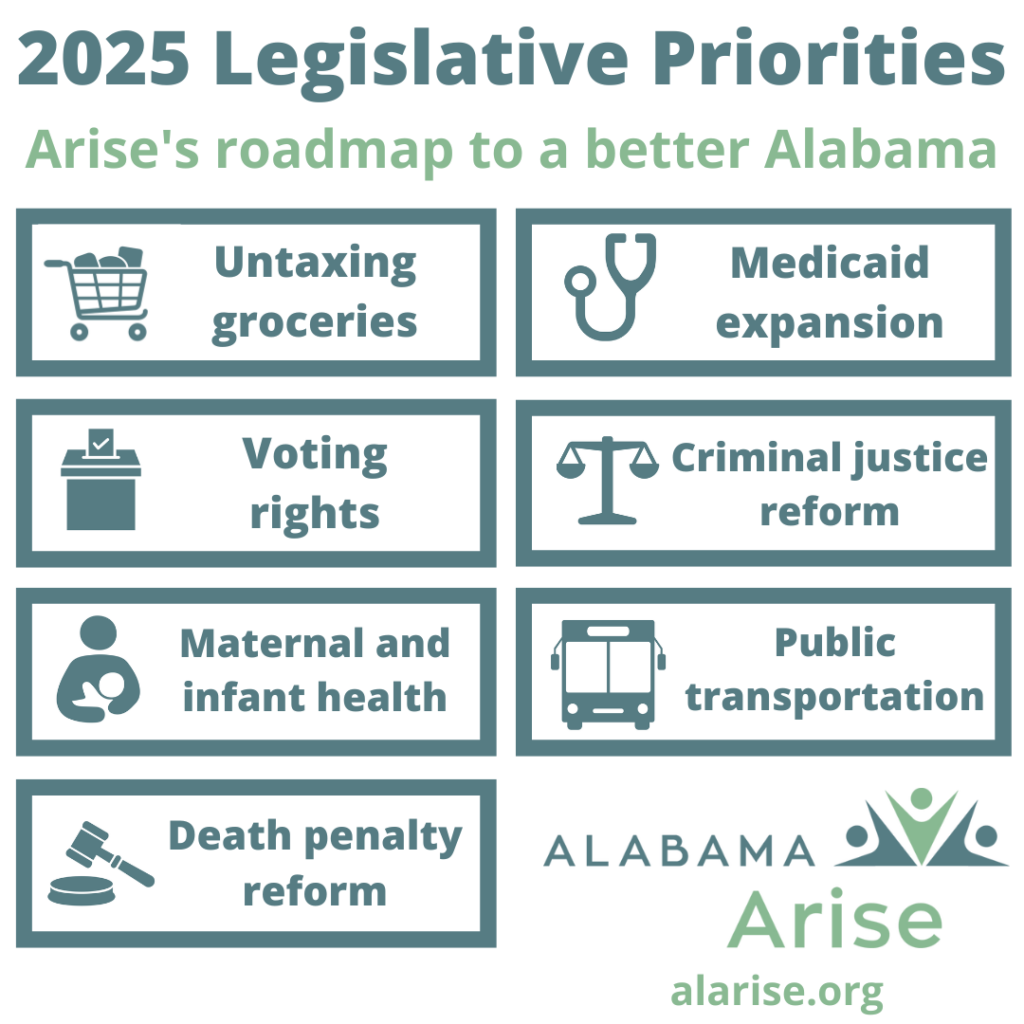
Graphic listing Alabama Arise's 2025 legislative priorities: Arise's roadmap to a better Alabama. The priorities are untaxing groceries, Medicaid expansion, voting rights, criminal justice reform, maternal and infant health, public transportation and death penalty reform.

It’s time to close Alabama’s health coverage gap

For more than a decade, Alabama has been outside looking in on a good deal. While hundreds of thousands of Alabamians continue to struggle without health insurance, state leaders have failed to expand Medicaid. A few loud voices have politicized an issue that never should have been political. And our state has paid the price in lost dollars, lost jobs and lost lives.

Alabama is one of 10 states that has yet to expand Medicaid. That inaction has left hundreds of thousands of Alabamians in a health coverage gap. We’re advocating to make this the year when our state closes that gap.

READ MORE – An Alabama solution: Closing the health coverage gap

Finish removing the state grocery tax

Alabama’s state sales tax on groceries is a cruel tax on survival, and Arise is committed to eliminating it. We were thrilled to see lawmakers pass legislation in 2023 to cut the state grocery tax in half after decades of persistent advocacy by our members. And we’ll continue advocating to remove the rest of the tax sustainably and responsibly. We’re grateful to serve on a state commission that is studying policy pathways to end the state grocery tax while protecting vital funding for public schools.

WATCH – The path forward in Alabama Arise’s work to untax groceries

Fund public transportation to improve life for all Alabamians

Alabama’s labor force participation rate is among the nation’s lowest. Only 58% of working-age adults reported they were actively working or looking for jobs as of November 2024. Our state also has nearly 100,000 more job openings than workers available to fill them. Yet 31% of Alabama job seekers cite transportation issues as the reason they are unemployed or underemployed, according to a study commissioned by the governor’s office.

Unfortunately, Alabama is one of only three states that has no state funding set aside to support public transportation. Alabama Arise will advocate for that to change during this legislative session.

READ MORE – Fund public transportation to improve life for all Alabamians

Expand voting rights to right past wrongs and safeguard democracy in Alabama

Voting rights are the foundation of our democracy, and we should do everything we can to protect them. However, since the U.S. Supreme Court stripped away federal preclearance of voting law changes in 2013, the Legislature has passed several harmful laws to create unnecessary barriers to voting rights in Alabama. This included 2024’s SB 1, which created a chilling effect for people trying in good faith to help Alabamians with absentee voting. Arise will advocate instead for positive steps to support voting rights, including passage of the Alabama Voting Rights Act, which would protect absentee voting and clarify voting procedures. Additionally, lawmakers will introduce bills to remove barriers to voting rights restoration for citizens released from incarceration.

READ MORE – Expand voting rights to right past wrongs and safeguard democracy in Alabama

It’s time for Alabama to prove we care about mothers and children

Healthy parents and healthy children mean a healthier future for Alabama. Comprehensive maternal and infant health care investments are crucial to ensure the health and safety of both infants and Alabamians of child-bearing age, especially postpartum mothers, pregnant women and future mothers. Lawmakers have numerous policy options to increase the number of health care providers and extend health coverage to more parents.

READ MORE – The Alabama Maternal Health Toolkit

School breakfast for all: What Alabama can do to help feed all of our kids

School breakfast for all would help reduce child hunger in Alabama, and it would go a long way toward the goal of guaranteeing a morning meal for every child in our state. School breakfast’s benefits are wide-ranging: It helps address chronic absenteeism, improves adolescent mental health, alleviates behavioral problems and improves test scores. Alabama Arise is pushing for a $16 million appropriation from the Education Trust Fund to ensure every district can pull down the maximum federal funding, and to give local schools the opportunity to offer no-cost breakfast for all Alabama children.

READ MORE – School breakfast for all: What Alabama can do to help feed all of our kids

Alabama’s death penalty practices remain unjust and unusually cruel

Americans increasingly oppose the death penalty. Gallup found that opposition to the death penalty more than doubled in the past 25 years. This may result from disturbingly high error rates in the system. For every 10 people executed since 1976, one innocent person on death row has been set free.

Alabama took an important step toward death penalty reform in 2017 by banning judicial overrides of juries’ sentencing decisions, and we will aim to work this session to make that ban retroactive. But the state’s death penalty scheme also remains broken in many other ways.

READ MORE – Alabama’s death penalty practices remain unjust and unusually cruel

Alabama’s parole system is still broken. How can we fix it?

The state’s parole system is a failure in both its design and in application of its own rules. We need to increase parole board oversight and eliminate racial disparities in parole. People also deserve to be able to attend their own parole hearings.

Arise’s suggested changes would be an important step in the direction of a more just Alabama, and they would mitigate some of the problems plaguing our state’s prison system overall.

READ MORE – Alabama’s parole system is still broken. How can we fix it?

Paid parental leave improves life for Alabama workers

Like any employer, our state should ensure its workers have jobs that support their ability to care for their families. The teachers, social workers and many other state employees who help look after our children and who build up Alabama for all the families in the state should be able to create and grow their own families without scrambling to pay the bills.

Paid parental leave is a common-sense policy that helps workers care for their families while maintaining their careers and financial well-being. State officials often have said Alabama is pro-family. Ensuring that teachers and state employees have paid parental leave is an important step to prove it.

READ MORE – Paid parental leave improves life for Alabama workers

56 Alabama groups urge Congress to reject tax cuts for the wealthy

Congress should oppose efforts to increase tax breaks for wealthy Americans and highly profitable corporations this year, 56 organizations across Alabama wrote in a letter sent to Alabama’s congressional delegation Wednesday. Lawmakers instead should seek to boost tax credits that expand opportunities for working people and families, the letter said.

“We urge you and all members of the Alabama delegation to reject renewed or expanded tax cuts for the wealthiest people in our society,” the groups wrote. “And we urge you instead to provide meaningful tax reductions for ordinary families in Alabama and nationwide through an expanded Child Tax Credit and expanded Earned Income Tax Credit.”

Alabama Arise is among 56 organizations that signed the letter to the state’s two U.S. senators and seven U.S. representatives. Read the full letter here.

‘An opportunity to address long-standing inequities with our tax code’

The Tax Cuts and Jobs Act (TCJA), enacted in 2017, increased federal deficits by nearly $2 trillion while lavishing tax cuts on the country’s wealthiest households. The law failed to live up to proponents’ claims that it would pay for itself or fuel wage increases for most workers, the organizations’ letter said.

Many TCJA provisions are set to expire this year, including numerous tax breaks that disproportionately benefit wealthy people. These include higher estate tax exemptions and a cut to the top marginal income tax rate. Other provisions are permanent and not up for renewal, including a 40% reduction of the corporate income tax rate. This tax break overwhelmingly benefits large, highly profitable corporations.

Proposals to renew and expand these tax breaks would be similarly skewed in favor of the wealthiest Americans. The White House’s proposed tax plan would lead on average to “a tax cut for the richest 5% of Americans and a tax increase for the other 95% of Americans,” according to the Institute on Taxation and Economic Policy (ITEP), a nonprofit tax policy research organization in Washington, D.C.

Lawmakers will have an opportunity during this year’s federal tax and budget debates to choose a better, more inclusive path, the Alabama organizations wrote.

“The expiration of these provisions [is] an opportunity to address long-standing inequities with our tax code and to raise more revenue to meet our country’s current obligations and address critical unmet needs,” the groups wrote.

Child Tax Credit, EITC improvements would reduce poverty, expand opportunity

A key TCJA provision that helped working families is also set to expire: an increase of the maximum Child Tax Credit (CTC) from $1,000 per child to the present $2,000 per child. Boosting the CTC is a proven way to ease suffering and expand economic opportunity, as 2021’s temporary CTC increase showed.

Congress in 2021 expanded the CTC for one year under the American Rescue Plan Act. The expansion increased the maximum credit for children under age 6 to $3,600, and for all other children to $3,000. It made the full CTC available to children living in families with low or no earnings. And it extended the credit to 17-year-olds, who previously were ineligible.

The benefits were swift and powerful, Census data showed. CTC payments helped families cover rising costs for necessities like food, utilities, rent and diapers. Overall, the policy kept more than 5 million Americans above the poverty line. It also contributed to a major nationwide reduction in the child poverty rate in 2021, with the Supplemental Poverty Measure for children falling from nearly 10% to about 5%.

Temporary improvements to the Earned Income Tax Credit (EITC) in 2021 also eased hardship for people across Alabama. More than 280,000 Alabamians with low incomes benefited from the one-year EITC expansion. Nearly three in four had incomes below $20,400, according to ITEP estimates.

“No matter what you look like or where you’re from, we all believe in caring for our families and community,” the organizations wrote to Alabama’s congressional delegation. “Americans want you to meet the moment and put the future and well-being of all of us ahead of tax cuts for the wealthy and well-connected.”

Read the full letter from Alabama Arise and 55 other organizations here.

Alabama Arise, 55 partner groups urge Congress to oppose more tax cuts for wealthy households

The Tax Cuts and Jobs Act (TCJA), enacted in 2017, increased federal deficits by nearly $2 trillion while lavishing tax cuts on the country’s wealthiest households. Many TCJA provisions are set to expire this year, including numerous provisions that disproportionately benefit wealthy people. Alabama Arise joined 55 partner organizations in a letter asking Alabama’s congressional delegation to oppose additional tax cuts for wealthy households and to support expansions of tax provisions that support working people and families. The full text of the letter is below.

Letter text

Dear Senators Tuberville and Britt and Representatives Aderholt, Rogers, Sewell, Palmer, Moore, Strong and Figures:

Congratulations on your election to the 119th Congress. As you know, the new Administration and Congressional Majority have made plans to prioritize extending and potentially expanding the 2017 tax law (Tax Cuts and Jobs Act, or TCJA), which is set to expire. We urge you to use the expiration of these provisions as an opportunity to address long-standing inequities with our tax code and to raise more revenue to meet our country’s current obligations and address critical unmet needs.

No matter what you look like or where you’re from, we all believe in caring for our families and community. People in our state work hard and are watching what happens in Congress. We give our all in so many ways: working as teachers, delivery drivers and nurses, volunteering at the local food bank or neighborhood cleanup, and caring for our friends and loved ones. Regardless of who they voted for in November, the vast majority of Americans were not voting to give another tax cut to the wealthy, or for another corporate tax cut.

The 2017 tax law failed in many ways, and there’s no mandate to repeat the mistakes of the past.

  • The proponents of these tax cuts said big corporate tax cuts would trickle down to big increases in wages for workers – but the typical worker got nothing from it.
  • They said the bill would pay for itself – but it actually increased the deficit by $2 trillion.
  • They said the tax cuts would create jobs – but the evidence doesn’t show that.

If Congress decides to give new corporate tax cuts and extend other provisions of the TCJA, the Committee for a Responsible Federal Budget says it would increase deficits by about $7.5 trillion over 10 years. We also know that the Administration’s tax plan favors the rich. The Institute on Taxation and Economic Policy found that it would lead “to a tax cut for the richest 5 percent of Americans and a tax increase for the other 95 percent of Americans.”

Americans want you to meet the moment and put the future and well-being of all of us ahead of tax cuts for the wealthy and well-connected. Alabamians prioritize funding services and taxing the wealthy by a wide, bipartisan margin. According to a recent survey:

  • 75% of Alabamians support raising taxes on wealthy corporations.
  • 75% of Alabamians support raising taxes on the wealthiest households in the nation.
  • 76% of Alabamians support raising taxes on households earning more than $400,000 annually.
  • 73% of Alabamians support increasing child tax credits for Alabama families.

Our 56 collective organizations work daily to reduce poverty, expand economic opportunity and create good jobs here in Alabama. Our missions speak directly to the importance of how you and the new Congress act on taxes in the next few months.

The tax code is one of our most powerful tools to shape the economy, but it too often has been used to divide us. For too long, the tax code has been slanted toward the wealthy and large corporations, and the economy, our country, and communities and families across Alabama have suffered as a result. The expiration of key provisions of the TCJA in 2025 is a rare opportunity to unite the vast majority of people who want to correct longstanding inequity in our tax code, and to help produce an economy that works for all Americans.

We urge you and all members of the Alabama delegation to reject renewed or expanded tax cuts for the wealthiest people in our society. And we urge you instead to provide meaningful tax reductions for ordinary families in Alabama and nationwide through an expanded Child Tax Credit and expanded Earned Income Tax Credit.

We appreciate your service and look forward to watching your efforts in the new year.

Signatories

Sincerely,

  1. AIDS Alabama
  2. Alabama Arise
  3. Alabama Black Women’s Roundtable
  4. Alabama Council on Human Relations
  5. Alabama Disabilities Advocacy Program (ADAP)  
  6. Alabama Forward
  7. Alabama Institute for Social Justice
  8. Alabama Justice Initiative
  9. Alabama Poor People’s Campaign
  10. Alabama Rivers Alliance
  11. Alabama State Association of Cooperatives
  12. Alabama State Conference of the NAACP
  13. All Saints Episcopal Church – Mobile
  14. Auburn United Methodist Church
  15. Baptist Church of the Covenant – Birmingham
  16. Bay Area Women Coalition – Mobile
  17. Beloved Community Church (United Church of Christ) – Birmingham
  18. Church Women United – Mobile
  19. Church Women United – Montgomery
  20. Collaborative Solutions, Inc.
  21. Community Enabler – Anniston
  22. East Lake United Methodist Church
  23. Faith in Action Alabama
  24. Fall Injury Prevention and Rehabilitation Services
  25. Feeding Alabama
  26. First Christian Church (Disciples of Christ) – Montgomery
  27. Five Horizons Health Services
  28. Grace Presbyterian Church – Tuscaloosa
  29. Greater Birmingham Ministries
  30. Interfaith Mission Service – Huntsville
  31. Jobs to Move America
  32. The Knights & Orchids Society
  33. League of Women Voters of Alabama
  34. Low Income Housing Coalition of Alabama
  35. Mary’s House Catholic Worker – Birmingham
  36. National Association of Social Workers – Alabama Chapter
  37. National Lawyers’ Guild – Alabama Chapter
  38. North Alabama Area Labor Council, AFL-CIO
  39. North Alabama Peace Network
  40. Open Table United Church of Christ – Mobile
  41. The People’s Justice Council
  42. The People’s Loan Program
  43. Professional Association of Social Workers in HIV & AIDS
  44. Progressive Women of Northeast Alabama
  45. Project Hope to Abolish the Death Penalty
  46. St. Paul UMC – Birmingham
  47. Sisters of Mercy in Alabama – Mobile
  48. Stand Up Mobile
  49. Thrive Alabama
  50. Unitarian Universalist Church of Birmingham
  51. Unitarian Universalist Fellowship of Montgomery
  52. United for a Fair Economy
  53. United Women of Color – Huntsville
  54. Valley Christian Church (Disciples of Christ) – Mountain Brook
  55. WAWC Healthcare – Tuscaloosa
  56. Youth Towers – Birmingham