
Arise legislative update: March 18, 2024

The Alabama Legislature is coming back into session after taking off last week. Arise’s Akiesha Anderson provides updates on what’s happened most recently — including unfortunate news on anti-DEI legislation — and gets you ready for another busy week ahead. Legislation we’re monitoring this week includes a bill to reform Alabama’s felony murder rule and a proposal to remove the sales tax from baby supplies and feminine hygiene products.


Full video text:

Hello, my name is Akiesha Anderson, and if you’re new to these videos, I’m the policy and advocacy director for Alabama Arise. After a much needed break from the State House last week, I am back to give you an update on what happened during the fifth week of the legislative session and what we’re expecting during this upcoming week.

As you likely know, legislators were not at the State House last week. Rather, they were in their districts for a constituent work week in which they were hopefully making time to talk to you and others that they represent. However, the week prior to that workweek, a whole lot happened.

Most notably, the House unfortunately passed both SB 29, which was the anti-diversity, equity and inclusion bill, and SB 1, the bill that restricts access to absentee voting. Both of these bills will be back in the Senate, where the Senate must approve of them before they will be sent off to the governor. There were some minor changes made to both in the House, and so I do not anticipate that the Senate will put up a fight, unfortunately. But most likely, these bills will get a vote this week in the Senate and then be sent off to the governor.

Also, by the time the Legislature left to take last week off, they had officially utilized half of their allocated legislative days. This means that at the time of this recording, we are officially halfway through the legislative session. While this pace feels a bit unprecedented, it is likely that the Legislature will continue its three-day workweek this week before going on a spring break next week, and then they will hopefully slow their pace somewhat in April. I’m being told that in April they will begin utilizing two-day work weeks instead of three. Two-day workweeks are definitely a bit a bit more typical, and this will allow them to buy time to pass the budgets.

Before sharing what’s happening this week, I do want to give you some status updates on bills that you’ve heard me talk about in prior weeks. So to begin, HB 29, which is the CHOOSE Act, and which could divert a minimum of $100 million in public education funds to private or home schools, was signed into law by the governor. SB 35 by Sen. Smitherman, which would require that history instruction be fact-based and inclusive, has passed out of a Senate committee and is waiting to be deliberated by the full Senate. HB 32 by Rep. England, which would reform and clarify Alabama’s felony murder rule, had a public hearing the week before last. Thus, we expect the House Judiciary Committee to vote on this bill this Wednesday, March 20.

HB 102 by Rep. Susan DuBose and SB 53 by Sen. Arthur Orr would both eliminate the eligibility to work form that children ages 14 and 15 are required to get signed by their schools before being employed. Both versions of this bill are expected to be considered by the full House sometime soon or at least to be in position to be considered by the full House sometime soon. The Senate version of this bill does still need to make it out of a House committee. However, it’s possible that that could happen as early as this week.

Other bills that we are watching this week include HB 188 by Rep. Terri Collins. This bill would create a uniform and improved process for the suspension or expulsion of public school students. The House Education Policy Committee has been assigned this bill, and they are expected to deliberate it this week. Also, HB 236 by Rep. Rafferty and SB 62 by Sen. Orr would both eliminate the sales tax for diapers, baby supplies, baby formula and feminine hygiene products. The Senate version of this bill is expected to be in House committee, whereas the House version of this bill is already positioned to be deliberated by the full House. That means that both or either of these bills will likely be in a position by this week to be deliberated by the full House.

And then lastly SB 31, which has been making a lot of news, will be in committee this week. And so SB 31 is a bill introduced by Sen. Waggoner. It has already made it out of the Senate and is in a House committee this week. But this is the bill that would be that is designed to get the state to give Birmingham-Southern a loan. It is also scheduled for a public hearing on Tuesday, March 19, at 11:30 a.m., and that public hearing will take place in the Ways and Means General Fund Committee.

Other things to keep an eye out for this week are new bills that legislators may introduce. So for example, the child tax credit bill that has been touted in the news as well by Lt. Gov. Ainsworth and others is expected to be introduced by Sen. Gudger and Rep. Daniels as early as this week. If legislators are hoping to get any legislation passed that has not been introduced yet, it is definitely to their benefit, especially for the sake of time, to try to have those bills filed as soon as possible. This week is ideal given the fact that they will be on the spring break next week.

Now the last thing to make sure you have on your radar is Arise’s upcoming advocacy day. So if you have not already marked your calendars to join us at the State House on Tuesday, April 2, please do. We hope to have as many people as possible to talk to legislators about our various issues, so register to join us. All you have to do is visit alarise.org and click on “Get Involved” and then click on “Upcoming Events.” That will take you directly to the page that you need to utilize to sign up. We definitely need you to let us know that you’re coming so that we can make sure we have an adequate head count, enough room for everyone, as well as meals for everyone. So I look forward to hopefully seeing you there, and in the meantime, take care.
Grocery tax, protecting voting rights among Arise priorities for 2024 session

The Alabama Legislature began its second regular session of the current quadrennium on Feb. 6. Lawmakers already have voted on numerous hot-button issues early in this session, and Alabama Arise anticipates that trend may continue. The upcoming presidential election, Alabama’s early primary date and other political factors may color what legislative leaders prioritize this year. The regular session will end no later than May 20.

Eliminate the state grocery tax

Arise was thrilled last year to help pass monumental legislation that reduced the state sales tax on groceries by 1 cent on Sept. 1, 2023. That law also authorized an additional 1-cent cut to the grocery tax in a future year. Combined, those reductions will cut the state grocery tax by half over time, from 4% to 2%.

Under the law, the second 1-cent reduction will occur in the first year when Education Trust Fund (ETF) revenues are projected to grow by 3.5% or more. Unfortunately, projections unveiled during this year’s budget hearings indicated ETF revenues will grow by only 2% in 2025. Thus, the additional 1-cent grocery tax reduction likely will occur in a future year rather than in September 2024.

This 3.5% growth provision, however, came as an amendment just before lawmakers passed the bill. The original version of the bill would have reduced the grocery tax by another 1 cent as long as annual ETF revenue growth was at least 2%. During a Feb. 12 meeting of Alabama’s Joint Study Commission on Grocery Taxation, Arise urged legislators to amend the law to reduce the growth threshold to 2%, as originally proposed. This change would allow Alabamians to receive the additional reduction sooner rather than later.

We will continue to push the Legislature to finish what it started with regard to cutting the grocery tax. We also will oppose budget legislation that we find alarming, such as the CHOOSE Act, which would divert at least $100 million of ETF money each year to non-public schools. At press time, the House had passed this proposal (HB 129, sponsored by Rep. Danny Garrett, R-Trussville), and a Senate committee had held a public hearing.

Protect voting rights and preserve child labor safeguards

Lawmakers have advanced two other troubling bills so far this year. The Senate passed SB 1, sponsored by Sen. Garlan Gudger, R-Cullman, which would criminalize many efforts to attempt to assist people with absentee voting. The Senate also passed SB 53, sponsored by Sen. Arthur Orr, R-Decatur, which would eliminate the eligibility to work form for 14- and 15-year-olds. This requirement is an important safeguard that helps protect children from exploitative child labor practices. Arise successfully advocated to amend SB 53 to require data collection about injuries and labor violations.

Arise has reason to be concerned about both of these measures. We have devoted the early weeks of this session to educating Arise members, legislators and communities about these bills’ harms.

Advance criminal justice reform 

It is an understatement to say that Alabama’s criminal justice system is in need of reform. A U.S. Department of Justice lawsuit accuses our state’s overcrowded prison system of violating the Constitution. And our state’s parole rates are abysmally low – just 8% in fiscal year 2023.

With those factors and others, Arise has a lot to keep us busy with regard to criminal justice reform. Thus, we will be devoting a significant portion of our time this year to legislation that would address issues like these. We also will support legislation to reform our death penalty laws. And we will support efforts to reform the felony murder rule, which allows a person to be convicted of first-degree murder even if they did not intend to or did not actually kill anyone.

Fund public transportation

Inadequate funding for public transportation keeps thousands of people across Alabama from meeting basic needs. Though lawmakers created the Alabama Public Transportation Trust Fund (PTTF) in 2018 to help fix our transit issues, the Legislature has never funded it. That is why Arise is urging lawmakers to include a General Fund appropriation for public transportation to rectify this oversight.

Ultimately, the return on transit investment makes allocating money to the PTTF a wise use of public funds. In fact, every $1 million invested in transit creates 49 full-time jobs, many of which are long-term jobs with good pay. An appropriation of up to $50 million from the General Fund to the PTTF also could empower Alabama to double its investment for operation expenses and to draw down up to $200 million of federal matching funds for capital improvements.

Arise will do all we can this year to educate lawmakers on the benefits of investing in public transportation. We also will highlight how a lack of adequate public transit limits workforce participation and shared prosperity across Alabama.

Arise legislative update: March 4, 2024

Arise’s Akiesha Anderson gives a rundown on a plethora of bills we are monitoring on voting rights, education funding and other issues as we begin the fifth week of the Alabama Legislature’s 2024 regular session. As a reminder, you can always visit alarise.org and click on “Take Action” to see a list of our action alerts and key legislation that we’re tracking.

Full video transcript

Hello, my name is Akiesha Anderson, and I am the policy and advocacy director for Alabama Arise.

I am excited to be here to give you yet another legislative update. Last week marked the fourth week of the 2024 legislative session. Thus, we are now entering into the fifth week of legislative session. By the end of this week, the Legislature will officially be halfway through their session, which means that they could — if they decide — be slated to end this year’s legislative session much earlier than the last day that they are constitutionally allowed to meet, which is May 20.

Last week, quite a bit happened. For starters, the CHOOSE Act, which threatens public education funding, passed out of the House. Two IVF bills designed to put a Band-Aid on the Alabama Supreme Court’s decision passed as well, one out of each chamber. The dangerous absentee ballot bill, SB 1, passed out of committee in the House. And last week also, the alarming child labor bill, which removes protections designed to ensure that 14- and 15-year-olds who work also perform well in school, was in committee in the House. This bill, however, was carried over and is expected to be heard in committee again this week.

Also in committee this week will be the anti-diversity, equity and inclusion bill, SB 129. Another IVF bill, SB 325, several voting rights bills — including one that allows people to easily update their address after voting, that’s HB 86 — one that prohibits political parties from disqualifying candidates from the ballot due to who they receive contributions from — that’s HB 186 — and also HB 218, which is a bill to allow improperly marked provisional and absentee ballots to be cured.

Also in committee this week is HB 238, which will remove the sales tax off of diapers, baby supplies, maternity clothing and women’s hygiene products. HB 227, which would reform our ethics laws, is also in committee this week. So is SB 4, which would prohibit most flags from being flown on public property. And lastly, HB 32 will be in committee this week. HB 32 is one of Arise’s priority bills, and this will amend our felony murder rule to make it less broad and more aligned with the way that most states apply this unique legal provision. HB 32 will also have a public hearing on Wednesday at 1:30 p.m., and I myself will be testifying in supporting the bill, alongside some of our friends from Arise.

Although not listed on the Legislature’s website at the time of this recording, I also anticipate that the Senate will take up both gaming and the CHOOSE Act in committees this week. In fact, I would actually be surprised if they don’t take up both or either of these issues.

I mentioned earlier that at the end of this week, the Legislature will have used half of their allocated meeting days for this session. Yet also worth noting is that next week the Legislature will be going on a one-week break for in-district legislative meetings with constituents. Thus, if there’s anything that you would like to meet with your legislators about, please take advantage of the fact that they will be in district rather than at the State House next week.

I anticipate that next week’s update will be relatively short, but I will be sure to keep you posted on what happens during this week at the Legislature. Take care.

Arise legislative update: Feb. 20, 2024

Arise’s Akiesha Anderson provides updates on all the bills that moved last week and previews what’s to come this week in the Alabama Legislature. Topics include a harmful bill that would create barriers to absentee voting, efforts to preserve child labor protections, the future of the state sales tax on groceries and the CHOOSE Act, which would redirect funding for public schools to private schools and homeschooling.

Full video transcript:

Hi there. Akiesha Anderson here, policy and advocacy director for Alabama Arise, and I am excited to be here today to give you your weekly legislative update and glimpse into what’s been happening in Montgomery.

On Tuesday, Feb. 20, the Legislature will gather in for this third week of the legislative session. Yet, what an eventful first two weeks they have had.

The second week of the legislative session, which ended last Friday, began with Arise staff showing up to the State House to testify against the CHOOSE Act, also known as SB 61. This is a piece of legislation that would divert a minimum of $100 million away from our public education system into private or home schools.

Last week, Arise also attended a grocery taxation commission meeting. This is a commission which I serve on, and at this meeting, I had the pleasure of presenting on Arise’s concern about the Legislature not taking steps to cut to cut the additional 1 cent off of the state-level grocery tax this year. This is alarming to us, especially considering that cutting this additional 1 cent would cost less than $100 million — or less than what the Legislature is trying to divert from the ETF via the CHOOSE Act.

Last week, we also saw an alarming piece of legislation, SB 53, that would remove some existing child labor protections and safeguards. This piece of legislation passed out of a Senate committee along with another piece of legislation, SB 62, which we are actually supportive of. SB 62 would remove the state-level tax from certain women’s hygiene and baby products.

Similarly, last week we saw that the House passed some significant legislation, specifically gaming legislation passed both out of committee and out of the full chamber of the House last week. And so if the Senate follows suit and passes this legislation similarly to what the House did, then everyday voters like you will likely see this issue on the ballot this upcoming November. This will be the first time if this passes out of the Senate that gaming has been voted on by the Alabama public in over a decade.

That’s a lot, right? Well, now that you’re up to date on what happened last week, I’ll go ahead and discuss what’s on the tap for this third week of the legislative session.

So this week, there are several pieces of legislation that will be in committee that Arise will be monitoring. Of concern to us include SB 89, which is an anti-loitering bill, SB 57, which is a anti-picketing bill, and HB 29, which is the House’s companion to the CHOOSE Act.

And so luckily, it is not all bleak and grim. There are also some good pieces of legislation slated to be heard in committee this week. And we will be monitoring those pieces of legislation as well. So for example, HB 64, which is a piece of legislation that makes curing and absentee ballot easier, will be up in committee this week.

And so will HB 63, which will authorize split sentences in certain instances. And so that’s a criminal justice piece of legislation that has come up in several past legislative sessions, and we are excited to see what happens with it this year.

Stay tuned. We will be sure to keep you posted. Definitely tune back in next week for another legislative update. I hope this helps. Later, y’all.

Arise legislative update: Feb. 12, 2024

Arise’s Akiesha Anderson catches everyone up on a busier-than-normal first week of the Alabama legislative session and previews an additional busy week ahead. Anderson discusses what’s been happening with a harmful bill that would create more barriers to absentee voting and provides an update on the future of the state sales tax on groceries.

Full video transcript:

Greetings! Akiesha Anderson here, policy and advocacy director for Alabama Arise, and I am thrilled to be here to provide you with your weekly legislative update.

We have ended the first week of the legislative session and are now entering into week two. During the first week of session, both chambers ate through three legislative meeting days rather than their normal two. That simply means that they are moving faster than usual.

Also during this first week, a very controversial bill — SB 1, sponsored by Sen. Garlan Gudger — was heard in a Senate committee and had a public hearing. This piece of legislation, if passed, could criminalize people who assist others with voting absentee. Thus, it was wonderful to see so many familiar faces, some Arise members and just fellow Alabamians, show up at the committee meeting in which this bill was being heard to testify against it.

There were way more people who testified in opposition to this bill than people who testified in support of it. Unfortunately, however, despite Sen. Gudger asking for this bill not to be voted on last week, leadership overruled that request, and senators unfortunately voted it out of committee directly along party lines. It is very likely now that this bill we will be heard and voted on by the full Senate chamber as early as Tuesday of this week.

Also on the slate for this week is a grocery tax commission meeting. I am grateful to have the honor of serving on this commission, and I look forward to gleaning more about where the state stands and its efforts to continue to reduce the grocery tax.

As you may know, budget hearings took place last Monday and Tuesday, and it was reported that fiscal projections for the upcoming fiscal year are not high enough in the ETF for the second cent to be reduced off the grocery tax this year. That is truly unfortunate and something that I really hope that the commission can attempt to address when we meet today. If you are able, I encourage you to tune in or to watch the replay of this commission meeting. It should be on the Alabama Channel, which is run by our friends from the League of Women Voters. And if you tune in, you might see a familiar face presenting at this meeting.

In addition to the grocery tax and voting rights being topics of discussion this week, so too will be gaming. Last week, HB 152, sponsored by by Rep. Blackshear, was introduced, and while Arise currently has no formal position on this legislation, seemingly, if passed, some of the money that comes in from gaming could possibly be used to fund a number of Arise priorities. Thus we will be closely monitoring and keeping you updated on this legislation throughout session.

Worth noting, this piece of legislation could be up in the House’s Economic Development and Tourism Committee as early as this Wednesday and on the floor of the House as early as the following day, which will be this Thursday.

Thank you for tuning in. I look forward to keeping you posted on what happens throughout the rest of the legislative session.

Arise legislative update: Feb. 6, 2024

Arise’s Akiesha Anderson welcomes everyone to the Alabama Legislature’s 2024 regular session. She talks about what we’ll be looking out for on our members’ legislative priorities and how you can stay engaged with us this year as we work to build a better, more inclusive Alabama.

Full video transcript:

Hi, everyone. My name is Akiesha Anderson, and I am the policy and advocacy director for Alabama Arise. I am here to give a brief update on the 2024 legislative session.

So if you are not aware, the 2024 legislative session will begin on Tuesday, Feb. 6. In the day prior to the beginning of the legislative session on Monday, Feb. 5, there will be budget hearings that will take place just about all day, and on Tuesday morning, those budget hearings will continue.

And then Tuesday afternoon, the legislative session will begin. This legislative session, we believe that there is a lot in store for Arise and our members and supporters, and we look forward to keeping you posted each week with the updates of what happened at the State House in the week prior.

And so for now, what we are anticipating before the start of the legislative session is that there will be a lot of hot topic issues that come up this session, some controversial issues that we may not be in support of. But we also are hopeful that our legislative priority issues — things related to maternal infant health criminal justice reform, death penalty reform, state budgets, tax reform, closing the health care coverage gap — all those things we hope will be up on the agenda of this session.

And so, again, we look forward to keeping you posted throughout legislative session about how things are progressing. And if you have any questions along the way, please don’t hesitate to reach out to our office.

But we especially look forward to making sure that you all stay engaged with the different action alerts that we send out, contacting your legislator and making sure that your voice is uplifted, to make sure that people at the State House understand and know what it is that you care about and what it is that you would like to see this session.

Take care.

Alabama Arise joins state commission on elimination of state grocery tax

The state sales tax on groceries is a cruel tax on survival, and Alabama Arise is committed to eliminating it. That is why I am grateful that Sen. Bobby Singleton nominated me to serve on the Joint Study Commission on Grocery Taxation on behalf of Arise. I am extremely excited about and honored for this opportunity, and I know that together, we will move Alabama closer to the goal of untaxing groceries once and for all.

How the commission came to be

After years of persistent advocacy by Arise members, policymakers took an important step toward tax justice this year by passing HB 479, a law that will cut the state grocery tax in half. The first decrease – from 4% to 3% – took effect in September 2023. The next decrease – from 3% to 2% – will occur in September 2024, or in the first year when Education Trust Fund (ETF) revenues grow by at least 3.5% annually.

Arise supports eliminating the state grocery tax sustainably and responsibly. That means ending the tax while also protecting vital funding for public schools. Lawmakers created the Grocery Tax Commission this year to figure out a pathway to do that.

This commission formed as the result of HJR 243 by Rep. Penni McClammy, D-Montgomery. The commission’s purpose is “to study a proposed elimination of the sales and use tax on food items,” according to the enabling legislation.

Arise’s testimony on untaxing groceries

I testified during the Grocery Tax Commission’s first meeting on Nov. 14 about the importance of untaxing groceries to help Alabama families make ends meet. And I suggested ways that Alabama could make it happen, including capping or eliminating the state deduction for federal income taxes.

Watch my testimony here, and download my presentation here.

I was one of three presenters at the first meeting. The others were representatives from the Alabama Grocers Association and the Fiscal Division of the Legislative Services Agency. During my presentation, I spoke about:

  • Arise’s 30-year history of advocating to reduce and ultimately eliminate the state’s grocery tax.
  • The harmful impact that taxing groceries has on families with low incomes.
  • Ways in which Alabama compares to other states regarding taxing groceries.
  • Innovative solutions and ways to eliminate the remainder of the state’s grocery tax while protecting the ETF.

What will happen next

In serving on the commission, Arise is charged with helping to evaluate the effects of eliminating the state sales and use tax on groceries. The factors we will help assess include:

(1) Household expenses of Alabamians with low and moderate incomes.
(2) Education Trust Fund revenues.
(3) County and municipal revenue collection.
(4) Community food banks and other nonprofit organizations that provide food.
(5) Hunger and malnutrition experienced by children and older adults.

Here is the full list of commission members:

  • Sen. Andrew Jones, R-Centre – co-chair of the Grocery Tax Commission 
  • Rep. Penni McClammy, D-Montgomery – co-chair of the Grocery Tax Commission 
  • Rep. Danny Garrett, R-Trussville – House Ways and Means Education Committee chair and sponsor of HB 479
  • Sen. Arthur Orr, R-Decatur – Senate Finance and Taxation Education Committee chair
  • Rep. Troy Stubbs, R-Wetumpka – appointee of Speaker Nathaniel Ledbetter
  • Akiesha Anderson (Alabama Arise) – appointee of Sen. Bobby Singleton, D-Greensboro
  • Michael Coleman (Heart of Alabama Food Bank) – nonprofit representative appointed by Senate President Pro Tem Greg Reed, R-Jasper
  • Rosemary Elebash – representative of the National Federation of Independent Business
  • Catherine Gayle Fuller – staffer for and appointee of Lt. Gov. Will Ainsworth
  • Allison King (Alabama Education Association) – designee of House Minority Leader Anthony Daniels, D-Huntsville
  • Wade Payne (Mitchell Grocery Co.) – representative of the Alabama Grocers Association

The Grocery Tax Commission will meet periodically between now and 2026, when it will release findings and recommendations. The next meeting will be in 2024. Arise will work closely with the commission in the coming years to lay the groundwork for eliminating the state grocery tax forever.

Three strategies to boost Alabama’s workforce

State of Working Alabama logo

Alabama leaders and policymakers are stressing about one big issue going into the 2024 legislative session: labor force participation.

Alabama’s labor force participation rate is among the nation’s lowest. Only 57% of working-age adults reported they were actively working or looking for jobs as of September 2023. We also have a severe worker shortage, with nearly 100,000 more job openings than workers available to fill them.

This situation gives Alabama workers increased power to negotiate better wages, benefits and working conditions. It also leaves state leaders and employers scratching their heads. Aren’t we supposed to be among the most “business-friendly” states in the country? How can we attract and retain industry if businesses can’t hire workers? And why aren’t more people applying for openings as the cost of living continues to increase?

Consistent barriers to workforce participation

If you want to know why people are leaving the workforce, you need to ask them. Thankfully, we have data to understand what is happening.

Workers who are underemployed or dropped out of the workforce cited three major, consistent concerns, according to multiple recent surveys from the Governor’s Office of Education and Workforce Transformation:

  1. No transportation.
  2. Inadequate pay or work schedule. (Workers are looking for full-time work or higher pay.)
  3. Illness or disability prevented them from working. (Indeed, disability is one of the main driving forces in Alabama’s extremely low workforce participation rates.)

One would hope we would see more of this data informing the conversation about the workforce. But unfortunately, it appears many lawmakers still haven’t seen the data.

Alabama Arise worker policy advocate Dev Wakeley participated in a recent discussion with lawmakers about barriers to workforce entry. He shared Arise’s policy prescription to address this issue, based on clear and direct feedback we’ve heard from workers.

1. Fund the Public Transportation Trust Fund to help workers get to jobs.

Alabama is one of only three states that has no state funding set aside to support public transportation. The Bipartisan Infrastructure Law of 2021 made massive federal boosts in public transit money available across the country. But with no local or state resources to match, cities and counties across Alabama cannot harness those federal matching funds.

Multiple survey groups cited transit access as their top barrier. It’s time for Alabama to join the rest of our Southeastern neighbors by boosting public transportation investments.

2. Stop incentivizing employers who fail to deliver on promises to provide good-paying jobs.

Alabama lawmakers passed “The Game Plan” earlier this year to renew several key economic incentive packages for large employers. Legislators also strengthened some reporting requirements via the Enhancing Transparency Act. These enhancements were critical, as Alabama still ranks among the least transparent states when it comes to economic incentives and tax expenditures.

We applaud efforts to hold businesses accountable for the promises they make when applying for these major tax breaks. But lawmakers must do more to enforce accountability and ensure the investment is paying off. While our state defers millions of dollars in tax revenue for vague incentives with unclear deliverables, many workers are still struggling to access the promised jobs because we have failed to invest in the necessary state infrastructure. And too often, the jobs simply don’t measure up to the promised wages and hiring goals.

3. Expand Medicaid to keep working-age adults healthy and in the workforce.

Investing in Alabama’s health care infrastructure is not just an avenue to create more health care jobs. It’s also a way to keep workers healthy and in the workforce.

Nearly 300,000 working Alabamians fall into the health coverage gap. Many are employed in high-demand but low-paying industries including service, retail, personal care or construction jobs. Consistent health care for low-wage workers can help prevent or control chronic disabling conditions. It also can give workers a lifeline when they are struggling with addiction, substance use disorders or mental illness.

Workers ideally would find good-paying jobs that provide flexible and inclusive family benefits. But they also should retain access to health coverage if they have to take a break from work to handle caregiving duties, manage a health or family crisis, go back to school or start their own business.

Temporarily losing a job with health coverage should not spiral further into permanent, preventable disability or untreated illness. Medicaid expansion would ensure many Alabamians still can get the health care they need during difficult times.

A prescription for a stronger workforce

We applaud House Speaker Nathaniel Ledbetter and the House Commission on Labor Shortage for expressing an interest in looking more deeply into the data around labor force participation. We were also glad to hear multiple lawmakers cite issues including affordable housing, wages and child care. All of these are critical supports to empower people to obtain and maintain employment.

To us, the message is clear: Investing more in work supports like public transportation and health care while ensuring more transparency and accountability for workforce incentives is a key, data-supported strategy to keep more Alabamians working and thriving.

Alabama Arise unveils 2024 roadmap for change in Alabama

Expanding Medicaid and ending the state sales tax on groceries will remain top goals on Alabama Arise’s 2024 legislative agenda. The group also will pursue a multifaceted approach to improving maternal and infant health in Alabama.

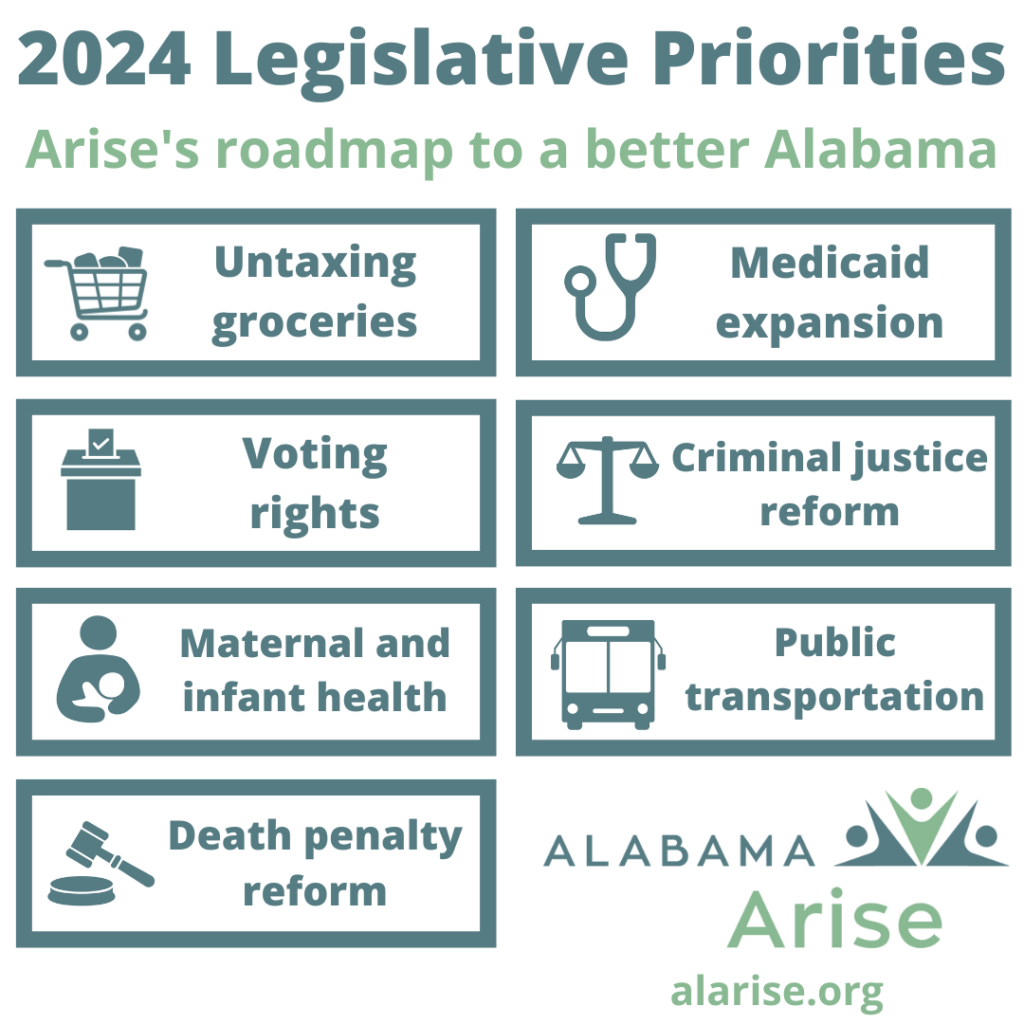
More than 500 members voted to determine Arise’s legislative priorities in recent days after the organization’s annual meeting Saturday. The seven priorities chosen were:

  • Adequate budgets for human services, including expanding Medicaid to make health coverage affordable for all Alabamians and protecting public education funding for all students.
  • Tax reform to build a more just and sustainable revenue system, including eliminating the rest of Alabama’s state sales tax on groceries and replacing the revenue equitably.
  • Voting rights, including no-excuse early voting, removal of barriers to voting rights restoration for disenfranchised Alabamians, and other policies to protect and expand multiracial democracy.
  • Criminal justice reform, including legislation to reform punitive sentencing laws and efforts to reduce overreliance on exorbitant fines and fees as a revenue source.
  • Comprehensive maternal and infant health care investments to ensure the health and safety of Alabama families.
  • Dedicated funding for public transportation to empower Alabamians with low incomes to stay connected to work, school, health care and their communities.
  • Death penalty reform, including a law to require juries to be unanimous in any decision to impose a death sentence.

“Arise believes in dignity, equity and justice for everyone,” Alabama Arise executive director Robyn Hyden said. “Our 2024 legislative priorities reflect our members’ embrace of those values, and they underscore the need to enact policies that empower Alabamians of every race, income and background to reach their full potential. Together, we’re working to build a healthier, more just and more inclusive Alabama for all.”

An infographic naming Alabama Arise's 2024 legislative priorities, Arise's roadmap to a better Alabama. The priorities are untaxing groceries, Medicaid expansion, voting rights, criminal justice reform, maternal and infant health, public transportation and death penalty reform.

The time is right to close Alabama’s health coverage gap

One essential step toward a healthier future for Alabama is to ensure everyone can afford the health care they need. Arise members believe Medicaid expansion is a policy path to that destination, and research provides strong support for that position.

Expanding Medicaid to cover adults with low incomes would reduce racial health disparities and remove financial barriers to health care for nearly 300,000 Alabamians. It would support thousands of new jobs across the state. And most importantly, it would save hundreds of lives every year.

“Medicaid expansion would boost our economy and improve the lives of hundreds of thousands of Alabamians,” Hyden said. “It’s time for Alabama’s policymakers to make this life-saving and job-creating investment in the people of our state. Ensuring Alabamians’ health and well-being now will help our state flourish for decades to come.”

Alabama became one of only 10 states yet to expand Medicaid after North Carolina enacted expansion in March. Medicaid expansion would ensure health coverage for nearly 300,000 Alabamians caught in the coverage gap. Most of these residents earn too much to qualify for the state’s bare-bones Medicaid program but too little to afford private plans.

How Medicaid expansion would improve maternal and infant health

Medicaid expansion also would bolster health care access for Alabamians before, during and after pregnancies. This would be a critical life-saving move in Alabama, which has the nation’s worst maternal mortality rate. Those rates are even higher for Black women, who are twice as likely to die during birth as white women. Adding to the problem, more than two-thirds of Alabama counties offer little or no maternity care or obstetrical services.

“Alabama took an important step to help families stay healthy by extending Medicaid postpartum coverage last year,” Hyden said. “However, that step alone was not enough to meet our state’s numerous health care needs. Policymakers should pursue numerous solutions to make Alabama a better place for parents and babies. At the top of that list should be expanding Medicaid to ensure Alabamians of all ages can stay healthy before, during and after conception.”

New to Arise’s agenda this year is a comprehensive policy approach to safeguarding and expanding access to maternal and infant health care in Alabama. In addition to Medicaid expansion, this approach would promote seamless continuity of care between home and clinical settings. It would include coverage for contraception and midwifery services. And it would eliminate the specter of criminal penalties for doctors who provide care to pregnant people who are experiencing life-threatening complications.

Finish the job: Alabama should remove the rest of the state grocery tax

Arise advocacy got results this year when legislators voted unanimously to reduce Alabama’s state sales tax on groceries by half. The new law reduced the state grocery tax from 4 cents to 3 cents on Sept. 1. Another 1-cent reduction will occur in 2024 or the first subsequent year when education revenues grow by at least 3.5%.

Arise’s members have advocated for decades to untax groceries, and they renewed their commitment to continue that work in 2024. Ending the state grocery tax remains a core Arise priority because the tax makes it harder for people with low incomes to make ends meet. The tax adds hundreds of dollars a year to the cost of a basic necessity for families. And most states have abandoned it: Alabama is one of only 12 states that still tax groceries.

The state grocery tax brought in roughly 7% of the Education Trust Fund’s revenue in the last budget year. But lawmakers have options to remove the other half of the state grocery tax while protecting funding for public schools. Arise will continue to support legislation to untax groceries and replace the revenue by capping or eliminating the state income tax deduction for federal income taxes. This deduction is a tax break that overwhelmingly benefits the richest households.

“Reducing the state grocery tax was an important step toward righting the wrongs of Alabama’s upside-down tax system,” Hyden said. “By untaxing groceries and reining in the federal income tax deduction, lawmakers can do even more to empower families to keep food on the table. Closing this skewed loophole is an opportunity to protect funding for our children’s public schools and ensure Alabama can afford to end the state grocery tax forever.”

Here’s what Alabama Arise heard from you in summer 2023!

Alabama Arise listens because we deeply value the input we get from members, partners and most importantly, those directly affected by the work we do together. We depend on what we hear to help guide our issue work and our strategies.

We held three statewide online events this summer: two Town Hall Tuesdays and one public transportation listening session. And we facilitated eight additional listening sessions around the state, engaging a total of about 375 people.

The town halls happened on July 18 and Aug. 8, and the public transit event was Aug. 9. Other meetings took place throughout the summer. This year we are sharing the direct notes and highlights from each of the meetings as recorded during the sessions.

Town Hall Tuesdays & Public Transportation Listening Session

  • Building on our vision: We had three breakout rooms during this session. We asked folks in each group to discuss their thoughts on current issues and to share other priorities they had. Here’s what we heard:

Group One: Participants generally thought Arise should continue working on the current issues. They noted that the issues are interconnected, and that makes it hard to prioritize. Concerns about criminal justice conviction practices were raised, along with the need for continued work on voting rights and Medicaid expansion. Other issues raised were the need for more affordable housing, paying a living wage versus a minimum wage, and the need to discuss the impact of the opioid epidemic on grandparents now raising children because their parents suffer with addiction. Participants also raised reapportionment as an important issue.

Group Two: Participants strongly believed all of the Arise priority issues are important and that we should continue to work on them. Some of the specific issues lifted up were transportation, voting rights, payday lending and Medicaid expansion. Some issues that are not current Arise priorities raised were housing, disability, mental health access and accountability and prison reform.

Group Three: Medicaid expansion received the most support for continued work. Several people voiced prisons and criminal justice as a concern, including the need for prison reform and bail reform. Voting rights and the concern about the many voter suppression bills was a high-priority topic. Participants discussed passionate concern about payday loans, and the group supported the present slate of issues.

  • Building on our hope: We had three breakout rooms during this session. We asked folks in each group to discuss what motivates them to act on issues and how Arise supports their actions. We also asked them to indicate their priority issues. Here’s what we heard:

Group One: 

  1. The discussion in the group was hot and heavy concerning voting rights and specifically the absentee ballot application. The group concluded that a no-excuse absentee ballot should be the norm and should be an Arise issue for 2024.
  2. The group felt strongly that the 2023 Arise slate of issues should all remain on the 2024 list of Arise priority issues. Medicaid is an issue we need to keep fighting for, they said.
  3. This group had a primary focus and lengthy discussion around voting rights.

Group Two: 

  1. All members of the group strongly believe all the Arise priority issues are important and that we should continue to work on them.
  2. Members also strongly believe affordable housing and public transportation should receive a strong voice like Medicaid expansion.
  3. Members said that to further our support of advocacy work, Arise can help unite nonprofits and grassroots organizations across the state to work together toward shared goals as opposed to working separately toward shared goals.
  4. Members lifted up our education and lobbying work as essential to connecting the people to those who represent them in the Legislature.

Group Three: Voting rights emerged as a strong theme from this group’s discussion. Participants stressed the importance of voter education and folks making the connection between voting and the policies elected officials make that impact their lives. Other voting themes included restoration of voting rights and engaging younger and BIPOC voters. Other issues raised were around public transportation and the need to fund mental health services. One participant expressed appreciation for the storytelling work Arise does related to Medicaid expansion and urged similar storytelling to help move elected officials around other Arise issues.

  • Public Transportation Listening Session: We had three breakout rooms during this session. We asked folks in each group to discuss what’s needed to improve public transit in Alabama, what strategies are needed to move the issue forward and how public transit impacts quality of life in their communities.

Group One: 

  1. Private companies like Uber and Lyft are not equipped to serve the disability community, group members said. This is very important when talking about transportation for the disability community wherever they may be, rural or urban. In other words, the private companies are not a viable resource, participants said.
  2. Rural linkage: Many rural counties have transportation-on-demand systems, but they only serve the county boundaries. Many health services reside in urban centers, and the rider needs to get from Blount County to UAB or Children’s Hospital in Birmingham. These riders are out of luck. Transfer hubs for rural to urban systems do not exist.
  3. A state transportation planning system is needed to coordinate all the existing public systems, rural and urban. Participants hoped Arise’s forthcoming transit study will shine some light on the need for a statewide public transportation planning entity.
  4. The group felt a need for massive public education around the benefits of public transportation. Somehow, Arise or a group of organizations should seek funding for an advertising budget, participants said.
  1. The real cost of owning a car versus using public transportation. This kind of information should be available to the public.
  2. The fact that public transportation is good for business development throughout the state should be targeted to legislators and local business councils and chambers of commerce.

Group Two: 

  1. This group believes public transportation is essential.
  2. There is a need for more hubs and covered stops for locations that already have public transportation in place.
  3. There is a need for more routes with more frequent buses each hour, as well as drivers who are paid livable wages.
  4. Specific strategies discussed included working with for-profits, chambers of commerce, small businesses and corporations to improve transportation for their employees. Participants also suggested surveying the need for transportation by including a question on applications to ask if transportation is needed.
  5. Public transportation impacts the quality of life across the board: health, food, employment, education, leisure, etc.
  6. People have a right to comfort, dignity, pride and independence that public transportation can provide.
  7. One member said reaching out to people who do not need or use public transportation is important to educate them that they can still benefit from it. It helps reduce traffic and road congestion, decreases likelihood of drinking and driving, and helps people out of desperate situations, which can help decrease poverty and crime.
  8. A member of the Alabama Institute for the Deaf and Blind shared how losing the ability to drive caused depression. But oppression is felt when there are no options for transportation other than relying on friends or family if you have them, or simply being unable to go to doctor’s appointments, shop for groceries or pick up medications when needed.
  9. Some members suggested a public Lyft/Uber service.

Group Three: 

  1. Needs: Money/state funding, alternative models, transit-oriented development at local levels, accessibility, buy-in from agencies like ALDOT, changed perception of public transit.
  2. Strategies/tactics: Collect public transit stories, share statistics on earning power with vs. without good public transit and other data relevant to workforce development, and highlight workforce development as a theme for legislative lobbying. Participants discussed a license plate fee, tire fee or special license plate (like public schools have, for example).
  3. Quality of life: A visually impaired participant described how a trip to the grocery store or polling place only a couple miles away is a $25 Uber ride one way. Another participant who works with clients described how their lack of access to public transit affects not just work but health appointments, visiting DHR to secure SNAP, applications for housing, etc. They also mentioned that even “low-cost” transit can be a barrier to low-income folks who may not have a dollar for a ride.

Additional listening sessions

Following are the brief notes/summaries from eight other sessions our organizers held during the summer. In general, all participants strongly affirmed Arise’s work on the current issue priorities. They also highlighted some other issues of concern.

  • Cullman, July 26 (Stan Johnson) – This was a well-informed group with a lot of comments and questions concerning criminal justice, public transportation, death penalty and new prison construction.
  • Opelika, July 26 (Formeeca Tripp) – This group discussed issues surrounding housing, transportation, food insecurity, health care and the legal system. Housing was a top issue.
  • Zoom, Aug. 3 (Formeeca) A death penalty group discussed issues related to recent executions in Alabama, as well as upcoming executions nationwide. Participants said more attention and connections are necessary to bring more awareness to death penalty reform.
  • Tuscaloosa, Aug. 7 (Stan) – The most passionate suggestion from this meeting was the need for legislative action to provide funding for mental health.
  • Opelika, Aug. 17 (Formeeca) – Arise conducted listening sessions in the form of a series of small group meetings.

Group 1: Predominantly parents, people of the community and law enforcement. They supported all current issues but wanted to focus on housing and transportation.

Group 2: Predominantly school staff, counselors, superintendents, principals, resource providers, etc. They wanted resources for non-English-speaking families, housing, transportation and effective mental health services.

Group 3: Predominantly youth, teenagers and support staff. They wanted to learn more about their representatives and how to lift up their own voices, as well as better wages and job opportunities.

  • Montgomery, Aug. 17 (Formeeca) – This group discussed their strategic plan to add to the existing public transportation priority issue. They want to add a $1 fee to license plates to fund the Public Transportation Trust Fund.
  • Birmingham, Sept. 10 (Stan) – This group showed special interest in fair housing and criminal justice reform. Voting rights also was a concern to the group, specifically absentee voting bills that may be reintroduced in the upcoming session.
  • Auburn, Sept. 21 (Formeeca) Students from an Auburn University class filled out a 2024 issue proposal survey form asking them to rank issues of priority. The top three issues that seemed to rank the highest were public transportation, voting rights and criminal justice reform.