Highs and lows: Alabama Arise’s look back at the 2022 regular session

The Alabama Legislature’s 2022 regular session adjourned sine die late on Thursday, April 7. Lawmakers capped off the session’s last week with intense debates and late nights, with the final gavel dropping just before midnight.

Alabama Arise is grateful for the many positive outcomes that came out of the State House this year. We also were glad to play a role in stopping several misguided pieces of legislation from becoming law. These wins wouldn’t have been possible without the support of Arise’s determined members and various coalition partners.

We were not able to get every good bill across the finish line or stop every harmful legislative effort from happening. But Arise saw real progress on several important issue priorities this year. Keep reading below for recaps on some of the key bills we supported or opposed in 2022. Then visit our Bills of Interest page for updates on all of the legislation we tracked.

Adequate state budgets

Alabama’s fiscal year 2023 General Fund and Education Trust Fund budgets are both the largest in state history. The General Fund budget of $2.7 billion includes a provision to extend Medicaid postpartum coverage from 60 days to 12 months, which will help reduce maternal mortality and improve health outcomes for more than 30,000 women. Rep. Laura Hall, D-Huntsville, has been a longtime legislative champion for postpartum Medicaid extension.

The Education Trust Fund budget of $8.2 billion will provide a major boost in teacher pay. The increases will range from 4% all the way to 21% depending on seniority.

SB 140, sponsored by Sen. Del Marsh, R-Anniston, did not pass this session. The bill would have allowed the diversion of hundreds of millions of dollars from public schools to private schools. Arise opposed this effort.

SB 261, sponsored by Sen. Dan Roberts, R-Mountain Brook, passed out of both chambers. This bill will increase the income tax credit filers can claim for contributions to scholarship granting organizations for private schools. Arise opposed this effort.

Tax reform

HB 163 and SB 19, sponsored by Rep. Lynn Greer, R-Rogersville, and Sen. Arthur Orr, R-Decatur, passed out of both chambers. This legislation will increase the standard deduction and dependent exemption. That change will provide a small but significant income tax cut for low- and moderate-income Alabamians. Arise supported this effort.

SB 43, sponsored by Sen. Andrew Jones, R-Centre, did not pass this session. The bill would have repealed the state’s 4% grocery tax and capped the state deduction for federal income taxes. Despite strong bipartisan leadership from Jones and Rep. Penni McClammy, D-Montgomery, the bill did not come up for committee consideration. Arise supported this effort.
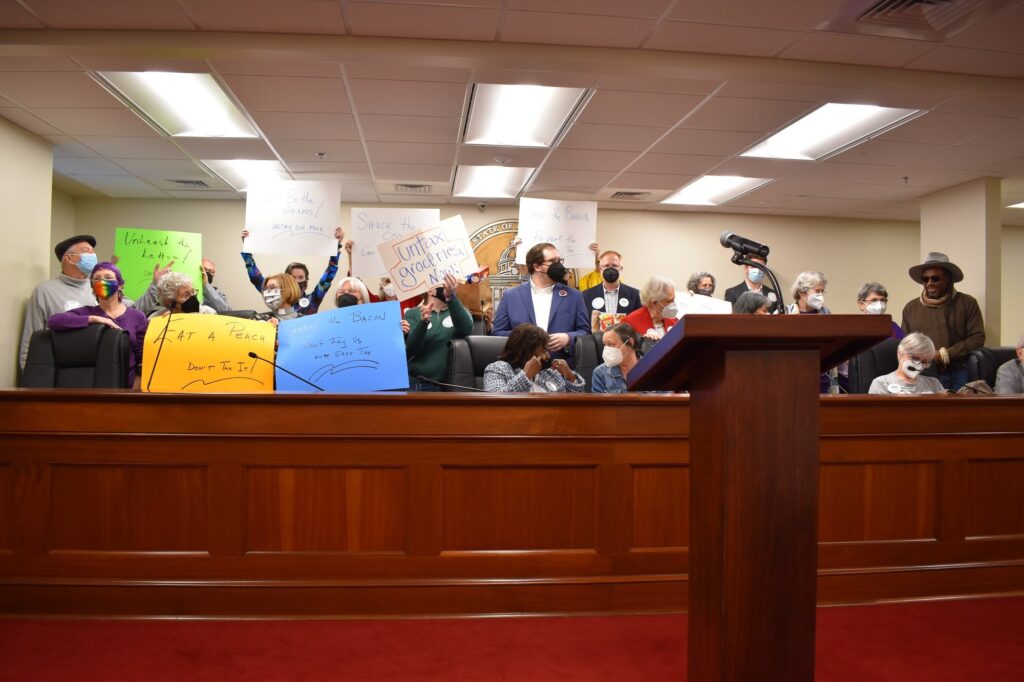
Photo of Arise members rallying against the state grocery tax inside the State House
Alabama Arise members gathered for an Untax Groceries Rally at the State House in Montgomery on March 15, 2022. Bills to end the state grocery tax did not move in the Legislature this year, but the effort continues to enjoy growing bipartisan support.

Voting rights

HB 53 and SB 6, sponsored by Rep. Laura Hall, D-Huntsville, and Sen. Linda Coleman-Madison, D-Birmingham, passed the Senate but did not advance to the House floor. This bill would have eliminated application requirements for voting rights restoration. It also would have restored the right to vote for many indigent individuals. Arise supported this effort.

HB 63, sponsored by Rep. Debbie Wood, R-Valley, did not pass this session. The bill would have criminalized the prefilling of any voter application or absentee ballot application. Arise opposed this effort.

Hall’s HB 167 failed to pass this session. This legislation would allow inmate identification cards to be used as valid ID for voting. Arise supported this effort.

HB 194, introduced by Rep. Wes Allen, R-Troy, passed out of both chambers. The bill will prohibit state and local election officials from soliciting, accepting or using donations for election-related expenses. Arise opposed this effort.

Criminal justice reform

HB 52, sponsored by Rep. Jim Hill, R-Moody, passed out of both chambers. This bill will allow judges to use discretion in the length of someone’s sentence if their probation is revoked. Arise supported this effort.

HB 95, sponsored by Rep. Jeremy Gray, D-Opelika, passed out of both chambers. The bill will create a 180-day grace period for people to repay court-imposed fines and fees following release from incarceration. Arise supported this effort.

SB 203, sponsored by Sen. Arthur Orr, R-Decatur, passed out of both chambers. This bill will require the Administrative Office of Courts to establish a database of municipal fines and fees. Arise supported this effort.

HB 230, sponsored by Rep. Rolanda Hollis, D-Birmingham, passed out of both chambers. This bill will ban the routine shackling of incarcerated individuals during pregnancy, delivery and immediate postpartum time. Arise supported this effort.

HB 200 and SB 117, sponsored by Rep. Merika Coleman, D-Birmingham, and Sen. Will Barfoot, R-Montgomery, failed to pass this session. The bill would have ended driver’s license suspensions for failure to pay fines and fees. Arise supported this effort.

SB 220, sponsored by Sen. Linda Coleman-Madison, D-Birmingham, failed to pass this session. The bill would have required that time served awaiting a hearing for parole violation be applied retroactively. Arise supported this effort.

HB 2, sponsored by Rep. Allen Treadaway, R-Morris, did not pass this session. This anti-protest bill would have created minimum holding periods for people accused of the crimes of rioting or interfering with traffic. It also would have penalized certain local jurisdictions that reduce funding for law enforcement. Arise opposed this effort.

Hill’s HB 55 failed to pass this session. The bill would have required every judicial circuit to establish a community corrections program. Arise supported this effort.

Unemployment insurance benefits

SB 224, sponsored by Sen. Arthur Orr, R-Decatur, passed out of both chambers. This bill will impose additional job search requirements as a condition of eligibility for unemployment insurance benefits. Specifically, individuals will have to show a “reasonable and active effort” to find work by providing proof every week that they have contacted at least three prospective employers. Unless a new job notice has been posted, a job seeker cannot apply for or seek work at an employer where they already made contact. Arise opposed this effort.

Food security

SB 156, sponsored by Sen. Arthur Orr, R-Decatur, did not pass this session. The bill would have required both custodial and non-custodial parents to cooperate with child support enforcement to qualify for SNAP food assistance. Arise opposed this effort.

‘Divisive concepts’

HB 312 and SB 292, sponsored by Rep. Ed Oliver, R-Dadeville, and Sen. Will Barfoot, R-Montgomery, did not pass this session. The bill would have prohibited the teaching of “divisive concepts” related to race, religion and sex in public K-12 schools, colleges, universities and certain state training programs. Arise opposed this effort.
Arise legislative update: April 12, 2022

Arise’s Robyn Hyden breaks down successes and missed opportunities from the Alabama Legislature’s 2022 regular session, which ended Thursday night. She highlights breakthroughs on federal ARPA funds, postpartum Medicaid extension and criminal justice reform, among other issues.

Untax Groceries Rally: March 15, 2022

More than 50 Arise members gathered in Montgomery on Tuesday for the Untax Groceries Rally to support efforts to eliminate the state sales tax on groceries. The event focused on two bills that would end the state grocery tax while protecting school funding: SB 43 by Sen. Andrew Jones and a forthcoming bill by Rep. Penni McClammy. Check out some key highlights from the rally.

New poll: Most Alabamians support plan to untax groceries, protect funding for public schools

Nearly three in five Alabamians (59.3%), including 56.1% of Republican voters, support legislation that would remove the state sales tax on groceries without cutting education funding, according to a new poll commissioned by Alabama Arise. Only 25.3% of respondents opposed the plan, with another 15.5% saying they were unsure or did not take a position.

The poll shows strong public support for untaxing groceries in a responsible way, Alabama Arise executive director Robyn Hyden said.

“The state grocery tax increases hunger rates and drives struggling Alabamians deeper into poverty,” Hyden said. “Legislators have a clear path to untax groceries without cutting a dime of funding for public schools. They should act now to seize this opportunity to improve life for families across our state.”

Arise unveiled the poll results Tuesday during a member rally at the State House in Montgomery. Dozens of Arise supporters gathered to show their support for efforts to eliminate the state sales tax on groceries.

Why and how to end the state grocery tax in Alabama

Alabama is one of only three states, along with Mississippi and South Dakota, with no tax break on groceries. And Alabama is one of only two states, along with Iowa, to allow a full state income tax deduction for federal income tax (FIT) payments. Because wealthy people pay more in federal income taxes on average, the state’s FIT deduction overwhelmingly benefits rich households.

Both sales tax revenue and individual income tax revenue go to the Education Trust Fund. By capping the FIT deduction, Alabama could afford to end the state sales tax on groceries while protecting school funding. Three bills this year would do that: SB 43 by Sen. Andrew Jones, R-Centre; HB 173 by Rep. Mike Holmes, R-Wetumpka; and a forthcoming bill by Rep. Penni McClammy, D-Montgomery. McClammy’s bill also would remove the state sales tax from over-the-counter medicines.

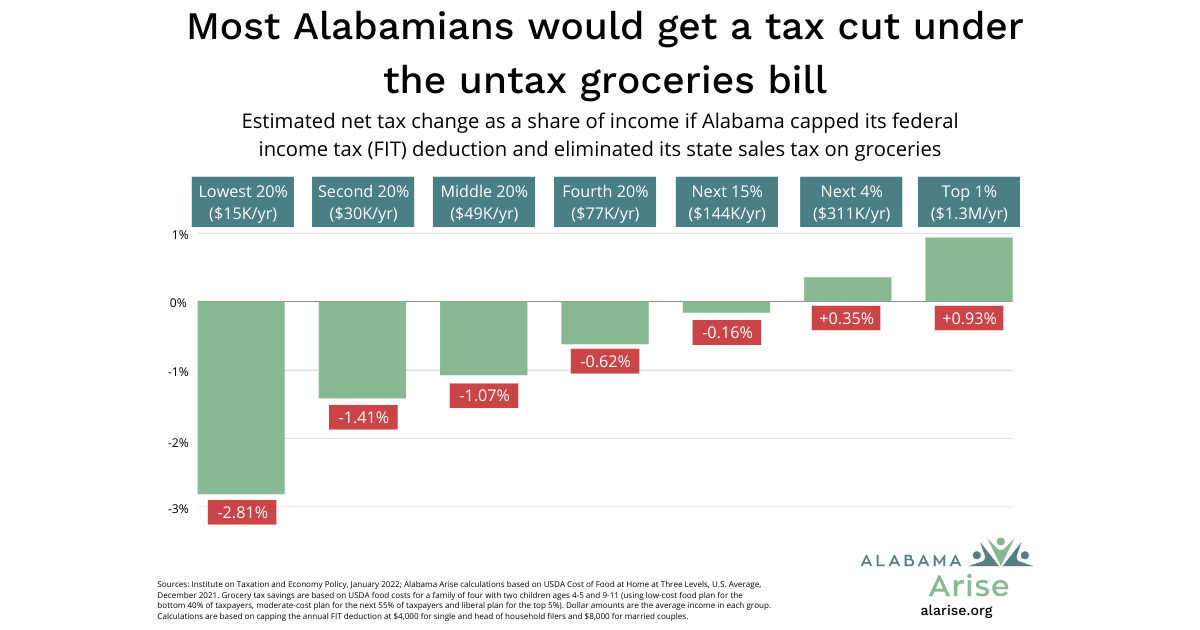
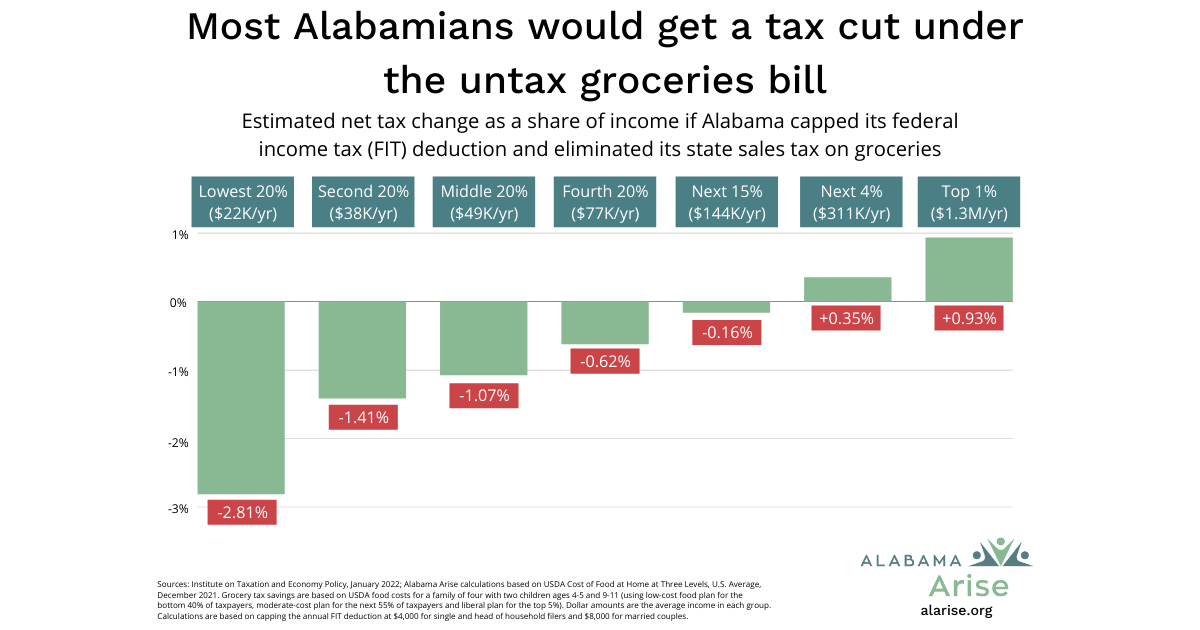
Bar graph showing how most Alabamias would get a tax cut under the untax groceries bill

Under SB 43 and HB 173, the FIT deduction cap for Alabamians who file as single, head of household or married filing separately would be $4,000 annually. For married couples filing jointly, the limit would be $8,000 a year. Under McClammy’s bill, those annual caps would be $3,500 and $7,000, respectively.

About the poll

Alabama Arise commissioned the poll, which the Montgomery-based firm Cygnal conducted in January. The poll surveyed 631 likely voters across Alabama and has a margin of error of +/- 3.85%. Interviews of known registered voters occurred via live phone calls, online panel, texts and email invitation.

Click here for Arise’s poll results on untaxing groceries in Alabama.

Arise legislative recap: March 14, 2022

Arise’s Carol Gundlach discusses SB 19, which would provide a small but significant income tax cut for Alabamians with low and moderate incomes. She also discusses Arise’s Untax Groceries Rally, scheduled for this Tuesday, March 15. Visit untaxgroceries.org to learn more.

Please note: In the case of inclement weather, Tuesday’s rally will be held inside the State House in Room 206.

Arise legislative recap: March 7, 2022

Arise’s Celida Soto Garcia discusses the problems with SB 156, a bill that would deny SNAP food assistance to Alabamians who fail to “cooperate” or “comply” with child support orders or collection services. The bill could come up for a Senate vote this week. Celida also discusses Arise’s upcoming Untax Groceries Rally, scheduled for March 15 in Montgomery.

Grocery tax, health care key Arise focuses this year

Untax groceries. Expand health coverage. Make the criminal justice system more just. Those are a few of Alabama Arise’s major priorities during the Legislature’s 2022 regular session. And we’re making real progress toward turning those goals into realities.

Untaxing groceries

Ending the state’s regressive sales tax on groceries has been a longtime Arise priority. It was the centerpiece of Alabama Arise Action’s online Legislative Day on Feb. 15, which attracted nearly 200 advocates from across the state. It also will be the focus of a March 15 rally in Montgomery.

Legislative Day attendees heard from two lawmakers working to untax groceries: Sen. Andrew Jones, R-Centre, and Rep. Penni McClammy, D-Montgomery. Jones’ and McClammy’s bills reflect growing support for untaxing groceries while protecting funding for public schools.

McClammy said the grocery tax is a policy concern that transcends political lines. “It’s important that we stand together united as one and show the citizens that we all care about what’s going on in our homes,” she said.

Jones expressed optimism that lawmakers are nearing a breakthrough on the grocery tax. “This is not a partisan issue,” he said. “This is something that really meets the full criteria of being a bipartisan issue.”

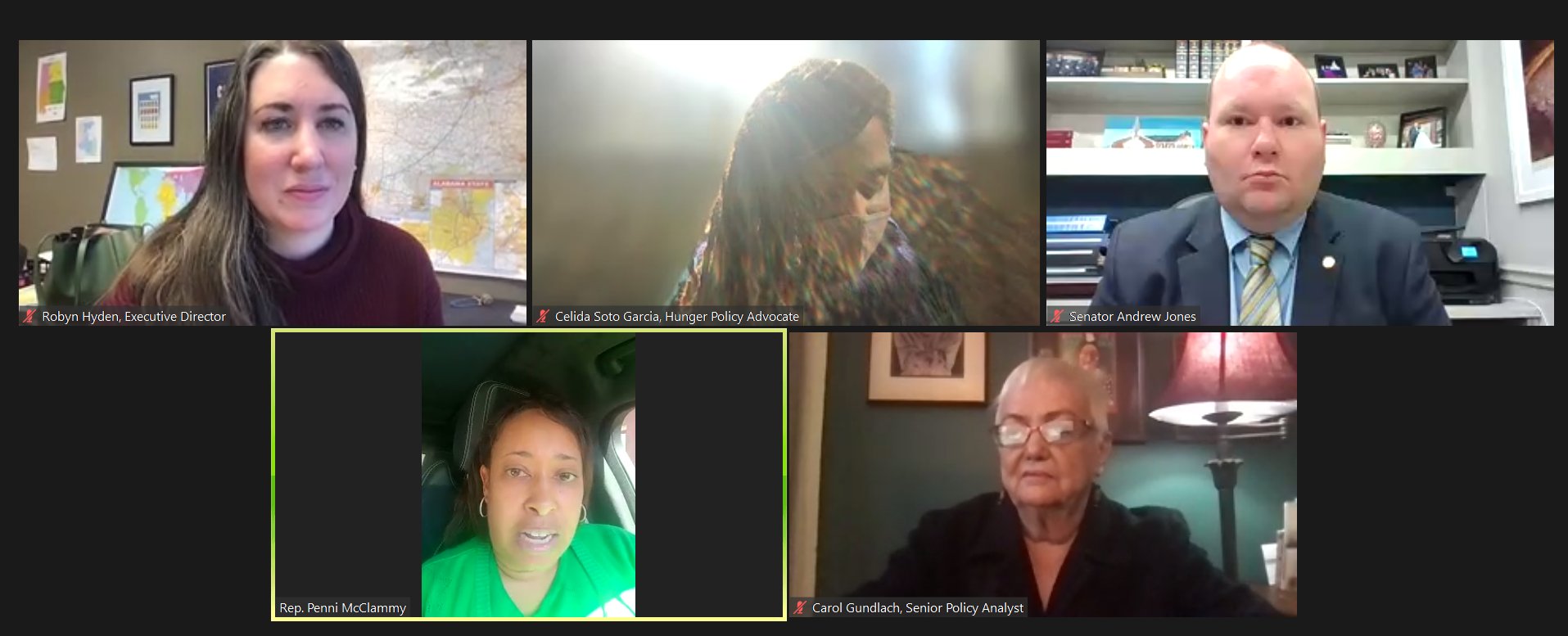
Nearly 200 advocates from across Alabama attended Arise’s virtual 2022 Legislative Day on Feb. 15. Supporters gathered to learn more about our issue priorities and get updates on where things stand legislatively on them. Sen. Andrew Jones, R-Centre (top right), and Rep. Penni McClammy, D-Montgomery (bottom left), joined us for a discussion of their bills to untax groceries.

Expanding health coverage

The COVID-19 pandemic has underscored a cruel fact: Hundreds of thousands of Alabamians can’t afford the health care they need. Gov. Kay Ivey can remove that financial barrier by expanding Medicaid to cover nearly 300,000 adults with low incomes. Arise and our Cover Alabama campaign are working hard to make that happen.

Public support for Medicaid expansion is strong and growing. More than seven in 10 Alabamians support expansion, according to a statewide Arise poll conducted in January. Expansion would create more than 20,000 jobs and save the state almost $400 million annually, a recent report estimated.

Extending Alabama Medicaid’s postpartum coverage to one year (up from the current 60 days) is another key goal this year. Nearly 70% of Alabama’s maternal deaths in 2016 were preventable, one study found. That’s why Arise is working hard to ensure legislators fund this life-saving coverage extension in the General Fund budget.

Advancing justice

Numerous reforms of Alabama’s criminal justice system are moving in the Legislature this year. Arise supports two bills – HB 200 by Rep. Merika Coleman, D-Birmingham, and SB 117 by Sen. Will Barfoot, R-Montgomery – to end driver’s license suspensions for failure to pay fines and fees. Arise also backs HB 57 by Rep. Chris England, D-Tuscaloosa, and SB 215 by Sen. Bobby Singleton, D-Greensboro, which would increase transparency in parole decisions.

Together, we can make a difference. Subscribe to our email list for timely alerts on these bills and others. And visit the Bills of Interest page to track legislation throughout the year.

Arise legislative recap: Feb. 11, 2022

Organizing director Pres Harris invites you to Arise’s 2022 Legislative Day! Please join us online this Tuesday as we advocate for our issue priorities, including untaxing groceries. Visit alarise.org/2022legislativeday to register and learn more about how you can help build a brighter future for every Alabamian.

Eliminating state grocery tax would make life better for Alabama families

Alabama’s sales tax on groceries is a cruel tax on survival, particularly in times of economic insecurity. It increases hunger rates and drives struggling Alabamians deeper into poverty.

Two bills in the 2022 regular session – SB 43 by Sen. Andrew Jones, R-Centre, and HB 173 by Rep. Mike Holmes, R-Wetumpka – would end the state grocery tax while protecting school funding. The graph below shows how millions of Alabamians would benefit.

Untaxing groceries is the right path for Alabama

Alabama lawmakers have a real opportunity this year to end the state’s sales tax on groceries in a responsible way. Here’s why it needs to happen during the 2022 regular session – and how the state can do it:

  • Alabama is one of only three states with no tax break on groceries.
  • The state grocery tax is 4%, equal to two weeks’ worth of groceries each year.
  • Alabama can and should untax groceries quickly and responsibly. That means replacing revenue for public schools in a way that doesn’t harm struggling families.
  • Alabama can protect education funding by limiting or ending its state income tax deduction for federal income taxes (FIT). The FIT deduction is a skewed tax loophole that overwhelmingly benefits rich households.

A pair of companion bills would untax groceries and protect education funding by capping the FIT deduction. Jones’ SB 43 and Holmes’ HB 173 both would end the state grocery tax and cap the FIT deduction for individuals. The cap for Alabamians who file as single, head of household or married filing separately would be $4,000 annually. For married couples filing jointly, the FIT deduction limit would be $8,000 a year. The plan would require voter approval of a constitutional amendment.

Both sales tax revenue and individual income tax revenue go to the Education Trust Fund. By capping the amount of the FIT deduction, these bills would allow Alabama to untax groceries without cutting school funding. This plan would be a significant tax cut for nearly all Alabamians, and the largest benefit would go to people with low and middle incomes who need it most. The Alabama Legislature should pass this proposal this year and send it to voters for final approval.

Bottom line

Untaxing groceries quickly and responsibly would boost economic and food security for all Alabamians. By ending the state grocery tax and capping the FIT loophole, lawmakers could protect funding for public schools and make life better for families across our state.

New poll: Alabamians strongly support use of ARPA funds to protect rural hospitals, increase mental health services

Alabama’s likely voters overwhelmingly support using federal COVID-19 relief funds to increase funding for mental health and rural hospitals, according to a new Alabama Arise poll released Monday.

More than four in five respondents (81.1%) supported using a portion of Alabama’s funding under the American Rescue Plan Act (ARPA) to invest in rural hospitals and increase rural Alabamians’ access to health care. And nearly three in four likely voters (73.6%) said lawmakers should boost mental health funding to increase access to services across Alabama. Among Republican voters, 80.1% supported investments in rural hospitals and 67.7% supported more mental health care funding.

“Alabamians are loud and clear that they want our lawmakers to use federal relief money to strengthen our state’s health care system,” Alabama Arise executive director Robyn Hyden said. “The COVID-19 pandemic has strained health care workers like nothing before in our lifetimes. And it has exposed and worsened our state’s persistent racial and geographic health disparities.

“ARPA offers an unprecedented chance to protect rural hospitals and increase access to mental health care and other services. We must seize this opportunity to build a healthier future for Alabama.”

Photo of a smiling couple and their child. Headline: Alabama should use ARPA funds to build a better, more inclusive future.

Child care, housing, public transportation also enjoy strong public support

Sizable majorities also approved of other potential uses of ARPA money to improve living conditions for Alabama’s children and families. Those proposals include:

  • Expanding access to subsidized child care for working families.
  • Establishing a state child tax credit to lower costs for working families.
  • Expanding access to affordable housing throughout the state.
  • Investing in public transportation, particularly in rural areas.

Alabama will receive a total of more than $2 billion in ARPA funds. Lawmakers last year appropriated $400 million of that amount toward prison construction and $80 million to hospitals and nursing homes. This week, the Legislature will vote on a plan to spend another $772 million of ARPA funds. Most of that money would go toward broadband internet expansion, water and sewer improvements, and additional funding for hospitals, nursing homes and assisted living facilities.

The state expects to receive the remaining $1 billion in ARPA funds later this year. Arise’s poll shows the public wants legislators to use that money to ease economic stress on Alabama households, Hyden said.

“The pandemic has made it harder for people across our state to find child care, keep a roof overhead and get where they need to go,” Hyden said. “We should use ARPA funding to ease families’ suffering and provide the supports needed to help every Alabamian succeed. It’s time for our lawmakers to meet this moment and ensure Alabama’s post-pandemic future is a bright and inclusive one.”

About the survey

Alabama Arise commissioned the poll, which the Montgomery-based firm Cygnal conducted Jan. 13-14. The poll surveyed 631 likely voters across Alabama and has a margin of error of +/- 3.85%. Interviews of known registered voters occurred via live phone calls, online panel, texts and email invitation.

Click here for Arise’s poll results on ARPA funding priorities in Alabama.