Learn more about Arise’s 2020 issue proposals

Grassroots democracy will be on display when Alabama Arise members choose our 2020 issue priorities at our annual meeting Sept. 7 in Montgomery.

The following proposals will be up for a vote for our 2020 legislative agenda.

Below, you’ll find member groups’ summaries of their new and modified proposals. And you’ll find our policy staff’s overviews of the current issue priorities and our two permanent priorities: tax reform and adequate state budgets. We hope to see you in September as we gather to renew our shared commitment to building a better Alabama for all!

New issue proposal

Housing Trust Fund revenue

Submitted by Gordon Sullivan, Low Income Housing Coalition of Alabama (LIHCA)

LIHCA thanks Alabama Arise and its members for supporting the Housing Trust Fund in 2018 and previous years. Our combined efforts resulted in social and political momentum to secure dedicated revenue for the Alabama Housing Trust Fund (AHTF)! We are here to ask for your continued support of the AHTF and help in securing dedicated revenue for the fund in 2020.

We believe safe, decent and affordable housing is a basic human right. Hard-working Alabamians should be able to pay rent and still be able to put food on the table. Unfortunately for many Alabamians, finding a safe and affordable home is only a dream. Alabama is in a housing crisis, with a lack of nearly 70,000 rental homes for folks surviving on minimum wage and fixed incomes.

Folks making minimum wage have to work 82 hours a week to afford a market-rate two-bedroom apartment. By doing so, they miss out on family suppers and Little League, because there simply aren’t enough hours in the day. Every child deserves a safe place to call home and a chance to have those who love them help with homework and read bedtime stories.

The AHTF created a fund to construct, rehabilitate and maintain homes for low-income households. Though the AHTF was created in 2012, it was enabling legislation and did not come with funding. That means we can’t create any new or rehabilitate any existing homes or address housing problems related to natural disasters. That is why LIHCA will seek dedicated revenue for the AHTF in 2020.

Proposed legislation to fund the AHTF

The bill, sponsored by Rep. Neil Rafferty, D-Birmingham, would increase the mortgage record tax from 15 cents to 20 cents for every $100 of a mortgage. This would put approximately $15 million per year in the AHTF. This type of revenue is a common funding source for housing trust funds across the country. In Alabama, this tax has not been increased since it was enacted in 1935.

We know that two-thirds of Alabamians (67%) see the lack of affordability as a problem in our state and that a strong majority (63%) of Alabamians are ready for state action to increase housing opportunities for households priced out of the market. Building on the momentum of previous years, we believe attaining bipartisan co-sponsors and endorsements from influential groups throughout the state is possible in 2020.

With the creation of new affordable homes in Alabama, families will begin to achieve economic stability. Communities will reduce blight. And the state will see an economic impact of nearly $1 billion over 10 years.

The dedicated revenue bill supports Arise’s values and its membership’s vision for addressing poverty in Alabama by investing in communities and helping low-income households access safe and affordable homes. The dedicated revenue bill will provide $15 million per year to create and rehabilitate homes for those in need. We have been successful in building momentum with Arise’s support in past years. Let’s work together to finish what we started!

Modified issue proposal

Voting rights

Submitted by Scott Douglas and Tari Williams, Greater Birmingham Ministries, and Ned Freeman, Birmingham Friends Meeting (Quakers)

Let’s build on Arise’s commitment to voting rights, continuing to prioritize automatic voter registration (AVR) and focusing on restoration of voting rights for Alabamians affected by felony disenfranchisement. Under AVR, Alabamians would be registered to vote by default, without having to register themselves, because the state already has the necessary information. And restoring voting rights for everyone would affirm basic ideals of democracy.

Historically, Alabama has been a leader among states with the most severely punitive disenfranchisement laws. These laws, with their blatantly racist history, have kept African Americans from the polls in enormous – and enormously disproportionate – numbers. Of the more than 280,000 disenfranchised felons in Alabama, nearly 150,000 are black, according to the Sentencing Project. That means that disenfranchised felons make up more than 15% of the state’s voting-age African American population.

Alabama’s felony disenfranchisement policies have disparate impact on individuals convicted of felonies who are poor, black or both. Therefore, we propose the introduction of legislation that will (a) remove the financial barrier of requiring payment of all fines, fees and/or restitution and (b) restore voting rights to individuals while on probation and parole. This legislation is not cost-prohibitive, may take one to three years to pass because of upcoming elections and is not potentially divisive for Arise members.

Alabama’s disenfranchisement laws have fostered an underclass of tens of thousands of people who are unable to vote because they do not have enough money. In 1964, the 24th Amendment abolished the poll tax, but to this day in Alabama, money keeps a disproportionate number of people away from the ballot box. People should not be barred from voting solely because they are unable to pay back their fines, fees and restitution.

Restoring voting rights to rebuild community ties

If we truly want people convicted of felonies to re-engage with society, become rehabilitated and feel a part of a broader community (thus creating incentives not to recidivate), then our state should do everything possible to reincorporate these individuals into mainstream society. In terms of being a just and even-handed society, it is not fair if thousands of people are unable to regain their voting rights because they are poor. People who are wealthy or have access to money are able to repay their financial debts. But poor people (the vast majority of people who have felony convictions) are not. This is an unjust system.

Individuals on probation and/or parole are actively working on retaining and/or rebuilding their ties to their families, employers and communities. Allowing them to reestablish ties as stakeholders in political life provides an analogous and important reintegrative purpose and promotes public safety.

Felony disenfranchisement provisions, especially in the South and particularly in Alabama, date back to the post-Reconstruction era. Their intent was always clear and explicit: to disenfranchise African Americans and preserve white domination.

Restoring voting rights and automatically registering voters is good policy. Arise prioritizing these policies also has the immediate benefit of putting a positive voting rights agenda in the public debate during an era when voting has been under attack.

Current Arise issue priorities

Criminal justice debt reform
Court fees and fines impose heavy burdens on many struggling families. Driver’s license suspensions over unpaid fines can cause Alabamians with low incomes to lose their jobs. Cash bail for minor offenses can imperil families’ economic security. And multiple fees can stack up, making it impossible to move on from a conviction because consequences never end. In Alabama, people are subject to 63 separate fees in the criminal justice system – including even a $1 fee for paying fee installments.

This year, Arise emphasized reforming civil asset forfeiture within the umbrella of criminal justice debt. This practice allows police to seize cash or other assets if they find probable cause to link the property to a crime. But the process doesn’t require a criminal conviction, or even a charge.

Originally intended to fight drug kingpins, civil asset forfeiture today sees heavy use against people accused of minor crimes. Underfunded law enforcement agencies have incentives to use forfeiture because they are often able to keep much of the seized property.

A philosophically diverse coalition is seeking to end forfeiture abuses in Alabama, and reform efforts already have borne fruit. In 2019, comprehensive reform efforts moved quickly at first but then slowed amid law enforcement opposition. Eventually, the Legislature passed incremental reform, mandating public reporting of property seizures. Public opinion strongly favors further change, and momentum continues to build.

Death penalty reform

Alabama’s capital punishment system is unreliable and racist. Our state hands down nearly double the national average of death sentences. We are the only state with no state-funded program providing legal aid to death row prisoners. And state laws give insufficient protection against executing people who were mentally incapable of understanding their actions.

Arise has worked for increased transparency on the lethal injection procedures and a three-year moratorium on executions. Bills were introduced but did not move in recent years. In 2017, the Legislature voted overwhelmingly to bar judges from imposing death sentences when a jury recommends life without parole. But the judicial override ban is not retroactive. About a fifth of the 175 people on Alabama’s death row received death sentences against the jury’s recommendation. We would like to enforce the override ban retroactively.

Alabama’s death penalty practices reflect deep racial inequities. Before the 2017 ban, judges imposed death against a jury’s determination more often when victims were white. The state argued as recently as 2016 that it should be allowed to kill a prisoner even when a judge explicitly cited race at the sentencing hearing. Much work remains to modernize Alabama’s justice system and prevent erroneous executions.

Payday and title lending reform

Every year, high-interest loans trap thousands of struggling Alabamians in a cycle of deep debt. Payday loans are short-term (usually two-week) loans charging high annual percentage rates (APRs), up to 456%. Auto title loans charge up to 300% APR and also carry the risk of repossession of the family vehicle.

These high-cost loans strip wealth from borrowers and hurt communities across Alabama. Payday lenders are on track to pull more than $1 billion in fees out of Alabama communities over the next decade, with most of that money flowing to out-of-state companies. Predatory lending practices disproportionately target people of color and exacerbate the economic challenges in struggling rural and urban communities.

Arise is part of a statewide coalition promoting interest rate caps on payday and title loans. In 2019, we supported legislation to give payday borrowers a 30-day repayment period – the same as other monthly bills – up from as few as 10 days now. But the bill didn’t move, despite the Senate Banking Committee chairman’s assurances that he would allow a vote.

The 30 Days to Pay bill’s sponsor – Sen. Arthur Orr, R-Decatur – is working to ensure it will receive consideration early in the 2020 regular session. Heavy citizen engagement will be needed to overcome the lending lobby.

Public transportation

Our state’s jumble of local transportation systems fails to meet the needs of many people in rural, suburban and urban areas. Alabama is one of just five states with no state public transportation funding. For many low-income workers, seniors and people with disabilities, the transit gap is a barrier to daily living. Many folks can’t get to work, school, the doctor’s office or other places they need to go in a reasonable amount of time.

Alabama took a good first step in 2018 by creating a state Public Transportation Trust Fund. But the law did not allocate any state money, even though it would be a high-return investment in our future. Each $1 million invested in public transportation creates 41 full-time jobs, research shows. Those jobs would fuel economic growth and improve quality of life in our communities.

Appropriations for the state trust fund would be eligible for a 4-to-1 federal match. So by not funding public transit, Alabama leaves millions of federal dollars on the table each year.

The General Fund remains a key potential source for state public transit funding. Greater Birmingham Ministries’ Economic Justice/Systems Change group also has urged Arise to support legislation in 2020 to allow Alabamians to dedicate part of their state income tax refund to public transit. The state already allows voluntary contributions for mental health care, foster care and other public services.

Compiled by Dev Wakeley, policy analyst

Permanent Arise issue priorities

Adequate state budgets

Our state’s upside-down tax system starves state budgets of money needed to invest in our shared future. Alabama provides almost no state money for child care. In-home services for parents of at-risk children receive a paltry $3 million a year, far less than other states. And young adults struggle to afford rising tuition and fees at universities and two-year colleges.

Alabama must address comprehensive sentencing and prison reform in 2020. The General Fund budget will need more revenue to pay for stronger investments in mental health care, substance use treatment, drug courts, community corrections and more corrections officers.

Arise’s health care advocacy has three main goals: defend, reform and expand Medicaid. Our defense work this year focused on Alabama’s pending plan to impose a catch-22 work penalty, which would strip Medicaid from thousands of parents with extremely low incomes. Looking ahead, we expect a new push to cut Medicaid by block-granting federal Medicaid funds to states.

We’ve seen progress on Medicaid reform. The statewide Integrated Care Network (ICN) for long-term care launched last October. And the long-delayed regional primary care reform takes effect this October. Arise has recruited consumer representatives for the ICN governing board and all seven Alabama Coordinated Health Network (ACHN) boards. Next year, we’ll push for the next step: Medicaid expansion, which would benefit more than 340,000 Alabama adults.

Tax reform

Alabama’s tax system is upside down. The rich get huge tax breaks, while the heaviest tax burden falls on people with low and moderate incomes. High, regressive sales taxes on groceries and other necessities drive this imbalance. So does the state’s deduction for federal income taxes (FIT), a skewed break that overwhelmingly benefits wealthy people.

Arise has fought to end the grocery tax for more than a decade. The central challenge is how to replace the $480 million it raises for education. In 2020, we’ll intensify our efforts to show legislators the powerful link between untaxing groceries and ending the FIT deduction.

Alabama is one of only three states where filers can deduct all federal income tax payments from state income taxes. This tax break disproportionately benefits wealthy people, who pay more in federal income taxes and are more likely to itemize. Ending the FIT deduction would bring in enough revenue to untax groceries, fund Medicaid expansion and meet other critical needs.

Compiled by Jim Carnes, policy director, and Carol Gundlach, policy analyst
New federal public charge rule will hurt families and children across Alabama

A new Department of Homeland Security regulation published Monday will harm the health and well-being of thousands of Alabama families. The so-called public charge rule also will threaten access to health and human services programs for U.S.-born citizen children.

When proposed last fall, the regulation drew more than 266,000 public comments, overwhelmingly in opposition. The feedback included opposition from Alabama Arise, our members and allies.

The final regulation could deny admissions to the United States or green card applications if an immigrant or a member of a legal immigrant’s family uses Medicaid, the Supplemental Nutrition Assistance Program (SNAP), Section 8 rent vouchers or Medicare low-income subsidies for prescription drugs. Citizenship applications are not subject to the public charge regulation. Refugees and asylum applicants are also exempt.

Conservative estimates peg the regulation’s impact at 26 million people nationwide and nearly 200,000 people in Alabama. This includes one-fourth of all U.S. children and more than 60,000 Alabama children who live in immigrant families. The majority of these children were born in the United States.

“This rule threatens the health and safety of hard-working Alabama families and their children,” Alabama Arise executive director Robyn Hyden said. “Alabama Arise stands with our partners in the immigrant community, and we support efforts to stop this cruel rule in the courts and in Congress.

”We call on other Alabamians of faith and conscience to do the same. We ask Senators Doug Jones and Richard Shelby and our congressional delegation to act now to override this rule and protect all Alabama families.”

The rule will make life even harder for millions of families who already work hard to make ends meet. Child poverty, hunger, substandard housing and other drivers of poor health outcomes are likely to increase when immigrants are afraid to apply for assistance to which they have a legal right. And because immigrants targeted by these rules are overwhelmingly people of color, racial health disparities are likely to widen as well.

How a proposed new SNAP rule would increase hunger for millions of Americans

The White House has proposed a new rule that would increase hunger for millions of Americans. The plan would require some states to reduce gross income limits for Supplemental Nutrition Assistance Program (SNAP) applicants. It also would force 42 states, including Alabama, to impose resource limits on applicants.

More than 3 million people would become ineligible for food assistance under the change, federal officials estimate. You can use this portal from the Food Research and Action Center (FRAC) to submit a public comment on the proposal now through Sept. 23.

The plan would require Alabama to impose an asset test, adding new red-tape barriers for nearly all SNAP participants. The state would have to verify numerous assets – including cash, property on which the family does not live, and the resale value above $4,650 for many vehicles – before a family could get assistance. Families with more than $2,250 in assets (or $3,250 for seniors or people with disabilities) would be denied SNAP.

Public policy shouldn’t discourage families to save small amounts to cover automobile repairs, unexpected medical bills or other emergencies. And many seniors have small savings accounts for long-term care or funeral expenses. But reinstating the asset test would punish these struggling families and seniors by denying them essential food assistance.

Federal officials will accept public comments on the proposal until Sept. 23. They must read and consider every comment, so please share your thoughts! Click here to submit your comment today through FRAC’s comment portal.

Enhanced child care funding makes life better for Alabama’s children and families

Quality, affordable child care is essential for families seeking to escape poverty and participate in employment, education and training activities. The Child Care and Development Block Grant (CCDBG), a federally funded program that subsidizes care for low and moderate-income parents of young children, provides critical funding for affordable child care.

In Alabama, CCDBG funds are administered by the Department of Human Resources (DHR). The agency also administers the closely related Temporary Assistance for Needy Families (TANF) cash assistance program. Congress reauthorized the CCDBG in 2014 and included significant quality improvement goals for states. In 2018, Congress provided a historic CCDBG funding increase, allowing DHR to serve more Alabama children in higher-quality settings.

The importance of federal child care funding in Alabama

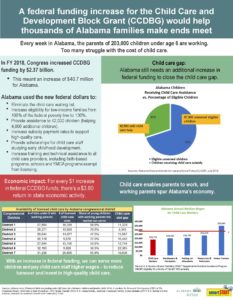
Federal CCDBG funding has increased, allowing Alabama to expand access to child care and improve quality. In 2017, Alabama received $53.2 million in discretionary CCDBG funds from Congress. The 2018 federal funding increase grew Alabama’s CCDBG grant to $93.9 million – a 76.5% increase.

Alabama faces deadlines to obligate and expend federal funds. Like other states, Alabama must obligate 2018 federal CCDBG dollars by Sept. 30, 2019, and expend those dollars by Sept. 30, 2020. Alabama is on track to meet the obligation and spending deadlines and anticipates no problem obligating or spending the grant.[1]

The additional CCDBG money was enormously important for child care in Alabama. The state does not provide any child care funding, except for the required match for the federal Child Care Entitlement to States grant, and does not use federal TANF funds for child care.[2] Alabama includes state-appropriated funds for pre-K education as a portion of its TANF maintenance of effort (MOE) obligation. But these funds were not, and could not be, supplanted with additional federal dollars.

How Alabama is using new CCDBG funding

Alabama used its new federal dollars to make investments that benefit children, families, workers and communities. The funding increase allowed Alabama to expand child care access and come into compliance with the 2014 reauthorization law. The state also made numerous improvements to its subsidized child care system.

According to officials and contractors with DHR,[1] the state has:

1. Eliminated the waiting list for child care slots. In 2017, Alabama provided child care subsidies to slightly more than 38,000 children. In April 2019, 42,000 children received subsidies, and slots remain available for more children.[3] The state’s regional Child Care Management Agencies, which determine eligibility for subsidies and help enroll children, are actively using social media and word of mouth to recruit new children.[1] Eligible families now can access care within one week of application.[1]

2. Increased initial subsidy eligibility from 100% of the federal poverty level (FPL) to 130%. That income is about $28,000 a year for a family of three.

3. Eliminated all copays that were less than $18 per month. This essentially eliminated copays for all families with income below the FPL.[1]

4. Increased provider rates twice.[1] Alabama now reimburses providers beginning at 70% of fair market rates. That is a significant increase over the prior reimbursement rates ranging from 14% to 40% of fair market rates. While this does not reach the federally recommended base level of 75%, it is a major improvement over prior years.

5. Allowed training and technical assistance providers, such as Childcare Resources in Birmingham and the Family Guidance Center in Montgomery, to offer training to workers at faith-based exempt facilities, schools, YMCAs and other exempt centers.[1] These providers also were able to increase bonuses paid to workers who participate in on-the-job training.

6. Increased scholarships for child care workers studying early childhood education, including scholarships up to the bachelor’s level.

7. Increased child care for recently unemployed parents to 90 days (up from 30 days) while they seek new jobs. DHR is planning a program that would include unemployed parents in workforce development so they will not lose child care after the 90-day period ends.

8. Expanded Help Me Grow, a referral and case-management system for children ages birth through 8, including more referrals to child care and to other health and developmental services, such as obesity prevention.[1]

9. Expanded the First Five program, which teaches parents and child care workers best practices for promoting social and emotional development of young children.

Disparities and barriers to child care access in Alabama

Alabama has significant racial and ethnic disparities in who receives child care assistance. In 2016 (the latest data available), 79% of children receiving child care subsidies were African American.[4] This is significantly higher than the national rate of 39%, as reported by the Center on Law and Social Policy (CLASP).[5] Approximately 29.5% of Alabama children are African American, and their poverty rate is more than twice that for whites. This is a major driver of the racial disparity in receipt of child care assistance.

Alabama is among the bottom five states in the share of eligible Hispanic children receiving child care subsidies, CLASP found. The state provides child care assistance to only 1% of potentially eligible Hispanic children.[5]

Providers suggested language barriers, fear of immigration enforcement, lack of knowledge of the availability of child care subsidies, and reliance on care by family members contribute to low participation among Hispanic families. Past outreach efforts by community-based Hispanic organizations have been unsuccessful. But efforts to encourage Hispanic parents to apply for family care subsidies are expanding and may help increase participation.[1]

Who would benefit from greater eligibility for subsidized child care?

More Alabama children are now eligible for subsidies, but there is room for further growth. Federal law sets the maximum income for receipt of a child care subsidy at 85% of a state’s median family income (MFI). At this level, 258,662 Alabama children were income-eligible for subsidized child care in 2016, CLASP reports.[5]

Like most states, Alabama sets eligibility for subsidized child care below the federal maximum. Prior to the receipt of new federal funds, Alabama set eligibility at 100% FPL. But after the new funds became available, Alabama raised eligibility to 130% FPL.

Based on that standard, 139,950 Alabama children are now eligible for subsidies, according to CLASP. If Alabama increased the subsidy eligibility standard to 85% MFI, an additional 118,712 children would become eligible for a subsidy.

In April 2019, Alabama provided child care subsidies to approximately 42,000 children, or 35% of kids who are income-eligible at 130% FPL. This is a significant increase from both 2016, when 32,651 children received subsidies, and 2017, when 38,025 children were served.[6]

While more slots are available to serve children beyond the current 42,000, federal funding is still not enough to serve all children in the state eligible at 130% FPL, according to DHR.[1] Absent additional federal funding or new state funding for child care, another increase in the eligibility standard is unlikely.

Affordable child care helps families make ends meet

Most Alabama families have a hard time meeting basic needs, including child care. Children in Alabama whose family income is less than 130% FPL are eligible for subsidized child care. (For a family of three, 130% FPL is $27,729 annually.)

Nowhere in Alabama does the cost of a modest standard of living fall below the cap for subsidized child care. The Economic Policy Institute’s Family Budget Calculator[7] estimates that the annual cost of living for two adults and one child in Huntsville is $63,360, including $430 per month for child care. In Selma, meanwhile, the annual estimated cost of living for the same family size is $56,695, including $387 per month for child care. And in Dothan, the annual estimated cost is $61,005, including $414 per month for child care.

The geography of child care access in Alabama

The share of young children Alabama’s child care market can serve is inadequate and varies widely by geography. No congressional district in Alabama has enough child care slots to serve every child under age 6 in the district, according to the Center for American Progress.[8] (See the table below.)

The lack of slots is particularly severe in some districts in north and central Alabama. The 4th Congressional District has only enough licensed child care slots to serve 20% of potentially eligible children. And the neighboring 6th Congressional District has only enough slots to serve 19% of potentially eligible children.

Both the 4th and 6th Districts have a disproportionate number of unlicensed, faith-based centers, a challenge discussed below.[1] Large areas of both districts are also economic suburbs of Birmingham, which is largely in the 7th Congressional District. Interviews with providers suggested residents of these counties might prefer child care facilities near their jobs rather than their homes.[1]

Providers interviewed suggested several changes that could increase the availability of care. These include increased subsidies for family day care homes and kinship care and higher reimbursement rates for center care, especially at initial certification.

State child care administrators also agree that more providers are needed, particularly in areas near U.S. 80, which runs through the 2nd, 3rd and 7th Congressional Districts in Alabama’s Black Belt.[1] They believe the state has a critical need for day care homes, centers offering non-traditional hours, centers that can provide infant and toddler care, and providers who can care for children with special needs.

Availability of licensed child care by Alabama congressional district

Alabama congressional district   Children    under 6 Percentage of  children under 6 in poverty Number of licensed         child care slots Share of young  children that market can serve
1    51,900 23%  16,316 31%
2    49,400 23%  19,928 40%
3    49,700 21%  14,077 28%
4    48,600 28%  9,676 20%
5    49,000 22%  15,100 31%
6    52,000 10%  9,828 19%
7    49,900 34%  20,600 41%

The child care shortage in rural Alabama

Alabama has a shortage of group and family child care homes, and this shortage is getting worse. Ninety-five percent of children are now served in child care centers, while only 3% are served in child care homes. And the number of child care homes continues to decline as providers retire.

This is a serious problem in rural counties, particularly in the Black Belt. In many such areas, the number of children needing care is too small and too isolated to support larger centers, and children could be better served in homes with three to 12 children. Rural areas also would benefit from an expansion of subsidized relative care, which is available in all 67 counties but not widely known.[1]

Alabama’s child care licensure deadline

Until a recent change in state law, Alabama exempted religiously affiliated providers from licensure. In 2017, 53% of child care facilities were licensed, while 42% were unlicensed due to religious affiliation.[9] (The other 5% were exempt from licensure for other reasons.)

In 2018, the Alabama Legislature passed HB 76, which required facilities receiving state or federal dollars to be licensed by Aug. 1, 2019. But as of June 2019, nearly 250 faith-affiliated centers, out of a total of 834, had not yet been licensed.

Both the state and technical assistance providers expressed concern that these facilities might not achieve licensure by the deadline and thereby might become ineligible for subsidies. This could result in a loss of slots for subsidized children – or a loss of entire facilities.

The need for quality improvements and new technology

Alabama has a tiered Quality Rating and Improvement System (QRIS) in place. But there is a lack of participation by centers, especially at the higher tiers. This appears to be because increases to provider rate reimbursements per tier are not sufficient to cover the cost of the service improvement.

Interviewees cited the need for increases in reimbursement rates and incentives for quality improvements. They also said more training incentives for center employees and aggressive outreach to providers are needed, along with greater consumer understanding of the importance of the QRIS.[1]

The 2014 CCDBG reauthorization requires extensive reporting of information on the Alabama DHR website. DHR’s computer system is well over 20 years old, creating service delivery problems for many programs they operate. So updating the system will be challenging and expensive, particularly in light of Alabama’s chronic underfunding of human services.

New criminal background checks required by the 2014 reauthorization pose a similar technology problem. These checks are a significant expense: $45 to $50 per background check for more than 15,000 child care facility employees. Data incompatibility between the National Crime Information Center and the Alabama Law Enforcement Agency has led Alabama to request a waiver of this mandate. The state is seeking bids from vendors for this service, but as with the state’s computer system, the cost is expected to be considerable.

A lingering challenge: low pay for child care workers

Low wages for child care workers, most of whom do not earn a living wage, is a serious problem. Many child care center employees are themselves eligible for a subsidy for their own children. A key quality improvement lies in education and training for child care workers, and Alabama has committed considerable resources to training and education subsidies up to the bachelor’s level.

But low wages in traditional child care drive many of the best educated and trained teachers to apply for jobs in K-12 schools, where wages are much higher and benefits, including health insurance and retirement, are much better. Technical assistance providers stressed that salaries and benefits for child care employees needed to reflect those of early childhood teachers in public schools, both for equity and retention of newly trained workers.

Conclusion

Maintenance of federal CCDBG funding at the 2018 level is critical for continued progress in the provision of child care for low- and moderate-income children in Alabama. Increased funding would allow Alabama to expand the number of children who receive assistance by increasing income eligibility to 85% of median family income. It also would allow Alabama to increase per-child subsidies to programs. And that would improve the incomes of child care teachers and the retention of well-qualified and educated teachers.

Footnotes

[1] Interviews conducted by the report author May 24, 2019, through June 4, 2019, with Kathy Camp, program director, Family Guidance Center; Bernard Houston, administrator of child care services and workforce development, DHR; Candice Keller, program manager for subsidy, DHR; Gail Piggott, executive director, Alabama Partnership for Children; Walter White, executive director, Family Guidance Center; and Joan Wright, executive director, Childcare Resources

[2] ACF/HHS, FY 2017 Federal TANF & State MOE Financial Data

[3] Alabama Department of Human Resources, 2017 Annual Report and April 2019 Monthly Statistical Report

[4] ACF/HHS Office of Child Care, FY 2016 Final Data, Table 12a-Average Monthly Percent of Children in Care by Race and Ethnicity

[5] Rebecca Ullrich, Stephanie Schmit & Ruth Cosse, “Inequitable Access to Child Care Subsidies,” Center on Law and Social Policy, April 2019

[6] Alabama Department of Human Resources, Annual Report 2016 and Annual Report 2017

[7] Economic Policy Institute, Family Budget Calculator

[8] Center for American Progress Early Childhood News, “Child Care Supply by Congressional District,” April 10, 2019

[9] ACF/HHS Child Care and Development Fund, Preliminary Data Tables, FY 2017

References

Alabama Department of Human Resources, Annual Statistical Reports, 2017 and 2018

Alabama Department of Human Resources, “Child Care Fact Sheet,” Oct. 1, 2018

Alabama Department of Human Resources, FY 2019-2021 Alabama CCDF State Plan

Alabama Department of Human Resources, State of Alabama Provider Rate Chart, Oct. 1, 2018

Patti Banghart, Carlise King, Anne Partika, and Victoria Perkins, “State Policies for Assessing Access: Analysis of 2016-2018 Child Care Development Plans,” The Early Childhood Data Collaborative, March 2018

Center on Law and Social Policy, “Budget Deal Includes Unprecedented Investment in Child Care,” February 2018

Nina Chien, “Factsheet: Estimates of Child Care Eligibility & Receipt for Fiscal Year 2015,” Office of the Assistant Secretary for Planning and Evaluation, HHS, January 2019

Hannah Matthews, Karen Schulman, Julie Vogtman, Christine Johnson-Staub, and Helen Blank, “Implementing the Child Care and Development Block Grant Reauthorization: A Guide for States,” Center on Law and Social Policy and National Women’s Law Center, June 2017

National Women’s Law Center, “Child Care and Development Fund Plans FY 2016-2018: State Waivers and Corrective Actions,” August 2016

Douglas Rice, Stephanie Schmit, and Hannah Matthews, “Child Care and Housing: Big Expenses with Too Little Help Available,” Center on Law and Social Policy, April 29, 2019

Rebecca Ullrich, Stephanie Schmit & Ruth Cosse, “Inequitable Access to Child Care Subsidies,” Center on Law and Social Policy, April 2019

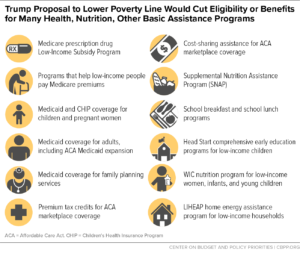
Alabama Arise comments in opposition to federal plan to redefine poverty line

The Office of Management and Budget (OMB) is proposing to reduce annual cost-of-living adjustments to the federal poverty line. Over time, this plan would reduce or end Medicaid, SNAP food assistance and other work supports for millions of Americans. Here is the full text of the comments Alabama Arise submitted in opposition to this proposal:

Organizational purpose and interest

Alabama Arise is a nonprofit, nonpartisan coalition of congregations, organizations and individuals promoting public policies to improve the lives of low-income Alabamians. Arise believes acts of charity are vital, but they are not enough. We also must work to improve harmful policies. Arise provides a structure through which Alabamians can engage in public debates with the goal of improving the welfare of all Alabamians.

Arise envisions an Alabama where all people have resources and opportunities to reach their potential to live happy, productive lives, and each successive generation is ensured a secure and healthy future. We envision an Alabama where all government leaders are responsive, inclusive and justice-serving, and where the people are engaged in the policymaking process. And we envision an Alabama where all people live with concern for the common good and respect for the humanity of every person.

Arise has engaged actively in advocacy and outreach on a wide variety of means-tested programs. These include Medicaid, Affordable Care Act subsidies, the Children’s Health Insurance Program (CHIP), the Supplemental Nutrition Assistance Program (SNAP), subsidized child care and school meals.

The Office of Management and Budget’s (OMB) proposed change in consumer inflation measurement would deeply affect all of these programs. More importantly, it would deeply affect the people who use them as work supports.

We understand OMB is not seeking comments on the impact of changing the Department of Health and Human Services’ (HHS) poverty guidelines. But we encourage OMB to undertake rigorous analysis and seek public comment before changing the inflation measurement underlying those guidelines.

Analysis of the proposed change

We understand OMB proposes to change the methodology for calculating poverty by using the Chained CPI (C-CPI-U) instead of the CPI for All Urban Consumers (CPI-U). We believe this change would not adequately reflect inflation’s impact on people living in or near poverty. And we believe this change ultimately would leave millions of struggling Americans ineligible for needed work supports.

The C-CPI-U assumes that, as inflation increases, consumers will purchase less expensive versions of items, thereby reducing their total cost. The flaw in this assumption is that most low-income families already purchase the least expensive items possible. That means they cannot turn to less expensive substitutes when prices increase.

In reality, low-income families typically face more inflation in the price of goods they purchase than do wealthier families. And people with low incomes cannot afford to make the adjustments in household expenditures available to more affluent people.

For the above reasons, the C-CPI-U is not an appropriate way to calculate the poverty line. Instead, it would simply define low-income families out of poverty even when they still cannot afford basic necessities.

Denying families who are still poor in every real sense access to health care, nutrition, child care or other assistance would only increase misery and threaten the health and welfare of American families. This is no way to promote economic prosperity. And it is not what Congress envisioned when creating a safety net for Americans facing hard times.

Conclusion

We agree that there are serious problems with the official poverty measure and that its calculation needs revision and updating. But we do not agree that the OMB’s proposed change is the right way to make those updates.

Changes in the cost of child care and housing have increased the burden of those expenditures for low-income families in a way not anticipated in the 1960s, when the poverty level was first established. The U.S. Census Bureau, recognizing the problems with the official poverty calculation, has developed the Supplemental Poverty Measure (SPM).

The SPM takes into account more realistic costs for housing, child care and health care. As a result, this measure actually shows a higher poverty level than does the official measure. If OMB truly wishes to calculate poverty more accurately, we would encourage rigorous analysis of actual spending patterns, similar to that reflected in the SPM.

OMB’s proposed change would not make the calculation of inflation and poverty more accurate. It would only make problems with the current calculation worse, while denying families assistance they need to make ends meet. This proposal would disproportionately harm people of color. And it would hurt the most vulnerable Americans – children, seniors, and people with disabilities – the most.

Struggling families will continue to need the assistance of critical work support programs. Denying access to those programs would be contrary to congressional intent and would only hurt our country and its people.

Harmful plan to redefine poverty would cut eligibility for Medicaid, SNAP

Pretending poverty doesn’t exist won’t reduce poverty. But a new federal plan seeks to shrink the federal poverty line, making it a less accurate measure of need.

The Office of Management and Budget’s proposal would reduce annual cost-of-living adjustments to the poverty line. And that would have disastrous consequences for millions of struggling Americans.

It’s time for advocates to speak out against this plan. Tell the White House not to use an artificial definition of poverty to deny people essential services. The comment deadline is June 21, 2019, so it’s important to act quickly.

Changing the way the federal poverty line is adjusted for inflation isn’t just an academic question. It would cause real-world harm to Alabamians struggling to make ends meet. You can read Alabama Arise’s full comments in opposition to this plan here.

Over time, this proposal would reduce or end federal work supports for millions of Americans. Fewer people would be eligible for Medicaid, SNAP food assistance, school meals, energy assistance and other important programs. The cuts would hit especially hard for children, seniors, and people with disabilities.

Redefining the poverty line wouldn’t reduce hunger or hardship. It would only mask the severity of human suffering.

There’s still time to share your thoughts on this proposal. Click here to submit a comment through the online portal that our friends at the Coalition on Human Needs created. Then ask your neighbors and friends to do the same. Remember: The comment deadline is June 21, 2019, so act quickly!

Arise legislative recap: June 7, 2019

Arise’s Robyn Hyden looks back at some important policy wins — and previews what’s still to come — following the conclusion of the Alabama Legislature’s 2019 regular session.

The 2019 session that was, and the one yet to come

Alabama legislators ended their 2019 regular session last week. But they’re not done yet.

Amid the threat of federal intervention, the Legislature likely will hold a special session this fall to address horrendous conditions in our state’s overcrowded prisons. This summer, Arise will continue making the case that meaningful prison reform must include Medicaid expansion. This move would cut state health care costs and help former inmates stay healthy and productive after release. And it would help people stay out of prison by strengthening treatment for mental illness and substance use disorders.

Arise will renew our call to fund these needed investments by fixing Alabama’s upside-down tax system. With high sales taxes and big tax breaks for rich people, this broken system is the worst of both worlds. It pushes struggling families deeper into poverty, and it doesn’t bring in enough money to provide adequate funding for corrections and other vital services. Untaxing groceries and ending the state’s deduction for federal income taxes would be two huge steps to undo that damage.

Breakthroughs on civil asset forfeiture, voting rights

Arise members’ advocacy led to progress on civil asset forfeiture and voting rights this year. Lawmakers voted unanimously for SB 191, sponsored by Sen. Arthur Orr, R-Decatur, which will increase transparency around forfeitures in Alabama. And they approved SB 301, sponsored by Sen. Rodger Smitherman, D-Birmingham, which will expand access to absentee ballots.

Our supporters were key in stopping numerous proposals to erect harmful new barriers to Medicaid and food assistance under the Supplemental Nutrition Assistance Program (SNAP). We also saw major breakthroughs on several recent Arise issue priorities and endorsements:

  • HB 225, sponsored by Rep. Adline Clarke, D-Mobile, will forbid pay discrimination based on race or sex.
  • SB 30, sponsored by Sen. Cam Ward, R-Alabaster, will ensure that inability to pay filing fees won’t block low-income Alabamians from pursuing their rights in court.
  • SB 228, sponsored by Orr, will increase jail food funding and prevent sheriffs from pocketing any leftover money.

Two other topics dominated the headlines at the State House this year. Legislators moved quickly to pass an abortion ban that is certain to face a lengthy, expensive court challenge. They also hustled to pass a 10-cent gas tax increase for infrastructure improvements during a special session in March.

The work that remains undone

But lawmakers showed much less urgency when it came to investments in human services. While Alabama’s funding for K-12 and higher education is increasing, it’s still well below 2008 levels. Similarly, General Fund (GF) revenues are rising. But it’s not nearly enough to reverse decades of underinvestment in Medicaid, mental health care, child care and other services.

The Legislature also waited until the session’s final week before finally deciding the GF, rather than the education budget, would pay for the state’s share of the Children’s Health Insurance Program. CHIP supports coverage for more than 170,000 Alabama kids.

Some climbs remain steeper than others. Reforms of payday lending and the death penalty struggled to gain traction this year. So did proposals for automatic voter registration and early voting. But Arise members – unafraid and undeterred – will keep working for those changes and others to promote opportunity, prosperity and justice for all Alabamians.

Arise legislative recap: April 26, 2019

A state Senate committee approved a bill Wednesday to cut new holes in Alabama’s safety net.

Arise’s Carol Gundlach explains how these new limits on Medicaid, SNAP and TANF would increase hunger and hardship for tens of thousands of struggling Alabamians.

Senate panel OKs costly new SNAP, Medicaid limits that would punish struggling Alabamians

There’s an old saying: If you like laws or sausage, you should never watch either one being made. Wednesday afternoon was a perfect example of how stomach-turning it can be to see how laws are often made in Alabama.

The Senate Fiscal Responsibility and Economic Development Committee approved a bill Wednesday to cut new holes in Alabama’s safety net. This plan would erect harmful, expensive new barriers to food assistance under the Supplemental Nutrition Assistance Program (SNAP), health coverage under Medicaid, and cash aid under the Temporary Assistance for Needy Families (TANF) program. And it would increase hunger and hardship for tens of thousands of struggling Alabamians in the process.

The bill – SB 294, sponsored by Sen. Arthur Orr, R-Decatur – is a version of the “HOPE Act” promulgated by the Foundation for Government Accountability (FGA), a nationwide conservative organization based in Florida. The bill now awaits consideration in the full Senate.

At a public hearing Wednesday, four Alabamians spoke against SB 294:

  • Carol Gundlach, policy analyst at Alabama Arise.
  • Jim Jones, director of Alabama Childhood Food Solutions.
  • Laura Lester, executive director of the Alabama Food Bank Association.
  • Ashley Lyerly, director of advocacy with the American Lung Association in Birmingham.

All of us agreed that this bill would make people in Alabama poorer, hungrier and sicker. The only speaker in support was an FGA staffer from Arkansas who repeatedly misstated many of the bill’s provisions. Compounding the problem, many committee members showed unfamiliarity with how safety net programs work in Alabama. The result was a frustrating discussion that consistently mixed up SNAP, TANF, Medicaid and even SSI eligibility requirements. In the end, few people left the room with a clear understanding of the bill.

How SB 294 would hurt struggling Alabamians

But it’s important to recognize the wide-ranging harm this plan would cause. SB 294 would take many steps to worsen life for Alabamians in poverty:

  • Reinstitute a SNAP asset test that could deny food assistance to some families with more than one automobile or to seniors with small savings accounts for medical or funeral costs.
  • Eliminate a slightly higher gross income limit for seniors, which helps make up for their higher medical costs.
  • Prohibit Gov. Kay Ivey from requesting a federal waiver of work requirements imposed on a small group of SNAP recipients, unless the unemployment rate is greater than 10%.
  • Require every non-disabled SNAP participant over age 16 to participate in an expensive workfare program, including parents with children over 6. This requirement would make it impossible for Alabama to continue operating an excellent job-training program that serves 36 counties.
  • Deny SNAP food assistance to people who fail to “comply” with child support services. But the word “comply” is not defined in SB 294. So we don’t know for sure what hoops people would need to jump through to get SNAP.
  • Reduce the maximum number of months that parents can receive TANF cash assistance to 36 months in a lifetime. This would cut even more adults off TANF, which is already a shadow of what was once the country’s most important anti-poverty program.
  • Require SNAP and Medicaid participants to recertify eligibility every six months. This complicated process inevitably would end assistance for otherwise eligible people who simply couldn’t navigate the red tape.

Many of SB 294’s would-be limits lack specificity. But proposed new data verification requirements are spelled out in minute detail. The bill also would allow Alabama to contract with a private company to comply with those requirements, a provision that raised several eyebrows.

The good news: SB 294 is a long way from becoming law

Now that it has won committee approval, SB 294 could appear on the Senate’s calendar at any time. But we expect the Senate to vote on the education budget next week, so SB 294 is unlikely to come up before May 7 at the earliest. And even if the Senate passed the bill, it still would have to clear the House as well. The closer we get to the end of the regular session, the less time SB 294 has to become law.

We’ll be keeping an eye on this harmful bill while we organize Arise supporters to make their opposition known. Watch this space for further updates!