Education, health care, nutrition and more: Why the Census matters to Alabama

The 2020 Census is nearly here. In mid-March, the Census Bureau will begin mailing out informational postcards to all U.S. residents. The postcards will provide instructions on how to complete the Census for your household.

Filling out the Census is important for a number of reasons. Alabama’s count impacts our state legislative districts and our representation in Congress. But it also influences the quality of life in our communities in a whole host of ways.

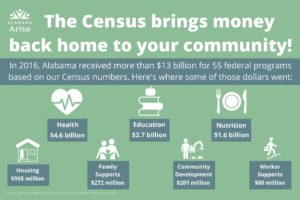
In 2016, Alabama received more than $13 billion for 55 federal programs based on data from the 2010 Census. Our Census count affected $4.6 billion that year in federal funding for health coverage through Medicaid and ALL Kids. It also shaped another $2.7 billion for education, including special education, student loans, and Title I grants to schools with high shares of students from households with low incomes.

The effects of Alabama’s Census numbers don’t stop there. The Census count guides more than $1.6 billion annually for the Supplemental Nutrition Assistance Program (SNAP), school meals and other nutrition services. And it affects funding for a range of other services, including affordable housing, child care, transportation and water treatment. The Census has important implications for virtually every aspect of our daily lives.

The Census brings money back home to your community! In 2016, Alabama received more than $13 billion for 55 federal programs based on our Census numbers. Here's where some of those dollars went. Health: $4.6 billion. Education: $2.7 billion. Nutrition: $1.6 billion. Housing: $965 million. Family supports: $272 million. Community development: $201 million. Worker supports: $80 million. Source: The George Washington University Institute of Public Policy, January 2019.

What you need to know to participate in the Census

Here are a few important things to know regarding the Census:

  • Postcards from the U.S. Census Bureau are scheduled to arrive between March 14 and April 1.
  • Officials encourage people to fill out the Census online if possible. But you also can complete the survey over the phone or request a paper copy in the mail.
  • The Census survey is just 10 questions, and it should only take you about 10 minutes to complete.
  • You will not need to provide a Social Security number to take the survey. Just your address will do.
  • Your responses are completely confidential. The Census Bureau uses them only for statistical purposes.
  • If you have any questions, visit census.gov or call 800-923-8282.

Alabama Arise is putting together informational toolkits for groups to share with folks all across the state. If you want information to share with your community, please email me at mike@alarise.org. Let’s make sure we each take 10 minutes to secure the funding we need for the next 10 years!

Why we’re spreading the word about the Census across Alabama

Filling out your Census form is quick and easy. It only takes about 10 minutes to answer 10 questions. You won’t have to do it again for 10 years. And your answers are completely confidential.

It may not seem like much, but the stakes are high. The accuracy of Alabama’s 2020 Census count will shape our state and local communities every day. Census results determine how many U.S. House members represent each state. They also guide the distribution of more than $700 billion in federal resources every year.

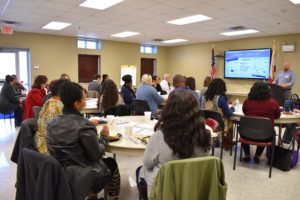
Alabama Arise organizer Mike Nicholson speaks to Madison County community representatives about the Census on Jan. 28 in Huntsville. Arise has partnered with VOICES for Alabama’s Children to conduct similar meetings across the state.

That money funds health coverage through Medicaid and the Children’s Health Insurance Program (CHIP), known as ALL Kids in Alabama. It also supports Head Start, the Supplemental Nutrition Assistance Program (SNAP) and many other services that help struggling families.

Census outreach across Alabama

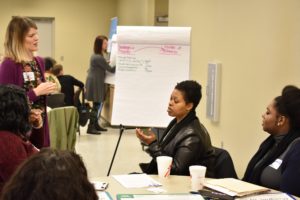
Alabama Arise is part of a statewide effort to protect these programs by getting as many Alabamians counted as possible. We’ve teamed with VOICES for Alabama’s Children to travel to as many counties as we can to meet with folks and come up with a plan to make sure everyone is counted. We’re providing information and assistance to grassroots partners so they can help their communities understand how the Census affects Alabama.

Alabama Arise organizer Debbie Smith (left) speaks to Madison County community representatives about the Census on Jan. 28 in Huntsville.

Please help us spread the word. In the coming weeks, we’ll share more information about the Census’ importance and tips on persuading your community to participate. No one is a better messenger for your community than you, and Alabama’s future depends on it!

Arise 2020: Our vision for a better Alabama

Alabama Arise members have worked for more than three decades to build a brighter, more inclusive future for our state. And as the Legislature’s 2020 regular session starts Tuesday, we’re proud to renew that commitment.

Below, Arise executive director Robyn Hyden highlights some key goals for the session, including Medicaid expansion and untaxing groceries.

How you can make a difference

Together, we can turn our shared vision for a better Alabama into a reality. Here are three ways you can help:

(1) Become an Arise individual member. Numbers matter. The more members we have, the louder our voice for change is at the State House. If you’re not yet an Arise member, click here to become one today. If you’re already a member, please ask your friends and neighbors to join us as well!

(2) Talk to your legislators. Make sure your lawmakers know where you stand on our issues. Click here to sign up for our action alerts. And if you can, come meet your lawmakers in person at Arise’s annual Legislative Day on Feb. 25 in Montgomery. Click here to pre-register before Feb. 14.

(3) Spread the word about our issue priorities. The more people learn about our movement, the more support we gain. Read more about our 2020 issue priorities and share this information with your friends:

Together, we can make Alabama a place where everyone’s voice is heard and everyone has the opportunity to reach their full potential. Together, we can build a better Alabama!

Arise 2020: Fight harmful proposals to cut Medicaid, SNAP and TANF

Safety net programs are designed to protect us when times get tough. But a recent wave of legislative and administrative attacks to those programs has threatened vital food and health assistance for millions of families across Alabama and the nation.

The stakes are high for people who struggle to make ends meet. Medicaid is a health care lifeline for one in four Alabamians. The Supplemental Nutrition Assistance Program (SNAP) helps one in six Alabamians keep food on the table. The Temporary Assistance for Needy Families (TANF) program provides meager but essential cash assistance for thousands of parents living in deep poverty.

All of these services improve lives. But numerous legislative plans could erect harmful barriers that keep struggling Alabamians from getting the help they need to survive.

Alabama Arise’s new fact sheet explains some of the harmful safety net proposals we may see this year. Arise members have helped defeat many of these proposals in the past. In 2020, we’ll need your help to do it again.

We need you with us as we work to defend programs that struggling people use in our state. Please join Alabama Arise or renew your membership today to add your voice to our chorus for change. Together, we can build a better Alabama!

A strong safety net means a stronger Alabama for all

We all know that people get down on their luck sometimes. They lose a job, have a sick child or need time to recover from an injury. And most Alabamians – understanding that “there, but for the grace of God, go I” – want to do what they can to help people going through a rough time.

The way that we, collectively, help our fellow Americans is through the safety net, a set of publicly funded services designed to help people meet basic needs when things get tough. Safety net programs include:

  • Food assistance through the Supplemental Nutritional Assistance Program (SNAP).
  • Health insurance through Medicaid or the Children’s Health Insurance Program (known as ALL Kids in Alabama).
  • Unemployment compensation.
  • Disability benefits.
  • Cash assistance through Temporary Assistance for Needy Families (TANF).

Attacks on the safety net in Alabama and other states

Some conservatives have been trying to cut the safety net at state and federal levels. During the 2018 Farm Bill reauthorization debate, the Foundation for Government Accountability (FGA) and other groups encouraged Congress to restrict hungry people’s ability to put food on the table. But these efforts failed, and SNAP emerged even stronger than before.

After this failure, opponents of the safety net turned their attention to the friendlier administrative rule process. They sought to force rules through the federal Departments of Agriculture, Housing and Homeland Security to cut food and housing assistance to marginalized people, including immigrant families.

Alabama Arise members and our state and national partners have submitted thousands of comments against these proposed changes. This advocacy has stopped or slowed some harmful plans, including the state’s proposed Medicaid work requirement. But the threats persist.

Another insidious attack on the safety net is happening in state legislatures across the country, including Alabama. While Medicaid and SNAP operate largely by federal rules, states have some discretion in how they design their programs. This discretion is called “state options” in SNAP.

Groups like the FGA have combed through the choices states have made in these state options. They have written “model” state legislation that would force states to select the most restrictive options allowed under federal law. Some of these bills are crafted to sound “reasonable” to legislators and to the general public. But together, they are designed to cut millions of struggling people off from the help they need.

Barriers to food and health care for struggling Alabamians

Since 2016, Arise has fought successfully against harmful barriers that would keep struggling Alabamians from getting the help they need. And we’re geared up to continue that fight for years to come. Here are a few of the damaging legislative proposals we expect to see again:

  • Stigmatize SNAP and TANF participants by requiring some of them to be tested for illegal drugs. States that implemented this approach have found it expensive and ineffective, with few participants testing positive. The plans would deny assistance to people who refuse a drug test or fail a drug test more than once. But they would not guarantee those participants get treatment for substance use disorders.
  • Prohibit Alabama from requesting a waiver of time limits for a small class of SNAP participants called able-bodied adults without dependents (ABAWDs). New federal rules already severely restrict these waivers, and the governor should have the authority to respond to an economic or environmental crisis by ensuring affected Alabamians can get the food they need during bad times.
  • Impose work requirements on SNAP participants who are not already working and who are not seniors or people with disabilities. This proposal would end Alabama’s very promising volunteer job training and employment assistance program for SNAP participants. Instead of getting the real job training they need, SNAP participants would be forced either to engage in less effective job search programs or to lose food assistance their families desperately need.
  • Require participants in “public benefits” to engage in community service at schools, nonprofits or other places. This could cut off assistance to hundreds of thousands of Alabamians who cannot jump through complex administrative hoops. It also would be time-consuming and expensive for participating agencies.

Other costly, harmful proposed administrative barriers

  • Require a photo ID to buy groceries using an Electronic Benefit Transfer (EBT) card for SNAP. This would be a tremendous barrier for seniors, people with disabilities and other Alabamians with transportation challenges. It would require store clerks to learn complex federal rules about who is allowed to use SNAP benefits. And it would slow down grocery store checkout lines for everyone.
  • Impose an asset test on applicants for SNAP food assistance. Alabama ended asset tests for SNAP because they were complex, time-consuming and expensive to administer, especially for seniors. They also rarely identified anyone too wealthy to be eligible for assistance.
  • Impose complex, duplicative and costly verification of income and assets for Medicaid, SNAP or TANF. This would slow down the processing of applications and deny or delay essential health and nutrition services for eligible people.
  • Require SNAP applicants to “comply” with child support orders or seek child support from the other parent before receiving food assistance. Cutting food assistance for families behind in child support does nothing but make children hungrier. And cutting assistance to a parent who has not demanded child support may force victims of domestic violence or child abuse to choose between their safety and their next meal.

The bottom line

All of these harmful ideas would make life harder for struggling Alabamians. Several proposals also would force agencies to pay millions of dollars to private firms that operate verification and client tracking functions now performed by state employees. Most importantly – and most troublingly – these proposals would increase the number of sick and hungry people in Alabama.

Alabamians deserve shared prosperity and inclusion, not increased human suffering and isolation. That is why we oppose cuts to Medicaid, SNAP, TANF and other programs that help people reach their full opportunity. Arise’s members rose to this challenge during the Farm Bill debate and in response to harmful federal rule changes. And we know you will continue to help protect the safety net that protects all Alabamians when times get tough.

How Alabama Arise is lifting up community voices in Alabama Medicaid

Alabama Medicaid is at a moment of transformation, opening up opportunities for a new focus on improving health outcomes. And Alabama Arise is working hard to ensure community needs and voices stay at the forefront.

Medicaid primary care is moving from a statewide fee-for-service model to a system of seven Alabama Coordinated Health Networks (ACHNs). The regional, nonprofit ACHNs began offering services Nov. 1, focusing on prevention, care coordination and health improvements. The inclusion of consumer representatives on regional governing boards and advisory committees also allows an unprecedented opportunity for Medicaid consumers to provide input directly to program officials.

Alabama Arise held a community asset mapping meeting on June 11, 2019, in Mobile. We met at the Bay Area Women Coalition and Trinity Gardens Community Civic Club offices. The meeting was the first held as part of a local project to help shape a Medicaid quality improvement project with the Alabama Coordinated Health Network for southwest Alabama.

In a pilot program designed to take advantage of these reforms, Arise has partnered with the Bay Area Women Coalition to enhance the local health system’s ability to promote greater food security in the Trinity Gardens neighborhood of Mobile. We’ve reached more than 100 people over six community meetings this year.

The community engagement effort is producing results. We’ve identified potential leaders and worked with residents to prioritize their ideas. We’re also discussing ways to strengthen community input as Medicaid implements and evaluates quality improvement projects.

Arise is grateful for our partnership with our Trinity Gardens neighbors. And we hope to build similar connections in communities across Alabama.

Alabama Arise comments on how proposed SNAP changes would reduce school meal access

The U.S. Department of Agriculture (USDA) is proposing a rule that would require some states to reduce gross income limits for Supplemental Nutrition Assistance Program (SNAP) applicants. It also would force 42 states, including Alabama, to impose resource limits on applicants.

More than 3 million people would become ineligible for food assistance under the rule, federal officials estimate. Alabama Arise originally submitted comments in opposition to this proposal in September 2019. But the USDA later reopened the comment period after calculating that the change would leave more children at risk of losing free school meals than original estimates showed. Arise policy analyst Carol Gundlach submitted the following additional comments in response:

Introduction

Re: Supplemental Nutrition Assistance Program Notice of Proposed Rulemaking: Revision of Categorical Eligibility in the Supplemental Nutrition Assistance Program (SNAP) [FNS–2018–0037]

Dear Program Design Branch:

Thank you for the opportunity to submit additional comments on behalf of Alabama Arise in response to the proposed changes to the categorical eligibility state option in the Supplemental Nutrition Assistance Program (SNAP).

Organizational purpose and interest

Alabama Arise is a nonprofit, nonpartisan coalition of congregations, organizations and individuals promoting public policies to improve the lives of Alabamians with low incomes. Arise believes acts of charity are vital, but they are not enough. We also must work to improve harmful policies. Arise provides a structure through which Alabamians can engage in public debates with the goal of improving the welfare of all Alabamians.

Arise envisions an Alabama where all people have resources and opportunities to reach their potential to live happy, productive lives, and each successive generation is ensured a secure and healthy future. We envision an Alabama where all government leaders are responsive, inclusive and justice-serving, and the people are engaged in the policy-making process. And we envision an Alabama where all people live with concern for the common good and respect for the humanity of every person.

Arise has engaged actively in advocacy to improve access to SNAP since our origin. In recent years, Arise has opposed state legislation restricting Alabama’s use of broad-based categorical eligibility (BBCE) and imposing other restrictions on Alabama’s election of state options.

Arise staff participated in formal and informal discussions and meetings with representatives of the Alabama Department of Human Resources (the state’s SNAP administrating agency), the Alabama Food Bank Association, Legal Services of Alabama and other organizations to improve state-level SNAP policy, staff training, outreach and client notices. Most recently, Arise and the Alabama Food Bank Association have spearheaded the creation of a Hunger Free Alabama advocacy coalition representing more than 20 diverse organizations and agencies.

Alabama has used BBCE to eliminate asset tests for working families

Alabama has elected to eliminate the SNAP asset test for applicants who are categorically eligible because they received a non-cash benefit under the Temporary Assistance for Needy Families program. Without BBCE, Alabama would be forced to reinstate a SNAP asset test.

Asset tests disproportionately affect certain types of households, including working families with small savings accounts or multiple cars. Many families at risk of losing SNAP because they exceed the asset limit will be working families with school-aged children. Because of the interaction between SNAP eligibility and eligibility for free school meals (either through direct certification or through the Community Eligibility option), children in families who lose SNAP assistance are also at risk of losing free school meals.

Restrictions on BBCE would increase child hunger and educational failure

Approximately 12,000 Alabama children live in SNAP households with “excess resources,” despite very low household incomes. Children who live in SNAP households are categorically eligible for free school meals. If these children lose SNAP assistance, they also lose automatic eligibility for school, breakfast, lunch and sometimes dinner.

Children who lose categorical eligibility would have to go through the school’s application process to receive free school meals. Some almost certainly would lose eligibility due to this additional hurdle.

Childhood hunger is strongly associated with negative educational outcomes, multiple studies have found. Hungry children have lower math scores and worse grades than do children who are not at risk of hunger.[1] Hungry children are more likely to be absent from school or tardy.[2] And hungry children are more likely to have to repeat a grade than are children not at risk of hunger.[3] The proposal would create additional barriers for children who are now eligible for free school meals. In doing so, it would increase childhood hunger and fuel lower educational achievement.

Reducing availability of universal free school meals would harm children and schools

Under the Community Eligibility option, schools with more than 40% “identified students” can elect to offer no-cost breakfast, lunch and sometimes dinner to every student in the school. By far the largest category of these “identified students” are children in families who receive SNAP. As in other states, the Alabama Department of Human Resources (the SNAP administrator) routinely sends the Alabama Department of Education a list of children who are members of SNAP households. Officials use this list, along with other data, to determine whether a school can elect Community Eligibility.

A reduction in the number of children receiving SNAP assistance could tip a school below the 40% threshold necessary for the adoption of Community Eligibility. And the loss of Community Eligibility would deny no-cost meals to all children who attend the school.

Undermining Community Eligibility would increase hunger among students

Chuck Marcum, superintendent of Roanoke City Schools in east Alabama, said Community Eligibility is vital to his system’s overall success. “I can’t overstate the importance of the program and what it’s doing for our students,” Marcum told Alabama Daily News. Community Eligibility has been especially helpful at ensuring high school students can eat breakfast, he said. “I couldn’t get them in high school to turn in the forms because they didn’t want other kids to know they were free,” Marcum said. “Now, everyone is free and we’ve removed that stigma.”[4]

Even if a school does not lose the ability to elect Community Eligibility, the reduction in the number of identified students would result in a financial loss. This is because the school’s meal reimbursement rate is based on its percentage of identified students.

The proposed rule certainly would reduce the number of identified students across Alabama. And it could reduce the percentage in some school systems so much that Community Eligibility is no longer an option. A return to the free/reduced/full-cost school meal system would increase schools’ administrative costs. Most troublingly, it would increase hunger among many of the children attending those schools.

Conclusion

For the reasons outlined in our previous comments and those discussed above, Alabama Arise again urges the USDA to withdraw this proposed rule. We urge the agency to work instead to ensure that all children, including those from households with low incomes, continue to have access to the nutrition they need to learn and thrive, both at home and school.

Footnotes

[1] Alaimo, K., Olson, C. M., & Frongillo, E. A., Jr. (2001). Food Insufficiency and American School-Aged Children’s Cognitive, Academic and Psychosocial Development. Pediatrics, 108(1), 44-53.

Shanafelt, A., Hearst, M. O., Wang, Q., & Nanney, M. S. (2016). Food insecurity and rural adolescent personal health, home, and academic environments. Journal of School Health, 86(6), 472-480.

[2] Murphy, J. M., Wehler, C. A., Pagano, M. E., Little, M., Kleinman, R. F., & Jellinek, M. S. (1998). Relationship Between Hunger and Psychosocial Functioning in Low-Income American Children. Journal of the American Academy of Child & Adolescent Psychiatry, 37, 163-170.

[3] Kleinman, R. E., Murphy, J. M., Little, M., Pagano, M., Wehler, C. A., Regal, K., & Jellinek, M. S. (1998). Hunger in Children in the United States: Potential Behavioral and Emotional Correlates. Pediatrics, 101(1), E3.

[4] Sell, Mary (Oct. 31, 2019). “Change to SNAP would impact some Alabama students’ access to free lunch.” Alabama Daily News. Available at https://www.aldailynews.com/change-to-snap-would-impact-some-alabama-students-access-to-free-lunch.

You can help protect school meals for thousands of Alabama children

We alerted you this summer to a proposed rule that could deny 36,000 Alabamians access to food assistance under the Supplemental Nutritional Assistance Program (SNAP). By changing SNAP’s categorical eligibility requirements, this proposal would deny or reduce nutrition assistance to almost 3 million struggling Americans.

But it turns out it’s even worse for children than we thought. And you have another chance to weigh in on this harmful plan through Friday, Nov. 1.

The proposal’s impact would reach beyond SNAP. Children in families who lose SNAP also may lose their free or reduced-price school meals. Appallingly, it turns out this proposed rule would put nearly twice as many kids at risk as originally estimated.

The USDA now says this portion of the rule could harm 982,000 children nationwide, including an estimated 14,000 in Alabama. That’s almost twice as many as the previous estimate of 500,000.

The comment period on this proposal previously had closed last month. But due to the USDA’s miscalculation, officials have reopened the comment period related only to the impact for school meals. The new comment deadline is Friday, Nov. 1.

Please tell the USDA that Alabama children can’t learn while they’re hungry. Use FRAC’s comment portal here to submit a comment by Nov. 1. And remember to limit your comment to the rule’s effects on children and school mealsOtherwise, it won’t be counted.

The USDA must read and consider every comment. So please share your thoughts today, and ask your friends and neighbors to do the same!

Affordable child care is an investment in Alabama’s future

“Anybody who’s ever paid for child care knows it’s cheaper to pay for college sometimes.”

That’s what I told AL.com’s Anna Claire Vollers about Alabama’s shortage of affordable child care. Her new article this week examines how expensive child care limits economic opportunity for struggling parents across our state.

Quality, affordable child care is essential for families seeking to escape poverty and participate in employment, education and job training. And while a federal funding increase has allowed Alabama to boost child care subsidies and expanded eligibility in recent years, there’s still much work left to do.

The AL.com article highlights Alabama Arise’s recent report on child care funding. It discusses the progress that Alabama has made in the past few years. And it illustrates many needs yet to be met, especially in rural areas and among Hispanic families.

State investment would make a real difference. As I said in the article: “Alabama is a state that puts absolutely no state dollars other than those mandated by the federal government into child care. That’s not true in most states.”

Be sure to read the AL.com article. And check out Arise’s child care report for more on how Alabama can and should invest in our children’s future.

Alabama Arise comments in opposition to proposed SNAP categorical eligibility changes

The U.S. Department of Agriculture (USDA) is proposing a rule that would require some states to reduce gross income limits for Supplemental Nutrition Assistance Program (SNAP) applicants. It also would force 42 states, including Alabama, to impose resource limits on applicants.

More than 3 million people would become ineligible for food assistance under the rule, federal officials estimate. Alabama Arise policy analyst Carol Gundlach submitted the following comments in opposition to this proposal:

Introduction

Re: Supplemental Nutrition Assistance Program Notice of Proposed Rulemaking: Revision of Categorical Eligibility in the Supplemental Nutrition Assistance Program (SNAP) [FNS–2018–0037]

Dear Program Design Branch:

Thank you for the opportunity to submit comments on behalf of Alabama Arise in response to the proposed changes to the categorical eligibility state option in the Supplemental Nutrition Assistance Program (SNAP).

Organizational purpose and interest

Alabama Arise is a nonprofit, nonpartisan coalition of congregations, organizations and individuals promoting public policies to improve the lives of Alabamians with low incomes. Arise believes acts of charity are vital, but they are not enough. We also must work to improve harmful policies. Arise provides a structure through which Alabamians can engage in public debates with the goal of improving the welfare of all Alabamians.

Arise envisions an Alabama where all people have resources and opportunities to reach their potential to live happy, productive lives, and each successive generation is ensured a secure and healthy future. We envision an Alabama where all government leaders are responsive, inclusive and justice-serving, and the people are engaged in the policy-making process. And we envision an Alabama where all people live with concern for the common good and respect for the humanity of every person.

Arise has engaged actively in advocacy to improve access to SNAP assistance since our origin. In recent years, Arise has opposed state legislation restricting Alabama’s use of broad-based categorical eligibility (BBCE) and imposing other restrictions on Alabama’s election of state options. Arise staff participated in both formal and informal discussions and meetings with representatives of the Alabama Department of Human Resources (the state’s SNAP administrating agency), the Alabama Food Bank Association, and Alabama Legal Services and other organizations to improve state-level SNAP policy, staff training, outreach and client notices. Most recently, Arise and the Alabama Food Bank Association have spearheaded the creation of a Hunger Free Alabama advocacy coalition representing more than 20 diverse organizations and agencies.

Categorical eligibility has made SNAP more efficient in Alabama

Alabama has made limited but effective use of broad-based categorical eligibility. The state has elected to eliminate the SNAP assets test for applicants found to be categorically eligible because they received a non-cash benefit under the Temporary Assistance for Needy Families (TANF) program. Alabama has not elected to increase the income eligibility limits for participants who are not seniors or people with disabilities.

By eliminating the assets test, Alabama has ensured that food-insecure seniors and people with disabilities can receive SNAP assistance without being driven into even deeper poverty. This move also has ensured that working people in poverty can receive both nutrition services and work supports. And it has helped SNAP operate economically and efficiently in a state that struggles to support basic human services adequately.

These changes would harm seniors and people with disabilities

The proposed categorical eligibility regulation revision would increase hunger among seniors and Alabamians with disabilities. Seniors in Alabama often maintain savings accounts to cover funeral expenses so these costs will not burden their children. Additionally, many seniors and individuals with disabilities wisely save money to pay for unexpected medical or long-term care expenses.

Elimination of broad-based categorical eligibility would force seniors and people with disabilities to spend down their hard-saved safety net. When faced with a medical crisis, many may have to forgo essential nutrition assistance or suffer other devastating consequences.

These changes would increase transportation barriers

The proposed categorical eligibility regulation revision also would increase hunger among working families. Alabama is a deeply rural state where workers or students commonly travel 30 miles or more to employment or job training. Alabama also lacks public transportation options in much of the state, particularly in rural areas. Because of the state’s rural nature and lack of public transportation, reliable transportation is essential for working people.

Thanks to BBCE, Alabama and most other states have not treated automobiles as countable assets in determining SNAP eligibility for many years. But under the proposed rule, the state could be forced again to count the value of certain cars in excess of $4,650 as an asset. Because so few states treat automobiles as an asset, officials have not adjusted the federal exemption for cars since 1977. The amount is now so low that most moderately price cars would exceed the allowable exemption.

Counting the “excess” value of cars as an asset would force families to choose between necessary transportation and food assistance. This is a choice that would force them into deeper poverty.

These changes would harm Alabama’s children

The proposed categorical eligibility regulation revision would reduce access to school meals for hungry children. Alabama, like nearly every other state, automatically enrolls children living in SNAP households for free school meals. Should these changes be approved, Alabama estimates approximately 4.5% of households, or more than 15,000 families, will lose SNAP benefits.

Insofar as these households include children, those children also would be denied automatic eligibility for free school breakfast and lunch. It is true that officials can establish a child’s eligibility for free meals by a separate application. But if these changes occur, many families who were automatically determined eligible in the past may be unaware they would have to apply for their children’s meals and may fail to do so.

Breakfast and lunch at school are closely correlated with better educational outcomes. A loss of free school meals will both increase child hunger and reduce school performance among the most at-risk children.

These changes would harm struggling families across Alabama

The proposed regulation would force Alabama to choose between weakening its already insufficient TANF program and denying nutrition assistance to thousands of currently eligible families. The proposed rule defines TANF benefits that would confer categorical eligibility for SNAP as “ongoing and substantial benefits.” This would be restricted largely to cash benefits, child care, subsidized employment and work supports funded through the TANF block grant.

Alabama has one of the nation’s lowest benefit limits for TANF cash assistance: just $215 for a family of three. In 2018, only 8,565 families in Alabama received ongoing TANF cash assistance. Facing the declining value of the TANF block grant, Alabama has elected to use TANF funds for one-time emergency assistance. This includes housing and transportation assistance, short-term work supports and other services for struggling families who are ineligible for ongoing cash assistance but still face critical needs.

The proposed rule would deny these families the benefits of categorical eligibility. The TANF assistance they receive would not meet the proposed definition of “ongoing” assistance, even though the dollar value of the assistance they receive may be many times Alabama’s maximum monthly TANF cash assistance amount. This definition of TANF assistance is arbitrary, and it could deny SNAP to many of Alabama’s poorest residents.

These changes would add unnecessary strain to state budgets

The proposed categorical eligibility regulation revision would impose administrative burdens on Alabama and other states. Alabama estimates that 81% of its SNAP caseload, or 275,000 households, would be subject to asset testing under the proposed rule. The state also estimates that 15,000 of those households would be denied SNAP assistance because they either have assets that exceed the limit or would be unable to verify the value of their assets.

Alabama would have to verify assets for all 275,000 households, which would cost considerable time and money. It is unknown whether officials could obtain verification of cash assets easily, especially given changes in the banking industry since Alabama last had to do so. Officials also could struggle to verify the value of real property held by multiple heirs of the original owner, a common situation in the rural South.

Because verification costs are an administrative expense, Alabama would have to cover 50% of those costs. Should the proposed rule’s verification requirements force Alabama to contract with a third party, those state costs may be considerable. This additional red tape could reduce the state’s ability to provide innovative services, including employment and training services. It also could increase the risk of delays in timely approval of SNAP applications.

Other major problems with the proposed changes

The proposed categorical eligibility regulation revision would place an increased burden on emergency food providers. Alabama estimates that 4.5% of its SNAP caseload, or 15,000 households, would be ineligible for food assistance under the proposed rule.

These struggling families would remain at risk of hunger. But instead of being able to purchase food with SNAP benefits, they would have to rely on Alabama’s already stretched network of food banks and pantries. Forcing yet more people into the private, emergency food system would reduce the system’s ability to serve current clients. And that would only result in greater hunger in the state.

The proposed rule also would circumvent a policy that Congress already has rejected. During the 2018 Farm Bill reauthorization, Congress considered and rejected a policy very similar to, and having the same effect as, the one proposed in this draft rule.

Circumventing a legislative decision made less than a year ago would be an inappropriate administrative action. That is a crucial reason for the USDA to withdraw the proposed rule.

Conclusion

As described above, Alabama Arise believes the proposed rule would increase hunger, particularly among seniors, working families, and people with disabilities. The rule would increase child hunger and reduce participation in USDA school meal programs. It would place additional administrative burdens and costs on states, reducing their ability to administer SNAP effectively. It would increase the burden on private emergency food providers. And it would seek to circumvent recently enacted federal legislation.

Arise urges the USDA to withdraw the proposed rule immediately. The agency should work instead to strengthen its commitment to end hunger and protect SNAP as authorized by Congress.