
Alabama must tear down the legacies of slavery and segregation

The monument stood in Birmingham for decades as a twisted tribute to Alabama’s original sins: slavery and white supremacy. It “honored” a violent rebellion that sought to protect the enslavement of human beings. During segregation and Jim Crow and civil rights protests and into the 21st century, it served as a daily 52-foot-tall reminder of the systemic oppression and persecution of Black Alabamians.

That monument is finally gone now. After protests, the city pulled it down June 1, on a state holiday named for the political leader of the rebellion it commemorated. Removing physical symbols of slavery and segregation is an important step toward healing and recovery, but it’s not enough. We also must tear down prejudices, disparities and injustices that trace their roots to these oppressive and racist practices. To do that, Alabama must enact public policies that undermine white supremacy and promote dignity, equity and justice for everyone.

The need for racial justice

For more than 30 years, Alabama Arise has worked to make life better for struggling Alabamians through better public policy. It’s impossible to do that work effectively without acknowledging and challenging our state’s historical and ongoing racial inequities. There can be no economic or social justice without racial justice. And as scholar Ibram X. Kendi said, policy cannot be merely non-racist; it must be anti-racist. That’s why we’re committed to placing racial equity and inclusion at the core of our work.

Black Alabamians have battled generation after generation of discriminatory barriers to education, jobs, housing and voting. Compounding those barriers is a criminal justice system that polices Black people more heavily, arrests them more often and condemns them to harsher sentences in dangerously overcrowded prisons and jails.

For centuries, Black people have suffered from police brutality and unequal treatment from law enforcement. This history has fueled protests across the country and around the world over the last week. Arise stands in solidarity with calls to stop killing Black people and start building a world that’s safe for everyone.

All of these systemic failures have added together to produce a series of terrible, ongoing disparities. Black people in our state face higher rates of poverty and hunger, lower life expectancies and lower rates of employment and health insurance coverage.

Policy changes to break down harmful barriers

These are institutional failures that require policy solutions. Here a few ways lawmakers can help break down barriers to opportunity and justice:

  • Expand Medicaid to cover adults with low incomes. Expansion would ensure health coverage for more than 340,000 Alabamians who are uninsured or barely paying for insurance they can’t really afford. It also would attack a fundamental injustice: People of color make up about 34% of our state’s population, but nearly half of all uninsured Alabamians with low incomes are people of color. Lack of affordable health coverage deprives Black people of timely care for cancer, diabetes, heart disease and other serious conditions. As the disproportionately high share of coronavirus deaths among Black Alabamians shows, health care access is literally a matter of life or death.
  • Invest more in public education. Alabama’s state funding for K-12 and higher education, adjusted for inflation, is lower today than it was in 2008. This chronic underfunding hits many schools that primarily serve Black students especially hard.
  • Equitably distribute funding for affordable housing and public transportation. Alabama has trust funds for both but hasn’t funded them yet. Lawmakers should fund public transportation to help everyone get to work, school and other places they need to go. Alabama should support the Housing Trust Fund to ensure people living in deep poverty have safe shelter. Our state also should commit to eliminating redlining, fighting housing discrimination and proactively reducing residential segregation.
  • Overhaul the criminal justice system and the death penalty. Areas with large Black populations often see a larger police presence. The weight of harsh sentences and criminal justice debt falls more heavily on these Alabamians as a result. Lawmakers should reform sentencing laws and ease the crushing burden of exorbitant fines and fees. They also need to end abuses of civil asset forfeiture and eliminate racial injustice in the state’s death penalty system.
  • Strengthen and expand voting rights. Voting barriers should find no home in the heart of the Civil Rights Movement. Automatic voter registration, no-excuse absentee voting and same-day registration are a few changes that would make voting more accessible. Alabama also should ease barriers to voting rights restoration.
  • Raise the minimum wage and restore home rule to localities. Alabama is one of only five states with no minimum wage law. Birmingham tried to raise its minimum wage in 2016, but state lawmakers blocked that effort. The Legislature has that power due to the 1901 state constitution, whose authors explicitly said the document aimed to “establish white supremacy in this state.” Alabama should lift constitutional barriers to home rule and allow local governments to make decisions in their own communities.

A better, more inclusive future for Alabama

Undoing the legacies of slavery and segregation in Alabama will require more than reassuring words and vague platitudes. It will require substantive policy changes to break down centuries-old barriers and ensure all Alabamians have a chance to reach their full potential.

Many of these changes – and others not mentioned above – won’t be easy. Some of them may not happen quickly. But we must keep advocating and working toward the day when they will. The road to dignity, equity and justice for all Alabamians remains a long one. But walking together and working together, we can and will reach that destination.
Arise legislative update: May 21, 2020

Alabama legislators ended the regular session this week by enacting education and General Fund budgets for 2021. But as the COVID-19 downturn hammers state tax revenues, we fear lawmakers’ optimism surrounding these budgets could be misplaced. Arise’s Carol Gundlach explains why the Legislature likely will return for one or more special sessions later this year to revisit the budgets and address other issues.


Arise update: May 1, 2020

As job losses and business closures mount, state revenues for education, health care and other public services are likely to plummet. Arise’s Carol Gundlach discusses how progressive tax changes would help prevent cuts to these services and help Alabama rebuild its economy after the COVID-19 pandemic.

Read more about our proposals here.

Progressive tax changes would allow Alabama’s budgets to endure and rebuild after COVID-19

Alabamians are living through hard times right now. Thousands of people are sick. Many more are scared or out of work. Uncertainty is everywhere amid a pandemic with no clear timetable or end game.

As more businesses close or cut back, as more people lose income, and as fewer of us go to the stores where we normally shop, state tax revenues are falling. That endangers funding for education, public health and other core services at a time when we need them most.

A state Senate committee Tuesday approved a smaller General Fund (GF) budget than the one Gov. Kay Ivey initially proposed. But that budget’s revenue assumptions may be too optimistic, and many lawmakers acknowledge they may need to revisit it this summer or fall as the pandemic’s financial toll becomes clearer. In the meantime, the ongoing public health emergency is compounding structural problems that have plagued Alabama for decades.

How Alabama should strengthen its tax system

The COVID-19 pandemic and its associated economic freefall are not the root cause of Alabama’s chronic underfunding of public services or the fundamental failures of its tax system. But this crisis is exposing and exacerbating those shortcomings. And it is illustrating the need for progressive tax changes that would equip our state to endure both this downturn and future recessions.

Alabama should enact these changes to raise revenue for vital services and make life better for struggling families:

  • Eliminate the regressive, and expensive, state income tax deduction for federal income taxes. About 80% of the $782 million deduction’s benefit flows to the top 20% of households.
  • Increase income tax brackets so the highest-paid 25% of taxpayers have a higher tax rate than people in the lower and middle brackets do. Alabama’s top income tax rate kicks in at just $3,000 of taxable income.
  • Impose a temporary income surtax on millionaires during the financial crisis.
  • Adopt combined reporting to prevent corporate tax avoidance while rejecting proposals, such as moving to a single sales factor formula, that would reduce taxes for large corporations.
  • Eliminate the state sales tax on groceries and replace that revenue by making progressive improvements to our income tax system. Alabama is one of only three states with no tax break on groceries.
  • Apply sales and use taxes to more professional services and digital goods and services like music downloads and video streaming services.
  • Institute or increase sales and excise taxes on unhealthy items like tobacco, vaping products or sugary soft drinks. The state could dedicate this money to Medicaid and other health care services.

Lessons from the past: How the last recession devastated Alabama’s finances

Alabama has two major revenue sources for public services that rise and fall with the economy. One is the income tax, which is earmarked (or dedicated) solely for K-12 teacher salaries. Sales and use taxes, which largely go toward education but also fund some other services, are the other. (Use taxes apply to online and mail-order purchases.) Most GF revenue sources grow slowly even in good times.

To understand this downturn’s potential impact, we should look back to the last recession, which struck Alabama in 2009. Both the Education Trust Fund (ETF) and GF were prorated as revenues plummeted during the Great Recession. Proration is an across-the-board funding cut when revenues fall short of expectations.

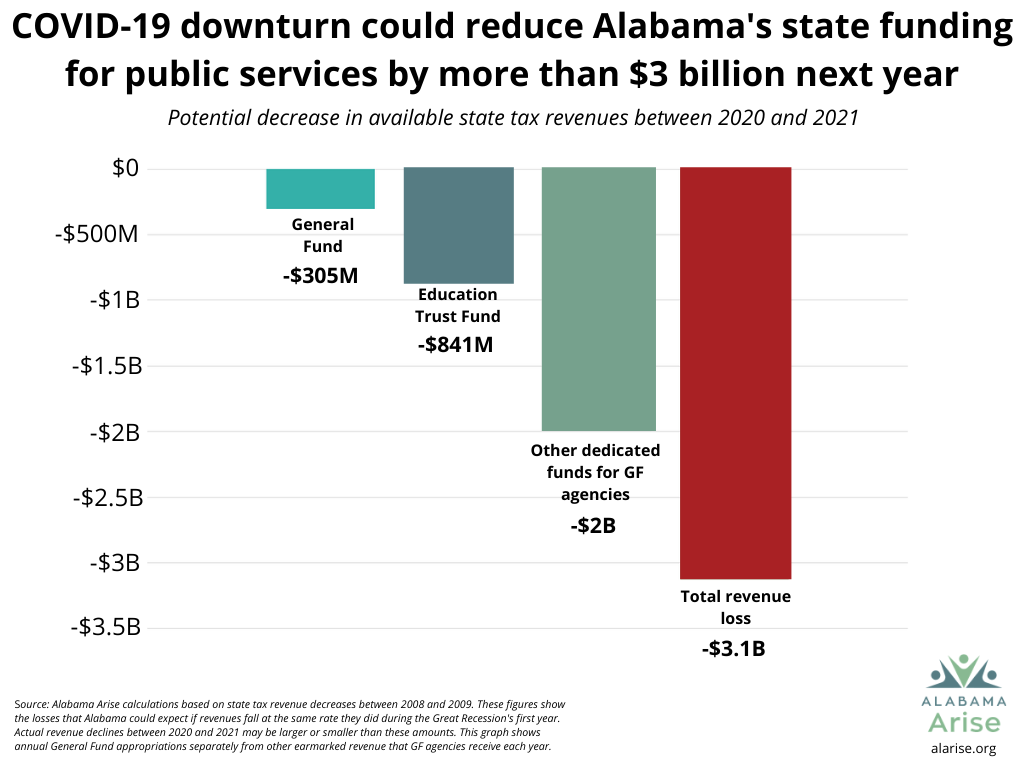
COVID-19 downturn could reduce Alabama's state funding for public services by more than $3 billion next year. Potential decrease in available state tax revenues between 2020 and 2021. General Fund: -$305 million. Education Trust Fund: -$841 million. Other dedicated funds for GF agencies: -$2 billion. Total revenue loss: -$3.1 billion. Source: Alabama Arise calculations based on state tax revenue decreases between 2008 and 2009. These figures show the losses that Alabama could expect if revenues fall at the same rate they did during the Great Recession's first year. Actual revenue declines between 2020 and 2021 may be larger or smaller than these amounts. This graph shows annual General Fund appropriations separately from other earmarked revenue that GF agencies receive each year.

ETF revenues went down 11.8%, or $702 million, between 2008 and 2009. GF revenues for services like courts, Medicaid, public safety and veterans’ assistance fell by 13.9%, or $250 million.

The ETF could lose $841 million in state money next year if revenues decline at the same rate as in 2009. This would be equivalent to $1,160 per student in public K-12 schools, or 20% of all state K-12 funding. It’s also more than this year’s state allocations to the University of Alabama and Auburn University systems combined.

Meanwhile, the GF could lose $305 million if this downturn matches the Great Recession. That would be equivalent to 2020 GF funding for the Department of Human Resources (DHR), mental health, public health and senior services combined.

This loss also doesn’t include other dedicated funds for GF agencies like child welfare, mental health and veterans’ services. If these earmarked funds dropped by 13.9%, as the GF did in 2009, Alabama would need another $2 billion to avoid cuts. Altogether, the total funding loss to education, health care and other services would exceed $3 billion.

Rainy day funds and federal relief will help, but they aren’t a lasting solution

Thankfully, Alabama has three revenue sources to help avoid or reduce service cuts, at least temporarily. Lawmakers have established two rainy day funds – essentially lines of credit – within the Alabama Trust Fund that the governor can tap to address major budget shortfalls. The ETF also has a reserve fund called the Budget Stabilization Fund, which can be tapped if revenues aren’t enough to cover budgeted expenses.

The governor can authorize withdrawal of no more than 14% total of the prior year’s education spending from a combination of the Budget Stabilization Fund and the ETF Rainy Day Fund. That amounts to around $997.6 million. And the state can withdraw 10% of prior-year spending for other services from the GF Rainy Day Fund, which comes to $219.2 million.

Between the two budgets, the governor could withdraw $1.2 billion from rainy day accounts. But to maintain current funding levels, Alabama still would need another $1.8 billion if this downturn matches the Great Recession.

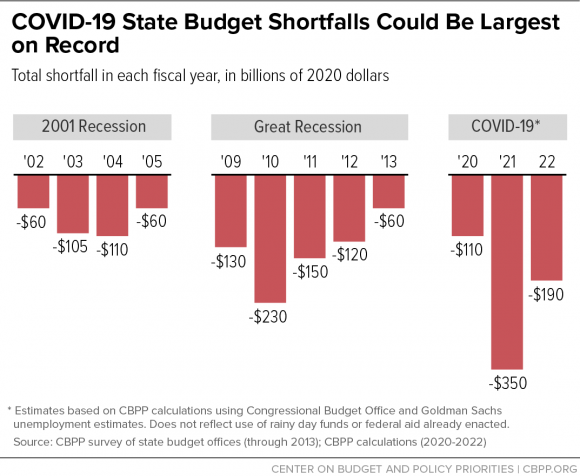
Alabama expects about $1.8 billion in federal relief as a result of the Coronavirus Aid, Relief and Economic Security (CARES) Act. This one-time relief could get the state through 2021 by a hair – if federal officials allow it. The U.S. Treasury is restricting the extent to which states can use these funds to plug budget shortfalls. Cumulative shortfalls in Alabama and other states from 2020-22 could top $650 billion, the Center on Budget and Policy Priorities estimates.

COVID-19 state budget shortfalls could be largest on record. Total shortfall in each fiscal year, in billions of 2020 dollars. 2001 recession. '02: -$60. '03: -$105. '04: -$110. '05: -$60. Great Recession. '09: -$130. '10: -$230. '11: -$150. '12: -$120. '13: -$60. COVID-19. '20: -$110. '21: -$350. '22: -$190. COVID-19 estimates based on CBPP calculations using Congressional Budget Office and Goldman Sachs unemployment estimates. Does not reflect use of rainy day funds or federal aid already enacted. Source: CBPP survey of state budget offices (through 2013); CBPP calculations (2020-2022). Center on Budget and Policy Priorities, cbpp.org.

COVID-19’s budgetary threats don’t end there. Local governments also will need relief, and this fiscal crisis may be even worse than 2009. If a 2020 recession spirals into a depression, we will be facing some very dark days without new tax revenue to make them brighter.

The path to stronger, more inclusive budget and tax policies for Alabama

Alabama could respond to these steep revenue losses with harmful cuts to education, mental health care, public health and other critical needs. Or the state could make the wiser choice of raising sustainable new revenue to invest in the common good.

Our partners at the Institute on Taxation and Economic Policy said it best: “For states facing catastrophic revenue declines, asking more of taxpayers with a clear ability to pay is far preferable to cutting state budgets, which would lead to mass layoffs, steep cuts in public services, and a downward spiral in the economy.”

Year after year, Alabama legislators have built a series of bare-bones budgets on one-time funds and temporary federal aid. They’ve refused to modernize our state’s upside-down tax system by making it more progressive and more fair for struggling families. And they’ve refused to ask large corporations and wealthy people who can afford to pay more to contribute their fair share to support the common good.

There’s a better way. The progressive tax changes we propose would protect education, health care and other services from devastating cuts during the COVID-19 recession. They also would allow our state to expand Medicaid and ensure all Alabamians can get the health care they need to survive and thrive, both during this pandemic and in the long recovery ahead. If we want a brighter future for Alabama, we need to invest in it now.

Arise update: April 16, 2020

State and federal leaders have taken action to help struggling Alabamians stay healthy and make ends meet amid the COVID-19 pandemic, but they must do more. Arise’s Robyn Hyden gives a video update on the coronavirus’ implications for Medicaid expansion, public health funding, food assistance, unemployment insurance, paid family and medical leave, prisons and jails, and other concerns.

COVID-19: 7 policy changes that would help protect Alabamians

The World Health Organization has labeled COVID-19 a global pandemic. And state officials announced the first confirmed case of the disease in Alabama on Friday. As the virus strains our health systems, schools and economy, we must ensure the most vulnerable Alabamians have the medical care, social supports and other protections they need to weather the crisis.

The Alabama Legislature will be on spring break for the next two weeks. We hope our state lawmakers and members of Congress will take time to examine the situation developing in their communities. And we hope they will act quickly and courageously to address these critical public health needs.

Here are seven actions that policymakers should take now to protect the well-being and security of all Alabamians:

1. Gov. Kay Ivey should expand Medicaid.

Medicaid expansion would extend health coverage to more than 223,000 uninsured Alabamians with low incomes. It also would ensure coverage for another 120,000 who struggle to afford the insurance they have.

Expansion would take several months to implement, but it would prepare us for the big challenges ahead. In the short term, Medicaid could take numerous other steps to protect families. Examples include streamlining enrollment, covering new mothers for one year after delivery and increasing our “bare-bones” income limit for parents.

Email Gov. Ivey to ask her to expand Medicaid and help address the coronavirus threat. Or if you’d prefer to reach out by phone, click here to call Gov. Ivey’s office.

2. Lawmakers should increase funding for public health to ensure adequate testing, preparation and prevention.

In addition, state and local agencies should take the lead on proactive policies and procedures to protect those who are most vulnerable to this virus. Read State Health Officer Scott Harris’ report to the Senate Health Committee.

3. Congress should authorize emergency food assistance increases.

Boosting the Supplemental Nutrition Assistance Program (SNAP) would help children get the food they need while they’re out of school. It also would promote food security for seniors, people who lose their jobs and other people at risk of hunger. Read additional recommendations to address critical food security issues from our partners at the Food Research and Action Center.

4. Policymakers should remove barriers to social support services.

Medicaid, SNAP, WIC and Temporary Assistance for Needy Families (TANF) save and improve lives. Red-tape barriers to these services make it harder for struggling families to get the help they need during a crisis. Read Arise’s fact sheet to learn why state lawmakers should abandon efforts to reduce access to safety net programs.

5. State lawmakers should remove the state sales tax on groceries while protecting education funding.

As many people prepare for social distancing by purchasing enough food to last for several weeks, the grocery tax imposes the highest tax burden on the people who can least afford it. It’s yet another illustration of why this cruel tax must end. Click here to urge state legislators to untax groceries and replace the revenue by supporting SB 144.

6. Policymakers should look at options to extend paid medical and family leave to every worker.

States including Washington and Massachusetts have created affordable buy-in plans so that even smaller employers can provide extended medical or family leave. Read how paid family and medical leave was made affordable and available to every worker in the state of Washington. Then read more about federal discussions to provide short-term relief for paid leave.

7. Alabama should expand unemployment protections to mitigate the effects of job losses for individuals and communities.

Closures and layoffs in the coming months will leave many workers without essential income. Public officials must act now to reduce the financial toll on people who struggle to make ends meet. Read recommendations from the National Employment Law Project (NELP) about potential improvements to unemployment insurance coverage.

Looking ahead

The conversation about the best policy and social responses will continue to evolve over the coming days and weeks. And additional needs and solutions are likely to emerge. Throughout this crisis and beyond, Arise will continue to speak out for dignity, equity and justice for all Alabamians.

Arise legislative recap: March 6, 2020

Arise’s Jim Carnes discusses how the coronavirus outbreak and the closure of Pickens County Medical Center showcase Alabama’s need for Medicaid expansion. Also, in the wake of the recent execution of Nathaniel Woods, Jim talks about HB 359, which would forbid the death penalty in capital cases where the jury does not agree unanimously to impose it.

Arise legislative recap: Feb. 28, 2020

Arise members showed up in force in Montgomery on Tuesday for our annual Legislative Day! Arise’s Chris Sanders gives a brief recap of the event and introduces a replay of our news conference on untaxing groceries. (Please note: The news conference footage was streamed from a cell phone and includes a few moments of adjustment.)


Arise legislative recap: Feb. 25, 2020

Today, Feb. 25, is our annual Legislative Day, and we’re excited to continue our efforts to untax groceries. Arise’s Carol Gundlach talks about steps you can take to contact your lawmakers on this issue if you can’t be there in person.

Arise 2020: Our vision for a better Alabama

Alabama Arise members have worked for more than three decades to build a brighter, more inclusive future for our state. And as the Legislature’s 2020 regular session starts Tuesday, we’re proud to renew that commitment.

Below, Arise executive director Robyn Hyden highlights some key goals for the session, including Medicaid expansion and untaxing groceries.

How you can make a difference

Together, we can turn our shared vision for a better Alabama into a reality. Here are three ways you can help:

(1) Become an Arise individual member. Numbers matter. The more members we have, the louder our voice for change is at the State House. If you’re not yet an Arise member, click here to become one today. If you’re already a member, please ask your friends and neighbors to join us as well!

(2) Talk to your legislators. Make sure your lawmakers know where you stand on our issues. Click here to sign up for our action alerts. And if you can, come meet your lawmakers in person at Arise’s annual Legislative Day on Feb. 25 in Montgomery. Click here to pre-register before Feb. 14.

(3) Spread the word about our issue priorities. The more people learn about our movement, the more support we gain. Read more about our 2020 issue priorities and share this information with your friends:

Together, we can make Alabama a place where everyone’s voice is heard and everyone has the opportunity to reach their full potential. Together, we can build a better Alabama!