At last: Alabama Arise members celebrate grocery tax reduction

The grocery tax bill passed. After more than three decades of persistent advocacy, Alabama Arise members turned that longstanding vision into reality this year. Every Alabamian will benefit as a result, and the benefits will be greatest for families struggling to make ends meet.

This breakthrough highlighted a 2023 regular session during which Arise members made a difference on numerous priorities at the Legislature. Our advocacy helped an important criminal justice reform become law and helped block efforts to undermine voting rights.

What the grocery tax bill will do

Alabamians will begin paying a lower state grocery tax this Labor Day weekend. HB 479, sponsored by Rep. Danny Garrett, R-Trussville, will cut the state sales tax on groceries from 4% to 2% in two steps. The reduction will apply to all items defined as food under the Supplemental Nutrition Assistance Program (SNAP). When fully implemented, the law will save Alabamians the equivalent of about a week’s worth of groceries every year.

The first step will take effect Sept. 1, when the state grocery tax will drop from 4% to 3%. The next reduction, from 3% to 2%, will come in September 2024, as long as Education Trust Fund (ETF) revenues have grown by at least 3.5% over the previous year. If they haven’t, the reduction will occur in the first year when revenue growth does meet that threshold.

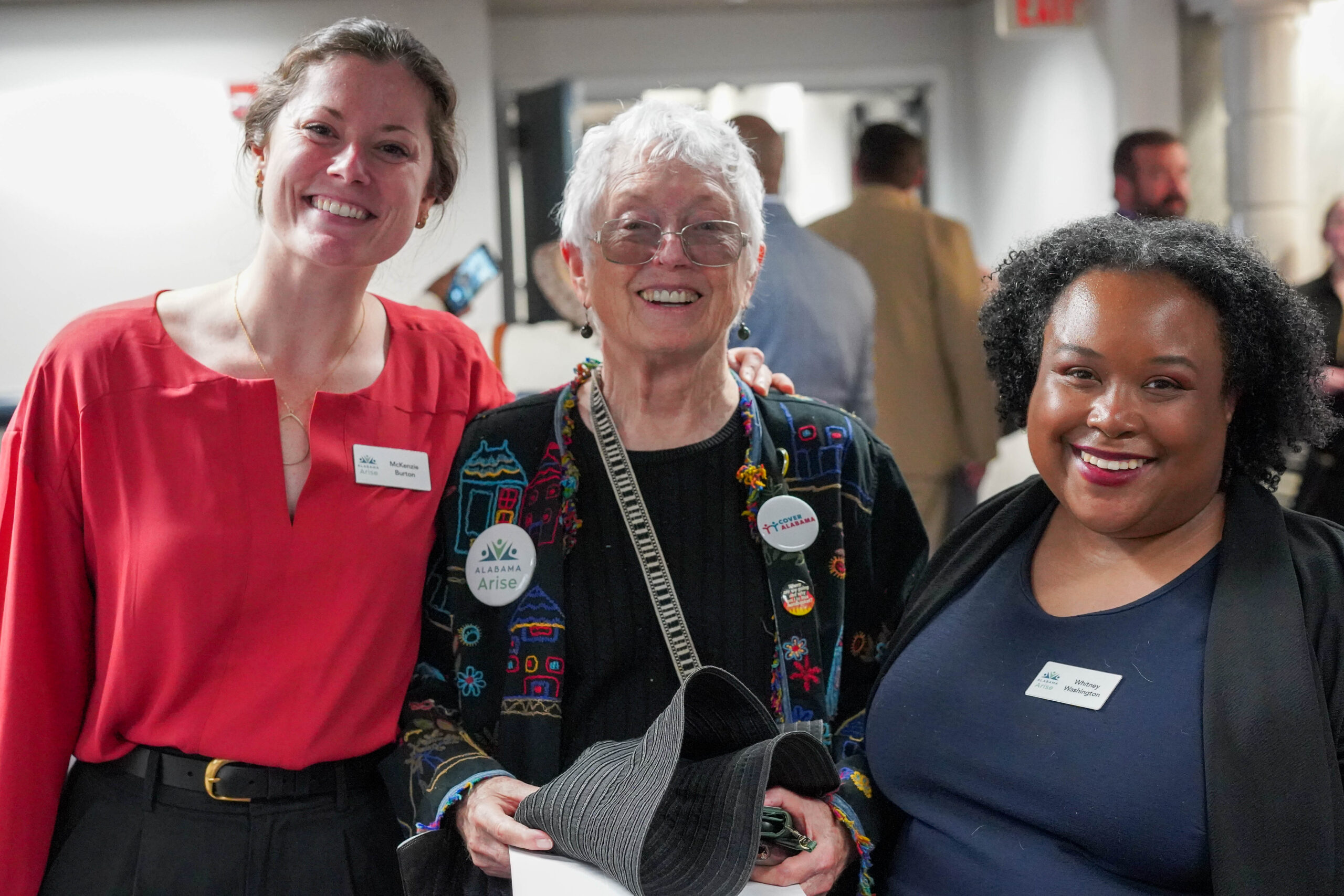
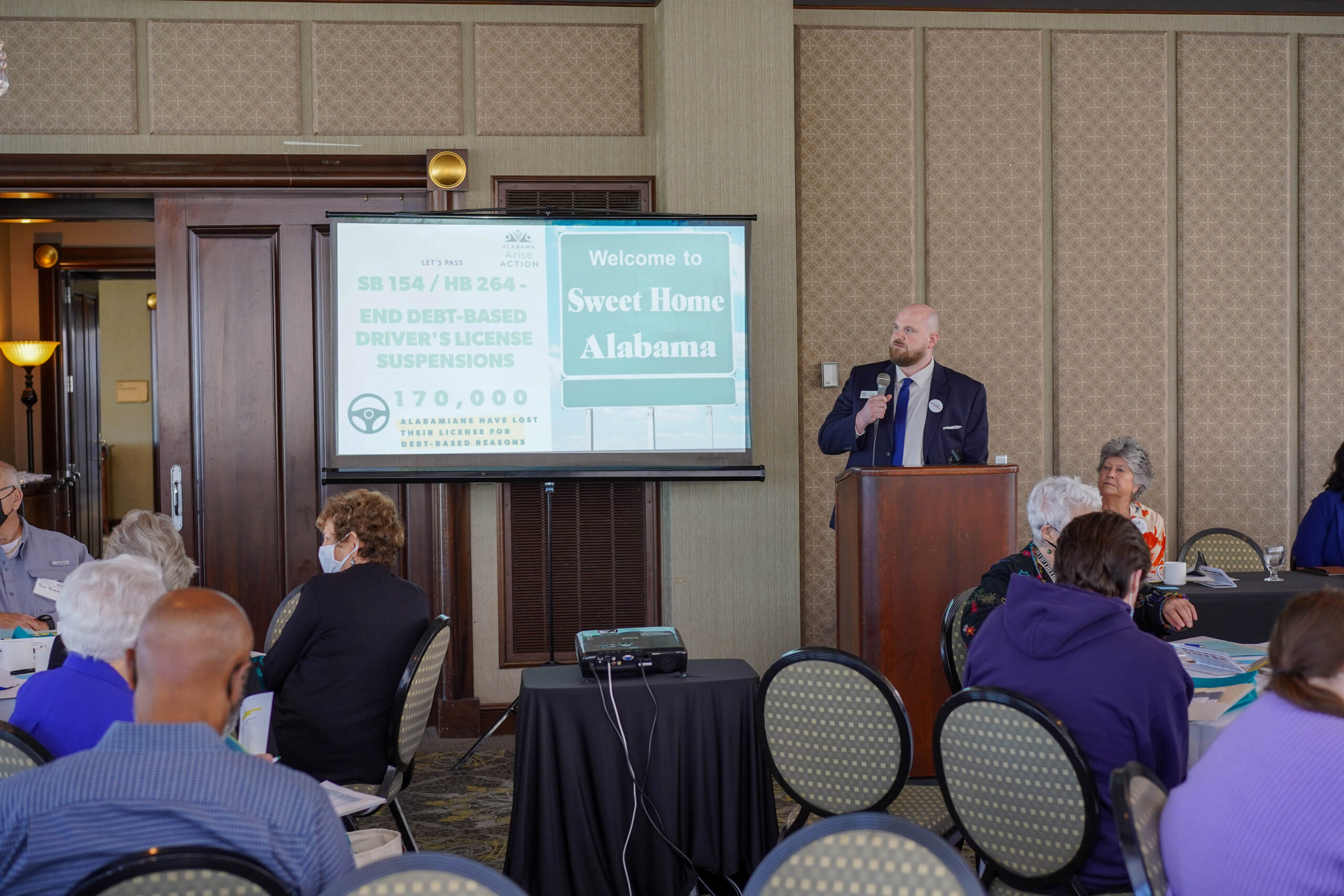
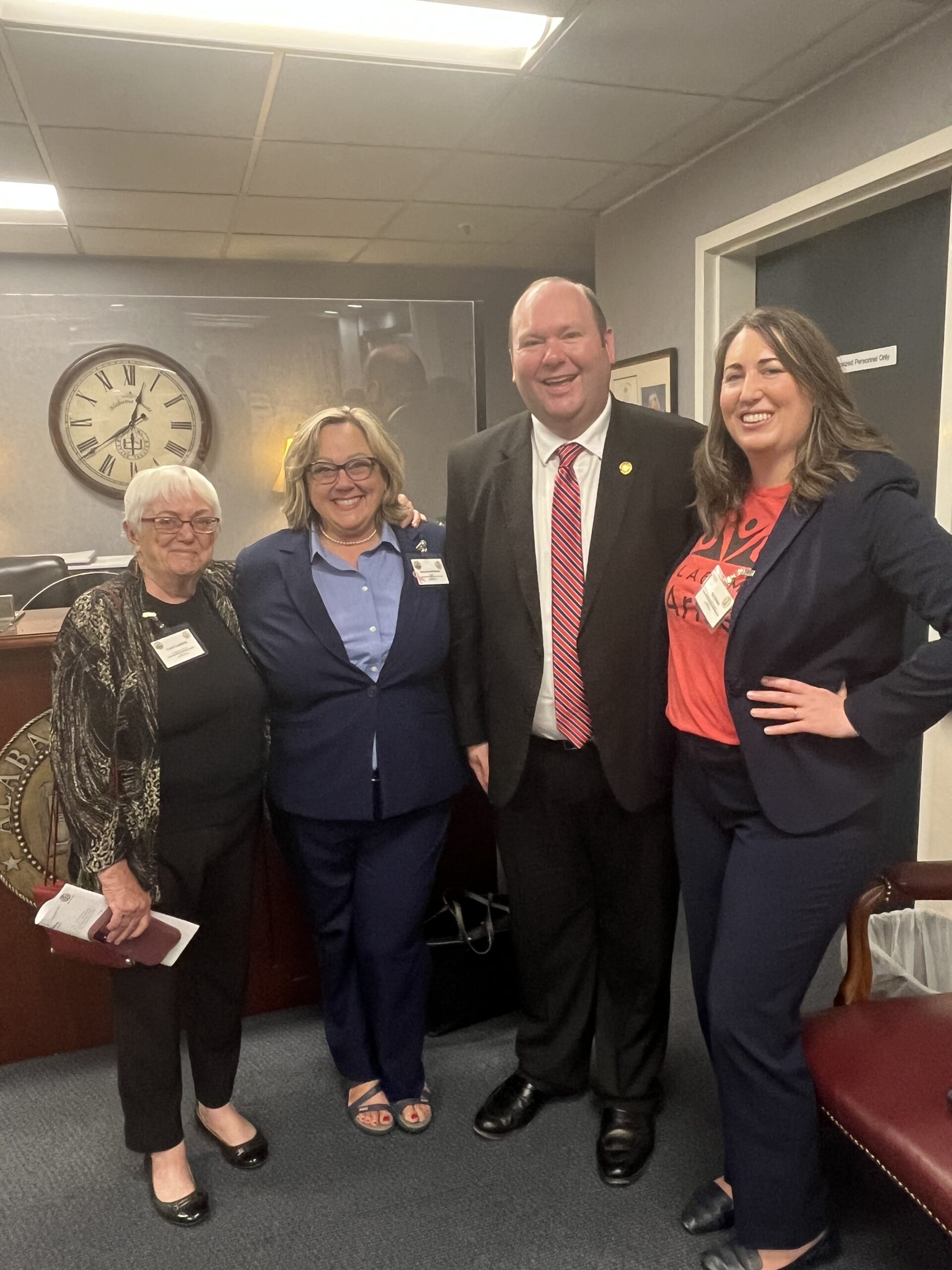
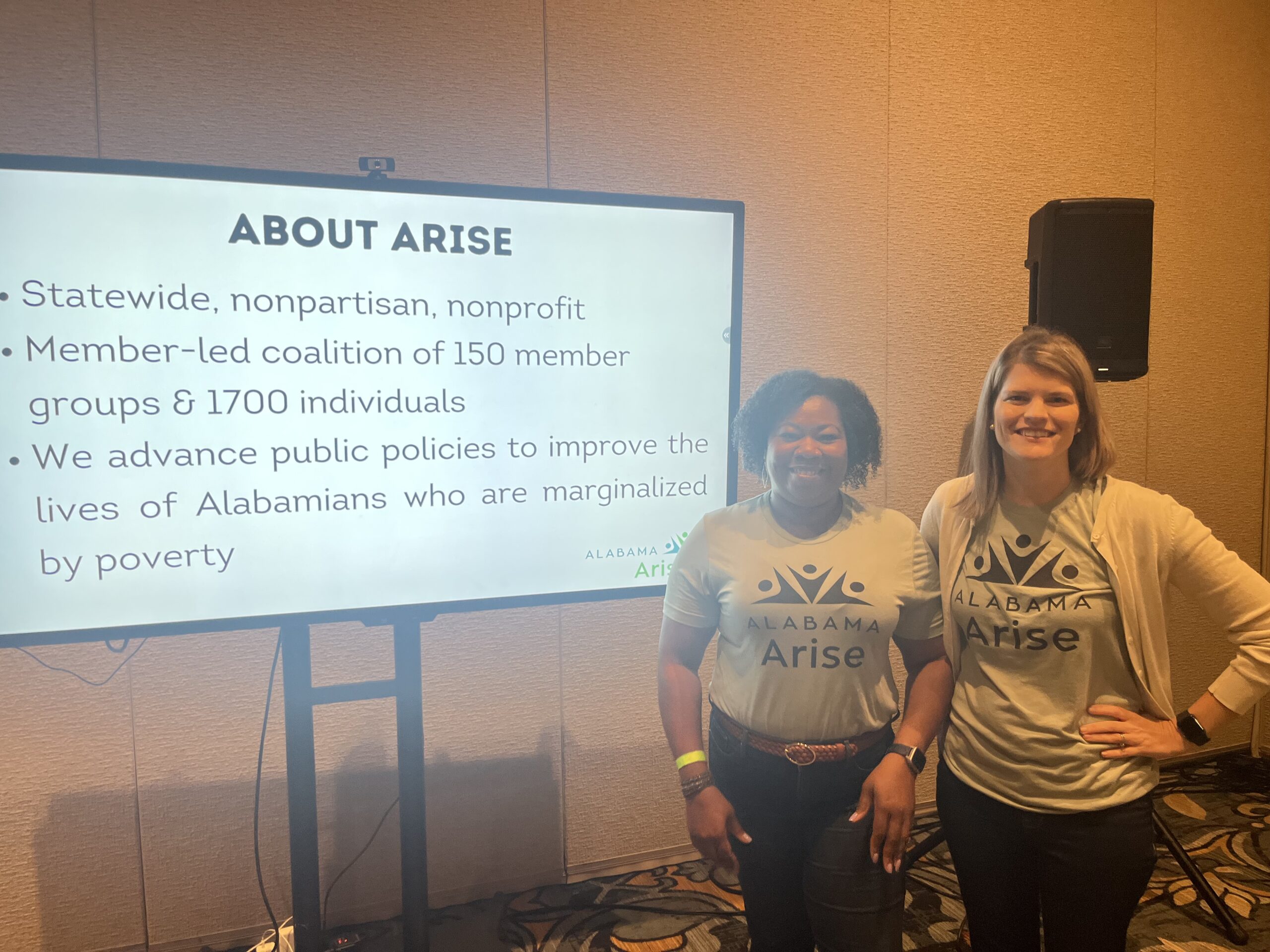
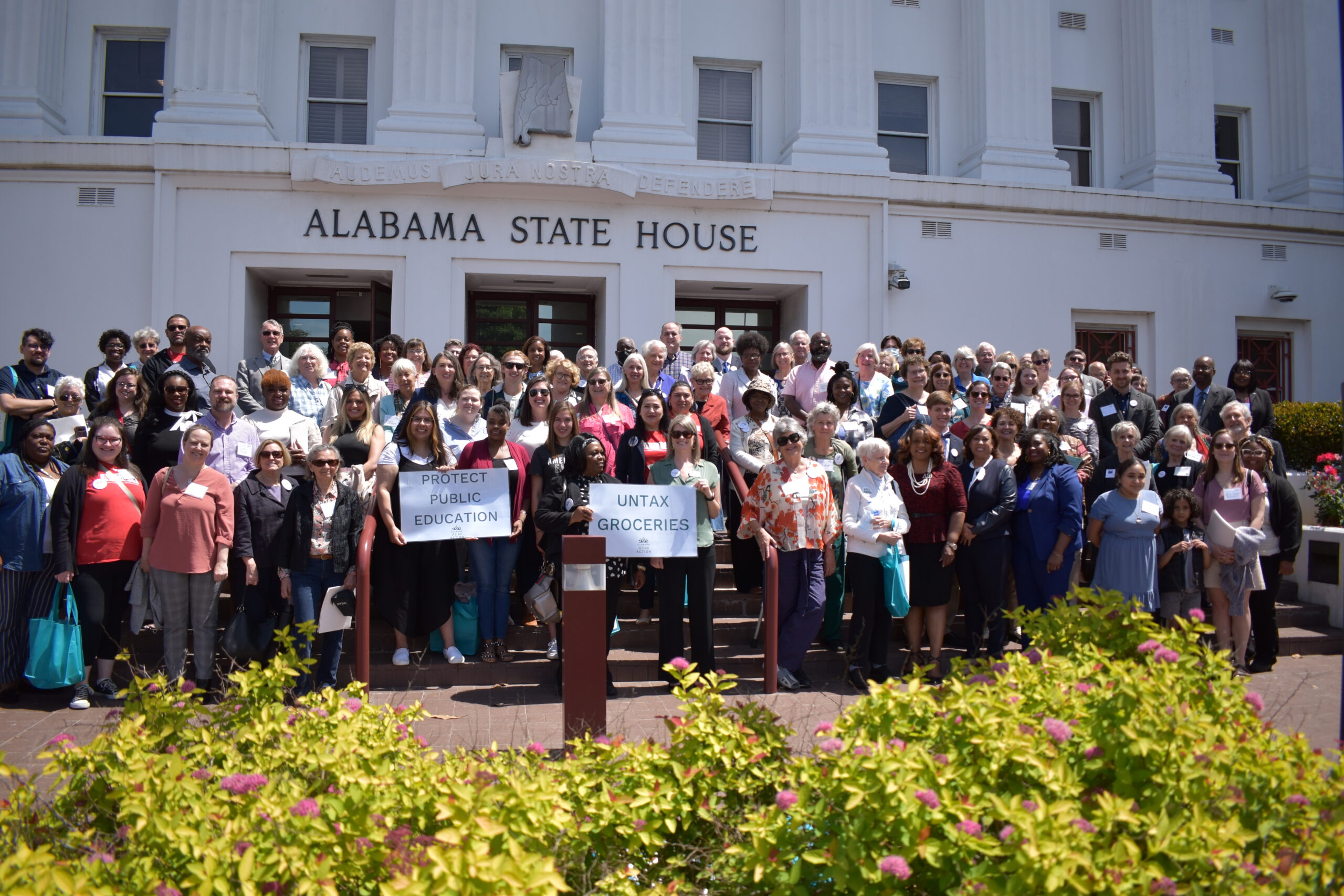
We were excited to see more than 120 people participating in Arise’s 2023 Legislative Day on April 11 in Montgomery. Arise’s longtime push to decrease the state sales tax on groceries took center stage, and our members’ energy was palpable. Our supporters’ passionate advocacy, this year and in so many previous years, got the bill across the finish line! Top photo: Arise members and supporters gather in front of the Alabama State House during our Legislative Day. Next: Arise’s McKenzie Burton (left) and Whitney Washington (right) pose for a photo with longtime Arise member Helen Rivas. Next: Policy analyst Mike Nicholson speaks about criminal justice reform. Next: Arise’s Robyn Hyden (right) and Carol Gundlach (left) and Anna Pritchett of AARP Alabama meet with Sen. Andrew Jones, R-Centre, to thank him for championing the fight to untax groceries.

HB 479 also allows (but does not require) cities and counties to reduce their sales taxes on groceries. The law allows localities that reduce their grocery tax to reverse some or all of that reduction later. But localities cannot increase local grocery taxes above their current rate.

Garrett’s bill emerged late in the session but quickly gained overwhelming bipartisan support. The House passed the bill 103-0 on May 25, and the Senate followed with a 31-0 vote June 1. Gov. Kay Ivey signed the bill into law June 15.

Garrett joined with Sen. Andrew Jones, R-Centre, and Lt. Gov. Will Ainsworth to guide HB 479 through the Legislature. But the bill’s passage also rests on the foundation laid by many other legislative champions through the years. They include former Rep. John Knight, D-Montgomery; former Sen. Hank Sanders, D-Selma; Sen. Merika Coleman, D-Pleasant Grove; and Reps. Laura Hall, D-Huntsville, Penni McClammy, D-Montgomery, and Mary Moore, D-Birmingham.

What comes next in our work to untax groceries

HB 479 is a watershed moment in Arise’s work for tax justice. That work will continue. The bill doesn’t eliminate the entire 4% state grocery tax, and it doesn’t replace the revenue. The state grocery tax is an important funding source for public education, bringing in about $600 million annually. That is about 7% of this year’s ETF budget.

“Revenues are strong enough for now to reduce the grocery tax without causing severe harm to education funding,” Arise executive director Robyn Hyden said. “But history tells us that good economic times won’t last forever.”

Legislators this year created a study commission to recommend sustainable ways to eliminate the rest of the state grocery tax. HJR 243, sponsored by McClammy, requires the commission to report its findings and recommendations by November 2026.

Arise will seize that opportunity to push lawmakers to close tax loopholes skewed in favor of wealthy people and highly profitable corporations. One such loophole is the state income tax deduction for federal income taxes (FIT). Alabama is the only state that still allows a full FIT deduction.

The state grocery tax is a cruel tax on survival that drives many Alabamians deeper into poverty. Arise is committed to building on this year’s success and ending this tax forever. With our members’ continued advocacy and support, that is another vision we’ll turn into reality together.

Allen v. Milligan ruling is a shot in the arm for democracy

Alabamians received good news this month with the U.S. Supreme Court’s decision in Allen v. Milligan. This decision upholds key parts of the Voting Rights Act and requires Alabama to draw new congressional districts by July 21. The Legislature likely will hold a special session in July to approve two majority-Black (or close to majority-Black) districts. Alabama has had only one majority-Black district for decades, diluting the voting power of Black residents.

The ruling came a decade after Shelby County v. Holder, a decision that gutted the Voting Rights Act’s preclearance protections. As we commemorate this anniversary, we are reminded of why protecting Black voting power in Alabama is so critical to achieving our vision of a strong, participatory democracy.

Alabama Arise salutes our partners at Alabama Forward, Alabama NAACP, Greater Birmingham Ministries and ACLU of Alabama for their hard work and vision in the Milligan case. Arise will continue working to advance legislation to protect and strengthen voting rights. And we will keep fighting to ensure that every vote counts and elected officials are accountable to their constituents.

Alabama Arise was thrilled to join Shake the Field, Alabama Forward and other groups for the Democracy Now or Never Festival in Montgomery on June 3. The event sought to promote civic participation in advance of the Allen v. Milligan ruling.

2023 was a momentous session on Alabama Arise policy priorities

June 6 ended one of the most significant legislative sessions ever for Alabama Arise and our supporters. Through timely and persistent advocacy, Arise members helped build a better, more equitable Alabama.

While our work continues, we want to highlight the many important strides this year in our movement for a better Alabama for all – and celebrate Arise members’ role in advancing that goal. This article summarizes some of the key bills on Arise priorities during the Legislature’s 2023 regular session. For information on all bills we tracked this year, visit the Bills of Interest page on our website.

Tax reform

Lawmakers proposed many significant tax reform bills this session. But none will have more lasting significance to Alabamians than reducing the state sales tax on groceries, a longstanding Arise priority. Thanks to phenomenal member advocacy, our state is finally removing part of this regressive tax.

HB 479, sponsored by Rep. Danny Garrett, R-Trussville, became law this year. This legislation will cut the state grocery tax by half in the coming years. This huge victory for tax justice resulted from decades of hard work by Arise members. (See page 1.)

Adequate state budgets

Alabama’s 2024 General Fund (GF) and Education Trust Fund (ETF) budgets are both significantly larger than 2023. The GF budget is about $3 billion and includes a 2% pay raise for state employees. It also includes significant funding increases for Medicaid, mental health care and other state services. The 2024 ETF budget is nearly $8.8 billion, half a billion dollars more than the previous year’s ETF.

HB 295 and SB 202, known as the PRICE Act, were sponsored by Rep. Ernie Yarbrough, R-Trinity, and Sen. Larry Stutts, R-Tuscumbia. These bills would have allowed parents to take tax dollars that otherwise would support local public schools and use them to pay for private schools or home schooling. Arise and other advocates helped defeat this legislation, protecting nearly $600 million of public education funding.

Voting rights

HB 209, sponsored by Rep. Jamie Kiel, R-Russellville, did not pass this session. This bill would have criminalized many efforts to assist voters with absentee ballot applications or completed ballots. Arise and other groups successfully stopped this bill, which passed the House but never reached the Senate floor.

Criminal justice reform

SB 154, sponsored by Sen. Will Barfoot, R-Pike Road, became law this year. This legislation will make it harder for the state to suspend people’s driver’s licenses for failure to pay traffic tickets. Arise and our partners at Alabama Appleseed strongly supported this bill.

HB 24, sponsored by Rep. Reed Ingram, R-Pike Road, passed despite Arise’s opposition. This bill will criminalize asking for money on the side of roads, punishing many Alabamians facing housing insecurity. Federal courts have found similar laws unconstitutional in recent years.

HB 229, sponsored by Rep. Chris England, D-Tuscaloosa, would have allowed resentencing of certain incarcerated individuals sentenced to life imprisonment without parole under Alabama’s Habitual Felony Offender Act. This bill passed the House and gained Senate committee approval, but it never reached the Senate floor. Arise supported this bill and expects a similar one to be filed next session.

Death penalty reform 

England’s HB 14 would have required a unanimous jury sentence to impose the death penalty. The bill also would have made the state’s judicial override ban retroactive. This bill received a public hearing but did not leave the committee. Arise supported this bill and expects a similar one to be filed next session.

Other issues 

SB 196, sponsored by Sen. Arthur Orr, R-Decatur, would have increased government transparency by improving Alabama’s open records process. This bill passed the Senate and gained House committee approval but did not pass in the House. Arise supported this bill and expects a similar one to be filed next session.

SB 242, sponsored by Sen. Keith Kelley, R-Anniston, would have undermined tenant protections by removing the cap on the amount of the security deposit that landlords can charge to renters. Arise opposed this bill, and it died without reaching the Senate floor.

Building momentum for closing the coverage gap

Cover Alabama has built powerful momentum to expand Medicaid and close the state’s health coverage gap in recent months. In March, Alabama Arise’s Cover Alabama campaign held its first in-person Medicaid expansion lobby day. With the participation of 80 passionate individuals, this event created a powerful platform for advocating Medicaid expansion.

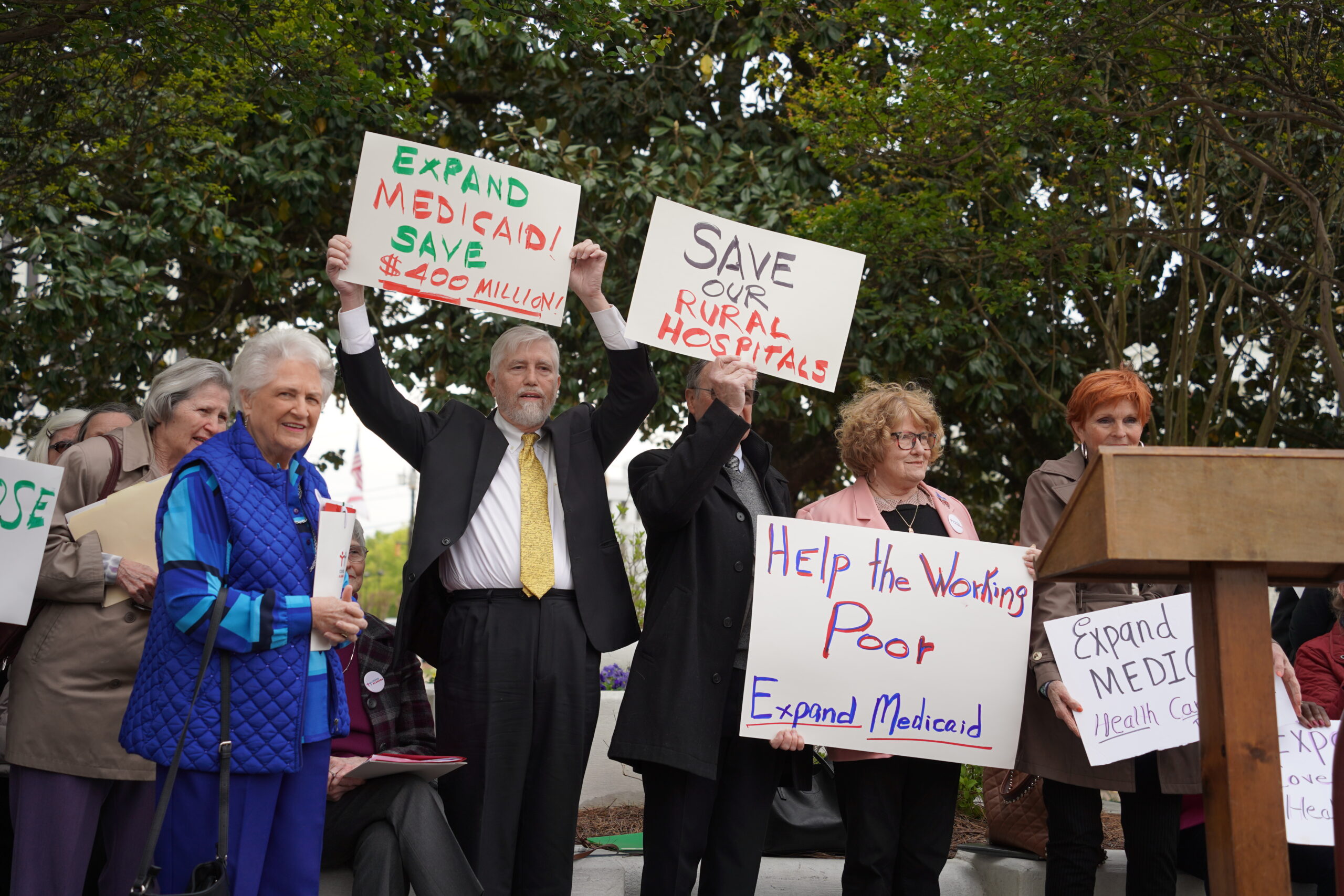
Cover Alabama Lobby Day attendees hold signs showing their support for Medicaid expansion.
Alabama Arise’s Cover Alabama coalition held its first lobby day on March 21 in Montgomery. More than 80 people came to the State House to support our movement for Medicaid expansion. Attendees show signs in support of expanding Medicaid during a news conference.

Alabamians living in the coverage gap – who earn too much to qualify for Medicaid but not enough to qualify for financial help to buy private insurance – shared their personal stories during the rally before engaging in meaningful conversations with their lawmakers. The event garnered great press attention, shining a spotlight on our state’s urgent need to expand health care access.

Other recent wins

In an encouraging development, the House Health Committee held a hearing this year specifically focused on the benefits of closing the coverage gap. This hearing came on the heels of Cover Alabama’s rally. And it marked a significant milestone, as the first time legislators formally discussed Medicaid expansion in a committee hearing. The hearing provided an important platform to educate lawmakers and the public about the positive impact Medicaid expansion can have on our communities.

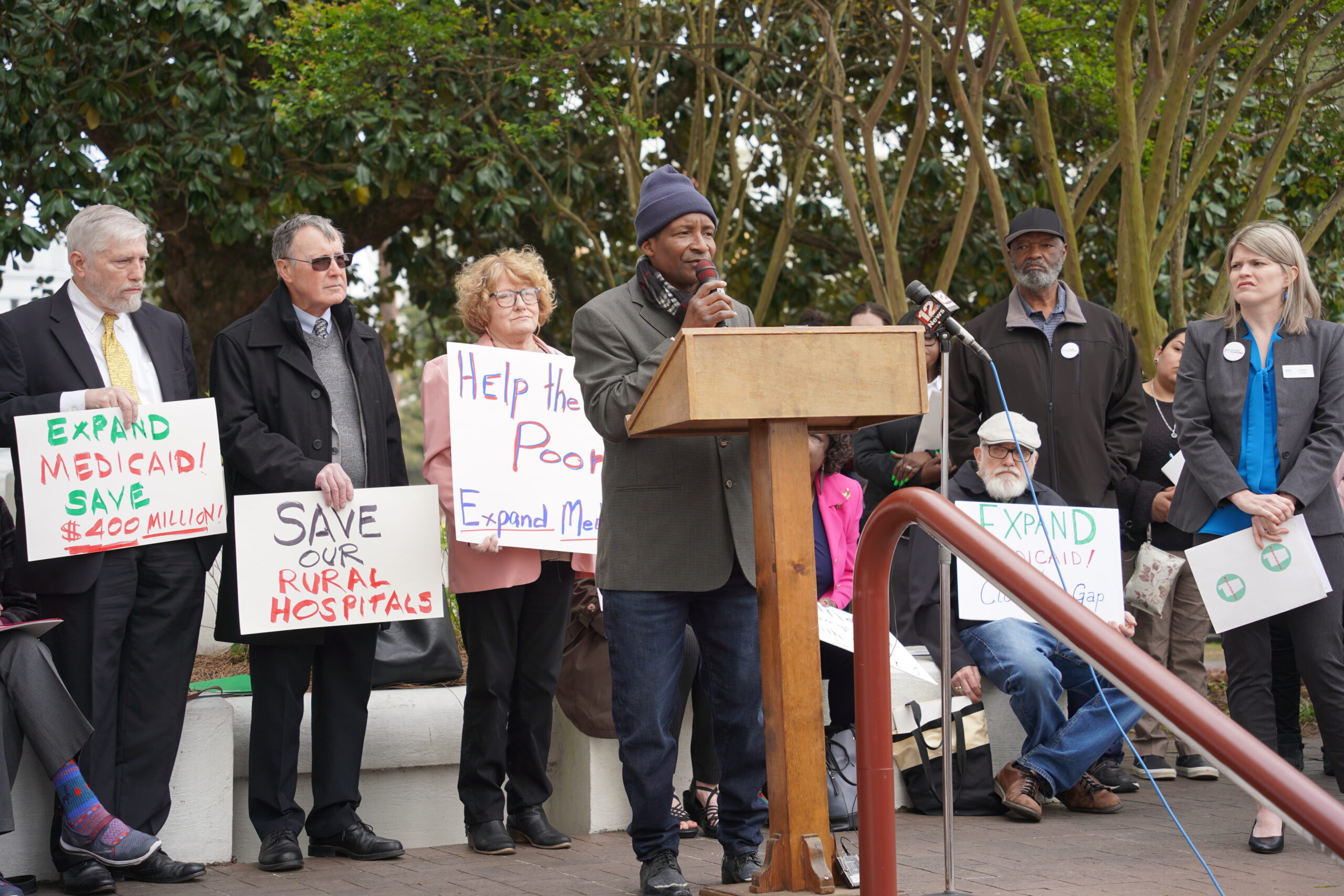
A man stands at a podium to give a speech on Medicaid expansion.
Arise board member Kenneth Tyrone King speaks to the importance of expanding Medicaid to ensure affordable health coverage for nearly 300,000 Alabama adults with low incomes.

Meanwhile, we also celebrated the recent success of North Carolina, which passed Medicaid expansion in March. That move means Alabama is now one of only 10 states that has not yet expanded its Medicaid program.

We are determined to change that. We will continue advocating for our state to join others in providing vital health care access to those in need.

Looking forward

In April, Arise and Cover Alabama partnered with Doctors for America to conduct a highly engaging half-day advocate training session. Fifty people attended the event in Birmingham or online on a Saturday morning. This event equipped our advocates with the knowledge and tools needed to advocate effectively for Medicaid expansion, empowering them to make a difference.

Thank you to each and every one of you for your unwavering support, dedication and passion for health justice. Together, we are making significant strides toward Medicaid expansion in Alabama.

Let’s continue to raise our voices, engage with lawmakers and advocate for equitable health care access for every Alabamian.

Leave a lasting impact

Alabama Arise has set long-term goals like a fairer state tax system and state budgets that provide opportunities for all. Together, we have made meaningful steps toward these goals. And our members – with monthly or one-time gifts – help us keep up the momentum every day. We are so grateful.

However, this vision won’t happen overnight. There’s a type of gift that you probably haven’t considered – one that will ensure you continue to join us in Alabama Arise’s work even past your lifetime. That’s leaving us in your will.

Regardless of your income, making a will is an important step to ensure your end-of-life wishes are known. There are online tools that can help. And consulting a financial planner would be a great idea, too. You don’t even have to tell us that you included us. (Though we would be glad if you did!)

We would love to share sample language or chat about the legacy you want to leave Alabama. Reach out to me at jacob@alarise.org.

Thank you for your ongoing work and contributions to building a better Alabama.

Join us for Town Hall Tuesdays!

Listening has been the key to shaping and advancing public policies that matter most to those suffering because of bad policies. We listened to continued demands to untax groceries in Alabama and realized an important victory this year. Together, we supported the passage of legislation that will reduce the state sales tax on groceries from 4% to 2% as soon as September 2024.

Alabama Arise depends on what we hear to help guide our work toward our vision of a better Alabama for all. Our online Town Hall Tuesdays will return again this year. These events are a chance for participants to hear issue updates and to share their vision for our 2024 priorities.

Please join us this summer to help identify emerging issues and inform our actions. Registration is required for these sessions. You can register for one or both sessions at the links below.

Furthermore, Arise organizers are also available to meet with your group in person. Please email me at pres@alarise.org to schedule a listening session with your area organizer!

July 18, 6 p.m. Building on our vision

Arise members have articulated a vision for Alabama that can be realized because of our commitment and perseverance. Together, we are committed to issues that matter to those marginalized by poverty, and we persevere in raising our voices for change. Join this session to discuss advances we made this year and to hear from each other about potential issues moving forward. Click here to register for this session.

August 8, 6 p.m. – Building on our hope

Together, we continue to be fueled by hope in our vision of a better Alabama for all. This session is another opportunity to discuss the steps forward we have taken and to hear from each other about issues next year. Click here to register for this session.


Arise legislative update: June 7, 2023

The Alabama Legislature’s 2023 regular session has come to a close. Arise’s Akiesha Anderson takes us through some big wins – including reducing the state’s grocery tax! – and other highlights from the session. We want to thank you for speaking out to support good bills and oppose harmful bills. Please visit alarise.org and follow us on social media as we continue to bring you updates throughout the year on our work for a better Alabama.

Medicaid expansion: Alabama’s path to long-term health and financial security

With North Carolina having joined the list of Medicaid expansion states, Alabama remains part of a dwindling group of just 10 states that have not closed the health coverage gap. More states are starting to realize the benefits of Medicaid expansion and finally adopting this life-saving measure.

But Alabama unfortunately remains an outlier. By failing to expand Medicaid, our state continues to jeopardize the health of its people. This means nearly 300,000 hard-working Alabamians continue to struggle to afford health coverage. It means a weakened health care system as rural hospitals become vulnerable to closure. And it means lawmakers are forgoing substantial federal funding that could fortify state budgets.

There’s a better way. Alabama can and should expand Medicaid to save lives, create jobs and boost tax revenues across our state.

Expansion would be a lifeline to struggling Alabamians

The traditional Medicaid program in Alabama has notably one of the strictest eligibility requirements in the country. A parent in a family of three qualifies for Medicaid coverage if their annual income is below 18% of the federal poverty level (FPL), equating to $4,475 a year. 

With expansion, Medicaid would cover all adults with incomes up to 138% FPL, or $34,307 for a family of three. This would include many adults who have no children and are frequently left in the health coverage gap. Most importantly, it also would provide financial relief to Alabamians struggling to afford health care.

Medicaid expansion would ensure health coverage for those who work low-wage jobs and can’t afford other forms of health insurance. It also would benefit workers switching jobs, adults staying home to care for other family members and people with disabilities awaiting SSI determinations. Expansion also would bring in additional federal revenue to invest in communities, rural hospitals and other health care support services.

Gov. Kay Ivey has the authority to begin Medicaid expansion administratively without legislation. Yet the governor’s spokesperson recently said, “The governor’s concern remains how the state would pay for it long-term.”

This blog post answers that question. It highlights how Medicaid expansion would keep hard-working Alabamians healthy and help rural hospitals remain open to serve their communities.

Fortifying the General Fund

Alabama’s budgeting structure is different from most states. However, this should not prevent the state from affording expansion in the long term.

Alabama is one of five states to have two separate budgets: the General Fund (GF) and Education Trust Fund (ETF). The ETF, created to prioritize education, receives state sales tax and individual income tax revenues, and is the state’s largest operating fund. The ETF makes up around 75% of the two combined budgets.

Under traditional Medicaid expansion, the federal government commits to paying 90% of the cost for new Medicaid members. States must cover only the remaining 10%. In other states, Medicaid expansion fueled more jobs and increased revenues that contributed to covering states’ share of expansion costs.

In Alabama, those increased revenues would be allocated to the ETF. This however, does not mean the GF, which finances non-education services (including Medicaid), would suffer due to expansion. Instead, because of increased incentives, Alabama would receive a federal signing bonus to cover expansion costs for several years.

Bringing federal tax dollars back home

Alabamians, like people across the country, contribute tax dollars each year that fund Medicaid expansion in states that already have adopted the program. However, Alabamians do not see those tax dollars coming back home. Ivey can bring those tax dollars back to Alabama as the federal government covers 90% of Medicaid expansion’s costs.

Without expansion, Alabama spent $7.7 billion in fiscal year 2020 on Medicaid. This money came from three main sources: the GF (10% of Medicaid’s funding), other state share sources (14%) and federal funds (76%).

These substantial federal funds result from the federal medical assistance percentage (FMAP) calculation. Alabama’s FMAP is projected to be 73.96% in 2024. That means the state will be responsible for funding 26.04% of the regular Medicaid program.

While federal funds already make up the vast majority of the state’s Medicaid funding, Alabama is leaving an estimated $619.4 million more in federal funding on the table by not expanding Medicaid. Under the American Rescue Plan Act (ARPA), states that finally adopt expansion will receive a signing bonus in the form of an additional 5% FMAP increase for the regular or already enrolled Medicaid population for two years.

In other words, once Alabama expands Medicaid, its federal match would increase to around 78.96% for two years. Alabama’s costs for the current program would fall to 21.04% for those years. On top of this, the federal government would pay 90 cents of every $1 of the cost to cover people newly covered by Medicaid expansion. And that 90% federal match would be permanent. This is a deal Alabama simply cannot afford to pass up.

Additional state savings that support the General Fund

Expansion also would help Alabama realize significant GF savings through a more generous federal match rate for services that the state already funds. Alabama pays for anywhere from 26% to 100% of the cost of these services now. These services include coverage for pregnant women, the Breast and Cervical Cancer Treatment Program, family planning services, mental health and substance use programs, and inpatient care for incarcerated people. 

But after expansion, the federal government would cover 90% of the cost of these services for the expansion population. This would reduce the state share to 10% for those Medicaid members. For example, if Alabama expanded Medicaid, the state could reduce its cost to provide Medicaid coverage for pregnant people by an average of $30.5 million per year over the next six years.

Alongside a reduction in uncompensated care, these savings are projected to save the state $266 million over the next six years after expansion. These substantial savings would help support the GF for years, offsetting costs after the two-year FMAP bump ends.

As a result, Alabama would have a net $41 million extra per year after paying for the cost of Medicaid expansion.

Keeping rural hospitals open

Rural hospitals and providers are facing a funding crisis right now. This is especially true in states that have not yet adopted Medicaid expansion, which would provide financial relief to Alabama’s rural hospitals at risk of closing. North Carolina’s Republican lawmakers emphasized rural hospital closures as one reason they expanded Medicaid now after 10 years of resistance.

Between 2011 and 2020, eight Alabama hospitals closed, leaving many communities stranded without adequate health care access nearby. Following the onset of the COVID-19 pandemic, Congress passed legislation to provide temporary funding relief and a provider relief fund to support rural hospitals and keep them open.

These funds slowed the rate of rural hospital closures to its lowest point since 2010. They also enabled rural hospitals to continue operating during a time when communities needed them most. However, this temporary funding has ended, putting rural hospitals at risk of negative operating margins and closures once again.

Medicaid expansion is an important step to keep hospitals open. Being in an expansion state decreases the likelihood of hospital closure by 62%. Expansion also sharply reduces uncompensated care, or services for which hospitals or health care providers are not reimbursed by some type of health insurance. Uncompensated care is a primary reason for hospitals having worse operating margins and closing.

In a year when uncompensated care could skyrocket as the pandemic’s continuous coverage requirement ends, expansion is the solution Alabama needs to protect rural hospitals and communities. With at least 15 rural hospitals at imminent risk of closing in Alabama, it’s crucial for state lawmakers to consider the importance of expansion to keep rural hospital doors open and provide critical care to rural communities.

Supporting hard-working Alabamians

Medicaid expansion is designed to support hard-working Alabamians who have no other opportunities for health coverage. Single parents working multiple jobs to make ends meet for their family are often who benefit the most from expansion.

Alabama has a total of 79,000 uninsured adults in the labor force. Additionally, 40,000 people in Alabama are parents with children at home, including one-third who have a child under 5. Many of these individuals may serve as unpaid caregivers, needing Medicaid coverage to keep themselves and their families healthy, while also being unable to meet stringent work reporting requirements.

Medicaid expansion would be a valuable tool to help people find work or stay employed. Medicaid coverage has proved helpful to unemployed individuals as they look for work. And Medicaid coverage has helped employed people keep working and perform better at work.

Additionally, a survey found that 81% of non-disabled people with young children worked in the past year. Proposals to add work reporting requirements to Medicaid have one main effect: causing people who already are working or who should be exempt from the requirements to lose their critical Medicaid coverage due to burdensome paperwork and administrative barriers. Thousands of Alabamians are working hard and in desperate need of the health coverage Medicaid expansion would provide.

Medicaid expansion is a vitally needed policy that would keep Alabamians with low incomes healthier. It would help rural hospitals and providers remain open to serve their communities. And it would fortify the GF due to increased federal investment. Ivey and Alabama lawmakers should put the people of Alabama first by expanding Medicaid.

Arise legislative update: May 30, 2023

As the Alabama Legislature’s 2023 regular session begins to wind down, Arise’s Carol Gundlach looks at the House passage of HB 479, a major breakthrough on our longtime goal of reducing the state sales tax on groceries. She also discusses four major budget bills headed to the governor’s desk.

Arise legislative update: May 22, 2023

Arise’s Akiesha Anderson shares some good news from last week’s action at the Alabama Legislature. Those breakthroughs include the introduction of a House bill to reduce the state grocery tax, with nearly every representative joining as a co-sponsor. We also saw progress on several criminal justice reform bills, including the passage of SB 154, which will ensure far fewer Alabamians will have their driver’s licenses suspended due to inability to pay fines or fees.