
Arise’s Mike Nicholson gives an update on the new congressional map that the U.S. District Court approved as a remedy in Alabama’s redistricting case last week. That order came after federal judges ruled that both the state’s original map and the revised one that the Legislature passed during a special session in July likely did not comply with the Voting Rights Act. Mike discusses why the court chose the new map and what it may mean for future elections.
Category: Blog
Here’s what Alabama Arise heard from you in summer 2023!
Alabama Arise listens because we deeply value the input we get from members, partners and most importantly, those directly affected by the work we do together. We depend on what we hear to help guide our issue work and our strategies.
We held three statewide online events this summer: two Town Hall Tuesdays and one public transportation listening session. And we facilitated eight additional listening sessions around the state, engaging a total of about 375 people.
The town halls happened on July 18 and Aug. 8, and the public transit event was Aug. 9. Other meetings took place throughout the summer. This year we are sharing the direct notes and highlights from each of the meetings as recorded during the sessions.
Town Hall Tuesdays & Public Transportation Listening Session
- Building on our vision: We had three breakout rooms during this session. We asked folks in each group to discuss their thoughts on current issues and to share other priorities they had. Here’s what we heard:
Group One: Participants generally thought Arise should continue working on the current issues. They noted that the issues are interconnected, and that makes it hard to prioritize. Concerns about criminal justice conviction practices were raised, along with the need for continued work on voting rights and Medicaid expansion. Other issues raised were the need for more affordable housing, paying a living wage versus a minimum wage, and the need to discuss the impact of the opioid epidemic on grandparents now raising children because their parents suffer with addiction. Participants also raised reapportionment as an important issue.
Group Two: Participants strongly believed all of the Arise priority issues are important and that we should continue to work on them. Some of the specific issues lifted up were transportation, voting rights, payday lending and Medicaid expansion. Some issues that are not current Arise priorities raised were housing, disability, mental health access and accountability and prison reform.
Group Three: Medicaid expansion received the most support for continued work. Several people voiced prisons and criminal justice as a concern, including the need for prison reform and bail reform. Voting rights and the concern about the many voter suppression bills was a high-priority topic. Participants discussed passionate concern about payday loans, and the group supported the present slate of issues.
- Building on our hope: We had three breakout rooms during this session. We asked folks in each group to discuss what motivates them to act on issues and how Arise supports their actions. We also asked them to indicate their priority issues. Here’s what we heard:
Group One:
- The discussion in the group was hot and heavy concerning voting rights and specifically the absentee ballot application. The group concluded that a no-excuse absentee ballot should be the norm and should be an Arise issue for 2024.
- The group felt strongly that the 2023 Arise slate of issues should all remain on the 2024 list of Arise priority issues. Medicaid is an issue we need to keep fighting for, they said.
- This group had a primary focus and lengthy discussion around voting rights.
Group Two:
- All members of the group strongly believe all the Arise priority issues are important and that we should continue to work on them.
- Members also strongly believe affordable housing and public transportation should receive a strong voice like Medicaid expansion.
- Members said that to further our support of advocacy work, Arise can help unite nonprofits and grassroots organizations across the state to work together toward shared goals as opposed to working separately toward shared goals.
- Members lifted up our education and lobbying work as essential to connecting the people to those who represent them in the Legislature.
Group Three: Voting rights emerged as a strong theme from this group’s discussion. Participants stressed the importance of voter education and folks making the connection between voting and the policies elected officials make that impact their lives. Other voting themes included restoration of voting rights and engaging younger and BIPOC voters. Other issues raised were around public transportation and the need to fund mental health services. One participant expressed appreciation for the storytelling work Arise does related to Medicaid expansion and urged similar storytelling to help move elected officials around other Arise issues.
- Public Transportation Listening Session: We had three breakout rooms during this session. We asked folks in each group to discuss what’s needed to improve public transit in Alabama, what strategies are needed to move the issue forward and how public transit impacts quality of life in their communities.
Group One:
- Private companies like Uber and Lyft are not equipped to serve the disability community, group members said. This is very important when talking about transportation for the disability community wherever they may be, rural or urban. In other words, the private companies are not a viable resource, participants said.
- Rural linkage: Many rural counties have transportation-on-demand systems, but they only serve the county boundaries. Many health services reside in urban centers, and the rider needs to get from Blount County to UAB or Children’s Hospital in Birmingham. These riders are out of luck. Transfer hubs for rural to urban systems do not exist.
- A state transportation planning system is needed to coordinate all the existing public systems, rural and urban. Participants hoped Arise’s forthcoming transit study will shine some light on the need for a statewide public transportation planning entity.
- The group felt a need for massive public education around the benefits of public transportation. Somehow, Arise or a group of organizations should seek funding for an advertising budget, participants said.
- The real cost of owning a car versus using public transportation. This kind of information should be available to the public.
- The fact that public transportation is good for business development throughout the state should be targeted to legislators and local business councils and chambers of commerce.
Group Two:
- This group believes public transportation is essential.
- There is a need for more hubs and covered stops for locations that already have public transportation in place.
- There is a need for more routes with more frequent buses each hour, as well as drivers who are paid livable wages.
- Specific strategies discussed included working with for-profits, chambers of commerce, small businesses and corporations to improve transportation for their employees. Participants also suggested surveying the need for transportation by including a question on applications to ask if transportation is needed.
- Public transportation impacts the quality of life across the board: health, food, employment, education, leisure, etc.
- People have a right to comfort, dignity, pride and independence that public transportation can provide.
- One member said reaching out to people who do not need or use public transportation is important to educate them that they can still benefit from it. It helps reduce traffic and road congestion, decreases likelihood of drinking and driving, and helps people out of desperate situations, which can help decrease poverty and crime.
- A member of the Alabama Institute for the Deaf and Blind shared how losing the ability to drive caused depression. But oppression is felt when there are no options for transportation other than relying on friends or family if you have them, or simply being unable to go to doctor’s appointments, shop for groceries or pick up medications when needed.
- Some members suggested a public Lyft/Uber service.
Group Three:
- Needs: Money/state funding, alternative models, transit-oriented development at local levels, accessibility, buy-in from agencies like ALDOT, changed perception of public transit.
- Strategies/tactics: Collect public transit stories, share statistics on earning power with vs. without good public transit and other data relevant to workforce development, and highlight workforce development as a theme for legislative lobbying. Participants discussed a license plate fee, tire fee or special license plate (like public schools have, for example).
- Quality of life: A visually impaired participant described how a trip to the grocery store or polling place only a couple miles away is a $25 Uber ride one way. Another participant who works with clients described how their lack of access to public transit affects not just work but health appointments, visiting DHR to secure SNAP, applications for housing, etc. They also mentioned that even “low-cost” transit can be a barrier to low-income folks who may not have a dollar for a ride.
Additional listening sessions
Following are the brief notes/summaries from eight other sessions our organizers held during the summer. In general, all participants strongly affirmed Arise’s work on the current issue priorities. They also highlighted some other issues of concern.
- Cullman, July 26 (Stan Johnson) – This was a well-informed group with a lot of comments and questions concerning criminal justice, public transportation, death penalty and new prison construction.
- Opelika, July 26 (Formeeca Tripp) – This group discussed issues surrounding housing, transportation, food insecurity, health care and the legal system. Housing was a top issue.
- Zoom, Aug. 3 (Formeeca) – A death penalty group discussed issues related to recent executions in Alabama, as well as upcoming executions nationwide. Participants said more attention and connections are necessary to bring more awareness to death penalty reform.
- Tuscaloosa, Aug. 7 (Stan) – The most passionate suggestion from this meeting was the need for legislative action to provide funding for mental health.
- Opelika, Aug. 17 (Formeeca) – Arise conducted listening sessions in the form of a series of small group meetings.
Group 1: Predominantly parents, people of the community and law enforcement. They supported all current issues but wanted to focus on housing and transportation.
Group 2: Predominantly school staff, counselors, superintendents, principals, resource providers, etc. They wanted resources for non-English-speaking families, housing, transportation and effective mental health services.
Group 3: Predominantly youth, teenagers and support staff. They wanted to learn more about their representatives and how to lift up their own voices, as well as better wages and job opportunities.
- Montgomery, Aug. 17 (Formeeca) – This group discussed their strategic plan to add to the existing public transportation priority issue. They want to add a $1 fee to license plates to fund the Public Transportation Trust Fund.
- Birmingham, Sept. 10 (Stan) – This group showed special interest in fair housing and criminal justice reform. Voting rights also was a concern to the group, specifically absentee voting bills that may be reintroduced in the upcoming session.
- Auburn, Sept. 21 (Formeeca) – Students from an Auburn University class filled out a 2024 issue proposal survey form asking them to rank issues of priority. The top three issues that seemed to rank the highest were public transportation, voting rights and criminal justice reform.
Alabama’s grocery tax reduction now in effect
Alabama has taken an important first step toward untaxing groceries. HB 479 took effect Sept. 1, reducing the state sales tax on groceries from 4% to 3%. The law will reduce the tax by another percentage point as soon as September 2024, as long as Education Trust Fund (ETF) revenues grow by at least 3.5% over the previous year. This policy change will help families keep food on the table and ease financial strain for Alabamians with low incomes.
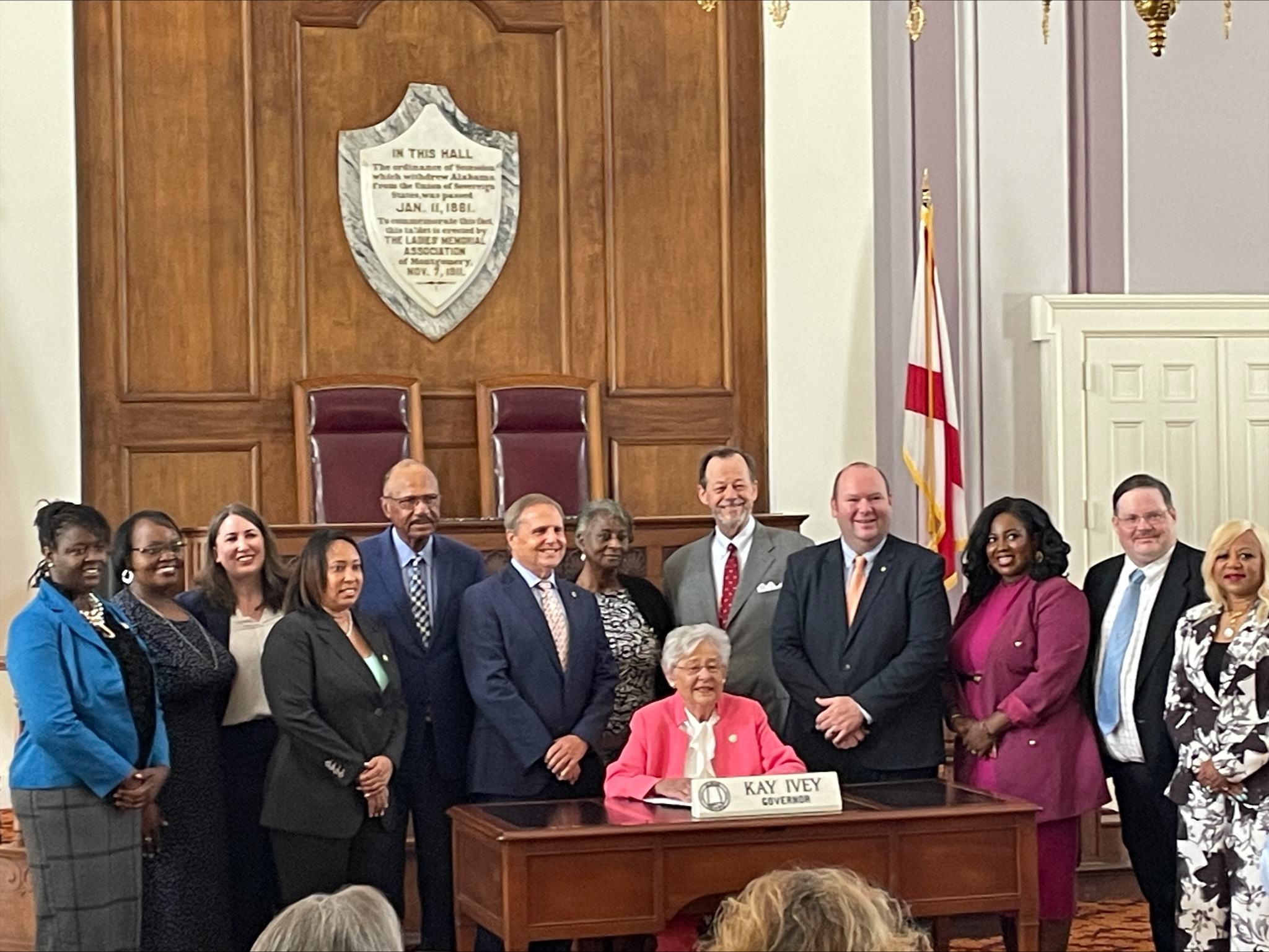
The law’s enactment came after decades of persistent advocacy by Alabama Arise members. Several Arise staff members celebrated at a ceremonial bill signing July 20 at the State Capitol in Montgomery. Numerous legislative champions also attended the event, including Sen. Andrew Jones, R-Centre; Reps. Danny Garrett, R-Trussville, and Penni McClammy, D-Montgomery; and former Rep. John Knight, D-Montgomery.
Arise remains committed to eliminating the rest of the state grocery tax responsibly and sustainably. Those efforts will include working with policymakers to protect ETF funding by closing tax loopholes skewed in favor of wealthy households and highly profitable corporations.
Arise legislative update: Update on Alabama redistricting case
The Alabama redistricting lawsuit continued this week as a federal court struck down the state’s congressional map once again. The Legislature approved the map in July after a U.S. Supreme Court ruling that the state’s original map likely violated the Voting Rights Act. But federal judges this week said the new map still failed to comply with the act. Arise’s Akiesha Anderson gives an update on what happened and what’s to come in Alabama’s redistricting case.
An Arise tradition: the member-led agenda
Something interesting is happening in the world of policy organizations. After years of many think tanks working behind the scenes to set their policy agendas with little transparency or buy-in from regular people, many of our peer organizations are now realizing the best policies are those informed by the people closest to the problems.
Research and data analysis have important roles to play in any new policy formulation or advocacy campaign. But they alone can’t tell us what needs to happen to improve conditions on the ground.
Thankfully, Alabama Arise is ahead of the curve. Thirty-five years ago, Arise’s founders knew we couldn’t truly work to advance people-centered policies in Montgomery without actually working with and talking to, well, regular people. That is why we are unique among many of our peers in having a policy agenda driven and guided by our membership and directly impacted people across our state.
Driven and guided by the people
I’m proud that with your support, we’ve invested over the years in listening, fostering community conversations and seeking answers to address economic and social justice from everyday Alabamians. Our Annual Meeting and voting process are an important part of this tradition.
Public policy should not be only the purview of the wealthy, white, well-connected or well-heeled. That kind of thinking has created the problems and inequities we are fighting. Instead, the best policies to address economic hardship and poverty are those driven and guided by the people who are struggling just to get by, and by those working on the front lines to advance justice. Every year we invite you, our members, to vote on our annual legislative agenda to ensure our policy goals align with those of everyday Alabamians.
If you have not yet joined us in this process, I hope you will. Join our 2023 Annual Meeting on Sept. 30 to hear from volunteers and leaders across our state. Then participate in voting to select our 2024 legislative agenda!
Arise thrives on its membership
When you give to Alabama Arise, you join as a member. We’re grateful for your giving: A significant percentage of our financial support comes from people like you. And we’re especially grateful for your membership.
Our members are important to us because, as we often say, people are our power. This month, members are coming together at our Annual Meeting to vote on our legislative priorities, approve our budget and elect our board of directors.
Because of this, we like to report regularly on who our members are. We have 1,412 members across the state in nearly three-quarters of Alabama counties. Through our membership survey (which you can fill out at bit.ly/alarise), we know our membership is 22% people with low incomes, 5% people under age 30 and 23% people of color.
Part of this membership is a dedicated group who sustain our work year-round. These are our recurring donors. More than 200 people give monthly to Arise, because they know it’s important for us to have the flexibility needed to focus year-round on the priorities our members choose.
Will you join this dedicated group? Visit alarise.org/donate to set up a recurring gift online or to access the monthly bank transfer form. Thank you for being a member!
Medicaid expansion would help working Alabamians
Medicaid expansion is a proven solution to help people join and stay in the workforce, a new report from Community Catalyst spotlights. States that have expanded Medicaid have seen a greater increase in labor force participation among people with incomes below 138% of the poverty line than states – like Alabama – that have not expanded.
“Every Alabamian should be able to get the medical care they need to survive and thrive,” said Debbie Smith, Alabama Arise’s Cover Alabama campaign director. “Removing financial barriers to health care would make our workforce more robust and more productive. It’s time for Alabama policymakers to close the health coverage gap and invest in a healthier future for our state and for our people.”
Nearly half of Alabama workers do not get employer-sponsored health insurance, the Catalyst report finds. This forces tens of thousands of Alabama families to make tough decisions, either to forgo needed health care or take on thousands of dollars of medical debt. When Alabamians are delaying the care and treatment they need, that hurts their productivity and their well-being.
The need for expansion is especially urgent right now as state officials unwind COVID-19 pandemic-era Medicaid policies, leaving about 61,000 Alabamians at risk of losing their Medicaid. Without Medicaid expansion in the state, many more individuals and families will be left with no options for affordable health coverage.
Closing Alabama’s coverage gap could create an average of 20,083 new jobs per year and have an estimated positive economic impact of $11.36 billion over the next six years. Medicaid expansion would be one key solution to improving workforce participation across the state.
Arise legislative update: Recap of Alabama redistricting hearing
The ongoing lawsuit over Alabama’s congressional map returned to federal court this week. Arise’s Mike Nicholson attended the U.S. District Court’s redistricting hearing in Birmingham on Aug. 14.
In this video update, Mike provides background on the case, which returned to district court after the U.S. Supreme Court’s decision in Allen v. Milligan. He also talks about the frustration that many people at the hearing seemed to feel in response to the state’s arguments. Judges questioned whether Alabama’s revised map complied with their order for lawmakers to draw two districts where Black voters have a realistic opportunity to elect a candidate of their preference.
This week’s hearing followed a July special session during which the Legislature drew a new congressional map in response to the Allen v. Milligan ruling. That decision found that Alabama’s congressional districts likely violated the Voting Rights Act by diluting the power of Black voters. Plaintiffs said lawmakers’ new map also violates the act and urged the court to appoint a special master to draw Alabama’s congressional districts.
See the Gap: How Medicaid expansion would benefit stylists – and every Alabamian
Over the last year, Alabama Arise has collected the stories of some of the nearly 10,000 personal care workers who would benefit from Medicaid expansion in our state. We spent months getting to know folks in one of our state’s most vibrant industries. And we want to be sure you see the last few stories in this series.
You can find all of our See the Gap stories in one place here.
We kicked off our series with a personal story about how beauty professionals make sacrifices to support us, but often have no safety net of their own. That’s especially true when it comes to having access to affordable health care for themselves or their families.
Now, as we close the series, we’re lifting up even more stories that speak to a vital question: “How would life be better for so many people if Alabama expanded Medicaid?”
Stories from Alabama’s coverage gap
Like Kayla, a young stylist who is at the pinnacle of her career. Even so, she has reservations about becoming pregnant and having a child while she has no health insurance. There are some possibilities that she just can’t afford.

Or Eryn Mullins, a new mom from Sumiton. She opened up to share her heart-wrenching story of navigating the mental health landscape in our state as a new stylist with no employer-provided health coverage. She needed help but couldn’t afford it.
The stories didn’t stop there. We highlighted the challenges facing many stylists seeking mental health care. We spoke to LGBTQ stylists about sacrifices they make both professionally and personally when it comes to finding care safely. And in our final piece in the See the Gap series, we talked to salon owners about what our state can and should do to improve lives and protect the health of those working in the beauty industry.
A path forward to close the coverage gap in Alabama
Hundreds of thousands of Alabamians are in the health coverage gap. Most of them are working at low-paid but essential jobs. They’re folks we see every day but may not realize are living without access to health care. Medicaid expansion would ensure they have the health coverage they need to survive and thrive.
With so many working folks in the gap, Medicaid expansion is an essential solution to save lives and make Alabama a healthier place. It would help real people across our state. And it would be an enormous financial boost for workers and businesses.
Expanding Medicaid would provide our state with more than $400 million a year to provide more than 280,000 people with health coverage. Click here to see the economic impact in our state, and click here to see it in your county.

Read the final story in our See the Gap series.
We encourage y’all to share these stories with state leaders in your district, as well as Gov. Kay Ivey. There’s never been a better time to, as Mert said herself, create more revenue for local businesses and put more money into workers’ pockets.
It’s been a privilege to collect these powerful stories and share them with the world. And we can’t wait to tell even more stories in the months to come. Thank you for your support of Arise and for being part of our work to make life better for all Alabamians.
Arise legislative update: Recap of 2023 redistricting special session
Arise’s Akiesha Anderson provides an update after the Alabama Legislature’s weeklong special session that focused on redistricting. The special session was in response to the U.S. Supreme Court’s ruling in Allen v. Milligan, which found that Alabama’s congressional districts likely violated the Voting Rights Act by diluting the power of Black voters. Akiesha also discusses what may happen next as the state’s new map faces a likely change in federal court next month.