
What Medicaid members need to know about Alabama Medicaid’s ‘unwinding’

After a continuous enrollment period brought about by the COVID-19 pandemic, Alabama Medicaid has begun an unwinding process. This “unwinding” will end Medicaid coverage for Medicaid members who don’t meet certain criteria. Read below to find out more about this process, including when and how Medicaid members will need to certify their eligibility. Click here for more about the unwinding and what state officials can do to help protect health coverage in Alabama.

(1) What is the unwinding? The unwinding is a reevaluation of Medicaid eligibility for all Medicaid members. Under federal law, all Medicaid members have been continuously enrolled since March 2020 unless they requested in writing to be removed, moved out of state or died. Enrollment was continuous due to the public health emergency (PHE) prompted by the pandemic. However, after the federal government announced the PHE’s end, the unwinding process began.

(2) Why is Medicaid unwinding? To help prevent health coverage losses during the pandemic, Medicaid members received continuous coverage. Continuous coverage meant that once someone was on the Medicaid rolls, they could remain even if they failed to maintain traditional eligibility requirements. However, the PHE ended May 11, 2023, and continuous eligibility enrollment ended before that on March 31, 2023.

(3) How is Medicaid unwinding? Beginning April 1, 2023, Alabama Medicaid began requiring all Medicaid members to verify eligibility requirements in their renewal month. Alabama Medicaid will notify members via mail prior to their enrollment month.

Medicaid members may verify their enrollment month via the Medicaid recipient portal. Alabama Medicaid also encourages members to update contact information and opt in to receive text or email updates.

(4) How can Medicaid members keep their Medicaid benefits? First, Medicaid members should ensure Medicaid has their current mailing address. People can update their contact information in the recipient portal or by calling 800-362-1504. Second, Medicaid members should be sure to respond to any mailing request from Alabama Medicaid with the information needed to verify eligibility. This response should occur within 60 days of the date listed on the mailing. It is important for Medicaid members to know that Medicaid will only initiate information requests via postal mail. People can contact their local Medicaid office or call 800-362-1504 for more information.
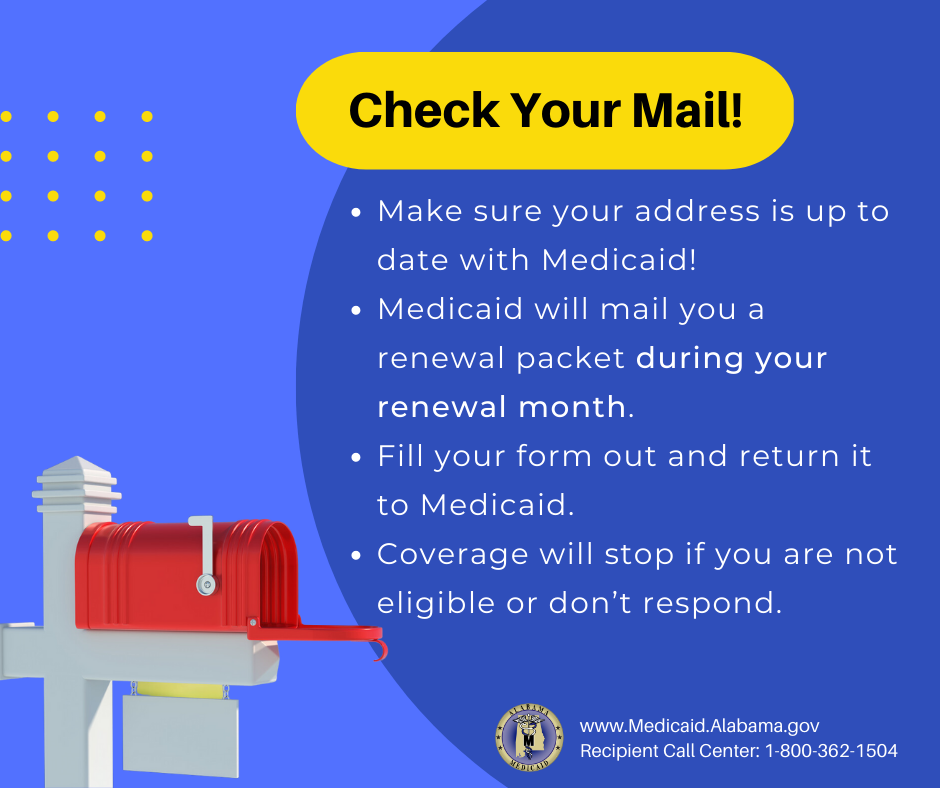
A notice from Alabama Medicaid to check your mail for important information beginning April 1.

(5) How will Medicaid determine eligibility? Medicaid will determine eligibility based on each Medicaid program and eligibility category. More information about those programs and categories is available here. Each has specific requirements that must be met. Medicaid will verify eligibility for each person now enrolled and for new applicants in each program or category.

(6) What if a person is no longer eligible for Medicaid benefits? Current Medicaid members who lose their health coverage during the unwinding period will receive a determination letter stating a loss of eligibility and providing a termination date for coverage. Medicaid members may appeal this determination if they believe they are in fact still eligible for Medicaid coverage. Anyone who is no longer eligible for Medicaid benefits can learn about other insurance options that may be available by visiting Enroll Alabama’s website or dialing 211 from their phone.

Arise legislative update: May 15, 2023

Arise’s Akiesha Anderson breaks down recent developments at the Alabama Legislature, including the committee approval of a troubling bill that could redirect a large amount of public school funding to private schools. She also discusses legislation we’re excited about, including the continuing progress of a bill that would greatly reduce the number of driver’s license suspensions due to unpaid fines or fees.

Arise legislative update: May 8, 2023

Arise’s Robyn Hyden provides an update on recent action at the Alabama Legislature, including why we support the latest proposal to reduce the state grocery tax. She also discusses how lawmakers made positive changes to the Education Trust Fund budget and why we oppose bills that would limit voting rights and make life harder for unhoused Alabamians.

Arise legislative update: May 1, 2023

Arise’s Mike Nicholson provides an update on a few criminal justice bills in the Alabama Legislature’s 2023 regular session, including one to end many debt-based driver’s license suspensions. He also explains ways Arise is providing up-to-date information on bills we’re watching and how you can get involved with our movement for change.

Arise legislative update: April 24, 2023

Arise’s Carol Gundlach discusses what we’re watching for as the 2024 General Fund budget advances to the House floor. She also reviews the package of business tax breaks that the Alabama Legislature enacted last week.

Alabama lawmakers allocated the state’s final $1 billion of ARPA funds. What comes next?

As the Alabama Legislature begins to craft the 2024 General Fund budget, decisions made during last month’s special session should provide lawmakers with more flexibility to meet ongoing needs for our state. With additional near-term funding already in place for key priorities, legislators should seize the opportunity to improve the quality of life for every Alabamian. Investments that would further this goal include providing funds for public infrastructure like Medicaid expansion and public transportation.

On March 16, Gov. Kay Ivey signed HB 1 to end the special session she called to distribute the remaining federal funds that Alabama received under the American Rescue Plan Act (ARPA). This act provided states with federal funding to help cover losses and expenses incurred because of the COVID-19 pandemic. Lawmakers previously distributed the majority of the funds, leaving $1.06 billion to be allocated in this year’s special session.

Arise priorities eligible for funding

The Department of Finance received $55 million in ARPA funding for direct services for people likely to face economic hardship. These categories include older Alabamians and victims of domestic violence. Service providers will receive this money through departmental grants.

Further available categories for this funding include food banks, long-term housing security and mental health care. Summer education programs for schoolchildren and services to families involved in child welfare also are eligible for this funding.

Arise has advocated for using a portion of Alabama’s ARPA aid for affordable housing. While the ideal path would have been a specific allocation to housing, this funding pool provides a path for that important investment. Direct food assistance is likewise a vital public good. And increased mental health funding could help improve the well-being of Alabamians of all demographics.

Health care receives significant funding

Lawmakers allocated $339 million for direct health care expenses and related services. The largest portion will be used for hospital and nursing home reimbursements at $100 million each. Increased expenses for state employees’ health insurance will account for $80 million of the remaining $139 million.

The remaining $59 million will go toward several programs to expand health care availability and efficacy for Alabamians. These funds include:

  • $9 million for telemedicine infrastructure expansion, particularly focused on specialist coverage for Alabamians in rural communities.
  • $20 million for research into increasing access to personalized health care.
  • $175,000 in cost reimbursement for COVID-19 vaccinations provided to college and university students.

Also notable is a $25 million line item for mental health care investment. This expenditure can help bring state programs up to the requisite standard of care. This amount is in addition to the permissible use of a portion of the Finance Department’s $55 million in funding.

Infrastructure improvements receive lion’s share of ARPA aid

Lawmakers allocated the largest share of this round of funds, $660 million, to infrastructure improvements in water and sewer systems. Of that amount, $260 million will go toward broadband internet access.

This decision is consistent with the state’s emphasis on increasing internet connectivity during recent legislative sessions. These funds are also available for use by state agencies to modernize and improve access to state computer infrastructure. This has been another recent priority for the Legislature.

The remaining $400 million in this category will go toward water and sewer infrastructure improvements. This includes $195 million for high-need water and sewer projects. A further $100 million will be available for water projects in growing communities. And an additional $100 million will be designated for grants that require 35% funding matches by local governments.

The Alabama Department of Public Health has designated $5 million to conduct wastewater system improvements in areas with high poverty rates, low populations and difficult soil conditions for septic systems. This expenditure aims to improve longstanding sewage disposal issues in the Black Belt.

In several Black Belt counties, recent major sewage problems due to inadequate investment in public sewage disposal have drawn international condemnation. This ARPA allocation will help mitigate the problems, though further investment will be necessary to fix them fully.

Final thoughts

Overall, state lawmakers used this final round of ARPA funds as generally intended: to improve Alabamians’ lives and mitigate shortfalls due to the COVID-19 pandemic. The relative flexibility of the appropriations bill still leaves open the possibility that some funds could be used in counterproductive ways. But the Legislature performed much better in allocating ARPA funds equitably this session than with the first round, when they devoted $400 million of relief funding to prison construction.

Thankfully, this special session created numerous pathways to help Alabamians by directly providing important public goods. The opportunity to make significant improvements in vital areas includes funding adequate housing and providing food for people who need it. It includes investments in mental health care and improvements in state agency reliability. And it includes mitigation of some harms resulting from decades of state disinvestment in Black Belt communities with mostly Black populations.

Make no mistake: Many urgent and vital needs remain unmet after the special session. But ARPA funding nonetheless will provide a generational opportunity to make substantial improvements to the lives of all Alabamians. Lawmakers should build on that momentum by expanding Medicaid, funding public transportation and making other investments in a brighter, more inclusive future for Alabama.

Walker County Medicaid town hall 2023

Alabama Arise and Cover Alabama co-hosted a Medicaid town hall in Jasper on April 10, 2023. Speakers discussed the importance of Medicaid expansion and how our state can afford it, as well as the cruelty of the Medicaid coverage gap. To learn more and join our movement to expand Medicaid in Alabama, visit coveralabama.org.

Arise legislative update: April 17, 2023

Arise’s Akiesha Anderson provides an update on two bills we’re watching in the Alabama Legislature this week. We are urging the Senate to support a bill that would end many driver’s license suspensions for debt-based reasons. And we are urging a House committee to oppose a bill that would add harmful and confusing limits to Alabama’s absentee voting process.

Alabama Arise Action Legislative Day 2023

Arise held our 2023 Legislative Day on Tuesday, April 11. More than 100 supporters joined us in Montgomery to hear updates on our policy priorities and urge their lawmakers to untax groceries, expand Medicaid and end debt-based driver’s license suspensions. Thank you to everyone who spoke out for a better Alabama for all!

Arise legislative update: April 10, 2023

Arise’s Mike Nicholson highlights three criminal justice reform bills that we’re watching and supporting during the Alabama Legislature’s 2023 regular session. This legislation would help modernize our state’s sentencing system, reduce the burdens of high fines and fees, and ease voting rights restoration for many Alabamians who were formerly incarcerated.