
Unemployment insurance improvements, recovery rebates will help Alabamians hurt by COVID-19 pandemic

The coronavirus pandemic has caused an unprecedented increase in unemployment insurance claims nationally. And the story is the same in Alabama, where 74,056 UI claims were filed in the week ending Saturday, March 28. That’s easily a record high since 1987, the earliest year for which weekly data is available for Alabama. The number of claims likely will continue to increase quickly in the coming weeks.

The pandemic has highlighted the need for Alabama to lift harmful UI cuts and barriers that lawmakers erected last year. In the meantime, three types of state and federal payments can help Alabamians who have lost their jobs or have working hours reduced because of the pandemic. They are traditional unemployment insurance (UI), Pandemic Unemployment Assistance and recovery rebates.

Unemployment insurance (UI)

This program provides financial support for qualifying Alabamians who lose their jobs or suffer a reduction in hours through no fault of their own. The weekly payments range from $45 to $275, based on earnings in roughly the past year and a half. That’s well below the nationwide median of $366 per week.

Alabama’s UI system is stressed by new claims because of recent massive layoffs. Many applicants have experienced long delays in accessing the website and phone lines to apply for benefits. As in other states, Alabama’s UI system wasn’t ready for a rapid, unprecedented flood of new applicants. But that’s no reason to delay a UI application if you’ve lost your job. You can click here to apply for UI benefits in Alabama.

To file unemployment compensation claims, visit www.labor.alabama.gov or call 1-866-234-5382.

The Alabama Department of Labor (DOL) has taken some important steps to ease UI access during the pandemic. The DOL has waived its usual requirements for job searches and a one-week waiting period before benefits begin. Employers also will not be penalized with an increased UI tax rate based on high amounts of paid benefits for now. This removes a motivation for employers to dispute an employee’s claim for benefits.

Even Alabama’s maximum UI benefit amount is insufficient to secure the basic needs of many people. Fortunately, new federal legislation enacted Friday will help jobless workers fill that gap for the next few months. The Coronavirus Aid, Relief and Economic Security (CARES) Act will allow Alabama to provide an additional 13 weeks of federally funded UI benefits. The CARES Act also will supplement state benefits by providing a federally funded $600 weekly benefit increase through July 31.

Pandemic Unemployment Assistance (PUA)

This new federal program provides benefits to many people who lost their jobs amid the pandemic but don’t qualify for traditional UI benefits. Participants can receive up to 39 weeks of PUA benefits. Eligible people include:

  • Self-employed people
  • People who haven’t been working long enough to qualify for UI
  • Contract workers and gig workers
  • People who have exhausted regular UI benefits
  • People whose workplaces closed because of COVID-19
  • Caretakers of people sick with COVID-19

PUA participants will receive half of the average weekly regular UI benefit in Alabama. They are also eligible for the federally funded $600 weekly benefit increase available to beneficiaries of regular UI. Federal and state agencies are still working to implement guidelines for the new program.

Recovery rebates

These benefits are refundable, one-time federal payments. The money will not count as federal taxable income. Here are some key facts:

    • The full rebate amounts are $1,200 for single adults and married couples who file taxes separately, and $2,400 for married couples filing jointly.
    • Families also will receive an additional $500 per dependent child under age 17. The $500 payment is unavailable for older dependents like college students, seniors or adults with disabilities.
    • Rebates will be paid in full to individuals making up to $75,000 per year and couples making up to $150,000 per year. These rebates are available to individuals or households who filed a tax return in either 2018 or 2019. Millions of Americans with extremely low incomes likely will have to file a return to receive the rebate.
    • The rebate phases down gradually for individuals who reported more than $75,000 in annual income and for couples who reported more than $150,000 in annual income. Payments will be unavailable to individuals with annual incomes of more than $99,000 and couples with annual incomes of more than $198,000.
    • Payments will arrive via direct deposit for those who have given the IRS their deposit information. Others will receive a check.

State changes to unemployment insurance still needed

UI benefit increases and removal of barriers are good first steps toward ensuring state and federal governments mitigate the economic consequences of COVID-19 as much as possible. The Alabama DOL’s response to the CARES Act has been quick and thorough. But the state still needs to take bold action in other areas to blunt the damage the pandemic will do to the economic health of the people of Alabama.

State lawmakers should build on the federal UI improvements in the CARES Act by undoing recent harmful policy changes. Alabama’s UI system offers fewer weeks of coverage than most other states because of a 2019 law sponsored by Sen. Arthur Orr, R-Decatur.

Orr’s measure reduced the maximum number of weeks an Alabamian could claim UI benefits from 26 – the standard in most states – to somewhere between 14 and 20, depending on the unemployment rate. It conditioned five additional weeks of benefits on participation in job training programs, some of which are now shut down because of COVID-19.

The 2019 law tied the maximum number of benefit weeks to the unemployment rate. Because Alabama’s published unemployment rates were unusually low recently, the number of benefit weeks is set at the lowest level, 14 weeks. The COVID-19 pandemic shows that published unemployment rates lag behind the reality that tens of thousands of Alabamians experience during crises.

The coronavirus pandemic threatens to trigger economic suffering unlike anything most of us have seen in our lifetimes. Alabama should help jobless workers endure this downturn by boosting weekly UI benefits and removing harmful barriers to unemployment assistance. Repealing the 2019 UI limits and restoring the full 26 weeks of state-funded benefits would be a great start.
Untax groceries and protect funding for Alabama’s public schools

The sales tax on groceries is a cruel tax on survival. It drives struggling people deeper into poverty. Here’s why Alabama should end this tax – and how to do it:

  • Alabama is one of only three states with no tax break on groceries.
  • The state grocery tax is 4%, equal to two weeks’ worth of groceries each year.
  • Alabama should untax groceries quickly and responsibly. That means ending the state grocery tax now, not over several years. And it means replacing that lost revenue for education in a way that doesn’t harm struggling families.
  • Alabama can protect education funding by limiting or ending its state income tax deduction for federal income taxes (FIT). The FIT deduction is a skewed tax loophole that overwhelmingly benefits rich households.

Two promising ideas have emerged to untax groceries and protect education funding by closing the FIT loophole. Both plans would be a significant tax cut for a large majority of Alabamians:

  • The best approach would be to end the state grocery tax and eliminate the FIT deduction on both corporate and individual income taxes. This plan would replace the grocery tax revenue and raise more than $400 million a year for Alabama’s underfunded public schools.
  • Another proposal would end the state grocery tax and cap the FIT deduction. This plan would replace the grocery tax revenue but would not raise any additional money for public schools.

Bottom line

Untaxing groceries quickly and responsibly would boost economic security for all Alabamians. By closing the FIT loophole, our state could make life better for families and protect funding for public schools.

Alabama needs to expand Medicaid NOW!

Medicaid is a health lifeline for one in four Alabamians and an economic engine for communities across our state. Extending Medicaid coverage to adults with low incomes would make life better for Alabamians of all races, genders and incomes.

Medicaid expansion would ensure coverage for 340,000 Alabamians, including:

  • People who work low-wage jobs and can’t afford private coverage
  • Workers who are between jobs
  • Adults who are caring for children or older family members at home
  • People who have disabilities and are awaiting SSI determinations
  • Adult college students
  • Uninsured veterans

Medicaid expansion would help more Alabamians have:

  • Regular primary care and preventive checkups
  • Earlier detection and treatment of serious health problems
  • Regular OB/GYN visits without referral
  • Less dependence on costly emergency care
  • Better health and greater financial peace of mind

Medicaid expansion would bring our federal tax dollars home to support:

  • Healthier families, workers and communities
  • Stronger rural hospitals and clinics
  • Stronger community mental health and substance use disorder services
  • A needed boost in jobs and revenue for state and local economies

Bottom line

Medicaid expansion is the single biggest step we can take to move Alabama forward. It’s time to invest in a healthier future for our state and our people. It’s time to #CoverAlabama.

Fund public transit to improve lives

Alabama’s public transportation shortfall is hurting people, communities and the economy. Many seniors, people with disabilities, and people with low incomes rely on public transit to go to work, get to the doctor and run essential errands. But Alabama provides no state money to help meet those needs. Here’s why our state should make this investment in a stronger economy and better quality of life:

  • Alabama is one of only five states that provide no state funding for public transportation. All four of our neighboring states do.
  • Alabama leaves millions in federal matching funds on the table every year. The federal government can grant $4 for every $1 the state spends on buses. And federal funds can double state investment in operations.
  • Every $1 million spent on operations creates 50 jobs. These jobs provide good benefits and an average operator’s salary of more than $70,000.
  • Alabama’s public transit options are limited because of the lack of funds. No service in Alabama operates past 11 p.m., even on weekends. Rural van routes may be booked up weeks in advance. And Alabama has cities with more than 30,000 people where no general public transit option exists.
  • Seven rural hospitals have closed since 2011, and many others are at risk. These closures have increased the strain on rural public transportation by leaving many Alabamians farther away from health care facilities.

Bottom line

State funding for public transportation would expand opportunity and connectivity across Alabama. With a General Fund appropriation to the Public Transportation Trust Fund, our state could create jobs, fuel economic growth and help people get where they need to go.

A strong safety net means a stronger Alabama for all

We all know that people get down on their luck sometimes. They lose a job, have a sick child or need time to recover from an injury. And most Alabamians – understanding that “there, but for the grace of God, go I” – want to do what they can to help people going through a rough time.

The way that we, collectively, help our fellow Americans is through the safety net, a set of publicly funded services designed to help people meet basic needs when things get tough. Safety net programs include:

  • Food assistance through the Supplemental Nutritional Assistance Program (SNAP).
  • Health insurance through Medicaid or the Children’s Health Insurance Program (known as ALL Kids in Alabama).
  • Unemployment compensation.
  • Disability benefits.
  • Cash assistance through Temporary Assistance for Needy Families (TANF).

Attacks on the safety net in Alabama and other states

Some conservatives have been trying to cut the safety net at state and federal levels. During the 2018 Farm Bill reauthorization debate, the Foundation for Government Accountability (FGA) and other groups encouraged Congress to restrict hungry people’s ability to put food on the table. But these efforts failed, and SNAP emerged even stronger than before.

After this failure, opponents of the safety net turned their attention to the friendlier administrative rule process. They sought to force rules through the federal Departments of Agriculture, Housing and Homeland Security to cut food and housing assistance to marginalized people, including immigrant families.

Alabama Arise members and our state and national partners have submitted thousands of comments against these proposed changes. This advocacy has stopped or slowed some harmful plans, including the state’s proposed Medicaid work requirement. But the threats persist.

Another insidious attack on the safety net is happening in state legislatures across the country, including Alabama. While Medicaid and SNAP operate largely by federal rules, states have some discretion in how they design their programs. This discretion is called “state options” in SNAP.

Groups like the FGA have combed through the choices states have made in these state options. They have written “model” state legislation that would force states to select the most restrictive options allowed under federal law. Some of these bills are crafted to sound “reasonable” to legislators and to the general public. But together, they are designed to cut millions of struggling people off from the help they need.

Barriers to food and health care for struggling Alabamians

Since 2016, Arise has fought successfully against harmful barriers that would keep struggling Alabamians from getting the help they need. And we’re geared up to continue that fight for years to come. Here are a few of the damaging legislative proposals we expect to see again:

  • Stigmatize SNAP and TANF participants by requiring some of them to be tested for illegal drugs. States that implemented this approach have found it expensive and ineffective, with few participants testing positive. The plans would deny assistance to people who refuse a drug test or fail a drug test more than once. But they would not guarantee those participants get treatment for substance use disorders.
  • Prohibit Alabama from requesting a waiver of time limits for a small class of SNAP participants called able-bodied adults without dependents (ABAWDs). New federal rules already severely restrict these waivers, and the governor should have the authority to respond to an economic or environmental crisis by ensuring affected Alabamians can get the food they need during bad times.
  • Impose work requirements on SNAP participants who are not already working and who are not seniors or people with disabilities. This proposal would end Alabama’s very promising volunteer job training and employment assistance program for SNAP participants. Instead of getting the real job training they need, SNAP participants would be forced either to engage in less effective job search programs or to lose food assistance their families desperately need.
  • Require participants in “public benefits” to engage in community service at schools, nonprofits or other places. This could cut off assistance to hundreds of thousands of Alabamians who cannot jump through complex administrative hoops. It also would be time-consuming and expensive for participating agencies.

Other costly, harmful proposed administrative barriers

  • Require a photo ID to buy groceries using an Electronic Benefit Transfer (EBT) card for SNAP. This would be a tremendous barrier for seniors, people with disabilities and other Alabamians with transportation challenges. It would require store clerks to learn complex federal rules about who is allowed to use SNAP benefits. And it would slow down grocery store checkout lines for everyone.
  • Impose an asset test on applicants for SNAP food assistance. Alabama ended asset tests for SNAP because they were complex, time-consuming and expensive to administer, especially for seniors. They also rarely identified anyone too wealthy to be eligible for assistance.
  • Impose complex, duplicative and costly verification of income and assets for Medicaid, SNAP or TANF. This would slow down the processing of applications and deny or delay essential health and nutrition services for eligible people.
  • Require SNAP applicants to “comply” with child support orders or seek child support from the other parent before receiving food assistance. Cutting food assistance for families behind in child support does nothing but make children hungrier. And cutting assistance to a parent who has not demanded child support may force victims of domestic violence or child abuse to choose between their safety and their next meal.

The bottom line

All of these harmful ideas would make life harder for struggling Alabamians. Several proposals also would force agencies to pay millions of dollars to private firms that operate verification and client tracking functions now performed by state employees. Most importantly – and most troublingly – these proposals would increase the number of sick and hungry people in Alabama.

Alabamians deserve shared prosperity and inclusion, not increased human suffering and isolation. That is why we oppose cuts to Medicaid, SNAP, TANF and other programs that help people reach their full opportunity. Arise’s members rose to this challenge during the Farm Bill debate and in response to harmful federal rule changes. And we know you will continue to help protect the safety net that protects all Alabamians when times get tough.

The new poll tax: Court debt and voting rights in Alabama

Everyone should be able to have a voice in governmental decisions that affect their daily lives. Voting is the most straightforward way Alabamians have to shape those decisions. But our state has a long, sad legacy of voter suppression tactics. As a result, Alabama today has more disenfranchised citizens than California, a state with eight times the population.

More than 280,000 Alabamians – one of every 13 otherwise qualified citizens in the state – have had voting rights stripped away by the state’s anti-democratic voting limitations, according to a Sentencing Project survey. And Alabama’s history of wielding voting restrictions more heavily against Black people remains a problem, even decades after passage of the Voting Rights Act. Voting barriers still deny the franchise to one out of every seven Black citizens in Alabama today.

Felon disenfranchisement’s racist origins

The states with the most hostile policies on voting rights fit a predictable historical pattern. Seventeen states – none of which were in the Confederacy – restore voting rights automatically to all people upon release from prison. Two other states outside the South, Maine and Vermont, disenfranchise no otherwise qualified citizens, even if they are incarcerated. Meanwhile, states that fought to maintain slavery constitute more than half of the states that still impose permanent disenfranchisement for some people with a felony conviction.

This is no coincidence. Alabama’s voter disenfranchisement practices have their roots in post-Reconstruction politicians’ efforts to avoid the 15th Amendment’s ban on explicitly race-based voting rights restrictions. Instead of directly prohibiting Black people from voting, many Southern states erected barriers to voting for people convicted of crimes. Officials then set to work convicting large numbers of Black people – often at trials lacking due process – with the intent of taking away their voting rights.

A series of voting barriers

The president of Alabama’s 1901 state constitutional convention openly said delegates’ goal was to establish white supremacy to the extent that the U.S. Constitution would allow. With the 15th Amendment outlawing explicitly race-based restrictions, the convention sought other methods to bar Black people from voting.

For decades, Alabama officials required poll taxes and literacy tests for people registering to vote. To reduce the number of disenfranchised white voters, the convention exempted people whose ancestors were U.S. or Confederate military veterans. Black people largely had been barred from military service to that point in history.

For Black citizens able to get through these barriers, a catch-all provision allowed the state to bar people from voting due to a conviction for undefined “crimes of moral turpitude.” Officials stripped voting rights from people convicted of minor crimes, including vagrancy and writing bad checks.

These manufactured convictions further entrenched the Jim Crow system for decades. They denied voting rights to hundreds of thousands of Black Alabamians. And they forced many into convict leasing systems – effectively slavery by another name.

Modern voting restrictions yield similar results

Federal law has outlawed many but not all of these voting barriers in recent decades. The 24th Amendment prohibits poll taxes in federal elections, and the U.S. Supreme Court has barred them in state elections as well. In 1965, Congress stopped states from using literacy tests to attack voting rights. As a result of these changes, today the widespread use of criminal convictions and their associated costs to disenfranchise citizens is one of the largest remaining policy obstacles to voting rights.

These barriers still harm Black Americans at a far higher rate than the general population. Thirty-eight percent of disenfranchised Americans are Black, according to the Vera Institute for Justice, though only 13% of the population is Black. And the sentiment that voting is a privilege, not a right, still festers in too many places.

Even in states that have taken active steps to fix their anti-democratic voting laws, progress has met resistance. For example, Floridians overwhelmingly voted to restore voting rights to nearly all people with a felony conviction in 2018. But the Florida Legislature responded with a law requiring people with such a conviction to pay all outstanding fines and fees before their voting rights are restored. Advocates have scrambled to address this problem, and a federal lawsuit is still ongoing.

How Alabama can carve a new path on voting rights

Alabama has made progress on breaking down barriers to voting, but there’s plenty of work left to do. The Definition of Moral Turpitude Act, passed in 2017, codified the offenses considered to be “crimes of moral turpitude.” Before then, local election officials often differed on which felonies disqualified an otherwise eligible citizen from voting. That created a web of confusion, with eligibility determined not on the basis of the offense but of which county someone called home.

Ending this inconsistency was a good start toward strengthening voting rights in Alabama. A meaningful next step would be to remove the financial limits that disenfranchise struggling people across our state.

Inability to repay court fines and fees is a harsh barrier that denies voting rights to thousands of otherwise eligible Alabamians who already struggle to make ends meet. Citizens’ right to vote shouldn’t come with conditions, restrictions or asterisks. People shouldn’t have to jump through a series of bureaucratic hoops to regain voting rights. And the color of a citizen’s skin shouldn’t predict a lesser likelihood of that person’s ability to cast a vote.

Alabama’s maze of hurdles to exercising voting rights is needlessly cruel and divisive. Our state needs to move beyond its troubled past on voting rights and into a future where every Alabamian can participate in democracy without unnecessary barriers. One significant step toward voting rights for all would be to change state law to ensure that the right to vote is never conditioned on someone’s ability to pay money.

Criminal justice debt: A modern-day debtors’ prison

By Carol Gundlach and Dev Wakeley, policy analysts

It is unconstitutional to jail a person in the United States just because he or she owes money. But Alabama has no process for courts to determine if a defendant can afford to pay fees and fines. And despite a prohibition on “debtors’ prisons,” thousands of Alabamians are in danger of going to jail or are driven further into poverty because they can’t afford to pay costs attached to the criminal justice system. These costs include:

  • Bail bonds and related fees to avoid incarceration before trial.
  • Fines and docket fees in criminal cases.
  • Drug testing and extra fees surrounding drug-related convictions.
  • Fees charged for every day spent in jail.
  • Fees for use of the court system.
  • Probation or parole supervision fees.
  • Fees when assigned a public defender.
  • Fees to enter a diversion or community corrections program.
  • Court costs and other fees for speeding tickets and other driving citations.
  • Fees to reinstate revoked driver’s licenses.
  • Higher insurance costs when a certificate is required upon license reinstatement.
  • Interest and penalties for late payments.
  • Fees for paying fees in installments.

What is the scope of this issue?

Criminal justice debt can add up. A 2014 survey by TASC, Jefferson County’s community corrections program, found 90% of participants owed court debt that averaged $7,885. Court costs, fines and fees for a conviction for possession of 1 ounce of marijuana in Shelby County could total at least $2,611, the Public Affairs Research Council of Alabama (PARCA) estimated in a 2014 study. Probation fees in the case could add an extra $960, and driver’s license restoration would add another $300.

These obligations often lead to incarceration and higher debt. In much of Alabama, someone who falls behind in court or probation payments can be incarcerated for failing to make required payments. TASC’s survey of community corrections participants found 18% had been jailed for failure to pay fees or fines. PARCA found 59% of attorneys surveyed had at least one client who had been jailed because of debt. A person who fails to make timely payment on court debt faces late charges and collections charges of as much as 30% in addition to the original debt.

People hit hardest by criminal justice debt are likely to be young and have low incomes. Four out of five people charged with crimes are indigent. TASC’s survey of community corrections participants found respondents had a median annual income of only $8,000. Nearly 30% of those surveyed had no income at all.

Who gets hurt by these debts?

Criminal justice debt acts as a particularly harsh tool of oppression against people of color. Many of the worst abuses of the practice in Alabama have occurred in places with large black and Latino populations.

These debts also divide communities. While some Alabamians with a past felony conviction can get their voting rights restored, they first must complete their sentence, including payment of all court-ordered fees and fines. Inability to pay can result in denial of voting rights and weaker ties to community institutions. Mounting debt also can prompt cynicism about a system seen as preying on people in poverty.

Criminal justice debt hurts individuals and their families. Sixty percent of people surveyed by TASC said they had to choose between paying fees and fines or for necessities like utilities, groceries and housing. These debts also harm children and other family members. Forty percent of people surveyed by TASC had children in the home who suffered from parents’ inability to pay for necessities.

These financial obligations can make it much harder for people convicted of a crime to get back on their feet. Credit ratings can be ruined when a missed payment is reported to a credit bureau. More than half of people surveyed by TASC lacked a car, a license or auto insurance. And people facing jail because of debt can fall into the trap of predatory lending.

Why are there so many fees?

Alabama has come to rely heavily on criminal justice debt to fund courts and other services. One reason criminal justice debt is so severe in Alabama is the state’s failure to fund its court system adequately. State revenues declined sharply during the Great Recession and still have not fully rebounded. Largely unwilling to increase taxes, the Legislature instead has cobbled together budgets overly dependent on one-time money and user fees. General Fund support for the Unified Judicial System fell from $125 million in 2003 to $88 million in 2018, adjusted for inflation. Court fees replaced much of that lost revenue.

Circuit clerks collected $154.8 million in fees and fines in 2013, PARCA reports. Municipal courts collected an unknown additional amount. More than half the fees went to court operations. Another 47% supported other entities, including jails, sheriffs, local governments, law libraries, district attorneys and court clerks. Courts struggle to collect much of what is owed. Fewer than half the fees and fines ordered are actually collected.

Local legislation has allowed counties and cities to impose their own fees and fines. Alabama’s constitution limits local taxing authority and gives much of that power to the Legislature, which is often more willing to pass user fees than local taxes. The Legislature has passed more than 400 local court fees since 1977, PARCA found. Most fund court operations, but some support government activities unrelated to courts. These acts have resulted in an arbitrary patchwork of court costs in different localities.

How can we solve the problem?

Alabama’s criminal justice debt problem has a host of potential solutions. One big step would be to overhaul the state tax system to fund courts adequately. This would end overreliance on fees that hold many struggling Alabamians back and that often never can be collected.

Short of that systemic change, the Legislature could implement many other helpful reforms. These would range from improvements in court procedure to elimination of some fees. Here are a few meaningful changes Alabama could make:

  • Require courts to consider a defendant’s ability to pay fees and fines and standardize a process for that determination.
  • Create a cap and a sliding scale for fees and fines, based on ability to pay.
  • Consider all financial obligations in ability-to-pay determinations.
  • Eliminate cash bail for most misdemeanors.
  • Forgive payment of fees upon acquittal or dropping of charges.
  • Require reasonable and fair payment plans based on ability to pay.
  • Prohibit incarceration for failure to pay a criminal justice debt.
  • Determine the degree of and remedy racial disparities in criminal justice debt.
  • Allow and encourage courts to use reasonable alternatives to monetary sanctions, such as community service or treatment programs.
  • End driver’s license revocations and suspensions for offenses unrelated to driving, such as drug crimes or missed court dates.
  • Reduce or eliminate fees for reinstatement of a suspended or revoked driver’s license.

People deserve a chance to participate in society without painful, unreasonable fines and fees dragging them down. Alabama’s criminal justice system needs system-wide reform to give thousands of people that fair chance.

Injustices remain in Alabama’s death penalty practices

Alabama took an important step toward death penalty reform in 2017, but numerous problems remain. That year, the state finally outlawed judicial override in capital cases. That change means judges no longer can impose the death penalty when a jury recommends life without parole. But the ban was not retroactive, and 35 people who were sentenced that way remain on death row. Remedying that omission is one of several key reforms that would bring Alabama’s capital punishment system in line with national standards and federal court rulings.

Americans increasingly oppose the death penalty. Gallup found that opposition to the death penalty more than doubled in the past 25 years. This may result from error rates in the system. For every 10 people executed since 1976, one innocent person on death row has been set free.

Alabama’s death penalty scheme has failed to keep up with reforms in the rest of the country. The state doesn’t have to prove a defendant was at least 18 years old at the time of the crime. State law also gives insufficient protection against executing people with certain mental disabilities. U.S. Supreme Court precedent is the sole authority preventing executions of defendants with IQs below 70.

An increasing number of states are abandoning capital punishment. Most recently, Washington’s state supreme court barred the death penalty in 2018 because of racial bias and arbitrariness in its administration. In Alabama, people convicted of killing a white victim are more than four times more likely to get a death sentence than people convicted of killing someone who is not white, the Equal Justice Initiative found in 2011. And Alabama has more people on death row per capita than any other state that performs executions.

How to reform Alabama’s death penalty system

Ending judicial override in future cases was an important first step toward fixing a broken system. But other recent changes have aimed to protect that system, not fix it. In 2018, the Legislature authorized a backup execution method, nitrogen hypoxia, in case courts rule lethal injection unconstitutional. This new execution method would kill prisoners through suffocation.

Efforts to protect the state’s ability to conduct executions are misguided. Instead of entrenching an unjust system, Alabama could enact numerous reforms to reduce the unfairness of its death penalty practices. Those changes include:

  • Make the judicial override ban retroactive.
  • Require unanimous agreement from the jury to sentence people to death.
  • Amend state law to require prosecutors to prove a defendant was 18 or older at the time of the crime.
  • Amend state law to forbid executions of people who have serious cognitive impairments.
  • Impose a moratorium to study and end racially biased death penalty practices.
  • Ultimately eliminate capital punishment.

Alabama should implement these steps to reduce and eliminate the unequal, unfair practices present in the state’s death penalty scheme. Alabamians deserve a fair, unbiased justice system, and these reforms would be steps toward a more just state.

How to get involved in Alabama’s legislative process

Most people recognize the vital role that voting plays in a democracy – even if they don’t vote. But fewer understand the citizen’s role in lawmaking. Using your power as a constituent to influence legislators is called lobbying.

Alabama Arise promotes its interest – the well-being of Alabamians with low and moderate incomes – not by “wining and dining” lawmakers but by presenting well-researched policy analysis and lifting up the strong voices of Arise members who live in their districts. We hope you can use the information in this fact sheet to sharpen your skills as a citizen lobbyist.

How the legislative process works

Alabamians elect their state officers (Governor, Lieutenant Governor, etc.) and members of the Legislature every four years. These elections occur during the even-numbered years that don’t feature a presidential election. The Legislature’s four-year cycle is called a quadrennium.

The Alabama Legislature has two chambers:

  • The Senate has 35 members (senators) from the 35 Senate districts. The presiding officer is the Lieutenant Governor. In his or her absence, the role is filled by the President Pro Tempore (president “for a time”) – called President Pro Tem for short – who is elected from the Senate by its members at the start of the quadrennium.
  • The House of Representatives has 105 members (representatives) from the 105 House districts. The presiding officer is the Speaker of the House, elected from the chamber by its members at the start of each quadrennium. The Speaker Pro Tem presides in the Speaker’s absence.

Regular sessions and special sessions

The annual period when the Legislature meets is called the regular session.

  • The regular session begins on the first Tuesday in March in the first year of a quadrennium. In the second and third years, it begins on the first Tuesday in February. And in the fourth and final year, it begins on the first Tuesday in January.
  • The Legislature meets, usually on Tuesdays and Thursdays, for a maximum of 30 meeting days within a period of 105 calendar days. Committees most often meet on Wednesdays.
  • The Governor may call a special session, indicating in a written “call” the subjects to be considered. No legislation on other subjects may be enacted during a special session without a two-thirds vote in both houses. A special session may last for up to 12 meeting days within a 30-day calendar span.

The Legislature’s main work is passing laws. Around 3,000 bills and resolutions are introduced each year. Some 40% of these are purely local in nature. About 180 to 200 general bills pass each year. Of these, only a small share affect the entire state. It often takes four years or more to pass a bill on a new subject.

How a bill becomes a law in Alabama

The process of proposing and passing laws is similar in the House and the Senate. Every new law must pass in both chambers.

  • A member of either chamber introduces a bill, which is a proposed new law. Sometimes members introduce identical bills in both chambers at the same time.
  • The bill gets a first reading (usually by title only) and is referred to a committee by the presiding officer.
  • The committee considers the bill – in a public hearing, if the committee chairman receives a written request for one. A bill that wins committee approval is “reported out” to the full chamber in a second reading (usually by number only) and placed on the General Calendar for the next meeting day.
  • On the next meeting day, the bill becomes eligible for its third reading and debate. The volume of bills, however, prevents most from being considered The Rules Committee places high-priority bills on the Special Order Calendar.
  • The bill gets its third reading (by number only unless a member requests a full reading, usually as a delaying tactic) when its number comes up in the assigned sequence on the Special Order Calendar or General Calendar. Debate in the full chamber begins at this time. When debate ends, the members vote on the bill.
  • After the bill passes one chamber, it goes to the other chamber and repeats the process.
  • Once a bill passes both chambers, it goes to the Governor to be signed (approved) or vetoed (rejected).
  • If vetoed, it goes back to the Legislature, where a simple majority vote can override (reverse) the veto.
  • If the Governor signs the bill or the Legislature overrides a veto, the bill becomes an act, or law.

How you can influence the process

Before a bill is introduced:

  • Stay informed about issues that are important to your group or community.
  • Work with organizations that research issues and recommend policy changes.
  • Talk to your legislators about introducing bills on issues important to your group or community.
  • Write a letter to your local newspaper concerning issues that are important to your group or community.

When a bill is in committee:

  • Contact committee members and ask them to support, reject or amend the bill – especially if your legislator serves on the committee.
  • Ask others to contact committee members.
  • Find out about and attend public hearings.
  • Testify for or against the bill. Arise lines up people to show a range of support or opposition.

When the bill is being debated on the floor:

  • Ask your legislators to support, reject or amend it.
  • Ask family and friends to contact their legislators and request that they support, reject or amend the bill.

When a bill awaits the Governor’s signature:

  • Call or write, urging the Governor to sign or veto.
  • Ask family and friends to contact the Governor.

Make your influence more effective

Plan your call. Before contacting your legislators by phone, prepare an informal “script”:

  • Give your name and where you live.
  • Identify the general reason for your call – for example, “I’d like to talk with you about Medicaid.”
  • Mention that you’re a member of Alabama Arise and that our members are interested in the issue. (To the legislator, this means voters!)
  • Refer to a specific piece of pending legislation, if there is one, including the bill number.
  • Make it personal. Tell a brief story or say why the issue matters to you.
  • Ask them to vote for the bill and where. (Mentioning a particular committee or floor vote suggests you may even be there to watch!)
  • Thank them in advance.

Try for direct contact

Legislators like to talk to voters. You can look up your lawmakers here, or get their contact information by calling 334-242-7600 (House) or 334-242-7800 (Senate). If you get a legislator’s secretary or answering machine, that’s OK! Your message still will get through. In this case, though, you must be even briefer: Leave out the story. No matter what kind of response you get, remain courteous. Anger doesn’t persuade.

Enlist other people to call with a similar message. Legislators know every phone call is the “tip of an iceberg.” For every person who takes the time to call, there are many others who share the caller’s concerns. Think of the number of voters you will represent if 10 or 20 people – or 50 or 100 – call on the same issue.

Take time to write a letter or email. Legislators do read their mail! Most legislators use email, and many are active on Facebook or Twitter as well. Keep your email subject line is simple and informative so it won’t resemble junk mail. You can write any legislator here: Alabama State House, Montgomery, AL 36130. Remember these tips:

  • Use your own words. Form letters are easy to recognize and less effective than personal statements.
  • Both handwritten and typed letters are fine.
  • Include the same information you would cover in a phone call, as noted above.
  • Limit your letter to one page in most cases.
  • Put letter-writing on your group’s agenda. Keep paper, envelopes, pens, stamps and addresses handy.

As long as you’re writing, remember your local newspaper. A letter to the editor will put your issue in the minds of many people. Some may be inspired to write their own letters, supporting your points. Legislators regularly read opinions sections to find out what their constituents are thinking.

Get to know your legislators personally

Make your voice more “real” with a face and a handshake:

  • Arrange a time to introduce your group as active constituents. Don’t wait until you have an issue to press.
  • Make a point to speak to them whenever you see them in public – at ballgames, the grocery store, etc.
  • Attend events where they are speaking.
  • Wear a name tag to every meeting.
  • Always tell them your name clearly and add a quick memory tag – for example, “My daughter goes to your child’s school,” or “I enjoyed your speech at the Kiwanis Club last Thursday.”
  • Invite them to your meeting – but remember how busy they are during the legislative session!
  • Help your group arrange a legislative reception.
  • Visit the State House during the legislative session.
  • Praise them when they deserve it, and respectfully express disapproval when they don’t.

For more information

Click here for an extensive, easy-to-use guide prepared by the Secretary of State. And please contact Alabama Arise at 334-832-9060 or info@alarise.org to learn more about speaking out and being heard on policies to make life better for Alabamians of all races, genders and incomes.

Why Medicaid expansion is a must for prison reform in Alabama

Against a backdrop of human tragedy, Gov. Kay Ivey’s Study Group on Criminal Justice Policy is working toward a January deadline for its recommendations to the Legislature. The U.S. Department of Justice in April issued a sobering overview of the Alabama corrections system’s numerous shortcomings. And the Montgomery Advertiser shed further light on the situation in November, publishing horrific accounts of life inside state prisons.

It’s no secret that Alabama’s prisons are overcrowded, violent and inhumane. Any meaningful solution to this crisis must address two major challenges. First, it must alleviate the abysmal conditions inside Alabama’s prisons. Second, it must help people who are at risk of incarceration or re-incarceration become productive members of their communities. (See the key policy recommendations from Alabamians for Fair Justice below.)

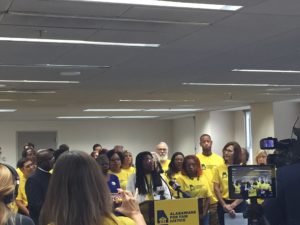
Dena Dickerson, executive director of the Offender Alumni Association, speaks during an Oct. 3 news conference at the State House in Montgomery. Dickerson was one of dozens of supporters of Alabamians for Fair Justice (AFJ) who assembled to show support for reforms to make Alabama’s corrections system more humane and restorative. Alabama Arise is a member of the AFJ coalition.

The missing voices who need to be heard

Alabama Arise has been following the study group’s learning curve on a broad array of criminal justice issues. In four public meetings since July, members have received a flood of statistics from prison administrators, sentencing specialists, law enforcement officers, prosecutors, judges, mental health officials and other experts. They also have toured multiple correctional facilities, becoming eyewitnesses to the shameful conditions they’re charged with improving.

Largely missing from this crash course: the voices of the people Alabama’s criminal justice system affects most. The panel should fill that gap by inviting testimony from inmates’ family members and formerly incarcerated individuals. Many of them have attended the public study group meetings, and the formal recommendations should reflect their lived experiences.

Policy solutions should ease reentry, reduce recidivism

Of the roughly 21,000 people in Alabama’s prisons in a given year, 95% eventually reenter society, according to the Alabama Department of Corrections (DOC). Of those, about 29% wind up back in prison within three years.

Breaking the cycle of recidivism is a challenge that reaches beyond DOC, or even criminal justice policy. It also requires community partnerships to serve people with untreated mental health and addiction problems. These challenges can undermine successful reentry and often contribute to incarceration in the first place.

By targeting recidivism, the study group is highlighting our state’s overburdened community mental health and substance use services network. Medicaid expansion, at a 90% federal match, would allow Alabama to expand these services tenfold for the same state investment. The study group should urge our state to take this essential step forward.

The study group’s measured, highly visible approach to its complicated challenge is not one it can easily shrug off. The panel has set a high bar for meaningful recommendations, and Arise expects them to meet it. Arise and our partners in the Alabamians for Fair Justice alliance will keep up the pressure for comprehensive, lasting reform.

The path to a better corrections system

Alabama’s corrections system must become more humane and restorative. Alabama Arise and our allies in the Alabamians for Fair Justice coalition have proposed numerous changes to put our state on a path toward dignity, equity and justice for all. Here are a few of these recommendations:

  • Expand state investments in mental health care and treatment for substance use disorders.
  • Increase state support for mental health courts, pretrial diversion and reentry programs.
  • Reduce court costs and give people a reasonable amount of time to begin paying fines and restitution after returning from prison.
  • End automatic suspensions of driver’s licenses in cases unrelated to traffic safety.
  • Apply the state’s presumptive sentencing guidelines retroactively.

Visit alabamafairjustice.org/resources to read the coalition’s full list of policy solutions on prison reform in Alabama.