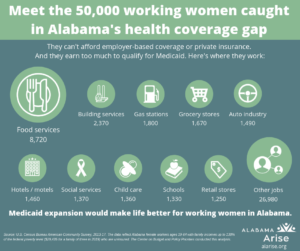
Meet the working men and women caught in Alabama’s health coverage gap

As we celebrate Alabama’s workforce on Labor Day, here’s a fact that deserves special attention: More than 100,000 Alabamians are working without health insurance. They work in child care, construction, food services and other vital jobs. They’re the folks who keep things going.

Yet they’re trapped in the health coverage gap. They can’t afford employer-based coverage or private insurance. And they earn too much to qualify for Medicaid. As a result, many struggle with health problems that sap productivity, add household stress and get worse without timely care.

Here are the jobs employing the most working women in Alabama’s coverage gap:

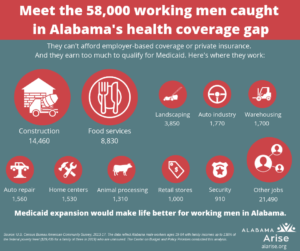
And here are the jobs employing the most working men in Alabama’s coverage gap:

Think about the importance of these lines of work. Then think about what access to regular health care would mean in the lives of these workers and their families.

Across the country, 36 states have closed their coverage gaps, but Alabama is lagging behind. What’s holding us back?

Lack of awareness plays a part. As folks go about their daily activities, they rarely stop to wonder who has health insurance and who doesn’t. It’s not something most people talk about – but it should be. Helping state leaders understand the real people who will benefit most from expanding coverage is an important step toward change.

Our entire state would benefit from Medicaid expansion. Broader access to regular care would improve the health of working families. Healthier families would mean higher productivity at work and better learning at school. And the additional federal funding would strengthen our health system and create jobs.

All these gains would spell a brighter future for Alabama. It’s time to expand Medicaid and make health coverage affordable for the workers we all depend on every day.

Alabama’s prison reform solution must include Medicaid expansion

Alabama’s prison crisis is about more than overcrowding and understaffing. It’s about the generational impacts of a criminal justice system warped by racism, chronic poverty, inadequate education and poor health.

The solution will require both new revenue and broad policy reform. And one essential step is to extend health coverage to uninsured Alabama adults with low incomes. Expanding Medicaid would address the prison crisis in four ways:

  • Untreated mental illnesses and substance use disorders are major contributors to Alabama’s over-incarceration problem, and Medicaid expansion would tackle these challenges head-on. Strengthening these services would help more people stay out of prison.
  • When a person leaves prison, it’s hard to get a job that offers health coverage. But to get and keep a job, you need to be healthy. Medicaid expansion would help former inmates become productive members of the workforce.
  • Federal funding would cover 90% of the cost of Medicaid expansion. That would slash state costs for hospitalizing prisoners.
  • A stronger education system creates economic opportunity that, in turn, reduces crime. As new federal dollars for Medicaid expansion flowed into the economy, they would generate major new state and local tax revenues for schools.

Bottom line

Alabama is one of only 14 states that have not yet accepted Medicaid expansion. The 36 states that have embraced it show how this single policy decision can strengthen the health care system, make the population healthier, reduce racial health disparities and shore up state budgets.

Alabama’s legacy of failure on all four counts is a major contributor to the prison crisis. And Medicaid expansion is an essential part of the solution.

Investing in the Housing Trust Fund would create jobs and expand housing opportunities across Alabama

Alabama lacks more than 69,000 homes for households with incomes under $24,600. That means many hard-working Alabamians, seniors, students, veterans and folks on fixed incomes can’t afford a safe place to call home. State investment in the Alabama Housing Trust Fund (AHTF) would provide flexibility to meet a variety of housing needs across the state, such as development, rehabilitation, down payment assistance and disaster recovery.

HB 487, sponsored by Rep. Neil Rafferty, D-Birmingham, and SB 189, sponsored by Sen. Linda Coleman-Madison, D-Birmingham, would fund the AHTF by increasing the state mortgage record fee from 15 cents to 20 cents per $100 of indebtedness. This one-time filing fee has not changed since it was enacted in 1935. The increase would leave Alabama’s fee less than both Georgia’s and Florida’s.

The benefits would be enormous for Alabamians and our state’s economy. Strong investment in the Alabama Housing Trust Fund would:

  • Allow municipalities, nonprofits and groups like Habitat for Humanity to build or rehabilitate homes. Individuals cannot access the funds.
  • Address Alabama’s shortfall of more than 69,000 homes for low-income working families, veterans, and retirees living on fixed incomes.
  • Create thousands of jobs across the state over the next decade.

BOTTOM LINE: Hard-working Alabamians should be able to pay rent and still be able put food on the table. Every child deserves a safe place to call home. And veterans who have defended our country deserve to return to a safe and affordable place to call home. Investing in the Housing Trust Fund would help Alabama achieve all three of those goals.

Federal ability-to-repay rule protects payday borrowers, Alabama Arise tells CFPB

Director Kathleen Kraninger:

I read with disappointment your recent proposal to rescind the thoroughly considered, factually grounded Consumer Financial Protection Bureau (CFPB) rule provision mandating ability-to-repay determinations by lenders offering payday, title and balloon loans. As a policy organization working to advance the public good in a state with wholly insufficient consumer protections for borrowers, Alabama Arise knows the CFPB’s payday lending rule would help thousands of people in Alabama, if left as written and implemented in good faith.

Astronomical and exploitative payday loan annual percentage rates (APR)[1] routinely trap borrowers in our state in inescapable debt cycles. Payday lenders have misled regulators and the public about the purpose of these loans since the day they were legalized in Alabama. Contrary to industry talking points, payday loans are not a short-term solution to emergencies. They are debt traps for people struggling to make ends meet, as the CFPB’s own 2014 report shows. A majority of payday borrowers in Alabama take out multiple loans every year. Thousands of borrowers in our state took out 30 or more payday loans last year.[2] Borrowing histories like that result from traps, not transactions between parties of equivalent power and legal sophistication.

For thousands of people who take out multiple loans a year, predatory loans are not an option. They are inherently destructive traps that destabilize families, and they destroy the lives of people throughout the United States who become trapped in intentionally created cycles of debt.

The American people overwhelmingly support regulation of payday loans. Eighty-four percent of Alabama respondents in a recent state survey[3] said they want significant reform to payday lending practices. Most Alabamians want to cap payday loan APR at 36 percent. That rate would be less than a tenth of the usurious 456 percent APR that Alabama allows on a 14-day loan, the most common loan period in our state. Further, a majority of the survey respondents said they want those reforms even if such changes cut into industry profits.

The Agency’s purported justification for rescinding the rule is a lack of data supporting the underwriting provision. The Agency bases this assertion on an arbitrary de-emphasis of the Mann study,[4] which was industry-funded yet nonetheless demonstrated that four in ten consumers had no knowledge of how they would repay loans. The Agency also de-emphasizes its own personnel’s expertise in determining the financial awareness of consumers.

The multi-page Agency justification for ignoring its own analysis could have been spun from a lending industry lobbyist. In it, the CFPB wrote, “Mann concluded that most borrowers anticipate that they will not be free of debt at the end of the initial loan term and instead will need to reborrow.” This sunny characterization of borrowers’ financial understanding ignores the 40 percent of borrowers who have no idea when they will escape the debt trap.

Moreover, the focused protections created by the CFPB’s rule have not yet been given a chance to work, even though the underwriting requirement falls short of the sweeping elimination of predatory loans the public wants. The Agency’s rhetoric surrounding this attempt to eliminate protections has relied heavily on the sort of talking points often repeated by the industry lobbyists we see lining the walls of the Alabama State House. Industry mouthpieces have claimed for years that regulation of any sort would bankrupt them. But reality shows these claims to be false. Procedural reform efforts focused on providing escape valves for trapped borrowers have not eliminated payday loans in the numerous states that have implemented them.[5]

The rule’s protections focus on borrowers who take out multiple loans over a short period and borrowers who spend much of their time in short-term loan debt. Lenders are conditionally exempt from the underwriting mandate for loans under $500, up to the third loan in a loan cycle. The rule is structured to prevent loan churn and stop cycles of debt. The payday lending business model relies on keeping borrowers in debt. One of the best ways to prevent that exploitation is to ensure that borrowers have a realistic way out of debt before they take out high-cost loans. The CFPB should protect borrowers, not the profits of an industry reliant on perpetuating human suffering to make its money.

Repeal of this protective provision would be a disservice to the fundamental mission of the CFPB. The Agency’s purpose is to protect consumers, not to clear the field of regulations to ensure lenders’ ability to prey upon on members of the public whose precarious financial positions leave them most vulnerable to predatory practices. The only support underlying the decision to eliminate this consumer protection is fanciful assertion by regulated parties that the regulatory costs of compliance would significantly damage their interests. Bald assertions of harm made by an industry with a history of operating in bad faith are wholly insufficient justification for an Agency rule. The CFPB should not engage in arbitrary determinations based on a dearth of evidence. Eliminating this protection is unjustified.

The CFPB’s rule in its current form would help mitigate the effects of the systematic exploitation of borrowers who can barely keep their heads above water. The ability-to-repay provision is not a complete reform of the usurious practices of predatory lending, but it helps rein in some of the worst abuses. Preventing lenders from issuing products structured to trap many borrowers in loans they are unable to repay is squarely within the Agency’s mission. The CFPB should implement the ability-to-repay rule as written. Anything less would be complicity in abusive practices and would be widely and correctly cited as an example of regulatory capture.

Footnotes

[1] Adam Hayes, Annual Percentage Rate (APR) Definition, Investopedia (2019), available at https://www.investopedia.com/terms/a/apr.asp (noting “[a]n annual percentage rate (APR) is the annual rate charged for borrowing,” and “[t]he formula for the Annual Percentage Rate (APR) is ((((Fees + Interest) / Principal) / [Number of days in loan term]) x 365) x 100”).

[2] Veritec Solutions, Report on Alabama Deferred Presentment Loan Activity For the Year Ending December 31, 2018 (2019).

[3] Public Affairs Research Council of Alabama, Alabama Public Opinion Survey (2018), available at http://parcalabama.org/wp-content/uploads/2018/09/PARCA-2018-Public-Opinion-Survey.pdf, 18.

[4] Ronald Mann, Assessing the Optimism of Payday Loan Borrowers, 21 Sᴜᴘʀᴇᴍᴇ Cᴏᴜʀᴛ Eᴄᴏɴ. Rᴇᴠ. 105 (2013), http://www.columbia.edu/~mr2651/AssessingPayday.pdf.

[5] See, e.g., Fla. Stat. § 560.404(22) (2018).

Removing the FIT deduction would allow Alabama to untax groceries, expand Medicaid

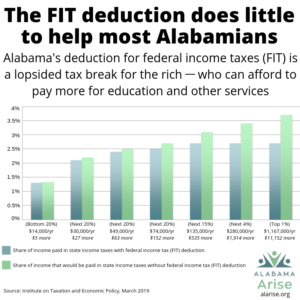
Alabama’s federal income tax (FIT) deduction provides a huge tax break for high-income individuals – but at what cost? $719 million to be exact.

The FIT deduction is one big reason Alabama’s tax system is upside down. For those who earn $30,000 a year, the deduction saves them about $27 on average. But for the top 1% of taxpayers, the FIT break is worth an average of more than $11,000. The higher the income, the more the FIT deduction is worth for those who can most afford to pay more to fund education, health care and other vital needs.

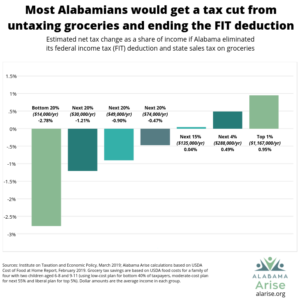
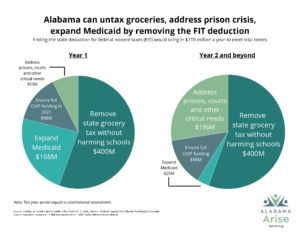
Only two other states offer a full FIT deduction like Alabama does. (Three other states offer a partial deduction.) Ending the FIT deduction would bring in an additional $719 million a year, the Institute on Taxation and Economic Policy estimates. That would be enough to allow Alabama to remove the state sales tax on groceries. For most people in our state, the net result would be a tax cut.

This proposal would make it easier for everyday Alabamians to make ends meet, but its benefits wouldn’t end there. Alabama also could use the new revenue to expand Medicaid, ensure full funding for the Children’s Health Insurance Program (CHIP) in 2021 and make critical investments in education and other areas. CHIP supports health coverage for more than 170,000 children through Medicaid and ALL Kids.

Alabama’s constitution dedicates income tax revenue to education, and the FIT deduction is written into the document as well. So this plan would require the Legislature and the public to approve a constitutional amendment. But ending the FIT deduction would be a good way for Alabama to begin prioritizing public investments that benefit everyone over tax breaks that primarily benefit a select few.

Alabama Medicaid reforms aim for better care, lower cost

Alabama is making some big changes in the way Medicaid members get their care. Alabama Arise believes the new plans, if carried out well, will be a significant improvement over the current Medicaid system. One way to improve the chances for success is to have a strong consumer voice at the policy table.

The changes are happening on two tracks:

  1. Primary care for children, pregnant mothers and family planning.
  2. Long-term care for people who need assistance with activities of daily living.

Alabama Coordinated Health Networks (ACHNs) for primary care, maternity care and family planning

Under the new plan, seven regional Alabama Coordinated Health Networks (ACHNs) will coordinate primary care for Medicaid children, pregnant mothers and people who receive family planning services. Primary care includes well-child visits; EPSDT (Early Periodic Screening, Diagnosis and Treatment); adult screening, diagnosis and treatment; and preventive care. Each member will choose a primary care doctor to be their “patient-centered medical home.”

(Note: A “medical home” is not a live-in care facility, like a nursing home. It’s more like a “home base” you stay in touch with for all your health care needs.)

Your ACHN will have a phone line to call when a Medicaid member has a health problem. The basic idea is that nurses, social workers and care coordinators working with the primary care doctor can help people get the right care for the right problem without going straight to the emergency room (ER) whenever they get sick.

ER services are important when there’s a real emergency (like a broken bone, chest pains or other critical need). But they’re also very expensive. So going to the ER for routine problems like a sore throat or upset stomach is a drain on the Medicaid budget. And it’s not the best way to get the right care for ordinary health needs. Getting checked first by your primary care doctor or nurse leads to better care at lower cost.

The ACHN can help patients identify health goals, create a care plan and connect with community resources that promote better health. Another feature aimed at improving care is bonus payments for doctors who reach quality benchmarks.

The new ACHN plan will begin Oct. 1, 2019. It will serve about 750,000 Medicaid members across seven regions. Each ACHN will have a consumer representative on its board, as well as a Consumer Advisory Committee (CAC). Arise is working to recruit Medicaid members, parents and caregivers to serve in these important roles. We also are urging Medicaid to add a second consumer representative to each regional ACHN board.

Integrated Care Network (ICN) for long-term care

On the long-term care side, Medicaid already has started a new plan called the Integrated Care Network (ICN). The ICN coordinates care for Medicaid members who live in nursing homes or receive certain home- and community-based waiver services. There are only about 25,000 of these members across Alabama, so one statewide ICN serves all of them. Right now, about 70% of people served by the ICN live in nursing facilities, and 30% are living at home. The program’s goal is to help more people get long-term care services in their home and community, if that’s what they want. The ICN works with 13 Area Agencies on Aging across Alabama to coordinate long-term care for Medicaid members who qualify.

The ICN has a strong consumer voice at the policy table. Four consumer advocates serve on the governing board. And the Consumer Advisory Committee includes eight consumer representatives, including Alabama Arise, along with a long-term care doctor.

What triggered reform?

Since it began in 1970, Alabama Medicaid has operated on a fee-for-service basis, with patients seeking care on their own from providers who then bill Medicaid for services rendered. For healthy patients, such a system can provide sufficient care at a reasonable cost. But many Alabama Medicaid patients have complicated health problems, involving one or more chronic conditions that are difficult and expensive to treat. Care providers often have difficulty monitoring patient care over time and educating patients on prevention and healthier lifestyles.

As Medicaid costs rose with enrollment growth during the Great Recession of 2008, state officials began to consider program changes that would both control budget growth and improve health outcomes.

In 2011, a few regional pilot projects began providing care coordination for people with chronic conditions, such as diabetes, cancer or substance use disorder. These successful experiments laid the groundwork for the regional care organizations (RCOs) that the Legislature authorized in 2013. Under the RCO plan, Alabama offered care coordination to people with chronic conditions statewide. Technical delays and other problems led Gov. Kay Ivey to cancel the RCO plan shortly after she took office in 2017, but the care coordination system remained in place. This time around, Medicaid will expand it even further – to serve not just patients with chronic illness but the majority of Medicaid members.

Long-term care reform took a different but parallel path. Alabama has long relied mainly on nursing homes to provide Medicaid long-term care services, even though home- and community-based services are far less expensive. The aging of the Baby Boom generation poses big challenges for the old system. A surge in nursing home patients would strain state budgets, and a movement for greater patient choice is changing the long-term care business. Alabama’s ICN has the potential to become a national model for expanding options in long-term care.

Bottom line for members

  • Regional ACHNs open Oct. 1, 2019. Through their primary care doctor, children, pregnant moms and family planning patients can get new services focused on prevention, care coordination and health improvement.
  • The primary care doctor is the patient’s “medical home” – the first place to contact for ordinary health needs. The goal: Reserve ERs for true emergencies.
  • A new focus on improving patient health gives doctors bonus payments for better outcomes. Special projects will target substance use disorders, infant mortality, and obesity and obesity prevention.
  • The ICN now gives long-term care patients more coordination of services and more choice in their care setting.
  • Consumer representatives give Medicaid members a new voice at the policy table.

Map of Medicaid ACHNs

Keywords in Medicaid reform

A basic understanding of these keywords will help Alabama Medicaid members navigate the changes that are underway and help advocates and others follow ongoing developments in the program:

ACHN (Alabama Coordinated Health Network) – beginning Oct. 1, 2019, any of seven regional organizations that administer Medicaid services for children, pregnant women and family planning patients in Alabama, with a special focus on care coordination to eliminate barriers to adequate health care.

Area Agency on Aging (AAA) – any of 13 regional offices that serve older Alabamians by coordinating state and federal services such as senior centers, Aging and Disability Resource Centers and the Alabama Cares caregiver support network. The AAAs provide case management for Medicaid long-term care in the home, community and nursing facilities through the new Integrated Care Network (ICN).

Care coordination – the practice of organizing patient care activities and sharing information among all parties concerned to achieve more effective and efficient care. Care coordination has a narrower focus than case management.

Case management – a collaborative process of assessment, planning, coordination and advocacy for options and services to meet a person’s health needs. Case management has a broader reach than care coordination, also addressing social determinants of health like housing, nutrition and transportation.

EPSDT (Early Periodic Screening, Diagnosis and Treatment) – comprehensive and preventive health services guaranteed for children under age 21 who are enrolled in Medicaid.

Home- and community-based services (HCBS) – Medicaid long-term care services for qualifying members who choose to live at home or in a community care setting. In Alabama, these services are delivered through seven waiver programs. Two of these – Elderly & Disabled (E&D) and Alabama Community Transition (ACT) – are part of the new Integrated Care Network.

ICN (Integrated Care Network) – Alabama Medicaid’s long-term care reform program promoting person-centered care in the least restrictive setting of the patient’s choice.

Long-term care – health care, personal care and social services provided to people with chronic illness or disability, either in institutional or home and community settings.

Medicaid – federal and state health insurance program for people with low incomes and few resources. Alabama Medicaid covers mainly children in families up to 146% of the federal poverty level (FPL), pregnant women up to 146% FPL, low-income people with disabilities, and low-income people in nursing homes. Parents are eligible in Alabama only if their income is 18% FPL or lower.

Medicaid member – any individual enrolled in a Medicaid program.

Patient-centered medical home – a health care setting that offers patients comprehensive, coordinated primary care; an ongoing relationship with a primary care doctor; and referrals for necessary additional care.

Preventive care – health care that emphasizes healthy behavior, regular testing and screening aimed at early detection and treatment.

Primary care – routine health care, including diagnostic, therapeutic and preventive services, as well as management of chronic conditions.

Waiver – permission granted by the federal government that allows the state to “waive” or change ordinary Medicaid rules to provide specific services to a targeted group, such as long-term care patients.

Revenue options for Medicaid expansion

Alabama’s budget is an expression of our values. Medicaid expansion means healthier families, thriving communities and a stronger economy. Policymakers have a range of options for making this bold investment in a brighter future. Now is the time to choose.

Remove the state deduction for federal income taxes (FIT)

$719 million in new revenue per year

Only two other states offer a full FIT deduction

This money would allow Alabama to achieve multiple goals:

Expand Medicaid (cost: $168 million in first year, $25 million per year thereafter)*

— Remove the state sales tax on groceries (cost: approximately $400 million per year)

— Secure long-term funding for ALL Kids (cost: $38.4 million for 2020, approximately $90 million for 2021)*

Remove the state deduction for FICA payroll taxes

$261 million in new revenue per year*

Only one other state offers a full FICA deduction

Raise the cigarette tax by $1 per pack

► $180 million in new revenue in 2020

Other revenue options include:

► Make large landowners pay their fair share of property tax

► Tax sugar-sweetened beverages and vaping-related products

► Close corporate tax loopholes – for example, enact combined reporting*


* Would require transfer from Education Trust Fund to General Fund

30 days to pay: A simple but important step forward on payday lending reform in Alabama

Alabama borrowers pay interest rates of 456 percent a year on payday loans. These high-cost loans trap thousands of struggling Alabamians in a debt cycle that deepens poverty and hurts the state’s economy.

SB 75, sponsored by Sen. Arthur Orr, R-Decatur, along with a House version sponsored by Rep. Danny Garrett, R-Trussville, would extend the time that payday borrowers have to repay to 30 days, up from as few as 10 days now. This one step would reduce the maximum annual percentage rate (APR) on payday loans in Alabama from 456 percent to about 220 percent. This bill would ease financial pressure on Alabamians who are struggling to make ends meet, letting them keep more money to take care of basic needs.

The 30-days-to-pay bill would help borrowers and preserve access to credit. Lengthening the repayment period for payday loans would:

  • Boost Alabama’s economy by reducing the amount of fees (more than $100 million last year alone) taken out of our communities every year to benefit primarily out-of-state corporations.
  • Bring payday loan repayment periods in line with repayment schedules for other loans and monthly bills, such as mortgages, rent, car loans, student loans, credit cards and utility bills.
  • Grant needed relief to tens of thousands of working Alabamians and allow them to use their hard-earned money to better their own lives.

BOTTOM LINE: Exorbitant interest rates on payday loans are devastating for families and communities across Alabama. SB 75 would take a simple, important step to reduce the damage from these high-cost loans. That would be good for consumers, good for the state’s economy and good for Alabama.

Medicaid expansion by the numbers

  • ± 223,000 Alabamians are caught in the coverage gap, unable to afford health insurance. Another 120,000 or more are stretching to pay for private or employer-based coverage.
  • 13 Alabama hospitals – including 7 rural ones – have closed since 2011.
  • 88 percent of Alabama’s rural hospitals operate in the red.
  • If we expand Medicaid to cover low-income adults, the permanent federal match is 9:1.
  • The first four years of federal match would generate $11.4 billion in new economic activity:

— $6.7 billion in direct federal spending

— $4.6 billion in indirect economic activity

  • Over four years, the enhanced match would free up $316 million in current state spending to address additional unmet health care needs:

— Existing Medicaid groups – $87.1 million

— Mental health & substance abuse – $121.6 million

— Corrections – $46.8 million

— Public health – $60.6 million

  • Expansion-related economic activity would generate $446 million in state tax revenues over four years. New local tax revenues would total $270 million over four years.
  • Net cost to the state would be $168 million in the first year, dropping to about $25 million annually in the following years because of savings and revenues, for a total of $239 million over four years. (This figure does not include local revenue gains.)

Bottom line

Medicaid expansion would help more than 340,000 Alabamians get health coverage, stabilize our rural hospitals and jump-start our economy – all for a dime on the dollar. It’s a bargain Alabama can’t afford to pass up.

(Sources: U.S. Census Bureau; Alabama Hospital Association; David J. Becker, “Medicaid Expansion in Alabama: Revisiting the Economic Case for Expansion,” January 2019; Manatt, “Alabama Medicaid Expansion: Summary of Estimated Costs and Savings, SFYs 2020-2023,” February 2019.)

How the state grocery tax hurts struggling Alabamians

No matter how much or how little money we have, we all have to eat to live. But the share of earnings that people must devote to securing basic survival is not the same for everyone. Food takes a much bigger bite out of the household budget for low-income families than for richer ones. And that means sales taxes on groceries hit harder at lower incomes. Most states either exempt groceries from state sales taxes entirely or have other ways to help offset grocery taxes for low-income people.

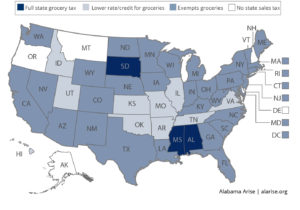
Alabama is one of only three states with no tax break on groceries. (Mississippi and South Dakota are the others.) Our state sales tax rate is 4 percent, but local taxes have driven the total rate to 10 percent or even 11 percent in many areas of the state.

Sales taxes are especially regressive in Alabama, because they apply to many kinds of spending that are not optional.

A gallon of milk plus sales tax costs the same for a family at the poverty line as for a millionaire. But that sales tax makes up a much larger share of income – and has a greater effect on the household’s standard of living – for a low-income family than for a richer one. That means Alabama’s state grocery tax disproportionately affects households struggling to make ends meet.

Ways to untax groceries

Other states offer a range of options for how to reduce or end grocery taxes. Full exemption would ensure an immediate tax break on groceries for all state residents. (Food bought with benefits under the Supplemental Nutrition Assistance Program (SNAP) is not taxed, but those benefits cover only a portion of food costs for most participants.) The state also could tax groceries at a reduced rate or create a targeted Earned Income Tax Credit (EITC) to help offset grocery taxes for residents with low incomes.

No matter how Alabama seeks to untax groceries, the state should replace the revenue. Most state sales tax revenues in Alabama support K-12 education. Removing the grocery tax without replacing that money could cost schools more than $300 million a year. Alabama could recoup those funds by limiting or ending its state income tax deduction for federal income tax payments, a tax break that overwhelmingly benefits the richest households. The state also could expand sales taxes on more services and luxury goods.

It’s time for Alabama to join 47 other states in giving a tax break on groceries. It would make our state’s upside-down tax system more progressive. And it would be an important step toward boosting economic security for all Alabamians.