Alabama’s death penalty practices remain unjust and unusually cruel

Americans increasingly oppose the death penalty. Gallup found that opposition to the death penalty more than doubled in the past 25 years. This may result from disturbingly high error rates in the system. For every 10 people executed since 1976, one innocent person on death row has been set free.

Alabama took an important step toward death penalty reform in 2017, but the state’s death penalty scheme remains broken. That year, the state finally outlawed judicial override in capital cases. That change means judges no longer can impose the death penalty when a jury recommends life without parole.

But the ban was not retroactive, and 35 people who were sentenced that way remain on death row. Fixing that failure is one of several key reforms that would bring Alabama’s capital punishment system in line with national standards and federal court rulings.

Alabama’s death penalty practices are behind the times

Alabama’s death penalty scheme has failed to keep up with reforms in the rest of the United States. Under state law, prosecutors do not have to prove a defendant was at least 18 years old when the crime occurred. State law also lacks protections against executing people with mental disabilities. U.S. Supreme Court precedent is the sole authority preventing executions of defendants with IQs below 70.

An increasing number of states are abandoning capital punishment. Most recently, Virginia became the first Southern state to do so when Gov. Ralph Northam signed an abolition bill in March 2021. In all, 26 states either have abolished the death penalty or have seen their governor impose a moratorium, according to the Death Penalty Information Center.

Racial disparities abound in our state’s capital punishment system. In Alabama, people convicted of killing a white person are more than four times more likely to get a death sentence than people convicted of killing someone who is not white, the Equal Justice Initiative found in 2011. And Alabama has more people on death row per capita than any other death penalty state.

How to reform Alabama’s capital punishment system

Ending judicial override in future cases was an important first step toward fixing Alabama’s broken death penalty system. But other recent changes have aimed to enshrine that system instead. In 2018, the Legislature authorized a backup execution method, nitrogen hypoxia, in case courts outlaw lethal injection. This new procedure would kill people through suffocation, and it has never been used on a human before.

Efforts to prop up the state’s broken death penalty system are misguided. Alabama can and should enact numerous reforms to reduce the unfairness of its death penalty practices. Those changes include:

  • Make the 2017 judicial override ban retroactive.
  • Require unanimous agreement from the jury to sentence people to death.
  • Amend state law to require prosecutors to prove a defendant was 18 or older at the time of the crime.
  • Amend state law to forbid executions of people who have serious cognitive impairments.
  • Impose a moratorium to study and end racially biased death penalty practices.
  • Provide state funding for appeals of death sentences, as all other states with capital punishment do.
  • Ultimately eliminate capital punishment.

Bottom line

Alabama should reduce and eliminate the unequal, unfair practices present in the state’s death penalty scheme – and ultimately should end capital punishment entirely. Alabamians deserve a fair, unbiased justice system, and these death penalty reforms would be steps toward a more just state.

Expand voting rights to move Alabama beyond its anti-democratic past

Voting rights are a flashpoint in Alabama’s history. The long denial of those rights to Black residents led to Bloody Sunday in Selma, the march to Montgomery and eventually passage of the Voting Rights Act of 1965. In the decades since, our state has taken a few steps that increase voting access for communities of color. Still, Alabama’s voting systems remain unnecessarily cumbersome, expensive and exclusionary.

Alabamians seeking to exercise their fundamental right to vote often face numerous administrative hurdles and physical and procedural barriers. Recent legislative sessions have included repeated attempts to make voting more inconvenient for Alabamians and more burdensome for election officials.

Recent policy changes have made voting harder

Efforts to restrict voting have gained traction since the U.S. Supreme Court overturned parts of the Voting Rights Act in its 2010 Shelby County v. Holder ruling. And some of those more recent efforts in Alabama unfortunately have succeeded.

For instance, the 2021 regular session saw lawmakers ban curbside voting, a practice that Mississippi expanded in 2020. Curbside voting would have increased polling place access for older and pregnant Alabamians, as well as people with disabilities. Echoing the state’s long past of racist voting policy, the curbside voting ban finally passed after a procedural vote to cut off debate and silence a filibuster by Black senators.

Legislative attempts to make it harder for Alabamians to have their voices heard haven’t stopped there. Some lawmakers also have sought to remove election officials’ ability to provide extended hours or accommodations during declared emergencies. This measure would be particularly shortsighted in Alabama, where tornado outbreaks are routine during the primary election season in the spring and hurricanes remain a persistent threat during the general election season in the fall.

Pro-democracy policies would build a better Alabama

Ensuring that everyone’s voice is heard is an essential part of building a better, more inclusive Alabama. Lawmakers can and should make numerous policy improvements to boost civic engagement and strengthen democracy in Alabama:

  • Register voters automatically through the Department of Motor Vehicles (DMV). Automatic voter registration (AVR) would increase turnout considerably. Twenty states (including Georgia) and the District of Columbia have approved AVR since 2015, according to the Brennan Center for Justice.
  • Remove the racist modern poll tax that requires repayment of fines and fees for people with a criminal conviction to regain voting rights. This disenfranchisement has its roots in post-Reconstruction efforts to sidestep the U.S. Constitution’s ban on explicitly race-based voting restrictions. And this practice continues to harm Black people at a far higher rate than the overall population.
  • Allow extended early voting for voters who can’t make it to the polls on Election Day.
  • Create a same-day voter registration process so voters who show up to the polls aren’t excluded from casting ballots.
  • Enable curbside voting to increase accessibility for voters who have mobility or health concerns.
  • Eliminate the burdensome photo ID requirement for voters to cast ballots.
  • Allow absentee voting without requiring voters to provide an excuse from a state-approved list.

Bottom line

Our democracy is strongest when everyone can participate. But Alabama has made that harder by erecting barriers that limit voting for many seniors, people with low incomes, people with disabilities and people who were formerly incarcerated. By enacting policies to protect and expand voting rights, lawmakers can move Alabama away from a shameful past and toward a brighter future where all voices are valued and included.

Jump-start public transit in Alabama

Alabama’s failure to invest in public transportation is hurting people, communities, the economy and the environment. Many seniors, people with disabilities and people with low incomes need public transit to get to work, medical care, the grocery store and more. Others prefer an energy-saving alternative to cars. The Legislature created the Public Transportation Trust Fund (PTTF) in 2018 but hasn’t provided state funds for it.

The November 2021 federal infrastructure law has changed the game. It targets hundreds of millions of federal dollars to Alabama for public transportation. It’s time to activate the PTTF to ensure transparent, equitable distribution of these historic resources. Here’s why:

  • Alabama is one of only three states (along with Hawaii and Nevada) that provide no state funding for public transportation. All other Southern states do.
  • Alabama leaves millions in federal matching funds on the table every year. The federal government can grant $4 for every $1 the state spends on buses. And federal funds can double state investment in operations.
  • Every $1 million spent on operations creates 50 jobs. These jobs provide good benefits and an average operator’s salary of more than $70,000.
  • Lack of funds has limited public transit options. No service in Alabama operates past 11 p.m., even on weekends. Rural van routes may be booked up weeks in advance. And some cities with more than 30,000 people have no general public transit option.
  • Eight rural hospitals have closed since 2011, and many others are at risk. These closures have increased the strain on rural public transportation by leaving many Alabamians farther away from health care facilities.
  • The Alabama Department of Economic and Community Affairs (ADECA) administers the fund. ADECA makes and audits project awards and does a needs assessment.

Bottom line

We have the vehicle. Let’s drive it. Alabama’s Public Transportation Trust Fund can match and distribute federal funds wisely and fairly. Expanding public transportation would create thousands of jobs, fuel economic growth and get people where they need to go. It would create a healthier environment and a healthier Alabama for all.

It’s time to expand Medicaid and close Alabama’s health coverage gap

For years, Gov. Kay Ivey and legislators have said cost is the barrier to covering Alabamians with low incomes through Medicaid. Thanks to federal COVID-19 relief funding with incentives for Medicaid expansion, any concerns about that barrier are gone. Now more than ever before, we have the opportunity to ensure no Alabamian has to choose between going to the doctor and putting food on the table.

Nearly 70% of Alabamians support Medicaid expansion, including 64% of Republican voters, according to a January 2021 poll. As we continue to struggle with the COVID-19 pandemic, extending Medicaid coverage to adults with low incomes is the single biggest step Alabama can take to restore health, save our rural hospitals and boost our state’s economic recovery.

Who would gain coverage under Medicaid expansion?

Medicaid expansion would ensure coverage for more than 340,000 Alabamians, including:

  • People who work low-wage jobs and can’t afford private coverage
  • Workers who are between jobs
  • Adults who are caring for children or older family members at home
  • People who have disabilities and are awaiting SSI determinations
  • Adult college students
  • Uninsured veterans

How would Medicaid expansion keep people healthier?

Medicaid expansion would help Alabamians stay healthy by ensuring pathways to:

  • Regular primary care and preventive checkups
  • Earlier detection and treatment of serious health problems
  • Regular OB/GYN visits without referral
  • Less dependence on costly emergency care
  • Better health and greater financial peace of mind

How would Medicaid expansion reduce health disparities?

Medicaid expansion would promote health equity in Alabama by:

  • Reducing the racial/ethnic disparities in health coverage
  • Lowering the high rate of Black infant deaths
  • Lowering the high rate of Black maternal deaths
  • Covering chronic health conditions that disproportionately affect people of color and make them more vulnerable to COVID-19 complications

How would Medicaid expansion boost the economy?

Medicaid expansion would bring our federal tax dollars home to support:

  • Healthier families, workers and communities
  • Stronger rural hospitals and clinics
  • Stronger community mental health and substance use disorder services
  • A needed boost in jobs and revenue for state and local economies

Bottom line

Medicaid expansion would save lives, create jobs and strengthen Alabama’s health care system. Closing the health coverage gap is one of the biggest policy changes available to move our state forward. The governor and the Legislature should embrace this opportunity to build a brighter, healthier future for Alabama.

Join our Cover Alabama campaign!

An end to Alabama’s coverage gap is within reach. Through our Cover Alabama campaign, Alabama Arise is working to ensure that every Alabamian can afford to get the health care they need when they need it. Visit coveralabama.org to learn more and add your name to our ever-growing list of supporters.

Alabama Housing Trust Fund can help thousands find a place to call home

Alabama lacks more than 73,000 homes for households with incomes below the federal poverty line ($26,500 for a family of four). That means many seniors, students, veterans and people with low or fixed incomes in Alabama can’t afford a safe place to call home. And the pandemic only made the housing crisis worse. Between Sept. 29 and Oct. 11, more than 28,000 Alabama families told the U.S. Census Bureau that they expected to be evicted from their current home because they couldn’t pay the rent.

State support for the Alabama Housing Trust Fund (AHTF) would provide flexibility to meet a variety of housing needs across the state. These include development, rehabilitation, down payment assistance and disaster recovery. Multiple funding paths for the AHTF exist:

  • The best way to fund the AHTF would be to increase the state mortgage record fee from 15 cents to 20 cents per $100 of indebtedness. This one-time filing fee has not changed since it was enacted in 1935.
  • Another way to jumpstart the AHTF would be to allocate $20 million of Alabama’s federal recovery money to the trust fund.
  • The Legislature also could take advantage of an unprecedented budget surplus and simply appropriate $20 million in General Fund money to the trust fund.

A strong investment in the Alabama Housing Trust Fund would allow cities, developers and nonprofits like Habitat for Humanity to build or rehabilitate thousands of homes for people with extremely low incomes. It would reduce Alabama’s shortfall of more than 73,000 homes for working families, veterans and retirees with low or fixed incomes. And it would create and support thousands of good-paying jobs across Alabama over the next decade.

Bottom line

Every Alabamian should be able to afford a roof over their head and food on their table. Every child deserves a safe place to call home. And veterans who have defended our country deserve to return to a safe and affordable dwelling. State funding for the Housing Trust Fund would help Alabama achieve all three of those goals.

Funding surge is a path for Alabama to untax groceries, expand Medicaid

Alabama’s broken tax system usually starves our state of money to fund education, public health and other basic responsibilities adequately. But 2022 may be different. Record tax revenues and a surge of federal recovery dollars could allow lawmakers to address longstanding state needs and inequities – if they have the political courage:

  • Tax revenues for our schools and universities went up more than 16% in 2021.
  • Tax revenues for services not related to education grew more than 11% in 2021.
  • Alabama still has more than $1.6 billion in federal recovery funds that must be budgeted in 2022 and 2023, with more on the way.

Arise’s proposed uses for federal recovery dollars can be found at alarise.org/rescueplan. Here are a few of our recommendations for budgeting state revenue increases:

  • Untax groceries. Alabamians with low and moderate incomes already pay a disproportionate share of their income in state taxes. Ending or rebating the state grocery tax while protecting education funding would help them make ends meet.
  • Raise the income tax threshold. Alabama should help people with low incomes by creating or increasing individual and child deductions or credits.
  • Expand Medicaid. Federal recovery dollars can’t be spent directly on expansion, but they can be spent on other needs. This will free up state money to expand Medicaid.
  • Make the criminal justice system more just. Lawmakers should increase funding for reentry services and for alternatives to incarceration like specialized courts and community correction programs.

Bottom line

This year’s budget landscape offers an opportunity to make Alabama better for generations to come. Thoughtful, transformative funding choices can bring that vision to life.

Rental assistance resources to prevent evictions in Alabama

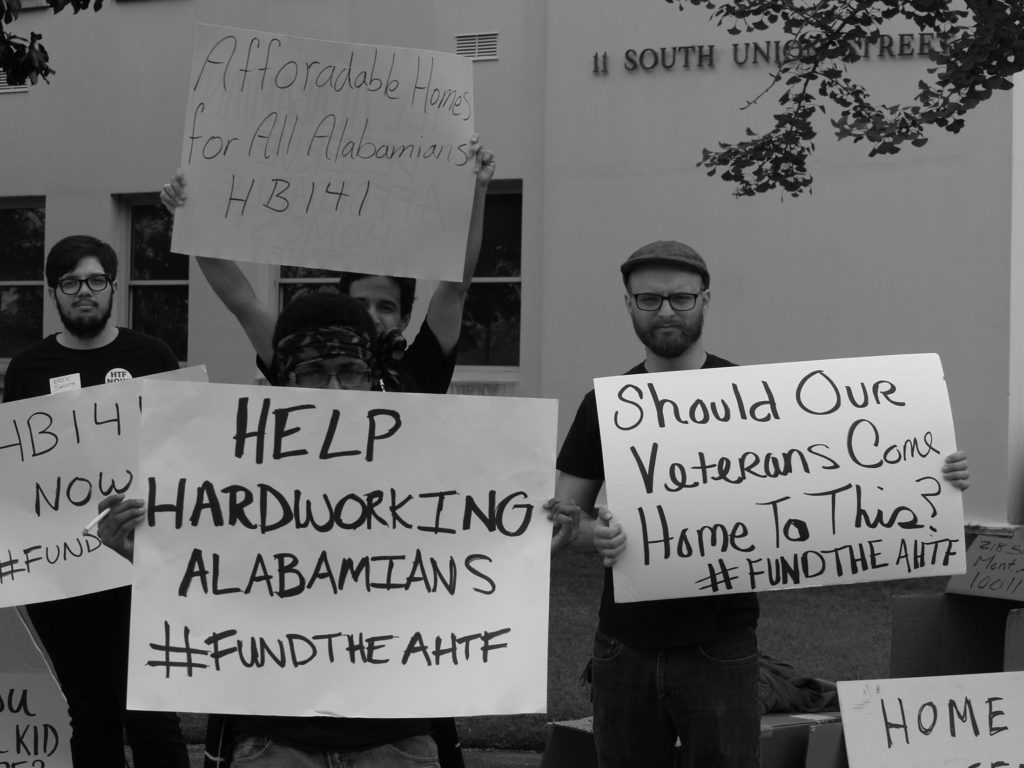
Affordable housing advocates rally outside the Alabama State House in Montgomery in 2015.

Are you facing eviction, or is a renter at your property unable to pay rent?

Evictions in Alabama are resuming now that the U.S. Supreme Court has overturned the federal eviction moratorium. If you are facing eviction because you cannot pay your rent, you may be able to receive emergency rental assistance. For a list of agencies serving various parts of the state, see below or visit the National Low Income Housing Coalition’s resource page at nlihc.org/rental-assistance.

Landlords can apply for these funds as well. Processing of claims has been slow, but more than 80% of applications processed so far have resulted in payments. If you need help completing the application, you can call the phone number(s) or visit the website listed for each location below. (Click here for a downloadable PDF of this resource list.)

Agency contact information

Baldwin County: Call 251-277-9969 or visit baldwinaltogether.org.

City of Birmingham: Call 205-778-2091 or visit birminghamal.gov/renthelp.

City of Huntsville: Call 256-535-2489 or 2-1-1, or visit huntsvilleal.gov/covid-19-emergency-rental-assistance.

Jefferson County outside Birmingham: Visit erap.jccal.org. To receive application assistance that is available through partner organizations, call 205-326-0162, 205-328-4292 or 205-930-0309.

Madison County outside Huntsville: Call 844-804-9454 or visit mcerap.com.

Mobile County: Call 855-209-4970 or visit mobilecountyal.gov/grants/rental-and-utility-assistance.

Montgomery County: Call 833-823-0007 or 334-261-6186, or visit mc-ala.org/services/emergency-rental-assistance-montgomery-county.

MoWa Choctaw Housing Authority: Call 251-829-9023 or visit mowachoctawhousingauthority.com.

Tuscaloosa County: Call 888-472-0027 or visit tuscco.com/erap.

Anywhere in Alabama not listed above: Call 833-620-2434 or visit eraalabama.com.

These assistance programs can allow renters to remain in the homes they are renting. The programs can allow landlords to be paid fully for all back rent and for rent in future months as well. Applicants should inform the court where the eviction case is filed that they have a rental assistance application in process.

Now is the time! Medicaid expansion talking points in Alabama

Cover Alabama logo

Timing

On Thursday, March 11, 2021, President Biden signed the American Rescue Plan Act, which will bring back federal funding for states to newly expand Medicaid. Thanks to this law, if Alabama expanded Medicaid, the state would get an estimated $940 million boost in federal Medicaid funds over two years. This is enough money to fully fund Alabama’s share of the cost of Medicaid expansion for many years.

Messaging on cost

For years, Gov. Kay Ivey and legislative leaders have said the barrier to expanding Medicaid is the cost. Thanks to the enhanced federal funding, Alabama will have the money to cover the cost of expansion. Now more than ever before, we have the chance to ensure that no Alabamian has to choose between going to the doctor and putting food on the table.

Medicaid expansion is popular

A January 2021 poll from the Cygnal polling firm showed that nearly 70% of Alabamians support Medicaid expansion, including 64% of Republican voters. The poll also revealed that Alabamians support using a portion of funds from any gambling or medical marijuana legalization to expand Medicaid.

Medicaid is necessary for COVID-19 recovery

Recovering from the COVID-19 pandemic will require Alabama to reinvigorate our public health system. Medicaid is a health lifeline for one in four Alabamians and an economic engine for communities across our state. As we struggle with the COVID-19 pandemic, extending Medicaid coverage to adults with low incomes is the single biggest step Alabama can take to restore health, save our rural hospitals and boost economic recovery.

The vast majority who would gain coverage are working

More than 100,000 Alabamians in the coverage gap hold regular jobs that pay low wages. Thousands more are self-employed, serve as caregivers or attend school. Medicaid expansion has proved to incentivize work and create jobs.

Medicaid expansion would ensure coverage for 300,000 Alabamians, including:

  • People who work low-wage jobs and can’t afford private coverage
  • Workers who are between jobs
  • Adults who are caring for children or older family members at home
  • People who have disabilities and are awaiting SSI determinations
  • Adult college students
  • Uninsured veterans

Medicaid expansion would help more Alabamians have:

  • Regular primary care and preventive checkups
  • Earlier detection and treatment of serious health problems
  • Regular OB/GYN visits without referral
  • Less dependence on costly emergency care
  • Better health and greater financial peace of mind

Medicaid expansion would promote racial equity by:

  • Reducing racial disparities in coverage, which is more likely to leave out people of color with low incomes
  • Lowering the high rate of African American infant deaths
  • Lowering the high rate of African American maternal deaths
  • Covering chronic health conditions that disproportionately affect African Americans, making them more vulnerable to COVID-19 complications

Medicaid expansion would bring our federal tax dollars home to support:

  • Healthier families, workers and communities
  • Stronger rural hospitals and clinics
  • Stronger community mental health and substance use disorder services
  • A needed boost in jobs and revenue for state and local economies

Bottom line

Medicaid expansion is the single biggest step we can take to weather the pandemic and move Alabama forward. It’s time to invest in a healthier future for our state and our people.

Progressive tax changes would allow Alabama’s budgets to endure and rebuild after COVID-19

Alabamians are living through hard times right now. Thousands of people are sick. Many more are scared or out of work. Uncertainty is everywhere amid a pandemic with no clear timetable or end game.

As more businesses close or cut back, as more people lose income, and as fewer of us go to the stores where we normally shop, state tax revenues are falling. That endangers funding for education, public health and other core services at a time when we need them most.

A state Senate committee Tuesday approved a smaller General Fund (GF) budget than the one Gov. Kay Ivey initially proposed. But that budget’s revenue assumptions may be too optimistic, and many lawmakers acknowledge they may need to revisit it this summer or fall as the pandemic’s financial toll becomes clearer. In the meantime, the ongoing public health emergency is compounding structural problems that have plagued Alabama for decades.

How Alabama should strengthen its tax system

The COVID-19 pandemic and its associated economic freefall are not the root cause of Alabama’s chronic underfunding of public services or the fundamental failures of its tax system. But this crisis is exposing and exacerbating those shortcomings. And it is illustrating the need for progressive tax changes that would equip our state to endure both this downturn and future recessions.

Alabama should enact these changes to raise revenue for vital services and make life better for struggling families:

  • Eliminate the regressive, and expensive, state income tax deduction for federal income taxes. About 80% of the $782 million deduction’s benefit flows to the top 20% of households.
  • Increase income tax brackets so the highest-paid 25% of taxpayers have a higher tax rate than people in the lower and middle brackets do. Alabama’s top income tax rate kicks in at just $3,000 of taxable income.
  • Impose a temporary income surtax on millionaires during the financial crisis.
  • Adopt combined reporting to prevent corporate tax avoidance while rejecting proposals, such as moving to a single sales factor formula, that would reduce taxes for large corporations.
  • Eliminate the state sales tax on groceries and replace that revenue by making progressive improvements to our income tax system. Alabama is one of only three states with no tax break on groceries.
  • Apply sales and use taxes to more professional services and digital goods and services like music downloads and video streaming services.
  • Institute or increase sales and excise taxes on unhealthy items like tobacco, vaping products or sugary soft drinks. The state could dedicate this money to Medicaid and other health care services.

Lessons from the past: How the last recession devastated Alabama’s finances

Alabama has two major revenue sources for public services that rise and fall with the economy. One is the income tax, which is earmarked (or dedicated) solely for K-12 teacher salaries. Sales and use taxes, which largely go toward education but also fund some other services, are the other. (Use taxes apply to online and mail-order purchases.) Most GF revenue sources grow slowly even in good times.

To understand this downturn’s potential impact, we should look back to the last recession, which struck Alabama in 2009. Both the Education Trust Fund (ETF) and GF were prorated as revenues plummeted during the Great Recession. Proration is an across-the-board funding cut when revenues fall short of expectations.
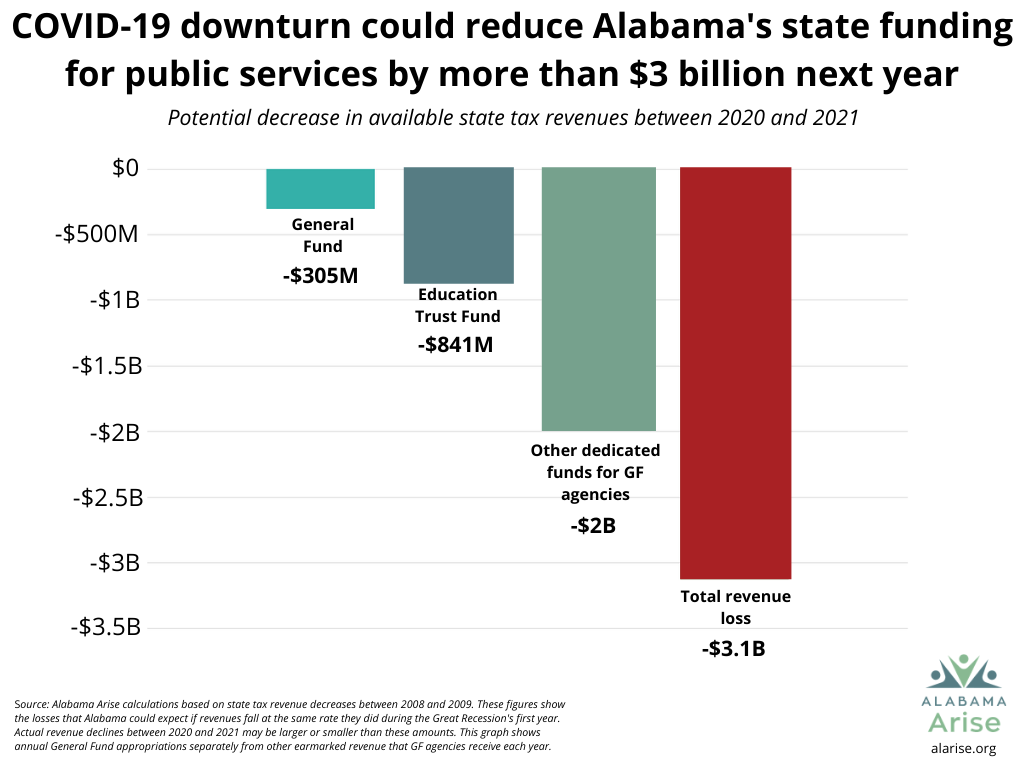
COVID-19 downturn could reduce Alabama's state funding for public services by more than $3 billion next year. Potential decrease in available state tax revenues between 2020 and 2021. General Fund: -$305 million. Education Trust Fund: -$841 million. Other dedicated funds for GF agencies: -$2 billion. Total revenue loss: -$3.1 billion. Source: Alabama Arise calculations based on state tax revenue decreases between 2008 and 2009. These figures show the losses that Alabama could expect if revenues fall at the same rate they did during the Great Recession's first year. Actual revenue declines between 2020 and 2021 may be larger or smaller than these amounts. This graph shows annual General Fund appropriations separately from other earmarked revenue that GF agencies receive each year.

ETF revenues went down 11.8%, or $702 million, between 2008 and 2009. GF revenues for services like courts, Medicaid, public safety and veterans’ assistance fell by 13.9%, or $250 million.

The ETF could lose $841 million in state money next year if revenues decline at the same rate as in 2009. This would be equivalent to $1,160 per student in public K-12 schools, or 20% of all state K-12 funding. It’s also more than this year’s state allocations to the University of Alabama and Auburn University systems combined.

Meanwhile, the GF could lose $305 million if this downturn matches the Great Recession. That would be equivalent to 2020 GF funding for the Department of Human Resources (DHR), mental health, public health and senior services combined.

This loss also doesn’t include other dedicated funds for GF agencies like child welfare, mental health and veterans’ services. If these earmarked funds dropped by 13.9%, as the GF did in 2009, Alabama would need another $2 billion to avoid cuts. Altogether, the total funding loss to education, health care and other services would exceed $3 billion.

Rainy day funds and federal relief will help, but they aren’t a lasting solution

Thankfully, Alabama has three revenue sources to help avoid or reduce service cuts, at least temporarily. Lawmakers have established two rainy day funds – essentially lines of credit – within the Alabama Trust Fund that the governor can tap to address major budget shortfalls. The ETF also has a reserve fund called the Budget Stabilization Fund, which can be tapped if revenues aren’t enough to cover budgeted expenses.

The governor can authorize withdrawal of no more than 14% total of the prior year’s education spending from a combination of the Budget Stabilization Fund and the ETF Rainy Day Fund. That amounts to around $997.6 million. And the state can withdraw 10% of prior-year spending for other services from the GF Rainy Day Fund, which comes to $219.2 million.

Between the two budgets, the governor could withdraw $1.2 billion from rainy day accounts. But to maintain current funding levels, Alabama still would need another $1.8 billion if this downturn matches the Great Recession.

Alabama expects about $1.8 billion in federal relief as a result of the Coronavirus Aid, Relief and Economic Security (CARES) Act. This one-time relief could get the state through 2021 by a hair – if federal officials allow it. The U.S. Treasury is restricting the extent to which states can use these funds to plug budget shortfalls. Cumulative shortfalls in Alabama and other states from 2020-22 could top $650 billion, the Center on Budget and Policy Priorities estimates.
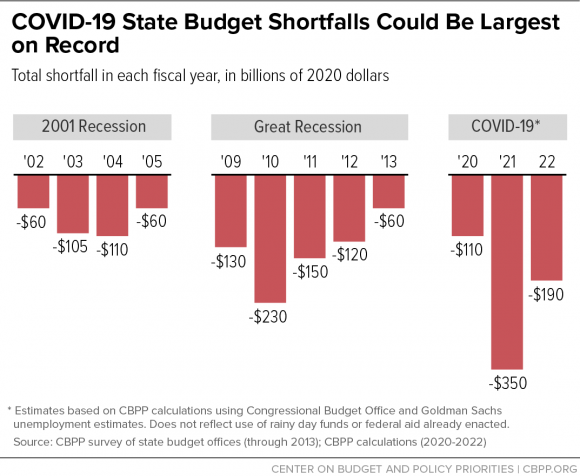
COVID-19 state budget shortfalls could be largest on record. Total shortfall in each fiscal year, in billions of 2020 dollars. 2001 recession. '02: -$60. '03: -$105. '04: -$110. '05: -$60. Great Recession. '09: -$130. '10: -$230. '11: -$150. '12: -$120. '13: -$60. COVID-19. '20: -$110. '21: -$350. '22: -$190. COVID-19 estimates based on CBPP calculations using Congressional Budget Office and Goldman Sachs unemployment estimates. Does not reflect use of rainy day funds or federal aid already enacted. Source: CBPP survey of state budget offices (through 2013); CBPP calculations (2020-2022). Center on Budget and Policy Priorities, cbpp.org.

COVID-19’s budgetary threats don’t end there. Local governments also will need relief, and this fiscal crisis may be even worse than 2009. If a 2020 recession spirals into a depression, we will be facing some very dark days without new tax revenue to make them brighter.

The path to stronger, more inclusive budget and tax policies for Alabama

Alabama could respond to these steep revenue losses with harmful cuts to education, mental health care, public health and other critical needs. Or the state could make the wiser choice of raising sustainable new revenue to invest in the common good.

Our partners at the Institute on Taxation and Economic Policy said it best: “For states facing catastrophic revenue declines, asking more of taxpayers with a clear ability to pay is far preferable to cutting state budgets, which would lead to mass layoffs, steep cuts in public services, and a downward spiral in the economy.”

Year after year, Alabama legislators have built a series of bare-bones budgets on one-time funds and temporary federal aid. They’ve refused to modernize our state’s upside-down tax system by making it more progressive and more fair for struggling families. And they’ve refused to ask large corporations and wealthy people who can afford to pay more to contribute their fair share to support the common good.

There’s a better way. The progressive tax changes we propose would protect education, health care and other services from devastating cuts during the COVID-19 recession. They also would allow our state to expand Medicaid and ensure all Alabamians can get the health care they need to survive and thrive, both during this pandemic and in the long recovery ahead. If we want a brighter future for Alabama, we need to invest in it now.

Federal law strengthened SNAP amid COVID-19 pandemic, but benefit increase still needed

The economic meltdown resulting from the COVID-19 pandemic has created an extraordinary demand for food assistance. State agencies are working overtime to figure out how to get food to hungry Alabamians while schools are closed, people are sheltering in place and the risk of infection is high. Applications for food assistance through the Supplemental Nutrition Assistance Program (SNAP) are at record highs as unemployment soars.

Unlike earlier recessions, which rolled out more slowly, the COVID-19 downturn happened virtually overnight. That has left state agencies scrambling to keep up with the demands for help, the implementation of new federal policies, and the virus threat to their workforce and clients. And they are doing it against a backdrop of decades of inadequate state funding, which led to smaller workforces and delayed implementation of new technologies that could have helped address the current crisis.

The Families First Coronavirus Response Act – the second federal law in response to the pandemic – gave the Alabama Department of Human Resources (DHR) new assistance, authority and flexibility to expand SNAP assistance during this pandemic. Thanks to the new legislation, DHR can make temporary but important changes to SNAP. These changes include:

Suspension of time limits

The Families First Act includes a nationwide, temporary suspension of SNAP’s three-month assistance time limit for able-bodied adults under age 50 and without children in their SNAP household. Officials reinstated this time limit in 2016 after the Great Recession ended. Since then, tens of thousands of Alabama SNAP participants have been cut off the program. People who lost food assistance because of the time limit are now eligible again under the new federal law. But it is unclear how officials will notify them of their restored eligibility.

Increased assistance for most families

The Families First Act authorizes states to give people additional SNAP benefits up to the maximum amount allowed for their household size. This will be an enormous help for hundreds of thousands of struggling Alabamians. Unfortunately, the poorest families – those already receiving the maximum benefit – will not receive an increase.

The increased benefits for March were added to participants’ EBT cards around the end of March. And participants will see this month’s increased benefits added to EBT cards around the end of April. DHR will approve new SNAP participants for assistance at the maximum level for their household size.

Replace school meals with SNAP and SNAP-like assistance

The Families First Act allows states to provide school meal replacement assistance of around $114 per child per month. This aid can come through SNAP or another mechanism if the children attend a school that is closed and otherwise would receive free or reduced-price school meals. This would include all children who are certified as eligible for free breakfast and lunch. It also would include all children who attend a school that provides free meals to all enrolled students through the Community Eligibility Provision.

Since all public schools in Alabama are closed for the rest of the semester, households already receiving SNAP could simply see their SNAP assistance increased by the value of school meals that children in the family previously received. However, Alabama hasn’t yet decided how to give SNAP-like “issuances” to such families who are not already enrolled in SNAP. Participants cannot receive school meal replacement benefits until DHR and the state Department of Education agree on a plan and get approval from the USDA Food and Nutrition Service (FNS).

Reduced administrative burdens

The Families First Act allows states to request policy changes to streamline SNAP procedures to keep up with increased demand. For example, a state could ask to make certification periods longer or waive interviews with new participants. States also could seek to reduce the amount of information that must be verified and simplify the verification process. Alabama already has streamlined many procedures, but it should make additional SNAP administrative changes to reduce waiting time for approvals. Thus far, DHR has not requested any administrative waivers from FNS.

What should happen next

Anti-hunger advocates had hoped the Coronavirus Aid, Relief and Economic Security (CARES) Act – the third federal law in response to the pandemic – would include a 15% increase for SNAP. Unfortunately, this increase was not in the final bill enacted March 27.

Alabama Arise and other advocates still encourage Congress to increase overall SNAP assistance and raise the minimum benefit levels. Congress also should prohibit the USDA from moving forward with proposed rule changes that would limit SNAP access and reduce benefits for most participants.

These SNAP improvements would boost the economy by increasing consumer spending. Most importantly, they would help families get the nutrition they need to stay healthy during this pandemic and beyond.