
Alabama Arise members vow to renew ‘untax groceries’ push in 2020

Ending the state sales tax on groceries is one of the top goals on Alabama Arise’s 2020 legislative agenda. Nearly 200 Arise members picked the organization’s issue priorities at its annual meeting Saturday in Montgomery. The seven issues chosen were:

  • Tax reform, including untaxing groceries and ending the state’s upside-down deduction for federal income taxes, which overwhelmingly benefits rich households.
  • Adequate budgets for human services like education, health care and child care, including Medicaid expansion and investment in home visiting services for parents of young children.
  • Voting rights, including creation of automatic universal voter registration and removal of barriers to voting rights restoration for disenfranchised Alabamians.
  • Payday and title lending reform to protect consumers from getting trapped in deep debt.
  • Criminal justice debt reform, including changes related to cash bail and civil asset forfeiture.
  • Death penalty reform, including a moratorium on executions.
  • Public transportation, including state investment in the Public Transportation Trust Fund.

“We believe in dignity, equity and justice for all Alabamians,” Alabama Arise executive director Robyn Hyden said. “And we believe our 2020 issue priorities would break down policy barriers that keep people in poverty. We must build a more inclusive future where everyone can prosper.”

Why Alabama should untax groceries

The state grocery tax is particularly harmful for Alabamians who struggle to make ends meet. The tax adds hundreds of dollars a year to the cost of a basic necessity. And most states have abandoned it: Alabama is one of only three states with no sales tax break on groceries.

Alabama is also one of only three states with a full income tax deduction for federal income taxes (FIT). For those who earn $30,000 a year, the deduction saves them about $27 on average. But for the top 1% of taxpayers, the FIT break is worth an average of more than $11,000 a year. Ending the FIT deduction would allow Alabama to remove the sales tax on groceries and still have funding left over to address other critical needs.

The grocery tax and FIT deduction are two key factors behind Alabama’s upside-down tax system. On average, Alabamians with low and moderate incomes must pay twice as much of what they make in state and local taxes as the richest households do.

“By untaxing groceries and ending the FIT deduction, lawmakers can make Alabama’s tax system more equitable for everyone,” Hyden said. “They can strengthen state support for K-12 and higher education. And they can make it easier for struggling families to put food on the table. This is an opportunity to make life better for everyone in our state, and the Legislature should do it.”
New federal public charge rule will hurt families and children across Alabama

A new Department of Homeland Security regulation published Monday will harm the health and well-being of thousands of Alabama families. The so-called public charge rule also will threaten access to health and human services programs for U.S.-born citizen children.

When proposed last fall, the regulation drew more than 266,000 public comments, overwhelmingly in opposition. The feedback included opposition from Alabama Arise, our members and allies.

The final regulation could deny admissions to the United States or green card applications if an immigrant or a member of a legal immigrant’s family uses Medicaid, the Supplemental Nutrition Assistance Program (SNAP), Section 8 rent vouchers or Medicare low-income subsidies for prescription drugs. Citizenship applications are not subject to the public charge regulation. Refugees and asylum applicants are also exempt.

Conservative estimates peg the regulation’s impact at 26 million people nationwide and nearly 200,000 people in Alabama. This includes one-fourth of all U.S. children and more than 60,000 Alabama children who live in immigrant families. The majority of these children were born in the United States.

“This rule threatens the health and safety of hard-working Alabama families and their children,” Alabama Arise executive director Robyn Hyden said. “Alabama Arise stands with our partners in the immigrant community, and we support efforts to stop this cruel rule in the courts and in Congress.

”We call on other Alabamians of faith and conscience to do the same. We ask Senators Doug Jones and Richard Shelby and our congressional delegation to act now to override this rule and protect all Alabama families.”

The rule will make life even harder for millions of families who already work hard to make ends meet. Child poverty, hunger, substandard housing and other drivers of poor health outcomes are likely to increase when immigrants are afraid to apply for assistance to which they have a legal right. And because immigrants targeted by these rules are overwhelmingly people of color, racial health disparities are likely to widen as well.

Civil asset forfeiture transparency bill is a good start, but Alabamians still need much stronger protections

The Alabama House on Thursday passed SB 191, which would increase transparency around civil asset forfeiture in the state, sending it to Gov. Kay Ivey. Alabama Arise executive director Robyn Hyden issued the following statement in response:

“SB 191’s passage is a good first step toward bringing more transparency to Alabama’s civil asset forfeiture practices. This bill will help shine some needed light on this process, and we hope the governor signs it. But simply gathering more information about the problem isn’t enough. We must change our state’s forfeiture practices to ensure they protect due process for all Alabamians.

“Alabama’s current civil asset forfeiture practices allow too much room for abuse. Hundreds of Alabamians lose cash, cars and other property under this practice every year. Many of them are never convicted of a crime – or even charged with one. And many people can’t afford to hire a lawyer to challenge these seizures in court.

“The original version of this bill showed the path to real reform. It would have required a felony conviction before property became subject to forfeiture in most cases. It also would have required the state to meet a higher burden of proof in connecting property to a crime. And it would have mandated a detailed, publicly searchable database laying out the full scale of seizures in the state.

“These reforms are still needed, and we’ll continue to fight for them. We thank all of the Alabama Arise members and other advocates across the state who helped SB 191 win legislative approval. And we appreciate their determination to keep pushing for the comprehensive change that the people of our state need and want.”

Alabama’s K-12 funding still far lower than a decade ago, despite recent gains

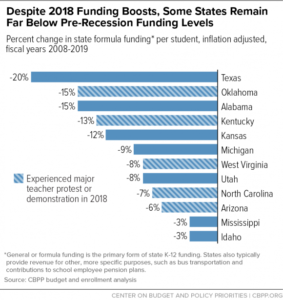
Alabama increased state education funding in 2018, but the legacy of years of extreme cuts remains, according to a new report from the Center on Budget and Policy Priorities (CBPP), a nonpartisan research organization based in Washington, D.C.

Alabama increased its K-12 formula funding by 1 percent per student last year. But that funding is still far below pre-recession levels: 15 percent less per student after adjusting for inflation.

“It’s good that state K-12 funding is moving in the right direction again, but Alabama must do much more to get our education system back on track,” Alabama Arise executive director Robyn Hyden said. “Otherwise, we risk falling even further behind states that invest more in their schools.”

Formula funding is the main state revenue source for K-12 schools nationally. It is especially important for schools in high-poverty areas, which educate a disproportionate share of black and Hispanic children. But state cuts have forced many cities and counties to cover more of the cost of education. Between 2008 and 2016, the national average for state funding declined by $167 per student. Average local funding grew by $161 during that time.

“The effects of state funding cuts are evident in teacher pay. Some 42 states cut the average teacher’s salary relative to inflation between 2010 and 2017,” said Michael Leachman, CBPP’s senior director of state fiscal research. “That is why teacher protests have emerged in many states recently.”

Adequate school funding can strengthen state economies. But steep funding cuts make it hard for states to reduce class sizes, extend learning time and enact other reforms to help students thrive.

“Alabama should close income tax loopholes that overwhelmingly benefit wealthy people and large corporations,” Hyden said. “That would allow our state to boost investments in K-12 education and offer pre-K to all families. And it would increase economic opportunities for low-income students and communities of color, who face the greatest barriers to education.”

Better policy choices on taxes, transit can improve Alabamians’ health

Deeper and smarter investments in education, housing, infrastructure and other vital services can eliminate barriers to good health for low-income residents and communities of color, according to a new report from the Center on Budget and Policy Priorities (CBPP), a nonpartisan policy research organization based in Washington, D.C.

Alabama can take many important policy steps to remove barriers to better health. These include:

  • Expand Medicaid to cover more than 340,000 adults with low incomes.
  • Provide state funding for public transportation to help seniors, people with disabilities, and people who can’t afford a car get to work or the doctor’s office and meet other basic needs.
  • End the state grocery tax to make it easier for families to make ends meet.
  • Modernize the state’s upside-down tax system to ensure Alabama raises enough money to invest in vital services and doesn’t tax struggling people deeper into poverty.

“Good health and good quality of life go hand in hand,” Alabama Arise executive director Robyn Hyden said. “By investing in Medicaid and public transportation and making our tax system more progressive, Alabama can build a stronger, healthier, more prosperous future for everyone.”

Income and wealth inequality, on top of centuries of structural racism, have taken their toll on health for black Alabamians. Black residents of our state die three years earlier than white residents, on average. Black babies in Alabama are twice as likely as white babies to be born with low birth weight, and they are twice as likely to die before their first birthdays.

Social, economic and environmental factors account for half of an individual’s health, the CBPP report says. That finding underscores the importance of investments in the common good.

“If Alabama really wants to improve the health of its residents, policymakers must prioritize education, housing, the environment, infrastructure, health programs and other public investments in their budgets,” CBPP senior policy analyst Jennifer Sullivan said.

Shutdown deal brings sigh of relief for struggling Alabamians

The White House on Friday announced a short-term agreement to end the 35-day partial shutdown of the federal government. Alabama Arise executive director Robyn Hyden issued the following statement in response:

“The pain from this unnecessary shutdown has grown by the day. Fortunately, this deal will reopen the federal government without causing further damage to struggling people. We thank all the everyday Alabamians who demanded an end to this harmful shutdown.

“Our country can’t afford to end up back in this shameful situation a few weeks from now. And we can’t afford to leave millions of Americans at greater risk for hunger, homelessness and hardship. Lawmakers must reach a long-term funding deal that protects SNAP, WIC and other vital nutrition assistance and rental assistance programs. And they should do it without seeking other policies that would hurt people who struggle to make ends meet.”

Bipartisan Farm Bill brings good news for struggling Alabamians

The U.S. House on Wednesday, Dec. 12, 2018, passed a compromise Farm Bill that avoided threatened cuts to the Supplemental Nutrition Assistance Program (SNAP). All members of Alabama’s House delegation joined Alabama’s two U.S. senators in voting for the bill. Alabama Arise executive director Robyn Hyden issued the following statement in response:

“The Farm Bill contains good news for struggling families across Alabama and across the country. It protects and strengthens the Supplemental Nutrition Assistance Program, our nation’s most effective anti-hunger program. SNAP has long had bipartisan support, and we commend House and Senate negotiators for continuing that tradition by working together across party lines to protect food assistance.

“SNAP helps nearly 900,000 Alabamians make ends meet, and we’re pleased that Congress passed a Farm Bill that protects this critical program. We thank Sens. Doug Jones and Richard Shelby and Alabama’s House members for voting to keep food on hundreds of thousands of Alabama tables.

“We also thank the many Alabamians who stood together to help protect food assistance after the House initially voted for harmful SNAP cuts that would have increased hunger. Their calls and letters to our representatives in Washington were critical in ensuring that SNAP will continue to help feed a range of people in households that struggle to make ends meet, including children, parents, seniors, people with disabilities, and working people with low pay and inconsistent hours.”

Alabama should expand Medicaid to continue gains in children’s health coverage, new national report indicates

Alabama still has one of the lowest rates of uninsured children in the country, but its progress on that measure stalled in 2017, according to a report released Thursday by Georgetown University’s Center for Children and Families (CCF).

The state’s uninsured rate for children (3.1 percent) remained below the national average (5 percent) in 2017. But after years of improvement, Alabama’s number of uninsured children under 19 ticked up from 32,000 in 2016 to 36,000 in 2017. While the increase was not statistically significant, it is a warning sign that Alabama could slip backward in children’s health care if policymakers do not protect and expand coverage, Alabama Arise policy director Jim Carnes said.

“Alabama’s rate of uninsured children has improved from 20 percent to just 3.1 percent in the last two decades, and CHIP and Medicaid have played big roles in that success,” Carnes said. “Our state should build on those gains by expanding Medicaid to cover uninsured adults. Medicaid expansion would boost financial security for struggling parents and increase the odds that their children get and stay insured. It would be a win for children, a win for families and a win for Alabama.”

Congress’ delay last year in renewing federal funding for the Children’s Health Insurance Program (CHIP) was a driver of the uptick in Alabama’s number of uninsured kids, the Georgetown CCF study says. CHIP covers about 171,000 Alabama children living in families with low or moderate incomes, including more than 84,000 on ALL Kids. Congressional efforts to cap and cut Medicaid and undermine the Affordable Care Act also likely contributed to the increase, the report finds.

The less you make, the more you pay: Alabama’s taxes remain upside down

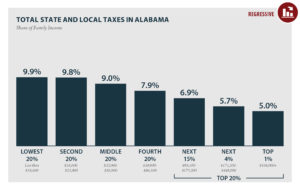
Low-income Alabamians pay twice as much in state and local taxes as a share of their income compared to the state’s wealthiest residents, according to a study released Wednesday, Oct. 17, 2018, by the Institute on Taxation and Economic Policy (ITEP), a nonprofit research organization based in Washington, D.C. The study, Who Pays?, analyzes major state and local taxes in all 50 states, including personal and corporate income taxes, property taxes, sales and other excise taxes.

Alabama has a regressive tax structure – meaning the lower your income, the higher your tax rate – and Alabama’s taxes are more regressive than those in most other states, ITEP finds. The Alabamians who earn the least – less than $18,600 a year – pay 9.9 percent of their income in state and local taxes on average. By contrast, the top 1 percent in Alabama – those who make $448,000 a year or more – pay an average of just 5 percent of their income in state and local taxes.

“For decades, big corporations and wealthy households have benefited the most from economic growth,” Alabama Arise executive director Robyn Hyden said. “But Alabama taxes struggling families deeper into poverty while lavishing tax breaks onto people who can afford to pay more. It’s time to modernize Alabama’s taxes by untaxing groceries and requiring wealthy people and corporations to pay a greater share of the cost of education, health care and other public services that make life better for everyone.”

The biggest driver of Alabama’s upside-down tax system is its heavy reliance on sales taxes to raise revenue for public services. That story is similar in many other states, but sales taxes in Alabama are particularly regressive because it is one of only three states with no tax break on groceries.

Alabama is also one of only three states to allow taxpayers to deduct every dollar of federal income tax payments on their state income taxes – a tax break that disproportionately benefits rich households. Recent increases in court fees and other user fees, which fall hardest on families who struggle to make ends meet, also have added to the regressive nature of Alabama taxes.

Such an upside-down tax structure limits Alabama’s ability to invest in services that support economic growth and help all residents stay healthy and productive, according to ITEP. If states fail to address systemic causes of growing income inequality, they will have more difficulty raising the revenue they need over time. The more income that goes to wealthy people (and the lower a state’s overall tax rate on the wealthy), the more slowly a state’s revenue grows over time, ITEP finds.

“Rising income inequality is unconscionable, and it is certainly a problem that local, state and federal lawmakers should address,” ITEP deputy director Meg Wiehe said. “Regressive state tax systems didn’t cause the growing income divide, but they certainly exacerbate the problem. State lawmakers have control over how their tax systems are structured. They can and should enact more equitable tax policies that raise adequate revenue in a fair, sustainable way.”

Alabama’s state higher ed funding cuts since 2008 are country’s third deepest

Alabama’s cuts to state higher education funding over the last decade are among the deepest in the country, according to a new report from the Center on Budget and Policy Priorities (CBPP), a nonpartisan research organization based in Washington, D.C. The funding decline persisted even as the state’s economy began to rebound from the Great Recession.

Since 2008, Alabama has slashed state higher education funding by 34.6 percent or $4,290 per student, CBPP found. The state’s cuts are the nation’s third worst by dollar amount and fifth worst by percentage. Nationally, the average cuts since 2008 are 16 percent or $1,502 per student.

Alabama’s inadequate public investment in higher education over the last decade has contributed to rising tuition prices, often leaving students with little choice but to take on more debt or give up on their dreams of going to college. Between 2008 and 2018, the average tuition at public four-year institutions in Alabama jumped by $4,329, or 69.8 percent – far outpacing the national average growth of 36 percent. These soaring costs have erected barriers to opportunity for young people across Alabama, particularly for black, Hispanic and low-income students.

“Pushing the cost of college onto students and their families will not make our state stronger,” Alabama Arise policy analyst Carol Gundlach said. “We must invest adequately in higher education to be able to build an Alabama where everyone has the opportunity to succeed.”

Americans’ slow income growth has worsened the college unaffordability problem. While the average tuition bill increased by 36 percent between 2008 and 2018, median incomes grew by just over 2 percent. Nationally, the average tuition at a four-year public college accounted for 16.5 percent of median household income in 2017, up from 14 percent in 2008.

In Alabama, a college education is even less affordable, especially for black and Hispanic families. In 2017, the average tuition and fees at a public four-year university accounted for:
•    21 percent of median household income for all Alabama families.
•    32.2 percent of median household income for black families in Alabama.
•    26.8 percent of median household income for Hispanic families in Alabama.

“The rising cost of college risks blocking one of America’s most important paths to economic mobility,” said CBPP senior policy analyst Michael Mitchell, the report’s lead author. “And while these costs hinder progress for everyone, black, Hispanic and low-income students continue to face the most significant barriers to opportunity.”

Financial aid has failed to bridge the gap created by rising tuition and relatively stagnant incomes. As a result, the share of students graduating with debt has increased. Between 2008 and 2015, the share of students graduating with debt from a public four-year institution rose from 55 percent to 59 percent nationally. The average amount of debt also increased during this period. On average, bachelor’s degree recipients at four-year public schools saw their debt grow by 26 percent (from $21,226 to $27,000). By contrast, the average amount of debt rose by only about 1 percent in the six years prior to the recession.

A large and growing share of future jobs will require college-educated workers. Greater public investment in higher education, particularly in need-based aid, would help Alabama develop the skilled and diverse workforce it needs to match the jobs of the future.

“All Alabamians, regardless of their income or where they grow up, deserve an opportunity to reach their full potential,” Gundlach said. “Our state should end tax breaks for large corporations and invest in making college more affordable for the students who need assistance the most.”