

Groups urge Dismukes’ resignation, ask Legislature to dismantle white supremacy through policy change

Alabama Arise logo     Alabama NAACP logo    Greater Birmingham Ministries logo

The following is a joint statement from Alabama Arise, the Alabama State Conference of the NAACP and Greater Birmingham Ministries:

Our elected officials and appointed leaders should respect the full dignity, worth and humanity of all people they represent. We urge all political parties and public officials to acknowledge the harm that white supremacy continues to inflict upon Alabama. And we call upon them to dismantle white supremacist structures through intentional policy changes.

The cause of white supremacy permeates our state’s fundamental governing document. When the president of the 1901 constitutional convention, John Knox, was asked why Alabama needed a new constitution, his answer was clear: “to establish white supremacy in this state.”

Any celebration of Nathan Bedford Forrest of the Ku Klux Klan – a white supremacist terrorist organization – is contrary to the values that Alabamians expect from our leaders, elected officials and neighbors. In celebrating Forrest, Rep. Will Dismukes revealed he is unable or unwilling to represent the best interests of his constituents and his state. We condemn his actions in the strongest possible terms. We also understand this is not the first time Dismukes has celebrated the Confederacy or Forrest in such a manner. Therefore, we join with many other individuals and organizations across Alabama in calling for Dismukes to resign immediately.

Racial equity requires action, not just words

Alabama’s need for racial justice and healing reaches far beyond any one individual. All elected officials must take a hard look at both their actions and the impacts of their policy decisions. Most lawmakers claim to support racial equality, but the results of their policy choices often do not match this claim.

Examples of this mismatch are unfortunately common in our state. The 2017 Memorial Preservation Act prevents localities from removing statues that “honor” the Confederacy without paying a steep fine or getting approval from a panel of legislators that to our knowledge has not approved a removal since the law was enacted. Lawmakers’ failure to expand Medicaid leaves a disproportionate share of African Americans without health insurance during a pandemic. And the absence of racial impact data prevents communities and legislators from evaluating the full effects of state policy choices.

The harsh reality of racial disparities in Alabama

While Dismukes dismisses the need for racial reconciliation in today’s society, we cannot remain ignorant of the truth. We all must reckon with these disparities created and maintained by structural policy barriers:

It’s time for more than talk. Denouncing and rejecting white supremacy is only the beginning. Lawmakers also must enact meaningful policy changes to break down institutional barriers to opportunity and justice for all Alabamians.
New Senate COVID-19 relief plan falls short of meeting Alabamians’ needs

U.S. Senate Republicans on Monday unveiled a new proposed COVID-19 relief plan. Alabama Arise executive director Robyn Hyden issued the following statement Tuesday in response:

“Millions of Alabamians are being pushed to the brink during the COVID-19 crisis. They’re struggling with difficult tradeoffs between protecting their own health, paying for basic necessities and caring for children and seniors. Nearly one in four renters in Alabama are behind on rent. And one in five adults with children in our state say their kids sometimes don’t have enough to eat because the household just can’t afford enough food.

“As families face these health and economic shocks, the Senate relief proposal fails to meet the demands of the moment. This plan would slash supplemental unemployment insurance benefits amid the highest unemployment since the Great Depression. It wouldn’t increase housing assistance to prevent families from being evicted and becoming homeless. It wouldn’t increase SNAP benefits to address the critical hunger concerns facing families of schoolchildren. And it wouldn’t provide Alabama and other states with the money needed to invest in child care, avoid teacher layoffs and prevent cuts to Medicaid and other vital services as budget shortfalls grow.

“This plan is inadequate by any measure. We urge our senators to reject it and look instead toward the approach taken in the House-passed HEROES Act. The House plan would boost Medicaid funding and offer more support for essential workers and people who lost their jobs. And it would provide federal assistance so states can avoid devastating service cuts that would hurt tens of millions of people.”

What a meaningful COVID-19 relief plan should look like

Alabama Arise urges Congress to negotiate a COVID-19 relief package that does the following:

  • Boosts Supplemental Nutrition Assistance Program (SNAP) benefits so struggling families can keep food on the table.
  • Increases housing assistance to help people pay their rent and mortgages and to avert a surge in homelessness.
  • Preserves the weekly $600 federal increase to unemployment insurance benefits.
  • Provides additional federal funding for states to avert harmful layoffs and invest in vital services like Medicaid and child care.
  • Removes administrative barriers to alternative school meal distribution procedures for districts that are holding classes online.
  • Allocates federal funding to help election officials process more absentee ballots and maintain proper social distancing at polling places.
  • Makes the Child Tax Credit temporarily available to children in families with the lowest incomes and expands the Earned Income Tax Credit (EITC) for low-paid workers who are not raising children in their homes.

69,000 Alabama workers lost coverage when they may need it most, new report finds

Job losses during the COVID-19 economic crash kicked 69,000 Alabamians off their health insurance between February and May, according to a new report by Families USA, a nonprofit research organization based in Washington, D.C.

Those coverage losses increased Alabama’s uninsured rate for non-elderly adults to 19%, the report finds. That is the ninth highest rate in the nation and 3 percentage points higher than in 2018. As workers and their families lose comprehensive health insurance, their risk of delayed care and complications from the virus increases. So does their risk of financial devastation.

“Even before COVID-19, Alabama’s failure to expand Medicaid left more than 220,000 adults uninsured,” Alabama Arise campaign director Jane Adams said. “Further coverage losses during the recession will bring health and financial suffering for even more families across our state. More people will go without needed health care. More hospital bills will go unpaid. And all Alabamians will bear the additional strain on our health care system. This report’s findings should be a blaring emergency siren for our state leaders.”

The number of uninsured adults jumped by 5.4 million nationally between February and May. The increase in those few months was 39% higher than any annual increase ever recorded, Families USA finds. The report also shows a disturbing overlap between states with the highest adult uninsured rates and the worst COVID-19 case trends.

“COVID-19 is putting lives, livelihoods and economic security at risk for thousands of Alabama workers. And many communities face long-term challenges for health care capacity and economic recovery,” Adams said.

“Alabama Arise and Cover Alabama urge Gov. Kay Ivey to save lives and stabilize our local hospitals by expanding Medicaid. We ask the Legislature to provide the needed state share of this pro-family, pro-health, pro-community investment in our future. And we ask Congress to strengthen Medicaid funding and help Alabama shore up our health care infrastructure.”

Adams directs Cover Alabama, a coalition of more than 90 organizations pushing for Medicaid expansion in Alabama. Arise is a founding member of the coalition.

Medicaid expansion would improve life for all Alabamians, new Arise report shows

Expanding Medicaid to cover adults with low incomes would build on the program’s successes and save hundreds of lives every year, according to a new report that Alabama Arise released Wednesday.

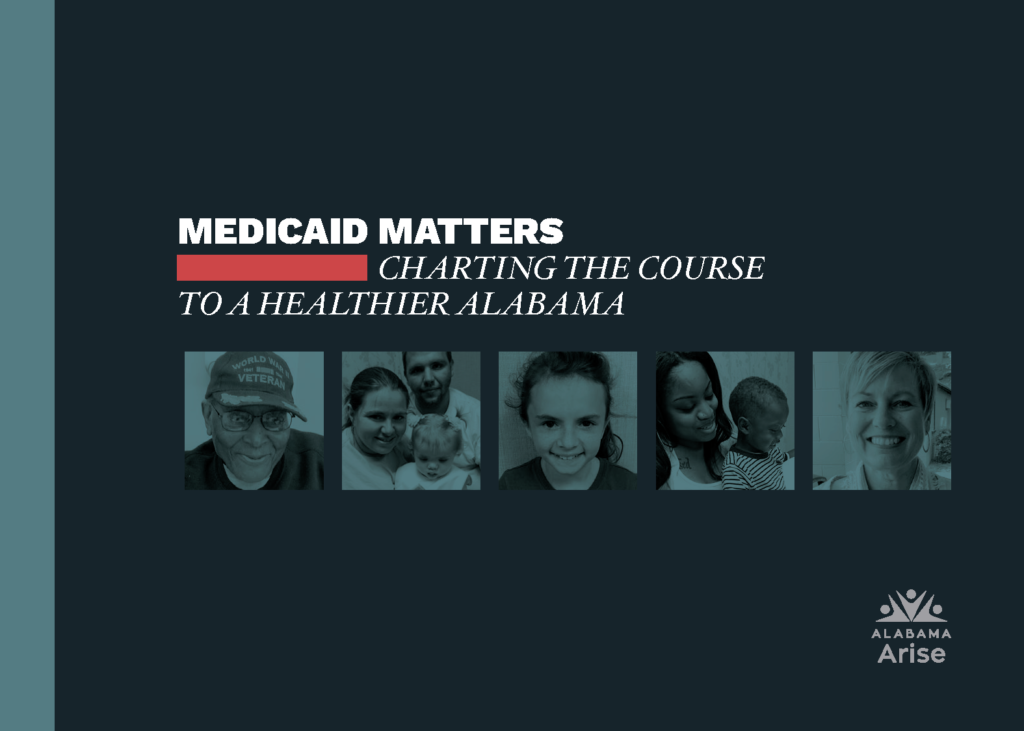
Arise’s report, Medicaid Matters: Charting the Course to a Healthier Alabama, illustrates why Medicaid expansion is so critical for the state at this moment in history. Through data, colorful graphics and personal profiles, the report explores Medicaid’s crucial role in Alabama’s health care system. And it reveals how Medicaid expansion would promote racial equity and leave communities better equipped to fight the COVID-19 pandemic.

“Expanding Medicaid would save thousands of lives, create tens of thousands of jobs and help hospitals and clinics across Alabama,” Alabama Arise policy director Jim Carnes said. “As our state continues to struggle with COVID-19, it’s more important than ever for the governor and lawmakers to step up and prove they value the health and well-being of all of our residents.”

Front cover of Alabama Arise's Medicaid Matters report

Medicaid is a health care lifeline for one in four Alabamians and an economic engine for the entire state. Medicaid Matters explains the Medicaid coverage available to more than 1 million children, seniors, and people with disabilities in Alabama. It highlights improvements that new Medicaid changes are promoting in key areas like infant mortality, obesity and substance use disorders. And it shines a spotlight on more than 340,000 uninsured and underinsured Alabamians who would be covered under Medicaid expansion.

Medicaid expansion would save and transform lives across Alabama

So far, 36 states – including Arkansas, Kentucky and Louisiana – have expanded Medicaid to cover adults with low incomes. But Alabama is one of just 14 states that have not. That remains the case even though the state would get $9 in federal money for every $1 of state funding.

Medicaid expansion would bring peace of mind to thousands of Alabamians who recently lost their jobs and health insurance. And it would make life better for many uninsured people who are working on the front lines of the pandemic. This includes workers at grocery stores, hospitals, child care facilities and other essential businesses.

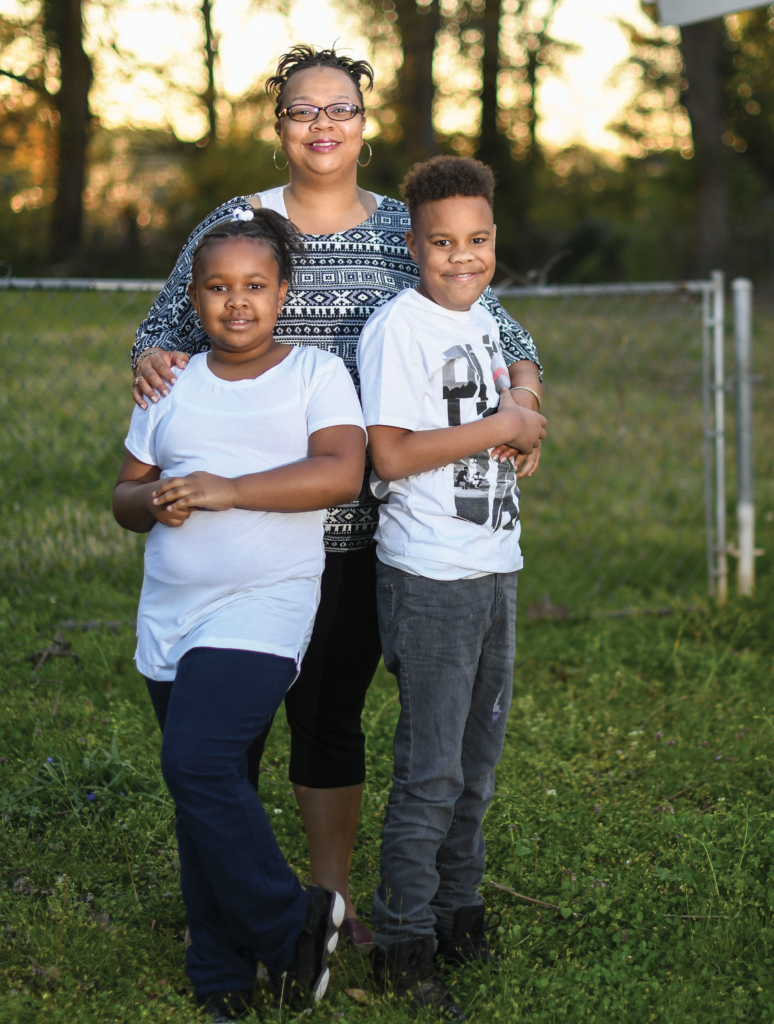
Formeeca Tripp, a behavior specialist who lives in Auburn, explains in Arise’s report how the health of any Alabamian is linked to the health of every Alabamian.

A photo of Formeeca Tripp with her two children.
Formeeca Tripp of Auburn knows firsthand the tough decisions that come with living and working in the coverage gap. (Photo: Julie Bennett)

“It’s the people who are working with the sick and elderly, working with your babies,” Tripp said. “It’s us, out here, hands on, making food, cleaning houses – it’s that gap of people, very important people. People who come into contact with thousands of other people. And you don’t want them to be healthy?”

Click here to read Arise’s full report. Links to each section of the report are below.

Medicaid Matters (Main Section)
How does Medicaid work in Alabama? (Section 1)
How is Medicaid improving coverage? (Section 2)
Who’s still left out of health coverage? (Section 3)
How can we make Alabama healthier? (Section 4)

Alabama Arise urges new federal guidance on return to unsafe working conditions

Workers shouldn’t have to choose between their lives and their livelihoods. That’s why Alabama Arise joined more than 220 organizations across the country Tuesday in a letter urging the U.S. Department of Labor to act aggressively to protect workers who are at higher risk from COVID-19.

Existing federal laws protect workers from losing eligibility for unemployment insurance (UI) or Pandemic Unemployment Assistance (PUA) benefits if they refuse to return to jobs that do not comply with health and safety rules. But the Department of Labor’s recent guidance does not reinforce these protections for workers whose employers are not taking proper precautions against COVID-19.

These shortcomings will force many workers to choose between their family’s health and financial security. And they will increase the pandemic’s toll on black and Latino communities where people are more likely to live in poverty and without health insurance.

The letter urges the Department of Labor to issue new guidance clarifying that workers are not disqualified for UI or PUA benefits if they refuse to work in conditions that do not comply with Centers for Disease Control and Prevention (CDC) guidelines to limit virus spread. The letter also asks the department not to require workers who are older or immunocompromised – or who live with people who are – to return to work under such conditions.

You can read the full letter here.

Cover Alabama Coalition: Medicaid expansion is essential to state’s recovery

A nonpartisan alliance of more than 60 Alabama organizations has come together to urge Gov. Kay Ivey to say yes to Medicaid expansion. The Cover Alabama Coalition, which launched Wednesday, is calling on Ivey to close the health coverage gap for workers who don’t have employer-based insurance and can’t afford to purchase insurance on their own. Alabama Arise is a founding member of the coalition.

Cover Alabama logo

Cover Alabama is a coalition of advocacy groups, businesses, community organizations, consumer groups, health care providers and religious congregations from across the state. (You can read the full membership list here.) The coalition held a virtual news conference Wednesday to highlight the critical role that Medicaid expansion can play in ensuring access to health care, protecting families against bankruptcy and stabilizing rural hospitals – both during the COVID-19 pandemic and the economic recovery.

“This pandemic only heightens the need for bold, comprehensive action,” said Evey Owen, interim coalition director for Cover Alabama. “The health and economic costs of COVID-19 will be high no matter what. Alabama must maximize the value of every state dollar we spend to protect public health. And the best way to do that is to leverage the 90% federal match for Medicaid expansion.”

The need to expand Medicaid here and now

So far, 36 states – including Arkansas, Kentucky and Louisiana – have expanded Medicaid to cover adults with low incomes. Alabama is one of just 14 states that have not done so. Medicaid expansion would benefit hundreds of thousands of Alabamians who are uninsured or struggling to pay for health coverage. Many of these uninsured people are “front-line workers” at grocery stores, hospitals, pharmacies and other essential businesses during the COVID-19 pandemic.

“It’s great to applaud the brave Alabamians who are keeping food on our tables and keeping hospitals clean during the crisis, but it would be even better to make sure they can get health coverage,” Owen said. “These are the workers most likely to be uninsured, and we should do everything we can to keep them safe and healthy.”

Speakers at Cover Alabama’s news conference Wednesday pointed out that Medicaid expansion would:

  • Help uninsured Alabamians avoid risks of delayed care, like unchecked COVID-19 transmission, poor health outcomes and overwhelming medical debt.
  • Relieve rural health care providers from financial strain, preventing further hospital closures.
  • Bring billions of federal dollars into local and state economies as they struggle to recover from revenue losses of historic proportions.

To elevate and amplify the public conversation about Medicaid expansion at this critical time, Cover Alabama plans to share stories of Alabamians caught in the coverage gap, news about expansion’s impact in other states and an opportunity for more groups to join the campaign.

Striking down the ACA would undermine health security for all Alabamians

The U.S. Court of Appeals for the 5th Circuit struck down the Affordable Care Act’s individual mandate on Wednesday. The court then returned the case to a district judge to consider whether other parts of the law can remain intact after the ruling. Alabama Arise policy director Jim Carnes issued the following statement Thursday in response:

“This appalling decision puts health coverage at risk for tens of millions of people. And it imperils important consumer protections for every single American. The ruling won’t affect the 2020 marketplace coverage that Alabamians have signed up for under the Affordable Care Act. But it poses a long-term threat to the health and well-being of our people and our communities.

“Let’s be clear about what’s at stake if the ACA disappears. Tens of millions of Americans who gained coverage through Medicaid expansion would lose their insurance. Young adults would lose the right to stay on their parents’ plans until age 26. Coverage guarantees for people with preexisting health conditions like cancer and diabetes would vanish. And insurers no longer would have to cover vital services like maternity care, mental health care or treatment for substance use disorders.

“We can’t afford to go back to those bad old days. This rehashed assault on health coverage flies in the face of settled law, public opinion and common sense. And this ruling should be a call to action for Alabama. Our families and our workforce deserve the same opportunity as all other Americans to stay healthy and productive. We urge our lawmakers to expand Medicaid and move toward a future where everyone can get the health care they need to survive and thrive.”

More Alabama children were uninsured in 2018 than in 2016, new report shows

Alabama’s rate of uninsured children has moved in the wrong direction since 2016, according to a report released Wednesday by Georgetown University’s Center for Children and Families.

The state’s uninsured rate for children (3.5%) remained one of the best in the South and was far below the national average (5.2%) in 2018. But after years of improvement, Alabama’s number of uninsured children ticked up from 32,000 in 2016 to 41,000 in 2018. (More Alabama-specific data is available at this link.)

The increase is a warning sign that Alabama could slip backward in children’s health care if policymakers do not protect and expand coverage, Alabama Arise policy director Jim Carnes said.

“Children’s health coverage has long been a point of pride for Alabama, and we can’t afford to backslide,” Carnes said. “ALL Kids and Medicaid have played huge roles in that success. And our state should build on those gains by expanding Medicaid to cover adults with low incomes as well. Medicaid expansion would boost financial security for struggling parents and increase the odds that their children get and stay insured. It would be good for children, good for families and good for Alabama.”

White House efforts to undermine the Affordable Care Act (ACA) also likely contributed to the coverage erosion, the report finds. Federal officials have shortened the open enrollment period for ACA Marketplace plans and have slashed outreach and advertising funding. Open enrollment for 2020 Marketplace coverage begins Nov. 1, 2019, and will continue until Dec. 15, 2019.

Alabama’s higher ed funding cuts since 2008 are the nation’s worst

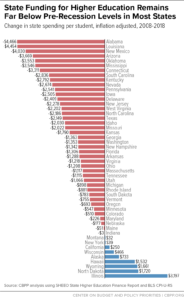
Alabama has slashed its per-student state higher education funding more than any other state over the last decade, according to a new report from the Center on Budget and Policy Priorities (CBPP), a nonpartisan research organization based in Washington, D.C.

Since 2008, Alabama has cut state higher education funding by 36.2%, or $4,466 per student, CBPP found. The state’s cuts are the nation’s worst by dollar amount and third worst by percentage. Nationally, the average cuts since 2008 are 13%, or $1,220 per student.

Alabama’s inadequate public investment in higher education over the last decade has contributed to soaring tuition costs. And that has forced many students either to start their careers in deep debt or abandon their college dreams entirely.

Between 2008 and 2018, the average tuition at public four-year institutions in Alabama jumped by $4,489, or 72.9%. That is nearly twice the national average growth of 37% – and almost exactly matches the size of state funding cuts. These soaring costs have erected barriers to opportunity for young people across Alabama, particularly for black and Latino students.

“This is another example of how short-sighted education cuts hurt people across Alabama,” Alabama Arise executive director Robyn Hyden said. “Pushing college students and their families into deep debt isn’t making our state stronger. We need to invest more in education at all levels to build an Alabama where everyone has the opportunity to succeed.”

Soaring tuition disproportionately harms black and Latino students

Alabama’s rising college costs have hit hardest among black and Latino students. In 2017, the average net price of attending a public four-year university accounted for:

  • 35% of median household income for all families in Alabama.
  • 45% of median household income for Latino families in Alabama.
  • 54% of median household income for black families in Alabama.

Financial aid has not increased enough to cover higher college costs nationwide. The resulting higher prices can dissuade many students from enrolling or finishing their degrees. Tuition increases also can reduce campus diversity, especially among people of color and students from households with low wealth.

A large and growing share of future jobs will require college-educated workers. Greater public investment in higher education, particularly in need-based aid, would help Alabama develop the skilled and diverse workforce it needs to match the jobs of the future.

“All Alabamians, regardless of their income or hometown, deserve an opportunity to reach their full potential,” Hyden said. “Alabama should invest in making college more affordable for the students who need assistance the most. And ending skewed tax breaks for large corporations and wealthy households would be a good place to start.”

Alabama’s uninsured rate is growing because we haven’t expanded Medicaid

U.S. Census findings released Tuesday show that about 32,000 more Alabamians were uninsured in 2018 than in 2017. They also found that the state’s uninsured rate remained higher than the national average. Alabama Arise policy director Jim Carnes issued the following statement in response:

“No one should have to go without the medical care they need simply because they can’t afford it. But that’s the reality for a growing number of Alabamians, because our state has refused to expand Medicaid. Gov. Kay Ivey and state lawmakers need to lift this policy barrier that separates hundreds of thousands of Alabamians from affordable health coverage.

“As Alabama’s inaction on Medicaid expansion continues, our state’s uninsured rate continues to climb. The share of Alabamians without health insurance coverage rose to 10% in 2018, up from 9.4% in 2017. This is a trend in the wrong direction, but we can reverse it with better policy choices.

“All Alabamians would benefit from Medicaid expansion. More than 340,000 adults across the state would gain health security. The new coverage would pump about $1.7 billion a year in direct federal spending into our economy. And over the next four years, economic activity related to expansion would generate $446 million in state tax revenues.

“Even more important than the economic gains would be the human gains. Medicaid expansion would give Alabama better tools to address mental illnesses, substance use disorders, infant mortality and other longstanding challenges. Closing our state’s coverage gap would mean healthier families, more vibrant communities and a more productive workforce.

“It’s time to make an investment in Alabama’s future. The governor should expand Medicaid to protect rural hospitals, create thousands of jobs and make Alabama healthier.”