20+ Alabama community groups call on Hyundai to stop alleged use of child labor at suppliers

The Alabama Coalition for Community Benefits issued an open letter on Thursday to Hyundai Motor of North America calling on the company to stop any use of child labor and to negotiate a community benefits agreement.

The letter from community leaders in Alabama comes as the U.S. Department of Labor continues to investigate widely reported alleged use of child labor by SMART, a Hyundai-owned parts supplier to the Korean company’s large assembly facility in Montgomery.

A Reuters writer initially reported evidence suggesting that as many as 50 underage workers – as young as 12 years old – had worked at the stamping plant that also has a long history of health and safety violations, including amputation hazards.

At the same time, another Hyundai supplier, SL Alabama, was sued by the Department of Labor last month over allegations that the supplier employed children under age 16. SL Alabama manufactures headlights and mirrors for Hyundai. Also last month, Hyundai was sued by Mexican workers who allege that Hyundai discriminated against them by paying them less than white workers at the same plant.

“When our state incentivizes employers to locate here, Alabamians have a right to expect a high level of accountability and transparency,” Alabama Arise executive director Robyn Hyden said. “Alabama has given up tax dollars to help support the Hyundai manufacturing plant and suppliers. We are asking for more accountability for all employers who receive subsidies and profit from state investments.”

“These allegations of child labor at multiple Hyundai subsidiaries suggest a potentially systemic problem with labor practices across the company’s U.S. supply chain,” United Auto Workers President Ray Curry said. “Accordingly, we urge the Biden Administration to use all available tools – administrative, criminal and civil – to investigate the alleged abuses and hold the company, its subsidiaries and suppliers, and any third-party labor recruitment firms accountable to the fullest extent of the law.”

“The working people of Alabama welcomed Hyundai into our community with open arms and generous financial support, with the expectation that the company would be a good corporate community partner,” said Carmen Paschal, a production worker at the Hyundai assembly plant in Montgomery. “The company needs to take responsibility, take action to prevent this kind of terrible exploitation and ensure that Hyundai provides quality jobs and workplace rights across its supply chain. We deserve nothing less.”

The Coalition works toward improving working conditions in Alabama manufacturing plants, including those in the state’s large auto industry. The Coalition includes civil rights groups, faith leaders, labor unions, Latinx organizations and environmental groups.

Scott Douglas, director of Greater Birmingham Ministries, said: “Taking advantage of children and placing them in harm’s way must stop, and as a coalition partner, we will continue to fight until this practice ends.”

Community benefits agreements are legally enforceable agreements between private companies and coalitions of community and labor groups that ensure a wide range of high-road job standards and equity measures. The Coalition recently negotiated such an agreement with New Flyer, the largest bus manufacturer in North America, for its assembly facilities in Anniston, Alabama, and Ontario, California.

Hyundai and its suppliers employ thousands of workers in Alabama and are one of the largest employers in the greater Montgomery area. The region also has a disproportionately high rate of poverty for Black and Latino people ‒ often two to three times that of white people.
New Census data reveals how good policy choices can cut poverty, keep Alabamians healthier

People-friendly federal policies reduced poverty and made it easier for people to get health care in 2021, U.S. Census figures released this week show. Perhaps the most eye-opening improvement was a dramatic reduction in child poverty nationwide.

The recent Child Tax Credit (CTC) expansion alone kept 5.3 million Americans above the poverty line. The one-year expansion under the American Rescue Plan Act (ARPA) made the full CTC available to children living in families with low or no earnings. It increased the maximum credit to $3,000 per child and $3,600 per child under age 6. And it extended the credit to 17-year-olds. The expansion expired in 2022 after Congress failed to renew it, but lawmakers could revisit that decision later this year.

Child Tax Credit improvements fuel record drop in U.S. child poverty

CTC expansion helped reduce disparities for Black and Hispanic children. It also drove the U.S. child poverty rate to a record low of 5.2% under the Supplemental Poverty Measure (SPM). Unlike the traditional poverty measure, the SPM reflects the poverty-reducing effects of tax credits and non-cash benefits like food assistance.

Alabama’s official child poverty rate was 22% last year under the American Community Survey (ACS), a more traditional measure that accounts for fewer factors than the SPM. That was an apparent increase from the pre-pandemic level of 21.1% in 2019, though within the margin of error. (ACS data for 2020 is unavailable due to pandemic-related data collection disruptions.)

SPM data paints a fuller picture of the poverty-reducing power of supports like the expanded CTC. Alabama’s three-year average overall poverty rate under the SPM was 10.3% in 2019-21. By contrast, the state’s overall ACS poverty rate moved from 15.5% in 2019 to 16.1% in 2021. That change was not statistically significant.

“The success of the Child Tax Credit expansion was undeniable,” Alabama Arise executive director Robyn Hyden said. “This policy slashed child poverty and helped families make ends meet across our state and our country. Congress needs to renew the Child Tax Credit expansion and make it permanent. And our state lawmakers should do their part to help Alabama families keep food on the table by ending the state grocery tax and replacing the revenue in a responsible way.”

Uninsured rates fall nationally despite tumult of COVID-19 pandemic

Federal policy choices also fueled a slight reduction in the number of uninsured Americans last year. The U.S. uninsured rate dropped to 8.6% last year, down from 9.2% in 2019. Alabama’s uninsured rate stayed relatively flat, moving from 9.7% in 2019 to 9.9% in 2021. That change was within the margin of error.

Alabama continued a years-long pattern of outperforming the national average in insuring children in 2021. The state’s rate of uninsured children (4%) remained the best in the Deep South last year. Much of that sustained success is attributable to ALL Kids, the state’s Children’s Health Insurance Program (CHIP) created in 1998. ALL Kids has played a crucial role in reducing Alabama’s rate of uninsured children from 20% in the late 1990s.

A key factor in the overall health coverage improvements was the federal requirement for state Medicaid programs to keep participants covered throughout the ongoing COVID-19 public health emergency declaration. That declaration may end later this year, underscoring the importance of helping many enrollees transition to new coverage.

Enhanced subsidies under ARPA also helped make health coverage more affordable for millions of Americans with private plans. This includes many of the 219,000 Alabamians with marketplace plans through the Affordable Care Act. Congress renewed subsidy enhancements through 2025 in the Inflation Reduction Act, which President Joe Biden signed into law last month.

“Medicaid, ALL Kids and ACA marketplace coverage have saved and improved the lives of millions of Alabamians,” Hyden said. “Alabama should build on these successes by expanding Medicaid to help more than 340,000 people who are uninsured or struggling to afford health insurance.

“It’s time for Gov. Kay Ivey to say yes to the generous federal incentives for Medicaid expansion. It’s time for her to say yes to a healthier future for Alabama.”

Inflation Reduction Act will make Alabama a healthier state

Alabama Arise executive director Robyn Hyden released the following statement Monday in response to the U.S. Senate’s passage of the Inflation Reduction Act on Sunday:

“The Inflation Reduction Act will help build a healthier future for people across Alabama. This plan will make health coverage more affordable for hundreds of thousands of Alabamians and millions of Americans. It will improve air quality by investing in clean energy and reducing emissions that fuel climate change. And it will pay for these investments by closing tax loopholes that subsidize profitable corporations and wealthy households.

“This plan will save money for patients and the federal government by allowing Medicare to negotiate certain prescription drug prices. It will cap the cost of insulin and other out-of-pocket drug expenses for Medicare enrollees. And it will extend enhanced subsidies that make health coverage more affordable for many of the 219,000 Alabamians with marketplace plans through the Affordable Care Act.

“We’re happy that the U.S. Senate passed this important legislation. And we look forward to the House approving it and sending it to President Joe Biden to sign into law.

“We also will continue advocating for state lawmakers to make other needed investments in families and communities. We’ll keep working for additional funding to make child care, housing and public transportation more affordable and available across Alabama. And we’ll continue pushing for Medicaid expansion to help more than 340,000 Alabamians who are uninsured or struggling to afford health insurance.

“These policy choices are essential to improve Alabamians’ quality of life and to boost our state’s economic prosperity. We’re determined to see each and every one of them across the finish line.”

82 Alabama groups urge Ivey, legislators to fund public transportation using ARPA funds

Lawmakers should jump-start public transportation across Alabama with an allocation of $20 million from the state’s remaining federal COVID-19 relief money, according to a letter that 82 churches and organizations across the state sent Wednesday to Gov. Kay Ivey and legislators. Alabama Arise is among the groups that co-signed the letter.

The organizations asked Gov. Kay Ivey and the Legislature to invest $20 million of American Rescue Plan Act (ARPA) funds in the state Public Transportation Trust Fund. That amount is just 2% of the state’s roughly $1 billion of remaining unallocated ARPA funds.

Alabama is one of only three states with no state funding for public transportation, the letter says. Lawmakers created the state Public Transportation Trust Fund in 2018, but it has yet to receive state funding. And the consequences of that state inaction have grown in recent years, the letter says.

“The COVID-19 pandemic only worsened the harm resulting from lack of state support for public transportation,” the letter says. “We know robust investments in public transit will provide strong benefits for people across Alabama. Greater access to work, school, child care and medical care are just a few examples of how public transit is critical not only for an individual’s quality of life but for the state’s economic development and prosperity.”

More public transit funding means fewer service barriers

Investments in public transportation would expand economic opportunity, advance racial equity and strengthen community connections, a recent Arise report found. Arise’s survey of public transit systems in 42 of Alabama’s 67 counties showed how additional funding would empower those systems to lift many service barriers.

“State public transportation funding is an investment in a stronger economy and healthier communities,” Arise executive director Robyn Hyden said. “This investment would allow Alabama to draw down more federal infrastructure dollars. It would allow systems to hire more drivers and add more routes. It would enable them to extend operating hours and modernize technology. And it would bring us closer to the day when all Alabamians can get where they need to go when they need to get there.”

Click here to read the full letter from 82 organizations to the governor and legislators.

New poll: Most Alabamians support plan to untax groceries, protect funding for public schools

Nearly three in five Alabamians (59.3%), including 56.1% of Republican voters, support legislation that would remove the state sales tax on groceries without cutting education funding, according to a new poll commissioned by Alabama Arise. Only 25.3% of respondents opposed the plan, with another 15.5% saying they were unsure or did not take a position.

The poll shows strong public support for untaxing groceries in a responsible way, Alabama Arise executive director Robyn Hyden said.

“The state grocery tax increases hunger rates and drives struggling Alabamians deeper into poverty,” Hyden said. “Legislators have a clear path to untax groceries without cutting a dime of funding for public schools. They should act now to seize this opportunity to improve life for families across our state.”

Arise unveiled the poll results Tuesday during a member rally at the State House in Montgomery. Dozens of Arise supporters gathered to show their support for efforts to eliminate the state sales tax on groceries.

Why and how to end the state grocery tax in Alabama

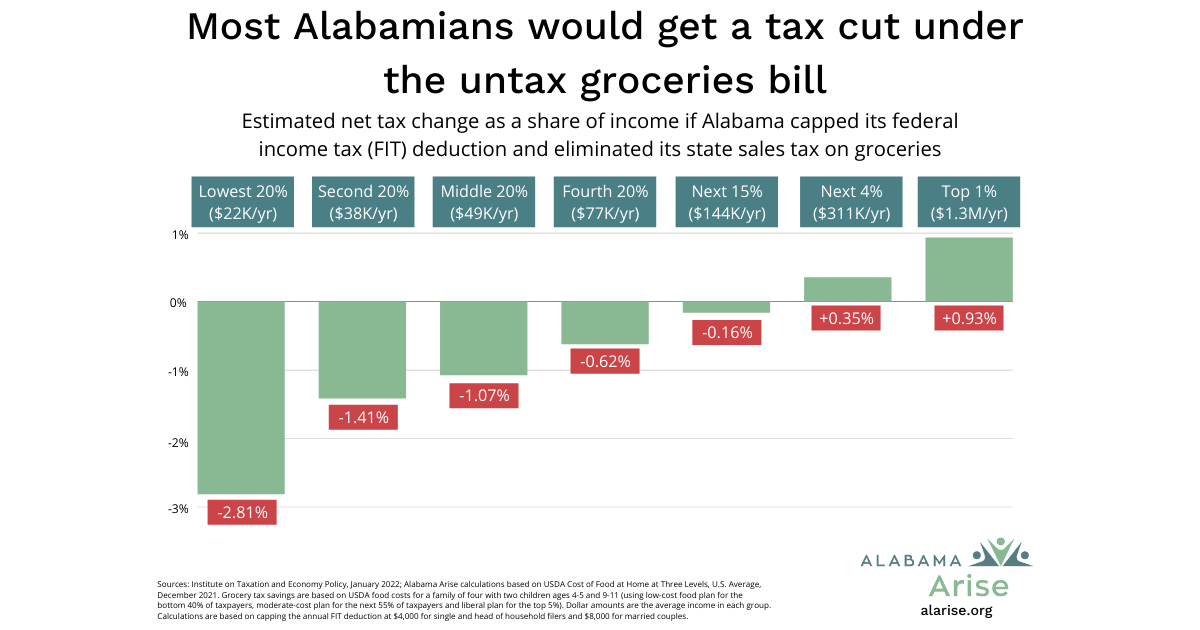
Alabama is one of only three states, along with Mississippi and South Dakota, with no tax break on groceries. And Alabama is one of only two states, along with Iowa, to allow a full state income tax deduction for federal income tax (FIT) payments. Because wealthy people pay more in federal income taxes on average, the state’s FIT deduction overwhelmingly benefits rich households.

Both sales tax revenue and individual income tax revenue go to the Education Trust Fund. By capping the FIT deduction, Alabama could afford to end the state sales tax on groceries while protecting school funding. Three bills this year would do that: SB 43 by Sen. Andrew Jones, R-Centre; HB 173 by Rep. Mike Holmes, R-Wetumpka; and a forthcoming bill by Rep. Penni McClammy, D-Montgomery. McClammy’s bill also would remove the state sales tax from over-the-counter medicines.

Bar graph showing how most Alabamias would get a tax cut under the untax groceries bill

Under SB 43 and HB 173, the FIT deduction cap for Alabamians who file as single, head of household or married filing separately would be $4,000 annually. For married couples filing jointly, the limit would be $8,000 a year. Under McClammy’s bill, those annual caps would be $3,500 and $7,000, respectively.

About the poll

Alabama Arise commissioned the poll, which the Montgomery-based firm Cygnal conducted in January. The poll surveyed 631 likely voters across Alabama and has a margin of error of +/- 3.85%. Interviews of known registered voters occurred via live phone calls, online panel, texts and email invitation.

Click here for Arise’s poll results on untaxing groceries in Alabama.

New poll: More than 7 in 10 Alabamians support Medicaid expansion

More than seven in 10 Alabamians (71.5%), including 65.8% of Republican voters, support expanding Medicaid when told about arguments in support of the idea, according to a new poll commissioned by Alabama Arise. The poll also showed robust bipartisan support for using a portion of the state’s funding under the American Rescue Plan Act (ARPA) to support Medicaid expansion.

Participants responded strongly when informed that expanding Medicaid would create an average of 20,000 new jobs per year over the next six years and have an economic impact of $1.8 billion per year. Nearly 69% of respondents, including 61.8% of Republican voters, supported using a portion of the state’s $2 billion in ARPA funds to expand access to Medicaid in Alabama.

Jane Adams, Cover Alabama campaign director at Alabama Arise, said the poll results underscore Alabama’s urgent need for Medicaid expansion.

“Voters support Medicaid expansion because it is a tremendous opportunity to create jobs, protect rural hospitals and provide life-saving care,” Adams said. “This poll shows Medicaid expansion is no longer a partisan issue and that most Alabamians support expanding Medicaid coverage to adults with low incomes.”

Support for Medicaid expansion grows across Alabama

The overwhelming polling support reflects an ever-growing group of individuals, organizations, veterans, faith leaders, medical professionals and businesses that support expanding Medicaid in Alabama. This group includes the Alabama Hospital Association, Alabama Chapter of the American Academy of Pediatrics, the Alabama Department of Public Health’s Maternal Mortality Review Committee and the Medical Association of the State of Alabama, as well as more than 100 nonprofits, faith-based groups and medical advocacy organizations in the Cover Alabama Coalition.

Alabama Arise commissioned the poll, which the Montgomery-based firm Cygnal conducted in January. The poll surveyed 631 likely voters across Alabama and has a margin of error of +/- 3.85%. Interviews of known registered voters occurred via live phone calls, online panel, texts and email invitation.

Click here for Arise’s poll results on Medicaid expansion in Alabama.

New report highlights economic benefits of Medicaid expansion

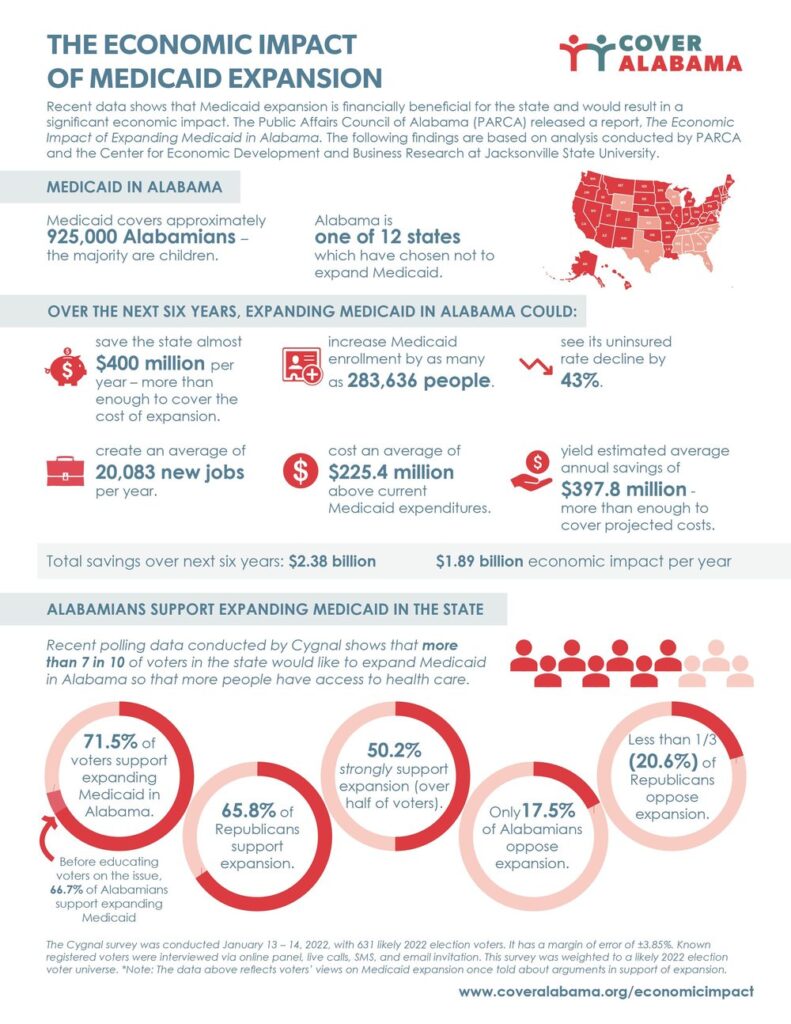
A recent report from the nonprofit Public Affairs Research Council of Alabama (PARCA) shows how Medicaid expansion would create jobs and boost local economies across the state. “Expanding Medicaid coverage in Alabama could save the state almost $400 million per year over the next six years – more than enough to cover the cost of expansion – and have an average positive economic impact of $1.89 billion per year over that same time frame,” the report found.

Medicaid expansion in Alabama would cost an average of $225.4 million per year, according to the PARCA report. But the report also found that expansion would lead to the federal government covering $379.9 million in annual expenses now paid by the state. “As a result, the state could expand coverage, and at the same time, reduce or reinvest the amount paid to support health care for low-income Alabamians by $172 million annually,” PARCA found.

The economic impact of Medicaid expansion. Medicaid covers approximately 925,000 Alabamians -- the majority are children. Alabama is 1 of 12 states that have not expanded Medicaid. Over the next six years, research by PARCA and Jacksonville State University shows Medicaid expansion in Alabama could save the state more than $400 million a year, increase Medicaid enrollment by as many as 283,636 people, drop the uninsured rate by 43%, create an average of 20,083 new jobs per year, cost an average of $225.4 million above current expenditures and yield average annual savings of $397.8 million. Recent polling by Cygnal shows more than 7 in 10 Alabama voters would like to expand Medicaid so more people can access health care. 71.5% of voters support Medicaid expansion, including 65.8% of Republicans. 50.2% strongly support expansion, while only 17.5% overall and only 20.6% of Republicans oppose expansion.

Adams said ARPA funding and other federal incentives make Medicaid expansion an opportunity too good for Alabama to pass up.

“Governor Ivey and leaders in Montgomery have said the obstacle to expanding Medicaid in Alabama is the cost. But with the American Rescue Plan Act funding, Alabama can expand Medicaid and could reinvest more than $170 million in state funding to provide more access to care,” Adams said.

“Public support is strong, and the report and polling data show there is no financial barrier or obstacle to overcome. We urge Governor Ivey and leaders in Montgomery to put forward a Medicaid expansion plan that is tailored to the needs of Alabamians.”

New poll: Alabamians strongly support use of ARPA funds to protect rural hospitals, increase mental health services

Alabama’s likely voters overwhelmingly support using federal COVID-19 relief funds to increase funding for mental health and rural hospitals, according to a new Alabama Arise poll released Monday.

More than four in five respondents (81.1%) supported using a portion of Alabama’s funding under the American Rescue Plan Act (ARPA) to invest in rural hospitals and increase rural Alabamians’ access to health care. And nearly three in four likely voters (73.6%) said lawmakers should boost mental health funding to increase access to services across Alabama. Among Republican voters, 80.1% supported investments in rural hospitals and 67.7% supported more mental health care funding.

“Alabamians are loud and clear that they want our lawmakers to use federal relief money to strengthen our state’s health care system,” Alabama Arise executive director Robyn Hyden said. “The COVID-19 pandemic has strained health care workers like nothing before in our lifetimes. And it has exposed and worsened our state’s persistent racial and geographic health disparities.

“ARPA offers an unprecedented chance to protect rural hospitals and increase access to mental health care and other services. We must seize this opportunity to build a healthier future for Alabama.”

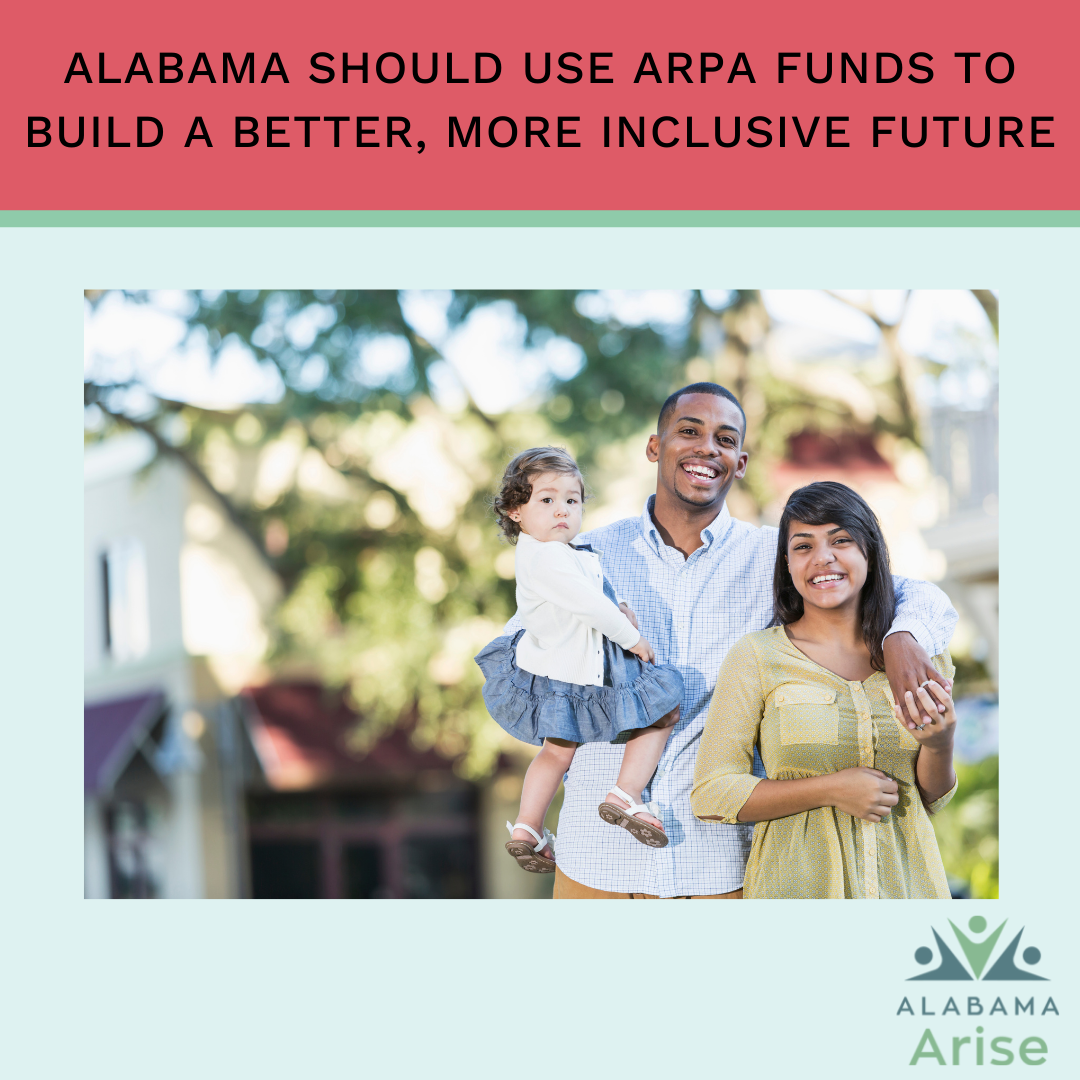
Photo of a smiling couple and their child. Headline: Alabama should use ARPA funds to build a better, more inclusive future.

Child care, housing, public transportation also enjoy strong public support

Sizable majorities also approved of other potential uses of ARPA money to improve living conditions for Alabama’s children and families. Those proposals include:

  • Expanding access to subsidized child care for working families.
  • Establishing a state child tax credit to lower costs for working families.
  • Expanding access to affordable housing throughout the state.
  • Investing in public transportation, particularly in rural areas.

Alabama will receive a total of more than $2 billion in ARPA funds. Lawmakers last year appropriated $400 million of that amount toward prison construction and $80 million to hospitals and nursing homes. This week, the Legislature will vote on a plan to spend another $772 million of ARPA funds. Most of that money would go toward broadband internet expansion, water and sewer improvements, and additional funding for hospitals, nursing homes and assisted living facilities.

The state expects to receive the remaining $1 billion in ARPA funds later this year. Arise’s poll shows the public wants legislators to use that money to ease economic stress on Alabama households, Hyden said.

“The pandemic has made it harder for people across our state to find child care, keep a roof overhead and get where they need to go,” Hyden said. “We should use ARPA funding to ease families’ suffering and provide the supports needed to help every Alabamian succeed. It’s time for our lawmakers to meet this moment and ensure Alabama’s post-pandemic future is a bright and inclusive one.”

About the survey

Alabama Arise commissioned the poll, which the Montgomery-based firm Cygnal conducted Jan. 13-14. The poll surveyed 631 likely voters across Alabama and has a margin of error of +/- 3.85%. Interviews of known registered voters occurred via live phone calls, online panel, texts and email invitation.

Click here for Arise’s poll results on ARPA funding priorities in Alabama.

Alabama Arise unveils members’ 2022 roadmap for change

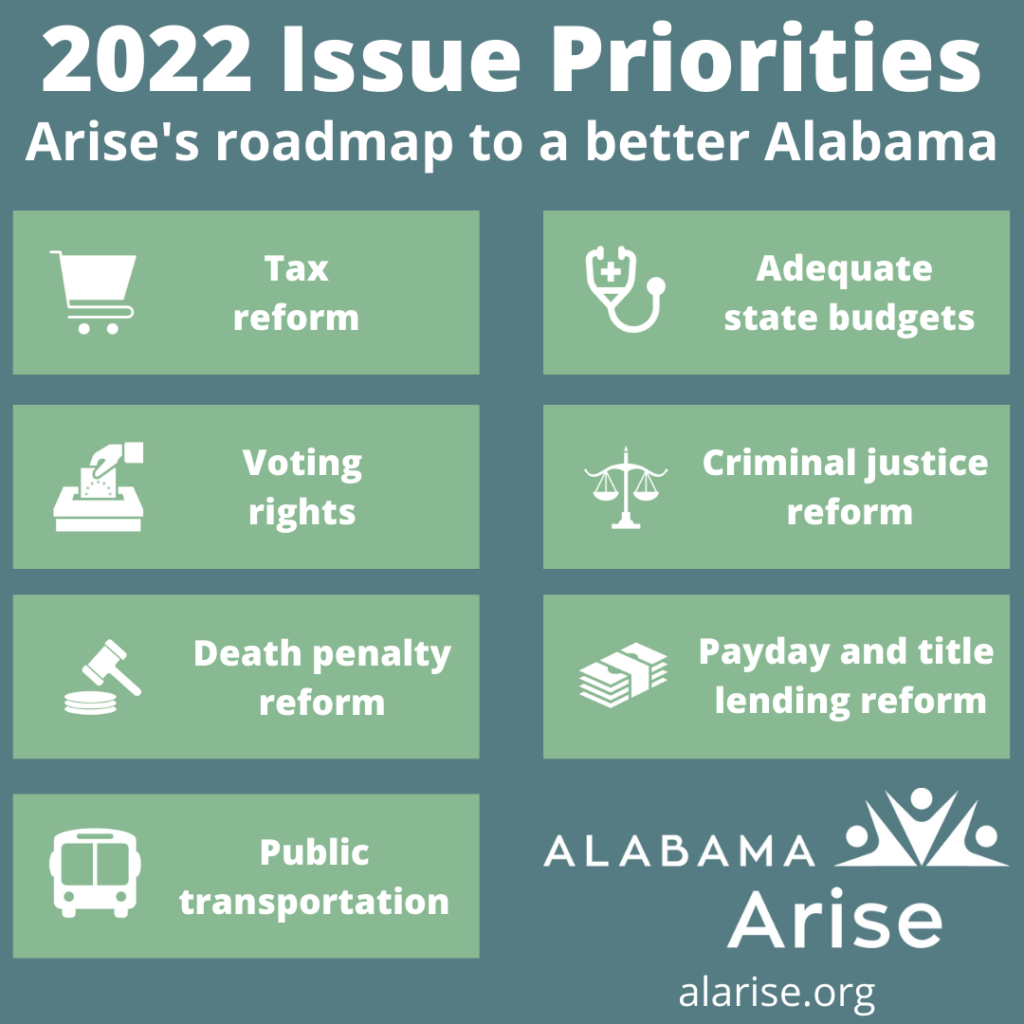
Sentencing reform and voting rights expansion are two key goals on Alabama Arise’s 2022 legislative agenda. Members voted for Arise’s issue priorities this week after nearly 300 people attended the organization’s online annual meeting Saturday. The seven issues chosen were:

  • Tax reform, including untaxing groceries and ending the state’s upside-down deduction for federal income taxes, which overwhelmingly benefits rich households.
  • Adequate budgets for human services like education, health care and child care, including Medicaid expansion to make health coverage affordable for all Alabamians.
  • Voting rights, including automatic universal voter registration and removal of barriers to voting rights restoration for disenfranchised Alabamians.
  • Criminal justice reform, including retroactive application of state sentencing guidelines and repeal of the Habitual Felony Offender Act.
  • Death penalty reform, including a law to require juries to be unanimous in any decision to impose a death sentence.
  • Payday and title lending reform to protect consumers from getting trapped in debt.
  • Public transportation to help Alabamians with low incomes stay connected to work, school, health care and their communities.

“Arise believes in dignity, equity and justice for all Alabamians,” Alabama Arise executive director Robyn Hyden said. “Our 2022 issue priorities would break down many of the policy barriers that keep people in poverty. We must build a more inclusive future for our state. And together, we will.”

Graphic listing Alabama Arise's 2022 issue priorities

The urgent need for criminal justice reform

Alabama’s criminal justice system is broken, and its prisons are violent and dangerously overcrowded. Exorbitant court fines and fees impose heavy burdens on thousands of families every year, taking a disproportionate toll on communities of color and families who already struggle to make ends meet. And Alabama needs investments in mental health care, substance use disorder treatment, community corrections and diversion programs to help stem the tide of mass incarceration.

Lawmakers’ plan to spend hundreds of millions of dollars on new prisons is not an adequate solution to these problems. Alabama must enact meaningful sentencing and reentry reforms to make its corrections system more humane and effective. Legislators took a good first step during this week’s special session by passing a bill by Rep. Jim Hill, R-Moody, to provide supervised release for everyone leaving prison in Alabama.

Many other needed changes still remain on the Legislature’s plate, however. One important priority is Hill’s proposal to allow judges to apply Alabama’s new sentencing guidelines retroactively. The House declined to vote on that bill this week, but Hill has promised to file it again in 2022. Hundreds of people would be eligible to apply for a reduced sentence if the measure passes.

Arise also will continue to work toward repeal of the Habitual Felony Offender Act (HFOA), the state’s “three-strikes” law. The HFOA is a driver of sentencing disparities and prison overcrowding in Alabama. The law lengthens sentences for a felony conviction after a prior felony conviction, even when the prior offense was nonviolent. Hundreds of people in Alabama are serving life sentences for non-homicide crimes because of the HFOA. Thousands more have had their sentences increased as a result. Repealing the law would reduce prison overcrowding and end some of Alabama’s most abusive sentencing practices.

Protect and expand voting rights so every voice is heard

Arise members provided a resounding endorsement of efforts to protect and expand voting rights in Alabama. This includes support of federal legislation to prevent voter suppression and strengthen the Voting Rights Act. And it includes calls for numerous state-level improvements to promote greater civic engagement and increase access to voting.

One such improvement would be automatic voter registration (AVR) across Alabama. AVR would use information the state already has to register or update registrations electronically for hundreds of thousands of Alabamians. Another important step would be to ensure people who struggle to make ends meet are not denied the right to vote simply because they cannot afford court fines and fees.

“Our ability to progress as a state will be limited as long as any person or group is unable to exercise their constitutional right to vote,” Hyden said. “We urge Alabama lawmakers to protect and expand voting rights by instituting automatic voter registration and lifting barriers to voting rights restoration.”

42 Alabama groups urge Ivey to drive transformative change with federal COVID-19 relief funds

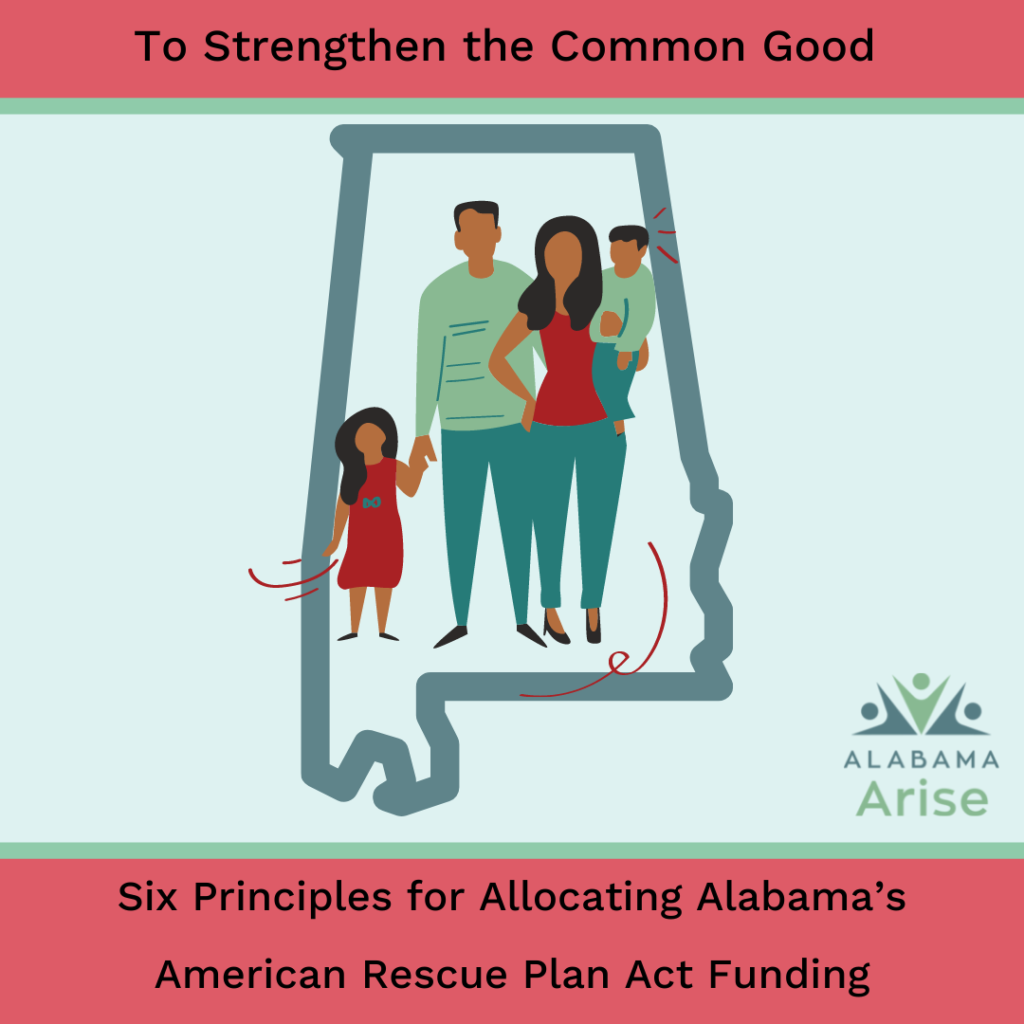
To strengthen the common good: Six principles for allocating Alabama's American Rescue Plan Act funding

Alabama should build a more equitable and inclusive future by using federal COVID-19 relief money for transformational investments in public health and economic opportunity, according to a letter that 42 churches and organizations across the state sent to Gov. Kay Ivey this week. Alabama Arise is among the groups that co-signed the letter.

The American Rescue Plan Act (ARPA) will provide Alabama $2.3 billion of federal assistance for education and other vital services. Local governments across the state will receive another $1.7 billion.

Affordable housing, education, nutrition and public transportation are a few key areas of need identified in the letter. The letter urges Alabama to use ARPA funds to expand Medicaid, increase broadband internet access in underserved areas and increase funding for child care, early childhood education and mental health care, among other investments.

“New funding at this scale can be transformative for our state, but only if we take a transformative approach to how we spend it,” the letter says. “For too long, Alabama’s leaders … have settled for poor outcomes in health, education, community development and other measures of shared prosperity, because they thought we couldn’t tackle such deep problems. The pandemic is challenging us to reclaim – and redefine – the common good. ARPA funding gives us a rare opportunity to meet the challenge, if we’re willing.”

The full letter, “To Strengthen the Common Good: Six Principles for Allocating Alabama’s ARPA Funding,” is available here.

Principles for effective, transparent use of ARPA money

COVID-19 and its associated recession exacerbated preexisting racial, gender and regional disparities that prevent Alabama from reaching its full potential. Enduring recovery will require breaking away from a mindset of scarce resources and limited opportunities, the letter says.

The letter encourages state leaders to allocate ARPA funds using these six principles as a framework:

  1. Engage local communities at every step.
  2. Aim for equity in outcomes.
  3. Maximize well-being by addressing health in all policies.
  4. Invest in existing assets and capacities to help funds work faster, go further and avoid duplication.
  5. Think big and create a 21st-century infrastructure for the common good.
  6. Build public trust and engagement by following the highest standards of documentation, transparency and accessibility of information about funding awards and expenditures.

Investments to increase equity, expand economic opportunity in Alabama

ARPA funds offer the state an opportunity to lift communities toward better health and broadly shared prosperity. They also can help Alabama address chronic challenges in education, health care, housing and other quality-of-life measures. Among the letter’s key recommendations for allocation of ARPA funds:

  • Expand Medicaid to save lives and ensure health coverage for more than 340,000 Alabamians with low incomes.
  • Invest in mobile mental health crisis services and expand mental health crisis centers and school-based mental health services.
  • Increase funding for in-home early childhood education and in-home services for older adults and people with disabilities.
  • Provide funding for the state’s Housing Trust Fund and Public Transportation Trust Fund.
  • Promote equity in high-speed internet access by targeting earmarked broadband funding to help providers expand into underserved areas.
  • Invest in workforce development by creating subsidized apprenticeships, two-year scholarship programs and subsidized certificate programs for workers with low incomes.
  • Provide a grocery tax rebate and other cash assistance to households with low incomes.

“Recovery from COVID-19 will require Alabama to go beyond a return to an inadequate status quo,” Alabama Arise executive director Robyn Hyden said. “Our elected officials must make better policy choices now to build thriving communities in the future, and ARPA funds offer a powerful pathway to help make that vision a reality. We urge the governor to seize this opportunity to increase public trust and build a brighter, more equitable future for all Alabamians.”

New report profiles essential workers most likely to lack health coverage in Alabama

Medicaid expansion would increase access to life-saving health care while also advancing racial and gender equity in Alabama, according to a new report by the Georgetown University Center for Children and Families (CCF). Expansion also would ensure coverage for tens of thousands of essential workers in industries like health care, retail and construction.

“Everyone in Alabama has relied on these essential workers in some way during the COVID-19 pandemic,” Alabama Arise policy director Jim Carnes said. “Now it’s our turn to help them get reliable, affordable health insurance so they can continue to do their jobs and care for their families. It’s time for Alabama to accept generous federal funding to expand Medicaid to our state’s uninsured workers.”

Alabama is one of 12 states that have not yet expanded Medicaid to cover adults with low incomes. This inaction has denied hundreds of thousands of Alabamians access to quality, affordable health care.

Approximately 204,100 uninsured adults – 49% of Alabama’s uninsured adult population – would gain coverage if Alabama expands Medicaid, Georgetown CCF estimates. That estimate is in line with prior projections that Medicaid expansion would benefit more than 340,000 Alabamians who are uninsured or struggling to afford coverage.

These residents earn too much to qualify for Medicaid under the state’s stringent income limit but too little to qualify for subsidized marketplace plans under the Affordable Care Act. As a result, they are stranded in a health coverage gap.

Expanding Medicaid would save lives, advance racial and gender equity

Women and Black people account for a disproportionate share of low-wage uninsured working Alabamians, the Georgetown CCF report finds. Black people represent about 27% of Alabama’s overall population but 39% of the state’s low-wage uninsured workers. Women also are overrepresented in this category, making up 55% of low-wage uninsured Alabamians.

These uninsured residents work in vital but low-paid jobs. More than one-third of Alabamians working without health insurance (35.2%) are in the hospitality or retail industries, the report finds. Another one in five work in construction or in health care and social assistance.

Alabama’s uninsured rate for working people (12.1%) exceeds the national average. In 11 counties, more than 15% of working people are uninsured, Georgetown CCF finds. The highest rates are in DeKalb County (19.2%) and Dale County (18.2%).

The map below shows the range of uninsured rates for working adults across Alabama. Hover over the map to see the rate in your county.

Nearly seven in 10 Alabamians support expanding Medicaid to reduce these disparities, a statewide poll found in February. And the American Rescue Plan Act offers federal incentives that would more than offset Alabama’s initial cost to expand Medicaid.

If Gov. Kay Ivey agrees to expansion, the law would give the state a 5-percentage-point increase in federal funding for its traditional Medicaid coverage for two years. That would bring Alabama an additional $732 million over two years, based on an average of federal, state and independent estimates.