Federal cuts to SNAP, health coverage will harm people across Alabama

The U.S. House voted Thursday for final passage of a budget bill that will make basic needs like food and health care more expensive for millions of American families through severe cuts to food assistance, Medicaid and other human services. These funding cuts will finance renewals and expansions of tax cuts for wealthy people and highly profitable corporations.

Alabama Arise executive director Robyn Hyden issued the following statement Thursday in response:

“It’s wrong to hurt people who are struggling to help people who are already far ahead. But Congress just passed legislation that will do exactly that. This budget bill is not only a moral failure. It’s bad policy, and it is a really bad deal for Alabama and our entire country. It also will undermine important bipartisan progress that state policymakers made this year on food affordability and maternal health care.

“This cruel budget plan will take away food assistance, health coverage and other vital services from tens of thousands of Alabama families who struggle to afford basic needs. And it will make those cuts in service of slashing taxes for billionaires and highly profitable corporations, with more than $1 trillion in tax cuts accruing to people in the top income brackets. Meanwhile, more than $1 trillion in funding cuts will impact essential services for people with low incomes.
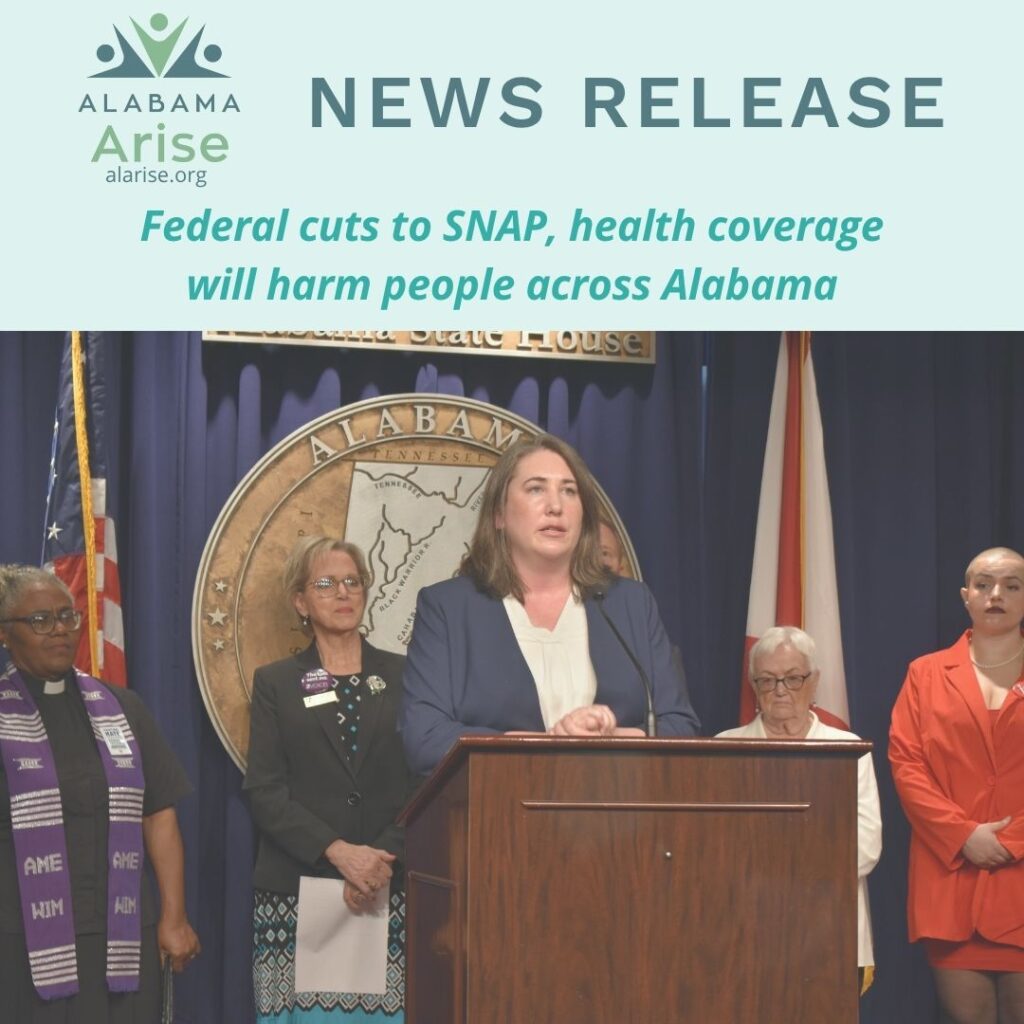
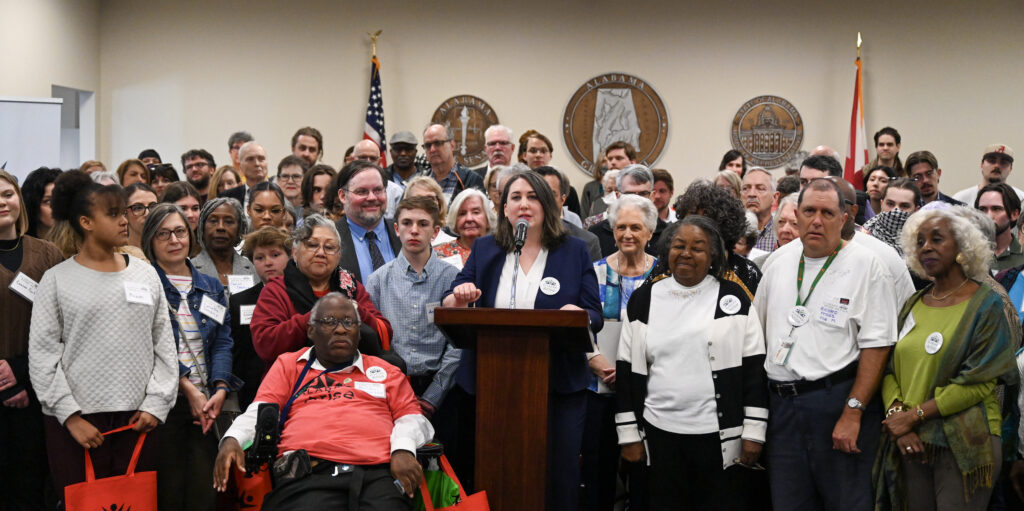
A woman speaks behind a lectern while advocates stand behind her. Headline: "Alabama Arise news release: Federal cuts to SNAP, health coverage will harm people across Alabama."

SNAP cuts could send hunger soaring, undermine state grocery tax reduction

“Alabama likely will feel the worst effects from cuts to the Supplemental Nutrition Assistance Program. SNAP benefits have been fully federally funded for decades, but this plan will change that starting in October 2027. If this legislation were in effect now, Alabama would be on the hook for about $207 million a year in direct benefits and additional administrative costs for SNAP. That amount would be roughly the same as the state’s first-year cost to expand Medicaid to cover nearly 200,000 adults with low incomes, and it would not include the cost savings that Medicaid expansion would generate for other services.

“There is reason to worry that the Legislature would decide it can’t or wouldn’t provide the additional SNAP funding. In that case, Alabama would be forced to cut SNAP participation significantly – or even eliminate the program altogether for nearly 800,000 participants statewide. This federal cost shift would reduce our state’s ability to fund existing essential services and programs. And it could lead to deep SNAP cuts that would devastate grocery stores and other retailers in communities across Alabama.

“This bill will expand work reporting requirements to cover more SNAP participants, including veterans, people experiencing homelessness, and young adults aging out of foster care. Many of them likely will lose food assistance not because of a failure to work but because of a failure to complete complicated paperwork. These new red-tape barriers will increase hunger for struggling families while billionaires and corporations run off with a bigger slice of the pie.

“Federal SNAP cuts will leave more Alabamians unable to afford to keep food on the table. That is a step in the wrong direction, and it will undermine the benefits of the state grocery tax reduction that Alabama legislators enacted unanimously this year.

Health coverage cuts will increase human suffering, reduce health care access

“This budget plan will make health care inaccessible or less affordable for tens of thousands of Alabamians. It will allow enhanced Affordable Care Act subsidies to expire, increasing premium costs for marketplace plans. It also will remove the additional $619 million in federal incentives for the first two years of Medicaid expansion that Alabama left on the table. That increases the chances that our state will continue to refuse to expand Medicaid, leaving hundreds of thousands of our neighbors stuck in the health coverage gap with no options to afford life-saving care.

“In total, nearly 200,000 Alabamians could lose health coverage as a result of policy changes like these. Those coverage losses likely will increase hospitals’ uncompensated care costs and make health care even less accessible in rural areas. Fourteen rural hospitals in our state have closed since 2010, and more than 20 others are at risk of closing. When a hospital or clinic closes, it closes for everyone, regardless of their insurance status.

“The human toll of cutting health coverage is all too real. It might mean a later cancer diagnosis for your neighbor. Your pregnant friend might die when her preeclampsia isn’t caught or treated in time because she has to drive an hour longer to get to a doctor. Your son or daughter might experience a mental health crisis and have no way to access or pay for care. Funding for health coverage is not just a line on a spreadsheet. It is often literally a matter of life or death for people facing medical challenges.

Where we go from here

“It will be a few years before many of the federal budget bill’s worst provisions will take effect in full. Alabama Arise’s members and supporters will continue urging our state’s congressional delegation to reverse this bill’s harmful provisions. We also will continue working at the state level to advance public policies to improve the lives of Alabamians marginalized by poverty. That includes advocacy to close our state’s health coverage gap, to right the wrongs of our state’s upside-down tax system and to ensure that all Alabamians have the resources they need to survive and thrive.

“Alabama Arise believes in building an economy that works for everyone and a society where everyone has the opportunity to reach their potential. We will continue working in the years and decades ahead to make that vision a reality for our state.”

More resources

June 27: A news release on the Hands Off SNAP and Medicaid news conference at the State House in Montgomery.

June 10: A letter from Alabama Arise and 49 partner organizations urging Gov. Kay Ivey and legislators to oppose harmful SNAP cuts and cost shifts.

June 5: A letter from 52 Cover Alabama coalition partners, including Alabama Arise, urging Ivey and legislators to oppose harmful cuts to Medicaid and health coverage under the Affordable Care Act.

May 23: A statement from Alabama Arise on numerous ways that the U.S. House budget bill would harm struggling Alabama families,

Feb. 25: A letter from Alabama Arise and 111 partner organizations urging Alabama’s congressional delegation to oppose cuts to Medicaid and SNAP.

Jan. 29: A letter from Alabama Arise and 55 partner organizations urging Alabama’s congressional delegation to oppose further tax cuts for wealthy people.
Alabama Arise, partner groups urge Congress to reject devastating cuts to SNAP, health coverage

Alabama’s congressional delegation should oppose a harmful budget bill that would reduce or remove food assistance, health coverage and other vital services for hundreds of thousands of Alabamians who struggle to afford basic needs, Alabama Arise and other advocates said Thursday during a Hands Off SNAP and Medicaid news conference at the State House in Montgomery.

The U.S. Senate could vote on the bill, HR 1, as soon as this weekend. The U.S. House passed its version of the legislation by a narrow 215-214 vote in May. Both versions include deep cuts to the Supplemental Nutrition Assistance Program (SNAP) and to health coverage under Medicaid and the Affordable Care Act. And both versions also include large tax cuts for wealthy households and highly profitable corporations.

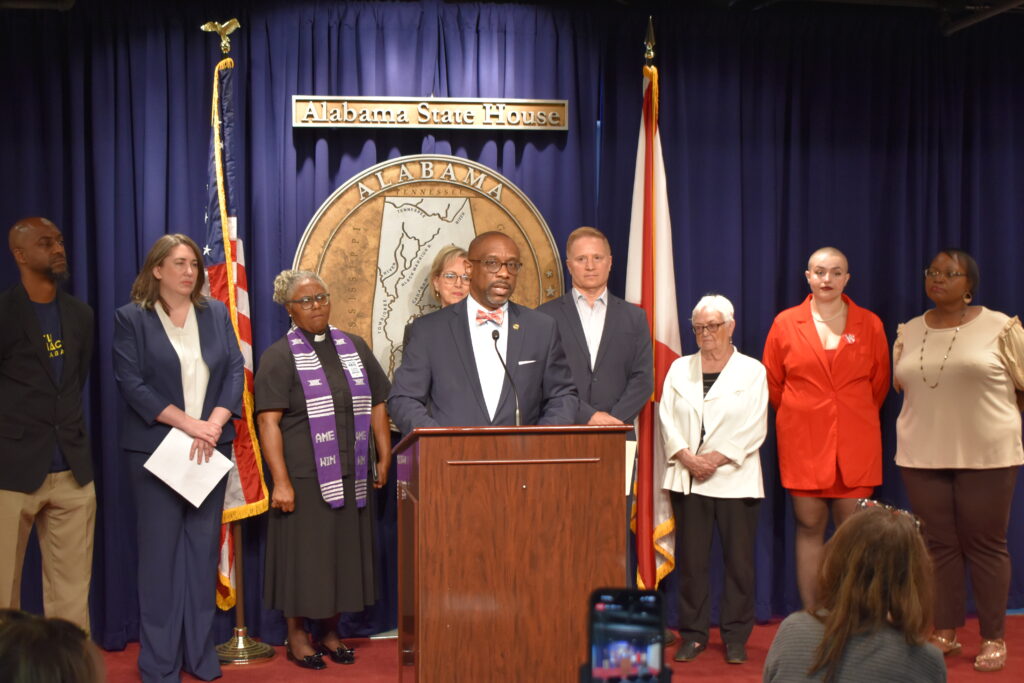
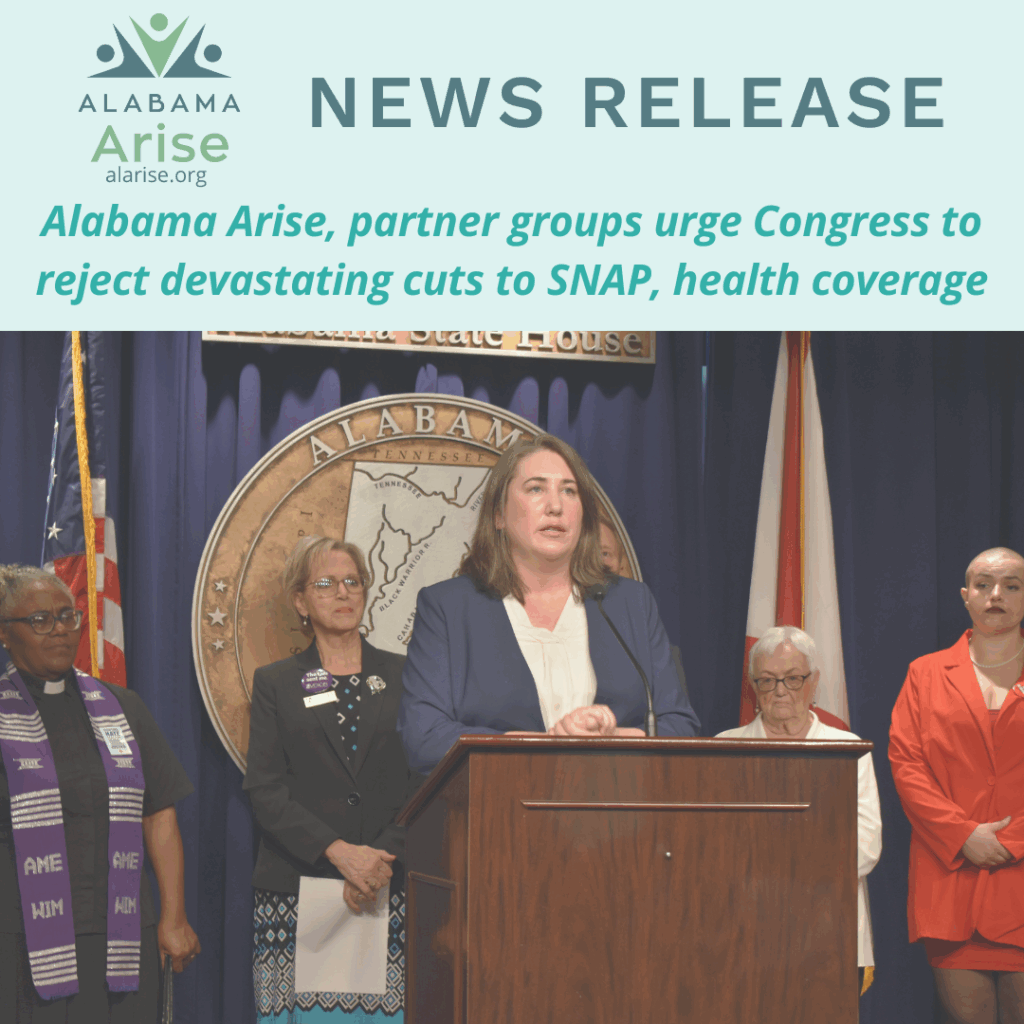
Image of Alabama Arise executive director Robyn Hyden speaking behind a lectern with advocates standing behind her. Text: "Alabama Arise news release: Alabama Arise, partner groups urge Congress to reject devastating cuts to SNAP, health coverage."

“It’s wrong to hurt people who are struggling just to help people who are already far ahead. That’s exactly what the Senate is debating right now,” Alabama Arise executive director Robyn Hyden said during the news conference. “The budget moving through Congress is not only a moral failure. It’s bad policy, and it is a really bad deal for our state.”

Photos from the news conference are available here. A video of the news conference is available here. (Remarks start at the 2:00 mark.)

SNAP cuts would send hunger soaring, imperil local retailers

For every meal that food banks provide in Alabama, SNAP provides nine. But if state lawmakers could not or would not provide new SNAP funding required under the bill, Alabama could be forced to cut SNAP benefits significantly – or even eliminate the program altogether for nearly 800,000 participants statewide.

Deep SNAP cuts could leave food banks with a “perhaps insurmountable” challenge, said Michael Ledger, president and CEO of Feeding the Gulf Coast, a food bank serving southwestern Alabama, southern Mississippi and western Florida.

“We’re worried that SNAP reductions are going to have a dramatic impact on our ability to help our neighbors,” Ledger said. “We’ve seen so many people who would have never dreamed they’d be in that position, in that position. I think as a community, it’s our responsibility to make sure we help these people through those struggles. If we don’t, where do they go?”

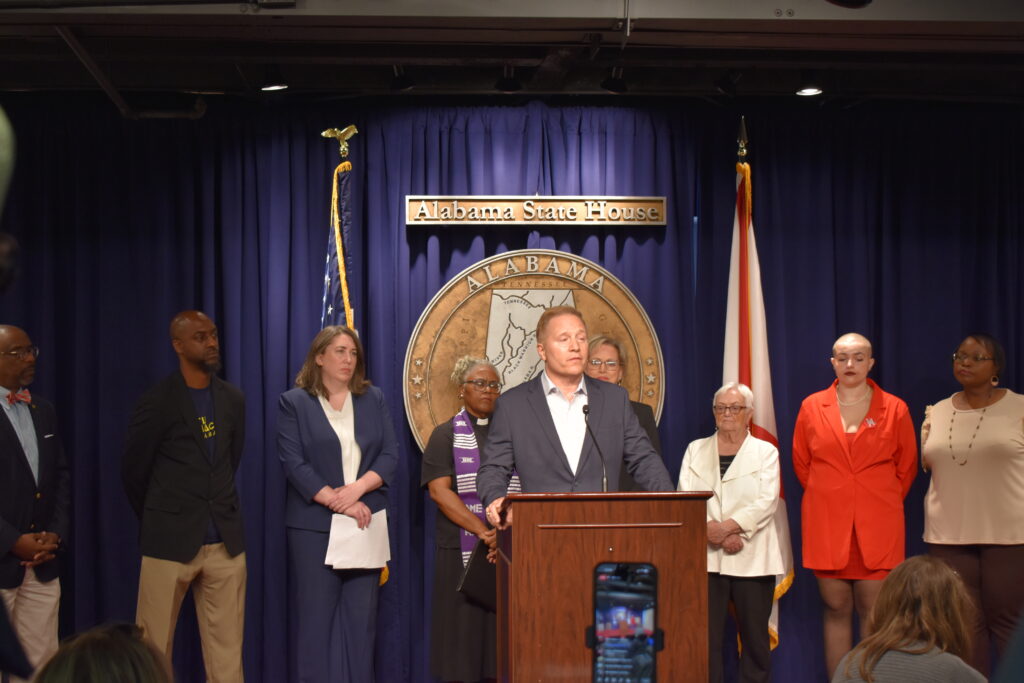
A man speaks behind a lectern with advocates standing behind him.
Michael Ledger, president and CEO of Feeding the Gulf Coast, speaks at a news conference at the State House in Montgomery on June 26, 2025. (Photo by Matt Okarmus)

Rhonda Mann, executive director of VOICES for Alabama’s Children, said nearly 5,000 retailers statewide redeemed more than $2 billion in SNAP benefits in 2023. She said the wreckage of harmful SNAP cuts would reach far beyond program participants.

“SNAP is incredibly important to the economy of our state. So when you don’t think this affects you because you don’t receive SNAP benefits, think again,” Mann said. “What you’re going to see are the closings of food retailers, and that will hurt everybody. Access to food in some areas of our state is already a problem, and it could become a problem in every area of our state.”

SNAP cost shift would strain state budgets

The federal budget bill could add severe strain to Alabama’s General Fund budget. Under the House-passed bill, states would have to pay for a portion of SNAP benefits, which have been 100% federally funded for decades, according to a sliding scale. The bill also would require states to pay for 75% of SNAP administrative costs, up from the current 50%.

Those cost shifts could leave Alabama on the hook for more than $120 million a year in direct benefits and additional administrative costs. For a sense of scale, that amount would be almost identical to the state’s Education Trust Fund (ETF) budget appropriations next year for both Jacksonville State University and the University of North Alabama combined. In a worst-case scenario, the state could be forced to find nearly $300 million a year for SNAP. That would be more than the 2026 ETF appropriation for either the University of Alabama or Auburn University.

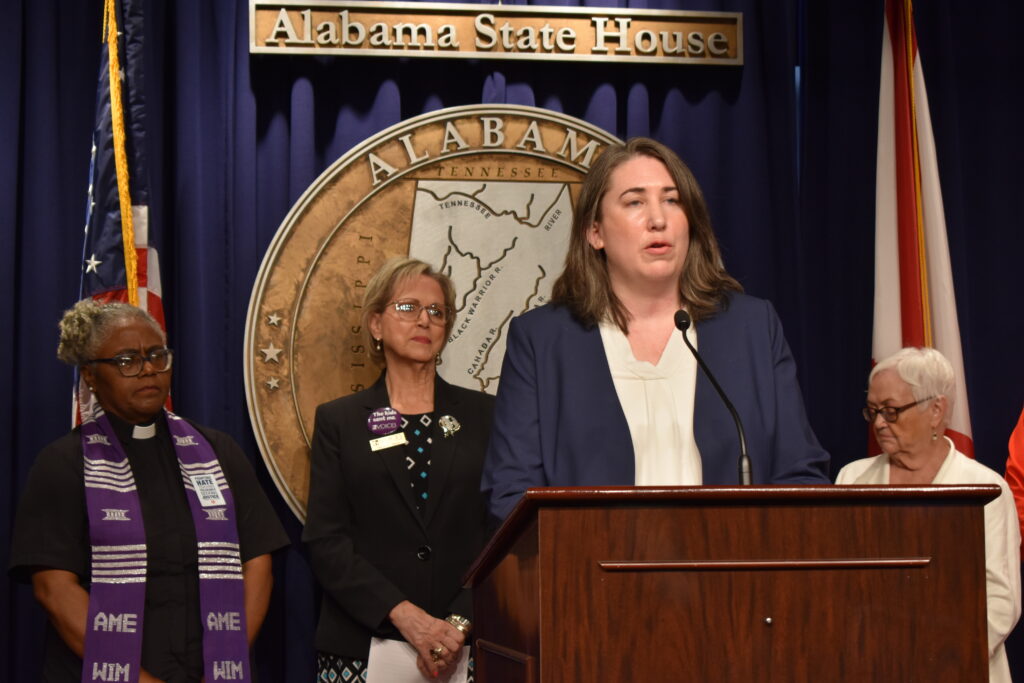
A woman stands behind a lectern with advocates standing behind her.
Alabama Arise executive director Robyn Hyden speaks at a news conference at the State House in Montgomery on June 26, 2025. (Photo by Matt Okarmus)

While increasing Alabama’s cost to administer SNAP, the bill also would expand work reporting requirements to cover many more participants. Hyden said these changes would harm many veterans, people experiencing homelessness, and young adults aging out of foster care. She also warned that many families could lose food assistance not because of a failure to work but because of a failure to complete complicated paperwork.

“These cuts will see hunger skyrocket while our state government, churches and charities and everyday working families are struggling to get by, and we’re all going to pay for that,” Hyden said. “It’s going to reduce our ability to fund existing essential services and programs. And we are going to be left on the hook to pick up the slack while billionaires and corporations run off with a bigger slice of the pie.”

Medicaid, ACA cuts would increase health care costs across Alabama

The Senate bill also would make health coverage more expensive or less accessible for tens of thousands of Alabamians. The legislation would allow the expiration of extra financial help for health coverage through HealthCare.gov and would block Alabama from receiving an additional $619 million in federal incentives to expand Medicaid to cover adults with low incomes. In total, nearly 200,000 Alabamians could lose health coverage as a result of the bill’s changes.

A woman speaks behind a lectern with advocates standing behind her.
Rhonda Mann, executive director of VOICES for Alabama’s Children, speaks at a news conference at the State House in Montgomery on June 26, 2025. (Photo by Matt Okarmus)

These coverage losses could make health care even less accessible in rural areas of Alabama, Mann said. Fourteen rural hospitals in the state have closed since 2010, and more than 20 others are at risk of closing.

“Medicaid dollars are for services and resources we all use, and cuts to Medicaid are going to result in increased health care costs for all of us,” Mann said.

Hyden underscored the human toll that losing health coverage could take on families and communities across Alabama.

“Cutting Medicaid and cutting the enhanced HealthCare.gov tax credits is going to mean one less early cancer diagnosis for your neighbor,” she said. “Your pregnant friend might die when her preeclampsia isn’t caught or treated in time because she has to drive over an hour to get to her doctor. Your daughter might experience a mental health crisis and have no way to access and pay for care.”

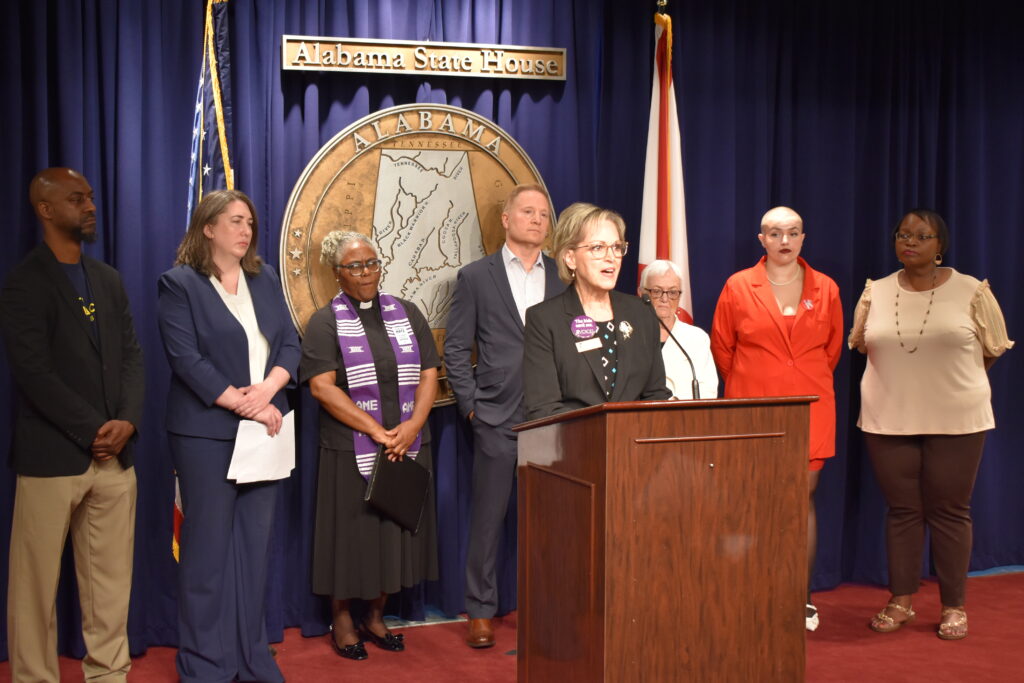
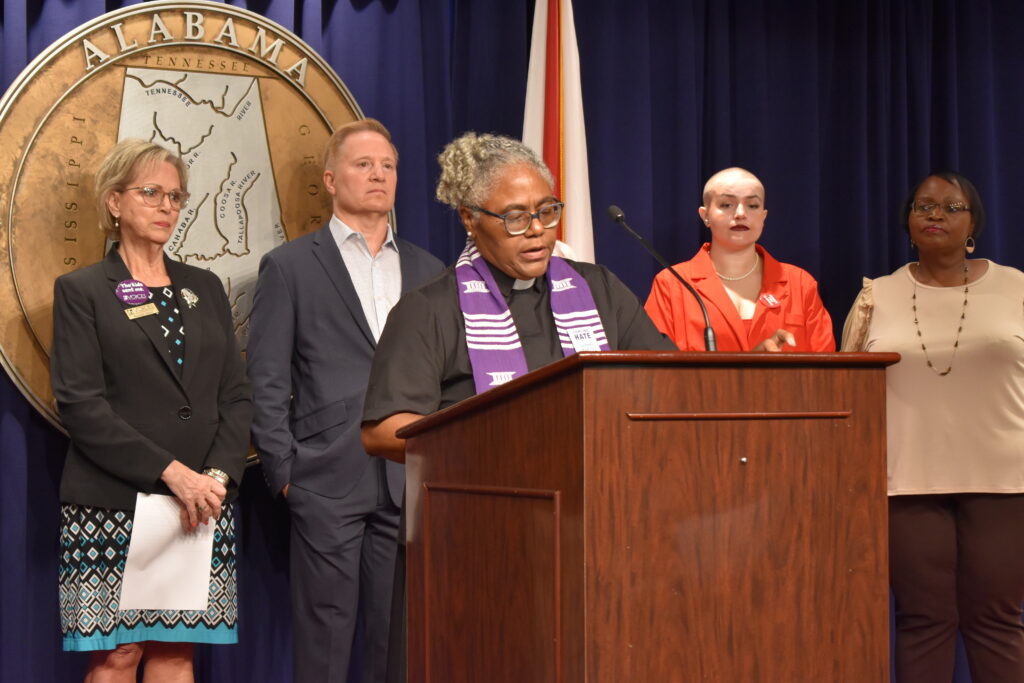
A woman speaks behind a lecture with advocates standing behind her.
Rev. Valtoria Jackson, the Montgomery lead organizer for the Alabama Poor People’s Campaign, speaks at a news conference at the State House in Montgomery on June 26, 2025. (Photo by Matt Okarmus)

Rev. Valtoria Jackson, the Montgomery lead organizer for the Alabama Poor People’s Campaign, called the bill’s proposed cuts to food assistance and health care “a war on the poor.”

“This is not just bad policy. It is a moral sin,” Jackson said. “We know that when people lose access to health care, they die. When food stamps are cut, hunger rises.”

‘Do something better for our state’

State Sen. Kirk Hatcher, D-Montgomery, said he sees up close the struggles that people living in poverty face, both as a legislator and in his role as Head Start director in Montgomery County. Passing legislation to make life even harder for struggling families would be “an absolute moral abomination,” he said.

“I do know what this particular bill and many of the things in it will do to damage the lives of so many,” Hatcher said. “Every life – and I do mean every life – has value. … We can do better.”

A man speaks behind a lectern with advocates standing behind him.
State Sen. Kirk Hatcher, D-Montgomery, speaks at a news conference at the State House in Montgomery on June 26, 2025. (Photo by Matt Okarmus)

Jackson said the federal budget bill would cause significant harm to “the least of these” and urged Congress to reject it.

“Budgets are moral documents, not just numbers. And this budget is morally bankrupt,” Jackson said. “The budget will not reduce poverty at all; it will increase it. It will not help seniors live with dignity; it will push them deeper into despair. It will not uphold Alabama’s moral values; it will betray them.”

Hyden closed by urging U.S. Sens. Katie Britt and Tommy Tuberville to oppose cuts to food assistance and health care and to focus instead on policies that would improve the well-being of every Alabamian.

“We have time to ask Congress to do something better for our state,” Hyden said. “We ask you to protect essential services like SNAP and Medicaid to help us build strong, healthy communities. For the future of our state, for our children and families, for all of us who struggle and anyone who might struggle, please vote no on HR 1.”

More resources

Thursday: A photo gallery and a video livestream from the Hands Off SNAP and Medicaid news conference at the State House in Montgomery.

June 10: A letter from Alabama Arise and 49 partner organizations urging Gov. Kay Ivey and legislators to oppose harmful SNAP cuts and cost shifts.

June 5: A letter from 52 Cover Alabama coalition partners, including Alabama Arise, urging Ivey and legislators to oppose harmful cuts to Medicaid and health coverage under the Affordable Care Act.

May 23: A statement from Alabama Arise on numerous ways that the U.S. House budget bill would harm struggling Alabama families.

Feb. 25: A letter from Alabama Arise and 111 partner organizations urging Alabama’s congressional delegation to oppose cuts to Medicaid and SNAP.

Jan. 29: A letter from Alabama Arise and 55 partner organizations urging Alabama’s congressional delegation to oppose further tax cuts for wealthy people.
Ivey, legislators should oppose federal SNAP cost shift to states, 50 Alabama groups write

Alabama lawmakers should speak out to help protect the state from devastating federal cuts to the Supplemental Nutrition Assistance Program (SNAP) in the U.S. House’s budget reconciliation bill, according to a letter that 50 organizations across Alabama sent to Gov. Kay Ivey and state legislators Monday.

The letter, initiated by Alabama Arise, asks state policymakers to contact members of Congress and express concerns about the bill’s negative impact on Alabama’s families and budgets.

“More than 750,000 Alabamians receive food assistance through SNAP, including 500,000 families with children,” the letter said. “The SNAP cuts being considered would increase hunger for every one of these Alabamians and would transfer significant financial obligations from the federal government to Alabama.”

Read the organizations’ full letter here.

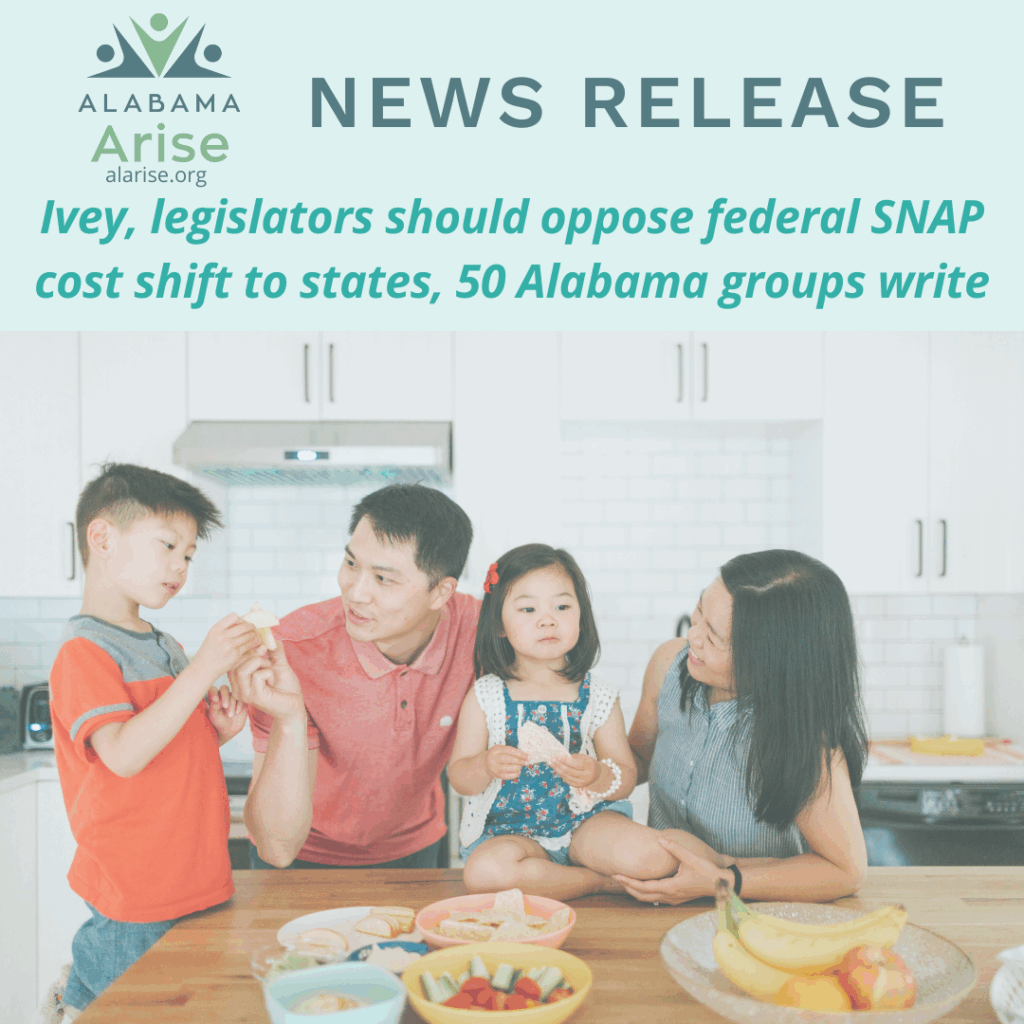
A mother, father and two children enjoy a meal at the table. Text above the image: "Alabama Arise news release: Ivey, legislators should oppose federal SNAP cost shift to states, 50 Alabama groups write."

SNAP cost shift would add enormous strain to Alabama budgets

U.S. House members voted 215-214 on May 22 for a budget bill that would reduce food assistance for tens of millions of Americans, including hundreds of thousands of Alabamians. The Senate is expected to consider the bill later this month.

The bill would require states to pay for a portion of SNAP benefits, which have been 100% federally funded for decades. States would be responsible for covering anywhere from 5% to 25% of SNAP benefit costs. The bill also would shift a larger share of SNAP administrative costs to states.

“At our best estimate, Alabama would become responsible for up to $258 million in direct benefit costs, plus an additional $35 million in administrative costs annually,” the groups’ letter said.

If state lawmakers could not or would not provide that funding, Alabama would be forced to cut SNAP benefits significantly – or even eliminate the program altogether for nearly 800,000 participants statewide. For a sense of scale, an additional $293 million in state expenses would be more than the state’s Education Trust Fund budget appropriation to either the University of Alabama ($266.2 million)  or Auburn University ($287.9 million) for 2026.

New SNAP barriers could increase food prices, harm local economies

The House bill would limit future growth in the value of SNAP benefits, effectively cutting food assistance over time even as food prices continue to increase. The legislation also would add more red tape for SNAP participants, the letter says. These new barriers would include expanding the scope of current time limits and creating new work reporting requirements for 165,000 Alabamians, including parents with children over age 7, the groups’ letter said.

“Changes of this magnitude would create additional burdens for Alabama’s already stretched child care and child welfare systems and potentially would leave thousands of Alabama children and families without food on their tables,” the letter said.

SNAP provides vital, federally funded nutrition assistance to about 1 in 7 Alabamians — more than 750,000 people. More than 2 in 3 households that participate in SNAP are families with children. Many other participants are older adults or people with disabilities.

SNAP’s role in reducing hunger is especially important in Alabama and other states with high poverty rates. Nearly 1 in 4 Alabama children face food insecurity, meaning they do not always have enough to eat or know where they will get their next meal.

Funding cuts or other new barriers to SNAP enrollment would increase hunger and hurt local retailers, the groups’ letter said. That could mean higher food prices for everyone and even longer trips to the grocery store for many rural Alabamians.

“Deep SNAP cuts could force layoffs or closures at grocery stores and other retailers across our state,” the letter said. “A reduction or loss of SNAP benefits is a threat to our economy and the local communities where we all live and shop.”

Potential SNAP cuts would help fund tax breaks for the wealthiest households

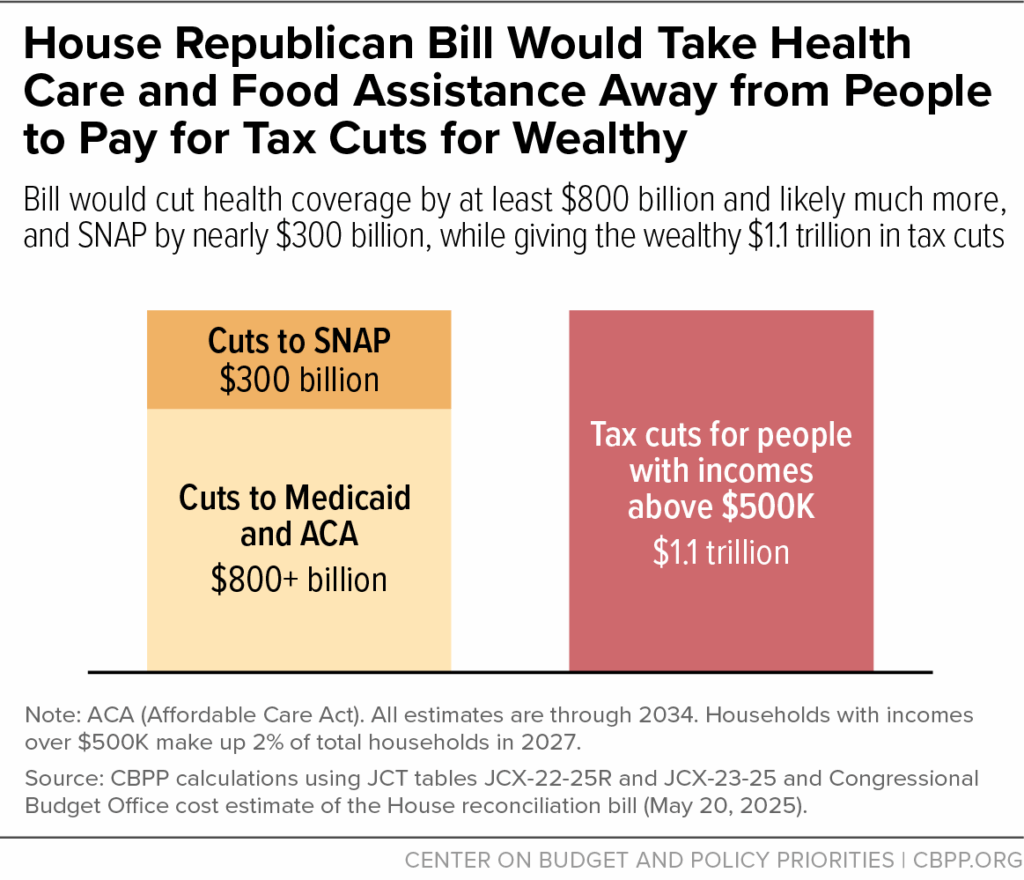
Congressional leaders are considering these cuts to food assistance and other human services in a push to offset the cost of tax cuts for wealthy households. The amount of potential SNAP and health care cuts in the House bill would be roughly equal to the cost of extending tax breaks for the wealthiest 2% of households, according to the Center on Budget and Policy Priorities, a nonprofit research and policy institute in Washington, D.C.

The Tax Cuts and Jobs Act, enacted in 2017, increased federal deficits while lavishing tax cuts on the country’s wealthiest households. Many of the law’s provisions are set to expire this year, including numerous tax breaks that disproportionately benefit wealthy people. These include higher estate tax exemptions and a cut to the top marginal income tax rate.

Read the 50 Alabama organizations’ full letter urging Ivey and legislators to oppose SNAP cuts here.

More resources

June 5: A letter from 52 Cover Alabama coalition partners, including Alabama Arise, urging Ivey and legislators to oppose harmful cuts to Medicaid and health coverage under the Affordable Care Act.

May 23: A statement from Alabama Arise on numerous ways that the U.S. House budget bill would harm struggling Alabama families.

Feb. 25: A letter from Alabama Arise and 111 partner organizations urging Alabama’s congressional delegation to oppose cuts to Medicaid and SNAP.

Jan. 29: A letter from Alabama Arise and 55 partner organizations urging Alabama’s congressional delegation to oppose further tax cuts for wealthy people.
Alabama Arise, CWA celebrate first collective bargaining agreement

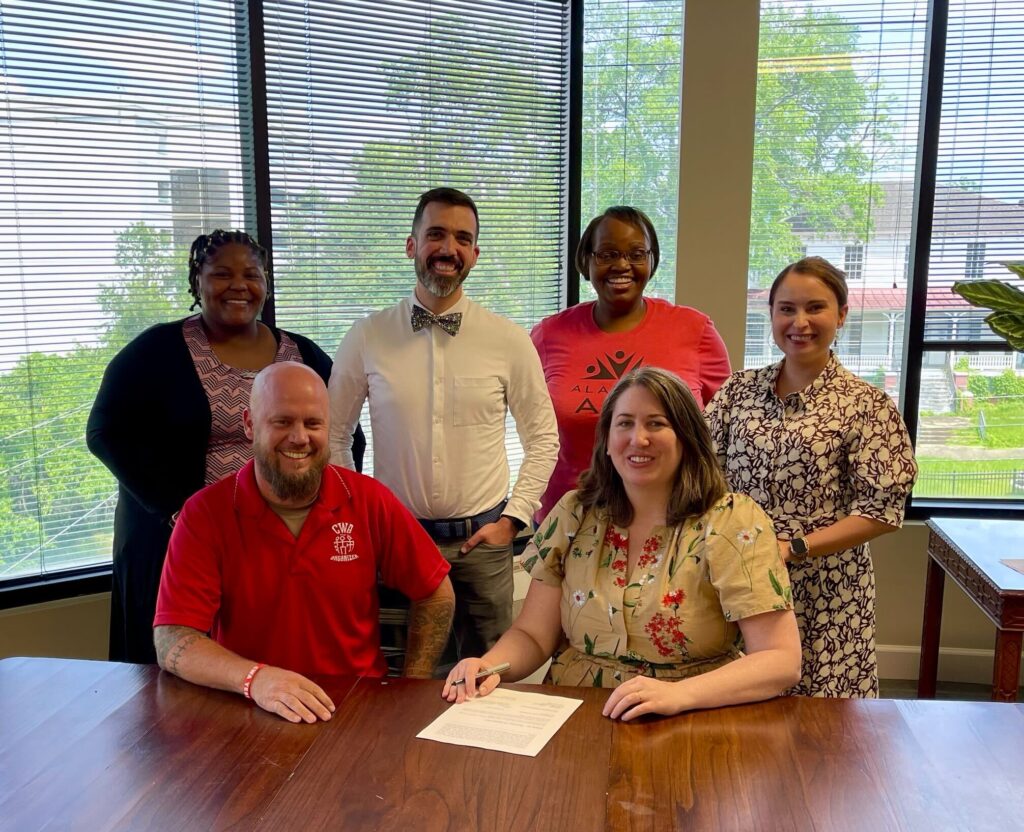
6 adults sitting at or standing by a table smiling after signing a contract.
Representatives from both Alabama Arise and Alabama Arise Workers United were on hand to sign their first collective bargaining agreement at the Arise office in Montgomery on May 19, 2025. Arise executive director Robyn Hyden is joined by Communications Workers of Alabama 3908 president Luther Land at the table. Above are AAWU steward Juliette Thornton and Arise staff members Jacob Smith, Presdelane Harris and Malee Galloway. (Photo by Bernadette Allen)

Alabama Arise and the staff union Alabama Arise Workers United (AAWU), represented by the Communications Workers of America (CWA), are proud to announce the ratification of their first collective bargaining agreement this month. This milestone reflects a collaborative, values-driven negotiation process and a shared commitment to justice, equity and dignity in the workplace.

The agreement, which the union members ratified unanimously, formalizes a strong foundation of mutual respect and solidarity between Arise leadership and AAWU-CWA members. It preserves longstanding workplace practices that support staff well-being and introduces key advancements that will enhance transparency and equity across the organization.

This positive bargaining experience builds on a strong foundation. In 2023, Arise staff unanimously signed union authorization cards to join CWA Local 3908. The organization’s staff and board leadership quickly responded by voluntarily recognizing the union.

The new agreement comes amid Alabama Arise’s deepening engagement with pro-worker and pro-labor policies in its public advocacy work.

“We’re thrilled to have reached this agreement,” said Whitney Washington, an Alabama Arise communications associate and an AAWU-CWA member. “Our values as an organization call us to live out our principles not just in our advocacy but in how we support one another as coworkers. This contract is an example of that.”

‘Walking the walk on the values we advocate for’

AAWU-CWA’s bargaining unit members voted 100% in support of the contract. That unanimity was a first for CWA’s District 3, which encompasses all right-to-work states in the Southeast. Both Arise and CWA described the bargaining process as respectful and solutions-oriented.

“Our members are proud of what we’ve achieved,” said Adam Keller, Alabama Arise’s worker power campaign director and an AAWU-CWA member. “This contract honors the strengths of Alabama Arise’s existing workplace culture while taking meaningful steps to strengthen fairness, job security and staff input.”

The contract locks in many benefits that Arise already provided staff. It also includes some powerful enhancements to those benefits. These include pay raises, 20 weeks of paid parental leave and an increase in paid time off.

“We see this agreement as a continuation of our mission as an organization that works to build a better, more inclusive Alabama for all,” Alabama Arise executive director Robyn Hyden said. “This contract protects so much of what makes Alabama Arise a great place to work, and it is one more way we’re walking the walk on the values we advocate for every day.”

CWA officials echoed that sentiment.

“This is what collective bargaining should look like,” said Andrell Hubbard, CWA’s District 3 Staff Representative. “It’s about partnership, listening and building workplaces where everyone can thrive. We’re excited about this model and what it means for movement organizations in the South.”

Arise leadership and AAWU-CWA members look forward to continuing to work together to advance policy changes to improve the lives of workers across Alabama and to deepen a workplace culture rooted in respect, democracy and shared purpose.

U.S. House budget bill would hammer struggling Alabama families

The U.S. House voted 215-214 Thursday for a budget bill that would make basic needs like food and health care more expensive for millions of families through severe cuts to food assistance, Medicaid and other human services. These funding cuts would finance efforts to renew or expand tax cuts for wealthy people and highly profitable corporations.

Alabama Arise executive director Robyn Hyden issued the following statement Friday in response:

“It’s wrong to hurt people who are struggling to help people who are already doing well. But the U.S. House just voted for a budget bill that would do exactly that.

“This cruel budget plan would take away food assistance, health coverage and other vital services from hundreds of thousands of Alabamians who struggle to afford basic needs. And it would make those cuts in service of slashing taxes for billionaires and highly profitable corporations. The bill’s $1.1 trillion of cuts to food assistance and health care over the next decade would be equal to the amount of tax breaks it would provide for the wealthiest 2% of households.

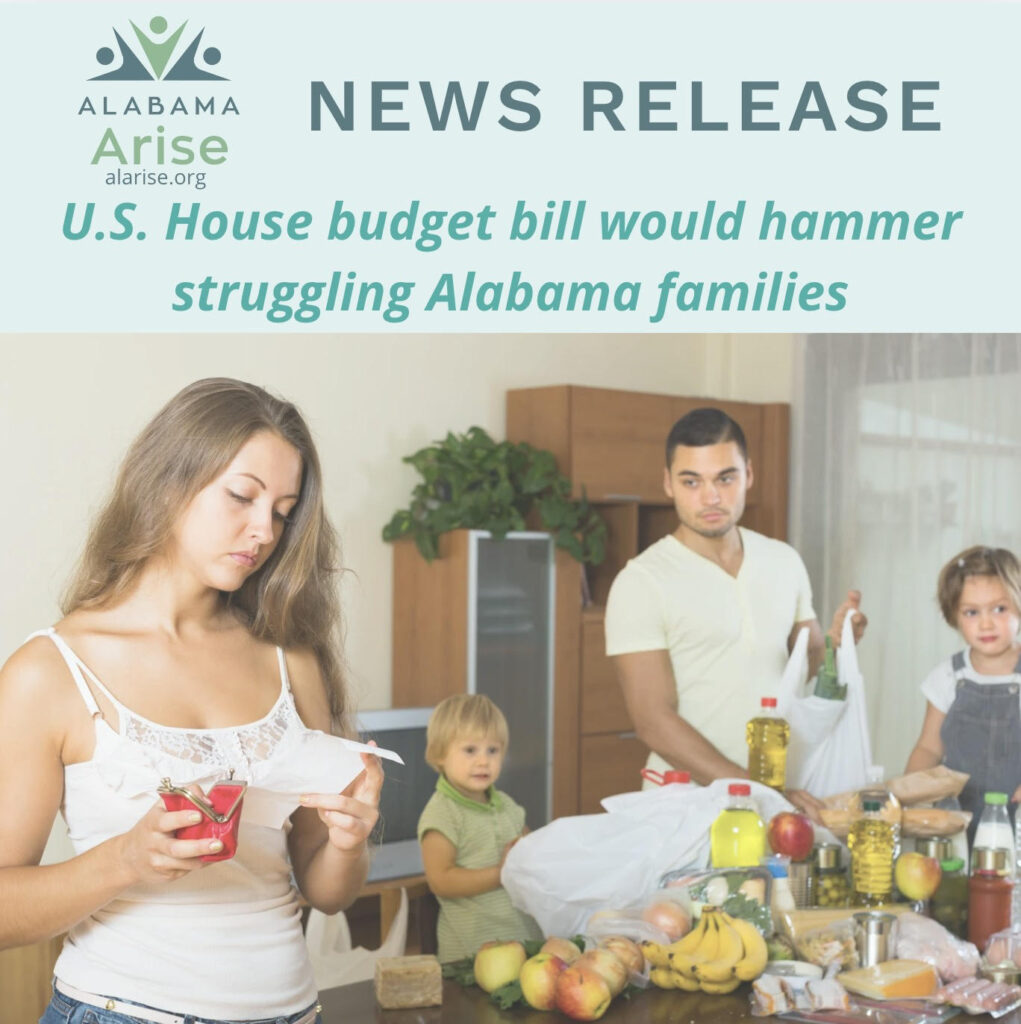
Text at the top: Alabama Arise news release: U.S. House budget bill would hammer struggling Alabama families. In the image below, a mother looks at a long receipt in the foreground. In the background, a father opens grocery bags on a kitchen table while their two young children stand to either side of him.

Threats to nutrition, health care

“Alabama likely would feel the worst effects from cuts to the Supplemental Nutrition Assistance Program. SNAP benefits have been fully federally funded for decades, but this bill would change that. As a result of this cost shift to states, Alabama would be on the hook to pay nearly $300 million a year in direct benefits and additional administrative costs.

“There is real reason to worry that the Legislature can’t or wouldn’t provide this additional funding. In that case, Alabama would be forced to cut SNAP benefits significantly – or even eliminate the program altogether for nearly 800,000 participants statewide. These cuts would send hunger soaring and devastate the economy in local communities across Alabama.

“The House bill also would make health care inaccessible or less affordable for hundreds of thousands of Alabamians. It would allow enhanced Affordable Care Act subsidies to expire, increasing premium costs for marketplace plans. It also would take away the additional federal incentives for the first two years of Medicaid expansion that Alabama left on the table, increasing the chances that hundreds of thousands of our neighbors will remain stuck in the health coverage gap with no options to afford life-saving care.

“The Senate should put the future and well-being of all of us ahead of tax cuts for the wealthy and well-connected. That means rejecting the House bill’s harmful service cuts for working people and tax giveaways to wealthy households. Our senators should focus instead on building an economy that works for everyone in Alabama and across our country.”

More resources

Read the February letter from Alabama Arise and 111 partner organizations urging Alabama’s congressional delegation to oppose harmful cuts to Medicaid and SNAP.

Read the January letter from Alabama Arise and 55 partner organizations urging Alabama’s congressional delegation to oppose further tax cuts for wealthy people.
Grocery tax bill’s passage will improve life for every Alabamian

The Alabama Senate voted 34-0 Tuesday for HB 386 by Rep. Danny Garrett, R-Trussville, a bill that will reduce the state sales tax on groceries from 3% to 2% beginning on Sept. 1 and give cities and counties more flexibility to reduce local grocery taxes if they choose. The Alabama House quickly concurred in the Senate’s changes, meaning the bill now will go to Gov. Kay Ivey.

Alabama Arise executive director Robyn Hyden released the following statement Tuesday in response.

“Reducing the grocery tax will make it easier for every Alabamian to make ends meet, especially in this time of persistently high food prices. Alabama Arise is thrilled to see the widespread, bipartisan support for reducing the state sales tax on groceries. And we urge Gov. Kay Ivey to sign this bill into law quickly.

“The state grocery tax reduction from 4% to 3% in 2023 was an essential first step toward tax justice in Alabama, and this year’s bill continues that momentum. The grocery tax drives many families deeper into poverty, and Arise remains committed to the goal of eliminating it entirely.

“Arise members from every corner of our state have advocated relentlessly for decades for Alabama to untax groceries. Our work will continue until the state grocery tax is in the dustbin of history where it belongs.

“Arise appreciates Rep. Danny Garrett and Sens. Arthur Orr and Andrew Jones for guiding HB 386 through the Legislature. We’re thankful for the unanimous legislative support on this bill this year. And we’re grateful for former Rep. John Knight, former Sen. Hank Sanders, Reps. Laura Hall, Penni McClammy and Mary Moore, and so many other legislators whose determined work over so many years laid the groundwork for this progress.

What should happen next

“Reducing the grocery tax benefits every Alabamian. And it is an important step toward righting the wrongs of our state’s upside-down tax system, which forces Alabamians with low and moderate incomes to pay a higher share of their incomes in state and local taxes than the wealthiest households.

Alabama Arise executive director Robyn Hyden speaks in support of untaxing groceries during Arise’s annual Legislative Day on March 20, 2025, in Montgomery. (Photo by Julie Bennett)

“It is important to ensure grocery tax elimination doesn’t harm our children’s education in the long term. Education Trust Fund revenues are strong enough for now to reduce the grocery tax without causing severe harm to school funding. But history tells us that times of strong revenues don’t last forever. Lawmakers must work together to agree to a solution to untax groceries sustainably and responsibly.

“Arise is open to numerous ideas for replacement revenue, and we will continue working with the state’s Joint Study Commission on Grocery Taxation to find a path forward. We continue to support our longstanding proposal to replace grocery tax revenue by capping or ending the state income tax deduction for federal income tax payments. Alabama is the only state to allow this full deduction, which overwhelmingly benefits the wealthiest households. Closing this skewed loophole would protect funding for public schools and ensure Alabama can afford to end the state sales tax on groceries forever.”

Alabama Arise praises new maternal health, paid parental leave laws

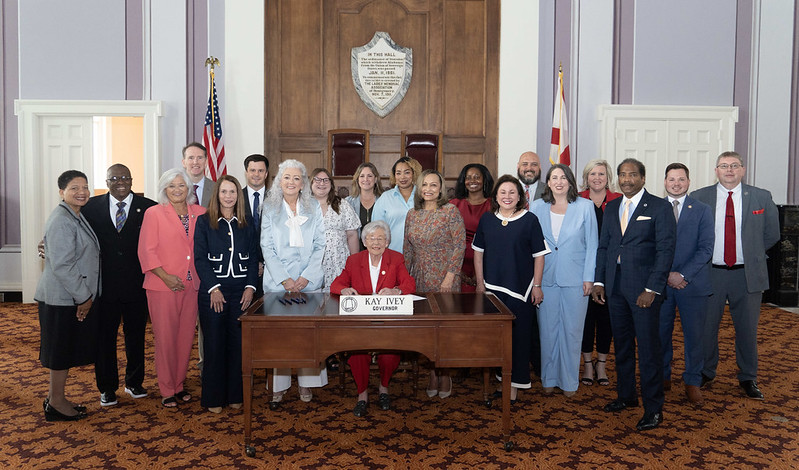
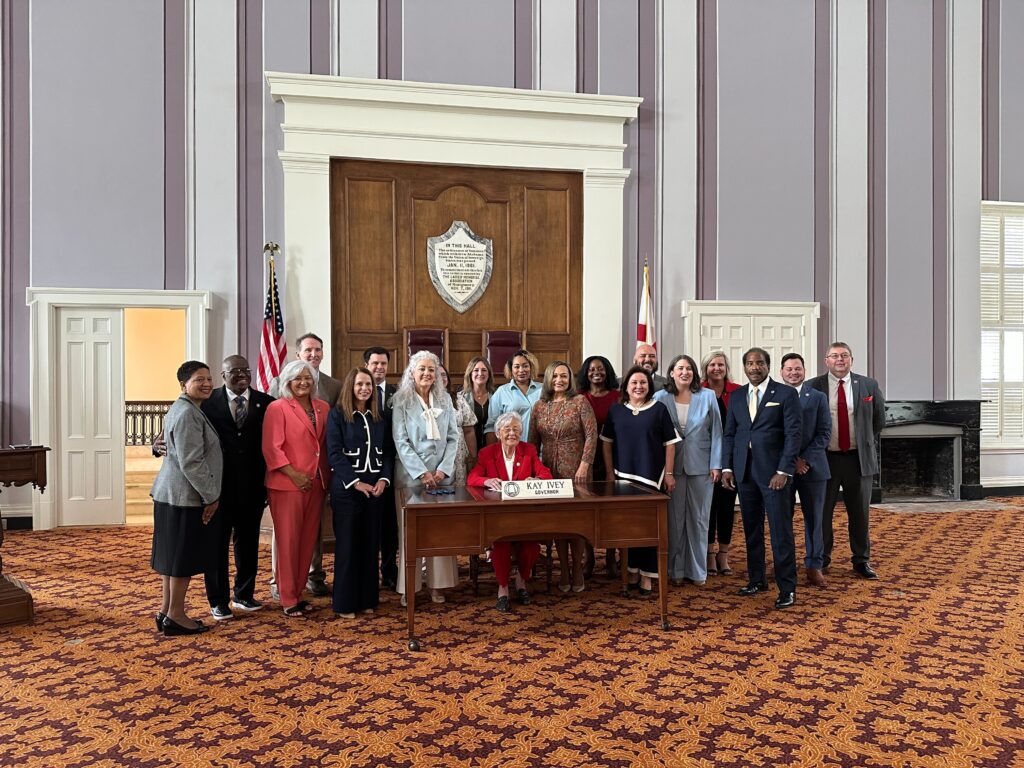
Gov. Kay Ivey sits behind a wooden desk with her nameplate on it and U.S. and Alabama flags in the background. Smiling people stand behind and to both sides of her. Behind her is wooden paneling and walls with a gray and white pattern. The patterned carpet is dark red and orange.
Alabama Arise executive director Robyn Hyden (fifth from right) and worker policy advocate Dev Wakeley (sixth from right) participated in Gov. Kay Ivey’s bill signing ceremony for SB 199 on May 1, 2025, at the State Capitol in Montgomery. SB 199 will ensure paid parental leave for teachers, two-year college workers and state employees. (Photo courtesy of Office of the Governor)

Tens of thousands of Alabama families will benefit from two new laws removing barriers to health coverage and increasing the availability of paid parental leave. Gov. Kay Ivey held a ceremonial bill signing Thursday at the State Capitol in Montgomery for both bills: SB 102, sponsored by Sen. Linda Coleman-Madison, D-Birmingham, and SB 199, sponsored by Sen. Vivian Figures, D-Mobile. The governor officially signed both bills into law last month.

Alabama Arise staff were proud to participate in the ceremonies for both bills. Improving health care access and ensuring paid parental leave are two key legislative priorities that Arise members advocated for during the Legislature’s 2025 regular session.

Official event photos from the Governor’s Office are available here.

Presumptive eligibility will reduce red-tape barriers to Medicaid coverage

SB 102, sponsored by Sen. Linda Coleman-Madison, D-Birmingham, will expand health care access for thousands of expectant mothers by allowing them to receive Medicaid coverage earlier in their pregnancy. The law will take effect Oct. 1.

The new law will expand presumptive eligibility, which allows doctors and other providers to determine Medicaid eligibility for expectant mothers who are likely to be eligible. This process allows women to begin receiving Medicaid coverage and prenatal medical care in the first trimester without having to wait for the agency’s official eligibility decision.

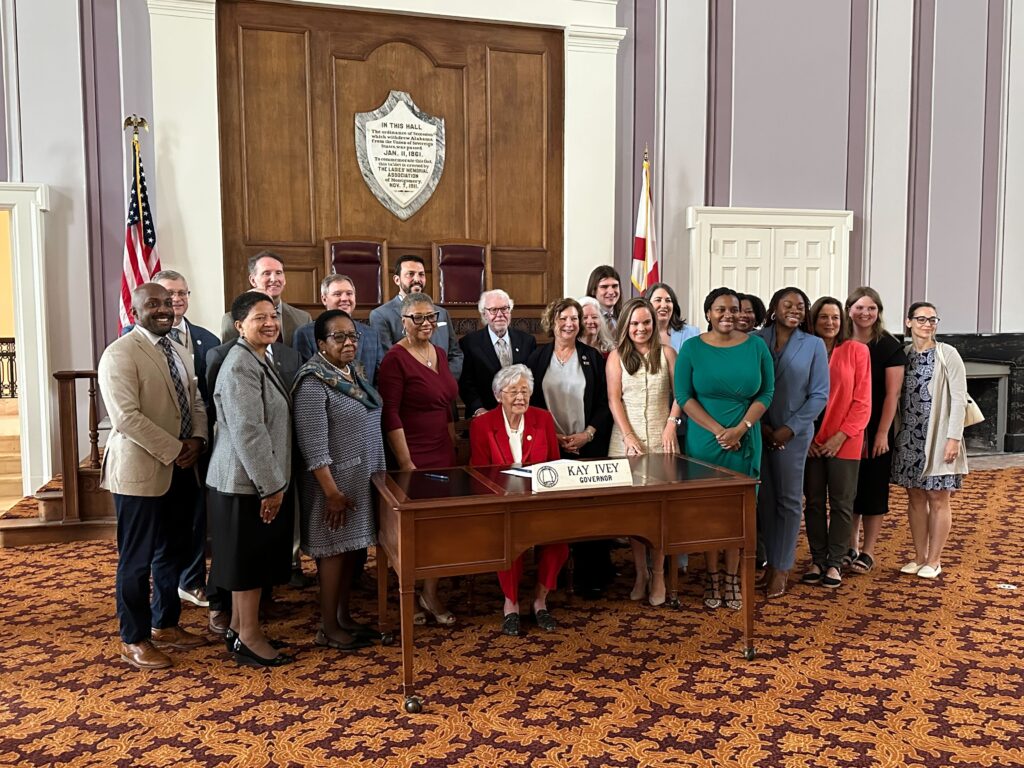
Gov. Kay Ivey sits behind a wooden desk with her nameplate on it and U.S. and Alabama flags in the background. Smiling people stand behind and to both sides of her. Behind her is wooden paneling and walls with a gray and white pattern. The patterned carpet is dark red and orange.
Alabama Arise senior health policy advocate Jennifer Harris (fifth from right) and executive director Robyn Hyden (seventh from right) participated in Gov. Kay Ivey’s bill signing ceremony for SB 102 on May 1, 2025, at the State Capitol in Montgomery. SB 102 will expand Medicaid presumptive eligibility and allow thousands of expectant mothers in Alabama to receive health care earlier in their pregnancy. (Photo by Matt Okarmus)

“This law will save lives and money for families across Alabama,” said Robyn Hyden, executive director of Alabama Arise. “For too long, Alabama mothers have faced needless barriers to early prenatal care – care that can mean the difference between hope and heartbreak. SB 102 will lift some of those red-tape barriers at last.

“The passage of this act is a life-changing victory for moms and babies in every part of Alabama. Alabama Arise thanks Sen. Linda Coleman-Madison and Rep. Marilyn Lands for their determination and visionary leadership on this legislation. We thank every Arise member who advocated for this bill and every lawmaker who voted for it. And we thank Gov. Kay Ivey for signing it into law.”

Paid parental leave law will help families, boost worker retention

SB 199, sponsored by Sen. Vivian Figures, D-Mobile, will ensure paid parental leave for new parents who work as teachers, two-year college employees or state employees. The law will take effect July 1.

The new law will provide eight weeks of paid leave to mothers after childbirth, adoption of a child aged 3 or younger, stillbirth or miscarriage. Fathers will receive two weeks of paid leave in those circumstances.

Gov. Kay Ivey sits behind a wooden desk with her nameplate on it and U.S. and Alabama flags in the background. Smiling people stand behind and to both sides of her. Behind her is wooden paneling and walls with a gray and white pattern. The patterned carpet is dark red and orange.
Alabama Arise executive director Robyn Hyden (fifth from right) and worker policy advocate Dev Wakeley (sixth from right) participated in Gov. Kay Ivey’s bill signing ceremony for SB 199 on May 1, 2025, at the State Capitol in Montgomery. (Photo by Matt Okarmus)

“Paid parental leave helps workers create and grow their families while maintaining their financial well-being,” Hyden said. “Alabama’s new law guaranteeing paid parental leave for teachers and state employees makes our state a leader in the Southeast. And it is important progress toward ensuring every parent can care for their families without scrambling to pay the bills.

“This new law will enhance the quality of life for families across Alabama. Paid leave will help improve health for babies and families, and it will ease economic stress for new parents. This policy also will improve employee retention for schools and state agencies, and it will help mothers in particular to remain in the workforce.

“Paid parental leave is a common-sense, pro-family policy that will result in a better, healthier future for everyone in our state. Alabama Arise appreciates the leadership from the legislative champions on this issue, Sen. Vivian Figures and Rep. Ginny Shaver. We appreciate Gov. Kay Ivey for highlighting paid leave as a priority in her State of the State address and for signing this bill into law. And we appreciate every legislator who voted for this law and every Arise member who advocated in support of this important investment in healthier families in Alabama.”

New paid parental leave law improves life for Alabama workers

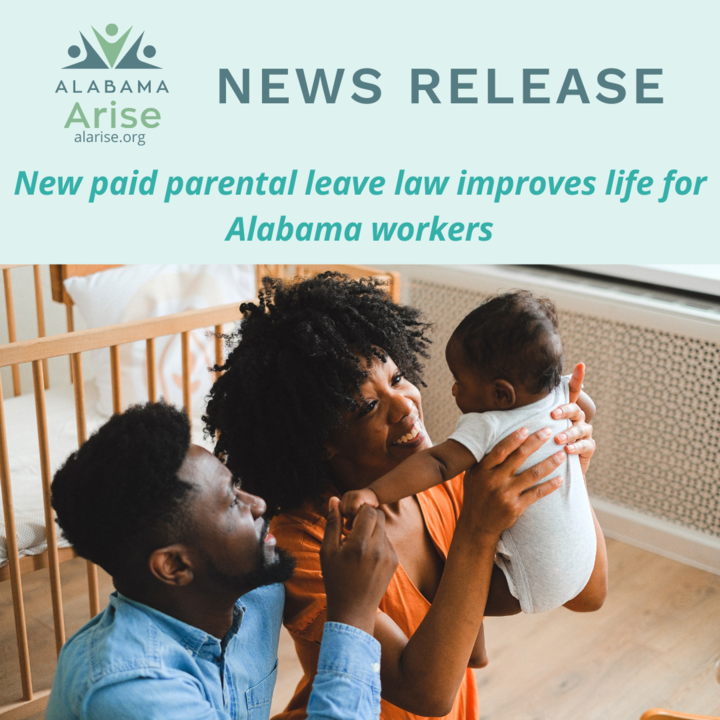
A mother holds her baby while the father holds the baby's hand. Both parents are smiling. Text: "Alabama Arise news release: New paid parental leave law improves life for Alabama workers."

Gov. Kay Ivey signed SB 199 into law Wednesday. The legislation, sponsored by Sen. Vivian Figures, D-Mobile, will ensure paid parental leave for new parents who work as teachers, two-year college employees or state employees. The law, which will take effect on July 1, provides eight weeks of paid leave to mothers and two weeks of paid leave to fathers after childbirth, adoption of a child aged 3 or younger, stillbirth or miscarriage.

Alabama Arise executive director Robyn Hyden released the following statement Wednesday in response:

“Paid parental leave helps workers create and grow their families while maintaining their financial well-being. Alabama’s new law guaranteeing paid parental leave for teachers and state employees makes our state a leader in the Southeast. And it is important progress toward ensuring every parent can care for their families without scrambling to pay the bills.

“This new law will enhance the quality of life for families across Alabama. Paid leave will help improve health for babies and families, and it will ease economic stress for new parents. This policy also will improve employee retention for schools and state agencies, and it will help mothers in particular to remain in the workforce.

“Paid parental leave is a common-sense, pro-family policy that will result in a better, healthier future for everyone in our state. Alabama Arise appreciates the leadership from the legislative champions on this issue, Sen. Vivian Figures and Rep. Ginny Shaver. We appreciate Gov. Kay Ivey for highlighting paid leave as a priority in her State of the State address and for signing this bill into law. And we appreciate every legislator who voted for this law and every Arise member who advocated in support of this important investment in healthier families in Alabama.”

200+ Alabama Arise supporters rally in favor of reducing state grocery tax

Alabama Arise executive director Robyn Hyden speaks in support of untaxing groceries during Arise’s annual Legislative Day on March 20, 2025, in Montgomery. (Photo by Julie Bennett)

Alabama should reduce the state sales tax on groceries again this year and work toward a sustainable solution to end the tax permanently, Alabama Arise members told legislators Thursday.

More than 200 Arise supporters gathered Thursday at the State House in Montgomery to show their support for untaxing groceries. The advocates urged state senators to support HB 386 by Rep. Danny Garrett, R-Trussville, which would reduce the state grocery tax from 3% to 2% beginning on Sept. 1. HB 386 passed the House 103-0 on Tuesday and now awaits Senate consideration.

“We’re here today to ask our lawmakers to continue what we started two years ago by reducing the state grocery tax again,” Alabama Arise board president Clyde Jones said at a news conference. “Reducing the grocery tax will make it easier for families across the state of Alabama to make ends meet. And it will be an important step toward our ultimate goal of untaxing groceries once and for all.”

The news conference was part of Arise’s annual Legislative Day event. Photos from the event are available here. A video of the news conference is available here. (Remarks start at the 3:50 mark.)

Building on a breakthrough in 2023

Alabama is one of only 10 states still taxing groceries. Three other states have ended their state tax but still allow local governments to tax food. The number of states reducing or eliminating their grocery tax has continued to grow in recent years. Most recently, Kansas ended its state grocery tax this year.

Arise members have advocated since the 1990s to eliminate Alabama’s grocery tax. That advocacy got results in 2023, when lawmakers voted unanimously to reduce the state grocery tax from 4% to 3%.

HB 386 presents an opportunity this year to continue the bipartisan progress toward untaxing groceries. Reducing the state grocery tax by 1 percentage point would save an average Alabama family of four around $150 per year, based on estimates using the moderate-cost food plan from the USDA’s cost of food at home reports.

“Our message today is simple: It is wrong to tax groceries,” Alabama Arise executive director Robyn Hyden said. “This is a highly regressive tax that drives many people deeper into poverty. Taxing food makes it harder for struggling families to put food on the table. It is a cruel tax on survival. This tax needs to end, and the sooner, the better.”

‘This is a moral issue’

Hyden expressed gratitude for Arise members’ persistent and determined advocacy to end the grocery tax. She also thanked Garrett and many other current and former legislative champions of untaxing groceries. Those lawmakers include Sens. Andrew Jones, R-Centre, and Merika Coleman, D-Pleasant Grove; Reps. Laura Hall, D-Huntsville, and Penni McClammy, D-Montgomery; and former Rep. John Knight, D-Montgomery.

“This is not a partisan issue. This is a moral issue,” Hyden said. “We’re going to continue to work together to get HB 386 across the finish line with the help of our senators, and to find a sustainable way to fund our state government without taxing people deeper into poverty.”

Another grocery tax reduction would be great news for every Alabamian

Rep. Danny Garrett, R-Trussville, on Wednesday introduced HB 386, a bill to reduce the state sales tax on groceries from 3% to 2% beginning on Sept. 1. The Alabama House Democrats also endorsed forthcoming legislation to end the state grocery tax during a news conference Wednesday. Alabama Arise executive director Robyn Hyden released the following statement Thursday in response:

“Alabama Arise is excited to see widespread, bipartisan support for reducing the state sales tax on groceries. The grocery tax reduction in 2023 was an essential first step toward tax justice in Alabama, and we look forward to working with lawmakers to continue the progress on this vital issue this year.

“Further reducing and ultimately eliminating the state sales tax on groceries would provide meaningful help for Alabamians who struggle to make ends meet. Reducing the grocery tax benefits every Alabamian. And it is an important step toward righting the wrongs of our state’s upside-down tax system, which forces Alabamians with low and moderate incomes to pay a higher share of their incomes in state and local taxes than the wealthiest households.

“The state grocery tax is a cruel tax on survival. It drives many families deeper into poverty. And Arise remains committed to the goal of eliminating it entirely. Arise members from every corner of our state have advocated relentlessly for decades for Alabama to untax groceries. Our work will continue until the state grocery tax is in the dustbin of history where it belongs.

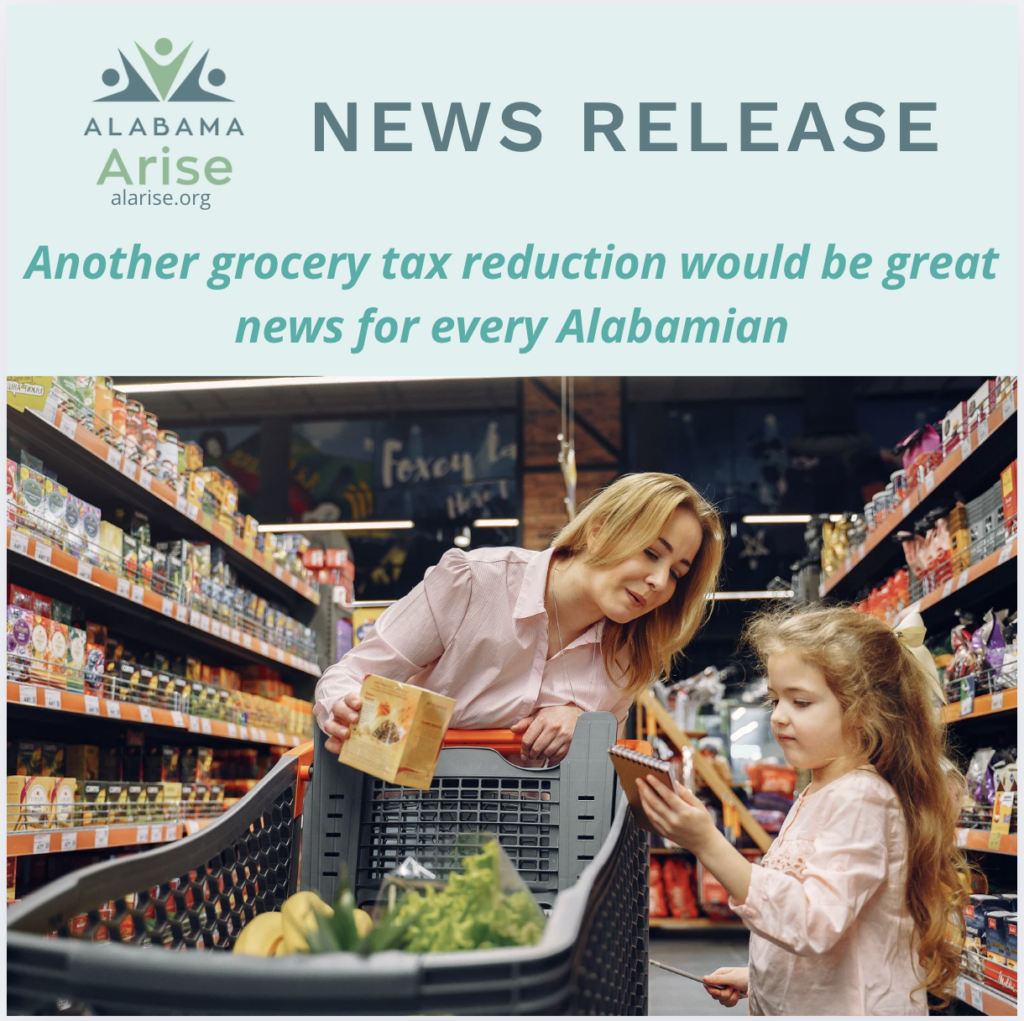
A woman pushes a grocery cart while her daughter stands next to her. Image text: "News release: Another grocery tax reduction would be great news for every Alabamian."

How to ensure the grocery tax reduction lasts

“It is important to ensure grocery tax elimination doesn’t harm our children’s education in the long term. Education Trust Fund revenues are strong enough for now to reduce the grocery tax without causing severe harm to school funding. But history tells us that good economic times don’t last forever. Lawmakers must work together to agree to a solution to untax groceries sustainably and responsibly.

“Arise is open to numerous ideas for replacement revenue, and we will continue working with the state’s Joint Study Commission on Grocery Taxation to find a path forward. We continue to support our longstanding proposal to replace grocery tax revenue by capping or ending the state income tax deduction for federal income tax payments. Alabama is the only state to allow this full deduction, which overwhelmingly benefits the wealthiest households. Closing this skewed loophole would protect funding for public schools and ensure Alabama can afford to end the state sales tax on groceries forever.”