The federal income tax deduction is skewed and wrong for Alabama

Wealthy people don’t need a huge, skewed income tax break ‒ but Alabama gives them exactly that. This loophole, called the federal income tax (FIT) deduction, overwhelmingly benefits rich households. It’s an imbalanced tax giveaway that reduces funding for public schools. And it increases the state’s reliance on regressive revenue sources, like the sales tax on groceries, that fall hardest on people who are striving to make ends meet.

The federal income tax (FIT) deduction is unfair and largely benefits the wealthiest Alabamians. The graphic has money bags of different sizes to show the deduction's average estimated value at different income levels. For low-income Alabamians, the average is $3. For median taxpayers, it's $67. For upper-income Alabamians, it's $549. And for the top 1%, it's $12,901. Source: Institute on Taxation and Economic Policy.

A 1965 constitutional amendment created the loophole by allowing Alabamians to deduct federal income tax payments from their income before calculating state income taxes. This deduction doesn’t exist in most other states ‒ and for good reason! Only Alabama and Iowa allow individuals to deduct all federal income tax payments. (Louisiana had an FIT deduction until 2022.) Three other states ‒ Missouri, Montana and Oregon ‒ cap their FIT deductions at around $5,000. There, as here, the benefits go largely to those with the highest incomes.

A tax break for those who need it least

The FIT deduction primarily benefits wealthy households and does little or nothing for families with low and moderate incomes. Unlike Alabama, where the state income tax rate is nearly flat (with most people paying the same percentage of their income), the federal government taxes people at higher rates as their income goes up. This means rich people can use Alabama’s FIT deduction to exclude much more of their total income when calculating state income taxes. And that means the FIT deduction gives the biggest breaks to those who can most afford to pay to fund education, health care and other vital needs.

By contrast, the FIT deduction offers comparatively little benefit to people with low or moderate incomes. For Alabamians with incomes under $22,000, the FIT deduction is worth an average of $3 a year, the Institute on Taxation and Economic Policy (ITEP) estimates. In fact, for most people in our state, the deduction is worth less than $135 a year. But for the richest 1% in Alabama ‒ whose average income is $1.28 million ‒ the deduction is worth an average of $12,901 a year, ITEP estimates.

A path to untax groceries and support public schools

Ending or capping the FIT deduction would be an important step to improve Alabama’s upside-down tax system. And the effects for individual tax filers would be relatively modest. Even for the richest Alabamians, eliminating the FIT deduction would increase their taxes by only around 1% of total income on average. For most people in our state, the increase would be significantly less ‒ or none at all.

By ending this upside-down tax break for the rich, Alabama lawmakers could generate $833 million in new revenue. More than 85% of that amount would come from the highest-paid 20% of residents. This money would empower Alabama to end the state grocery tax without cutting a dime of funding for public schools. And after untaxing groceries, lawmakers still would have more than $300 million in new revenue every year to strengthen investments in K-12 and higher education.

Bottom line

The FIT deduction is a nearly 60-year-old bad idea. It takes money away from our children’s schools. It forces the Legislature to tax groceries and other necessities instead of income from wealthy residents. And it provides a giant tax loophole for the richest people in our state. By abandoning this failed experiment, lawmakers can help make our state more just and inclusive and build a brighter future for every Alabamian.
52 Alabama groups urge Shelby, Tuberville to support Child Tax Credit, EITC improvements this year

U.S. Sens. Richard Shelby and Tommy Tuberville should support expanding the Child Tax Credit (CTC) and Earned Income Tax Credit (EITC) in year-end budget legislation, 52 organizations across Alabama wrote in a letter sent to the senators Tuesday. Alabama Arise is among the groups that signed the letter.

The American Rescue Plan Act (ARPA) temporarily expanded the CTC for hundreds of thousands of Alabama children last year. The law also temporarily increased the maximum EITC for workers without children and broadened the age range for EITC eligibility. Those temporary improvements have expired, but Congress can renew them in the “lame duck” session beginning this week.

“We urge you to put families and workers first,” the groups wrote to Shelby and Tuberville. “There should be no expanded tax breaks for businesses and corporations without expanding the CTC and EITC.”

Click here to read the organizations’ full letter to Shelby and Tuberville.

Child Tax Credit improvements helped cut U.S. child poverty rate by nearly half

Nearly 350,000 Alabama children would benefit from renewing the CTC improvements, according to the Center on Budget and Policy Priorities (CBPP), a nonprofit research organization in Washington, D.C. The impact would be especially significant for children of color across the state. Among Alabama children who would benefit from renewing the CTC improvements, 161,000 are Black, 130,000 are white and 41,000 are Hispanic, according to CBPP estimates.

The temporary CTC expansion worked swiftly and powerfully to ease suffering and expand economic opportunity, Census data shows. Monthly CTC payments last year helped families cover rising costs for necessities like food, utilities, rent and diapers. Overall, the policy kept more than 5 million Americans above the poverty line. It also contributed to a major nationwide reduction in the child poverty rate in 2021, with the Supplemental Poverty Measure for children falling from nearly 10% to about 5%.

ARPA’s one-year CTC expansion increased the maximum credit for children under age 6 to $3,600, and for all other children to $3,000. It made the full CTC available to children living in families with low or no earnings. And it extended the credit to 17-year-olds, who previously were ineligible.

“Our nation’s historically high child poverty rate is a choice,” the organizations’ letter said. “Recent U.S. Census data reveals a fundamental truth: Congress has the power to make a different choice.”

EITC expansion increases boost financial stability for Alabama workers

The EITC improvements under ARPA also eased hardship for people across Alabama. More than 280,000 Alabamians with low incomes benefited from last year’s temporary EITC expansions. Nearly three in four had incomes below $20,400, according to estimates by the Institute on Taxation and Economic Policy.

ARPA temporarily raised the maximum EITC for working adults from roughly $530 to roughly $1,500. It also increased the income eligibility limit and expanded the age range of eligible workers. Those changes allowed adults aged 19-24 who are not full-time students to qualify, as well as people 65 and over.

“[CTC and EITC expansions] have proved effective to reduce child poverty and boost incomes for people who work but aren’t paid enough to make ends meet,” the groups’ letter said. “We hope we can count on you to fight for these policies to support kids and workers.”

Click here to read the organizations’ full letter to Shelby and Tuberville.

Alabama Arise, 51 partner groups urge U.S. senators to support Child Tax Credit, EITC improvements

The American Rescue Plan Act (ARPA) temporarily expanded the Child Tax Credit (CTC) for hundreds of thousands of Alabama children last year. The law also temporarily increased the maximum Earned Income Tax Credit (EITC) for workers without children and broadened the age range for EITC eligibility. Alabama Arise joined 51 partner organizations Tuesday in a letter asking Alabama’s U.S. senators, Richard Shelby and Tommy Tuberville, to support renewing these CTC and EITC improvements this year. The full text of the letter is below.

Letter text

Dear Senators Shelby and Tuberville,

Our nation’s historically high child poverty rate is a choice. Recent U.S. Census data reveals a fundamental truth: Congress has the power to make a different choice. Congress can and should put families and workers first by expanding the Child Tax Credit (CTC) and Earned Income Tax Credit (EITC). These strategies have proved effective to reduce child poverty and boost incomes for people who work but aren’t paid enough to make ends meet.

We, the undersigned organizations representing people with low incomes in Alabama, are writing to urge you to prioritize expanding these programs as part of the anticipated end-of-year budget bill. The time to pass these policies is now, as this may be the last chance this Congress has to act.

Even as Congress has this tremendous opportunity to deliver for families and workers, press reports indicate lobbyists are pressuring Congress to deliver more significant tax breaks for businesses and corporations. One example is the push for a tax break for companies engaged in “research and experimentation,” including tech, pharmaceuticals and other large corporations.

We urge you to put families and workers first. There should be no expanded tax breaks for businesses and corporations without expanding the CTC and EITC.

Under current law, too many children in families with the lowest incomes receive no CTC or receive a smaller credit than children in families with higher incomes. Expanding the CTC so that it reaches more of those children will go a long way toward improving families’ ability to make ends meet and reducing child poverty.

As you know, the American Rescue Plan Act (ARPA) temporarily expanded the CTC for 480,000 children in Alabama, but the expansion has expired. The overwhelming majority of families with low incomes used ARPA’s monthly CTC payments to cover everyday challenges and basic expenses, such as food, utilities, rent and diapers. Before ARPA was passed, roughly 27 million children received less than the full CTC, including many who got no credit at all — not because their families earned too much, but because of a flaw in the law that excludes kids from families with the lowest incomes. Those children excluded from the full credit include roughly half of all children in rural areas.

The Rescue Plan’s CTC expansion, combined with other relief efforts, helped lower child poverty by more than 40% between 2020 and 2021, Census data shows. Investing in children in low-income families by expanding programs like the Child Tax Credit also has shown success in improving outcomes for those children over their whole lives, including higher educational attainment, better health and higher earnings as adults.

We also urge you to expand the EITC for workers paid low wages who do not have children living with them. This part of the EITC has not been adjusted for nearly 30 years (outside of a temporary, one-year Rescue Plan expansion). As a result, about 6 million of these workers 19 and older have incomes below the poverty line, once federal taxes are taken into account.  This commonsense proposal is long overdue and has enjoyed bipartisan support in the past.

Congress has a critical choice to make now: Will it expand the CTC and EITC, to put more kids on an upward trajectory for life and help working people make ends meet? Or will it go home without reaching a bipartisan agreement on these straightforward policies?

We hope we can count on you to fight for these policies to support kids and workers – and to make sure any final legislative package in December doesn’t give more tax breaks for corporations without supporting Alabamians.

Should you have any questions, please do not hesitate to contact Robyn Hyden with Alabama Arise at robyn@alarise.org. We appreciate your time and your consideration of our views.

Signatories

¡HICA! Hispanic Interest Coalition of Alabama

Advocacy for Social Justice Team of the North Alabama Conference of the United Methodist Church

AIDS Alabama

Alabama Appleseed Center for Law and Justice

Alabama Arise

Alabama Civic Engagement (ACE) Coalition

Alabama Coalition for Immigrant Justice

Alabama Council on Human Relations (ACHR)

Alabama Forward

Alabama Institute for Social Justice

Alabama Justice Initiative

Alabama Possible

Alabama State Nurses Association

Bay Area Women Coalition, Inc.

Beloved Community Church, UCC

Chat World Home Daycare

Childcare Resources

Cody S. King Home Daycare

Communities of Transformation

Community Action Association of Alabama

Community Enabler Developer, Inc.

Community Food Bank of Central Alabama

DayKara’s Group Home

Dee’s Daycare

Edmundite Missions

Fairhope Friends

Faith in Action Alabama

First Christian Church (Disciples of Christ) of Montgomery

First Presbyterian Church of Birmingham

Gadsden Outreach Ministries

Grace Presbyterian Church, Tuscaloosa

Greater Birmingham Ministries

Hometown Action

Jobs to Move America

League of Women Voters of Alabama

Monte Sano UMC

Montgomery PRIDE United

Mrs. Mazaheri’s Day Care

NAACP: Tuscaloosa Branch

Nana’s Nursery

North Alabama Peace Network

Open Table UCC

Project Hope to Abolish the Death Penalty

Redemption Earned, Inc.

Restorative Strategies

Sisters of Mercy in Alabama

SPLC Action Fund

Unitarian Universalist Church of Birmingham

University of Montevallo Alabama Arise Student Chapter

Valley Christian Church

Volunteers of America, Southeast (VOA)

YWCA Central Alabama

Congress should make the Child Tax Credit expansion permanent

Good public policy is vital in the fight against poverty, and U.S. Census data released last month demonstrates its importance. The 2021 Child Tax Credit (CTC) expansion is uplifting proof of how better policies can reduce poverty and ease suffering. And Congress needs to renew this expansion when it returns to Washington, D.C., after the general election.

Many of the people-first policies in the American Rescue Plan Act (ARPA) swiftly combated economic insecurity during the COVID-19 pandemic. And the CTC expansion was the most resounding success. It heavily contributed to a major decline in child poverty rates nationwide, with the Supplemental Poverty Measure (SPM) for children dropping by nearly half, falling from nearly 10% to about 5%.

ARPA’s one-year CTC expansion increased the maximum credit for children under age 6 to $3,600, and for all other children to $3,000. It made the full CTC available to children living in families with low or no earnings. And it extended the credit to 17-year-olds, who previously were ineligible. Congress so far has failed to renew the expansion for 2022, but lawmakers should revisit that decision later this year.

The SPM differs from the official poverty measure in that it provides a fuller, more realistic understanding of economic insecurity. The SPM includes the effects of non-cash benefits like housing subsidies and the CTC. And the data shows the CTC expansion alone kept more than 5 million Americans above the poverty line.

CTC expansion reduced racial disparities

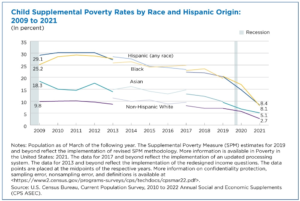
Importantly, this impact was especially significant for people of color. Hispanic children saw a dramatic nationwide reduction in poverty, with SPM rates falling from about 15% in 2020 to 8.4% in 2021. SPM rates for Black children saw similar improvement, falling from 18% to 8% during the same period.

Black and Hispanic children are still more likely to experience poverty than white children, but the expanded CTC shows the power of public policy to reduce racial disparities, promote broadly shared prosperity and create a more economically equitable society. The Census Bureau graph below demonstrates the expanded CTC’s dramatic effect on child SPM rates by race.

Graph of child poverty rates under the Supplemental Poverty Measure by race from 2009 to 2021. See the graph at https://www.census.gov/content/dam/Census/library/stories/2022/09/record-drop-in-child-poverty-figure-1.jpg.

While the CTC expansion isn’t yet permanent, its impact was clear, immediate and overwhelmingly positive. The expansion’s benefits speak volumes for the power of strong, deliberate public policy to reduce economic insecurity and racial disparities.

People-first public policy works. Just ask the 5.3 million Americans kept out of poverty by the expanded Child Tax Credit. It’s time for Congress to step up to the plate and make the CTC expansion permanent.

Alabama Arise unveils 2023 roadmap for change in Alabama

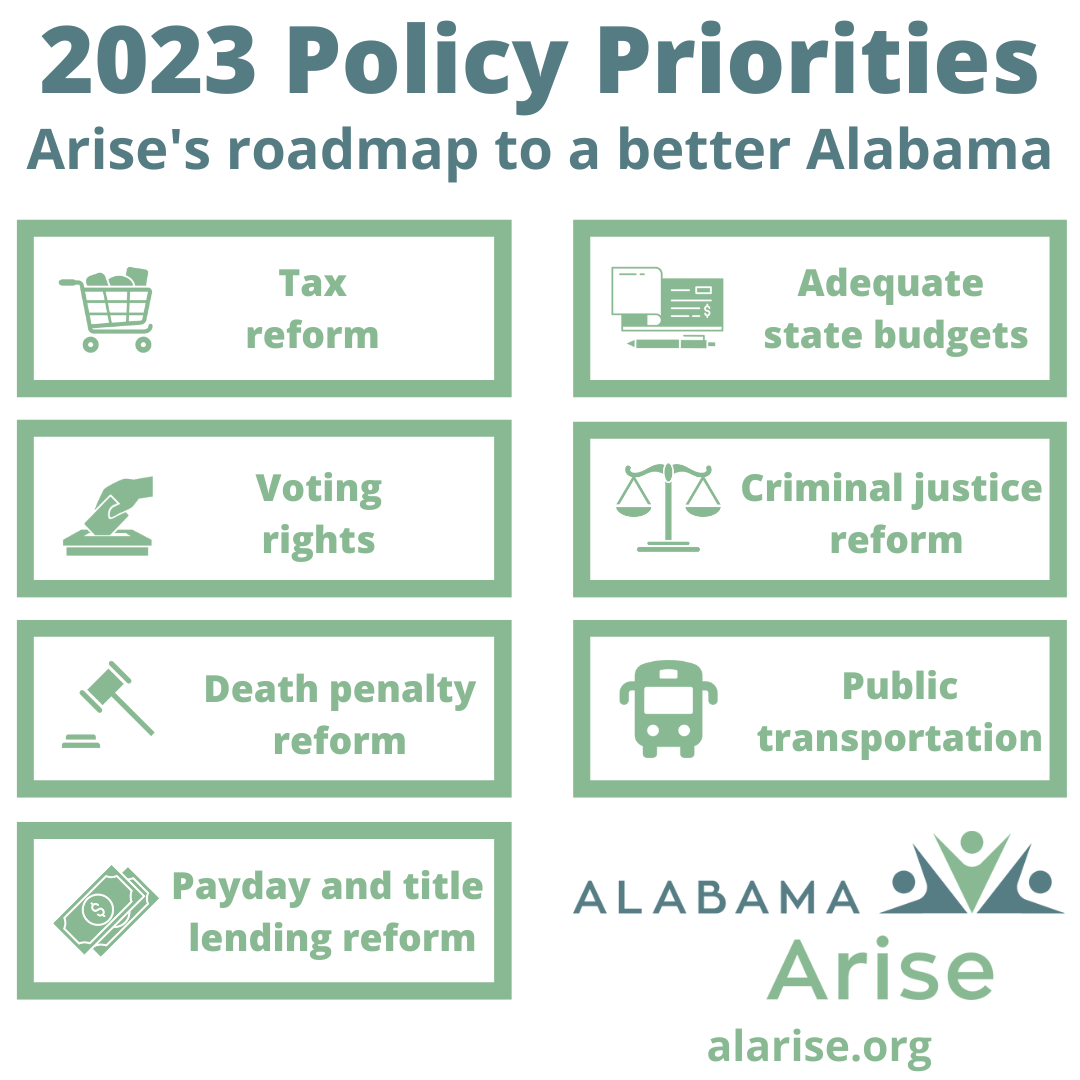
Expanding Medicaid and ending the state sales tax on groceries will remain top goals on Alabama Arise’s 2023 legislative agenda. More than 400 members voted on Arise’s issue priorities in recent days after the organization’s annual meeting Saturday. The seven issues chosen were:

  • Adequate budgets for human services like education, health care and child care, including Medicaid expansion to make health coverage affordable for all Alabamians.
  • Tax reform, including untaxing groceries and capping the state’s upside-down deduction for federal income taxes, which overwhelmingly benefits rich households.
  • Voting rights, including automatic universal voter registration, removal of barriers to voting rights restoration for disenfranchised Alabamians, and other policies to expand and protect multiracial democracy in the state.
  • Criminal justice reform, including retroactive application of state sentencing guidelines and repeal of the Habitual Felony Offender Act.
  • Death penalty reform, including a law to require juries to be unanimous in any decision to impose a death sentence.
  • Public transportation to empower Alabamians with low incomes to stay connected to work, school, health care and their communities.
  • Payday and title lending reform to protect consumers from getting trapped in debt.

“Arise believes in dignity, equity and justice for everyone,” Alabama Arise executive director Robyn Hyden said. “Our 2023 issue priorities reflect the need to work together to break down policy barriers that keep people in poverty, and that disproportionately harm Black and Hispanic Alabamians. We must build a healthier, more just and more inclusive future for our state.”

Displaying Arise's 2023 Policy Priorities: Tax reform, Adequate state budgets, Voting rights, Criminal justice reform, Death penalty reform, Public transportation, Payday and title lending reform

The time is right to expand Medicaid in Alabama

One essential step toward a healthier future for Alabama is to ensure everyone can afford the health care they need. Arise members believe Medicaid expansion is a policy path to that destination, and research provides strong support for that position.

Expanding Medicaid would reduce racial health disparities and remove financial barriers to health care for more than 340,000 Alabamians. It would support thousands of new jobs across the state. And most importantly, it would save hundreds of lives every year.

Medicaid expansion would ensure health coverage for more than 220,000 Alabamians caught in the coverage gap. These residents earn too much to qualify for the state’s bare-bones Medicaid program but too little to afford private plans. Expansion also would benefit another 120,000 Alabamians who are stretching to pay for coverage they cannot readily afford.

Alabama is one of only 12 states that have not yet expanded Medicaid to cover adults with low incomes. But an Alabama Arise poll earlier this year found that more than seven in 10 Alabamians (71.5%) support Medicaid expansion. That figure included 65.8% of Republican voters.

“Medicaid expansion would boost our economy and improve the lives of hundreds of thousands of Alabamians,” Hyden said. “It’s time for Gov. Kay Ivey and lawmakers to say yes to the generous federal incentives for Medicaid expansion. Making this crucial investment in Alabamians’ well-being now will make our state better for decades to come.”

Why and how Alabama should untax groceries

Alabama’s state grocery tax makes it harder for people with low incomes to make ends meet. The tax adds hundreds of dollars a year to the cost of a basic necessity for families. And most states have abandoned it: Alabama is one of only three states with no sales tax break on groceries.

The state sales tax on groceries brings in roughly 6% of the Education Trust Fund’s annual revenue. But lawmakers have a path available to end the state grocery tax while protecting funding for public schools. Arise will continue to support legislation to untax groceries and replace the revenue by capping the state income tax deduction for federal income taxes (FIT).

The FIT deduction is a skewed tax break that overwhelmingly benefits the richest households. It is also exceedingly rare: Alabama is one of only two states to allow this deduction in full. The FIT deduction and grocery tax are two policies that contribute heavily to Alabama’s upside-down tax system. On average, Alabamians with low and moderate incomes must pay twice as much of what they make in state and local taxes as the richest households do.

“By untaxing groceries and capping the FIT deduction, lawmakers can make Alabama’s tax system more just and equitable,” Hyden said. “This plan would empower more families to keep food on the table while also protecting funding for our public schools. The Legislature should seize this opportunity to make life better for every Alabamian.”

20+ Alabama community groups call on Hyundai to stop alleged use of child labor at suppliers

The Alabama Coalition for Community Benefits issued an open letter on Thursday to Hyundai Motor of North America calling on the company to stop any use of child labor and to negotiate a community benefits agreement.

The letter from community leaders in Alabama comes as the U.S. Department of Labor continues to investigate widely reported alleged use of child labor by SMART, a Hyundai-owned parts supplier to the Korean company’s large assembly facility in Montgomery.

A Reuters writer initially reported evidence suggesting that as many as 50 underage workers – as young as 12 years old – had worked at the stamping plant that also has a long history of health and safety violations, including amputation hazards.

At the same time, another Hyundai supplier, SL Alabama, was sued by the Department of Labor last month over allegations that the supplier employed children under age 16. SL Alabama manufactures headlights and mirrors for Hyundai. Also last month, Hyundai was sued by Mexican workers who allege that Hyundai discriminated against them by paying them less than white workers at the same plant.

“When our state incentivizes employers to locate here, Alabamians have a right to expect a high level of accountability and transparency,” Alabama Arise executive director Robyn Hyden said. “Alabama has given up tax dollars to help support the Hyundai manufacturing plant and suppliers. We are asking for more accountability for all employers who receive subsidies and profit from state investments.”

“These allegations of child labor at multiple Hyundai subsidiaries suggest a potentially systemic problem with labor practices across the company’s U.S. supply chain,” United Auto Workers President Ray Curry said. “Accordingly, we urge the Biden Administration to use all available tools – administrative, criminal and civil – to investigate the alleged abuses and hold the company, its subsidiaries and suppliers, and any third-party labor recruitment firms accountable to the fullest extent of the law.”

“The working people of Alabama welcomed Hyundai into our community with open arms and generous financial support, with the expectation that the company would be a good corporate community partner,” said Carmen Paschal, a production worker at the Hyundai assembly plant in Montgomery. “The company needs to take responsibility, take action to prevent this kind of terrible exploitation and ensure that Hyundai provides quality jobs and workplace rights across its supply chain. We deserve nothing less.”

The Coalition works toward improving working conditions in Alabama manufacturing plants, including those in the state’s large auto industry. The Coalition includes civil rights groups, faith leaders, labor unions, Latinx organizations and environmental groups.

Scott Douglas, director of Greater Birmingham Ministries, said: “Taking advantage of children and placing them in harm’s way must stop, and as a coalition partner, we will continue to fight until this practice ends.”

Community benefits agreements are legally enforceable agreements between private companies and coalitions of community and labor groups that ensure a wide range of high-road job standards and equity measures. The Coalition recently negotiated such an agreement with New Flyer, the largest bus manufacturer in North America, for its assembly facilities in Anniston, Alabama, and Ontario, California.

Hyundai and its suppliers employ thousands of workers in Alabama and are one of the largest employers in the greater Montgomery area. The region also has a disproportionately high rate of poverty for Black and Latino people ‒ often two to three times that of white people.

Here’s what Alabama Arise heard from you in summer 2022!

We deeply value the input we get from Alabama Arise members, our allies and most importantly, those directly affected by the work we do together. We depend on what we hear to help guide our issue work and our strategies.

Despite the ongoing challenges of connecting in person, we kept working at finding ways to listen. We did another series of three statewide online Town Hall Tuesdays. And we held seven additional listening sessions around the state, engaging about 200 people.

The town halls happened every two weeks, starting July 12 and ending Aug. 9. Other meetings took place throughout the summer. Below are summaries of what we heard in those meetings.

Town Hall Tuesdays

Food and health

Most participants deeply cared about Medicaid expansion. They discussed how it would help many people, including rural communities struggling with access to care. Many were frustrated that Gov. Kay Ivey has not yet expanded Medicaid in Alabama. Others discussed the connection between health and access to healthy food and nutrition. Some participants noted that other barriers like transportation also directly impact health, nutrition and employment.

Related issues raised were the needs to address the racial wealth gap and increase wages for front-line workers. Many people expressed appreciation for food banks and pantries but acknowledged that they cannot meet all food security needs. Participants encouraged Arise to remain vigilant about the threat to impose stringent work requirements for Medicaid and SNAP food assistance. Many participants also mentioned untaxing groceries as a way to improve food security.

Democracy and justice

Many participants expressed concerns about legislative attempts to suppress voting rights and said Election Day should be a state holiday. Others also expressed concerns about ballot access for people with disabilities, limited numbers of voting precincts and gerrymandering. Bottom line: We should make it easier to vote, as ballot access is key to a strong democracy.

Several participants expressed concerns about the need for more services for people leaving incarceration. We need to expand community corrections programs, enact real prison reform and get rid of unjust fines and fees.

Some participants identified language accessibility as a potential barrier to receiving many services and participating fully in our democracy. Others were concerned about allocation of American Rescue Plan Act funds and wanted more funding for the Housing Trust Fund.

The path forward

This town hall was an opportunity to talk about any issues of concern people wanted to highlight. Participants raised the following needs and concerns:

  • Expand Medicaid in Alabama now and address health disparities, including women’s health issues.
  • Untax groceries and improve our regressive tax system.
  • Improve voting access, including restoration of voting rights for people who were formerly incarcerated.
  • Address environmental issues, including working to improve air quality in schools.
  • Improve affordable housing access and language access, fully fund the child home visitation program and address gun violence.

Group and regional listening sessions

Session participants around the state strongly affirmed Arise’s work on the current 2022 issue priorities. They also emphasized the ongoing work to be done in those areas. Current issues highlighted were Medicaid expansion, criminal justice reform (particularly in the area of unjust fines and fees), more funding for child care and first class pre-K, public transportation and death penalty reform.

Session participants also discussed issues that aren’t on the Arise agenda but are of concern to them and their communities. Some of those issues include:

  • Affordable housing, with a focus on increased funding and availability. One example was discussion of whether to limit the number of vacation rental properties one person could own in an area, as this can contribute to the shortage of affordable housing. Many renters also discussed the soaring prices of rent.
  • Automatic organ donor registration linked to getting and renewing driver’s licenses.
  • Broadband internet extension to reach more rural households and Alabamians with low incomes.
  • Constitutional reform.
  • Government intrusion on private medical decisions. One example shared was concern over lawmakers interfering with rights of transgender teens to seek medical care. Another concern raised was doctors being able to provide medical care during pregnancy and decide the right time to intervene on a pregnancy that threatens the life of the mother.
  • Gun violence prevention.
  • Marijuana sentencing reform.

New Census data reveals how good policy choices can cut poverty, keep Alabamians healthier

People-friendly federal policies reduced poverty and made it easier for people to get health care in 2021, U.S. Census figures released this week show. Perhaps the most eye-opening improvement was a dramatic reduction in child poverty nationwide.

The recent Child Tax Credit (CTC) expansion alone kept 5.3 million Americans above the poverty line. The one-year expansion under the American Rescue Plan Act (ARPA) made the full CTC available to children living in families with low or no earnings. It increased the maximum credit to $3,000 per child and $3,600 per child under age 6. And it extended the credit to 17-year-olds. The expansion expired in 2022 after Congress failed to renew it, but lawmakers could revisit that decision later this year.

Child Tax Credit improvements fuel record drop in U.S. child poverty

CTC expansion helped reduce disparities for Black and Hispanic children. It also drove the U.S. child poverty rate to a record low of 5.2% under the Supplemental Poverty Measure (SPM). Unlike the traditional poverty measure, the SPM reflects the poverty-reducing effects of tax credits and non-cash benefits like food assistance.

Alabama’s official child poverty rate was 22% last year under the American Community Survey (ACS), a more traditional measure that accounts for fewer factors than the SPM. That was an apparent increase from the pre-pandemic level of 21.1% in 2019, though within the margin of error. (ACS data for 2020 is unavailable due to pandemic-related data collection disruptions.)

SPM data paints a fuller picture of the poverty-reducing power of supports like the expanded CTC. Alabama’s three-year average overall poverty rate under the SPM was 10.3% in 2019-21. By contrast, the state’s overall ACS poverty rate moved from 15.5% in 2019 to 16.1% in 2021. That change was not statistically significant.

“The success of the Child Tax Credit expansion was undeniable,” Alabama Arise executive director Robyn Hyden said. “This policy slashed child poverty and helped families make ends meet across our state and our country. Congress needs to renew the Child Tax Credit expansion and make it permanent. And our state lawmakers should do their part to help Alabama families keep food on the table by ending the state grocery tax and replacing the revenue in a responsible way.”

Uninsured rates fall nationally despite tumult of COVID-19 pandemic

Federal policy choices also fueled a slight reduction in the number of uninsured Americans last year. The U.S. uninsured rate dropped to 8.6% last year, down from 9.2% in 2019. Alabama’s uninsured rate stayed relatively flat, moving from 9.7% in 2019 to 9.9% in 2021. That change was within the margin of error.

Alabama continued a years-long pattern of outperforming the national average in insuring children in 2021. The state’s rate of uninsured children (4%) remained the best in the Deep South last year. Much of that sustained success is attributable to ALL Kids, the state’s Children’s Health Insurance Program (CHIP) created in 1998. ALL Kids has played a crucial role in reducing Alabama’s rate of uninsured children from 20% in the late 1990s.

A key factor in the overall health coverage improvements was the federal requirement for state Medicaid programs to keep participants covered throughout the ongoing COVID-19 public health emergency declaration. That declaration may end later this year, underscoring the importance of helping many enrollees transition to new coverage.

Enhanced subsidies under ARPA also helped make health coverage more affordable for millions of Americans with private plans. This includes many of the 219,000 Alabamians with marketplace plans through the Affordable Care Act. Congress renewed subsidy enhancements through 2025 in the Inflation Reduction Act, which President Joe Biden signed into law last month.

“Medicaid, ALL Kids and ACA marketplace coverage have saved and improved the lives of millions of Alabamians,” Hyden said. “Alabama should build on these successes by expanding Medicaid to help more than 340,000 people who are uninsured or struggling to afford health insurance.

“It’s time for Gov. Kay Ivey to say yes to the generous federal incentives for Medicaid expansion. It’s time for her to say yes to a healthier future for Alabama.”

A revenue-neutral plan to untax groceries in Alabama

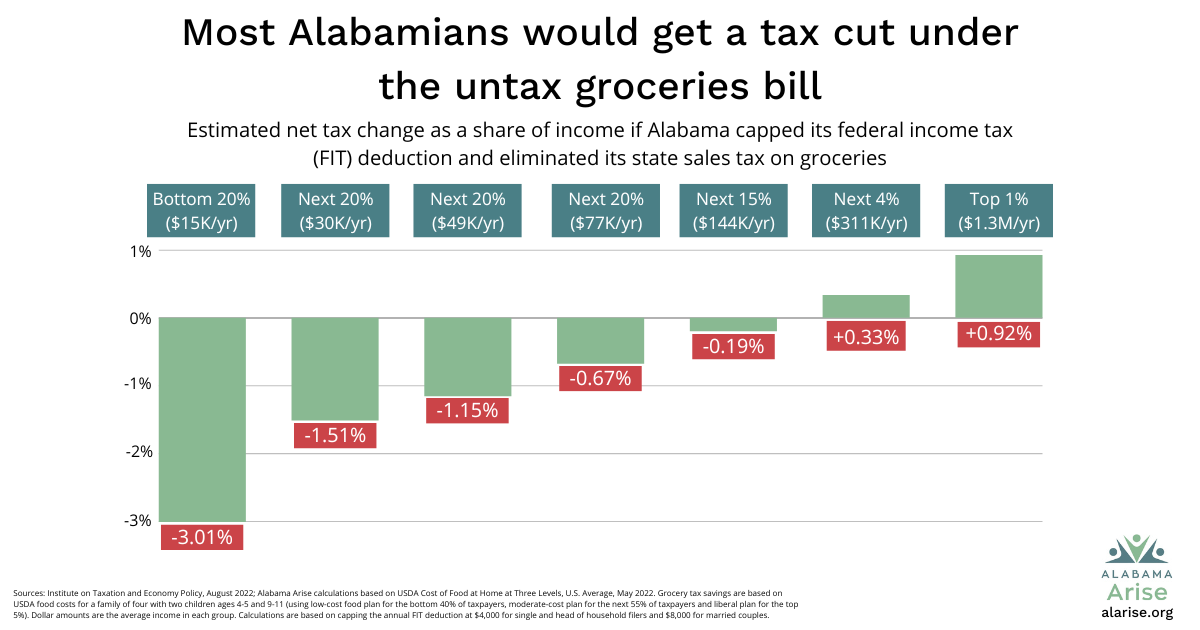
Alabama Arise supports legislation that would end the state sales tax on groceries and over-the-counter (OTC) drugs and protect school funding. By capping the state income tax deduction for federal income taxes, the plan would bring in $520 million a year, the Legislative Services Agency (LSA) estimates. That would replace the revenue from ending the sales tax on groceries and OTC drugs, which the LSA estimates at $513 million a year. The graph below shows how millions of Alabamians would benefit from untaxing groceries.

Untaxing groceries is the right path for Alabama

Alabama’s sales tax on groceries is a cruel tax on survival, particularly in times of economic insecurity. It increases hunger rates and drives struggling Alabamians deeper into poverty. Here’s why legislators need to end the state sales tax on groceries – and how they can do it:

  • Alabama is one of only three states with no tax break on groceries.
  • The state grocery tax is 4%, equal to two weeks’ worth of groceries each year.
  • Alabama can and should untax groceries quickly and responsibly. That means replacing revenue for public schools in a way that doesn’t harm struggling families.
  • Alabama can protect education funding by limiting or ending its state income tax deduction for federal income taxes (FIT). The FIT deduction is a skewed tax loophole that overwhelmingly benefits rich households.

A revenue-neutral plan to improve Alabamians’ lives

Arise supports legislation to end the state sales tax on groceries and over-the-counter medicines at an annual cost of $513 million, according to the LSA. (Local sales taxes on groceries and OTC medicines would not be affected.) To replace that revenue, the plan would cap the state FIT deduction for individuals. That change would generate $520 million a year, the LSA estimates.

The cap for Alabamians who file as single, head of household or married filing separately would be $3,500 annually. For married couples filing jointly, the FIT deduction limit would be $7,000 a year. The plan would require voter approval of a constitutional amendment.

Both sales tax revenue and individual income tax revenue go to the Education Trust Fund. By capping the FIT deduction, Arise’s plan would allow Alabama to untax groceries without cutting school funding. This plan would be a significant tax cut for nearly all Alabamians, and the largest benefit would go to people with low incomes who need it most.

Bottom line

Untaxing groceries quickly and responsibly would boost economic and food security for all Alabamians. By ending the state sales tax on groceries and over-the-counter medicines and capping the FIT loophole, lawmakers could protect funding for public schools and make life better for families across our state.

Inflation Reduction Act will make Alabama a healthier state

Alabama Arise executive director Robyn Hyden released the following statement Monday in response to the U.S. Senate’s passage of the Inflation Reduction Act on Sunday:

“The Inflation Reduction Act will help build a healthier future for people across Alabama. This plan will make health coverage more affordable for hundreds of thousands of Alabamians and millions of Americans. It will improve air quality by investing in clean energy and reducing emissions that fuel climate change. And it will pay for these investments by closing tax loopholes that subsidize profitable corporations and wealthy households.

“This plan will save money for patients and the federal government by allowing Medicare to negotiate certain prescription drug prices. It will cap the cost of insulin and other out-of-pocket drug expenses for Medicare enrollees. And it will extend enhanced subsidies that make health coverage more affordable for many of the 219,000 Alabamians with marketplace plans through the Affordable Care Act.

“We’re happy that the U.S. Senate passed this important legislation. And we look forward to the House approving it and sending it to President Joe Biden to sign into law.

“We also will continue advocating for state lawmakers to make other needed investments in families and communities. We’ll keep working for additional funding to make child care, housing and public transportation more affordable and available across Alabama. And we’ll continue pushing for Medicaid expansion to help more than 340,000 Alabamians who are uninsured or struggling to afford health insurance.

“These policy choices are essential to improve Alabamians’ quality of life and to boost our state’s economic prosperity. We’re determined to see each and every one of them across the finish line.”