The Alabama Tax and Budget Handbook – Income Tax

Feeling the pinch

Alabama’s nearly flat income tax can’t offset our regressive sales taxes. As a result, the lowest-paid 20% of Alabama residents pay more than twice the share of their incomes in state and local taxes that the top 1% pay. It’s an upside-down tax system: It reduces the consumer spending that fuels economic growth and makes it harder for Alabamians with low and middle incomes to get ahead.
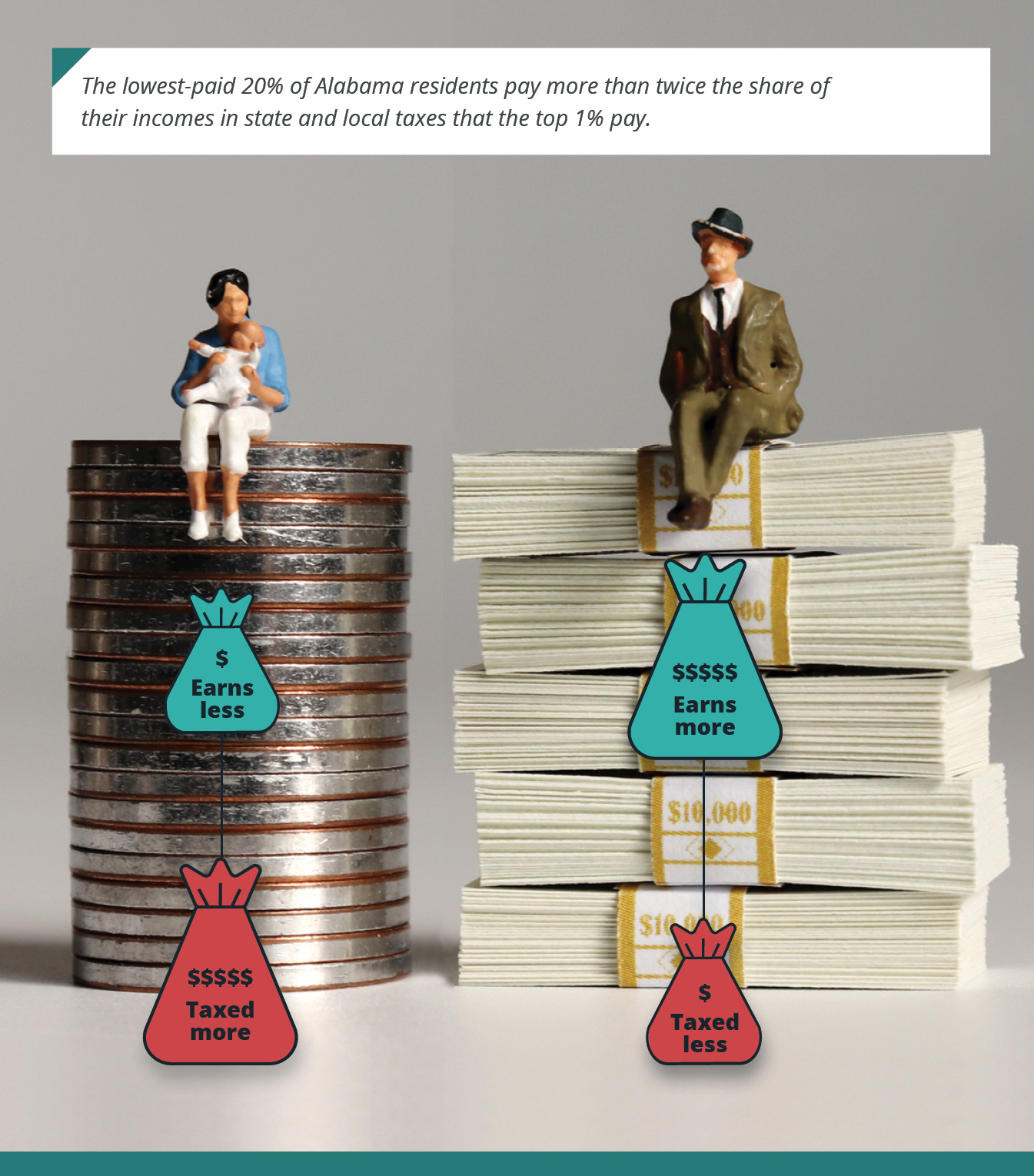
Photo illustration of a mother and child atop a tall stack of coins and a businessman in a suit sitting atop a stack of $100 bills. Below the mother and child are money bag graphics reading "Earns less, taxed more." Below the businessman are money bag graphics reading "Earns more, taxed less." Caption: The lowest-paid 20% of Alabama residents pay more than twice the share of their incomes in state and local taxes that the top 1% pay.

How does Alabama’s income tax work?

A 1933 amendment to the Alabama Constitution authorized the state to create a tax on personal income and set a limit of 5% for the tax rate. The Legislature enacted that tax in 1935, establishing three income tax rates for individuals that are still in place today:

  • Yearly taxable income of up to $500 is taxed at 2%.
  • Income from $501 to $3,000 is taxed at 4%.
  • Income of $3,001 and above is taxed at the top rate, 5%.

Most states define their income tax by statute, meaning their legislatures can change it. But major parts of Alabama’s income tax are written into our constitution, which is much harder to change.

Ideally, an income tax should be the most progressive tax, because it’s the easiest one to structure to help offset regressive taxes. When it began in 1935, Alabama’s graduated system of income tax rates was very progressive. That year, when the state began taxing incomes of $3,600 or more for a family of four, teachers earned around $500. Only about 7,000 people (less than a quarter of 1% of the population then) earned enough to be taxed. But since then, the system hasn’t kept pace with inflation.

Like most states, Alabama uses exemptions and deductions to exclude everyone’s most basic costs of living from taxation. This is especially important to low-income taxpayers, for whom this small amount is a large share of income. But our exemptions and deductions are lower than in many other states.

The 1935 law set personal exemptions of $1,500 for single adults and $3,000 for married couples. It also set a dependent deduction that lawmakers increased in 2006 and again in 2022. The standard deduction, for taxpayers who don’t claim itemized deductions, was added in 1951 and has increased three times, most recently in 2022 when the standard deduction increased to $3,000 for single adults and $8,500 for couples. Taxpayers can itemize if their deductions exceed the standard deduction. (See the chart on below for Alabama’s deductions by income level.)
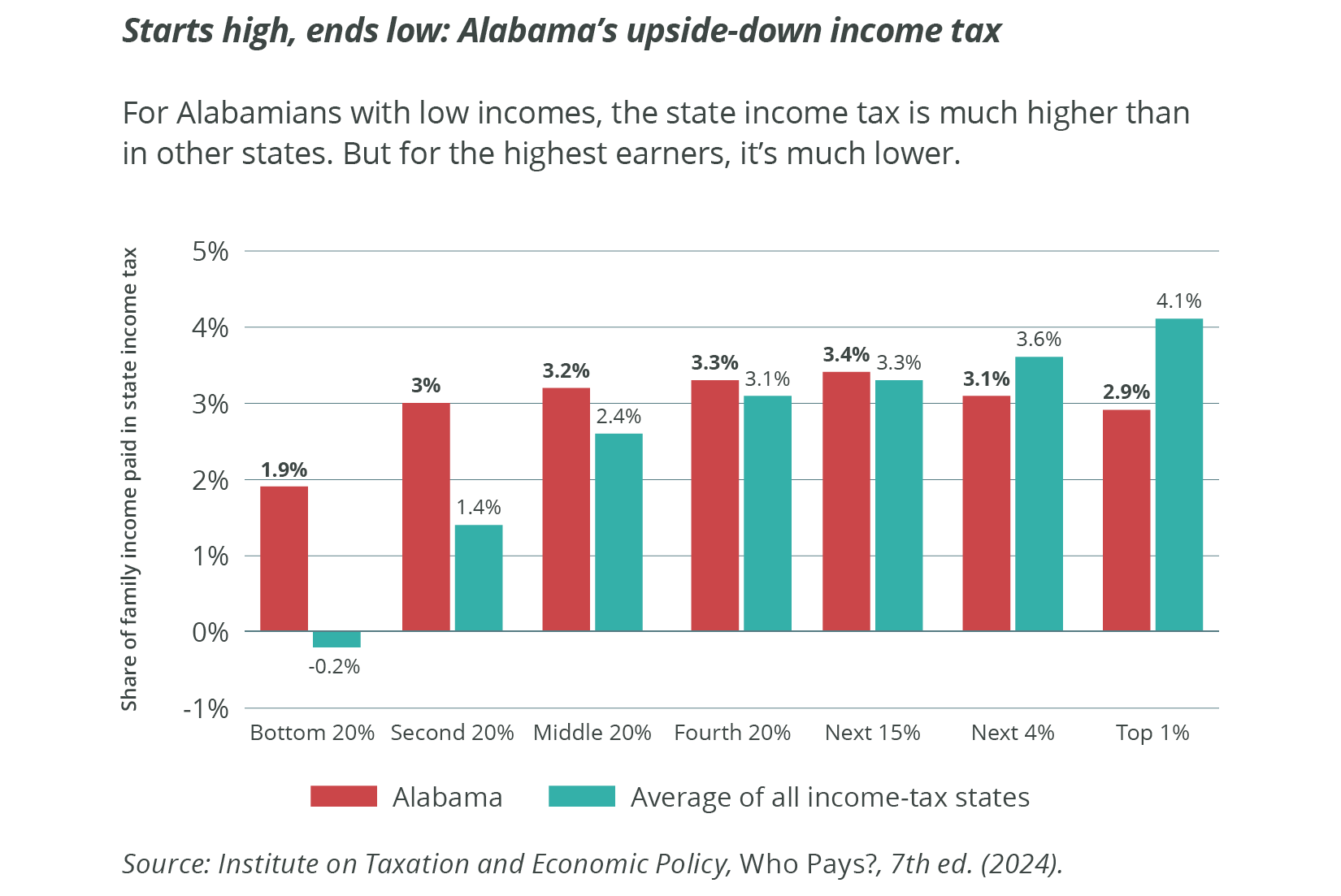
Bar graph showing that for Alabamians with low incomes, the state income tax is much higher than in other states. But for the highest earners, it's much lower. For the Bottom 20%, the tax is 1.9% in Alabama and -0.2% for the average of all income-tax states. For the Second 20%, the tax is 3% in Alabama and 1.4% for the average. For the Middle 20%, the tax is 3.2% in Alabama and 2.4% for the average. For the Fourth 20%, the tax is 3.3% in Alabama and 3.1% for the average. For the Next 15%, the tax is 3.4% in Alabama and 3.3% for the average. For the Next 4%, the tax is 3.1% in Alabama and 3.6% for the average. For the Top 1%, the tax is 2.9% in Alabama and 4.1% for the average. Source: Institute on Taxation and Economic Policy, Who Pays?, 7th ed. (2024).

Better, but we still have work to do

In 2022, Alabama increased its income tax threshold – the income where one begins to pay income tax – from $12,500 to $13,500 for a family of four by expanding deductions. Even so, Alabama still taxes families with low incomes deeper into poverty.
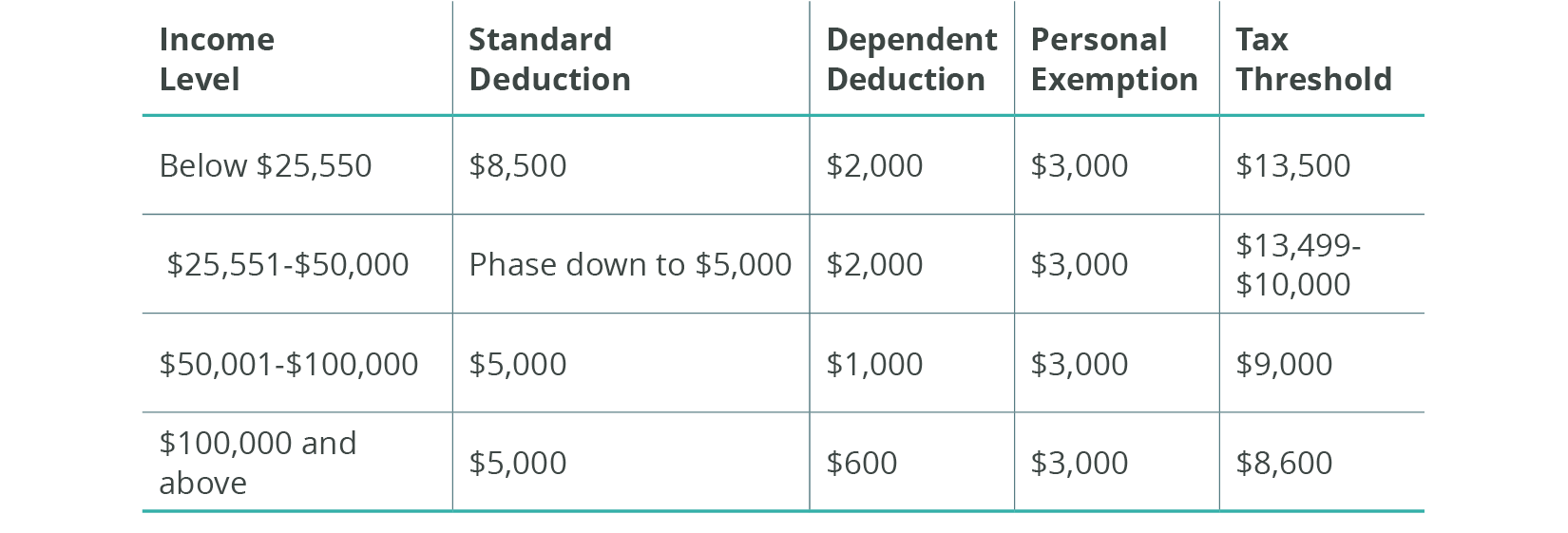
Data table outlining the standard deduction, dependent deduction, personal exemption, and tax threshold by income level.

Below $25,550: Standard Deduction is $8,500, Dependent Deduction is $2,000, Personal Exemption is $3,000, and Tax Threshold is $13,500.

$25,551–$50,000: Standard Deduction phases down to $5,000, Dependent Deduction is $2,000, Personal Exemption is $3,000, and Tax Threshold is $13,499–$10,000.

$50,001–$100,000: Standard Deduction is $5,000, Dependent Deduction is $1,000, Personal Exemption is $3,000, and Tax Threshold is $9,000.

$100,000 and above: Standard Deduction is $5,000, Dependent Deduction is $600, Personal Exemption is $3,000, and Tax Threshold is $8,600.

Racial inequity at a glance

While Alabama’s income tax system appears essentially flat, Alabama doesn’t tax many sources of income received by wealthier (and disproportionately white) taxpayers. Many of these tax breaks are available to older adults no matter what their income or wealth.

Because of these tax breaks, many seniors with higher incomes pay less in income taxes than do younger, working families. The targeting of these special tax breaks also increases racial disparities because of demographics and historic inequities in wealth accumulation. As a result, white retirees have around seven times as much untaxed retirement wealth as do Black retirees.

Nearly all defined-benefit retirement income is exempt from Alabama income tax. This includes state retirement benefits for teachers and state employees, U.S. civil service retirement, judicial retirement, military retirement, federal government retirement, Social Security and some private retirement benefits. Alabama does not count inheritance as income and only counts the increased value of stocks and bonds when they are sold. These exemptions, along with the deduction for federal income taxes, allow many wealthy people in Alabama to pay much lower state income taxes than wage earners do. Because white people are much more likely to receive defined-benefit retirement benefits, own stocks and bonds, inherit wealth and pay higher federal income taxes, they are more likely to benefit from Alabama’s income tax structure than are Black people or people with lower incomes.
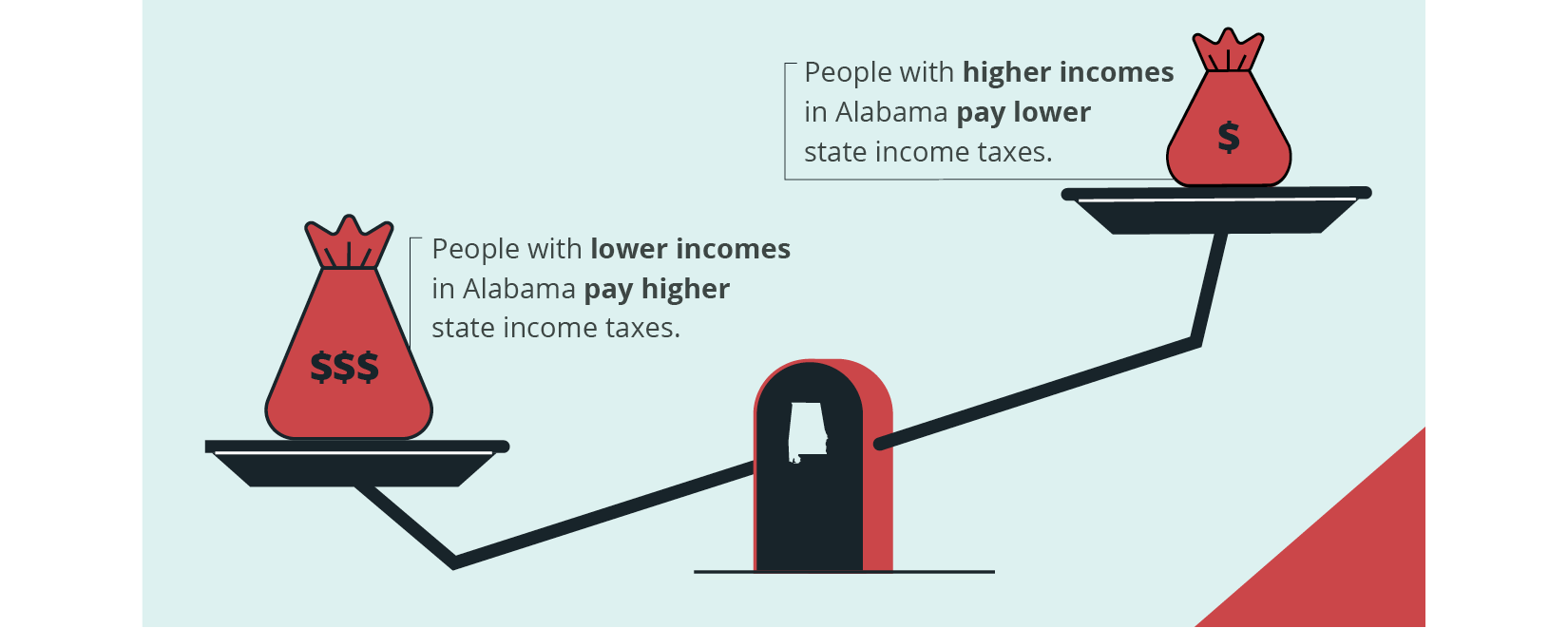
An illustration of a balance scale with an outline of the state of Alabama at the center. On the lower side, a large red money bag marked with three dollar signs represents "People with lower incomes in Alabama pay higher state income taxes." On the higher side, a smaller red money bag marked with one dollar sign represents "People with higher incomes in Alabama pay lower state income taxes."

How does Alabama’s income tax measure up?

Most states have made sure that people below the federal poverty line don’t have to pay income taxes. Alabama begins taxing a two-parent family of four at an income of $13,500. It’s an improvement from the pre-2006 level (just $4,500), but it’s still less than half of poverty-line wages (about $31,800 in 2024). Alabama’s income tax threshold is one of the nation’s lowest.

By contrast, Mississippi doesn’t start taxing such a family until they make $19,600 per year, and Georgia doesn’t start until they make $32,000.

In Alabama, families with low and high incomes pay income taxes at the same rate: 5% on taxable income above $3,000. Most Alabama taxpayers pay at the top rate. In 2023, most of Alabama’s taxpayers paid around 3% of their income in state income taxes. Even the Alabama families with the lowest incomes pay 1.9% of their income. Nationally, many families with the lowest incomes pay less than 0% in state income taxes (depending on the availability of refundable tax credits), while the top 1% pay 4.1%. But in Alabama, the top 1% pay an average of 2.9% of their income in state income taxes, barely more than the 1.9% paid by taxpayers with the lowest incomes.

Anatomy of a tax threshold

The tax threshold – the income where one begins to pay income tax – is a sum of tax deductions and exemptions. Here’s how it worked when applied to 2022 Alabama and federal taxes for a two-parent household of four.

(In 2017, Congress ended the federal personal exemption, significantly increased the standard deduction and replaced the dependent deduction with an increased Child Tax Credit.)
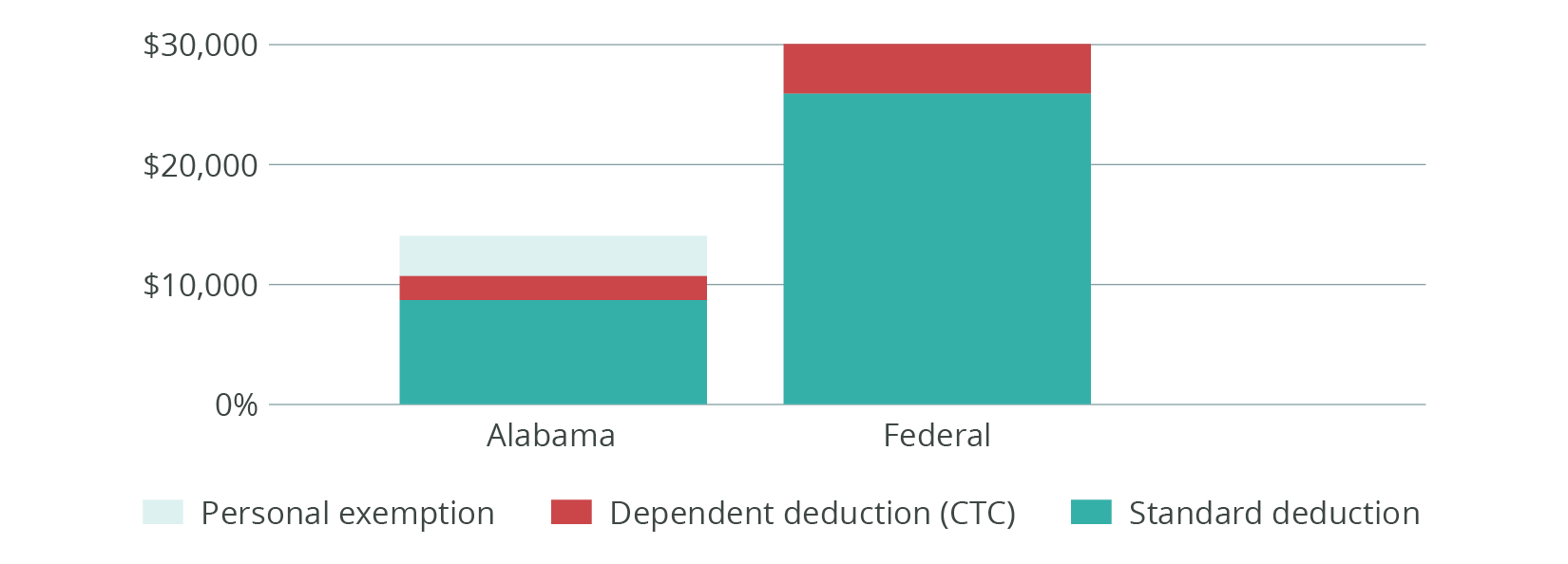
Stacked bar graph comparing Alabama and Federal tax deductions and exemptions in dollars. For Alabama, the total is approximately $14,000, consisting of a standard deduction of $8,500, a dependent deduction of $2,000, and a personal exemption of $3,000. For the Federal level, the total is $30,000, consisting of a standard deduction of $25,900 and a dependent deduction (CTC) of $4,100, with no personal exemption shown. The y-axis ranges from $0 to $30,000.

Few other states impose an income tax nearly as high as Alabama does on a two-parent family of four at the poverty line. Alabama’s income tax on such a family in 2024 was $838. That family pays no federal income tax, and in most states would pay no state income tax at all.

Alabama’s income tax system is unfair for three reasons:

First are our out-of-date deductions. Despite an increase in 2022, our standard and dependent deductions are still below those in many other states. Alabama’s standard deduction for individuals ($3,000) is less than a quarter of the federal one; the maximum for couples ($8,500) is less than half. Alabama’s standard deduction is not tied to inflation, which means its value will continue to decline over time.

Second is a big tax break we give the highest earners. Alabama is the only state that allows taxpayers to deduct all of their federal income taxes before calculating their state taxes. A 1965 constitutional amendment entrenched this federal income tax (FIT) deduction. The FIT deduction gives higher-income earners a special break, because they can deduct more from their Alabama taxes than those who earn a lower income and pay less federal tax. Alabama forgoes about $1.26 billion of its potential income tax revenue because of this lopsided deduction, and 86% of the tax break’s value goes to the highest-paid 20% of taxpayers.

Third, Alabama also allows Social Security contributions to be deducted. In theory, this should help people with low incomes, who pay a higher share of their income toward Social Security. The catch is that the deduction is available only to those who itemize deductions, which excludes most people with low or middle incomes.

Unlike the federal government and many states, Alabama doesn’t give targeted tax breaks to people with less income. This is in contrast to the 31 states and the District of Columbia that have followed the federal example and created state-level Earned Income Tax Credits (EITCs), which allow many taxpayers with low incomes to receive a credit against taxes owed or a tax refund if they do not owe taxes. Alabama has not created an EITC, a failure that makes it harder for families with low incomes to get ahead and makes our income tax more unfair.

How could we improve our income tax?

Because much of Alabama’s income tax structure is spelled out in the constitution, changing it would require changing the constitution. If Alabama’s income tax more closely followed the system of exemptions and deductions used at the federal level and in many other states, working families would have more money available to spend. That would boost the economy and improve their quality of life. The following proposals would help modernize our income tax and make it fairer:

  • Make income taxes less regressive and more progressive. Ensure people who make more money pay a larger share of their income in taxes than those who make less. Alabama’s state income tax rates top out at low income levels, making our income tax practically a flat tax. Transitioning to a more progressive system that requires households with higher incomes to pay a more equitable share of tax revenues would expand economic opportunity for families with lower and middle incomes. And it would make funding for vital public services more equitable and sustainable.
  • Reform out-of-date deductions. Update Alabama’s standard and dependent deductions to align with modern economic realities and periodically adjust them for inflation to prevent their gradual erosion over time. This should include increasing the personal exemption and standard and dependent deductions. The state also should conduct a comparative analysis with deductions in other states to determine appropriate adjustments or link these dollar amounts to federal levels. These changes would allow Alabama’s deductions and exemptions to keep pace with increases in the cost of living.
  • Eliminate the federal income tax (FIT) deduction. Repeal the provision that allows taxpayers to deduct federal income tax payments before calculating their state taxes. This lopsided deduction disproportionately benefits higher-income earners and results in a significant loss of revenue that could support public schools.
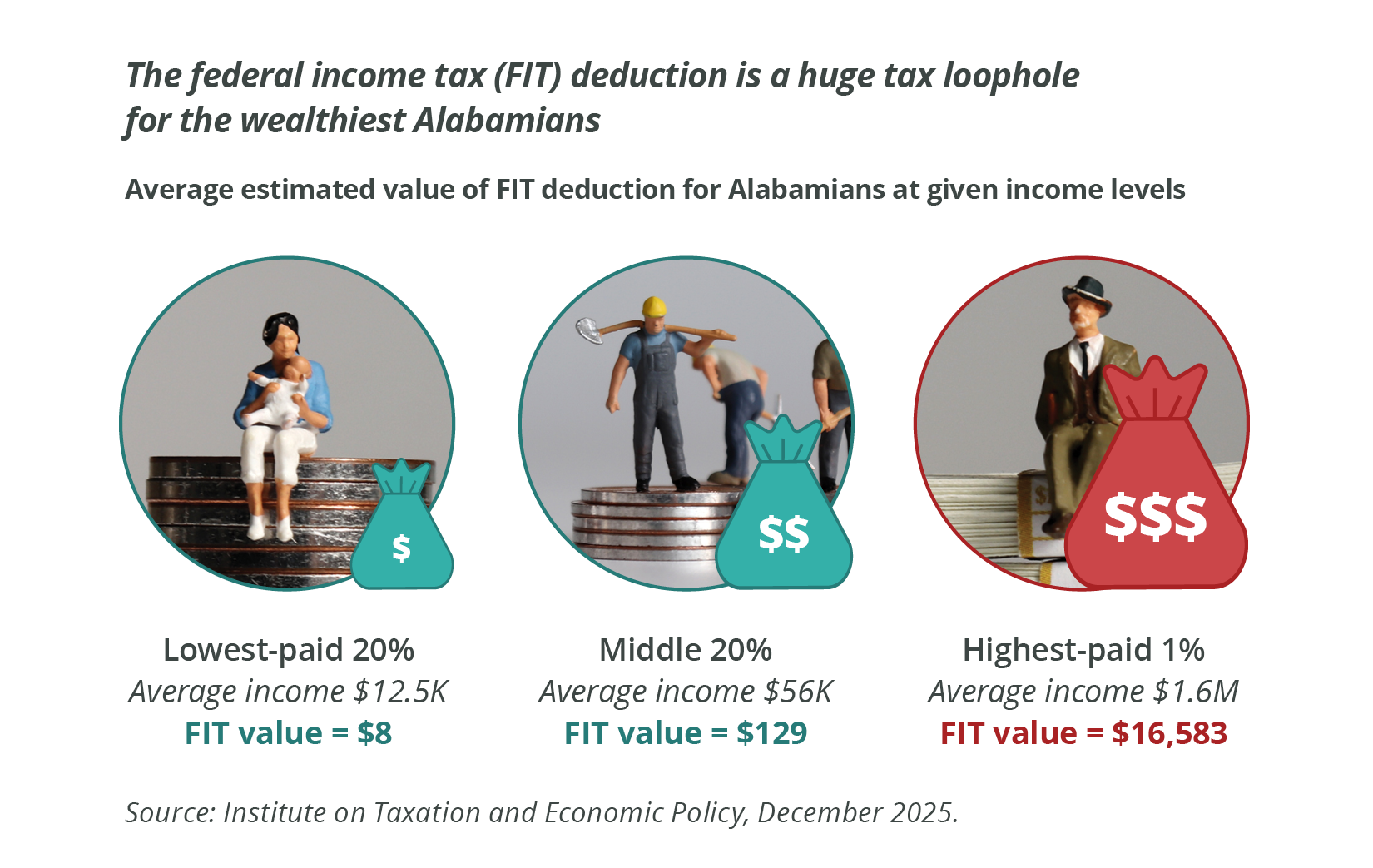
Graphic titled "The federal income tax (FIT) deduction is a huge tax loophole for the wealthiest Alabamians," showing the average estimated value of the FIT deduction for Alabamians at three income levels. The data is presented using miniature figures sitting on stacks of currency. Lowest-paid 20%: Average income of $12.5K with a FIT value of $8. Middle 20%: Average income of $56K with a FIT value of $129. Highest-paid 1%: Average income of $1.6M with a FIT value of $16,583.
Source: Institute on Taxation and Economic Policy, December 2025.

  • Review Social Security contribution deductions. Examine the eligibility criteria for deducting Social Security contributions. Expand access to this deduction beyond itemizers to ensure it benefits a broader range of people with low and middle incomes. These changes would help ensure the deduction benefits those who need it most.
  • Establish a state Earned Income Tax Credit (EITC). Introduce a state-level EITC program similar to the federal EITC and equal to at least 10% of the federal EITC amount. This credit would help low-paid working families make ends meet and help offset the regressive effects of Alabama’s high sales tax. This initiative also would provide a targeted reduction to lower-income taxpayers by allowing them to receive a credit against taxes owed or as a tax refund. Alabama can and should model this program after successful EITC programs in other Southern states like Louisiana, Oklahoma and Virginia.
  • Gradually increase standard deductions. Phase in a plan that gradually increases standard deductions for individuals and couples. This would help rebalance Alabama’s upside-down tax system to be more equitable toward people with lower and moderate incomes. Policymakers also should enact higher-rate tax brackets for millionaires.
The Alabama Tax and Budget Handbook

The Alabama Tax and Budget Handbook – Sales Taxes

Sales taxes: The key driver of Alabama’s upside-down tax system

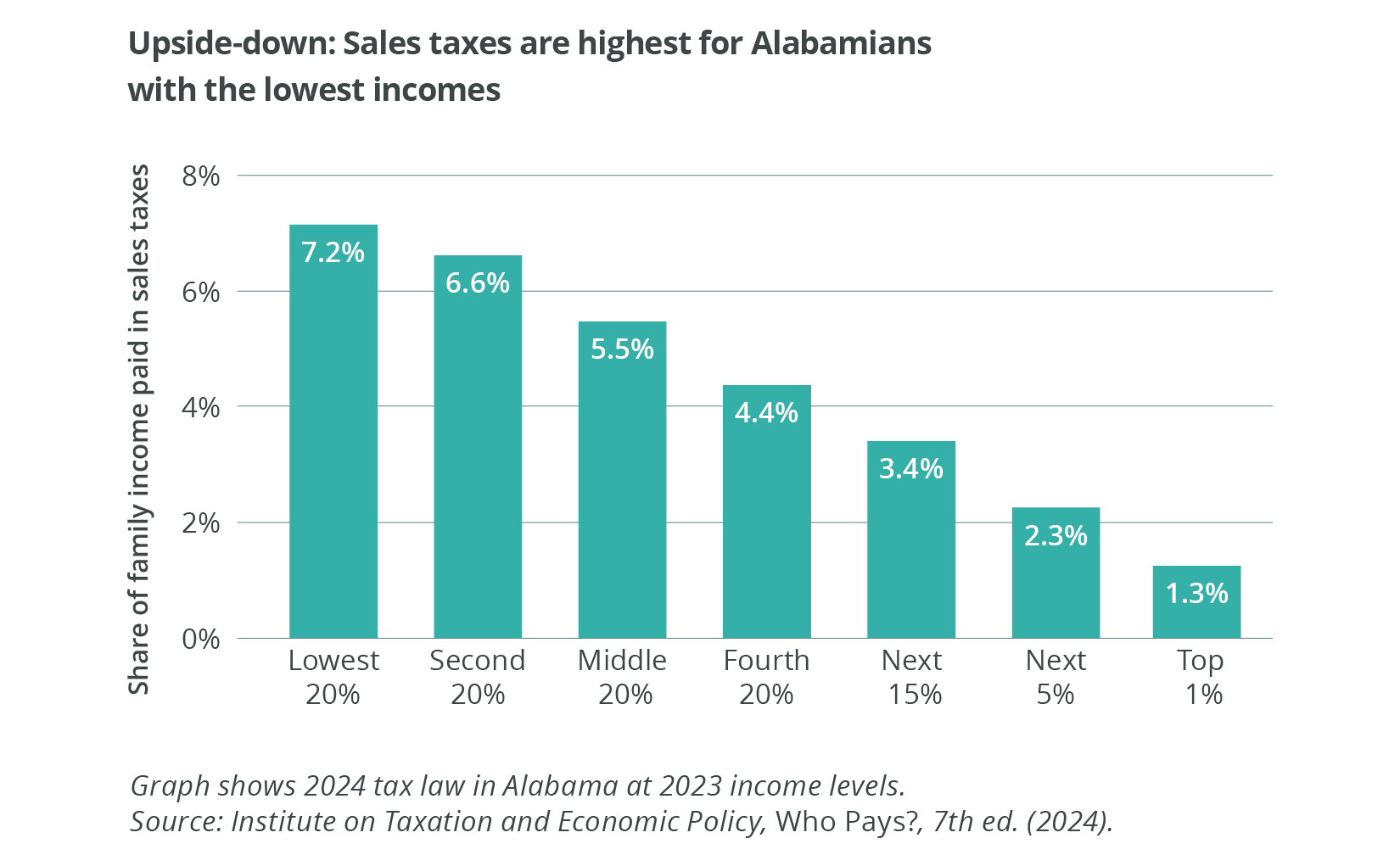
Should wealthy people pay at a lower tax rate than everyone else? Most Alabamians would answer with a resounding “no.” Yet that’s exactly the result that our state’s tax system produces. Families with low incomes in Alabama pay more than twice the share of income in state and local taxes that the top 1% do.

By far the biggest cause is our state’s overreliance on sales taxes. They apply to a wide range of consumer goods, including necessities like food and clothing. And the tax on a $20 item is the same whether you make $20,000 or $20 million. (See below for more on Alabama’s grocery tax.) As a result, the sales tax takes the biggest bite out of the budgets of families with low incomes, who must spend most of what they make on items subject to sales tax just to get by.

Bar graph of the share of family income paid in sales taxes. Title: Upside down: Sales taxes are highest for Alabamians with the lowest incomes. The lowest 20% pays 7.2%. The second 20% pays 6.6%. The middle 20% pays 5.5%. The fourth 20% pays 4.4%. The next 15% pays 3.4%. The next 4% pays 2.3%. The top 1% pays 1.3%. Graph shows 2024 tax law in Alabama at 2023 income levels. Source: Institute on Taxation and Economic Policy, Who Pays?, 7th edition (2024).

Families with low incomes in Alabama pay more than twice the share of income in state and local taxes that the top 1% do.

How do Alabama’s sales taxes work?

The Legislature established the current state sales tax in 1939 at 2% on retail sales of tangible personal property like clothing, appliances, toys, food and over-the-counter drugs. The sales tax is defined by statute rather than the constitution. That means the Legislature can increase or decrease it without a vote of the people. Twenty years after introducing the tax, lawmakers increased it to 3% and expanded it to include entertainment. In 1963, legislators raised the sales tax to 4%. Lawmakers voted unanimously in 2023 to reduce the state sales tax on groceries to 3%. In 2025, lawmakers approved a second state grocery tax reduction, to 2%.

The state also levies some special sales taxes (in the form of excise taxes, privilege taxes and use taxes) on certain products, including gasoline. Special sales taxes on products that some people consider to be vices, such as tobacco and alcohol, often are called “sin taxes.” Over the years, the Legislature has found it easier to justify increasing this kind of tax than the general sales tax. By contrast, Alabama always has taxed cars at a lower rate (2%).

In 2015, Alabama adopted the simplified sellers use tax (SSUT) to collect sales tax on items purchased over the internet. Online sellers (such as Amazon and eBay) voluntarily collect the SSUT of 8%. Unlike the state sales tax on items purchased in a brick-and-mortar store, the SSUT is divided by formula between the state, counties and municipalities. As of early 2023, state and local governments had received $365 million in SSUT revenues.

Most Alabamians also pay municipal (or city) and county sales taxes to support services ranging from schools to parks to police. Local governments set the rate for these taxes but must follow state law in specifying what to tax. Combined municipal, county and state sales taxes range from 7% in the Kansas community (in Walker County) to 11.5% in Tuskegee and Shorter (in Macon County). The Legislature has granted municipal governments the authority to increase sales taxes without a vote or even a hearing. (Counties can act on their own to increase sales taxes used for schools, but not for other purposes.) In 2025, the Alabama Legislature also gave counties and municipalities the authority to decrease their local sales tax on groceries.

In theory, the sales tax applies to all retail transactions – that is, purchases by the final consumer. In Alabama, this means purchases of goods and entertainment, but not other services that account for an increasing share of consumer spending. Like almost all states, Alabama exempts some “essentials” like rent and prescription drugs. In 2023, the Legislature reduced the state sales tax on food to 3%, followed by another reduction to 2% in 2025. But Alabama still applies the full sales tax to many other essentials like shoes, clothing and over-the-counter medicines.

Racial inequity at a glance

The Alabama Constitution limits the ability of cities and counties to raise revenue needed to provide basic services for their residents. Services like fire protection, roads and streets, libraries, schools, parks, public safety and infrastructure like water and sewage service all require local funding. But Alabama has limited localities’ ability to make even the most basic decisions for themselves, including decisions on how to raise the revenue they need. While counties have some limited self-governance, local governments still cannot raise most taxes without permission from the Legislature. However, cities can set their own local sales tax rates without having to ask legislative permission, and counties can adjust local sales taxes for schools. These limitations force many cities and counties to rely on this regressive tax to provide basic services.

Like many other provisions of Alabama’s constitution, the denial of home rule to cities and counties has a racialized history. The Constitution of 1875, passed immediately after Reconstruction, placed most of the power in the state in the hands of the Planters and Big Mules who ran the state government. These restrictions remained in both the 1901 constitution and the 2022 recompilation. This restricted the ability of Black-majority communities to make decisions for themselves. In recent years, the “preemption” of local authority has denied Birmingham the right to increase its minimum wage, restricted the ability of localities to remove Confederate monuments and denied Montgomery the ability to apply an occupational tax on people who work in the city but live in predominantly white suburbs.

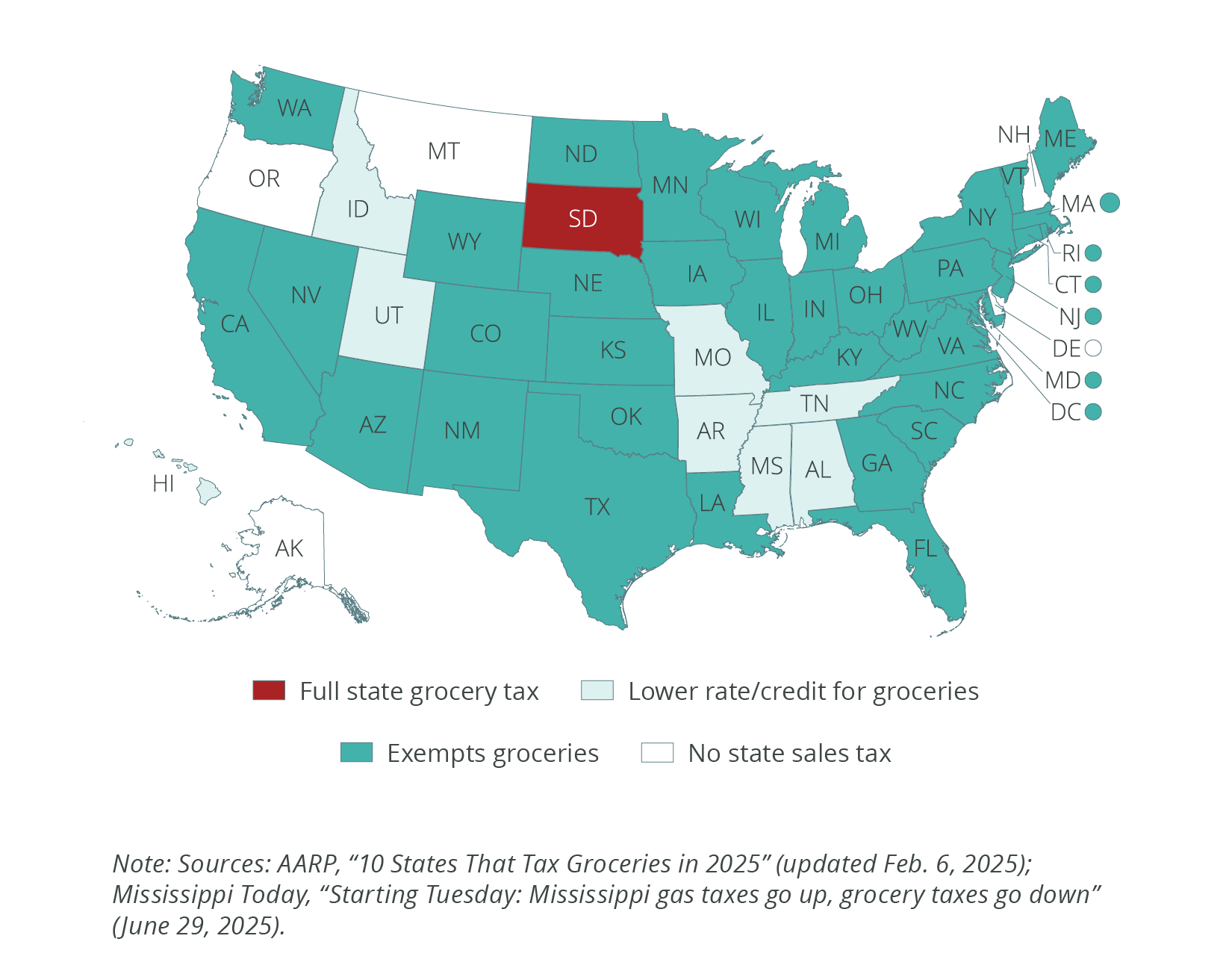
Taxing survival: Alabama is 1 of 9 states still taxing groceries

It’s an exclusive list, but Alabama shouldn’t be proud to be on it. Alabama is one of only nine states still collecting a state sales tax on groceries. Of the 45 states with a general sales tax, 36 exempt groceries entirely, and eight others (including Alabama as of 2023) either charge a reduced tax rate or offer a tax credit to help families with low incomes offset grocery tax payments.

By taxing groceries, Alabama adds to the cost of a basic necessity of life. That hurts the economy by leaving shoppers with less money to buy meat, vegetables and other products. It hurts working families by making it harder for them to get ahead. And it hurts Alabama by fueling an upside-down tax system that requires people with low and middle incomes to shoulder too much of the cost of education, health care and other public services that benefit all of us.

Map of states that still tax groceries. Full state grocery tax: South Dakota. Lower rate or credit for groceries: Alabama, Arkansas, Hawaii, Idaho, Mississippi, Missouri, Tennessee and Utah. No state sales tax: Alaska, Delaware, Montana, New Hampshire and Oregon. All other states exempt groceries from their sales tax. Sources: AARP and Mississippi Today.

How do Alabama’s sales taxes measure up?

We pay sales taxes in small bits throughout the year, unlike once-a-year property and income tax payments. This fact can mask the sales tax’s severe impact on Alabamians who are working hard to make ends meet. In fact, the sales tax is the most regressive of the three major taxes (income, property and sales), because it consumes a much greater portion of the household budget for families with low and middle incomes than for wealthy people.

Alabama’s state sales tax rate (4%) is lower than that of most states. However, when you add in local sales taxes, the combined sales tax rate (averaging 9%) is among the nation’s highest. Sales and excise taxes in Alabama provided 45% of all state and local revenue in 2023, the 12th highest share nationwide, according to the Institute on Taxation and Economic Policy.

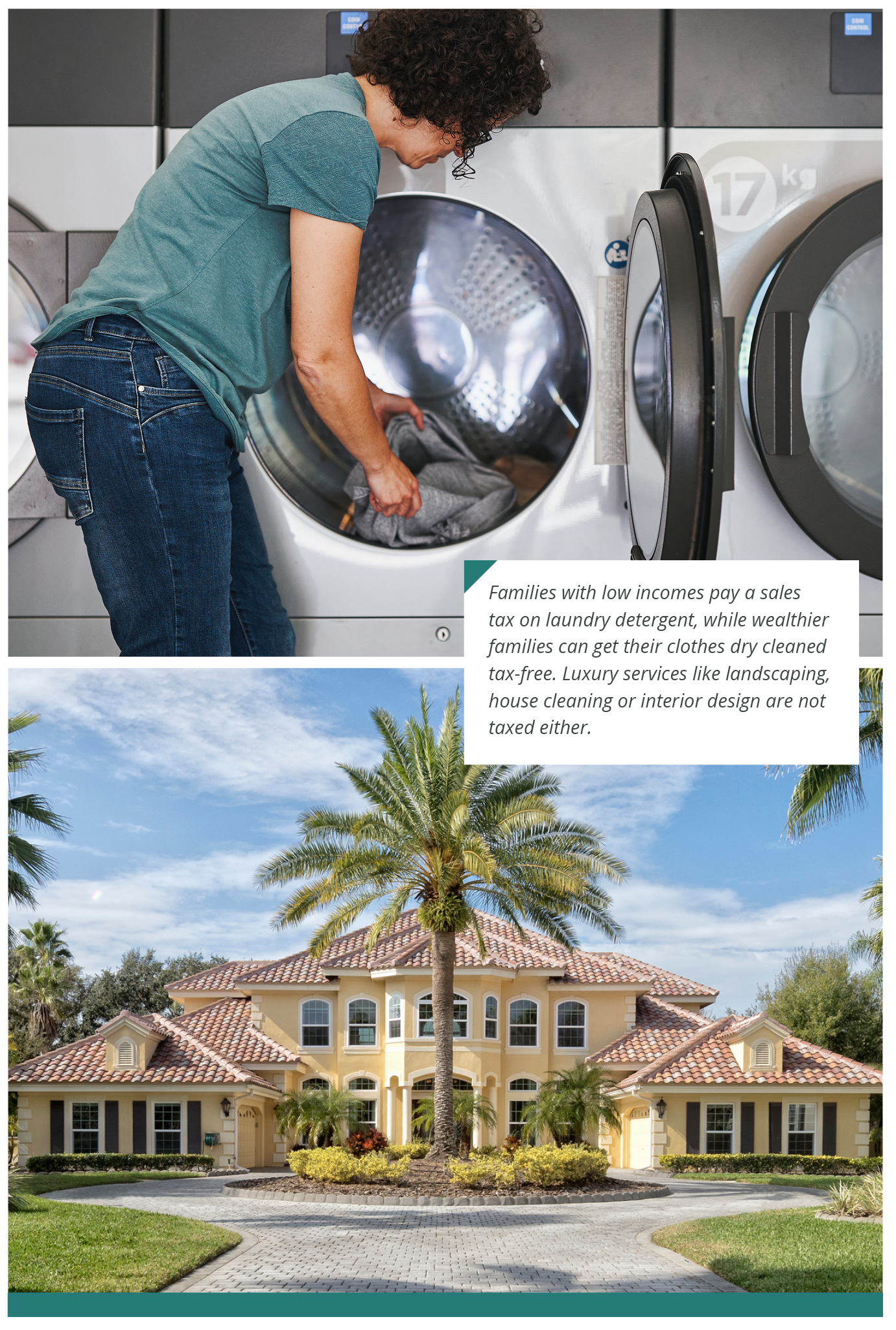
Our sales tax continues to apply almost entirely to goods and entertainment, even as spending patterns shift more toward services. Families with low incomes pay a sales tax on laundry detergent, while wealthier families can get their clothes dry-cleaned tax-free. Luxury services like landscaping, house cleaning or interior design are not taxed either.

Alabama is one of a shrinking minority of states still taxing groceries. While the state grocery tax reductions that went into effect in 2023 and 2025 were a vital step forward on tax justice, Alabama is still one of only nine states with any state tax on groceries. Shoppers who buy $100 worth of food in Pensacola pay $100. But in Montgomery, that same food costs $108.

Alabama is still one of only nine states with any state tax on groceries. Shoppers who buy $100 worth of food in Pensacola pay $100. But in Montgomery, that same food costs $108.

Fortunately, sales taxes don’t apply to food bought with food assistance under the Supplemental Nutrition Assistance Program (SNAP), formerly known as food stamps. But SNAP benefits cover only a portion of grocery purchases for most families who receive them. Families with low incomes must pay for the rest of their food out of pocket. Alabama continues to tax those groceries, albeit at a reduced rate.

A collage of two photos. Top: A woman uses a washing machine at a laundromat. Bottom: A large mansion with a circular driveway and a palm tree in front of it. Caption: Families with low incomes pay a sales tax on laundry detergent, while wealthier families can get their clothes dry cleaned tax-free. Luxury services like landscaping, house cleaning or interior design are not taxed either.

How could we improve our sales taxes?

As the most regressive of the major taxes, the sales tax works best when balanced by a progressive income tax. That’s a problem in Alabama, because our nearly flat income tax does not come close to offsetting the regressive sales tax. The best way to reduce the sales tax’s impact on families with low and middle incomes would be to collect a larger share of the funding for public services from the income tax and local property taxes.

Alabama can modernize its sales tax system to make the tax less regressive and better reflect current spending patterns. Policy changes that would advance these goals include:

  • Modernize sales taxes on goods and services. Reduce or eliminate sales taxes on essential goods to avoid taxing people with low incomes into poverty. Policymakers should find a way to eliminate the sales tax on groceries while ensuring adequate funding for public education. Alabama also can generate additional revenue by broadening its tax base to include services primarily purchased by households (not businesses) and “digital goods” like video and music streaming services.
  • Expand the sales tax base to include more services. Broaden the sales tax base to include a wider range of personal and professional services, which would help the state preserve revenue lost by decreasing the tax on food and other necessities. The state should identify and assess services that can be included in the tax base without disproportionately increasing sales taxes on individuals with low incomes.
  • Adopt a progressive approach to taxing services. Implement a progressive approach to taxing services, considering the ability to pay and potential impact on households with low incomes. Graduated tax rates on luxury services used by the wealthiest households could help maintain fairness and reduce the sales tax’s regressive nature.

The best way to reduce the sales tax’s impact on families with low and middle incomes would be to collect a larger share of the funding for public services from the income tax and local property taxes.

A smiling family of a mother, father and two daughters hug each other while posing for a photo. Caption: Providing tax exemptions for services like health care, education and basic utilities could help ease potential negative impacts on Alabamians with low incomes.

  • Target exemptions for essential services. While expanding the tax base, provide exemptions for essential services that directly impact families’ well-being. Exempting services like health care, education and basic utilities could help ease potential negative impacts on Alabamians with low incomes. Lawmakers also could offset existing sales taxes or future sales tax increases with refundable income tax credits that gradually phase out as income increases.
  • Regularly review and adjust sales tax rates. Establish a mechanism for regular review and adjustment of the sales tax system to accommodate changing consumption patterns and economic trends. This flexibility would help ensure Alabama’s tax system remains effective and responsive over time.
  • Conduct a cross-state comparison. Analyze sales tax structures in other states that already have expanded their tax base to include services. Policymakers can learn from those states’ experiences and tailor policy recommendations to suit Alabama’s economic and social environments.

The Alabama Tax and Budget Handbook

The Alabama Tax and Budget Handbook – Property Taxes

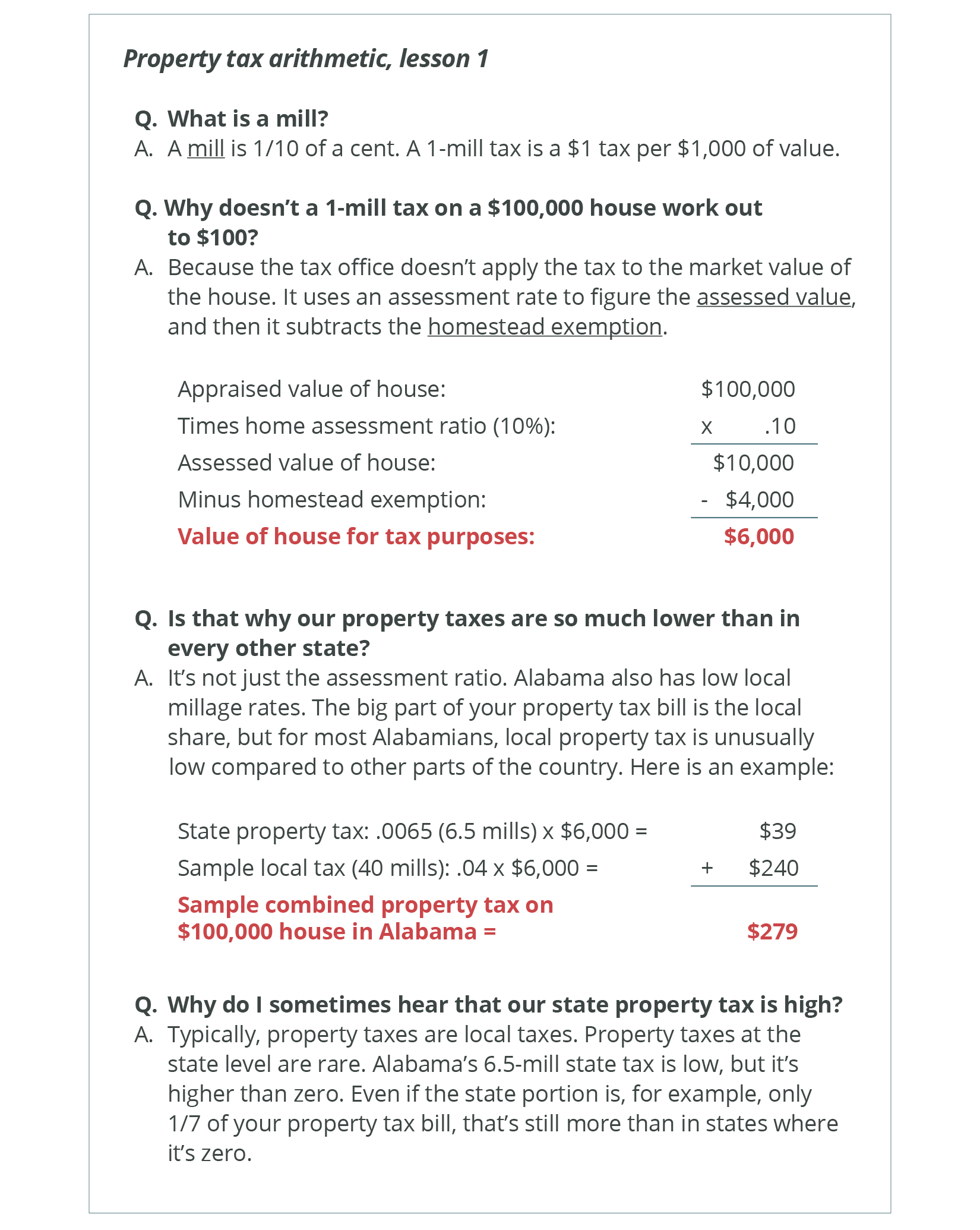
How do Alabama’s property taxes work?Property tax arithmetic, lesson 1 Q. What is a mill? A. A mill is 1/10 of a cent. A 1-mill tax is a $1 tax per $1,000 of value. Q. Why doesn’t a 1-mill tax on a $100,000 house work out to $100? A. Because the tax office doesn’t apply the tax to the market value of the house. It uses an assessment rate to figure the assessed value, and then it subtracts the homestead exemption. Appraised value of house: $100,000 Times home assessment ratio (10%) = Assessed value of house: $10,000 Minus homestead exemption ($4,000) = Value of house for tax purposes: $6,000 Q. Is that why our property taxes are so much lower than in every other state? A. It’s not just the assessment ratio. Alabama also has low local millage rates. The big part of your property tax bill is the local share, but for most Alabamians, local property tax is unusually low compared to other parts of the country. Here is an example: State property tax: .0065 (6.5 mills) x $6,000 = $39 Sample local tax (40 mills): .04 x $6,000 = $240 Sample combined property tax on $100,000 house in Alabama = $279. Q. Why do I sometimes hear that our state property tax is high? A. Typically, property taxes are local taxes. Property taxes at the state level are rare. Alabama’s 6.5-mill state tax is low, but it’s higher than zero. Even if the state portion is, for example, only 1/7 of your property tax bill, that’s still more than in states where it’s zero.

The 1901 Alabama constitution established a property tax of 6.5 mills to help fund the state government. That was 30 years before our state had income or sales taxes. More than a century later, the state property tax rate has not changed.

Property tax is applied to real estate, motor vehicles and boats as a millage rate. A mill is 1/10 of a cent, so a 1-mill tax amounts to $1 of tax per $1,000 of taxable property value. Three mills of the revenue from Alabama’s 6.5-mill state property tax is earmarked for the Public School Fund, which helps pay for school construction projects, while the rest supports other services.

The 6.5-mill state property tax is a small part of your property tax bill. The larger part is your local property tax, which pays for public schools and local services like parks and fire protection. In 2020, local property taxes generated nearly 86% of total property tax revenues in Alabama. By state law, each school district must have at least 10 mills of local tax dedicated to education. Local property taxes (excluding the state one) vary widely depending on where you live, ranging from 19.5 mills in rural Coosa County to 109 mills in Mountain Brook (in Jefferson County). Even so, Alabama’s average local property taxes are the lowest in the country.

Photo of piece of paper with numbers on it. On top of the paper are a pen and a calculator. A key chain is atop the calculator.

Local governments regularly assess the value of property for both state and local tax purposes. The assessed value is the portion of the appraised value (or fair market value) that the government uses to calculate the amount of property tax. (See the graphic above.)

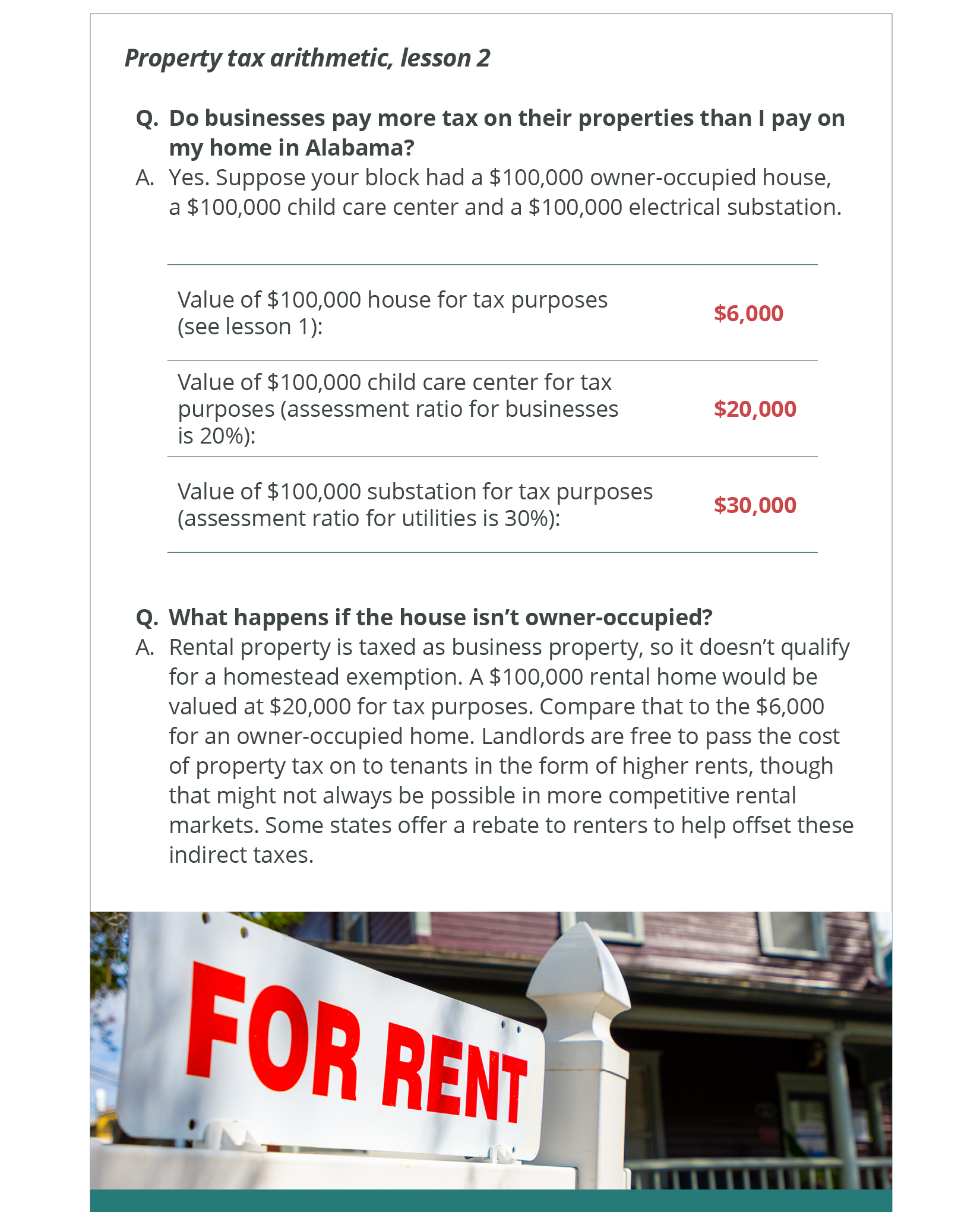
Property tax arithmetic, lesson 2. Q. Do businesses pay more tax on their properties than I pay on my home in Alabama? A. Yes. Suppose your block had a $100,000 owner-occupied house, a $100,000 child care center and a $100,000 electrical substation. Value of $100,000 house for tax purposes (see lesson 1): $6,000. Value of $100,000 child care center for tax purposes (assessment ratio for businesses is 20%): $20,000. Value of $100,000 substation for tax purposes (assessment ratio for utilities is 30%): $30,000. Q. What happens if the house isn’t owner-occupied? A. Rental property is taxed as business property, so it doesn’t qualify for a homestead exemption. A $100,000 rental home would be valued at $20,000 for tax purposes. Compare that to the $6,000 for an owner-occupied home. Landlords are free to pass the cost of property tax on to tenants in the form of higher rents, though that might not always be possible in more competitive rental markets. Some states offer a rebate to renters to help offset these indirect taxes.

Alabama taxes property at only a fraction of its value. Since the so-called Lid Bill capped property tax collections in 1978, the state has used the following system of property classifications for assessing taxes:

  • Utility company property is assessed at 30% of fair market value.
  • Commercial property is assessed at 20%.
  • Individually owned vehicles are assessed at 15%.
  • Farms, timberland and owner-occupied residential property are assessed at 10%. Huge corporate farms and timber holdings are treated the same as 100-acre family farms. The homestead exemption exempts from property taxes (except countywide school taxes and school district taxes) the first $4,000 of an owner-occupied home’s assessed value (an amount equal to $40,000 of appraised, actual value).

If Alabama taxed residences at their full value, a 1-mill tax on a $100,000 house would be $100. But the state taxes homes on only 10% of their value, so a $100,000 home is assessed at a taxable value of $10,000. (See the “lesson 1” graphic at the top of this page.) The homestead exemption lowers the tax even further, meaning you don’t pay on the first $4,000 of the amount subject to tax.

Alabama has numerous property tax exemptions for older adults and people who are blind or disabled. In fact, some Alabamians who are aged 65 and older or who have disabilities pay no property tax at all. Senior married couples who have a gross income of less than $12,000 are exempt from all state and county property taxes on their homestead and up to 160 acres of land. Alabamians who are blind or permanently disabled are exempt from all property taxes.

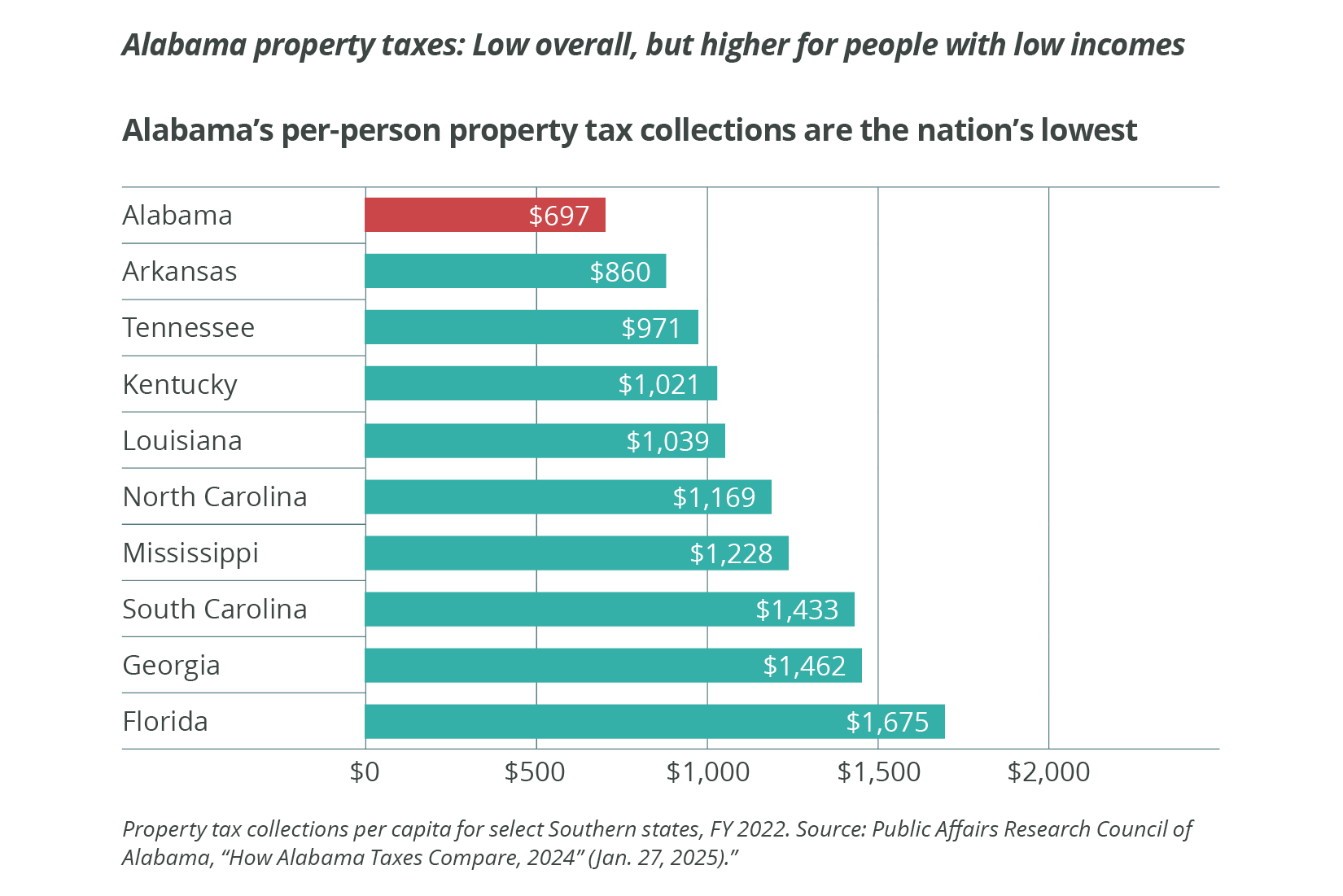
Bar graph of per-person property tax collections in selected Southern states. Top headline: Alabama property taxes are low overall but higher for people with low incomes. Subhead: Alabama's per-person property tax collections are the nation's lowest. Alabama: $697. Arkansas: $860. Tennessee: $971. Kentucky: $1,021. Louisiana: $1,039. North Carolina: $1,169. Mississippi: $1,228. South Carolina: $1,433. Georgia: $1,462. Florida: $1,675. Figures are for FY 2022. Source: Public Affairs Research Council of Alabama.

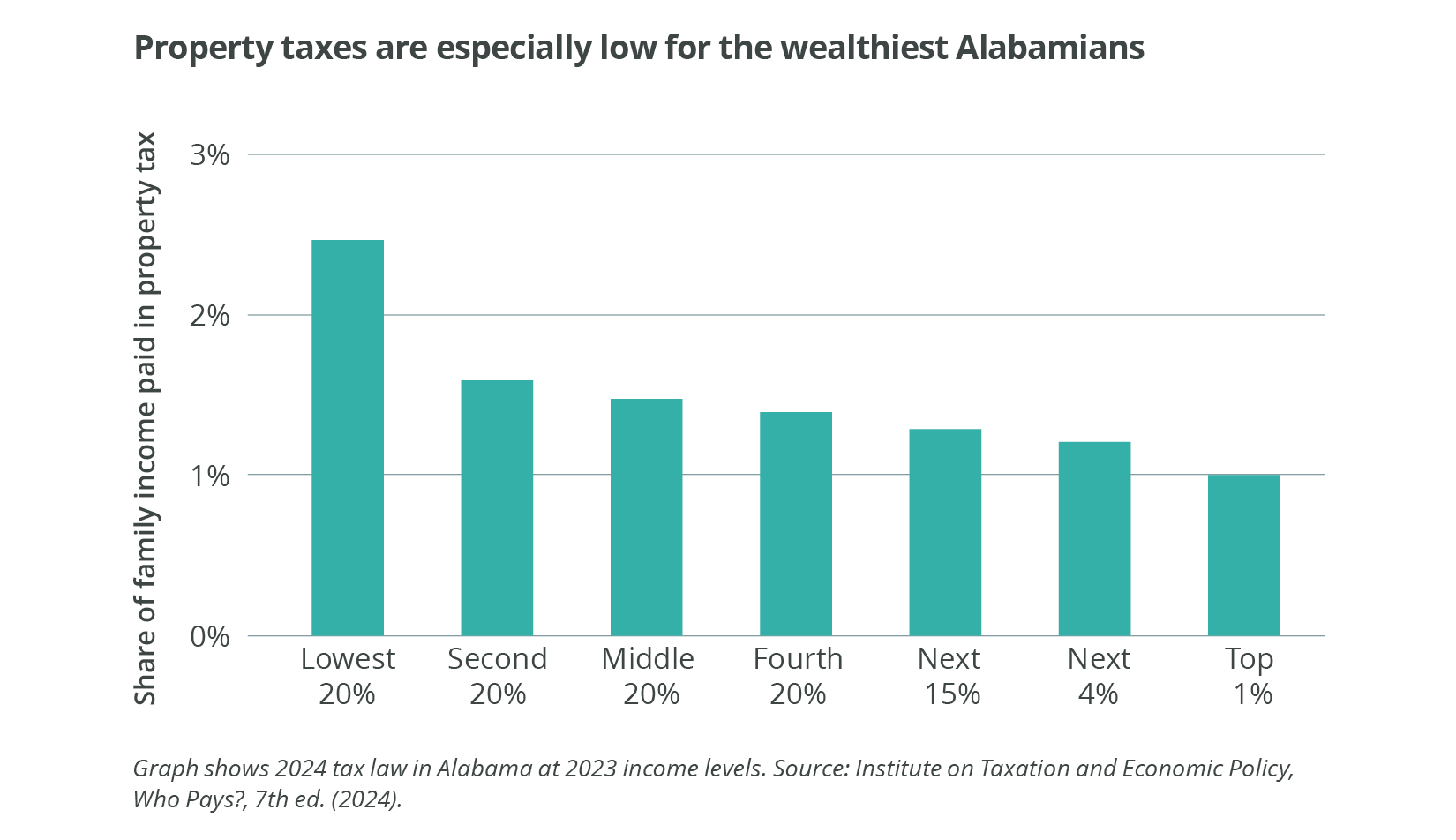
Bar graph of the share of family income paid in property tax by income level. Headline: Property taxes are especially low for the wealthiest Alabamians. The lowest 20% pay about 2.5%. The top 1% pay about 1%. Income groups in between pay between about 1.2% and 1.6%. Graph shows 2024 tax law in Alabama at 2023 income levels. Source: Institute on Taxation and Economic Policy, Who Pays?, 7th edition (2024).

Racial inequity at a glance

The racial impact of property taxes is complex. The most important source of household wealth for most people is homeownership. In part because of low property tax rates, Alabama’s Black homeownership rate is the nation’s fifth highest at 50.1% of households. This promotes higher rates of household and intergenerational wealth. But racial disparities in both tax assessment and property valuations reduce the benefits of a high homeownership rate.

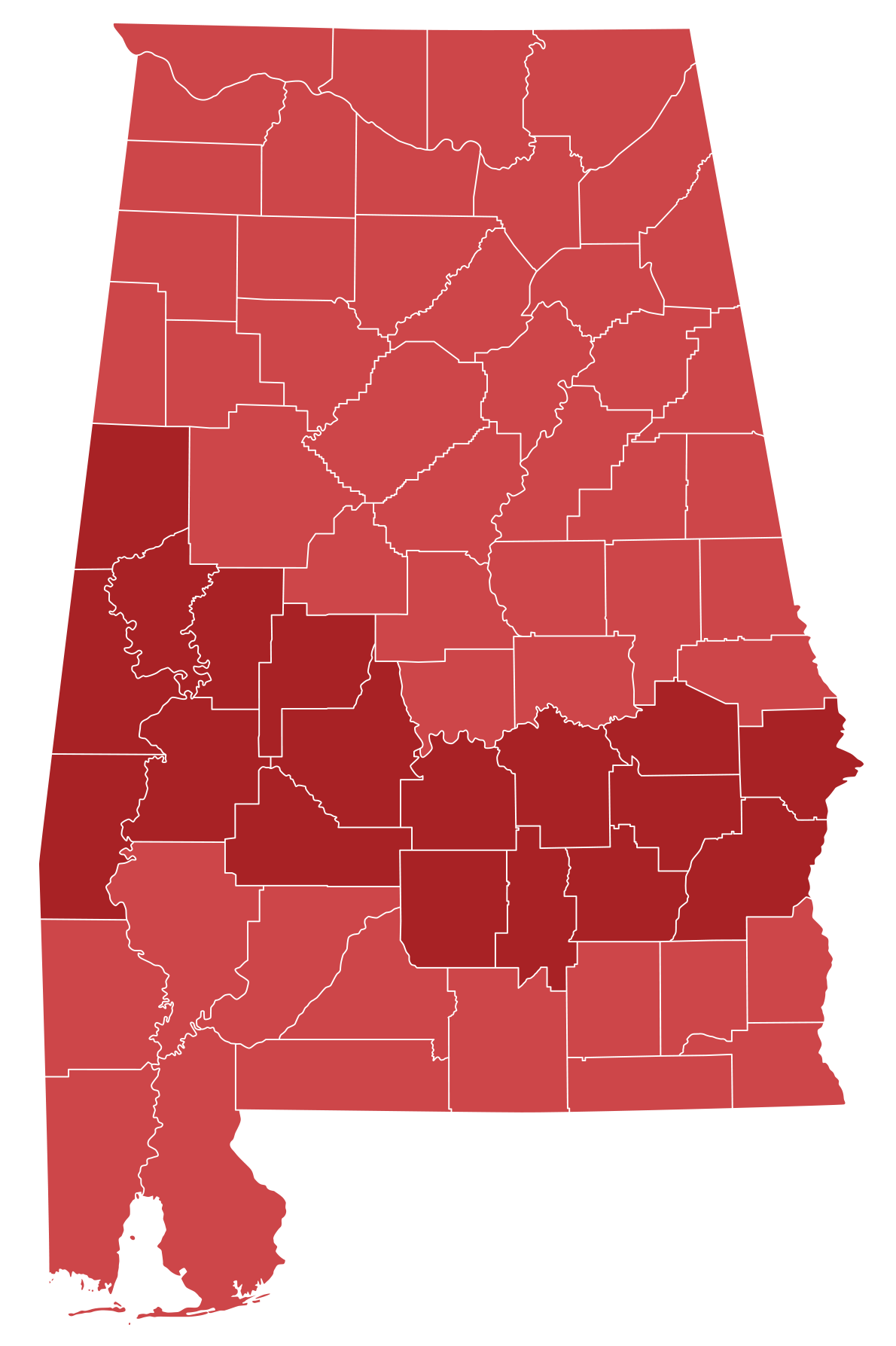
Map of Alabama counties with Black Belt counties highlighted.Several counties in Alabama’s Black Belt, a region with high poverty rates and a predominantly Black population, have property tax valuations well above the average for all Alabama counties. And because Alabama earmarks most property taxes for education, Black families are disproportionately harmed by underfunded schools. Many rural Black Belt counties lack a strong economic and retail base, limiting sales taxes and other revenues for education. Coupled with constitutional restrictions on property tax rates, this forces many counties to increase home assessments to fund their schools.

Alabama needs to find a solution that supports homeownership, while reducing unfair tax assessment of Black-owned property and providing adequate funding for public schools in rural communities.

Alabama’s Black Belt region includes these 18 counties:

  • Barbour
  • Bullock
  • Butler
  • Choctaw
  • Crenshaw
  • Dallas
  • Greene
  • Hale
  • Lowndes
  • Macon
  • Marengo
  • Montgomery
  • Perry
  • Pickens
  • Pike
  • Russell
  • Sumter
  • Wilcox

How do Alabama’s property taxes measure up?

Alabama property owners overall pay the lowest combined local and state property taxes in the United States. In fact, the average combined taxes could double and still be below the national average. There are two main reasons for this ranking:

First, Alabama’s agricultural property tax breaks are poorly targeted. In the 1970s, rapid expansion of commercial and residential development increased the value of rural land near cities and towns. To keep property taxes on farms from skyrocketing, the Legislature created a set of formulas to assign discounted values based on current use of land. Alabama’s current use formulas allow landowners to pay far less than they would in other states. The maximum value per farm acre (for the best land) is $532 – unchanged since 1982. The maximum value per timber acre is $827.

Alabama’s agricultural landscape has changed in the last 40 years. Today, owners of giant corporate farms and timber holdings take advantage of discounts originally designed to protect smaller farmers. These discounts lead to severely undertaxed timberland, which contributes to the underfunding of health care, education and other valuable investments. Alabama places no limit on the size of a farm that benefits from reduced property tax rates. Georgia, by contrast, has a 2,000-acre limit on farms that qualify for a current use exemption. This cap protects family farmers while still ensuring equitable taxes on large corporate landholders. Alabama counties tax timberland at rates one-half of those paid by owners in similar counties in Florida, and only one-third of those paid by owners in similar counties in Georgia, Tennessee and Mississippi, according to a 2020 study by researchers at Auburn University and other institutions.

The severe undertaxing of Alabama’s timberland primarily benefits wealthy landowners – often large, profitable corporations – with limited ties to the community where their property is located. Nearly 60% of Alabama timberland is owned by people living outside of the county where the land is located. Alabama’s share of foreign-owned agricultural land in 2023 was 8%, more than twice the national average, according to the U.S. Department of Agriculture.

Second, Alabama’s constitution makes it hard for localities to raise property taxes but easier for them to increase sales taxes. Wealthy landowners and industrialists built barriers into the state’s 1901 constitution to shelter property from adequate taxation. Those barriers still exist, and the Lid Bill of 1978 made them even tougher.

Cover image of the 1901 Alabama constitution

How could we improve our state property tax?

Keep in mind: Alabama’s per-person property tax collections are the lowest in the nation. To fill the resulting funding gap, many communities have high sales taxes, which make our tax system more regressive. We need a better approach.

The property tax reforms below would help restore balance to Alabama’s upside-down tax system. Large landholders would pay more, while small-scale farmers would pay less. And Alabamians’ overall property taxes still would remain below the national average.

  • Evaluate and update the state property tax rate. Property taxes are primarily a local revenue source but are subject to complex web of state restrictions. Many of these limits were erected by the 1978 Lid Bill and forgo revenue by providing large tax breaks to huge corporate landowners and wealthy homeowners. By contrast, the best form of relief are circuit breakers, which limit property tax liability to a certain share of income for households and renters with low and moderate incomes. In addition, many wasteful and ineffective property tax abatements for businesses need to be repealed.
  • Increase overall property tax rates. Modest increases could generate a large amount of new revenue to strengthen public schools in communities across Alabama. One pathway would be to tax business property at the same assessment ratio as utility property. The state also could raise the minimum local millage rate for public schools from 10 mills to 20 mills.
  • Protect homeowners with low incomes by increasing the homestead exemption. Excluding the first $50,000 of a home’s value from state taxes would provide a 25% increase in this exemption.
  • Protect small-scale farmers by creating a “farmstead exemption.” This could be done by increasing the homestead exemption for a farmer’s home, or by creating a farmstead exemption that would protect average-sized family farms. Another option would be to create a new farmstead exemption for a certain number of specified improvements (such as irrigation systems).
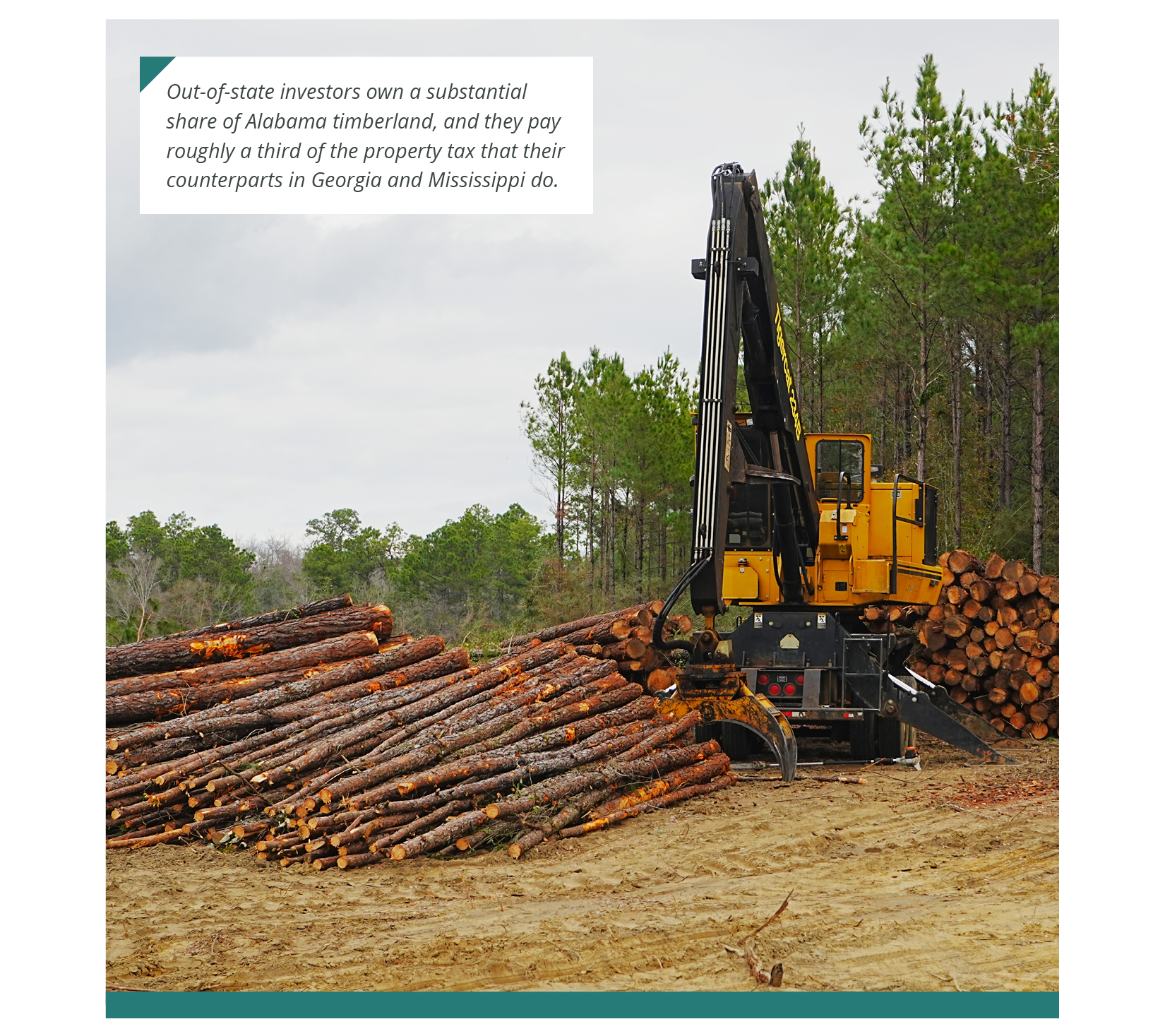
  • Adjust property taxes on timberland to bring them in line with surrounding states. Out-of-state investors own a substantial share of Alabama timberland, and they pay roughly a third of the property tax that their counterparts in Georgia and Mississippi do. Current use formulas set the value of Alabama timberland between $360 to $827 per acre depending on productive capacity. Alabama assesses timberland at 10% of these values for tax purposes, while the comparable figure is 40% in Georgia. Increasing the assessment rate to 20% for timberland holdings above 500 acres would protect most family timberland owners while raising revenue for counties to meet local needs.

A knuckleboom loader sits between piles of logs. Caption: Out-of-state investors own a substantial share of Alabama timberland, and they pay roughly a third of the property tax that their counterparts in Georgia and Mississippi do.


The Alabama Tax and Budget Handbook

The Alabama Tax and Budget Handbook – Business Taxes

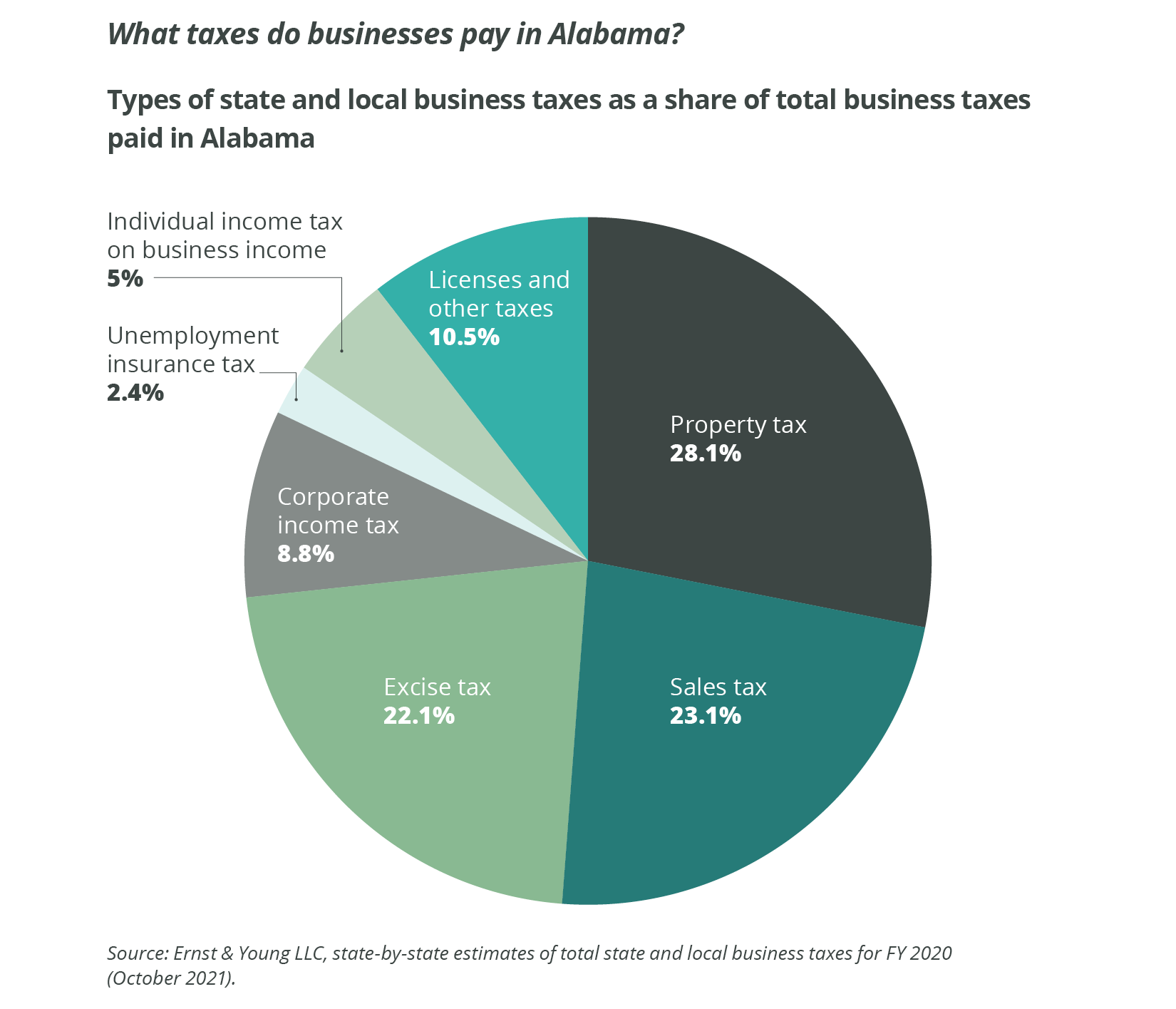
What taxes do businesses pay in Alabama?

Pie graph of types of state and local business taxes as a share of total business taxes paid in Alabama. Property tax 28.1%, sales tax 23.1%, excise tax 22.1%, corporate income tax 8.8%, individual income tax on business income 5% and unemployment insurance tax 2.4%. Source: Ernst & Young LLC, state-by-state estimates of total state and local business taxes for FY 2020 (October 2021).

How does Alabama tax businesses?

Business taxes provide the important “fourth leg of the stool” of our tax system. Alabama’s business taxes were restructured in 1999 after courts ruled the old system unconstitutional because it taxed out-of-state companies at a higher rate.

Today’s structure relies on two taxes:

First, the corporate income tax is a 6.5% tax on the taxable profits of corporations doing business in Alabama. Like all states, Alabama is barred by federal law from taxing all of the income of multistate companies. Each state uses apportionment rules – based on the share of business activities that take place in the state – to divide these companies’ profits into in-state and out-of-state portions. A 2021 change in Alabama’s apportionment rule moved some manufacturing profits into the out-of-state portion, further reducing corporate income taxes owed to Alabama.

In place of the income tax, insurance companies pay taxes on premiums. Utility companies pay both income taxes and taxes on gross receipts.

Second, the business privilege tax is a tax on the company’s net worth. In Alabama, this tax is capped at $15,000 a year. (That’s a problem. See “How do Alabama’s business taxes measure up?” below to learn why.)

Businesses pay other state and local taxes as well:

  • Nearly a quarter of the tax dollars that businesses pay are for state and local sales taxes on items purchased for their own use or consumption. The sales tax does not apply to “inputs to production” or goods offered for resale. For example, Alabama taxes the pizza sold by a restaurant, but the restaurant does not pay state tax on the flour or other raw ingredients. Businesses pay an excise tax on motor fuels for business use.
  • Businesses pay at least twice the rate of property tax that homeowners pay. Business property is taxed on 20% of appraised value, and utility property is taxed on 30%.
  • Businesses contribute to employees’ payroll taxes for unemployment insurance, workers’ compensation and disability insurance.

A 2021 change in Alabama’s apportionment rule moved some manufacturing profits into the out-of-state portion, further reducing corporate income taxes owed to Alabama.

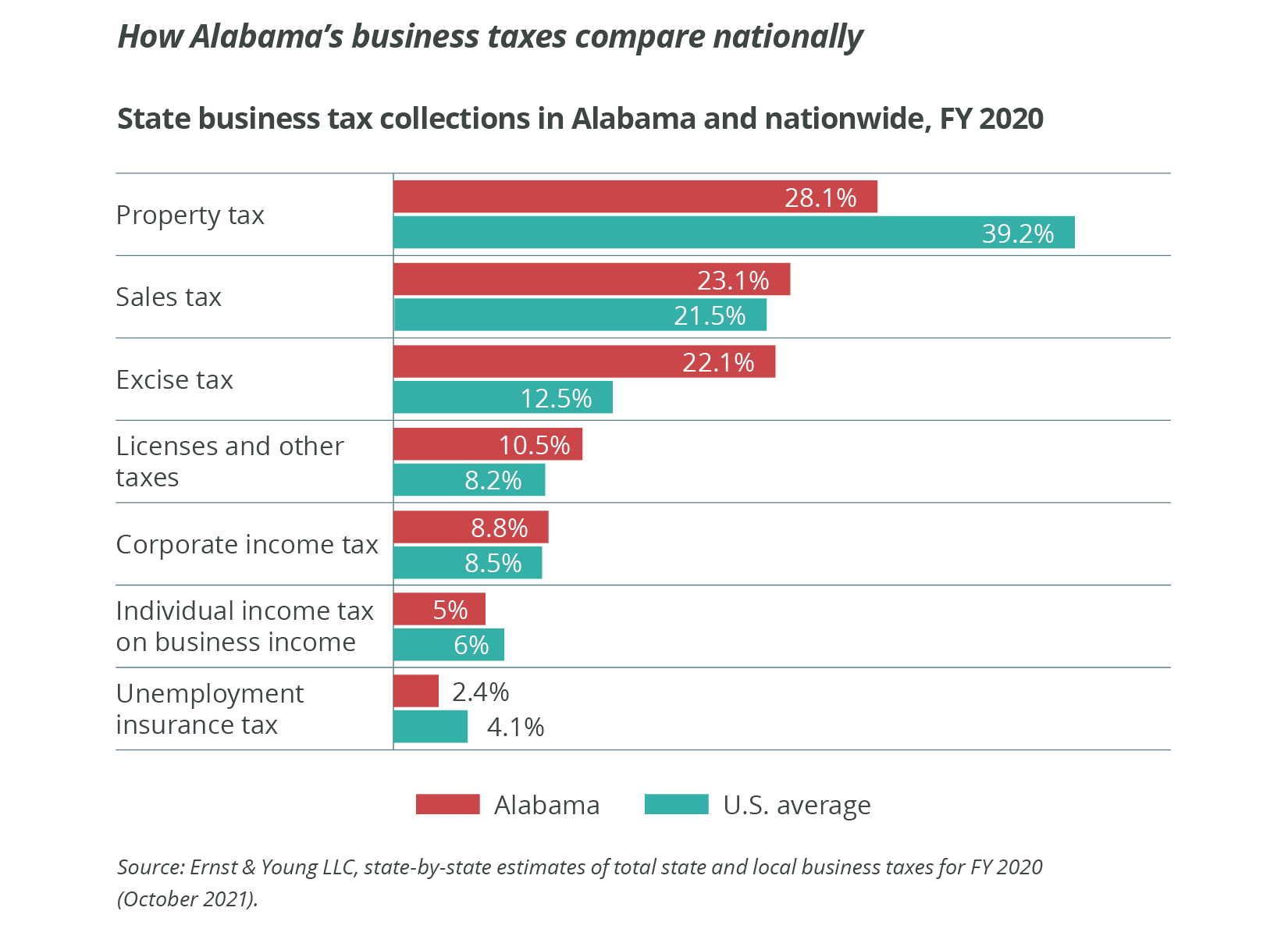
Bar graph of state business tax collections in Alabama and nationwide as a share of overall state business taxes in FY 2020. Property tax is 28.1% in Alabama and 39.2% nationwide. Sales tax is 23.1% in Alabama and 21.5% nationwide. Excise tax is 22.1% in Alabama and 12.5% nationwide. Licenses and other taxes are 10.5% in Alabama and 8.2% nationwide. Corporate income tax is 8.8% in Alabama and 8.5% nationwide. Individual income tax on business income is 5% in Alabama and 6% nationwide. Unemployment insurance tax is 2.4% in Alabama and 4.1% nationwide. Source: Ernst & Young LLC, state-by-state estimates of total state and local business taxes for FY 2020 (October 2021).

This graph reveals some striking ways in which Alabama’s business taxes differ from national patterns:

  • Alabama is sharply below average in its reliance on the property tax for business tax revenues.
  • The state is sharply above average in use of business excise (e.g., motor fuel) taxes.
  • Unemployment insurance taxes account for a lower share of business taxes in Alabama than the national average.
  • Alabama businesses pay more in sales taxes than the national average, reflecting the state’s high overall sales tax rate.
  • Licenses and fees account for a higher percentage of business taxes in Alabama than the national average, adding to strain on small businesses.

Racial inequity at a glance

Alabama offers significant subsidies and tax breaks to companies operating, expanding or locating in economically disadvantaged areas of the state called “enterprise zones.” Enterprise zones originally were classified as geographic areas (like Alabama’s Black Belt) suffering from high unemployment, low educational attainment levels, population decline or other signs of economic distress. In 2019, however, Alabama expanded its definition of “enterprise zone” to include any Alabama county with a population of less than 50,000. As a result, 45 of Alabama’s 67 counties have become eligible for tax incentives and exemptions originally targeted to the most economically disadvantaged areas of the state.

Despite the expansion of eligibility for these subsidies, Alabama remains one of the poorest states in the nation, as economic development has remained close to stagnant in many parts of the state. In 2023, Good Jobs First (GJF) assessed the relationship nationwide between race, ethnicity and corporate subsidies. The group’s findings indicated that states that provide economic development subsidies in the way that Alabama does often exacerbate racialized inequality. These kinds of subsidies often disproportionately transfer public wealth to white male executives and the companies they run, according to GJF.

How do Alabama’s business taxes measure up?

Alabama’s corporate income tax collections declined as a share of revenue between 2005 and 2015 but have since increased to account for 11.2% of tax revenues for the ETF. State and federal corporate tax laws and loopholes have been the major driver of changes in corporate income tax collections. Federal corporate tax law affects Alabama’s tax collections because the two often are linked by state law.

Yet Alabama provides many special business tax breaks of its own. For example, Alabama is the only state to let corporations deduct all of their federal income taxes from state taxable income. (Missouri allows a partial deduction.) This lowers the effective tax rate (the tax as a share of profits) dramatically. On the surface, Alabama’s 6.5% corporate income tax rate is higher than the rate in neighboring states. But the effective rate (including the federal income tax deduction) may be significantly lower.

Recent legislation has proposed eliminating the federal income tax deduction while reducing the corporate income tax rate, making Alabama a more competitive location for new businesses. Other legislation passed in recent years allowed corporations to exclude federal COVID-19 relief funds as income when calculating their state taxes.

Alabama is one of a declining number of states (16 now, down from 25 in 2015) that levy a business privilege tax. But Alabama caps the tax, unlike most other states with a business privilege tax. Companies above the cap pay taxes on a lower share of their net worth – an advantage of being big. Because it’s based on net worth instead of profits, the privilege tax is less sensitive to economic changes than the income tax – and less susceptible to tax avoidance techniques. A bill to eliminate Alabama’s business privilege tax nearly passed the Legislature in 2022.

On the surface, Alabama’s 6.5% corporate income tax rate is higher than the rate in neighboring states. But the effective rate (including the federal income tax deduction) may be significantly lower.

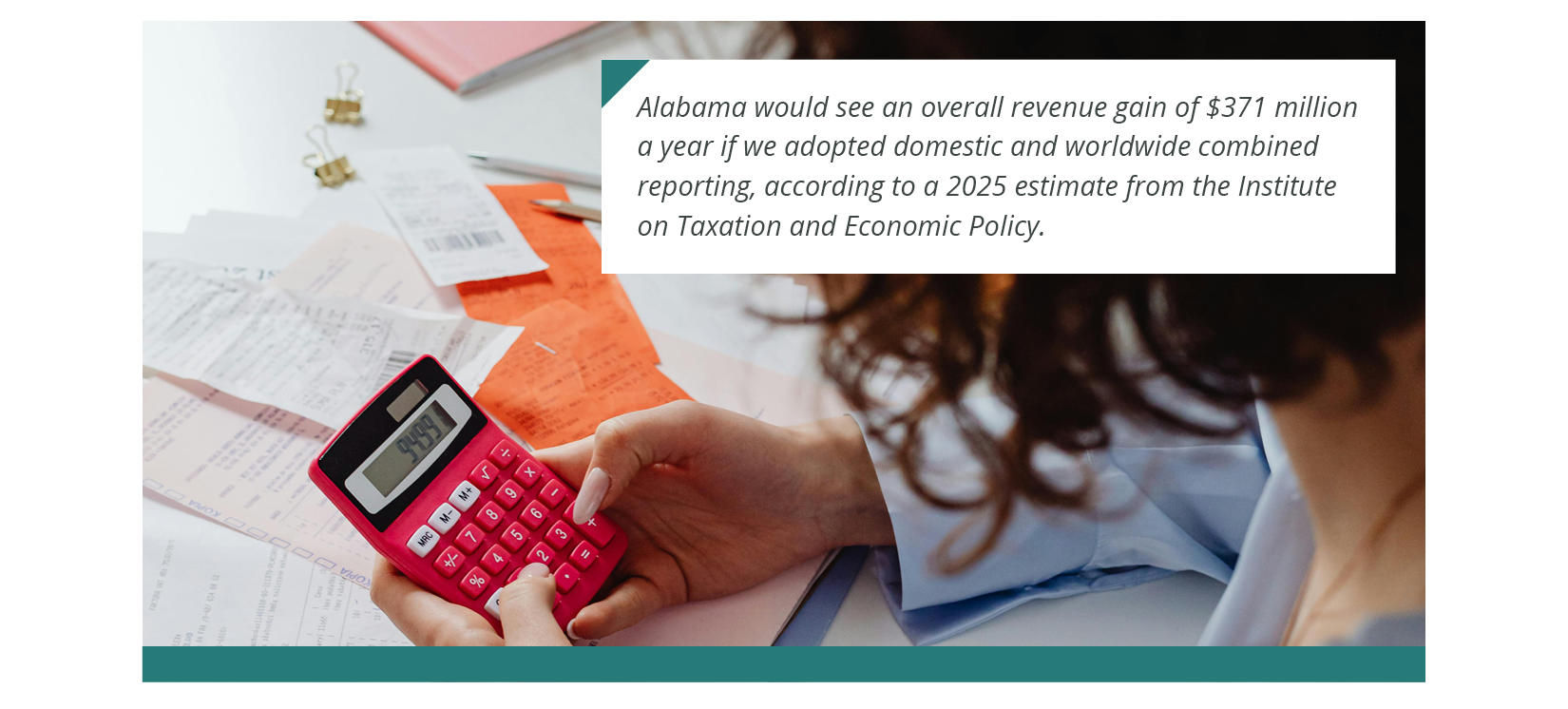
Image of a woman's hands holding a red calculator. Accompanying text: Alabama would see an overall revenue gain of $371 million a year if we adopted domestic and worldwide combined reporting, according to a 2025 estimate from the Institute on Taxation and Economic Policy.

Many multistate corporations are able to avoid state income taxes due to how they are allowed to treat income earned, or spent, in other states or nations. In 28 states and the District of Columbia, state laws requiring combined reporting of out-of-state income and expenses address this problem. By requiring this information on a state income tax return, states can ensure that corporate income is appropriately reported and required taxes are paid on that income. Despite legislative efforts, Alabama still does not require combined reporting, allowing creative accounting to reduce income taxes owed here. Alabama would see an overall revenue gain of $371 million a year if we adopted domestic and worldwide combined reporting, according to a 2025 estimate from the Institute on Taxation and Economic Policy.

Businesses also benefit from economic incentives, usually in the form of tax breaks, intended to encourage location or expansion in Alabama. Recent changes in state law have increased the employment and wage standards that companies must meet in exchange for incentives – and have improved the state’s ability to hold companies accountable for failing to meet commitments. Still, much work remains to ensure full transparency in reporting the costs and benefits. Legislation passed in 2023 improved transparency somewhat, but it remains difficult to track which corporation received incentives or how those incentives benefited workers or the state. Alabama lost almost $179 million from incentives in 2023, Good Jobs First estimated based on state and federal tax reports, with our largest cities and counties losing an additional $231 million in tax revenue that year.

How could we improve our business taxes?

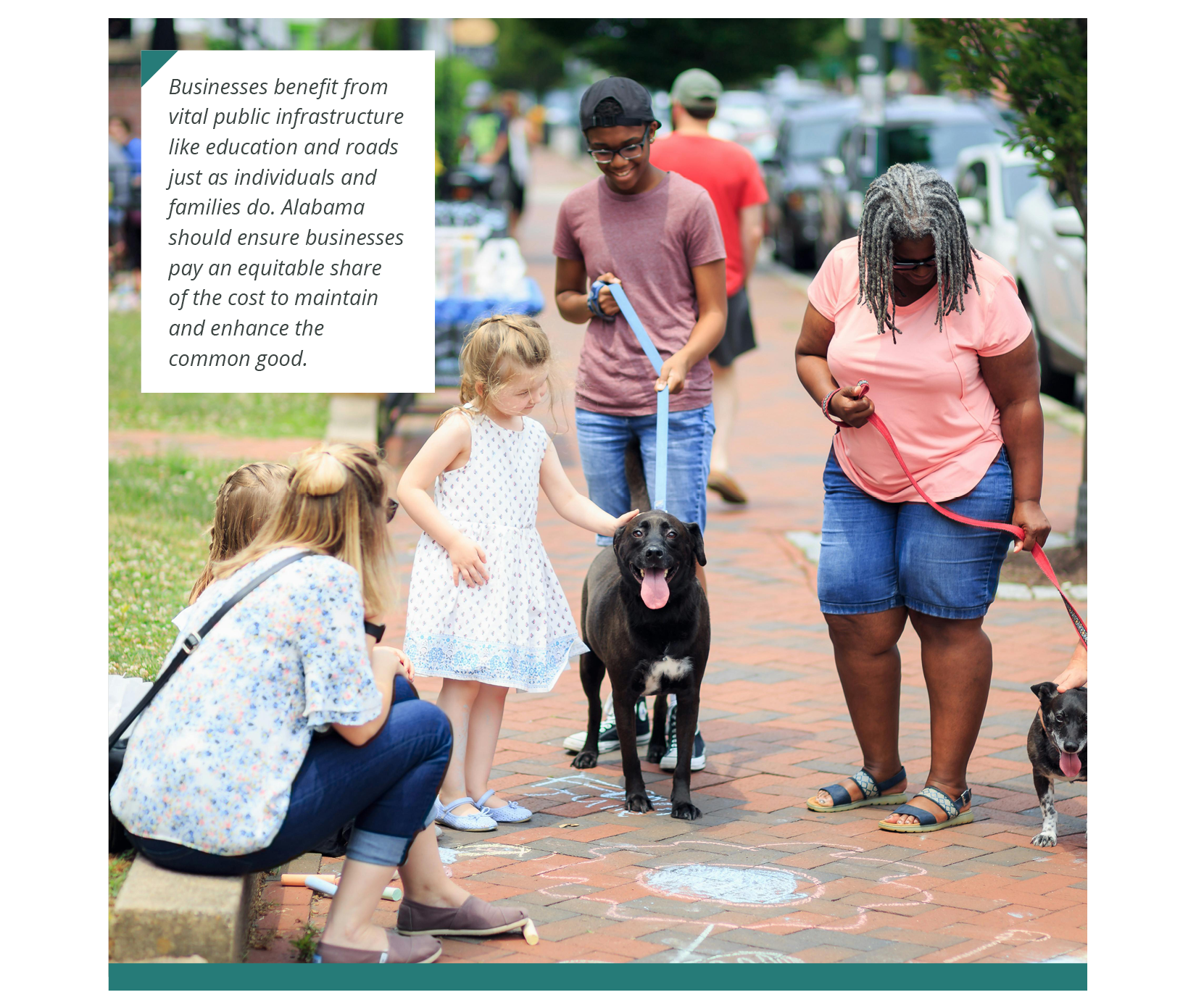
Businesses benefit from vital public infrastructure like education and roads just as individuals and families do. Numerous changes to Alabama’s business taxes could make them fairer and ensure businesses pay an equitable share of the cost to maintain and enhance the common good:

  • Remove the deduction for federal income tax payments and drop the corporate income tax rate to 6%. The current 6.5% rate really amounts to 4.2% when factoring in the deduction for federal income tax payments.
  • Raise the cap on the business privilege tax so the largest and most profitable corporations will compete more fairly with smaller ones. Even with this change, Alabama’s business tax levels would remain below those of most other states.
  • Adopt combined tax reporting for businesses and their subsidiaries. By treating a company and all of its related enterprises as one taxpayer, Alabama could keep a business from deducting payments to its own subsidiary from its state taxes. This change also could prevent corporations from shifting taxable in-state earnings to other states to avoid Alabama taxes. Alabama should embrace the approach taken by 28 states and the District of Columbia to require accurate reporting of out-of-state income and expenses.
  • Restore Alabama’s three-factor apportionment formula for calculating corporate income tax liability. Until 2021, Alabama’s formula accounted for companies’ shares of payroll, property and sales located in the state. But the current formula, known as “single sales factor,” is based solely on sales. Many states that have adopted a single sales factor formula have seen significant decreases in corporate income tax revenue.
  • Decouple Alabama’s business taxes from the federal tax code so that tax breaks or increases given by Congress do not automatically apply to state business taxes. This would allow the Legislature to decide for itself if a particular tax break is good for Alabama.
  • Limit tax incentives for luring companies to Alabama. Many companies rank tax breaks low among the reasons they choose to locate in a state, but they still bargain for the best incentive plan they can get. Numerous studies show the most effective incentives are a skilled workforce, a good education system and other quality-of-life measures. Large corporations should pay their fair share to support those investments.

Image of a girl petting a black dog on the sidewalk while the dog's smiling owners watch. Accompanying text: Businesses benefit from vital public infrastructure like education and roads just as individuals and families do. Alabama should ensure businesses pay an equitable share of the cost to maintain and enhance the common good.


The Alabama Tax and Budget Handbook

The Alabama Tax and Budget Handbook – Tax Policy Solutions for the Long Haul

How could we make our tax code more fair?

Alabama can move forward by changing its outdated, imbalanced approach to raising revenue. Our state’s current approach is not helping workers get ahead, and it is not adequately funding education, health care and other vital services that help make widely shared prosperity possible. Alabama should consider numerous reforms to make its upside-down tax system more just, equitable and resilient.

Income tax: Because much of Alabama’s income tax structure is spelled out in the constitution, changing it would require changing the constitution. If Alabama’s income tax more closely followed the system of exemptions and deductions used at the federal level and in many other states, working families would have more money available to spend. That would boost the economy and improve their quality of life. The following proposals would help modernize our income tax and make it fairer:

  • Make income taxes less regressive and more progressive.
  • Reform out-of-date deductions.
  • Eliminate the federal income tax (FIT) deduction.
  • Review Social Security contribution deductions.
  • Establish a state Earned Income Tax Credit (EITC).
  • Gradually increase standard deductions.

Sales taxes: Alabama can modernize its sales tax system to make the tax less regressive and more reflective of current spending patterns. Policy changes that would advance these goals include:

  • Modernize the sales tax on goods and services, including eliminating the grocery tax.
  • Expand the sales tax to include more services and digital goods.
  • Adopt a progressive approach to taxing services.
  • Target exemptions for essential goods and services.
  • Regularly review and adjust sales tax rates.
  • Conduct a cross-state comparison.

Photo of a young couple holding their baby.

Property taxes: Numerous property tax reforms would help restore balance to Alabama’s upside-down tax system. Large landholders would pay more, while small-scale farmers would pay less. And Alabamians’ overall property taxes still would remain below the national average. These reforms include:

  • Evaluate and update the state property tax rate.
  • Increase overall property tax rates.
  • Protect homeowners with low incomes by increasing the homestead exemption.
  • Protect small-scale farmers by creating a “farmstead exemption.”
  • Adjust current use formulas to make them fairer.

Business taxes: A number of changes to Alabama’s business taxes could make them fairer and increase the amount of money for vital services, which businesses benefit from as much as individuals and families. These include:

  • Remove the deduction for federal income tax payments and reduce the corporate income tax rate to 6%.
  • Raise the cap on the business privilege tax so the wealthiest corporations will compete more fairly with smaller ones.
  • Adopt combined tax reporting for businesses and their subsidiaries.
  • Restore Alabama’s three-factor apportionment formula for calculating corporate income tax liability.
  • Decouple Alabama’s business taxes from the federal tax code so that tax breaks or increases given by Congress do not automatically apply to state business taxes.
  • Limit tax incentives for luring companies to Alabama.

New rules: What to watch for in new tax proposals

We can use four criteria to assess plans to improve Alabama’s taxes:

1. Fairness: Do they lower taxes for those who pay too much and increase taxes for those who pay too little?

  • Will wealthy people and highly profitable companies pay their fair share? Alabamians with low incomes pay more than twice the share of income that the top 1% pay in state and local taxes.
  • Will new plans tax low-paid workers deeper into poverty? Hurdles in Alabama’s constitution make it hard to raise new revenue through income or property taxes. But it’s easy to increase sales taxes, driving “the least of these” deeper into poverty and forcing them to shoulder an even greater share of the cost of the public services that benefit us all.

2. Adequacy: Do new plans meet the needs of a growing population?

  • Do the plans help end the state’s structural deficit? Simply put, will they pay the bills? Stagnant income sources can’t keep pace with rising costs. One way to keep up with the changing times would be to extend our sales and use taxes to cover the services that account for an increasing share of consumer spending. We also could revise how we tax corporations so that the largest and most profitable pay their fair share of state taxes. And we can adjust our individual income taxes so that the wealthiest households pay their fair share while allowing more robust tax deductions for working families.
  • Do the plans allow flexibility to address changing needs? As technology evolves and the population grows, Alabama must be able to keep up. Can our public schools educate our children properly when policymakers continue to redirect a growing share of their funding to private schools and homeschooling? Can one of the nation’s most limited Medicaid programs adequately serve aging and working populations? Can our overcrowded, brutal and inadequate prisons provide real rehabilitation and second chances for returning citizens? If we want a better tomorrow, we need to invest in it today.
  • Does Alabama have adequate reserves? Or have we set too much aside in reserve that could be used to fund critical services for our residents? Do our multiple reserve accounts meet the needs of the people, or are they confusing and duplicative? We should take a careful look at our reserve funds to see if they serve our residents’ best interests or if they could be streamlined and revised.

3. Simplicity: Can people file a basic tax return?

  • Is it easy to understand how taxes work? As lobbyists and special interests push new tax measures, our income tax form gets more complicated. Key principles can keep the system simpler.
  • Does our tax system have confusing loopholes? A hodgepodge of tax breaks for some but not others makes our system inefficient. Worse yet, legislators sometimes create preferences for certain industries without revealing who would benefit.

4. Transparency: Can we see that everyone pays a fair share?

  • Does the budget process let the public follow the money from tax collection through spending? Policymakers should set rules that ensure everyone pays a fair share in taxes. Do we know how much money is available for the state to spend on core services? And how can we ensure state agencies have what they need to provide vital services to families who are struggling to make ends meet?
  • Is the state required to list tax breaks in a format that is clear and understandable? Alabama’s budgets reveal our values and priorities. But many tax breaks pushed through by powerful lobbyists can be virtually invisible. While Alabama provides a report on tax breaks, it’s difficult to read and understand. Most residents aren’t going to read audit reports to find tax breaks offered by state and local governments. Alabama’s tax expenditure report is a good first step, but it needs improvements to become truly accessible to the public.

Bottom line: Does our government reflect our values?

We need strong public services and inclusive public policies to meet the needs of our people. We create governments to promote the common good, to do together what we can’t accomplish alone – educating and protecting and planning and building a better future for everyone. If we hope to move forward, we have to change our broken, upside-down approach to taxes and budgets.

By getting involved, Alabamians can require their policymakers to be responsive to the needs in our communities. Our residents deserve a government that gives everyone a voice, an economy that offers everyone a chance to get ahead, and an Alabama that works for all of us.

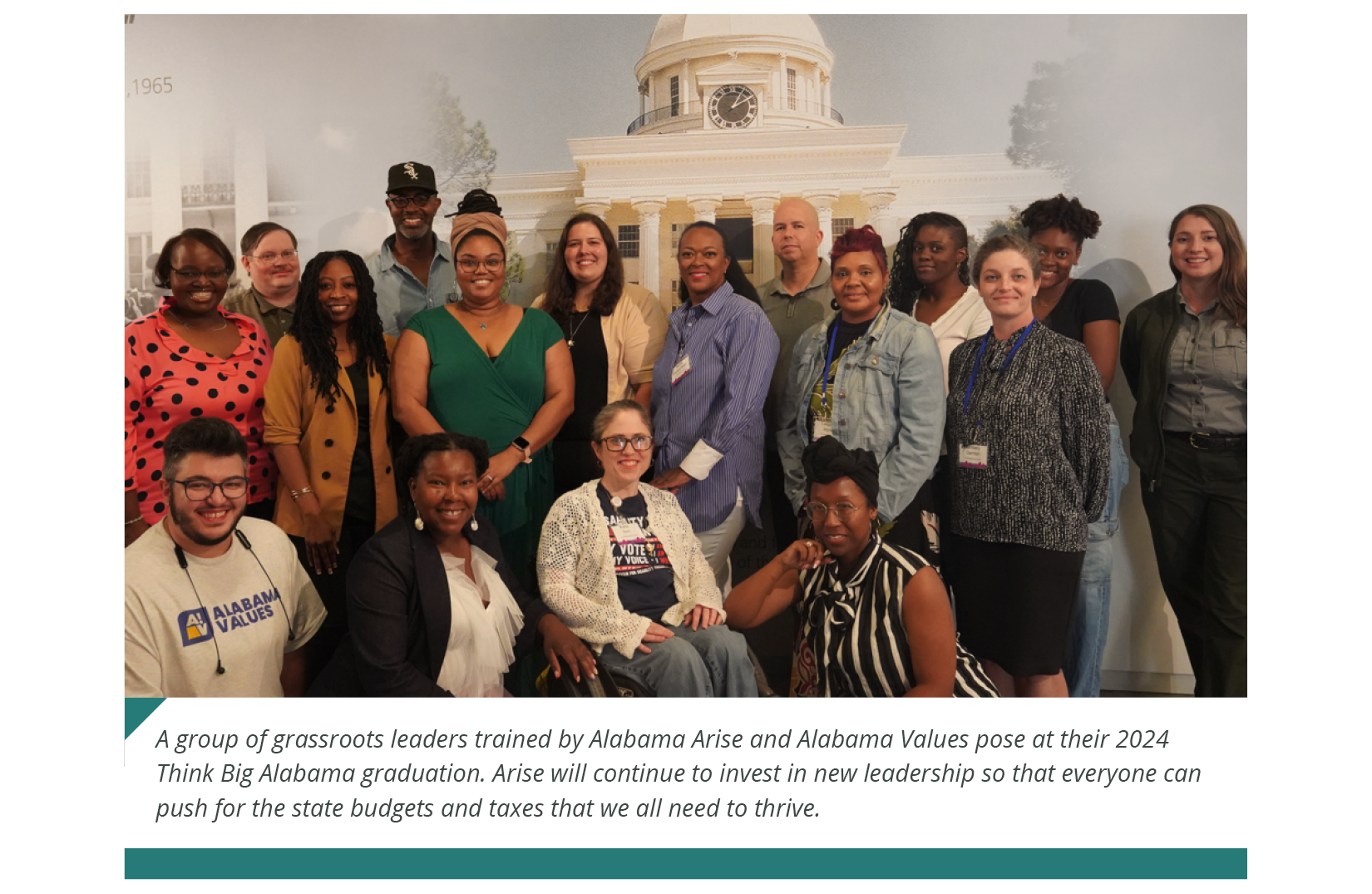
A group of smiling people pose in front of an image of the Alabama State Capitol in the background. Accompanying text: A group of grassroots leaders trained by Alabama Arise and Alabama Values pose at their 2024 Think Big Alabama graduation. Arise will continue to invest in new leadership so that everyone can push for the state budgets and taxes that we all need to thrive.


The Alabama Tax and Budget Handbook

The Alabama Tax and Budget Handbook – Glossary

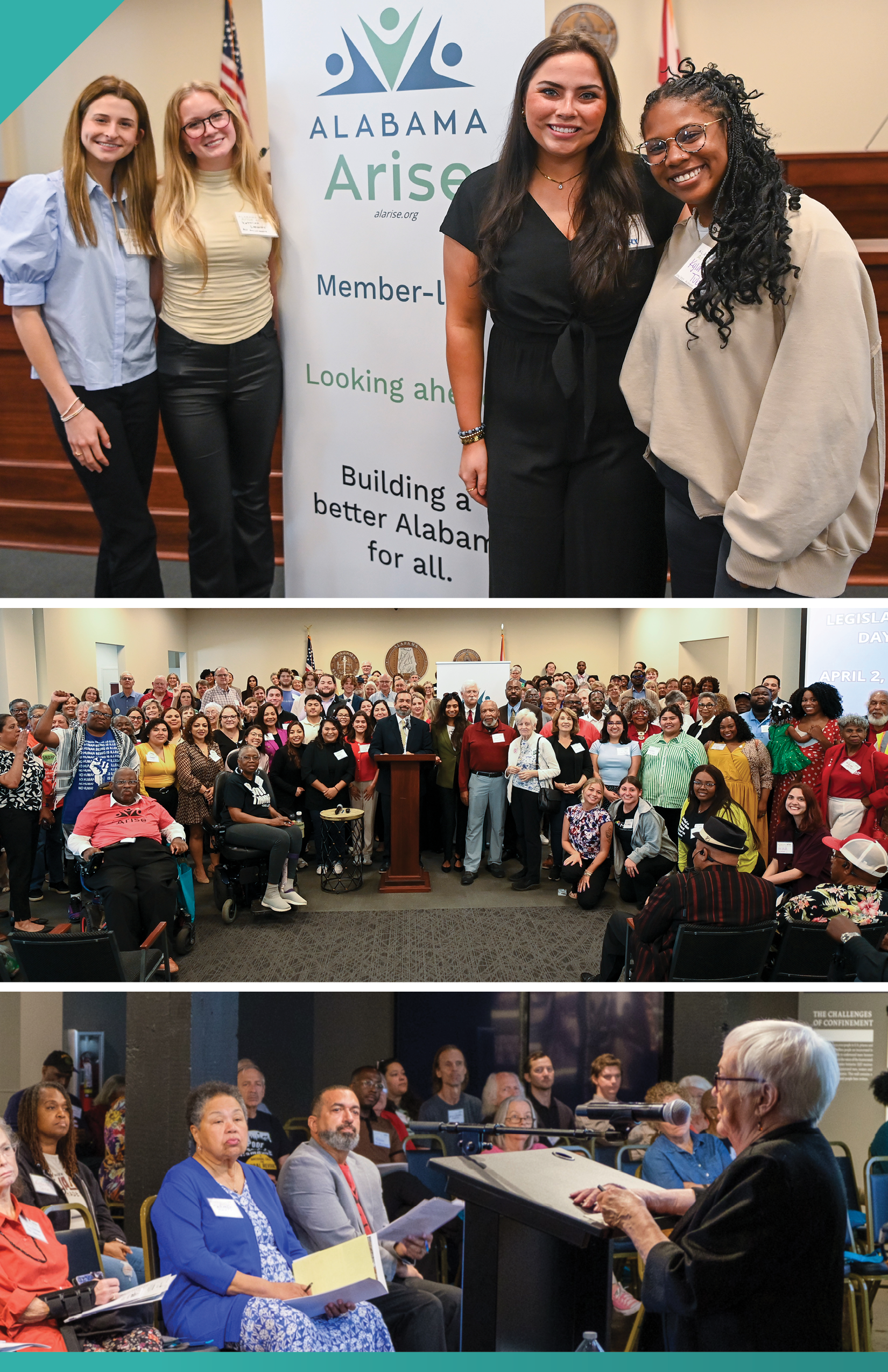
A collage of three photos from Arise events. Top: Four smiling young women pose beside an Alabama Arise banner. Middle: More than 100 advocates gather for a news conference at the Alabama State House. Bottom: An Arise staff member standing behind a lectern speaks to attendees at an Arise Annual Meeting in Montgomery.

This glossary includes keywords used in The Alabama Tax and Budget Handbook, as well as other terms commonly encountered in tax and budget debates. Terms that are italicized in the definitions are defined elsewhere in this glossary.

act – a bill that has become law.

adjusted gross income – total annual earnings after subtracting certain expenses (such as qualified retirement contributions) but before subtracting deductions and exemptions. Compare taxable income.

ad valorem – a Latin phrase meaning “according to value.” See property tax.

Alabama Department of Revenue – the state agency that administers tax programs and collects taxes in Alabama. The federal tax authority is the Internal Revenue Service.

Alabama Trust Fund – a savings fund established to capture future revenues from sales of offshore drilling rights and from royalties on the resulting gas production.

apportionment – the process of determining what percentage of businesses’ profits are subject to a given state’s corporate income tax or other business taxes.

appropriation – an amount of money approved by the Legislature for a certain purpose. See also conditional appropriation; supplemental appropriation.

appraised value – an expert opinion of the current market value of a property.

assessed value – a tax assessor’s determination of property value, based on appraised value and lowered in Alabama by a property classification factor.

assessment ratio – a formula set by law to determine the portion of a property’s appraised value that is subject to tax. See also property tax.

balanced budget – an income and spending plan for which projected income is equal to or greater than projected spending. Alabama law requires the Legislature to balance the budget every year.

Big Mule – a political term coined in 1926 to describe influential wealthy industrialists and utility executives who influenced Alabama politics. See also Planters.

bill – a proposed piece of legislation to be considered by the Legislature for passage (or enactment) into law. See also act.

Black Belt – Alabama’s Black Belt area is part of a larger national Black Belt region that stretches from Texas to Virginia. This region has historically been home to “the richest soil and the poorest people” in the United States.

budget – a spending plan for a fiscal year. See also governor’s budget proposal.

Budget Stabilization Fund – a reserve balance that is set aside during good economic times to protect the state budget from cyclical changes in revenues and expenses that may occur during poor economic times.

business privilege tax – a tax on the net worth of companies doing business in Alabama. The business privilege tax replaced the franchise tax in 1999.

chamber – a deliberative assembly within a legislature that generally meets and votes separately from the legislature’s other chambers. In Alabama, a chamber refers to either the House of Representatives or the Senate.

circuit breakers a targeted property tax reduction program that operates like an electric circuit breaker, which cuts off the flow of current before an electrical surge can cause damage. Circuit breaker programs account for ability to pay when calculating a property tax bill and cap property tax payments that exceed a certain percentage of income.

combined reporting – a tax practice that treats a “parent” corporation and its subsidiaries as one corporation for corporate income tax purposes. Many large corporations avoid taxes by artificially moving profits out of the states where they are earned and into states where they will be taxed either at lower rates or not at all. States that have adopted combined reporting can prevent many of these tax avoidance strategies.

conditional appropriation – an amount of money approved by the Legislature for a particular purpose only if funds become available later in the fiscal year.

conference committee – a legislative committee composed of House and Senate members that meets to reconcile differences in legislation that has passed both chambers.

corporate income tax a tax on the net income of a corporation located in Alabama or deriving income from sources within Alabama.

credit (also called tax credit) – a direct, dollar-for-dollar reduction in taxes owed. A credit reduces the amount of tax owed on income, while a deduction reduces the amount of income that is subject to taxation.

current use – the valuation of certain qualifying properties at a reduced amount based upon their use as farmland or timberland.

decouple (also called de-link) – to break the connection between a state’s tax code and certain provisions of the federal tax code.

deduction (also called tax deduction) – an expense (such as a charitable gift or mortgage interest) subtracted from adjusted gross income while figuring taxable income. See also itemized deduction; standard deduction.

dependent – a person, usually a family member, who is supported financially by another person.

dependent deduction – an amount excluded from taxable income in Alabama to help offset a taxpayer’s cost to support a child or other dependent. On federal income tax returns, this reduction is claimed through a personal exemption.

discretionary funds – money that is available to spend on things that are not considered necessary but that may be useful.

earmarking – the practice of setting aside – through constitutional provision or statutory law – revenues from particular sources for particular purposes.

earned income – money received in payment for a job or through self-employment and reported to the Internal Revenue Service (IRS) and the state for tax purposes.

Earned Income Tax Credit (EITC; also called earned income credit or EIC) – a refundable credit for low-income taxpayers who earn income above a given amount. “Refundable” means taxpayers get the full amount of the credit no matter the size of their tax bill. State EITCs often are set at a percentage of the federal EITC and can help offset the regressive effects of sales taxes.

economic incentives – cash or near-cash assistance (such as tax benefits, reductions, subsidies and rebates) provided on a discretionary basis to attract or retain business operations.

Education Trust Fund (ETF) – state revenues set aside for public education and related services at all levels. Compare General Fund.

Education Trust Fund Budget Act – annual legislation that provides the spending plan for federal, state and some local revenues set aside for education. Compare General Fund Budget Act.

Educational Opportunities Reserve Fund – a fund created in 2023 that could help offset future shortfalls in the state’s Education Trust Fund.

excise tax – a special sales tax that is levied on the purchase of a particular type of product or service, such as alcohol, tobacco or gasoline.

executive amendment – suggested changes to a vetoed bill that the house in which it originated must make for the governor to sign it into law. See veto.

Executive Budget Office (EBO) – a division of the state’s Department of Finance that prepares the governor’s budget proposal, administers legislative appropriations, estimates revenues for budget preparation and assists in drafting appropriation bills.

exemption – a portion of income on which no tax is imposed – usually intended to help shield the basic costs of living from taxation. See also farmstead exemption; homestead exemption; personal exemption.

farmstead exemption – a proposed tax code provision that would exempt a certain share of assessed value for calculating property tax on an owner-occupied farm. See also homestead exemption.

federal income tax (FIT) deduction – a deduction that allows taxpayers to write off their federal income tax payments on their state income taxes. Alabama is the only state to allow a full federal income tax deduction.

federal match – refers to a cost-sharing mechanism in which a portion of a project’s costs are paid by federal funds. Matching funds are typically stated as a percentage of the total project cost.

federal poverty measure See poverty line.

fee – a fixed charge for a privilege or service.

fiscal note – an analysis of how a bill would increase or decrease the revenues available to fund state or local services. The Fiscal Division of the Legislative Services Agency prepares fiscal notes for the Alabama Legislature.

fiscal year (FY) – an annual accounting period. Like the federal fiscal year, Alabama’s fiscal year runs from Oct. 1 through Sept. 30 and is designated by the calendar year in which it ends. For example, fiscal year 2040 will start in October 2039.

flat tax (also called proportional tax) – a tax that is levied at the same rate on all levels of income. Compare graduated tax; progressive tax; regressive tax.

General Fund (GF) – state revenues that are not earmarked and that provide for most public services except education. Compare Education Trust Fund.

General Fund Budget Act – annual legislation that provides the spending plan for federal and state revenues supporting all non-education programs.

governor’s budget proposal – a suggested allocation of state money that the governor presents to the Legislature by the second legislative day of each regular session.

graduated tax – a type of progressive tax in which the tax rate is higher as the value of the taxed income or item increases.

gross income – the sum of all wages, salaries, profits, interest payments, rents and other forms of earnings, before any deductions or taxes. Compare adjusted gross income; taxable income.

home rule – implies that each level of government has a separate realm of authority. The state constitution could grant home rule, which would provide more ability for local governments to address local issues.

homestead exemption – a provision in the tax codes of Alabama and other states that reduces the assessed value of a primary residence by a set amount for the purpose of calculating property tax. See also farmstead exemption.

income tax – a tax on earned income and unearned income.

inflation – growth in the price level of goods and services, measured as an annual rate.

Internal Revenue Service (IRS) – the federal agency responsible for collecting taxes and administering tax programs. Alabama’s state tax authority is the Alabama Department of Revenue.

itemized deduction – an individual expense (such as mortgage interest, charitable gifts or payments for medical services) that lowers taxable income. Taxpayers itemize if their deductions exceed the standard deduction.

law – a legal document (constitution, act, regulation, ordinance, etc.) that sets rules governing a particular activity.

Legislative Services Agency (LSA) – a nonpartisan state agency that provides objective fiscal analysis (including information about tax and budget matters), legal advice and bill drafting services to Alabama legislators.

legislative session – a period when the Legislature meets, either in regular session or in special session.

levy – to impose a tax or fee on a person, business or other entity.

Lid Bill – a 1978 amendment to the Alabama Constitution that lowered the assessment ratio for farm, forest and residential property to 10% of appraised value, established a current use provision and capped the amount of property tax that can be collected overall.

local tax – a tax imposed by a local government to fund services such as water treatment, fire protection and garbage collection.

Medicaid – a health insurance program, funded by federal and state governments and operated by the state, for people with incomes below a certain level – primarily children, older adults, and people with disabilities in Alabama. Compare Medicare.

Medicare – a federal health insurance program for adults aged 65 and older and for people with disabilities. Compare Medicaid.

mill – one-tenth of a cent. A one-mill tax is equivalent to $1 per $1,000 of value.

millage rate – the number of mills that a locality or state levies on property within its authority.

payroll tax – a tax on wages that is used to finance unemployment insurance, worker compensation, disability insurance, Social Security and Medicare.

personal exemption – an amount excluded from the taxable income of any taxpayer who cannot be claimed as a dependent by another taxpayer.

Planters – members of the Legislature, typically from the Black Belt, who controlled the Alabama Legislature along with the Big Mules in the early 1900s.

poverty guidelines – standards issued by the U.S. Department of Health and Human Services to measure eligibility for certain federal programs. The guidelines are based on the poverty thresholds but are simpler and more current.

poverty line (formally called the federal poverty measure) – a U.S. government standard used to classify people as “poor.” There are two versions: poverty thresholds and poverty guidelines. Both versions vary with family size and ages.

poverty thresholds – standards issued by the U.S. Census Bureau to estimate the number of people living in poverty. The thresholds, issued in late summer for the previous calendar year, are more detailed than poverty guidelines.

progressive tax – a tax that requires people who make more money to pay a bigger share of their income than those who make less. A tax can be made progressive by the use of graduated rates, exemptions, deductions or credits. See also graduated tax; compare regressive tax.

property classification – a set of categories of real estate defined by state law for the purpose of assigning assessment ratios for property tax.

property tax (also called ad valorem tax) – a tax that a state or local government levies on the assessed value of property.

proportional tax – See flat tax.

proration – the process of cutting agency budgets equally across the board when revenues fall short of expectations.

Public School Fund – a state fund that helps pay for public school construction and renovation projects. The Public School Fund receives 3 mills of revenue from the state property tax.

rainy day fund (also called reserve fund) – money set aside in a budget or borrowed from a government account for emergency use.

Reconstruction – the period after the Civil War during which attempts were made to redress the inequities of slavery and its political, social and economic legacy and to solve the problems arising from the readmission to the Union of the 11 states that had seceded.

regressive tax – a tax that requires people who make less money to pay a bigger share of their income than people who make more money. Compare progressive tax.

regular session – the annual period when the Alabama Legislature meets, limited to 30 meeting days within a period of 105 calendar days beginning in the first quarter of the year. Compare special session.

reserve fund – See rainy day fund.

revenue – money collected by a government from the public in taxes and fees.

revenue forecast – predicts revenue over a certain time period, usually one year.

Rolling Reserve Act – a 2011 state law that limits Education Trust Fund spending based on average revenue growth in prior budget years. Revenue in excess of the spending cap goes toward an account designed to prevent proration or toward capital expenses like school bus purchases or school building repairs.

sales tax – a tax that a state or locality levies on the retail price of an item, collected by the retailer.

simplified sellers use tax (SSUT) – allows eligible sellers to participate in a program to collect, report and remit a flat 8% sellers use tax on all sales made into Alabama.

sin tax – a tax that is levied on products or activities that some people consider to be vices, such as cigarettes, liquor or gambling.

Social Security – a social insurance program that provides most of the nation’s workforce with retirement, disability and survivor benefits.

special sales tax – a tax charged on certain goods or activities that is higher than the normal sales tax.

special session – a convening of the Legislature, limited to 12 meeting days within 30 calendar days, that the governor calls for a specific purpose. Any measures not included in the “call” require a two-thirds majority vote in both chambers to pass. Compare regular session.

standard deduction – a fixed amount that taxpayers who do not claim itemized deductions can subtract from adjusted gross income to reduce their taxable income.

structural deficit – the inability of a government’s revenue system to keep up with normal cost increases resulting from factors like inflation and population growth. The General Fund has had a structural deficit for decades.

substitute bill – a version of a bill offered by a legislative committee. If adopted, the substitute replaces the original bill or resolution.

supplemental appropriation – an amount of money approved by the Legislature to meet current needs that were not met in the budget passed in an earlier session.

Supplemental Nutrition Assistance Program (SNAP) – a program that provides food assistance benefits to help people with low incomes supplement their grocery budgets.

tax – an amount charged by a government on income, goods, property, services or activities to help pay for public services like education and public safety.

tax expenditure – potential revenue forgone through tax credits and exemptions.

tax rate – the percentage of a given level of income or value paid in taxes.

tax threshold – the lowest income level subject to the income tax.

taxable income – amount of income subject to income tax (after subtracting all deductions and exemptions). Compare adjusted gross income.

unearned income – income (such as dividends, interest or rental fees) that does not result directly from the recipient’s labor. Compare earned income.

use tax – a tax on goods bought outside a locality or state for use inside it. The use tax is equivalent to a sales tax on such goods. It is commonly discussed in the context of internet or mail-order purchases.

utility property – all property and assets of a company and its subsidiaries used principally in electric, natural gas and water operations.

veto – the power of the governor to refuse to approve a bill and thus prevent its enactment into law. In Alabama, if a majority of the members elected to each chamber vote to approve a vetoed bill as the Legislature passed it – a process known as overriding a veto – the bill becomes a law despite the governor’s veto. See also executive amendment.


The Alabama Tax and Budget Handbook

2026 Legislative Day – Vote ‘Yes’ on HB 336: Help Alabama families by ending the state grocery tax

Why Alabama needs to untax groceries

  • The grocery tax increases hunger rates and drives many struggling families deeper into poverty.
  • Alabama’s tax system is upside down. On average, people with low incomes pay a much higher share of their income in state and local taxes than the wealthiest households do.
  • The grocery tax is a major reason that Alabama’s tax system is so upside down. Grocery taxes take a much bigger bite out of household budgets for Alabamians with low and middle incomes than for wealthier people.
  • Most states have rejected the grocery tax. Alabama is one of only nine states still taxing groceries.

How HB 336 would help people across Alabama

  • HB 336 by Rep. Penni McClammy, D-Montgomery, would end the state sales tax on groceries starting on Sept. 1, 2026. This would build on progress made in 2023, when the Legislature reduced the tax from 4% to 3%, and in 2025, when lawmakers reduced the tax again from 3% to 2%.
  • Ending the remaining 2% state grocery tax would save an average Alabama family of four about $250 to $300 a year.

Bottom line

Alabama’s grocery tax is a cruel tax on survival. Lawmakers should pass HB 336 to eliminate the state grocery tax once and for all. They also should identify more sustainable, less harmful options to fund public education and other vital services.

Arise 2026: How we’re working to build a better Alabama

Alabama Arise believes in dignity, equity and justice for all. We believe in an Alabama where everyone’s voice is heard and everyone has the opportunity to reach their full potential. And we believe better public policies are the key to building a brighter future for our state. 

Below, we’ll share some details of that vision as the Alabama Legislature’s regular session begins January 13. This blog focuses on the crucial legislative priorities on our 2026 roadmap to change.

If you’re not already a member of Alabama Arise, join us! Members will receive an exclusive version of our weekly Legislative Updates throughout the session. These emails include a weekly video update from Arise staff members on what’s happening at the State House, as well as details about upcoming legislation and links to additional resources.

Executive Director Robyn Hyden welcomes us to the 2026 session

Arise’s Robyn Hyden welcomes everyone to the Alabama Legislature’s 2026 regular session. Watch to see what to expect this year and to learn more about our advocacy on school breakfast, protecting funding for public schools and other member-selected legislative priorities. 

Strong investments in schools, housing and transit improve life for all Alabamians

Strong funding for public services like education and public health broadens opportunity for everyone, especially for Alabamians with low incomes. Arise members for decades have urged robust and secure state funding for these services. Our top adequate state budget priorities include protecting funding for public schools and securing state support for affordable housing and public transportation.

READ OUR FACT SHEET

Closing the health coverage gap: Alabama must enact policies to save lives

As Alabama enters the 2026 legislative session, Medicaid expansion and maternal health will be central to the state’s health equity conversations. Recent federal policy changes have made these conversations more urgent and more complex. Our top health equity priorities are Medicaid expansion and investments in comprehensive maternal health care.

READ OUR FACT SHEET

Federal SNAP cuts underscore Alabama’s need to protect and increase food access

Alabama’s food insecurity rates are among the worst in the country. More than 1 in 6 people in our state (17%) face food insecurity, according to the Alabama Department of Public Health. And that share is even larger for children: Nearly 1 in 4 Alabama children (23%) live in households with food insecurity. Our top hunger relief priorities are increasing the availability of no-cost school meals, protecting SNAP food assistance and continuing the successful SUN Bucks summer nutrition program.

READ OUR FACT SHEET

An inclusive democracy is vital to building a better Alabama for all

Alabama was central to the struggle for democracy and voting rights in the United States during the Civil Rights Movement in the 1950s and 1960s. And the need for our state to do more to build a more inclusive democracy continues today. That is especially true after recent U.S. Supreme Court decisions affecting the rights of people nationwide to have their say in who represents them at the local, state and federal levels. Our top inclusive democracy priorities include no-excuse absentee voting, early voting and removal of barriers to voting rights restoration.

READ OUR FACT SHEET

Alabama’s justice system should focus on rehabilitation, not cruelty

Alabama’s criminal justice system too often prioritizes punishment over evidence-based interventions. This cruel orientation has fueled heavy-handed sentencing policies and a broken parole system. And it has led to a death penalty system where state officials continue to kill prisoners against the recommendation of the juries that convicted them. Our justice reform priorities include reforms to Alabama’s sentencing and parole practices and legislation to make the state’s ban on judicial override in death penalty cases retroactive. 

READ OUR FACT SHEET

Alabama’s tax system is upside down and needs real reform

Alabama’s tax structure is among the nation’s most unfair and unjust. The state is heavily reliant on regressive sales taxes on consumer goods that account for a larger share of spending for households with low incomes. Our state continues to tax groceries, though at a lower rate than other goods after grocery tax reductions in 2023 and 2025. And Alabama does not tax numerous services that people with higher incomes more often purchase. Our tax reform priorities include untaxing groceries, reining in income tax breaks for wealthy households and opposing further diversion of public school funding to private schools and homeschooling.

READ OUR FACT SHEET

Empower workers to build an economy that works for all Alabamians

Alabama has a history of anti-worker policies that prioritize the interests of wealthy corporations over those of working people. This top-down structure has led to our state falling behind in measurable standards of well-being. Our worker power priorities include increased accountability for child labor law violators, expansion of paid leave and stronger protections for temp workers.

READ OUR FACT SHEET

Alabama’s tax system is upside down and needs real reform

Haga clic aquí para leer esto en español.

Alabama’s tax structure is among the nation’s most unfair and unjust. The state is heavily reliant on regressive sales taxes on consumer goods that account for a larger share of spending for households with low incomes. Our state continues to tax groceries, though at a lower rate than other goods after grocery tax reductions in 2023 and 2025. And Alabama does not tax numerous services that people with higher incomes more often purchase.

Our state’s income tax is almost flat for all but the lowest-paid families, so we rely too heavily on steeply regressive sales taxes to fund K-12 schools and higher education. And Alabama gives generous income tax breaks to wealthy individuals and highly profitable corporations. This includes a full deduction for federal income tax (FIT) payments, which provides the largest benefits to the wealthiest few. Alabama is the only state that still allows this deduction.

Alabama’s property taxes are capped at low rates, providing huge tax breaks to highly profitable multistate corporations that own much of the timber acreage in the state. And our corporate income tax structure gives big tax breaks to large manufacturers and industries.

The result is an upside-down tax system that requires the most from those with the least. Alabamians with low and moderate incomes pay nearly 12% of their incomes in state and local taxes on average, while the wealthiest pay just 5.4% on average.

The state’s tax structure hurts everyday Alabamians who are struggling to make ends meet. It also fails to generate enough revenue for basic needs like education and health care. Arise members voted to prioritize these essential tax reforms for 2026:

  • Untax groceries by removing the remaining 2% state sales tax on food.
  • Pursue replacement tax revenue for our public schools and other critical state needs, including capping or eliminating the federal income tax (FIT) deduction. This break disproportionately slashes taxes for the wealthy and costs our education budget more than $1 billion each year.
  • Oppose further tax expenditures for private education while protecting revenue that supports public schools.
  • Explore and support comprehensive income tax reforms that raise needed revenue to invest in essential state services while reducing taxes overall for Alabamians with low and moderate incomes.

Building on our momentum for the new year

As we close out 2025, Arise members and member organizations can reflect on a very successful year. Reducing the state sales tax on groceries from 3% to 2% and guaranteeing more students in public schools get a free breakfast with a $7.3 million budget appropriation were two of the biggest highlights worth celebrating. 

Improvements were also made in maternal health, including tax cuts passed for maternal and infant care products as well as those that fell under the “pink tax” such as diapers, baby formula and feminine hygiene products. Expecting mothers became eligible for Medicaid during the early days of their pregnancy, creating an increased opportunity for healthy pregnancies and babies. For the first time, a progressive model for parental leave for education employees and state workers became law. 

Arise aggressively fought to ensure SNAP benefits remained intact among federal changes. These successes come from the dedicated and engaged members who have remained steadfast in Arise’s mission to make Alabama more responsive to its citizens.

The 2026 legislative session, the last session of the quadrennium before lawmakers will face the public at the voting booth, is gearing up to be another busy time for Arise. Below is our roadmap for how we will prepare for the challenges ahead.

Health equity

Arise will continue our commitment to expand Medicaid and ensure health care for more Alabamians. With the growing lack of access to maternal health care, we will also continue the fight to protect and improve access for life-saving maternal care and contraception. In the realm of improving our current Medicaid coverage, Alabama is ranked 49th for dental care. We will work to expand access to adult dental benefits for Medicaid members.

Hunger relief

While 2025 saw a significant step forward in no-cost school meals, almost 30 percent of students still lack access to school breakfast or lunch. Arise will work to protect and expand funding for school meals as well as the Summer EBT program (now SUN Bucks) for low-income students. Arise will also be a voice of reason to block ill-intended limitations on the purchase of certain items under SNAP guidelines.

Adequate state budgets

With the constant waste of lucrative tax incentives going to big corporations, we must remain vigilant to protect our budgets from excessive giveaways, ill-conceived tax exemptions and tax credits. The biggest threat to the Education Trust Fund is the relatively new tax credit for private school students from the CHOOSE Act that allows up to $7,000 per student, a drain on public school resources. 

If income caps are removed, more than $500 million in school tax dollars could go to previously enrolled private school students. In 2026, Arise will continue to oppose any expansion of the CHOOSE Act.

Alabama does not currently provide any state funds for the Housing Trust Fund to support more affordable housing for low-income, elderly, and disabled citizens. Equally insufficient is the state’s failure  to fund the Public Transportation Trust Fund, which could secure up to an 80% percent match in federal funds. Arise will continue to fight to fund the Alabama Housing Trust Fund and the Public Transportation Trust Fund.

Inclusive democracy

The constant effort to suppress voting in Alabama demands we expand voting rights with comprehensive legislation, including allowing people to cast an absentee ballot without unnecessary, trivial restrictions. We will work to remove barriers for people who have been banned from voting because of a criminal conviction. We will also continue to oppose laws attacking the inclusion of immigrants, Black Alabamians and other racial and ethnic minorities in our society. 

Justice reform

In 2018, Arise worked to eliminate judicial override, a policy that allowed judges to impose a death sentence against the will of the jury. Unfortunately, the law was not retroactive. With nearly 30 people still on death row because of this outdated and now illegal policy, it’s time to make judicial override retroactive and seek justice for those condemned.

We must also work to reform Alabama’s three-strikes law, which disproportionately impacts low-income defendants. Under this law, a person could be serving a life sentence because of a series of minor infractions. Adding to the burden of prison overcrowding, Alabama’s parole system has been plagued by unworkable guidelines, driving our prison overcrowding crisis and making our system more punitive, not restorative. It’s time to make the parole system more fair, transparent and efficient.

Tax reform

Faced with tariffs and increasing food costs, there’s never been a better time to fully eliminate Alabama’s tax on groceries. A larger share of the burden falls on those with lower incomes, who spend more of their income on food than the wealthy. Arise supports a more progressive and fair income tax that recognizes the inequities in our tax rates.          

Worker power

The newest priority on our 2026 legislative agenda is supporting worker power legislation in partnership with organized labor. Our primary goal will be to remove tax incentives from companies that employ child labor and violate workers’ rights. We will also work to expand paid parental leave policies to cover more state employees, teachers and other workers. Often, the person most abused is the temporary worker, who has no rights. Arise will work to pass workplace protections in a Temp Workers’ Bill of Rights to improve on-the-job conditions, along with a pathway for full-time jobs.