Not back yet: Alabama’s K-12, higher education funding still lower than 2008

Alabama children who entered first grade in 2008 will get their high school diplomas next year. And they’ll graduate from an education system that still gets less state support than it did when they were first learning how to add and subtract.

The $7.1 billion Education Trust Fund (ETF) budget that the Alabama Senate passed 28-2 Thursday contains substantial funding increases for K-12 schools, two-year colleges and four-year universities. (Read the excellent coverage from AL.com’s Trisha Powell Crain and the Montgomery Advertiser’s Brian Lyman for the full details.) The budget’s sponsor, Sen. Arthur Orr, R-Decatur, called it “the largest ETF budget in history.”

In terms of raw dollar amounts, that’s true. But it’s not the full story. To compare funding across the years on an apples-to-apples basis, you need to adjust for inflation. And adjusted for inflation, Alabama’s education funding is still much lower than it was in 2008, before the Great Recession hammered state revenues.

The math: ETF increases aren’t keeping up with inflation

Alabama allocated $6.7 billion to the ETF in 2008, which is equivalent to $7.8 billion in today’s dollars. That means the Senate’s $7.1 billion budget for next year still would be 8.6% below the ETF’s 2008 level.

The story is similar for both K-12 and higher education, both of which are on track to fall far short of their inflation-adjusted 2008 funding levels. Under the Senate budget, K-12 schools would get 6.9% less than they did in 2008, while higher education funding would be 17.2% below where it was that year.
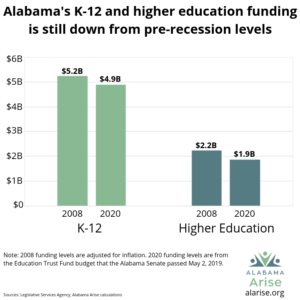
Even so, the 2020 Senate budget would be a move in the right direction. This plan would provide $4.9 billion for K-12 schools and $1.9 billion for higher education. Those amounts would be 6.8% and 10% increases, respectively, over this year’s allocations. That is significant, praiseworthy progress toward returning to 2008 levels.

But it’s also important not to look at 2008 through rose-colored glasses. Though that budget was the ETF’s recent high-water mark, it still didn’t invest adequately in a range of important services. State officials at the time identified hundreds of millions of dollars of unmet needs in reading and math education, distance learning, need-based tuition assistance and other areas. As time has passed and inflation has continued to outpace state funding increases, Alabama’s unmet educational needs have only grown.

How Alabama can fund needed investments

Our state’s education funding isn’t an uncontrollable force of nature like the weather. Policy choices determine the amount of money that Alabama raises – or doesn’t raise – for education. And lawmakers have a range of choices to bring in more money for investments in our schools, colleges and universities.

One option would be to modernize Alabama’s income tax rates, which haven’t changed since 1935. The state’s 5% top rate kicks in starting at just $3,000 of taxable income. That means the marginal rate that multimillionaires pay is no higher than the one that applies to many families who struggle to make ends meet.

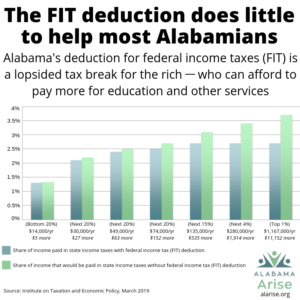
Another approach would be to close tax loopholes that disproportionately benefit large corporations and wealthy households. Alabama’s deduction for federal income taxes (FIT) is one example of that kind of skewed tax break. For those who earn $30,000 a year, the FIT deduction saves them about $27 on average. But for the top 1% of taxpayers, it’s worth an average of more than $11,000 a year.

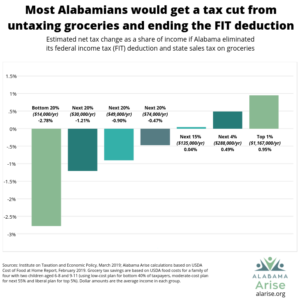
Ending the FIT deduction would raise $719 million a year. That’s money Alabama could use to invest in education, end the state sales tax on groceries and take other steps to make life better for everyday folks.

Budget and tax decisions reflect what we value as a society. Alabama could continue to cling to a tax system that delivers lavish tax breaks to wealthy people while making it harder for struggling families to get ahead. Or our state could choose instead to prioritize stronger investments in education, health care and other services that benefit everyone.
Arise legislative recap: April 19, 2019

“The grocery tax is a tax on a basic necessity of life. It’s a tax on survival. And it’s time for Alabama to bring this tax to an end.”

Arise communications director Chris Sanders discusses a recent bill by Rep. Chris England that would be a major step forward on untaxing groceries. The video also details Arise’s plan for how Alabama could end the state grocery tax and expand Medicaid without cutting a dime from the education budget.

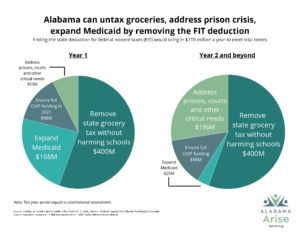
Removing the FIT deduction would allow Alabama to untax groceries, expand Medicaid

Alabama’s federal income tax (FIT) deduction provides a huge tax break for high-income individuals – but at what cost? $719 million to be exact.

The FIT deduction is one big reason Alabama’s tax system is upside down. For those who earn $30,000 a year, the deduction saves them about $27 on average. But for the top 1% of taxpayers, the FIT break is worth an average of more than $11,000. The higher the income, the more the FIT deduction is worth for those who can most afford to pay more to fund education, health care and other vital needs.

Only two other states offer a full FIT deduction like Alabama does. (Three other states offer a partial deduction.) Ending the FIT deduction would bring in an additional $719 million a year, the Institute on Taxation and Economic Policy estimates. That would be enough to allow Alabama to remove the state sales tax on groceries. For most people in our state, the net result would be a tax cut.

This proposal would make it easier for everyday Alabamians to make ends meet, but its benefits wouldn’t end there. Alabama also could use the new revenue to expand Medicaid, ensure full funding for the Children’s Health Insurance Program (CHIP) in 2021 and make critical investments in education and other areas. CHIP supports health coverage for more than 170,000 children through Medicaid and ALL Kids.

Alabama’s constitution dedicates income tax revenue to education, and the FIT deduction is written into the document as well. So this plan would require the Legislature and the public to approve a constitutional amendment. But ending the FIT deduction would be a good way for Alabama to begin prioritizing public investments that benefit everyone over tax breaks that primarily benefit a select few.

What we’re watching during the 2019 special session

This week brought a first in recent memory at the Alabama Legislature: a session within a session. The regular session began Tuesday, but lawmakers have put it on hold until March 19 to make way for a special session on the state gas tax.

At Gov. Kay Ivey’s call, legislators will consider a proposed 10-cent gas tax increase, to be phased in over three years. (The current tax is 18 cents per gallon.) Ivey’s plan aims to strengthen Alabama’s roads, bridges and port, which has become a mantra for state leaders in the run-up to the 2019 session.

Arise hasn’t taken a position on the gas tax proposal, but we have a lot to say about infrastructure. We’re calling on lawmakers to claim a larger vision of infrastructure as Alabama begins its third century of statehood.

Rural hospitals, for example, are key infrastructure but weren’t mentioned in the governor’s State of the State address Tuesday night. Seven rural hospitals have closed since 2011, including one in Georgiana that will close Friday. Another overlooked sector is public transportation, which receives no state funding in Alabama.

There’s a good chance we’ll see Arise issues emerge in the gas tax debate. For example, the Montgomery Advertiser on Wednesday cited a potential push for Medicaid expansion to win gas tax votes from Democratic members. Some lawmakers also have expressed interest in reducing the grocery tax to offset the effects of the gas tax hike. Wouldn’t it be amazing if a plan to rebuild roads and bridges became the first step toward helping struggling Alabama families get health coverage and make ends meet?

Why is this special session happening?

Ivey called a special session to remove a procedural hurdle for the gas tax bill. To pass in the regular session, any bills other than the Education Trust Fund and General Fund budgets must first win a three-fifths majority in both chambers in a vote called the budget isolation resolution (BIR). But in a special session, any bill included in the governor’s “call” can pass with a simple majority.

The Legislature can meet for up to 12 legislative days across 30 calendar days during a special session. But because the regular session started first, each day of the special session also will count against the 105 calendar days available for the regular session. Lawmakers can meet for up to 30 legislative days during the regular session.

How to advance our vision for Alabama’s next century

What kind of future do we want for Alabama? It’s a question worth reflecting on as our state enters its third century this year. Are we all right with limiting power and prosperity to a select few? Or would we rather build a state where everyone has a voice and where people of all races, genders and incomes have a real chance to get ahead?

Alabama Arise believes in justice and opportunity for all, and our policy priori­ties flow from that vision. It’s why we support expanding Medicaid for Alabam­ians who can’t afford coverage. It’s why we want to rebalance an upside-down tax system that taxes struggling families deeper into poverty. And it’s why we urge stronger investments in education, housing, public transportation and other services that improve quality of life and promote economic opportunity.

We expect lots of infrastructure talk at the Legislature this year. The regular session starts Tuesday, but lawmak­ers may move quickly into a special session on the gas tax. Gov. Kay Ivey has asked legislators to increase the state’s 18-cent gas tax by 10 cents over three years. That money would fund road and bridge maintenance and oth­er infrastructure improvements.

Many of Alabama’s deteriorating roads are overdue for repair. But the defi­nition of “public infrastructure” goes far beyond tar and gravel. Education, health care and public transportation also help lay the foundation for shared prosperity. This session could bring chances to strengthen those invest­ments – and to make the tax system that funds them more progressive.

Hope on grocery tax, Medicaid expansion

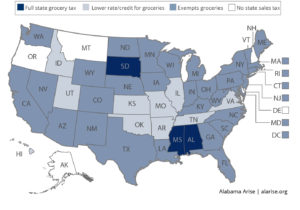
One key breakthrough could be on a longtime Arise priority: ending the state grocery tax. We came heartbreaking­ly close in 2008, when a bill to untax groceries passed the House and fell one vote short in the Senate. But Arise members never gave up the advocacy fight. Now legislators face renewed pressure to end or cut the state’s 4 percent sales tax on groceries. (Some conservative lawmakers are urging a grocery tax reduction to accompany a gas tax increase.) Alabama is one of only three states with no tax break on groceries. It’s a highly regressive tax on a basic necessity, hitting hardest on people who struggle to make ends meet.

Pressure also is building for Alabama to expand Medicaid to cover more than 340,000 adults with low incomes. Medicaid expansion would save hun­dreds of lives annually and create a healthier, more productive workforce. It also would help save rural hospitals, support thousands of jobs and pump hundreds of millions of dollars into the economy.

Our work for a brighter, more inclu­sive future won’t end there. We’ll keep pushing for stronger consumer protec­tions against high-cost payday loans. We’ll make the case for the state to fund public transportation and remove barriers to voter registration. And we’ll continue seeking an end to injustices in Alabama’s civil asset forfeiture and death penalty systems. Visit our website and follow us on Facebook and Twitter for updates on these issues throughout the year.

How the state grocery tax hurts struggling Alabamians

No matter how much or how little money we have, we all have to eat to live. But the share of earnings that people must devote to securing basic survival is not the same for everyone. Food takes a much bigger bite out of the household budget for low-income families than for richer ones. And that means sales taxes on groceries hit harder at lower incomes. Most states either exempt groceries from state sales taxes entirely or have other ways to help offset grocery taxes for low-income people.

Alabama is one of only three states with no tax break on groceries. (Mississippi and South Dakota are the others.) Our state sales tax rate is 4 percent, but local taxes have driven the total rate to 10 percent or even 11 percent in many areas of the state.

Sales taxes are especially regressive in Alabama, because they apply to many kinds of spending that are not optional.
A gallon of milk plus sales tax costs the same for a family at the poverty line as for a millionaire. But that sales tax makes up a much larger share of income – and has a greater effect on the household’s standard of living – for a low-income family than for a richer one. That means Alabama’s state grocery tax disproportionately affects households struggling to make ends meet.

Ways to untax groceries

Other states offer a range of options for how to reduce or end grocery taxes. Full exemption would ensure an immediate tax break on groceries for all state residents. (Food bought with benefits under the Supplemental Nutrition Assistance Program (SNAP) is not taxed, but those benefits cover only a portion of food costs for most participants.) The state also could tax groceries at a reduced rate or create a targeted Earned Income Tax Credit (EITC) to help offset grocery taxes for residents with low incomes.

No matter how Alabama seeks to untax groceries, the state should replace the revenue. Most state sales tax revenues in Alabama support K-12 education. Removing the grocery tax without replacing that money could cost schools more than $300 million a year. Alabama could recoup those funds by limiting or ending its state income tax deduction for federal income tax payments, a tax break that overwhelmingly benefits the richest households. The state also could expand sales taxes on more services and luxury goods.

It’s time for Alabama to join 47 other states in giving a tax break on groceries. It would make our state’s upside-down tax system more progressive. And it would be an important step toward boosting economic security for all Alabamians.

Better policy choices on taxes, transit can improve Alabamians’ health

Deeper and smarter investments in education, housing, infrastructure and other vital services can eliminate barriers to good health for low-income residents and communities of color, according to a new report from the Center on Budget and Policy Priorities (CBPP), a nonpartisan policy research organization based in Washington, D.C.

Alabama can take many important policy steps to remove barriers to better health. These include:

  • Expand Medicaid to cover more than 340,000 adults with low incomes.
  • Provide state funding for public transportation to help seniors, people with disabilities, and people who can’t afford a car get to work or the doctor’s office and meet other basic needs.
  • End the state grocery tax to make it easier for families to make ends meet.
  • Modernize the state’s upside-down tax system to ensure Alabama raises enough money to invest in vital services and doesn’t tax struggling people deeper into poverty.

“Good health and good quality of life go hand in hand,” Alabama Arise executive director Robyn Hyden said. “By investing in Medicaid and public transportation and making our tax system more progressive, Alabama can build a stronger, healthier, more prosperous future for everyone.”

Income and wealth inequality, on top of centuries of structural racism, have taken their toll on health for black Alabamians. Black residents of our state die three years earlier than white residents, on average. Black babies in Alabama are twice as likely as white babies to be born with low birth weight, and they are twice as likely to die before their first birthdays.

Social, economic and environmental factors account for half of an individual’s health, the CBPP report says. That finding underscores the importance of investments in the common good.

“If Alabama really wants to improve the health of its residents, policymakers must prioritize education, housing, the environment, infrastructure, health programs and other public investments in their budgets,” CBPP senior policy analyst Jennifer Sullivan said.

The less you make, the more you pay: Alabama’s taxes remain upside down

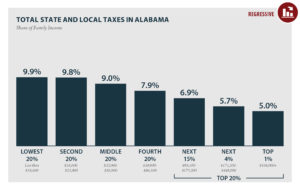
Low-income Alabamians pay twice as much in state and local taxes as a share of their income compared to the state’s wealthiest residents, according to a study released Wednesday, Oct. 17, 2018, by the Institute on Taxation and Economic Policy (ITEP), a nonprofit research organization based in Washington, D.C. The study, Who Pays?, analyzes major state and local taxes in all 50 states, including personal and corporate income taxes, property taxes, sales and other excise taxes.

Alabama has a regressive tax structure – meaning the lower your income, the higher your tax rate – and Alabama’s taxes are more regressive than those in most other states, ITEP finds. The Alabamians who earn the least – less than $18,600 a year – pay 9.9 percent of their income in state and local taxes on average. By contrast, the top 1 percent in Alabama – those who make $448,000 a year or more – pay an average of just 5 percent of their income in state and local taxes.

“For decades, big corporations and wealthy households have benefited the most from economic growth,” Alabama Arise executive director Robyn Hyden said. “But Alabama taxes struggling families deeper into poverty while lavishing tax breaks onto people who can afford to pay more. It’s time to modernize Alabama’s taxes by untaxing groceries and requiring wealthy people and corporations to pay a greater share of the cost of education, health care and other public services that make life better for everyone.”

The biggest driver of Alabama’s upside-down tax system is its heavy reliance on sales taxes to raise revenue for public services. That story is similar in many other states, but sales taxes in Alabama are particularly regressive because it is one of only three states with no tax break on groceries.

Alabama is also one of only three states to allow taxpayers to deduct every dollar of federal income tax payments on their state income taxes – a tax break that disproportionately benefits rich households. Recent increases in court fees and other user fees, which fall hardest on families who struggle to make ends meet, also have added to the regressive nature of Alabama taxes.

Such an upside-down tax structure limits Alabama’s ability to invest in services that support economic growth and help all residents stay healthy and productive, according to ITEP. If states fail to address systemic causes of growing income inequality, they will have more difficulty raising the revenue they need over time. The more income that goes to wealthy people (and the lower a state’s overall tax rate on the wealthy), the more slowly a state’s revenue grows over time, ITEP finds.

“Rising income inequality is unconscionable, and it is certainly a problem that local, state and federal lawmakers should address,” ITEP deputy director Meg Wiehe said. “Regressive state tax systems didn’t cause the growing income divide, but they certainly exacerbate the problem. State lawmakers have control over how their tax systems are structured. They can and should enact more equitable tax policies that raise adequate revenue in a fair, sustainable way.”

Medicaid expansion, end to grocery tax highlight Alabama Arise’s 2019 priorities

Medicaid expansion and legislation to end the state sales tax on groceries are among the top goals on Alabama Arise’s 2019 legislative agenda. More than 200 Arise members picked the organization’s issue priorities at its annual meeting Saturday, Sept. 8, 2018, in Montgomery. The seven issues chosen were:

  • Tax reform, including untaxing groceries and closing corporate income tax loopholes.
  • Adequate funding for vital services like education, health care and child care, including approval of new tax revenue to protect and expand Medicaid.
  • State funding for the newly created Public Transportation Trust Fund.
  • Consumer protections to limit high-interest payday loans and auto title loans in Alabama.
  • Legislation to establish automatic universal voter registration in Alabama.
  • Reforms to Alabama’s criminal justice debt policies, including changes related to cash bail and civil asset forfeiture.
  • Reforms to Alabama’s death penalty system, including a moratorium on executions.

“Public policy barriers block the path to real opportunity and justice for far too many Alabamians,” Alabama Arise executive director Robyn Hyden said. “We’re excited to unveil our 2019 blueprint to build a more just, inclusive state and make it easier for all families to make ends meet.”

Alabama’s failure to expand Medicaid to cover adults with low wages has trapped about 300,000 people in a coverage gap, making too much to qualify for Medicaid but too little to receive subsidies for Marketplace coverage under the Affordable Care Act. Expanding Medicaid would save hundreds of lives, create thousands of jobs and pump hundreds of millions of dollars a year into Alabama’s economy. Expansion also would help keep rural hospitals and clinics open across the state.

The state grocery tax is another harmful policy choice that works against Alabamians’ efforts to get ahead. Alabama is one of only three states with no sales tax break on groceries. (Mississippi and South Dakota are the others.) The grocery tax essentially acts as a tax on survival, adding hundreds of dollars a year to the cost of a basic necessity of life. The tax also is a key driver of Alabama’s upside-down tax system, which on average forces families with low and moderate incomes to pay twice as much of what they make in state and local taxes as the richest Alabamians do.

4 reasons why a new state tax break for private school tuition would hurt public education in Alabama

Update: Arise members stopped this plan in its tracks! After lawmakers received hundreds of emails and phone calls from our supporters opposing this bill, the Senate amended HB 251 on March 14 to remove the language that would have created a tax break for private school tuition. The House agreed to the change on March 16 and sent the revised bill to Gov. Kay Ivey, who signed it into law on March 22.

Alabama allows a state income tax deduction for contributions to college savings accounts known as 529 plans. But HB 251 and SB 189 would let Alabamians use 529s to get a state tax break on tuition at K-12 private schools as well. Proponents say the move would do little harm to Education Trust Fund (ETF) revenues. But there are four reasons to believe the change would cost the ETF millions of dollars a year:

1. This bill would change the nature of 529s in Alabama. 529 plans originally were designed as long-term savings plans for college costs. But if this proposed change is enacted, Alabama’s 529s could end up looking much more like a short-term tax break for private K-12 school tuition instead. By simply putting up to $10,000 for tuition payments in a 529 and then immediately withdrawing it, a couple could save up to 5 percent in state income taxes on that amount.

2. It’s reasonable to expect that participation rates in 529s for K-12 private school tuition would be much higher than those for college. Many parents can’t afford to save for their children’s college, so they hope for scholarships and loans to help cover the cost. But most parents of Alabama’s 83,000 private school students obviously can afford to pay tuition – because they already do.

3. Private schools and tax professionals likely would promote 529s in a whole new way.Colleges generally don’t promote 529s. Instead, they promote themselves as the college to choose. But many K-12 private schools likely would promote 529s for their students, as 529s essentially would offer parents a tax break of up to 5 percent on tuition. Many tax advisers also would urge parents with children in private school to use 529s as a tax-savings device.

4. The ETF’s revenue loss could add up quickly. Alabama allows couples to deduct 529 contributions of up to $10,000 per year. At a 5 percent income tax rate, each maximum contribution would cost the ETF $500 a year. And the potential revenue loss for the ETF could extend even further: Alabama allows grandparents to deduct contributions to their grandchildren’s 529s as well.

Read the Institute on Taxation and Economic Policy’s report on how states can prevent revenue losses in the wake of the 2017 changes to federal law on 529 plans.