Alabama Arise members have worked for more than three decades to build a brighter, more inclusive future for our state. And as the Legislature’s 2020 regular session starts Tuesday, we’re proud to renew that commitment.
Below, Arise executive director Robyn Hyden highlights some key goals for the session, including Medicaid expansion and untaxing groceries.
How you can make a difference
Together, we can turn our shared vision for a better Alabama into a reality. Here are three ways you can help:
(1) Become an Arise individual member. Numbers matter. The more members we have, the louder our voice for change is at the State House. If you’re not yet an Arise member, click here to become one today. If you’re already a member, please ask your friends and neighbors to join us as well!
(3) Spread the word about our issue priorities. The more people learn about our movement, the more support we gain. Read more about our 2020 issue priorities and share this information with your friends:
Together, we can make Alabama a place where everyone’s voice is heard and everyone has the opportunity to reach their full potential. Together, we can build a better Alabama!
Happy anniversary – not! 2020 marks the 10th year of Medicaid expansion under the Affordable Care Act, but not in Alabama. We’re one of just 14 states that have rejected federal funding to extend affordable health coverage to adults with low incomes. And soon, Kansas may cut that number to 13.
The stakes have only gotten higher as time has passed. Over the last 10 years, Alabama has:
Seen 13 hospital closures, including seven rural ones.
Given up more than $1 billion a year in federal Medicaid funding.
Forfeited a similar amount in related economic activity.
Allowed thousands of preventable deaths.
Stranded more than 220,000 Alabamians in the coverage gap, unable to qualify for Medicaid or afford private coverage.
Left tens of thousands more struggling to pay for health insurance they can barely afford.
After a decade of missed opportunity, Alabama needs to invest in our people and our future. Uninsured working parents, caregivers, veterans, people awaiting disability determinations, adult students and other Alabamians with low wages are putting off needed health care. Nearly 90% of our rural hospitals are operating in the red. People and communities across our state are suffering unnecessarily, and it’s time to do something about it.
What will it take to move Alabama forward?
This can and should be the year for Medicaid expansion in Alabama. It’s an overdue move that would bring our federal tax dollars home to stabilize our rural hospitals and clinics. It would provide critical investment in local economies. And it would increase economic security for struggling Alabamians.
Success would not require passing a bill. Gov. Kay Ivey could simply request a Medicaid rule change raising the eligibility limit for adults, including those without children. A legislative panel that reviews rule changes could allow Medicaid to seek permission from Washington. If that gets the OK, Medicaid would simply factor expansion costs into its next annual budget.
Arise members have identified Medicaid expansion as a top priority. It’s the single biggest step Alabama could take to make life better for people with low incomes. And we’re working hard to make it happen.
It’s no secret that Alabama’s prisons are overcrowded, violent and inhumane. Any meaningful solution to this crisis must address two major challenges. First, it must alleviate the abysmal conditions inside Alabama’s prisons. Second, it must help people who are at risk of incarceration or re-incarceration become productive members of their communities. (See the key policy recommendations from Alabamians for Fair Justice below.)
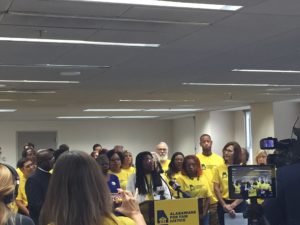
Dena Dickerson, executive director of the Offender Alumni Association, speaks during an Oct. 3 news conference at the State House in Montgomery. Dickerson was one of dozens of supporters of Alabamians for Fair Justice (AFJ) who assembled to show support for reforms to make Alabama’s corrections system more humane and restorative. Alabama Arise is a member of the AFJ coalition.
The missing voices who need to be heard
Alabama Arise has been following the study group’s learning curve on a broad array of criminal justice issues. In four public meetings since July, members have received a flood of statistics from prison administrators, sentencing specialists, law enforcement officers, prosecutors, judges, mental health officials and other experts. They also have toured multiple correctional facilities, becoming eyewitnesses to the shameful conditions they’re charged with improving.
Largely missing from this crash course: the voices of the people Alabama’s criminal justice system affects most. The panel should fill that gap by inviting testimony from inmates’ family members and formerly incarcerated individuals. Many of them have attended the public study group meetings, and the formal recommendations should reflect their lived experiences.
Policy solutions should ease reentry, reduce recidivism
Breaking the cycle of recidivism is a challenge that reaches beyond DOC, or even criminal justice policy. It also requires community partnerships to serve people with untreated mental health and addiction problems. These challenges can undermine successful reentry and often contribute to incarceration in the first place.
By targeting recidivism, the study group is highlighting our state’s overburdened community mental health and substance use services network. Medicaid expansion, at a 90% federal match, would allow Alabama to expand these services tenfold for the same state investment. The study group should urge our state to take this essential step forward.
The study group’s measured, highly visible approach to its complicated challenge is not one it can easily shrug off. The panel has set a high bar for meaningful recommendations, and Arise expects them to meet it. Arise and our partners in the Alabamians for Fair Justice alliance will keep up the pressure for comprehensive, lasting reform.
The path to a better corrections system
Alabama’s corrections system must become more humane and restorative. Alabama Arise and our allies in the Alabamians for Fair Justice coalition have proposed numerous changes to put our state on a path toward dignity, equity and justice for all. Here are a few of these recommendations:
Expand state investments in mental health care and treatment for substance use disorders.
Increase state support for mental health courts, pretrial diversion and reentry programs.
Reduce court costs and give people a reasonable amount of time to begin paying fines and restitution after returning from prison.
End automatic suspensions of driver’s licenses in cases unrelated to traffic safety.
Apply the state’s presumptive sentencing guidelines retroactively.
Our state’s uninsured rate for children (3.5%) remained one of the best in the South in 2018. After years of improvement, though, Alabama’s number of uninsured children ticked up from 32,000 in 2016 to 41,000 in 2018.
That’s a warning sign that our policymakers should heed. Alabama must protect the coverage gains we’ve made through ALL Kids. And we should build on those gains by expanding Medicaid to cover adults with low incomes.
When parents have health insurance, their children are more likely to have coverage as well. Medicaid expansion would boost health security for struggling families across Alabama. That would be good for children, good for communities and good for our entire state.
Veterans Day gives Alabama a chance to shine. Our cities and towns hold parades and ceremonies each Nov. 11 to honor service members and to burnish the state’s reputation as a great place for veterans to retire.
This year, as we celebrate those who have risked and sacrificed to defend our country, let’s remember a group too often overlooked: veterans who have low incomes and no health insurance. And let’s commit to expanding Medicaid to help them meet their health needs.
It’s a common misconception that people who serve in the U.S. military automatically receive lifetime eligibility for health coverage and other benefits. In reality, though, veterans’ health benefits depend on their length of service, military classification, type of discharge and other factors. Treatment for service-connected conditions has no time-of-service requirement, but other health benefits do.
Active-duty service members and their families receive health coverage through the Department of Veterans Affairs (VA). Most also receive “bridge” health insurance coverage in the 180 days before and after their active-duty service.
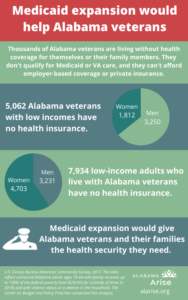
But many veterans — including many National Guard and Reserve members — return home without military health care for the long term. For the 13,000 Alabama veterans and adult family members who have no military health insurance and can’t afford private plans, the consequences can be dire.
A lasting commitment to Alabama’s uninsured veterans
Returning to civilian life can be challenging enough without the added burden of being uninsured. Injuries sustained from combat, environmental hazards or physical stress can cause chronic disability or loss of function. And the mental stress of combat and separation from family also puts some veterans at risk for mental health problems and substance use disorders. The rising rate of veteran suicides is stark evidence of this troubling toll.
There’s something Alabama can do to help. If we expanded Medicaid to adults earning up to 138% of the federal poverty level ($29,435 a year for a family of three), nearly 13,000 uninsured veterans and family members could get the health coverage they need. Medicaid expansion would be a meaningful and lasting commitment to make life better for veterans across Alabama.
U.S. Census findings released Tuesday show that about 32,000 more Alabamians were uninsured in 2018 than in 2017. They also found that the state’s uninsured rate remained higher than the national average. Alabama Arise policy director Jim Carnes issued the following statement in response:
“No one should have to go without the medical care they need simply because they can’t afford it. But that’s the reality for a growing number of Alabamians, because our state has refused to expand Medicaid. Gov. Kay Ivey and state lawmakers need to lift this policy barrier that separates hundreds of thousands of Alabamians from affordable health coverage.
“As Alabama’s inaction on Medicaid expansion continues, our state’s uninsured rate continues to climb. The share of Alabamians without health insurance coverage rose to 10% in 2018, up from 9.4% in 2017. This is a trend in the wrong direction, but we can reverse it with better policy choices.
“All Alabamians would benefit from Medicaid expansion. More than 340,000 adults across the state would gain health security. The new coverage would pump about $1.7 billion a year in direct federal spending into our economy. And over the next four years, economic activity related to expansion would generate $446 million in state tax revenues.
“Even more important than the economic gains would be the human gains. Medicaid expansion would give Alabama better tools to address mental illnesses, substance use disorders, infant mortality and other longstanding challenges. Closing our state’s coverage gap would mean healthier families, more vibrant communities and a more productive workforce.
“It’s time to make an investment in Alabama’s future. The governor should expand Medicaid to protect rural hospitals, create thousands of jobs and make Alabama healthier.”
Ending the state sales tax on groceries is one of the top goals on Alabama Arise’s 2020 legislative agenda. Nearly 200 Arise members picked the organization’s issue priorities at its annual meeting Saturday in Montgomery. The seven issues chosen were:
Tax reform, including untaxing groceries and ending the state’s upside-down deduction for federal income taxes, which overwhelmingly benefits rich households.
Adequate budgets for human services like education, health care and child care, including Medicaid expansion and investment in home visiting services for parents of young children.
Voting rights, including creation of automatic universal voter registration and removal of barriers to voting rights restoration for disenfranchised Alabamians.
Public transportation, including state investment in the Public Transportation Trust Fund.
“We believe in dignity, equity and justice for all Alabamians,” Alabama Arise executive director Robyn Hyden said. “And we believe our 2020 issue priorities would break down policy barriers that keep people in poverty. We must build a more inclusive future where everyone can prosper.”
Alabama is also one of only three states with a full income tax deduction for federal income taxes (FIT). For those who earn $30,000 a year, the deduction saves them about $27 on average. But for the top 1% of taxpayers, the FIT break is worth an average of more than $11,000 a year. Ending the FIT deduction would allow Alabama to remove the sales tax on groceries and still have funding left over to address other critical needs.
The grocery tax and FIT deduction are two key factors behind Alabama’s upside-down tax system. On average, Alabamians with low and moderate incomes must pay twice as much of what they make in state and local taxes as the richest households do.
“By untaxing groceries and ending the FIT deduction, lawmakers can make Alabama’s tax system more equitable for everyone,” Hyden said. “They can strengthen state support for K-12 and higher education. And they can make it easier for struggling families to put food on the table. This is an opportunity to make life better for everyone in our state, and the Legislature should do it.”
As we celebrate Alabama’s workforce on Labor Day, here’s a fact that deserves special attention: More than 100,000 Alabamians are working without health insurance. They work in child care, construction, food services and other vital jobs. They’re the folks who keep things going.
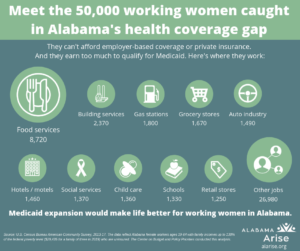
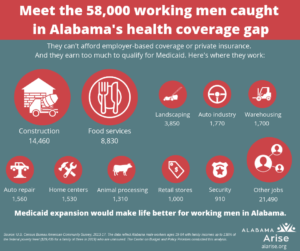
Yet they’re trapped in the health coverage gap. They can’t afford employer-based coverage or private insurance. And they earn too much to qualify for Medicaid. As a result, many struggle with health problems that sap productivity, add household stress and get worse without timely care.
Here are the jobs employing the most working women in Alabama’s coverage gap:
And here are the jobs employing the most working men in Alabama’s coverage gap:
Think about the importance of these lines of work. Then think about what access to regular health care would mean in the lives of these workers and their families.
Across the country, 36 states have closed their coverage gaps, but Alabama is lagging behind. What’s holding us back?
Lack of awareness plays a part. As folks go about their daily activities, they rarely stop to wonder who has health insurance and who doesn’t. It’s not something most people talk about – but it should be. Helping state leaders understand the real people who will benefit most from expanding coverage is an important step toward change.
Our entire state would benefit from Medicaid expansion. Broader access to regular care would improve the health of working families. Healthier families would mean higher productivity at work and better learning at school. And the additional federal funding would strengthen our health system and create jobs.
All these gains would spell a brighter future for Alabama. It’s time to expand Medicaid and make health coverage affordable for the workers we all depend on every day.
They’re the folks who keep things going: the people who serve food at restaurants, bag groceries, patch roofs and repair cars. They’re Alabamians with economically essential jobs that pay low wages.
But tens of thousands of these workers have no health coverage. As a result, they often struggle with health problems that sap productivity, add stress to their households and get worse without timely care.
Imagine what it would mean to the state’s business community to have a workforce with access to regular health care. And more importantly, imagine the peace of mind that coverage would bring for workers and their families.
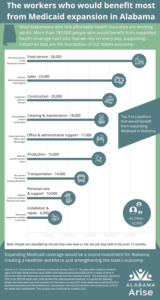
Most uninsured Alabamians aged 19 to 64 who would qualify for expanded Medicaid coverage (those earning below 138% of the federal poverty level) are workers. The graphic below shows the nine industries employing the largest number of these workers. More than 70,000 work in food service, sales or construction.
Overall, more than 180,000 Alabama workers would gain health security from Medicaid expansion. Our businesses would gain a more reliable workforce. And our economy would gain billions of federal dollars, stronger tax revenues and thousands of new health care jobs.
Alabama Medicaid has succeeded in providing health care for children, people with disabilities, and seniors living in nursing homes. Our state can build on these gains and make coverage affordable for the workers we all depend on every day.
Now that the Alabama Legislature’s 2019 regular session has come to a close, we’ve turned our focus to the expected special session on the state’s prison crisis later this year. In our latest video, Arise’s Jim Carnes explains how Medicaid expansion is an essential component of fixing the state’s prison crisis and increasing economic opportunity for all Alabamians.